Guardians of UK’s precious habitat in Suffolk are fearful of government decision on Sizewell nuclear plan.
East Anglian Daily Times 12th Nov 2020, Guardians of one of Britain’s most precious habitats are waiting to see
how Prime Minister Boris Johnson’s 10-point plan for the environment will
affect their Suffolk site.
https://www.eadt.co.uk/news/rspb-minsmere-sizewell-c-damage-1-6926669
Canada’s Greens call on federal government to abandon nuclear and invest in renewables

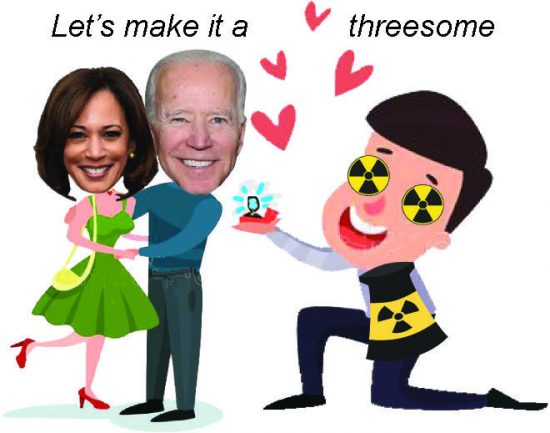
Harris and Biden – what are their views on nuclear power?
The Democrats don’t say much about nuclear power, -but the Party seems to be well in favour of it.
During the campaign,The Washington Post questioned Democrat presidential candidates on their views on nuclear power.
 At that time 10 Democratic contenders said ”No new plants”
Australian government’s plan for nuclear waste dump on farming land bombs in the Senate
 Pauline Hanson’s One Nation torpedoes Kimba nuclear waste dump in SA, Claire Bickers, Federal Politics Reporter, The Advertiser, November 11, 2020
Pauline Hanson will torpedo the Federal Government’s bid to build a radioactive waste dump in regional South Australia.
The One Nation leader, who aims to win a seat in SA at the next federal election, has confirmed she will not back legislation to build the nuclear waste storage site at Napandee farm, near Kimba.
Without One Nation’s two crucial votes – and Labor, the Greens, and independent senator Rex Patrick not backing the Bill – the government does not have enough votes for it to pass parliament without changes.
Senator Hanson told The Advertiser she had serious concerns about the process to select Napandee, the level of community support, the waste site being built on farming land, and the facility storing intermediate radioactive waste above ground.
“I want to make the right decision, not for the interim, I want to make the right decision for future generations,” Senator Hanson said.
“I’m not going to be badgered or pushed into this.
“It’s about looking after the people of SA, but also the whole of Australia.”
Senator Hanson said One Nation wanted to win a seat in SA at the next election, and she hoped South Australians would take into account her strong stance on the waste site.
One Nation adviser Jennifer Game, who ran as the party’s SA Senate candidate at the 2019 election, has been leading research and consultation on the Kimba site.
“I think the government has rushed the decision to have it there,” Senator Hanson said.
Almost 62 per cent of 734 Kimba residents supported the facility in a postal vote in 2019 but Senator Hanson said locals had indicated to the party that closer to half of the town did not support the facility.
The region’s native title holders, the Barngarla people, were also not given a say in the official vote.
Senator Hanson was concerned other locations that may be suitable were not investigated, such as an old mining site in Leonora, in Western Australia, which may be able to store the waste underground.
“We don’t know what the future is going to hold, we don’t know if war is going to touch our shores,” she said.
“Do we really want a facility that is above ground that could be problems further down the track, if anything happens?”…https://www.adelaidenow.com.au/news/south-australia/pauline-hansons-one-nation-torpedoes-kimba-nuclear-waste-dump-in-sa/news-story/9043c46fa44ecd8a1b4e46be111745f3
Suffolk County Council raised over 50 concerns about the Sizewell nuclear project, but UK govt going ahead anyway?
 Anglian Daily Times 10th Nov 2020, The Government has vowed to ensure it considers whether Sizewell C mitigation measures are stringent enough, after a Suffolk MP called for adequate scrutiny of the plans. Sources have indicated that the Government is close to giving the go ahead for the £20 billion scheme on the Suffolk coast, prompting Central Suffolk and North Ipswich MP Dr Dan Poulter to call on the Secretary of State for Business, Alok Sharma, to ensure developers EDF will be “held to account and will properly engage with theconsultation to implement the changes needed to improve road and rail infrastructure”.
Raising the issue in Parliament on Tuesday morning, Dr Poulter said that while the development would bring benefits such as de-carbonisation and thousands of new jobs, it was “not a case of Sizewell C being built at any cost”. He said: “Many people in Suffolk have concerns about the failure of EDF to properly engage with the consultation process. “There are still over 50 outstanding concerns raised by Suffolk County Council.”
https://www.eadt.co.uk/news/government-sizewell-c-scrutiny-pledge-1-6924184
Campaign group project images on side of Government building. Stop Sizewell C, who are against the development of a nuclear plant in Suffolk, have projected two images on the side of a Government building.
.U.S. nuclear security administrator resigns – lost the confidence of Donald Trump?
|
Nuclear security administrator resigns from post, https://www.reviewjournal.com/news/politics-and-government/nuclear-security-administrator-resigns-from-post-2180746/ By Gary Martin Las Vegas Review-Journal
November 10, 2020 – WASHINGTON — Lisa Gordon-Hagerty, who headed the National Nuclear Security Administration that oversees national security sites in Nevada and New Mexico, has resigned from her position, according to the Department of Energy.
Gordon-Hagerty resigned as administrator on Friday, according to a NNSA statement. Dr. William Bookless, the NNSA principal deputy administrator, was appointed acting administrator of the semi-autonomous agency that maintains and measures the effectiveness of the nation’s nuclear weapons stockpile. The NNSA oversees the Nevada National Security Site, located 65 miles north of Las Vegas on 1,370 square miles. The site, which conducts subcritical nuclear weapons testing, employees about 2,400 workers. Los Alamos National Laboratory also is under the agency. The resignation of Gordon-Hagerty followed a clash with Energy Secretary Dan Brouillette, who apparently said President Donald Trump has lost confidence in her, according to Bloomberg. The White House declined to comment. But Rep. Dina Titus, D-Nev., said “the chaos of the Trump administration extends even to the agency responsible for safeguarding our nuclear weapons.” I will keep a close watch on the activities at NNSA during this transitional period while we eagerly await the inauguration of President-elect (Joe) Biden,” Titus said. Sen. Catherine Cortez Masto, D-Nev., said she was disappointed to learn of Gordon-Hagerty’s resignation. “It is imperative that any future Administrator uphold NNSA’s mission to ensure the safety, security, and reliability of our nation’s nuclear stockpile, the continued security and efficiency of the Nevada National Security Site and the agreement the State of Nevada reached with the Department of Energy to begin removing the weapons grade plutonium currently being stored at NNSS next year,” Cortez Masto said. The termination of Gordon-Hagerty also brought a rebuke of Brouillette from Sen. James Inhofe, R-Okla., who questioned the timing of the move. Inhofe also praised the abilities of Gordon-Hagerty, who was confirmed by the Senate for the position in 2018. She was the first woman to serve in the position, according to a NNSA news release announcing her resignation. |
|
China’s ambition to build Bradwell nuclear plant in Essex will likely fail on national security grounds.
 Guardian 11th Nov 2020 , China’s ambition to build a nuclear plant in Essex will likely
 fail on national security grounds. The new national security and investment bill, aiming to give the government sweeping powers to block foreign takeovers and investments, will inevitably be viewed through the lens of China and new nuclear power plants in UK.
“progressive entry” into UK nuclear to China General Nuclear, the state-backed firm that owns a 33% stake in Hinkley Point C in Somerset and has ambitions to build its own plant in Bradwell in Essex. That entry ticket will surely have to be cancelled.
Consortium wants to take over Wylfa nuclear power project
New Civil Engineer 11th Nov 2020, A consortium led by Bechtel is reportedly in talks with the government
about acquiring the Wylfa Newydd site on Anglesey earmarked for nuclear
development. Plans for a £20bn nuclear plant were recently scrapped by
developer Horizon after 18 months of talks with government about a funding
mechanism eventually fizzled out. The site is however still safeguarded and
the project could theoretically be restarted by a third party. Led by the
Bechtel, the consortium includes Southern Company, an electricity utility,
and Westinghouse, a nuclear engineering company.
https://www.newcivilengineer.com/latest/bechtel-led-consortium-in-talks-about-wylfa-site-11-11-2020/
City AM 10th Nov 2020, A group of US companies has reportedly approached the government about
taking over the development of a nuclear power plant at Wylfa in north
Wales. Engineering giant Bechtel will lead the consortium, and will be
joined by utility firm Southern and nuclear engineers Westinghouse.
https://www.cityam.com/us-consortium-mulls-taking-on-abandoned-wylfa-nuclear-project/
Belarus shuts down its newly inaugurated nuclear power plant to replace equipment
|
Belarus shuts down its newly inaugurated nuclear power plant to replace equipment, VILNIUS, Nov 9 (Reuters) – Belarus has shut down production at its new nuclear power plant, inaugurated on Saturday by President Alexander Lukashenko, to replace some of its equipment, its Ministry of Energy said in a statement on Monday.It did not say when the need to replace the equipment was first discovered. Lithuanian grid operator (TSO) Litgrid , located 20km from the plant, said it had detected a production stoppage at the plant at 1000 GMT on Sunday. The power plant was built by Russian state-owned firm Rosatom and financed by Moscow with a $10 billion loan…… https://www.reuters.com/article/belarus-nuclearpower-stoppage/belarus-shuts-down-its-newly-inaugurated-nuclear-power-plant-to-replace-equipment-idINL1N2HV26T
|
|
Nuclear lobby is happy with the Biden-Harris election result
The nuclear lobby is quite happy with the Biden -Harris win. More on this later, as I try to delve deeper into a possibly cosy relationship

Christina Macpherson’s websites & blogs
between Kamala Harris and the global nuclear lobby.
Meanwhile, the Atlantic Council writes confidently of the nuclear industry’s plans for future development under the new American administration.
Biden could take swift action on nuclear weapons policy and arms control agreements
 Biden could take swift action on transgender ban, nuclear weapons, It would take only an executive order to reverse Trump’s 2017 ban on most transgender Americans from joining the military. Politico, By BRYAN BENDER, 11/07/2020 Biden could take swift action on transgender ban, nuclear weapons, It would take only an executive order to reverse Trump’s 2017 ban on most transgender Americans from joining the military. Politico, By BRYAN BENDER, 11/07/2020
President-elect Joe Biden could get some quick wins by using executive orders to roll back several of President Donald Trump’s Pentagon policies. For example, very little will stand in the way of Biden’s pledge to allow transgender service members to serve openly in the military. It would take only an executive order to reverse Trump’s 2017 ban on most transgender Americans from joining the military. Nuclear weaponsThe Pentagon budget, like other federal spending, will be under new pressure regardless of the outcome of the election, forcing some major acquisition programs to be cut or scaled back. The Biden administration is expected to take an especially close look at one particular set of programs: nuclear weapons. One program considered especially vulnerable is the Long-Range Standoff Weapon, or LRSO, an air-launched cruise missile slated to be outfitted on the Air Force’s B-2 and future B-21 bombers and under development by Raytheon. The land-based leg of the nuclear triad, the intercontinental ballistic missiles deployed in underground silos throughout the American West, is also expected to come under new scrutiny. But a $13 billion contract was awarded by the Air Force on Sept. 8 to Northrop Grumman for the so-called Ground Based Strategic Deterrent and may be difficult for the incoming administration to roll back. Still, “I know in the Biden administration the necessity for the ICBM force would be a point of debate, as would the LRSO,” said Robert Work, who served as deputy secretary of defense in both the Obama and Trump administrations. “There’ll be debates over whether those are necessary.” Arms controlAlong with changes to the nuclear weapons portfolio will likely be a fresh emphasis on arms control treaties. The Democratic party platform takes aim at what party leaders consider the Trump administration’s reckless abandonment of several nuclear and other arms treaties with Russia, including the Intermediate-range Nuclear Forces Treaty and the Open Skies Treaty. Trump withdrew from both. “Its brash nuclear threats, ill-considered withdrawals from critical arms control treaties and nuclear agreements, and reckless embrace of a new arms race have made the United States, and the world, less safe,” the platform states. Biden may have an early opportunity to go in a different direction. The New Strategic Arms Reduction Treaty, which limits the number of deployed nuclear weapons on both sides to 1,550, is set to expire Feb. 5, 2021, just a few weeks after inauguration, unless Washington and Moscow agree beforehand to extend it for up to five years. Trump administration officials have signaled that they are open to an extension if they can get Russian agreement to temporarily freeze all nuclear weapons while negotiating a new pact that covers more classes of atomic arms. But Biden pledged last year to extend it regardless for the full five years permitted, calling New START “an anchor of strategic stability” and “a foundation for new arms control agreements.” War powersBiden also pledges to reverse course from the Trump administration when it comes to presidential war powers. That means reengaging with Congress to repeal and rewrite the Authorizations for the Use of Military Force. Congress first adopted that in 2001 to wage the war on terrorism, and then again in 2002 before the U.S.-led in invasion of Iraq. We will only use force when necessary to protect national security and when the objective is clear and achievable — with the informed consent of the American people, and where warranted, the approval of Congress,” the Democratic Party platform states. “That is why we will work with Congress to repeal decades-old authorizations for the use of military force and replace them with a narrow and specific framework that will ensure we can protect Americans from terrorist threats while ending the forever wars.” To be sure, it’s something the Obama administration tried but failed to find bipartisan consensus on, on Capitol Hill. https://www.politico.com/news/2020/11/07/joe-biden-policies-defense-433632 |
|
UK’s ‘small nuclear reactors’ – the real agenda is the funding of nuclear weapons

A secret military agenda. UK defence policy is driving energy policy – with the public kept in the dark, Beyond Nuclear
By David Thorpe, 8 Nov 20,The UK government has for 15 years persistently backed the need for new nuclear power. Given its many problems, most informed observers can’t understand why. The answer lies in its commitment to being a nuclear military force. Here’s how, and why, anyone opposing nuclear power also needs to oppose its military use.
“All of Britain’s household energy needs supplied by offshore wind by 2030,” proclaimed Prime Minister Boris Johnson at a recent online Conservative Party conference. This means 40 per cent of total UK electricity. Johnson did not say how, but it is likely, if it happens, to be by capacity auctions, as it has been in the recent past.
But this may have been a deliberate distraction: there were two further announcements on energy – both about nuclear power.
16 so-called “small nuclear reactors”
Downing Street told the Financial Times, which it faithfully reported, that it was “considering” £2 billion of taxpayers’ money to support “small nuclear reactors” – up to 16 of them “to help UK meet carbon emissions targets”.
It claimed the first SMR is expected to cost £2.2 billion and be online by 2029.
The government could also commission the first mini power station, giving confidence to suppliers and investors. Any final decision will be subject to the Treasury’s multiyear spending review, due later this year.
The consortium that would build it includes Rolls Royce and the National Nuclear Laboratory.
Support for this SMR technology is expected to form part of Boris Johnson’s “10-point plan for a green industrial revolution” and new Energy White Paper, which are scheduled for release later in the autumn.
Johnson will probably also frame it as his response to the English citizens assembly recommendations– a version of the one demanded by Extinction Rebellion in 2019 – which reported its conclusions last month.
While the new energy plan will also include carbon capture and storage, and using hydrogen as vehicle fuel, it’s the small modular reactors that are eye-popping.
They would be manufactured on production lines in central plants and transported to sites for assembly. Each would operate for up to 60 years, “providing 440MW of electricity per year — enough to power a city the size of Leeds”, Downing Street said, and the Financial Times copied.
The SMR design is alleged to be ready by April next year. The business and energy department has already pledged £18 million (US $23.48 million) towards the consortium’s early-stage plans.
They are not small
The first thing to know about these beasts is that they are not small. 440MW? The plant at Wylfa (Anglesey, north Wales) was 460MW (it’s closed now). 440MW is bigger than all the Magnox type reactors except Wylfa and comparable to an Advanced Gas-cooled Reactor.
Where will they be built? In the town of Derby – the home of Rolls Royce – where, as nuclear consultant Dr. David Lowry points out, the government is already using the budget of the Housing and Communities Department to finance the construction of a new advanced manufacturing centre site.
When asked why this site was not being financed by the business and energy department (BEIS), as you’d expect, a spokesperson responded that it was part of “levelling up regeneration money”.
Or perhaps BEIS did not want its budget used in such a way. Throwing money at such a “risky prospect” betrays “an irrationally cavalier attitude” according to Andrew Stirling, Professor of Science & Technology Policy at the University of Sussex Business School, because an “implausibly short time” is being allowed to produce an untested reactor design.
Only if military needs are driving this decision is it explicable, Stirling says. “Even in a worst case scenario, where this massive Rolls Royce production line and supply chain investment is badly delayed (or even a complete failure) with respect to civil reactor production, what will nonetheless have been gained is a tooled-up facility and a national skills infrastructure for producing perhaps two further generations of submarine propulsion reactors, right into the second half of the century.
“And the costs of this will have been borne not by the defence budget, but by consumers and citizens.”
Yes, military needs
UK defence policy is fully committed to military nuclear. The roots of civil nuclear power lay in the Cold War push to develop nuclear weapons. Thus has it ever been since the British public was told nuclear electricity would be “too cheap to meter”.
The legacy of empire and thrust for continued perceived world status are at the core of a post-Brexit mentality. It’s inconceivable to the English political elite that this status could exist without Great Britain being in the nuclear nations club, brandishing the totem of a nuclear deterrent.
“The civil-military link is undisputable and should be openly discussed,” agrees Dr Paul Dorfman at the Energy Institute, University College London.
Andrew Stirling talks of the “tragic relative popularity of (increasingly obsolescent) nuclear weapons”. The coincidental fact that civil nuclear installations are also crumbling provides a serendipitous opportunity for some.
The stores of plutonium in the UK are already overflowing and the military has its own dedicated uranium enrichment logistics.
Any nation’s defence budget in this day and age cannot afford a new generation of nuclear weapons. So it needs to pass the costs onto the energy sector.
“Clearly, the military need to maintain both reactor construction and operation skills and access to fissile materials will remain. I can well see the temptation for Defence Ministers to try to transfer this cost to civilian budgets,” observes Tom Burke, Chairman of think tank E3G.
The threat of nuclear proliferation
The threat of nuclear proliferation is therefore linked to the spread of civil nuclear power worldwide, says Dr David Toke, Reader in Energy Politics, Department of Politics and International Relations at the University of Aberdeen. David Lowry agrees: “India, Pakistan and above all Israel are obvious examples, each of which certainly has built nuclear weapons.”
It’s impossible to separate the tasks of challenging civil nuclear power without also challenging military nuclear interests, Stirling strongly believes. “The massive expense of increasingly ineffective military nuclear systems extend beyond the declared huge budgets. They are also propped up by large hidden subsidies from consumer and taxpayer payments for costly nuclear power.
“Huge hidden military interests will likely continue to keep the civil nuclear monster growing new arms. Until critics reach out and engage the entire thing, we’ll never prevail in either struggle.”
How new plants would be paid for still remains a question. Nuclear power is prohibitively expensive………..https://wordpress.com/read/feeds/72759838/posts/3011373103
Biden – Harris win is a win for the climate
 Joe Biden and Kamala Harris cinch win, Climate Group responds, Mirage News 8 Nov 20, The Climate Group congratulates Joe Biden and Kamala Harris on their historic victory, as announced by the New York Times, Associated Press, and BBC.President-elect Biden’s climate and clean energy plan is the most ambitious we’ve seen from a major US presidential nominee. Under his administration and leadership, we are optimistic about the future of US climate action and the opportunity for renewed global collaboration to address the
  climate crisis.
Amy Davidsen, Executive Director at the Climate Group, said: “Concern for the climate played a major role in the 2020 presidential debates. President-elect Biden’s win shows that Americans expect their president to follow climate science and take the bold and necessary actions to get the US back on track as a leader….. https://www.miragenews.com/joe-biden-and-kamala-harris-cinch-win-climate-group-responds/
Explaining the diseconomics problems for the NuScale small nuclear reactors plan in Utah

First major modular nuclear project having difficulty retaining backers, The complicated finances of the first major test of small modular nuclear reactors. https://arstechnica.com/science/2020/11/first-major-modular-nuclear-project-having-difficulty-retaining-backers/ JOHN TIMMER – 11/8/2020,
Earlier this year, the US took a major step that could potentially change the economics of nuclear power: it approved a design for a small, modular nuclear reactor from a company called NuScale. These small reactors are intended to overcome the economic problems that have ground the construction of large nuclear plants to a near halt. While each only produces a fraction of the power possible with a large plant, the modular design allows for mass production and a design that requires less external safety support.
But safety approval is just an early step in the process of building a plant. And the leading proposal for the first NuScale plant is running into the same problem as traditional designs: finances.
The proposal, called the Carbon Free Power Project, would be a cluster of a dozen NuScale reactors based at Idaho National Lab but run by Utah Associated Municipal Power Systems, or UAMPS. With all 12 operating, the plant would produce 720MW of power. But UAMPS is selling it as a way to offer the flexibility needed to complement variable renewable power. Typically, a nuclear plant is either producing or not, but the modular design allows the Carbon Free Power Project to shut individual reactors off if demand is low.
According to one report, the US Department of Energy had originally planned to purchase the first reactor for research use, then turn it over to UAMPS. But now, the goal is apparently for the DOE to provide an annual supplement of about $130 million a year for a decade. However, that would be dependent upon annual renewals of the funding by Congress during that decade, which is yet another risk. Separately, to reach a target price for the power that is expected to be competitive with natural gas, the project has been made larger and its completion delayed by three years.
That shouldn’t be unexpected, as utilities are notoriously conservative—justifiably so, considering how much their customers rely on electricity. So any new electrical technology is likely to face some struggles as its customers learn to use it effectively and understand how to extract the most value out of it. Typically, the government steps in to provide some support during this awkward phase, as it has done for wind and solar, and plans to do for NuScale.
Boris Johnson at a critical point on the decision about Sizewell C nuclear construction
Times 7th Nov 2020, The prime minister was set to announce a ten-point plan to meet the UK’s climate change promises due the week after next.https://www.thetimes.co.uk/article/petrol-and-diesel-car-sales-face-2030-ban-x8bn3rjgp
1 This Month



Shut down the radiation-damaged Heysham nuclear reactors now
To see nuclear-related stories in greater depth and intensity – go to https://nuclearinformation.wordpress.com

Say No to NASA’s Reckless Nuclear Reactor on the Moon
Say No to NASA’s Reckless Nuclear Reactor on the Moon
-
Archives
- October 2026 (256)
- September 2026 (339)
- August 2026 (330)
- July 2026 (355)
- June 2026 (287)
- May 2026 (306)
- April 2026 (356)
- March 2026 (251)
- February 2026 (267)
- January 2026 (308)
- December 2025 (358)
- November 2025 (359)
-
Categories
- 1
- 1 NUCLEAR ISSUES
- business and costs
- climate change
- culture and arts
- ENERGY
- environment
- health
- history
- indigenous issues
- Legal
- marketing of nuclear
- media
- opposition to nuclear
- PERSONAL STORIES
- politics
- politics international
- Religion and ethics
- safety
- secrets,lies and civil liberties
- spinbuster
- technology
- Uranium
- wastes
- weapons and war
- Women
- 2 WORLD
- ACTION
- AFRICA
- Atrocities
- AUSTRALIA
- Christina's notes
- Christina's themes
- culture and arts
- Events
- Fuk 2022
- Fuk 2023
- Fukushima 2017
- Fukushima 2018
- fukushima 2019
- Fukushima 2020
- Fukushima 2021
- general
- global warming
- Humour (God we need it)
- Nuclear
- RARE EARTHS
- Reference
- resources – print
- Resources -audiovicual
- Weekly Newsletter
- World
- World Nuclear
- YouTube
-
RSS
Entries RSS
Comments RSS

