Is the £20 billion Sizewell C project right for the region and country?
 East Anglia’s nuclear option – is the £20 billion Sizewell C project right for the region and country? ANGLIA
The electricity company EDF plans to build a new nuclear power station on the Suffolk coast, but what will that mean for our region?
How will it impact local people and the environment? And what role does nuclear power play in the East as the country moves towards zero carbon emissions by 2050?
-
- EDF proposes building a twin nuclear reactor at a cost of £20 billion pounds. .
- ………………..It’s expected to operate for 60 years.
- The whole project will take around 10-12 years to build with a construction site covering 620 acres.
-
also a fear that it will come at a cost to existing businesses – especially the tourism industry.
One of those concerned is local brewery Adnams.
Andy Wood from Adnams said: “The tourism industry employs nearly 100,000 people, the value of tourism in Norfolk and Suffolk is about £5.4 billion, and all of these things are going to be impacted by a large construction infrastructure project.”
The impact on wildlife is also raising concerns.
At RSPB Minsmere – an internationally important wildlife reserve – there are serious concerns about how noise and pollution would irrevocably damage rare wildlife habitats and species.
Adam Rowlands, from RSPB Suffolk, said: “We’re concerned about the direct impact, so the noise, the visual disturbance, in essence that could change the patterns of the birds and the other species that use the area.”
…… People have until September 30 to give their views before a decision is made.
Hitachi waiting for tax-payer funding, to start nuclear projects in UK
 Horizon waiting for chance to restart new-build projects, WNN 19 August 2020 Horizon Nuclear Power has been holding “detailed conversations” with the UK government in recent weeks to persuade ministers that the proposed Wylfa Newydd plant on Anglesey could be quickly re-mobilised if they can produce a new financing model for large nuclear power plants in Britain, according to an article in the Financial Times on 16 August. A decision on Wylfa’s planning application is expected by the end of next month.Horizon announced the suspension of its new-build projects in January 2019. The UK subsidiary of Japan’s Hitachi said it had made substantial progress with its plans to provide at least 5.4 GWe of new capacity across two sites – Wylfa Newydd, in north Wales, and Oldbury-on-Severn, in southwest England – by deploying Hitachi-GE UK advanced boiling reactors.
The UK government is currently considering the Regulated Asset Base (RAB) model for new nuclear projects. This would allow investors to start making a pre-determined return as they invested, but any new policy would require primary legislation and the whole process of developing and then enacting a new policy would likely take a minimum of 18 months……. https://www.world-nuclear-news.org/Articles/Horizon-waiting-for-chance-to-restart-new-build-pr
Joe Biden will ,be just as pro nuclear as Trump- maybe worse?

|
Nuclear proponent James Conca, writing in that generally pro nuclear publication, Forbes, is jubilant that the Democrats, under Joe Biden , will be staunchly pro nuclear : “The idea that Republican Administrations are pro-nuclear and Democratic ones are anti-nuclear is one of those enduring myths……. nuclear has no real constituency.
……. That said, there has been some recent political and legislative movement on nuclear energy, including passage of the Nuclear Energy Leadership Act, Lifting of the Prohibition on Nuclear Funding, adoption of the Democrat’s America’s Newest Climate Plan that includes nuclear, and DOE’s funding of the Advancing Nuclear Research initiative and the Advanced Reactor Demonstration Project.
The [ Biden] Plan calls for “leveraging the carbon-pollution free energy provided by existing sources like nuclear and hydropower.” The Plan also calls to “Create a Advanced Research Projects Agency on Climate, a new, cross-agency ARPA-C to target affordable, game-changing technologies to help America achieve our 100% clean energy target, including… advanced nuclear reactors …..
Many are questioning how much Biden’s VP choice, Kamala Harris, supports his plan for nuclear. In one of the few insights into her thoughts on the subject, when she was asked d “Do you support the use of nuclear energy?” she answered, “Yes, temporarily while we increase investment into cleaner renewable alternatives.”
Not the most ringing endorsement, but now that she is hooked up with the ticket, it’s likely she will endorse Biden’s plan. The Democratic Party Platform, still in draft form, also calls for a technology-neutral approach, including new and existing nuclear, so again, she is likely to adopt that as well. ….. So expect an up-turn in nuclear energy in a Biden-Harris Administration. https://www.forbes.com/sites/jamesconca/2020/08/17/what-will-a-biden-harris-administration-do-for-nuclear-energy/#1ca07b4a1dd9 |
|
Will Ohio finally be able to use its wind resources, now that the nuclear corruption is being exposed?

|
Will Ohio Finally Inherit Its Wind? https://readersupportednews.org/opinion2/277-75/64623-rsn-will-ohio-finally-inherit-its-wind?fbclid=IwAR0iFghBoz4O6r7yMYGVnrXjyQ27vmsal94R3U6STsPlmM2TWvPOriQ4IiMBy Bob Fitrakis and Harvey Wasserman, Reader Supported News, 17 August 20
 midst an astonishing billion-dollar nuke reactor corruption scandal, one of the world’s richest wind resources—the key to Ohio’s economic and ecological future—is being trashed by a single sentence. midst an astonishing billion-dollar nuke reactor corruption scandal, one of the world’s richest wind resources—the key to Ohio’s economic and ecological future—is being trashed by a single sentence.
According to the American Wind Energy Association, Ohio is being robbed of $4 billion worth of industrial development, thousands of jobs, and a wealth of cheap, emissions-free energy by a single easily-removable clause in the Ohio Code. How? In 2014, without public hearings, pro-fossil/nuke legislators slipped into law a requirement that wind turbines be sited at least 1300 feet from property lines. The previous requirement was 600 feet. There are no meaningful economic, ecological, or health/safety imperatives served by the additional set-back footage. No other state has such a requirement. But by vastly expanding the land required for turbine siting, that single sentence stopped some $4 billion in pre-approved northern Ohio wind farm development. Ohio’s “North Coast” has steady winds blowing over flat fields whose farmers desperately need the fat checks that come with turbine leasing. The region is uniquely crisscrossed with transmission lines feeding nearby urban areas where the power is consumed. Ironically, Ohio is already a leading manufacturing center for the turbine industry being blocked within its own borders. The proposed arrays are set to create thousands of jobs, save hundreds of family farms, and provide decades of reliable, clean electricity at rates far below current subsidized fossil/nuke prices. The employment created by the wind construction projects would far exceed that at the Davis-Besse and Perry reactors. The nuke bailout is now under intense fire. Because House Bill 6 has been tainted by the $60 million in bribes given House Speaker Larry Householder to grease it through the legislature, even pro-nuke governor Mike DeWine wants it rescinded. It comes in the wake of some $9 billion in “stranded cost” bailout money sucked up by Ohio’s nukes starting in 1999. But if HB6 goes away as promised, DeWine and pro-reactor legislators will likely introduce a new, slightly altered bailout. As a popular concession, they might drop the previously included handout for two coal burners or avoid attacking Ohio’s highly successful energy efficiency programs. But the one move that could completely revamp Ohio’s energy future would be to restore its wind setback to levels commonly accepted nearly everywhere else. Opening Ohio’s energy markets to cheap wind power would undercut subsidized, fossil/nuke-inflated electric rates, restore the jobs deleted by shutting the reactors, and spur long-term economic growth as virtually nothing else would. Will Ohio’s safe energy movement grab the opportunity to make all that happen? Bob Fitrakis & Harvey Wasserman have co-authored numerous books on election protection and the environment appearing at www.freepress.org along with Bob’s Fitrakis Files. Harvey’s People’s Spiral of US History awaits Trump’s departure at www.solartopia.org, where his Solartopia! Our Green-Powered Earth also resides. |
|
Nuclear waste should no longer be exempt from environmental laws
 How Bedrock Environmental Law Can Break the Nuclear Waste
  Logjam, https://news.bloomberglaw.com/environment-and-energy/insight-how-bedrock-environmental-law-can-break-the-nuclear-waste-logjam Geoffrey Fettus, NRDC 17 Aug 20
The 30-year battle over nuclear waste disposal at Yucca Mountain in Nevada shows it’s time for the Atomic Energy Act to be amended. Geoffrey Fettus, senior attorney for the Natural Resources Defense Council, says Congress should pass legislation to end the exemption of nuclear waste from hazardous waste and other bedrock environmental laws.
For more than 30 years, Congress and the federal government have tried again and again to shove our nation’s spent nuclear fuel down a hole at Yucca Mountain, Nev. It’s time to use our foundational environmental laws get out of this seemingly impenetrable maze.
Congress should amend the Atomic Energy Act to remove exemptions from environmental laws for radioactive waste, a proposal that got an important boost from the House Select Committee on Climate Crisis as it called for a task force of federal, state, local, and tribal officials to study the implications of this idea.
Earlier this year, President Trump bowed to reality and abandoned efforts to force the radioactive waste on Nevada, the Yucca mirage finally dissipated. What’s clear now is that trying to force Nevada, or Utah, or New Mexico, or Tennessee (or any other state) to take the entirety of the nation’s most toxic nuclear waste won’t work. Continuing down that path will get us nowhere.
Instead of seeing recalcitrant states as the problem, what if we acknowledge the reality that they must be a key part of the solution for nuclear waste?
Feds Have Exclusive Jurisdiction Over Radioactive Materials
Remarkably, our bedrock environmental laws don’t cover nuclear waste, and they should. The Atomic Energy Act started the nuclear industry and was enacted years before our key pollution safeguards were established.
Crucially, and mostly for nuclear weapons reasons, the AEA gave the federal government exclusive jurisdiction over all radioactive materials, including radioactive waste. When Congress enacted our foundational environmental laws decades later, each of them included an exemption that excludes radioactive waste except in limited or marginal ways.
This is the original sin that must be rectified.
To explain this pernicious problem, when Congress considered nuclear waste in its precedent setting 1982 Nuclear Waste Policy Act, it just accepted the AEA’s sole federal authority and nuclear waste’s exclusion from environmental law as the way of the world. Only a few years later, for the sake of political expedience, Congress cut short a well thought out siting process and required the Yucca Mountain repository as the only option.
This was supposed to expedite the process, but not surprisingly, it exploded in controversy and eventually ground to a halt. And now it has finally, truly, died. But nuclear waste remains just as toxic and problematic as ever.
If nuclear waste were covered by environmental laws, i.e., without the current exemptions that limit EPA and state authority, protective federal health and welfare standards can combine with state-level decision-making over where and how the waste could be stored within its borders.
Amending the AEA and removing the provisions that exempt nuclear waste from our hazardous waste and water laws would give us our best chance to garner public acceptance for a process to find safe, technically sound storage sites for toxic nuclear waste—waste that will remain dangerous to human health for hundreds of thousands of years.
Why This Can Work
Consider how things could change if environmental laws could operate as intended.
Under regular environmental law (that covers pollution of air, water, land), the EPA sets strong standards commensurate to the harm of the pollutant. States can then assume the management of that program (or leave it to the EPA) and set additional, stricter standards if they wish.
A state can have strong regulatory authority to set terms for how much waste it might dispose of, how the facility will operate, and the requisite power to enforce those protective standards and protect its citizens—all things it cannot do now for radioactive waste.
To be clear, the standards for high-level radioactive waste will need to be special and extraordinarily protective, and the rulemaking for those standards will be quite a technical ordeal. But, there’s no getting around doing that hard work; Congress tried to take a short cut and it failed.
Once those standards are in place, the EPA and the states can, as in other instances, share the necessary roles of guarding public safety and welfare from radioactive waste. This institutional framework allows for both scientific defensibility of potential sites and, importantly, public acceptance of the process.
The Task Falls to Congress
For far too long many members of Congress and officials in Washington fought any efforts like this as they sought the quick fix of Yucca. Now there’s evidence of change. The ambitious report from the House Select Committee on Climate Crisis included this key recommendation:
Congress should establish a task force comprised of federal, state, local, and tribal officials to study the implications of amending the Atomic Energy Act to remove exemptions from environmental laws for spent fuel and high-level waste, while maintaining federal minimum standards.
Lawmakers should pick up this recommendation, create just such a task force, and move forward with this plan. Will this work? Yes—but it will take both hard work and time.
One thing I can guarantee is that the current approach isn’t working and won’t ever work. No single state is going to willingly accept the entirety of the nation’s nuclear burden without any way to protect their citizens; we have decades of evidence for this proposition. No amount of stomping of feet in the halls of Congress can change that.
Author Information
Geoffrey Fettus is a senior attorney for the Natural Resources Defense Council’s climate and clean energy program in Washington, D.C. He litigates in federal courts and testifies before Congress on the beginning and end of the nuclear fuel cycle. Prior to joining the NRDC, he was a staff attorney at the New Mexico Environmental Law Center and an assistant attorney general in New Mexico’s Office of the Attorney General.
A real setback to UK”s Bradwell nuclear project: Colchester Council voted unanimously to reject the proposal

Blow to Bradwell B nuclear power plant as council unanimously reject plans, Maldon Standard
A motion, put forward by council leader Mark Cory, said: “This council objects to new nuclear at Bradwell due to the local environmental impacts and prefers a focus on renewable energy alternatives.”
During the debate, councillors called for a “united front” approach amongst councillors and north Essex MPs.
he Bradwell B project is a joint operation between CGN and EDF Energy. Its backers claim it will create 900 permanent jobs as well as 9,000 jobs during construction.
If permitted, it would be built alongside the decommissioned Bradwell power station, however, the proposals have generated a wave of opposition.
Campaign group Blackwater Against New Nuclear Group (BANNG) welcomed Colchester Council’s decision after submitting a statement to the council, outlining four reasons for rejecting the proposal.
Chairman Prof Andy Blowers said: “It is unacceptable for such a dangerous power station and long-term highly radioactive waste stores to be located so close to large populations such as Mersea and Colchester which would be completely unprotected in the event of a major release of radioactivity.
“And the site is unsuitable since its precious environment and heritage is irreplaceable and would be severely compromised if not altogether destroyed.”
Peter Banks, of West Mersea Town Council and co-ordinator of BANNG, added: “With my practical, scientific mind, I endorse this policy. With my passionate, environmentally pumping heart, I endorse this policy.
“BANNG is delighted that all councillors, regardless of political persuasion, have endorsed this policy.”….https://www.maldonandburnhamstandard.co.uk/news/18652490.blow-bradwell-b-nuclear-power-plant-council-unanimously-reject-plans/
U.S. Senator Harris and Rep Ocasio-Cortez introduce Bill on climate harm
 Reuters 6th Aug 2020, U.S. Senator Kamala Harris and Representative Alexandria Ocasio-Cortez on
Thursday introduced legislation to beef up federal accountability for
pollution in minority communities disproportionately harmed by climate
change. Harris, a leading contender to be Democratic presidential candidate
Joe Biden’s running mate, was running in the Democratic primary last year
when she first floated the Climate Equity Act with Ocasio-Cortez.
Hitachi renews interest in Wylfa nuclear project, wants government assurance on funding
Hitachi seeks to resurrect Welsh nuclear plant plans, Ft.com, 16 Aug 20,
Japanese industrial group wants clarity from UK ministers on financing model,
Hitachi is talking to the UK government about resurrecting plans for a nuclear power plant in north Wales, which were frozen at the start of last year.
Maldon District Council now to hold Nuclear Public meeting In Secret

Maldon Nub News 14th Aug 2020, THERE was turmoil at a Maldon District Council meeting yesterday (Thursday,
13 August) when it was abandoned during a row between councillors over whether some of the debate on plans for a nuclear power station at Bradwell should be held in public or private.
The virtual meeting had three major planning applications on the agenda – with a planned exclusion of the
public and press after the first while councillors heard ‘exempt information’ on the two applications listed last on the agenda –including the power station plan. Independent Councillor Chrisy Morris then objected to the exclusion of the public and press.
He argued that the entire discussion of the Bradwell plans should be heard in public and demanded a committee vote on whether to continue in private or not. Chair of the meeting, Deputy Leader and Conservative Councillor Maddie Thompson, did not agree and the discussion became heated before public and press access to the live stream was cut off.
The meeting was not resumed later as planned. A spokesperson for Maldon District Council said: ““Due to the
continued interruptions during the meeting, the Deputy Leader decided that the best option was to call a halt to the meeting.
Discussions are currently taking place as to when this meeting can be reconvened.” In a statement after the meeting, Cllr Morris said: “The councillors quite overwhelmingly refused these applications and we asked the officers to make
our objections watertight if the applicants were to appeal.
It appears that they instead decided to seek legal advice that would make our objections seem unreasonable at appeal in an attempt to change our minds – my personal opinion is this is bullying. “I am against hearing this advice in private as if an attempt to bully us is made – the public have a right to know. I believe that once there was a possibility that this bullying attempt was going to be in the public domain, they used it to shut the meeting. “I am
here to represent the wishes of the people and will not be bullied. The public has a right to know.”
No prefecture in Japan wants to host nuclear waste dump
|
No Japan prefectures positive about hosting nuclear waste site https://www.japantimes.co.jp/news/2020/08/14/national/prefectures-nuclear-waste-site/ –14 Aug 20, KYODO Nearly half of Japan’s 47 prefectures said they are opposed to or held negative views about hosting a deep-underground disposal site for high-level radioactive nuclear waste, a Kyodo News survey showed Friday.
None expressed a favorable stance. The result signals further woes for the central government in its attempt to find a permanent geological disposal repository. Little progress has been made since the process to find local governments willing to host one started in 2002, due mainly to opposition from local residents. The survey was sent to all prefectures in July, with additional interviews conducted depending on their answers. While 16 prefectures such as Fukushima, Kanagawa and Okinawa clearly opposed hosting a site, seven others including Hokkaido, Kyoto and Nagasaki also expressed negative views. Most of the others did not make their positions clear.
“We are already undertaking a certain amount of social responsibility by hosting nuclear plants and providing energy,” Niigata Prefecture said in its response. Fukui Prefecture said, “We are generating power. Nuclear waste disposal should be handled by others.” Meanwhile, Hokkaido mentioned its existing ordinance to prevent nuclear waste from being brought into the northernmost main island, a view that contradicts the relatively positive stance held by one of its municipalities. The town of Suttsu said Thursday it is considering signing up for preliminary research into its land to gauge its suitability for hosting a disposal site. On Friday, however, its mayor, Haruo Kataoka, said the town has been asked by the prefecture not to apply for the preliminary study. Before Suttsu, the town of Toyo in Kochi Prefecture applied for the study in 2007, but it later withdrew the application following strong protests by local residents. In the Kyodo News poll, the western prefecture expressed opposition to hosting a disposal site, saying it faces the need to take measures against a possible major earthquake in the region. For permanent disposal, high-level radioactive waste, produced as a result of the process of extracting uranium and plutonium from spent fuel, must be stored more than 300 meters underground so that it cannot impact human lives or the environment. Elsewhere in the world, Finland and Sweden are the only countries to have decided on final disposal sites. |
|

Alberta joins Ontario, New Brunswick and Saskatchewan -led by the nose by nuclear NuScam?

 Going Nuclear: Alberta Signs Inter-Provincial MOE to Explore Small Modular Reactors, J.D. Supra, 14Aug 20,
On August 7, 2020, the Government of Alberta announced its intention to enter into a Memorandum of Understanding (MOU) to explore emerging nuclear power generation technology in the form of Small Modular Reactors (SMRs).
Alberta is the fourth province to sign the MOU, following in the footsteps of the governments of Ontario, New Brunswick and Saskatchewan, which signed the MOU in December 2019. Ontario and New Brunswick are Canada’s only provinces currently producing nuclear energy, while uranium fuel is mined in Saskatchewan. Athabasca Basin contains the world’s largest high-grade deposits of uranium and straddles the Alberta-Saskatchewan border……
Malaysia rejects nuclear power, focuses on renewable energy
Khairy says nuclear energy ‘not on the table’ for now, focus on renewable energy sources, Malay Mail, Friday, 14 Aug 2020, BY YISWAREE PALANSAMY KUALA LUMPUR, — Science, Technology and Innovation Minister Khairy Jamaluddin said today that the idea to develop nuclear energy as a power source will be a last option for Malaysia, as there are many other sources of energy in the same category which the country has yet to explore.
The Rembau MP said that his ministry is not considering nuclear energy development for now…..
In February, then Prime Minister Tun Dr Mahathir Mohamad spoke of the inherent need for a more non-polluting renewable energy source for the world, but rejected nuclear energy source, over the fear of the radioactive level in its waste.
Dr Mahathir pointed out that Malaysia does not have enough expertise in science that is needed to manage nuclear power.
He also expressed worry about the long-term effects of radioactive waste.
In July 2018, Yeo announced that the then PH government would not be building nuclear power plants or explore nuclear energy.
In winding up her ministerial reply on the 2020 Budget in Parliament last year, Yeo also announced that the Malaysian Nuclear Power Corporation (MNPC) would be shut down. ……. https://www.malaymail.com/news/malaysia/2020/08/14/khairy-says-nuclear-energy-not-on-the-table-for-now-focus-on-renewable-ener/1894036
Survey finds that U.S. Democrats and Republicans both want to phase out land-based nuclear missiles
|
Democrats And Republicans Agree: Phase Out Land-Based Nuclear Missiles https://www.forbes.com/sites/matthewkorda/2020/08/12/democrats-and-republicans-agree-phase-out-land-based-nuclear-missiles/#74441be7109d Matt Korda I write about the nexus between nuclear weapons, climate change, and injustice. Although Democrats and Republicans increasingly seem worlds apart, when it comes to nuclear weapons issues, they’re actually much closer than one might think.
According to a new report by the Program for Public Consultation at the University of Maryland, 61 percent of Americans–including both Democratic and Republican majorities–are in favor of phasing out the United States’ aging fleet of 400 intercontinental ballistic missiles. This finding is highly noteworthy, as it runs in direct contrast to the Pentagon’s current plan of spending approximately $100 billion to buy a brand-new generation of ICBMs by 2030. The survey, entitled “Common Ground of the American People,” is a compilation of studies conducted over the past five years, collecting data from nearly 86,000 individuals throughout the polling process. It specifically aimed to place the respondents into the shoes of a policymaker: respondents were first given an issue briefing, and were then asked to evaluate arguments for and against various policy proposals, before finally offering their recommendations.
The survey’s unique methodology is highly illuminating, because it allows readers of the report to see which arguments were deemed to be most or least convincing, and by whom. For example, Republicans preferred a proposal to phase out ICBMs while maintaining the same number of deployed warheads, while Democrats preferred a proposal to phase out ICBMs and reduce the arsenal to a lower number of deployed warheads.
The main takeaway though, is that–regardless of how the ICBM phase-out takes place–69 percent of Democrats and 53 percent of Republicans agree that the land-based leg of the nuclear triad should be eliminated entirely.
It makes sense that both Democrats and Republicans would agree on phasing out ICBMs: they are outdated, destabilizing, and very expensive. Intercontinental ballistic missiles are largely relics of the Cold War, when the United States and the Soviet Union alike feared a “bolt-from-the-blue” nuclear attack. At the time, it was believed that both countries having large land-based nuclear arsenals would prevent each other from launching a massive surprise attack. However, in today’s multipolar nuclear environment, the likelihood of such an attack is extremely slim, and so ICBMs no longer hold much strategic value. Given the abundance of more flexible options in the U.S. arsenal, U.S. Strategic Command would certainly turn to nuclear bombers or submarines–not ICBMs–in the event of a low-level nuclear crisis.
Additionally, the inherent vulnerability of the ICBM fleet actually creates a psychological pressure to launch them during a nuclear crisis, before an adversary’s missiles can wipe them out. This is why siloed ICBMs–like those deployed across the United States––are commonly referred to as “use ‘em or lose ‘em” weapons. In the event of a false alarm, accident, or miscalculation, this pressure to “use ‘em” could inadvertently trigger a nuclear war. No other nuclear weapon in the US nuclear arsenal comes with this kind of destabilizing psychological pressure. ……
Perhaps knowing this, the Pentagon argues that ICBMs are necessary as a “hedge” in case technological advances suddenly render the United States’ nuclear-armed submarines vulnerable. However, the 2018 Nuclear Posture Review admits that “When on patrol, [ballistic missile submarines (SSBNs)] are, at present, virtually undetectable, and there are no known, near-term credible threats to the survivability of the SSBN force.” This condition is likely to continue as US submarines get even quieter, thus making these fears seem relatively exaggerated. On top of this, replacing the ICBMs with brand-new missiles would be extremely expensive. The latest estimate for the Ground-Based Strategic Deterrent, as the replacement program is called, totals approximately $100 billion. In reality, these costs are expected to rise, given that the contract will be sole-sourced to Northrop Grumman NOC -0.7% after Boeing BA -2.6% pulled out of the competition last year. The chairman of the House Armed Services Committee has called this development “very troubling,” and the sole-source contract has since triggered a Federal Trade Commission investigation into Boeing’s allegations that Northrop Grumman was engaging in anti-competitive behavior.
Given these underlying programmatic and strategic concerns––in addition to the new survey demonstrating that both Democrats and Republicans want to phase out ICBMs entirely––why is this $100 billion project still moving forward? In the midst of an election, a recession, and a devastating pandemic, it seems like common sense to delay the program at the very least.
However, a robust lobbying effort by weapons contractors has impeded public scrutiny of the program. Northrop Grumman––the only bidder for the ICBM replacement contract––spent more than $162 million on lobbying between 2008 and 2018, with the bulk of the contributions going to members of the “ICBM Caucus”––a coalition of Senators from states where ICBMs are deployed. In 2018, this lobbying effort helped kill an amendment to the National Defense Authorization Act which called for a feasibility study on extending the life of the current ICBM force, rather than rebuilding it from scratch. This has had the effect of suppressing public debate over the future of the ICBMs; without studies like this one, the public is being asked to blindly swallow the pro-ICBM claims of those that would materially benefit from their replacement.
The University of Maryland’s report offers a new tool to push back against the “business” of nuclear policy. The survey suggests that corporate lobbying and “special interests” are alienating the public from their elected representatives, and dividing the two political parties even further. Therefore, treating its respondents as neutral “policymakers” clearly demonstrates that without the presence of moneyed interests, Democrats and Republicans agree on much more than one might think. And in this particular instance it is clear: majorities from both parties want to phase out intercontinental ballistic missiles.
|
|
North Dakota shows how to deter any plan for nuclear waste dumping

The Legislature passed a bill into law in 2019 that prohibits the disposal of high-level radioactive waste in North Dakota. For the rules to even take effect, “the first thing you have to do is get that law overturned or thrown out,” State Geologist Ed Murphy said.
Regulators prep for an industry few want: nuclear waste disposal, Bismarck Tribune, 10 Aug, 20
The state Industrial Commission approved the regulations in late July, as well as new rules surrounding deep geothermal wells, another industry that does not exist in North Dakota but could emerge one day.
The waste disposal rules spell out all the steps an entity would have to go through if it were to propose storing “high-level radioactive waste” in North Dakota. Such waste is highly radioactive material generated from the reprocessing of spent nuclear fuel, for example, and it requires permanent isolation……
The Legislature passed a bill into law in 2019 that prohibits the disposal of high-level radioactive waste in North Dakota. For the rules to even take effect, “the first thing you have to do is get that law overturned or thrown out,” State Geologist Ed Murphy said.
“We were writing rules for a program that, by law, is prohibited,” he said.
Roers said the thinking behind establishing the rules in light of the ban is that if the federal government were ever to try to trump North Dakota’s prohibition, it might still agree to follow the regulations established by the state.
If the entity wanted to move forward with a project, it would then need a “facility permit,” which would prompt a similar vetting process. Officials would have up to a year to decide whether to issue a permit.
Before granting a permit, the operator would need to deposit at least $100 million in a new state fund.
“The half-lives of some of the radioactive waste will be dangerous much longer than any sign, monument, or avoidance structures would remain unless they are maintained in perpetuity,” the regulations state. “This money is to be used to ensure the passive institutional controls are maintained for thousands of years.”
If a facility were to make it through the permitting process, it would have to pay an annual operating fee of at least $1 million to the state. It also would need to provide monthly reports on activities at the site and comply with reclamation rules when the site is no longer in use.
Documents regarding the location and depth of the site, as well as details about the half-life of the radioactive waste buried there, must be stored in local, state and national archives — an effort to ensure they last in perpetuity in case the information is needed hundreds or thousands of years down the road, Murphy said.
While counties cannot outright impose a ban on the disposal of the materials, any project would need to adhere to local zoning regulations as to the size, scope and location of the site.
Murphy said the state examined the regulations of 13 other states in developing its rules…………..
The new rules for high-level radioactive waste and deep geothermal energy have one final hurdle to clear before they become official — they will go to a legislative Administrative Rules Committee for approval. ….. https://bismarcktribune.com/news/state-and-regional/regulators-prep-for-an-industry-few-want-nuclear-waste-disposal/article_5afd3c76-9ac1-556f-be69-50f6c9811642.html
UK Chancellor evasive on the involvement of China in building Bradwell nuclear plant
|
LBC 7th Aug 2020 The Chancellor refuses to rule out a U-turn on the involvement of China in
the building of the Bradwell nuclear power station in Essex. Tom Swarbrick asked Chancellor Rishi Sunak if the Government would still allow a Chinese state-owned nuclear power company to build a nuclear power plant at Bradwell, in Essex. Rishi Sunak said the Government’s position hasn’t changed adding “decisions haven’t been made” for the project. The
Chancellor said the Business Secretary would be the lead minister on this issue and he thought a paper would be published on it in Autumn. When LBC host Tom asked if the Chancellor thought Chinese president Xi Jinping was a “reliable partner,” Mr Sunak said he thought the UK should have an “eyes wide open relationship with China.” He added the country was “obviously
important to us in many ways” for supply of goods and as a trading partner. But, the senior Minister said, “we should be eyes wide open where we have different values and interests and we should be robust in standing up for those things.” The Chancellor cited Huawei as an example of the Government taking “quite strong, and significant action over time.”https://www.lbc.co.uk/radio/presenters/tom-swarbrick/chancellor-says-uk-needs-eyes-wide-open-relationship-with-china/ |
|
|
1 This Month
26 April – Chernobyl: Inside the Meltdown airs on National Geographic on Sunday 26th April from 4pm

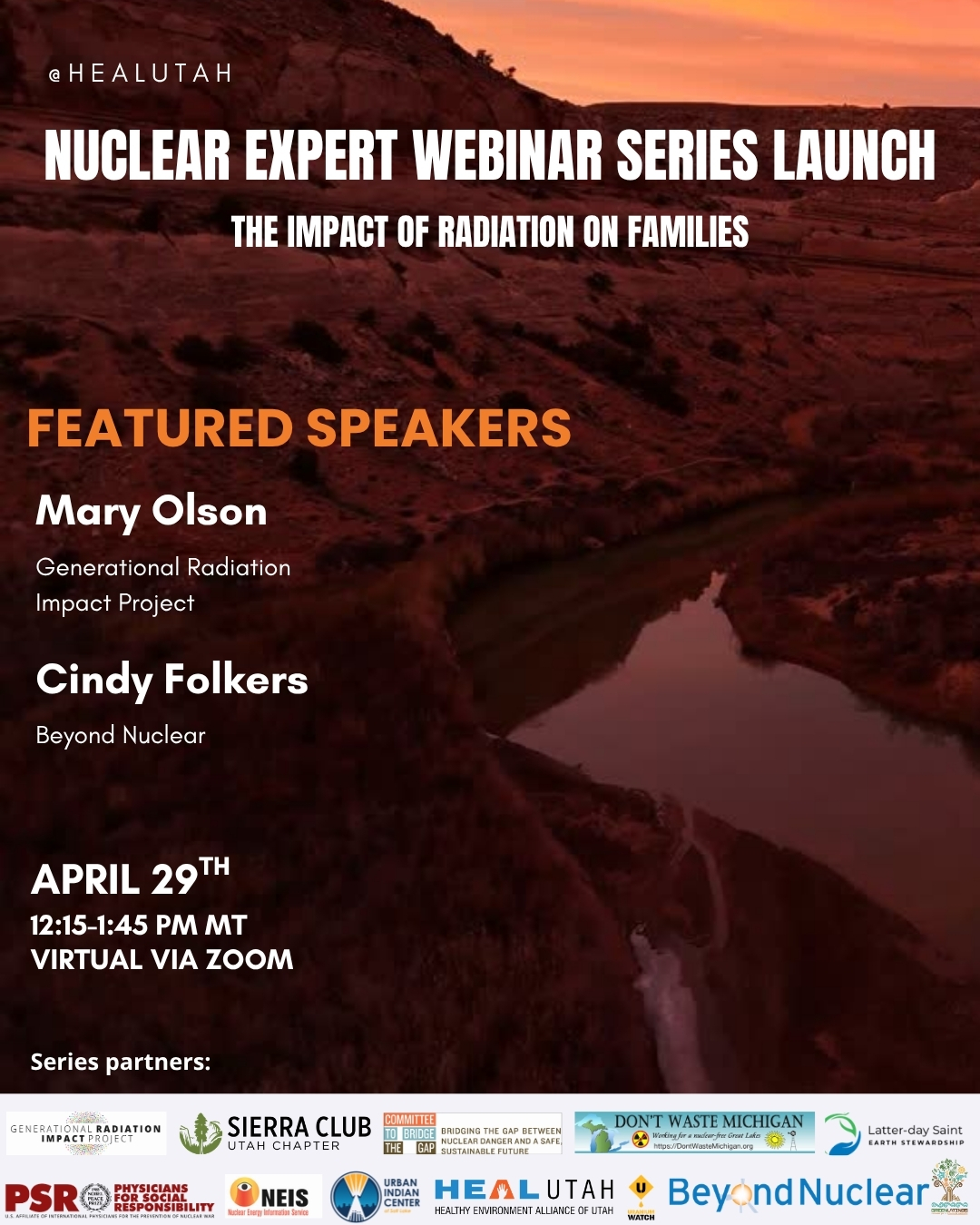
29 April – Nuclear Expert Webinar #1 – Radiation Impacts on Families with Mary Olson and Cindy Folkers
- 12:15 PM MT – 1:45 PM MT
- Location: Virtual – REGISTER TODAY

4 May -West Suburban Peace Coalition to discuss Iran war at May Educational Forum
Monday, May 4, 7:00 – 8:00 PM Central Standard Time
Title: : How Trump’s Narrative Tries to Shape the Reality of the War on Iran.
Contact Walt Zlotow, zlotow@hotmail.com 630 442 3045 for further information
14 May – online event From Bombs to Data Centres: the Face of Nuclear Colonialism

Pine Ridge Uranium is the real threat, not Tehran- Tell Burgum: Stop the Extraction.
Chernobyl: The Lost Tapes – A good documentary on Chernobyl on SBS available On Demand for the next 3 weeks– https://www.sbs.com.au/ondemand/tv-program/chernobyl-the-lost-tapes/2352741955560
To see nuclear-related stories in greater depth and intensity – go to https://nuclearinformation.wordpress.com
-
Archives
- May 2026 (12)
- April 2026 (356)
- March 2026 (251)
- February 2026 (268)
- January 2026 (308)
- December 2025 (358)
- November 2025 (359)
- October 2025 (376)
- September 2025 (257)
- August 2025 (319)
- July 2025 (230)
- June 2025 (348)
-
Categories
- 1
- 1 NUCLEAR ISSUES
- business and costs
- climate change
- culture and arts
- ENERGY
- environment
- health
- history
- indigenous issues
- Legal
- marketing of nuclear
- media
- opposition to nuclear
- PERSONAL STORIES
- politics
- politics international
- Religion and ethics
- safety
- secrets,lies and civil liberties
- spinbuster
- technology
- Uranium
- wastes
- weapons and war
- Women
- 2 WORLD
- ACTION
- AFRICA
- Atrocities
- AUSTRALIA
- Christina's notes
- Christina's themes
- culture and arts
- Events
- Fuk 2022
- Fuk 2023
- Fukushima 2017
- Fukushima 2018
- fukushima 2019
- Fukushima 2020
- Fukushima 2021
- general
- global warming
- Humour (God we need it)
- Nuclear
- RARE EARTHS
- Reference
- resources – print
- Resources -audiovicual
- Weekly Newsletter
- World
- World Nuclear
- YouTube
-
RSS
Entries RSS
Comments RSS
 nuclear-news