Move in Ohio Senate to repeal nuclear bailout law
|
By ANDY CHOW • 24 Feb 21, A measure to repeal part of Ohio’s controversial nuclear power plant bailout, and stop the increase to monthly electric bills, is gaining momentum in the Ohio Senate.
The Republican-backed bill, SB44, would repeal the nuclear subsidies created through 2019’s HB6. It’s now on its way to a possible full Senate vote after being unanimously passed by the energy and public utilities committee. Investigators say a utility, believed to be FirstEnergy, funneled millions of dollars to a dark money group controlled by Rep. Larry Householder (R-Glenford). They say Householder used those funds to become House Speaker, and in return pass FirstEnergy’s legislative agenda in the form of HB6, which in part subsidized two nuclear plants formerly owned by the company. Most Democrats and several Republicans want a full repeal of HB6, which would also have the effect of reviving green energy standards that the 2019 law eliminated. However, doing away with just the nuclear subsidies seems to be the option with the most traction. The extra charge on electric bills to generate $150 million a year for Ohio’s two nuclear power plants has been stalled through a court injunction, which will remain in place while the federal investigation continues. Three defendants in the bribery case, including the dark money group Generation Now, have plead guilty to racketeering charges. |
|

Luxembourg’s continued fight against nuclear power in Europe
How do you remember the nuclear incident at Fukushima?
Some countries still see it as a cheap, emissions-free source of power. What will it take to change their minds?
It’s a constant battle. Some countries, also in Europe, see nuclear energy as a solution to the climate crisis. That is a fallacy. First, it’s not cheap. Hinkley Point in the UK, for example, will only work out economically at a fixed tariff that is higher than the price for renewable energy. The waste problem hasn’t been solved.
The European Commission is technology neutral, leaving it up to member countries to decide whether to use nuclear power. What challenges does this pose?
Luxembourg still uses nuclear energy in its network. By when would you like to see this phased out?
You came out strongly against Belgium exploring nuclear waste storage sites near Luxembourg, with the Belgian environment minister citing a “serious diplomatic incident”. Would you react in the same way again today?
France is in the process of exploring lengthening the lifespan of some of its reactors. What do you hope will happen with the Cattenom site in the next ten years?
Obviously, I want Cattenom to close and for there to be no extension. If I look towards the future, the best solution would be a switch to renewables, to new jobs and in favour of a circular economy. It’s about enabling a transition for the people working in this sector, too. Cattenom is a big power station.
Ohio House and Senate wrestle with Bills about the nuclear bailout law
 Ohio Lawmakers Consider More Bills To Repeal Or Revise Nuclear Bailout Law WOSU Ohio Lawmakers Consider More Bills To Repeal Or Revise Nuclear Bailout Law WOSU
By ANDY CHOW, 22 Feb 21, Several bills have been introduced in the Ohio House and Senate to tackle the controversial nuclear power plant bailout law. The measures range from a partial repeal to a complete revoking of HB6, which is currently at the center of a $61 million federal bribery investigation.
Several bills have been introduced in the Ohio House and Senate to tackle the controversial nuclear power plant bailout law. The measures range from a partial repeal to a complete revoking of HB6, which is currently at the center of a $61 million federal bribery investigation………
While the investigation into HB6 is ongoing, some legislators say Stein’s bill doesn’t go far enough. State Rep. David Leland (D-Columbus) is proposing HB10, which eliminates the nuclear and solar subsidies, along with a measure that guaranteed a certain amount of subsidies for two coal plants.
There are other pieces of legislation, HB18 and HB57, that would repeal all of HB6, which would mean the revival of Ohio’s green energy standards. Republican leadership in the House and Senate have signaled a willingness to move on bills that address the nuclear and solar subsidies. https://radio.wosu.org/post/ohio-lawmakers-consider-more-bills-repeal-or-revise-nuclear-bailout-law#stream/0 |
|
Iran lawmakers call for president’s prosecution over IAEA deal
 Iran lawmakers call for president’s prosecution over IAEA deal
Motion passed on Monday signals the biggest rift in years between Iran’s moderate government and its hardline parliament. Aljazeera, By Maziar Motamedi, 22 Feb 2021
In a public vote on Monday, an overwhelming majority of lawmakers voted to send a report by the National Security and Foreign Policy Commission on the agreement reached with the International Atomic Energy Agency (IAEA) to the judiciary for review.
The report asserts that the deal struck on Sunday between the IAEA and the Atomic Energy Organisation of Iran (AEOI) constitutes a “clear violation” of a law passed by Parliament in December.
As per the law, the government of President Hassan Rouhani must stop the voluntary implementation of the Additional Protocol, which gives broad authorities to IAEA inspectors, from Tuesday.
In a statement, the AEOI said the implementation of the Additional Protocol will be completely halted from Tuesday, in accordance with the law, and no access will be given to the UN’s nuclear watchdog beyond those laid out in a principal safeguards agreement aimed at ensuring nuclear non-proliferation.
However, detractors have said the agreement reached after IAEA Director General Rafael Grossi visited Tehran violates the December law, in that Iran would unilaterally record the monitoring data the nuclear watchdog’s inspectors would normally be able to access under the Additional Protocol, but would not share the data.
The arrangement will remain in place for three months, at the end of which the data will be destroyed if all United States sanctions, imposed on Iran since 2018 after former President Donald Trump unilaterally withdrew from Iran’s 2015 nuclear deal with world powers, are not lifted.
Iran’s foreign ministry spokesman Saeed Khatibzadeh said the talks “resulted in a very significant diplomatic achievement and a very significant technical achievement … within the framework of the parliament’s binding law”.
Iran’s Supreme National Security Council also said in a statement on Monday the IAEA agreement falls in compliance with the parliament’s law.
‘President on the way to court!’
Instead of their scheduled work on the annual budget bill that had been delayed for months amid a spat with the government, they held a meeting behind closed doors to review the IAEA deal and drafted a motion to involve the judiciary.
Several lawmakers delivered fiery speeches in condemnation of the deal in a public session held afterwards.
But angry parliamentarians held a different view………………
Members of the assembly will meet Supreme Leader Ayatollah Ali Khamenei later on Monday, https://www.aljazeera.com/news/2021/2/22/iran-parliament-call-for-president-be-punished-for-iaea-agreement
Lobbyists from West Cumbria Mining appointed to Committee on Radioactive Waste Management (CoRWM)
 Radiation Free Lakeland 19th Feb 2021, Letter
 sent today to MP Tim Farron from Radiation Free Lakeland. We haven been looking at West Cumbria Mining’s lobbying over the last several years. While WCM class themselves as a “small company” in order it seems to avoid full filing of company finances, they have been afforded incredible access to key government departments. Access that other Cumbrian small businesses could only dream of.
wonder how CoRWM expect Mark Kirkbride’s business interests of a coal mine in the same area will make the already complex and faulted geology in the Eastern Irish Sea area safer?)
Lies in Texas, as Republicans blame renewable energy for cold weather traumas
|
Pressenza 19th Feb 2021, Forget Ted Cruz, What’s Really Missing in Texas Is the Green New Deal. While Republican Sen. Ted Cruz of Texas is under fire for fleeing to Cancún for a vacation as his constituents endure devastating power outages as well as food and water shortages due to rare winter weather, climate campaigners are pointing to the compounding crises in the Lone Star state as proof of the need for a Green New Deal.
As dozens of people have died and millions have spent days without electricity, some right-wing news outlets and lawmakers—including GOP Texas Gov. Greg Abbott, who’s facing calls to step down—have lied about the state’s power problems, blaming renewable energy, even though the outages are largely tied to issues with gas, coal, and nuclear facilities. Abbott even claimed Tuesday on Fox News that “this shows how the Green New Deal would be a deadly
deal for the United States of America.” |
On nuclear power as climate solution, Bill Gates shows alarming ignorance
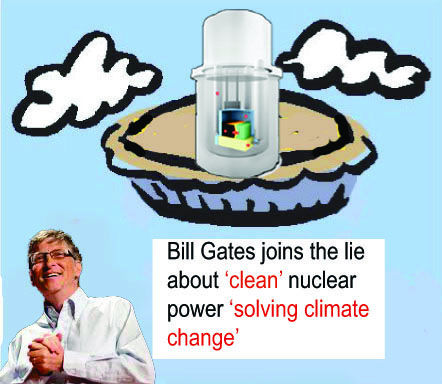
David Lowry’s Blog 16th Feb 2021 The multi-billionaire Bill Gates, founder of Microsoft, in his new book, “How to Avoid a Climate Disaster”, is sceptical of the Green New Deal.(Allen Lane/Penguin) published on 16 February. Gates secured much pre-publication publicity for his new tome, including an interview in the Guardian Weekend Magazine, which wrote “Of the Green New Deal, the proposal backed by Alexandria Ocasio-Cortez [the Congresswoman who has promoted the merits of the GND in the US] that raises the goal of carbon neutrality in a decade, he is flatly dismissive, with Gates telling the interviewer. “Well, it’s a fairytale. It’s like saying vaccines don’t work – that’s a form of science denialism. Why peddle fantasies to people?”
Gates also opined: “I’m not a survivalist.” Instead his version of survivalism is to fund innovation, the reporter noted. “I’m putting money into carbon capture and nuclear fission” Gates told her. (Bill Gates: ‘Carbon neutrality in a decade is a fairytale. Why peddle fantasies?’, Guardian, 13 February 2021; https://www.theguardian.com/technology/2021/feb/15/bill-gates-carbon-neutrality-in-a-decade-is-a-fairytale-why-peddle-fantasies)
Indeed, his book is laced with positive, if inaccurate, mentions of nuclear power. For example, he asserts on page 84, in a section on “Making Carbon-Free Electricity”, uns der a sub-section titled ‘ Nuclear Fission’ he writes: “”Here’s the one sentence case for nuclear power: It’s the only carbon-free energy sources that can reliably deliver power day and night, through every season.”
Relief that Bradwell nuclear project has stalled
altogether.
announced engagement and active project work on Bradwell B will be paused
for at least a year and says it indicates a “significant reversal” for
the project.
Generation Company – a collaboration between China General Nuclear (CGN)
and EDF – have stalled. The Bradwell group said, in order to tightly
control expenditure, it needs to pause aspects of the project it is not yet
ready to progress. But BANNG chairman Prof Andy Blowers said: “Despite
urging the developer to suspend public engagement during the pandemic,
BANNG was told the national need was urgent and it was in the public
interest that the proposed development is not indefinitely or even
substantially delayed.
https://www.gazette-news.co.uk/news/19094101.baang-reacts-positively-bradwell-b-talks-paused/
USA to join in multilateral talks with EU and Iran, on return to nuclear deal
Guardian 19th Feb 2021, The US has agreed to take part in multilateral talks with Iran hosted by the EU, with the aim of negotiating a return by both countries to the 2015
nuclear deal that is close to falling apart in the wake of the Trump
administration.
‘Medical Scientific’ committee, stacked with nuclear executives, promotes nuclear power in space
 “The nuclear industry views space as a new—and wide-open—market for their toxic product that has run its dirty course on Mother Earth.”
“Now it appears that the nuclear industry has also infiltrated the National Academies of Sciences, Engineering, and Medicine that has been studying missions to Mars. ”
It’s going to take enormous grassroots action—and efforts by those in public office who understand the error of the space direction being taken—to stop it.
Nuclear Rockets to Mars?, BY KARL GROSSMAN– CounterPunch, 16 Feb 21,
A report advocating rocket propulsion by nuclear power for U.S. missions to Mars, written by a committee packed with individuals deeply involved in nuclear power, was issued last week by the National Academies of Sciences, Engineering and Medicine.
The 104-page report also lays out “synergies” in space nuclear activities between the National Aeronautics and Space Administration and the U.S. military, something not advanced explicitly since the founding of NASA as a civilian agency supposedly in 1958.
The report states: “Space nuclear propulsion and power systems have the potential to provide the United States with military advantages…NASA could benefit programmatically by working with a DoD [Department of Defense] program having national security objectives.”’
The report was produced “by contract” with NASA, it states.
The National Academy of Sciences, Engineering and Medicine (NAS) describes itself as having been “created to advise the nation” with “independent, objective advice to inform policy.”
The 11 members of the committee that put together the report for the National Academy includes: Jonathan W. Cirtain, president of Advanced Technologies, “a subsidiary of BWX Technologies which is the sole manufacturer of nuclear reactors for the U.S. Navy,” the report states; Roger M. Myers, owner of R. Myers Consulting and who previously at Aerojet Rocketdyne “oversaw programs and strategic planning for next-generation in-space missions [that] included nuclear thermal propulsion and nuclear electric power systems; Shannon M. Bragg-Sitton, the “lead for integrated energy systems in the Nuclear Science and Technology Directorate at the Idaho National Laboratory:” Tabitha Dodson, who at the U.S. government’s Defense Advanced Research Project Agency is chief engineer of a program “that is developing a nuclear thermal propulsion system;” Joseph A. Sholtis, Jr., “owner and principal of Sholtis Engineering & Safety Consulting, providing expert nuclear, aerospace, and systems engineering services to government, national laboratories, industry, and academia since 1993.” And so on.
The NAS report is titled: “Space Nuclear Propulsion for Human Mars Exploration.” It is not classified and is available here.
Bruce Gagnon, coordinator of the Global Network Against Weapons and Nuclear Power in Space, from its offices in Maine in the U.S., declared: “The nuclear industry views space as a new—and wide-open—market for their toxic product that has run its dirty course on Mother Earth.”
“During our campaigns in 1989, 1990, and 1997 to stop NASA’s Galileo, Ulysses and Cassini plutonium-fueled space probe launches, we learned that the nuclear industry positioned its agents inside NASA committees that made the decisions on what kinds of power sources would be placed on those deep space missions,” said Gagnon. “Now it appears that the nuclear industry has also infiltrated the National Academies of Sciences, Engineering, and Medicine that has been studying missions to Mars. The recommendation, not any surprise, is that nuclear reactors are the best way to power a Mars mission.”
“It’s not the best for us Earthlings because the Department of Energy has a bad track record of human and environmental contamination as they fabricate nuclear devices. An accident at launch could have catastrophic consequences.”
Stated Gagnon: “We fought the DoE and NASA on those previous nuclear launches and are entering the battle again. The nuclear industry has its sights set on nuclear-powered mining colonies on an assortment of planetary bodies—all necessitating legions of nuclear devices being produced at DoE and then launched on rockets that blow up from time to time.”
“We urge the public to help us pressure NASA and DoE to say no to nukes in space. We’ve got to protect life here on this planet. We are in the middle of a pandemic and people have lost jobs, homes, health care and even food on their table.”
“Trips to Mars can wait,” said Gagnon.
There have been accidents in the history of the U.S.—and also the former Soviet Union and now Russia—using nuclear power in space……
(Article goes on to explain how solar power can be, and is being used for space travel and research)
The NAS committee, however, was mainly interested in a choice between a “nuclear thermal propulsion” (NTP) or “nuclear electric propulsion” (NEP) for rocket propulsion…….
“Advanced nuclear propulsion systems (along or in combination with chemical propulsion systems) have the potential to substantially reduce trip time” to Mars “compared to fully non-nuclear approaches,” says the report.
An issue: radioactivity from either of the systems affecting human beings on the rockets with nuclear reactors propelling them. Back after World War II with the Cold War beginning, the U.S. began working on bombers propelled by onboard nuclear reactors—even built one. The idea was that such bombers could stay aloft for days ready to drop nuclear weapons on the Soviet Union. No crews would need to be scrambled and bombers then sent aloft.
But, as The Atlantic magazine noted in a 2019 article titled, “Why There Are No Nuclear Airplanes”:
“The problem of shielding pilots from the reactor’s radiation proved even more difficult. What good would a plane be that killed its own pilots? To protect the crew from radioactivity, the reactor needed thick and heavy layers of shielding. But to take off, the plane needed to be as light as possible. Adequate shielding seemed incompatible with flight. Still, engineers theorized that the weight saved from needing no fuel might be enough to offset the reactor and its shielding. The United States spent 16 years tinkering with the idea, to no avail”
The Eisenhower administration concluded that the program was unnecessary, dangerous, and too expensive. On March 28, 1961, the newly inaugurated President John F. Kennedy canceled the program. Proposals for nuclear-powered airplanes have popped up since then, but the fear of radiation and the lack of funding have kept all such ideas down.”……
The “synergies” in space nuclear activities between NASA and the U.S. military advanced in the NAS report mark a change in public acknowledgement. The agency was supposed to have a distinctly civilian orientation, encouraging peaceful applications in space science.
However, throughout the decades there have been numerous reports on its close relationship with the U.S. military—notably during the period of NASA Space Shuttle flights. As a 2018 piece in Smithsonian Magazine noted, “During the heyday of the space shuttle, NASA would routinely ferry classified payloads into orbit for the Department of Deense among other projects the agencies have collaborated on.”
With the formation of a U.S. Space Force by the Trump administration in 2019, the NASA-Pentagon link would appear to be coming out of the shadows, as indicated by the NAS report. The Biden administration is not intending to eliminate the Space Force, despite the landmark Outer Space Treaty of 1967 put together by the U.S., the then Soviet Union and the U.K, setting aside space for peaceful purposes. It is giving the new sixth branch of U.S. armed forces “full support,” according to his spokesperson Jen Psaki.
The NAS report says, “Areas of common interest include (1) fundamental questions about the development and testing of materials (such as reactor fuels and moderators) that can survive NTP conditions and (2) advancing modeling and simulation capabilities that are relevant to NTP.” And, “Additionally, a NASA NTP system could potentially use a scaled-up version of a DoD reactor, depending on the design.”
It declares: “Threats to U.S. space assets are increasing. They include anti-satellite weapons and counter-space activities. Crossing vast distances of space rapidly with a reasonably sized vehicle in response to these threats requires a propulsion system with high Isp [Specific Impulse] and thrust. This could be especially important in a high-tempo military conflict.”
Moreover, on December 19, just before he was to leave office, Trump signed Space Policy Directive-6, titled “National Strategy for Space Nuclear Propulsion.” Its provisions include: “DoD [Department of Defense] and NASA, in cooperation with DOE [Department of Energy}, and with other agencies and private-sector partners, as appropriate, should evaluate technology options and associated key technical challenges for an NTP [Nuclear Thermal Propulsion] system, including reactor designs, power conversion, and thermal management. DoD and NASA should work with their partners to evaluate and use opportunities for commonality with other SNPP [Space Nuclear Power and Propulsion] needs, terrestrial power needs, and reactor demonstration projects planned by agencies and the private sector.”
It continues: “DoD, in coordination with DOE and other agencies, and with private sector partners, as appropriate, should develop reactor and propulsion system technologies that will resolve the key technical challenges in areas such as reactor design and production, propulsion system and spacecraft design, and SNPP system integration.”
It’s going to take enormous grassroots action—and efforts by those in public office who understand the error of the space direction being taken—to stop it.
Karl Grossman, professor of journalism at State University of New York/College at Old Westbury, and is the author of the book, The Wrong Stuff: The Space’s Program’s Nuclear Threat to Our Planet, and the Beyond Nuclear handbook, The U.S. Space Force and the dangers of nuclear power and nuclear war in space. Grossman is an associate of the media watch group Fairness and Accuracy in Reporting (FAIR). He is a contributor to Hopeless: Barack Obama and the Politics of Illusion. more https://www.counterpunch.org/2021/02/16/nuclear-rockets-to-mars/

Over 100,000 people sign petition to stop Sizewell nuclear, save nature reserve

East Anglian Daily Times 16th Feb 2021, More than 100,000 people have signed a petition calling for the proposed Sizewell C nuclear power station to be rejected because of its fearednimpact on an internationally-important nature reserve.
The RSPB Love Minsmere campaign launched a national advertising campaign last week
targeting EDF Energy offices with more experts and wildlife campaigners backing its fight against the £20billion project.
https://www.eadt.co.uk/news/rspb-love-minsmere-petition-hits-100000-target-7327452
Keep the public vote on nuclear energy in Montana
 Keep the public vote on nuclear energy in Montana https://missoulacurrent.com/opinion/2021/02/opinion-nuclear-energy/
BY BACKERS OF I-80 17 bFeb 21, Forty years ago, the Montana voters passed Initiative 80 (I-80). This initiative empowered Montanans with the right to vote for or against allowing any nuclear generating facility in Montana.
Last week, Rep. Derek Skees introduced House Bill (HB) 273, a bill to overturn this initiative and eliminate the public’s right to vote on new nuclear proposals. During the hearing, Rep. Skees said, “The majority of the folks who voted for the initiative did not know what they were voting for. That shouldn’t even really be a benchmark. We’re not even overturning the will of the people when the people did not know what they were voting for.”
Really? These are the same voters that elected him! I-80 was a hotly contested ballot measure with a great deal of press coverage and citizen involvement. Opponents spent a record amount of money attempting to defeat the initiative – and failed. The public had concerns about nuclear energy and many of us thought that the public should have the final yes or no vote on whether to allow nuclear energy facilities in Montana.
In 1978, the initiative passed with an overwhelming 65% of state voters supporting it. Now, the Montana Legislature wants to overturn I-80. Do legislators think that the very same voters that elected them aren’t smart enough to determine whether nuclear energy is safe?
A year after approving I-80, the most significant nuclear accident in U.S. history occurred: Three Mile Island. That incident justified the public’s concerns regarding nuclear energy, and it continued to be justified with subsequent disasters in Chernobyl (1986) and Fukushima (2011).
The costs are catastrophic when an accident occurs at a nuclear facility: Nuclear radiation released as a result of the Chernobyl disaster seeped into local vegetation and livestock. Thousands have been diagnosed with cancer as a result.
Nuclear waste also has to be stored somewhere, as Japanese scientists and citizens are discovering. They’re running out of room to store dangerous irradiated water at the Fukushima-Daiichi power plant, and releasing it into the ocean could cause genetic damage to all living creatures.
Nuclear–generating facilities are sited on large bodies of water for cooling purposes. Flathead Lake would be ideal, as would Ennis Lake and Fort Peck just to name a few. Plus, there is no guarantee that the storage location necessary to contain the waste for thousands of years will not have severe future environmental impacts… especially in seismically active Montana.
Montana voters gave themselves the exclusive power to approve or reject the siting of nuclear power facilities through passage of Initiative 80. Regardless of how much nuclear technology has progressed, science has still not found a cure for the dangers associated with nuclear radiation. We say, if it’s safe, let Montanans decide. Montana voters are smart.
John Wilson, Jim Barngrover, Matthew Jordan, Jan Strout, Deborah Hanson, Terry Hanson, Steve Doherty, Pat Sweeney, Nancy McLane, Tom Schneider, and Adele Pittendrigh, all of whom worked to write, qualify and pass I-80.
Biden Must Take Immediate Action to Reduce the Risk of Nuclear War
Biden Must Take Immediate Action to Reduce the Risk of Nuclear War
The continuing proliferation of atomic weapons threatens the safety of billions
https://www.scientificamerican.com/article/biden-must-take-immediate-action-to-reduce-the-risk-of-nuclear-war/ By THE EDITORS | Scientific American March 2021 Issue
When Joe Biden was sworn in as the 46th U.S. president on January 20, he inherited major crises, including a raging pandemic, a planet gripped by escalating climate change, a ravaged economy and a nation riven by hyperpartisanship, worsened by what amounted to an attempted coup inspired by his predecessor. But it is an older existential threat, the fearsome power of nuclear weapons, that should still be the most terrifying. Immediately after his inauguration, the new president gained official control over the “nuclear football,” a 20-kilogram satchel containing launch codes and strike options for unleashing the nation’s vast atomic arsenal on his sole authority, at a moment’s notice. But the intricate international web of agreements and strategies used to restrain this world-destroying power—held by other countries as well as the U.S.—has become dangerously frayed.
Some 9,500 warheads are currently in military service among the world’s nine nuclear-armed states, with over 90 percent held by the U.S. and Russia. Just a minuscule fraction of that alarming total could bring about millions of deaths, unfathomable suffering and a new Dark Age from which recovery would not be guaranteed. And unlike the most significant impacts of climate change, which manifest over decades and centuries, the devastation from nuclear warfare could unfold in mere minutes and hours.
This modern-day sword of Damocles has hung over humanity’s head for generations, held at bay by diplomacy, carefully orchestrated international agreements and the chilling zero-sum game of mutually assured destruction. Yet today, after years of neglect if not outright opposition by those who believe nuclear warfare can be “winnable,” those intertwined threads of safety are worn, loose and about to come apart.
Treaties to limit the proliferation and use of nuclear weapons have expired, more nations than ever before are poised to develop new arsenals, and potential destabilizing factors such as antiballistic missile defense systems and novel hypersonic weapons platforms continue to multiply.
The Biden administration can take several steps to tiptoe back from the brink of disaster while maintaining national security. The first should be Biden’s fulfillment of his campaign promise to extend the New Strategic Arms Reduction Treaty (New START), the sole remaining arms-control agreement with Russia, set to expire on February 5. It is a vital component in curtailing each nation’s existing nuclear forces and the possibility of a new nuclear-arms race. More broadly, extending the treaty should be part of a much needed attempt to improve the perilous state of U.S.-Russia relations—exemplified by Russia’s recent, massive cyberattack on U.S. institutions, including the federal agencies charged with maintaining the national nuclear stockpile. Such efforts could serve as a model for dialogues with other nuclear-armed nations, especially China, which could in turn yield a wider range of solutions to the vexing problem of how to denuclearize North Korea.
And Biden should make good on his promise to reenter the Joint Comprehensive Plan of Action, also known as the Iran nuclear deal, an agreement from which then President Donald Trump withdrew the U.S. in 2018. The 2015 deal sought to extend Iran’s “breakout time”—its capability to produce bombs from enriched fissile material—from a few months to at least a year. But after Trump reinstated severe sanctions, Iran resumed vigorous uranium enrichment. The assassination of Iran’s top nuclear scientist last November and substantial congressional opposition to the deal all set high barriers to the U.S. rejoining. Nevertheless, the consensus view among arms-control experts is that the agreement is the least-worst option for ensuring a nuclear-free Iran.
Yet if such efforts are met with intransigence from Congress—a not unlikely event—Biden should take unilateral actions designed to reduce risks and bolster international cooperation. Drawing down the nation’s number of deployed strategic weapons; reevaluating its byzantine “command and control” systems; and declaring a “no first use” policy for nuclear weapons—something U.S. presidents have so far been unwilling to do—all fall within his purview. Most consequentially, however, Biden should order sweeping changes to what is now the president’s sole authority for launching nuclear weapons. He should insist that it be made in consultation with executive branch officials and congressional leaders, a step that can be taken without weakening deterrent ability, arms-control experts say. If this move were eventually formalized through federal legislation, it could be the most meaningful act of Biden’s presidency toward ensuring a safer world.
Germany concerned about Poland’s nuclear energy plans
|
Germany concerned about Poland’s nuclear energy plans, DW, 17 Feb 21, The Polish government wants to start producing nuclear energy in 2033 and has agreed to deals with the US and France. But Germany is increasingly alarmed by its neighbor’s energy plans……….
A seemingly perfect solutionNuclear reactors are considered by many to be the perfect solution. Plans to develop nuclear energy go back to the 1970s and construction had begun on two reactors of Soviet design in Zarnowiec, some 80 kilometers (50 miles) northwest of Gdansk, but was stopped after the 1986 Chernobyl disaster. All subsequent attempts to relaunch the project failed. Now, the new reactors will probably be built in Zarnowiec and nearby Lubiatowo-Kopalino. However, Poland cannot fund the reactors, whose capacity will be six to nine gigawatts and which are estimated to cost €30 billion ($36 billion). Last year, Prime Minister Mateusz Morawiecki said that the ideal partners for the project, both in terms of technology transfer and funds, would be “proven partners from NATO and the western world.” US or France?An ideal partner for Poland would be the US. Former President Donald Trump raised great hopes when he visited his Polish counterpart Andrzej Duda in June 2020 and promised support from US companies. The prime minister said that the meeting had “moved Poland in the right direction.” The two countries signed a preliminary agreement to cooperate on the development of Poland’s nuclear energy program less than a month before Trump’s election defeat. But with Trump out of office, Poland lost its closest ally. Now France has come into play. On February 2, the day the government approved the energy strategy, French Foreign Trade Minister Franck Riester visited Poland to offer support. The CEO of the state-owned Electricite de France (EDF) spoke to the Polish media and proposed a deal to fund two-thirds of the project while promoting the European Pressurized Reactor (EPR), which is already in operation in Taishan, China. With a capacity of over 1000 MW (1 GW) the gigantic reactor corresponds to what the government is looking for. Potential risks…..Other experts said that Poland’s plans went against the current trend in the EU to move towards gas and renewable energies. “With current technologies, it would not be difficult to raise the share of renewables in the energy mix to 80%. The missing 20% is due to the Polish winter, when there is little wind and little sun,” Marcin Popkiewicz, a nuclear physicist at Warsaw University, told DW, pointing out that it’s also very expensive to build nuclear power plants. “For customers, the cost of nuclear energy could be five times the cost of renewables.” Lagging behindThe government’s energy strategy already includes renewables, but progress has been slow. Their share of the energy mix has stagnated at 14% for years. This is lower than the EU average of 20% (2020). This could change in 2025 when Poland’s first wind farm on the Baltic coast goes into operation. It’s slated to reach a capacity of 8 GW by 2040……….. For the time being, fossil fuels account for the bulk of Poland’s energy supply Germany wants to be kept in the loopPoland’s plans are already causing resentment in neighboring Germany. According to an expert report commissioned by the Green Party’s parliamentary faction in the German Bundestag in January, the Polish nuclear power plants, just a few hundred kilometers from the German border, would pose a high risk to the population. “Experts evaluated everything on the basis of weather data over the past three years. There is a 20% probability that Germany would be affected by an accident at the planned nuclear power plant,” the chairwoman of the Bundestag Committee on the Environment, Ursula Kotting-Uhl, told DW. “In the worst-case scenario, 1.8 million Germans would be exposed to radiation of over 20 millisieverts. At that level, we would have to start evacuating. Berlin and Hamburg could be affected, which are densely populated.” https://www.dw.com/en/germany-concerned-about-polands-nuclear-energy-plans/a-56603782 |
|
Is this the end of the road for UK’s Bradwell nuclear project?
|
16 February, 2021, The Blackwater Against New Nuclear Group (BANNG) considers the announcement by BRB, the UK division of China General Nuclear (CGN), that engagement and all active project work on Bradwell B will be paused for at least a year indicates a significant reversal for the project. Despite urging the developer to suspend public engagement during the pandemic, BANNG was told the national need was ‘urgent’ and it was in the public interest that the proposed development ‘is not indefinitely or even substantially delayed’.
‘Now it seems, the project is slowing down and no longer so vital. The indefinite pause makes one wonder if this could be the beginning of the end for a project for which there is no vital need and which will create irretrievable damage and danger to the coastal communities of Essex’, said Prof. Andy Blowers, Chair of BANNG. Until a year ago CGN was claiming it was ramping up its plans for Bradwell B to take pole position in the UK’s civil nuclear programme as other projects fell by the wayside. This acceleration has apparently been impeded by the problem of travel for engineers between the UK and China during the pandemic and the risk that work is being delayed and getting out of sequence. It may be that this is the precipitating cause of the delay but there were already signs that the project was encountering difficulties that could lead to ultimate abandonment. First among these was the massively negative public reaction to the proposals that were revealed on the eve of the first lockdown. People were shocked by the sheer scale of the project and its massive impact on environment, communities and wellbeing. Even the Environment Agency (EA) was scathing in its criticism emphasising the contrast between the plan’s economic ambitions and the inadequate ambition for the environment and lack of detailed information given by the developer. In the last few weeks the EA has produced a cautious assessment of the reactors planned for Bradwell indicating there are a number of issues to be resolved before the project gets design approval. On top of this came the loss of political support. Initially, all the main local authorities welcomed the power station for the potential jobs and wealth it would bring but making clear support was contingent on environmental protection and improvement. First Colchester Borough and then Maldon District, which had been a major protagonist for Bradwell B, declared total opposition to the proposals. Maldon went further, turning down BRB’s planning application for land investigations at the site. The company has appealed but the long delay by the planning inspector in determining the appeal suggests there may be problems with environmental impacts. Elsewhere, the nuclear industry is running into trouble. The recent decision by the infrastructure planning inspectorate to recommend refusal of planning for the Wylfa project in North Wales on environmental grounds bodes ill for both Sizewell and Bradwell where environmental sensitivities are at least as strong. The threat to the iconic Colchester Native Oyster and Brent Geese are among the many environmental impacts posed by Bradwell B. The potential suitability of the Bradwell site has long been contested by BANNG and it is currently under review by the Government. Recent climate change predictions indicate that the site could be overwhelmed by sea-level rise and storm surges before the end of this century and well before the site could be cleared of spent fuel and other highly radioactive wastes during the next century. And the Government’s support for nuclear power as set out in its Energy White Paper is hardly evangelical: the Government ‘will remain open to other projects if the nuclear industry demonstrates that it is able to reduce costs and deliver to time and budget’. On Bradwell B specifically the White Paper is silent. Lastly, in the geopolitical sphere, there are serious concerns about security risks in inviting Chinese participation in the development of the UK’s critical infrastructure. It is quite possible, some would say likely, that the project will be withdrawn as part of the fall out in deteriorating Chinese and UK relations. Andy Blowers commented: ‘Taking all these issues together, it is quite possible that the pause will provide the prelude to final abandonment of the project. Covid-19 may be the final straw. For far too long this black cloud has been hanging over the Blackwater. At last there are signs of a silver lining’. |
|
1 This Month
23-25 October – on Zoom – World BEYOND War’s annual global conferenc


Shut down the radiation-damaged Heysham nuclear reactors now
To see nuclear-related stories in greater depth and intensity – go to https://nuclearinformation.wordpress.com

Say No to NASA’s Reckless Nuclear Reactor on the Moon
Say No to NASA’s Reckless Nuclear Reactor on the Moon

-
Archives
- October 2026 (231)
- September 2026 (339)
- August 2026 (330)
- July 2026 (355)
- June 2026 (287)
- May 2026 (306)
- April 2026 (356)
- March 2026 (251)
- February 2026 (267)
- January 2026 (308)
- December 2025 (358)
- November 2025 (359)
-
Categories
- 1
- 1 NUCLEAR ISSUES
- business and costs
- climate change
- culture and arts
- ENERGY
- environment
- health
- history
- indigenous issues
- Legal
- marketing of nuclear
- media
- opposition to nuclear
- PERSONAL STORIES
- politics
- politics international
- Religion and ethics
- safety
- secrets,lies and civil liberties
- spinbuster
- technology
- Uranium
- wastes
- weapons and war
- Women
- 2 WORLD
- ACTION
- AFRICA
- Atrocities
- AUSTRALIA
- Christina's notes
- Christina's themes
- culture and arts
- Events
- Fuk 2022
- Fuk 2023
- Fukushima 2017
- Fukushima 2018
- fukushima 2019
- Fukushima 2020
- Fukushima 2021
- general
- global warming
- Humour (God we need it)
- Nuclear
- RARE EARTHS
- Reference
- resources – print
- Resources -audiovicual
- Weekly Newsletter
- World
- World Nuclear
- YouTube
-
RSS
Entries RSS
Comments RSS

