Ex-PMs Kan, Koizumi urge Japan to quit nuclear power generation
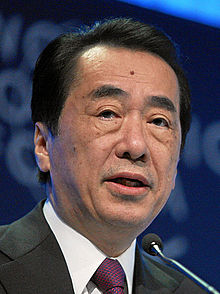 Ex-PMs Kan, Koizumi urge Japan to quit nuclear power generation https://english.kyodonews.net/news/2021/03/6b3c5a6b5519-ex-pms-kan-koizumi-urge-japan-to-quit-nuclear-power-generation.html1 Mar 21, KYODO NEWS – Former prime ministers Naoto Kan and Junichiro Koizumi on Monday urged Japan to stop using nuclear power, saying the country should learn from the Fukushima crisis a decade ago and turn to renewable energy.
 Both were proponents of nuclear power while in office but became critics following the March 11, 2011, earthquake, tsunami and subsequent triple meltdown at the Fukushima Daiichi nuclear plant.
“Japan has so much natural sources of energy like solar power, hydropower and wind power. Why should we use something that’s more expensive and less safe?” said Koizumi, a maverick reformist who held office from 2001 to 2006, at a joint press conference.
Kan, who led the response to the disaster at the time, criticized Yoshihide Suga’s vow to reduce Japan’s net carbon emissions to zero by 2050, calling it a pretense to restart nuclear reactors across the country, most of which have been halted as utilities wait to clear tougher regulations imposed after the Fukushima crisis.
While the former prime ministers come from opposite ends of the political spectrum — Koizumi led the center-right Liberal Democratic Party while Kan headed the now-defunct Democratic Party of Japan, which leaned left — they said opposing nuclear energy was a nonpartisan stance.
The main obstacle to shifting toward renewable energy is structural, Kan said, stemming from the entrenched interests of utility companies, government agencies and academics who constitute the “nuclear power village.”
“They know it would be too expensive to build new plants, or that there’s no way to properly dispose of nuclear waste. But there are a lot of stakeholders and they want to keep it that way,” said Kan, now a member of the Constitutional Democratic Party of Japan.
Regarding tritium-laced water at Fukushima Daiichi quickly filling up tanks, Koizumi said in the press conference at the Foreign Correspondents’ Club of Japan that plans to release the water into the sea were fiercely opposed by local fishermen and that further research into other options was needed.
Japan got 76 percent of its electricity from thermal power in fiscal 2019, compared with 18 percent from renewable energy and 6 percent from nuclear energy, according to preliminary data from the Ministry of Economy, Trade and Industry.
Under Suga’s “Green Growth Strategy,” the country is aiming to increase renewable energy to 50-60 percent while thermal power and nuclear energy is to constitute a combined 30-40 percent.
The Trump personality cult is still a threat
CPAC Showed That Trump’s Personality Cult Is Still Alive — and Still a Threat, https://truthout.org/articles/cpac-showed-that-trumps-personality-cult-is-still-alive-and-still-a-threat/?eType=EmailBlastContent&eId=30eb7938-c44f-478d-a80d-5562c3d8b80a, Sasha Abramsky, 1 Mar 21,
In the classic 1950 movie Sunset Boulevard, Gloria Swanson plays the has-been Hollywood diva, Norma Desmond, desperate for adoration, utterly infatuated with the spotlight. One of its most famous lines — “Alright, Mr. DeMille, I’m ready for my close up” — captures the unseemly spectacle of someone far past their sell-by date who refuses to accept their fall from stardom.
“You see,” the has-been actress utters with undistilled terror, “This is my life. It always will be. There’s nothing else. Just us and the camera — and those wonderful people out there in the dark.”
When Donald Trump stepped up to the podium at the CPAC event in Orlando, Florida, this weekend, it was, unsurprisingly, both a ghastly and incredibly tired remake of Sunset Boulevard, a reprise of yesterday’s news, of the former president’s greatest hits, from a man who cannot imagine a world without himself at the center.
During a bizarre CPAC presentation, Trump named all the Republicans who had crossed him and threatened to destroy their careers. He asked his audience — plaintively — whether they missed him yet. He claimed he had won the last election and would, if he so chose, win again in 2024. To this last point, his cult-like audience — which had already paraded through the conference center, in imitation of strong-men idolatrous cults in locales such as North Korea, a golden bust of the disgraced ex-president — responded, on cue, and overwhelming evidence to the contrary notwithstanding, “You won! You won! You won!”
Trump, in gilded retirement at Mar-a-Lago not only refuses to accept that Joe Biden won last year’s election, but he also hasn’t even remotely begun to consider the possibility that the GOP might ever be anything other than a vehicle for the enrichment of the Trump family. He has, these past months, teased the possibility of starting a third party; at the CPAC event, however, he scotched those rumors, instead urging GOP members to donate to political action committees controlled by Trump himself, along with members of his inner circle.
That decision wasn’t exactly a surprise; after all, most of the GOP is still in lockstep with Trumpism, convinced the election was stolen, and, as January 6th fades into the past, more than willing to forgive and forget the ex-president’s incitement to deadly violence. In the past couple weeks, House Minority Leader Kevin McCarthy traveled to Mar-a-Lago to pay an obsequious homage to the man whom, back in January, he had screamed at during a profanity-laden phone call at the height of the Capitol siege. So, too, did GOP whip Steve Scalise, make a kiss-the-ring visit to the exiled president.
Mitch McConnell, who bared just a touch of courage after the Senate impeachment vote by saying on the Senate floor that there was no doubt that Trump was responsible for the events of January 6th, followed up with an astounding public display of gorging himself on humble pie.
That decision wasn’t exactly a surprise; after all, most of the GOP is still in lockstep with Trumpism, convinced the election was stolen, and, as January 6th fades into the past, more than willing to forgive and forget the ex-president’s incitement to deadly violence. In the past couple weeks, House Minority Leader Kevin McCarthy traveled to Mar-a-Lago to pay an obsequious homage to the man whom, back in January, he had screamed at during a profanity-laden phone call at the height of the Capitol siege. So, too, did GOP whip Steve Scalise, make a kiss-the-ring visit to the exiled president.
Mitch McConnell, who bared just a touch of courage after the Senate impeachment vote by saying on the Senate floor that there was no doubt that Trump was responsible for the events of January 6th, followed up with an astounding public display of gorging himself on humble pie.
Meanwhile, state GOP chapters around the country are busily censuring GOP congressmembers and senators who voted to impeach or convict Trump. And GOP-controlled legislatures are pushing through legislation aimed to prevent the sort of non-existent “fraud” that Trump still claims cost him the last election. Of course, since the fraud wasn’t real, what this means in practice is a vast effort to contract the electorate and to make it harder for people of color, the poor and students to cast ballots in coming elections.
The ungodly CPAC display this past four days made two things absolutely clear. The first is that CPAC, and by extension most of the GOP, is nothing more or less than a personality cult; the values that have traditionally animated conservative movements in the U.S. have, now, been entirely subjugated to the allure of Trumpism. The second is that Trump’s financial interests — which are all he really cares about at this point — clearly lie not in putting his own dollars on the line by building up a third party, but in milking the GOP faithful for all he can, as quickly as he can, before his myriad legal woes catch up to him.
Toward the end of Sunset Boulevard, Desmond shoots an ex-lover as he attempts to walk out on her. In a bizarre twist, the dead man then narrates his posthumous understanding of how this will all end. He imagines the headlines that will accompany the announcement of his murder. “Forgotten star, a slayer, aging actress, yesterday’s glamor queen.” Instead, as Desmond is perp-walked down her palace steps, the cameras keep clicking, and the diva remains, even in delusional disgrace, the star of her own show.
Having failed to deal Trump a political death-blow in the Senate during the impeachment trial, the GOP is now stuck with its very own Norma Desmond. Trump is always ready for his close-up, because without the sound of the adoring claque, he is nothing.
Michigan Attorney General wants review of nuclear plant license transfer to Holtec
 an energy company to seek more review before it undertakes a license transfer that could cost Michiganders money and safety.AG Nessel is petitioning the Nuclear Regulatory Commission to look more closely into a case involving a license transfer request for the Palisades Nuclear Plant and Big Rock Point Independent Spent Fuel Storage Installation, which are both currently owned by Entergy Co.
Nessel is requesting a hearing for the transfer of control of the licenses to those facilities from Entergy to Holtec International.
Earlier this month, Entergy and Holtec filed an application asking for the approval of the transfer of control of the licenses. Entergy plans to retire the Palisades Nuclear Plant in 2022.
A trust fund of about $550 million was established with ratepayer funds to decommission the Palisades. Not only does Holtec want to use that fund to decommission the Palisades but also to handle the site restoration and fuel management cost.
Attorney General Nessel filed her petition and request to further review this license transfer application.
In her petition, Nessel said that she supports safe decommissioning, site restoration and fuel management at Palisades, but she’s concerned that Holtec does not have the financial qualifications to complete a risk-intensive project.
The petition demonstrates that Holtec has underestimated the costs for actual decommissioning, thus threatening the health and safety of Michigan residents, according to Michigan AG Dana Nessel. The petition also questions Holtec’s exemption request to use the decommissioning funds for site restoration and nuclear fuel management without providing evidence of other funding sources.
“Protecting the environment, the health and the pocketbooks of Michigan residents are part of my responsibilities as attorney general,” said Nessel in a press release. “My concern is that by seriously underestimating the cost of decommissioning, site restoration and nuclear fuel management, coupled with a lack of appropriate financial assurances, Holtec endangers our environment and health, and potentially leaves our residents to bear the costs of proper clean-up.”
Palisades Nuclear Power Plant is located in Covert Township and the Big Rock Point facility is located in Hayes Township both on the shores of Lake Michigan.
Opinion poll – 77% of Ayshire public support a total ban on all nuclear weapons.
Ayrshire CND are greatly encouraged by recent polllling which shows that 77 per cent of the public support a total ban on all nuclear weapons.
1 March 2021 Anti-nuclear campaigners across Ayrshire have been given a huge boost in their battle to force an end to the arms race, writes Stewart McConnell.
Ayrshire CND are greatly encouraged by recent polling which shows that 77 per cent of the public support a total ban on all nuclear weapons.
The survey also showed that almost 60 per cent of people want Britain to sign up to the United Nations Treaty on the Prohibition of Nuclear Weapons which came into force last month.
Group secretary Arthur West, pictured, said: “This recent polling was organised by CND at UK level in conjunction with the professional polling company Survation and the results are hugely encouraging for our campaign to rid this country and our world of the scourge of nuclear weapons.”
“The government’s own figures show that the cost of maintaining Britain’s nuclear weapons based at Faslane is an eye watering 2 billion pounds a year.
“This is frankly money which could be better spent on decent things like health and education and creating quality jobs in areas such as renewable energy and affordable house building.”
The opinion poll referred to was organised by CND at UK level in conjunction with polling company Survation and was conducted on January 12-13.
South Africa, with no way to deal with radioactive waste, must not develop new nuclear power
|
How can we think about more nuclear power when state cannot manage what we have? https://www.businesslive.co.za/bd/opinion/letters/2021-03-01-letter-how-can-we-think-about-more-nuclear-power-when-state-cannot-manage-what-we-have/– Keith Gottschalk, Claremont 01 MARCH 2021
State must first demonstrate its ability to cope with the existing radioactive waste by building a depository Bernard Benson falsely claims that “nuclear energy is clean and efficient … small modular reactors are safe and clean” (“Energy lessons to be learnt,” February 28.) All of the CSIR modelling has concluded that nuclear power is never the most cost-effective option for SA. And, far from being “clean”, Koeberg now stores a total of 1,000 tonnes of high-level radioactive waste within Cape Town’s municipal boundaries, due to Eskom and the government’s failure for 40 years to build a high-level radioactive waste depositary. It is unthinkable to fantasise about more nuclear power stations until the state first demonstrates its ability to cope with the existing radioactive waste by building that depository. Eskom is supposed to be setting aside funds monthly to cover the costs of radioactive waste disposal and Koeberg’s decommissioning. It has failed to do that for 40 years. This ballooning cost will inevitably be dumped onto taxpayers when it cannot be kicked down the road any longer. “Small modular reactors” is the industry’s latest euphemism for pebble-bed modular reactors, which have unsolved intrinsic flaws, such as neutron embrittlement of the “pebbles”, causing failing structural integrity. The Chernobyl and Fukushima disasters prove the necessity of siting nuclear power stations as far away as possible from major population centres. |
|
Labour’s nuclear weapons stance needs a rethink
Labour’s nuclear weapons stance needs a rethink, Guardian, Richard Norton-Taylor
London 28 Feb 21,
Readers respond to the shadow defence secretary’s announcement that his party’s commitment to Trident is ‘non-negotiable’
You report (Labour to state ‘non-negotiable’ support for UK’s nuclear weapons, 25 February) that the shadow defence secretary, John Healey, says his party’s commitment to nuclear weapons is “non-negotiable”, seemingly taking a harder line even than successive Conservative governments, which have at least supported talks on multilateral nuclear disarmament.
The new Labour leadership in its rhetoric seems more frightened of being accused at home of being weak on defence than a nuclear attack by a foreign power. For years, Whitehall analysts have considered a pandemic more likely than any real threat of a nuclear attack. Yet for years, ministers and opposition frontbenchers ignored the former while exaggerating the latter. Trade union leaders, meanwhile, back a new Trident missile programme and spending more than £200bn on unusable weapons, citing the need to preserve highly skilled jobs. Yet Britain has had to bank on French engineers for civil nuclear power stations of which Britain now appears to be in dire need. https://www.theguardian.com/world/2021/feb/28/labours-nuclear-weapons-stance-needs-a-rethink
Jeremy Corbyn – Britain Should Join Nuclear Ban Treaty and Scrap Nukes.
 Jeremy Corbyn – Britain Should Join Nuclear Ban Treaty & Scrap Nukes. https://labouroutlook.org/2021/02/27/jeremy-corbyn-britain-should-join-nuclear-ban-treaty-scrap-nukes/, 27th February 2021 “From coronavirus to environmental destruction to economic inequality, we face threats that the war machine cannot fix, & can only worsen.”
Jeremy Corbyn used a speech at the Stop the War Coalition AGM today to make the case for the labour movement taking a stand against nuclear weapons and US-led wars of intervention.
Speaking to Labour Outlook he said, “The public consensus is changing. One hundred and twenty countries have signed the Treaty on the Prevention of Nuclear Weapons at the UN this year.”
In his speech at the AGM, Jeremy pointed out how three out of five people in the UK think we should join them, and four out of five people support a total ban on all nuclear weapons globally.
Jeremy added, “Something else has happened. People have begun to understand where the real threats to our security are.
From coronavirus to environmental destruction to economic inequality, we face threats that the war machine cannot fix, and can only worsen.”
Yesterday saw Labour members across the country oppose the Party’s leadership decision to say support for nuclear weapons was not negotiable, including Emma Dent Coad and Diane Abbott MP in interviews with this publication.
Jennifer Granholm. new leader of USA’s Department of Energy gives clearly pro nuclear answers

26 Feb 21, Don Hancock of Southwest Research Information Center (SRIC) in Albuquerque, NM, has extracted Granholm’s answers to questions from U.S. Senators on nuclear weapons, nuclear power, and radioactive waste, during her confirmation to become President Biden’s Energy Secretary.
Is it wise for the Biden administration to fund Small Nuclear Reactors?

|
Climate change and ‘advanced nuclear’ solutions, The Hill, BY GREGORY JACZKO, — 02/23/21
Nuclear power is knocking on the government’s door offering solutions. The Biden platform answered by including so-called “advanced nuclear” in its list of climate options. The question now is will they wisely fund any such efforts?
While talk of advanced nuclear reactors is ubiquitous, a precise definition is elusive. Without a clear target in which to aim, government funds will not hit the mark. Advanced nuclear has become the catch-all for the knight-in-shining-armor reactors that promise to address issues that have kept nuclear a marginal electricity player since its inception. But we need more than this open-ended definition. The Biden administration should support projects only if they can compete with renewables and storage on deployment cost and speed, public safety, waste disposal, operational flexibility and global security. There are none today.
The only advanced nuclear technologies close to realization are called small modular reactors. These reactors are smaller than traditional reactors and are self-contained. These features allow companies to manufacture most of the reactor in a factory and ship it to a plant site. This concept evokes images of smart phones rolling out of factories by the billions — each design identical and mass produced. Their small size reduces the amount of radiation that can be released to the environment, greatly reducing — but not eliminating — safety to a plant’s community….
Yet the economic competitiveness of small modular reactors appears weak. Shrinking the size of a traditional reactor and splitting it among many modules increases the cost of the electricity it produces. It is the same reason airlines fly large capacity jets instead of private jets. You maximize the revenue per area of the aircraft hull. Proponents argue mass production will overcome this problem with fleet-wide economies of scale and construction efficiencies. Only wide scale adoption of the technology would deliver those benefits and there is no obvious market to support that today.
Moreover, the nuclear industry always promises better, faster and cheaper yet it fails to deliver. ……
Small modular designs are only promising to be cheaper than traditional reactors. Current estimates show they are more expensive than renewables, like wind and solar, even with storage and without subsidies. Small reactors have a long way to go to be competitive. Dramatic cost decreases for high-volume energy storage, which address the intermittency of some renewables, make the competitive case for any form of nuclear even tougher.
Even if everything else was lined up perfectly, nuclear has little time to catch up. After reentering the Paris Agreement, the U.S. will again strive to achieve drastic reductions in greenhouse gas emissions (GHG) within the next 10 years. Even in the most optimistic scenario, we won’t see even a handful of small modular nuclear reactors in the U.S. until 2029 or 2030, which means a large-scale impact would come far after the climate tipping point.
What about the other factors like proliferation resistance and waste disposal? For those criteria, small modular reactors offer no advantages over their traditional reactor cousins. Even if the cost factors are addressed, proliferation concerns and waste management will be hurdles.
Most importantly, no small modular reactors have been deployed yet in the United States, despite government efforts. In 2011, the Department of Energy (DOE) offered $400 million grants to support two small modular reactor designs. After providing tens of millions, only one design is still under development. That company originally planned to build a 12-module plant at the Idaho National Laboratory.
Predictably, this project is in trouble. Electricity customers have committed to purchase just a small fraction of the power produced annually by that plant, which now is likely to be scaled down, diminishing the economies of scale from mass production. It will not operate until at least 2030, years behind schedule and too late to help deal with the problem forecast in the best climate models. Despite these challenges, the federal government agreed in concept to a $1.4 billion direct subsidy over 10 years for the project. Without this cash infusion, the project will not meet its already disputed targets for price competitiveness. Such largesse is part of the billions Congress and the Trump administration committed to other advanced reactor concepts, none of which are close to deployment. To avoid wasting money on advanced nuclear reactors, the Biden administration must establish clear metrics for advanced nuclear reactors and apply them rigorously. Only ideas that can meet the pressing timetable of climate demands and electricity market realities deserve a serious look. My list is a good place to start. If advanced reactors cannot meet these metrics, they should not receive funding. Proponents of nuclear power will certainly say that living up to my list is an arduous task. Perhaps it is, but the future of our planet hangs in the balance. That is more important than the profits of an industry. Dr. Gregory Jaczko was the chairman of the U.S. Nuclear Regulatory Commission from 2009 to 2012 and currently develops clean energy projects and teaches at Princeton University. https://thehill.com/opinion/energy-environment/539991-climate-change-and-advanced-nuclear-solutions |
|
Australian federal and state governments keeping laws banning nuclear power, despite Murdoch pro nuc
 Renew Economy 25th Feb 2021, State parliaments in NSW and Victoria have completed nuclear inquiries over the past two years but the governments of both states have no intention of repealing laws banning nuclear power.
The Morrison government established an inquiry into nuclear power in 2019 but made it clear that the federal ban would be retained regardless of the findings of the inquiry.
Nevertheless, supporters continue to campaign for the repeal of federal and state laws banning nuclear power. The Murdoch papers and Murdoch’s Sky News have ramped up their campaign to have those laws repealed.
https://reneweconomy.com.au/legislation-banning-nuclear-power-in-australia-should-be-retained/
Jennifer Granholm becomes U.S. Energy Secretary: the nuclear lobby is pleased, but not certain
Granholm becomes US energy secretary, WNN 26 February 2021 Jennifer Granholm has been sworn as the 16th US secretary of energy. ….. Maria Korsnick, president and CEO of the US Nuclear Energy Institute, said Granholm will play a pivotal role…….
Judi Greenwald, executive director of the Nuclear Innovation Alliance, said the think tank is looking forward to working with Granholm and her team on the development, demonstration and deployment of the advanced nuclear reactors …
Granholm made no mention of nuclear power……in the article, nor in a video address released to coincide with the swearing-in…… https://www.world-nuclear-news.org/Articles/Granholm-becomes-US-Energy-Secretary
Jennifer Granholm seems more muted in her support for nuclear, compared to previous Energy Secretaries
Recent USA Energy Secretaries in USA have been strong promoters of the nuclear industry. Up until January 2021 it was Dan Brouillette, very keen on nuclear power. The two Energy Secretaries before that , Rick Perry, Ernest Moniz pretty well used the job as if they were employees of the nuclear industry
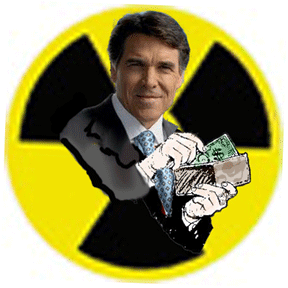

In that context, Biden’s new pick for Energy Secretary, Jennifer Granholm, seems much more muted in her support for nuclear
Jennifer Granholm’s nuke priorities remain hazy, https://www.postandcourier.com/aikenstandard/news/jennifer-granholms-nuke-priorities-remain-hazy/article_2c6c6f36-6240-11eb-9f33-b745c10da3cf.html By Colin Demarest cdemarest@aikenstandard.com Feb 3, 2021
-
- In written testimony provided to a Senate panel Wednesday, the new president’s pick to lead the Department of Energy said she would prioritize, among other things, American safety and security.
Doing so, Jennifer Granholm explained in a single paragraph, would mean focusing on the department’s offensive-and-defensive arm, the National Nuclear Security Administration, as well as the cleanup of Cold War artifacts – pockets of toxic waste, for example, trapped at sprawling installations like the Savannah River Site south of Aiken.
During her confirmation hearing this week, before the Senate Energy and Natural Resources Committee, the latter was discussed at decent length; the Hanford Site in Washington, notoriously difficult and expensive to remediate, was brought up several times, and Granholm pledged not to kick the can down the road. Some might argue such remarks are a rite of passage for Energy Department executives.
In written testimony provided to a Senate panel Wednesday, the new president’s pick to lead the Department of Energy said she would prioritize, among other things, American safety and security.
Doing so, Jennifer Granholm explained in a single paragraph, would mean focusing on the department’s offensive-and-defensive arm, the National Nuclear Security Administration, as well as the cleanup of Cold War artifacts – pockets of toxic waste, for example, trapped at sprawling installations like the Savannah River Site south of Aiken.
During her confirmation hearing this week, before the Senate Energy and Natural Resources Committee, the latter was discussed at decent length; the Hanford Site in Washington, notoriously difficult and expensive to remediate, was brought up several times, and Granholm pledged not to kick the can down the road. Some might argue such remarks are a rite of passage for Energy Department executives.
The former – the National Nuclear Security Administration, its hefty budget and its myriad missions – was sparsely touched, even with Granholm cracking open the door.
The disconnect, though, didn’t catch observers off guard.
“Given the committee in which the confirmation hearing took place and the fact that she’s not yet up to speed on nuclear weapons issues, it’s no surprise that Gov. Granholm was not asked about key NNSA issues,” said Tom Clements, the director of Savannah River Site Watch, an organization that monitors a host of energy- and nuclear-related issues. “I assume she is receiving briefings on NNSA matters and will soon be fully conversant and able to make informed, sound decisions.”
The committee that handled Granholm’s nomination has jurisdiction over nuclear waste, not nuclear weapons – exactly why Sens. Maria Cantwell of Washington and Ron Wyden of Oregon broached Hanford and why Sen. Catherine Cortez Masto of Nevada railed against Yucca Mountain.
“I wouldn’t want to read the tea leaves too much,” said Marylia Kelley, the executive director of Tri-Valley CAREs, which tracks Lawrence Livermore National Laboratory and the nuclear-weapons complex, more broadly. “I do know that after the hearing I was left with questions.”
The hearing Wednesday, shy of three hours, served as a digestible introduction to Granholm, a two-time governor of Michigan, auto-industry adept and clean-energy advocate. The conversation was heavy on energy sources and fuels, climate change and job losses, a major concern for some lawmakers as President Joe Biden signs a flurry of environmental executive orders. Kelley, though, is anxious to see where the nominee stands on nuclear-weapons issues: new warheads, new cores, modernization spending and the like. Such topics are a rarity on governors’ desks.
“I am hopeful that our new energy secretary will bring a set of skills that will help her make difficult decisions under pressure in a logical and organized fashion,” Kelley said. She later added: “Of course, from my organization’s perspective, I will be looking toward the Energy Department being more skeptical about expanding pit production, both on the question of what we need and on the question of when we need it, and how much we’re going to spend on it and how we’re going to accomplish it. I’m looking for her to be skeptical.”
Indications of priority – what’s important, and how much – will unfurl in budget requests and related budget hearings, said Nickolas Roth, the director of the nuclear security program at the Stimson Center, headquartered in Washington, D.C.
“That’s where you usually get more into the weeds on this kind of stuff,” Roth said. His hope, he explained, “is that the Biden administration will look for ways to curtail a very expensive nuclear-weapons modernization program” and strike a better balance with the nonproliferation portfolio.
If confirmed, Granholm would take the reins at a department very much devoted to the U.S. nuclear arsenal.
“The National Nuclear Security Administration is the largest part of the budget when you figure that environmental management is related to the nuclear weapons mission,” Kelley said. “It’s the lion’s share of the budget, by far.”
The Energy Department’s fiscal year 2021 budget request added to $35.4 billion; the National Nuclear Security Administration earmark totaled $19.8 billion. Of that sum, a vast majority was for weapons activities. (Daryl Kimball, the executive director of the Arms Control Association, has branded the DOE as the NWD: Nuclear Weapons Department.)
In the weeks before the 2021 blueprint was unveiled, dozens of lawmakers, including three Palmetto State Republicans, lobbied then-President Donald Trump to funnel more money to the NNSA and its weapons work. Insufficient funding, the elected officials wrote, would risk U.S. national security and embolden “anti-nuclear Democrats who oppose your effort to rebuild our military,” a red meat appeal.
Clements, who leads SRS Watch, anticipates Granholm “will make tough decisions reshaping U.S. nuclear weapons policy in a way that increases our collective security while reducing financial costs and reducing reliance on nuclear weapons.”
That remains to be seen.
Well-funded pro nuclear lobby has wishlist for Joe Biden
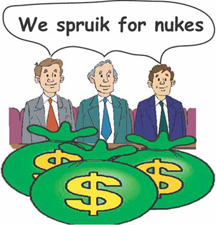



Is the Biden government going to buy these lies? Nuclear – clean? renewable?
|
Reports Envision a Leading Role for Nuclear in this Administration, JDSUPRA, 25 Feb 21, On February 16, the Nuclear Innovation Alliance (NIA) and the Partnership for Global Security (PGS) issued a report to help guide the Biden Administration in its support of nuclear amidst the President’s ambitious climate agenda. The report, U.S. Advanced Nuclear Energy Strategy for Domestic Prosperity, Climate Protection, National Security, and Global Leadership, provides detailed recommendations to promote advanced reactor development that could garner bipartisan support if implemented. It discusses federal, state-level, and international goals for advancing nuclear. The next day, February 17, the American Nuclear Society (ANS) published a report on Public Investment in Nuclear Research and Development that requests an additional $10.3B by 2030 in funding for demonstration reactors and projects aimed to streamline commercialization of advanced nuclear. While the NIA and PGS report establishes a roadmap for advanced reactor development, the purpose of the ANS report is to make a case for increased federal investment in nuclear. Here are some of the recommendations from the NIA/PGS report:
|
|
France slow to leave nuclear power, (cheaper to extend lives of reactors)

France to extend lifetime of old nuclear power plants https://au.finance.yahoo.com/news/france-extend-lifetime-old-nuclear-102331756.html
Thu, 25 February 2021, French safety officials on Thursday gave the green light to extend the lifetime of the country’s oldest nuclear power plants as it seeks to boost the share of renewables in its power mix.
Nuclear energy currently provides nearly 70 percent of French electricity, more than in any other country.
France, hoping to reduce that share to 50 percent by 2035 — a target pushed back from an earlier 2025 date — with the help of renewables, has been holding off from building new reactors.
The number of French reactors, at 56, is second in the world only to the United States which operates 85.
French safety officials on Thursday gave the green light to extend the lifetime of the country’s oldest nuclear power plants as it seeks to boost the share of renewables in its power mix.
Nuclear energy currently provides nearly 70 percent of French electricity, more than in any other country.
France, hoping to reduce that share to 50 percent by 2035 — a target pushed back from an earlier 2025 date — with the help of renewables, has been holding off from building new reactors.
The number of French reactors, at 56, is second in the world only to the United States which operates 85.
The safety of French nuclear plants is checked every decade.
ASN asked state-controlled electricity provider EDF, which manages the country’s nuclear plants, to undertake any necessary work to safeguard their security.
The main target was to “limit the consequences of any accident, especially any serious accident involving the meltdown of a reactor”, ASN’s deputy director-general Julien Collet told AFP.
Another objective was to improve the resistance of the plants to outside shocks including earthquakes, floods, extremely hot weather, or a fire in the reactor.
Anti-nuclear campaigners have long demanded the closure of veteran nuclear power stations, and last year obtained the decommissoning of France’s oldest plant at Fessenheim in the east of the country.
“Active French nuclear power plants were built to operate for 30 or 40 years. Beyond that, nuclear reactors enter an unknown ageing phase,” said NGO Greenpeace, calling for more plants to be closed.
ASN president Bernard Doroszczuk told the Ouest France newspaper that there were still “weak points” in the stations’ security equipment, requiring “vigilance”, but that there had been improvements.
France’s nuclear reactors, grouped in 18 sites, are all second-generation pressurised water reactors.
EDF in 2015 estimated the cost of dismantling all the reactors at 75 billion euros ($92 billion) but a parliamentary report said the real cost would be more.
A third-generation reactor called EPR and under construction since 2007 in Flamanville in northern France was supposed to go online in 2012, but the launch date has been delayed repeatedly and is now fixed for next year.
Flamanville’s cost has run over 10 billion euros, more than three times the initial estimate. Once operational, it will have an estimated life span of 60 years.
France’s nuclear reactors’ lives to be extended beyond 40 years
Le Monde 25th Feb 2021, The oldest nuclear reactors extended by ten years. EDF’s 32 900-megawatt reactors are the oldest in operation in France. They were originally designed to operate for forty years. This is a decision that officially opens the way to extending the life of the oldest reactors in France’s nuclear fleet beyond forty years. In an opinion published Thursday, February 25, the Nuclear Safety Authority (ASN) considers that “all the planned provisions open the prospect” of a continuation of the activity of the 32 French 900 megawatt (MW) reactors for a ten-year period. While French regulations do not provide for a maximum “lifespan” for reactors, an assumption of forty years of operation was adopted during their design.
1 This Month
23-25 October – on Zoom – World BEYOND War’s annual global conferenc


Shut down the radiation-damaged Heysham nuclear reactors now
To see nuclear-related stories in greater depth and intensity – go to https://nuclearinformation.wordpress.com

Say No to NASA’s Reckless Nuclear Reactor on the Moon
Say No to NASA’s Reckless Nuclear Reactor on the Moon

-
Archives
- October 2026 (231)
- September 2026 (339)
- August 2026 (330)
- July 2026 (355)
- June 2026 (287)
- May 2026 (306)
- April 2026 (356)
- March 2026 (251)
- February 2026 (267)
- January 2026 (308)
- December 2025 (358)
- November 2025 (359)
-
Categories
- 1
- 1 NUCLEAR ISSUES
- business and costs
- climate change
- culture and arts
- ENERGY
- environment
- health
- history
- indigenous issues
- Legal
- marketing of nuclear
- media
- opposition to nuclear
- PERSONAL STORIES
- politics
- politics international
- Religion and ethics
- safety
- secrets,lies and civil liberties
- spinbuster
- technology
- Uranium
- wastes
- weapons and war
- Women
- 2 WORLD
- ACTION
- AFRICA
- Atrocities
- AUSTRALIA
- Christina's notes
- Christina's themes
- culture and arts
- Events
- Fuk 2022
- Fuk 2023
- Fukushima 2017
- Fukushima 2018
- fukushima 2019
- Fukushima 2020
- Fukushima 2021
- general
- global warming
- Humour (God we need it)
- Nuclear
- RARE EARTHS
- Reference
- resources – print
- Resources -audiovicual
- Weekly Newsletter
- World
- World Nuclear
- YouTube
-
RSS
Entries RSS
Comments RSS

