Scottish Council calls on big pension fund to stop investing in weapons makers

The Ferret 5th March 2021, Inverclyde Council has called on Scotland’s largest council pension fund to stop investing in arms and to commit to ethical investments. A motion was passed this week after Inverclyde Council was told that Strathclyde Pension Fund (SPF) held shares in 11 of the world’s 20 biggest arms manufacturers, including some involved in the production of nuclear weapons. The council’s decision has been welcomed by Campaign Against Arms Trade, Nuclear Free Local Authorities (NFLA) and Don’t Bank on the Bomb.
https://theferret.scot/inverclyde-council-pension-fund-invest-ethically/
Bill in U.S. Congress to stop new nuclear-armed, sea-launched cruise missile
|
Lawmakers aim to prevent sea-based nuclear cruise missile, Defense News,
By: Joe Gould 7 Mar 21, WASHINGTON ― Two Democratic lawmakers are introducing legislation to kill the nuclear-armed, sea-launched cruise missile set to begin development next year and its associated warhead.
Maryland Sen. Chris Van Hollen, a lead appropriator, and House Seapower Subcommittee Chairman Joe Courtney, of Connecticut, planned Thursday to unveil the bill, a copy of which was obtained by Defense News. It’s the latest sign of pressure on President Joe Biden from his own party to scale back nuclear plans formed under the Trump administration. The bill would prohibit research and development, production, and deployment of the missile, known as the SLCM-N, arguing that the Obama administration found a similar weapon, the TLAM-N, redundant and retired it. The lawmakers say the cost of the SLCM-N would top the Congressional Budget Office estimate of $9 billion. In a statement, Courtney said that installing nuclear warheads on Virginia-class attack subs would sap resources from growing the Navy’s fleet and distract from the core mission of attack submarines in the Pacific and European theaters, where they are typically laden with ship-killing, conventional Tomahawk missiles. “This legislation is a common-sense bill that will stop the hemorrhaging of precious Navy dollars for a wasteful program that Congress barely debated.” Courtney said………. https://www.defensenews.com/congress/2021/03/04/lawmakers-aim-to-prevent-sea-based-nuclear-cruise-missile/ |
|
In India, Google and Facebook help a vicious government campaign against environmental activists
Naomi Klein: how big tech helps India target climate activists, Guardian, by Naomi Klein 5 Mar 21, Companies such as Google and Facebook appear to be aiding and abetting a vicious government campaign against Indian environmental campaigners
The bank of cameras camped outside Delhi’s sprawling Tihar jail was the sort of media frenzy you would expect to await a prime minister caught in an embezzlement scandal, or a Bollywood star caught in the wrong bed. Instead, the cameras were waiting for Disha Ravi, a nature-loving 22-year-old vegan climate activist who against all odds has found herself ensnared in an Orwellian legal saga that includes accusations of sedition, incitement and involvement in an international conspiracy whose elements include (but are not limited to): Indian farmers in revolt, the global pop star Rihanna, supposed plots against yoga and chai, Sikh separatism and Greta Thunberg.
If you think that sounds far-fetched, well, so did the judge who released Ravi after nine days in jail under police interrogation. Judge Dharmender Rana was supposed to rule on whether Ravi, one of the founders of the Indian chapter of Fridays for Future, the youth climate group started by Thunberg, should continue to be denied bail. He ruled that there was no reason for bail to be denied, which cleared the way for Ravi’s return to her home in Bengaluru that night.
But the judge also felt the need to go much further, to issue a scathing 18-page ruling on the underlying case that has gripped Indian media for weeks, issuing his own personal verdict on the various explanations provided by the Delhi police for why Ravi had been apprehended in the first place. The police’s evidence against the young climate activist is, he wrote, “scanty and sketchy”, and there is not “even an iota” of proof to support the claims of sedition, incitement or conspiracy that have been levelled against her and at least two other young activists.
Though the international conspiracy case appears to be falling apart, Ravi’s arrest has spotlighted a different kind of collusion, this one between the increasingly oppressive and anti-democratic Hindu nationalist government of the prime minister, Narendra Modi, and the Silicon Valley companies whose tools and platforms have become the primary means for government forces to incite hatred against vulnerable minorities and critics – and for police to ensnare peaceful activists like Ravi in a hi-tech digital web.
The case against Ravi and her “co-conspirators” hinges entirely on routine uses of well-known digital tools: WhatsApp groups, a collectively edited Google Doc, a private Zoom meeting and several high-profile tweets, all of which have been weaponised into key pieces of alleged evidence in a state-sponsored and media-amplified activist hunt. At the same time, these very tools have been used in a coordinated pro-government messaging campaign to turn public sentiment against the young activists and the movement of farmers they came together to support, often in clear violation of the guardrails social media companies claim to have erected to prevent violent incitement on their platforms.
In a country where online hatred has tipped with chilling frequency into real-world pogroms targeting women and minorities, human rights advocates are warning that India is on the knife-edge of terrible violence, perhaps even the kind of genocidal bloodshed that social media aided and abetted against the Rohingya in Myanmar.
Through it all, the giants of Silicon Valley have stayed conspicuously silent. Their famed devotion to free expression, as well as their newfound commitment to battling hate speech and conspiracy theories, is, in India, nowhere to be found. In its place is a growing and chilling complicity with Modi’s information war, a collaboration that is poised to be locked in under a draconian new digital media law that will make it illegal for tech companies to refuse to cooperate with government requests to take down offending material or to breach the privacy of tech users. Complicity in human rights abuses, it seems, is the price of retaining access to the largest market of digital media users outside China.
After some early resistance from the company, Twitter accounts critical of the Modi government have disappeared in the hundreds without explanation; government officials engaging in bald incitement and overt hate speech on Twitter and Facebook have been permitted to continue in clear violation of the companies’ policies; and Delhi police boast that they are getting plenty of helpful cooperation from Google as they dig through the private communications of peaceful climate activists like Ravi.
“The silence of these companies speaks volumes,” a digital rights activist told me, requesting anonymity out of fear of retribution. “They have to take a stand, and they have to do it now.”
…………………. It is this quest for a political diversion, in other words, that helps explain how a simple solidarity campaign has been recast as a secret plot to break India apart and incite violence from abroad. The Modi government is attempting to drag the public debate away from terrain where it is glaringly weak – meeting people’s basic needs during an economic crisis and pandemic – and move it to the ground on which every ethnonationalist project thrives: us versus them, insiders versus outsiders, patriots versus seditious traitors.
In this familiar manoeuvre, Ravi and the broader youth climate movement were simply collateral damage. Yet the damage done is considerable, and not only because the interrogations are ongoing and Ravi’s return to jail remains distinctly possible. As the joint letter from Indian environmental advocates states, her arrest and imprisonment have already served a purpose: “The Government’s heavy handedness are clearly focused on terrorising and traumatising these brave young people for speaking truth to power, and amounts to teaching them a lesson.”
The still wider damage is in the chill the entire toolkit controversy has placed over political dissent in India – with the silent complicity of the tech companies that once touted their powers to open up closed societies and spread democracy around the world. As one headline put it, “Disha Ravi arrest puts privacy of all Google India users in doubt”.
Indeed, public debate has been so deeply compromised that many activists in India are going underground, deleting their own social media accounts to protect themselves. Even digital rights advocates are wary of being quoted on the record. Asking not to be named, a legal researcher described a dangerous convergence between a government adept at information war and social media companies built on maximising engagement to mine their users’ data: “All of this stems from a stronger weaponisation of social media platforms by the status quo, something that was not present earlier. This is further aggravated by the tendency of these companies to prioritise more viral, extremist content, which allows them to monetise user attention, ultimately benefiting their profit motives.”…………..
The new code is being introduced in the name of protecting India’s diverse society and blocking vulgar content. “A publisher shall take into consideration India’s multi-racial and multi-religious context and exercise due caution and discretion when featuring the activities, beliefs, practices, or views of any racial or religious group,” the draft rules state.
In practice, however, the BJP has one of the most sophisticated troll armies on the planet, and its own politicians have been the most vociferous and aggressive promotors of hate speech directed at vulnerable minorities and critics of all kinds. To cite just one example of many, several BJP politicians actively participated in a misinformation campaign claiming that Muslims were deliberately spreading Covid-19 as part of a “Corona Jihad”.
What a code like this would do is enshrine in law the double digital vulnerability experienced by Ravi and other activists: they would be unprotected from online mobs revved up by a Hindu nationalist state, and they would be unprotected from that same state when it sought to invade their digital privacy for any reason it chose……….
The new code, which will impact all digital media, including streaming and news sites, is set to take effect within the next three months. A few digital media producers in India are pushing back. Siddharth Varadarajan, the founding editor of the Wire, tweeted last Thursday that the “lethal” new code is “aimed at killing the independence of India’s digital news media. This attempt to arm bureaucrats with the power to tell the media what can and can’t be published has no basis in law.” ………….
Do not expect portraits of courage from Silicon Valley, however. Many US tech executives regret early decisions, made under public and worker pressure, to refuse to cooperate with China’s apparatus of mass surveillance and censorship – an ethical choice, but one that cost companies like Google access to a staggeringly large, lucrative market. These companies appear unwilling to make the same kind of choice again. As the Wall Street Journal reported last August, “India has more Facebook and WhatsApp users than any other country, and Facebook has chosen it as the market in which to introduce payments, encryption and initiatives to tie its products together in new ways that [CEO Mark] Zuckerberg has said will occupy Facebook for the next decade.”
For tech companies like Facebook, Google, Twitter and Zoom, India under Modi has heralded a harsh moment of truth. In North America and Europe, these companies are going to great lengths to show that they can be trusted to regulate hate speech and harmful conspiracies on their platforms while protecting the freedom to speak, debate, and disagree that is integral to any healthy society. But in India, where helping governments hunt and imprison peaceful activists and amplify hate appears to be the price of access to a huge and growing market, “all of those arguments have gone out the window,” one activist told me. And for a simple reason: “They are profiting from this harm.” https://www.theguardian.com/news/2021/mar/04/how-big-tech-helps-india-target-climate-activists-naomi-klein
10 years after Fukushima nuclear disaster, – poor prospects for nuclear revival in Japan
Decade after Fukushima disaster survivor looks back | Tomioka just 10 km from wrecked nuclear plant
gainst almost any conceivable tsunami. Two reactors are ready to start splitting atoms again to heat water into steam and generate power, the operator has told regulators.
All of Fukushima prefecture’s reactors are closed permanently or set to do so. Chubu Electric Power Co. , owner of the Hamaoka plant, declined to make an executive available for comment. It has formally applied to reopen two reactors at the plant and told regulators that new measures such as the wall, mainly completed in 2015, make them safe to operate.
Hopes in Luxembourg for the closure of Cattenom nuclear power plant.
L’Essentiel 3rd March 2021, Luxembourg has an idea to shut down Cattenom. Claude Turmes hopes the German Greens will come to power to put pressure on France and obtain the
closure of the Cattenom nuclear power plant.
Montana legislatures to review the law restricting nuclear developments
At the same time the House was reviewing a bill sponsored by Rep. Derek Skees, R-Kalispell, to remove restrictions on nuclear development, the Senate was at work on Senate Joint Resolution 3, which directs the state to study advanced nuclear reactors. The resolution appears well-positioned to pass — halfway through the session, SJ 3 has garnered unanimous support in the Senate.
Sponsor Terry Gauthier, R-Helena, becomes audibly excited discussing the measure. He said he sees modern nuclear technology as a way for Montana to send electrons to the energy-thirsty markets of the Pacific Northwest by tying into the high-voltage transmission lines leading out of Colstrip……..
 Gauthier is particularly interested in a company called NuScale, based in Portland, Ore., that’s garnered more than $1.3 billion from the federal government to advance its small modular reactor, or SMR, design. It’s the only company that’s received approval from the federal Nuclear Regulatory Commission for that type of design — a significant milestone on the journey to market……….
Much of the debate about the environmental impact associated with nuclear energy is focused on what to do with the spent fuel. Some kinds of nuclear fuel can remain radioactive for hundreds or thousands of years. The U.S. has yet to arrive at a long-term solution for re-using or storing spent fuel, creating a contentious political issue that’s spanned decades.
As is the case with larger-scale traditional nuclear plants, spent fuel from SMRs remains a “significant issue,” according to Darby.
NuScale’s plan is to store used fuel underwater in a stainless-steel lined concrete pool located onsite for at least five years. They say the pool is designed to withstand “a variety of severe natural and human made phenomena” like earthquakes and aircraft impacts. After the five-year period when the used fuel is both hottest and most radioactive has elapsed, it’s moved to a stainless-steel canister surrounded with concrete that’s designed to contain the radioactivity.
The United States doesn’t have a permanent underground repository for high-level nuclear waste, so those concrete containment vessels generally remain on-site or near the plant they came from. A 33-year-old effort to create such a long-term storage repository northwest of Las Vegas is still subject to heated debate. ……….
Another question hanging over nuclear energy development is the price of building a new plant. It’s not uncommon for new construction costs to exceed $1 billion. Concerns about cost increases led several cities that had committed to participate in NuScale’s demonstration plant in Idaho Falls to pull out of the multi-billion-dollar project last year.
NuScale told Montana Free Press that once production is rolling on their product, it anticipates the facility construction cost to be about $2,850 per kilowatt of producing capacity for its largest, 12-module iteration. For comparison, new construction of a natural gas plant averaged about $837 per kilowatt of capacity in 2018, and wind plants clocked in at $1,382, according to the U.S. Energy Information Administration.
Brad Molnar, a Republican senator from Laurel, told MTFP that cost will be an important consideration as the state plots its energy future. He said the study Gauthier is spearheading should involve the Public Service Commission, because it doesn’t make sense to conduct the study without landing on a cost-per-megawatt estimate.
Gauthier knows that nuclear is by no means the least expensive energy source, particularly if calculations are based on a strict dollars-and-cents equation…….
It’s not yet clear if Montana’s 1978 law requiring voter approval before a nuclear energy plant can be built in the state will still be on the books next year. The Legislature is still deciding the fate of HB 273, which would strike that law and remove nuclear projects from the purview of the Major Facility Siting Act.
Sen. Molnar has been asked if he’d carry HB 273 when it’s heard in the Senate, but he said he has reservations about the measure.
“By and large, I’m really hesitant to overturn a [voter] initiative,” he said, adding that the order of operations seems a little off to him.
“First you do the study, then you take action,” he said. “You don’t take action and then do the study.”
As of March 4, both HB 273 and SJ 3 have been transmitted to the Senate and House, respectively, for review. Hearing dates before those chambers’ energy committees have not been set. https://montanafreepress.org/2021/03/04/nuclear-on-the-radar-part-ii/
Widespread public support for Germany’s nuclear phaseout, as renewable energy expands
TechXplore, 5 Mar 21, ”……….By the end of 2022, Germany will have achieved its goal of completely phasing out nuclear power, set by Chancellor Angela Merkel on May 30, 2011.
The plan represented a dramatic change of course by Merkel’s ruling conservatives, who just a few months earlier had agreed to extend the lifespan of Germany’s oldest power stations.
It was met with widespread public support in a country with a powerful anti-nuclear movement, fuelled first by fears of a Cold War conflict and then by disasters such as Chernobyl.
Yet it also prompted a lengthy legal battle with major energy companies, which ended Friday with Berlin’s agreement to pay 2.4 billion euros worth of compensation to nuclear power plant operators………
The German government is still looking for a long-term storage site for the country’s residual nuclear waste.
Renewables have seen a spectacular rise since 2011 and in 2020 made up more than 50 percent of Germany’s energy mix for the first time, according to the Fraunhofer research institute—compared with less than 25 percent 10 years ago.
The declining importance of nuclear power (12.5 percent in 2020) “has been compensated for by the expansion of renewable energies”, Claudia Kemfert, an energy expert at the DIW economic research institute, told AFP.
Nuclear power stations have therefore not been replaced by coal, though the fossil fuel does still represent almost a quarter of the electricity mix.
Biden’s first budget should reduce excessive expenditure on nuclear weaponry
|
Biden’s first budget should reduce nuclear excess, Defense News, By: Kingston Reif, 5 Mar 21, As the Biden administration begins crafting its defense budget submission for fiscal 2022, the debate about how it should handle the U.S. nuclear arsenal is heating up.
Proponents of the Trump administration’s approach, which fanned the flames of a burgeoning arms race, are warning any deviations will lead to disaster. President Joe Biden, however, appears to have a different view. During the campaign, he said the United States “does not need new nuclear weapons” and that his “administration will work to maintain a strong, credible deterrent while reducing our reliance and excessive expenditure on nuclear weapons.” Biden is right. Current U.S. nuclear weapons policies exceed what is necessary for a credible nuclear deterrent, and their financial costs are taking a growing toll. Biden should use his forthcoming budget to steer the country in a safer and more affordable direction. In addition to continuing legacy plans to replace the nuclear triad and its associated warheads, the Trump administration pursued new types of weapons and more bomb-making infrastructure. It also expanded the circumstances in which President Donald Trump would consider using nuclear weapons. Worse still, the administration put New START — the sole remaining agreement verifiably limiting the size of the U.S. and Russian nuclear arsenals — on the brink of expiration. Mindful of the danger he inherited, Biden quickly and wisely agreed with Russian President Vladimir Putin to extend New START by five years. Trump’s FY21 budget request of $44.5 billion to sustain and upgrade the nuclear arsenal was a 19 percent increase over the previous year. Over the next several decades, spending is likely to top $1.5 trillion. Russian and Chinese nuclear advances and aggressive behavior might seem to justify such investments. But the spending plans pose a major threat to security priorities more relevant to countering Moscow and Beijing and assuring allies. A long-foreseen budget reckoning has arrived.
An early reassessment of the Trump administration’s dubious proposal to double the number of more usable low-yield nuclear options is more than justified. In particular, the Biden administration should provide no funding to begin development of a new nuclear-armed, sea-launched cruise missile. The weapon, which is projected to cost at least $9 billion over the next decade, is a redundant and costly hedge on a hedge. But the mini-review should go further and hit pause on other controversial programs, pending the outcome of a more comprehensive policy review later this year. For example, the administration should freeze funding for the Air Force’s program to build a new land-based intercontinental ballistic missile system at the current-year level. It should also set the budget for the National Nuclear Security Administration at the level projected for FY22 as of the FY20 budget request……………. https://www.defensenews.com/opinion/commentary/2021/03/04/bidens-first-budget-should-reduce-nuclear-excess/ |
|
Germany to pay nuclear operators 2.4 bln euros for plant closures
|
Germany to pay nuclear operators 2.4 bln euros for plant closures, https://www.reuters.com/article/germany-nuclear-settlement/germany-to-pay-nuclear-operators-24-bln-euros-for-plant-closures-idUSS8N2IR026 By Reuters Staff, (Reporting by Vera Eckert, Tom Kaeckenhoff and Markus Wacket, editing by Thomas Escritt)
FRANKFURT, March 5 21, (Reuters) – The German government has agreed to pay nuclear operators 2.4 billion euros ($2.86 billion) in compensation for forcing them to shut their nuclear plants early in response to the the Fukushima disaster, ministries said on Friday.The Frankfurter Allgemeine Zeitung daily had reported on Thursday that a sum of 2.4 billion euros will be made available from the general budget, citing government sources. The four affected companies are the German listed utilities RWE, which will get 880 million euros, and E.ON , which will get 42.5 million euros, as well as Swedish state-owned rival Vattenfall, which will get 1.425 billion euros, and mainly publicly-owned German EnBW , which will get 80 million euros. A Constitutional Court ruling in November had found in favour of the companies in their complaint that the government’s previous offer had not gone far enough. The court called for a speedy settlement of the dispute, which was mainly pursued by Vattenfall. The court had already ruled in 2016 that while the nuclear phase-out was legal, the operators needed to be better compensated for lost production. ($1 = 0.8389 euros) |
|
Nuclear Power’s Prospects Cool a Decade After Fukushima Meltdowns
Nuclear Power’s Prospects Cool a Decade After Fukushima Meltdowns
Disaster at the Japanese reactors marked a turning point for an industry that once promised to give the world a nearly unlimited source of energy WSJ, By Peter Landers, March 3, 2021
OMAEZAKI, Japan—At a seaside nuclear-power plant here, a concrete wall stretching a mile along the coast and towering 73 feet above sea level offers protection against almost any conceivable tsunami. Two reactors are ready to start splitting atoms again to heat water into steam and generate power, the operator has told regulators.
Yet despite safety measures set to cost nearly $4 billion, the Hamaoka plant hasn’t produced a single kilowatt since May 2011, and it has no target date to restart. The paint on billboards is fading and an old “no trespassing” sign outside the barbed wire lies on the ground—signs of creeping neglect.
Even a local antinuclear leader, Katsushi Hayashi, said he spent more time these days fighting an unrelated rail line in the mountains, confident that regulators and public opinion wouldn’t let the plant open any time soon. “Fukushima gave us all the proof we need. It’s dangerous,” Mr. Hayashi said.
The triple meltdowns at Japanese nuclear reactors in Fukushima after the March 11, 2011, earthquake and tsunami marked a turning point in an industry that once dreamed of providing the world with nearly unlimited power.
A decade after Fukushima, just nine reactors in Japan are authorized to operate, down from 54 a decade ago, and five of those are currently offline owing to legal and other issues. All of Fukushima prefecture’s reactors are closed permanently or set to do so. Chubu Electric Power Co. , owner of the Hamaoka plant, declined to make an executive available for comment. It has formally applied to reopen two reactors at the plant and told regulators that new measures such as the wall, mainly completed in 2015, make them safe to operate…… (subscribers only) https://www.wsj.com/articles/nuclear-powers-prospects-cool-a-decade-after-fukushima-meltdowns-11614767406
Fukushima’s Olympic makeover: Will the ‘cursed’ area be safe from radioactivity in time for Games?

|
Fukushima’s Olympic makeover: Will the ‘cursed’ area be safe from radioactivity in time for Games? VIDEO, https://www.france24.com/en/asia-pacific/20200626-fukushima-s-olympic-makeover-will-the-cursed-area-be-safe-from-radioactivity-in-time 26/6/ 20 The Olympic Games, dubbed the “reconstruction Olympics”, should allow Japan to move on from the Fukushima tragedy. The region, a symbol of the 2011 disaster, has officially been cleaned up but many problems remain, such as radioactivity and “forbidden cities”. Over the course of several months, our reporters followed the daily lives of the inhabitants of this “cursed” region. In recent months, Japanese authorities have been working hard to finish rebuilding the Fukushima region in time for the Summer Games. This huge reconstruction and decontamination project is never-ending and is expected to cost nearly €250 billion. Although the work undertaken over the past 10 years is colossal and the region is partly rebuilt, it’s still not free from radioactivity. The NGO Greenpeace has detected radioactive hotspots near the Olympic facilities. And at the Fukushima power plant, Tepco engineers continue to battle against radioactive leaks. They also face new issues such as contaminated water, which is accumulating at the site and poses a new-fangled problem for Japan. Our reporters were able to visit the notorious nuclear power plant. They bring us a chronicle of daily life in Fukushima, with residents determined to revive their stricken region. |
|
Nuclear power bailout Bill to be eliminated by Ohio law-makers
 Ohio Senate passes proposal to eliminate nuclear bailout at heart of House Bill 6 Ohio Senate passes proposal to eliminate nuclear bailout at heart of House Bill 6
https://www.cincinnati.com/story/news/politics/2021/03/03/ohio-senate-eliminate-nuclear-bailout-heart-house-bill-6/6892339002/ Jessie Balmert, Cincinnati Enquirer
COLUMBUS – Ohio lawmakers unanimously passed a proposal to eliminate a controversial $1 billion bailout for nuclear plants – with the apparent blessing of the company that owns them.On Wednesday, the Ohio Senate passed Senate Bill 44, 32-0, which would eliminate subsidies for two nuclear plants in northern Ohio tacked onto Ohioans’ electric bills. The bailout is a key component of House Bill 6, which was at the heart of a federal bribery investigation. Former Ohio House Speaker Larry Householder, R-Glenford, and four others were accused of participating in a nearly $61 million scheme to elect Householder as leader of the House, pass House Bill 6 and defend it against a ballot initiative to block the law. In the seven months since their arrests, Ohio lawmakers have done little to change the underlying law, which also subsidized coal plants, eliminated incentives for renewable energy and energy efficiency and guaranteed profits for Akron-based FirstEnergy Corp. “We need to use this as a learning opportunity,” said Sen. Rob McColley, R-Napoleon, of House Bill 6. “This is something that will undo what I feel is an awful lot of damage that has been done not just to our institution but to the state of Ohio.” Senate Bill 44 would eliminate the subsidies for the Perry and Davis-Besse plants owned by Energy Harbor, which was previously called FirstEnergy Solutions. Energy Harbor now says it doesn’t need those fees, which were slated to be added to Ohioans’ electric bills through 2027. A change from federal utility regulators in late 2019 effectively penalizes companies that accept state subsidies when those companies sell their power. Energy Harbor also expects it can compete with natural gas under Democratic President Joe Biden’s policies, lawmakers said. Sen. Michael Rulli, R-Salem, said Energy Harbor appears to have benefitted from its bankruptcy proceedings, too. Fees on Ohioans’ electric bills never took effect because lawsuits brought by Ohio Attorney General Dave Yost, Cincinnati and Columbus blocked them. The bill keeps $20 million in subsidies for solar companies, which would drop the monthly fee from 85 cents to 10 cents for residential customers and from $2,400 to $242 for industrial customers. Sen. Sandra Williams, D-Cleveland, offered an amendment to put utility shutoffs on hold during the COVID-19 emergency, but it was rejected. Sen. Matt Dolan, R-Chagrin Falls, said Ohio recently authorized $50 million for help with utility bills and he would work with Gov. Mike DeWine’s administration to ensure it gets to the people who need it. One lesson Senate President Matt Huffman, R-Lima, said he’s learned from House Bill 6 is Ohio lawmakers aren’t all experts on energy policy and should leave some decisions to the Public Utilities Commission of Ohio. “These complex issues regarding utilities should be decided by the public utilities commission and not, from time to time, with legislation,” Huffman said. “It’s sort of a cautionary tale to a lot of complex issues.” The Ohio Senate recently passed Senate Bill 10, which eliminates the decoupling provision from state law and refunds about $17 million collected from customers before the court ruling. FirstEnergy could still seek that benefit from state utility regulators. Both bills would need approval from the Ohio House of Representatives and Gov. Mike DeWine to become law. Going forward, Huffman said Ohio lawmakers could do more to limit the influence of dark money in politics. “We have to find a way to minimize it, but so much of that is controlled by the federal government,” he said. |
|
Public Service Enterprise Group trying to force ratepayers to act as guarantors for nuclear power debts
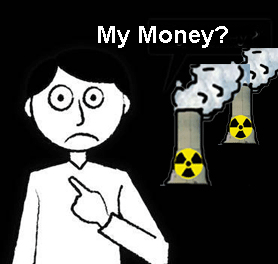 Obligating ratepayers to act as guarantors…
…. they seek to leverage the subsidies as a means to obligate ratepayers to act as guarantors of the plants’ profitability,
It is noteworthy that PSEG never offered to return any stranded-cost payments to ratepayers and now has the temerity to argue that this $3 billion wealth transfer should not be considered in determining whether the nuclear plants require further subsidization.
Despite the efforts of PSEG and Exelon to ignore precedent and establish their preferred regulatory structure, the fact remains that the BPU and Legislature removed precisely these types of costs and risks from ratepayer responsibility long ago.
|
Ratepayers held up their side of nuclear deal. PSEG must do the same https://www.njspotlight.com/2021/03/nj-board-public-utilities-must-decide-massive-nuclear-subsidies-pseg-drumbeat-no-justification-responsibility-costs-risks/ STEVEN S. GOLDENBERG | MARCH 3, 2021
There is no justification for PSEG’s effort ‘to require ratepayers to assume responsibility for the costs and risks associated with the continued operation’ of its nuclear plants
With the issue regarding the propriety of nuclear subsidies — known as Zero Emission Certificates or ZECs — again before the Board of Public Utilities, the predictable PSEG-inspired public drumbeat supporting its nuclear plants has begun. News outlets, including NJ Spotlight News, have recently featured articles and editorials that tout the benefits the nuclear plants confer on the state, and are intended to gin up support for extending the current $300 million annual ratepayer subsidies. Continue reading
|
Ohio Senate votes unanimously to repeal nuclear plant bailout
 Ohio Senate votes to repeal nuclear plant bailout, Toledo Blade https://www.toledoblade.com/local/politics/2021/03/03/ohio-senate-votes-to-repeal-nuclear-plant-bailout/stories/20210303112, JIM PROVANCE
COLUMBUS — Making its biggest statement yet in the wake of a $61 million Statehouse bribery scandal, the Ohio Senate voted unanimously Wednesday to kill a controversial $1 billion bailout of two northern Ohio nuclear power plants.
The chamber, however, kept the portion of the now tainted House Bill 6 passed in 2019 that provides $20 million a year to support qualifying utility-scale solar projects.
If the House of Representatives agrees, the bill would remove provisions of the law requiring electricity customers to pay $150 million a year in surcharges to support operation of the Davis-Besse nuclear power plant near Oak Harbor and the Perry plant east of Cleveland. Together, the two plants along Lake Erie directly employ about 1,400 people.
“This is something that will undo what I feel is an awful lot of damage that has been done, not just to our institution but to the state of Ohio,” he said.The decision to end the nuclear credits was made easier by the decision of the plants’ owner, Energy Harbor, to forgo the money after federal rules were changed to penalize providers in the competitive electricity marketplace if they accept state subsidies.
Two individuals and a nonprofit corporation involved in the bribery scheme have already pleaded guilty to federal racketeering charges. Charges are still pending against three others, including former Ohio House Speaker Larry Householder (R., Glenford), in connection with the scheme to hide the flow of cash from Akron-based FirstEnergy Corp. and related entities.
The money was used to help elect representatives loyal to Mr. Householder, help elect him speaker, and then enact the nuclear bailout sought by what was then a FirstEnergy subsidiary but is now the independent Energy Harbor.
The Senate’s move Wednesday does not undo provisions of House Bill 6 that roll back and then eliminate prior statutory mandates that utilities produce more of their power from renewable sources and reduce energy consumption overall.
There also are competing bills, including one that passed the Senate and is now in the House that would repeal House Bill 6 provisions that would have locked in FirstEnergy Corp. profits regardless of what happened in the electricity marketplace. FirstEnergy has already agreed not to take advantage of that provision this year.
The House also has its own bill pending to repeal the nuclear and revenue guarantee provisions.
Senate President Matt Huffman (R., Lima) said no agreement has been reached with the House as to which vehicle legislation will be sent to Gov. Mike DeWine’s desk.
“I was part of the discussion in the last month or so of the last General Assembly, and in general conversations with Speaker [Bob] Cupp at that time, about things that collectively the House and Senate could get enough votes to pass,” he said. “Those are the first two things that we have done….
“I think those things are supported by a significant majority,” Mr. Huffman said. “You can see they were passed unanimously out of the Senate, so we can deal with those two significant problems of House Bill 6…. It certainly doesn’t mean it’s the end of the discussion regarding those things.”
With the initial passage of House Bill 6, the plants’ owner, then FirstEnergy Solutions, proceeded with refueling Davis-Besse, clearing a potential major hurdle in the plant’s continued operation.
Russia’s most high-tech multi-purpose nuclear submarine further delayed
Russia’s most high-tech multi-purpose nuclear sub further delayed
The first upgraded cruise missile submarine of the Yasen-M class, the Kazan, will for unknown reasons have to sail another test-voyage before being handed over to the Northern Fleet. Barents Observer, 3 Mar 21, By Thomas Nilsen
New date for possible handover is set for May-June 2021, TASS reports with a source in the military-industrial complex. The state-affiliated news agency is known voicing military insights, but also for sugarcoating facts.
Another factory sea trial is planned, to be followed by an audit of the components and mechanisms, the source said without elaborating on which technical design flaws are to be fixed this time.
The “Kazan” was expected to be handed over from the submarine builder Sevmash yard to the Northern Fleet last Friday.
“The lead nuclear submarine “Kazan” can be handed over to the Russian Navy on February 26, the head of the United Shipbuilding Corporation, Aleksey Rakhmanov told RIA Novosti as late as on February 10.
Why the prestigeous submarine is hold back for more testing is unkown……..
Since first scheduled for delivery to the navy in 2017, the submarine has been notoriously delayed. A planned delivery in 2018 was postponed to 2019. That year came with another announcement that the “Kazan” would probably need all of 2020 to fix a number of auxiliary parts and assemblies which did not met the tactical and technical requirements set by the Ministry of Defense, the Barents Observer reported at the time……… https://thebarentsobserver.com/en/security/2021/03/russias-most-high-tech-multi-purpose-nuclear-sub-further-delayed
1 This Month
23-25 October – on Zoom – World BEYOND War’s annual global conferenc


Shut down the radiation-damaged Heysham nuclear reactors now
To see nuclear-related stories in greater depth and intensity – go to https://nuclearinformation.wordpress.com

Say No to NASA’s Reckless Nuclear Reactor on the Moon
Say No to NASA’s Reckless Nuclear Reactor on the Moon

-
Archives
- October 2026 (231)
- September 2026 (339)
- August 2026 (330)
- July 2026 (355)
- June 2026 (287)
- May 2026 (306)
- April 2026 (356)
- March 2026 (251)
- February 2026 (267)
- January 2026 (308)
- December 2025 (358)
- November 2025 (359)
-
Categories
- 1
- 1 NUCLEAR ISSUES
- business and costs
- climate change
- culture and arts
- ENERGY
- environment
- health
- history
- indigenous issues
- Legal
- marketing of nuclear
- media
- opposition to nuclear
- PERSONAL STORIES
- politics
- politics international
- Religion and ethics
- safety
- secrets,lies and civil liberties
- spinbuster
- technology
- Uranium
- wastes
- weapons and war
- Women
- 2 WORLD
- ACTION
- AFRICA
- Atrocities
- AUSTRALIA
- Christina's notes
- Christina's themes
- culture and arts
- Events
- Fuk 2022
- Fuk 2023
- Fukushima 2017
- Fukushima 2018
- fukushima 2019
- Fukushima 2020
- Fukushima 2021
- general
- global warming
- Humour (God we need it)
- Nuclear
- RARE EARTHS
- Reference
- resources – print
- Resources -audiovicual
- Weekly Newsletter
- World
- World Nuclear
- YouTube
-
RSS
Entries RSS
Comments RSS

