Nuclear power losing out in the UK – not a good omen for the global nuclear industry
 Seeking Alpha 13th March 2021, My comments on offshore wind making other forms of energy uncompetitive in 2017 have only become more clear in the past 3 years. Now the adoption ofnoffshore wind is happening elsewhere around the world including in the US, Japan, South Korea, Taiwan, China, India.
not one, but 16 of these plants with a capacity of 440 MW at a cost of 2 billion pounds each.
The Rolls Royce strategy is that by building multiple SMRs it will get good at it and the cost might go down. The reality behind this proposal is that it seems pretty ambitious to set out to build 16 plants before one has been successfully constructed. Time seems against this concept as the UK will have largely exited nuclear power by 2030.
China maintains only a lean nuclear weapons force – aimed at survival if attacked.
When it comes to China’s nuclear weapons, numbers aren’t everything
Threat inflation tends to lead to poor policy outcomes. When it comes to China’s nuclear arsenal, it’s important for American leaders to accurately understand the nature of the problem. Nuclear risks between the United States and China manifest differently than those of the past U.S.-Soviet nuclear competition, or that of the United States and Russia today.
Concerns regarding nuclear use in the U.S.-China context stem from, among other things, mutual mistrust and the manipulation of risk below the nuclear threshold, largely from qualitative force posture and strategy choices each country has made. Quantitative factors — most importantly the size of China’s nuclear arsenal — are less pressing.
Despite this reality, a recent exchange between Sen. Tom Cotton, R-Ark., and Adm. Philip Davidson, commander of U.S. Indo-Pacific Command, reveals how the nature of nuclear risk with China continues to be mischaracterized in Washington. Cotton expressed concern during a Senate hearing that China may attain “nuclear overmatch” against the United States if it were to triple or quadruple its nuclear stockpile. Adm. Davidson agreed.
But Cotton misstated the degree to which China may expand its nuclear warhead stockpile relative to the United States. In doing so, he suggests the United States should focus more on quantitative nuclear arms racing, stating that “it is much better to win an arms race than to lose a war.”
Cotton’s framing gets several facts wrong. First, the U.S. Defense Department’s most recent report on the Chinese military states that China’s warhead stockpile is “currently estimated to be in the low-200s.” This pales in comparison to the total U.S. inventory of 5,800 nuclear warheads.
Of these, 3,800 are available for deployment, with approximately 1,400 warheads already on alert delivery systems. Additionally, 150-200 gravity bombs sit in protected bunkers at five European air bases. Insofar as “overmatch” — a concept with little use to nuclear strategists — exists, it is squarely with the United States.
Cotton also incorrectly suggests that the U.S.-Russia New START arms control pact limits the United States to “800 deployed nuclear weapons.” In reality, New START permits 1,550 deployed warheads (including bombers counted as a single warhead apiece per treaty rules).
So why are senior officials and members of Congress so focused on numerical comparisons? Examining qualitative differences between U.S. and Chinese nuclear forces and accompanying doctrines is harder to do. These differences tell a slightly less alarmist story when it comes to the bilateral nuclear competition, but by no means present easy answers to the project of deterring China or avoiding nuclear war.
Since China’s first nuclear test in 1964, its leaders have not sought to “race to parity” with the United States and Russia. This policy originates in part from former chairman of the People’s Republic of China, Mao Zedong, whose had a dismissive view of nuclear weapons, calling them “paper tigers.” But even as China has modernized its nuclear forces and practiced more sophisticated nuclear operations, it maintains a lean nuclear force — one postured to survive an adversary’s first strike and still credibly maintain the “minimal means of reprisal.” Ongoing Chinese investments in road-mobile intercontinental ballistic missiles and better submarine-launched ballistic missiles support this goal……………
Overinflating the nature of the challenge from China’s nuclear forces would be especially unwise if it leads to U.S. overinvestment in nuclear systems, when the challenges in the Asia-Pacific region today require improved conventional deterrence. Strategy, after all, requires matching ends with means. Bipartisan support already exists for new conventional firepower, as evidenced by approval for the Pacific Deterrence Initiative…………..
Chinese leaders, meanwhile, should view the Cotton-Davidson interaction as an example of how U.S. officials may interpret China’s nuclear modernization in a vacuum of information and dialogue. Chinese officials have ducked U.S. offers for strategic dialogue in recent years; hopefully, following an upcoming ministerial meeting, U.S. and Chinese civilian and military officials can discuss — and begin to define — strategic stability. By beginning this dialogue, U.S. officials can focus on solving the qualitative challenges that actually exist, rather than getting bogged down in imagined concerns about “overmatch.” https://www.defensenews.com/opinion/commentary/2021/03/13/when-it-comes-to-chinas-nuclear-weapons-numbers-arent-everything/
In Germany, the Greens are likely to be propelled into government in the national vote
Times 14th March 2021, The national vote is expected to propel the Greens into government for the first time since 2005 — either as junior partner to the CDU/CSU or even as the leader of a so-called “traffic light coalition” with the Social Democrats (red) and the liberal Free Democrats (yellow).
The Baden-Württemberg poll — and another today in neighbouringRhineland-Palatinate — are the first key indicators of what lies ahead. Tucked in the southwest corner of Germany between France and Switzerland, Baden-Württemberg is at first sight an unlikely Green stronghold. The
state is home to Mercedes-Benz and Porsche, and hundreds of thousands of jobs in the area around Stuttgart, the state capital, depend on the car industry. But in 2011, in the wake of the Fukushima nuclear disaster in Japan, Kretschmann became Germany’s first — and so far only —Green state premier after running on a platform to shut nuclear plants, impose speed limits on the autobahn and reform an elitist school system. He was re-elected five years later after his party’s share of the vote surged to a record 30 per cent.
https://www.thetimes.co.uk/article/greens-set-to-redraw-germanys-political-landscape-b6xmvnspt
Nuclear power is unpopular: promoted only by those with vested interests/

Bellona 12th March 2021,Nuclear advocates point to the development of new technologies, such as small modular reactors, which can be deployed locally, and whose small scale limits the potential for Fukushima-sized accidents.
month for Nature, the influential US scientific journal, they assert that the nuclear industry has long ago lost touch with the public it is meant to serve.
Germany pledgse to work towards a nuclear free Europe
Ten years after the Fukushima nuclear disaster in Japan, German environment minister Svenja Schulze insisted that the country does not consider nuclear energy an option for low-carbon power production. “Nuclear power is neither safe nor clean,” Schulze said, rejecting the “myth” that the technology could help to find a way out of the climate crisis. “The future is for renewable energy,” she said. Germany’s phase-out decision, originally taken in the year 2000 and confirmed after the 2011 meltdown of the power plant in Japan, had “brought peace to a social conflict that raged for decades” and helped minimise a major risk at least nationally, Schulze said.
Nuclear power could not be in Germany’s interest when it is generated abroad either, “be it in our immediate neighbourhood, in the EU or globally”, the minister said, adding that “our work has not ended with the German nuclear exit”. The environment ministry published a position paper listing 12 key objectives required to reduce nuclear risk even further. They include actions under the three sections of a) completing the German nuclear phase-out: Close nuclear plants, promote final storage, accelerate the expansion of renewable energies; b) reducing nuclear risks in Europe, strengthen cooperation; and c) increasing nuclear safety worldwide, maintain nuclear risk competence and provide appropriate information.
Today we commemorate the catastrophic #nuclear accident that took place in #Fukushima 10 years ago. This disaster has shown us the risks of #NuclearEnergy. Also @SvenjaSchulze68
With a view to the decision by Germany’s largest neighbour country France to extend the running time of old nuclear reactors, she said that while the “principle of energy sovereignty” would have to be respected, there are “technical and economic limits to retrofitting”. Especially plants near the German border would be “monitored very closely and critically”, the minister said, adding that the German government expected France to enable “comprehensive cross-border cooperation” on the matter. More than half of all EU states do not use nuclear power at all or are considering a phase-out, Schulze said.
“Together with likeminded countries in Europe, I will actively work towards more countries joining the phase-out of nuclear power,” she stated. Schulze minister colleagues from Austria and Belgium, Leonore Gewessler and Tinne van der Straeten, joined her German counterpart in a joint message published on Twitter, in which the three state representatives said they will work towards ending the use of nuclear power in Europe and pave the way for an energy system solely based on renewables.
Nuclear “poison for a secure and climate-just future” – NGOs
Ten years after the disaster, Japanese officials in Fukushima still grapple with key questions regarding the removal, storage and processing of the plant’s nuclear waste. These problems remain unresolved and many former residents are still not allowed to return to their homes, Schulze said. “If we’ve learned something from all this then it has to be the common goal to protect people from further devastation from nuclear power.” For Germany, nuclear power’s “residual risk” simply had been too significant to carry on with the technology, she argued. Of the six remaining reactors in the country, three will go offline as planned in 2021 and the remaining three at the end of 2022. A 2019 survey found that 77 percent of people in Germany support the nuclear phase-out and 60 percent also its quick finalisation by the end of next year.
A group of more than 50 civil society and environmental groups backed the government’s stance on excluding nuclear energy from Germany’s emissions reduction plans, arguing that claims about the technology being “climate neutral” and “environmentally friendly” would be “poison for a secure and climate-just future”. In a joint letter, the group including NGOs like Germanwatch, BUND, NABU or PowerShift said nuclear power could have no future in energy systems and called on the government to double down on its efforts to phase-out the technology, including a shutdown of uranium enrichment facilities in Germany and an end of EU nuclear power project funding. Investments instead should flow into renewable power, storage technology and efficiency gains, the group argued.
Global nuclear industry in decline since 1996, even without Fukushima disaster
|
Clean Energy Wire 11th March 2021, Germany right to stick to nuclear exit despite revival plans abroad – media comments. On the tenth anniversary of the Fukushima nuclear desaster, a majority of media commentators in Germany praised the country’s decision to exit the technology for good. Nuclear power may be gaining new advocates and investors around the world due to its [very dubiously] potential role in enabling a climate neutral economy, but the technology’s days are numbered, Christoph von Eichhorn writes in the Süddeutsche Zeitung.
“When the devastating wave hit Japan’s shores and destroyed the Fukushima-Daiichi nuclear plant, it hit a technology that was in decline already – even without having experienced three nuclear meltdowns at once,” von Eichhorn argues, adding that the global nuclear power share reached a peak at around 17 percent in 1996 and has declined ever since to around ten percent today.
Almost no country announced a nuclear exit after the disaster, but it led to higher regulatory hurdles, tighter safety measures, and cost increases that make the technology less and less profitable, von Eichhorn adds.
|
|
Japan’s main opposition party -”Japanese society is viable without operating nuclear power plants”
|
Mainichi 12th March 2021, Yukio Edano, leader of the main opposition Constitutional Democratic Party of Japan (CDP), expressed his intention to aim for the elimination of
nuclear power in Japan on March 11 — the 10th anniversary of the 2011 Great East Japan Earthquake and tsunami — after earlier stating it was no easy task. Edano’s declaration appeared to be a response to criticism over
his recent comment that “ending nuclear power is not easy.” Edano told reporters at the Diet, “It has been demonstrated during these 10 years that Japanese society is viable without operating nuclear power plants. I intend to make a society that does not depend on nuclear power permanent.” https://mainichi.jp/english/articles/20210312/p2a/00m/0na/002000c |
|
Fukushima: “How Japan was blinded to the predicted certainty of disaster”.
Anxieties over Turkey’s new Russian-backed nuclear plants
Turkey’s nuclear power dilemma, Turkey’s first Russia-backed nuclear plant has raised issues around its safety and potential for use in building nuclear weapons. Al Jazeera, By Sinem Koseoglu. 10 Mar 2021
Istanbul, Turkey – Turkish and Russian officials laid the foundation for the third reactor of Turkey’s first nuclear power plant Akkuyu in the southern coastal city of Mersin on Wednesday.
The plant’s first reactor unit is expected to be operational in 2023, the centenary of the Turkish Republic, and the remaining units in 2026.
The co-construction of the Akkuyu plant started in April 2018, eight years after the two countries signed an intergovernmental agreement.
The project is owned by the Russian energy company Rosatom while the Turkish Akkuyu is the license owner and the local operator.
Once completed, the plant is expected to produce 35 billion kilowatt-hours (kWh) of electricity annually, about 10 percent of Turkey’s total electricity supply. The service life will last 50 years.
The facility will launch Turkey into the ”league of nuclear energy countries”, President Recep Tayyip Erdogan said, hailing it as a “symbol of Turkish-Russian cooperation”.
Russian President Vladimir Putin, who spoke at the event via video-conference from Moscow, called it a “truly flagship project”.
Akkuyu is the only nuclear power facility under construction in Turkey but a second project in the Black Sea province of Sinop is expected to kick off this year, reports suggest, if Ankara can find a new partner after Japan’s Mitsubishi pulled out last year.
The project was agreed on by the Japanese and Turkish governments in 2013. A consortium led by Mitsubishi Heavy Industries conducted a feasibility study until March for the construction of a 4,500-megawatt plant in Sinop.
A senior energy official, speaking on condition of anonymity, told Al Jazeera the Turkish government is also considering a third nuclear plant with four reactors in the country’s northwest. Turkey’s ultimate goal is not building a nuclear weapon but diversity in energy resources, he said.
Russian dependency?
Since the Akkuyu project was signed, proponents of nuclear energy in Turkey have argued it would limit Turkey’s dependency on foreign energy suppliers. They also underline it is clean energy. [clean???]
However, some international experts think differently. Henry D Sokolski, executive director of the Nonproliferation Policy Education Center in Washington, DC, said Akkuyu’s financing model could further Ankara’s dependency on Russia, a major energy provider to Turkey. The project is fully financed by Moscow.
Sokolski said it is an intensive capital investment and questioned why Turkey frontloads such debt while alternative and cheaper energy resources are coming down the pipeline.
Could Akkutu be a target?
Turkey is not the only country seeking nuclear energy in the Middle East. Saudi Arabia and Jordan are still considering establishing nuclear power plants. Egypt and the United Arab Emirates (UAE) are in on it, while Israel is long believed to have a stockpile of nuclear weapons and Iran has the capacity to develop them.
Sokolski warned Turkey about the regional challenges of entering the fray. “Your neighbourhood is dangerous. People are fighting. Nuclear reactors in a shooting war can be targets.”
He said missiles and drones could knock out critical electrical supply lines to a reactor and destroy emergency generators, nuclear control rooms, reactor containment buildings, and spent reactor fuel buildings.
“These kinds of strikes can make people more anxious and result in radiological releases, like Chernobyl or worse,” said Sokolski.
Turkey has waged a war against the PKK, the outlawed Kurdistan Workers’ Party listed as a “terrorist” organisation by the United States, the European Union, and Turkey, for decades in a conflict that has killed an estimated 40,000 people.
News reports have suggested the armed group has camps in northern Iraq where armed drones are being developed.
Turkey is also embroiled in conflicts in Syria and the eastern Mediterranean, while the Iran-aligned Houthi rebels in Yemen have targetted Saudi and Emirati targets with its missiles and drones. Armed groups such as the Syrian National Defence Forces, which is supportive of President Bashar al-Assad’s government, could mimic such attacks, said Sokolski.
Turkey has waged a war against the PKK, the outlawed Kurdistan Workers’ Party listed as a “terrorist” organisation by the United States, the European Union, and Turkey, for decades in a conflict that has killed an estimated 40,000 people.
News reports have suggested the armed group has camps in northern Iraq where armed drones are being developed.
Turkey is also embroiled in conflicts in Syria and the eastern Mediterranean, while the Iran-aligned Houthi rebels in Yemen have targetted Saudi and Emirati targets with its missiles and drones. Armed groups such as the Syrian National Defence Forces, which is supportive of President Bashar al-Assad’s government, could mimic such attacks, said Sokolski.
Atomic weapon suspicions
Despite Turkey’s claims the plant will only be used to diversify energy resources, some have suggested Ankara may have plans to enrich uranium.
Turkey and nuclear-armed Pakistan have long had military cooperation agreements that were recently intensified, with some news reports suggesting Islamabad may be covertly supporting a nuclear weapons programme.
Military cooperation deals have been signed earlier this year with Kazakhstan, a country providing at least 35 percent of the world’s uranium…….https://www.aljazeera.com/news/2021/3/10/turkeys-nuclear-dilemma
Ohio House passes its version of Bill rescinding nuclear subsidies
House Bill 128 passed 86-7 on Wednesday afternoon. The bill also would revoke “decoupling” language in HB6 that guaranteed revenue for FirstEnergy at 2018 levels, and language that likely would have made it easier for FirstEnergy to pass a state test meant to prevent utilities from making excessive profits.
Of note, a House committee before passing the bill earlier this week changed it to add back in language offering $20 million in annual solar subsides to six large-scale solar projects. Developers behind some of the projects, some of which are have been completed or are close to it, told lawmakers that revoking the funding would economically undermine the deals they had made with companies that had agreed to buy the power they generated.
Other portions of HB6 so far have remained untouched, provisions eliminating energy efficiency programs and renewable energy mandates, and subsidizing two coal plants — one in Indiana, one in Ohio — owned by a consortium of Ohio utility companies.
Ohio House and Senate leaders will have to sort out how they line up the competing versions of the bills. Any law change requires approval by both chambers before heading to Gov. Mike DeWine for his signature….. https://www.cleveland.com/open/2021/03/ohio-house-passes-their-version-of-bill-rescinding-nuclear-subsidies.html
Nuclear power not an option for Taiwan,
|
Nuclear power not an option: Su https://www.taipeitimes.com/News/front/archives/2021/03/10/2003753555CHANGING TRENDS: A world report showed that in 2019, non-hydro renewables surpassed nuclear power in global electricity generation, environmentalists said, By Lee I-chia / Staff reporter, 10 Mar21,
Premier Su Tseng-chang (蘇貞昌) yesterday said that reviving the Fourth Nuclear Power Plant project would be impossible, adding that the government has always believed that the power plant should not be started. Su made the remarks in response to questions by Chinese Nationalist Party (KMT) Legislator Lu Yu-ling (呂玉玲) about a campaign by environmentalists to hold a referendum on a government plan to build a liquefied natural gas (LNG) terminal off the coast of Datan Borough (大潭) in Taoyuan’s Guanyin District (觀音) on the grounds that it would damage the algal reefs there. Lu asked if the mothballed Fourth Nuclear Power Plant in New Taipei City’s Gongliao District (貢寮) would be a backup plan if the LNG project is scrapped. The premier said the nuclear power plant project was suspended during the administration of former president Ma Ying-jeou (馬英九), and that the disposal of nuclear waste from the nation’s first and second nuclear power plants remains a problem, so it would be impossible to restart construction of the fourth plant now. In related news, the Green Citizens’ Action Alliance yesterday said the share of non-hydro renewables in global electricity generation exceeded that of nuclear power for the first time in 2019, implying that nuclear energy is a declining industry, and that Taiwan should push its energy transition policy forward. The environmental group cited data from the World Nuclear Industry Status Report 2020, published in September last year, of which it was authorized to release a summary in traditional Chinese. The 361-page report provides an assessment of “the status and trends of the international nuclear industry and analyzes the additional challenges nuclear power is facing in the age of COVID-19,” with contributions by seven interdisciplinary experts from Canada, France, Germany, Japan, Lebanon, the US and the UK, the report’s Web site says. Alliance researcher Chen Shi-ting (陳詩婷) said the contributors included Mycle Schneider, an independent international energy and nuclear analyst and consultant who is also the convening lead author of the report; and Tadahiro Katsuta, an associate professor at Meiji University in Tokyo, Japan. Citing the report, alliance researcher Dennis Wei (魏揚) said the share of nuclear energy in the global electricity generation mix peaked at 17.5 percent in 1996 and dropped to only 10.35 percent in 2019. In 2019, non-hydro renewables, such as solar, wind and biomass, generated 10.39 percent of total global electricity, marking the first time in history that renewable energy sources generated more electricity than nuclear power plants, he said. That year, wind and solar power generation increased by 13 percent and 24 percent respectively, while nuclear energy rose by only 3.7 percent, with China accounting for half of the increase, Wei said. Moreover, the cost of nuclear power has continued to increase, rising by 26 percent from 2009 to 2019, while the cost of natural gas dropped by 33 percent, solar power by 89 percent and wind power by 70 percent, he said. Total investment in renewable energy in 2019 exceeded US$300 billion, while investment in nuclear power was only about US$31 billion, showing that nuclear power is losing competitiveness in the global energy market, and that except for China, building nuclear reactors is not a global trend anymore, Wei said. Additional reporting by CNA |
|
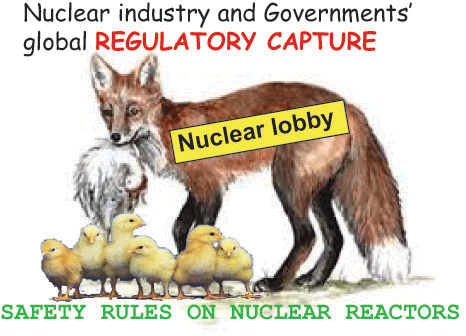
10 years after Fukushima – still nuclear regulatory capture, and poor safety culture
 10 years after Fukushima, safety is still nuclear power’s greatest challenge The Conversation, March 6, 2021 Kiyoshi Kurokawa, Professor Emeritus, University of Tokyo, Najmedin Meshkati, Professor of Engineering and International Relations, University of Southern California ” …………A decade later, the nuclear industry has yet to fully to address safety concerns that Fukushima exposed.We are scholars specializing in engineering and medicine and public policy, and have advised our respective governments on nuclear power safety. Kiyoshi Kurokawa chaired an independent national commission, known as the NAIIC, created by the Diet of Japan to investigate the root causes of the Fukushima Daiichi accident. Najmedin Meshkati served as a member and technical adviser to a committee appointed by the U.S. National Academy of Sciences to identify lessons from this event for making U.S. nuclear plants safer and more secure. 10 years after Fukushima, safety is still nuclear power’s greatest challenge The Conversation, March 6, 2021 Kiyoshi Kurokawa, Professor Emeritus, University of Tokyo, Najmedin Meshkati, Professor of Engineering and International Relations, University of Southern California ” …………A decade later, the nuclear industry has yet to fully to address safety concerns that Fukushima exposed.We are scholars specializing in engineering and medicine and public policy, and have advised our respective governments on nuclear power safety. Kiyoshi Kurokawa chaired an independent national commission, known as the NAIIC, created by the Diet of Japan to investigate the root causes of the Fukushima Daiichi accident. Najmedin Meshkati served as a member and technical adviser to a committee appointed by the U.S. National Academy of Sciences to identify lessons from this event for making U.S. nuclear plants safer and more secure.
Those reviews and many others concluded that Fukushima was a man-made accident, triggered by natural hazards, that could and should have been avoided. Experts widely agreed that the root causes were lax regulatory oversight in Japan and an ineffective safety culture at the utility that operated the plant. These problems are far from unique to Japan. As long as commercial nuclear power plants operate anywhere in the world, we believe it is critical for all nations to learn from what happened at Fukushima and continue doubling down on nuclear safety. |
|
Cash-strapped Japanese nuclear company funds road plans near idle nuclear plant
Cash-strapped JAPC funds road plans near idle nuclear plant, THE ASAHI SHIMBUN
March 8, 2021, TSURUGA, Fukui Prefecture—Multibillion-yen road projects continue on a peninsula here, funded in part by a nuclear power company that has gained no income from electricity for a decade.
The roads were planned decades ago for the expected expansion of the Tsuruga Nuclear Power Plant here. Although all nuclear operations and construction at the nuclear plant have long been halted, the work on the roads has not stopped.
“We are building a new road,” said a signboard near an area where heavy vehicles were removing dirt from the site of a planned tunnel in the city of Tsuruga, Fukui Prefecture, in mid-February.
The sign included an apology for causing an inconvenience to motorists.
The city roads being built are Nishiura Route No. 1 and No. 2 on the sparsely populated eastern side of a peninsula that juts out into the Sea of Japan separating Wakasa and Tsuruga bays.Japan Atomic Power Co. (JAPC) and Kansai Electric Power Co. (KEPCO) plan to provide 1.5 billion yen ($14 million) to Tsuruga for road construction from fiscal 2018 to fiscal 2021, according to sources.
JAPC owns three nuclear reactors, including two at the Tsuruga Nuclear Power Plant. But all three reactors have been shut down since the 2011 Fukushima disaster, meaning that JAPC has had zero income from electric power generation for a decade.
The neighboring town of Mihama hosts the KEPCO-run Mihama Nuclear Power Plant, which has also been shut down since 2011.
So where does JAPC’s money for the roads come from?
JAPC had derived income from selling its electricity to five major utilities—Tokyo Electric Power Co., KEPCO, Tohoku Electric Power Co., Hokuriku Electric Power Co. and Chubu Electric Power Co. After the Fukushima nuclear disaster, JAPC’s management has relied on the basic electricity rates paid by the five major electric companies.
The basic rates come mainly from electricity bills that consumers pay.
Some experts are concerned that JAPC’s continued generous aid for road construction could affect the electricity rates charged by the five utilities.
The plans to build the two city roads were hatched around 1993, when the Fukui prefectural assembly passed a resolution to build the No. 3 and No. 4 reactors at the Tsuruga plant.
The work was expected to increase traffic of large vehicles into the peninsula………..By fiscal 2021, JAPC and KEPCO will have provided 4.06 billion yen to the city for the road construction.
After fiscal 2022, the city government said it will tell the companies how much they should pay “from fiscal year to fiscal year.”
JAPC shoulders 58 percent of the costs, while KEPCO pays 42 percent. The ratio “was decided by the business operators,” and the city government “does not know how it was decided,” an official said.
After its reactors were shut down and its business conditions deteriorated, JAPC was criticized for providing such generous donations to Tsuruga.
JAPC in 2013 demanded that the city not list its donations in the financial document, and the payments were not recorded in fiscal 2012 and fiscal 2013, the sources said.
……… KEPCO’s public relations office said the company “will be actively involved in” the city’s road construction projects, but declined to reveal the amount it has provided.
As of the end of January this year, there were 520 people living in the peninsula registered as residents of Tsuruga. The peninsula has hosted seven nuclear reactors, of which five have been under decommissioning work.
The planned city-owned Nishiura Route No. 2 will be 800 meters long. The construction site is located north of the center of the Tsuruga city.
The estimated cost to build this road is 1.46 billion yen.
A former Fukui prefectural official who was familiar with the deal-making process said.
JAPC offered the money “as a quid pro quo for the city’s acceptance of the nuclear plant’s expansion plan.”
The innkeeper who wanted the roads in the area also noted that times have changed since the start of construction.
“The traffic of vehicles related to nuclear power plants has drastically decreased compared to the times before the Fukushima accident,” the innkeeper said. “I don’t know if the roads are really needed.”
(This article was written by Hideki Muroya and Tsunetaka Sato.) http://www.asahi.com/ajw/articles/14250714
Battle coming in U.S. Congress over spending on nuclear weapons

|
Lawmakers gird for spending battle over nuclear weapons, The Hill, BY REBECCA KHEEL – 03/07/21 Nuclear weapons are emerging as one of the top political brawls in the brewing battle over next year’s defense budget.Democrats have been introducing bills to curtail costly nuclear modernization programs, as well writing letters urging President Biden to support their efforts.
But Republicans are shooting back with their own letters and op-eds calling on Biden to stay the course on programs that largely originated during the Obama administration. They’re also working to pin down Pentagon nominees on where they stand. The back-and-forth over nuclear modernization is providing a lens into the larger fight that’s taking shape as the Biden administration prepares to present its first defense budget in the spring. Expectations are that the administration will keep funding flat. In one of the latest salvos, top Republicans on the House Armed Services Committee said Biden should boost defense spending by 3 to 5 percent, in part citing nuclear modernization needs, as well as bolstering cyber and naval capabilities……. But even the Trump administration had projected a relatively flat defense budget in fiscal year 2022 compared to the $740 billion defense budget in fiscal 2021, amid other pressures such as a growing national debt. As the Biden administration faces a time crunch in crafting its first budget proposal, Deputy Defense Secretary Kathleen Hicks in a February memo directed a review of a select group of programs, including low-yield nuclear warheads and nuclear command and control, according to multiple reports. The Trump administration developed and deployed a submarine-launch low-yield nuclear warhead, dubbed the W76-2 warhead, that Democrats argued raised the risk of nuclear war by potentially lowering the threshold for the U.S. willingness to use nuclear weapons. Trump officials were also in the early stages of developing a new nuclear-armed sea-launched cruise missile. On Thursday, Sen. Chris Van Hollen (D-Md.) and Rep. Joe Courtney (D-Conn.) introduced a bill to prohibit production and deployment, as well as research and development, of the nuclear-armed sea-launched cruise missile and its associated warhead. “Putting new, expensive nuclear warheads on attack submarines and surface ships that haven’t carried those weapons in almost thirty years is a distraction that will suck precious resources away from the most pressing need of the U.S. Navy—namely, to increase the size of its overworked fleet,” Courtney, chairman of the House Armed Services Committee’s seapower subcommittee, said in a statement. “This legislation is a common-sense bill that will stop the hemorrhaging of precious Navy dollars for a wasteful program that Congress barely debated.” An interim national security strategy released by the White House on Wednesday said the administration would “take steps to reduce the role of nuclear weapons in our national security strategy, while ensuring our strategic deterrent remains safe, secure, and effective and that our extended deterrence commitments to our allies remain strong and credible.” But Republicans have been pushing back against any potential changes to nuclear programs……………….. https://thehill.com/policy/defense/541906-lawmakers-gird-for-spending-battle-over-nuclear-weapons |
|
Japan’s government – fading support for nuclear power
East Asia Forum 6th March 2021, Ten years after the world watched the explosions at the Fukushima Daiichi Nuclear Power Plant, Japan’s pro-nuclear advocates have lost policy
implementation power.
As part of the three-yearly energy policy review, Prime Minister Yoshihide Suga’s government needs to decide on the electricity mix for 2030 this year — including the future of nuclear
power. But given the need to maintain safety standards and public opposition to building new reactors, Japan’s nuclear target is realistically constrained to no more than an 8–10 per cent share of projected power needs.
https://www.eastasiaforum.org/2021/03/06/waning-support-for-nuclear-power-10-years-after-fukushima/
1 This Month
23-25 October – on Zoom – World BEYOND War’s annual global conferenc


Shut down the radiation-damaged Heysham nuclear reactors now
To see nuclear-related stories in greater depth and intensity – go to https://nuclearinformation.wordpress.com

Say No to NASA’s Reckless Nuclear Reactor on the Moon
Say No to NASA’s Reckless Nuclear Reactor on the Moon

-
Archives
- October 2026 (231)
- September 2026 (339)
- August 2026 (330)
- July 2026 (355)
- June 2026 (287)
- May 2026 (306)
- April 2026 (356)
- March 2026 (251)
- February 2026 (267)
- January 2026 (308)
- December 2025 (358)
- November 2025 (359)
-
Categories
- 1
- 1 NUCLEAR ISSUES
- business and costs
- climate change
- culture and arts
- ENERGY
- environment
- health
- history
- indigenous issues
- Legal
- marketing of nuclear
- media
- opposition to nuclear
- PERSONAL STORIES
- politics
- politics international
- Religion and ethics
- safety
- secrets,lies and civil liberties
- spinbuster
- technology
- Uranium
- wastes
- weapons and war
- Women
- 2 WORLD
- ACTION
- AFRICA
- Atrocities
- AUSTRALIA
- Christina's notes
- Christina's themes
- culture and arts
- Events
- Fuk 2022
- Fuk 2023
- Fukushima 2017
- Fukushima 2018
- fukushima 2019
- Fukushima 2020
- Fukushima 2021
- general
- global warming
- Humour (God we need it)
- Nuclear
- RARE EARTHS
- Reference
- resources – print
- Resources -audiovicual
- Weekly Newsletter
- World
- World Nuclear
- YouTube
-
RSS
Entries RSS
Comments RSS

