There’s a long and devastating history behind the proposal for a nuclear waste dump in South Australia,

There’s a long and devastating history behind the proposal for a nuclear waste dump in South Australia, https://theconversation.com/theres-a-long-and-devastating-history-behind-the-proposal-for-a-nuclear-waste-dump-in-south-australia-158615,,,Katherine Aigner
PhD candidate Centre for Aboriginal Economic Policy, Australian National University On Saturday at the Adelaide Festival there will be a public showing of Australian Atomic Confessions, a documentary I co-directed about the tragic and long-lasting effects of the atomic weapons testing carried out by Britain in South Australia in the 1950s.
Amid works from 20 artists reflecting on nuclear trauma as experienced by Indigenous peoples, the discussion that follows will focus on the ways in which attempts at nuclear colonisation have continued in South Australia, and are continuing right now.
For the fourth time in 23 years South Australia is being targeted for a nuclear waste dump — this time at Napandee, a property near Kimba on the Eyre Peninsula.
The plan is likely to require the use of a port, most probably Whyalla, to receive reprocessed nuclear fuel waste by sea from France, the United Kingdom and the Lucas Heights reactor in NSW via Port Kembla.
The waste will be stored above ground in concrete vaults which will be filled for 100 years and monitored for a further 200-300 years.
Nuclear waste can remain hazardous for thousands of years.
The Barngarla people hold cultural rights and responsibilities for the region but were excluded from a government poll about the proposal because they were not deemed to be local residents.
The 734 locals who took part backed the proposal 61.6%
The Barngarla people are far from the first in South Australia to be excluded from a say about proposals to spread nuclear materials over their land.
It’s not the first such proposal
Australian Atomic Confessions explores the legacy of the nine British atomic bombs dropped on Maralinga and Emu Field in the 1950s, and the “minor trials” that continued into the 1960s.
After failed clean-ups by the British in the 1960s followed by a Royal Commission in the 1980s, the Australian Radiation Protection and Nuclear Safety Agency conducted a cleanup between 1995 and 2000 it assures us was successful to the point where most of the contaminated areas at Maralinga fall well within the clean-up standards applied for unrestricted land use.
But experts remain sceptical, given the near-surface burial of plutonium and contamination remaining across a wide area.
The Tjarutja people are allowed to move through and hunt at the Maralinga site with their radiation levels monitored but are not permitted to camp there permanently.
We are told that what happened in the 1950s wouldn’t happen today, in relation to the proposed nuclear waste dump. But it wasn’t our enemies who bombed us at Maralinga and Emu Field, it was an ally.
In exchange for allowing 12 British atomic bombs tests (including those at the Monte Bello Islands off the northern coast of Western Australia), the Australian government got access to nuclear technology which it used to build the Lucas Heights reactor.
It is primarily the nuclear waste produced from six decades of operations at Lucas Heights that would be dumped onto Barngarla country in South Australia, closing the links in this nuclear trauma chain.
Nuclear bombs and nuclear waste disproportionately impact Indigenous peoples, yet Australia still has not signed up to the United Nations Declaration on the Rights of Indigenous Peoples. The declaration requires states to ensure there is no storage or disposal of hazardous materials on the lands of Indigenous peoples without their free, prior and informed consent.
Nor has Australia shown any willingness to sign up to the Treaty on the Prohibition of Nuclear Weapons which came into force on January 22 this year after a lobbying campaign that began in Australia and was endorsed by Indigenous leaders worldwide.
Aboriginal people have long known the dangers of uranium on their country.
Water from the Great Artesian Basin has been extracted by the Olympic Dam copper-uranium mine for decades. Fragile mound springs of spiritual significance to the Arabunna People are disappearing, posing questions for the mining giant BHP to answer.
Australian uranium from BHP Olympic Dam and the now-closed Rio Tinto Ranger mine fuelled the 2011 Fukushima nuclear disaster.
Senior traditional custodian of the Mirrar people, Yvonne Margarula, wrote to the United Nations in 2013 saying her people feel responsible for what happened.
It is likely that the radiation problems at Fukushima are, at least in part, fuelled by uranium derived from our traditional lands. This makes us feel very sad.
The Irati Wanti (The Poison, Leave It!) campaign led by a council of senior Aboriginal women helped defeat earlier proposals for nuclear waste dumps between 1998 and 2004.
There remains strong Indigenous opposition to the current nuclear waste proposal.
Over the past five years, farmers have joined with the Barngarla People to protect their communities and the health of the land.
In 2020 the government introduced into the Senate a bill that would do away with traditional owners’ and farmers’ rights to judicial reviews and procedural fairness in regard to the use of land for the facility.
Resources Minister Keith Pitt is deciding how to proceed.
Dodgy European Taxonomy report was favourable to nuclear power – but it’s far from a done deal.

About EU Taxonomy Report , Joint Research Centre , JD Supra 9 Apr 21,
”……..While the JRC report has been well received by the nuclear industry, there are further administrative hurdles to be cleared prior to nuclear energy being deemed sustainable under the EU Taxonomy Regulation. The JRC report needs to be reviewed by two additional expert groups: (a) the group of experts on radiation and protection and waste management under Article 31 of the Euratom Treaty, and (b) the Scientific Committee on Health, Environmental and Emerging Risks, who deal with environmental impacts. These two groups are expected to issue their reports within the next three months and will inform the EU Commission’s final decision on the matter. There could of course be some delay as the Scientific Committee on Health, Environmental and Emerging Risks remains very occupied with COVID matters at the current time……”
An American village made dependent on the nuclear industry. Perry schools’ crisis if the nuclear power station shuts down

After Being “Promised Wealth:” What Happens to Perry if the Nuclear Power Plant Shuts Down? Spectrum News, By Micaela Marshall Cleveland, Apr. 08, 2021, PERRY, Ohio — What’s been called the largest corruption and money-laundering scheme in Ohio history has dominated headlines since last summer.
The political back-and-forth surrounding House Bill 6 has led to uncertainty in communities that rely on the two Ohio nuclear power plants caught up in the controversy.
What You Need To Know
The money-laundering scheme surrounding House Bill 6 has been in the headlines for months
House Bill 6 is a bailout for nuclear power plants
The halting of the bailout causes concerns the plants may close
The communities and schools depending on the employment at the plants are worried.
The village of Perry in Lake County is known for two things: The Perry Nuclear Power Plant and Perry Local Schools, and the relationship between the two is vital to the local economy. ……
Less than three miles away [from the schools complex] is the Perry Nuclear Power Plant.
It was commissioned in 1987 and a big promise was made to the people of Perry, in return for the risk of exposure.
“Back in the day, they were promised wealth that would go on through eternity,” Thompson said.
That guarantee held up at first and allowed for the Perry Local Schools District to become home to state-of-the-art facilities.
“We were able to build and have some amenities that were not common,” Thompson said.
The Goodwin Theatre, and a campus fitness center with an Olympic-sized pool are some of those amenities.
“You’re not going to see another district that’s built like this,” he said.
Grants have led to upgrades over the years. …..
The two-story building’s architecture is elaborate. There’s even a clock tower.
“It has absolutely zero use other than aesthetics,” Thompson said.
Many of the features are unique for a school, especially one in rural Ohio.
“You have this outside veranda that is just gorgeous,” he said pointing to the area outside the middle school.
………… “Nothing’s going to replace the revenue that the nuclear power plant has brought this community over the last 30 years,” Thompson said. ………. https://spectrumnews1.com/oh/columbus/news/2021/04/08/-they-were-promised-wealth-that-would-go-on-through-eternity–what-happens-to-perry-if-the-nuclear-power-plant-shuts-down-
France fully nationalises debt-laden EDF nuclear company, – EDF can now focus on renewable energy.
France reportedly to spend $12bn to buy out EDF minority shareholders
NS Energy 7th April 2021
POWERNUCLEARINVESTMENTBy NS Energy Staff Writer 07 Apr 2021
The move is part of the proposed restructuring of the multinational electric utility company
The French government is reportedly anticipating to spend around 10 billion euros ($11.87bn) to buy out minority shareholders in EDF.
The move is part of the proposed restructuring of the multinational electric utility company, in which the current ownership of the French government stands at 83.7%.
Currently under discussion between Paris and the European Commission, the restructuring is expected to result in the formation of a holding company, EDF SA, Reuters reported.
The holding company will be fully state-owned and the proposed restructuring of EDF is codenamed “Project Hercules.”
CGT union executive Sebastien Menesplier was quoted by the news agency as saying: “We are told the state will invest 10 billion euros to buy back the shares held by minority shareholders in order for EDF SA to become 100% state-owned.”
The French government has initiated Project Hercules in order to secure the future of the debt-laden nuclear unit of EDF.
The project was also conceived to enable more attractive part of the business not get impacted by the group’s liabilities.
The proposed restructuring is planned to include nationalisation of the holding company that will incorporate nuclear assets.
As part of the plans, a separate entity, which will be controlled by the holding company, will be created to hold more lucrative businesses.
EDF earlier said that it would be able to double its growth target for renewable energy if the planned restructuring was given go ahead.
The company expected to expand its renewable energy capacity to 100GW by 2030, if Project Hercules is rolled out.
In February, EDF Renewables, along with its partners Enbridge and wpd, started the construction activities at the 448MW Calvados offshore wind farm in France.
New defects in France’s Flamanville nuclear project. Doubts that it will start-up on time, – or indeed ever!
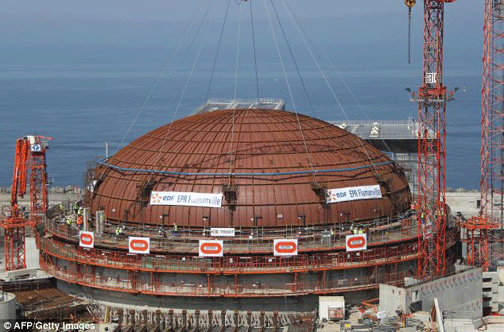
France Info 7th April 2021, Flamanville EPR: “The start-up does not seem possible before 2023” and we can doubt “that it will start one day”, according to negaWatt. “The decision to stop the costs is extremely difficult to take because we are talking about an investment of around 20 billion euros,” said energy expert and spokesperson for the association, Yves Marignac.
La Presse de la Manche 6th April 2021, The Nuclear Safety Authority was notified on March 17, 2021 of the late detection of faults in several pieces of equipment in reactors 1 and 2 at the Flamanville nuclear power plant, in the English Channel.
Japanese government continues Japan’s ”Nuclear Village” generous grants to keep ageing nuclear reactors going.

Lucrative grants offered to keep aging nuclear reactors running, http://www.asahi.com/ajw/articles/14326422
THE ASAHI SHIMBUN
April 7, 2021 The central government is offering billions of yen in new grants to Fukui Prefecture to allow a nuclear plant operator to run its aging reactors beyond their operational life span of 40 years.
Fukui is not the only prefecture in Japan that hosts old reactors, and the grants could create momentum toward the restarts of these units.
“As for an expansion of grants, up to 2.5 billion yen ($22.6 million) will be provided per nuclear plant to a prefecture preparing to respond to the extension of the 40-year life of reactors,” the Ministry of Economy, Trade and Industry said in a document presented to the Fukui prefectural government on April 6.
The ministry’s offer is expected to become a key point of discussions as Fukui Prefecture and the prefectural assembly begin to weigh whether they should approve of the restart of three reactors in question there.
Fukui Governor Tatsuji Sugimoto hailed the central government’s offer, calling it “a step forward.”
He had urged the prefectural assembly to discuss the restart issue in February, but the assembly put off the debate, citing a lack of measures to revitalize the local economy.
Osaka-based Kansai Electric Power Co. is pushing to reactivate the three reactors in Fukui Prefecture–the No. 1 and 2 reactors at the Takahama nuclear plant in Takahama and the No. 3 reactor at the Mihama nuclear plant in Mihama.
The Nuclear Regulation Authority has given its one-time permission to operate those reactors for 20 more years beyond their 40-year life spans.
If the local governments approve the restarts, Fukui Prefecture would receive a combined 5 billion yen under the new grant setup.
The town halls of Takahama and Mihama have already given the greenlight to the restarts. The remaining hurdle is whether the governor and the prefectural assembly will approve them.
The maximum 2.5 billion yen will be made available over a period of five years, according to the industry ministry’s Agency for Natural Resources and Energy.
The offer of the funds came in response to the Fukui prefectural government’s request for additional grants concerning the reactors as a measure to stimulate the local economy.
The prefectural government is expected to discuss how to distribute the grants with Takahama and Mihama.
Other prefectures hosting old reactors operated by companies seeking the 20-year extension will be eligible for the new grants.
The only other facility that has gained the NRA’s permission to operate beyond 40 years is the Tokai No. 2 nuclear plant in Ibaraki Prefecture.
Five other reactors in Japan have been in service for more than 35 years.
The decommissioning process has started for other aging reactors because their operators decided that upgrades and additional safeguard measures required to bring them back online would be too expensive.
(This article was written by Kenji Oda and Takayuki Sato.)
Scottish government firmly opposed to nuclear weapons and demands complete withdrawal of all nuclear weapons from Scotland
Scottish government firmly opposed to nuclear weapons and demands complete withdrawal of all nuclear weapons from Scotland https://www.helsinkitimes.fi/world-int/18924-scottish-government-firmly-opposed-to-nuclear-weapons-and-demands-complete-withdrawal-of-all-nuclear-weapons-from-scotland.html“Following the publication of the UK Government’s Integrated Review of Security, Defence, Development and Foreign Policy, the Scottish Government reaffirms that it is firmly opposed to the possession, threat and use of nuclear weapons – and it is committed to pursuing the safe and complete withdrawal of all nuclear weapons from Scotland,” the Scottish government said in a statement released today.
Britain is lifting the cap on the number of Trident nuclear warheads it can stockpile by more than 40% – from 180 to 260 warheads, Boris Johnson announced on Tuesday last week. This will end 30 years of gradual disarmament since the collapse of the Soviet Union. This would require a £24 billion (€27 billion) investment in response to “perceived” threats from Russia and China.
Ironically, Johnson criticised Iran for increasing its enriched Uranium stockpile in the same speech. Iran has signed the nuclear non-proliferation agreement and does not have any nuclear weapons.
Britain stockpiles its nuclear weapons at Coulport in the Clyde Area in Scotland. The depot consists of sixteen nuclear weapon storage bunkers. Trident missile warheads and conventional torpedoes are stored at the weapons depot, where they are installed and removed from submarines.
The United Kingdom is one of the five “official” nuclear weapon states and has been estimated to have a stockpile of 120 active nuclear warheads and 215 nuclear warheads in total.
The Scottish Parliament, in a meeting on Tuesday 3 November 2015, voted in favour of a motion calling on the UK government to drop plans to renew Trident nuclear weapons.
A review, ‘Scotland: A Good Global Citizen A Scottish Perspective on Climate, Defence, Security and External Affairs’, was published today. The publication outlines the Scottish Government’s position on a range of key international issues including a desire to engage proactively and energetically with the European Union, resolute support for international development, and a commitment to being a good global citizen.
Cabinet Secretary for Justice Humza Yousaf said:
“Scotland is an open, welcoming nation, internationalist in outlook and committed to working in partnership to tackle global challenges. We are steadfastly European, and do not want to turn our backs on our closest friends and partners.
“We are determined to enhance and develop this approach. This document – an important restatement of our approach to security, defence, development and foreign policy, which also outlines our strengths such as science, technology and shipbuilding – reflects that commitment, and indeed our values as a nation.
“The UK Government’s plans to expand the stockpile of nuclear weapons, spending billions on weapons that must never be used, is a lamentable and deeply disturbing response to the rapidly changing challenges of the modern age.
“Indeed the decision to increase the nuclear weapon stockpile is completely at odds with two thirds of the international community who signed the United Nation’s Treaty on the Prohibition of Nuclear Weapons.”
The Scottish government reiterated its position that only independence can give Scottish people the possibility of deciding on their own affairs, including removal of all nuclear weapons from Scotland.
“A steadfast opposition to nuclear weapons is underlined in the Scottish Government’s new assessment of security, defence, development and foreign policy,”
The review also emphasises that Scotland is committed to working with others to tackle global challenges including the climate crisis, migration and human rights.
France’s nuclear reactors in state of disrepair, reducing electricity output
World Nuclear Industry Status Report 21st March 2021, Will France ever run out of electricity? Hardly believable in the homeland of nuclear power! By the admission of EDF officials, France is no longer immune to power cuts on very cold days. Here’s why. on January 8, RTE , the subsidiary of EDF in charge of balancing electricity supply and demand, invited households to reduce their consumption in order to avoid a bad surprise.
The production capacities, ie 88,200 megawatts, were indeed just sufficient to cover the needs (88,000 megawatts). The day went off without a hitch, but ” the winter of 2020-2021 remains under special vigilance, mainly because of the health crisis,” RTE made a point of clarifying . If the weather conditions turn out to be normal, then no difficulty will be
expected with the electricity supply. On the other hand, in the event of a cold snap, difficulties could arise ”.
An elegant way to ask us to prepare the candles … Name of a pylon, but how did it come to this, in a country supposedly king of nuclear energy ? The first reason is precisely the state of disrepair of our atomic park. In the annual World Nuclear Industry Status Report for 2020, written by a group of internationalbexperts led by Mycle Schneider, the chapter devoted to France is particularly harsh for our national electricity supplier.
It reveals that the number of days of unavailability of its 58 reactors exploded in 2019, reaching 96.2 on average. This represents more than three months of closure each year for each of our plants. ! Suddenly, the load factor of the tricolor nuclear fleet (in other words its real production compared to its capacities) does not exceed 68.1%, an extremely low figure. By way of comparison, other nuclear countries, such as the United States, show
performances close to 90%.
https://www.worldnuclearreport.org/La-France-va-t-elle-manquer-un-jour-d-electricite.html
German government settles disputes with nuclear plant operators
German govt decides amended nuclear law, settles disputes with plant operators, https://www.cleanenergywire.org/news/german-govt-decides-amended-nuclear-law-settles-disputes-plant-operatorsClean Energy Wire 24 Mar 21,
Germany’s government cabinet today approved an amendment to the Nuclear Energy Act which provides for financial compensation to nuclear power plant operators due to the country’s phase-out decision of 2011. Plant operators will be compensated with a total of 2.4 billion euros for the amount of electricity they couldn’t sell and devalued investments, government ministries had announced earlier this month.
An amendment of the existing compensation rules was necessary after Germany’s highest court ruled in November 2020 that the compensation clauses in the nuclear exit law are unconstitutional. While the ruling left the general nuclear phase-out decision and timetable untouched, it forced the government to revisit the law again. Now the government also announced that it had agreed with energy companies EnBW, E.ON/PreussenElektra, RWE and Vattenfall to set the actual amounts of compensation and in return have the companies settle all related legal disputes.
Environment minister Svenja Schulze, whose ministry drafted the amendment said in a press release: “It is good that we are now finally drawing a line under the protracted legal disputes. This is happening at a price that is significantly lower than the energy suppliers’ original demands.”
Germany will pay compensation totalling about 2.428 billion euros. Vattenfall will receive 1.425 billion euros, RWE 880 million euros, EnBW 80 million euros and E.ON/PreussenElektra 42.5 million euros. The compensation is granted primarily for electricity volumes that cannot be used in the group’s own nuclear power plants (RWE and Vattenfall) – a total of about 2.3 billion euros – and for devalued investments in the lifetime extension withdrawn by the German Bundestag (EnBW, E.ON/PreussenElektra and RWE).
Germany’s accelerated nuclear exit was passed by a large majority in parliament in 2011. The last nuclear reactor will go offline at the end of 2022.
Minister Svenja Schulze said that, with the accelerated nuclear phase-out, Germany has created “predictability and reliability on the energy market and cleared the way for electricity from wind and sun”. Johannes Teyssen, CEO of German energy company E.ON, told business daily Handelsblatt that days of nuclear energy are numbered, as no business-oriented company will invest in it. “If nuclear power plants are still being built anywhere, it will be by state-owned companies or with massive state support,” he said, and added it is “too expensive, too risky and too politically explosive”. Teyssen also said he was sceptical of plans for small nuclear power units.NEWS
UK nuclear announcement ‘shocking and alarming’ warn the Elders
UK nuclear announcement ‘shocking and alarming’ warn the Elders https://theelders.org/news/uk-nuclear-announcement-shocking-and-alarming-warn-elders MARY ROBINSONNUCLEAR DISARMAMENT-22 Mar 21,
The Elders say UK proposals risk contributing to a dangerous new nuclear arms race.
Following the release by the UK government of its Integrated Review of Security, Defence, Development and Foreign Policy, Mary Robinson, Chair of The Elders, said:
“The announcement today by the UK Government of its intention to increase by over 40% the cap on its nuclear warhead numbers is surprising and deeply alarming. This would be incompatible with the UK’s international obligations to pursue disarmament under the Non-Proliferation Treaty (NPT), and risks contributing to a dangerous new nuclear arms race. It also risks undermining the NPT Review Conference due to take place in August this year.
It is particularly shocking that a permanent member of the UN Security Council should make such an announcement at a time when other countries have been taking positive steps to reverse the deterioration in nuclear arms controls, following the extension of New START between the US and Russia, and the entry into force of the Treaty on the Prohibition of Nuclear Weapons earlier this year.
While the UK cites increased security threats as justification for this move, the appropriate response to these challenges should be to work multilaterally to strengthen international arms control agreements and to reduce – not increase – the number of nuclear weapons in existence.
The Elders call on all nuclear states to demonstrate their commitment to nuclear disarmament, and to make concrete reductions to their stockpiles in line with the minimisation agenda put forward by The Elders.
As decision-makers take stock of the UK government’s announcement, we urge all world leaders to recall the spirit of Ronald Reagan and Mikhail Gorbachev’s declaration in 1985 that “a nuclear war can never be won and must never be fought”, and redouble their efforts to make progress towards achieving a world wholly free from nuclear weapons.”
For media inquiries, please contact Luke Upchurch, Director of Communications at The Elders (+44 7741 742 064) or email:media@theElders.org
UK govt – cutting costs on troops as it expands nuclear missile numbers?
|
Labour question ‘baffling decision’ to expand nuclear missile numbers as Defence Secretary hints at army numbers cutsLabour have questioned the “baffling decision” to expand the nuclear missile numbers and demanded answers after the UK Defence Secretary refused to rule out cuts to the armed forces. The Scotsman By Alexander BrownSunday, 21st March 2021, ”…………. The Government last week published details of its major review of foreign and defence policy, known as the Integrated Review.
It stated the UK could consider deploying its nuclear arsenal against non-nuclear countries if they possess equivalent weapons of mass destruction – including new “emerging technologies”. However, UK Defence Secretary Ben Wallace refused to deny Army Numbers will be cut by up to 10,000. Asked if he could guarantee to maintain troop numbers, Mr Wallace told Sky’s Sophie Ridge: “I am not going to reveal on the media before Parliament, the details of the numbers of men and women of our armed forces. Labour’s Shadow Defence Secretary John Healey MP called for more support for military numbers, and accused the Government of repeating it’s mistakes. He said: “After weeks of trying to hide their true intentions, the cat is out the bag – the threats Britain faces are increasing but Conservative ministers are cutting the Army yet again. “Over the last decade the Conservatives have broken their pledges on full-time Forces numbers and run down our Armed Forces……… https://www.scotsman.com/news/politics/labour-question-baffling-decision-to-expand-nuclear-missile-numbers-as-defence-secretary-hints-at-army-numbers-cuts-3173345 |
|
France must restructure debt-laden EDF (Electricite de France) and reform nuclear sector by October
Reuters 17th March 2021, France’s parliament must pass a bill on reforming utility EDF and the country’s sprawling nuclear sector by October if the plan is to be agreed in time for a presidential election in 2022, the prime minister’s office said on Wednesday.
The reforms, which have sparked wrangling with the European Union and labour unions, involve raising price guarantees on nuclear power that state-controlled EDF sells to third-party providers, helping the debt-laden utility cover its costs.
The government has recapitalised EDF in the past and has for now agreed to take dividend payouts in shares to alleviate pressure on the company’s finances.
A crowded parliamentary agenda is piling pressure on France to reach a deal quickly with antitrust authorities in Brussels over the restructuring of EDF, the first step needed before reforms can go ahead. Sources told Reuters last week that talks between Paris and the European Commission had entered a make-or-break phase, with end-March seen as a deadline to reach an agreement over antitrust and state aid issues or abandon the plan for now.
Deb Haaland -new U.S. Secretary for Interior, – first Native American in a U.S. presidential cabinet
Democracy Now 17th March 2021, Deb Haaland, a tribal citizen of the Laguna Pueblo, is being sworn in as
secretary of the interior and will be the first Native American ever to
serve in a U.S. presidential cabinet. Just four Republicans joined
Democrats in voting to confirm Haaland, who will manage 500 million acres
of federal and tribal land.
Haaland will also oversee government relations
with 574 federally recognized tribal nations and is expected to address the
legacy of uranium mining on Indigenous land and other areas. Leona Morgan,
a Diné anti-nuclear activist and community organizer, says that while
it’s “impossible to expect one person to correct the centuries of
racism and policy that have really devastated our people,” there is hope
that Haaland will use her power to make important changes. “She will be
held accountable,” Morgan says.
https://www.democracynow.org/2021/3/17/deb_haaland_interior_secretary?s=09
Dilemma over plan to dump Himkley nuclear mud off Cardiff coast

Nation Cymru 15th March 2021, Proposals to dump hundreds of thousands of tonnes more mud from theconstruction of a new nuclear power plant two miles off the Cardiff coast
will be discussed in the Senedd tomorrow. Last year a petition opposing EDF
Energy’s application demanded a full Environmental Impact Assessment
(EIA) before the dump could be licensed. The petition gained almost 10,700
signatures and forced a Senedd debate. In 2018 EDF were granted permission
to dump at the Cardiff Deep Grounds inshore disposal site despite fierce
opposition and an earlier debate in the Senedd.
https://nation.cymru/news/battle-to-block-hinkley-c-mud-dump-returns-to-the-senedd/
Tokyo’s ”Recovery Olympics”? But Japan has not recovered from the Fukushima meltdown
Japan Hasn’t Recovered 10 Years After Fukushima Meltdown, https://truthout.org/articles/japan-hasnt-recovered-10-years-after-fukushima-meltdown/, Arnie Gundersen, -March 11, 2021
On March 11, 2011, a devastating offshore earthquake and ensuing tsunami rocked Japan and resulted in nuclear meltdowns in three nuclear reactors at the Fukushima Daiichi nuclear site. Until the 2020 Tokyo Olympics were placed on a one-year hiatus because of concerns over  COVID-19, the Japanese government had portrayed these events as the “Recovery Olympics.” It had hoped to use the Olympics to showcase a claimed restoration of Japan since it was devastated in 2011. But has Japan really “recovered?”
1. Existing radiation maps ignore significant sources of radiological exposure.
Most of the radiation maps of northern Japan are based on external radiation detected in handheld instrument measurements by citizens and scientists, who then link the measurements to GPS coordinates while downloading that data into a massive database. This information about direct, external radiation is certainly important, but it has become the de facto criteria for decision makers in Japan to decide which cities and towns should be repopulated.
We found that this approach only provides limited policy alternatives and serves to minimize potential population exposure for two reasons. First, the Geiger counter data is for external radiation that was deposited on the ground external to human bodies and ignores radiation imbibed or inhaled as “hot particles” into the human body.
Secondly, the external radiation data frequently displayed for northern Japan is based on radiation emitted from only a single radioactive isotope, Cesium-137 (Cs-137), as measured externally. On the other hand, our papers show a wide variety of isotopes that are not detected by handheld Geiger counters or absorbed externally. We show that there is an extensive brew of various isotopes present in radioactive dust that is inhaled or imbibed. Our papers indicate that the radioactive concentration in these dust particles varies widely, by a factor of 1 million, with 5 percent (3 sigma) of these “hot particles” 10,000 times more radioactive than the mean. Our most radioactive dust particle was collected 300 miles from the site of the meltdown.
Furthermore, the data show that alpha, beta and gamma-emitting contaminants in radioactive fallout from the Daiichi meltdowns have not traveled together in lockstep. This means that measuring only beta-emitters like Cesium-137 or only total gamma (as you would with a Geiger counter) is not enough to map the full impact of the fallout. Alpha-emitters must also be measured to protect the public health. This is especially important because of the serious health impacts that can come from exposure to alpha radiation.
2. Northern Japan remains radiologically contaminated.
When a nuclear chain reaction stops, the hazardous remnants of the previously split uranium atoms, euphemistically called “fission products,” are left behind and remain radioactive for centuries. The triple meltdowns and explosions at Fukushima Daiichi Units 1, 2 and 3 in March 2011 released an enormous amount of these fission products into the environment. Wind currents pushed as much as 80 percent of this radiation over the Pacific Ocean, while 20 percent fell on northern Japan, forcing the evacuation of approximately 160,000 Japanese citizens from ancestral lands.
Absent any human intervention, short-lived fission products that originally accounted for more than half of this contamination have already decayed away during the last nine years, while even more has washed into the Pacific from storms and typhoons. Limited cleanup efforts by the Japanese government have further reduced the contamination in a fraction of the populated portion of the devastated Fukushima prefecture. Greater than 10 million tons of radioactive material have been collected and stored in 10 million individual large black bags at hundreds of locations. However, due to mountainous terrain, more than 70 percent of Fukushima prefecture will never be decontaminated.
Absent any human intervention, short-lived fission products that originally accounted for more than half of this contamination have already decayed away during the last nine years, while even more has washed into the Pacific from storms and typhoons. Limited cleanup efforts by the Japanese government have further reduced the contamination in a fraction of the populated portion of the devastated Fukushima prefecture. Greater than 10 million tons of radioactive material have been collected and stored in 10 million individual large black bags at hundreds of locations. However, due to mountainous terrain, more than 70 percent of Fukushima prefecture will never be decontaminated.
As the cost and effort to completely decontaminate the entire land mass of Fukushima prefecture would be prohibitive, the Japanese government has focused on cleaning only populated areas. It also increased the “allowable” radiation limit 20-fold, after an initial partial decontamination, from 1 milli-Sievert to 20 milli-Sieverts per year (100 millirem to 2 rem) to facilitate repopulation of abandoned villages. A 20-fold increase in radiation will create a 20-fold increase in radiation-induced cancers. A significant fraction of residents chose not to return, recognizing the increased risk that these higher approved limits present.
3. Previously “cleaned” areas are becoming radiologically contaminated yet again.
The city of Minamisoma was contaminated and evacuated at the height of the Fukushima disaster. After a period of several years, radiation in the city was remediated and citizens were allowed to return. Minamisoma City Hall was decontaminated, with a new epoxy roof applied after the meltdowns in 2011. The authors collected samples from this previously “clean” fourth-story roof in 2016 and again in 2017, finding high levels of alpha radiation in the relative absence of the normally ubiquitous Cesium isotopes. This can only imply that wind-borne contamination from uncleaned areas is recontaminating those areas determined habitable.
4. Olympic venues in Fukushima prefecture are more contaminated than in Tokyo Olympic venues.
Suburbs of Tokyo are approximately 120 miles from the reactors at Fukushima Daiichi. We found particulate radiation at Olympic venues in Tokyo to be normal compared to other cities worldwide. We found that areas in Japan beyond the Olympic venues were seven times more contaminated than the venues themselves. Contamination at the Olympic venues in Fukushima prefecture, planned to showcase the region’s recovery, were also more contaminated than the Tokyo venues. We found that on average, these northern Olympic venues were two to three times more contaminated with “hot particles” than venues in Tokyo.
We also detected small but statistically significant levels of plutonium at the J-Village national soccer camp in Fukushima prefecture. Even though the Japanese government claims to have thoroughly decontaminated these Fukushima locations, it is not surprising that these Olympic venues remain contaminated. As discussed previously, since the entirety of the prefecture’s area will never be decontaminated, these areas will continue to have wind-borne contamination for centuries.
Science on a Shoestring
As Fukushima was melting down, nuclear advocates in the U.S. were testifying to the Washington State legislature, saying that Japan’s nuclear plants would not be a problem, and that working in a nuclear plant is “safer than working in Toys R Us.” Not surprisingly, those same zealots are now claiming that there will be no increase in cancer fatalities as a result of the three Fukushima meltdowns. However, not including the hot particle contamination my colleagues and I have identified, the UN estimates that thousands of fatalities will occur. Others, including myself, believe the actual cancer increase could result in upwards of 100,000 increased deaths as a result of the radioactive microparticles strewn into the environment.
There is no doubt that radiological conditions in Japan have improved in the decade since the triple meltdowns at Fukushima Daiichi. However, our data show that Japan has not “recovered,” nor can it ever return to pre-meltdown norms. Public relations campaigns by interested parties cannot obscure the recontamination of populated areas in northern Japan that will continue to occur.
Hasegawa, the former head of Maeda Ward in Fukushima prefecture at the time of the Fukushima disaster, sums up the sentiment of most of Japanese citizens in northern Japan: “The nuclear plant took everything.… We are just in the way of the Olympics. In the end, the radiation-affected places like us are just in the way. They are going ahead just wanting to get rid of these places from Japan, to forget.”
There is an old laboratory adage that says, “The best way to clean up a spill is not to have a spill,” and this applies on a much larger scale to the entirety of northern Japan, where cleanup will remain economically unfeasible. Our future plans to further support our hypothesis that Japan remains contaminated will involve testing the shoestrings of Olympic athletes and visitors to northern Japan. Shoestrings are useful, as their woven fabric traps dust which may assist in determining the extent of contamination into populated areas in northern Japan compared to that in Tokyo.
1 This Month
23-25 October – on Zoom – World BEYOND War’s annual global conferenc


Shut down the radiation-damaged Heysham nuclear reactors now
To see nuclear-related stories in greater depth and intensity – go to https://nuclearinformation.wordpress.com

Say No to NASA’s Reckless Nuclear Reactor on the Moon
Say No to NASA’s Reckless Nuclear Reactor on the Moon

-
Archives
- October 2026 (231)
- September 2026 (339)
- August 2026 (330)
- July 2026 (355)
- June 2026 (287)
- May 2026 (306)
- April 2026 (356)
- March 2026 (251)
- February 2026 (267)
- January 2026 (308)
- December 2025 (358)
- November 2025 (359)
-
Categories
- 1
- 1 NUCLEAR ISSUES
- business and costs
- climate change
- culture and arts
- ENERGY
- environment
- health
- history
- indigenous issues
- Legal
- marketing of nuclear
- media
- opposition to nuclear
- PERSONAL STORIES
- politics
- politics international
- Religion and ethics
- safety
- secrets,lies and civil liberties
- spinbuster
- technology
- Uranium
- wastes
- weapons and war
- Women
- 2 WORLD
- ACTION
- AFRICA
- Atrocities
- AUSTRALIA
- Christina's notes
- Christina's themes
- culture and arts
- Events
- Fuk 2022
- Fuk 2023
- Fukushima 2017
- Fukushima 2018
- fukushima 2019
- Fukushima 2020
- Fukushima 2021
- general
- global warming
- Humour (God we need it)
- Nuclear
- RARE EARTHS
- Reference
- resources – print
- Resources -audiovicual
- Weekly Newsletter
- World
- World Nuclear
- YouTube
-
RSS
Entries RSS
Comments RSS

