Group of USA Republicans and Democrats united in $trillion Bill to subsidise the nuclear and carbon capture industries

Bipartisan $1 trillion Senate infrastructure bill focuses on nuclear, carbon capture, transmission, Utility Dive Aug. 3, 2021
Bipartisan $1 trillion Senate infrastructure bill focuses on nuclear, carbon capture, transmission, Utility Dive Aug. 3, 2021
Catherine Morehouse A bipartisan group of senators on Sunday unveiled its nearly $1 trillion infrastructure bill, formalized into text following a 67-32 consensus to advance the legislation. The vote to advance the bill included the support of 17 Republicans.
The approximately 2,700-page bill would invest billions of dollars in transmission and grid infrastructure, new advanced nuclear plants as well as current nuclear facilities, electric vehicle infrastructure, carbon capture and other clean energy resources.
Ten senators led negotiations on the bill over the weekend, and it remains to be seen whether the legislation has enough support on either side of the aisle to make it to President Joe Biden’s desk. The bill will likely face several rounds of amendments, according to multiple reports…………………
Nuclear, carbon capture a focus
The Senate bill targets two clean [whaa aa t?] energy technologies that currently aren’t an economically viable investment for most utilities: carbon capture and storage and nuclear power. It focuses less on renewables,…..
On nuclear power, the legislative package targets aging power plants as well as yet-to-be-built small modular reactors. It sets aside $6 billion for the Department of Energy to spend on nuclear facilities that are under threat of being shut down due to economic factors. It also sets aside $6 billion in funding for microreactors, small modular reactors and advanced nuclear reactors.
The nuclear industry has struggled economically for decades, and proponents of the fuel believe policy should focus on saving existing plants and financing newer, smaller facilities.
The chair of the Nuclear Regulatory Commission earlier this year predicted that without congressional assistance, the nuclear industry would go under trying to compete with cheaper resources like wind, solar and natural gas. Three nuclear plants owned by Exelon in Illinois failed to clear the PJM capacity auction in June, following the utility’s announcement earlier that year that the plants might face retirement without economic assistance from the state. Only one nuclear unit has been put into service in the last 30 years, and two units are under construction in Georgia, but the Georgia Vogtle project has run over budget and been delayed for years.
The Senate package is “a welcome step forward,” said John Kotek, senior vice president of policy development and public affairs at the Nuclear Energy Institute, but “additional action must be taken” to retain the existing fleet of nuclear power plants, including through a production tax credit…………. https://www.utilitydive.com/news/bipartisan-1t-senate-proposal-focused-on-nuclear-carbon-capture-transmis/604348/
UK Taxpayer funding will pour in, to get Rols Royce’s small modular nuclear reactors happening

Rolls-Royce lines up funding for mini nuclear reactor revolution. Private
backing for Rolls-led consortium to build new generation of ‘mini nukes’
unlocks hundreds of millions of taxpayer support. Britain has taken a
crucial step towards creating a fleet of mini reactors that would reduce
reliance on Chinese money and nuclear technology after Rolls-Royce secured
investment to build the world’s first production line.
A consortium led by the FTSE 100 engineer has secured at least £210m needed to unlock a
matching amount of taxpayer funding, which will make it the first “small
modular reactors” (SMR) developer to submit its designs to regulators. It
is understood heavyweight financial investors specialising in energy are
now thrashing out the final details of their backing to drive work on the
so-called “mini nuke” power plants.
State support for SMRs – which
each generate about 450 megawatts, about a seventh of the output of
conventional nuclear power stations such as Hinkley Point – was revealed
in the Prime Minister’s ten-point plan for a green industrial revolution
released in the autumn. ………..
SMRs must play a
critical role in our clean energy transition and can open new export
markets worth billions of pounds. “To realise this potential, however,
the Government needs to establish a siting and policy framework by next
year to enable the deployment of a fleet of SMRs and capture the promise of
a net zero [that’s a lie] future.” Although officials are engaging with other businesses
on SMRs, one Whitehall source described the Rolls-led consortium as “by
far the most advanced”.
The UK SMR consortium also includes the National
Nuclear Laboratory and Laing O’Rourke, the construction firm. Ministers
are expected to push for the Office for Nuclear Regulation to prioritise
assessment of the consortium’s SMR design, while simultaneously driving the
planning process to get potential sites.
Telegraph 3rd Aug 2021
Exelon keeps up its drive for subsidies to keep uneconomic nuclear reactors going.

Lacking a lifeline, Exelon’s Illinois nuclear plants to retire in fall -CEO Aug 4 (Reuters) – U.S. energy company Exelon Corp (EXC.O) said on Wednesday it still plans to retire uneconomic nuclear reactors at Byron and Dresden in Illinois this autumn unless some state or federal program is passed to save the plants.
Exelon Chief Executive Christopher Crane said in an earnings release that the company remains “hopeful that a state solution will pass in time to save the plants,………
there is also lingering public and political anger at Exelon’s Commonwealth Edison unit after the Chicago-based utility agreed to pay $200 million to resolve a U.S. Justice Department probe over inappropriate lobbying practices in 2020…….
In 2016, Exelon, which operates six nuclear plants in Illinois, won state subsidies that analysts have said provide about $230 million a year to keep its Clinton and Quad Cities plants operating.
Exelon, however, has long sought subsidies for its other Illinois nuclear plants.
Exelon has been successful in winning subsidies in New York and New Jersey to keep reactors operating to help meet those states’ clean(?) energy goals.https://www.reuters.com/business/energy/lacking-lifeline-exelons-illinois-nuclear-plants-retire-fall-ceo-2021-08-04/
Stalemate between environmentalists and unions on keeping Illinois nuclear reactors going
Unions, Environmentalists Declare Impasse on Energy Deal wttw, Amanda Vinicky | August 3, 2021 With possibly just a few weeks left before Exelon shutters a nuclear reactor in Byron, feuding and politically powerful interests have failed to reach a deal that would keep the plant open and otherwise move Illinois toward its renewable energy goals.After years of negotiating on a major energy deal, environmentalists and unions agree that they’re deadlocked, and that it’s time for legislators and Gov. J.B. Pritzker to take over talks.Environmental groups, under the mantle of the Illinois Clean Jobs Coalition, blame organized labor working as the umbrella group Climate Jobs Illinois. “We write to regretfully inform you that negotiations between the Illinois Clean Jobs Coalition and Climate Jobs Illinois around passing a climate and equitable jobs bill in Illinois have reached an impasse,” the environmental advocates wrote Monday in a letter addressed to General Assembly leaders and Gov. J.B. Pritzker. Unions likewise sent a note to the governor and legislative leaders citing “intractable differences.”……..https://news.wttw.com/2021/08/03/unions-environmentalists-declare-impasse-energy-deal |
All logic says that UK’s Hinkley Point C nuclear power project should be abandoned now.

“Anything that passes nuclear’s costs on to the taxpayer — costs like nuclear waste management, nuclear station decommissioning, or delays and cost overruns — will be a total betrayal of taxpayers and cost every household in Britain a small fortune,”
Times 1st Aug 2021, David Cameron could barely hide his glee. In June 2014, the then prime minister welcomed Chinese premier Li Keqiang, who signed a string of trade and investment deals totalling £14 billion. The deal bonanza came a year before the Chinese agreed to pump billions into Hinkley Point C in a move that was meant to revive Britain’s nuclear industry, ushering in a new Sino-British golden era.
That vision is long gone and the future of the UK’s nuclear industry is up in the air after reports that the government is exploring ways to remove state-owned China General Nuclear (CGN) from the proposed £20 billion Sizewell C nuclear plant on the Suffolk coast, amid mounting concerns about Beijing’s influence in critical infrastructure projects.
If the government removes CGN from Sizewell, the Chinese could pull out of all three, leaving a multibillion-pound black hole in Britain’s nuclear plans.
One way in which the government might attract new backers to replace Chinese money would be by introducing a regulated asset base (RAB) funding model. Usually reserved for capital -intensive sectors such as water and energy where monopolies exist, RAB takes the risk away from the developer and piles it on to consumers through higher bills during the construction phase. The RAB model was used
to support the Thames Tideway “super sewer”. Steve Thomas, professor of energy policy at Greenwich University, said: “On Hinkley, intuition says it cannot possibly be abandoned now — but all logic says it should be abandoned now.
You can’t imagine that after 15 years, the government is going to say, ‘Sorry, we made a mistake with this.’ But the reality is that it will be the most expensive power on the system, so from a consumer point of view, it will be awful.” A paper authored by Thomas with Alison Downes of the pressure group Stop Sizewell C estimated that using the RAB model could pile more than £500 on to household bills during the
construction, assuming cost overruns and delays.
Sir Ed Davey, the former energy secretary and now Liberal Democrat leader said “Anything that passes nuclear’s costs on to the taxpayer — costs like nuclear waste management, nuclear station decommissioning, or delays and cost overruns — will be a total betrayal of taxpayers and cost every household in Britain a small fortune,”
Sources told The Sunday Times that EDF was also keen to eject CGN from Sizewell, as its involvement was becoming a block on securing further investment. Thomas at Greenwich University said: “The problem is going to be finding investors who think the project [Sizewell C] is attractive enough, whilst at the same time not dumping huge amounts of risk on to consumers. And I don’t see how you can square that equation.
All the experience in the past 20 years says that costs are going to go horribly over budget and construction times are going to be horribly delayed. Who’s going to take that risk?”
https://www.thetimes.co.uk/article/britains-nuclear-winter-wch7cg2t5
Exelon moves to shutdown 2 nuclear power stations in Illinois, amidst subsidy negotiations.
Exelon moves to shut down 2 nuclear power plants in Illinois, Pantagraph.com, Dan Petrella Chicago Tribune Jul 29, 2021 CHICAGO — The parent company of scandal-plagued Commonwealth Edison filed plans with federal regulators to shut down two nuclear power plants for which it is seeking state subsidies that have been caught up in stalled energy negotiations in Springfield.
Gov. J.B. Pritzker has proposed a deal that would put power customers on the hook for a nearly $700 million bailout of three Exelon nuclear plants, including the plants in Byron and Dresden that are facing closure. Lawmakers returned to the Capitol in mid-June to vote on an energy policy overhaul but left town without an agreement on the timeline for phasing out natural gas-fired plants.
Exelon has argued that state subsidies are necessary for its nuclear plants, which don’t emit carbon pollution,[ as long as you don’t include the full nuclear fuel chain] to compete with plants that run on fossil fuels………….

Exelon’s threat to close the plants mirrors the company’s strategy from 2016, when it succeeded in winning approval for subsidies for two other plants. That legislation is now at the center of an ongoing federal corruption investigation in which its ComEd subsidiary has admitted to engaging in yearslong bribery scheme to win support for its agenda in Springfield.
During negotiations this spring, lawmakers were hesitant to appear to be doing the bidding of Exelon and ComEd in the wake of the scandal but also were eager to preserve thousands of high-paying union jobs at the nuclear plants.
Pritzker’s office and Exelon found common ground in the waning hours of the spring legislative session. But disagreements on other issues derailed a final deal on a larger package that would put the state on a path toward Pritzker’s goal of 100% carbon-free energy by 2050.
When the state Senate adjourned its one-day session in mid-June without voting, Senate President Don Harmon, an Oak Park Democrat, pointed to an ongoing disagreement between two of his party’s core constituencies: organized labor and environmental advocates…….
Further complicating the issue, there are discussions in Congress about potential federal tax credits for nuclear plants that could be even more lucrative than what Illinois is considering.
A proposal from U.S. Sen. Ben Cardin, a Maryland Democrat, would create a tax credit for nuclear generators worth more than three times the ratepayer subsidy Illinois lawmakers are considering. But that plan would subtract the value of any state support, meaning ComEd customers would essentially be picking up part of the tab from federal taxpayers…………
from the company’s perspective, any help from Washington wouldn’t come in time to preserve the plants. Byron, near Rockford, is slated for closure in September, with Dresden, in Grundy County, to follow in November…….. https://www.pantagraph.com/news/state-and-regional/exelon-moves-to-shut-down-2-nuclear-power-plants-in-illinois/article_2f61090a-fb68-56af-a126-8b34875b1f05.html
Over 1.5k people sign petition against nuclear waste storage in Lincolnshire, UK
Over 1,500 people have signed a petition to say no to plans to store
nuclear waste underground on the Lincolnshire coast. Plans emerged to
dispose of nuclear waste at a site near Mablethorpe this week, as
Radioactive Waste Management (RWM) said it was in “early discussions”
with Lincolnshire County Council about using the former ConocoPhillips Gas
Terminal in Theddlethorpe as a Geological Disposal Facility, but that no
decisions had been made.
Lincolnshire County Council Leader Martin Hill
claimed it was only 10 days ago they had a presentation from the firm, and
that it was the first time they’d had a meeting with them. He also said a
“binding” local referendum would be held and “if it’s a no,
that’s the end of it”, according to the BBC.
Lincolnite 29th July 2021
UK debate should not be about excluding China from nuclear build, but about whether nuclear build is even nucessary.
Given the explosive costs of large nuclear, the
debate shouldn’t be over how to replace China on these projects. It’s
whether we need Sizewell and Bradwell at all.”
The Foreign Secretary Dominic Raab observed last year that Britain could
no longer conduct “business as usual with China”. The UK’s
highest-profile action so far has been to force the Chinese telecoms
supplier, Huawei, out of Britain’s 5G network, said the FT.
But now ministers are seeking to “ditch” China General Nuclear from future UK
power projects – ending a collaboration dating back to a 2015 agreement
between David Cameron and Xi Jinping.
The move reflects growing concerns
about CGN’s “role in critical infrastructure” and follows a similar
ban in the US, which put the Chinese state-owned company on an “export
blacklist” in 2019, “alleging it had stolen US technology for military
purposes”.
The brief “golden era” of Sino-British relations has
turned “radioactive”, said Ben Marlow in The Daily Telegraph –
exposing great holes in UK energy policy. Ministers claim “the removal of
the Chinese will encourage other partners to come forward”, but “there
is no proper contingency plan”. How very unsurprising, said Alistair
Osborne in The Times. “Given the explosive costs of large nuclear, the
debate shouldn’t be over how to replace China on these projects. It’s
whether we need Sizewell and Bradwell at all.”
The Week 29th July 2021
https://www.theweek.co.uk/news/uk-news/953642/china-general-nuclear-banned-from-britain
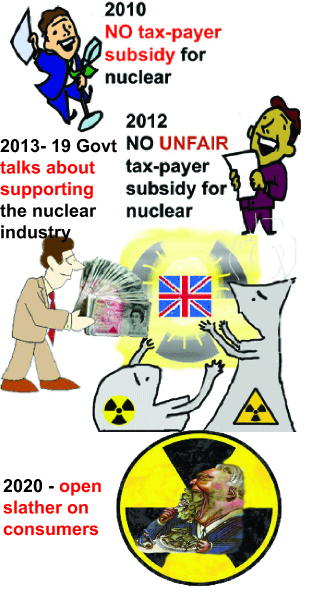
Will British taxpayers end up bankrolling Sizewell C nuclear power project ?
The flagship of Britain’s new nuclear power fleet is under threat as the
Government prepares curbs on Chinese involvement in critical national
infrastructure. Whitehall sources admitted last night that the £23bn
Hinkley Point C project underway in Somerset could be jeopardised by plans
to block China General Nuclear (CGN) from future UK projects.
The Hinkley reactor, Britain’s first in a generation, is being partially bankrolled by
CGN as part of a wider deal with French company EDF to replace the UK’s
aging nuclear plants. Under Government proposals which have not been
officially confirmed, CGN’s involvement in subsequent planned projects, in
Suffolk and Essex, would end. Government insiders said that there are
concerns this could disrupt the linked deal under which CGN is developing
Hinkley, where work is already significantly advanced.
Ministers are preparing to introduce legislation to Parliament that would allow nuclear
power developers to recoup costs from household bills. This could spark a
significant backbench rebellion from MPs concerned about China if CGN is
involved. Industry sources also suggested that EDF would find it easier to
court pension funds and other institutional investors without the political
risk of a major Chinese state partner.
CGN owns about a third of Hinkley Point C and has a 20pc development phase stake in Sizewell C, with an
option to participate in the construction phase. Its own reactor design for
Bradwell is going through UK regulatory approval, with CGN hoping it can
then export this technology more widely. The Times reported last night that
the Government is considering buying an equity stake in Sizewell C as part
of its moves to replace CGN, reversing a long-standing wish to keep nuclear
build off the Government balance sheet.
Telegraph 26th July 2021
https://www.telegraph.co.uk/business/2021/07/26/hinkley-nuclear-plant-risk-china-crackdown/
China’s nuclear power firm could be blocked from UK projects
China’s nuclear power firm could be blocked from UK projects
Ministers looking at ways to exclude state-owned China General Nuclear from future UK involvement Guardian, Jillian Ambrose Energy correspondent 26 July 21 China’s state-owned nuclear energy company could be blocked from building a nuclear reactor due to rising security concerns over Chinese involvement in critical national infrastructure.
Ministers are reportedly looking for ways to move ahead with plans for EDF Energy to build the £20bn Sizewell C nuclear plant on the Suffolk coast without China General Nuclear (CGN), which owns a one-fifth stake in the project.
Whitehall sources have confirmed the report, first published in the Financial Times, which has emerged amid deepening concerns over China’s security risk after the Huawei scandal last year.
CGN holds a minority stake in EDF’s Hinkley Point C nuclear power plant in Somerset, as well as the Sizewell C project, but it hopes to use the pair as a springboard to building a Chinese-designed reactor at Bradwell-on-Sea in Essex.
It has submitted its reactor design for scrutiny by the UK’s nuclear authorities, but industry sources have warned that even if CGN wins approval for its reactor, a Chinese nuclear plant within 30 miles of London would be “politically unpalatable”……… https://www.theguardian.com/environment/2021/jul/26/chinas-nuclear-power-firm-could-be-blocked-from-uk-projects
Japan’s cleaner energy vision marred by burden of nuclear power
Cleaner energy vision marred by burden of nuclear power, Asahi Shimbun July 24, 2021, The industry ministry July 21 laid out its vision for a cleaner energy future in its draft new Basic Energy Plan. The blueprint gives a breakdown of energy sources to power the nation in fiscal 2030 to achieve the government’s goal of carbon neutrality, or net-zero carbon dioxide emissions, in 2050.
It states that promoting renewable energy sources should be the policy priority and set a target of raising the share of renewables in the nation’s overall power output by 14 points to 36-38 percent in fiscal 2030. The ministry deserves to be lauded for declaring that renewables should a primary energy source.
The industry ministry July 21 laid out its vision for a cleaner energy future in its draft new Basic Energy Plan. The blueprint gives a breakdown of energy sources to power the nation in fiscal 2030 to achieve the government’s goal of carbon neutrality, or net-zero carbon dioxide emissions, in 2050.
It states that promoting renewable energy sources should be the policy priority and set a target of raising the share of renewables in the nation’s overall power output by 14 points to 36-38 percent in fiscal 2030. The ministry deserves to be lauded for declaring that renewables should a primary energy source.
But its decision to maintain the share of nuclear power at the current level of 20-22 percent is baffling.But its decision to maintain the share of nuclear power at the current level of 20-22 percent is baffling.
By contrast, costs of power generation using renewable energy sources have shown a steady decline. Solar power generation for businesses will produce 1 kilowatt-hour of electricity at estimated costs in the lower 8-yen range to the higher 11-yen range in 2030.
Even though the draft energy supply blueprint calls for reducing Japan’s reliance on nuclear power as much as possible, it nevertheless sets an unrealistic target for the share of nuclear power……..
…..The first order of business for the ministry is to define the composite of power sources in 2050 required to achieve carbon neutrality. Currently, the only imaginable main source of electricity to ensure a greener energy future is renewables.
Clean energy accounted for 21.7 percent of Japan’s total power output last year, close to the target for 2030 (22-24 percent). It would be wiser to make utmost use of the huge potential of renewable energy…………. https://www.asahi.com/ajw/articles/14402202
Japanese govt’s new Basic Energy Plan will prioritise renewable energy
The industry ministry July 21 laid out its vision for a cleaner energy future in its draft new Basic Energy Plan. The blueprint gives a breakdown of energy sources to power the nation in fiscal 2030 to achieve the
government’s goal of carbon neutrality, or net-zero carbon dioxide emissions, in 2050. It states that promoting renewable energy sources should be the policy priority and set a target of raising the share of
renewables in the nation’s overall power output by 14 points to 36-38 percent in fiscal 2030.
The ministry deserves to be lauded for declaring that renewables should a primary energy source. But its decision to maintain the share of nuclear power at the current level of 20-22 percent is baffling.
Asahi Shimbun 24th July 2021
Biden administration approves $25 Billion Pentagon budget increase, despite calls from House Democrats opposing this.

Because of its role in setting defense policy—which determines subsidies and other rewards to private industry—the Senate Armed Services Committee is awash in cash from military contractors. According to OpenSecrets, Reed’s top contributors during the 2020 campaign cycle included Lockheed Martin and General Dynamics, two of the leading beneficiaries of federal contracts.
A Huge Outrage’: Senate Panel Approves $25 Billion Pentagon Budget Increase https://www.commondreams.org/news/2021/07/23/huge-outrage-senate-panel-approves-25-billion-pentagon-budget-increase
“Not so incidentally, the $25 billion spending increase approved by the Senate Armed Services Committee exactly matches the cost to scale up Covid-19 vaccine production to meet global demand.”
The Senate Armed Services Committee agreed Thursday to add $25 billion to President Joe Biden’s already massive $715 billion Pentagon spending request, a move that prompted immediate outrage from progressive activists who have been demanding cuts to the bloated U.S. military budget.
“Just the proposed $25 billion increase to the Pentagon budget alone could end homelessness in the United States, making clear that senators are more interested in increasing the profits of military contractors than meeting the needs of everyday working people,” said Carley Towne, co-director of the anti-war group CodePink.
Because of its role in setting defense policy—which determines subsidies and other rewards to private industry—the Senate Armed Services Committee is awash in cash from military contractors. According to OpenSecrets, Reed’s top contributors during the 2020 campaign cycle included Lockheed Martin and General Dynamics, two of the leading beneficiaries of federal contracts.
Robert Weissman, president of the watchdog group Public Citizen, said in a statement Thursday that “anyone who cares about our national security should oppose this increase in Pentagon spending and demand… that the funds that would have gone to the Pentagon instead be allocated to global Covid-19 vaccine production or other human needs priorities.”
“When the coronavirus has demonstrated that all the guns in the world can’t protect our national security; when the U.S. spends more on its military than the next eleven nations combined; when we are withdrawing from Afghanistan and therefore reducing required military expenditures; when the Pentagon can’t pass an audit; when the Pentagon continues to lavish funds on the F-35 which is ten years behind schedule, double the original price tag and plagued by performance issues (like engines that don’t work); what possible justification is there for increasing the Pentagon budget over and above the increase already requested by the Biden administration?” Weissman asked.
“Not so incidentally,” he added, “the $25 billion spending increase approved by the Senate Armed Services Committee exactly matches the cost to scale up Covid-19 vaccine production to meet global demand.”
In addition to money for the Pentagon, the Senate panel’s proposed NDAA includes nearly $30 billion in funding for the Department of Energy, which manages the nation’s nuclear stockpile. Just a day after more than 20 Democratic lawmakers demanded reductions in the United States’ nuclear arsenal, the Senate Armed Services Committee called for “recapitalizing and modernizing the U.S. nuclear triad.”
The House and Senate must ultimately agree to identical legislation for the NDAA to become law. Given the narrow margins in both chambers, progressive members of Congress could credibly threaten to tank any bill that includes what they consider to be excessive funding for the Pentagon.
In March, 50 House Democrats led by Reps. Barbara Lee (D-Calif.), Mark Pocan (D-Wis.), and Jake Auchincloss (D-Mass.) demanded cuts to Defense Department budget, arguing the money would be better spent on “diplomacy, humanitarian aid, global public health, sustainability initiatives, and basic research.”
But Biden ignored the Democrats’ call, requesting $715 billion for the Pentagon—an increase from the current $704 billion spending level approved under former President Donald Trump.
Democrat lawmakers call on President Biden to reduce the role of nuclear weapons in the upcoming Nuclear Posture Review.
SENATORS MARKEY, MERKLEY AND REPS. BEYER, GARAMENDI LEAD COLLEAGUES IN URGING PRESIDENT BIDEN TO REDUCE MILITARY ROLE OF U.S NUCLEAR WEAPONS IN UPCOMING NUCLEAR POSTURE REVIEW https://www.markey.senate.gov/news/press-releases/senators-markey-merkley-and-reps-beyer-garamendi-lead-colleagues-in-urging-president-biden-to-reduce-military-role-of-us-nuclear-weapons-in-upcoming-nuclear-posture-review Washington (July 22, 2021)–
Today, Senators Edward J. Markey (D-Mass.), Jeffrey A. Merkley (D-Ore.) and Representatives Don Beyer (VA-08) and John Garamendi (CA-03), co-chairs of the Nuclear Weapons and Arms Control Working Group, led 18 of their colleagues in calling on President Joseph R. Biden to actively guide the formation of the Department of Defense-led Nuclear Posture Review. The Nuclear Posture Review (NPR) will be part of an integrated National Defense Strategy that the Department of Defense says will be completed by early next year. The lawmakers urged the Administration to consider a series of bold actions that would fulfill the President’s pledge to reduce the role of “nuclear weapons in our national security strategy.”
“Mr. President, as a United States Senator and then as Vice President, you were a party to every major nuclear weapons debate of the past five-decades. From bolstering the Anti-Ballistic Missile Treaty, to building European support for the Intermediate-Nuclear Forces Treaty, to securing votes for ratification of the New START Treaty, you have consistently been on the right side of history. Your Administration’s NPR is a watershed moment where you can reject a 21st century arms race and make bold decisions to lead us towards a future where nuclear weapons no longer threaten all humanity,” the lawmakers wrote in their letter to President Biden.
Specifically, the lawmakers called for President Biden’s Nuclear Posture Review to:
- Adjust U.S. declaratory policy to assign a reduced role for U.S. nuclear weapons, consistent with the President’s past stated view that: “Given our non-nuclear capabilities and the nature of today’s threats — it’s hard to envision a plausible scenario in which the first use of nuclear weapons by the United States would be necessary. Or make sense.”
- Direct the Department of Defense to include in its proposed target list a breakdown of the damage expectancy, civilian casualties, and climatic and humanitarian consequences stemming from nuclear weapons use.
- Examine the number and types of new weapons needed to deter nuclear attack, taking into account recommendations from the Government Accountability Office to consider deferring or cancelling certain nuclear weapons modernization programs.
- Complete independent review of the proposed intercontinental ballistic missile (ICBM) – the Ground Based Strategic Deterrent – that looks into the technical feasibility and comparative cost savings of life-extending the current Minuteman III ICBM.
- Eliminate two of President Trump’s new types of nuclear weapons: the nuclear sea-launched cruise missile (SLCM) under development and the low-yield W-76(2) warhead already deployed on U.S. ballistic missile submarines.
- Commit to pursuing robust diplomacy with Russia and China on arms control through U.S.-Russia bilateral strategic stability talks, which build upon an extended New START Treaty, and starting a new bilateral U.S.-China strategic stability dialogue that builds towards the eventual conclusion of arms control measures that reduce the risk of miscalculation.
A copy of the letter can be found HERE.
Pentagon review: What happens if ‘nuclear football’ is lost?
Pentagon review: What happens if ‘nuclear football’ is lost? Questions about security procedures arose after Jan. 6, when Vice President Mike Pence was escorted to safety along with a military aide carrying the backup communications system.. 6, when Vice President Mike Pence was escorted to safety along with a military aide carrying the backup communications system.
By The Associated Press NBC News, 21 July 21, WASHINGTON — The Pentagon is taking a rare look at whether it is prepared to deal with the theft or compromise of the portable communications system nicknamed the “nuclear football,” which enables the president or a stand-in to order a nuclear attack.
In announcing the probe Tuesday, the Pentagon inspector general’s office did not disclose what precipitated it, but questions about security procedures arose in the aftermath of the Jan. 6 insurrection at the Capitol.
Vice President Mike Pence was seen on security camera video being escorted to safety, along with a military aide carrying the backup “nuclear football,” as rioters entered the Capitol.
A backup system always accompanies the vice president so that he is able to communicate in the event the president cannot. The “football,” officially called the Presidential Emergency Satchel, enables communication with the office inside the Pentagon that transmits nuclear attack orders.
The inspector general’s office said its review began this month. It gave no timeline for completing it.
“The objective of this evaluation is to determine the extent that DoD processes and procedures are in place and adequate to alert DoD officials in the event that the Presidential Emergency Satchel is lost, stolen, or compromised,” Randolph R. Stone, an assistant inspector general, wrote in a July 19 letter to the director of the White House military office and the director of the Joint Staff at the Pentagon. “This evaluation will also determine the adequacy of the procedures the DoD has developed to respond to such an event.”
Two Democrats who had asked the Pentagon inspector general to review the matter, Reps. Stephen Lynch of Massachusetts and Jim Cooper of Tennessee, said in a joint statement that the Jan. 6 riot raised questions about whether the Pentagon was even aware that Pence’s “nuclear football” was potentially in danger of falling into the hand of insurrectionists………..
“U.S. Strategic Command, which is responsible for U.S. strategic deterrence and nuclear operations, was reportedly unaware that Vice President Pence, his military aide, and the nuclear football were all potentially in danger and only came to understand the gravity of the incident several weeks later when security camera footage was played as a video exhibit during the Senate impeachment trial,” they wrote. https://www.nbcnews.com/politics/national-security/pentagon-review-what-happens-if-nuclear-football-lost-n1274582
1 This Month
26 April – Chernobyl: Inside the Meltdown airs on National Geographic on Sunday 26th April from 4pm


29 April – Nuclear Expert Webinar #1 – Radiation Impacts on Families with Mary Olson and Cindy Folkers
- 12:15 PM MT – 1:45 PM MT
- Location: Virtual – REGISTER TODAY

4 May -West Suburban Peace Coalition to discuss Iran war at May Educational Forum
Monday, May 4, 7:00 – 8:00 PM Central Standard Time
Title: : How Trump’s Narrative Tries to Shape the Reality of the War on Iran.
Contact Walt Zlotow, zlotow@hotmail.com 630 442 3045 for further information
14 May – online event From Bombs to Data Centres: the Face of Nuclear Colonialism

Pine Ridge Uranium is the real threat, not Tehran- Tell Burgum: Stop the Extraction.
Chernobyl: The Lost Tapes – A good documentary on Chernobyl on SBS available On Demand for the next 3 weeks– https://www.sbs.com.au/ondemand/tv-program/chernobyl-the-lost-tapes/2352741955560
To see nuclear-related stories in greater depth and intensity – go to https://nuclearinformation.wordpress.com
-
Archives
- April 2026 (346)
- March 2026 (251)
- February 2026 (268)
- January 2026 (308)
- December 2025 (358)
- November 2025 (359)
- October 2025 (376)
- September 2025 (257)
- August 2025 (319)
- July 2025 (230)
- June 2025 (348)
- May 2025 (261)
-
Categories
- 1
- 1 NUCLEAR ISSUES
- business and costs
- climate change
- culture and arts
- ENERGY
- environment
- health
- history
- indigenous issues
- Legal
- marketing of nuclear
- media
- opposition to nuclear
- PERSONAL STORIES
- politics
- politics international
- Religion and ethics
- safety
- secrets,lies and civil liberties
- spinbuster
- technology
- Uranium
- wastes
- weapons and war
- Women
- 2 WORLD
- ACTION
- AFRICA
- Atrocities
- AUSTRALIA
- Christina's notes
- Christina's themes
- culture and arts
- Events
- Fuk 2022
- Fuk 2023
- Fukushima 2017
- Fukushima 2018
- fukushima 2019
- Fukushima 2020
- Fukushima 2021
- general
- global warming
- Humour (God we need it)
- Nuclear
- RARE EARTHS
- Reference
- resources – print
- Resources -audiovicual
- Weekly Newsletter
- World
- World Nuclear
- YouTube
-
RSS
Entries RSS
Comments RSS
 nuclear-news