To obtain authorisation to commission the Flamanville EPR nuclear reactor, EDF must get full infomation on the incident at the Taishan EPR reactor.
To obtain authorization to commission the Flamanville EPR, EDF will first have to shed light on the Taishan EPR 1 incident in China, the Nuclear Safety Authority (ASN) told Reporterre. Thursday, December 9. “ASN asked EDF to take account of the experience feedback from this event prior to the commissioning of the Flamanville EPR reactor.
To do this, EDF will either have to demonstrate that the Flamanville EPR is not affected, or propose
measures to prevent fuel degradation, “ASN wrote. “EDF is currently working in conjunction with the operator of Taishan (TNPJVC) and Framatome on the interpretation of the results of the checks on the fuel unloaded from the Taishan 1 reactor.
These analyzes aim to identify the phenomena that led to the rupture of the ducts. fuel and to determine whether the other EPR reactors are concerned, ”ASN added. The French nuclear gendarme says it has not obtained any information concerning the restart of Taishan 1 “which falls under the competence of its Chinese counterpart (NNSA)”.
Reporterre 13th Dec 2021
France’s Court of Audits demands information on the costs of future EPR nuclear reactors, and cost implications for waste management.

The Court of Auditors called on Monday to take into account the uncertainties surrounding the cost of future EPR2 nuclear reactors, and to foresee the implications for waste management, as President Macron
announced the launch of a new construction program. “Regarding the cost of future EPR 2, uncertainty ranges on construction costs should be systematically tested, given the lack of maturity of this new reactor”, note the magistrates in their conclusions.
Le Figaro 13th Dec 2021
Call to halt UK’s Hinkley Point C new EPR nuclear reactor until problems at similar reactor in China resolved.
he Nuclear Free Local Authorities network (NFLA) has written to the
Minister of State for Energy and the Head of the Office of Nuclear
Regulation calling for an indefinite halt to construction work at the new
Hinkley Point C nuclear plant whilst the impact of the Taishan-1 nuclear
accident in China is investigated. T
The Chair of the NFLA Steering Committee, Councillor David Blackburn, has written to Minister Greg Hands and Chief Executive Mark Foy outlining concerns that a radioactive gas leak
at the Taishan 1 reactor in China has uncovered a potentially fatal design
flaw which could have a serious impact on the UK Government’s plans to
permit identical reactors to operate at Hinkley Point C in Somerset and at
Sizewell C in Suffolk. The Hinkley Point and Sizewell projects would both,
like Taishan-1. be equipped with EPRs (short for European Pressurised or
Evolutionary Power Reactors). EPR projects have a history of safety
concerns, massive delays and huge cost overruns. Although the Hinkley Point
C is planned to come on line in 2026, plants at Olkiluoto 3 in Finland and
Flammaville 3 in France are now 13 and 11 years behind schedule
respectively. Sizewell is still awaiting final government authorisation.
NFLA 13th Dec 2021
Independent MP Andrew Wilkie implores the Australian Prime Minister to pick up the phone to the US president and UK prime minister to end the prosecution of Julian Assange.
MP urges PM to pick up phone over Assange, https://www.mandurahmail.com.au/story/7548246/mp-urges-pm-to-pick-up-phone-over-assange/?cs=9397Dominic Giannini
MP urges PM to pick up phone over Assange, https://www.mandurahmail.com.au/story/7548246/mp-urges-pm-to-pick-up-phone-over-assange/?cs=9397
- Dominic Giannini 12 Dec 21
Independent MP Andrew Wilkie has implored the prime minister to pick up the phone to the US president and UK prime minister to end the prosecution of Julian Assange.
The former intelligence analyst said the prosecution of Mr Assange has always been political which meant it could be solved politically by Prime Minister Scott Morrison.
“The reality is this has always been an intensively political matter and it can be solved politically by Scott Morrison picking up the phone to Joe Biden and Boris Johnson,” Mr Wilkie told the ABC.
It comes after reports the 50-year-old WikiLeaks founder suffered a stroke in prison in October.
“Jail is killing Julian Assange,” Mr Wilkie said.
“There is no way he will survive continued incarceration in the UK.”
Mr Assange has just suffered a legal blow after the UK High Court ruled he could be extradited to face charges in the US.
Mr Assange’s lawyers say they intend to appeal the decision in the UK’s highest court.
“Nuclear power has no future inFrance”.
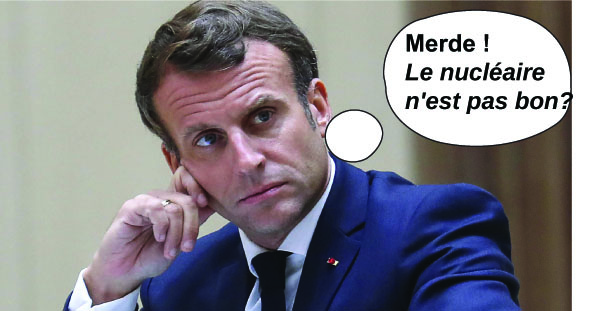
Thierry Gadault gave a conference on French nuclear power on December 3,
2021 in Orleans with a shocking title: “Nuclear power has no future in
France”. This independent journalist who has been investigating the atom
for ten years is the co-author of the book Nuclear, immediate danger (2018,
Flammarion) and the TV documentary Nuclear, the end of a myth broadcast on
Public Senate in 2018. He granted at Magcentre an exclusive interview.
Magcentre 8th Dec 2021
Are We Forever Captives of America’s Forever Wars? This is what needs to be done to finally end our forever wars.
Are We Forever Captives of America’s Forever Wars? This is what needs to be done to finally end our forever wars.
KAREN GREENBERG December 10, 2021 by TomDispatch As August ended, American troops completed their withdrawal from Afghanistan almost 20 years after they first arrived. On the formal date of withdrawal, however, President Biden insisted that “over-the-horizon capabilities” (airpower and Special Operations forces, for example) would remain available for use anytime. “[W]e can strike terrorists and targets without American boots on the ground, very few if needed,” he explained, dispensing immediately with any notion of a true peace. But beyond expectations of continued violence in Afghanistan, there was an even greater obstacle to officially ending the war there: the fact that it was part of a never-ending, far larger conflict originally called the Global War on Terror (in caps), then the plain-old lower-cased war on terror, and finally—as public opinion here soured on it—America’s “forever wars.”
As we face the future, it’s time to finally focus on ending, formally and in every other way, that disastrous larger war. It’s time to acknowledge in the most concrete ways imaginable that the post-9/11 war on terror, of which the bombing and invasion of Afghanistan was the opening salvo, warrants a final sunset.
True, security experts like to point out that the threat of global Islamist terrorism is still of pressing—and in many areas, increasing—concern. ISIS and al-Qaeda are reportedly again on the rise in the Middle East, South Asia, and Africa.
Nonetheless, the place where the war on terror truly needs to end is right here in this country. From the beginning, its scope, as defined in Washington, was arguably limitless and the extralegal institutions it helped create, as well as its numerous departures from the rule of law, would prove disastrous for this country. In other words, it’s time for America to withdraw not just from Afghanistan (or Iraq or Syria or Somalia) but, metaphorically speaking at least, from this country, too. It’s time for the war on terror to truly come to an end.
With that goal in mind, three developments could signal that its time has possibly come, even if no formal declaration of such an end is ever made. In all three areas, there have recently been signs of progress (though, sadly, regress as well).
Repeal of the 2001 AUMF
First and foremost, Congress needs to repeal its disastrous 2001 Authorization for the Use of Force (AUMF) passed—with Representative Barbara Lee’s single “no” vote—after the attacks of 9/11. Over the last 20 years, it would prove foundational in allowing the U.S. military to be used globally in essentially any way a president wanted.
That AUMF was written without mention of a specific enemy or geographical specificity of any kind when it came to possible theaters of operation and without the slightest reference to what the end of such hostilities might look like. As a result, it bestowed on the president the power to use force when, where, and however he wanted in fighting the war on terror without the need to further consult Congress. Employed initially to root out al-Qaeda and defeat the Taliban in Afghanistan, it has been used over the last two decades to fight in at least 19 countries in the Greater Middle East, Africa, and Asia. Its repeal is almost unimaginably overdue…………….
At the moment, some efforts towards repeal again seem to be gaining momentum, with the focus now on the more modest goal of simply reducing the blanket authority the authorization still allows a president to make war as he pleases, while ensuring that Congress has a say in any future decisions on using force abroad……………..
Closing Gitmo
A second essential act to signal the end of the war on terror would, of course, be the closing of that offshore essence of injustice, the prison at Guantánamo Bay, Cuba (aka Gitmo) that the Bush administration set up so long ago. …………
some progress is being made, but as long as Gitmo remains open, our own homemade version of the war on terror will live on.
Redefining the Threat
Another admittedly grim sign that the post-9/11 war on terror could finally fade away is the pivot of attention in this country to other far more pressing threats on a planet in danger and in the midst of a desperate and devastating pandemic. Notably, on the 20th anniversary of those attacks, even former President George W. Bush, whose administration launched the war on terror and its ills, acknowledged a shift in the country’s threat matrix: “[W]e have seen growing evidence that the dangers to our country can come not only across borders, but from violence that gathers within.”
some progress is being made, but as long as Gitmo remains open, our own homemade version of the war on terror will live on.
Redefining the Threat
Another admittedly grim sign that the post-9/11 war on terror could finally fade away is the pivot of attention in this country to other far more pressing threats on a planet in danger and in the midst of a desperate and devastating pandemic. Notably, on the 20th anniversary of those attacks, even former President George W. Bush, whose administration launched the war on terror and its ills, acknowledged a shift in the country’s threat matrix: “[W]e have seen growing evidence that the dangers to our country can come not only across borders, but from violence that gathers within.”
Each of these potential pivots suggest the possible end of a war on terror whose casualties include essential aspects of democracy and on which this country squandered almost inconceivable sums of money while constantly widening the theater for the use of force. It’s time to withdraw the ever-expansive war powers Congress gave the president, end indefinite detention at Gitmo, and acknowledge that a shift in priorities is already occurring right under our noses on an ever more imperiled planet. Perhaps then Americans could turn to short-term and long-term priorities that might truly improve the health and sustainability of this nation. https://www.commondreams.org/views/2021/12/10/are-we-forever-captives-americas-forever-wars
Australian government urged to push UK and US to free Julian Assange.
Australian government urged to push UK and US to free Julian Assange, SBS , 12 Dec 21,
Australia’s Department of Foreign Affairs and Trade says officials have raised issues of due legal process and access to proper medical care for Julian Assange with officials in the UK and the US. By Alexander Britton
The Australian government has been urged to weigh in on the case of WikiLeaks founder Julian Assange as supporters vowed to continue to fight against his extradition……………..
Senator Rex Patrick told SBS News the Australian government has not placed enough pressure on the US and UK governments about the case but was hopeful “common sense will prevail”.
He said: “We have a Deputy Prime Minister (Barnaby Joyce) who spoke in support of Julian Assange while on the backbench who is in Washington in quarantine.
“He could be using his time pushing his views, speaking to the (US) Secretary of State.
“The Deputy Prime Minister was very clear as to what the Government should be doing, but has remained quiet since he rejoined the cabinet.”
‘Dangerous and misguided’
In a statement, Mr Joyce said: “My position remains the same….In regards to the current UK proceedings, I note he was not in the US at the time of the action he is accused nor was he a US citizen at the time so should not be bound to US laws.”
The US said the release of the classified information put lives in danger, but Mr Assange’s backers say the case is retaliation for his exposing of wrongdoing in overseas conflicts.
His fiancee, Stella Moris, said his legal team would appeal against the decision and said Friday’s verdict at the Royal Courts of Justice in London was “dangerous and misguided”.
“This goes to the fundamentals of press freedom and of democracy. We will fight,” she said outside the court.
“Every generation has an epic fight to fight, and this is ours because Julian represents the fundamentals of what it means to live in a free society, of what it means to have press freedom.”
The ruling has been the subject of criticism from a range of campaign groups, as well as a number of politicians in Australia.
Labor MP Julian Hill said the Australian government “must stand up to the US and the UK and stop this extradition”.
In a series of tweets, he said: “Julian Assange, an Australian citizen is fighting for his life in London, as the USA seeks his extradition to face an effective death sentence.
“This Australian, who exposed US war crimes, is treated worse than a war criminal. He’s NOT receiving a fair trial.
“There will never be a legal solution to Julian Assange’s case. It is an inherently political witch-hunt.
“The Australian Government must stand up to the US and the UK and stop this extradition.”
Federal Independent MP Andrew Wilkie urged Prime Minister Scott Morrison to “end the lunacy” and demand the release of Mr Assange.
“The PM must end this lunacy, pick up the phone to his counterparts in the US and UK, and urge them to release Mr Assange immediately and allow him to return to Australia. He is a hero, not a villain, and journalism is not a crime.”
Greens senator Janet Rice added: “Julian Assange’s prosecution has always been political. It’s going to need a political response from our government to get justice for him.”
And MP George Christensen, who introduced a private bill to address the illegal detention of journalists last month, titled “free Julian Assange”, called on US President Joe Biden to drop the case.
He wrote on Facebook: “A foreign court just ruled that an Australian journalist – Julian Assange – should be extradited to another foreign nation to face trumped-up charges of hacking and espionage.
“This is an affront to freedom of speech and Australian sovereignty.”
Concerns about Assange’s health………..
The legal wrangling will go to the Supreme Court, the United Kingdom’s final court of appeal.
Amnesty International’s Europe Director Nils Muižnieks said the decision was a “travesty of justice”.
“The US government’s indictment poses a grave threat to press freedom both in the United States and abroad.”
While Nils Melzer, the UN’s special rapporteur on torture, noted the court’s decision came on the same day as Human Rights Day and expressed concerns about Mr Assange’s health.
He said: “It’s just like a car crash happening in slow motion and every now and then someone asking you to comment on what you’re seeing.
“Well it’s still a car crash happening in slow motion, we know exactly what’s at the end of this.
“At the end, Julian Assange is crushed as a person and our rights have been done away with.”……………..
A Department of Foreign Affairs and Trade spokesperson said they have made available consular assistance and continue to monitor the case. [ed note: a fat lot of good that will do!]………….. https://www.sbs.com.au/news/australian-government-urged-to-push-uk-and-us-to-free-julian-assange_1/057ebae4-4cc9-40ba-9536-f6a2b74cf6e7
‘Spend money on the National Health Service – not nuclear submarines’
‘Spend money on the NHS – not nuclear subs’ https://www.newsandstar.co.uk/news/19777700.spend-money-nhs—not-nuclear-subs/ Philip Gilligan On behalf of South Lakeland and Lancaster District CND, 12 Dec 21, SINCE September, local Conservative politicians have seemed very eager to praise the new military pact known as AUKUS.
They are apparently unconcerned that the US and UK will be assisting Australia to acquire new long-range strike capabilities for its air force, navy and army, including the provision of nuclear-powered submarines fuelled by weapons grade uranium.
They clearly hope that BAE Systems staff in Barrow will be involved in designing and building the submarines, but appear to have ignored the potential threats to peace and stability inherent in such military escalation.
They seem unconcerned that AUKUS has already sparked tensions between the UK and France and seems likely to provoke a regional arms race in the South China Sea.
In the UK, the Campaign for Nuclear Disarmament (CND) is calling on the UK government to focus its resources instead on funding our NHS more adequately and on meeting the social care needs of our communities.
Indeed, CND wants the government to halt all its dangerous and provocative nuclear adventures.
Meanwhile, in Australia, the Maritime Union is also calling for a shift away from wasteful and environmentally harmful military spending to investment in health care and socially useful jobs.
They say that the pact will “continue to escalate unnecessary conflict with China”, and state “We don’t want war”.
This Saturday, Australian peace campaigners and trade unionists are holding an international day of action in opposition to the AUKUS pact.
South Lakeland and Lancaster District CND expresses its solidarity with the Australian campaign, while calling on the UK government to make genuine efforts to invest in increased and more diverse employment opportunities in Barrow.
UK’s Nuclear Energy Finance Bill Committee hears problems about funding of new nuclear projects, that will be too late to affect climate change.
nuClear News No 126 December 21, . New Nuclear Energy Developments In Safe Energy Journal No.92 and nuClear News No.135 we reported on a debate in the House of Commons on the Second Reading of the Nuclear Energy Finance Bill, which took place on 3rd November. (1) Since then, there have been several meetings of the Nuclear Energy Finance Bill Committee, including one session which took evidence from Doug Parr of Greenpeace, Mycle Schneider of the World Nuclear Industry Status Report and Professor Steve Thomas. (2)

The SNP’s Energy Spokesperson at Westminster, Alan Brown, asked Mycle Schneider about the argument that the UK needs baseload power and can’t meet its net zero targets without nuclear power. Mycle pointed out that we are in a climate emergency, so we need reductions in carbon emissions as quickly as possible. For every pound we spend we need to see large and fast results. It’s clear that there are other options beside nuclear which are more climate effective. The cost of renewables is cheaper and nuclear is five times slower. Possible investments in nuclear which might deliver after 2030 are much too slow.
Regarding the need for baseload electricity, the National Grid’s scenarios say nothing about the need for reliable baseload. Only one out of their three scenarios needs Sizewell C. Nuclear is not flexible. If the wind isn’t blowing nuclear doesn’t help. What is required is batteries and demand-side responses to compensate for intermittency.
Analysis of the French nuclear fleet shows that nuclear power is not a reliable source providing power 24/7. For 2019 – the year before Covid – when EDF starts an outage for maintenance and refuelling it has lost control entirely over the date and time it is able to restart its reactors. There were over 40 cases of revised times and dates. EDF was not even able to make reliable predictions 24 hours before the reactors were due to restart.
Labour’s Alan Whitehead asked Mycle Schneider about the experience of the United States using the Regulated Asset Base (RAB) funding model for two plants in South Carolina which were abandoned recently. Should there be measures in any Bill which make sure any nuclear plant is finished to avoid consumers being dumped with the cost of a plant that wasn’t finished. Construction of VC Summer started in 2013 and it was supposed to come on-line in 2017. By 2017 the cost estimate had increased by 75%. In July 2017 construction was abandoned. This was one of the consequences of the fact that Westinghouse filed for bankruptcy. The affair has cost consumers billions.

Steve Thomas said what marked out the VC Summer project and a similar project in Georgia from other US projects was that they allowed the recovery of costs from consumers before completion of the reactors. The Summer experience shows very clearly the folly of using the RAB model. We would have to be careful with any legislation which prevents nuclear plants under construction being abandoned. Dungeness B took 24 years from the start of construction to commercial operation, and over its 32 years of operation its availability was well below 50%. It should have been abandoned before it was completed.
Matthew Pennycook said there is a lack of clarity around the Chinese company, CGN’s investment in Sizewell C and how that interacts with the intentions of this Bill. He asked what is in the 2016 Strategic Investment Agreement and what provisions there are in that agreement that would allow the Government to remove CGN. And related to that there was £1.7 billion in the budget to enable a final investment decision for a large scale nuclear project. Is that money to buyout the CGN stake?

Steve Thomas said in the 2016 Agreement CGN agreed to take up to 20% of the Sizewell C project up to the Final Investment Decision (FID). They have an option to take 20% of the construction and operation of the plant if it goes ahead. EDF and CGN have spent about half a billion pounds so far, It may take another £0.5 billion at the most to get to FID. So £1.7bn seems too much. In terms of how you get CGN out of Sizewell C it probably depends on what happens to Bradwell B. The Chinese really want to get the endorsement of UK nuclear regulators for it HPR1000 reactor. If they are not going to be allowed to build Bradwell B, they are unlikely to be interested in putting money into Sizewell C.
Steve Thomas told MPs there is a lot of missing detail in the RAB proposals. One of the biggest elements is how much the surcharge will be during the construction. The Government has said it will be a maximum of about £10 per year per consumer. That would yield £6bn. In the context of a project that will cost £24-40bn, plus financing costs, £^bn is not much of a game changer.
PMQs On 24th November, during Prime Minister’s Questions Matthew Pennycook asked: “The Government’s integrated review has concluded that the Chinese state poses a systemic challenge to our national security, and the Prime Minister has made it clear that when it comes to China, we must remain vigilant about our critical national infrastructure. Can he therefore confirm unequivocally today that plans for China General Nuclear to own and operate its own plant at Bradwell in Essex have been abandoned, and explain to the House precisely how and when his Government intend to remove CGN’s interest from the Sizewell C nuclear project?”
Boris Johnson replied that “…we do not want to see undue influence by potentially adversarial countries in our critical national infrastructure. That is why we have taken the decisions that we have. On Bradwell, there will be more information forthcoming – What I do not want to do is pitchfork away wantonly all Chinese investment in this country, or minimise the importance to this country of having a trading relationship with China.” (3)
The Times pointed to the National Security and Investment Bill, going through parliament at present, which will allow the government to “screen” and potentially block sensitive foreign investments, and concluded that China will be cut out of future involvement in developing new nuclear power stations, but this is still not entirely clear. (4)
Mr Pennycook later responded to the PMs answer via Twitter: “We need certainty on the future of China’s involvement in UK nuclear power and clarity about how and when the Government intends to remove China’s state-controlled nuclear energy company from involvement in any future UK project.”
Subsequently the team behind Bradwell B said China’s nuclear group remains committed to the project. (5) https://www.no2nuclearpower.org.uk/wp/wp-content/uploads/2021/12/nuClearNewsNo136.pd
British pensioners funding France’s ”nuclear renaissance” with white elephant nuclear projects?
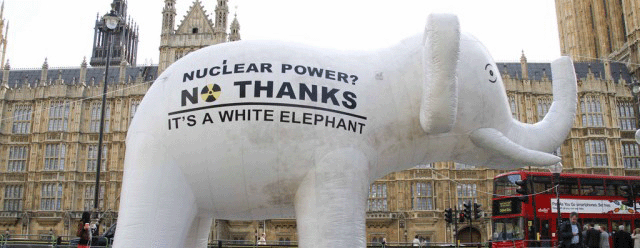
According to Gérard Magnin, a former EDF director, the French company sees Hinkley as ‘a way to make the British fund the renaissance of nuclear in France’. He added: ‘We cannot be sure that in 2060 or 2065, British pensioners, who are currently at school, will not still be paying for the advancement of the nuclear industry in France.’ ..……….
White elephant energy projects that are tomorrow’s HS2, The Conservative Woman, 10 Dec 21, -December 10, 2021AS someone who has in a small way been opposing the climate catastrophe narrative* and has had to study the government’s energy plans, I’m beginning to wonder why Suffolk has been chosen for not one but two white elephant energy projects. What have we done to deserve this? An even more pertinent question is ‘What the hell does this technologically-illiterate government think it is doing?…….
The proposed Sizewell C will house a pair of French-designed nuclear fission reactors of 1600MW output each which are slated to be built next to the decommissioned Sizewell A. …………
Superficially (i.e. as assessed by a typical minister who has the same knowledge of science, technology, engineering and mathematics as the average 12-year-old) Sizewell seems an obvious place to dump a pair of the new generation large nuclear reactors, that is if you ignore the fact that it will take a big bite out of the Suffolk Coastal Area of Outstanding Natural Beauty, ruin the tourist trade for decades and require the building of a temporary town to house the thousands of workers who will be imported to build it. More to the point, they’ll come in late while costing far more than the estimate.
It seems no one in government has noticed that European Pressurised Water Reactors (EPRs) like the two planned for Sizewell C are proving extremely difficult to build. For example, the Finnish Olkiluoto Nuclear Power Plant already had two reactors of a different design, so they are not nuclear tyros. They applied for planning permission for the third, the first Finnish EPR, in 2000. It was due to begin feeding power to the grid in 2010. The latest estimate is June 2022. That’s 22 years between application and delivery of electricity instead of ten. It comes as no surprise that Finland has cancelled plans for a second EPR. Another example: the Hinkley C EPRs in Somerset have a strike price of £106/MWh at 2021 prices and will, unless there are further delays, be contributing to the grid in 2026 after approval in 2008. As well as being late it is over budget: the cost estimate was £18billion in 2016, but by 2019 it was up to £22,500,000,000 and the electricity it produces will cost more than forecast.
The deadline for the UK Planning Inspectorate to submit their recommendation for Sizewell C is January 14, 2022. The minister then has three months to think it over. It will be interesting to see what he or she decides if, as is perfectly possible, we are then in the middle of a fuel and energy crisis.
Working on the Olkiluoto timescale, Sizewell C would begin to power UK homes in 2044, by which time climate hysteria may well have abated. And of course there is the matter of cost. Initial estimate for Olkiluoto was €3billion for the single reactor. Latest and nearly final estimate is €11,000,000,000. It makes HS2 look a bargain.
According to the Financial Times Her Majesty’s Government has noticed that China General Nuclear (CGN) may not be the ideal partner to be involved in building nuclear reactors in the UK: like all Chinese firms it is the tool of its owner, the Chinese State, and as such has strategic interests which may not chime with those of the UK. Permitting any foreign state-controlled company to have its hand on the off switch of the National Grid is obviously undesirable – which is unfortunate as there’s another foreign state-owned ‘partner’ in the car crash that is the UK’s nuclear development plan. Électricité de France (EDF) owns 75 per cent of Framatome, the firm responsible for the disastrous EPR design. There are various subsidies, name changes and takeovers that complicate matters but here is the underlying reality: Framatome designs, manufactures, and installs components, fuel and instrumentation and control systems. It is involved in Hinkley C, the Chinese reactors at Taishan where there have recently been safety concerns, and has recently bagged a contract to supply control and support equipment for a Russian reactor. So this foreign firm is supplying Russia and China with duplicates of the equipment which is being installed in the UK…………
And while we’re on the subject of EDF, here’s a report from the Guardian in 2017: According to Gérard Magnin, a former EDF director, the French company sees Hinkley as ‘a way to make the British fund the renaissance of nuclear in France’. He added: ‘We cannot be sure that in 2060 or 2065, British pensioners, who are currently at school, will not still be paying for the advancement of the nuclear industry in France.’ …………
European Union passes sustainable taxonomy law, but postpones decision about nuclear power.

“The commission must deliver a science-based taxonomy regulation that excludes fossil gas, nuclear, and factory farming. Otherwise, the credibility of the taxonomy is ruined.”
EU green taxonomy becomes law, gas and nuclear postponed, Institutional investors have signalled they want a taxonomy that is based on science – not political compromise. euobserver, By WESTER VAN GAAL 11 Dec 21,
BRUSSELS, The first two chapters of the sustainable taxonomy, the EU’s ambitious labelling system for green investment, were passed on Thursday (9 December).
Until midnight on Wednesday, EU member states had time to reject this first set of rules – the so-called ‘first delegated act’.
But despite opposition from a group of countries, the proposal passed and will come into force on 1 January 2022. It will describe the sustainable criteria for renewable energy, car manufacturing, shipping, forestry and bioenergy and more, and include a “technology-neutral” benchmark at 100 grams of CO2 per kilowatt-hour for any investments in energy production.
The criteria for the list has mainly been compiled by the Sustainable Finance Platform, a group of 57 NGOs, scientific and financial experts, making the first part of taxonomy “science-based”…..
The European Commission will now likely unveil the second delegated act on 22 December.
This will describe how nuclear and gas will be labelled under the taxonomy. But the process has become highly-politicised over the last months.
Second act
In a meeting of member states on 29 November the project nearly faltered.
An EU diplomat, speaking anonymously, explained to EUobserver that a French-led group of 13 member states tried to block the first list “out of principle” – because the commission had not agreed to include nuclear and gas in the green taxonomy.
France and Finland pushed for nuclear to be “fully part of the taxonomy.” Ten other mainly eastern European countries want gas included. Sweden joined the group because the new rules endanger its forestry sector.
The group tried to gain a supermajority of 15 to force the commission’s hand but fell short. Germany and Italy abstained, but did not respond to requests for explanation made by EUobserver.
The commission will now decide how to label nuclear and gas before the end of the year, and it is not yet clear how the issue will pan out…………..
Whatever the commission will decide, only a supermajority in the council – 15 member states – or a parliamentary majority can block the second delegated act. Both are unlikely.
What next?
Institutional investors have already signalled they want a taxonomy based on science, not political compromise.
This will “harm the objective-scientific, transparent character of the taxonomy and increases the risk of ‘greenwashing’. Europe promised the world climate leadership, it is time to show it,” a group of banks wrote this week.
Sebastien Godinot, a senior economist at WWF and member of the EU’s Sustainable Finance Platform, said the commission must not give in to blackmail and bullying.
“The commission must deliver a science-based taxonomy regulation that excludes fossil gas, nuclear, and factory farming. Otherwise, the credibility of the taxonomy is ruined.”
But the commission may have no choice but to compromise between the gas and nuclear-supporting member states on one side, and countries opposing these on the other – while also being mindful that investors and experts from its Sustainable Finance Platform will reject a system containing contradictory political concessions. https://euobserver.com/climate/153776
Nuclear power is a failure – former French Environment Minister

Yves Cochet: “The nuclear failure” Former Minister of the Environment. Against the recent projects announced by the President of the Republic for the revival of nuclear power in France, Yves Cochet, former Minister of the Environment, recalls how the history of this energy sector is marked by a
succession of setbacks.
Despite seventy years of nuclear energy research and development, nuclear energy remains a failure caused by a list of setbacks such that one is enough to destroy any prospect of lasting success. Nuclear power today only contributes 5% of global energy supply and 10% of electricity production, this share has been steadily declining for twenty-five years, while the share of renewable electricity has now surpassed that of nuclear power.
Le Monde 4th Dec 2021
https://www.lemonde.fr/idees/article/2021/12/04/yves-cochet-l-echec-du-nucleaire_6104683_3232.html
UK government secretive about its Net Zero strategy, especially on tax-payer funded projects like small nuclear power plants.
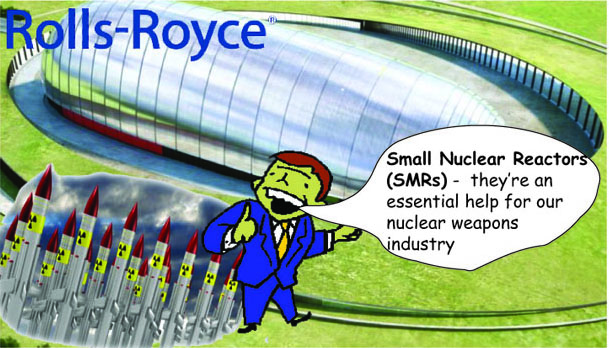
UK refuses to release document showing Net Zero Strategy CO2 savings, New Scientist, 1 December 2021, By Adam Vaughan
The UK government Department for Business, Energy and Industrial Strategy (BEIS) has turned down a freedom of information request that would allow independent scrutiny of its plan for net-zero greenhouse gas emissions.
The UK government has refused a freedom of information request to release a spreadsheet showing how much its landmark Net Zero Strategy will cut carbon emissions for individual measures, such as backing a new nuclear power station and fitting new electric car chargers.
Withholding the document smacks of “secrecy and subterfuge” and prevents the public from being able to interrogate the estimated impacts of the measures, says Ed Matthew at climate change think tank E3G.
The publication of the government’s Net Zero Strategy on 19 October was a key moment ahead of the COP26 climate summit, laying out in detail how the UK plans to reach its 2050 commitment to net-zero greenhouse gas emissions in the coming years.
Previous government blueprints for decarbonisation, such as the 2020 10-point green plan and 2017 clean growth strategy, have spelled out estimates of exactly how much individual policies will cut emissions. But the Net Zero Strategy failed to provide any such breakdown, which observers said showed a lack of transparency that hampered independent scrutiny.
Government officials conceded that there was a spreadsheet containing all the figures, but said they wouldn’t release it. Now, the Department for Business, Energy and Industrial Strategy (BEIS) has refused a freedom of information request by New Scientist to publish the document. It declined the request on the grounds that it involves the disclosure of internal communications…………….
The strategy does show top-level estimates of how much emissions will change for different sectors, such as power, buildings and farming, between now and 2050. But it doesn’t break down individual measures, including backing new hydrogen production or developing new small nuclear plants, both of which will be supported by hundreds of millions of pounds in public funding.
“Ministers are behaving like a shady dealer asking customers to buy a product without seeing it first,” says John Sauven at Greenpeace UK. He is calling on BEIS to publish the spreadsheet: “The best thing would be for the government to release the numbers behind the plan and allow experts to kick the tyres on it”.
The document is likely to include estimates of how extensively various technologies will be employed and their impacts on greenhouse gas emissions in the UK. There may be a mismatch between what the government has committed to publicly, such as a Conservative party manifesto pledge to quadruple offshore wind capacity by 2030, and the estimates that are being withheld, for example………..
New Scientist has appealed the decision not to publish the document. https://www.newscientist.com/article/2299318-uk-refuses-to-release-document-showing-net-zero-strategy-co2-savings/#ixzz7Drfyfmii
Crypto currency mining is rampant, so Kazakhstan looks to nuclear energy, despite its dreadful history there.
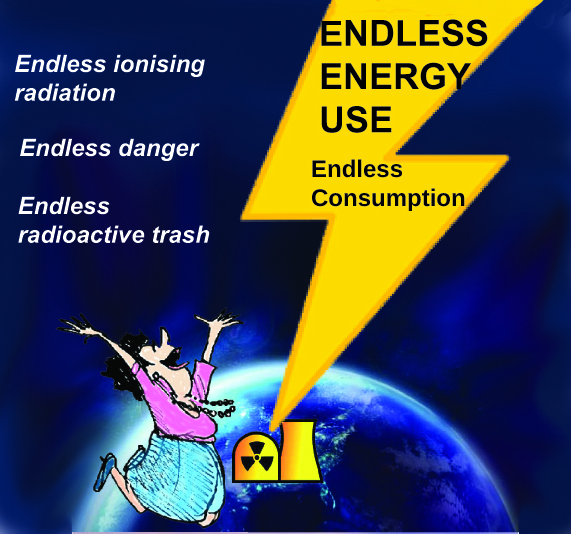
Kazakhstan is now home to 50 registered and an unknown number of unregistered crypto mining companies. The decision to build new nuclear power plants is a serious one for a country that suffered severe nuclear fallout from weapons testing during the Soviet occupation. Kazakhstan’s last nuclear power plant closed in 1999.
Bitcoin mining power crunch: Kazakhstan looks toward nuclear solution, CoinTelegraph, 25 Nov 21
The country saw a great influx of miners this year, but it might have to sacrifice the immense tax revenue from Bitcoin miners if power grid issues are not resolved.
–The exodus of Bitcoin miners from China into Kazakhstan has contributed to an energy crunch that the central Asian country’s president has proposed solving with nuclear energy.
Kazakhstan’s Ministry of Energy has attributed the 8% increase in domestic electricity consumption throughout 2021 to Bitcoin miners. The country received at least 87,849 Bitcoin mining machines from Chinese companies so far this year, following China’s crackdown on crypto mining, according to data from the Financial Times.
The substantial increase in demand has led to a deficit in the domestic power supply and contributed to unreliable electricity services, according to the Kazakhstan Electricity Grid Operating Company. President Tokayev told bankers at a Friday meeting that he thinks building a nuclear power plant will help ease the stress on his country’s electrical infrastructure:………………
Kazakhstan is now home to 50 registered and an unknown number of unregistered crypto mining companies. The decision to build new nuclear power plants is a serious one for a country that suffered severe nuclear fallout from weapons testing during the Soviet occupation. Kazakhstan’s last nuclear power plant closed in 1999……..https://cointelegraph.com/news/bitcoin-mining-power-crunch-kazakhstan-looks-toward-nuclear-solution
26 UK investment funds pouring money into nuclear weapons companies: some have links to UK government.
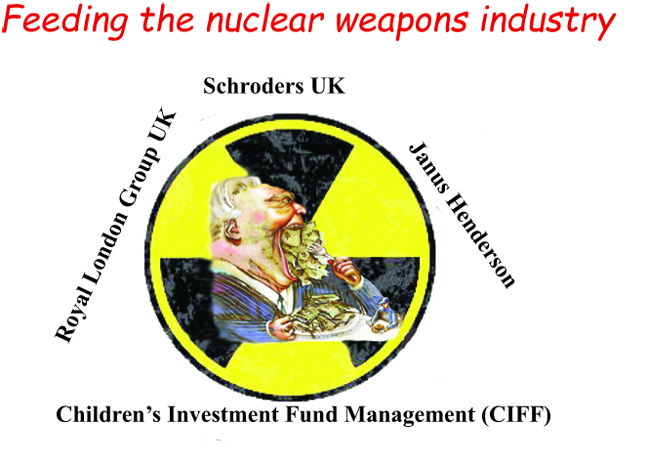
“It is unsurprising that the same financial institutions who continue to pour funding into companies like BAE Systems also have close links with senior Conservative party members and is yet another example of the cosy relationship between the arms industry and the UK government,”
The Ferret, November 28, 2021 Twenty-six financial firms in London have been accused of funding a “new nuclear arms race” including investment funds with links to the UK Government, The Ferret can reveal.
The Ferret found that 26 were based in London and six have links to the Conservative Party, which plans to increase Britain’s nuclear weapons arsenal.
They include Schroders UK which holds shares in the arms giant, BAE Systems. Schroders chair is Lord Geidt, who was an advisor to BAE Systems until April this year. He is now an advisor to Prime Minister Boris Johnson, whose plan to produce more nuclear weapons has been condemned by peace organisations.
Netherlands-based peace group, PAX, produced the study with the International Campaign to Abolish Nuclear Weapons (ICAN). Their report warns that financial institutions continuing to invest in companies involved with the nuclear weapons industry could face “regulatory risks” because of the Treaty on the Prohibition of Nuclear Weapons, which came into force in January 2021.
The treaty – which the UK has not ratified – bans nuclear weapons and has been signed by 86 states so far.
The UK Government — which claims it is “committed to the long-term goal of a world without nuclear weapons” — said in March it would lift the cap on its nuclear arsenal by 40 per cent, from 180 to 260 warheads. In a statement in November the government claimed it had “played a leading role by pioneering work in nuclear disarmament”.
Perilous Profiteering says that Schroders UK had investments in 2020 worth $125.3 million (£93.97m) in BAE Systems which is building new Dreadnought submarines that will be armed with nuclear missiles. The company also provides logistics support for the US Trident and Minuteman missiles. BAE Systems stressed that it does not make nuclear warheads.
The report also names Royal London Group UK which had shares in 2020 worth $98.6m (£74m) in BAE Systems. In June the insurance company appointed Ruth Davidson, former leader of the Scottish Tories , as a non-executive director. Davidson is now a peer.
Others with links to the Tories include the Children’s Investment Fund Management (CIFF) which has shares in Safran, a French firm. Safran owns 50 per cent of ArianeGroup which has contracts for French nuclear weapon production.
Emma Cockburn, Scotland co-ordinator for Campaign Against Arms Trade
CIFF’s investment assets are managed by TCI Fund Management, where Rishi Sunak MP, chancellor of the exchequer, was a partner from 2006 to 2009.
Investment firm Janus Henderson, which has shares in General Dynamics, L3 Harris and Leidos, gave the Tories £3,500 in 2018, a payment which was registered in the House of Commons as required. General Dynamics, L3 Harris and Leidos all operate within the nuclear sector, says the new report.
According to the new report, the entry into force of the Treaty on the Prohibition of Nuclear Weapons in January 2021, is an “historic shift” in the way the world “deals with nuclear weapons”. It points out that while nuclear weapons are controlled by governments, their production is often contracted to private companies. “They (nuclear weapons) are now comprehensively outlawed, as is any assistance with producing, manufacturing or developing them,” the report says.
“Financial institutions that continue investing in companies building nuclear weapons face regulatory risks as more countries join the treaty. They also face an increased reputational risk as clients learn of their support for weapons of mass destruction and terminate their relationships.”
The report also reveals that 338 institutions have financing or investment relationships with the 25 nuclear weapon producing companies, down from 390 the previous year – a fall of 52, which the authors welcomed……….
Other critics of the nuclear weapons industry include Emma Cockburn, Scotland co-ordinator for Campaign Against Arms Trade (CAAT). She said the report provides a “damning insight to the endless billions available for the nuclear and arms manufacturers.”
“It is unsurprising that the same financial institutions who continue to pour funding into companies like BAE Systems also have close links with senior Conservative party members and is yet another example of the cosy relationship between the arms industry and the UK government,” she added……………………….. https://theferret.scot/revealed-27-london-companies-funding-nuclear/
1 This Month
23-25 October – on Zoom – World BEYOND War’s annual global conferenc


Shut down the radiation-damaged Heysham nuclear reactors now
To see nuclear-related stories in greater depth and intensity – go to https://nuclearinformation.wordpress.com

Say No to NASA’s Reckless Nuclear Reactor on the Moon
Say No to NASA’s Reckless Nuclear Reactor on the Moon

-
Archives
- October 2026 (209)
- September 2026 (339)
- August 2026 (330)
- July 2026 (355)
- June 2026 (287)
- May 2026 (306)
- April 2026 (356)
- March 2026 (251)
- February 2026 (267)
- January 2026 (308)
- December 2025 (358)
- November 2025 (359)
-
Categories
- 1
- 1 NUCLEAR ISSUES
- business and costs
- climate change
- culture and arts
- ENERGY
- environment
- health
- history
- indigenous issues
- Legal
- marketing of nuclear
- media
- opposition to nuclear
- PERSONAL STORIES
- politics
- politics international
- Religion and ethics
- safety
- secrets,lies and civil liberties
- spinbuster
- technology
- Uranium
- wastes
- weapons and war
- Women
- 2 WORLD
- ACTION
- AFRICA
- Atrocities
- AUSTRALIA
- Christina's notes
- Christina's themes
- culture and arts
- Events
- Fuk 2022
- Fuk 2023
- Fukushima 2017
- Fukushima 2018
- fukushima 2019
- Fukushima 2020
- Fukushima 2021
- general
- global warming
- Humour (God we need it)
- Nuclear
- RARE EARTHS
- Reference
- resources – print
- Resources -audiovicual
- Weekly Newsletter
- World
- World Nuclear
- YouTube
-
RSS
Entries RSS
Comments RSS

