Boris Johnson government to put limits on local community opposition to nuclear power
Boris Johnson prepares planning overhaul to speed up nuclear power plants.
Prime Minister considering reforms that would make it easier to build new
reactors after meetings with industry.
At a meeting with senior energy executives in Downing Street, ministers indicated that they were
considering reforming rules to make it more difficult for residents and officials to object to the construction of new nuclear sites.
Mr Johnson has previously pledged to put “big bets on nuclear power” as a way of
shoring up UK energy security following the Russian invasion of Ukraine and
concerns about the cost of imported fossil fuel.
Local people may have their ability to oppose new plants stripped away under proposals being
considered by ministers, but industry bosses are more concerned about the
Environment Agency and Marine Management Organisation wrapping their
projects in red tape and slowing them down, The Telegraph understands.
Telegraph 21st March 2022
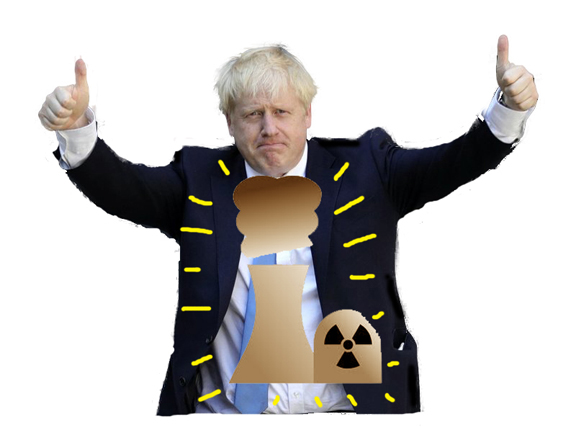
Boris Johnson’s splashy style still avoids the costs, lack of financial commitments for nuclear power development
Garden bridges, routemaster buses, oven-ready Brexit deals…Prime
Minister Boris Johnson is no stranger to eye-catching pledges and, in
fairness, he occasionally achieves them. His latest media-friendly
commitment for “big new bets” on nuclear is typical Johnsonian
politics: brash, bold and intentionally vague.
This is reflected in the UK’s nuclear strategy – which is powered by enthusiasm but weakened by
a lack of details. On the one hand, Business Secretary Kwasi Kwarteng has
brought in the Regulatory Asset Base (RAB) model to power the construction
of projects with public money.
The government has also encouraged
Rolls-Royce’s plan to build small modular reactors (SMRs) across the
country, and has approved plans for light water reactor Sizewell C, while
the much-delayed Hinkley Point C is expected to open in 2026.
However – there remains no specific target for the UK’s nuclear capacity – and
the financial commitments remain threadbare. Its net zero ten-point plan
published last October only includes up to £385m for an Advanced Nuclear
Fund, and £170m for research and development on next-gen technology such
as Advanced Modular Reactors (AMRs) that could unlock hydrogen and
synthetic fuels. For context, Hinkley Point C is estimated to have cost
£23bn. The hesitancy from the Chancellor raises a key question: is bulking
up nuclear power to ensure supply security even a feasible goal?
City AM 22nd March 2022
UK’s Green Party calls for big effort on energy efficiency and renewables – nuclear is an ”expensive distraction”
Nuclear power is a distraction from cleaner, cheaper solutions, say
Greens. Responding to the announcement by the government that it plans for
the UK to get 25% of its electricity from nuclear power, co-leader of the
Green Party, Adrian Ramsay, responded: “Nuclear energy is an expensive
distraction at a time when we face the dual challenges of spiralling energy
costs and concerns over energy security.
“Our focus needs to be on
developing renewable energy technologies and a big push on energy
efficiency. Both are cleaner and cheaper solutions that can be delivered
far quicker than nuclear ever can. “That’s why we are calling for a
£250 billion investment plan for a nationwide home retrofit scheme and
renewables in tomorrow’s Spring statement.
Green Party 22nd March 2022
Greenpeace scathing about Boris Johnson’s plan for nuclear power.
| In response to reports that the Prime Minister wants to generate 25% of the UK’s electricity from nuclear power, Dr Doug Parr, Chief Scientist for Greenpeace UK, said –“Aside from the still-unresolved hazards particular to nuclear power, the Prime Minister’s plan for 25% of power from nuclear suggests some short memories – both Thatcher and Blair had big plans for nuclear which ran into the sand because the technology was expensive, slow, and prone to mishaps. This initiative will result in lots of time, effort and ministerial bandwidth being spent on things that don’t deliver whilst the real solutions to our energy and climate crisis languish with inadequate support.” Greenpeace 22nd March 2022https://www.greenpeace.org.uk/press-centre/ |
Greens firm on Scotland’s opposition to nuclear power.
THE Greens have hit back at claims the Scottish Government should rethink
its opposition to building new nuclear power stations. Greg Hands, the UK
energy minister, insisted in an interview this morning he hoped the war in
Ukraine had given Scotland a “pretext” to get behind nuclear power and be
part of its development.
The National 21st March 2022
https://www.thenational.scot/news/20008191.greens-say-no-building-new-nuclear-power-stations/
Nuclear Information and Resource Servic calls upon the Biden administration to sanction the Russian nuclear industry
This week, the Energy Transition Coalition, an alliance of Ukrainian
environmental and climate organizations, appealed directly to President
Biden to expand US sanctions to Russia’s nuclear energy sector.
The US nuclear industry initially lobbied President Biden not to do so, but in
recent days they have shifted their stance, at least publicly. We will say
more soon about why expanding sanctions to Russia’s nuclear industry
neither entails significant hardships on people in the US nor necessitates
greater investment in domestic nuclear infrastructure.
But today we focus
on why NIRS stands in solidarity with our Ukrainian counterparts and we
call on President Biden to sanction the Russian nuclear industry.
NIRS 18th March 2022 https://www.nirs.org/nirs-joins-ukrainian-calls-for-sanctions-on-russian-nuclear-industry/
Boris Johnson determined to show ‘leadership’ on nuclear power
Johnson announces aim for UK to get 25% of electricity from nuclear power. PM meets industry bosses to discuss new power stations, with several reactors slated for closure as energy demand rises, Guardian, Jasper Jolly and Rob Davies 22 Mar 22,
Boris Johnson has told nuclear industry bosses that the government wants the UK to get 25% of its electricity from nuclear power, in a move that would signal a significant shift in the country’s energy mix.
Johnson on Monday met executives from major nuclear utilities and technology companies including the UK’s Rolls-Royce, France’s EDF, and the US’s Westinghouse and Bechtel to discuss ways of helping to speed up the development of new nuclear power stations.
The UK generates about 16% of its power from nuclear power stations, but several reactors are slated for closure, while electricity demand is expected to rise steadily in the next decade. That would mean large investments in new power stations would be required just to keep the share of nuclear constant, let alone increase it to a record level of just over a quarter of electricity use.
Also present at the meeting were a series of big pension companies and insurers, including Aviva, Legal & General and Rothesay Life, alongside major foreign investors including Australia’s Macquarie and the Canada Pension Plan Investment Board. Ministers have wrestled for years with how to attract private capital to invest in nuclear – but companies have balked at putting pension and insurance cash at risk.

The government is considering changes to insurance rules set by the EU and copied by the UK to make it easier for insurers and pensions to invest. The UK is switching to a “regulated asset base” model, which it hopes will give long-term investors more certainty on returns, a change it hopes will address limitations to the current rules, known as Solvency II.
The government wanted to show the nuclear and investment industries that it had a “clear ambition for more nuclear” in part to balance out intermittent renewable power sources, according to a government source briefed on the discussion.
………………..According to an aide who was present at the meeting, Johnson told industry heads and financiers that there had been a “chronic absence” of leadership by successive British governments on nuclear energy and that the country was “being left for dead” by other nations, such as France, on the issue.
Speaking after the meeting, Tom Greatrex, the chief executive of the Nuclear Industry Association (NIA), said: “Accelerating nuclear projects is absolutely essential to keep energy costs down, cut expensive gas imports and strengthen our energy security as we move towards net zero.
“That means urgently investing in a fleet of large and small nuclear stations, alongside renewable investment, to deliver the clean, sovereign power we need.”
The UK has struggled to build new nuclear power stations in recent decades, with the Japanese conglomerate Hitachi in 2020 pulling out of plans to build a new reactor at Wylfa, north Wales, and geopolitical tensions making the government less keen on attracting Chinese investment to Sizewell C on the Suffolk coast.
Meanwhile the existing nuclear fleet has been in steady decline, with Hunterston B in Scotland retiring earlier this year, Hinkley Point B in Somerset due to follow suit in the summer, and Heysham I and Hartlepool I due to shut down in 2024.
At that point, nuclear capacity is expected to fall as low as 3.6GW.A cross-party group of MPs that campaigns on nuclear issues has called for the government to increase its annual nuclear power capacity to 15GW by 2030 and 30GW by 2050, far above the 12.7GW installed at nuclear power’s peak in 1995.
Major obstacles include difficulty in securing funding from private investors and a ban on new nuclear projects, which was among the factors that scuppered the Wylfa project in north Wales.projects in Scotland, imposed by the devolved government, which prevents Hunterston B being replaced.
The government is examining a plan to revise the financing model for major projects, which was among the factors that scuppered the Wylfa project in north Wales.
Under plans for Sizewell being discussed by Whitehall officials and EDF, the government could take a stake in a development company that will push it through various stages of planning and bureaucracy, sharing the costs with EDF.
Private sector investors such as the insurance funds L&G and Aviva would then be lured in at a later stage in return for a government-backed funding model called the regulated asset base (Rab), diluting the taxpayer and EDF.
Legislation on Rab funding – the same model used to fund airports such as Heathrow and water companies – is due to progress through parliament next month. https://www.theguardian.com/environment/2022/mar/21/johnson-announces-aim-for-uk-to-get-25-of-energy-from-nuclear-power
Nuclear energy development not possible in USA, unless it is tax-payer funded?

What Is Holding U.S. Nuclear Energy Back? OilPrice.com 21 Mar 22,
”……….There are three basic business risks associated with nuclear power for an investor-owned utility: financing, operating, and sales. (Four if you add in new construction risk which is not inconsequential.) The simple reason no US investor-owned utility — apart from Southern Company’s Plant Vogtle—- is building or considering new nuclear investments is the first risk, financing. To paraphrase a former NYC mayoral candidate, the capital costs are “too damn high”. By any metric, nuclear power is economically uncompetitive. According to the recent Lazard study comparing the cost of new power generation, it is about three times more costly than natural gas and five times more costly than new wind and solar.
This begs an obvious question. How can we have more of something if it is wildly, economically uncompetitive? The answer is simple: eliminate the consideration of economics from new power plant development. Take for example a large nuclear construction project at Turkey’s four-unit Akuyu nuclear power station. In the US that is a $40+billion capital project. No US investor-owned utility has the balance sheet to handle multiple unit projects of that size. Only the US government has the borrowing capacity for projects of that magnitude and risk. This, in turn, suggests that new nuclear power plant development will only occur in the US If we compromise on our free enterprise principles and take new nuclear plant development out of the private sector entirely. These enormous financing risks are now impossible to comfortably absorb in a corporate setting where they must be constantly balanced against shareholder interests. ….’
UK’s Business secretary Kwasi Kwarteng considering launching State-owned nuclear company

Government ministers are mulling over plans to launch a state-owned
nuclear company, which would assume stakes in future domestic projects.
Business secretary Kwasi Kwarteng is considering the move as he looks to
speed up the development of nuclear plants – which have suffered years of
delays- and reduce the UK’s reliance on foreign energy, according to The
Sunday Times.
City AM 20th March 2022
Boris Johnson all for nuclear power – but there are tensions with the Treasury about this
Boris Johnson will host a meeting with leaders from the nuclear power
industry today as part of efforts to boost domestic energy supplies. The
prime minister wants to remove the barriers to the raising of Britain’s
nuclear power output and sees the industry, along with renewables, as key
to reducing energy imports.
Today’s meeting with nuclear industry bosses
will inform the prime minister’s British Energy Security Strategy, which
has been hit by delays. It is unlikely to be unveiled until early next week
because of tensions with the Treasury and the prime minister’s travel
arrangements, which include a trip this week to a Nato summit in Brussels.
A government source said that the Treasury had delayed Johnson’s plans
for a significant increase in the number of nuclear power plants out of
concern about the feasibility and cost.
Times 21st March 2022
Boris Johnson ‘gung ho’ for new nuclear power, but Chancellor Rishi Sunak applying the brakes
Boris Johnson in ‘gung ho’ push for more nuclear power as energy
crisis starts to bite. Boris Johnson will on Monday sketch out to industry
bosses what one minister called his “gung ho” approach to boosting
Britain’s nuclear power sector, as officials draw up plans that could
target a fivefold increase in capacity by 2050.
The prime minister vowed
this month to make “a series of big new bets on nuclear power” and
government insiders say this could imply the construction of at least half
a dozen big new stations between 2030 and 2050.
Rishi Sunak, chancellor,
last week applied the brakes to Johnson’s plans to set out an energy
security strategy this week, amid Treasury fears about the cost to the
public purse. New nuclear power stations each require close to £ 20bn to
build and the industry is prone to cost overruns.
Sunak, who presents his
Spring Statement this week, is trying to hold down spending to give him
space to cut taxes. “We need to do more work on the nuclear strategy
before we press ahead,” said one ally of the chancellor. But one cabinet
minister said: “Boris has had something of an evangelical conversion, in
the past few months – he has been really gung-ho for nuclear.” The
energy strategy is due before the end of the month.
FT 20th March 2022
https://www.ft.com/content/17852c7c-fd92-40cb-b4ec-9767c6069677
Evangelical fervour for new nuclear power in UK’s Tory government
Wylfa on Anglesey could get three new nuclear reactors as the Prime
Minister is said to be ‘enthusiastic’ about accelerating plans in order
to reach the UK’s future net-zero targets and close an energy black hole.
US nuclear company Westinghouse has put together a consortium with
construction group Bechtel to revive plans for two nuclear reactors at
Wylfa since Hitachi, a Japanese conglomerate, abandoned their own plans in
2019.
A consortium led by Rolls-Royce also wants to place one of their own
‘small’ modular reactors on the site. According to the Financial Times,
Boris Johnson is “enthusiastic about Wylfa’s prospects,” with one
cabinet minister telling the newspaper he “has had something of an
evangelical conversion, in the past few months”.
Ynys Môn MP Virginia
Crosbie has also been enthusiastic about the plans, describing herself in
the House of Commons as “the Atomic Kitten”. However, Chancellor Rishi
Sunak is said to be less enthusiastic given the cost to the taxpayer of
financing such huge projects that would not be operational for decades,
with a target of meeting the UK Government’s ‘net zero’ goal by 2050.
Nation Cymru 21st March 2022 https://nation.cymru/news/wylfa-could-get-three-new-nuclear-reactors-as-boris-johnson-enthusiastic-about-accelerating-plans/
Boris Johnson in the grip of the nuclear lobby
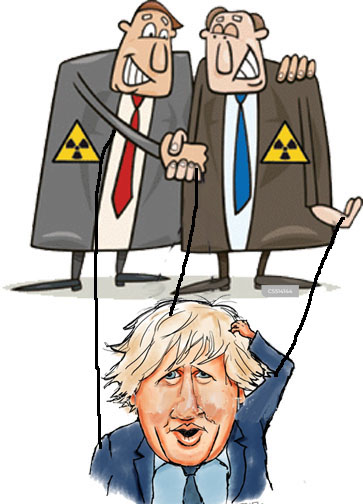
Prime minister Boris Johnson is expected this week to meet the bosses of
leading power and energy development companies to discuss ways of
increasing Britain’s electricity and gas supplies.
Officials from EDF, developer of the proposed Sizewell C nuclear power plant, are expected to
be invited to the talks. Rolls-Royce and nuclear company Westinghouse are
also understood to have been invited. EDF and Sizewell C declined to
comment.
But Stop Sizewell C said the Suffolk power project was not the
solution to the energy crisis as it stepped up its campaign again at the
weekend by projecting messages onto Sizewell B on Saturday night.
East Anglian Daily Times 20th March 2022
https://www.eadt.co.uk/news/business/sizewell-projections-message-on-nuclear-power-8768518
The energy crisis is now, new nuclear will be (at least) twenty years too late – UK’s Nuclear Free Local Authorities (NFLA)
The energy crisis is now, new nuclear will be (at least) twenty years too late
The Nuclear Free Local Authorities were dismayed to hear that the door of Number 10 will today once more be held open for guests from the nuclear power industry as Prime Minister Boris Johnson hosts a roundtable with prospective commercial partners, ahead of a new energy statement later this week.
Following Johnson’s proclamation that he will look to ‘place big new bets on nuclear’ and with one cabinet member allegedly describing the Prime Minister as ‘really gung ho for nuclear’, the participants are likely to meet with a firm ally. Government resolve will also be bolstered by the publication last week by the All-Party Parliamentary Group on Nuclear Energy of a ‘roadmap’ to make sites, money and a pared-down regulatory environment available to the nuclear industry to enable the development of a further 15 Gigawatts of new nuclear generating capacity by 2035 and 30 GW by 2050.
The NFLA believes that this hyperbole ignores the reality that any new nuclear projects will take too long, cost too much and have too many uncertainties to provide a meaningful solution to the energy and climate crisis that Britain faces now.
“Despite the need to generate ‘more electricity more greenly’ now, the Prime Minister seems determined to ignore the obvious solution that would result from a far greater and more urgent investment in renewable technologies and is instead taking us once more along the increasingly well-trodden and costly road to no-where that is new nuclear”, said Councillor David Blackburn, Chair of the NFLA, in response to the news.
“Every pound spent on nuclear is a pound denied to renewables. New nuclear has a lamentable history of being delivered at far greater cost and far more slowly than was at first predicted. New nuclear plants take decades to deliver with Hinkley Point C currently estimated to cost at least £23 billion. Renewables have been proven to deliver electricity far more cheaply, far more quickly and far more safely than new nuclear ever can – and renewable energy comes without the additional eye-watering cost of decommissioning nuclear plants and managing the legacy of radioactive waste for millennia that comes with it.”
The NFLA would like the government to change tack and look to harness natural energy sources to generate power to meet our needs, whilst saving our environment.
“The irony is that we already have the solutions to our energy and climate crisis to hand. When you live in a country that is surrounded by seas and has unpredictable weather it is surely a far safer bet to invest in tidal energy, hydro power, solar panels and wind turbines to draw energy from Mother Nature. The NFLA believes this, combined with investment in innovative energy storage solutions and in retrofitting our cold and draughty homes to a far higher standard to reduce energy use, could meet Britain’s energy needs, reduce fuel bills, and safeguard our planet in the here-and-now, not the never-never.”
Ends//…For more information please contact Richard Outram, Secretary, NFLA Email Richard.outram@manchester.gov.uk / Mobile 07583 097793
Water supply problems for planned £20billion twin reactor on the Suffolk coast
Sizewell C developer EDF is being asked by government whether a temporary
desalination plant could last for the lifetime of the new nuclear power
plant if it is built. The public examination of the plans for the
£20billion twin reactor on the Suffolk coast was told a permanent water
supply for the proposed development had not yet been secured. However, a
temporary desalination plant would run during the construction of the
project.
Kwasi Kwarteng, secretary of state at the Department of Business,
Energy and Industrial Strategy, is now asking EDF what progress has been
made on securing a permanent water supply solution. But he also says: “The
applicant should confirm if it would be possible for the proposed temporary
desalination plant to permanently meet the full water supply demand for the
lifetime of the proposed development should no alternative water supply
solution be identified.”
East Anglian Daily Times 20th March 2022
https://www.eadt.co.uk/news/business/water-supply-sizewellc-questioned-by-government-8768432
1 This Month
23-25 October – on Zoom – World BEYOND War’s annual global conferenc


Shut down the radiation-damaged Heysham nuclear reactors now
To see nuclear-related stories in greater depth and intensity – go to https://nuclearinformation.wordpress.com

Say No to NASA’s Reckless Nuclear Reactor on the Moon
Say No to NASA’s Reckless Nuclear Reactor on the Moon

-
Archives
- October 2026 (199)
- September 2026 (339)
- August 2026 (330)
- July 2026 (355)
- June 2026 (287)
- May 2026 (306)
- April 2026 (356)
- March 2026 (251)
- February 2026 (267)
- January 2026 (308)
- December 2025 (358)
- November 2025 (359)
-
Categories
- 1
- 1 NUCLEAR ISSUES
- business and costs
- climate change
- culture and arts
- ENERGY
- environment
- health
- history
- indigenous issues
- Legal
- marketing of nuclear
- media
- opposition to nuclear
- PERSONAL STORIES
- politics
- politics international
- Religion and ethics
- safety
- secrets,lies and civil liberties
- spinbuster
- technology
- Uranium
- wastes
- weapons and war
- Women
- 2 WORLD
- ACTION
- AFRICA
- Atrocities
- AUSTRALIA
- Christina's notes
- Christina's themes
- culture and arts
- Events
- Fuk 2022
- Fuk 2023
- Fukushima 2017
- Fukushima 2018
- fukushima 2019
- Fukushima 2020
- Fukushima 2021
- general
- global warming
- Humour (God we need it)
- Nuclear
- RARE EARTHS
- Reference
- resources – print
- Resources -audiovicual
- Weekly Newsletter
- World
- World Nuclear
- YouTube
-
RSS
Entries RSS
Comments RSS

