Greenpeace: Nuclear power is not the solution to Philippines’ energy woes
Greenpeace: Nuclear power is not the solution to PH’s energy woes, https://opinion.inquirer.net/151278/greenpeace-nuclear-power-is-not-the-solution-to-phs-energy-woes
Philippine Daily Inquirer / 04:05 AM March 22, 2022
We are writing to respond to Solita Monsod’s two recent columns on nuclear power and the Bataan Nuclear Power Plant (BNPP). We believe these columns glossed over several important facts that the nuclear industry also wants to hide from the public eye.
First, nuclear power is not cheap. Costs for radioactive nuclear waste management and storage, decommissioning, and insurance, need to be factored in. Monsod compares nuclear prices to coal and oil, but recent reports by the International Energy Agency and the International Renewable Energy Agency have already confirmed that renewable energy (RE), primarily from solar and wind, is now the cheapest source of electricity by far. Rehabilitating the BNPP won’t be cheap either. Monsod makes a price comparison with new nuclear plants (which are prohibitively expensive) but neglects to make a comparison with RE, whose capital costs are a lot less than that of upgrading the BNPP.
We are writing to respond to Solita Monsod’s two recent columns on nuclear power and the Bataan Nuclear Power Plant (BNPP). We believe these columns glossed over several important facts that the nuclear industry also wants to hide from the public eye.
First, nuclear power is not cheap. Costs for radioactive nuclear waste management and storage, decommissioning, and insurance, need to be factored in. Monsod compares nuclear prices to coal and oil, but recent reports by the International Energy Agency and the International Renewable Energy Agency have already confirmed that renewable energy (RE), primarily from solar and wind, is now the cheapest source of electricity by far. Rehabilitating the BNPP won’t be cheap either. Monsod makes a price comparison with new nuclear plants (which are prohibitively expensive) but neglects to make a comparison with RE, whose capital costs are a lot less than that of upgrading the BNPP.
There are also hidden costs, such as the costs to health and livelihoods of communities living in the vicinity of these plants, as well as the costs all Filipinos will pay to maintain a regulatory agency. But the biggest hidden cost is the price of a nuclear accident. This cost runs in the trillions of pesos and will affect generations of Filipinos. Neither the nuclear industry nor the government has mentioned anything about how these costs will be paid for should this happen.
Second, nuclear power will not solve our power woes or give us energy security. We still need to import radioactive fuel, so we will be hostage to the price volatility of this commodity. Nuclear proponents also never mention that fuel production is almost a monopoly, dominated by only four companies. This arrangement will lock us into dependence on foreign fuel and companies, where any shortage or increase in demand globally would mean Filipinos will be faced with rising energy costs that the government can’t control.
Third, the BNPP has not been confirmed by any independent study to be safe for operation, and “small modular nuclear reactors” for power generation don’t exist. All the studies so far conducted that have called the BNPP “safe” were undertaken by bodies connected with the industry, and therefore would not be subjective in their assessment. On the other hand, a safety inquiry conducted by the Union of Concerned Scientists found more than 4,000 technical defects in the plant. Meanwhile, small modular reactors being promoted by nuclear companies or agencies of Russia and the US are still currently being studied. Should the Philippines take this route, we will be among the first guinea pigs of this human experiment.
Fourth, we’ve never heard anything about permanent storage for radioactive spent fuel from nuclear promoters. The cost for constructing and maintaining this facility will likely be in the trillions of pesos, to be paid for by all Filipinos, not just nuclear power customers. But will the government find a safe place for this deadly waste in the archipelagic and volcanic Philippines? And will there be a local government unit that would willingly accept it? The problem of dealing with nuclear waste is the toxic burden we will leave today’s youth and their children, for them to additionally deal with, alongside climate impacts.
The debt we incurred because of BNPP was gargantuan. It was unfortunate that we paid for what was, in reality, the price of bad energy planning railroaded by a government that was blinded by the false glitter of nuclear power—and the kickbacks an expensive power project would bring. Will we let history repeat itself?
Monsod’s hinayang is for the past—sayang the money we paid for it, she says. It’s true we can’t get it back. But we can prevent Flipinos from bearing the same oppressive burden again. We have the opportunity to harness the cheapest power sources in the world—RE in the form of solar and wind—and redesign our energy system into flexible decentralized grids that are infinitely more efficient than the outdated centralized models reliant on inflexible baseload plants, such as nuclear. This kind of energy planning is smart, and game-changing, and is the real solution to the climate crisis. Mas malaking hinayang if we don’t take this opportunity to transform our energy system now, and create a better energy future for ourselves.
Khevin Yu,
energy transition campaigner
Greenpeace Philippines
Zelensky bans 11 political parties, although no evidence linking any to Russian government
Zelensky Announces Ban on 11 Political Parties–At the onset of the Feb. 24 invasion, Zelensky signed a measure that established martial law and general mobilization. | 20 March 2022 | Ukraine President Volodymyr Zelensky announced a measure that bans 11 opposition political parties, alleging they have ties to Russia, he announced in a Telegram video posted on March 20. Zelensky also said “wartime exposes quite well the paucity of personal ambitions of those who try to put their own ambitions” or “their own party or career above the interests of the state,” according to a translation. The National Security Council agreed to suspend the parties, Ukrinform reported, citing Zelensky’s video address. The Ukrainian Ministry of Justice has been told to immediately take measures to ban those political parties, he said. Zelensky didn’t provide evidence that linked the 11 opposition parties to the Russian government.
‘Let them kill as many as possible’ The Roots of US Militarism in Russia and Around the World
“This time, is the primary goal of the paramilitary program to help Ukrainians liberate their country or to weaken Russia over the course of a long insurgency that will undoubtedly cost as many Ukrainian lives as Russian lives, if not more?”
What the people of Ukraine are suffering from Russian aggression is suffered daily by millions around the world from U.S. aggression.
Common Dreams, BRIAN TERRELL, March 4, 2022 In April 1941, four years before he was to become President and eight months before the United States entered World War II, Senator Harry Truman of Missouri reacted to the news that Germany had invaded the Soviet Union: “If we see that Germany is winning the war, we ought to help Russia; and if that Russia is winning, we ought to help Germany, and in that way let them kill as many as possible.” Truman was not called out as a cynic when he spoke these words from the floor of the Senate. On the contrary, when he died in 1972, Truman’s obituary in The New York Times cited this statement as establishing his “reputation for decisiveness and courage.”
“This basic attitude,” gushed The Times, “prepared him to adopt from the start of his Presidency, a firm policy,” an attitude that prepared him to order the atomic bombings of Hiroshima and Nagasaki with “no qualms.” Truman’s same basic “let them kill as many as possible” attitude also informed the postwar doctrine that bears his name, along with the establishment of NATO, the North Atlantic Treaty Organization and the CIA, the Central Intelligence Agency, both of which he is credited with founding.
A February 25 op-ed in The Los Angeles Times by Jeff Rogg, “The CIA has backed Ukrainian insurgents before- Let’s learn from those mistakes,” cites a CIA program to train Ukrainian nationalists as insurgents to fight the Russians that began in 2015 and compares it with a similar effort by Truman’s CIA in Ukraine that began in 1949. By 1950, one year in, “U.S. officers involved in the program knew they were fighting a losing battle…In the first U.S.-backed insurgency, according to top secret documents later declassified, American officials intended to use the Ukrainians as a proxy force to bleed the Soviet Union.” This op-ed cites John Ranelagh, a historian of the CIA, who argued that the program “demonstrated a cold ruthlessness” because the Ukrainian resistance had no hope of success, and so “America was in effect encouraging Ukrainians to go to their deaths.
The “Truman Doctrine” of arming and training insurgents as proxy forces to bleed Russia to the peril of the local populations that it was purporting to defend was used effectively in Afghanistan in the 1970s and ’80s, a program so effective, some of its authors have boasted, that it helped bring down the Soviet Union a decade later. In a 1998 interview, President Jimmy Carter’s National Security Advisor Zbigniew Brzezinski explained, “According to the official version of history, CIA aid to the Mujaheddin began during 1980, that is to say, after the Soviet army invaded Afghanistan on December 24, 1979. But the reality, closely guarded until now, is completely otherwise: Indeed, it was July 3, 1979 that President Carter signed the first directive for secret aid to the opponents of the pro-Soviet regime in Kabul. And that very day, I wrote a note to the president in which I explained to him that in my opinion this aid was going to induce a Soviet military intervention… We didn’t push the Russians to intervene, but we knowingly increased the probability that they would.”
“The day that the Soviets officially crossed the border,” Brzezinski recalled, “I wrote to President Carter, essentially: ‘We now have the opportunity of giving to the USSR its Vietnam war.’ Indeed, for almost 10 years, Moscow had to carry on a war that was unsustainable for the regime, a conflict that brought about the demoralization and finally the breakup of the Soviet empire.”
…………………….. In his LA Times op-ed, Rogg calls the 1949 CIA program in Ukraine a “mistake” and asks the question, “This time, is the primary goal of the paramilitary program to help Ukrainians liberate their country or to weaken Russia over the course of a long insurgency that will undoubtedly cost as many Ukrainian lives as Russian lives, if not more?” Viewed in light of United States foreign policy from Truman to Biden, the early cold war debacle in Ukraine might better be described as a crime than a mistake and Rogg’s question seems rhetorical.
………………… Globally, through its armed forces but even more through the CIA and the so-called National Endowment for Democracy, through NATO muscle masquerading as mutual “defense,” in Europe as in Asia, as in Africa, as in the Middle East, as in Latin America, the United States exploits and dishonors the very real aspirations of good people for peace and self-determination. At the same time, it feeds the swamp where violent extremisms like the Taliban in Afghanistan, ISIS in Syria and Iraq and neo-Nazi nationalism in Ukraine can only fester and flourish and spread. …………………………………………… https://www.commondreams.org/views/2022/03/04/let-them-kill-many-possible-roots-us-militarism-russia-and-around-world
Canada’s green bond program specifically prohibits investments in nuclear energy

Is nuclear energy green or not? Federal government sending conflicting messages, critics say
At the same time the government invests in small modular nuclear reactor projects, its new planned green bond program specifically prohibits investments in nuclear energy
Excerpt from the National Post, Mar 18, 2022 •The Liberal government is being accused of sending conflicting messages about the nuclear industry and how it can help adapt to a green environment.
The week the Liberal government put $27.2 million into a promising new small modular nuclear reactor — but at the same time its green bond program, meant to boost environmentally-friendly programs, specifically excludes investments in nuclear power.
The conflict shows mixed support at best for the industry, say critics………….
The green bond program was announced in last spring’s budget and detailed rules were released earlier this month. The green bonds would be part of Canada’s broader debt program, but the money would be specifically diverted to environmentally-friendly programs, such as climate change adaptation measures, other forms of renewable energy, and energy efficiency……….
Adrienne Vaupshas, a spokesperson for Finance Minister Chrystia Freeland, said Canada’s green bonds were following international standards.
“Canada’s green bond framework is fully aligned with international green bond standards and market expectations,” she said….
UK’s Nuclear All-Party Parliamentary Group (APPG) condemned for calling on govt to reclassify nuclear energy as ‘green’

CND condemns Westminster nuclear group’s call for nuclear energy to be re-classified as ‘green’ https://cnduk.org/cnd-criticises-westminster-nuclear-groups-call-for-nuclear-energy-to-be-re-classified-as-green/?fbclid=IwAR3H1WnXXIVuZY0u8smeKP097HzFohe3_Xgonazrwhe1X6sldhOzfhX12T0CND has condemned MPs and Peers from the Nuclear All-Party Parliamentary Group (APPG) for calling on the UK government to reclassify nuclear energy as ‘green’ so it can avail of the Green Finance Initiative.
The informal cross-party group included the demand as part of a five-point plan published this week, after Prime Minister Boris Johnson announced “big new bets on nuclear” as part of efforts to cut reliance on gas and oil imports from Russia .
The APPG is also urging that the government sets out key targets for nuclear energy ambitions such as 15GW of power generated by 2035, and at least 30GW generated by 2050, as well as fast-tracked decisions on both large-scale nuclear plants and small modular reactors (SMRs).
In addition to opening up nuclear energy to green financing, the group wants unused former nuclear sites to be made available for further nuclear development.
CND has long-pointed out that genuinely sustainable alternatives to nuclear power exist in renewable energy sources and calls on the government to invest in these technologies rather than diverting billions of pounds into subsidising the nuclear industry. By doing so, we could secure enough clean energy sources while creating thousands of new jobs
CND Vice-President and nuclear energy expert, Dr Ian Fairlie, said the APPG’s proposals for a nuclear bonanza were ill-considered: “The idea that nuclear power, in any shape or form, was a ‘green technology’ was absurd. Nuclear wastes last for millennia and the government has nothing but hazy ideas and paper plans for its nuclear waste, so these proposals for yet more nuclear power make rational people shake their heads in disbelief. In our view, nuclear power with all its problems is not just unsustainable, it is a veritable insult to any notion of sustainability. It is for this reason that several EU Member States have objected to current proposals to make nuclear power eligible under the EU’s Green Financing Framework.”
Push for UK govt to call nuclear power ”green”, so that nuclear industry can get money from theGreen Financing Framework.

Westminster’s Nuclear All Party Parliamentary Group (APPG) has published
a roadmap that calls for 15GW of new nuclear generation by 2035 and 30GW by
2050. In light of the current energy crisis and comments from the prime
minister earlier this week about ‘big new bets on nuclear power’, the
Nuclear APPG set out a five-point plan that urges commitment to both
large-scale plants as well as small modular reactors (SMRs).
Alongside the 15GW and 30GW ambitions, the plan also includes reclassifying nuclear as
green energy to make it eligible under the Green Financing Framework,
accelerating decisions and funding on Sizewell C and SMRs, freeing up
unused nuclear sites for prospective developers, and streamlining the
development and planning processes.
The Engineer 17th March 2022
Silence in the media and Labour “left” on Assange’s extradition danger

Silence in the media and Labour “left” on Assange’s extradition danger, WSWS, 16 Mar 22,
Thomas Scripp, Julian Assange was shunted a step closer to his would-be executioners on Monday. The UK Supreme Court issued a one-line decision refusing to hear the WikiLeaks founder’s appeal against an earlier decision ordering his extradition to the United States.
The case will now be returned to the original court as a formality before being passed to the home secretary, Priti Patel, to give the final order. Once Patel receives the case, Assange could be on a plane to the US in just four weeks’ time, except for inevitable further appeals.The Biden administration intends to prosecute Assange for charges under the Espionage Act with a potential sentence of 175 years in prison. This would be served in barbaric conditions that previous judgements acknowledged could drive him to suicide. His health has already been destroyed by years of incarceration in Britain’s maximum security Belmarsh prison.
Despite the immense danger faced by the most significant journalist of the 21st century, many major newspapers did not cover the Supreme Court decision. Those that did ran entirely perfunctory stories, largely without comment.Britain’s leading liberal newspaper, the Guardian, did not write a single critical line in its cursory 350-word article, quoting just two sentences from his legal team. The US New York Times managed, “If Mr. Assange were extradited to the United States and faced a trial, the case could raise profound First Amendment issues. His prosecution has alarmed advocates of press freedom.”
These are publications which have spent the last weeks screaming about Russian President Vladimir Putin’s censorship and attacks on free speech and journalistic freedoms. When speaking out about democratic rights lines up with imperialist war aims, they are fervent advocates. In the case of Assange, who exposed the systematic crimes of US and British imperialism, the “democratic principles” they so fiercely defend in Russia whither on the vine.
The NATO-Russia war over Ukraine has not only accelerated Assange’s persecution, but intensified his long and deliberate isolation by the corporate media.
At a briefing with the Foreign Press Association last month, to introduce his new book The Trial of Julian Assange: A Story of Persecution, UN special rapporteur on torture Nils Melzer accused the mainstream media of failing in their duty as the “fourth estate” to hold governments to account. Melzer’s book is based on his three years of efforts to end the illegal mistreatment of the WikiLeaks founder.
In it, he criticises the “too little, too late”, “tame and lame” reporting of the British, American and American press, exposing their cynical pseudo-support for Assange:“A handful of half-hearted opinion pieces in the Guardian and the New York Times rejecting Assange’s extradition are not bold enough, and so fail to convince. While both papers have timidly declared that convicting Assange of espionage would endanger press freedom, not a single mainstream media outlet protests the blatant violations of due process, human dignity and the rule of law that pervade the entire trial. None holds the involved governments to account for their crimes and corruption; none has the courage to confront political leaders with uncomfortable questions; none feels dutybound to inform and empower the people—a mere shadow of what was once the ‘fourth estate’.”
Amid the war frenzy and the need to present Britain and the US as champions of global democracy, even the days of the half-hearted opinion piece are over.
Melzer’s point extends far beyond the media. The UN rapporteur is one of just a handful of prominent public figures in any sphere with an honourable record on Assange. At his FPA event, he described his inability to seek redress “through the diplomatic channels at my disposal, or by alerting the General Assembly [of the UN] or the Human Rights Council in Geneva,” describing Assange as “the untouchable case,” kept behind a “wall of silence”.
Among the more significant silences is kept by the British “left”.
In July 2020, only 26 MPs could bring themselves to sign an early day motion, “Julian Assange, press freedom and public-interest journalism”, which asserted, “That this House notes the July 2020 statement by the National Union of Journalists, the International Federation of Journalists, Reporters Without Borders and others in relation to the WikiLeaks founder Julian Assange and affirms its commitment to press freedom and public-interest journalism.”
Among the signatories were 16 Labour MPs, including now former party leader Jeremy Corbyn and several of his shadow front benchers: John McDonnell, Diane Abbott, Rebecca Long-Bailey, Ian Lavery and Clive Lewis.
Of this rump, only one, Claudia Webbe, has spoken on Assange since the Supreme Court decision. Webbe is no longer a Labour MP, having been expelled from the party after a criminal harassment conviction. She tweeted simply, “Julian Assange should be free”……………………. https://www.wsws.org/en/articles/2022/03/16/assa-m16.html?pk_campaign=assange-newsletter&pk_kwd=wsws
Message to Biden: Help De-Escalation in Ukraine or Risk Nuclear War

https://www.commondreams.org/views/2022/03/14/message-biden-help-de-escalation-ukraine-or-risk-nuclear-war, Instead of pouring in weapons and piling on sanctions, we should call on President Biden to begin good faith negotiations with all concerned parties, respecting each of their security concerns.
GERRY CONDON, March 14, 2022 “The first casualty of war is truth.” This simple yet profound statement is attributed to many, including Hiram Johnson in a speech in the U.S. Senate in 1918, during the “war to end all wars.”………………..
As the war rages in Ukraine in 2022, actual combat is eclipsed by well-practiced information warfare. It was not surprising when the White House and State Department began shouting that the Russians were about to launch a “false flag” event to justify their pending invasion of Ukraine. After all, isn’t that the way it is always done? Isn’t that the way the US did it with the Tonkin Gulf Incident in Vietnam, babies being thrown out of incubators in Kuwait, and Weapons of Mass Destruction in Iraq. Of course, the US has a bigger challenge claiming self-defense as it invades smaller, weaker countries halfway around the globe.
Twenty-four hour news coverage is keeping Americans hyped up and dumbed down
Once the fighting commences, deception is also an important ploy on the battlefield. The ancient Greek playwright Aeschylus wrote, “God is not adverse to deceit in a just cause.” Aside from keeping the enemy guessing about when and where the next attack will be launched, it is critically important to maintain popular support for a questionable enterprise that requires the sacrifice of blood and treasure.

Totally absent from nonstop coverage of the war and condemnations of Russian president Putin is any reporting on the role of the United States and NATO in creating the crisis over Ukraine. No reports about the relentless NATO expansion up to the very borders of Russia. No mention of US missile emplacements in Romania and Poland. Nothing about the unilateral US exit from vital nuclear treaties—the Anti-Ballistic Missile Treaty (George W. Bush, 2002), and the Intermediate Nuclear Forces Treaty (Donald Trump, 2018).
Twenty-four hour cable news coverage of the ugly war in Ukraine is keeping Americans hyped up and dumbed down. The very real horror of war is on the screen for all to see. The bombed-out buildings, the mounting civilian casualties and the frightened refugees speak their own truth. Unfortunately, we rarely see the victims, the grieving families and the terrified refugees when the invader is the US. The “shock and awe” US terror bombing campaign on Baghdad was described by one network TV anchor as a “beautiful thing to see.”
Joe Biden is also worried about nuclear war, a serious concern for all modern presidents. Vladimir Putin is brandishing his large nuclear arsenal as a disincentive for direct US/NATO engagement in the Ukraine war. The US canceled a planned ICBM test launch from Vandenberg Space Force Base in California to its usual target in the much-bombed Marshall Islands. Apparently, the US did not want to risk spooking Putin, about whose mental state many people are speculating. Could it be that Putin is employing Richard Nixon’s famous “madman theory,” keeping his enemies at bay with unpredictability?
Of course, Russia has its own propaganda apparatus, but we will not be much exposed to it here in the US. Russia Today (RT) has been removed from most cable TV services as well as from YouTube. Well actually, almost everything Russian is currently being canceled, in a furious frenzy of the Russia-hating that has been central to US culture ever since World War II. The Russians are never given credit for their outsized role in defeating the Nazis, nor sympathy for the 27 million lives lost in that war.
The US routinely violates the UN Charter—and now Russia has done so
The Russian invasion is a terrible violation of the UN Charter, but hardly unprecedented. International law in no way restrained US war-making in Vietnam, the Dominican Republic, Panama, Grenada, Afghanistan, Iraq, Libya, Syria, Somalia or Yemen. Russia’s invasion was not in self-defense—except in a preemptive sense—they were not under immediate military attack.
Some say that the ongoing Ukrainian war against two breakaway Russia-aligned provinces in eastern Ukraine provided Just Cause for Russia’s invasion. Fourteen thousand people have died in the violence there since 2014, when a US-backed coup overthrew a Russia-friendly president and replaced him with someone handpicked by the US.
Another annoying factoid is the well-documented role of Nazi militias in the 2014 coup and in the current government and military. These inconvenient truths in no way can justify the blatant Russian aggression, however, which is killing hundreds of innocent civilians and has created a dangerous crisis for humanity.
The Information War Presents the Peace Movement with a Dilemma
The nonstop barrage of information, misinformation, disinformation and rallying around the flag has presented the peace movement with a dilemma. How do peace-loving people righteously condemn the Russian invasion—the destruction of cities, the killing of hundreds of civilians, the displacement of millions? How do we express our outrage and our strong disapproval of this aggression and violence without appearing to join in the war fervor that is sweeping the US?
Conversely, how do we explain the role of the US and NATO in creating this crisis without appearing to justify this horrible violence? How do we demand that President Biden stop pouring fuel on the fire by sending more weapons into Ukraine? How do we tell people that sanctions are not an alternative to war, but rather an escalation of war?
Escalation is the very last thing we want. The Ukraine war presents the entire world with an existential threat. It is not alarmist to say this is the greatest imminent threat of nuclear war since the Cuban Missile Crisis of 1962. The one where the US was reacting to Russian nuclear missiles being positioned in Cuba, way too close for comfort. Does that ring a bell?
The Danger of Nuclear War Should Focus Our Attention
The very real danger of nuclear war should focus all our attention. With both US and Russian nukes on “hair-trigger alert,” what could go wrong? And then there are the 15 or so nuclear power plants in Ukraine, several of them reportedly compromised by the war. Is that a real threat or is it war propaganda? Perhaps both. It is in EVERYBODY’s interest to end this very dangerous war as soon as possible.
Joe Biden is not new to this conflict. Biden and—famously—his son Hunter, have been involved in the Ukraine mess at least since the 2014 coup, after which a Ukrainian oil company paid Hunter Biden $50,000 a month to sit on its Board. No conflict of interest there, all the Democrats insisted. Even without family enrichment, Joe Biden has long been dedicated to the Cold War project of putting the Soviet Union—and now Russia—in its place, which is no place, and with no respect.
The United States leads NATO—the Supreme Allied Commander in Europe is always a U.S. general. President Biden probably could have headed off the Russian invasion by simply saying publicly that Ukraine would not become a member of NATO. But he refused to do that. He called Putin’s bluff, and Putin showed him it was no bluff.
President Biden Must Act Now to De-Escalate this Dangerous War
Whatever disagreements there are about how the Ukraine war came about, reasonable people should be able to agree on this: This war is very dangerous. It threatens to become a wider war in Europe. It could even lead to a civilization-ending nuclear war. It therefore must be brought to an end as soon as possible.
President Biden is in a position to make a bold diplomatic move that could bring this war to a screeching halt. Instead of pouring in weapons and piling on sanctions, we should call on President Biden to begin good faith negotiations with all concerned parties, respecting each of their security concerns.
Once the world has—hopefully—pulled back from the brink, we should begin a serious international discussion about how to abolish nuclear weapons and war once and for all. How will we avoid getting into the same kind of war with China over Taiwan? How can the United States adjust to a multi-polar world where it is no longer The Sheriff?
Veterans For Peace is offering its own Nuclear Posture Review, with sections on Russia and Europe and all the nuclear powers. It makes well-researched recommendations, such as implementing No First Use policies and taking nuclear missiles off “hair-trigger alert.” It calls on the US to rejoin the ABM and INF treaties, and to sign the Treaty on the Prohibition of Nuclear Weapons. It calls on the U.S. to initiate negotiations “to reduce and eventually eliminate all nuclear weapons,” as the five permanent UN Security Council members—the original nuclear powers—agreed when they signed the 1970 Nuclear Nonproliferation Treaty. If the United States and other nuclear powers had kept their promise to eliminate nuclear weapons, we would probably not be at war today in Ukraine, or worrying about Armageddon.
UK government now considering extending life of Sizewell nuclear power station by 20 years
UK looking to extend life of nuclear plant by 20 years amid energy crisis, Ft/com 14 Mar 22, Sizewell B in Suffolk was due to be decommissioned in 2035 and can meet about 3% of Britain’s electricity demand
The UK is looking at a 20-year extension of the Sizewell B nuclear power plant on England’s east coast to 2055 as Boris Johnson aims to bolster domestic energy supplies following Russia’s invasion of Ukraine. The extension is one of several options under consideration as the prime minister draws up a new “energy supply strategy”, which will be published next week against the backdrop of highly volatile international gas prices and an escalating cost-of-living crisis. ……………………….
Britain is set to experience a significant loss in nuclear capacity by the end of the decade as EDF of France and the UK’s Centrica, which own all of the current fleet of reactors, have been forced to close several earlier than planned.
EDF’s 1.2 gigawatt Sizewell B plant in Suffolk, which started operating in 1995 and can meet about 3 per cent of the UK’s electricity demand, is the only one of Britain’s six remaining atomic power plants that will continue generating beyond the end of the decade. Only one new station, the 3.2GW Hinkley Point C in Somerset, is currently under construction. It is due to come on stream in 2026.
Ministers are encouraging investors to build another new plant on a site adjacent to Sizewell B but are also keen for EDF to invest the estimated £500mn-£700mn that would be needed to extend the lifetime of the existing station to 2055.
Kwasi Kwarteng, business secretary, visited Sizewell in January, where he met EDF directors and some of the workforce. Government officials said Kwarteng was supportive towards EDF, which is “actively exploring” a 20-year extension for Sizewell B and is aiming to take a final decision on the project in 2024, for which UK government approval would be required. “It probably will be extended,” said one official. ……………. https://www.ft.com/content/51d4ff8c-f0c0-4082-8db6-11c031be1420
Another burst of tax-payer funding for Bill Gate’s gee-whiz Natrium reactor project
TerraPower receives $8.5M grant to explore recovering uranium from used nuclear fuel, Oil City News
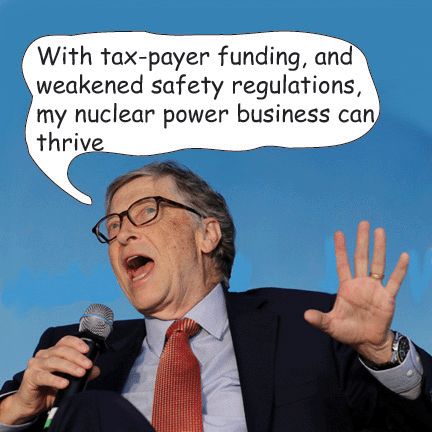
CASPER, Wyo. — TerraPower, the Bill Gates–founded company working toward building a new nuclear reactor in Kemmerer, Wyoming, said in a press release Monday that it has been awarded an $8.5 million grant from the U.S Department of Energy’s Advanced Research Project Agency – Energy (ARPA-E).
The grant funding is part of ARPA-E’s Optimizing Nuclear Waste and Advanced Reactor Disposal Systems (ONWARDS) program that aims to increase the use of nuclear power as a source of clean energy while limiting the amount of nuclear waste created by advanced reactors……
TerraPower and GE technology is going into the new Natrium nuclear reactor, which is expected to be built in Wyoming as part of the U.S. Department of Energy’s Advance Reactor Demonstration program.
“TerraPower is further demonstrating, through the Molten Chloride Reactor Experiment (MCRE), a uranium chloride salt–fueled concept with the DOE, Southern Company and other partners, and advancing medical research and innovation through its TerraPower Isotopes® subsidiary,” the press release states.
TerraPower President and CEO Chris Levesque added in the press release that “TerraPower continues to advance nuclear energy’s promise for our country and the world………… https://oilcity.news/wyoming/energy/2022/03/14/terrapower-receives-8-5m-grant-to-explore-recovering-uranium-from-used-nuclear-fuel/
Ukraine war triggers debate on Japan’s nuclear option,
The Interpreter. PURNENDRA JAIN, 14 Mar 22,
In a new and volatile strategic environment, a decades-
old commitment on non-proliferation is up for discussion.
In the wake of the Ukraine conflict, Shinzo Abe, Japan’s former prime minister and now head of the largest faction of the ruling Liberal Democratic Party (LDP), has suggested that Japan consider hosting US nuclear weapons facilities on Japanese soil, similar to some European nations, such as Germany, which have nuclear sharing arrangements with the United States.
Abe’s suggestion was made in the context of Ukraine having renounced nuclear weapons in 1994, leaving itself vulnerable today. The announcement also comes on top of deepening concerns about China’s growing military assertiveness around Japan’s maritime space and beyond, and the dangerous situation on the Korean peninsula with threats from the nuclear-capable rocket-launching North Korea.
Debates over whether Japan should host nuclear weapons or even go fully nuclear are not new………….. Discussion has since continued among political and scholarly communities as to whether Japan should go nuclear, opt for a nuclear sharing arrangement with the United States by hosting nuclear weapons, or maintain its current non-nuclear weapons status.
This latest eruption though is in a different context. This time, chairman of the General Council of the LDP Tatsuo Fukuda, who like his father Yasuo Fukuda before him holds an influential ruling party post and is touted as a future prime minister, has suggested that “we must not shy away from any debate whatsoever”. Last year’s LDP party presidential candidate and current LDP policy chief Sanae Takaichi also favours a debate. Some smaller conservative opposition parties want to include nuclear options in policy discussions while considering Japan’s strategic objectives. The main opposition parties have, however, strongly resisted any such prospects, arguing in favour of Japan’s non-nuclear status.
Abe’s suggestion was promptly and solidly rejected by Prime Minister Fumio Kishida, as well as by the leader of the Komeito, the junior coalition partner of the ruling LDP. Even Defence Minister Nobuo Kishi, Abe’s younger brother, adopted into the Kishi family, also dismissed the idea of hosting nuclear weapons on Japanese shores. Kishi may have expressed this view in order to align with his boss, Prime Minister Kishida, rather than reflecting his true thinking on the matter, given his political pedigree.
Kishida quickly confirmed that Japan firmly adheres to the three non-nuclear principles adopted in 1967, to not possess, produce or permit the introduction of nuclear weapons into Japan’s territory. These principles remain sacrosanct, even though Japan has made substantial departures in defence and security matters in the past decade…………….
Not only has the Kishida government announced an intended update to the NSS, first issued in 2013, it has also promised to revise the National Defence Program Guidelines and Mid-Term Defence Program issued in 2013 and 2018. All these updates and revisions are undertaken in view of a rapid transformation in the strategic environment……………….
| Japan, along with Germany, has often been recognised as an example of a “civilian state”. Germany currently hosts US nuclear weapons facilities and, in view of the Ukraine conflict, has announced a significant increase to its defence budget. Calls are now being made to urge Japan to follow suit. The postwar US-Japan Treaty of Mutual Cooperation and Security has ensured that Japan has lived happily under US extended deterrence, including the nuclear umbrella. This arrangement is unlikely to change, barring an existential threat to Japan’s territory and sovereignty. But what seemed to be taboo in terms of Japan’s strategic policy – that is, breaching one per cent of GDP on defence spending and developing strike capabilities – is now being discussed seriously. No policy in international relations is eternal, it must change as a nation’s interests change. https://www.lowyinstitute.org/the-interpreter/ukraine-war-triggers-debate-japan-s-nuclear-option |
US Republican senators say they will not back Iran nuclear deal
US Republican senators say they will not back Iran nuclear deal, Aljazeera, 14 Mar 22,
Republican lawmakers oppose, but lack power to block, an agreement with Tehran sought by US President Joe Biden. Forty-nine of the 50 Republicans in the US Senate have announced they will not back a new nuclear deal between Iran and world powers, underscoring their party’s opposition to attempts to revive a 2015 accord amid fears multilateral nuclear talks might collapse.
In a statement on Monday, the Republican senators pledged to do everything in their power to reverse an agreement that does not “completely block” Iran’s ability to develop a nuclear weapon, constrain its ballistic missile programme and “confront Iran’s support for terrorism”
………………………. US lawmaker Rand Paul was the only Senate Republican who did not sign Monday’s statement. In an emailed statement, he said, “Condemning a deal that is not yet formulated is akin to condemning diplomacy itself, not a very thoughtful position.”
No congressional Republicans supported the 2015 nuclear agreement between Tehran and the so-called “P5+1” countries, the five permanent members of the UN Security Council – the US, UK, Russia, China and France – plus Germany. A handful of Democrats also objected.
US Deputy Secretary of State Wendy Sherman said during the weekend that Biden administration officials believe an agreement is near and “we would like all of the parties – including Russia, which has indicated it’s got some concerns – to bring this to close.”…………………………
The 2015 Iran Nuclear Agreement Review Act gives Congress the right to review an agreement, but lawmakers are unlikely to be able to kill a deal outright after failing to do so in 2015 when Republicans controlled Congress.
Democrats now hold slim majorities in both the House of Representatives and Senate and are unlikely to turn against Biden in sufficient numbers to stop a major initiative like an Iran deal.
Nevertheless, the Republican opposition ensures Congress cannot adopt any nuclear agreement with Iran as a permanent treaty, which requires a two-thirds vote in favour, rendering it vulnerable to abandonment by a future Republican president.
A spokesperson for Iran’s foreign ministry said on Monday that Washington needs to decide to wrap up a deal……… https://www.aljazeera.com/news/2022/3/14/us-republican-senators-say-they-will-not-back-new-iran-nuclear
Macron government considering nationalising France’s debt-laden nuclear company EDF
 | |||
France looking to nationalise debt-laden power company EDF https://www.power-technology.com/news/france-power-company-edf/ 13 Mar 22
The French Government, which holds an 84% stake in the $30bn energy giant, could retain domestic business but review overseas operations. The Government of France is reportedly weighing options to nationalise multinational electric utility company Electricite de France (EDF), reported Bloomberg.
Citing people familiar with this, the report said that the French Government is considering the option to reorganise the debt-laden business with a focus on nuclear energy production.
French officials have been carrying out talks with advisers on the option to acquire all the stake from EDF’s small stakeholders and delist the company from the stock exchange, people aware of the development said.
The French Government, which owns 84% of EDF, could retain the ownership of the company’s domestic business but review EDF’s overseas operations, the sources added.
If the idea to nationalise EDF is approved, then the move is expected to take place after the French Presidential election, which is slated to take place later this year.
The Government of France is reportedly weighing options to nationalise multinational electric utility company Electricite de France (EDF), reported Bloomberg.
Citing people familiar with this, the report said that the French Government is considering the option to reorganise the debt-laden business with a focus on nuclear energy production.
French officials have been carrying out talks with advisers on the option to acquire all the stake from EDF’s small stakeholders and delist the company from the stock exchange, people aware of the development said.
The French Government, which owns 84% of EDF, could retain the ownership of the company’s domestic business but review EDF’s overseas operations, the sources added.
If the idea to nationalise EDF is approved, then the move is expected to take place after the French Presidential election, which is slated to take place later this year.
However, a spokesperson for the French finance ministry said that the information is ‘false’ and the government isn’t working on such a project.
Last month, French Government announced it will offer $2.4bn to support EDF, as the group sees a hit to profits due to outages at several of its nuclear plants and the impacts of a government power-price cap.
Hopes for Bradwell nuclear power station now fading away like the ebbing tide
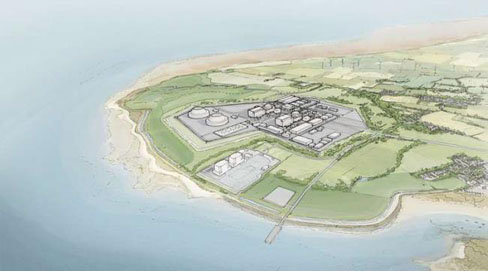
Calm After the Storm https://www.banng.info/news/regional-life/calm-after-the-storm/ 3 March 2022
As we emerge from Covid a rather eerie silence descends over Bradwell B. After a tumultuous period of fighting the grotesque prospect of a colossal nuclear power station of Chinese design we are left wondering if the threat is ebbing away or will flow back like the returning tide.
Just two years ago and just before the first frightening lockdown, The Chinese operator launched its pre-Application proposals and the gross scale of the Bradwell B juggernaut was as unexpected as it was threatening. Despite lockdown the local reaction was immediate, widespread and determined. The proposals were summarily repelled and CGN declared a pause and retreated homeward to think again.
At least the China General Nuclear Power Corporation (CGN) has got part of what it came for. The regulators, Environment Agency and Office for Nuclear Regulation, have gifted approval for the Chinese Hualong One UK HPR1000 reactor design as ‘suitable for deployment in the UK’.
But, not necessarily at the Bradwell site. Although the ultimate prize for CGN is to build its reactors at Bradwell gaining the Generic Design Assessment (GDA) approval is not really much help. It doesn’t tackle the issues of cooling water, long-term storage of radioactive waste or the impacts of climate change in anything like the detail needed to gain approval for the Bradwell site. There are many obstacles that must be surmounted before permission to build can be granted.
Perhaps, as BANNG and other commentators have observed, CGN will have to be content with the consolation prize and seek its fortune elsewhere. That may not be in the UK since it is widely felt that the UK will prevent the Chinese state in the guise of CGN having a strategic role in developing sensitive UK infrastructure like a nuclear power station.
And so there is impasse. Opposed by the local Blackwater communities and shunned by the UK Government Bradwell B seems frozen in aspic. The best that may be said is that CGN may not walk away or be pushed immediately but the project is likely to languish in a state of indefinite inanition and will fade away like the ebbing tide.
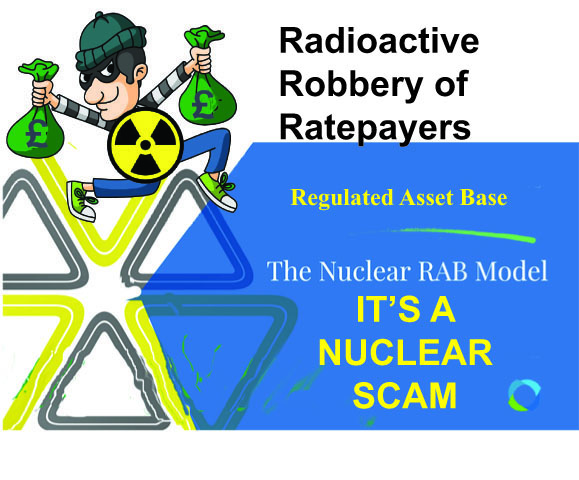
Investors keen on renewable energy, while UK govt is trapping consumers into paying upfront for nuclear power plants to be built in a decade or more
Gordon Murray: LESLEY Riddoch’s article (The National, March 10)
is eminently sensible. The UK Government wants to build more large nuclear
plants such as Hinkley Point C. The problem for Boris is that investors are
not interested.
Centrica abandoned its plans to build new nuclear, Toshiba
exited the giant 3.3GW plant at Moorside, Cumbria and Hitachi scrapped the
£16 billion Wylfa plant on Anglesey. The current Hinkley development costs
are a whopping £23bn, almost double that projected in 2008 and set to rise
further.
The smart money is now with renewables where the returns are
higher, more immediate and less risky. Notwithstanding these setbacks, the
Conservative government, backed by Labour, is determined to plough on with
Sizewell C.
Their problem is who is going to fund it. The Government is not
keen to involve the Chinese who already get a return of 15% on their
investment at Hinckley Point C.
The Business Secretary Kwasi Kwarteng’s
answer is the Regulated Asset Base (RAB) funding model whereby consumers,
that’s us, will pay the construction costs by increasing energy bills. It
is a fanciful type of nuclear subsidy where consumers pay for and
underwrite the construction costs for 10 years before a single watt of
power has been generated.
You have not misread this! The Government is set
to increase our energy bills even further at a time when gas/energy prices
are soaring, pushing even more people into fuel poverty. Perhaps their
spirits will be raised when they learn that RAB, according to Kwarteng,
will give private investors greater certainty through a lower and more
reliable rate of return.
An added bonus is that bill payers can expect
their bills to rise even further when the project is completed since we can
expect the energy strike price for nuclear to be twice that of renewable
– the cheapest form of electricity generation that is now subsidy
free-where consumers only start paying once they start to generate.
TheSmall Modular Reactor programme promises lower energy production costs but
there is no hard evidence to support this claim. What we will get for
certain is large numbers of these power plants spread all over the country
that will raise safety concerns over proliferation of nuclear materials and
terrorist attacks.
The National 12th March 2022
1 This Month
23-25 October – on Zoom – World BEYOND War’s annual global conferenc


Shut down the radiation-damaged Heysham nuclear reactors now
To see nuclear-related stories in greater depth and intensity – go to https://nuclearinformation.wordpress.com

Say No to NASA’s Reckless Nuclear Reactor on the Moon
Say No to NASA’s Reckless Nuclear Reactor on the Moon

-
Archives
- October 2026 (199)
- September 2026 (339)
- August 2026 (330)
- July 2026 (355)
- June 2026 (287)
- May 2026 (306)
- April 2026 (356)
- March 2026 (251)
- February 2026 (267)
- January 2026 (308)
- December 2025 (358)
- November 2025 (359)
-
Categories
- 1
- 1 NUCLEAR ISSUES
- business and costs
- climate change
- culture and arts
- ENERGY
- environment
- health
- history
- indigenous issues
- Legal
- marketing of nuclear
- media
- opposition to nuclear
- PERSONAL STORIES
- politics
- politics international
- Religion and ethics
- safety
- secrets,lies and civil liberties
- spinbuster
- technology
- Uranium
- wastes
- weapons and war
- Women
- 2 WORLD
- ACTION
- AFRICA
- Atrocities
- AUSTRALIA
- Christina's notes
- Christina's themes
- culture and arts
- Events
- Fuk 2022
- Fuk 2023
- Fukushima 2017
- Fukushima 2018
- fukushima 2019
- Fukushima 2020
- Fukushima 2021
- general
- global warming
- Humour (God we need it)
- Nuclear
- RARE EARTHS
- Reference
- resources – print
- Resources -audiovicual
- Weekly Newsletter
- World
- World Nuclear
- YouTube
-
RSS
Entries RSS
Comments RSS

