The £billions cost of the Sizewell nuclear plan becomes an issue in the fight for the role of Prime Minister
In a move that has caused great irritation in Team Truss, Nadhim Zahawi, Chancellor of the Exchequer, and Johnson are set to approve the financing of the Sizewell C nuclear plant in Suffolk. It received planning consent last month and the government signalled that it would buy a 20 per cent stake in the project, which is being run by the French company EDF and is expected to cost between £20 billion and £30 billion after inflation. The final investment decision has not been announced.
Simon Clarke, the chief secretary to the Treasury who backs Truss and who sources say will have a “top half of the cabinet job” under her leadership, wrote to Johnson and Zahawi warning that a signoff for Sizewell would compromise the new prime minister’s ability to cut taxes or spend more on the cost of living. In his letter, Clarke wrote:
“The quantum is sufficient to materially affect spending and fiscal choices for an incoming government, especially in the context of wider pressures on the public finances.” While the cost to government is likely
to be about £6 billion, rather than £30 billion, that will give Truss far less room for manoeuvre.
Times 20th Aug 2022
California nuclear power plant extension challenged in legislative proposal
“This is too little too late, a sham process designed to circumvent citizen enforcement of the National Environmental Policy Act,”
Watchdog groups contend that regardless of the review, the NNSA will march ahead with its production plans for plutonium cores at Los Alamos
S nuclear policy | US nuclear stockpile | Environment protection
AP | Albuquerquue (US) August 20, 2022
The US government is planning to review the environmental effects of operations at one of the nation’s prominent nuclear weapons laboratories, but its notice issued Friday leaves out federal goals to ramp up production of plutonium cores used in the nation’s nuclear arsenal.
The National Nuclear Security Administration said the review being done to comply with the National Environmental Policy Act will look at the potential environmental effects of alternatives for operations at Los Alamos National Laboratory for the next 15 years.
That work includes preventing the spread and use of nuclear weapons worldwide and other projects related to national security and global stability, the notice said.
Watchdog groups contend that regardless of the review, the NNSA will march ahead with its production plans for plutonium cores at Los Alamos.
The northern New Mexico lab part of the top secret Manhattan Project during World War II and the birthplace of the atomic bomb is one of two sites tapped for the lucrative mission of manufacturing the plutonium cores. The other is the Savannah River Site in South Carolina.
The US Energy Department had set deadlines for 2026 and 2030 for ramping up production of the plutonium cores, but it’s unclear whether those will be met given the billions of dollars in infrastructure improvements still needed.
Watchdog groups that have been critical of Los Alamos accused the NNSA of going through the motions rather than taking a hard look at the escalating costs of preparing for production, the future consequences to the federal budget and the potential environmental fallout for neighbouring communities and Native American tribes.
This is too little too late, a sham process designed to circumvent citizen enforcement of the National Environmental Policy Act,” said Jay Coghlan, executive director of Nuclear Watch New Mexico.
The Los Alamos Study Group, another New Mexico-based organisation that monitors lab activities, said there is no indication that NNSA will pause any preparations for the sake of complying with National Environmental Policy Act, which mandates some scrutiny before moving ahead with major federal projects.
The group pointed to more than $19 billion in new construction and operational costs for Los Alamos’ new plutonium core production mission through fiscal year 2033. They say the price tag is expected to grow.
According to planning documents related to the sprawling Los Alamos campus, lab officials have indicated that they need more than 4 million square feet (371,612 square metres) of new construction to bolster one of its main technical areas and the area where the lab’s plutonium operations are located. Several thousand new staff members also would be needed.
This is a completely bogus process in which NNSA seeks to create a veneer of legitimacy and public acceptance for its reckless plans,” said Greg Mello, director of the Los Alamos Study Group……….. more https://www.business-standard.com/article/international/plutonium-cores-review-at-us-nuclear-lab-sham-process-watchdog-groups-122082000062_1.html
Twelve months, one meeting – the complete lack of accountability on nuclear in Copeland

In fact, the Rolls-Royce fronted consortium developing a 470-MW so-called ‘Small’ Modular Nuclear Reactor still faces considerable challenges in bringing a design to market. The design still needs to be approved by the Office of Nuclear Regulation after a comprehensive Generic Design Assessment. If approved, the consortium would need to build and test an actual working prototype; establish facilities to fabricate the parts; master the fabrication and on-site assembly process; secure funding; navigate the siting, planning and Development Consent process; and actually build the first plant. So hardly a rose in fragrant bloom!
https://www.nuclearpolicy.info/news/twelve-months-one-meeting-the-complete-lack-of-accountability-on-nuclear-in-copeland/ 19 Aug 22, Despite Copeland Council being at the heart of plans to develop a new nuclear plant and a nuclear waste dump in the borough, the Nuclear Free Local Authorities were surprised to see that the Council’s Strategic Nuclear and Energy Board has only met once in the last twelve months.[1]
Only last month, Copeland Borough Council’s Portfolio Holder for Nuclear and Commercial Services Councillor David Moore described how “the future looks rosy” for new nuclear in Copeland as talks progress on Small Modular Nuclear Reactors.[2]
Unfortunately, for the members of the Board, there was no opportunity to explore how ‘rosy’ the future was as the scheduled 9 August meeting was subsequently cancelled. Since the last meeting of the Board on 6 October 2021, meetings have been cancelled on 9 December; 10 February; 28 April; 7 June; and latterly on 9 August 2022.
In fact, the Rolls-Royce fronted consortium developing a 470-MW so-called ‘Small’ Modular Nuclear Reactor still faces considerable challenges in bringing a design to market. The design still needs to be approved by the Office of Nuclear Regulation after a comprehensive Generic Design Assessment. If approved, the consortium would need to build and test an actual working prototype; establish facilities to fabricate the parts; master the fabrication and on-site assembly process; secure funding; navigate the siting, planning and Development Consent process; and actually build the first plant. So hardly a rose in fragrant bloom!
Perhaps the infrequency of the meetings of the Board can be related to the disquiet expressed by some members over the lack of accountability over plans for Copeland Borough Council to partner with Nuclear Waste Services to bring a nuclear waste dump (a so-called Geological Disposal Facility or GDF) to Copeland. The Board minutes for 9 October 2021 record that three Councillors wanted the final decision taken by a meeting of the Full Council rather than reserved to the Executive; with a tied vote, this proposal was defeated only on the Chair’s casting vote. To placate the objectors, Councillor Moore promised that ‘this committee and full Council would be updated on a regular basis’.[3] The Board has since never met.
Commenting, Councillor David Blackburn said: “At a cost of up to £53 billion, the GDF would be the biggest engineering undertaking to take place in Copeland, since the creation of the Sellafield complex. It would be a repository for Britain’s high-level nuclear waste from seven decades of civil nuclear operations, and also take waste from future generation. Taking up to 150 years to build, fill and seal, it would have massive implications for, and be completely disruptive to, any host community in Copeland for generations.
“The GDF process is fast moving on apace. Since October 2021, first a Working Group and then a Community Partnership have been formed with Copeland’s involvement. In the last month, seismic testing has been taking place off the coast of West Cumbria, an activity which has rightly been hugely controversial for its adverse impact on marine life. Yet during this whole time, this Board, the very body charged by Copeland Council to provide oversight on the GDF and nuclear projects, has not met; no reports on these and other important issues have been brought before this Board for debate; and there has been no opportunity for members of the public to sit in on deliberations. Hardly democracy at its finest.”
For more information, please contact NFLA Secretary Richard Outram by email on richard.outram@manchester.gov.uk or telephone 07583 097793
Commenting, Councillor David Blackburn said: “At a cost of up to £53 billion, the GDF would be the biggest engineering undertaking to take place in Copeland, since the creation of the Sellafield complex. It would be a repository for Britain’s high-level nuclear waste from seven decades of civil nuclear operations, and also take waste from future generation. Taking up to 150 years to build, fill and seal, it would have massive implications for, and be completely disruptive to, any host community in Copeland for generations.
“The GDF process is fast moving on apace. Since October 2021, first a Working Group and then a Community Partnership have been formed with Copeland’s involvement. In the last month, seismic testing has been taking place off the coast of West Cumbria, an activity which has rightly been hugely controversial for its adverse impact on marine life. Yet during this whole time, this Board, the very body charged by Copeland Council to provide oversight on the GDF and nuclear projects, has not met; no reports on these and other important issues have been brought before this Board for debate; and there has been no opportunity for members of the public to sit in on deliberations. Hardly democracy at its finest.”
For more information, please contact NFLA Secretary Richard Outram by email on richard.outram@manchester.gov.uk or telephone 07583 097793
Why Am I Banned in Ukraine?

plebiscite,” which is defined under the 1919 Versailles Treaty with very precise rules, starting with complete control by neutral powers and the vetting of eligible voters.
neither Moscow nor Kyiv will unilaterally accept defeat, and plebiscites are the only available exits from the burning house of war.
Geostrategist Edward Luttwak explains his support for plebiscites in Donetsk and Luhansk
https://www.tabletmag.com/sections/news/articles/banned-ukraine-edward-luttwak-donetsk-luhansk BY EDWARD N. LUTTWAK, 2 Aug 22, Last year a “Center for Countering Disinformation,” headed by former lawyer Polina Lysenko, was established within Ukraine’s National Security and Defense Council under the authority of President Volodymyr Zelensky. Its stated aims were to detect and counter “propaganda” and “destructive disinformation” and prevent the “manipulation of public opinion.”
On July 14, 2022, it published on its website a list of politicians, academics, and activists accused of “promoting Russian propaganda,” including me.
Two specific reasons were given for my inclusion on this list. The first one was that I said or wrote that “Putin has been provoked to start a war against Ukraine.”
This is an easy one to dispense with: I never said or wrote or thought that. Either Polina Lysenko or one of her staff confused me with somebody else, or else they cut short a longer phrase of mine, such as “Putin’s agents claim that he was provoked …”
The other reason given is that I’ve supposedly proposed holding referendums in the Donetsk and Luhansk regions of eastern Ukraine as a way out of the war.
This is inaccurate: I’ve proposed holding plebiscites, not referendums, and not just because Russia’s fake overnight vote held in Crimea in 2014 made “referendum” an infamous term, but because the term has no precise meaning—unlike “plebiscite,” which is defined under the 1919 Versailles Treaty with very precise rules, starting with complete control by neutral powers and the vetting of eligible voters.
This is crucial, both to exclude recent border-crossers and to include all traceable refugees. Under these rules, plebiscites were held in 1920 in Eupen-Malmédy to allow the locals to decide between annexation to Belgium or to Germany, in Schleswig to decide between Denmark and Germany, in Carinthia to decide between the new state of Austria and the new Kingdom of Serbs, Croats, and Slovenes, and in the Allenstein and Marienwerder districts of East Prussia to decide between Germany and Poland, with further plebiscites in 1921 in Upper Silesia, followed by a December plebiscite to allow the inhabitants of Sopron to choose between Austria and Hungary.
The First World War, with all its ravages, had just ended, the Spanish influenza was killing off many of the younger people who had survived years of warfare, and some of the contenders were brand-new states just getting organized, including truncated Austria, and brand-new independent Hungary and Poland.
Nevertheless, the plebiscites went off without major incident and avoided more fighting.
But Ukraine’s Center for Countering Disinformation did not merely confuse a free and fair vote with a fake referendum, but also disregarded my precondition that plebiscites should be held with Kyiv’s prior agreement, after a complete cease-fire and standstill, preceded by Russia’s renunciation of any other territorial claims.
All of the above were simply ignored, as was the fact that in countless interviews and tweets since the first day of the war, I’ve called for the supply of weapons to Ukraine and personally met with European defense officials to press them to send the specific weapons that have been most urgently needed at various stages: antitank missiles at first, self-propelled artillery later on, and small arms and armored combat vehicles all along.
Of course I do not know if and when Kyiv and Moscow might agree to hold plebiscites in Donetsk and Luhansk. But I do know that every war must end, that neither Moscow nor Kyiv will unilaterally accept defeat, and that plebiscites are the only available exits from the burning house of war.
Edward N. Luttwak is a contractual strategic consultant for the U.S. government and an author.
More tax-payer money to USA’s nuclear industry with INFLATION REDUCTION ACT OF 2022
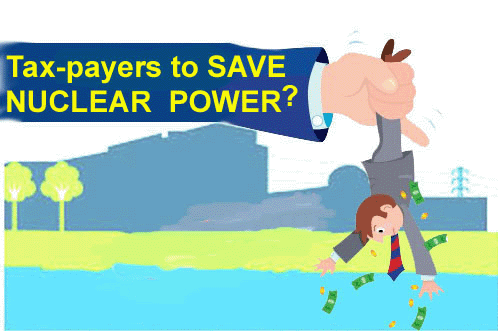
INFLATION REDUCTION ACT OF 2022 BOOSTS NUCLEAR POWER WITH TAX CREDITS AND FUNDING
…… The act contains several key provisions that bolster a broad spectrum of new and existing activities in the nuclear industry.
As a targeted benefit to the nuclear industry, the Inflation Reduction Act of 2022 (IRA) modifies the Internal Revenue Code (IRC or Code) to allow new production tax credits (PTCs) for existing nuclear plants.
Importantly, the IRA also introduces significant changes to the Code to allow for greater monetization of applicable tax credits, including those that relate to nuclear power. From a practical perspective, these changes may ultimately prove transformative to the nuclear industry in allowing access to the tax equity markets for project financing, which to date has been virtually nonexistent for largely technical reasons.
Finally, the IRA also provides additional funding to establish a domestic supply of High-Assay Low-Enriched Uranium (HALEU) fuel, which is needed by many next-generation reactors.
ZERO-EMISSION NUCLEAR POWER PRODUCTION TAX CREDIT (IRC SECTION 45U)
IRA Section 13105 creates a “zero-emission nuclear power production tax credit” in Section 45U of the Code (the Nuclear PTC) aimed at preventing the decommission of existing nuclear plants. The Nuclear PTC is available with respect to existing nuclear plants for electricity produced and sold for taxable years beginning after December 31, 2023, and before December 31, 2032…………………..
Importantly, the credit is unavailable to an “advanced nuclear power facility” that qualifies for the advanced nuclear tax credit in IRC Section 45J (added by the Energy Policy Act of 2005). The advanced nuclear tax credit under Section 45J, which offers a maximum 1.8 cent per kWh credit, continues to be the only currently available generation credit for new nuclear electricity generation facilities not yet placed into service (the new 45Y and 48E zero emissions facility credits, each described below, are only available for facilities placed into service after December 31, 2024).
Although outside the scope of this summary, the limited “allocation” Section 45J credit was refreshed by Congress in 2018, and allocations still remain available for advanced nuclear reactors that are placed into service on a first in line basis (although the IRS has yet to update allocation guidance for the 2018 refresh legislation)……………………………
ADDITIONAL FUNDING FOR HALEU AND DOE
Along with the tax credits above, the IRA allocated $150 million to the US Department of Energy’s (DOE’s) Office of Nuclear Energy “to carry out activities for infrastructure and general plant projects.” The IRA also allocated money through 2026 to support the development of a domestic HALEU fuel supply. Most advanced nuclear reactor designs require HALEU, a uranium fuel that is more power dense than the fuel used in the current reactor fleet. Currently, the domestic HALEU supply is constrained and much of the current HALEU supply is sourced from Russia. The IRA addresses this issue by allocating $700 million dollars in funding to DOE to develop a domestic HALEU supply chain…………..
The majority of funding, $500 million, will be allocated to environmental impact reduction work and public relations initiatives, and to support collaboration between the National Laboratories and the private sector. Another $100 million will be allocated to research, development, and safety initiatives. Finally, an additional $100 million will directly support HALEU availability for civilian domestic research, development, demonstration, and commercial use. The advanced reactor community has advocated for this kind of support for years, but this is the first big appropriation to support the domestic HALEU supply. https://www.morganlewis.com/pubs/2022/08/inflation-reduction-act-of-2022-boosts-nuclear-power-with-tax-credits-and-funding
Kishida, ‘PM from Hiroshima’, is Shifting Japan’s Long-Standing Pro-Nuclear Weapons Posture

He has begun a sincere effort to realign Japan’s position from one that supports the maintenance of the US “nuclear umbrella” to one that aims for gradual global nuclear weapons disarmament.
Marcus Donaldson The Wire, 17 Aug 22
Prime Minister Fumio Kishida has outlined what appears to be a sincere effort to realign Japan’s position on nuclear weapons – from one that supports the maintenance of the US “nuclear umbrella” to one that aims for gradual global nuclear weapons disarmament.
Previous administrations have been unwilling to challenge the nuclear weapons status quo. Indeed, Tokyo has been a quiet and consistent advocate for nuclear weapons among the non-nuclear powers (as counterintuitive as this may be for the only nation to have been subjected to nuclear weapons attacks).
At present, the United States, Russia, France, China, the United Kingdom, Israel, India, Pakistan, and North Korea are known to possess nuclear weapons arsenals.
In 2016, Japan voted against a UN resolution that would have compelled nations to negotiate the reduction and eventual elimination of nuclear weapons stockpiles. It also chose not to sign the Treaty on the Prohibition of Nuclear Weapons in 2017 – which did eventually pass – and snubbed subsequent invitations to ratify the accord or even to send observers to related diplomatic events.
Japan’s pro-nuclear weapons posture continued, relatively unchanged, into the early months of Kishida’s government. …………………………….
On August 1, Prime Minister Kishida travelled to New York to address the latest Review Conference for the Treaty on the Non-Proliferation of Nuclear Weapons (NPT), which are scheduled every five years, although this was held two years late due to the COVID-19 pandemic. This was the first time that a Japanese prime minister had ever spoken at one of these conferences, usually attended by working-level diplomats.
Kishida began by relating the issue to himself, noting that, “as a prime minister from Hiroshima, I believe that we must take every realistic measure towards a world without nuclear weapons, step by step, however difficult the path may be.”
This phrasing echoed the title of a book that Kishida published in 2020 – Kakuheiki no nai Sekai e (Toward a World without Nuclear Weapons).
In his speech, Kishida declared that “Japan is determined to firmly uphold the NPT as its guardian.” adding that he is working on a five-point “Hiroshima Action Plan” to reduce nuclear weapons risks.
As part of his initiative, Kishida clarified that “Japan supports the dialogue conducted between the United States and Russia for further reductions, and encourages the United States and China to engage in a bilateral dialogue on nuclear arms control and disarmament.” He also emphasised the importance of transparency between nuclear weapons powers, a greater commitment to the Comprehensive Nuclear-Test-Ban Treaty (CTBT), and a peaceful solution to conflicts such as that on the Korean Peninsula.
Kishida further announced that Tokyo would make a US$10 million contribution to the United Nations in order to set up a “Youth Leader Fund for a World without Nuclear Weapons,” again making use of the phrase which he seems to be promoting as his own political trademark.
“We must ensure that Nagasaki remains the last place to suffer an atomic bombing,” he declared.
Kishida’s address was well received by the Japanese public. Interestingly, some of the most outspoken praise came from the Japan Communist Party, which viewed the speech as a “landmark success.”
In late 2019, the Journal for Peace and Nuclear Disarmament conducted a poll which found that about 75% of the Japanese public supported joining the Treaty on the Prohibition of Nuclear Weapons, which the government has so far spurned.
In spite of the popularity of Kishida’s anti-nuclear weapons orientation among the general public, he faces the potential risk of alienating both rightwing forces within his own ruling party as well as some figures within the US government. Indeed, it was reported that Kishida’s own political advisers counselled him not to give the speech in New York and to keep a lower profile on nuclear weapons disarmament issues. https://thewire.in/world/fumio-kishida-japan-nuclear-weapons-stance
France’s government determined to expand nuclear power, oblivious to environmental, safety, and cost ill-effects

the plant’s cooling processes have increased the water’s temperature by 6 degrees C, which has triggered ripple effects throughout the food chain.
that will have a disastrous impact on the ecosystem,”
French nuclear plants break a sweat over heat wave, DW 15 Aug 22, Successive heat waves are putting French nuclear reactors under strain. But that is not pushing them into an existential crisis, as Lisa Louis reports from Paris.
Like other European countries, France has been baking in temperatures of up to 40 degrees Celsius (104 degrees Fahrenheit) for several weeks. Although that is putting French nuclear reactors under strain, this does not seem to be calling the country’s nuclear-heavy energy strategy into question.
Nuclear power plants normally generate roughly 70% of electricity in France — making nuclear’s share of the energy mix there higher than in any other country.
But more than half of the country’s 56 reactors have been closed for several months due to planned or extraordinary maintenance.
And about a fifth of them would normally need to interrupt their activity or at least reduce it to a bare minimum, as the water temperature of the rivers into which plants discharge their cooling water exceeds a certain limit.
But the government has suspended that rule until at least September 11.
‘Ripple effects throughout the food chain’
For Jean-Pierre Delfau, an environmental activist at local group FNE86, that is an exasperating decision.
“I just can’t understand how they can keep the reactors running although that will have a disastrous impact on the ecosystem,” he told DW, as he and two other environmentalists made their way through high grass on the bank of the Garonne river to take a water sample on a recent afternoon.
The Garonne supplies cooling water for the Golfech nuclear plant in southwestern France. One of the power station’s two reactors has been standing still for months, after authorities found corrosion and small cracks on pipes relevant for the plant’s safety. The second reactor is still functioning.
“Due to the heat, the Garonne’s water throughput is already down to 50 cubic meters per second, from several thousand in normal times,” Delfau said. “The Golfech plant makes that worse, as it uses 8 cubic meters for its cooling system but only discharges 6 cubic meters back, as some of the water evaporates during the process,” he pointed out.
He added that the plant’s cooling processes have increased the water’s temperature by 6 degrees C, which has triggered ripple effects throughout the food chain.
“The warmer water destroys microalgae that are food for certain small fish, which bigger fish feed on,” explained the 79-year-old, who has been an anti-nuclear protester for more than 50 years.
“Plus, warmer water contains more bacteria. In order to make it potable, we have to add a lot of chemicals, which people then drink.”
Not an existential crisis for French nuclear power
Power company EDF, which runs all of France’s nuclear power plants, declined an interview request with DW. A spokeswoman replied by email that the situation was “extraordinary” and that so far, environmental probes had not revealed any negative impact on the flora and fauna around the respective reactors.
Despite environmental concerns, current issues are not throwing French nuclear power into an existential crisis. The government is planning to soon nationalize EDF and construct additional nuclear plants.
That has Anna Creti, climate economy director at Paris University Dauphine, scratching her head.
“It’s not quite clear how this strategy is supposed to work on a technology level, especially in the short run,” she told DW.
Technology not ready

“France is banking on so-called small modular reactors (SMRs), for which there exist roughly 40 different technologies, all of them in a pilot phase,” Creti said. “Getting them ready for deployment could take up to 10 years,” she added.
“The government also plans to construct more pressurized-water, so-called EPR reactors — a model that has encountered numerous problems,” she continued.
According to current predictions, the country’s first EPR plant is to go live next year in Flamanville in the north of the country. According to developer EDF, building costs have so far at least tripled, to roughly €13 billion ($13.3 billion).
The European Court of Auditors puts that figure at €19 billion — with construction taking more than 10 years longer than planned. Other EPRs in Britain, China and Finland are reported to experience construction, conceptual or production problems.
“The government has nevertheless earmarked €150 billion for refurbishing existing nuclear plants and constructing new ones,” Creti said, adding that no such funding boon was announced for renewables, although Paris is working on new rules to cut red tape for development of renewables.
“Putting more money intorenewables would make sense, as theyhave become ever cheaper over the past few years, and their technology is sufficiently advanced for them to be deployed immediately across the country,” she emphasized.
France is the only European country not to have reached its 2020 EU renewables targets. Renewable energies make up only roughly 19% of energy production, instead of the planned 23%……………………………………..
Energy shortages expected in winter
Philippe Mante is strongly hoping for that [shift to renewables]. He’s in charge of climate affairs at EELV, France’s green party, which is opposed to constructing new nuclear plants. For the sake of energy security, the party is not in favor of immediately dismantling existing nuclear energy plants.
Neighboring countries will be watching closely. Until now, France has been Europe’s biggest net energy exporter. This year, however, the country will have to import more electricity than it’s exporting.
That’s likely to add even more pressure to energy prices, which are already skyrocketing, due among other things to Moscow’s invasion of Ukraine and reduced delivery of Russian gas. https://www.dw.com/en/french-nuclear-plants-break-a-sweat-over-heat-wave/a-
Governor of California proposes to extend life of last nuclear plant at cost of $1.4 billion

The bill would carve out an exemption from state regulations to allow operators to maintain operations at the plant without conducting extensive technical analysis of the environmental effects.
A joint statement from Environment California, Friends of the Earth and the Natural Resources Defense Council said legislators should reject Newsom’s new bill “out of hand.”
Politico, By LARA KORTE, 08/12/2022
Gov. Gavin Newsom has proposed keeping open California’s last nuclear plant for up to another 10 years as the state wrestles with how to meet power demand while it reduces its reliance on fossil fuels for energy.
Plans to start closing the Diablo Canyon Power Plant over the next three years would be halted at a cost of up to $1.4 billion under draft legislation Newsom sent to legislators late Thursday, angering some of the governor’s environmentalist allies.
Diablo Canyon provides nearly a tenth of the state’s electrical power. Critics have long sought its closure for reasons that include the potential danger of a radiation leak because of earthquakes along the seismically active central coast of California. It was scheduled to close by 2025.
The proposed legislation would direct the California Public Utilities Commission to set a new closure date of Oct. 31, 2029 for one unit, and Oct. 31, 2030, for the other, according to the governor’s office. By 2026, regulators could consider an extension, but not beyond Oct. 31, 2035.
The bill would carve out an exemption from state regulations to allow operators to maintain operations at the plant without conducting extensive technical analysis of the environmental effects.
Extending the life of the nuclear plant would come at a cost. Pacific Gas & Electric, which operates the plant, applied to the U.S. Department of Energy’s $6 billion program to preserve the operations of nuclear power plants — though it’s unclear how much will be granted, or when. The language proposed by Newsom’s office this week would allow the state to grant PG&E a $1.4 billion forgivable loan to cover the costs of relicensing. Any extension would additionally require approvals by federal, state and local regulatory entities, the governor’s office said.
A joint statement from Environment California, Friends of the Earth and the Natural Resources Defense Council said legislators should reject Newsom’s new bill “out of hand.”
“The findings used to justify these extraordinary provisions include no citations to published studies by any California regulator or agency recommending a further life extension for Diablo Canyon because there are none,” the statement said. “With Governor Newsom and the legislature working to appropriate climate budget funds and advance ambitious climate legislation in the waning days of the legislative session, this proposal is a dangerous and costly distraction.” ……………………….. more https://www.politico.com/news/2022/08/12/california-proposes-extend-nuclear-plant-cost-1-4-billion-00051535
Rishi Sunak, UK Tory leader a keen supporter of the nuclear industry
Tory leader and Prime Minister contender Rishi Sunak says he is looking
forward to seeing plans for Wylfa Newydd if he’s elected and said he is a
strong supporter of nuclear. Former Chancellor Mr Sunak is going head to
head with Foreign Secretary Liz Truss to replace Boris Johnson. The UK
Government has earmarked Wylfa Newydd as a key site for new nuclear
although as yet no developer has been confirmed for the location after the
collapse of the previous plans following the withdrawal of Hitachi.
“Heunderstands that the Wylfa project is eligible for support as part of the
£120m Future Nuclear Enabling Fund, which was approved during his time as
Chancellor. He looks forward to seeing the proposals for the Wylfa Newydd
project if he is elected Prime Minister.” Wylfa and Trawsfynydd in
Gwynedd have also been tipped as potential sites for Small Modular
Reactors. Ms Truss’s campaign team have been asked to comment.
Daily Post 15th Aug 2022
https://www.dailypost.co.uk/news/north-wales-news/rishi-sunak-wylfa-newydd-nuclear-24756725
Electricite de France (EDF) nuclear corporation is headed for bankruptcy – that’s why France’s government is nationalising it.
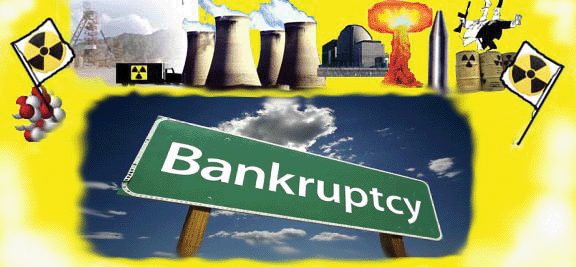
Is EDF running out of money? The French government is to spend £20
billion buying back the final 16% of Electricité de France (EDF) shares
still privately owned, bringing the company back under public ownership.
Why are they renationalising this company? The answer is simple. It is to
avoid EDF going bankrupt. Right now, over half (29 out of 56) of EDF’s
French nuclear reactors are currently offline. The company is already
hugely indebted and faces a massive bill of up to 100 billion euros (£85
billion) to keep its ageing nuclear fleet going.
And EDF’s flagship EPR reactor is over-cost and over-time everywhere it is being attempted to be
built. Aside from its debts, EDF has faced issues with ageing reactors,
after experts warned President Macron of significant corrosion safety
problems in EDF nuclear power plants in France as cracks were detected in
the cooling systems of some nuclear reactors.
Meanwhile there is delay after delay in bringing online every one of the EDF flagship nuclear
reactors, in Finland, in France, even here in Somerset. In desperation to
help fund its latest lossmaker at Sizewell, Suffolk, EDF is reaching out to
fellow utility giant Centrica for help. Could this be the same Centrica,
which in 2016 abandoned plans to invest in EDF’s Hinkley C partly because
of ‘the lengthening time frame for a return on the capital invested in a
project of this scale’?
Electrical Review 9th Aug 2022
New leader of Canada’s New Brunswick Liberals breaks ranks with the party’s previous support for Small Nuclear Reactors
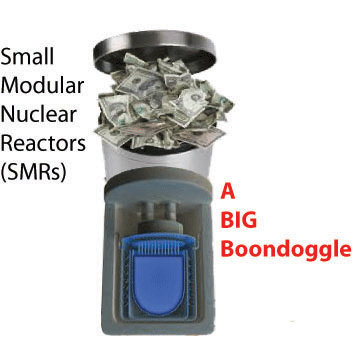
New Liberal leader questions small nuclear reactors. Susan Holt says it’s not clear the technology is a responsible energy solution
Jacques Poitras · CBC News · Aug 10, 2022
The new leader of the New Brunswick Liberals is questioning whether small modular nuclear reactors are the answer to the province’s energy needs, a more cautious stance than her party’s previous full-throated support for the technology.
Susan Holt said after winning the leadership Saturday that while the potential jobs created by SMRs would be good for the province, she was looking for more evidence they were the right bet for clean energy.
“It’s an interesting project on the economic development level … but I’m not sure it’s the solution for electricity generation for our province,” Holt told reporters.
“I think it’s not clear yet if it will really give us energy in a way that’s responsible and efficient with our investments, so there’s still more to determine there.”
Two companies based in Saint John, ARC Clean Energy and Moltex Energy, have received tens of millions of dollars in taxpayer funding to develop reactors………..
Last year the province handed ARC $20 million, while Moltex received more than $50 million from the federal government.
The previous provincial Liberal government gave each of them $5 million.
Holt held the title of chief of business relationships at the Jobs Board secretariat under then-Liberal Premier Brian Gallant at the time ARC and Moltex got that initial funding.
Both the Liberals and the Progressive Conservatives have been enthusiastic supporters of SMRs until now, ………………..
at legislative committee hearings in January, former N.B. Power CEO Gaëtan Thomas and officials from Saint John Energy warned that SMRs may not be ready in time to replace electricity from the Belledune generating station, which must stop using coal by 2030.
Louise Comeau, the director of climate change and energy solutions for the Conservation Council of New Brunswick, welcomed Holt’s comments.
“It sounds to me like the new leader is open to more information and analysis, which is what we desperately needed on the question of small modular nuclear reactors,” she said.
“We’ve been more in a phase of hype and boosterism. … I think what she’s said is we need to have more information, we need to look at all options, and we would really agree with that. Wind and solar and efficiency and other options all have to be part of the portfolio.”
Susan O’Donnell, a member of the Coalition for Responsible Energy Development in New Brunswick, said she was happy Holt was “reading the independent research about SMRs instead of the nuclear industry sales and promotional materials.”…………………..
In January, the Pembina Institute, a clean energy think tank, released a report that said small nuclear reactors would be more expensive and generate less electricity than a combination of renewable energy and energy efficiency measures. https://www.cbc.ca/news/canada/new-brunswick/susan-holt-questions-small-nuclear-reactors-1.6545007
Nuclear Free Local Authorities Briefing to Local Councils – Energy Minister responds to NFLA concerns over Nuclear Liabilities Fund.
Richard Outram, 8 Aug 22. In response to Parliamentary concerns that the cost of decommissioning redundant nuclear power stations was out of control, and after hearing news that a further £10.7 billion of public money has been made available by the UK Government to bolster the finances of the Nuclear Liabilities Fund, the public – private sector body responsible for managing finances of approximately £15 billion to meet the long-term cost of decommissioning (https://www.nlf.uk.net/), in early June the Chair of the NFLA Cllr David Blackburn wrote to the Energy Minister Greg Hands to urge him to give the NLF Board more latitude to invest in green energy to make the fund sustainable. On 25 July, Minister Hands replied. This briefing includes our initial media release, Cllr Blackburn’s letter to Minister Greg Hands and the Minister’s response.
France’s problems with nuclear corporation EDF
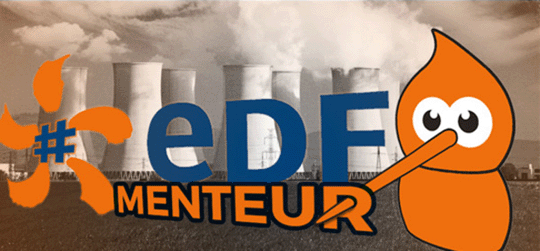
Following my previous post on EDF’s woes and their impact on the
European market, here’s a list of topics, both practical and political,
that the company needs to deal, and their domestic impact in France.
Corrosion issues. 12 plants, mostly the more modern ones, have been stopped
due to cracks in pipes;
Flamanville. The only new nuclear plant in
construction in France, it has been beset by delays and cost overruns;
Overall supply levels. With the existing nuclear fleet getting older, it
will likely require more maintenance (both scheduled and unscheduled), and
become more vulnerable to loss of skills as experienced nuclear workers
retire and are only partly replaced given the uncertain prospects of the
sector; Expensive imports. The lower production levels mean that EDF needs
to import increasing volumes of power. With the current gas crisis
triggered by the Russian invasion of Ukraine, this leads to very high power
prices and significant costs;
Blocked retail prices. After years of being
told that France has the cheapest electricity thanks to nuclear, the price
of retail electricity is a highly volatile political topic. Energy prices
are a hot-button issue everywhere, but they are specifically so for
President Macron;
The ARENH boondoggle. As part of the opening of the
French power market pushed by the EU commission, EDF has been forced to
sell a chunk of its nuclear production (initially 100 TWh/y, ie roughly 25%
of its production) at a fixed price (42 EUR/MWh) to new competitors on the
retail market;
EDF restructuring and EU competition issues. Several of the
items above remind us that EDF is a topic closely watched in Brussels. The
earlier EDF restructuring concept (codename “Hercule”) which proposed
to split EDF in 2 entities (nuclear and hydro, publicly owned: networks and
renewables, to be listed) was opposed by unions, and viewed with skepticism
in Brussels;
One of the topics that derailed the Hercule process was what
to do with EDF’s large portfolio of hydro generation. The EU commission
has long wanted to open up that sector to competition and force the
government to tender the dams when the concessions granted to EDF come to
an end. The fact that EDF has proven unable to build the next-generation
EPRs is either seen as a temporary blip, or a plot by outsiders to weaken
the country (anti-nuclear policies, pushed in particular by Germany, are
seen to have willfully weakened France’s industrial base). Renewables,
despite all evidence to the contrary, are still seen as either a useless
greenwashing sideshow or a dangerous distraction.
Jerome in Paris 4th Aug 2022
https://jeromeaparis.substack.com/p/edf-the-strategic-questions-and-to
Senator Manchin Democrats Bill to give $30 billion lifeline to save America’s moribund nuclear industry

Manchin Deal Tosses $30 Billion Lifeline to US Nuclear Reactors,
- Tax credit for nuclear power included in Senate spending bill
- Incentive could save as much as 38% of fleet, analyst says
Bloomberg, By Ari Natter, August 4, 2022
Struggling nuclear reactors would get a $30 billion lifeline under the Democrats’ climate change and tax bill that could save dozens of nuclear power plants from an early retirement.
Included in the $433 billion Inflation Reduction Act, which is slated for a Senate vote as soon as this week, is a 10-year production tax credit for nuclear energy producers that could be a boon for reactor operators such as Southern Co., Constellation Energy Corp., Public Service Enterprise Group Inc. and Energy Harbor Corp.
The proposed $15 per megawatt-hour credit for existing nuclear plants — which provide about 19% of the nation’s electricity — will help an industry that has undergone a wave of closures. Reactors have high operating costs and are increasingly struggling to compete with cheaper electricity produced using natural gas and renewables.
Between 22% and 38% of the nation’s nuclear fleet of 93 reactors is at risk of retiring in the 2030s, depending on natural gas prices, according to an analysis by Rhodium Group…………………………
It remains to be seen whether the Inflation Reduction Act, which represents a compromise between Manchin and Senate Majority Leader Chuck Schumer, will be backed by the full Democratic caucus in the 50-50 Senate. It would also have to pass the House, where progressives sought a much more expansive plan. https://www.bloomberg.com/news/articles/2022-08-03/machin-deal-tosses-30-billion-lifeline-to-us-nuclear-reactors
Fukushima Prefecture seeks government help in preventing reputational damage to its marine products
Local officials from Fukushima Prefecture on Wednesday called on the
central government to take measures to prevent reputational damage to
marine products, a day after giving their approval to the construction of
facilities to release treated water from the crippled Fukushima nuclear
power plant into the ocean.
The mayors of the two towns hosting the
Fukushima Daiichi plant, Okuma and Futaba, and Fukushima Gov. Masao
Uchibori made the request during a meeting with Economy, Trade and Industry
Minister Koichi Hagiuda in Tokyo.
Mainichi 3rd Aug 2022
https://mainichi.jp/english/articles/20220803/p2g/00m/0na/033000c
1 This Month
23-25 October – on Zoom – World BEYOND War’s annual global conferenc


Shut down the radiation-damaged Heysham nuclear reactors now
To see nuclear-related stories in greater depth and intensity – go to https://nuclearinformation.wordpress.com

Say No to NASA’s Reckless Nuclear Reactor on the Moon
Say No to NASA’s Reckless Nuclear Reactor on the Moon

-
Archives
- October 2026 (199)
- September 2026 (339)
- August 2026 (330)
- July 2026 (355)
- June 2026 (287)
- May 2026 (306)
- April 2026 (356)
- March 2026 (251)
- February 2026 (267)
- January 2026 (308)
- December 2025 (358)
- November 2025 (359)
-
Categories
- 1
- 1 NUCLEAR ISSUES
- business and costs
- climate change
- culture and arts
- ENERGY
- environment
- health
- history
- indigenous issues
- Legal
- marketing of nuclear
- media
- opposition to nuclear
- PERSONAL STORIES
- politics
- politics international
- Religion and ethics
- safety
- secrets,lies and civil liberties
- spinbuster
- technology
- Uranium
- wastes
- weapons and war
- Women
- 2 WORLD
- ACTION
- AFRICA
- Atrocities
- AUSTRALIA
- Christina's notes
- Christina's themes
- culture and arts
- Events
- Fuk 2022
- Fuk 2023
- Fukushima 2017
- Fukushima 2018
- fukushima 2019
- Fukushima 2020
- Fukushima 2021
- general
- global warming
- Humour (God we need it)
- Nuclear
- RARE EARTHS
- Reference
- resources – print
- Resources -audiovicual
- Weekly Newsletter
- World
- World Nuclear
- YouTube
-
RSS
Entries RSS
Comments RSS

