Zelensky denies ordering attack on Crimean Bridge
https://www.rt.com/russia/565053-zelensky-crimea-bridge-attack/–-22 Oct 22
Officials in Kiev have taken credit for the blast, with the postal service even issuing a commemorative stamp
Ukrainian President Vladimir Zelensky has denied “ordering” the bombing of the Crimean Bridge, earlier this month. The president made the remarks during an interview with the Canadian broadcaster CTV, aired on Wednesday.
Asked to comment on the “spectacular attack” on the bridge, as the broadcaster put it, Zelensky said Kiev was not involved.
lensky said Kiev was not involved.
“We definitely did not order that, as far as I know,” he told the reporters.
The bridge was hit by a massive explosion on October 8, which severely damaged its road traffic section and killed three civilians, as well as setting a passing freight train on fire. Several top Ukrainian officials openly celebrated the attack, while the country’s postal service issued a stamp commemorating the blast, just hours after it happened.
Moscow has directly blamed Kiev for the incident, branding the explosion a “terrorist attack.” Russian law enforcement claims to have established how the bomb, which was disguised as construction materials, made it to the bridge from the Ukrainian port city of Odessa, via multiple transit countries.
Russian investigators believe the plot was hatched by Ukrainian military intelligence. Moscow has identified 12 individuals as suspected accomplices in the plot and has arrested eight of them, the FSB said.
The list of people in custody includes five Russians and three foreign nationals, who hold passports of Ukraine and Armenia. A spokesman for Ukrainian military intelligence told the media that the FSB was a “fake structure,” and that the report was unworthy of comment.
Days after the attack, Moscow ramped up its aerial bombing campaign against Ukraine, targeting its critical infrastructure with cruise missiles and suicide drones. Kiev reported on Tuesday that 23 people were killed and over 100 injured in the barrage.
Rishi Sunak’s Richmond constituency is one of the potential locations for a small nuclear reactor factory
Second Welsh location shortlisted for siting of new nuclear reactor
factory. Shotton has been added to the list of potential locations for one
of the three factories across the UK which will manufacture Rolls-Royce’s
fleet of new SMR reactors.
Deeside was confirmed as the first Welsh
location when the initial round of six potential sites were announced in
July. Redcar in the northeast of England has also been added to the
shortlist of candidates list alongside Shotton.
The Rolls-Royce-led
consortium developing the new technology has confirmed the eight locations
following a bidding process which was launched in January and involved
several English regional development bodies and the Welsh Government.
The eight sites also include Tory leadership candidate – and former
Chancellor Rishi Sunak’s Richmond constituency in North Yorkshire, along
with Sunderland, Ferrybridge in West Yorkshire, Stallingborough,
Lincolnshire, and Carlisle. The winning bid has been promised investment of
up to £200m and the creation of up to 200 jobs.
Nation Cymru 22nd Oct 2022
Second Welsh location shortlisted for siting of new nuclear reactor factory
What is Regulatory Asset Base and how will it affect future energy charges for Scots?
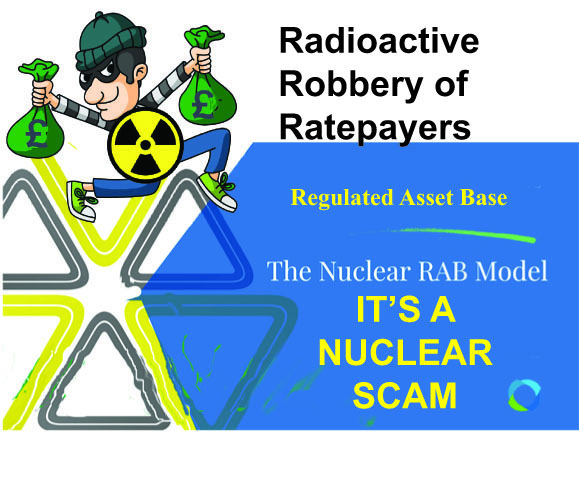
THE UK Government is set on using a Regulatory Asset Base (RAB) model to fund
nuclear projects south of the Border. This will directly result in Scots
paying more on their energy bills. Here, former Scottish Office chief
statistician Jim Cuthbert explains what an RAB model is, and the problems
behind it. There are two main problems.
First, the construction phase of
nuclear projects is extremely long. Further, nuclear construction is
notoriously beset by technical difficulties. Midway through a nuclear
construction project, it will be extremely difficult for the regulator to
resist pressure for the RAB base to be inflated to overcome any technical
problems or uncertainties.
Secondly, the operating life of nuclear projects
is again very long, with the UK Government’s current working assumption
being about 60 years. This means that any surplus which is built into the
stream of future RAB payments will be available to be capitalised over this
long period – which will greatly increase the potential windfall profits
to be extracted by the original equity investors.
The National 23rd Oct 2022
https://www.thenational.scot/politics/23071054.rab-will-affect-future-energy-charges-scots/
The Generational Divide Over Nuclear Power
The scientists at the Cigéo lab in France are not including the risk of deliberate attacks in their research. All of this – the security risks, the enormous uncertainty around waste, the potential for nuclear proliferation – concerns the activists at the House of Resistance.
https://www.forbes.com/sites/christinero/2022/10/21/the-generational-divide-over-nuclear-power/?sh=5d8d990a6b13 Christine Ro 21 Oct 22
Maud Simon is one of the younger residents of the House of Resistance, a home in the bucolic French commune of Bure. The setting is peaceful, with fewer than 100 residents amidst the fields and cottages.
But Simon and her housemates want disruption. The activists, part of the anti-nuclear network Sortir du nucléaire, purchased this house back in 2006 to mobilize against the nearby Cigéo research laboratory, where scientists are testing deep geological disposal for eventually storing nuclear waste. The activists say there hasn’t been enough information about the risks of this research, and are opposed more generally to the legitimation of nuclear energy given its risks.
The House of Resistance is now home to a fluctuating population of about 5 to 40 people, though this can swell to as many as 400 during a special event.
Simon has been living here for two years. She believes that many young French people favor nuclear energy because of propaganda disseminated by the pro-nuclear lobby, which has spread for instance to YouTube. She’s somewhat unusual, as she grew up in an anti-nuclear family.
A short drive away is the reason that Simon and her fellow protestors chose this site.
To get to the heart of the Cigéo nuclear research laboratory, I’m squeezed with nine other people into an elevator descending 490 meters.
Lasting five minutes, it’s the longest lift ride of my life.
In this peaceful corner of northeast France, scientists are working on a problem that no one, in any country, has solved: what to do permanently with the waste produced by nuclear power generation. In France the total inventory of such waste amounted to 1.7 million m3 at the end of 2020, according to the French National Agency for Radioactive Waste Management (Andra), which operates the Cigéo site.
Our guide’s name at the Cigéo facility is, appropriately enough, Jacques Delay. Dealing with the waste problem involves a high degree of uncertainty and epic timescales (Switzerland, for instance, requires planning for up to 1 million years of containment for any deep geological repository there).
Geologist Delay says that the scientists are expecting technology to continue progressing at its current rate. So certain decisions will be left to future scientists.
Andra hopes to begin operating long-term disposal by 2050, and to have reversible storage until about 2150, in case future scientists come up with a better solution. Then the deep geological disposal would be sealed off completely.
Every 25 metres or so in the Cigéo facility, the construction of the drifts (passageways) changes, to allow for years-long experiments on factors like corrosion and swelling. Walls are lined with concrete of different quality and rigidity levels, for instance. The shape of the drifts fluctuates as well. Scientists here run tests with waste after it’s waited on the surface for 70 years, and cooled to below 90°C.
The scientists at the Cigéo lab in France are not including the risk of deliberate attacks in their research. All of this – the security risks, the enormous uncertainty around waste, the potential for nuclear proliferation – concerns the activists at the House of Resistance.
Nuclear science like that on display at Cigéo is clearly a point of pride in France, which is a permanent member of the UN Security Council and has embraced nuclear energy much more than its neighboring countries. Yves Marignac, who leads the Nuclear and Fossil Energy Unit at the négaWatt Association, notes, “There’s no equivalent worldwide of a country that has developed so much nuclear industry relative to its size.”
The French nuclear fleet is large but not always reliable. Currently, half of France’s currently 56 nuclear reactors are currently out of operation due to corrosion and maintenance issues.
Rainer Baake, the managing director of the Climate Neutrality Foundation in Germany, believes that young people are more pro-nuclear because “they never experienced nuclear fallout.” The former politician says that Germans were very enthusiastic about nuclear energy until the Chernobyl disaster, which led to radioactivity contaminating German gardens. He’s helped shape Germany’s subsequent transition away from nuclear energy, which was meant to have been completed in 2022 but has now been postponed due to the energy supply crisis.
Nuclear is increasingly popular among young people – for instance in Finland, home to the world’s first deep geological repository for nuclear waste – not only because they have less memory of the risks, but also because of widespread concern about climate change. Unlike fossil fuels, nuclear energy is mostly emissions-free; unlike solar and wind energy, it can operate 24/7. And climate anxiety is more pressing than radiophobia for many people who grew up after the Cold War.
The world’s most famous youth climate activist, Greta Thunberg, declared on October 12 that it would be a mistake for Germany to phase out nuclear energy altogether. This set her apart from political units like Germany’s Green Party – which was one of the parties that negotiated for the closure of nuclear plants by the end of 2022 – and long-established environmental organizations like Greenpeace.
Thunberg’s support for nuclear power appears somewhat ambivalent, as she was arguing that nuclear should not be eased off in favor of coal plants, which are set to continue operating in Germany until 2030. After all, Nobel Prize-winning physicist Steven Chu has argued, air pollution from fossil fuels kills more people than the harms from nuclear energy.
Some young people are all in on nuclear. In North America, “nuclear bros” show that nuclear energy’s popularity is picking up steam among young men.
Nuclear energy is one of the most contentious topics within the environmental movement. To ensure its relevance going forward, the anti-nuclear camp will need to make its core issues – including safety, costs, nuclear proliferation, and the pesky problem of nuclear waste – resonate with more young people like Simon.
Off the hook: UK government absolves nuclear operators from accident liability
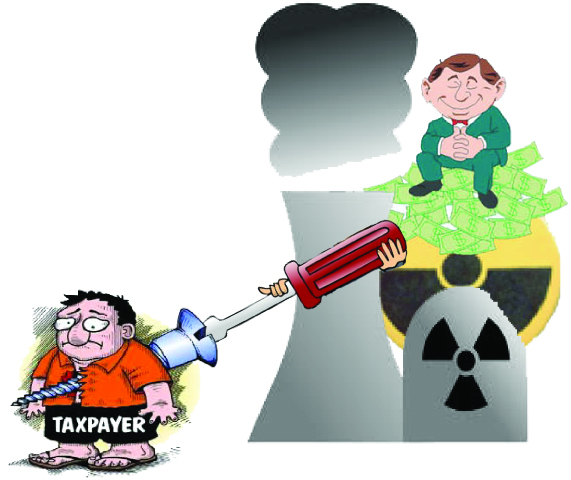
“It’s as we suspected”, says the Chair of the Nuclear Free Local Authorities, expressing his disappointment that once more the UK Government is providing a subsidy to the nuclear industry by absolving operators of the need to pay compensation in the event of an accident.
In a letter to Energy Minister Lord Callanan, Councillor David Blackburn asked how nuclear operators, at present French-owned EDF Energy, would be expected to comply with the requirements of the revised provisions of the Paris Convention that they pay out up to 700 million Euro in damages after an accident, whether through taking out insurance with private-sector underwriters to pay the compensation in the event of an accident or by setting aside funds in an escrow account. This liability will increase by a further 100 million Euro in each of the next five years.
In the letter, Cllr Blackburn also expressed the NFLA’s fears that the UK Government would provide a taxpayer funded bailout for the industry by taking on the liability itself, and Lord Callanan’s reply, citing an immature insurance market, makes it clear that this will indeed be the case: ‘the Government has agreed initially to provide an indemnity, for an economic charge, to cover increased personal injury liabilities for the 10-to-30-year period’.
Commenting Councillor Blackburn said: “This is yet another example of a situation in which nuclear enjoys the benefit of a public subsidy.
“Exactly like the situation with the Nuclear Liabilities Fund, where taxpayers pick up the tab for the cost of decommissioning, which in the last two financial years has meant a further £10.7 billion of public money going to the Fund, the poor suffering British taxpayer will have to shell out up to 1.2 billion Euros, that should be paid by the industry, in the event of a nuclear accident.
“By accepting liability, the government is de-risking nuclear operations. And EDF Energy and its ultimate owner, France, are laughing – they can dodge the liability and walk away scot-free if calamity strikes”.
The NFLA has now sent a request under the Freedom of Information Act seeking further details of the so-called ‘economic charge’ paid by nuclear operator EDF Energy to allow them to evade their legal responsibilities. https://www.nuclearpolicy.info/news/off-the-hook-uk-government-absolves-nuclear-operators-from-accident-liability/
Germany will still end nuclear power by April 2023
German chancellor Olaf Scholz has announced that his government would pave
the way for prolonging the runtime of all three of Germany’s remaining
reactors until April 2023, reports online news agency Clean Energy Wire.
The country’s leader has intervened to settle a dispute about the delayed
end of nuclear power in Germany which has kept his coalition government in
conflict for several months. The decision was made in light of the European
energy crisis and went further than an earlier proposal by the country’s
economy ministry for just two of the plants.
However, the chancellor’s decision means that the foreshadowed nuclear exit will not be changed in
principle and no new fuel rods will be purchased, thus ending nuclear power
in Germany by April next year. The limited runtime extension – which
still needs approval by parliament – is seen as a compromise for his
coalition partners, the Green Party and the pro-business FDP, made ahead of
what is expected to become a difficult winter for Germany’s and Europe’s
energy supply.
Modern Power Systems 18th Oct 2022
Tulsi Gabbard dares to challenge Washington’s war machine
The former presidential candidate has shown that opposing regime-change policies is the one taboo that the ruling class won’t tolerate, Rt.com, Tony Cox, a US journalist who has written or edited for Bloomberg and several major daily newspapers. 15 Oct 22,
Tulsi Gabbard’s rapid transformation from rising Democratic star to demonized outcast – culminating this week with her decision to leave the party – has exposed the one thing on which every powerful person in Washington can agree: war is good.
It’s the one thing, in fact, that everyone must agree on, if they expect to attain any power and have a long and prosperous career in American politics. Those who don’t will be kept on the fringes, at best. If they speak out too effectively, they’ll be branded a traitor. As former congressman Ron Paul and his son, Senator Rand Paul, have proved, they’ll never be taken seriously as a presidential candidate and won’t be allowed to contest, regardless of how many debates they win.
Gabbard has illustrated this reality better than anyone. Consider how much she brought to the table when she entered Congress in 2013, how touted she was as the next big thing, then look at how seemingly little it took for her to be essentially excommunicated. Her fall from grace was astonishingly quick, and illuminating.
Then just 31, she came from one of the most reliably blue states, Hawaii, as the youngest lawmaker to ever represent her district. She’s non-white. In fact, she checked a couple of those identitarian boxes that the Democrats love so much, becoming the first Hindu member and the first Samoan-American voting member of Congress. She’s a war veteran. She’s articulate and comes across as a person who passionately believes in what she’s saying.
……………………………. CNN and other legacy media outlets began fawning over Gabbard as the “next superstar” and “the one to watch.” MSNBC suggested that Hollywood might want to make a movie about her, and CNN commentator Ana Navarro quipped, “I don’t know, but in a battle, I want her in my trench.”
……………………………….. When Gabbard ran for president in the 2020 race, she brought her anti-war message to the primary debates
…………. With the media portraying her as an anti-LGBTQ bigot and a “Russian asset,” Gabbard’s career in Congress was also soon to end. She chose not to seek re-election …………
However, Gabbard continued to speak out against warmongering, especially after Russia began its military offensive against Ukraine in February, triggering rebukes from Democrats and Republicans alike. She became even more of a political pariah when she warned that Biden’s policy of fighting a proxy war against Russia was pushing Americans closer to nuclear disaster. After she raised concern about claims of US-funded biolabs in Ukraine, Senator Mitt Romney accused her of spouting “treasonous lies.”…………………..
Gabbard’s effectiveness as a communicator makes her dangerous to the war machine. She makes clear that US policies have nothing to do with the real security and economic interests of the American people.
“We have too many people in Washington who are warmongers, subservient to the military industrial complex, and continuing to put their own selfish interests and the interests of their donors first, with no mind for the cost and consequence that their decisions have on the American people,” she said in a Fox News interview on Tuesday.
“That’s exactly what we’re seeing right now with President Biden and leaders in Congress, whose decisions are actively pushing us to the brink of a nuclear holocaust, of which they may have their bunkers where they’ll be safe, but we the American people will have no shelter, no place to go, no place to hide, and face the consequences that could destroy all of humanity and the world as we know it.” https://www.rt.com/news/564594-tulsi-gabbard-democratic-party-us/
Protests in 40+ US Cities Demand De-escalation as Poll Shows Surging Fear of Nuclear War
“Anyone paying attention should be worried about the rising dangers of nuclear war, but what we really need is action,” said one organizer.
Common Dreama, JULIA CONLEY, October 14, 2022,
As new polling showed this week that Americans’ fear of nuclear war has steadily grown since Russia invaded Ukraine in February, anti-nuclear campaigners on Friday called on federal lawmakers to take action to mitigate those fears and ensure the U.S. is doing all it can to deescalate tensions with other nuclear powers.
Anti-war groups including Peace Action and RootsAction organized picket lines at the offices of U.S. senators and representatives in more than 40 cities across 20 states, calling on lawmakers to push for a ceasefire in Ukraine, the revival of anti-nuclear treaties the U.S. has exited in recent years, and other legislative actions to prevent nuclear catastrophe.
“Anyone paying attention should be worried about the rising dangers of nuclear war, but what we really need is action,” Norman Solomon, co-founder of RootsAction, told Common Dreams. “Picket lines at so many congressional offices across the country convey that more and more constituents are fed up with the timidity of elected officials, who’ve refused to acknowledge the extent of the current grave dangers of nuclear war, much less speak out and take action to mitigate those dangers.”
The most recent polling released by Reuters/Ipsos on Monday showed that 58% of Americans fear the U.S. is headed toward nuclear war.
……………….. “The level of anxiety is something that I haven’t seen since the Cuban missile crisis,” Peter Kuznick, a history professor and director of the Nuclear Studies Institute at American University, told The Hill. “And that was short-lived. This has gone on for months now.”
Campaigners at “Defuse Nuclear War” picket lines on Friday called on members of Congress to allay those concerns by:
- Adopting a “no first use” policy regarding nuclear weapons, to restrict when the president of the United States can consider a nuclear strike and signal that the weapons are for deterrence rather than the fighting of wars;
- Pushing for the U.S. to reenter the Anti-Ballistic Missile (ABM) Treaty, which it withdrew from in 2002, and the Intermediate-Range Nuclear Forces (INF) Treaty, which it left in in 2019;
- Passing H.R. 1185, which calls on the president “to embrace the goals and provisions of the Treaty on the Prohibition of Nuclear Weapons and make nuclear disarmament the centerpiece of U.S. national security policy;”
- Redirecting military spending, which makes up half the country’s discretionary budget, to ensure Americans have “adequate healthcare, education, housing, and other basic needs” and that the U.S. is taking far-reaching climate action; and
- Pushing the Biden administration to take nuclear weapons off “hair-trigger alert,” which enables their rapid launch and “increases the chance of a launch in response to a false alarm,” according to Defuse Nuclear War organizers.
…………………………… In addition to Friday’s pickets, campaigners are organizing a Day of Action on Sunday, with supporters holding demonstrations, handing out fliers, and prominently displaying banners calling for a deescalation of the nuclear threat. https://www.commondreams.org/news/2022/10/14/protests-40-us-cities-demand-deescalation-poll-shows-surging-fear-nuclear-war?fbclid=IwAR3U681WT7zPDYNqRo7B1uo_KQUkqnnkBnFvwZIZ0ZYHQamAT6qgP8sX4XU
German Greens lay out nuclear power extension position amid coalition infighting
DW 15 Oct 22, The Green Party decided to support reserve operation of nuclear power plants in Germany, but rejected procurement of new fuel rods. Their party conference coincides with a conflict in the coalition on the issue.
…………………………………………. No to new nuclear fuel
The issue has also put Habeck in a difficult position with the party grassroots, given the Green Party’s longstanding objection to German nuclear power and the pride it took in being part of the first government to declare that the country would stop using it altogether.
The Greens said their red line on any nuclear extension would be the procurement of new nuclear fuel elements. The Greens would not agree to any legal regulation in the Bundestag that would procure new nuclear fuel.
Party co-leader Ricarda Lang said in the debate that new fuel rods or a return to nuclear power “will not happen with us.” Renewable energies need to be expanded, and “nuclear power is not the future,” Lang said.
Habeck also described a return to nuclear power as “wrong”, adding: “There’s no way that’s going to happen to us.”
As for the reserve operation of the two nuclear power plants, he said that “we shouldn’t rule out this contribution from the outset” because of the emerging gap in the energy supply…………………………….. more https://www.dw.com/en/german-greens-lay-out-nuclear-power-extension-position-amid-coalition-infighting/a-63449846
France’s Finance Minister : Priority is to restart nuclear reactors a soon as possible
https://www.reuters.com/business/energy/frances-le-maire-priority-is-restart-nuclear-reactors-soon-possible-2022-10-11/—PARIS, Oct 11 (Reuters) – French Finance Minister Bruno Le Maire said on Tuesday the government’s priority was to restart EDF’s (EDF.PA) nuclear reactors – with more than half of them currently offline – as soon as possible.
During a press conference at the headquarters of grid operator RTE, Le Maire also said the goal was still to go back to 50GW of nuclear production capacity for the network at the start of 2023.
French nuclear power output is at a 30-year low for the year, owing to an unprecedented number of outages at EDF’s fleet of 56 reactors, with more than half offline because of corrosion issues and scheduled maintenance.
Scotland government will double down on opposition to new nuclear power stations north of the border.
JOHN Swinney is set to renew the Scottish Government’s opposition to new
nuclear power stations being built north of the border. The Deputy First
Minister will double down on his Government’s stance when he delivers his
keynote speech to SNP conference today.
Energy policy is reserved to Westminster, but the Scottish Government can effectively veto proposals
north of the border through devolved planning rules.
Since becoming Prime Minister last month, Liz Truss has repeatedly called for the Scottish
Government to change its tune on nuclear power. But the Scottish Government
has insisted it has no intention of doing so, when its delayed updated
energy strategy is published later this year.
Mr Swinney is expected to tell the SNP conference: “Scotland is a nation rich in energy resources
– we have a plentiful supply of clean, green, affordable renewable
energy. “The equivalent of almost 100 per cent of our electricity demand
is from renewable sources.
Not only is Scotland self-sufficient in natural
gas, we are a huge exporter. “Scotland is secure in energy.
So, we need no lectures from Liz Truss about security of energy supply. It is the UK
that has failed to achieve energy security, with the National Grid warning
of possible power cuts this winter. “And Scotland is not going to put up
with a new round of nuclear power stations to make up for the failure of
energy policy in the United Kingdom.” He will add: “Despite our huge
strength in energy, 150,000 more people in Scotland will be forced into
extreme fuel poverty as a result of the UK Government’s increase to the
energy price cap in September. “We are an energy rich nation, but 35% of
our citizens live in fuel poverty. Why is that? Because, while Scotland has
the energy, Westminster has the power. And how Westminster chooses to use
its reserved power has consistently, and deliberately, disadvantaged
Scotland.”
Herald 9th Oct 2022
Truss call for Scottish nuclear power is to make up for UK mistakes
Truss call for Scottish nuclear power is to make up for UK mistakes –
Swinney. The Prime Minister previously said she wanted to see nuclear power
stations built in Scotland.
Evening Standard 8th Oct 2022
Liz Truss blocks a plan for UK citizens to reduce their energy use

How Liz Truss blocked Jacob Rees-Mogg’s energy-saving public information campaign.
Liz Truss is reported to have blocked the launch of a publicminformation campaign aimed at conserving energy, despite warnings that blackouts could be imposed in the UK if gas imports fall short this winter.
Business Secretary Jacob Rees-Mogg is understood to have backed a £15m “light touch” initiative, according to The Times, encouraging households to reduce their use of gas and electricity by taking a series of simple measures. However, Ms Truss is said to be “ideologically opposed” to such an approach as it could be too interventionist.
iNews 7th Oct 2022
https://inews.co.uk/news/liz-truss-jacob-rees-mogg-energy-saving-campaign-1899019
No nuclear power ‘renaissance’ as Europe wrestles energy crisis
“Most efforts right now are based on developing renewables, that’s what you can see in the European strategy in response to the Russian crisis,” “Nuclear is still not a shared solution in Europe.”
Russian invasion of Ukraine sparks incremental shifts in divisive issue, but no major pivot seven months into fighting.
Aljazeera, By Joseph Stepansky 6 Oct 20226
Nuclear power, and the heavy safety baggage it carries, has long divided European opinion, with individual countries charting vastly divergent paths on the industry’s role in future energy sustainability and security plans.
The Russian invasion of Ukraine has again brought the atomic question to the fore, as nations scrambled for short-term solutions before winter sets in, as well as longer-term safeguards, to avoid similar energy upheavals in the years ahead.
But after eight months of fighting in Ukraine, and an energy crisis compounded most recently by the alleged sabotage of the arterial Nord Stream 1 and 2 Russia-to-Europe pipelines in the Baltic Sea, European governments long opposed to nuclear power have shown only incremental shifts in their attitudes, which have been informed by years of concerns about nuclear waste and safety.
A wider pivot has remained absent…………………..
Mark Hibbs, a Germany-based non-resident senior fellow at the Carnegie Endowment for International Peace, “I don’t see a major [nuclear power] watershed from what’s happening in Ukraine.”
Instead, the situation has reinforced some trends among countries already bought into nuclear energy, he said, while slowing some opponents’ phase-outs of the technology.
Europe’s nuclear hesitancy
Opposition to nuclear power, coupled with other factors, has created a 25 percent overall decline in electricity produced by splitting atoms in the 27-country European Union from 2006 to 2020, according to the bloc’s executive wing, the European Commission.
By 2020, the EU produced 24 percent of the bloc’s overall electricity from nuclear plants, with 13 countries operating nuclear reactors: France, Belgium, Germany, Bulgaria, the Czech Republic, Finland, Hungary, the Netherlands, Romania, Slovakia, Slovenia, Spain and Sweden.
Countries that already have nuclear power capacity, according to Hibbs, are likely to face the greatest demands in light of the conflict in Ukraine, particularly as typically 30- to 40-year power plant licences begin to expire.
“There will be pressure on European governments and industry to continue operating their nuclear power plants,” he said, adding that pressure will grow as the conflict stretches on…………………………………….
More recently, Greenpeace, an organisation that has long opposed nuclear power, has pointed to fighting around the Russian-seized Zaporizhzhia nuclear plant in Ukraine as an example of the ever-present danger of relying on nuclear as an energy source.
Denmark, Ireland and Serbia, countries that do not have nuclear power industries, have longstanding bans on developing the technology. Others, such as Greece, have avoided the technology for fear of natural disasters……………………………………………………………………………………..
No short-term solutions
Still, a more immediate pivot has been widely constrained by the reality that nuclear power’s ability to address Europe’s short-term energy challenges is “fairly limited”, according to Cobb.
“And the reason for that is, in most countries, nuclear operates in a baseload mode. So, it is already the case that nuclear plants tend to operate full-time,” he said. “They’re not like gas plants that operate at a peaking load, producing electricity, when demand is at the highest. They’re always operating”.
Meanwhile, developing new nuclear facilities remains a daunting, costly and years-long ambition, with a high barrier of entry, IDDRI’s Berghmans said.
“It’s a complex industry,” he said. “You need big infrastructure. You need to plan where you can put these facilities. You need nuclear know-how, which is not as widespread as it used to be in Europe.”
Proponents of new generation small modular reactors (SMRs), which can be built off-site and transported, have said the new technology could offer more efficient and cheaper development, although the plants are still years away from operating and have raised their own unique safety concerns.
And while nuclear power analysts have said the nuclear supply chain is generally more stable and easier to reroute than that of many fossil fuels, particularly natural gas, it does not come without its own Russia problems.
In 2020, EU utilities imported about 20 percent of their natural uranium, the fundamental resource needed to produce nuclear energy, from Russia. The bloc also received 26 percent of its enrichment services, the required process of altering uranium’s makeup before it can be used to create energy, from Russia, according to the European Atomic Energy Community (Euratom).
Bulgaria, the Czech Republic, Finland, Hungary, Slovakia and Ukraine also currently operate Russian-made nuclear reactors, raising questions about their long-term needs for specific Russian-made parts and services, according to an analysis by Matt Bowen and Paul Dabbar of Columbia University’s Center on Global Energy Policy.
To date, Russia’s nuclear industry has broadly escaped Western sanctions.
Recent outages at French power plants, because of maintenance, corrosion problems and heat stresses, have also reinforced longstanding hesitancy towards nuclear power, according to Carole Nakhle, the founder of the Crystol Energy consulting organisation.
“Mind you, one of the problems that the EU faced that made the current crisis even worse were the nuclear outages in France,” she told Al Jazeera. “France, which usually exports electricity, had to import this year because its power plants couldn’t keep up.”
Given the myriad challenges that continue to surround nuclear, governments are more likely to see renewable energies, such as wind and photovoltaic energy, as “more economical” alternatives to energy security and sustainability, according to Berghmans.
“Most efforts right now are based on developing renewables, that’s what you can see in the European strategy in response to the Russian crisis,” he said. “Nuclear is still not a shared solution in Europe.”
https://www.aljazeera.com/news/2022/10/6/europe-sees-shift-in-attitudes-no-nuclear-power—
The World Nuclear Industry Status Report 2022 (WNISR2022)
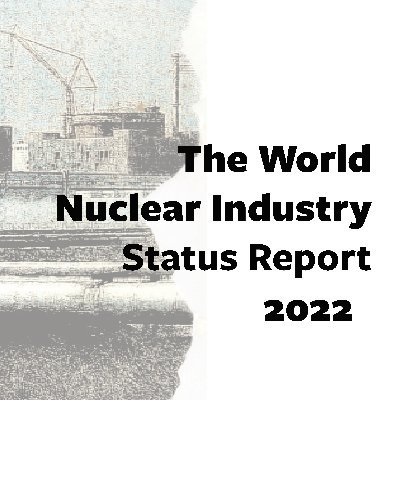
The World Nuclear Industry Status Report 2022 (WNISR2022) assesses on 385
pages the status and trends of the international nuclear industry. It
provides a comprehensive overview of nuclear power plant data, including
information on operation, production, construction, and decommissioning.
The WNISR assesses the status of new-build programs in existing as well as
in potential newcomer nuclear countries. The report also compares the
development of nuclear power and renewable energy globally.
WNISR2022 contains a special focus chapter on Nuclear Power and War that assesses the
safety and security challenges of nuclear power plants in war situations.
Further focus chapters include the Fukushima Status Report providing an
overview of ongoing onsite/offsite challenges of the 2011-disaster.
The Decommissioning Status Report looks at the current situation of the now
over 200 closed nuclear power reactors.
Nine interdisciplinary experts from
Canada, France, Germany, Japan, and the U.K., from top think tanks like
Chatham House in London and prestigious academic institutions like Nagasaki
University, University of British Columbia, and Technical University in
Berlin, have contributed to the report, along with a data engineer,
numerous proofreaders, and two artistic designers. The foreword was
provided by Aviel Verbruggen, Prof. Dr. Emeritus, University of Antwerp,
Belgium.
WNISR 5th Oct 2022
https://www.worldnuclearreport.org/World-Nuclear-Industry-Status-Report-2022-870.html
1 This Month
23-25 October – on Zoom – World BEYOND War’s annual global conferenc


Shut down the radiation-damaged Heysham nuclear reactors now
To see nuclear-related stories in greater depth and intensity – go to https://nuclearinformation.wordpress.com

Say No to NASA’s Reckless Nuclear Reactor on the Moon
Say No to NASA’s Reckless Nuclear Reactor on the Moon

Please sign the petition here: https://www.change.org/p/stop-japan-s…
-
Archives
- October 2026 (190)
- September 2026 (339)
- August 2026 (330)
- July 2026 (355)
- June 2026 (287)
- May 2026 (306)
- April 2026 (356)
- March 2026 (251)
- February 2026 (267)
- January 2026 (308)
- December 2025 (358)
- November 2025 (359)
-
Categories
- 1
- 1 NUCLEAR ISSUES
- business and costs
- climate change
- culture and arts
- ENERGY
- environment
- health
- history
- indigenous issues
- Legal
- marketing of nuclear
- media
- opposition to nuclear
- PERSONAL STORIES
- politics
- politics international
- Religion and ethics
- safety
- secrets,lies and civil liberties
- spinbuster
- technology
- Uranium
- wastes
- weapons and war
- Women
- 2 WORLD
- ACTION
- AFRICA
- Atrocities
- AUSTRALIA
- Christina's notes
- Christina's themes
- culture and arts
- Events
- Fuk 2022
- Fuk 2023
- Fukushima 2017
- Fukushima 2018
- fukushima 2019
- Fukushima 2020
- Fukushima 2021
- general
- global warming
- Humour (God we need it)
- Nuclear
- RARE EARTHS
- Reference
- resources – print
- Resources -audiovicual
- Weekly Newsletter
- World
- World Nuclear
- YouTube
-
RSS
Entries RSS
Comments RSS

