Iran increasing its nuclear power
Iran on Saturday began construction on a new nuclear power plant in the
country’s southwest, Iranian state TV announced, amid tensions with the
U.S. over sweeping sanctions imposed after Washington pulled out of the
Islamic Republic’s nuclear deal with world powers.
The new 300-megawatt plant, known as Karoon, will take eight years to build and cost around $2
billion, the country’s state television and radio agency reported. The
plant will be located in Iran’s oil-rich Khuzestan province, near its
western border with Iraq, it said.
Iran has one nuclear power plant at its
southern port of Bushehr that went online in 2011 with help from Russia,
but also several underground nuclear facilities. The announcement of
Karoon’s construction came less than two weeks after Iran said it had
begun producing enriched uranium at 60% purity at the country’s
underground Fordo nuclear facility. The move is seen as a significant
addition to the country’s nuclear program.
PBS 3rd Dec 2022
https://www.pbs.org/newshour/world/iran-announces-start-of-construction-on-new-nuclear-power-plant
Small modular reactor plans to be blocked by the Scottish government
Plans to power a refinery in Scotland with a Rolls-Royce small modular
reactor (SMR) are likely to stall due to opposition from the Scottish
government. Government officials have said they will block any moves to
power the Grangemouth refinery on the Firth of Forth with a nuclear
reactor. According to the Sunday Telegraph, talks have taken place between
chemicals group Ineos and Rolls-Royce, and the two companies are understood
to have considered whether the plant could be powered by an SMR.
New Civil Engineer 30th Nov 2022 https://www.newcivilengineer.com/latest/scottish-small-modular-reactor-plans-to-be-blocked-by-government-30-11-2022/
UK Funding subsidy to French firm EDF, for the £26bn Hinkley Point C nuclear plant even if it does not start operating until 2036
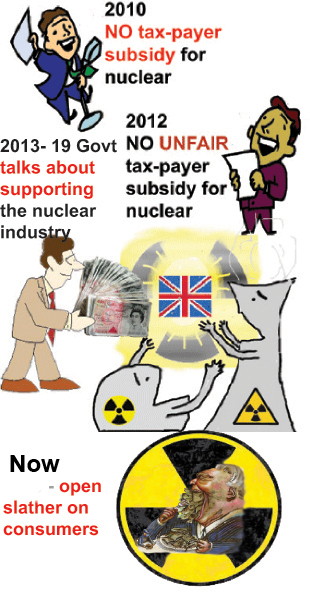
EDF has secured 14 years of funding for the UK’s upcoming nuclear plant
Hinkley Point C in case of the risk of further delays. The French energy
giant has agreed a new contract ensuring its funding even if it does not
start operating until 2036.
EDF confirmed to City A.M. the project is still
on course for completion in 2027, following an approximately two year delay
driven by the pandemic and supply chain disruptions. It is also roughly 45
per cent over budget – having initially been projected to cost £18bn, but
now expected to be priced at £26bn.
The new subsidy contract still includes
clauses in the former deal, which was set to expire just three years
earlier in 2033. This includes stipulations such as shortened payments to
EDF if Hinkley Point C fails to start generating power by May 2029.
If the plant is up and running by that date, EDF receives a guaranteed £92.50 per
megawatt hour for its electricity for the first 35 years of its life. The
latest deal instead reflects a renegotiated settlement between the UK and
China, with the Government paying CGN a £100m exit fee from the next
project – Sizewell C.
City AM 1st Dec 2022
https://www.cityam.com/edf-secures-further-funding-for-hinkley-point-c-in-new-settlement/
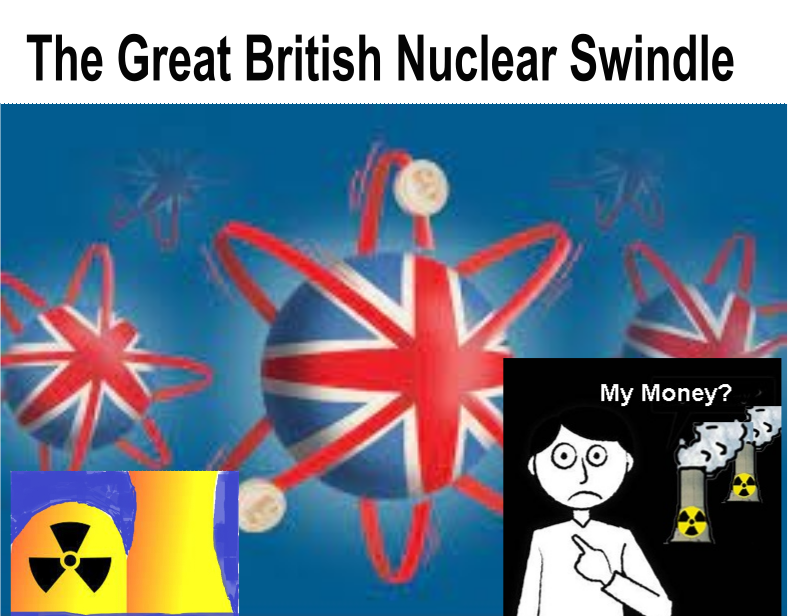
TODAY. The GREAT BRITISH NUCLEAR financial mess
In a gloomy financial statement, Chancellor Jeremy Hunt said the Office for Budget Responsibility had judged that the UK’s economy was shrinking. J.P.Morgan said on Tuesday it expects a contraction in the UK’s economy next year as it enters a lengthy period of stagnation in the face of soaring gas prices, slowing global growth and tighter economic conditions. It predicts “Tighter monetary and fiscal policy amid scarring from both the pandemic and Brexit”
In the midst of all this financial gloom, both the Tory government and the Labour opposition delight in predicting a boom in electricity production from a fleet of nuclear reactors both Big and Small – a fleet that is magically going to appear like some sort of miasma – as taxpayer funds pour into nuclear projects like Sizewell C (Big) and Rolls Royce’s 470 MWe SMR (Not Really Small At All)

Seven months ago the UK government dreamed up “Great British Nuclear” – a “flagship” to “enable nuclear projects”. Now it is clear that “Great British Nuclear” is nothing more than a public relations exercise.
Wylfa and Cumbria nuclear projects failed. because, although the
government offered to take a 30 per cent stake, no other investors came
forward. Now the government is to take a 50% stake in the up to £43 billion Sizewell C , – again desperately touting for investors.
And now – the government unveils plans to establish “Great British Energy”, a new arms-length public body to oversee UK nuclear power pipeline

The Tories pinched the name from the opposition Labour Party, which touted its plan as “all about renewables”. But Labour didn’t mind a bit, when the government co-opted it and turned it into some sort of nuclear justification body. Indeed, Labour’s just as ecstatic as the Tories, about Britain’s wonderful nuclear future – and to hell with the expense!
UK’s £26bn Hinkley Point C nuclear station now faces 11 year delay

Britain’s flagship Hinkley Point C nuclear power station is facing the risk of an 11-year delay, piling further pressure on efforts to keep the lights on. According to a new contract between the Government and French company
EDF, Hinkley will still be funded even if it does not start operating until 2036 – more than a decade after its initial deadline in 2025.
It raises the prospect of significant further hold-ups at Hinkley, which has already been delayed until mid-2027. The change to the subsidy contract terms comes as the Government is paying China a reported £100m to exit its involvement in a second planned new nuclear project, Sizewell C in Suffolk, which is also being developed with EDF. The Government confirmed on Tuesday that CGN will exit Sizewell C, with the state paying an unconfirmed sum to cover its 20pc shareholding and a commercial return. The Times reported this to be £100m. CGN’s involvement with Hinkley Point C is believed to be unaffected.
However, as part of the negotiations, Hinkley Point C now has more leeway than previously to get up and running. The project has a deal with the Government under which it gets a guaranteed £92.50 per megawatt hour for its electricity for the first 35 years of its life, backed by a levy on consumer bills.

When the project was first agreed in 2016, it was due to start generating at the end of 2025. In January 2021, that was pushed back
to June 2026, and in May 2022 it was pushed back again to 2027, with EDF blaming the pandemic and supply chain issues. Costs are now expected to be as high as £26bn. The plant is using a new type of generating technology, EPR, which is so far only in commercial operation in Taishan, China, where one reactor has been shut down due to problems.
Telegraph 29th Nov 2022
UK government to take 50% stake in the French development of Sizewell C nuclear station

Ed note: This is the Tory government plan. But didn’t they pinch the Great British Energy idea from Labour?
Sizewell C project takes major step forward as government unveils plans to establish Great British Energy, a new arms-length public body to oversee UK nuclear power pipeline. The government has approved plans to build the UK’s
first new nuclear power plant in a quarter of a century, today confirming it has agreed to invest £679m to take a 50 per cent stake in the Sizewell C project being developed in Suffolk by French energy giant EDF.
Then”historic” investment will see the UK government become joint shareholder in Sizewell C alongside developer EDF, which will also provide additionalminvestment to match the UK government’s stake, muscling out previousmshareholder China’s CGN in the process.
EDF and the government now plan to work together to attract further third-party investment in the 3.2GW low carbon power project, which once completed would be expected to provide enough power to meet the needs of six million homes for more than 50 years.
In addition, the government today also announced plans to establish Great British Nuclear, a new arms-length public body to help develop a pipeline of new nuclear projects. More details are expected early in the new year, including on the government’s funding commitment to the new body.
Business Green 29th Nov 2022
UK government desperate for investors in its Sizewell C nuclear project, as it pays out the Chinese company previously involved
Construction will not begin in earnest until the consortium has raised close to £20bn of equity and debt from private investors. That fundraising could take at least a year and has no guarantee of success.
The UK government is to pay Chinese state-owned power group CGN over £100mn to exit Britain’s £20bn Sizewell C nuclear energy project in a bid to reduce Beijing’s involvement in the country’s infrastructure. The payment to CGN for its 20 per cent stake in the proposed nuclear plant in Suffolk is part of a £679mn UK state investment in Sizewell first announced by former prime minister Boris Johnson in September and finalised on Tuesday.
Construction will not begin in earnest until the consortium has raised close to £20bn of equity and debt from private investors. That fundraising could take at least a year and has no guarantee of success. UK government officials said that the departure of CGN would clear the way for US investors to put money into Sizewell C, since the Chinese company has been put under US sanctions.
CGN remains a minority 33 per cent investor in Britain’s giant Hinkley Point C nuclear power station in Somerset, another
EDF led project. Although this has already been delayed by several years, it is intended to be the first of a new generation of nuclear power stations. The Chinese group also controls a site at Bradwell-on-Sea in Essex, where it hopes to be the lead investor in a new generator.
CGN’s planned use of its own reactor technology at Bradwell received former approval from Britain’s nuclear regulator in February. But ministers think that ultimately it will not be allowed to build at the site, which they expect to change hands in due course.
FT 29th Nov 2022
https://www.ft.com/content/a9a34ea3-649f-4a47-a4c8-ee269e07eccc
UK government PR exercise “Great British Nuclear” headed for financial failure.

Letter Steve Thomas: Six months after it was announced, it is clear that
Great British Nuclear was no more than a government PR exercise. You report
that it “could prevent a repeat of the Wylfa and Cumbria farragoes”.
That would be remarkable.
The Cumbria project failed because the reactor
supplier, Westinghouse, went bankrupt; Wylfa failed because, although the
government offered to take a 30 per cent stake, no other investors came
forward.
he problem with nuclear is not that we don’t have the
organisation quite right. It’s that nuclear is far too expensive and
economically risky and takes much too long to build to be any use.
Times 25th Sept 2022
https://www.thetimes.co.uk/article/admit-it-nuclears-going-nowhere-tclmnr89f
Middle East investors and French developers for Sizewell C nuclear station to be paid by “an extra tax” on UK public’s bills ?

Alison Downes of campaign group Stop Sizewell C criticised the idea of foreign investors paid with money from ‘an extra nuclear tax on our bills’. She added: ‘The promise of UK energy independence looks pretty hollow if Sizewell C turns out to be French-built and Middle East-funded.’
UAE wealth fund may invest in Sizewell C – Mubadala one of main names in frame to back £20bn nuclear plant. Emirati sovereign wealth fund Mubadala has been tipped as a potential investor in Sizewell C. Sources said the investment group, whose board includes the owner of Manchester City FC, is one of the main names in the frame to back the £20billion nuclear plant.
They suggested talks with the fund may already have taken place. Mubadala is chaired by UAE president Sheikh Mohamed bin Zayed Al Nahyan. Its vice-chairman Sheikh Mansour bin Zayed Al Nahyan bought Manchester City in 2008.
The Government is expected to give the go-ahead to Sizewell C within days with a ‘general investment decision’ that will formalise taxpayer support. The Government and French energy firm EDF, which is developing the power station, are each taking a 20 per cent stake. They are racing to recruit investors to fill a 60 per cent funding gap.
Ministers have put in place a new funding model, the ‘regulated asset base’, which lets investors receive cash back during construction. This is intended to attract pension funds and institutional investors. But they are also said to be approaching potential supporters in the Middle East, Australia and North America.
Alison Downes of campaign group Stop Sizewell C criticised the idea of foreign investors paid with money from ‘an extra nuclear tax on our bills’. She added: ‘The promise of UK energy independence looks pretty hollow if Sizewell C turns out to be French-built and Middle East-funded.’
A BusinessDepartment spokesman said it would ‘not be appropriate to comment on potential investors’.
Mail on Sunday 26th Nov 2022
https://www.thisismoney.co.uk/money/markets/article-11472637/UAE-wealth-fund-invest-Sizewell-C.html
USA government forks out a $billion to keep uneconomic Diablo Canyon Nuclear Power Plant going.
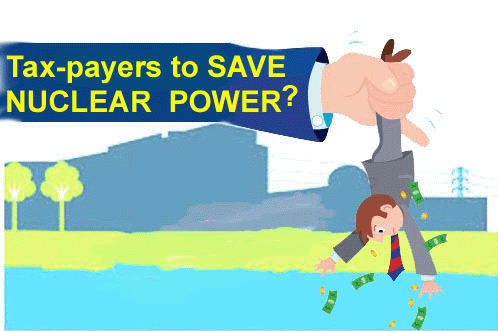
U.S. Ponies Up $1B to Keep California’s Last Nuclear Plant Humming
The Diablo Canyon Power Plant was scheduled to close in 2025, but federal backing will now prolong its (half) life indefinitely
Los Angeles Magazine, By Julius Miller, November 27, 2022,
The Biden Administration announced this week that it had reached preliminary approval to allocate at least $1.1 billion in an effort to keep California’s sole remaining nuclear power plant running.
The Energy Department says that it is negotiating final terms for the Diablo Canyon Power Plant on the central coast of California to remain open and avoid its 2025 end date, according to the Associated Press. The plant was selected in the first round of funding for the administration’s new civil nuclear credit program, which is intended to help owners or operators of the nation’s last nuclear plants help cover the costs of preserving the existing U.S. reactor fleet.
Applicants must not only demonstrate that closure of their plant could directly lead to economic suffering, but also that carbon emission and air pollutant levels will rise without their continued operation………………………
“This investment creates a path forward for a limited-term extension of the Diablo Canyon Power Plant to support reliability statewide and provide an onramp for more clean energy projects to come online,” Newsom said……………
The Diablo Canyon Power Plant produces nine percent of California’s electricity. For comparison, the wind power provides roughly seven percent of the state’s electricity, while solar makes up nearly 14 percent of the total. https://www.lamag.com/citythinkblog/u-s-ponies-up-1b-to-keep-californias-last-nuclear-plant-humming/
USA’s Inflation Reduction Act of 2022 (IRA) cleverly worded so it could be a bonanza for small nuclear plant developers
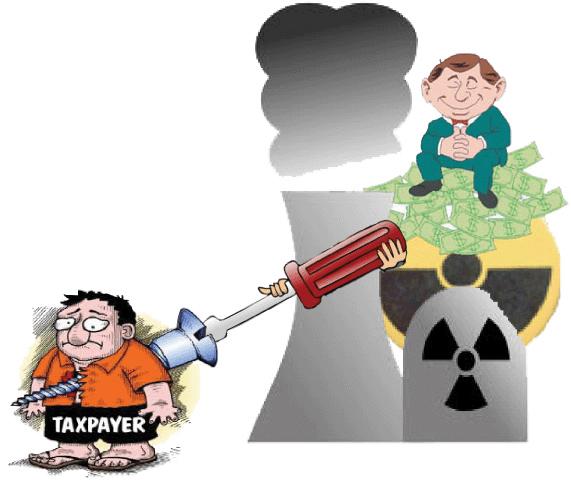
Advanced Nuclear Plants Poised to Benefit from Inflation Reduction Act, Retiring Coal Plants
American Power Association, November 27, 2022 Peter Maloney “………………………………… The Inflation Reduction Act of 2022 (IRA) provides production tax credits (PTC) for existing nuclear power plants but, more importantly, for new nuclear power plants and specifically for advanced reactors and small modular reactors – the type NuScale Power is working on. The IRA amends the definition of a qualified facility eligible for a “clean PTC” to mean any plant placed into service after Dec. 31, 2024, that produces zero greenhouse gas emissions.
The IRA also amends the Internal Revenue Service (IRS) rules on qualifying for a clean energy investment tax credit (ITC) by changing the language in the code to allow investments for advanced reactors to qualify for the credit. The change provides a tax credit of 30 percent of the cost of building a zero-emission advanced nuclear power plant that is placed in service after 2025.
“If you design and plan to put in a small modular reactor at the site of a retired coal plant, there is a further 10 percent ITC available, and if you use domestic content there is another 10 percent ITC added on,” Colbert said. “That can add up to a 50 percent reduction in costs.”
In September, the Department of Energy (DOE) released a study that found that hundreds of coal power plant sites across the country could be converted to nuclear power plant sites……………………..
Each NuScale small modular reactor (SMR) is designed to generate 77 megawatts (MW) of electricity. Up to 12 SMRs can be combined to make a 924-MW VOYGR™-12 power plant. In addition to their compact design, which makes them scalable and cost competitive, …………………………..
NuScale is now looking forward to reaching another milestone in the regulatory process.
In July, the NRC directed its staff to issue a final rule certifying NuScale’s SMR design.
The rulemaking would amend NRC regulations to incorporate NuScale’s SMR standard plant design, which would allow applicants intending to build and operate an SMR plant to reference the design certification rule.
“If approved, the certification would be published in the Federal Register and have the effect of law,” Colbert said.
The rulemaking is on the docket for the NRC to make a decision in November.
UK government underestimated the cost to the public of Regulated Asset Base financing of nuclear power
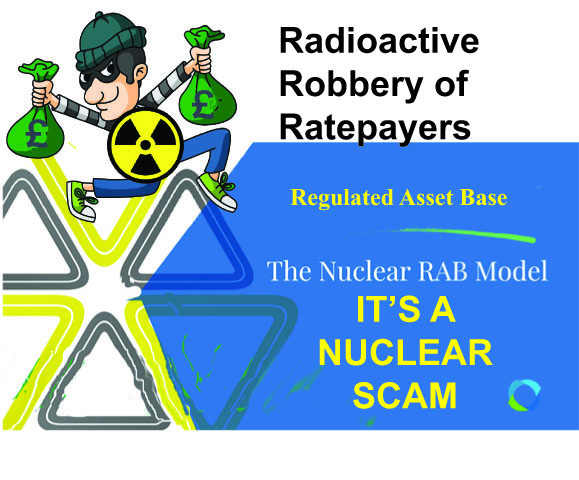
The government has been accused of under-estimating the cost to customers
of its new financing support mechanism for nuclear power, which could add
£100 onto annual bills if ex-prime minister Boris Johnson’s pledge to
roll out a new fleet of the plants is honoured.
At a meeting of the
All-Party Parliamentary Group on Energy Costs, held at the House of Commons
on Wednesday (23 November), University of Greenwich emeritus professor of
energy Steve Thomas criticised the use of the Regulated Asset Base (RAB)
for nuclear projects.
Utility Week 24th Nov 2022
Rolls-Royce calls for formal funding talks over small nuclear plants
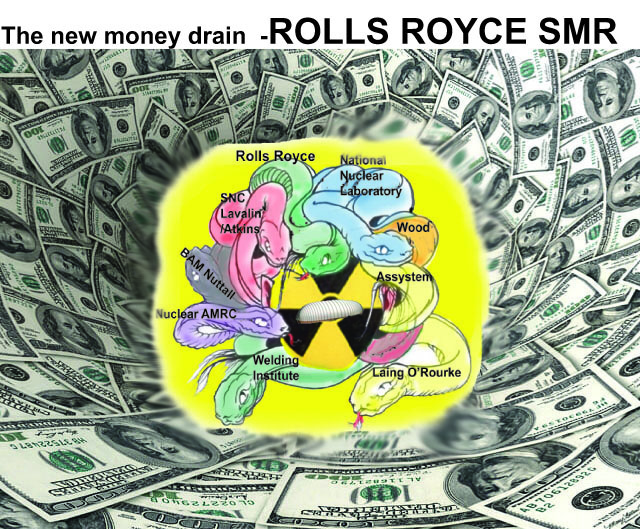
Ft.com Nathalie Thomas in Edinburgh and Sylvia Pfeifer in London, 23 Nov 22
Rolls-Royce has urged the UK government to enter formal negotiations over the funding for small nuclear reactors, which it hopes to build in England or Wales by the early part of next decade.
Tom Samson, head of the company’s small modular reactor business, told a committee of MPs on Wednesday that Britain would face an electricity crisis next decade if it did not push ahead with building more “baseload” power stations that offer a reliable [?] source of generation when weather-dependent renewables including wind and solar are not producing.
Rolls-Royce is leading a consortium that has designed a 470-megawatt [that’s LARGE !] small modular nuclear reactor, which could produce enough power for a city the size of Leeds and would be built in factories before being deployed at existing nuclear sites in England and Wales.
It wants the government to enter formal talks over potential funding models and how the technology could be deployed so it can start building factories. The first Rolls-Royce-designed SMR would cost £2.5bn, although the UK engineering company has argued the cost of each plant will drop to £2bn once it has a pipeline of orders.
……….. the first Rolls-Royce SMR would probably need a funding model underpinned by the government or bill payers.
The company has previously talked about models such as “contracts for difference”, which are used for technologies such as offshore wind and guarantee developers a set price for their output.
Alternatively, it has said it may consider a “regulated asset base” mechanism, whereby a surcharge is added to consumer energy bills long before any plant is operating to help finance schemes.
Samson warned the government it did not have the luxury of spending another two to three years talking about whether to build more nuclear capacity……………
Former prime minister Boris Johnson said while in office that he wanted up to 24 gigawatts of nuclear capacity by 2050 — up from just 5.9GW at present — but chancellor Jeremy Hunt’s recent Autumn Statement referred only to the 3.2GW Sizewell C nuclear project in Suffolk, about which the government is in negotiations with French state-backed energy group EDF. Opponents of nuclear argue that is expensive compared with other technologies.
……………. “The government is investing in these new technologies through the £385mn Advanced Nuclear Fund including £210mn towards the Rolls-Royce SMR programme,” a BEIS spokesperson said. https://www.ft.com/content/21a54a90-1b51-4561-ba9e-c1677e0262ed
—
Lawmaker says Filipinos will be ‘guinea pigs’ in nuclear pact with US

ABS-CBN News Nov 24 2022
MANILA — House Deputy Minority Leader France Castro is against negotiations for a civilian nuclear pact between the United States and the Philippines, saying it poses threat to the health and safety of Filipinos.
According to the ACT Teachers party-list representative, the Filipinos will become “guinea pigs” in this nuclear energy cooperation deal known as “123 agreement”.
The pact, among initiatives announced during US Vice President Kamala Harris’s recent trip to the Philippines, can lead to the future sale of US nuclear reactors to Manila.
“The US and the Philippines agreed to have a… testing of what we call the nuclear equipment here in the Philippines,” Castro told ANC’s “Headstart” Thursday.
“So, we are being made as guinea pigs in this experiment. This would affect our health, of course, our safety and the environment,” she added.
The Makabayan bloc, led by Castro, has filed House Resolution 582 to investigate the “123 agreement”.
The group said modular or microreactor nuclear power plants are still at an experimental stage and are only legally being made in US bases…………………… https://news.abs-cbn.com/video/news/11/24/22/filipinos-will-be-guinea-pigs-in-nuclear-pact-with-us-solon
UK recognises veterans of nuclear weapons tests with medals
Aljazeera, 22 Nov 22
The honour comes 70 years after Britain detonated a nuclear bomb in the Indian Ocean.
Seventy years after Britain detonated a nuclear bomb in the Indian Ocean, troops who took part – sometimes unknowingly – in the country’s atomic weapons tests are being recognised with a medal.
The UK government’s announcement on Monday of the Nuclear Test Medal is a victory for veterans and their families, who have campaigned for years for recognition.
Now, many want recognition of the health problems they believe they suffered as a result of exposure to radiation.
……….. Sunak attended the first-ever ceremony for the nuclear veterans at the National Memorial Arboretum in central England, marking the 70th anniversary of the United Kingdom’s first atmospheric atomic test on October 3, 1952.
Operation Hurricane
The detonation of a plutonium implosion device aboard a Royal Navy ship in the Montebello Islands off Western Australia, dubbed Operation Hurricane, made Britain the world’s third nuclear-armed nation, after the United States and Russia…….
The UK set off further nuclear explosions in Australia and ocean territories, including on Christmas Island, over the following years.
Veterans groups say about 22,000 UK military personnel were involved in British and American tests in the 1950s and 60s, many of them conscripts doing postwar national service.
Veterans, scientists and civil servants from Australia, New Zealand, Fiji and Kiribati who served under British command during the tests between 1952 and 1967 will also be eligible for the UK medal.
Many veterans and their families are convinced there is a link between the tests and health problems they have suffered, and are pressing the UK to hold a public inquiry into the tests.
Some allege they were deliberately exposed to radiation to see how their bodies would react, and claim their medical records were later suppressed.
‘The end of the world’
John Morris, who saw nuclear blasts on Christmas Island as a young conscript in the 1950s, told the BBC earlier this year that “I felt like I had seen the end of the world.”
“I saw right through my hands as the light was so intense,” he said. “It felt like my blood was boiling. The palm trees – which had been 20 miles [32km] away – were scorched.”
Numerous studies over the decades have probed allegations of high cancer rates among the test veterans, and of birth defects in their children, but have failed to establish an ironclad connection with the nuclear tests.
Successive British governments have denied troops were exposed to unsafe levels of radiation.
Alan Owen, founder of the Labrats International charity for atomic test survivors, welcomed the government’s recognition, but said “we want more”………………………………………https://www.aljazeera.com/news/2022/11/21/uk-recognises-veterans-of-nuclear-weapons-tests-with-medals
1 This Month
23-25 October – on Zoom – World BEYOND War’s annual global conferenc


Shut down the radiation-damaged Heysham nuclear reactors now
To see nuclear-related stories in greater depth and intensity – go to https://nuclearinformation.wordpress.com

Say No to NASA’s Reckless Nuclear Reactor on the Moon
Say No to NASA’s Reckless Nuclear Reactor on the Moon
-
Archives
- October 2026 (190)
- September 2026 (339)
- August 2026 (330)
- July 2026 (355)
- June 2026 (287)
- May 2026 (306)
- April 2026 (356)
- March 2026 (251)
- February 2026 (267)
- January 2026 (308)
- December 2025 (358)
- November 2025 (359)
-
Categories
- 1
- 1 NUCLEAR ISSUES
- business and costs
- climate change
- culture and arts
- ENERGY
- environment
- health
- history
- indigenous issues
- Legal
- marketing of nuclear
- media
- opposition to nuclear
- PERSONAL STORIES
- politics
- politics international
- Religion and ethics
- safety
- secrets,lies and civil liberties
- spinbuster
- technology
- Uranium
- wastes
- weapons and war
- Women
- 2 WORLD
- ACTION
- AFRICA
- Atrocities
- AUSTRALIA
- Christina's notes
- Christina's themes
- culture and arts
- Events
- Fuk 2022
- Fuk 2023
- Fukushima 2017
- Fukushima 2018
- fukushima 2019
- Fukushima 2020
- Fukushima 2021
- general
- global warming
- Humour (God we need it)
- Nuclear
- RARE EARTHS
- Reference
- resources – print
- Resources -audiovicual
- Weekly Newsletter
- World
- World Nuclear
- YouTube
-
RSS
Entries RSS
Comments RSS

