Apprehension in Japan, about the idea of getting nuclear-powered submarines.
Kishida cautious about Japan acquiring nuclear-powered sub Nikkei Asia, June 19, 2022
Natsuo Yamaguchi, head of the LDP’s junior coalition partner Komeito, echoed Kishida’s view, calling the idea of a nuclear-powered submarine “unrealistic.”
Ichiro Matsui, leader of the Japan Innovation Party, and Yuichiro Tamaki, head of the Democratic Party for the People, called for acquisition of a nuclear-powered submarine to boost deterrence and reconnaissance capacity……….
The main opposition Constitutional Democratic Party of Japan’s leader Kenta Izumi was against acquiring a nuclear-powered submarine, saying the country’s defenses “won’t get stronger simply because some deluxe equipment is added.”………………. https://asia.nikkei.com/Politics/International-relations/Indo-Pacific/Kishida-cautious-about-Japan-acquiring-nuclear-powered-subs
Biden Proposes Changes to Help Rescue California Nuclear Plant
Biden Proposes Changes to Help Rescue California Nuclear Plant https://www.bloomberg.com/news/articles/2022-06-18/biden-proposes-changes-to-help-rescue-california-nuclear-plant#xj4y7vzkg
By Mark Chediak, 18 June 2022, The US Department of Energy is proposing changes requested by California Governor Gavin Newsom that will allow the state’s last nuclear power plant to qualify for federal financial assistance.
The Energy Department proposed removing a requirement that would have prevented PG&E Corp.’s Diablo Canyon nuclear power plant from getting a portion of $6 billion in funds the Biden Administration is making available to rescue reactors at risk of closing early because they are losing money. The Energy Department posted the suggested amendment on its website and asked for public comments by June 27.
Newsom is reconsidering a state plan to retire Diablo Canyon in 2025 because of projected electricity shortages that could lead to blackouts in the state. The effort to keep Diablo Canyon open would gain momentum if the plant can qualify for federal financial aid. California’s potential reversal of its anti-nuclear power stance underscores the crisis the state is facing as it seeks to decarbonize its grid.
Last month, Newsom asked the Energy Department to amend its nuclear funding criteria so Diablo Canyon would be eligible. The federal program was originally designed to help nuclear plants that were financially struggling in competitive wholesale power markets, which wasn’t the case with Diablo Canyon.
The Energy Department suggested that it would eliminate a requirement that a nuclear reactor applying for funds not recover more than 50% of its costs from regulated rates or contracts. The costs of PG&E’s Diablo Canyon plant are recovered through bill charges to its customers.
President-elect Ferdinand Marcos Jr. plans to confirm Duterte’s executiveorder to include nuclear power
President-elect Ferdinand Marcos Jr. plans to confirm Duterte’s executive
order to include nuclear power in the country’s energy mix. The first step
could be repurposing a plant already built under Marcos Sr by US company
Westinghouse in the early eighties not far from the capital, but which was
never fuelled. In Southeast Asia, the Philippines’ energy costs are
second only to Singapore’s.
Asia News 18th June 2022
https://www.asianews.it/news-en/Manila-to-reboot-the-Bataan-Nuclear-Power-Plant-56065.html
Why nuclear energy won’t work in Australia

Scott Ludlam, https://www.thesaturdaypaper.com.au/opinion/topic/2022/06/18/why-nuclear-energy-wont-work-australia#mtr Scott Ludlam is a writer and activist, and a former Greens senator. 18 June 22, There is something almost comical about the Liberals and Nationals throwing the forlorn spectre of nuclear power back into national energy debates, right after their loss in the 2022 “climate election”.
The incoming Energy minister, Chris Bowen, immediately slapped down the idea, calling it a “complete joke” and noting that nuclear is the most expensive form of energy. He’s right, and that should be the end of the argument, but we know it won’t be, because Peter Dutton and his colleagues are not engaged in a good faith debate about Australia’s future energy mix. For them, this is about something else entirely.
Not everyone who invites discussion on nuclear power acts in bad faith. In a climate emergency, it’s essential to have all viable, low-carbon energy sources on the table, which does entail a periodic assessment of where the nuclear industry actually stands. Has any progress been made on the intractable question of nuclear waste? How permeable is the barrier between civil and military applications? How are safety concerns over the world’s ageing reactor fleet being managed? How is the industry planning to clean up the enormous volumes of radioactive wastes left behind at uranium mines?
Can this technology compete against low-cost renewables?

It’s tempting to imagine the nuclear industry stumbling around like the Black Knight in Monty Python and the Holy Grail, bleeding freely, mortally wounded and yet stubbornly defiant and refusing to die.
The best independent analysis of the state of the industry is provided by the World Nuclear Industry Status Report. Since 2007, these reports have provided an annual, country-by-country snapshot of nuclear plant construction, start-ups, accidents and closures.
They make for forbidding reading, painting a picture of an industry in deep trouble. The number of reactors in operation has declined by two dozen since 2002, as the share of global electricity generation provided by nuclear power fell from about 17 per cent in 1996 to just above 10 per cent in 2020. Part of the problem is that the age of the industry is catching up with it. In the two decades to 2020, there were 95 new nuclear plant start-ups and 98 closures. As plants built in the 1970s and ’80s reach the end of their design life, and construction dries up nearly everywhere other than China, there is no real prospect of them being replaced at anything like the rate of closure. This decline is structural and inexorable.
There is an additional wildcard, which the industry refuses to acknowledge: the risk of future catastrophic reactor accidents. The industry insists it has learnt the lessons of Three Mile Island, Chernobyl and Fukushima, and it is true that plant redesigns and additional safety systems are a major factor driving up the costs of new reactors. But despite this, any accident, disaster or attack that shuts down the cooling system inside a nuclear power plant runs the risk of a meltdown. One study from 2017 analysed the frequency and intensity of 216 nuclear accidents between 1950 and 2014, estimating that “there is presently a 50 per cent chance that a Fukushima event (or larger) occurs every 60-150 years, and a Three Mile Island event (or larger) occurs every 10-20 years”.
These are shocking odds, both for host communities and for energy planners trying to manage the transition to zero-carbon electricity supply. People organising against nuclear power stations, waste dumps and uranium mines are commonly accused of being emotional, hysterical or delusional, when in fact these actions are usually informed by a willingness to look honestly at the difficult truths of this industry.
Someone who has seen those truths close up is Naoto Kan, who was prime minister of Japan at the time of the Fukushima disaster in 2011. In his introduction to the 2021 World Nuclear Industry Status Report, he writes: “The reactors in Units 1 to 3 suffered not only meltdowns, but also melt-through of the nuclear fuel, while the spent fuel pool at Unit 4 came close to evaporating entirely. Had this come to pass, it would have necessitated the evacuation of all residents within a radius of 250 kilometres – an area including the metropolis of Tokyo, the consequences of which would have been unimaginable.”
On the awful day we learn the name of the next Fukushima, whether it be in France, China, the United States or Russia, neither the industry nor its investors will be able to say they weren’t warned.
Surprisingly, it turns out these arguments are now accepted by a growing number of pro-nuclear advocates. Many of them tacitly or openly acknowledge that the technology they’ve been promoting for decades has no future. They have ceased arguing for the giant, water-cooled fission reactors that have been the backbone of the commercial nuclear energy sector since the 1960s.

Instead, they now advocate for a bewildering variety of experimental reactor types, fuelled by uranium or thorium or plutonium, cooled with helium or molten salt or liquid metal. These designs are proclaimed to be simultaneously cheap, safe and efficient, free of proliferation, waste and accident risks, and ready for commercial deployment any decade now.
What unifies many of them is not so much the technology type, but the smaller scale and the fact that they don’t really exist.
A pilot plant of one such small modular reactor (SMR) went into operation at Shidao Bay in China late in 2021, but outside the Chinese nuclear establishment, nobody knows how much it cost to build. According to the World Nuclear Industry Status Report, “There appear to be no plans to construct more reactors of the same design.” These plants are not an answer to climate change. Even the most ambitious estimates for commercial deployment of SMRs stretch into the 2030s and 2040s, long after the heavy lifting of global decarbonisation needs to have been done. Allison Macfarlane, the former chair of the US Nuclear Regulatory Commission, stated in 2021: “When it comes to averting the imminent effects of climate change, even the cutting edge of nuclear technology will prove to be too little, too late.”
This is where what Peter Dutton and his colleagues are really up to comes into sharper focus.
The speed and scale of low-cost solar and wind energy backed up by batteries and hydro power has hit critical mass worldwide. According to the International Renewable Energy Agency, 2015 was the first year that more renewable energy capacity was added to the grid than non-renewable, including fossil and nuclear. By 2021, clean energy technologies accounted for 81 per cent of new generation capacity globally. Closer to home, the signs are everywhere, from the early closure of AGL’s coal-fired power stations to the announcement of huge new renewable energy zones across multiple Australian states.
Into this fast-closing gap, the nuclear industry is making its final pitch before obsolescence: enormous public subsidies in exchange for an imaginary generation of small, cheap, safe reactors that exist nowhere but on paper. Complicating the message for those who still insist that there is no connection between nuclear weapons and nuclear power, the Morrison government’s reckless entry into the AUKUS agreement threatens to enmesh Australia in the trafficking and disposal of high-level spent nuclear fuel from submarine reactors, with all the public health, national security and proliferation risks this entails.
Importing this staggering debacle into Australian energy markets would be much more than just financially irresponsible: it would lock us into a high-risk dead end just as the clean energy revolution is finally under way at scale. But unlike the Black Knight, nuclear technology still retains the capacity to do enormous harm, even in its present enfeebled state. The UN Secretary-General’s special adviser on climate change, Selwin Hart, put it like this in a statement last year: “Where countries are depending on technologies that have not yet been developed, or indicating they intend to cut in the 2030 and 2040s, quite frankly, that’s reckless and irresponsible.”
The foundation of the global anti-nuclear movement has always been in the frontline communities that have suffered the harshest impacts of this technology. Whether it be the First Nations communities in Central and Western Australia, whose lands and health were sacrificed for nuclear weapons testing decades ago, or those who won an end to uranium mining in Kakadu or nuclear waste dumping in Central and South Australia: these debates are won and lost on Country, not in op-ed pages or analysts’ spreadsheets. So, while a combination of lived experience, mockery and hard data may be enough to put Dutton and his colleagues’ latest deranged foray to rest for the time being, the “debate” over nuclear power seems likely to hang around until the solar age puts it to the sword once and for all.
What I Know About Human Life as a Nuclear Downwinder

A government that knowingly harms its own citizens must be held accountable. Our lives are worth more than civilization-ending weapons. https://www.commondreams.org/views/2022/06/17/what-i-know-about-human-life-nuclear-downwinder MARY DICKSON, June 17, 2022
With Russia’s invasion of Ukraine in February, we unbelievably find ourselves on the brink of a new Cold War, ironically as casualties of the last Cold War are running out of time to seek the compensation and justice they deserve.
President Biden recently signed into law a stopgap bill to extend for another two years the Radiation Exposure Compensation Act, which pays partial restitution to select victims of atmospheric nuclear testing on American soil. While a welcome first step, it fails to address thousands more Americans who have been excluded from compensation despite the devastating harms they have suffered from radiation exposure. Time is running out as many are literally dying as they wait for justice.
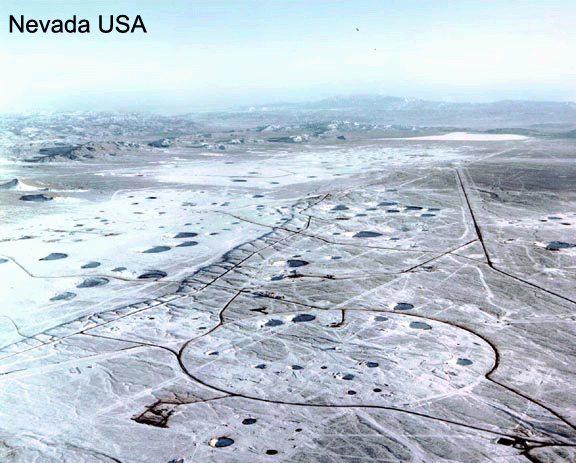
I am a casualty of the Cold War, a survivor of nuclear weapons testing. Growing up in Salt Lake City, Utah during the Cold War I was repeatedly exposed to dangerous levels of radioactive fallout from hundreds of detonations at the Nevada Test Site just 65 miles west of Las Vegas.
Our government detonated 100 bombs above ground in Nevada between 1951 and 1962 and 828 more bombs underground through 1992, many of which broke through the earth’s surface and spewed radioactive fallout into the atmosphere as well. The jet stream carried fallout far beyond the test site where it made its way into the environment and the bodies of unsuspecting Americans, while a government we trusted repeatedly assured us “there is no danger.”
In the spring before my 30th birthday, I was diagnosed with thyroid cancer. Children, especially those under the age of five at the time of radiation exposure, as I was, were most at risk.
I have been sliced, radiated and scooped out. I have buried and mourned the dead, comforted and advocated for the living, and worried with each pain, ache and lump that I am getting sick again. I survived thyroid cancer as well as subsequent health complications that left me unable to have children. My sister and others I grew up with were not so fortunate. They lost their lives to various cancers and other radiation-related illnesses. Before she died, my sister and I counted 54 people in a five-block area of our childhood neighborhood who developed cancer, autoimmune disorders, and other diseases that ravaged them and their families.
The government’s ambitious program of nuclear testing had tragic consequences for countless unsuspecting, patriotic Americans living downwind. “We are veterans of the Cold War, only we never enlisted and no one will fold a flag over our coffins,” a late friend of mine was fond of saying.
The U.S. government finally acknowledged its responsibility in 1990 when it passed the bipartisan Radiation Exposure Compensation Act (RECA), which paid partial restitution to some fallout victims in select rural counties of Utah, Arizona and Nevada. The bill never went far enough. We now know that the harm wreaked by fallout extends far beyond these counties. We also know that people are still getting sick. The suffering has not ended.
As part of a coalition of impacted community groups working with allied advocates nationwide, we have worked hard for the speedy expansion and extension of RECA through the Radiation Exposure Compensation Act Amendments of 2021. This bipartisan bill would add downwinders from all of Utah, Nevada, Arizona, Idaho, Montana, Colorado, New Mexico and Guam, as well as uranium miners who worked in the industry beyond 1971. It also would increase compensation from $50,000 to $150,00 for all claimants and extend the program for 19 years.
The House bill currently has 68 co-sponsors, the Senate bill 18, Republicans and Democrats from across the country. What we now need are their colleagues in both parties to join them.
As we reach out to Senators and Representatives asking them to support the bills, we are sometimes confronted with questions about cost. What, I ask in return, is a human life worth? Over the last 32 years, RECA has paid out $2.5 billion to 39,000 Americans. To put that into perspective, each year this country spends $50 billion just to maintain our nuclear arsenal. Are our lives not worth 0.5% of the cost of weapons that harmed us?
What is paramount is rectifying the mistakes of the past. As Rep. Diane Titus of Nevada said, “These people are Cold Warriors and we do not leave our warriors on the field.”
A government that knowingly harms its own citizens must be held accountable. Our lives are worth more than civilization-ending weapons. It’s a simple matter of priorities and justice.
UK government’s new financing plan for %20 tax-payer funded Sizewell C nuclear project will increase costs and delays, – is aimed to cut China out.
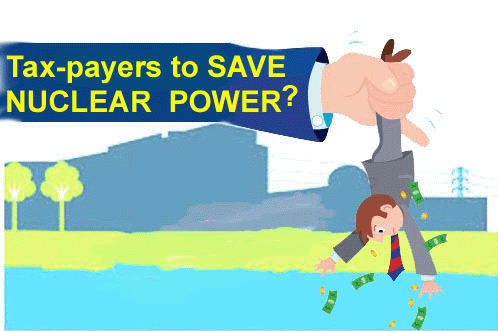
The government has bought an option to take a 20% stake in the Sizewell C nuclear power plant in a move that could ease China’s state nuclear company out of the project. Ministers took a £100m option to invest in Sizewell C’s holding company in January and said on Tuesday it would convert that into equity if the project reaches a final investment decision.
The venture on the Suffolk coast is jointly owned by EDF and China General Nuclear Power. The government is understood to be keen toremove CGN from the project amid concerns over China’s involvement in critical UK infrastructure. The business secretary, Kwasi Kwarteng, set out the taxpayer-funded financing model for Sizewell C and future projects on Tuesday.
The strategy the government plans to use – a regulated asset
base model – involves taxpayers taking on risk alongside private investors. The government is
attempting to inject urgency into a notoriously slow-moving industry amid a
drive to boost Britain’s domestic energy supplies.
In April Boris Johnson set out plans to approve up to eight reactors by the end of the decade. A
decision on whether to grant Sizewell C planning consent was last month delayed until 8 July. Research by the University of Greenwich Business School seen by the Guardian last month showed the project could cost UK taxpayers more than double government estimates and take five years longer to build.
Guardian 14th June 2022
Two European Parliamentary committees oppose inclusion of nuclear power and gas as environmentally sustainable
MEPs from the two responsible committees on Tuesday opposed the inclusion
of gas and nuclear power on the list of environmentally sustainable
economic activities. On Tuesday, at a joint meeting of the Committee on
Economic and Monetary Affairs and the Committee on the Environment, Health
and Food Safety, MEPs adopted by 76 votes for, 62 against and 4 abstentions
an objection the Commission’s proposal to include specific nuclear and gas
activities in the list of environmentally sustainable economic activities
covered by the EU taxonomy.
European Parliament 14th June 2022
Experts doubt Polish government’s plans to have nuclear by 2033
By Bartosz Sieniawski | EURACTIV.pl 13 June 22, The government’s plan to have its first nuclear plant by 2033 as part of the six reactors it aims to have in operation by 2043 is too ambitious, experts have said.
Poland, which relies heavily on fossil fuels and has no nuclear plants for commercial use, announced in August 2020 it would have six nuclear reactors in operation in the Baltic municipality of Choczewo in the north.
With the climate crisis and the need to become independent from Russian fuel, the government is now eager to build a nuclear power plant as soon as possible, with its representatives assuring that the first plant will be built as planned.
However, some energy experts, including the deputy editor-in-chief of Energetyka24.com, Jakub Wiech, question their optimism.
In an interview with Onet.pl, Wiech said 2033 was an “unrealistic deadline”. According to him, building such a highly specialised facility in a country where no other is standing will not be easy, and there will be delays. It may also be problematic to get the parts that are key to the power plant’s functionality, he added.
“We are talking about parts that have to be ordered well in advance. You have to queue up at factories that make, for example, reactor casings. Another issue is the training of appropriate personnel, who will manage such a unit,” he said………. https://www.euractiv.com/section/energy-environment/news/experts-doubt-polish-governments-plans-to-have-nuclear-by-2033/
Germany rules out nuclear power as an option during the energy crisis.
German Leader Rules Out Nuclear Option to Fill Energy Gaps
German Chancellor Olaf Scholz says his government remains committed to phasing out nuclear power despite concerns about rising energy prices and possible future shortages due to Russia’s war in Ukraine.
By Associated Press, June 8, 2022, BERLIN (AP) — German Chancellor Olaf Scholz said Wednesday that his government remains committed to phasing out nuclear power despite concerns about rising energy prices and possible future shortages due to Russia’s war in Ukraine.
Germany shut down half of its six nuclear plants in December and the remaining three are due to cease production at the end of this year as part of the country’s long-running plan to phase out conventional power plants in favor of renewable energy……………….
“We also know that building new nuclear power plants makes little sense,” he said at a news conference with foreign correspondents in Berlin.
“If someone decides to do so now they would have to spend 12-18 billion euros on each nuclear power plants and it wouldn’t open until 2037 or 2038,” said Scholz. “And besides, the fuel rods are generally imported from Russia. As such one should think about what one does.”
“That’s why the government, all the governing parties unanimously, are counting on (…) the massive expansion of renewable energy,” he added…………..
“The goal of completing the phaseout of coal in Germany ideally by 2030, and the climate targets, remain in place,” Government spokeswoman Christiane Hoffmann said. https://www.usnews.com/news/business/articles/2022-06-08/germany-to-keep-more-coal-plants-on-hand-in-case-of-gas-cuts
UK government urged to end its obsession with nuclear power

THE UK Government has been urged to end its “obsession” with nuclear
power and focus on renewable energy. The SNP have said it is “abundantly
clear” nuclear will cost more and will send energy bills soaring even
further, while people in Scotland “can see clean energy being produced in
their own backyards”.
It comes as a written response to a parliamentary
question confirms further delays to the UK’s Hinkley Point C nuclear
power station, which reports suggest could cost the taxpayer up to £26
billion – opening four years later than scheduled. MP Alan Brown, the party’s Shadow Minister for Energy and Climate change, said the delays added “insult to injury” for consumers, after UK
Government Business Secretary Kwasi Kwarteng admitted recently the
construction of new nuclear plants would initially raise household energy
bills.
Based on the contract awarded by the Westminster government to
Hinkley Point C, the electricity that will be generated by that existing
nuclear station will be priced at £92.50 per megawatt hour, for a 35-year
contract, whereas the electricity being generated from offshore wind is
currently priced at £39.65 per megawatt hour on a 15-year concession. This
means Hinkley Point C alone could add up to £40 a year to consumer bills,
compared to wind power, which could reduce bills by £8 a year. Brown said:
“This latest admission shows the Westminster government’s obsession
with nuclear power will do absolutely nothing to help people cope with the
spiralling Tory-made cost of living crisis. “For months we’ve heard
endless lectures and bleatings from the Tories on their nuclear obsession,
yet every week we’re treated to new reports and estimates of the true
cost of prioritising a massive shift towards nuclear.
“The latest reports simply add insult to injury for the consumers whose energy bills have
skyrocketed in recent months and who were promised a great reprieve when
the UK shifts its reliance to nuclear.
The Scottish Greens have also branded the UK Government’s drive towards nuclear as nonsensical. The
party’s climate change spokesperson, Mark Ruskell, said: “Both the Tory
Government and Labour Party’s ideological obsession with nuclear power
doesn’t make sense either economically or environmentally. “Nuclear is
hugely expensive and leaves a toxic waste legacy for generations. Instead
of investing in toxic white elephants, investment should be focused in
Scotland’s massive renewable potential.”
Lynn Jamieson, chair of the Scottish Campaign for Nuclear Disarmament (CND), said she rejected the UK
Government’s claims nuclear was good for the planet, and insisted we
should be transitioning away from it. She said: “The UK Government’s
claims that nuclear is good for the environment ignores the harms of
uranium mining, the radioactive waste, the risks of cancers and
catastrophic accident – irrationally favouring nuclear industries over
cheaper, safer and more quickly available renewables.
The National 1st June 2022
A warning from France, about nuclear delusions of grandeur,
Nuclear: ” Industrialists are in denial, politicians know nothing about it “

France had the madness of grandeur in wanting to build more and more powerful reactors.
Gaspard d’Allens and Émilie Massemin (Reporterre) Reporterre 28th May 2022
Nuclear ” unacceptable “, ” industrial disaster ” of the EPR , France and its ” delusions of grandeur “… Pillar of the fight against the atom, the engineer Bernard Laponche warns of the dangers of this technology.
You are reading Bernard Laponche’s great interview. The first part is here .
Reporterre — How do you analyze the return to grace of the nuclear industry by Emmanuel Macron, with the construction of six EPR2s and the study of eight additional ones ?
Bernard Laponche — It’s communication ! This operation is part of the mythology that goes back to General de Gaulle, and that Emmanuel Macron has taken over, according to which civil and military nuclear power is the basis of France’s independence.
EDF ‘s nuclear fleet is going through its worst crisis since its birth. The stalemate of the Flamanville EPR site , the chain shutdowns of reactors due to problems of corrosion and cracks, the problems at the Orano reprocessing plants in La Hague and the manufacture of Mox [1] in Marcoule, EDF on the verge of bankruptcy … This is unheard of. Between 2010 and 2020, nearly a hundred incidents occurred throughout the park. Bernard Doroszczuk, president of the Nuclear Safety Authority ( ASN ), recognized this on April 7, 2021 during a hearing in the Senate : “ A nuclear accident is possible in France. »
In this situation, it seems very difficult to hold a triumphant speech on nuclear power. But the industrialists are in denial, the politicians who promote it know nothing about it. All are surfing on the argument of the fight against climate change to promote the sector.
Why nuclear won’t save the climate ?
Greenhouse gas emissions are far from negligible. Nuclear fissions in an operating reactor, the source of the energy produced, do not effectively emit CO₂ . But all nuclear activities in a plant in operation – 800 employees on average – or during shutdowns for maintenance work, yes. These activities also very often cause leaks of gases that are very active in global warming, such as refrigerants (1,000 times warmer than CO₂) and especially sulfur hexafluoride (23,500 times more warming). The extraction of uranium from the mines of Canada, Niger and Kazakhstan, the construction of nuclear plants and power stations, the manufacture of nuclear fuels, the transport and storage of radioactive materials and waste also emit considerable quantities of CO ₂ and other greenhouse gases. For example, the work for each fourth ten-year inspection of a 900 megawatt ( MW ) reactor — there are thirty-two of them — mobilizes 5,000 workers, between six months and a year.
………………………………….. Take the case of the Flamanville EPR : very high CO₂ emissions during construction — several thousand cubic meters of concrete, hundreds of tons of steel and thousands of workers since 2007 — and we do not know still not sure if it will start one day, or when.
Today, nuclear represents only 10 % of the world’s electricity production and only makes it possible to avoid 2.5 % of the world’s greenhouse gas emissions. For it to contribute significantly to the fight against climate change, its share in the global electricity mix would have to be multiplied by at least five. Which, given the duration of construction of a plant, is absolutely technically impossible, even in fifty years.
Finally, due to accelerating global warming, power stations on the banks of the river will increasingly be confronted with warming waters and the reduction of this resource, and those on the seashore with rising ocean waters, caused by melting ice.
But above all, the nuclear issue cannot be reduced to greenhouse gas emissions. Other factors must be taken into account when choosing the electricity mix: the risk of a serious or major accident , the radioactive waste which accumulates for thousands of years, the proliferation of nuclear weapons through the enrichment uranium and the production of plutonium, via the reprocessing of irradiated fuel. This technique is unacceptable for the threat it poses to humanity.
As you remember, the setbacks accumulate for the sector. Which do you think is the most serious ?
The management of radioactive waste is very problematic. In the other nuclear-powered countries, irradiated fuel is considered waste as soon as it leaves the reactors. France, on the other hand, reprocesses its irradiated fuel to produce plutonium, initially for the atomic bomb. Nearly 70 tons of this radioactive material are currently stored at La Hague. The plutonium produced is now used to manufacture Mox fuel. Used in about twenty 900 MW reactors , it is more radioactive and more dangerous than ordinary enriched uranium fuel and is not reprocessed once it is irradiated.
The La Hague plant is one of the most dangerous installations in the world. It stores in its pools, unprotected against external attacks, the equivalent of 100 reactor cores in irradiated fuel. And she is aging. Some evaporators are down, preventing the site from operating at full capacity. The risk of bottling the fuels to be reprocessed and saturation of the storage pools is increasing.

It is urgent to stop reprocessing. The Nuclear Safety Authority recently mentioned the difficulties that are accumulating in the management of irradiated fuels. But the sector is stubborn, and prefers to mitigate the risk of saturation by asking to build a new large storage pool .
Even if we stopped reprocessing, the question of waste would still arise. What do you think of the only seriously studied project in France to bury them 500 meters underground in Bure (Meuse) ?
………………….. There are many criticisms and questions about this project, in particular from the Environmental Authority , independent experts, environmental organizations and local populations: on the legacy to future generations of hazardous waste for hundreds of thousands of years, on the risks during the 150-year period of construction and operation, on the choice of clay, on the risks of fire, hydrogen production, water pollution, etc. Such experiences abroad of deep burial of chemical or nuclear waste have proven to be catastrophic: Stocamine in France , Asse in Germany , WIPP in the United States. In addition, the cost of Cigéo, not yet estimated [4] , would be considerable, not to mention the CO ₂ emissions of such a project………………………………..
The number of reactors currently shut down is historically high. How do you assess the state of the park ?
France had the madness of grandeur in wanting to build more and more powerful reactors.
After the French natural uranium graphite gas ( UNGG ) model was abandoned in 1969, France bought the American Westinghouse license for pressurized water reactors. Framatome [5] was tasked with implementing the 1974 Messmer plan and delivered the first 900 MW reactors under Westinghouse license. EDF has thus built 34 reactors in less than ten years, which is a performance.
Framatome then developed a 1,300 MW model , then achieved a further power jump of around 1,450 MW . This latest model presented design problems from the start. The Civaux and Chooz plants were delivered two years late.
The difficulties continued with the EPR , of 1,650 MW , a veritable industrial disaster. The Flamanville EPR began construction in 2007 and was due to start in 2012. It has accumulated failures: concrete of its platform, welds to be redone several times, refusal of control command, falsification of equipment certificates, delivery of a non-compliant tank… The cost of the EPR , initially established at 3 billion euros, is now estimated at 19 billion euros by the Court of Auditors . The two Taishan reactors in China, built faster and commissioned in 2018 and 2019, are shut downsince the discovery of radioactive leaks from damaged fuel sheaths – without the cause of this phenomenon being understood yet.
……….. Every time you increase the power of a reactor, you have to redesign everything. The calculations to be performed are extremely complex. But if these leaks turned out to be linked to a design problem, it would be catastrophic for EDF , because all the EPRs would be affected.
Finally, for several months, EDF has been faced with a problem of corrosion and cracks on the emergency cooling circuits connected to the primary circuit of several reactors in the fleet, primarily its most powerful reactors (1,450 megawatts) at Civaux and Chooz, but also those of 1,300 MW and probably those of 900 MW . The Civaux, Chooz and Penly reactors have been shut down for several months and will perhaps remain so for years, for inspections after cutting and examination of the parts concerned in the safety cooling circuits ( RIS ) and the cooling circuits at the stop ( RRA), for repair. All reactors must be checked by the end of 2023. The cause of these faults is still poorly explained [6] and would be multifactorial: quality of the steel of the parts, method of welding, layout of the circuits…
Currently, between a third and a half of EDF ‘s reactors are shut down due to these difficulties and almost daily incidents on such and such a reactor.
During the war in Ukraine, civilian nuclear power became a military target with the seizure of the Chernobyl and Zaporijia power plants. How do you view this new risk ?
In Ukraine, the Chernobyl power plant, located on the northern border with Belarus, was equipped with four Soviet RBMK reactors commissioned between 1974 and 1983. After the 1986 disaster on reactor 4, the other three were definitively stopped between 1991 and 2000. There now remains on the site the destroyed reactor containing the molten core protected by a sarcophagus, a new arch intended to confine the radioactivity, but not at all designed to withstand strikes ; three reactors to be dismantled ; as well as storage facilities for irradiated fuel and radioactive waste. Many workers remain on site. The entry of Russian tanks into the prohibited fenced area of 2,600 km 2produced significant resuspension of radioactive aerosols and air contamination. Russian soldiers who dug trenches were irradiated. On March 30, the Russian army began to evacuate the Chernobyl site.
( Zaporizhia)…………………………………..The reactors, even shut down, and the storage facilities for irradiated fuels, must be supplied with cooling water and therefore constantly supplied with electricity. They are therefore extremely fragile vis-à-vis any external aggression in a situation of armed conflict or terrorist attack. Even if the reactor itself is not targeted, any bombardment, missile or shell can lead to a loss of water, by the piercing of a pipe for example, or of electricity by loss of the network or lack of fuel for emergency diesels. With the key to a risk of serious accident as in Three Mile Island (United States), even major as in Fukushima and Chernobyl. This intrinsic fragility is a warning for all nuclear plants and power stations in the world.
Reporterre 28th May 2022 https://reporterre.net/Nucleaire-Les-industriels-sont-dans-le-deni-les-politiques-n-y-connaissent-rien
Julian Assange’s family says Australia’s election result brings renewed hope for WikiLeaks founder’s release
https://www.abc.net.au/news/2022-05-27/julian-assange-release-family-election-result-brings-hope/101100860, By Brendan Mounter and Adam Stephen, 27 May 22,
Key points:
- The family and supporters of Julian Assange are hopeful of securing his release following a change of government
- Prime Minister Anthony Albanese has previously expressed support for efforts to secure the WikiLeaks founder’s return to Australia
- Mr Assange has spent the past three years in the UK’s Belmarsh Prison
The family of Julian Assange is hopeful the election of a federal Labor government will pave the way for the WikiLeaks founder’s eventual release and a return to Australia.
It has been almost a decade since Mr Assange, who originally hails from Townsville in north Queensland, has been a free man.
For the past three years, he has been in high security detention at Belmarsh Prison in the United Kingdom, after seven years of asylum within London’s Ecuadorian embassy in a bid to avoid arrest.
United States authorities have sought Mr Assange’s extradition from the UK so he can stand trial on charges of espionage and computer misuse relating to hundreds of thousands of leaked cables from the wars in Iraq and Afghanistan.
His brother, film producer Gabriel Shipton, said Mr Assange had been persecuted for publishing the ugly truths of war.
“Julian is accused of what investigative journalists do all the time, which is sourcing and publishing materials from a source, Chelsea Manning,” Mr Shipton said.
“Those releases exposed war crimes in Iraq, undocumented civilian deaths in Iraq, corruption, government malfeasance … all sorts of things.”
American prosecutors allege Mr Assange unlawfully helped US Army intelligence analyst Chelsea Manning steal classified diplomatic cables and military files that WikiLeaks later published, putting lives at risk.
Family urges incoming government to act
Lawyers for Mr Assange fear he could face up to 175 years in jail if he is extradited to the US and convicted.
But the weekend’s election result has buoyed his supporters, with the hope that the new Labor government will intervene and help secure his release.
While in Opposition, newly elected Prime Minister Anthony Albanese is reported to have told a February 2021 caucus meeting that “enough was enough” and he “can’t see what’s served by keeping [Assange] incarcerated”.
Mr Albanese is also a signatory to the Bring Julian Assange Home Campaign petition.
Senior Labor MP Mark Dreyfus, who is expected to be appointed Attorney-General, has also expressed a need to “bring the matter to a close”.
Mr Shipton is calling on the new government to turn those words into action.
“That was the Labor position before the election so we’re very hopeful when there’s a new administration, a new government coming in there’s always a lot of hope that they will live up to their promises,” he said.
France’s Nuclear Industry Slides Into Crisis

https://globeecho.com/news/europe/germany/frances-nuclear-industry-slides-into-crisis/ By David Sadler May 26, 2022,
France is less dependent on Russian gas than Germany – thanks to the country’s 56 nuclear reactors. But because more than half of them are standing still and Russia is disappearing as a customer, France’s nuclear industry is under pressure.
French President Emmanuel Macron had promised a “renaissance of nuclear energy” in February. He wants to have six new pressurized water reactors built. More electricity, more independence, more innovation – Macron is going all-out on the nuclear power card to push France’s industry forward.
Corrosion stalls the plans

But these ambitious plans are currently experiencing a serious setback: 29 of the 56 reactors are shut down. There is a double problem: the state-owned company EDF’s kiln park is showing its age. Many reactors are shut down for routine maintenance. But now, of all things, twelve of the younger series also have to be taken off the grid.
The reason is a corrosion problem that nobody expected. “At the moment, the controls do not allow any statement to be made as to how large the cracks in the cooling tubes are. The reactors have to be shut down for this,” says Bernard Doroszczuk, rapporteur for the Nuclear Safety Authority.
Proportion of nuclear power unplanned at low point
Instead of around 70 percent, France’s nuclear power plants only supplied 37 percent of the electricity requirement in April – less than ever before! Europe’s largest nuclear power provider, Electricité de France, currently estimates the group’s shortfall in revenue for 2022 at 18.5 billion euros. It is already foreseeable that there will be power shortages in winter.
But a quick solution to the technical problems is not in sight. Because there is a lack of skilled workers. “Basically, EDF estimates that by 2026 there will be a six-fold increase in the need for specialist staff. Above all when it comes to the machinery: i.e. pumps, the pipe network, and there is a lack of welders – that’s what drives everyone,” says Jean-Luc Lachaume from the security agency. “And this calculation does not even include the announced construction of new reactors. Nor does it include the need that has now arisen as a result of these unforeseen corrosion problems.”
Instead of renaissance, first of all, renovation. Security auditor Doroszczuk therefore calls for a Marshall Plan. “Industry and the state have to get involved now,” he demands. “Otherwise the announced goals are not tenable. And that would be the worst thing for the credibility of the entire industrial program.”
Russia has been the most important customer so far
On top of all these problems there is now the war in Ukraine. To date, Russia has been the most important customer of the French nuclear industry. Mycle Schneider, editor of the World Nuclear Industry Status Report, sees the items in the order books dwindling. Internationally, Russia was “the decisive, most aggressive promoter” of the construction of new nuclear power plants. And now suddenly this bottleneck has arisen. “In Finland, a project for a Russian nuclear power plant has already been officially canceled – and turbines for this nuclear power plant were to be delivered from France,” says Schneider.
In fact, the French Ministry of Economic Affairs even planned to take a 20 percent stake in the domestic turbine manufacturer in Belfort for the Russian company Rosatom. But that plan could now be shelved. France believed that its nuclear strategy was on the upswing. But the plans have gone haywire.
Australia’s new Labor government urged to act to prevent Julian Assange extradition

https://www.thesaturdaypaper.com.au/news/politics/2022/05/28/labor-urged-act-prevent-julian-assange-extradition#mtr, 28 May 22, The legal case against Julian Assange is a game of luck and whim. Any day now, the British home secretary, Priti Patel, is expected to rubber stamp his extradition to the United States. What will happen to him there is uncertain.
The Westminster Magistrates’ Court formally approved his extradition on April 20 and Patel has until May 31 to announce whether it will happen. If convicted of espionage in the US, Assange could be sentenced to 175 years in prison. His legal team argue he would likely kill himself.
There is one glimmer of hope for the WikiLeaks founder, however, bound up in last weekend’s Australian election result. The victory of Anthony Albanese, a supporter of the journalist, has reignited calls to halt the extradition.
Albanese has said that while he didn’t sympathise with Assange for some of his actions, he could not see any purpose to keeping him in jail.“Assange’s appeal is like a game of extradition snakes and ladders. He managed to take his argument about US prison conditions all the way to the door of the Supreme Court, but they rejected it, so he slid back down to the magistrates’ court where he started.”
“The prime minister, Mr Albanese, has previously said ‘enough is enough’. [Then shadow] Attorney-General Mark Dreyfus issued a statement last year confirming that Labor wanted the matter ‘brought to an end’,” says lawyer and human rights activist Kellie Tranter, who is a former WikiLeaks Party senate candidate. “So it remains to be seen whether such statements will result in the new government requesting that the US drop the case.”
She was “cautiously optimistic” about the case of Assange, who faces 17 charges under the US Espionage Act relating to the publication of classified documents and information related to US war crimes.
“It is helpful that the Greens – who have been calling for the Australian government to take action in the Assange case for some time – may hold the balance of power in the senate,” Tranter added.
Earlier this week, Albanese travelled to Japan for a meeting of the Quad leaders – from India, Japan, the US and Australia – to deliver a message about Australia’s policy changes.
Supporters including Tranter had urged the Department of Foreign Affairs and Trade (DFAT) and the Department of the Prime Minister and Cabinet to include the whistleblower on the agenda, and not just as a sideline issue.
The meeting was the “ideal opportunity” for Albanese to speak with US President Joe Biden and British Prime Minister Boris Johnson to request that Assange be allowed to come home, said Greg Barns SC, an adviser to the Australian Assange campaign.
A spokesperson for the Department of the Prime Minister and Cabinet said they were unable to provide comment on Quad agenda items. Comment was being sought from DFAT.
Stella Assange, who married the WikiLeaks founder in Belmarsh prison this year and is the mother of their two children, told The Saturday Paper the case had become political. She insisted the government had a duty to protect its citizens.
“By failing to act, it’s not just negligent; it shows that whoever is in office that isn’t acting is not fit for office,” the human rights lawyer said. “This can end today if the Australian government decides to do something about it.”
Every human rights organisation in the world had said the extradition of the Townsville-born computer hacker, editor and publisher should be stopped, she said. The latest to speak out is the Council of Europe.
Earlier this month, then Foreign Affairs minister Marise Payne and her Labor shadow, Penny Wong, claimed Australia couldn’t intervene, as the matter was before the courts.
But former British Labour Party leader Jeremy Corbyn, speaking to The Saturday Paper, rubbished the claim. The MP pleaded to Australia to “speak up for your own”.
“Whilst in Britain there are – for good reason – constraints about raising [it] in parliament because it’s a sub judice matter, that does not apply in Australia,” Corbyn said.
“There is no legal case in Australia. So there’s nothing to stop every Australian politician speaking up with Julian Assange, and I think they should. Please do, because it will help the freedom for journalists everywhere.”
Barns said there was “plenty of political support” for Albanese to ensure the whistleblower does not face an effective death penalty in the US. He pointed out that the Bring Julian Assange Home Parliamentary Group had 30 members from every party before the election. This is expected to increase, Assange’s brother, Gabriel Shipton, said.
“Ultimately I don’t think Albo wants to become another Australian prime minister who is complicit in Julian’s persecution and more broadly the Western descent into barbarity that has been taking place ever since the Iraq invasion,” he said. “Whether he has the power to resist that is up to us.”
A spokesperson for DFAT said the government had “consistently raised the situation of Mr Assange with the United States and the United Kingdom”. The spokesperson said the government “conveyed our expectations that Mr Assange is entitled to due process, humane and fair treatment, access to proper medical and other care, and access to his legal team”. However, “The extradition case regarding Julian Assange is between the United States and the United Kingdom; Australia is not a party to this case.”
US–Australian relations are one of many matters that will test Albanese’s leadership. According to Tranter, freedom of information requests show “that consecutive governments have long held the view that the Assange case has strategic implications for the alliance”. She says this is why no Australian government had spoken out in support of his human rights or provided diplomatic assistance to him.
“Mr Albanese should take a stand consistent with his stated ethos of protecting the persecuted and not forsake any Australian citizen to personal abuse for political purposes,” Tranter said.
As he awaits his fate, Assange is incarcerated in London’s maximum security Belmarsh prison. He was taken there after seven years in the Ecuador embassy in London, where he sought asylum to prevent extradition to Sweden over now-abandoned sexual assault charges.
“Assange’s appeal is like a game of extradition snakes and ladders,” says Nick Vamos, the former head of extradition at Britain’s Crown Prosecution Service. “He managed to take his argument about US prison conditions all the way to the door of the Supreme Court, but they rejected it, so he slid back down to the magistrates’ court where he started.”
Assange “can’t climb that particular ladder again”, Vamos says. “But he can still appeal on the other grounds that he lost originally, so there are likely to be a few more ups and downs before this process is finally over.”
The partner and head of business crime at London firm Peters & Peters said the attempts to persuade Home Secretary Patel not to order the extradition would not be successful – “not in a million years”.
Vamos says that if there is another appeal in Britain it could take another six months to be heard. If it is denied, another avenue is the European Court of Human Rights, in Strasbourg, France, which could issue an order directing Britain not to extradite Assange until its case is heard.
Jennifer Robinson, part of Assange’s legal team, has confirmed this is a path being considered.
“This case is too important from a free speech point of view, but also from a humanitarian point of view,” she said.
“We know what the medical evidence is about Julian’s mental health, and that he will find a way to commit suicide if he’s extradited.”
In all, Vamos says, these appeals could take another two years. But once Assange’s extradition has been signed off, he says, US Marshals are free to fly to Britain to arrest Assange: “It will normally happen within a couple of weeks of Patel making the order.”
At an EU Free Assange rally in Brussels, on April 23, Assange’s wife wiped away tears as she spoke to the crowd. The event was aimed at targeting European leaders, with speeches by politicians from various countries. “In the end this will end up in Europe,” Stella Assange said. “Europe can free Julian. Europe must free Julian.”
She recalled that 15 years into his 27-year imprisonment, people thought Nelson Mandela would never be liberated. “But he was, because decent people in that case came out and they shouted for his freedom, even if they were the only person in the square to shout,” she said.
“The fact is, it takes a few decent people to show the way and what we stand for, because we create the reality around us.”
Activists were defending “not just decency and the memory” of all the tens of thousands of victims of the Iraq and Afghan war, caught up in the crimes that WikiLeaks exposed; they were also standing up for the right to a free future.
“What has been done to Julian is a crime,” Stella Assange said. “The law is being abused in order to keep him incarcerated, year after year, for doing the right thing … When will it end? Will it end?”
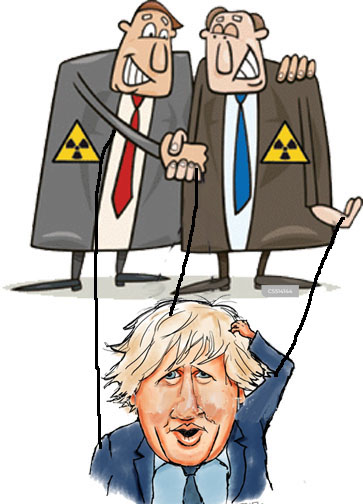
Boris Johnson promised ”1 nuclear reactor a year for 8 years” – one by 2040 if he’s lucky!
With the weather changing dramatically across the world, will politicians
finally take the climate crisis seriously? With a concerted effort, there
could still be time. But time is the critical thing. And on the campaign
trail in “red wall” seats before the May elections, the prime minister,
Boris Johnson, repeatedly promised building nuclear reactors “one a year
for eight years”.
Last week at the Conservative conference in Wales he
was at it again – this time promising one on Anglesey and another at
Trawsfynydd in Mid Wales.
Anyone who knows a little about nuclear reactors
(current designs 10 years late and £10bn over budget) or about the prime
minister’s other mega-projects – bridges across the Thames and Irish
Sea, and an airport in the Thames estuary – is confident that this
won’t happen.
A protest via my MP brought a measured response from Greg
Hands, the minister responsible for energy policy. He said provided
reactors were value for money and technically sound, the government’s
target for nuclear projects was to give one a final investment decision
this parliament, and two in the next – so maybe three building starts by
2030. On current trends that means one reactor possibly ready by 2040 and
two others much later. Far too late to heal the climate.
Guardian 27th May 2022
1 This Month
26 April – Chernobyl: Inside the Meltdown airs on National Geographic on Sunday 26th April from 4pm

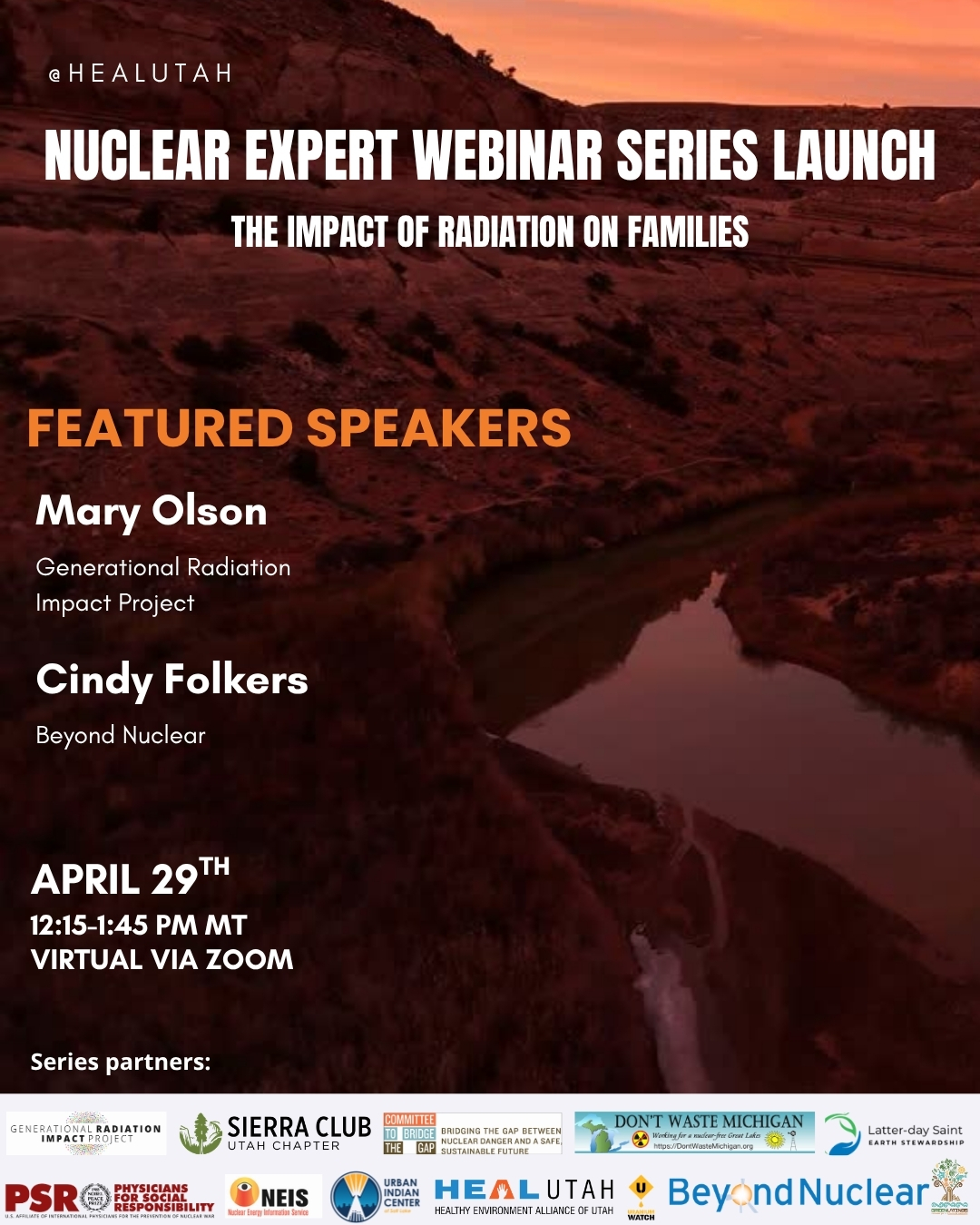
29 April – Nuclear Expert Webinar #1 – Radiation Impacts on Families with Mary Olson and Cindy Folkers
- 12:15 PM MT – 1:45 PM MT
- Location: Virtual – REGISTER TODAY

4 May -West Suburban Peace Coalition to discuss Iran war at May Educational Forum
Monday, May 4, 7:00 – 8:00 PM Central Standard Time
Title: : How Trump’s Narrative Tries to Shape the Reality of the War on Iran.
Contact Walt Zlotow, zlotow@hotmail.com 630 442 3045 for further information
14 May – online event From Bombs to Data Centres: the Face of Nuclear Colonialism

Pine Ridge Uranium is the real threat, not Tehran- Tell Burgum: Stop the Extraction.
Chernobyl: The Lost Tapes – A good documentary on Chernobyl on SBS available On Demand for the next 3 weeks– https://www.sbs.com.au/ondemand/tv-program/chernobyl-the-lost-tapes/2352741955560
To see nuclear-related stories in greater depth and intensity – go to https://nuclearinformation.wordpress.com
-
Archives
- April 2026 (317)
- March 2026 (251)
- February 2026 (268)
- January 2026 (308)
- December 2025 (358)
- November 2025 (359)
- October 2025 (376)
- September 2025 (257)
- August 2025 (319)
- July 2025 (230)
- June 2025 (348)
- May 2025 (261)
-
Categories
- 1
- 1 NUCLEAR ISSUES
- business and costs
- climate change
- culture and arts
- ENERGY
- environment
- health
- history
- indigenous issues
- Legal
- marketing of nuclear
- media
- opposition to nuclear
- PERSONAL STORIES
- politics
- politics international
- Religion and ethics
- safety
- secrets,lies and civil liberties
- spinbuster
- technology
- Uranium
- wastes
- weapons and war
- Women
- 2 WORLD
- ACTION
- AFRICA
- Atrocities
- AUSTRALIA
- Christina's notes
- Christina's themes
- culture and arts
- Events
- Fuk 2022
- Fuk 2023
- Fukushima 2017
- Fukushima 2018
- fukushima 2019
- Fukushima 2020
- Fukushima 2021
- general
- global warming
- Humour (God we need it)
- Nuclear
- RARE EARTHS
- Reference
- resources – print
- Resources -audiovicual
- Weekly Newsletter
- World
- World Nuclear
- YouTube
-
RSS
Entries RSS
Comments RSS
 nuclear-news