‘Not wise’ to let Ukraine join NATO – Kissinger
https://www.rt.com/news/563858-kissinger-ukraine-nato-russia/ 1 Oct 22, Russia regarded its sphere of influence in Eastern Europe as a “safety belt,” the former US secretary of state said.
Washington’s attempts to incorporate Ukraine into NATO after the collapse of the Soviet Union were not prudent, former US Secretary of State Henry Kissinger said on Friday.
Speaking to the Council on Foreign Relations, a non-partisan US think tank, the 99-year-old veteran diplomat argued that Washington tried to indiscriminately include all former members of the Soviet bloc under its umbrella after the Berlin wall fell, and that the “whole region between the center of Europe and Russian border became open to restructure.”
“From the Russian point of view, the United States then attempted to integrate this whole region, without exception, into an American-led strategic system,” he said, adding that this development basically removed Russia’s historic “safety belt.”
Kissinger thus stressed that “it was not a wise American policy to attempt to include Ukraine into NATO.”
He does not believe, however, that this justifies attempts by Russian President Vladimir Putin to re-incorporate Ukraine into Moscow’s sphere of influence by a “surprise attack.”
Kissinger said he does not know if it is possible to make peace with the Russian leader, but stressed that the West “must seek an opportunity for an arrangement that guarantees Ukrainian freedom” and keeps the country part of the European system.
Moreover, Kissinger opined that in a way, Russia has “already lost the war” because its capacity to threaten Europe with conventional attacks, which it had enjoyed for decades or even centuries, “has now been demonstrably overcome.”
Despite that, the former secretary of state signaled that sooner or later, the West and Russia must engage in dialogue. “Some dialogue, maybe on an unofficial level, maybe in an exploratory way is very important,” he reiterated, adding that “in the nuclear environment” such an outcome is preferable to a “battlefield decision.”
In early August, Kissinger warned that the US had found itself “at the edge of war with Russia and China on issues which we partly created,” arguing that Washington has rejected traditional diplomacy, as it has been “seeking to convert or condemn their interlocutors rather than to penetrate their thinking.”
Here comes the catastrophocene…

If humans have become a geological force reshaping the Earth in the Anthropocene, then we need to become a geological force to undo the damage we have caused, and correct the threats we are still causing.
Pearls and Irritations, By Julian Cribb Oct 3, 2022, https://johnmenadue.com/here-comes-the-catastrophocene/
The good news is that the Anthropocene is almost over. It will have been the shortest geological epoch in all of Earth history.
The bad news is that the Catastrophocene is just beginning.
This is a period marked by the interaction of ten catastrophic risks which many scientists are now warning could precipitate the end of human civilisation – and potentially bring about the departure of our species from an uninhabitable Earth.
The Holocene, the climatically stable period which enabled humans to develop agriculture and cities, is now over. It lasted about 11,650 years, from the last Ice Age to the latter C20th. And now it is gone and we are into a wholly different world, named in 2000 by Dutch Nobel laureate Paul Crutzen ‘the Anthropocene’ – the epoch in which humans became a truly geological force, reshaping and altering the entire planet, its atmosphere, oceans, the land, and life itself. On present indications, the Anthropocene will last only a century or two.
The evidence is all about us that we’re into something altogether grimmer. Each day, almost, brings fresh reports of colossal unintended consequences of human activity around the planet – vast floods, tens of thousands of fires raging, dust storms sweeping topsoil off our farms, heatwaves, dried-up rivers and lakes, melting glaciers, unimaginable losses of birds, animals, insects and other life, dwindling forests and fish, poisoned water, oceans, food and air, declining oxygen levels, hunger and starvation, the dissemination of new diseases, the mass migration of 350 million people a year, the advent of powerful new technologies whose effects are unknown and uncontrolled, and the insidious worldwide seep of malicious lies about it all.
The evidence is all about us that we’re into something altogether grimmer. Each day, almost, brings fresh reports of colossal unintended consequences of human activity around the planet – vast floods, tens of thousands of fires raging, dust storms sweeping topsoil off our farms, heatwaves, dried-up rivers and lakes, melting glaciers, unimaginable losses of birds, animals, insects and other life, dwindling forests and fish, poisoned water, oceans, food and air, declining oxygen levels, hunger and starvation, the dissemination of new diseases, the mass migration of 350 million people a year, the advent of powerful new technologies whose effects are unknown and uncontrolled, and the insidious worldwide seep of malicious lies about it all.
These phenomena are the physical manifestations of what the Council for the Human Future has termed the ‘existential emergency’ now confronting humanity – a crisis which many scientists and individual citizens now recognise as real, but which most governments, corporates and politicians seem loath to accept the evidence that is before their very eyes.
This crisis is comprised of ten catastrophic risks, not just the one or two most commonly reported in the media. All these risks interact with one another, meaning they cannot be tackled separately or solved one by one. Collectively, they are driven by human overpopulation, overconsumption and over pollution. The risks are:
Extinction and eco-collapse: currently proceeding 1000-10,000 times faster than normal, eliminating the ecosystems that humans and wildlife need to survive. Mainly caused by agriculture and land development.
Overheating: a climate approaching out-of-control as nine huge ‘feedbacks’ from the Earth system itself make it even faster, hotter and more turbulent than man-made factors (like fossil fuels and land clearing) alone.
Global poisoning: five times larger and ten times more deadly even that climate, human chemical emissions are the largest and most underestimated threat to planetary health and survival.
Nuclear holocaust: with 70 nations still committed to nuclear arms and conflict, scientists currently rate the threat at ‘100 seconds to midnight’, the worst level since Hiroshima.
Resource scarcity: a world water crisis is already a reality for half the population. Loss of topsoil, forests, fish stocks and scarcity of other key resources threaten to unleash fresh conflicts.
Pandemics: there have been seven pandemics since 2000, with a new one striking every 2-3 years. With some 90 wild animal diseases already crossed into humans, more are on the way.
Overpopulation: due to hit 8 billion in November and 10 billion by 2060, human numbers are estimated by some researchers to now be 4 times what the Earth can carry in the long run. Not a threat in itself, population pressure drives all the other threats and must be brough under control.
Famine and hunger: already rising due to loss of soil, water and a stable climate. World food chains increasingly vulnerable to disruption from shortages, conflict and big events, putting megacities at risk.
Ultratechnologies: uncontrolled development and release of powerful new technologies without thought for the consequences will unlock fresh threats for humanity, just as fossil fuels and chemistry already have.
Misinformation: the world is drowning in lies, half-truths and disinformation, mainly spread by the fossil fuels lobby, certain media, politicians and other malicious actors. These are disabling government, breeding mistrust of science and making the task of saving civilisation ever harder.
It is the interaction of these ten mega-threats which now constitutes the new age – The Catastrophocene. This will be a period in which most human lives will be consumed in attempting merely to survive and find workable collective solutions to these threats, to repair our damaged planet and salvage all that is good and decent of our civilisation.
Take heart, solutions do exist. I detail the main ones in a forthcoming book, both global answers and what individuals can do to save themselves. However, as the Council for the Human Future has noted: no government on Earth yet has a policy for human survival. They simply do not grasp the magnitude or the reality of what is unfolding. Or they don’t care. Nor do the giant corporations who now rule the world economically.
If humans have become a geological force reshaping the Earth in the Anthropocene, then we need to become a geological force to undo the damage we have caused, and correct the threats we are still causing. Part of that consists in reducing both our numbers and our material demands to what the planet can safely bear in the long term. If we do not undertake this task, then nature will surely do it for us. Doing nothing, or doing too little too late, will destroy us.
In other words, controlling the catastrophic risks we now face will save countless lives, help avoid total collapse or even extinction, restore the Earth and preserve what is best about the human endeavour.
It is the greatest, noblest and most urgent cause in all our million year journey.
Washington split over Ukraine’s NATO bid – Politico
https://www.rt.com/news/563851-washington-split-ukraine-nato/ 2 Oct 22,
Zelensky’s unexpected demand to fast-track membership talks has reportedly been met with a mixed reaction
Ukraine’s bid for accelerated accession to NATO caught Washington off-guard, driving a wedge between a number of US lawmakers, Politico reported on Friday.
When the outlet asked US House Speaker Nancy Pelosi if she supports Kiev’s demand to join NATO, she stopped short of unequivocally endorsing the move, saying the US is “very committed to democracy in Ukraine.”
“Let’s win this war. But I would be for them having a security guarantee,” she told Politico.
Democratic Party colleague Representative Mike Quigley (D- Illinois) said that Washington should support Ukraine’s NATO bid. “Ukraine’s fight is the reason we formed NATO in the first place,” he told Politico, adding that since WWII, the US has recognized “that an authoritarian regime cannot be allowed to wipe out a democratic country.”
On Friday, following the start of the formal accession of four former Ukrainian regions to Russia, Ukrainian President Vladimir Zelensky demanded that the procedure for joining NATO be fast-tracked. This apparently came as a surprise to the Biden administration, according to two US officials cited by the outlet.
Many Western officials fear that if Kiev becomes a full-fledged member of the bloc, it would not only provoke Russia, but would also draw Washington and Moscow into a direct war, as NATO’s charter stipulates that an attack on one member is considered an attack against the entire alliance. The only instance in which this principle has been applied came after the 9/11 terrorist attacks against the US.
On Friday, President Vladimir Putin signed treaties on the inclusion of the two Donbass republics, as well as the two southern Ukrainian regions which had declared independence, into the Russian Federation. All four territories held referendums from September 23 to 27, in which the people voted overwhelmingly in favor of joining Russia.
Western leaders have condemned Moscow’s latest moves. US President Joe Biden has vowed to impose further sanctions on Russia and continue to supply Kiev with military aid.
The world in denial about the climate crisis
Climate breakdown is far more intense in 2022 than even many scientists
expected, yet the world still isn’t treating this like a crisis. I
underestimated the depth and intransigence of society’s collective
climate denial. Despite climate breakdown being far more intense by 2022
than I thought it would be – it all feels like a decade or two ahead of
schedule, somehow – the world still isn’t treating global heating like
the emergency it is.
To understand what an emergency we are now in, the
scale and variety of the climate damage we’ve already incurred, you only
need to look at a few of the most recent disasters. Hurricane Ian has just
pummeled Cuba and Florida. The full extent of the disaster will only be
revealed in the coming days and weeks, although first looks are shocking.
But we do know with certainty that Ian was supercharged by global heating
through several well-understood fundamental physics pathways.
Or consider the record extreme heat, fires, and drought that have hammered arid
subtropical regions such as California, Spain, China and elsewhere this
summer.
The planet has heated by about 1.3C on average since fossil fuel
burning began in earnest 150 years ago, and is now increasing by 0.1C every
five years. These mean values roughly double over the planet’s land
surfaces. That extra heat also supercharges heatwaves. In addition, global
heat is expanding the Hadley cell circulation and moving subtropical storms
poleward, causing a permanent increase in subtropical aridification.
All of this tends to dry out soils, kill trees and worsen wildfires. Or consider
the biblical flooding in Pakistan from a few weeks ago. Or the “doomsday
glacier” in Antarctica which promises “big changes over small
timescales”. Or record melt of the Greenland ice sheet. Or the crazy and
deadly disintegration of glaciers in Europe. In short, it has been a summer
of climate insanity.
But even so, this will be, on average, the coolest
summer with the least climate chaos for the rest of your life. That is just
the nature of trends. It should be terrifying.
Guardian 1st Oct 2022
https://www.theguardian.com/commentisfree/2022/oct/01/climate-emergency-hurricane-ian-crisis
NATO in the horns of a dilemma after former Ukrainian regions vote to join Russia
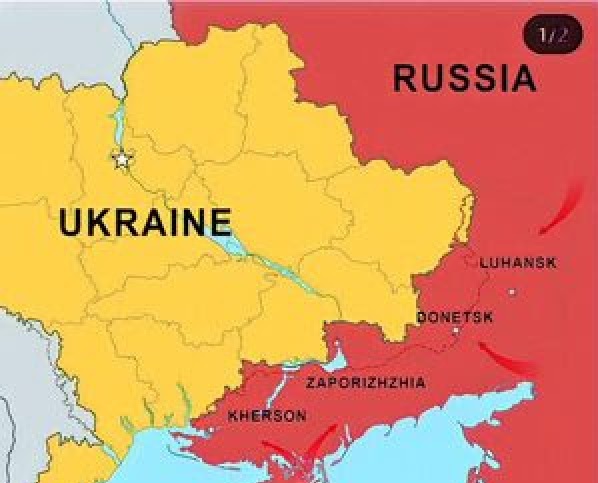
NATO, having overcommitted to Ukraine, now finds itself “on the horns of a dilemma” – if it continues to provide massive material and financial support to Ukraine, it will, in effect, become a direct party to the conflict, something no one in the bloc wants. However, if it backs away from supporting Ukraine, the various Western political leaders and institutions which have made support for Kiev a sacred obligation will be seen as going back on their word.
How NATO opts to proceed has yet to be manifest, but indications are that it will not be in a manner which continues to double down on supporting Ukraine no matter what
https://www.rt.com/russia/563788-referendums-ukraine-nato-dilemma/–-1 Oct 22,
Moscow is flipping the bloc’s script by moving to absorb Kiev’s lost lands, thus switching the fight to its own turf.
By infusing tens of billions of dollars’ worth of military aid into Ukraine, NATO produced a “game-changing” dynamic designed to throw Russia off balance. By undertaking the referendums in Kherson, Zaporozhye, Donetsk, and Lugansk, Russia changed the game altogether.
The ancient Greeks spoke of lemma as representing a logical premise, a matter taken for granted. This contrasted with a dilemma, or “dual premise”, where one would be presented with an either/or proposition. The Romans furthered this notion, referring to a “double premise” as argumentum cornutum, of the “horned argument,” because by answering one argument, an individual would be impaled by the logic of the second. Thus are the ancient roots of the modern idiom, “on the horns of a dilemma.”
This is the ultimate objective of maneuver warfare, for example: to position your forces in such a manner as to present the enemy with no good option – should they react to one pressing threat, they would find themselves overwhelmed by the other.
The Russian military operation that has been underway in Ukraine for more than seven months now has provided ample examples of the military forces of both sides being confronted with a situation that compelled them to alter their preferred course of action; the Russian “diversion” against Kiev early on in the SMO prevented the Ukrainians from reinforcing their forces in eastern Ukraine, and the recently concluded Ukrainian counteroffensive in Kharkov compelled a hasty Russian withdrawal from a significant swath of previously occupied Ukrainian territory.
Both examples cited presented one side with a lemma, or a single problem, which needed to be addressed. But neither was able to put its opponent “on the horns of a dilemma,” forcing a response which would result in impalement regardless of the option chosen. The reason for this is simple – very rarely will competent military commanders allow themselves to be presented with a military problem for which there is no viable response. War, it seems, is hard work, and dilemmas don’t fall from trees.
Or do they? Ever since Boris Johnston flew to Kiev in April to convince Ukrainian President Vladimir Zelensky to pull out of peace talks then ongoing with Russia in the Turkish city of Istanbul, NATO has embarked on a program designed to provide Ukraine with tens of billions of dollars in military and financial assistance, including the transfer of modern heavy weapons and the use of facilities on Western soil where tens of thousands of Ukrainian troops could be trained and organized without fear of Russian intervention.
The purpose behind the NATO infusion of weaponry into Ukraine was straightforward – to empower Ukraine to not only lengthen the conflict, but also to undertake offensive military operations designed to evict Russia from what Kiev and its backers consider occupied Ukrainian territory, including the Donbass and Crimea. The counteroffensive in Kharkov in early September underscored the serious consequences of NATO’s actions – even though, given the massive loss of life and material suffered by the attacking Ukrainian forces, made the Kharkov victory Pyrrhic in nature, it was a Ukrainian victory, and one which compelled a Russian retreat.
By transforming the Ukrainian army into a NATO army which was manned by Ukrainians, the US-led bloc had, in fact, changed the nature of the game from a straightforward Russia-versus-Ukraine “special military operation” into a “Russia-versus-the collective West” struggle where the military resources originally allocated by Moscow to the fight were now insufficient to the task.
Russia, however, was not taking the game-changing actions of NATO standing still. Responding to the new reality on the ground in Ukraine, Russian President Vladimir Putin opted not to simply up the ante in this new NATO-driven game of increasing military power but change the game altogether. Not only did he order the partial mobilization of some 300,000 Russian reservists to reinforce the troops currently committed to the SMO, Putin also approved referendums in the four territories where Russian forces are presently fighting – Kherson and Zaporozhye (formerly occupied Ukrainian regions), and Donetsk and Lugansk (former regions of Ukraine, de-facto independent since 2014). These referendums asked the citizens of these four territories one simple question: do you wish to become part of Russia?
After five days of voting, the results from all four territories were clear – by an overwhelming majority, the participants in the referendums approved the proposition. Shortly thereafter, they were incorporated into the Russian Federation. What was once Ukraine has now become Mother Russia
Russia didn’t just change the rules of the game – it changed the game itself. Instead of Ukrainian forces fighting Russian forces on the territory of Ukraine, any future combat carried out by Ukraine against Russian forces would represent an attack on the Russian homeland itself.
Where does this leave NATO? The bloc’s leadership has made it clear from day one that it is not seeking direct confrontation with Russia. While its members have poured in tens of billions of dollars of material into Ukraine to help reconstitute its military, and provided critical logistics, intelligence, and communications support to Ukraine, it has repeatedly and insistently stated that it has no desire to fight a war with Russia directly and has made it clear that it would rather have the Ukrainians serve as a de facto NATO proxy in resisting Moscow.
NATO has gone “all in” both economically and politically when it comes to supporting Ukraine, to the extent that some of its members, having stripped their respective military structures of equipment and material, have nothing left to give. Despite this, European political and economic elites continue to articulate their strong support for Ukraine going forward.
This support, however, was predicated on the fundamental assumption that by providing Ukraine with this massive level of support, NATO would not get directly involved in a conflict with Moscow. But Russia, by transforming the battleground from one being fought on Ukrainian soil to one where it’s now defending its own land, has flipped the script.
NATO, having overcommitted to Ukraine, now finds itself “on the horns of a dilemma” – if it continues to provide massive material and financial support to Ukraine, it will, in effect, become a direct party to the conflict, something no one in the bloc wants. However, if it backs away from supporting Ukraine, the various Western political leaders and institutions which have made support for Kiev a sacred obligation will be seen as going back on their word.
How NATO opts to proceed has yet to be manifest, but indications are that it will not be in a manner which continues to double down on supporting Ukraine no matter what. Secretary General Stoltenberg’s tepid speech condemning Russia while showing no enthusiasm for Zelensky’s “accelerated application” for membership is indicative of the less-than-resolute nature of its support for Kiev.
NATO now will find its role diminished by the consequences of the Russian mobilization and referendums. Years from now, when the history of the conflict is finally written, the decision by President Putin to simultaneously mobilize the Russian reserves while absorbing the territory of southern and eastern Ukraine into the Russian Federation will serve as one of the premier modern-history examples of putting an adversary “on the horns of a dilemma.” The effective neutering of NATO by this action will more than likely be seen as a turning point in the conflict, one which sealed the fate of Ukraine in the face of an inevitable Russian victory.
“End War in Ukraine” Say 66 Nations at UN General Assembly
Common Dreams, BY MEDEA BENJAMIN – NICOLAS J. S. DAVIES, 30 Sept 22,
We have spent much of the past week reading and listening to speeches by world leaders at the UN General Assembly in New York. Most of them condemned Russia’s invasion of Ukraine as a violation of the UN Charter and a serious setback for the peaceful world order that is the UN’s founding and defining principle.
But what has not been reported in the United States is that leaders from 66 countries, mostly from the Global South, also used their General Assembly speeches to call urgently for diplomacy to end the war in Ukraine through peaceful negotiations, as the UN Charter requires. We have compiled excerpts from the speeches of all 66 countries to show the breadth and depth of their appeals, and we highlight a few of them here.
African leaders echoed one of the first speakers, Macky Sall, the president of Senegal, who also spoke in his capacity as the current chairman of the African Union when he said, “We call for de-escalation and a cessation of hostilities in Ukraine, as well as for a negotiated solution, to avoid the catastrophic risk of a potentially global conflict.”
The 66 nations that called for peace in Ukraine make up more than a third of the countries in the world, and they represent most of the Earth’s population, including India, China, Indonesia, Bangladesh, Brazil and Mexico.
While NATO and EU countries have rejected peace negotiations, and U.S. and U.K. leaders have actively undermined them, the leaders of five European countries – Hungary, Malta, Portugal, San Marino and the Vatican – joined the calls for peace at the General Assembly.
The peace caucus also includes many of the small countries that have the most to lose from the breakdown of the UN system that recent wars in Ukraine and the Greater Middle East represent, and who have the most to gain by strengthening the UN and enforcing the UN Charter to protect the weak and restrain the powerful.
Philip Pierre, the Prime Minister of Saint Lucia, a small island state in the Caribbean, told the General Assembly,
“Articles 2 and 33 of the UN Charter are unambiguous in binding Member States to refrain from the threat or use of force against the territorial integrity or political independence of any state and to negotiate and settle all international disputes by peaceful means.…We therefore call upon all parties involved to immediately end the conflict in Ukraine, by undertaking immediate negotiations to permanently settle all disputes in accordance with the principles of the United Nations.”
Global South leaders lamented the failure of the UN system, not just in the war in Ukraine but throughout decades of war and economic coercion by the United States and its allies. President Jose Ramos-Horta of Timor-Leste directly challenged the West’s double standards, telling Western countries,
“They should pause for a moment to reflect on the glaring contrast in their response to the wars elsewhere where women and children have died by the thousands from wars and starvation. The response to our beloved Secretary-General’s cries for help in these situations have not met with equal compassion. As countries in the Global South, we see double standards. Our public opinion does not see the Ukraine war the same way it is seen in the North.”
Many leaders called urgently for an end to the war in Ukraine before it escalates into a nuclear war that would kill billions of people and end human civilization as we know it. The Vatican Secretary of State, Cardinal Pietro Parolin, warned,
“…the war in Ukraine not only undermines the nuclear non-proliferation regime, but also presents us with the danger of nuclear devastation, either through escalation or accident. … To avoid a nuclear disaster, it is vital that there be serious engagement to find a peaceful outcome to the conflict.”
Others described the economic impacts already depriving their people of food and basic necessities, and called on all sides, including Ukraine’s Western backers, to return to the negotiating table before the war’s impacts escalate into multiple humanitarian disasters across the Global South…………………………………………………
At the end of the debate on September 26, Csaba Korosi, the president of the General Assembly, acknowledged in his closing statement that ending the war in Ukraine was one of the main messages “reverberating through the Hall” at this year’s General Assembly.
You can read here Korosi’s closing statement and all the calls for peace he was referring to.
And if you want to learn more about the “legions working together in solidarity… to impose the unconditional option of peace on the war lobbies,” as Jean-Claude Gakosso said, you can find out more at https://www.peaceinukraine.org/. https://qoshe.com/common-dreams/medea-benjamin/-end-war-in-ukraine-say-66-nations-at-un-general-assembly/147104931
These ‘nuclear bros’ say they know how to solve climate change

These ‘nuclear bros’ say they know how to solve climate change.
Meet the internet subculture obsessed with nuclear power — and proud of it.
The typical “nuclear bro” is lurking in the comments section of a clean energy YouTube video, wondering why the creator didn’t mention #nuclear.
He is marching in Central California to oppose the closing of the state’s Diablo Canyon nuclear power plant. His Twitter name includes an emoji of an atom. He might even believe that 100 percent of the world’s electricity should come from nuclear power plants.
As a warming world searches for ever more abundant forms of clean energy, an increasingly loud internet
subculture has emerged to make the case for nuclear. They are often — but not always — men. They include grass-roots organizers and famous techno-optimists like Bill Gates and Elon Musk. And they are uniformly convinced that the world is sleeping on nuclear energy.
Nuclear advocates often meet each other on the internet — on large shared WhatsApp groups, sharing news on the subreddit r/nuclear, or on Twitter. The “nuclear bro” label …… — serves to cast nuclear supporters as all being of a particular type: young, White, millennial men with a singular focus on splitting atoms.

It alludes to a few factors of “bro culture” that can make interacting with some nuclear bros frustrating and bizarre. The criticism is that these types of bros mansplain, refuse to accept other arguments, or otherwise harass their interlocutors.
Washington Post 30th Sept 2022
https://www.washingtonpost.com/climate-environment/2022/09/30/nuclear-bros-power-activists/
King Charles abandoned plans to speak at Cop27 climate summit, now will not attend, on instruction from Prime Minister Liz Truss.
Liz Truss advised King Charles to stay away from Cop27 climate summit. The
King, a passionate environmental campaigner, has abandoned plans to attend
next month’s Cop27 climate change summit after Liz Truss told him to stay
away. He had intended to deliver a speech at the meeting of world leaders
in Egypt. Truss, who is also unlikely to attend the Sharm el-Sheikh
gathering, objected to the King’s plans during a personal audience at
Buckingham Palace last month.
Times 1st Oct 2022
King Charles III has reportedly abandoned plans to attend and deliver a
speech at the Cop27 climate change summit on the advice of Liz Truss. The
monarch, a veteran campaigner on environmental issues, had been invited to
the 27th UN climate change conference in Sharm el-Sheikh, Egypt, next
month. But the prime minister is understood to have raised objections
during a personal audience at Buckingham Palace last month, according to
the Sunday Times. Buckingham Palace has confirmed King Charles III will not
attend the summit.
Guardian 1st Oct 2022
America’s nuclear industry remains dependent on Russia for enriched uranium fuel

Russia’s dominance in the global nuclear fuel market presents another
massive challenge for Washington, especially the liberal hawks in the Biden
administration, who are trying to wean Western countries off Russian energy
supplies. Secretary of Energy Jennifer Granholm said President Biden is
redoubling efforts to break the US reliance on Russian nuclear fuel,
indicating domestic uranium-enrichment capacity could be increased with
upcoming key legislation.
Oil Price 1st Oct 2022
Zaporizhzhia nuclear plant director general detained by Russian patrol
A Russian patrol has detained the director general of Ukraine’s
Russian-occupied Zaporizhzhia nuclear power plant, the state-owned company
in charge of the plant said on Saturday, and the U.N. nuclear watchdog said
Russia had confirmed the move. Ihor Murashov was detained on his way from
the nuclear plant, Europe’s largest, to the town of Enerhodar at around 4
p.m. (1300 GMT) on Friday, the head of state-owned Energoatom, Petro Kotin,
said in a statement.
Reuters 1st Oct 2022
Russia’s oil and gas sanctioned, – but its profitable nuclear trade allowed to roll on!

Russia’s nuclear trade with Europe flows despite Ukraine war. European
Union nations are continuing to import and export nuclear fuel that is not
under EU sanctions on Russia. While the European Union has agreed to
curtail its use of Russian oil and gas, its member nations continue to
import and export nuclear fuel that is not under EU sanctions — to the
chagrin of the Ukrainian government and environmental activists.
A cargo ship carrying uranium that departed from the French port of Dunkirk
traveled across the North Sea on Thursday, heading toward the Russian
Baltic port of Ust-Luga. It was the third time in just over a month that
the Panama-flagged Mikhail Dudin ship docked in Dunkirk to transport
uranium from or to Russia.
Environmental group Greenpeace France denounced
the ongoing shipments and called for stopping all trade in nuclear fuel,
which it said was “financing the war in Ukraine, extending (Europe’s)
energy dependence and delaying the transition to renewable energy.” The
EU’s executive arm, the European Commission, did not propose targeting
Russia’s nuclear sector in its latest sanctions package presented
Wednesday.
ABC News 29th Sept 2022
Giant pensions group Phoenix considers investing in nuclear, but wary of the financial risks
One of Britain’s biggest investors is preparing to back the
Government’s plans for a nuclear renaissance, but only if ministers
overhaul the funding model that previously led to the collapse of proposed
power stations. Andy Briggs, chief executive of pensions giant Phoenix
Group, said he has been in talks with the Government about investing in
nuclear power infrastructure and is exploring how it could support the
creation of new plants.
His support is unusual for the industry, with
pension companies traditionally avoiding nuclear because of the huge
up-front costs involved. However, Mr Briggs also warned that ministers need
to give private sector investors greater clarity on returns around the
investment if the FTSE 100 company is to back future projects. He said:
“We’re in ongoing dialogue regularly [with Government] on this. To
date, we haven’t made significant investments into nuclear, [but] it’s
something we would consider.”
Under the new proposed model, companies
building plants would be paid during the construction phase, cutting down
their development risk and allowing them to secure cheaper financing. Mr
Briggs said: “There’s definitely risks associated with it so we would
need to be comfortable that there’s a robust and safe model around it. It
seems to us likely that it will form part of the [energy] solution going
forward provided it’s done safely and sensibly. “It’s about getting
clarity on the model around it…but it’s definitely an area of potential
interest where there may be attractive returns in long-term, illiquid
assets.”
Telegraph 2nd Oct 2022
https://www.telegraph.co.uk/business/2022/10/02/pension-titan-vows-back-nuclear-power-renaissance/
Climate pragmatism or Faustian bargain? — Beyond Nuclear International

A (rotten) compromise
The Inflation Reduction Act, with its hodgepodge of climate measures, is what remains of progressive Democrats’ multi-trillion dollar Green New Deal agenda of 2019 and the $2 billion Build-Back-Better framework legislation that President Biden pushed last fall……..……………………………
the enacted climate action bill is technology agnostic, and includes, for example, tax support for nuclear plant lifetime extensions. Rhodium Group estimates that without the bill’s funding commitments, about one-third of U.S. nuclear plants would have to shut down by 2030 due to cost. Hundreds of millions of dollars also support nuclear fusion research………….
New US laws will prop up old nukes
Climate pragmatism or Faustian bargain? — Beyond Nuclear International What the new US climate law does—and where it fails
By Liane Schalatek, Heinrich Böll Stiftung 2 Oct 22,
Analysis: U.S. climate policy is currently putting observers through a roller coaster of emotions: just a few weeks ago, the Supreme Court limited the authority of the U.S. Environmental Protection Agency to issue far-reaching climate regulations. Now, after decades of unsuccessful legislative attempts, the U.S. Congress has passed the most comprehensive American climate legislation ever by a razor-thin majority.
The $369 billion package is now law with President Biden’s recent signature. The legislation is intended to lead to drastic emissions reductions over the next decade and transform the U.S. energy sector and the U.S. economy. What some see as an expression of goal-oriented climate pragmatism, in which the perfect must not become the enemy of the good, others see as a Faustian bargain that tightens rather than loosens the fossil fuel industry’s stranglehold on the U.S. economy. So what exactly is in the package?
The sweeping climate package, embedded alongside health care and tax reforms in the surprise passage of the more than 700-page Inflation Reduction Act, represents the largest U.S. funding boost to date to reduce greenhouse gases and promote climate-friendly “green” technologies. It is roughly four times what was authorized for climate action under President Biden’s Democratic predecessor Obama in 2009 in what was then the American Recovery and Reinvestment Act. This spending is in addition to the more than $200 billion in clean energy and climate action investments that a majority Democratic Congress already approved last year in a massive infrastructure funding bill.
Passage of the bill is a much-needed win for the Biden administration, whose approval ratings are extremely low given the impact of inflation on American households. It comes just months before the November midterm elections, in which Republicans are expected to win.
Carrots instead of sticks: financial incentives instead of bans
The law includes neither a carbon price nor a CO2 cap under a federal emissions trading system. It also fails to radically address the main cause of climate change, namely the extraction and burning of fossil fuels. Thus, the measure clearly relies on carrots rather than sticks, in part because previous attempts to push a climate bill through Congress that relies on carbon taxation have repeatedly failed over the past several decades. Then-Vice President Al Gore’s push in 1993 failed to gain traction, as did the Markey-Waxman emissions trading plan of 2010.
So instead of punitive measures and restrictions, the package prioritizes financial support as an incentive and emphasizes how much the investments will support the American economy, create jobs and benefit consumers. This also secured the almost euphoric support of the U.S. business sector for the proposed legislation, with letters of support from more than 1,000 companies, investors and trade groups, including major oil companies, as well as labor unions. The Biden administration has purposefully pursued this approach, which justifies climate protection with green jobs and economic growth, since the beginning of his term in office as part of his reconstruction strategy to Build Back Better after the pandemic-related economic crisis.
Accordingly, the White House stressed that the Inflation Reduction Act “secures America’s position as a world leader in domestic manufacturing and clean energy supply chains,” creates and sustains “good-paying union jobs in construction and manufacturing, including in rural communities,” and lowers annual energy costs for Americans by an average of up to $1840, according to expert estimates.
Expansion of the US markets for renewable energies and e-mobility…………………………………
A (rotten) compromise
The Inflation Reduction Act, with its hodgepodge of climate measures, is what remains of progressive Democrats’ multi-trillion dollar Green New Deal agenda of 2019 and the $2 billion Build-Back-Better framework legislation that President Biden pushed last fall…………………………………..
The majority of Democrats and climate experts celebrates the package as a historic success of pragmatic climate policy, in which good legislation was not sacrificed in the name of hoping for an even better ideal—especially in the face of the expected Republican win in the midterm elections, which could block U.S. climate legislation for the rest of the decade so critical for accelerated climate action. …………………………..
Safeguarding the fossil fuel industry
The many-voiced chorus of those hailing the legislative coup drowns out the critical voices from the progressive U.S. climate movement, who castigate what they see as a rather rotten compromise and a Faustian bargain.
That’s because in order to win Manchin’s approval, numerous pledges were made that solidify the fossil fuel industry’s stranglehold on the U.S. economy instead of reducing its influence. Chief among these is the provision requiring the U.S. Department of the Interior to agree to millions of acres of new oil and gas development concessions over the next decade as a precondition to leases for offshore wind and solar and wind farms on federally owned land, including in the Gulf of Mexico and Alaska’s Cook Inlet. Each year, for example, an area of ocean the size of the U.S. state of Wyoming, about 60 million acres, could be opened to offshore drilling. While such extraction concessions need not necessarily lead to expanded fossil fuel production, their forced linkage to permits for new renewable energy projects could slow such clean investments…………………………………………..
the enacted climate action bill is technology agnostic, and includes, for example, tax support for nuclear plant lifetime extensions. Rhodium Group estimates that without the bill’s funding commitments, about one-third of U.S. nuclear plants would have to shut down by 2030 due to cost. Hundreds of millions of dollars also support nuclear fusion research……………………………………………………..
even in the best-case scenario, emissions reductions are still well below what would be needed to meet the climate pledge President Biden has made to the global community, which calls for the U.S. to reduce emissions by 50 to 52 percent from 2005 levels by 2030………………………………..
Climate justice deficits
Many U.S. climate activists view the passage of the legislative package with mixed feelings , if not outright anger and disappointment, including in light of critical equity deficiencies in its design and foreseeable implementation. After all, it was their political pressure on Democrats, their mobilization of votes, and their implementation proposals over recent years, which made the Inflation Reduction Act even possible.
………………………………………………………………………. Many progressive climate groups in the U.S. see the passage of the climate package, despite or more precisely because of all its flaws, as an incentive to ramp up their climate activism in the run-up to the midterm elections and to keep up the pressure on Democrats to implement more progressive legislative goals if more progressive climate activists can be elected to Congress. They have not yet given up hope that President Biden might yet declare a national climate emergency, as they have requested, which would allow him, via presidential decrees, to, for example, halt U.S. crude oil exports, limit private investment in fossil fuel projects abroad, or spend defense budget money on renewable energy. And they are also counting on young climate activists in particular to become more involved at the local level in the coming years in order to politically implement their vision of far more comprehensive climate-just social and environmental protection rules in cities and municipalities in all U.S. states.
Uncle Sam’s Long Trail of Wreckage
the Biden administration opted to use Ukraine in a Western proxy war against Russia.
Washington and London appear to have sabotaged a possible peace accord between Moscow and Kiev.
The Biden administration is risking nuclear war with Russia to assist a corrupt, authoritarian regime in a country of little importance to the United States.
Until the early 1990s, Ukraine wasn’t even an independent country, much less a U.S. vital interest.
Very few policymakers even concede that Washington’s overseas military adventures often have not turned out as planned.
The American Conservative, Ted Galen Carpenter, Sep 28, 2022, The leaders and most of the news media in the U.S. seem to believe that Washington’s foreign policy over the past several decades has been a success and benefitted both the United States and the world. That assumption wasn’t really true even during the Cold War, although that confrontation eventually resulted in the peaceful demise of America’s nasty totalitarian adversary. There was plenty of collateral damage along the way, with the suffering caused by Washington’s conduct in Vietnam and Afghanistan being the most glaring examples.
The performance of U.S. leaders after the Cold War has been even worse. An array of disruptive, bloody tragedies—most notably those in the Balkans, Afghanistan (again), Iraq, Libya, Syria, and Yemen—mark Uncle Sam’s global trail of wreckage. The Biden administration’s decision to use Ukraine as a pawn in Washington’s power struggle with Russia is fast becoming the latest example.
Very few policymakers even concede that Washington’s overseas military adventures often have not turned out as planned. The news media, which is supposed to serve as the public’s watchdog, have routinely ignored or excused America’s foreign-policy disasters. Instead, when one intervention fails, they simply move on to lobby for the next crusade pushed by U.S. leaders. Consider how few news accounts now deal with the ongoing violence and chaos in places such as Libya, Syria, and Yemen, even though Washington was a major contributor to all of those tragedies.
Paul Poast, a scholar with the Chicago Council on Global Affairs, aptly describes the conflict in Syria as America’s “forgotten war.” “That the war in Syria has become the “forgotten war,” he observes, “points to a more disturbing trend in U.S. foreign policy: The United States is so engaged in wars and interventions around the world that a conflict involving the U.S. military that has killed hundreds of thousands of civilians does not even register with the American public anymore.”………………………………………
The turmoil in Iraq is less severe, but is still damaging the country. Political disputes and mass demonstrations against the current government regularly surface in Iraq. Pro-Iranian militias continue to play a prominent role in the country’s government, and the three-way split among Sunni Arabs, Shiite Arabs, and Kurds is becoming ever more contentious. Political violence among rival factions shows no signs of subsiding, nor does public resentment against the presence of U.S. troops. Washington so lacks trust in its “ally” that officials once threatened to seize the country’s bank reserves if Iraqi leaders continued to press for the withdrawal of U.S. forces.
The level of human tragedy in Libya and Yemen is horrifying. Washington and its NATO allies bear almost exclusive responsibility for the situation in Libya………………………
The latest application of Washington’s meddlesome policy is in Ukraine. U.S. leaders ignored repeated Russian warnings that making Ukraine a NATO member or even an unofficial NATO military asset would cross a line that threatened Russia’s security. When Moscow finally responded to the provocations with an invasion of Ukraine in February 2022, the Biden administration opted to use Ukraine in a Western proxy war against Russia.
The conflict has already done enormous damage to Ukraine’s infrastructure and taken thousands of lives. Worse, Washington and London appear to have sabotaged a possible peace accord between Moscow and Kiev.
The U.S. foreign-policy record over the past three decades could hardly be worse. It is crucial not to let policymakers and their media mouthpieces get away with convenient collective amnesia and imitations of Pontius Pilate. Instead, they need to be held fully accountable for their blunders and deception.
Future U.S. policymakers also need to avoid repeating the faulty performance of their predecessors. To do so, they must make three significant changes to U.S. foreign policy.
First, Washington should utterly renounce nation-building. Trying to remake alien societies by force and impose Western political, economic, and social values is the essence of folly.
Even when the United States has not yet been drawn into a new war to enforce crumbling nation-building goals, as in Bosnia and Kosovo, such armed social experiments are an exercise in futility and frustration. Worse, nation-building missions frequently worsen conditions in the targeted country, and the predictable failure of U.S. objectives even can lead to Washington’s outright humiliation. The debacle in Afghanistan is a stark reminder of that danger.
Second, the United States must avoid the temptation to engage in regime-change wars. Such offensives often are a prelude to disastrous nation-building ventures. That was the case in Iraq, Afghanistan, and Libya. Those wars not only made matters worse for the populations in the three countries, but worsened the security situation for neighboring states and even the United States. In both Iraq and Libya, U.S. actions toppled secular dictators, paving the way for chaos that strengthened the position of Islamic jihadists. Granted, the secular dictators were brutal and sometimes caused problems for the United States, but Washington’s “solution” clearly made matters worse, not better.
Third, U.S. leaders must do a much better job of distinguishing vital national interests from secondary or peripheral ones. Washington’s current policy of using Ukraine as a proxy for a war against Russia is a troubling example of the failure to make such basic distinctions. The Biden administration is risking nuclear war with Russia to assist a corrupt, authoritarian regime in a country of little importance to the United States.
Until the early 1990s, Ukraine wasn’t even an independent country, much less a U.S. vital interest. To accept the risks the Biden administration is incurring is irresponsible and violates the U.S. government’s responsibility to the American people.
Unless these policy changes are made, it is just a matter of time until a new set of officials repeat the disastrous blunders of their predecessors. If they do, the consequences to America and the world will be equally damaging. Indeed, the Ukraine adventure reveals that the consequences could be even worse than the wreckage already wrought by Uncle Sam. https://www.theamericanconservative.com/uncle-sams-long-trail-of-wreckage/
Sanctions against Russian exports – but that doesn’t apply to NUCLEAR EXPORTS, (while they bring in funding for Russia’s war!)

ED note. When will they all wake up? The nuclear industry is essential for the nuclear weapons so beloved by the governments that have them.
Keeping the nuclear industry going is essential for the wealth, power and influence of the global nuclear lobby, and the future of all their crackpot super-costly ‘advanced’ nuclear gimmicks.
Apparently we can all accept cutting back gas, oil, food ……. but must not let anyone curtail that sacred cow – the nuclear industry
Russia’s nuclear trade with Europe flows despite Ukraine war, By SYLVIE CORBET, September 30, 2022,
PARIS (AP) — While the European Union has agreed to curtail its use of Russian oil and gas, its member nations continue to import and export nuclear fuel that is not under EU sanctions — to the chagrin of the Ukrainian government and environmental activists.
A cargo ship carrying uranium that departed from the French port of Dunkirk traveled across the North Sea on Thursday, heading toward the Russian Baltic port of Ust-Luga. It was the third time in just over a month that the Panama-flagged Mikhail Dudin ship docked in Dunkirk to transport uranium from or to Russia.
Environmental group Greenpeace France denounced the ongoing shipments and called for stopping all trade in nuclear fuel, which it said was “financing the war in Ukraine, extending (Europe’s) energy dependence and delaying the transition to renewable energy.”
The EU’s executive arm, the European Commission, did not propose targeting Russia’s nuclear sector in its latest sanctions package presented Wednesday.
“France ensures strict compliance by economic players with all the European sanctions adopted against Russia. Civil nuclear power is not affected by these sanctions,” the French Foreign Affairs Ministry told the Associated Press.
The ministry that EU nations “did not consider this to be a relevant area for ending Russian aggression against Ukraine.”
Ukraine, meanwhile, is pushing for European sanctions in that area. The Ukrainian president’s economic adviser, Oleg Ustenko, said Wednesday that “in terms of uranium, we think it’s extremely important to impose sanctions, not only on Russian oil.”
“Oil, gas, uranium and coal, all this should be banned. Because they are using this money in order to finance this war,” Ustenko said.
According to Greenpeace France, reprocessed uranium meant to be transported to Russia were loaded onto the Mikhail Dudin on Wednesday. Pauline Boyer, an energy campaigner at Greenpeace France, said the ship’s repeated trips between Russia and France show “the extent to which the French nuclear industry is trapped in its dependence on Russia.”
French authorities have repeatedly said the country does not depend on Russia to supply the nuclear power plants that provide 67% of its electricity — more than any other nation………………………………………..
The Lingen plant is operated by Framatome, which is majority-owned by French utility giant EDF. It is supplying nuclear fuel to plants in France, Belgium, Switzerland, the Netherlands, Britain, Spain, Sweden and Finland.
Faced with activists’ protests, the German government took a critical view toward the uranium shipment but said it couldn’t stop the fuel from being processed because it isn’t covered by the EU’s war-related sanctions on Russia.
At the end of last month, enriched uranium unloaded from the Mikhail Dudin in Dunkirk was destined for the Rhone valley in southern France, which is home to major sites of the French civil nuclear industry, according to Greenpeace France.
The French nuclear sector has a series of contracts with Russian state-controlled energy giant Rosatom, including some to import enriched uranium destined for European nuclear power plants and to export reprocessed uranium to Russia. Rosatom is one of the world’s biggest actors in the nuclear energy market.
Multinational company Orano, headquartered in France, has a contract with Rosatom to buy reprocessed uranium to convert it into nuclear fuel at its Seversk plant, in Siberia, and ultimately use it in reactors to produce energy.
The U.S. power industry also imports uranium from Russia to feed its nuclear plants.
AP recently tracked millions of dollars worth of shipments of radioactive uranium hexafluoride from Russian state-owned Tenex JSC, the world’s largest exporter of initial nuclear fuel cycle products, to Westinghouse Electric Co. in South Carolina. https://apnews.com/article/russia-ukraine-france-global-trade-only-on-ap-business-c521f2248c823f69f0a677735a78e89d
1 This Month


Read the Public Inquiry Report, the Commissioners’ report, Surrendering Australia: The AUKUS Deception is available to download for free at aukuspublicinquiry.com. Or just watch the replay of the National Press Club Luncheon.



19 November – Webinar – The Reality of Reprocessing
Time: 11:00 AM Pacific Time (US & Canada) / 2:00 PM Eastern / 7:00 PM UK / 8:00 PM CET
Register for the Zoom Event Here



Shut down the radiation-damaged Heysham nuclear reactors now
To see nuclear-related stories in greater depth and intensity – go to https://nuclearinformation.wordpress.com

Say No to NASA’s Reckless Nuclear Reactor on the Moon
Say No to NASA’s Reckless Nuclear Reactor on the Moon
-
Archives
- November 2026 (119)
- October 2026 (302)
- September 2026 (339)
- August 2026 (330)
- July 2026 (355)
- June 2026 (287)
- May 2026 (306)
- April 2026 (356)
- March 2026 (251)
- February 2026 (267)
- January 2026 (308)
- December 2025 (358)
-
Categories
- 1
- 1 NUCLEAR ISSUES
- business and costs
- climate change
- culture and arts
- ENERGY
- environment
- health
- history
- indigenous issues
- Legal
- marketing of nuclear
- media
- opposition to nuclear
- PERSONAL STORIES
- politics
- politics international
- Religion and ethics
- safety
- secrets,lies and civil liberties
- spinbuster
- technology
- Uranium
- wastes
- weapons and war
- Women
- 2 WORLD
- ACTION
- AFRICA
- Atrocities
- AUSTRALIA
- Christina's notes
- Christina's themes
- culture and arts
- Events
- Fuk 2022
- Fuk 2023
- Fukushima 2017
- Fukushima 2018
- fukushima 2019
- Fukushima 2020
- Fukushima 2021
- general
- global warming
- Humour (God we need it)
- Nuclear
- RARE EARTHS
- Reference
- resources – print
- Resources -audiovicual
- Weekly Newsletter
- World
- World Nuclear
- YouTube
-
RSS
Entries RSS
Comments RSS

