Austria has filed a legal case against European Union’s inclusion of nuclear and gas as “clean” in the EU “taxonomy”

Staunchly anti-nuclear Austria said on Friday it had followed through on a
pledge to file a legal challenge to the European Union’s inclusion of
natural gas and nuclear energy in a list of “green” investments. At issue
is the European Union’s so-called taxonomy, a rulebook defining which
investments can be labelled climate friendly and designed to guide
investors toward green projects that will help deliver the bloc’s
emissions-cutting targets.
Reuters 7th Oct 2022
US comments on Zelensky’s ‘preemptive strike’ appeal

Washington has no plans to attack Russian forces in Ukraine, the State Department has said
https://www.rt.com/news/564292-us-zelenskys-preemptive-strike-russia/ 8 Oct 22,
The US is not about to get directly involved in the hostilities between Moscow and Kiev, a State Department spokesman said on Friday, after Ukrainian President Vladimir Zelensky had urged the West to conduct “preventive strikes” against Russia.
When asked about the Ukrainian leader’s latest appeal to the West, State Department Principal Deputy Spokesperson Vedant Patel said that the administration of US President Joe Biden has repeatedly stated that it has no intention of taking part in the fighting.
“As long as the United States or our allies are not attacked, we are not going to get directly engaged in this conflict either by putting American troops to fight in Ukraine or attacking Russian forces,” he reiterated, adding that Washington’s message on this matter has been “very clear.”
On Thursday, Zelensky, speaking at an online conference at the Australian Lowy Institute, called for “preventive strikes” against Russia so that Moscow knew what to expect should it resort to nuclear weapons.
Later, Zelensky’s press secretary attempted to clarify these remarks, arguing that they should not be interpreted as a request for NATO to attack Russia. The Ukrainian leader himself also stepped in, telling BBC on Friday that he had meant “preventive kicks, not attacks.” The UK outlet also clarified that Zelensky was “referring to sanctions.”
The comments made by the Ukrainian president sparked a backlash from Moscow, which accused him of attempting to spark a world war, which would lead to “unforeseeable disastrous consequences.” Foreign Ministry spokeswoman Maria Zakharova went so far as to describe him as “a monster, whose hands can destroy the planet.”
Russia has repeatedly stated that a nuclear war should never be fought, while Russian Defense Minister Sergey Shoigu in August made it clear that Moscow is not considering a nuclear strike on Ukraine, given that there are no targets warranting such drastic measures.
‘We want to thank them’: Local Marshallese community welcomes anti-nuclear testing ship.

BY ERIK HOGSTROM erik.hogstrom@thmedia.com
The voices of Noreen Akeang and the other singing women rose in intensity as the ship passed through the gates of Dubuque’s Ice Harbor.
The visit of the Golden Rule to Dubuque carried great significance to Akeang and other members of the city’s Marshallese community.
“We want to tell them how much we appreciate them,” Akeang said. “We want to thank them for what they tried to do so long ago.”
A national project of the Veterans For Peace organization, the Golden Rule arrived in Dubuque late Sunday afternoon and will depart Tuesday morning. Dubuque is among 100 ports of call during a tour of the Midwest, Southeast and eastern United States. The ship’s arrival Sunday drew more than 50 people to the Ice Harbor – with about half of the attendees drawn from the city’s Marshallese community.
“The significance (of the Dubuque visit) is especially important for the 800-plus members of the Marshallese community who live in Dubuque,” said Art Roche, a local organizer of the ship’s Dubuque visit. “Of all of the places where the ship is going to be stopping in the 15-month tour this is the largest Marshallese population on that tour.”
The 34-foot vessel attempted to sail in 1958 from Hawaii to the Marshall Islands to prevent atmospheric nuclear weapons testing. The ship never made it.
“They tried to come to the Marshall Islands, but the U.S. Coast Guard came (and intercepted the ship) and put (the crew) in jail,” said Maitha Jolet, a member of Dubuque’s Marshallese community. “We never knew about it (in the Marshall Islands). Many people didn’t know that a crew of people were supposed to come to the Marshall Islands and do something to protest and try to stop the nuclear testing.”
The United States began using the Marshall Islands as a nuclear testing site shortly after the end of World War II.
“The testing was really bad,” Jolet said.
Jolet said the nuclear testing and associated radiation has resulted in higher rates of cancer and other illnesses among Marshallese. Roche said nuclear contamination of the islands’ areas resulted in dietary changes with adverse effects, too.
“The nuclear testing resulted in their inability to grow their own food and take fish from local waters,” Roche said. “They can’t rely on their own natural resources so everything has to be brought into the Marshall Islands. Consequently, they experienced big dietary changes, including a dependence on rice.”
Roche said the high consumption of rice and other introduced foods puts Marshallese at greater risk of diabetes and other health concerns.
Golden Rule crew members and support staff said they were touched by the Marshallese community’s song-filled welcome to Dubuque.
“I wasn’t expecting it to be so emotional,” said Cindy Boyum, of St. Paul, Minn. “It was just so powerful to meet the people.”
Boyum has been sailing on the ship for part of its southerly journey down the Mississippi River.
“It’s so amazing that the Golden Rule finally gets to be among the Marshallese,” said Helen Jaccard, the Golden Rule project manager. “It just warms my heart that after all of these years we are able to see them and interact.”
Ukraine’s ZNPP Must Be Urgently Protected, IAEA’s Grossi Says After Plant Loses All External Power Due to Shelling
https://www.iaea.org/newscenter/pressreleases/ukraines-znpp-must-be-urgently-protected-iaeas-grossi-says-after-plant-loses-all-external-power-due-to-shelling 8 Oct 22, Ukraine’s Zaporizhzhya Nuclear Power Plant (ZNPP) has lost its last remaining external power source due to renewed shelling and is now relying on emergency diesel generators for the electricity it needs for reactor cooling and other essential nuclear safety and security functions, Director General Rafael Mariano Grossi of the International Atomic Energy Agency (IAEA) said today.
The ZNPP’s connection to the 750 kilovolt (kV) power line was cut at around 1am local time today, Director General Grossi said, citing official information from Ukraine as well as reports from the team of IAEA experts present at the site of Europe’s largest nuclear power plant.
Sixteen of the plant’s diesel generators started operating automatically, providing its six reactors with power. After the situation stabilised, ten of the generators were switched off, leaving six to provide the reactors with necessary electricity.
“The resumption of shelling, hitting the plant’s sole source of external power, is tremendously irresponsible. The Zaporizhzhya Nuclear Power Plant must be protected,” Director General Grossi said. “I will soon travel to the Russian Federation, and then return to Ukraine, to agree on a nuclear safety and security protection zone around the plant. This is an absolute and urgent imperative.”
All the plant’s safety systems continue to receive power and are operating normally, the IAEA experts were informed by senior Ukrainian operating staff at the site. Although the six reactors are in cold shutdown, they still require electricity for vital nuclear safety and security functions. The plant’s diesel generators each have sufficient fuel for at least ten days. ZNPP engineers have begun work to repair the damaged 750 kV power line.
Lasting peace in Europe only possible with Russia’s input – Angela Merkel

Rt.com 7 Oct 22,
The Cold War won’t really be over until Russia has contributed to European security architecture, the former German Chancellor said.
Sustainable peace in Europe may only be achieved if Russia is part of it, former German Chancellor Angela Merkel said on Thursday.
Speaking during the 77th anniversary of the German newspaper ‘Suddeutsche Zeitung,’ Merkel explained that while the West has been adamant in its support for Ukraine as the nation remains locked in conflict with Russia, it should also keep its mind open about what might seem as “unthinkable” now – Moscow’s future role in Europe’s affairs.
She stressed that “a future European security architecture within international law will meet the requirements” only if it involves Russia. “As long as we haven’t achieved that, the Cold War is not really over either,” she added.
Merkel described February 24 – the day Russia launched its military campaign in Ukraine – as a “turning point,” adding that statements made by various parties to the conflict should be taken “seriously and not to be classified as a bluff from the start.”………………………..
She also noted that former German chancellor Helmut Kohl, who before his death, was widely regarded as her political mentor, would have kept an open mind about “how relations to and with Russia could one day be redeveloped” after hostilities in Ukraine end.
Such a stance, however, did not sit well with Ukrainian officials. Last week, Andrey Melnik, Kiev’s outgoing ambassador to Berlin, called Merkel’s attitude towards Russia and its role in European security “almost perverse.” https://www.rt.com/news/564203-merkel-peace-europe-ukraine-russia/;/
Biden must deal on Ukraine
https://www.news-gazette.com/opinion/letters-editor/letter-to-the-editor-biden-must-deal-on-ukraine/article_be32d819-6aa1-5751-b55a-f8881c4d13f0.html FRANCIS A. BOYLE 9 Oct 22 Having lived through the Cuban Missile Crisis myself, right now, we are witnessing a slow-motion Cuban Missile Crisis in reverse over Ukraine.
The key to resolving the Cuban Missile Crisis was that President John F. Kennedy opened up back-channel negotiations with Soviet Premier Nikita Khrushchev in order to come up with a compromise solution that barely avoided a nuclear war.
So far, the Biden administration has publicly ruled out direct negotiations with the Putin government over the Ukraine war, though there could be back-channel negotiations going on right now that I am not aware of — let’s hope there are.
As I see it, the main problem here is that Biden is no JFK. It is really up to the American people to pressure the Biden administration to open direct negotiations over the war in Ukraine with the Russian government before the war degenerates out of control as almost happened during the original Cuban Missile Crisis.
Renewables need minerals. Can their pollution and public health challenges be overcome?
https://beyondnuclearinternational.org/2022/10/09/renewables-need-minerals/ By Linda Pentz Gunter, by beyondnuclearinternational,
We are now both on the path to — and amidst the crisis of — resolving our past greed and irresponsibility in the energy and transport sector. But few, if any, human industries are without a carbon footprint. This has made the climb out of our carbon-intensive paradigm all the harder.
Consequently, our first imperative — in order to do as little current or future environmental harm as possible — is to focus on solutions that have the lowest carbon footprint and environmental and human impact. This puts conservation at the pinnacle of our priorities, followed by energy efficiency.
Particularly in developed countries — where we bear almost the entire responsibility for the mess we have made of our planet — we can, and must, consume less, become more energy efficient, live in smaller homes, use public transport routinely, walk and bicycle more and drive and fly less.
Using fossil fuels has to stop. Completely. And ideally now, but, realistically, as soon as possible. Replacement power will still be needed. But nuclear power, which creates long-lived lethal radioactive waste from the beginning to the end of its fuel cycle, and, as a large thermo-electric generator, relies on huge quantities of what will become increasingly scarce water supplies, is not the substitute for fossil fuels. Nuclear power cannot be an environmentally clean and just energy solution. And it has no answers for the transport sector, either.
Yet, as we decry the extraction of uranium — and all its attendant poisoning of the environment and ourselves along with human rights violations — we are met with the legitimate argument that increasing the use of renewables (and electric cars) in order to decarbonize, brings with it the same extractive environmental impacts.
But are they really the same? If we dig deeper, to use an unwelcome metaphor, we find parallels but not necessarily equity between the impacts of renewables and nuclear. This does not excuse or justify worker abuse, human rights violations or extractive contamination in any sector. But it’s an important distinction.
First and foremost, we must look to carbon emissions. It makes sense, even if all the other downsides were equal — which they clearly are not — to at least focus on the lowest carbon emitters. And those are unquestionably renewables. Therefore, our responsibility now is to put things right in the renewable energy industry, even as we must point out, criticize and urge change in those areas that need improvement, including recycling, sustainable sourcing and human rights.
A second priority, is the ability and willingness of industries to make those improvements.
We have seen how the wind industry has worked to minimize its impacts on migratory birds. It’s no coincidence that some of the biggest bird conservation groups, including BirdLife International, the American Bird Conservancy and the Audubon Society, cautiously support the development of wind power while scrupulously watchdogging its progress.
The renewable energy and electric vehicle industries recognize the fact that they rely on mineral extraction and, as such, must try to mitigate or avoid negative environmental, social and human rights impacts. Unlike the nuclear industry — which has been guilty of environmental and human rights abuses since it began — the renewable energy industry is working to resolve these significant drawbacks.
As Justine Calma wrote in The Verge at the end of last year: “There are ways to get the minerals the clean energy revolution needs while minimizing the impact on people and the planet. Startups are figuring out how to get better at recycling lithium batteries.” Mining companies are also looking to power their extraction using renewables rather than fossil fuels.
The World Bank program — The Climate-Smart Mining Initiative — aims to help “resource-rich developing countries benefit from the increasing demand for minerals and metals, while ensuring the mining sector is managed in a way that minimizes the environmental and climate footprint as it works to decarbonize”.
The nuclear industry, by contrast, has made no such effort to mitigate its environmental impact, and cannot do so, because splitting the atom to boil water is inherently dangerous and polluting. Worse, the industry actively pushes back against — or outright rejects — mitigation efforts because it would cost the already financially struggling nuclear sector money it can’t afford to expend if it is to stay in business.
The end product of nuclear power is long-lived highly radioactive waste with no long-term, safe, permanent management solution. While the renewable energy sector is looking into the recycling of batteries, there is no recycling of nuclear waste. Reprocessing — often misleadingly called “recycling” — does no such thing.
In separating out the uranium and plutonium from irradiated reactor fuel, reprocessing produces even higher volumes of largely “low” and “intermediate”-level radioactive wastes, discharged into the air and sea or stored indefinitely.
The mining of uranium for use in nuclear power leaves behind radioactive waste and heavy metals that persistently contaminate the local environments, harming the health and safety of those communities and that of their land and water resources.
Nevertheless, there is no getting around the reality that the renewable industry, too, requires mining of minerals and rare earth metals, and that recycling, while beneficial, is not always done sustainably.
These hurdles are laid out in detail in a useful report prepared for Earthworks by the Institute for Sustainable Futures — Responsible minerals sourcing for renewable energy (Dominish, E., Florin, N. and Teske, S., 2019, Responsible Minerals Sourcing for Renewable Energy. Report prepared for Earthworks by the Institute for Sustainable Futures, University of Technology Sydney.)
The report emphasizes that “recycling and responsible sourcing are fundamental to improving the sustainability of the renewable energy transition”.
However, it points out that while “the renewable energy and battery industries have made significant improvements to the efficiency of technologies, to improve performance, minimize demand for materials and reduce production costs,” attention to stewardship and human rights abuses has been less promising. “The industry experts interviewed noted that reducing the environmental and social impacts of supply is not a major focus of the renewable energy industry.”
Inevitably, many of the resources for the renewable energy industry (along with electric vehicles, not discussed here as these are outside our energy focus), are to be found in troubled parts of the world — most notably DR Congo. In turn, the manufacturing of those minerals into metals is largely carried out in China, where human rights are suppressed.
The impacts of mining to supply the renewable energy industry invariably result in “pollution and heavy metal contamination of water and agricultural soils, and health impacts on workers and surrounding communities”.
The wind energy industry emerges as the least offender, according to the report. “Material use for wind turbines is already very efficient. Recycling of bulk materials (steel, aluminium, copper) used in wind turbines is well established with high recycling rates.”
The report offers some glimmers of hope, noting that increased use of renewables means a reduction in coal mining, “which is responsible for the greatest number of fatalities, health and environmental issues.”
But we are undoubtedly now in the land of Faustian bargains. We have left it too late to make choices that are problem-free. Renewables, therefore, must be measured up against the alternatives and nuclear power isn’t one of them. Aside from the carbon footprint and human rights violations of nuclear power, and its high costs and long construction times, we must also factor in the lethal waste; the daily radioactive releases harming primarily children; the outcome of a catastrophic accident; and the inextricable link to nuclear weapons development, to name a few.
We must learn to live more simply; smaller. More quietly. Tread lightly. And yes, we must transition to renewables, energy efficiency and conservation, not tomorrow, not gradually, but immediately. Can we do it without leaving yet another mess? Without further abuses?
As the ISF study concludes, not yet, but we are getting there. “There are a large number of responsible sourcing initiatives that promote environmental stewardship and the respect of human rights in the supply chain, most of which are voluntary and industry-led,” the authors wrote. “If these initiatives are harmonized and widely adopted, it may lead to more responsible supply chains.”
Until then, renewables are our least worst power option, and, out of time as we are, it’s a choice we have brought upon ourselves.
‘Now, All of You Are Azov’: ‘openly neo-Nazi’ Ukrainian delegation meets Congress, tours US

Earlier this year, Stanford’s Center for International Security and Cooperation (CISAC) published a detailed report on the “Azov Movement… a far-right nationalist network.”
Earlier this year, Stanford’s Center for International Security and Cooperation (CISAC) published a detailed report on the “Azov Movement… a far-right nationalist network.”
https://thegrayzone.com/2022/10/05/azov-neo-nazi-ukrainian-congress/ MOSS ROBESON·OCTOBER 5, 2022
After meeting with at least 50 members of Congress, soldiers of the neo-Nazi Azov Regiment toured the US to auction off swastika-inspired patches and lobby for an end to restrictions on US arms and training.
This article was originally published by Moss Robeson’s Ukes, Kooks and Spooks blog and lightly edited by The Grayzone.
Read part one of Robeson’s series on Azov’s US tour here.
This September, a delegation of the Ukrainian neo-Nazi-led Azov movement arrived in the United States, at a time when myth making about the far-right network’s “depoliticization” had reached a fever pitch. By this time, the New York Times had ceased referring to Azov as “openly neo-Nazi,” and was referring to the ultra-nationalist organization as “celebrated.”
Since news broke of Azov’s US tour, more information has come to light about the ultra-nationalist organization’s outreach in the country, including efforts by Azov to reverse Congress’ ban on supplying it with arms and training.
Continue readingScotland government will double down on opposition to new nuclear power stations north of the border.
JOHN Swinney is set to renew the Scottish Government’s opposition to new
nuclear power stations being built north of the border. The Deputy First
Minister will double down on his Government’s stance when he delivers his
keynote speech to SNP conference today.
Energy policy is reserved to Westminster, but the Scottish Government can effectively veto proposals
north of the border through devolved planning rules.
Since becoming Prime Minister last month, Liz Truss has repeatedly called for the Scottish
Government to change its tune on nuclear power. But the Scottish Government
has insisted it has no intention of doing so, when its delayed updated
energy strategy is published later this year.
Mr Swinney is expected to tell the SNP conference: “Scotland is a nation rich in energy resources
– we have a plentiful supply of clean, green, affordable renewable
energy. “The equivalent of almost 100 per cent of our electricity demand
is from renewable sources.
Not only is Scotland self-sufficient in natural
gas, we are a huge exporter. “Scotland is secure in energy.
So, we need no lectures from Liz Truss about security of energy supply. It is the UK
that has failed to achieve energy security, with the National Grid warning
of possible power cuts this winter. “And Scotland is not going to put up
with a new round of nuclear power stations to make up for the failure of
energy policy in the United Kingdom.” He will add: “Despite our huge
strength in energy, 150,000 more people in Scotland will be forced into
extreme fuel poverty as a result of the UK Government’s increase to the
energy price cap in September. “We are an energy rich nation, but 35% of
our citizens live in fuel poverty. Why is that? Because, while Scotland has
the energy, Westminster has the power. And how Westminster chooses to use
its reserved power has consistently, and deliberately, disadvantaged
Scotland.”
Herald 9th Oct 2022
Truss call for Scottish nuclear power is to make up for UK mistakes
Truss call for Scottish nuclear power is to make up for UK mistakes –
Swinney. The Prime Minister previously said she wanted to see nuclear power
stations built in Scotland.
Evening Standard 8th Oct 2022
25 years ago Australia’s Paul Keating warned against expanding NATO

25 Years ago, I warned expanding NATO ranked with the errors that led to WWI and II
Expanding NATO’s military demarcation point to the very borders of the former Soviet Union was an error which may rank with the strategic miscalculations which prevented Germany from taking its full place in the international system at the beginning of this century.
Paul Keating said these things twenty-five years ago in a major address to the University of New South Wales, 4 September 1997:
“Partly as a result of the reluctance of current members to move faster in expanding EU membership, I believe a great security mistake is being made in Europe with the decision to expand NATO. There is no doubt this was seen by some in Europe as a softer option than EU expansion.
NATO and the Atlantic alliance served the cause of western security well. They helped ensure that the Cold War finally ended in ways which serve open, democratic interests. But NATO is the wrong institution to perform the job it is now being asked to perform.
The decision to expand NATO by inviting Poland, Hungary and the Czech Republic to participate and to hold out the prospect to others – in other words to move Europe’s military demarcation point to the very borders of the former Soviet Union – is, I believe, an error which may rank in the end with the strategic miscalculations which prevented Germany from taking its full place in the international system at the beginning of this century.
The great question for Europe is no longer how to embed Germany in Europe – that has been achieved – but how to involve Russia in a way which secures the continent during the next century.
And there was a very obvious absence of statecraft here. The Russians, under Mikhail Gorbachev, conceded that East Germany could remain in NATO as part of a united Germany. But now just half a dozen years later NATO has climbed up to the western border of the Ukraine. This message can be read in only one way: that although Russia has become a democracy, in the consciousness of western Europe it remains the state to be watched, the potential enemy.
The words used to explain NATO’s expansion have been nuanced, and the dangers have been acknowledged. But however careful the words are, whatever the window dressing of the Permanent NATO-Russia Joint Council, everybody knows that Russia is the reason for NATO’s expansion.
The decision is dangerous for several reasons. It will fuel insecurity in Russia and strengthen those strains of Russian thought, including the nationalists and former communists in the parliament, which are opposed to full engagement with the West. It will make more likely the restoration of military links between Russia and some of its former dependencies. It will make arms control, and especially nuclear arms control, more difficult to achieve.
And NATO expansion will do much less to strengthen the new democracies of eastern Europe than would enlargement of the EU.”
The above from Paul Keating was posted earlier in Pearls and Irritations. See extract from an earlier post John Menadue.
Assange protesters rally for his release
https://www.examiner.com.au/story/7934633/assange-protesters-rally-for-his-release/ By Tara Cosoleto, October 8 2022 ,
Thousands have marched through the Melbourne city centre calling for the release of WikiLeaks founder Julian Assange.
The 51-year-old Australian has been in London’s Belmarsh prison since he was removed from the Ecuadorian embassy in 2019.
Assange is fighting a long-running legal battle to avoid extradition to the United States, where he is wanted for espionage offences.
Melbourne protesters marched through the city streets and formed a human chain across a Southbank bridge on Saturday morning as they called on the Australian government to intervene.
“There’s an expectation in the electorate that the prime minister and this government is going to get Julian out of jail,” Assange’s brother Gabriel Shipton told AAP.
“The prime minister’s statements before the election – enough is enough, he doesn’t see what purpose is served by Julian being kept in prison – those were seen as a commitment.
“It’s been so many days of this government and Julian is still rotting in that prison.”
Prime Minister Anthony Albanese should contact the US president directly and plead Assange’s case, Mr Shipton said.
“They can pick up the phone, call Joe Biden and say, hasn’t Julian suffered enough? Drop the charges and extradition,” he said.
“Julian would walk free.”
In August, lawyers for Assange filed an appeal against his extradition to the US, arguing he is being prosecuted and punished for his political opinions.
Assange was charged by the US with 17 counts of espionage and one charge of computer misuse after WikiLeaks published thousands of leaked military and diplomatic documents.
Melbourne’s demonstration against Assange’s detention was one of many being held across the world on Saturday.
It was heartening to see such global solidarity for Assange’s cause, Mr Shipton said.
“The movement is growing around the world as evidenced by these protests,” he said.
“We’re not going to stop. We are not going to be quiet.”
Australian Associated Press
Zelensky aide attempts to walk back call for ‘preemptive strike’

It’s not clear what Zelensky meant by a “pre-emptive strike”. He might not have meant that NATO/USA should use a nuclear weapon.
But – he might well have meant that USA/NATO should strike at Russian nuclear sites
And that would indeed mean a Nuclear Pre-emptive Strike
https://www.rt.com/russia/564204-zelensky-no-nuclear-strike/ 7 Oct 22, The Ukrainian president didn’t urge NATO to attack Russia with nuclear weapons, he pointed out.
Ukrainian President Vladimir Zelensky’s call for a preemptive NATO strike against Russia should not be interpreted as a request to attack the country, his press secretary has insisted.
“Colleagues, you have gone a bit too far with your nuclear hysterics and hear ‘nuclear strikes’ where there are none,” Sergey Nikoforov wrote on Facebook on Thursday, responding to widespread alarm over the president’s words.
The press secretary pledged that Ukraine will never resort to nuclear threats, calling it something only the “terrorist state Russia” would do.
Moscow has denied that its senior officials were threatening anybody when they described the country’s official nuclear posture, in the context of warning NATO members against attacks on Russia.
Hours earlier, Zelensky told the Australian Lowy Institute that NATO should carry out preemptive strikes against Russia so that it “knows what to expect” in the event that it uses atomic weapons.
Such an attack would “eliminate the possibility of Russia using nuclear weapons,” the Ukrainian leader claimed. He urged the US and its allies to make a show of force, recalling how he appealed to other nations for preemptive measures against Russia before Moscow sent troops into Ukraine in late February.
“I once again appeal to the international community, as it was before February 24: preemptive strikes so that they [Russians] know what will happen to them if they use it, and not the other way around,” he said.
His press secretary also noted that before the hostilities started, “the only measures we talked about were preemptive sanctions”.
Russian officials have accused Zelensky of trying to provoke a global nuclear war. Foreign Ministry spokeswoman Maria Zakharova described him as “a monster, whose hands can destroy the planet,” after being pumped with Western weapons.
The Russian military doctrine allows the use of nuclear weapons in a conventional conflict, if Moscow believes that the existence of the country is under threat. Russian officials have repeatedly warned against escalating the crisis in Ukraine, stating that it could spiral out of control and result in a global nuclear exchange.
Lavrov explains why Russia sees Ukraine as a threat – Zelensky asked NATO for a pre-emptive nuclear strike.
https://www.rt.com/russia/564206-lavrov-zelensky-preemptive-strike/ 7 Oct 22, President Zelensky did ask NATO for a preemptive nuclear strike, despite claims to the contrary, the Russian foreign minister said.
A call by Ukrainian President Vladimir Zelensky for NATO members to deploy nuclear weapons against Russia is a reminder of why Moscow launched military action against his country, Russian Foreign Minister Sergey Lavrov has said.
“Yesterday, Zelensky called on his Western masters to deliver a preemptive nuclear strike on Russia,” Moscow’s top diplomat stated during a media conference on Wednesday
In doing so, the Ukrainian leader “showed to the entire world the latest proof of the threats that come from the Kiev regime.” Lavrov said Russia’s special military operation had been launched to neutralize those threats.
He dismissed as “laughable” an attempt to downplay Zelensky’s words made by his press secretary, Sergey Nikoforov.
We all remember how [Zelensky] declared in January Ukraine’s intention to acquire nuclear weapons. Apparently, this idea has long been stuck in his mind,” the Russian minister said.
On Thursday, Zelensky told the Australian Lowy Institute that NATO must carry out preemptive strikes against Russia so that it “knows what to expect” if it uses its nuclear arsenal. He claimed that such action would “eliminate the possibility of Russia using nuclear weapons,” before recalling how he urged other nations to preemptively punish Russia before it launched its military action against his country.
“I once again appeal to the international community, as it was before February 24: Preemptive strikes so that [the Russians] know what will happen to them if they use it, and not the other way around,” he said.
His spokesman then claimed that people interpreting Zelensky’s words as a call for a preemptive nuclear strike were wrong, and that Ukraine would never use such rhetoric.
TODAY. Folie a deux? – Liz Truss and Emmanuel Macron – besties, in going all out for nuclear power
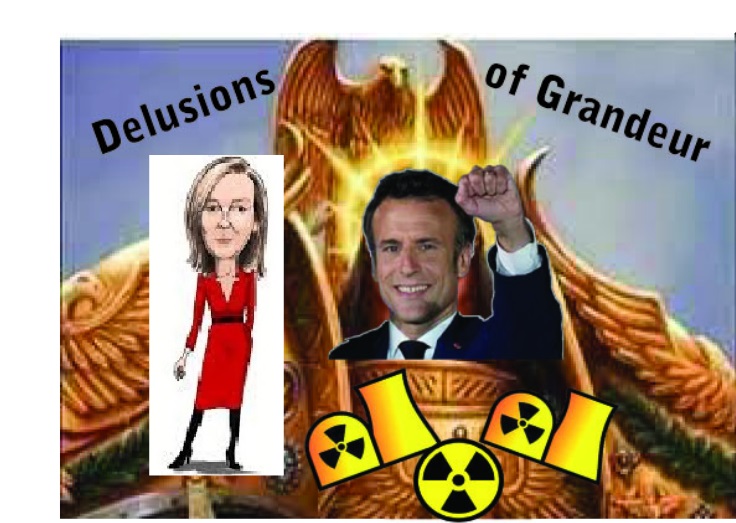
What a pair! They have so much in common. Especially their glorious abandon in going back on previous promises. Macron promised to phase out nuclear power. Truss wanted Britain to stay in the European Union. Then – hey presto! Macron’s all for the nuclear industry, and Liz all for “Brexit” – UK getting out of the EU.
But now, Liz and Emmanuel are besties again, as both go hell for leather for the dangerous, weapons-proliferation, environment-damaging and – oh dear! unaffordably costly nuclear power!
Is this some sort of subconscious Folie à deux – a strange political suicide wish?
They’re committed to work together to get EDF’s Sizewell C nuclear station project happening.
For France – by the end of this year, EDF’s net debt is already forecast to swell to about €60bn, while its French construction programme alone could cost another €52bn.
For Britain – not counting the astronomic cost , ( up to £30 billion, to be paid sort of upfront by the odious Regulated Asset Base ) Sizewell C will be foreign owned, and years to build, with dangerous, hazardous waste and horrendous decommissioning costs – not to mention a potential target for terrorists. Located on low-lying Suffolk coast – vulnerable to rising seas due to global heating.

One point of difference. Liz Truss opposes the idea of Britons conserving energy, whereas the Macron government is promoting energy conservation. Macron’s a bit less nutty?
1 This Month


Read the Public Inquiry Report, the Commissioners’ report, Surrendering Australia: The AUKUS Deception is available to download for free at aukuspublicinquiry.com. Or just watch the replay of the National Press Club Luncheon.



19 November – Webinar – The Reality of Reprocessing
Time: 11:00 AM Pacific Time (US & Canada) / 2:00 PM Eastern / 7:00 PM UK / 8:00 PM CET
Register for the Zoom Event Here



Shut down the radiation-damaged Heysham nuclear reactors now
To see nuclear-related stories in greater depth and intensity – go to https://nuclearinformation.wordpress.com

Say No to NASA’s Reckless Nuclear Reactor on the Moon
Say No to NASA’s Reckless Nuclear Reactor on the Moon
-
Archives
- November 2026 (119)
- October 2026 (302)
- September 2026 (339)
- August 2026 (330)
- July 2026 (355)
- June 2026 (287)
- May 2026 (306)
- April 2026 (356)
- March 2026 (251)
- February 2026 (267)
- January 2026 (308)
- December 2025 (358)
-
Categories
- 1
- 1 NUCLEAR ISSUES
- business and costs
- climate change
- culture and arts
- ENERGY
- environment
- health
- history
- indigenous issues
- Legal
- marketing of nuclear
- media
- opposition to nuclear
- PERSONAL STORIES
- politics
- politics international
- Religion and ethics
- safety
- secrets,lies and civil liberties
- spinbuster
- technology
- Uranium
- wastes
- weapons and war
- Women
- 2 WORLD
- ACTION
- AFRICA
- Atrocities
- AUSTRALIA
- Christina's notes
- Christina's themes
- culture and arts
- Events
- Fuk 2022
- Fuk 2023
- Fukushima 2017
- Fukushima 2018
- fukushima 2019
- Fukushima 2020
- Fukushima 2021
- general
- global warming
- Humour (God we need it)
- Nuclear
- RARE EARTHS
- Reference
- resources – print
- Resources -audiovicual
- Weekly Newsletter
- World
- World Nuclear
- YouTube
-
RSS
Entries RSS
Comments RSS

