NATO member sending banned cluster bombs to Ukraine – media
https://www.rt.com/news/569679-ukraine-t%C3%BCrkiye-cluster-munitions/ 11 Jan 23, Türkiye has been supplying Kiev with weapons that are banned in many countries, sources told Foreign Policy magazine
Ukraine has been receiving consignments of controversial cluster munitions from Türkiye, Foreign Policy magazine has reported. Kiev had been asking Washington for the Cold-War-era weapons for months.
The shipments have been taking place since November, current and former US and European officials told the outlet. It was unclear how many of the munitions had been received, or whether they had yet been used on the battlefield.
The weapons in question are called dual-purpose improved conventional munitions, or DPICMs. They were designed during the Cold War era, when NATO was planning to deploy them against a large-scale Soviet invasion of Europe. The rounds are filled with dozens of submunitions, intended to strike personnel and light-armored targets, scattering over a large area for increased lethality.
Like many other cluster munitions, DPICMs tend to produce long-lasting hazards, as some submunitions can fail to detonate and have the potential to maim or kill somebody years after being deployed.
US law prohibits the exportation of any cluster weapons with a failure rate over a certain threshold. The same regulations require guarantees that cluster munitions will not be used in areas where civilians may be present. Washington has repeatedly rejected requests from Kiev for the supply of DPICMs.
Most European NATO members are signatories of the 2008 Convention on Cluster Munitions (CCM), which bans this type of weapons. Türkiye is not one of them, but has observer status in the Geneva-based organization that oversees the implementation of the treaty. It has indicated that it abides by the rules, though it’s not obliged to.
According to Foreign Policy, the weapons supplied to Ukraine were manufactured during the Cold War under a co-production agreement with the US. Turkish companies made 155mm and 122mm cluster artillery rounds, the magazine claimed.
Neither Russia nor Ukraine are parties to the CCM, and both have reportedly used their Soviet-made cluster munitions in their armed conflict. In March, a Tochka-U missile with a cluster payload killed more than 20 people and injured dozens more in the city of Donetsk. Moscow blamed Kiev for the attack, but this was denied. International watchdog Human Rights Watch (HRW) later stated that it could not investigate the incident.
“Ukraine already has a massive problem on its hands, and it’s only magnifying it by introducing this weapon,” Mark Hiznay, a senior researcher in the Arms Division for HRW, told Foreign Policy, commenting on Kiev’s effort to get more cluster weapons.
Adam Tooze: Why Nuclear Fusion Is Not the Holy Grail

Of course, the amount of energy necessary to generate the laser beam is multiples larger—in the case of this laser beam, somewhere between 150 times larger than the amount that actually reaches the fuel materials. So this is still a powerfully net negative reaction that we have going on here; it uses more energy than it produces
It’s directly related to the military industrial complex, and so the synergies are there. It’s also very expensive; it requires a lot of capital investment, so the engineering companies like getting in on this.
A recent breakthrough is good news, but renewables are still the better bet.
FP.com By Cameron Abadi, a deputy editor at Foreign Policy. 9 Jan 23
Last month in California, a nuclear reactor produced 3.15 megajoules of energy using only 2.05 megajoules of energy input. That surplus has been treated as a major breakthrough in the future of energy because it was produced through the process of nuclear fusion. Experts have talked for decades about nuclear fusion’s potential as a carbon neutral source of energy without any of nuclear energy’s toxic waste.
What were the economics behind this breakthrough technology? Might it provide a status boost to old-fashioned engineering relative to computer engineering? And what’s the path from laboratory success to industrial use? Those are a few of the questions that came up in my recent conversation with FP economics columnist Adam Tooze on the podcast we co-host, Ones and Tooze. What follows is an excerpt, edited for length and clarity.
For the full conversation, look for Ones and Tooze wherever you get your podcasts.
………………… Adam Tooze: It’s a project that goes back originally to some really far-out thinking in the 1950s about uses that could be made of atomic bombs for the purposes of power generation. And the original idea was literally to organize a continuous stream of atomic explosions underground—you know, find some suitably stable caves, and explode several atomic bombs a day to keep a huge mass of water boiling to generate lots of steam. Anyway, that’s where it started.
But out of all of this, from the late 1960s onward, came more serious programs in fusion energy, which essentially focused on lasers. And that’s what this National Ignition Facility is—it is the ultimate fire lighter, right? Basically it’s a gigantic torch or something—the sort of effect that you generate as a Boy Scout or a Cub Scout or whatever, when you start a fire by concentrating the heat of the sun using a magnifying glass. So that’s essentially what we’re doing. And the stunning success of the current round of experiments announced by the U.S. Department of Energy to the public a few weeks ago now is that now for the first time ever, the amount of energy generated by the fusion reaction is larger than the amount of energy fired at it by the laser.
Of course, the amount of energy necessary to generate the laser beam is multiples larger—in the case of this laser beam, somewhere between 150 times larger than the amount that actually reaches the fuel materials. So this is still a powerfully net negative reaction that we have going on here; it uses more energy than it produces……….
CA: How long are we still from having fusion as a workable source of energy? What is the path generally from basic research to industrial use?
AT: I think the only honest answer to this in general is that we do not know the answer to this. You know, there was somebody talking to the New York Times and it really took me aback because this expert assumed that the answer was half a century away. …. it could easily be many decades.
……….. AT: I think, fundamentally- it’s gee whiz, final frontier, extraordinary stuff. And the physics involved are mind-blowing; the engineering is crazy and so much more exciting than just a solar panel sitting beat up in a field somewhere or on a roof or a windmill slowly turning.
It’s directly related to the military industrial complex, and so the synergies are there. It’s also very expensive; it requires a lot of capital investment, so the engineering companies like getting in on this. You know, as much as this National Ignition Facility is a public project, the $3.5 billion were mainly not spent on scientists. It was mainly spent on extremely complex raw materials and labor necessary to build the facilities, and much of that goes to the private sector. So there was a huge private sector stake in these kinds of projects.
But having said all of that, our experience both at the level of economics and at the level of politics with this particular set of technologies—those to do with nuclear power, fission, and fusion—over the last 50 years has been sobering. And on the whole, they appear at this point to be both massively unpopular technologies and, in some cases, hugely politicized technologies as well as incredibly expensive in terms of capital costs—not in terms of operating them but in terms of capital cost to build them.
…………… it’s pretty difficult to see what the case is for investing in new capacity when the costs are as explosively uneconomic.
So that is why I find it difficult to make the case for either conventional atomic power or fusion power as an immediately practical or relevant answer to the issues facing Western countries in the chase for a solution to the problem of the energy transition and decarbonization. And we are lucky, extraordinarily lucky, that renewable technologies have come on as quickly as they have. We should double down on this. We should invest even more.
CA: Can this kind of breakthrough serve to raise the status of materials engineering relative to computer engineering or even financial engineering? Is the old-fashioned kind of engineering in need of that kind of status boost in our society?
AT ………..I actually looked at the data for the National Science Foundation, and it turns out that among Ph.D.s of all types, it’s the humanities and the social sciences that we need to worry about because the share of doctorates in engineering—and this is distinct from computer science—is in fact on the rise and has been very dramatically over the last 20 years…. https://foreignpolicy.com/2023/01/08/adam-tooze-why-nuclear-fusion-is-not-the-holy-grail/
The C-17A Has Been Cleared To Transport B61-12 Nuclear Bomb To Europe
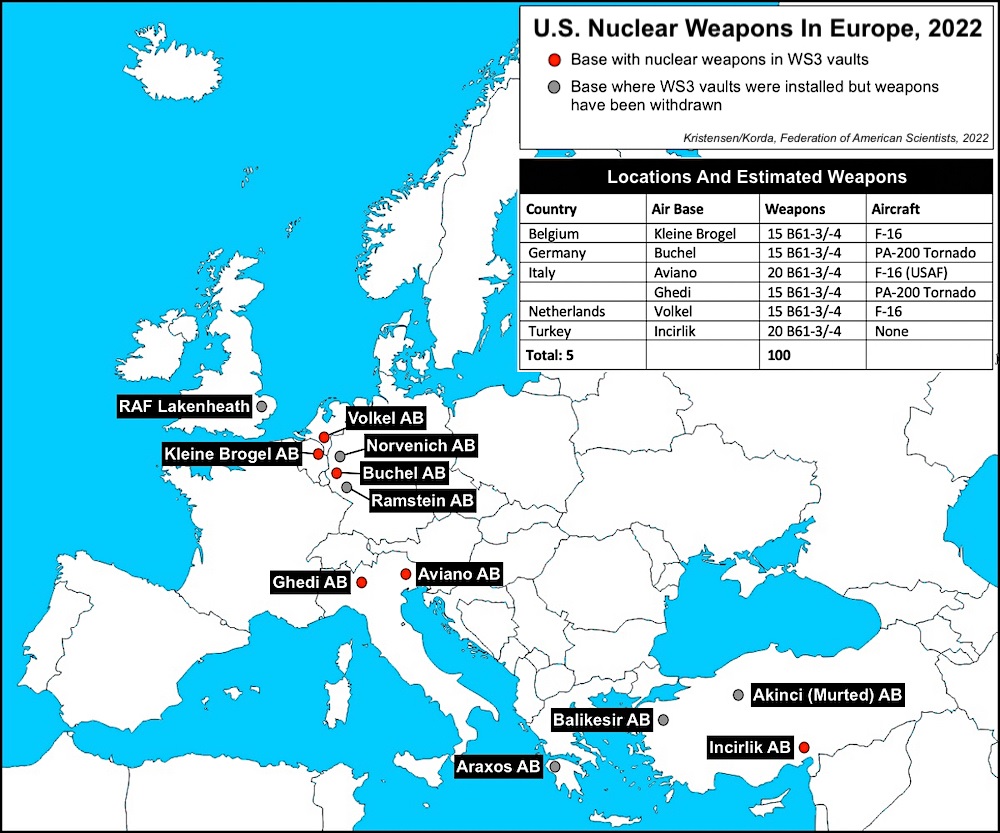
By Hans Kristensen • January 9, 2023 https://fas.org/blogs/security/2023/01/c17-cleared-to-transport-b61-12/
In November 2022, the Air Force updated its safety rules for airlift of nuclear weapons to allow the C-17A Globemaster III aircraft to transport the new B61-12 nuclear bomb.
The update, accompanied by training and certification of the aircraft and crews, cleared the C-17A to transport the newest U.S. nuclear weapon to bases in the United States and Europe.
The C-17As of the 62nd Airlift Wing at Joint Base Lewis-McChord serve as the Prime Nuclear Airlift Force (PNAF), the only airlift wing that is authorized to transport the Air Force’s nuclear warheads.
The updated Air Force instruction does not, as inaccurately suggested by some, confirm that shipping of the weapons began in December. But it documents some of the preparations needed to do so.
Politico reported in October last year that the US had accelerated deployment of the B61-12 from Spring 2023 to December 2022. Two unnamed US officials said the US told NATO about the schedule in October.
But a senior Pentagon official subsequently dismissed the Politico report, saying “nothing has changed on the timeline. There is no speeding up because of any Ukraine crisis, the B61-12 is on the same schedule it’s always been on.”
Although the DOD official denied there had been a change in the schedule, he did not deny that transport would begin in December.
The B61-12 production scheduled had slipped repeatedly. Initially, the plan was to begin full-scale production in early-2019. By September 2022, the National Nuclear Security Administration (NNSA) was still awaiting approval to begin full-scale production. Finally, in October 2022, NNSA confirmed to FAS that the B61-12 was in full-scale production.
The B61-12 is intended as an upgrade and eventual replacement for all current nuclear gravity bombs, including the B61-3, -4, -7, and probably eventually also the B61-11 and B83-1. To that end, it combines and improves upon various aspects of existing bombs: it uses a modified version of the B61-4 warhead with several lower- and medium-yield options (0.3-50 kilotons). It compensates for its smaller explosive yield (relative to the maximum yields of the B61-7 and -11) by including a guided tail-kit to increase accuracy, as well as a limited earth-penetration capability.
At this point in time, it is unknown if B61-12 shipments to Europe have begun. If not, it appears to be imminent. That said, deployment will probably not happen in one move but gradually spread to more and more bases depending on certification and construction at each base.
There are currently six active bases in five European countries with about 100 B61 bombs present in underground Weapons Storage and Security Systems (WS3) inside aircraft shelters. A seventh site in Germany (Ramstein Air Base) is active without weapons present and an eighth site – RAF Lakenheath – has recently been added to the list of WS3 sites being modernized. The revitalization of Lakenheath’s nuclear storage bunkers does not necessarily indicate that US nuclear weapons will return to UK soil, especially since as recently as December 2021, NATO’s Secretary General stated that “we have no plans of stationing any nuclear weapons in any other countries than we already have . . . ” However, the upgrade could be intended to increase NATO’s ability to redistribute the B61 bombs in times of heightened tensions, or to potentially move them out of Turkey in the future. In addition, four other sites have inactive (possibly mothballed) vaults (see map above).
This research was carried out with generous contributions from the John D. and Catherine T. MacArthur Foundation, the New-Land Foundation, the Ploughshares Fund, the Prospect Hill Foundation, the FTX Future Fund and Longview Philanthropy, the Stewart R. Mott Foundation, the Future of Life Institute, Open Philanthropy, and individual donors.
Pacific states entitled to claims against Japan for discharge of radioactive nuclear wastewater

As a contracting party to the United Nations Convention on the Law of the Sea, the Convention on Early Notification of a Nuclear Accident, and the Convention on Nuclear Safety, Japan has knowingly violated them all by making such a dangerous decision. Without exhausting all safe means of disposal, disclosing all information, or fully consulting with surrounding countries and international organizations, the Japanese government went ahead and unilaterally decided to dump its wastewater into the ocean in a flagrant attempt to pass on the disastrous consequences to other Pacific countries. Those countries have every right to defend their rights and interests through legal means.
Li Weichao http://eng.chinamil.com.cn/view/2023-01/06/content_10210311.htm
“We must remind Japan that if the radioactive nuclear wastewater is safe, just dump it in Tokyo, test it in Paris and store it in Washington, but keep our Pacific nuclear-free.” Vanuatu’s famous politician Motarilavoa Hilda Lini spoke for all people living in the Pacific region when making this statement.
The Japanese government announced in April 2021 that it will begin dumping the nuclear wastewater stored at Fukushima into the ocean from the spring of 2023. As that day is approaching, the international community is voicing waves of objection, and people living in the Pacific region have consistently expressed their strong protest. Analysts said if Japan did discharge the wastewater into the Pacific Ocean as planned, the Pacific countries would have the right to claim damages.
Japan decided to just dump the wastewater into the ocean in order to save trouble and money, at the price of transferring nuclear contamination to the whole world, which is extremely irresponsible and selfish. South Pacific countries have suffered enough from nuclear contamination. From 1946 to 1958, the US conducted 67 nuclear weapon tests on the Marshall Islands, the aftermaths of which are still haunting the local residents in the form of radioactive poisoning, contamination of marine species, and leak from radwaste landfill.
The Fukushima nuclear station had the highest-level nuclear accident that produced an enormous amount of nuclear wastewater – more than 1.3 million tons in storage right now. Even though Japanese politicians claimed that the wastewater is safe enough for drinking after being treated with the Advanced Liquid Processing System (ALPS), that’s simply not true.
A Japanese NGO recently released an article saying that treated nuclear wastewater still contains 64 kinds of radioactive substances, including tritium, which, once released into the ocean, will contaminate the marine environment and spread through the food chain, till eventually taking a toll on human health and the ecological environment. A report released by Greenpeace, an international environmental protection organization, showed that the technology currently adopted by Japan cannot get rid of the Sr90 and C14 in the wastewater, which are even more damaging than tritium with their half-life of 50 years and 5,730 years respectively.
It’s foreseeable that dumping Fukushima’s more than 1.3 million tons of nuclear wastewater into the ocean is a murderous move for people living along the ocean and will put the marine ecology at stake with irreversible outcomes. A renowned environmental protection organization of Pacific island countries said that such an irresponsible move of transboundary pollution is no different from waging a nuclear war against the people and the islands in the Pacific region.
As a contracting party to the United Nations Convention on the Law of the Sea, the Convention on Early Notification of a Nuclear Accident, and the Convention on Nuclear Safety, Japan has knowingly violated them all by making such a dangerous decision. Without exhausting all safe means of disposal, disclosing all information, or fully consulting with surrounding countries and international organizations, the Japanese government went ahead and unilaterally decided to dump its wastewater into the ocean in a flagrant attempt to pass on the disastrous consequences to other Pacific countries. Those countries have every right to defend their rights and interests through legal means.
In fact, there are already precedents for claims of this kind. For instance, the International Arbitration Tribunal ruled in 1938 and 1941 that Canada’s Trail Smelter should compensate America’s State of Washington for the damages caused by the SO2 it emitted. The “Trail Smelter case” is generally considered the basis for holding countries committing transboundary pollution accountable. Countries along the Pacific Ocean can totally refer to it and pursue claims against Japan after scientifically measuring the damages imposed upon them.
The ocean is the common wealth and symbiotic home for humanity. Dumping nuclear wastewater into it is not Japan’s internal affair. Right now the IAEA is still conducting a comprehensive evaluation of the wastewater at Fukushima, and Japan’s pushing for the dumping plan reveals its intention to make it a fait accompli regardless of the concerns of other parties. Japan’s egregious atrocities in history have already caused horrendous miseries to the surrounding countries. Does it plan to add another entry to its infamous track record now?
Editor’s note: Originally published on news.cri.cn, this article is translated from Chinese into English and edited by the China Military Online. The information and opinions in this article do not necessarily reflect the views of eng.chinamil.com.cn.
Going nuclear? MPSC to hire outside firm to study Michigan’s energy future (but will the firm have vested interests?)

by: Matt Jaworowski, Jan 9, 2023
GRAND RAPIDS, Mich. (WOOD) — The Michigan Public Service Commission is looking for a consulting firm to conduct a study on whether the state should consider allowing a new nuclear power plant.
The study is a requirement of Michigan’s appropriations bill passed last July, giving the MPSC $250,000 to find an outside team to run the study. The goal is to spell out the advantages and disadvantages of operating a nuclear energy plant in Michigan and its economic and environmental impact.
The bidding window will for consulting firms opens on March 3. The study must be submitted to the Legislature by April 2024………………………… more https://www.upmatters.com/news/michigan-news/going-nuclear-mpsc-to-hire-outside-firm-to-study-michigans-energy-future/
Philippines looking at Chinese investors for cooperation on nuclear energy
By JON VIKTOR D. CABUENAS, GMA Integrated News, January 9, 2023 The Philippines is banking on Chinese investors to participate in the planned venture into nuclear energy, along with cooperation in other areas such as renewable energy, the Department of Energy (DOE) said Monday…………………………………..
The briefing was made after a state visit by President Ferdinand “Bongbong” Marcos Jr. to Beijing, China last week, where Malacañang said he secured $13.76-billion worth of investments in the energy sector.
………………………………… Malacañang last week said the government is set to update its nuclear energy roadmap, with Marcos pushing for its adoption in a bid to lower power rates.
The President, along with his running mate Vice President Sara Duterte, have been pushing for the adoption of nuclear energy, which they said would lower electricity rates and help secure a steady power source.
His predecessor, former President Rodrigo Duterte, last March issued Executive Order 164, directing the conduct of relevant studies for the adoption of a National Position for a Nuclear Energy Program.
The DOE in November said, however, that the Philippines will have to wait a decade to see a working nuclear power plant given the time needed for feasibility studies and other factors.
“At this point we cannot say how fast they (Chinese commitments) will be implemented but the President has committed that he’s going to make sure that there will be a systematic handholding of investors,” Lotilla said…… https://www.gmanetwork.com/news/money/economy/856790/philippines-looking-at-chinese-investors-for-cooperation-on-nuclear-energy/story/
Djibouti signs Treaty on the Prohibition of Nuclear Weapons
https://www.icanw.org/djibouti_tpnw_signature 9 Jan 23,
Djibouti has become the first new signatory to the Treaty on the Prohibition of Nuclear Weapons (TPNW) in 2023. At the UN headquarters in New York on 9 January, the country’s ambassador to the United Nations, Mohamed Siad Doualeh, signed the landmark treaty, bringing the total number of signatories to 92. Djibouti will now commence its domestic ratification process in order to become a state party.
ICAN Executive Director, Beatrice Fihn, welcomed Djibouti’s decision: “The steady increase in adherence to the landmark nuclear ban treaty reflects the strong desire of the international community to strengthen the global norm against nuclear weapons and see more rapid progress on disarmament.”
To date, 33 African countries have signed the TPNW, of which 15 have also ratified it. The TPNW complements and reinforces the 1996 Treaty of Pelindaba, which established Africa as a nuclear-weapon-free zone. The states parties to the Treaty of Pelindaba have called upon all African Union member states “to speedily sign and ratify the [TPNW]”.
Support for the TPNW
Djibouti has historically been a strong supporter of the TPNW. In 2016, Djibouti voted in favour of the UN General Assembly resolution that established the mandate for states to begin negotiations on “a legally binding instrument to prohibit nuclear weapons, leading towards their total elimination,” participated in the negotiation of the TPNW in 2017 and was among 122 states that voted in favour of its adoption.
More recently, in a statement to the United Nations in October 2022, Djibouti announced that it would adhere to the TPNW as part of its “commitment to peace and disarmament”. It also encouraged other states that have not yet signed it to do so. In December 2022, Djibouti voted in favour of an annual UN General Assembly resolution calling on all states to sign, ratify, or accede to the TPNW “at the earliest possible date”.
NO – Sir Keir Starmer – nuclear power is NOT clean.
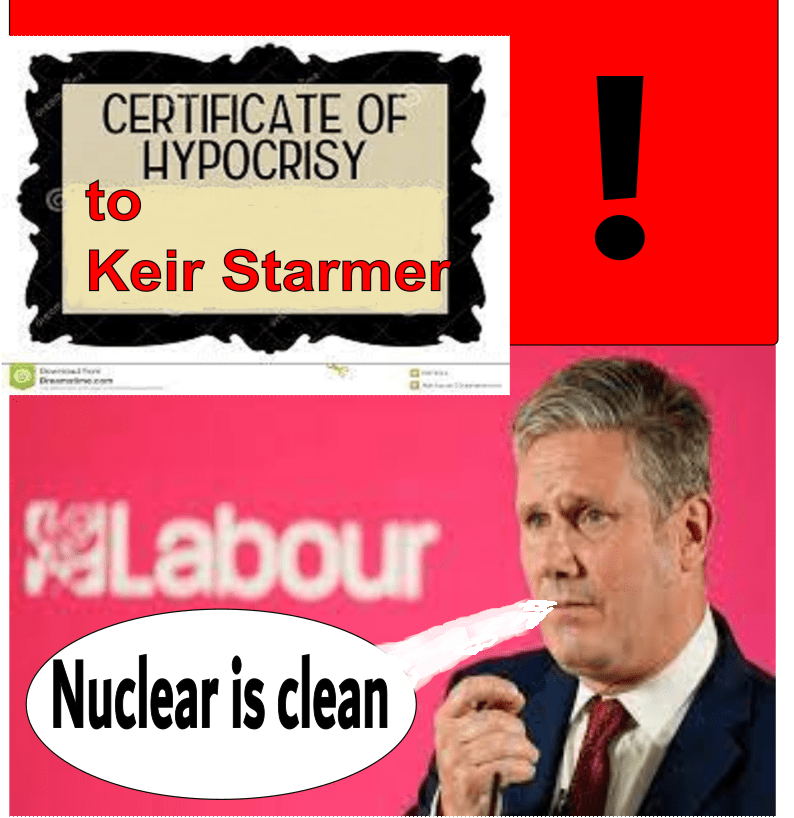
A great opportunity being wasted!
The British Labour Party has the chance to get into power, following the disastrous Boris Johnson Tory leadership.
Top of Johnson’s follies was the plan for a fleet of nuclear reactors, large and small.
The incompetent Tories will inevitably go. Their hopeless dirty and super-costly nuclear plans should go with them.
But Keir Starmer now squanders this chance with his hypocritical pretence that nuclear power is clean.
Current reports that the Labour Opposition leader highlighted that, in power, Labour would bring a “different approach” to energy -it “would target 100% clean power generation by 2030”. The
Association for Renewable Energy and Clean Technology (REA) jumped up and down with delight, not realising that they’re being taken for a ride by the nuclear lobby
All very good – wind, solar, hydrogen, green steel and carbon capture – it does sound clean.
But, sneaked in amongst all this positive, forward -looking stuff, is that dirty old dinosaur – nuclear power.
The inclusion of nuclear power in the compendium of clean energy technologies will mean that funds and resources are siphoned away from real solutions to climate change.
It will quietly send resources , talented workers, and money to the nuclear weapons industries.
Shame on Labour – for inventing Great British Energy – “It’s galvanised by reform: a new publicly owned company” – but very quickly subverted to push for the nuclear lobby.

The problem with nuclear energy advocates

There is something curiously bewitching about nuclear power that makes its backers disciples rather than advocates. They become nuclear champions first rather than energy champions (which is what everyone should be), and are either unaware of or intentionally ignoring the fact that most of the time, they are putting their efforts into a solution that is looking for a problem.
ROUGH TRADE, By Ben Kritz, January 10, 2023
I WAS asked over the weekend if I planned to respond to a recent letter to the editor (“SMR issues addressed,” published on January 5), which said it was a reaction to my December 29 column about small modular reactor (SMR) technology and the problems that have been encountered in trying to make it commercially practical.
No, I responded, I had not planned to react to the letter because I could not see much in it to actually react to; while polite and thoughtful, it essentially boiled down to the same long-on-enthusiasm and short-on-specifics kind of pitch for SMR technology I see every day.
Maybe that’s exactly the point you need to address, my annoying yet helpful self-appointed consultant suggested.
I realized she’s right; there’s a bigger problem with nuclear energy and its advocates than just the technical and economic details that make it difficult to develop and use. There is something curiously bewitching about nuclear power that makes its backers disciples rather than advocates. They become nuclear champions first rather than energy champions (which is what everyone should be), and are either unaware of or intentionally ignoring the fact that most of the time, they are putting their efforts into a solution that is looking for a problem.
For the record, my December 29 column dealt with two more exotic forms of SMR technology, the traveling wave reactor (TWR) and the Natrium reactor; the basic difference between the two being that the latter uses uranium fuel that is enriched to a concentration that is four or five times what is used in a conventional reactor, and the former is designed to use unenriched or depleted uranium fuel. For a variety of reasons, both of those technologies are at least eight to 10 years from even being functional, and whether or not they can be made economical at all is still an open question.
The discussion about the less extreme and more common form of SMR technology was in the column prior to that, on December 27, and detailed obstacles with the development of commercial-ready SMRs that have been identified through actually trying to build an SMR plant, on the one hand, and a couple of reliable studies by nuclear experts (Stanford University and the Argonne National Laboratory) on the other.
The first obstacle is cost. A plant being constructed in rural Idaho by SMR developer NuScale — which is designed to eventually consist of six 77-megawatt units — has run into massive cost overruns, despite the assumption that SMRs are relatively inexpensive due to being smaller and simpler than conventional nuclear plants. NuScale is hoping to have the first of the six units online by 2029, but the per-megawatt-hour cost of the plant has hit $58, the threshold set by the consortium of six utilities in the western US which are financing the project to decide whether or not to continue.
The reason for this is that at that cost, there are already a variety of conventional and renewable energy generation sources available, so there is nothing to be gained by building the SMR complex, no matter how cutting-edge its technology may be.
The second obstacle is waste management. Again, because SMRs are smaller and less complex than conventional nuclear power plants, it is assumed that they would produce less radioactive waste, both of the more dangerous high-level variety in the form of spent fuel and the low-level variety in the form of wastewater and contaminated discarded equipment and other materials.
This, however, is not the case, according to the Stanford and Argonne studies, both published last year. Both studies found the same result, that SMRs produce about as much waste as conventional light-water reactors, but differed in their subjective interpretation. The Stanford researchers concluded that this contraindicated the use of SMRs since they do not offer any improvement in waste management, while Argonne’s lead scientist suggested that the result was more positive, as it demonstrated using SMRs wouldn’t be any worse than conventional nuclear power.
Contrary to our recent reader-correspondent’s assertions, neither of those issues — the only two I focused on concerning SMRs, because they are not hypothetical, but demonstrated by real-world experience or analysis — are “addressed” at all by what he presented, which is “a unique approach to SMRs” being developed by an unnamed enterprise only identified as being Seattle-based. The design, according to him, uses “widely available, cheap low-enriched uranium” (as I have pointed out more than once, except for reactors running on exotic fuel like the Natrium, fuel is actually the least of the cost issues for a nuclear plant); do not need to be refueled (are they then considered disposable?); and “are safe enough that their ‘plug-and-play’ generators can be placed anywhere with little infrastructure investment and without any special security.”
As for the application of this mysterious miracle technology in the Philippines, the company in question is “confident that they can satisfy all the requirements of the Philippine government regulators, the power companies and the public. They could even achieve the objective of having the current president preside over the ribbon-cutting ceremony before he leaves office.”
First of all, if the developer of this game-changing technology has created something that is ready enough that they are actively seeking a foothold in the Philippine market, one would think that they would be willing, even eager, to be clearly identified. I suspect I know who it is, and if I’m right, I’m going to be very disappointed because then this sly press release in the form of a letter to the editor (and yes, that’s exactly what it is; I get three or four press releases a day from different companies or trade publications that sound exactly like this) doesn’t even begin to answer questions that have already been raised about this specific company’s technology.
Second, even if this is just a standard-design SMR, we already know that a commercial version in its own country of origin will not be operational by the time President Marcos steps down, let alone be available to the Philippines. Local requirements might indeed be satisfied, but before that can even happen, the hoops that both US and Philippine stakeholders will have to jump through in order to secure export authorization from the US government — with the resulting agreement also needing approval from the Philippine Senate, the sort of thing it never acts quickly on — will take a couple of years at a minimum.
The Philippines could use nuclear energy, and it’s rational not to completely discount the future possibility of its doing so, provided a very long list of conditions are satisfactorily met. But it is in no position to serve as a test site for novel ideas that have been clearly demonstrated to be years from being a viable, let alone a practical, best option. Trying to mislead the public into believing that a magical solution is available for the asking — proselytizing for nuclear energy, rather than seeking actual attainable solutions for the country’s rather more immediate energy problems — is going to achieve very little, except to disappoint people and ensure this won’t be a market for whatever you’re selling.
Lithuania deal to dismantle Soviet-era nuclear reactors could be world first
Pamela Largue , January 9, 2023
https://www.powerengineeringint.com/nuclear/waste-management-decommissioning/lithuania-to-dismantle-soviet-era-nuclear-reactors/
Two contracts have been signed to plan the dismantling and waste management for the Ignalina Nuclear Power Plant in Lithuania.
The first of two four-year contracts was signed with a consortium led by Westinghouse Electric Spain, including Jacobs Slovakia, and Lithuanian Energy Institute.
The second contract was signed with another consortium led by the French company Electricite de France.
The dismantling services will be provided in two phases. The first will see contractors propose engineering solutions for dismantling the reactor.
The engineering design concept will be assessed and then further developed in consultation with stakeholders, namely the European Commission, Ministry of Energy of the Republic of Lithuania, CPVA (Central Project Management Agency) and VATESI (State Nuclear Power Safety Inspectorate).
Audrius Kamienas, director general of the Ignalina plant, said in a statement that the signing of the contracts is an important milestone, as dismantling the reactor core is the most challenging part of the decommissioning.
“There are only a few examples of graphite reactors being dismantled in the world today, but the RBMK reactor type has never been dismantled before.
“This is an extremely complex task, unprecedented in the world, for which preparatory work will continue for several more years.”
Physical dismantling of the reactor will commence in 2028 and will be funded by the EU Ignalina Programme.
Graphite-moderated reactor
Dismantling two of the most powerful RBMK reactors is believed to be a decommissioning first.
According to the World Nuclear Association, Soviet-designed RBMK (reaktor bolshoy moshchnosty kanalny, high-power channel reactor) is a water-cooled reactor with individual fuel channels and uses graphite as its moderator.
Ignalina could be the first graphite-moderated reactor plant to be dismantled, making it an important test bed for methodologies that could be used to decommission others of the same type, such as the UK’s Magnox and advanced gas-cooled reactors, which also have graphite cores.
Jacobs Energy, Security & Technology senior vice president Karen Wiemelt, commented: “Our teams based in the UK, France and Slovakia are applying decommissioning skills acquired through work on some of the world’s most complex and challenging nuclear sites including Sellafield and Fukushima.”
In 2002, the Lithuanian government decided to shut down Ignalina NPP, which supplied up to 88% of the country’s electricity.
Ukraine on ‘NATO mission’ – defense minister
https://www.rt.com/russia/569500-reznikov-ukraine-nato-mission/ 9 Jan 23
Aleksey Reznikov has argued that Kiev is shedding blood for the military bloc and expects weapons in return.
Kiev is shedding blood to carry out the mission NATO set for itself and expects the “civilized West” to provide weapons and ammunition in return, Ukrainian Defense Minister Aleksey Reznikov has said in an interview for a domestic TV channel.
Appearing on the 1+1 network’s TSN channel on Thursday evening, Reznikov pointed out that at the Madrid summit last summer, NATO declared Russia the greatest threat to the US-led bloc.
“Today, Ukraine is addressing that threat. We’re carrying out NATO’s mission today, without shedding their blood. We shed our blood, so we expect them to provide weapons,” he said.
Reznikov also claimed that his NATO colleagues have told him, both in conversations and via text messages, that Ukraine is the “shield of civilization” and “defending the entire civilized world, the entire West.”
Ukrainian officials, from President Vladimir Zelensky down, routinely make public appeals for tanks, missiles, artillery and ammunition. Russian Defense Minister Sergey Shoigu told the General Staff in December that Moscow was de facto fighting the collective West. By his estimates, the government in Kiev has received almost $100 billion worth of weapons, ammunition and other supplies in 2022 alone.
Reznikov has led that effort, boasting to the US outlet Politico in October that he had figured out the Pentagon’s political process. His goal, he said, was to keep raising the bar until Ukraine received main battle tanks.
While that particular threshold has yet to be crossed, on Friday Washington announced the delivery of 50 Bradley infantry fighting vehicles, the most modern armor sent to Kiev so far, as part of a $3 billion weapons package. Earlier this week, France pledged a number of wheeled ‘light tanks’ as well.
These shipments are intended to replace Ukraine’s battlefield losses. Last month, Kiev’s top general Valery Zaluzhny told The Economist he would need 300 more tanks, up to 700 infantry fighting vehicles, and 500 howitzers to conduct offensive operations. This is more than the number of such vehicles in British or German inventory.
Moscow insists that Western weapon deliveries only serve to prolong the conflict, and has repeatedly warned Ukraine’s backers that this could result in an all-out military confrontation between Russia and NATO.
Holtec seeks $7.4 billion government loan for expansion tied to new reactor

“an outrageous pickpocketing of hardworking American taxpayers to benefit a filthy rich private company.”
Jim Walsh, Cherry Hill Courier-Post, 9 Jan 23
CAMDEN – Holtec International Inc. has applied for a $7.4 billion federal loan to fund expansion expected from future sales of a company-designed nuclear reactor.
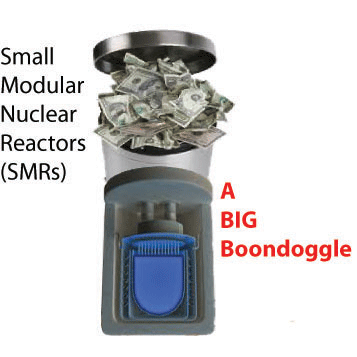
Holtec would tap the loan to boost capacity to make parts at its existing U.S. facilities, and to build and commission “at least four” SMR-160 advanced light water reactors.
It also expects to build “one or more additional manufacturing plants,” the company said.
Holtec added it’s “actively evaluating” potential sites “for the new ultra-modern manufacturing plant(s).”
The firm has three nuclear manufacturing facilities in the United States, including one at its Camden corporate campus that was designed for the eventual production of SMR-160s. It also has a fabrication plant in India.
Holtec claims its small modular reactor produces carbon-free energy more safely than a conventional nuclear power plant.
The firm has invested more than $400 million in the reactor’s development since 2010. It was approved in 2020 for $116 million in federal aid “to support the SMR-160’s commercialization readiness.”
Holtec is seeking the loan from the U.S. Department of Energy’s Loan Programs Office, which received an infusion of about $111 billion from last year’s Inflation Reduction Act.
“We anticipate that (the application process) will be ongoing for a while as DOE usually (has requests) for information or clarifying questions for an applicant,” said Holtec spokesman Patrick O’Brien………………….
Holtec also said it expects the U.S. Nuclear Regulatory Commission “early this year” will license its planned nuclear-waste storage facility in New Mexico.
The complex, in the works for seven years, could hold “the vast quantity of spent nuclear fuel presently stored at more than 70 nuclear sites in 35 states,” the company said.
But an environmental coalition plans to challenge any NRC approval in federal court, said Kevin Kamps of Beyond Nuclear, a nonprofit that’s sharply critical of Holtec’s plan.
Kamps said Holtec’s waste-storage project also faces court challenges from the states of New Mexico and Texas, as well as from businesses with mining and ranching interests near the proposed storage site.
He also described potential federal aid to Holtec as “an outrageous pickpocketing of hardworking American taxpayers to benefit a filthy rich private company.”
According to Holtec, the operation of a consolidated waste-storage site would spur nuclear power in the United States, “leading to the rise of small modular reactors.”
It also expressed the belief that modular reactors made in America would find “a large global export market.”
Holtec previously has predicted it could place 32 SMR-160s in the United Kingdom by 2050………….. https://www.courierpostonline.com/story/news/local/south-jersey/2023/01/09/holtec-federal-loan-production-advanced-nuclear-reactor-oyster-creek/69779027007/
Irish Republic monitoring nuclear risk as a consequence of fighting in Ukraine
International Atomic Energy Agency repeatedly expresses concern over shelling around Zaporizhzhia plant
Irish Times, Jennifer Bray, Mon Jan 9 2023
Europe’s exposure to a potential nuclear event in Ukraine is being monitored by a team of public health and Government officials as well as the State’s environmental watchdog.
The Zaporizhzhia plant, Europe’s largest, was captured by Russian forces in March, soon after their invasion of Ukraine. It repeatedly came under fire last year, prompting concerns about a possible nuclear disaster. The International Atomic Energy Agency (IAEA) has repeatedly expressed concerns over shelling around the site.
Health Service Executive chief risk officer Patrick Lynch told a meeting of the organisation’s audit and risk committee in October that public health officials were involved in an evaluation process around potential nuclear exposure which would require further reflection.
He advised the committee that a Government department and the Environmental Protection Agency (EPA) are “considering the potential risk of nuclear release in Ukraine and subsequent exposure across Europe”…….
A Department of the Environment spokesman confirmed that its officials and other agencies are “closely monitoring the evolving situation in Ukraine in relation to nuclear safety implications”.
He said the EPA is “in close contact” with the IAEA, the European Nuclear Safety Regulators Group and national authorities in other European countries in order “to keep a close watch on developments and to monitor any increases in exposure levels”.
The department said that the EPA has an around-the-clock radiation monitor in use………………………..
The EPA operates a radiation monitoring network for Ireland which is continuously monitoring for radioactivity in the environment and also maintains contact with radiation authorities in other countries throughout Europe.” https://www.irishtimes.com/politics/2023/01/09/republic-monitoring-nuclear-risk-as-a-consequence-of-fighting-in-ukraine/
Guilty of Journalism

The Political Prosecution of Julian Assange
by Kevin Gosztola https://www.sevenstories.com/books/4493-guilty-of-journalism?fbclid=IwAR2np9Ku9WHMKuJ7xTPkrrolJRvbkxdWcmyac0FnEZqKSduuhH2g2M-zPaM 7 Jan 23
From an acclaimed independent journalist, this carefully-documented analysis of the government’s case against Julian Assange and its implications for press freedom acts as a crucial, compelling guidebook to Assange’s upcoming trial.
The legal action against Julian Assange is poised to culminate in a trial in the United States in 2023, and this book will help the public understand the proceedings. The establishment media’s coverage of WikiLeaks founder Julian Assange’s extradition case has focused on his deteriorating health and what CBS News called his “secret family,” but most of this coverage failed to detail the complex issues at stake against Assange.
Guilty of Journalism outlines how WikiLeaks exposed the reality of American wars, the United States government’s unprecedented indictment against Assange as a publisher, and the media’s role in persuading the public to “shoot the messenger.” This new book by Kevin Gosztola, who has spent the last decade covering Assange, WikiLeaks, and the wider war on whistleblowers, tells the full story based on testimony from dozens of witnesses.
It examines abuses of power by the CIA and the FBI, including a spying operation that targeted Assange’s family, lawyers, and doctors. Guilty of Journalism offers a balanced and comprehensive perspective on all the events leading up to what press freedom advocates have called the trial of the century.
It’s all about the bomb: why civilian nuclear power is merely a cover for producing more nuclear weapons

Nuclear weapons are a special kind of horror opposed by most rational people around the world.
the IAEA’s bluntly stated mission is to promote nuclear technology.
Like Atoms for Peace, this repackaging of a military activity as a civilian one succeeded in making the endeavor socially acceptable and somewhat self-funding
The nuclear power-nuclear weapons link can only be broken by a ban on both
It’s all about the bomb — Beyond Nuclear International
Why civilian nuclear power is merely a cover for producing more nuclear weapons
By Alfred Meyer, 8 Jan 23,
The Zaporizhzhia Nuclear Power Station in southeastern Ukraine, Europe’s largest nuclear power plant, has the world’s attention right now, and rightly so. For the first time in history, six nuclear reactors and thirty-seven years’ worth of high-level nuclear waste are in the middle of a battlefield in an active war zone—one artillery shell, on site or off, could interrupt the control and cooling of the operational reactor, or the cooling of the waste in storage, leading to a catastrophic release of radiation that could spread throughout the Northern Hemisphere. How in the world can nuclear power reactors be considered clean and safe sources of electricity?
Russia, a nuclear-armed nation that invaded Ukraine on February 24, 2022, has said that it would use nuclear weapons if needed. And strong allies of Ukraine—the United States, the United Kingdom, and France, all NATO members—are also armed with nuclear weapons.
You likely are aware of what has happened in the weeks since this magazine went to press, and whether or not the world is in the midst of another major radioactive disaster, as happened at Fukushima in Japan in 2011, Chernobyl in northern Ukraine in 1986, and Three Mile Island in the United States in 1979. I assume that if you are reading this, nuclear weapons have not been used in the war in Ukraine. So how has the world ended up in such an existentially threatening situation? Why does the nuclear enterprise have the world’s future so tightly in its grip?
The short answer: nuclear weapons. It is all about the bomb.
In 1939, Albert Einstein wrote to President Franklin D. Roosevelt urging him to pursue nuclear research in the United States. It was crucial, Einstein wrote, to counter Germany’s efforts to harness the magic of radioactivity and develop a super weapon. A few years later, the Manhattan Project was born in secrecy in 1942. A sprawling and tightly controlled academic, military, industrial, and governmental infrastructure was built to accommodate an entirely new industry equal in size to the American automobile industry at the time. Secrecy was so thorough that when Vice President Harry Truman ascended to the presidency on April 12, 1945, upon Roosevelt’s sudden death, he was unaware that the atomic bomb program even existed, much less that it was on the verge of testing a plutonium weapon in July.
During World War II, the United States succeeded in developing atomic weapons, while Germany was defeated before it could do so. Even though Japan was essentially defeated by then, Truman, some three months after he learned that the United States did possess the super weapons, chose to use them. Although the firebombing of Tokyo in March 1945 had burned to death more than 100,000 people and left more than a million people homeless, it did not occasion the global outcry that followed the use of the uranium bomb on Hiroshima, on August 6, 1945, and the plutonium bomb on Nagasaki, three days later. Nuclear weapons are a special kind of horror opposed by most rational people around the world.
However, following the use of nuclear weapons in Japan in 1945, there has been significant ongoing public opposition to them. In the earliest days of the United Nations, there were various efforts to abolish or control nuclear weapons. It was clear that they constitute an entirely different type of military threat that includes the likelihood of ending life on earth as we know it. Abolishing nuclear weapons is the way to end this existential threat.
When World War II hero General Dwight D. Eisenhower became President in 1953, the dilemma for the military, and for Eisenhower, was how to grow the atomic bomb programs, in light of negative public opinion toward the nuclear enterprise. At the same time, the United States wanted to be recognized as the leader of the “free world” in the postwar years. In the early 1950s, the military needed to recast nuclear enterprise activities to appear to be peaceful, beneficial parts of our modern life, very distant from the wartime horrors.
In August 1953, Eisenhower was worried about the Soviet Union’s successful test of a sophisticated hydrogen bomb—which signaled to the United States that the nuclear arms race was officially on. Eisenhower considered delivering a type of “fireside chat” to the American public—or perhaps a “mushroom cloud chat”—to level with citizens about the truly horrific existential threat that nuclear weapons posed to the world.
But by December of that year, a different strategy appeared to take effect. In a now famous speech on December 8, 1953, titled “Atoms for Peace,” Eisenhower proposed to the U.N. General Assembly an international program of sharing “peaceful” nuclear materials and know-how for untold bounty, to encourage development of nuclear programs around the world.
The United States also proposed an international agency under the United Nations to promote and oversee nuclear activities, which today is the International Atomic Energy Agency, or IAEA. While acknowledging the IAEA’s important oversight role, such as inspecting the Zaporizhzhia reactors and fuel pools at this perilous time in history, one should also recognize that the IAEA’s bluntly stated mission is to promote nuclear technology. The first leaders of the IAEA were from the United States, to ensure that U.S. interests were protected.
Nuclear enterprise infrastructure is an outgrowth of World War II. These new endeavors drew international interest in creating the huge nuclear marketplace now in existence. Atoms for Peace—a plan to share nonmilitary nuclear technology with other countries to “win hearts and minds”—placed nuclear materials and reactors in more than forty countries, including Iran. This generated ongoing business for many American nuclear enterprise companies while supporting and expanding the U.S. military’s nuclear infrastructure and capacity in the United States.
Having nuclear activities under the auspices of the United Nations conferred upon them the legitimacy and respect of that international body. While Eisenhower was making his “Atoms for Peace” speech at the United Nations, he was in the middle of planning the largest hydrogen bomb test ever in the United States, the fifteen-megaton “Bravo” test, on March 1, 1954, which was more than 1,000 times bigger than the bomb dropped on Hiroshima.
The generally favorable response to Atoms for Peace was a trifecta for the nuclear enterprise. U.S. nuclear activities were repackaged as the “peaceful” atom and given the patina of social acceptance through United Nations oversight. Eisenhower was lauded as a good leader for sharing the atom with the world, and the U.S. nuclear infrastructure got new business and growth, which supported more U.S. nuclear weapons and nuclear Navy programs.
Atoms for Peace also served geopolitical ends. For instance, one reason the United States provided Iran with a research reactor in 1967 was to saddle that country with significant financial obligations, including paying for ongoing parts, services, and technical support from American companies. These financial obligations would then, theoretically, force Iran to sell more oil on the world market, regardless of OPEC actions, a kind of atoms-for-oil program—but only peaceful atoms, mind you!
As Atoms for Peace was taking shape, a major policy change was made via the Atomic Energy Act of 1954. The top-secret, tightly controlled Manhattan Project to build the atomic bomb was a governmental endeavor. Nuclear reactors produce the plutonium needed for atomic bombs. With the passage of this new bill by Congress, the operation of nuclear power reactors by privately owned corporations was allowed.
The Atomic Energy Commission was created in 1946 to promote and regulate the development of this new industry. With the commission led by Wall Street banker Lewis Strauss for five critical years, it is not surprising that the scales heavily favored promotion over regulation. Encouraging private investment in these risky reactor projects was assisted by minimizing regulatory safety and operational demands upon the private operators.
Being the biggest nuclear enterprise on earth encourages the circular, self-sustaining dynamic of the nuclear arms race.
But why was it so important for the U.S. government to develop and subsidize civilian nuclear power? Because it allowed the military, in essence, to spin off its nuclear reactor activities to private financing and corporate operations. Like Atoms for Peace, this repackaging of a military activity as a civilian one succeeded in making the endeavor socially acceptable and somewhat self-funding—although government subsidies are still perennially needed to carry on, and taxpayers are still covering the liability insurance costs of the private corporations. Most importantly, as detailed in a 2017 report by former U.S. Energy Secretary Ernest Moniz, civilian nuclear power is an “essential enabler” of our national security. The Atlantic Council calculates the value of this contribution to national security to be $42.4 billion a year. Businesses contributing to the nuclear Navy’s supply chain are in forty-four U.S. states.
The essential nature of civilian nuclear power for national security would suggest that if the United States has the largest national inventory of civilian nuclear reactors in the world, then it also has the largest nuclear enterprise infrastructure to support nuclear weapons production and a nuclear Navy.
Being the biggest nuclear enterprise on earth encourages the circular, self-sustaining dynamic of the nuclear arms race. The United States is busy modernizing its nuclear weapons infrastructure to be “strong enough” to negotiate the elimination of nuclear weapons. This is presented as official doctrine in the nonproliferation world. In reality, the United States is actually driving the growing international nuclear arms race.
Atoms for Peace and the nuclear enterprise employ particularly successful advertising campaigns, greatly influencing public opinion and shaping our cultural consciousness of the nuclear world.
Presenting civilian nuclear power as the answer to climate change, as clean and safe electrical generation, or as energy “too cheap to meter” is simply a sales pitch. What is actually delivered by a robust nuclear energy fleet is the capacity for nuclear weapons and a nuclear Navy.
Over the decades, there have been numerous expert critiques of nuclear power, authoritatively debunking these misleading and false promises, yet these critiques seem to have no effect on the trajectory of the nuclear enterprise. I suggest that these sales pitches are diversionary techniques aimed at sapping our energy. It does not matter if nuclear power can really solve climate change, it just has to be seen as an essential part of the solution to attract bright, young talent into what is made to appear as the cutting edge of technology and climate solutions, even though the civilian nuclear power industry worldwide has been in decline since 2002.
To protect ourselves from the dangers of the nuclear enterprise, we need to stop the nuclear weapons and nuclear power reactor programs—a tall order, for sure. But if we seek success in our efforts, we are well advised to understand the forces we are engaging with. It is all about nuclear weapons.
Alfred Meyer is a member of Physicians for Social Responsibility and has worked with communities affected by the Chernobyl and Fukushima nuclear catastrophes.
1 This Month

Read the Public Inquiry Report, the Commissioners’ report, Surrendering Australia: The AUKUS Deception is available to download for free at aukuspublicinquiry.com. Or just watch the replay of the National Press Club Luncheon.


19 November – Webinar – The Reality of Reprocessing
Time: 11:00 AM Pacific Time (US & Canada) / 2:00 PM Eastern / 7:00 PM UK / 8:00 PM CET
Register for the Zoom Event Here



Shut down the radiation-damaged Heysham nuclear reactors now
To see nuclear-related stories in greater depth and intensity – go to https://nuclearinformation.wordpress.com

Say No to NASA’s Reckless Nuclear Reactor on the Moon
Say No to NASA’s Reckless Nuclear Reactor on the Moon
-
Archives
- November 2026 (103)
- October 2026 (302)
- September 2026 (339)
- August 2026 (330)
- July 2026 (355)
- June 2026 (287)
- May 2026 (306)
- April 2026 (356)
- March 2026 (251)
- February 2026 (267)
- January 2026 (308)
- December 2025 (358)
-
Categories
- 1
- 1 NUCLEAR ISSUES
- business and costs
- climate change
- culture and arts
- ENERGY
- environment
- health
- history
- indigenous issues
- Legal
- marketing of nuclear
- media
- opposition to nuclear
- PERSONAL STORIES
- politics
- politics international
- Religion and ethics
- safety
- secrets,lies and civil liberties
- spinbuster
- technology
- Uranium
- wastes
- weapons and war
- Women
- 2 WORLD
- ACTION
- AFRICA
- Atrocities
- AUSTRALIA
- Christina's notes
- Christina's themes
- culture and arts
- Events
- Fuk 2022
- Fuk 2023
- Fukushima 2017
- Fukushima 2018
- fukushima 2019
- Fukushima 2020
- Fukushima 2021
- general
- global warming
- Humour (God we need it)
- Nuclear
- RARE EARTHS
- Reference
- resources – print
- Resources -audiovicual
- Weekly Newsletter
- World
- World Nuclear
- YouTube
-
RSS
Entries RSS
Comments RSS

