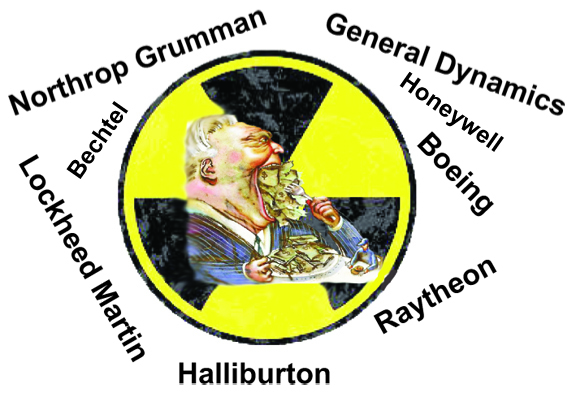
As the war rages on and military spending booms, the US arms industry is a big winner in Ukraine
ABC News, By Annika Burgess 21 Jan 23
As the war in Ukraine heads towards the one-year mark, so far there has been only one clear winner — the US arms industry.
There is no way Ukraine would have been able to hold out against Russia without American weapons.
But as the conflict rages on, there have been accusations from some EU officials that the US is profiting from the war through weapons sales and gas prices.
Meanwhile, analysts have warned of excessive spending and the US military-industrial complex (MIC) expanding beyond what is needed in response to Ukraine.
Defence budgets are also booming worldwide as countries replenish stocks sent to Ukraine and try to boost military capabilities in the face of mounting security threats.
Ultimately, the US defence contractors are set for a bonanza. ……..
What are the issues with the MIC?
The military-industrial complex is a term coined during the Cold War to describe the relationship between a government and defence industry contractors that lobby for increased military spending.
A country’s MIC has the potential to exert influence over government policy, especially if there are legislators who can benefit from the partnerships.
In the US, there is a wider vested interest in keeping the industry thriving, especially for local economies that are highly dependant on defence contractors for jobs.
Charles Miller, senior lecturer at the ANU’s school of politics and international relations, said about 800,000 jobs are directly tied to the sector.
“The local economy is highly dependent on defence contractors for its economic wellbeing,” Mr Miller told the ABC.
“And that’s not the Raytheons or the Boeings themselves, but what’s called the secondary contractors — that is, the people and the companies that make a living by servicing them.”
Former US president Dwight Eisenhower warned of the rise of the MIC and its threat to democracy in his 1961 farewell address.
“He viewed it as a huge problem,” Bill Hartung, a defence analyst at the US Quincy Institute for Responsible Statecraft, told the ABC.
“Although, he did say in the Cold War-era large military sales were necessary, but the question was how to control it, and what democratic guardrails could be put in place.”
Today, there doesn’t seem to be the same level of concern.
The MIC was already a “powerful force”, and in response to Ukraine the US has stripped away many safeguards to protect against waste and price gouging, Mr Hartung said.
He added that a lot of changes being discussed will last far beyond the war in Ukraine.
“The United States is kind of seizing this moment to try to get out a bunch of things that have been on their wish list for years, like committing to multi-year procurement of weapons,” Mr Hartung said.
“All of which will probably make it easier for those companies to rip off the government, because there will be less negotiation over prices and the inclination to just push things out the door.”………………………………….
Who are the biggest winners?
Since Russia’s full-scale invasion in February 2022, the US and its NATO allies have been throwing tens of billions of dollars worth of military aid Ukraine’s way.
The United States alone sent around $US21.3 billion ($30 billion) in security assistance to Kyiv last year.
Contracts have been rolled out thick and fast to speed up weapons production and fill supply gaps.
And there are a small number of companies in the highly consolidated industry that are reaping the rewards.
Lockheed Martin, Raytheon, Boeing and Northrop Grumman — all from the US — are among the top contractors.
They also produce some of the most in-demand and expensive weapons being sent to Ukraine.
The conflict has sent their stocks surging, with the share price of Northrop Grumman increasing 40 per cent by the end of 2022, while Lockheed Martin’s was up by 37 per cent.
In October, the Pentagon announced $US1.2 billion in contracts were underway to replenish US military stocks for weapons sent to the battlefield.
Production for Lockheed Martin’s popular Javelin anti-tank missiles — dubbed “Saint Javelin”, the protector of Ukraine — increased from 2,100 to nearly 4,000 per year.
While production for its High Mobility Artillery Rocket Systems (HIMARS) shot up from 60 to 96 units a year.
The US upped the ante further in November, awarding Raytheon — which also co-produces Javelins — a $US1.2 billion contract for another six National Advanced Surface-to-Air Missile Systems (NASAMS) for Ukraine.
Soon after, Lockheed Martin won a $US7.8 billion contract modification for F-35 aircraft, and $US431 million to deliver new HIMARS and support services for the US Army and its foreign allies.
Australia this month also announced it was purchasing 20 HIMARS and associated hardware for $558 million.
Global defence spending boom
Last month, the US Senate passed a funding bill that included a record $US858 billion in annual defence spending — up from $US740 billion the previous year.
It was $US45 billion more than what was proposed by President Joe Biden.
The bill includes funding for Taiwan and Ukraine, allowing the Pentagon to buy massive amounts of high-priority munitions using multi-year contracts — both to help Kyiv fight Russia and to refill US stockpiles.
“It’s surprising how much it has gone up,” Mr Hartung said.
Hanna Homestead, a policy associate from the Center for International Policy (CIP) — a US-based group monitoring military spending and weapons — said contractors were already receiving a staggering amount.
“In 2020, Lockheed Martin got more money through federal contracts than the Department of State and USAID combined,” she told the ABC.
Allies like Japan have also announced historic surges in defence spending.
Last month, Prime Minister Fumio Kishida said he was boosting Japan’s 2023 defence budget by 20 per cent in the face of regional security concerns and threats posed by China and North Korea.
It includes around 250 billion yen ($3.16 billion) to buy Lockheed Martin fighter jets.
Japan’s major military reform plan will see it double defence spending to 2 per cent of GDP by 2027, using a spending target that follows the NATO standard.
Meanwhile, some NATO countries are pushing for a greater defence commitment in response to the Ukraine conflict, saying the benchmark of 2 per cent of GDP should be the bare minimum.
‘That’s just the way it is’
Many believe the US arms industry doesn’t have a great reputation.
“They continue to arm repressive regimes like Saudi Arabia, Egypt, the Philippines and Algeria that have horrific human rights records and have engaged in destabilising activities,” Mr Hartung said.
He also accused companies of “pure profiteering” when it came to Ukraine, saying they are buying back their own share market stocks to boost the prices at a time when they claim they need more money.
“[This] has nothing to do with making anyone safer,” Mr Hartung said.
“In general, the chaos of war makes profiteering easier.
The European Union’s chief diplomat Josep Borrell has accused the US of profiting from high gas prices, weapons and trade while its allies suffer.
However, Ms Homestead said it was still a small amount of companies getting the bulk of the benefits, which doesn’t necessarily trickle down.
“It’s really the private companies that are profiting, I wouldn’t say the US government is profiting,” she said. …………………………………………. https://www.abc.net.au/news/2023-01-21/us-arms-industry-military-spending-profits-ukraine-war-russia/101843752
New NASA Nuclear Rocket Plan Aims to Get to Mars in Just 45 Days
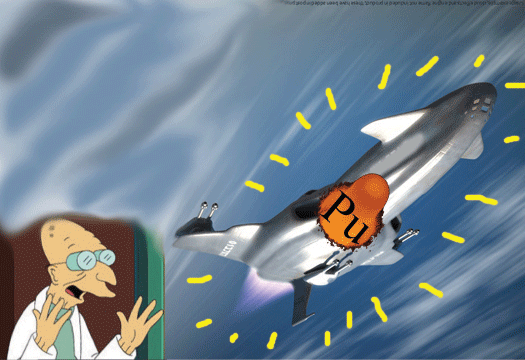
Science Alert23 January 2023, By MATT WILLIAMS, “…………………………. A few years ago, NASA reignited its nuclear program for the purpose of developing bimodal nuclear propulsion – a two-part system consisting of an NTP and NEP element – that could enable transits to Mars in 100 days.
As part of the NASA Innovative Advanced Concepts (NIAC) program for 2023, NASA selected a nuclear concept for Phase I development. This new class of bimodal nuclear propulsion system uses a “wave rotor topping cycle” and could reduce transit times to Mars to just 45 days………………………….
Nuclear-Electric Propulsion (NEP), on the other hand, relies on a nuclear reactor to provide electricity to a Hall-Effect thruster (ion engine), which generates an electromagnetic field that ionizes and accelerates an inert gas (like xenon) to create thrust. Attempts to develop this technology include NASA’s Nuclear Systems Initiative (NSI) Project Prometheus (2003 to 2005)………………………………………..
A transit of 45 days (six and a half weeks) would reduce the overall mission time to months instead of years. This would significantly reduce the major risks associated with missions to Mars, including radiation exposure, the time spent in microgravity, and related health concerns.
In addition to propulsion, there are proposals for new reactor designs that would provide a steady power supply for long-duration surface missions where solar and wind power are not always available………….. more https://www.sciencealert.com/new-nasa-nuclear-rocket-plan-aims-to-get-to-mars-in-just-45-days
2022 saw the slow demise of the Bradwell B nuclear plan

That was the Year That Was…
https://www.banng.info/news/that-was-the-year-that-was/
Andy Blowers summarises the past year for the Bradwell B project in the BANNG column for the January 2023 edition of Regional Life
A year is a short time in the glacial progress of a nuclear power station as it slowly moves through the various hurdles until it falls or proceeds eventually to the point where it goes critical and its long-term legacy becomes eternal and irreversible. So, with Bradwell B’s faltering progress over the past seven years until its fall last year. It may seem, in the words of Charles II, that it has been ‘an unconscionable time a-dying’, but the year just ended has witnessed the slow demise of Bradwell B.
Bradwell B entered 2022 with diminishing prospects. From the moment in early 2020 when it disclosed its preposterous plans to an outraged public, it had struggled for credibility. It’s true that in 2021 the Chinese-designed reactors gained Generic Design Approval (GDA) from the UK regulatory authorities. But, also in 2021, CGN (China General Nuclear Power Group) announced it was pausing its activities indefinitely. No doubt this was, in part, a result of the overwhelming and sustained opposition from BANNG, BAN, local councils and communities that it had encountered over the years.
During 2022 any lingering hopes for the project appeared to vanish amid deepening fears about Sea Level Rise and destructive impacts on our vulnerable coast. And it became clear that Chinese participation in UK nuclear projects was unwelcome for reasons of national security. By the year’s end, CGN informed stakeholders that it was effectively decommitting from its activities on the site with no plans for resumption.
It’s over. Let it go…
So, Bradwell B is over and we can let it go. But the threat of new nuclear at Bradwell will remain as long as the Government categorises the site as ‘potentially suitable’. Other developers may try to muscle in and we know that Rolls Royce has made a ranging shot at Bradwell as a ‘deployable site’ for its non-existent Small Modular Reactors (SMRs). It must be finally and unequivocally demonstrated that the Bradwell site is utterly unsuitable for the deployment of nuclear development, whether big Gigawatts (GW) or big SMRs That has been the nub of BANNG’s campaign over many years and it remains so as we enter 2023.
Ukraine says situation deteriorating at Zaporizhzhia nuclear plant.
Ukraine says situation deteriorating at Zaporizhzhia nuclear plant.
Ukraine’s energy minister said on Friday the situation at the Russian-held
Zaporizhzhia nuclear power station was deteriorating because of the
psychological state of its Ukrainian staff and the condition of equipment.
The Ukrainian staff have remained at the plant in southeastern Ukraine
since Russian forces captured it last March, soon after Moscow’s invasion.
Reuters 20th Jan 2023
The first breach of 1.5°C will be a temporary but devastating failure

The world has already warmed by about 1.2°C since pre-industrial times.
Within the next four years, there is a 48 per cent chance temperatures
could breach the 1.5°C threshold for the first time, according to the UK
Met Office.
At most, the world has nine years until breaching 1.5°C for at
least one year is inevitable, according to the Global Carbon Project. It
would be a totemic milestone. The 1.5°C target has become a guiding light
for the climate movement, after it was included as a “stretch goal” in
the 2015 Paris Agreement.
In the document, the world’s nations promise to
limit any global rise in average temperatures to “well below” 2°C and
to strive for warming of no more than 1.5°C. That inclusion of 1.5°C in
the agreement – fought for by campaigners and small island states at risk
of rising seas – focused scientific minds.
In 2018, the Intergovernmental
Panel on Climate Change published a report on the projected impact of
exceeding the 1.5°C target, which warned that warming beyond this level
would be far more damaging than first thought.
New Scientist 16th Jan 2023
French nuclear safety needs review ahead of reactor lifespan extensions, newbuilds.
https://www.reuters.com/business/energy/french-nuclear-safety-needs-review-ahead-reactor-lifespan-extensions-newbuilds-2023-01-23/ PARIS, Jan 23 (Reuters) – France’s nuclear safety needs a global and systemic review as President Emmanuel Macron’s government prepares to extend the lifespan of the existing fleet while planning to build new reactors, nuclear agency ASN said on Monday.
Bernard Doroszczuk, head of the French nuclear safety watchdog, also told a news conference that utility EDF (EDF.PA) must explain by end-2024 how it plans to extend the life of its nuclear plants up to or beyond 60 years, in order to formulate a first position on the issue within a further two years.
Doroszczuk said a nuclear safety review needs to anticipate the effects of ageing on nuclear installations as well as new challenges posed by climate change.
The government plans to present new energy and climate legislation this summer that will serve as the legislative framework for plans announced by Macron in February 2022 to start construction of at least six new EPR 2 nuclear reactors and to extend the lifespan of as many reactors as possible.
“We need to identify for which components there may be a limit to their operating lifespan,” Doroszczuk said, adding that some components, such as the reactor vessel and the reactor building, cannot be replaced while other components are hard to replace.
“This is not something that can be worked out on the back of an envelope, we cannot decide in a few months whether it is feasible to go beyond 60 years,” he said.
As well as better anticipating the long-term consequences of climate change on the current and future fleet, ASN also wants the new climate and energy law to tackle the issue of treatment and recycling of spent nuclar fuel.
During last year’s heatwave, the watchdog had to grant waivers in order to let certain reactors continue to operate – which had not happened since 2003.
The agency added that EDF unit Framatome had asked it to delay the replacement of the vessel cover of the EPR reactor under construction in Flamanville so it coincided with the first fuel reloading rather than replacing it at the end of 2024 as currently planned.
ASN said that the safety of French nuclear installations overall in 2022 was satisfactory, despite corrosion problems detected on some reactors.
U.S. officials advise Ukraine to wait on offensive, official says
By Steve Holland Reuters 20 Jan 23
Senior U.S. officials are advising Ukraine to hold off on launching a major offensive against Russian forces until the latest supply of U.S. weaponry is in place and training has been provided, a senior Biden administration official said on Friday.
The official, speaking to a small group of reporters on condition of anonymity, said the United States was holding fast to its decision not to provide Abrams tanks to Ukraine at this time, amid a controversy with Germany over tanks.
President Joe Biden, who approved a new $2.5 billion weapons package for Ukraine this week, told reporters at the White House, “Ukraine is going to get all the help they need,” when asked if he supports Poland’s intention to send German-made Leopard tanks to Ukraine. https://www.reuters.com/world/europe/us-officials-advise-ukraine-wait-offensive-official-says-2023-01-20/
Comment: US advises Ukraine not to squander scarce resources.
The US believes that Ukraine should “refocus” on preparations for a new offensive, suggesting fierce battles for the eastern city of Artyomovsk (called Bakhmut by Ukraine) may be “hampering” Kiev. The comments cut against months of Western media reports that described the town as a key, strategic area.
The aid includes a large number of artillery rounds, munitions for the US-supplied HIMARS multi-launch rocket platform, and, for the first time, Stryker combat vehicles – but no tanks. A small number of Ukrainian troops are also undergoing training at a US base in Germany, with some learning how to operate the Patriot missile defense battery authorized for Kiev in December.
The official allegedly said that Western weapons that will be needed for a “mobile offensive force” for future battles are currently “pouring into Ukraine,” adding that Kiev should not waste its limited resources on the “strategically unimportant target,” according to Reuters.
 | |||
Ukraine steps up preparations for new nuclear reactors (NO this is not a joke!)

WNN 23 January 2023
The Cabinet of Ministers in Ukraine has given the go-ahead to begin work on project documentation for the construction of two Westinghouse AP1000 reactors at the Khmelnitsky nuclear power plant.
Ukraine’s Minister of Energy, Herman Halushchenko, said the decision was a key moment for the country.
He said: “The Cabinet of Ministers decided that we are starting to develop technical documentation for a new type of reactors that have never been built in Ukraine. In other words, we have ended the era of the creation of nuclear energy based on Soviet technology.”
According to the country’s energy’s ministry, the target date to complete construction and start-up of the two power units at Khmelnitsky is 2030-2032, subject to the impact of the current war. It estimates the cost of each unit at about USD5 billion. Then cabinet decision means that a technical and economic feasibility study and other project documentation can be taken forward……………………………………….
In June last year, Energoatom agreed to increase from five to nine the number of Westinghouse AP1000 reactors to be built in the country, which will include unit 5 and unit 6 at Khmelnitsky, plus a switch to supply all of the country’s nuclear fuel………………………….more https://world-nuclear-news.org/Articles/Ukraine-begins-preparations-for-first-AP1000-react
Investigation underway after nine nuclear missileers develop non-Hodgkin’s lymphoma
ABC News 23 Jan 23
Nine military officers — who had worked decades ago at a nuclear missile base in Montana — have been diagnosed with a blood cancer, and there are “indications” the disease may be linked to their service, according to military briefing slides obtained by The Associated Press. One of the officers has died.
Key points:
- One of the nine officers diagnosed with non-Hodgkin lymphoma has since died
- Top officials say military medical professionals are investigating the new cases
- Previously, 14 cancer cases were investigated at the base, which was deemed safe
All of the officers — known as missileers — were assigned as many as 25 years ago to Malmstrom Air Force Base, home to a vast field of 150 Minuteman III intercontinental ballistic missile silos.
The nine officers were diagnosed with non-Hodgkin’s lymphoma, according to a January briefing by US Space Force Lieutenant Colonel Daniel Sebeck.
Missileers ride caged elevators deep underground into a small operations bunker encased in a thick wall of concrete and steel.
They remain there sometimes for days, ready to turn the launch keys if ordered to by the country’s president.
“There are indications of a possible association between [this] cancer and missile combat crew service at Malmstrom AFB,” Lieutenant Colonel Sebeck said in slides presented to his Space Force unit this month.
The “disproportionate number of missileers presenting with cancer, specifically lymphoma” was concerning, he said…………………………..
Non-Hodgkin’s lymphoma — which, according to the American Cancer Society, affects an estimated 19 out of every 100,000 people in the US annually — is a blood cancer that uses the body’s infection-fighting lymph system to spread………………..
The median age for adult non-Hodgkin’s lymphoma is 67, according to the National Institutes of Health.
However, the former missileers affected are far younger.
Officers are often in their 20s when they are assigned duty watch.
The officer who died, who was not identified, was a Space Force officer assigned to Schreiver Space Force Base in Colorado, with the rank of major, a rank typically achieved in a service member’s 30s.
Two of the others are in the same Space Force unit with the rank of lieutenant colonel, which is typically reached in a service member’s early 40s…………………………………………………
Last year, President Joe Biden signed the PACT Act, which greatly expanded the the types of illnesses and toxic exposures that would be considered presumptive — meaning a service member or veterans would not face an uphill battle to convince the government that the injury was tied to their military service — in order to received covered care. https://www.abc.net.au/news/2023-01-23/nuclear-missileers-develop-non-hodgkins-lymphoma/101883726
Ukraine storing weapons at nuclear plants.
https://www.rt.com/russia/570349-ukraine-stockpiling-ammo-plants/ 23 Jan 23
Kiev is using the facilities as cover for stockpiles of Western-made munitions, Moscow’s foreign intelligence chief says.
Ukrainian forces are storing Western-supplied missiles and artillery shells in nuclear power plants, Russian Foreign Intelligence Service Director Sergey Naryshkin said on Monday. He claimed that Kiev has been using the plants as cover for ammunition stockpiles..
There is credible information that Ukrainian troops are stockpiling the Western-supplied weapons and ammunition on the territory of nuclear power plants,” Naryshkin said, according to a statement on the intelligence service’s website. He added that the armaments include rockets for US-made HIMARS launchers and missiles used by foreign air defense systems, as well as “large-caliber artillery shells.”
According to Naryshkin, several cars loaded with “lethal cargo” were delivered by rail to the Rovno Nuclear Power Plant in western Ukraine during the last week of December alone. “They rely on the calculation that the Russian Armed Forces would not strike nuclear power plants because they realize the danger of a nuclear disaster,” the intelligence chief said.
Both sides have raised concerns over the safety of power plants since the conflict between Russia and Ukraine broke out in late February. The International Atomic Energy Agency (IAEA) deployed a monitoring mission to the Rovno plant last week and promised to station experts in other facilities in Ukraine.
Russia has accused Ukrainian forces of shelling the Zaporozhye Nuclear Power Plant, which is Europe’s largest. It is located in the eponymous region which, along with three other former Ukrainian territories, joined Russia following referendums in September.
Kiev denied targeting the facility and claimed that Russia was using the plant as a base and cover for its soldiers. Russian officials said that heavy weapons have never been deployed to the site, and that a select number of armed security personnel were maintaining the safety of the plant, as it is located near the frontline.
David Schlissel: Small modular reactor project likely to end badly for Utah utilities

NuScale plan shows no promise of being better than solar and wind.
https://www.sltrib.com/opinion/commentary/2023/01/19/david-schlissel-small-modular/ By David Schlissel The Tribune, Jan. 20, 2023,
Solar and wind power, augmented by battery storage, are becoming less expensive. Hydropower and geothermal energy already are providing substantial amounts of power in many parts of the country. Cost-effective, proven technologies exist and can speed the transition to a carbon-free economy.
Small modular reactors (SMRs) designed by NuScale are not among them.
More than two dozen of the 48 Utah Associated Municipal Power Systems (UAMPS) members have signed on to buy power from the NuScale SMR when the project is planned to come online in 2029. But a history of the project — and of nuclear energy projects in general — suggests the project is likely to end badly for utilities and worse for ratepayers.
UAMPS announced earlier this month that the cost per megawatt-hour (MWh), a unit of measurement roughly equivalent to the electricity used by the average U.S. home for a little more than a month, has risen from $58/MWh to $89/MWh, a 53% increase. Plus, the cost of power from the project would be much higher than $89/MWh without more than $4 billion in subsidies the project would receive from the U.S. government. Already, the total cost of the project has risen from $5.3 billion to $9.3 billion.
Nuclear advocates often claim that the costs of nuclear reactors fall after a first design, which (if true) would be very good news for the NuScale design. Unfortunately, the nuclear industry has never shown the ability to take advantage of a learning curve, and there is no evidence to suggest that it will be able to do so now. A 2020 Massachusetts Institute of Technology study found the costs of successive nuclear projects are more expensive than the original project, which is very bad news for the NuScale design.
It’s also not good news for ratepayers. New reactor designs are already notoriously expensive and highly unlikely to meet initial deadlines. The Westinghouse AP1000 design at Plant Vogtle in Georgia, for example, was originally expected to cost $14 billion and begin operation in 2016. Its price tag has soared past $34 billion, and it won’t provide power until later this year.
Think corporations like Georgia Power, which are posting record profits, will pick up the tab? Think again: Residential consumers have already eaten $1.66 billion of construction costs, with more on the menu.
To be sure, nuclear energy has some advantages. It doesn’t emit carbon dioxide, takes up a relatively small amount of space and produces large amounts of energy. Its advantages, however, become far less apparent when the costs of a nuclear facility — and the time that it takes to build even a modest-sized project — are considered.
Proven, less-costly clean alternatives exist, especially in the western U.S. Geothermal, for example, made up 5.7% of California’s electricity generation in 2021; it was responsible for 9% in Nevada, and it’s being pushed as a much less expensive alternative to the NuScale project. Solar covers about 16% of Arizona electricity production and 6% in New Mexico. Almost 20% of Wyoming electricity comes from wind; in Idaho, the figure is about 16%.
The NuScale SMR is just another in a long line of overhyped and overpriced nuclear projects that take too much time and money — resources the planet doesn’t have in abundance if we’re serious about avoiding cataclysmic climate change by limiting global warming to 1.5⁰C by 2050.
Small modular reactors may be viable one day — but they are not today, will not be tomorrow, and may never make as much economic sense as renewable sources of electricity. We should stick to carbon-free energy sources that make financial and environmental sense.
It comes down to weapons

NewAge, by Richard Moser , Jan 22,2023
THE deep divisions in the US left over the Ukraine war can be reduced to a single practical question: Do you support sending weapons to Ukraine?
The answer to that question depends on whether or not you accept the idea that we’re the cops of the world. The two parties accept this without question but the pro-weapons left? Behind a facade of left-sounding words, political practice tells the tale……………..
The pro-weapons left hides their collaboration with NATO behind the seemingly simple idea that ‘Ukraine has the right to get weapons or seek aid from anywhere they see fit.’ Except that ‘anywhere’ does not exist in the real world. Ukraine is not a customer in some free market for weapons. There is a highly structured supply chain for weapons that is a long-standing feature of the US empire and it is directed by the US war machine. The US has dominated the weapons trade since its rise to global power after WWII. Yes, Russia was often in second or third place, but Ukraine will sure not get its weapons from Russia. The only ‘anywhere’ that actually exists is the US government, which is the primary source for weapons transfers to Ukraine.
The other flaw in the ‘from anywhere they see fit’ formula is the assumption that weapons given from the US to Ukraine are simply an exercise in Ukrainian self-determination — not one way it’s incorporated into the US-dominated global order. Self-determination is not a by-product of the world’s largest military alliance, whose standard operating procedure is to turn allies into pawns and proxies. The drill begins with the mandatory weapons trade demanded of all NATO members. The Ukrainian defense minister recently admitted that Ukraine is a NATO proxy trading blood for weapons.
No, the existing international order is not some normal, natural state of affairs whose peace and harmony was disrupted by the ‘unprovoked’ Russian invasion. To believe that, you’d have to ignore decades of historical context, including the obvious expansion of NATO that put missiles and troops on Russia’s borders, military advisers inside Ukraine and the less obvious policy of ‘full spectrum dominance’ by which the US seeks to dominate ‘everyone, everywhere, all at once.’ The neoliberal world order is no more based on free markets than self-determination or peace.
Instead, Ukraine found itself between two great powers with a long history of hostility and rivalry. Its only hope for self-determination would have been to maintain the balancing act of neutrality and diplomacy, playing one power off the other. …………………………………………………….. more https://www.newagebd.net/article/192295/it-comes-down-to-weapons
French government moves to fully nationalise the nuclear industry

The French state acquired enough EDF shares on the market to start
squeeze-out proceedings as it fully nationalises the nuclear energy giant,
the finance ministry said on Friday.
The government now holds 92.71% of
voting rights in EDF, the ministry said, marking the successful end of the
full takeover proceedings, launched by President Emmanuel Macron’s
government last summer, which cost Paris some $10 million.
Debt-laden EDF, Europe’s biggest nuclear power operator, runs France’s nuclear reactor
fleet, some hydropower plants and other production sites and supplies
millions of households with electricity. Its de-listing from the Paris
stock market will be the end of an era for the utility which was partially
privatised in 2005, when a chunk of its share capital was floated at 33
euros ($35.82) a share.
Reuters 20th Jan 2023
The French nuclear sector up against the wall in terms of recruitment.
The French nuclear sector up against the wall in terms of recruitment. To
build the six reactors announced by the government, the sector must recruit
at least 10,000 people per year until 2030.
L’usinenouvelle 18th Jan 2023
Canadian MP Charlie Angus Questions the Claims of SMRs (Small Modular Reactors)
Proponents of SMRs are on a major spin campaign. None of them have been approved for licensing. The Toronto Star calls them a “boutique boondoggle”. The IPCC raises serious questions about the dangers of nuclear proliferation. Chris Keefer is their big proponent. Here is the exchange at the Natural Resources Committee.
“Proponents of SMRs are on a major spin campaign. None of them have
been approved for licensing. The Toronto Star calls them a “boutique
boondoggle”. The IPCC raises serious questions about the dangers of
nuclear proliferation.”
1 This Month

Read the Public Inquiry Report, the Commissioners’ report, Surrendering Australia: The AUKUS Deception is available to download for free at aukuspublicinquiry.com. Or just watch the replay of the National Press Club Luncheon.


19 November – Webinar – The Reality of Reprocessing
Time: 11:00 AM Pacific Time (US & Canada) / 2:00 PM Eastern / 7:00 PM UK / 8:00 PM CET
Register for the Zoom Event Here



Shut down the radiation-damaged Heysham nuclear reactors now
To see nuclear-related stories in greater depth and intensity – go to https://nuclearinformation.wordpress.com

Say No to NASA’s Reckless Nuclear Reactor on the Moon
Say No to NASA’s Reckless Nuclear Reactor on the Moon
-
Archives
- November 2026 (103)
- October 2026 (302)
- September 2026 (339)
- August 2026 (330)
- July 2026 (355)
- June 2026 (287)
- May 2026 (306)
- April 2026 (356)
- March 2026 (251)
- February 2026 (267)
- January 2026 (308)
- December 2025 (358)
-
Categories
- 1
- 1 NUCLEAR ISSUES
- business and costs
- climate change
- culture and arts
- ENERGY
- environment
- health
- history
- indigenous issues
- Legal
- marketing of nuclear
- media
- opposition to nuclear
- PERSONAL STORIES
- politics
- politics international
- Religion and ethics
- safety
- secrets,lies and civil liberties
- spinbuster
- technology
- Uranium
- wastes
- weapons and war
- Women
- 2 WORLD
- ACTION
- AFRICA
- Atrocities
- AUSTRALIA
- Christina's notes
- Christina's themes
- culture and arts
- Events
- Fuk 2022
- Fuk 2023
- Fukushima 2017
- Fukushima 2018
- fukushima 2019
- Fukushima 2020
- Fukushima 2021
- general
- global warming
- Humour (God we need it)
- Nuclear
- RARE EARTHS
- Reference
- resources – print
- Resources -audiovicual
- Weekly Newsletter
- World
- World Nuclear
- YouTube
-
RSS
Entries RSS
Comments RSS

