With weasel words, Australia’s top military brass, and sycophant Richard Marles, justify allowing U.S. nuclear weapons in Australia

US nuclear-armed bomber visits allowed under Australian treaty obligations The Age, Matthew Knott, February 15, 2023
American B-52 bombers armed with nuclear warheads could rotate through Australia without breaching treaty obligations, the nation’s most senior defence public servant has indicated.
The Australian public would never be informed whether such aircraft are carrying nuclear weapons under the so-called US policy of “warhead ambiguity” in which it neither confirms nor denies if particular forms of military equipment are nuclear-armed.
While adamantly refusing to address hypothetical scenarios, Foreign Minister Penny Wong said: “The responsible way of handling this is to recognise that the US has a ‘neither confirm nor deny position’ which we understand and respect.”
It was revealed last year that the United States is preparing to build dedicated facilities for up to six B-52 bombers at Tindal air base, south of Darwin, for use in the Northern Territory dry season.
Nuclear weapons opponents and the Chinese government blasted the plan on the basis it could escalate tensions in the Asia-Pacific and accelerate an arms race in the region………………….
Australia is prohibited from permanently housing nuclear weapons in the country under its treaty obligations. But Moriarty, speaking in general terms, suggested US nuclear-armed bombers could temporarily pass through Australia without breaching international law.
“The stationing of nuclear weapons in Australia is prohibited by the South Pacific Nuclear-free Zone Treaty to which Australia is fully committed,” Moriarty said.
“There is no impediment under this treaty or the Nuclear Non-proliferation Treaty to the visit of foreign aircraft to Australian airfields or transit of Australia’s airspace, including in the context of our training and exercise programs and Australia’s force posture co-operation program with the United States.”
The B-52 is a long-range, heavy bomber that can carry out ocean surveillance and anti-ship operations and “can carry nuclear or precision guided conventional ordnance”, according to the US government……………
Greens defence spokesman David Shoebridge said: “It is highly alarming that Australian military facilities are being made available for the US to launch its nuclear-capable bombers.
“This decision not only makes us a nuclear target – it further erodes our sovereignty.
“The US has made it clear it won’t tell anyone when their B-52’s are nuclear armed or not. This leaves Australia in the dark about our role in the USA’s global nuclear strategy.”
Defence Minister Richard Marles said that while Australia had agreed to an increased tempo of American rotations in northern Australia, there had been no change in policy regarding the presence of nuclear-armed weapons.
“America maintains a policy of ambiguity in terms of the nature of assets that are on their platforms and they do that so as to amplify their extended nuclear deterrence,” he told the ABC.
Asked whether US nuclear-armed bombers should be allowed in Australia, opposition defence spokesman Andrew Hastie said: “Of course, we want to see a greater presence of the American military in the Indo-Pacific.”……………………………………………
When the ABC’s Four Corners revealed the plan to build dedicated facilities for the B-52s in October, Chinese Foreign Ministry spokesman Zhao Lijian said: “Such a move by the US and Australia escalates regional tensions, gravely undermines regional peace and stability, and may trigger an arms race in the region.”
Greens foreign affairs spokesman Jordan Steele-John said: “Nuclear-capable B-52 bombers have no place on Australian bases, on Australian shores or in Australian airspace. They are an offensive weapon that will destabilise our region.” https://www.theage.com.au/politics/federal/us-nuclear-armed-bomber-visits-allowed-under-australian-treaty-obligations-20230215-p5ckrs.html—
Russia’s Grip on Nuclear-Power Trade Is Only Getting Stronger.
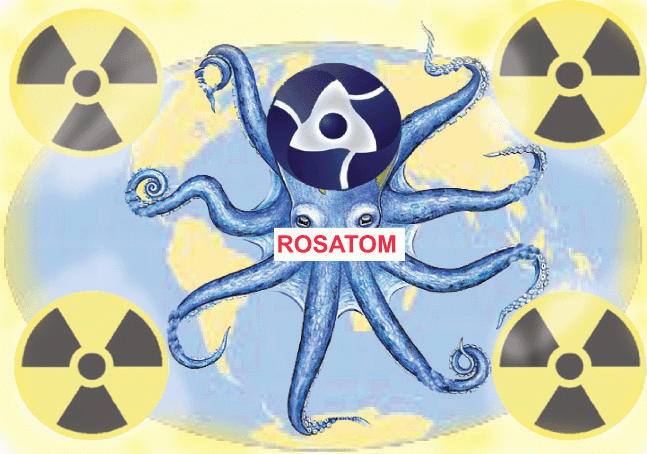
New data shows exports in the strategic industry jumped more than 20% last year, as
long-term projects boost Russian influence. Russia’s nuclear exports have
surged since the invasion of Ukraine, boosting the Kremlin’s revenue and
cementing its influence over a new generation of global buyers, as the US
and its allies shy away from sanctioning the industry. Exclusive trade data
compiled by the UK’s Royal United Services Institute show that Russian
nuclear fuel and technology sales abroad rose more than 20% in 2022.
Bloomberg 14th Feb 2023
Rising seas threaten ‘mass exodus on a biblical scale’, UN chief warns

An increase in the pace at which sea levels are rising threatens “a mass
exodus of entire populations on a biblical scale”, the UN secretary
general has warned. The climate crisis is causing sea levels to rise faster
than for 3,000 years, bringing a “torrent of trouble” to almost a
billion people, from London to Los Angeles and Bangkok to Buenos Aires,
António Guterres said on Tuesday.
Some nations could cease to exist,
drowned under the waves, he said. Significant sea level rise is already
inevitable with current levels of global heating, but the consequences of
failing to tackle the problem are “unthinkable”. Guterres said:
“Low-lying communities and entire countries could disappear for ever. We
would witness a mass exodus of entire populations on a biblical scale. And
we would see ever fiercer competition for fresh water, land and other
resources.
Guardian 14th Feb 2023
Why the US seeks War with China by 2025
A clash between the United States and China over Taiwan would be the result of the United States willfully going to war with China over a matter the United States officially recognizes as China’s internal political affairs.
The current US State Department’s website regarding “U.S. Relations With Taiwan” admits that officially, “we do not support Taiwan independence.”

The US has also poured billions of dollars’ worth of weapons into Taiwan, just as the US did in Ukraine from 2014 onward. The weapons are clearly intended for a Ukraine-style proxy war with China
.
New Eastern Outlook, : Brian Berletic 8 Feb 23
In recent weeks there has been a build-up of talk regarding a US war with China. Not because of any actual provocation from Beijing, but instead because of a collective resignation to its supposed inevitability.
This is best illustrated by comments made by US Air Force General Michael Minihan. In TIME Magazine’s article, “U.S. General’s Prediction of War With China ‘in 2025’ Risks Turning Worst Fears Into Reality,” General Minihan is quoted as saying:
Worst of all is the small but growing presence of US military activity on Taiwan itself.
Even as the US State Department claims it does not support Taiwan independence, in 2021 Voice of America in its article, “US Nearly Doubled Military Personnel Stationed in Taiwan This Year,” admits that not only are there US troops on Taiwan, the number is increasing.
The article explains:……………………………
“My gut tells me we will fight in 2025.”
The article goes on to claim:
“I hope I am wrong,” Minihan, who heads the Air Force’s Air Mobility Command, wrote in an internal memo, which circulated on social media, to the leadership of its 110,000 members. Chinese President Xi Jinping, he explains, “secured his third term and set his war council in October 2022. Taiwan’s presidential elections are in 2024 and will offer Xi a reason. United States’ presidential elections are in 2024 and will offer Xi a distracted America. Xi’s team, reason, and opportunity are all aligned for 2025.”
Yet nothing General Minihan says explains why the United States itself would conceivably find itself at war with the United States. Instead, General Minihan is more or less admitting that the US will go to war with China over Chinese actions regarding Taiwan. In fact, the article goes on to admit:
Minihan’s comments are merely the most immediate of a worrying, emerging consensus that the U.S. and China are destined to clash over Taiwan, the self-ruling island of 23 million that Beijing claims as its sovereign territory.
A clash between the United States and China over Taiwan would be the result of the United States willfully going to war with China over a matter the United States officially recognizes as China’s internal political affairs.
The current US State Department’s website regarding “U.S. Relations With Taiwan” admits that officially, “we do not support Taiwan independence.”
If the US does not support Taiwan independence then by extension the US acknowledges Taiwan is not independent and therefore Washington, officially, recognizes Beijing’s sovereignty over Taiwan. This is what defines the “One China” policy Washington and virtually every other nation on Earth has agreed to in order to establish diplomatic relations with the People’s Republic of China in Beijing.
At a time when Washington regularly lectures Moscow about “violating sovereignty,” Washington’s stance toward Beijing and Taiwan should be a simple matter of respecting Chinese sovereignty. Yet it is not because of the double-game the United States plays both internationally and with China specifically.
Washington’s Deliberate Provocations
TIME Magazine and other Western media publications attempt to depict Beijing as the aggressor, omitting any discussion of either the “One China” policy or the US State Department’s own official declaration of supposedly upholding it.
Instead, Western audiences are led to believe that Taiwan somehow is independent and that Beijing is “bullying” it. The inevitable clash between the US and China is supposedly driven by America’s desire to “stand up” for Taiwan and its inferred sovereignty. In reality, a potential clash between the US and China would be the result of Washington once again violating the sovereignty of another nation thousands of miles from its own shores.
Washington’s double game of officially recognizing Chinese sovereignty over Taiwan while openly and deliberately trampling that sovereignty is best illustrated by former US Speaker of the House Nancy Pelosi’s visit to Taiwan utilizing an official US Air Force aircraft against the protests of Beijing. Pelosi’s trip to Taiwan is only one of many made by US representatives who openly use visits like this in an attempt to goad Beijing……….
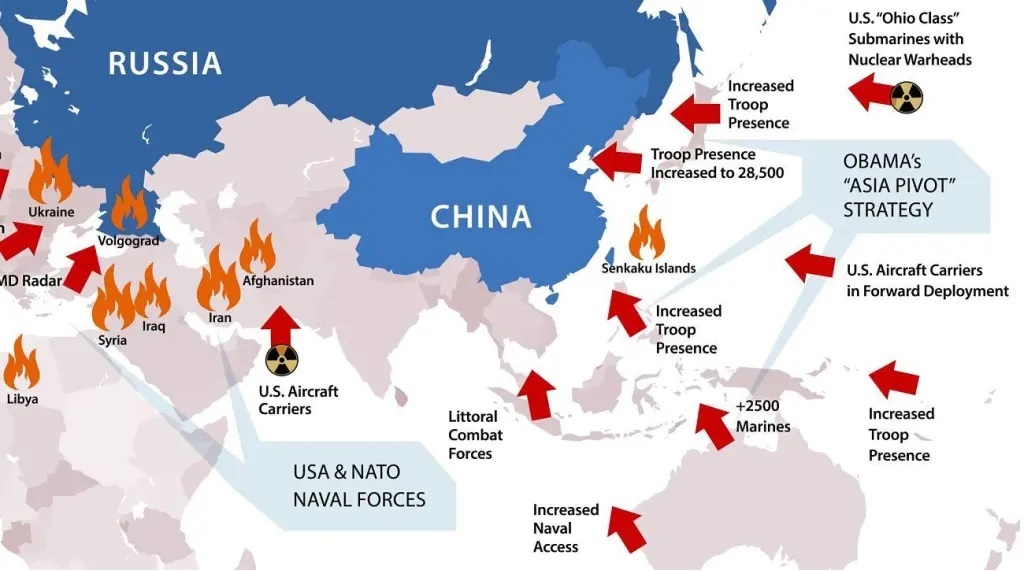
Looking at any map of US military deployments in the “Indo-Pacific” region reveals China as virtually surrounded by the US military by way of South Korea, mainland Japan, Okinawa, and with new basing agreements in the works with Manila, potentially the Philippines as well.
This puts US troops, naval assets, and hundreds of warplanes within striking distance of China, including Taiwan from north, east, and potentially the south.
The US has also poured billions of dollars’ worth of weapons into Taiwan, just as the US did in Ukraine from 2014 onward. The weapons are clearly intended for a Ukraine-style proxy war with China.
Worst of all is the small but growing presence of US military activity on Taiwan itself.
Even as the US State Department claims it does not support Taiwan independence, in 2021 Voice of America in its article, “US Nearly Doubled Military Personnel Stationed in Taiwan This Year,” admits that not only are there US troops on Taiwan, the number is increasing.
The article explains:………………………………….
One could only imagine the reaction in Washington if Beijing and a government in, say San Juan, revealed the presence of Chinese forces in Puerto Rico. Yet as is the case in many instances regarding international relations, American “exceptionalism” not only absolves the US from any penalty for blatant violations of another nation’s sovereignty, it transfers the blame to the nation being targeted itself, in this case, China.
Why US War with China by 2025?
Despite serial provocations, Beijing has exercised exemplary patience and restraint. China has invested heavily in its military and is indeed preparing for conflict with the United States, not because it seeks to wage war with the United States but because the United States has placed its military on China’s doorstep, very clearly seeking war with China.
Taiwan’s full reintegration with the rest of China is inevitable. Already its economy is heavily dependent on access to markets across the rest of China. Harvard University’s Atlas of Economic Complexity reveals that nearly 50% of all exports from Taiwan go to the rest of China. The rest of China also accounts for the largest amount of imports to the island. Many of these imports are crucial inputs for Taiwan’s semiconductor and electronic component production which constitutes, by far, Taiwan’s largest industry.
Only through Washington’s persistent and extensive interference in Taiwan’s local political affairs has gradual reintegration been suspended. Before the US-backed Democratic Progressive Party (DPP) came to power in 2016, the incumbent Kuomintang (KMT) party was on track to sign a trade agreement with the mainland that would have increased already extensive economic integration even further.
Ironically, as the US captured Ukraine politically in 2014, it was also backing opposition protests in Taiwan dubbed the “Sunflower Movement,” paving the way for the DPP’s ascent into power 2 years later. Just like the US-installed client regime in Kiev, the DPP immediately set a course for self-destruction, irrationally rolling back ties with the mainland at the expense of the people living on Taiwan.
More recently, local elections in Taiwan saw the DPP fare poorly, serving as an unofficial referendum rejecting the DPP’s separatist platform, the damage it has consistently done to the local economy, and the instability it has created across the strait with the mainland. However, just as was the case in Ukraine where public sentiment sought peace, Washington and its client regime have every intention of overriding that sentiment in Taiwan, and pushing the island closer still to yet another US-engineered proxy war.
It is clear that it is not China rushing for war with the United States, but precisely the other way around. Time, economics, and proximity favor China. In 10 years, China will be economically and militarily stronger while the US will continue its slow decline. At that point the window of opportunity will have closed for the United States to wage any type of military conflict with China and obtain anything close to resembling “victory.”
Some could argue that the window has already closed.
The Center for Strategic and International Studies (CSIS) recently published the outcome of “wargames” regarding a theoretical Chinese “invasion” of Taiwan in a paper titled, “The First Battle of the Next War: Wargaming a Chinese Invasion of Taiwan.”The paper concludes:
In most scenarios, the United States/Taiwan/Japan defeated a conventional amphibious invasion by China and maintained an autonomous Taiwan. However, this defense came at high cost. The United States and its allies lost dozens of ships, hundreds of aircraft, and tens of thousands of servicemembers. Taiwan saw its economy devastated. Further, the high losses damaged the U.S. global position for many years.
Regarding China, it says:
China also lost heavily, and failure to occupy Taiwan might destabilize Chinese Communist Party rule. Victory is therefore not enough. The United States needs to strengthen deterrence immediately.
In essence, the US will suffer unprecedented military losses and Taiwan itself will be scoured clean of its industry and infrastructure. While CSIS claims that the Chinese amphibious landing was successfully foiled in its wargames thus preserving Taiwan’s political existence, the cost is Taiwan’s physical existence.
Both the CSIS paper together with public comments made by the Pentagon about their own classified wargames indicate disparity between the US and China militarily is narrowing quickly. If there is to be a conflict between the US and China, the sooner it takes place the better chance the US has of achieving a favorable outcome. It is therefore the US racing eagerly toward war, not China. China’s military posture reflects the close proximity of US forces to Chinese territory and their obvious intent to menace China in its own territory, not a China expanding its military capabilities to threaten the United States. In fact, the CSIS paper made a specific note about China’s ability to attack the US “homeland.”
The paper claims:
Because the United States will be striking the Chinese homeland, the base case assumes that the U.S. homeland is not a sanctuary. However, the ability of the Chinese to conduct strikes against the U.S. homeland and thereby affect operations in the Western Pacific is extremely limited. A few special forces might infiltrate and attack a small number of high-value targets but not enough to materially affect military operations in the Western Pacific.
Thus, even in a war between the US and China where the US is conducting strikes on Chinese territory, CSIS admits that China has very limited means to likewise strike at the US. This reveals that US policymakers are not concerned about any real threat China poses to the US, but instead to US “interests” thousands of miles from its own shores and, in fact, within the sovereign territory of China itself.
Potential war between the US and China, if it takes place, will merely be the most recent example of US military aggression in pursuit of global hegemony targeting and attempting to undermine another nation’s sovereignty in violation of international law, not as a means to uphold it. As the US often does, the lead up to this potential war sees the US projecting its own menace toward international law, peace and stability onto the very target of US military aggression, in this case China.
Brian Berletic is a Bangkok-based geopolitical researcher and writer, especially for the online magazine “New Eastern Outlook”.
“No regrets” as UK government portrays nuclear power as “clean” and “green”

Nuclear power to get ‘green’ status as Britain races EU to hit net
zero. Move is part of a bid to unlock billions of pounds of funding for
more power stations. Nuclear power projects such as Sizewell C in Suffolk
will be granted so-called “green” status under plans by Jeremy Hunt to
unlock billions of pounds in funding for the industry. The Chancellor is
expected to announce the change within weeks as part of a broader shake-up
of the UK’s financial rules on green energy.
It would see nuclear power
projects classed as “green” or “sustainable” investments, clearing
the way for more institutional investors and environment-focused funds to
back them. There are also hopes that the Treasury could fund new power
plants with money raised through the Government’s green gilts and green
savings bonds. Generating nuclear power does not produce carbon dioxide, [ if you ignore the total nuclear fuel chain] so the sector is seen as a key plank of Britain’s plans to reach net zero
emissions by 2050.
A recent review by former energy minister and Tory MP
Chris Skidmore said that supporting the construction of more nuclear
reactors was a “no regrets” option. However, the sector has faced
difficulties portraying itself as environmentally friendly in the past
because of concerns about nuclear waste, water usage, and the remote but
catastrophic risk of nuclear accidents. Top fund managers such as Legal &
General and Aviva have previously expressed caution about the green
credentials of nuclear, with Aviva chairman George Culmer last year saying
there was an “ongoing debate”.
Telegraph 14th Feb 2023
Some, but not all, First Nations support small nuclear reactors in New Brunswick

Moltex CEO says company has full support of all 15 First Nations in N.B. to develop SMRs
Jennifer Sweet · CBC News Feb 15, 2023
Companies trying to develop small modular nuclear reactors in New Brunswick are getting some support from an unlikely source.
An energy crisis is looming large, and SMRs have better potential than renewables in the short term, said Chief Terry Richardson of Pabineau First Nation, near Bathurst.
Richardson said he sees nuclear power as consistent with his cultural values.
“As First Nations, we are stewards of the land. Well, when we look at nuclear technology, it’s not a carbon emitter. So it’s not going to cause a problem. It’s going to actually solve the problem of carbon.
“If we don’t do something, we all know what’s happening with climate change.”
Pabineau has signed memoranda of understanding to work with two companies that have SMR projects under way at Point Lepreau — Moltex and ARC, said Richardson.
He describes the MOUs as “non-contractual, binding documents” that state a willingness to work together on development.
Details of exactly how his community and potentially other First Nations in the province may take part in SMR projects have yet to be negotiated, said Richardson.
“There’s going to be an opportunity to be involved on the equity side and that’s where we have to sit down and talk and discuss it and see where we’re going to go.”
After the initial development at Lepreau, ARC is talking about installing more SMRs in Belledune, Richardson noted, which could mean job opportunities in northern New Brunswick.
He also likes that Moltex is looking at reusing spent fuel rods, which it says would reduce the amount of toxic nuclear waste that already exists.
Study looks at SMR waste
A Canadian peer-reviewed study that came out last summer found the volume of waste from SMRs would be between double and 30 fold that from a typical reactor and that its chemical complexity would make it more difficult to manage.
Richardson said he is satisfied that plans are in place to deal with nuclear waste and added that maybe in the future there will be a way to recycle it…..
Moltex CEO Rory O’Sullivan told the legislative committee Wednesday that his company has the support of all 15 First Nations in the province to develop SMRs.
However, some other Indigenous leaders addressed the committee who have concerns about the SMR plans and the public investment in development.
Chief Hugh Akagi represents the Peskotomuhkati Nation at Skutik, which doesn’t have official recognition as a First Nation in Canada. https://www.cbc.ca/news/canada/new-brunswick/first-nations-small-modular-nuclear-reactors-1.6749808
Officials will not confirm whether US bombers in Australia carry nuclear weapons

By defence correspondent Andrew Greene, 16 Feb 23
Officials have stopped short of ruling out that US strategic bombers are carrying nuclear weapons to Australia, but the government insists any such move would not breach this country’s international obligations.
Key points:
- United States bombers with nuclear capability frequently fly in Australian air
- The US has a policy of refusing to confirm or deny if those bombers carry nuclear weaponry
- The federal government says it respects US secrecy on nuclear weapons
During a Senate estimates hearing on Wednesday Greens senators sought details on whether visiting American aircraft such as the B-52s operating out of the Top End are ever nuclear armed.
The committee was told the United States had a longstanding policy of “neither confirming or denying” the presence of nuclear weapons under its practice of maintaining global operational unpredictability. ……..
Defence Department secretary Greg Moriarty said the “stationing of nuclear weapons” in Australia was prohibited under the South Pacific Nuclear Free Zone Treaty, but the treaty did not prevent visits by the US bombers.
Foreign Minister Penny Wong backed the secretary’s statement and accused Greens senators of trying to “make a political point”.
“This is the Australian position: We understand and respect the longstanding US policy of neither confirming or denying. That is the position,” Senator Wong said.
“But we remain fully committed to the South Pacific Nuclear Free Zone Treaty, and we will fully comply with our international obligations, which are understood by the United States.”
Under further questioning from Greens senator David Shoebridge, the foreign minister said it would not be appropriate to elaborate. …………………….

Defence mulls methods to make warships more deadly
Defence has also revealed it is examining ways to make Australia’s next fleet of warships more lethal. ……………more https://www.abc.net.au/news/2023-02-15/defence-wont-confirm-if-us-bombers-carry-nuclear-weapons/101978596
Scotland’s campaign groups call on government to reject plans for nuclear power at new Green Freeports.
NORTH campaigners have called on the Scottish Government to reject plans
to build nuclear plants at the country’s two new Green Freeports.
John O’Groat Journal 14th Feb 2023
THE convener of Scotland’s nuclear-free local authorities (NFLAs) has
written to Net Zero Minister Michael Matheson asking him to reject nuclear
power at Scotland’s two new green freeports.
The National 15th Feb 2023
Earth Changes Summary – January 2023: Extreme Weather, Planetary Upheaval, Meteor Fireballs.
Sott.net
2023-02-14
The start of 2023 has been marked by heavy snow, unseasonably cold temperatures, and wetter-than-expected weather for the season.
Extreme weather hit California pretty hard this month: A bomb cyclone, severe flooding, mudslides, power outages, walls of snow in Soda Spring, and a magnitude 4.2 earthquake with an epicenter in offshore Malibu……………………………….
Heavy snow also disrupted normal life in Italy, Austria, Slovenia, Croatia, and Mallorca. Mallorca was covered by its largest snowfall in more than five years.
China’s northernmost city, Mohe, was hit by an all-time record of -53°C, the lowest ever recorded. The local officials worked overtime to ensure heating and water services. This comes days after temperatures plunged to -50°C in Russia’s Yakutsk.
Central Asia also suffered a harsh January. In Kyrgyzstan, Tajikistan, Uzbekistan, and Turkmenistan recorded unusual levels of snow, that collapsed power poles and trees, blocked main roads, and burst water pipes. Thetemperatures in Kazakhstan reached a chilling -30°C.
The Middle East was also caught off guard by colder-than-usual temperatures and snow. Tens of thousands of Iranians were left without gas amid snow and freezing conditions, and Afghanistan temperatures plummeted as low as -33°C,combined with widespread snowfall, freezing gusts, and regular power outages. At least 166 people died due to the cold wave.
Ex-Tropical Cyclone Ellie continued to batter northern Australia this month. Heavy rain turned roads into rivers, thousands of cattle got lost or died, and boats were the only form of transportation in some counties. Western Australia was also hit hard by heavy rain and floods. 38 homes and 37 businesses were destroyed, with an additional 121 homes damaged. In some cases, the damage is so severe that will require long-term rebuilding efforts. The floods have also caused significant damage to infrastructure and transportation routes.
New Zealand’s largest city declared a state of emergency after torrential rains caused widespread flooding and evacuations. Heavy floods washed away houses, blocked roads, and knocked out power. The city received 75% of its usual summer rainfall in just 15 hours.
Latvia experienced its worst flooding since 1981, forcing residents of central areas to evacuate their homes. Meanwhile, large chunks of ice that drifted from Belkarus caused the water level to rise, while also putting pressure on a new dam.
Other noteworthy events this month:
- Sumatra, Indonesia: Heavy flooding leaves 3 dead and 15,000 homes damaged
- Johor and Pahang, Malaysia: More than 4,000 were displaced by flooding caused by 17 inches of rain in 24 hours
- North Sulawesi, Indonesia: Nearly 18 inches of rain in 48 hours left 3-meter floods in some areas.
- Zambia – Non-stop rains caused catastrophic flooding in southern and central provinces.
And things start to get rocky! A 5.9 Mag earthquake struck northwestern Iran, killing at least seven people and injuring 440.
All this and more in our SOTT Earth Changes Summary for January 2023:… https://www.sott.net/article/477313-SOTT-Earth-Changes-Summary-January-2023-Extreme-Weather-Planetary-Upheaval-Meteor-Fireballs
At Sellafield nuclear site workers ready to go on strike
Hundreds of Sellafield cleaners have voted to strike in anger at a broken
pay promise More than three hundred workers employed by Mitie at the
nuclear power plant have said they are ready to take industrial action.
Bosses had promised to up workers’ pay from November last year to help
with the cost of living crisis. Now they have gone back on their word and
say a pay rise will only be paid from April – six months later. Workers
and GMB representatives will meet in the coming days to discuss strike
dates.
GMB 14th Feb 2023
U.S. military’s newest weapon against China and Russia: Hot air balloon

The Pentagon is quietly transitioning high-altitude balloon projects to the military services.
By LEE HUDSON, 07/05/2022 https://www.politico.com/news/2022/07/05/u-s-militarys-newest-weapon-against-china-and-russia-hot-air-00043860
The Pentagon is working on a new plan to rise above competition from China and Russia: balloons.
The high-altitude inflatables, flying at between 60,000 and 90,000 feet, would be added to the Pentagon’s extensive surveillance network and could eventually be used to track hypersonic weapons.
The idea may sound like science fiction, but Pentagon budget documents signal the technology is moving from DoD’s scientific community to the military services.
“High or very high-altitude platforms have a lot of benefit for their endurance on station, maneuverability and also flexibility for multiple payloads,” said Tom Karako, senior fellow for the International Security Program and Missile Defense Project director at the Center for Strategic and International Studies.
The Pentagon continues to invest in these projects because the military could use the balloons for various missions.
Over the past two years, the Pentagon has spent about $3.8 million on balloon projects, and plans to spend $27.1 million in fiscal year 2023 to continue work on multiple efforts, according to budget documents.
Meanwhile, the Pentagon is working on its own hypersonic weapons program, despite Wednesday’s failure of the latest test.
A bright spot for the U.S. is the balloons may help track and deter hypersonic weapons being developed by China and Russia.
The half billion nuclear kitty litter incident
by Brian Nitz “…………………………. imagine being the person who caused a nuclear accident by ordering the wrong kitty litter?
It happened in February 2014 at a nuclear weapons waste processing facility for the Los Alamos National Laboratory in New Mexico. Anyone involved may be trying hard to forget that it ever happened. The confusion began with a typo in a request for “kitty litter/zeolite clay.” (Zeolites can also be used in energy storage as I wrote here).
At some point this was replaced with kitty litter (clay). This was further transformed into an order for organic cat litter, specifically the sWheat Scoop brand which the manufacturer claims is 100% wheat. Now while the word organic has a folk meaning to environmentalists and hipsters at your local cafe, to chemists it means something more specific……………………………
Don’t try this at home
Green Prophet recently covered the possibilities of using Zeolite for energy storage and this amazing mineral has many more tricks up its sleeve. But while it might seem obvious that anything capable of detoxifying cat pee would be equally effective for nuclear waste disposal, this isn’t necessarily true.
The problem with using 100% organic wheat-based organic kitty litter for your nuclear waste disposal instead of zeolite (non-clay) kitty litter has to do with its reactivity and flammability when confined in a barrel with plutonium, americium, uranium and nitrate-based processing chemicals when compared to zeolite. It doesn’t help that all of this takes place deep underground in an abandoned salt mine where there is much more salt and nuclear waste than there are people to watch it.
So the problem wasn’t discovered until barrel #68660 burst, releasing radiation into a ventilation system. It is believed that several hundred nuclear waste barrels were contaminated with the wrong kind of kitty litter. The cost of the cleanup is said to have been more than half a billion. https://www.greenprophet.com/2023/02/kitty-litter-nuclear/
Richard Marles and Jonathan Mead babble on about nuclear submarines, (adding to the confusion)

Australia will have ‘unequivocal’ control over nuclear-powered submarines, insists chief adviser
‘When we take command of our first boat, we will have sovereign capability’, says Vice Admiral Jonathan Mead,
Daniel Hurst Guardian, 14 Feb 23,
The head of Australia’s nuclear-powered submarine taskforce insists Australia will retain full operational control over the submarines, while potentially having US or British engineers on board to provide technical advice.
The comments follow renewed debate in recent weeks over whether the flagship project of the Aukus pact – which relies on support from the US and the UK – will lead to an erosion of Australian sovereignty.
The former prime minister Malcolm Turnbull has been calling on the government to answer whether the submarines could be “operated, sustained and maintained by Australia without the support or supervision of the US navy”, and whether that effectively meant “sovereignty would be shared with the US”.
But the head of the taskforce advising the Australian government on the acquisition of at least eight submarines, Vice Admiral Jonathan Mead, used an interview with ABC TV on Monday evening to assert Australian control.
“When we take command of our first boat, we will have sovereign capability,” he told the 7.30 program.
“We will be commanding and controlling, under the Australian government direction, that nuclear-powered submarine.”…………………………….
Like the defence minister, Richard Marles, Mead expressed confidence that the plan to be announced soon would ensure there was no capability gap between the retirement of Australia’s existing Collins class diesel-electric submarines and the entry into service of nuclear-powered boats. But he did not provide specifics.
Mead also described the purpose of nuclear-powered submarines as being to “put the greatest question of doubt in the enemy’s mind” and “if necessary, respond with massive firepower”.
Marles used a speech to parliament last week to declare that acquiring nuclear-powered submarines would “dramatically enhance” Australia’s sovereignty, rather than undermine it………
Marles said Australia would “always make sovereign, independent decisions on how our capabilities are employed”.
In the wake of that speech, Turnbull tweeted that it was “quite a different thing to have a major platform that cannot be operated without the supervision/support of another country”
Turnbull said on Monday evening: “I think the question which has not been answered is: could the submarines be operated if US technical advice/support were withdrawn? The entire resources of the Australian news media have been unable to pin the government or the navy down on that.”
Paul Keating, the former Labor prime minister has previously raised concerns about increased reliance on US support and suggested Australia’s sovereignty was being “wilfully suborned”. https://www.theguardian.com/australia-news/2023/feb/13/australia-will-have-unequivocal-control-over-nuclear-powered-submarines-insists-chief-advisor
NewsReal: Alien Balloon Malarkey! Setting The Stage For Proxy War Against China?
What in the name of God is going on in America?
Following last week’s comically bizarre ‘Chinese Spy Balloon Shoot-down’, this weekend the Pentagon declared that it shot down two MORE ‘Chinese balloons’ over Alaska and Canada, and that it scrambled fighter jets to investigate a ‘radar anomaly’ over Montana. (And, since airing, a FOURTH balloon has been downed by the US Air Force over Lake Huron.)
What’s different this week is that the Pentagon isn’t exactly confirming that these latest ‘objects’ are balloons, much less Chinese ‘spy’ ones. In fact, the media and govt spokespeople seem to be deliberately insinuating that these ‘unidentified objects’ are… extraterrestrial in origin!
Nuclear zealot Jonathan Mead touts nuclear-powered submarines- Australia to have “full control” – (oh yeah?)

Australian commanders to have complete control over nuclear-powered submarines and reactors
ABC 7.30 / By Sarah Ferguson and James Elton, 13 Feb 23
Australian Navy commanders will have full operational control over their submarines and the powerful nuclear reactors onboard, despite the potential presence of US or UK engineers.
Key points:
- US or UK personnel may go to sea on Australian nuclear submarines
- Australian technicians will understand “every detail” of how the reactors work
- Construction in Adelaide shipyards may begin by end of 2020s
Vice Admiral Jonathan Mead, chief of the AUKUS submarine taskforce, has rejected criticisms that the nuclear propulsion program, based on US technology, would undermine Australian sovereignty.
“When we take command of our first boat, we will have sovereign capability,” he told 7.30‘s Sarah Ferguson in an exclusive interview.
Details of extensive plans to build a fleet of eight boats powered with weapons-grade uranium will be revealed next month.
Vice Admiral Mead was asked what would happen onboard in the event of any dispute over the nuclear reactor, including following an accident, between a US or UK engineer and the boat’s Australian commander.
“We would expect anyone, be it a foreign engineer or an Australian engineer, to provide advice,” he said.
But the commanding officer of that submarine, the Australian, would have “command and control over the reactor, over the submarine – unequivocal”.
Australians will understand ‘every detail’ of welded-shut nuclear reactors
The defining feature of the submarine deal is that the highly enriched uranium reactors that power the boats will be supplied by either the US or UK, and “welded shut”.
The use of weapons-grade fuel means the reactors do not need to be opened for refuelling over the 30-plus-year life of the boat. Reactors that run on low-enriched uranium, like those used by the French and Chinese navies, do require refuelling.
This also means Australia will not need to manufacture nuclear fuel – one of the commitments the country has made to the International Atomic Energy Agency.
Vice Admiral Mead said Australia would, however, be sending people to US “design facilities” so we would understand “every element of detail of that reactor”.
No Australian reactors … for now
Asked if Australia is considering building its own nuclear reactors in the future, Vice Admiral Mead said: “We are not envisioning that at the moment, we haven’t gone into that at the moment.”
The senior Navy official has spoken previously about the need for the AUKUS program to have public support.
Asked what would happen to an Australian nuclear-propelled submarine that was hit by a missile, Vice Admiral Mead said he could not reveal the technical details but that “nuclear-powered submarines are designed for exacting standards”.
He also said that submariners receive only minimal doses of radiation onboard – less than an ordinary person walking the streets of a capital city.
UK or US-designed boat, and when will we see them?
Addressing the scale of the program, Vice Admiral Mead said if Australia wanted to begin construction of new boats in Adelaide “towards the end of this decade” the government would need to quickly finalise the construction of a revamped shipyard.
He also described the extraordinary staffing requirements of the project, requiring nuclear physicists, chemists and engineers, as well as specialist tradesmen.
One of the biggest questions around AUKUS is whether Australia would be left without a functioning submarine force before the new boats are launched, as the ageing Collins fleet approaches retirement.
Vice Admiral Mead said unequivocally there would be no gap, but would not be drawn on the Navy’s specific plans.
The UK defence secretary, Ben Wallace, recently suggested a new submarine design the three countries could share was under consideration.
Asked whether that strategy would further delay the delivery of new submarines, Vice Admiral Mead reaffirmed there would be no gap in Australia’s capability.
China is the motivation
Vice Admiral Mead said rapid changes in the Indo Pacific had sharpened strategic competition.
“We’ve also seen in recent years a significant modernisation in the Chinese military, particularly the Navy,” he said.
Australia’s current fleet of Collins class submarines run on diesel-electric engines that are extremely quiet when running off the battery.
Nuclear submarines have massive range and the stealth advantage of not needing to resurface, but they do have reactor components that can’t be easily switched off to “go quiet”.
The pros and cons of nuclear and conventional submarines have led defence analysts to suggest a new generation of diesel submarines should be considered as well, particularly to operate closer to the Australian coastline – while the nuclear boats could be prioritised for operations further away from the mainland.
But Vice Admiral Mead said the nuclear submarines would be a good option in both theatres.
“Nuclear-powered submarines provide a capability to deploy away from the home shore, or to deploy close to home shore,” he said.
Pressed on whether conventional submarines would be quieter for closer operations, Vice Admiral Mead said under some circumstances nuclear submarines could be “just as quiet”.
“It’s often more to do with the age and the technology of the submarine that we are dealing with,” he said.
Vice Admiral Mead said the purpose of nuclear-powered submarines was to “put the greatest question of doubt in the enemy’s mind” and “if necessary, respond with massive firepower”.
This type of game-changing capability, he said, would change Australia’s “strategic personality”. https://www.abc.net.au/news/2023-02-13/australian-commanders-complete-control-over-nuclear-submarines/101965182
1 This Month

Read the Public Inquiry Report, the Commissioners’ report, Surrendering Australia: The AUKUS Deception is available to download for free at aukuspublicinquiry.com. Or just watch the replay of the National Press Club Luncheon.


19 November – Webinar – The Reality of Reprocessing
Time: 11:00 AM Pacific Time (US & Canada) / 2:00 PM Eastern / 7:00 PM UK / 8:00 PM CET
Register for the Zoom Event Here



Shut down the radiation-damaged Heysham nuclear reactors now
To see nuclear-related stories in greater depth and intensity – go to https://nuclearinformation.wordpress.com

Say No to NASA’s Reckless Nuclear Reactor on the Moon
Say No to NASA’s Reckless Nuclear Reactor on the Moon
-
Archives
- November 2026 (94)
- October 2026 (302)
- September 2026 (339)
- August 2026 (330)
- July 2026 (355)
- June 2026 (287)
- May 2026 (306)
- April 2026 (356)
- March 2026 (251)
- February 2026 (267)
- January 2026 (308)
- December 2025 (358)
-
Categories
- 1
- 1 NUCLEAR ISSUES
- business and costs
- climate change
- culture and arts
- ENERGY
- environment
- health
- history
- indigenous issues
- Legal
- marketing of nuclear
- media
- opposition to nuclear
- PERSONAL STORIES
- politics
- politics international
- Religion and ethics
- safety
- secrets,lies and civil liberties
- spinbuster
- technology
- Uranium
- wastes
- weapons and war
- Women
- 2 WORLD
- ACTION
- AFRICA
- Atrocities
- AUSTRALIA
- Christina's notes
- Christina's themes
- culture and arts
- Events
- Fuk 2022
- Fuk 2023
- Fukushima 2017
- Fukushima 2018
- fukushima 2019
- Fukushima 2020
- Fukushima 2021
- general
- global warming
- Humour (God we need it)
- Nuclear
- RARE EARTHS
- Reference
- resources – print
- Resources -audiovicual
- Weekly Newsletter
- World
- World Nuclear
- YouTube
-
RSS
Entries RSS
Comments RSS

