Prevent, protect, consult – the NFLA (Nuclear Free Local Authorities)’ three priorities for UK radioactive waste policy

The UK Government has its priorities ‘all wrong’ in its proposals for the future management of radioactive substances and nuclear decommissioning, so says the UK/Ireland Nuclear Free Local Authorities in its response to the Department for Energy Security and Net Zero’s consultation on its proposals for the future management of radioactive substances and nuclear decommissioning.
Instead of an emphasis on cutting costs and reducing the burdens on the nuclear industry as DESNZ would like, the NFLA believes that government and the nuclear industry should do everything necessary for the protection of human health and safeguarding our natural environment – whatever the cost.
To the NFLA, government policy and industry practice should focus upon three main tenets:
- Preventing the creation of more radioactive waste, by not building any more nuclear power plants, by closing and decommissioning existing ones as quickly as possible, and by not revisiting mad-cap schemes that have failed before, like repurposing plutonium as reactor fuel, which creates yet more waste and risks nuclear weapons proliferation;
- Protecting the public and the natural environment, by ‘concentrating and containing’ existing waste on or near the surface on the sites where it was created or is currently stored and having a policy of active ongoing management, with the facility of retrieval if waste is stored below ground. This is opposed to government policy which for high-level waste is focused upon transportation by rail to a Geological Disposal Facility into which the waste would be deposited and forgotten about and for lower-level wastes is one of ‘dilute and disperse’, which involves incineration releasing radiation into the atmosphere or dumping into municipal waste tips or discharging it into rivers or oceans.
- Consulting the public, over the storage and treatment of radioactive waste, and its transportation if this should continue, and also educating the public on the radiological risks attached to these activities; all too often consultation is tokenistic, not inclusive and not open, with the nuclear industry still conducting much of its business behind closed doors.
The author of our response was Pete Roche, the NFLA Policy Advisor (Scotland). Pete has over fifty years of environmental and anti-nuclear campaigning experience, having first been involved in protests against the construction of the Torness Nuclear Power Station in the 1970s.
The NFLA’s full response can be read at the end of this media release [on original]; it amounts to a resounding ‘No’.
The DESNZ consultation is still open for public comments until 24 May 2023.
The consultation papers can be found at https://www.gov.uk/government/consultations/managing-radioactive-substances-and-nuclear-decommissioning
For more information, please contact NFLA Secretary Richard Outram by email on richard.outram@manchester.gov.uk or mobile 07583097793
Links between Nuclear Weapons and Nuclear Power.

International Physicians for the Prevention of Nuclear War (IPPNW) 30 Apr 23
Note from GordonEdwards
* There is one exception. Plutonium-238 is normally present as a very small percentage of reactor-produced plutonium. However, if plutonium-238 is highly concentrated, it generates so much heat that it will melt the conventional explosice charges needed to trigger a nuclear explosion and for that reason cannot be used to make an effective nuclear weapon. However that situation never arises when dealing only with the plutonium produced by a nuclear reactor fueled with uranium. In other words, all plutonium produced in the used uranium fuel from a nuclear reactor is “good” for use as a nuclear weapons explosive material.
This resolution was passed at the 23rd World Congress, in Mombasa, Kenya
by the IPPNW International Council – April 30th, 2023
IPPNW affirms that the links between nuclear power and nuclear weapons are such that in order to fully abolish nuclear weapons, we also must stop the parallel process of nuclear power.
This resolution is an updated version of a similar resolution “Nuclear Weapons and Nuclear Energy – The Links” adopted at the 13th World Congress of IPPNW in Melbourne, Australia, Dec 1998.
IPPNW urges that there be:
- No more uranium mining. Leave it in the ground.
- No more plutonium extraction from existing nuclear materials.
- No new nuclear power plants.
- Expeditious transition from nuclear power to renewable energy sources.
- Blending down of existing stores of highly enriched uranium thus rendering these stores less likely to be diverted for nuclear weapons proliferation. How to handle plutonium to make it safe is still being discussed.
Reasons for Above:
- The acquisition of nuclear-weapons-useable materials is the first step to making nuclear weapons
- The technical processes to create nuclear power or nuclear-weapons-usable materials are essentially the same. Many nuclear plants have produced both. For example Chernobyl was a “dual purpose” plant.
- The 1953 “Atoms for Peace” speech was widely seen as a cover for the military to maintain access to nuclear-weapons material after the closure of the Manhattan Project.
- Nuclear power makes the proliferation of nuclear weapons more likely and verification of nuclear weapons more difficult. For example India made and exploded its first nuclear weapons test from a reactor given to India from Canada. This example of proliferation happened despite promises to the contrary.
- The problem of what to do with high level nuclear wastes remains an unsolved dilemma threatening the environment and human health. This issue is similar for wastes originating from commercial nuclear fuel cycles or wastes from military grade material. Health hazards and multi generational health effects are the same from either stream.
- The ‘weaponization’ of a nuclear power plant can happen in areas of conflict with great risks of purposeful or accidental dispersal of radioactive material. (e.g. Zaporizhzhia plant in Ukraine).
US Politicians Suggest Bombing Taiwan Semiconductor Manufacturing Company (TSMC) in Event of Cross-Strait Conflict
US politicians have once again sparked debate by suggesting bombing Taiwan Semiconductor Manufacturing Company (TSMC) in the event of cross-strait conflict. During a recent Milken Institute forum discussion on China-US strategic competition, Democratic Congressman Seth Moulton stated, “China needs to know that if you invade Taiwan, we’ll blow up TSMC”. While participating in the same panel discussion, US House Foreign Affairs Committee Chairman Michael McCaul revealed that President Tsai Ing-wen had asked him about the status of her country’s weaponry during his visit to Taiwan in April.
This is not the first time that US politicians have suggested bombing TSMC. In 2019, former Vice President Joe Biden had mentioned that the US would have to come up with new ways to counter China’s cyber attacks and intellectual property theft, including striking at Chinese companies like TSMC. Republican Senator Tom Cotton also touched on the topic earlier in May this year when he stated that America’s military response should include targeting Chinese critical infrastructure such as TSMC and Huawei.
Moulton later clarified his stance, saying that it is not the best strategy but only an example. Nevertheless, his comment could bring Taiwan’s technology industry, particularly TSMC, into focus in the escalating tensions between the US and China over the issue of Taiwan. TSMC, a crucial supplier to US firms such as Apple and Qualcomm, has seen its stock fall repeatedly this week following his comment.
Experts have pointed out that bombing TSMC would not only anger China but also cause significant harm to Taiwan’s economy. TSMC accounts for nearly half of the world’s chip production and is a critical part of Taiwan’s technology industry. The threats against it have highlighted how Taiwan, which relies heavily on the US for support, can be caught in the middle of tensions between the superpowers.
The US silence on Israeli nuclear weapons and the right-wing Israeli government
While the US government tiptoes around the issue, Israel brags about its nuclear force.
Who would have imagined that, just as we have been worrying about Pakistani weapons falling into the hands of Islamic fanatics, we would come to the point where we have to fear Israel’s nuclear weapons falling into the hands of Israeli fanatics, who, as Ehud Barak explained, are “determined to attack Islam.” Our government cannot deal with these issues if it ignores the existence of Israeli nuclear weapons.
By Victor Gilinsky | May 4, 2023, Victor Gilinsky is a physicist and was a commissioner of the US Nuclear Regulatory Commission during the Ford, Carter, and Reagan administrations https://thebulletin.org/2023/05/the-us-silence-on-israeli-nuclear-weapons-and-the-right-wing-israeli-government/?utm_source=Newsletter&utm_medium=Email&utm_campaign=MondayNewsletter05042023&utm_content=NuclearRisk_IsraeliNukes_05042023
The Israeli protests against its new right-wing government have now touched on Israel’s nuclear weapons. To underline what is at stake, former Israeli prime minister Ehud Barak cast aside Israeli ambiguity over whether it possesses nuclear weapons to warn his compatriots that Western diplomats are worried that a Jewish messianic dictatorship could gain control over Israel’s nuclear weapons.
One thing we can be sure of is that the United States was not officially represented among those Western diplomats. American diplomats—in fact all US government employees—are forced to pretend they know nothing about Israeli nuclear weapons. Since everyone knows it’s not true, the pretense hobbles America’s policy on restraining the spread of nuclear weapons in the Middle East. Barak’s acknowledgment of Israel’s weapons, backhanded as it was, should free the United States from this outdated omerta.
The popular explanation of the US gag on Israeli nuclear weapons is that it is required by a September 1969 deal between Richard Nixon and Israel’s then-prime minister Golda Meir in which America would accept a nuclear-armed Israel and both would keep Israel’s nuclear weapons secret. US policy toward Israeli nuclear weapons was indeed eased after their meeting, but judging by Nixon’s memoirs, it was because he didn’t care much whether Israeli had them. His main interest was to gain Israeli support in the Cold War.
They spoke alone, kept no notes, and told no one what they talked about. A memorandum days later to the president from Henry Kissinger, then his national security advisor, shows even he knew little about the conversation. As to maintaining secrecy, they didn’t need a formal agreement. Nixon and Meir both understood a declared Israeli nuclear arsenal would have led to pressure on Moscow to provide their Arab allies with nuclear weapons.
The US bureaucracy and academics later created a myth about a nuclear deal, turning a convenient accommodation into a perpetual obligation, and subsequent presidents fell in line. But an international deal of which there is no record is no deal at all.
Nevertheless, US presidents since Bill Clinton are said to have signed a secret letter that they will not interfere with Israel’s nuclear weapons, and Israel acted as if it was entitled to such a commitment from every incoming US president. It got the commitment. When President Obama took office in 2009, the first question at his first televised press conference, from veteran reporter Helen Thomas, was: “Do you know of any country in the Middle East that has nuclear weapons?” The president’s slippery reply was: “I don’t want to speculate.” Helen Thomas got fired soon after, and while this was for her anti-Israeli remarks on a different occasion, no reporter has asked the question since. In February 2017 Israeli ambassador Ron Dermer managed to infuriate even the newly arrived Trump White House staff, sympathetic to Israel, with his heavy-handed demands the new president sign “the letter.” Still, it worked.
A change won’t come easily. A realistic US government assessment of Israel’s nuclear weapons will have to overcome not only Israeli intervention for its own reasons, but also State Department and White House resistance, in part because of the embarrassment of such an admission after years of denial, but also because such an admission could lead to complications under US law.
There is persuasive evidence that Israel detonated at least one test nuclear explosion on September 22, 1979, about a thousand miles south of South Africa. The signal, detected by a US Vela satellite, with corroborating evidence, was widely interpreted by the US intelligence community and most analysts as coming from an Israeli nuclear test explosion.
While the Carter White House publicly argued otherwise, months after the event Carter wrote in his diary: “We have a growing belief among our scientists that the Israelis did indeed conduct a nuclear test explosion in the ocean near the southern end of Africa.” Such an explosion was a violation of the 1963 Limited Test Ban Treaty, to which Israel was a party.
Confirmation of such a test would also trigger the 1977 Glenn Amendment to the Arms Export Control Act, which imposes tough economic and military sanctions on any state, other than the five nuclear powers authorized under the Non-Proliferation Treaty, that detonates a bomb post-1977. The president can waive the penalty, but not without political embarrassment.
While the US government tiptoes around the issue, Israel brags about its nuclear force. At the 2016 ceremony for the arrival of the fifth German-built submarine which Israel outfits with long range nuclear-tipped missiles, Netanyahu said: “Our submarine fleet is used first and foremost to deter our enemies who strive to extinguish us. They must know that Israel is capable of hitting back hard against anyone who seeks to hurt us …” No mention of “nuclear,” but the message was unmistakable.
Who would have imagined that, just as we have been worrying about Pakistani weapons falling into the hands of Islamic fanatics, we would come to the point where we have to fear Israel’s nuclear weapons falling into the hands of Israeli fanatics, who, as Ehud Barak explained, are “determined to attack Islam.” Our government cannot deal with these issues if it ignores the existence of Israeli nuclear weapons.
In his book on Israeli spy Jonathan Pollard, Wolf Blitzer wrote there is “a widely held attitude among Israeli officials that Israel can get away with the most outrageous things. There is a notion among many Israelis that their American counterparts are not too bright, that they can be ‘handled’.” We should not any longer put up with that. The Cold War reasons for America to stay mum about Israeli nuclear weapons evaporated decades ago. What the Israeli government says about its nuclear weapons is its business—but what our government says about it is American business.
The crazy plan to explode a nuclear bomb on the Moon

BBC the next giant leap, 3 May 23
In the 1950s, with the USSR seemingly sprinting ahead in the space race, US scientists hatched a bizarre plan – nuking the surface of the Moon to frighten the Soviets.
…………………………….. At first reading, the title of the research paper – A Study of Lunar Research Flights, Vol 1 – sounds blandly bureaucratic and peaceful. The kind of paper easy to ignore. And that was probably the point.
Glance at the cover, however, and things look a little different.
Emblazoned in the centre is a shield depicting an atom, a nuclear bomb, and a mushroom cloud – the emblem of the Air Force Special Weapons Center at Kirtland Air Force Base, New Mexico, which played a key role in the development and testing of nuclear weapons.
Down at the bottom is the author’s name: L Reiffel, or Leonard Reiffel, one of America’s leading nuclear physicists. He worked with Enrico Fermi, the creator of the world’s first nuclear reactor who is known as the “architect of the nuclear bomb“.
Project A119, as it was known, was a top-secret proposal to detonate a hydrogen bomb on the Moon. Hydrogen bombs were vastly more destructive than the atomic bomb dropped on Hiroshima in 1945, and the latest in nuclear weapon design at the time. Asked to “fast track” the project by senior officers in the Air Force, Reiffel produced many reports between May 1958 and January 1959 on the feasibility of the plan……………………
While it might have helped to answer some rudimentary scientific questions about the Moon, Project A119’s primary purpose was as a show of force. The bomb would explode on the appropriately named Terminator Line – the border between the light and dark side of the Moon – to create a bright flash of light that anyone, but particularly anyone in the Kremlin, could see with the naked eye. The absence of an atmosphere meant there wouldn’t be a mushroom cloud.
There is only one convincing explanation for proposing such a horrendous plan – and the motivation for it lies somewhere between insecurity and desperation.
In the 1950s, it didn’t look like America was winning the Cold War. Political and popular opinion in the United States held that the Soviet Union was ahead in the growth of its nuclear arsenal, particularly in the development, and number, of nuclear bombers (“the bomber gap”) and nuclear missiles (“the missile gap”).
In 1952, the US had exploded the first hydrogen bomb. Three years later the Soviets shocked Washington by exploding their own. In 1957 they went one better, stealing a lead in the space race with the launch of Sputnik 1, the first artificial satellite in orbit around the world.
t didn’t help American nerves that Sputnik was launched on top of a Soviet intercontinental ballistic missile – albeit a modified one – nor that the US’s own attempt to launch an “artificial moon” ended in a huge, fiery explosion. The inferno that consumed their Vanguard rocket was captured on film and shown around the world. A British newsreel at the time was brutal: “THE VANGUARD FAILS…a big setback indeed…in the realm of prestige and propaganda…”
All the while, US schoolchildren were being shown the famous “Duck and Cover” information film, in which Bert the animated turtle helps teach children what to do in the event of a nuclear attack.
Later that same year, US newspapers citing a senior intelligence source reported that “Soviets to H-Bomb Moon On Revolution Anniversary Nov 7” (The Daily Times, New Philadelphia, Ohio) and then followed it up with reports that the Soviets might already be planning to launch a nuclear-armed rocket at our nearest neighbour.
Like with other Cold War rumours, its origins are hard to fathom…………………………………………………..
“Project A119 reminds me of the segment in The Simpsons when Lisa sees Nelson’s ‘Nuke the Whales’ poster on his wall,” says Bleddyn Bowen, an expert in international relations in outer space. “And he says, ‘Well you’ve got to nuke something.’
…………………………………. Most of the details of Project A119 are still shrouded in mystery. Many of the were apparently destroyed…. https://www.bbc.com/future/article/20230505-the-crazy-plan-to-explode-a-nuclear-bomb-on-the-moon
Vogtle-3 nuclear reactor flunked cybersecurity inspections, still at 0% power
The Vogtle-3 nuclear reactor in Georgia hasn’t even reached full power yet
(still at 0% as of yesterday morning) and it has already flunked a
cybersecurity inspection, with three violations, including issues with
procedure adherence and training.
Ed Lyman 6th May 2023
NRC 3rd May 2023
Nuclear Energy and the Non-Proliferation Treaty: A Retrospective Examination
Mycle Schneider & M. V. Ramana
Received 08 Nov 2022, Accepted 17 Apr 2023, Published online: 04 May 2023
ABSTRACT
This commentary looks at how nuclear power has evolved in the last five decades since the Treaty on the Non-Proliferation of Nuclear Weapons entered into force in 1970. Using data on numbers of reactors constructed around the world, we show that the early expectations of a rapid growth of nuclear power plants around the world has not materialized. We also outline the trends in safeguards at nuclear facilities, namely the measures undertaken to prevent the diversion of fissile materials for use in nuclear weapons, and highlight the potential risks due to the rapid growth in the amount of material that could potentially be diverted.
more https://www.tandfonline.com/doi/full/10.1080/25751654.2023.2205572—
The success of the Zelensky regime coming unstuck?
Zelensky regime’s fate is sealed Indian Punchline BY M. K. BHADRAKUMAR
The West’s cryptic or mocking remarks doubting the Kremlin statement on the failed Ukrainian attempt to assassinate President Vladimir Putin do not detract from the fact that Moscow has no reason on earth to fabricate such a grave allegation that has prompted the scaling down of its Victory Day celebrations on May 9, which is a triumphal moment in all of Russian history, especially now when it is fighting off the recrudescence of Nazi ideology on Europe’s political landscape single-handedly all over again.
The alacrity with which the US Secretary of State Antony Blinken debunked the Kremlin allegation, perhaps, gives the game away. It is in the neocon DNA to duck in such defining moments. That said, predictably, Blinken also distanced the Biden administration from the Kremlin attack.
Earlier, the chairman of Joints Chiefs of Staff General Marks Milley also did a similar thing in an interview with the Foreign Affairs magazine disowning in advance any responsibility for the upcoming Ukrainian “counteroffensive”. This is the Biden Administration’s new refrain — hear no evil, speak no evil. No more talk, either, of backing Kiev all the way “no matter what it takes” — as Biden used to say ad nauseam.
The heart of the matter is that Kiev’s much touted “counteroffensive” is struggling amidst widespread western prognosis that it is destined to be a damp squib. Actually, the salience of the Foreign Affairs podcast this week with Gen. Milley was also his diffidence about the outcome. Milley refused to be categorical that Kiev would even launch its “counteroffensive”!
There is a huge dilemma today as the entire western narrative of a Russian defeat stands exposed as a pack of lies, and alongside, the myth of Kiev’s military prowess to take on the far superior military might of a superpower has evaporated. The Ukrainian military is being ground to the dust systematically. In reality, Ukraine has become an open wound that is fast turning gangrene, and little time is left to cauterise the wound.
However, Kiev regime is ridden with factionalism. There are powerful cliques who are averse to peace talks with Russia short of capitulation by Moscow and instead want an escalation so that the Western powers remain committed. And even after Boris Johnson’s exit, they have supporters in the West.
The militant clique ensconced in the power structure in Kiev could well have been the perpetrators of this dangerous act of provocation directed against the Kremlin with an ulterior agenda to trigger a Russian retaliation.
From Blinken’s vacuous remark, it seems the neocons in the Biden Administration led by Victoria Nuland are in no mood to rein in the mavericks in Kiev, either. As for Europe, it has lost its voice too.
This will probably show up in history books as a historic failure of European leadership and at its core lies the paradox that it is not France but the German government that has aligned itself closer with the US in the Ukraine war and risking an intra-European “epoch of confrontation.”
Even otherwise, these are fateful times, with the political middle ground already shrinking in France and Italy and is much weakened in Germany itself in the wake of the pandemic, the war, and inflation. Importantly, this is only partly an economic story, as the decline of the centre and the de-industrialisation in Europe are closely related and the social fabric that supported the centre has come unstuck.
……………………………………….. The considered Kremlin reaction is available from the remarks by the Russian Ambassador to the US, Anatoly Antonov:
“How would Americans react if a drone hit the White House, the Capitol or the Pentagon? The answer is obvious for any politician as well as for an average citizen: the punishment will be harsh and inevitable.” ………………………………………… more https://www.indianpunchline.com/zelensky-regimes-fate-is-sealed/
Five years after Trump’s exit, no return to the Iran nuclear deal
Trump’s slew of sanctions and a changing political climate have contributed to JCPOA remaining in limbo.
Aljjazeera On 8 May 20238 May 2023
Tehran, Iran – Five years ago today, President Donald Trump held up a signed executive order for the cameras at the White House, announcing a unilateral withdrawal from a nuclear deal the United States had signed in 2015 with Iran and world powers.
Despite years of efforts, and after many ups and downs, the landmark accord known formally as the Joint Comprehensive Plan of Action (JCPOA), has not been restored, contributing to rising tensions across the region.
The Trump administration’s many designations of Iranian entities and institutions, specifically aimed at making it difficult for his successor Joe Biden to undo his damage, worked in tandem with a changing political climate to prevent a restored JCPOA.
The then-US president had argued that the deal was not doing enough to permanently keep Tehran from acquiring a nuclear weapon, and Trump rejoiced as he undid one of the most important foreign policy achievements of his predecessor Barack Obama.
His administration set out a dozen conditions to renegotiate a deal more favourable to Washington with Tehran, which would effectively amount to a total political capitulation by Iran…………………………
Iranian leaders, however, have not surrendered their doctrine of defying the US, and attacks by pro-Iran groups on US interests across the region have only multiplied in recent years, according to Washington.
The US assassination of Iran’s top general Qassem Soleimani in Iraq in early 2020 took tensions to new heights, with Tehran and Washington teetering on the edge of war…………………………………………………………..
JCPOA in the region
Since its inception, Israel has been the JCPOA’s biggest foe, incessantly lobbying Washington to declare the deal dead.
Prime Minister Benjamin Netanyahu praised Trump after his reneging on the deal, and Tel Aviv has repeatedly pushed against efforts by other signatories – namely China, Russia, France, Germany and the United Kingdom – to restore the accord through now-stalled talks that began in 2021.
Israel has also warned it will attack Iran to stop it from acquiring a bomb, and Biden’s national security adviser, Jake Sullivan, last week said the US president is willing to recognise “Israel’s freedom of action” if necessary.
The comment drew ire in Tehran, prompting security chief Ali Shamkhani to deem it a US admission of responsibility for Israeli attacks on Iranian facilities and nuclear scientists.
Elsewhere in the Middle East, many Arab states, led by Saudi Arabia, also cheered for Trump as they expressed concern over Tehran’s nuclear programme – which it maintains is strictly peaceful – and its support for proxies across the region.
But as Tehran also ramped up the pressure, and the US gradually saw its role in the region diminished, Arab leaders recognised a need for change.
The 2019 attack on Saudi oil facilities by the Iran-aligned Houthis in Yemen, and the subsequent non-response from Washington, appeared to be a turning point for Arab nations.
After two years of direct talks, Iran and Saudi Arabia agreed in March to restore diplomatic relations in a deal mediated by China, and embassies are expected to be reopened this week.
More challenges ahead
At least for now, JCPOA stakeholders appear to be content with maintaining the status quo while managing tensions.
The passing of two Western-introduced resolutions last year at the board of the International Atomic Energy Agency (IAEA) that censured Iran – and Tehran’s response – and a deadlock in talks since September have not prompted any side to declare the JCPOA dead in the absence of a better alternative for the accord.
The deal’s fate, however, promises to produce more confrontations between Tehran and the West in the coming months.
The Western parties have already reportedly warned Iran that if it further increases its enrichment of uranium to levels that could be potentially used to produce a bomb, it will prompt them to activate the deal’s so-called “snapback” mechanism that will automatically reinstate the United Nations sanctions on Iran.
Iran and the IAEA reached an agreement in Tehran in March to increase cooperation, which could potentially prevent another resolution at the upcoming board meeting of the nuclear watchdog in June.
Another major deadline arrives in October when the JCPOA is set to lift a number of restrictions on Iran’s research, development and production of long-range missiles and drones.
With Israel also pushing for snapback and the West accusing Tehran of selling armed drones to Russia for the war in Ukraine, stakeholders will have their work cut out for them in managing tensions during the coming months. https://www.aljazeera.com/news/2023/5/8/five-years-after-trumps-exit-no-return-to-the-iran-nuclear-deal
Power alert: Be wary of lifting moratorium on new Illinois nuclear plants

Advocates of ending the moratorium have said they want to make it possible to build small power nuclear power plants in the state.
Chicago Sun-TimesBy CST Editorial Board May 9, 2023
Illinois should move carefully before repealing its three-decade-old moratorium on new nuclear power plants.
On Tuesday, the House Senate Energy and Public Utilities Committee will discuss an amended version of a bill passed by the state Senate to lift the moratorium and allow “advanced nuclear reactors.” Advocates of ending the moratorium have said they want to make it possible to build small power nuclear power plants in the state, which would take advantage of new federal spending, although the technology to make that possible is years in the future. And it’s not clear how the “advanced nuclear reactors” in the bill would differ from small modular ones.
Meanwhile, Illinois still faces the problem that led to the moratorium in the first place: There is no long-term storage facility to store nuclear waste, which can go on emitting hazardous radiation for tens of thousands of years.
As envisioned, small modular nuclear power plants would have about a third of the generating capacity of traditional nuclear reactors. Their modular design would allow them to be factory assembled, saving money and allowing them to be constructed on sites too small for traditional reactors. U.S. Special Presidential Envoy for Climate John Kerry has said small modular reactors can be a tool to fight against climate change.
But some environmentalists and stakeholders are wary. “What’s really at play here is the attempt to resurrect the moribund and uneconomic nuclear industry,” said David Kraft, director of the Nuclear Energy Information Service, a nuclear watchdog. “But most fundamentally and important, we need an overhaul of the transmission grid, because you could have a million reactors or you could have a million wind turbines, but if you can’t connect power to the customer, they are worthless.”
…………………. small nuclear plants are a dubious answer. Will the nuclear waste they generate lead to vulnerable storage sites or risky transportation of spent fuel? Global energy prices are higher now, but if they go back down, will smaller reactors be in line for the subsidies larger ones got? Why focus on them when they won’t be built in time to meet the Intergovernmental Panel on Climate Change’s 2030 deadline to halve carbon emissions?
Illinois needs to focus on achieving its goal of transitioning to renewable energy. The state must ensure the idea of new nuclear plants does not divert it from that mission. https://chicago.suntimes.com/2023/5/8/23715796/small-modular-power-nucear-energy-reactors-moratorium-illinois-legislature-editorial
What to Know About Fukushima’s Exclusion Zone and Nuclear Mutations
The Fukushima exclusion zone is the result of a nuclear disaster in 2011. Keep reading to learn more about nuclear mutations and the earthquake that started it all.
BY RAYNA SKIVER. MAY 8 2023, https://www.greenmatters.com/clean-energy/fukushima-exclusion-zone
Back in 2011, a coastal city in Japan was hit by a powerful earthquake and tsunami. When this disaster struck Fukushima, reactors at a nuclear power plant overheated melted, causing radioactive materials to be released into the environment.
Soon after the catastrophe, the Fukushima exclusion zone was created.
After the disaster, the area surrounding the power plant was closed off due to the dangers of radiation— this site is called an exclusion zone. Today, a few places are still closed even after all of these years.
Some people might think that Fukushima is completely unsafe to visit, but that’s actually not the case. In fact, it’s possible to tour the area and learn more about the disaster. Real Fukushima is one of the many organizations that are working to change the public’s perception — they want people to see the city as hopeful, not dark.
The Fukushima disaster resulted in nuclear mutations.
Another result of the 2011 catastrophe was nuclear mutations. According to NBC News, researchers found mutations in butterflies near the Daiichi power plant. This observation was a sign of potential changes to the local ecosystem.
Nearby forests were also affected by the nuclear disaster. Studies showed that leaves had high concentrations of radiation and that there were “growth mutations of fir trees,” according to Greenpeace. The organization voiced concern about the potential consequences that the disaster might have on plants and animals.
The Fukushima nuclear disaster had terrible consequences for the surrounding communities and the environment. According to BBC, the earthquake and the tsunami that followed killed over 18,000 people, with many still missing. Over 150,000 had to evacuate the area as well, due to radiation leaks.
After the event, many countries began correcting design flaws — such as having the generators in the basement — and conducting stress tests in order to minimize future risks. On the other hand, Japan decided to phase out nuclear energy altogether.
The country’s citizens were uncomfortable with their dependence on atomic energy after the disaster, understandably so. Most nuclear power plants in Japan have been idle since 2011. Before the incident, nuclear energy accounted for about a third of the country’s power, but in 2020, the number significantly decreased to less than 5 percent, according to The Guardian.
But now, the country is reconsidering its reliance on nuclear power. Japan is looking for a secure energy supply — the war in Ukraine and rising energy costs have made the feat difficult. Not only might this be an unpopular move with the country’s citizens, but it’s also a loss for the environment.
Nuclear energy produces radioactive waste. This waste can end up harming both humans and the environment, according to the Energy Information Association. Nuclear power plants are also water hungry — they require a lot of water for cooling, Greenpeace explained.
With all of the risks involved, it might be best to turn away from nuclear energy and toward renewable energy.
Bill Gates, Rolls Royce, and others, in the scrum to con the UK government into buying useless nuclear reactor minitrash

Rolls-Royce mini-nukes project under threat as Bill Gates eyes bid
Global interest comes as British company scrambles to secure government contract
By Gareth Corfield, 7 May 2023
Bill Gates is eyeing a bid to build Britain’s first mini-nuclear reactor in a direct challenge to Rolls-Royce which is scrambling to secure a government contract. Seattle-based TerraPower, which was founded by the Microsoft billionaire, said it was considering throwing its hat into the ring for lucrative contracts to build Britain’s next-generation small modular reactors or “mini-nukes”.
In a blog post, Mr Gates said the nuclear energy company’s work “has drawn interest from around the globe”, citing agreements with Japan, South Korea and the Luxembourg-based ArcelorMittal steel conglomerate. TerraPower claims its travelling wave reactor design can “operate for centuries with unenriched uranium fuel”. Founded in 2006, the company secured $830m (£657m) in its most recent funding round last summer. Unlike many traditional SMR designs, the company’s plant, called Natrium, uses a molten salt heat storage system that will allow it to rapidly boost its power output at peak times.
Dozens of other nuclear energy startups are competing to bring their designs into
service, with Rolls-Royce competing against the likes of GE-Hitachi, Mitsubishi Heavy Industries and Westinghouse Electric. In March, US company Last Energy, signed a deal to sell 24 small modular reactors (SMRs) to British customers. While Last Energy still needs regulatory approval for its designs, the company expects the first of its SMRs to be operational by 2026 with no government funding required.
Telegraph 7th May 2023
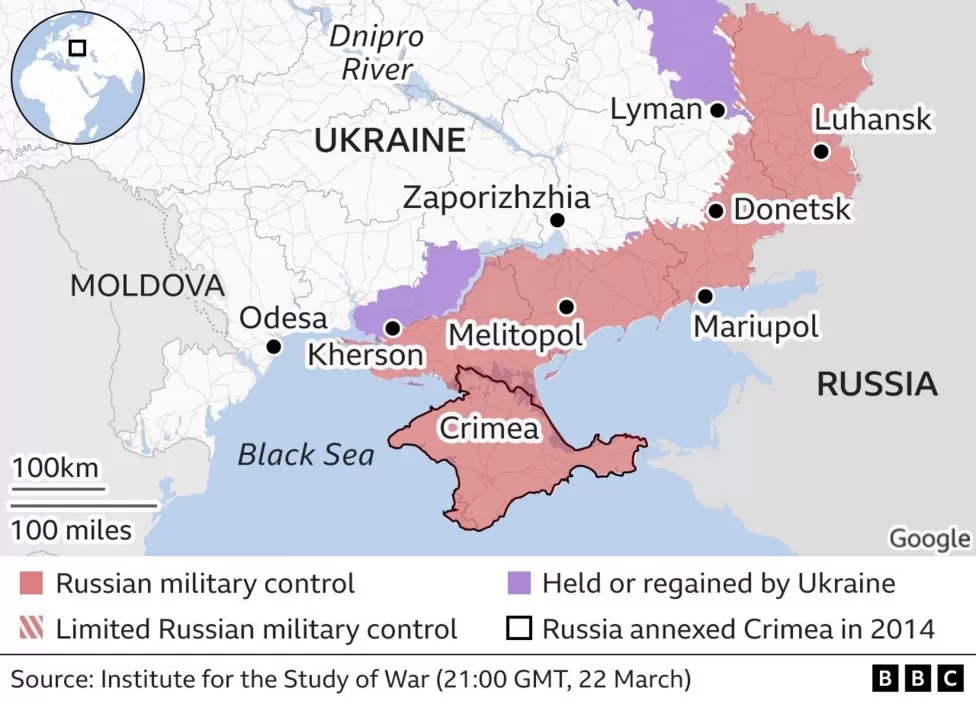
Ukraine war: ‘Mad panic’ as Russia evacuates town near Zaporizhzhia plant
BBC 8 May 23
Russia has sparked a “mad panic” as it evacuates a town near the contested Zaporizhzhia nuclear power plant, a Ukrainian official says.
Russia has told people to leave 18 settlements in the Zaporizhzhia region, including Enerhodar near the plant, ahead of Kyiv’s anticipated offensive.
The Ukrainian mayor of Melitopol, Ivan Fedorov, said there were five-hour waits as thousands of cars left.
The UN’s nuclear watchdog warned a “severe nuclear accident” could occur.
Speaking to the BBC’s Newshour programme Rafael Grossi – the director of the International Atomic Energy Agency (IAEA) – said the evacuation of residents near the nuclear facility indicated the possibility of heavy fighting between Russian and Ukrainian forces around the plant.
Although its reactors were not producing electricity they were still loaded with nuclear material, he said.
Mr Grossi added that he had had to travel through a minefield when he visited the plant a few weeks ago.
Earlier, the IAEA warned in a statement that situation at the Zaporizhzhia facility was “becoming increasingly unpredictable and potentially dangerous”.
Operating staff were still at the site but there was “deep concern about the increasingly tense, stressful, and challenging conditions for personnel and their families”.
It said IAEA experts at the plant had “received information that the announced evacuation of residents from the nearby town of Enerhodar – where most plant staff live – has started”.
On Friday, the Russian-installed regional head Yevgeny Balitsky said that “in the past few days, the enemy has stepped up shelling of settlements close to the front line”.
“I have therefore made a decision to evacuate first of all children and parents, elderly people, disabled people and hospital patients,” he wrote on social media. .
The IAEA has issued warnings previously about safety at the plant – which Russia captured in the opening days of its invasion last year – after shelling caused temporary power cuts.
In March the IAEA warned the plant was running on diesel generators to keep vital cooling systems going, after damage to power lines.
Since Russia launched its invasion in February 2022 the number of staff at the plant has declined, the IAEA says, “but site management has stated that it has remained sufficient for the safe operation of the plant”.
Russian forces occupy much of the Zaporizhzhia region but not the regional capital Zaporizhzhia, which lies just north-east of Enerhodar across the Dnipro reservoir.
On Sunday, the Ukrainian general staff said civilians were being evacuated to the cities of Berdyansk and Prymorsk, further inside Russian-held territory……………………….. https://www.bbc.com/news/world-europe-65515443
Christopher Nolan’s New ‘Oppenheimer’ Trailer Sees U.S. On the Brink of Nuclear War
Cillian Murphy stars as the father of the atomic bomb in the film, hitting theaters in July.
Stacey Ritzen, May 8, 2023 https://www.mensjournal.com/news/oppenheimer-trailer-christopher-nolan
“This is a national emergency,” says Cillian Murphy in the latest trailer for Christopher Nolan’s upcoming epic Oppenheimer, which dropped today. “We’re in a race against the Nazis. And I know what it means if the Nazis have a bomb.”
Murphy stars as the titular J. Robert Oppenheimer, the theoretical physicist credited with the invention of the atomic bomb during World War II. Although the real Oppenheimer would later go on to regret his role and spent the rest of his life advocating against his creation, the film is set during the Manhattan Project, the research and development program that was ultimately responsible for producing the first nuclear weapons.
In addition to Murphy, the star-studded cast features Emily Blunt, Matt Damon, Robert Downey Jr., Florence Pugh, Rami Malek, Benny Safdie, Michael Angarano, Josh Hartnett, and Kenneth Branagh.
“Are we saying there’s a chance that when we push that button, we destroy the world?” Damon’s skeptical Lieutenant General Leslie Groves, the director of the Manhattan Project, asks Murphy’s Oppenheimer midway through the trailer. “Near zero,” the physicist guesses, to which Damon’s character responds: “Zero would be nice.”
In other words, not exactly your typical breezy summer movie fare, as Oppenheimer hits theaters on July 21, 2023. The film, which clocks in at two hours and 30 minutes, has been named one of the most highly anticipated movies of the year. It remains to be seen how its box office returns will fare against the upcoming Barbie movie from director Greta Gerwig, which opens on the same day.
Whitewashing history. Estonia to issue fines for celebrating WW2 victory over Nazis
Rt.com 8 May 23
The Estonian police have warned citizens against displaying any Russian or Soviet flags or symbols, or playing “aggressive music”
Carrying a Soviet flag or sporting any other symbol deemed offensive by the authorities could cost Estonians dearly on Victory Day, the local police have warned. Any gatherings that could be interpreted as “supportive of aggression,” which Tallinn says Russia is waging against Ukraine, are also outlawed.
Speaking to the media outlet Postimees on Thursday, Elena Miroshnichenko, a lieutenant colonel of the Police and Border Protection Department in the Pyhja prefecture, said that while people are allowed to lay flowers at graves and WWII memorials on May 9, they should not have on them “any symbols and shouldn’t listen to aggressive music on their cellphones.”
The official reminded the public that any rallies featuring Russian or Soviet flags, or those of Russia’s Donbass republics, are strictly prohibited. Also off limits are any flags or placards emblazoned with the Latin letters Z and V, which have come to symbolize Russia’s military campaign against Ukraine.
Miroshnichenko stressed that the police are not going to “engage in any dialogue with anyone” found in breach of the rules. Violators can expect to be fined to the tune of up to €1,200 euros ($1,345) or even face prison time………………….
Late last month, authorities in another former Soviet republic, Moldova, warned the public against displaying St. George’s ribbons, which have become a symbol of May 9 celebrations in Russia over the past two decades.
Moldovan Prime Minister Dorin Recean emphasized that individuals running afoul of the ban will face fines.
The country’s parliament outlawed the ribbon along with the letters ‘Z’ and ‘V’ last year as promoting “Russian aggression.”
Earlier last month, Moldova’s Constitutional Court issued a ruling that some opposition politicians construed as a lifting of the ban. The judges, however, were quick to clarify that this was not the case.
According to the Moldovan media, more than 300 people were fined for wearing the ribbon last year. https://www.rt.com/news/575916-eu-nation-police-fine-victory-day/
1 This Month



19 November – Webinar – The Reality of Reprocessing
Time: 11:00 AM Pacific Time (US & Canada) / 2:00 PM Eastern / 7:00 PM UK / 8:00 PM CET
Register for the Zoom Event Here



Shut down the radiation-damaged Heysham nuclear reactors now
To see nuclear-related stories in greater depth and intensity – go to https://nuclearinformation.wordpress.com

Say No to NASA’s Reckless Nuclear Reactor on the Moon
Say No to NASA’s Reckless Nuclear Reactor on the Moon
-
Archives
- November 2026 (84)
- October 2026 (302)
- September 2026 (339)
- August 2026 (330)
- July 2026 (355)
- June 2026 (287)
- May 2026 (306)
- April 2026 (356)
- March 2026 (251)
- February 2026 (267)
- January 2026 (308)
- December 2025 (358)
-
Categories
- 1
- 1 NUCLEAR ISSUES
- business and costs
- climate change
- culture and arts
- ENERGY
- environment
- health
- history
- indigenous issues
- Legal
- marketing of nuclear
- media
- opposition to nuclear
- PERSONAL STORIES
- politics
- politics international
- Religion and ethics
- safety
- secrets,lies and civil liberties
- spinbuster
- technology
- Uranium
- wastes
- weapons and war
- Women
- 2 WORLD
- ACTION
- AFRICA
- Atrocities
- AUSTRALIA
- Christina's notes
- Christina's themes
- culture and arts
- Events
- Fuk 2022
- Fuk 2023
- Fukushima 2017
- Fukushima 2018
- fukushima 2019
- Fukushima 2020
- Fukushima 2021
- general
- global warming
- Humour (God we need it)
- Nuclear
- RARE EARTHS
- Reference
- resources – print
- Resources -audiovicual
- Weekly Newsletter
- World
- World Nuclear
- YouTube
-
RSS
Entries RSS
Comments RSS

