Japanese protesters call for US military to be evicted
https://www.rt.com/news/576288-okinawa-protesters-us-bases-china/ 15 May 23
Increasingly hostile relations between Washington and Beijing have dialed up the urgency of Okinawan protesters’ demands
Thousands of Japanese protesters assembled near Kadena Air Base in Okinawa to protest the US occupation of the island on Saturday, on the 51st anniversary of the island returning to Japanese control.
The annual demonstration comes amid rising regional tensions as the US supplies Taiwan with weapons in what China views as open provocation.
Chanting slogans including “Give us back our peaceful life” and “Osprey get out,” the latter being a reference to US military helicopters, the demonstrators demanded the closure of the US’ Okinawa bases. The island’s inhabitants are weary of the pollution – both chemical and aural – produced by Washington’s military outposts, as well as the high number of crimes committed by American servicemembers, from petty theft and drunk driving to rape and murder.
Governor Denny Tamaki has urged the Japanese and US governments to reduce the Pentagon’s footprint on the island, which hosts 70% of all US military facilities in Japan despite comprising just 1% of the country’s total land area.
The protests come as an increasingly militarized Japan becomes a focal point in the great-power rivalry between the US and China. The US recently fast-tracked a $500 million defense package to Taiwan, just a month after hosting Taiwanese President Tsai Ing-Wen for a hugely controversial “unofficial” visit, eliciting warnings and massive military maneuvers from Beijing.
Last year, Japan’s Ground Self-Defense Force held its first-ever large-scale maritime drill with US troops stationed in Okinawa, enacting scenarios aimed at deterring “competitor and adversary aggression.”
NATO is reportedly even planning to open a liaison office in Tokyo, as the bloc last year discarded the pretense of limiting itself to the ‘North Atlantic’ part of North Atlantic Treaty Organization by inviting its regional allies – Japan, Australia, South Korea, and New Zealand – to its annual summit in a signal of increased focus on Beijing.
Should war break out between the two countries, it is widely understood that the US would use its Japanese bases to stage operations, making Japan a likely target of Chinese retaliation.
Japan approved its largest defense budget ever last year and plans to double defense spending to 2% of GDP by 2027, making its defense budget the world’s third-largest after the US and China, in a drive to acquire “counterstrike capability.” This represents a significant strategic shift away from the solely defensive posture Tokyo has been legally required to maintain since the end of World War II, though the constitution’s language was relaxed in 2017.
Biden too scared to come to Australia because of protests about Julian Assange?

Darn it! I was just about to buy my “Free Julian Assange” shirt – to wear in Canberra, and at the Sydney Opera House, and join thousands of others protesting – wherever Joe Biden dares to show his face in Australia.
USA Republican House Speaker Kevin McCarthy said on Tuesday that a deal on the debt ceiling negotiations might be made by the end of this week. So – perhaps all the panic about the US Debt Ceiling will not be necessary? So – does Biden really need to cancel his visit to Australia?
Never mind – he’s still going to Hiroshima for the G7 summit. That’ll be OK. Everyone will say worthy things about how there must never be another nuclear bombing, and how we must all send drones, tanks, missiles etc to Ukraine . And they’ll say it politely -that’s the thing.
As for those bloody uncouth Australians – heck – someone might throw a rotten egg at Biden, – such is our rage about the persecution of Julian Assange. I mean – the Australian Prime Minister will of course bend over backwards to bed polite, and not mention Assange. And Julian’s family and his other prominent supporters will be courteous.
But ya can’t count on the rest of us downunder colonials to be nice about it.
Yes Joe, – safer to go straight home from the G7 – give Australia a miss.
Nuclear power and the technocratic system are not compatible with democracy: France’s group in Grenoble that fights this system

The nuclear renaissance is a repeat of the fiasco of 1974. Published in La Relève et La Peste, Text prepared by Laurie Debove, January 30, 2023, Translation by Dennis Riches
Translator’s introduction
This interview published in January 2023 has a message for Oliver Stone and all the other cheerleaders of a nuclear renaissance. Oliver Stone’s new film Nuclear Now is just a rehash of Nuclear Then. The discussion below illustrates that there is nothing new about the nuclear renaissance being promoted as a solution to global warming and fossil fuel shortages caused by war. Anti-nuclear arguments were valid then and they still are now, and there isn’t really anything new to add to them. ……………………..
Introduction
The government is doing everything to revive the nuclear industry in France at a rapid pace, to the detriment of the public debate underway until February 27, a debate which is supposed to take account of the opinion of the population on this subject. To get a historical and technological perspective on this issue, we interviewed two people from Grenoble who belong to “Pièces et main d’oeuvre.” They have been active in the fight against nuclear power since the 1970s. We met in a Grenoble café, and in the text below their answers have been edited and compiled into one common voice.
LR&LP: Could you introduce yourselves and your organization?
“……………………………………………..We produce ideas and participate in demonstrations because we believe that ideas can change and transform the course of the world, that they can oppose technology.
LR&LP: What led you to look at nuclear, and what are the biggest pitfalls you found?
“………………………………Throughout the 1940s, 50s and 60s, a divisive critique of nuclear power developed……………………. it was at this time that US President Eisenhower launched the program “Atoms for Peace,” saying that the atom can also have a civilian application in the form of nuclear power plants and research. It therefore proposed technology transfers from the United States to more than twenty countries that wanted to manufacture reactors.
……………. The moment we manufacture nuclear power, we manufacture the consequences of nuclear power and especially its waste.
As we supply the whole of society with nuclear power, we must maintain a scientific clergy of nucleocrats because it is a very complicated and dangerous technology, and on the other hand we must protect these nuclear power plants, mineral mines, transport, and waste with a dedicated militia because we do not want it to fall into the wrong hands.
With the civilian atom, there is therefore an entire electro-totalitarian society that is being set up with a state apparatus, a police, and a particular political organization. No more dreams and utopias of self-management or anarchy. Nuclear waste cannot be managed by just anyone. There is a ratchet effect in it where there is no turning back…………………………………………………………..
LR&LP: Here we are in 2022, and the Autorité de Sureté du Nucléaire (Nuclear Safety Authority) has launched an alert on the failures of the French nuclear fleet. Having seen both the establishment and the evolution of this fleet, was this predictable, and what do you think of the French nuclear recovery plan, imposed by the government, while we see that the [nuclear power plant] EPR of Flamanville has ten billion euros of additional cost as well as twelve years of delay in its construction?
P.M.O: That nuclear power plants wear out, like all factories, is a banality. The life cycle of a nuclear power plant is 100 years on average, from the time construction starts to the time it is decommissioned. Nuclear power costs a fortune, but no matter how much cheap French electricity is promoted, it is a lie. Over time, the state has financed EDF less so we have maintained the plants less. We have fewer trained specialists, and the private sector has not taken over of the cost.
Today we are witnessing a repeat of what happened in 1974 after the Yom Kippur War, when Arab countries punished the West by tripling oil prices. We did not have oil, but nuclear was an alternative, so Pompidou, Giscard d’Estaing and the Prime Minister at the time, Messmer, launched a plan to nuclearize France to compensate for the deficit in oil imports. The uranium came from Niger. We had the skills because the CEA existed since 1945 [for the bomb program]. EDF placed the orders and they manufactured nuclear power plants at a rapid rate.
It is striking to observe how Pierre Messmer’s speech on TV in 1974 and Emmanuel Macron’s speech in Belfort in 2021 are like twins! The recovery is justified by a drop in supplies: at the time the cause was the Arab countries and today it is the Russia-Ukraine conflict.
In the same way, there was an increase in demand at the time because people were forced to equip themselves with electric household appliances, and today it is the means of electric transport and gadgets like smartphones that create this additional demand. On the one hand, industry creates the demand and therefore the problem, and on the other hand it comes with the solution that the population cannot refuse.
The surprise is that we re-apply the same old methods with the same old arguments. It is a headlong rush to ignore the current disaster. We cannot have such a demand for electricity. It is neither sustainable nor reasonable.
……………..There is also the denial of the poisoning of the environment with radioactivity. We live in a world where radioactivity is anthropogenic. Physics teaches us that this is not going away. We could have anticipated all this.
………………………………………………….. a technocratic class developed. In the same way that technology has become the real politics of our time, the real ruling class of our time is technocracy: the class that has produced and is the product of technology (engineers, business leaders, some elected officials).
………… These people are keeping citizens in ignorance. The elected official will then surround himself with scientific advisors that he cannot control since he does not know how to solve their equations.
……….. The basic citizen has integrated this and understood that he does not understand anything, or not much. The citizen therefore relies on those who know.
…………………the technocratic system and technology have the power to change the world, yet it is not compatible with participatory democracy.
LR&LP: However, a public debate has been launched to ask citizens for their opinion. In your opinion, can participating in this public debate allow the French population to regain control over the decisions made on energy production in France? If not, what should everyone do for an informed debate on nuclear technology?
P.M.O: Public debates are like the bullfighter’s cape. The authorities know very well that there will be rants, foghorns, banners, and they find it very good since then the protest is confined to the “public debate”. Chantal Jouanno, the president of the National Commission for Public Debate (CNDP) said the banners are welcome in 2022 because of a precedent in the history of French public debate…………………………………………………………..
A yes or no outcome will have no impact. Sociologists themselves have defined public debate by saying “involvement is enforced acceptance.” For us, participation is therefore accepting, as we have written about extensively. To believe that they will take into account the opinion of citizens on such a vast social project is illusory.
The only real public inquiry on nuclear power ended in a fiasco. That was in Plogoff. The Bretons there refused the public inquiry and fought for weeks against the police. Every evening, hundreds of people gathered to throw stones and slurry because, for them, every form of pseudo-consultation was a smokescreen. This explains why there has never been a nuclear power plant built in Plogoff while they have been built everywhere else.
LR&LP: Power is in the hands of technocrats. “Participation is enforced acceptance.” Therefore, how can a citizen regain an influence in energy production?
“………………………………………………………..The only force likely to turn the tide would be a collective realization that it is not sustainable to continue to consume so much energy, physically and materially, because of entropy and its effects. We would then have to decide to get rid of this energy-intensive and material-intensive lifestyle, and give up certain habits, but it remains an abstract goal.
The problem is that people do not necessarily demand democracy. They are like passengers on a train who, of course, don’t want to be able to drive it. Most people just want a society that works. The question is how.
Further reading
The latest book published by Pièces et Main d’oeuvre:
Technocracy: The Ruling Class of the Technological Age https://dennisriches.wordpress.com/2023/05/14/the-nuclear-renaissance-is-a-repeat-of-the-fiasco-of-1974/
8 arrested at nuclear protest on Mother’s Day
https://www.kitsapdailynews.com/news/8-arrested-at-nuclear-protest-on-mothers-day/ By Staff report • May 15, 2023
A small group of nuclear arms protesters celebrated Mother Earth on Mother’s Day by getting arrested.
Despite the heat, eight peace activists held banners that read, “The Earth is Our Mother Treat Her With Respect” and “Nuclear Weapons are Immoral to Use, Immoral to Have, Immoral to Make.”
Brenda McMillan, 89, wore a T-shirt with Julian Ward Howe’s plea, “Disarm, Disarm!”
The activists are all with Ground Zero Center for Nonviolent Action in Poulsbo. They were cited and released by state troopers for pedestrian on roadways infractions.
Demonstrators included Lee Alden of Bainbridge Island, Sue Ablao of Bremerton, Carolee Flaten of Hansville and Tom Rogers of Keyport.
Traffic was halted and diverted as the 15-member Seattle Peace Chorus Action Ensemble, sang “The Lucky Ones,” an original composition by director Doug Balcom, to the guards and Navy personnel. The song describes the different stages of personal, regional and global destruction that a nuclear war would inflict on humanity.
The civil disobedience was part of Ground Zero’s annual observance of Mother’s Day, first suggested in the United States in 1872 by Howe as a day dedicated to peace.
Earlier in the day 45 people gathered to plant rows of sunflowers at the Ground Zero Center directly across from the Trident Submarine Base. Naval Base Kitsap-Bangor is homeport to the largest concentration of deployed nuclear warheads in the U.S. The nuclear warheads are deployed on Trident D-5 missiles on SSBN submarines and are stored in an underground nuclear weapons storage facility on the base.
Rogers, a retired Navy captain and former nuclear submarine commanding officer who was cited for participating in the action, said, “The destructive power of the nuclear weapons deployed here on board Trident submarines, is beyond human imagination. The simple fact is, that a nuclear exchange between the great powers would end civilization on our planet.”
Fukushima greets summer with dread as nuclear-contaminated wastewater dumping approaches
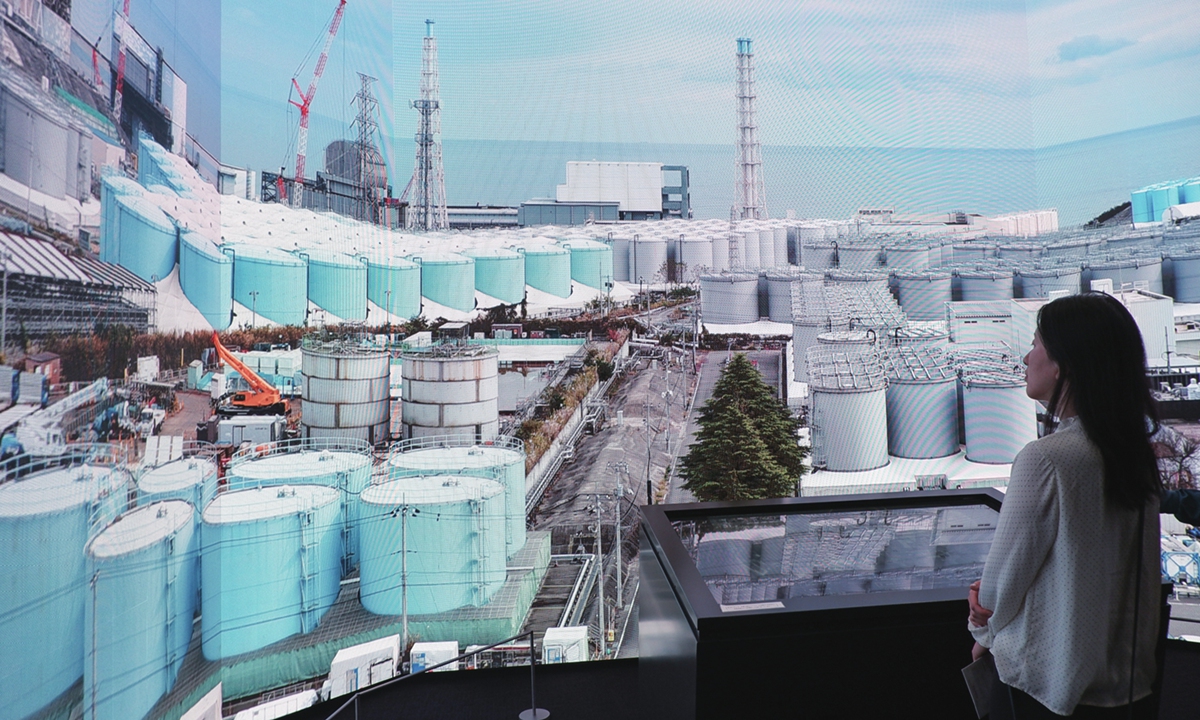
Global Times, By Xu Keyue and Xing Xiaojing in Iwaki, May 15, 2023
The Fukushima Prefecture in northeastern Japan is known as “the island of happiness,” which embodies people’s longing for a better life. Summer began in Fukushima in early May when locals normally look forward to intimate contact with the sea.
However, despite strong opposition at home and abroad, the Japanese government and the Tokyo Electric Power Company (TEPCO) are set to go ahead with the plan to dump the nuclear-contaminated wastewater from the Fukushima Daiichi Nuclear Power Plant into the sea this summer.
As summer approaches, the Global Times reporters went to the Fukushima Prefecture. In this first installment of this field investigation, the Global Times reveals the palpable sense of fear and unease hanging over Fukushima, paired with intense opposition from locals who chanted “Never allow arbitrary dumping into the sea!”………………………………………………………………………………………………………
About 54 kilometers away from the Fukushima Daiichi Nuclear Power Plant, the city looks subdued with few passersby along the streets. The excavation of an underwater tunnel for the project to drain the nuclear-contaminated wastewater from the Fukushima Daiichi Nuclear Power Plant was completed in April, and TEPCO announced that it is expected to complete the construction of the tunnel by the end of June. Measuring 1,031 meters long and 1 kilometer away from the coast, the tunnel will allow radioactive wastewater to be dumped into the sea.
…………………………………………………….. Chiyo Oda, co-chairperson of an environmental NGO and city assembly “Stop polluting the oceans!” was one of them.
“Summer is coming. What’s going to happen? Fukushima greets summer with fear!” said Oda, who expressed strong concern about the dumping of nuclear-contaminated wastewater at a conference themed “Don’t Nuke the Pacific” on May 7. “The Japanese government has reached an agreement with the fishing community that nothing will be done without [the fishing community and other stakeholders’] understanding.” Nevertheless, the Japanese government is apparently breaking its promise and is preparing to dump the water which is likely to start this summer.
When the Global Times reporters met Oda, the 68-year-old woman had just returned to Iwaki from Fukushima city, the capital of Fukushima Prefecture. Early that day, with Kazuyoshi Sato, another co-representative of the city assembly, Oda had driven for two hours to the Fukushima prefectural office to hold a press conference to announce that a mass rally called “May 16 Tokyo Action” will be held in Tokyo on May 16 to urge the Japanese government and TEPCO to stop dumping the nuclear-contaminated wastewater.
Oda told the Global Times that the campaign will last all day on May 16, when anti-sea pollution campaigners from all over Japan are meant to gather in Tokyo. As planned, they will gather in front of the TEPCO headquarters at 10:30 am, and then head to the House of Representatives with lawmakers to hold the rally. The rally and petition to the Japanese government and parliament will be followed by a speech at the Hibiya Open Air Concert Hall in the evening. It will then be followed by a massive demonstration in Ginza, Tokyo, which is expected to be attended by more than 1,000 people.
“The sea of my hometown, the Sea of Japan, and the seas of the world must not be polluted,” said Oda.
Oda noted that the Japanese government, TEPCO, the Fukushima Prefectural Federation of Fisheries Cooperative Associations, and the National Federation of Fisheries Cooperative Associations of Japan signed an agreement in 2015, stating it would not “do anything about the nuclear-contaminated water from Fukushima without the understanding and consent of the relevant people,” but now the Japanese government and TEPCO insist on dumping the water despite opposition from all parties, including fishermen. …………………………………………………………………………………………………………………………………………………………………..
“Look! This is the sea we want to protect!” Ikarashi told the Global Times that he and his family have fond memories of living by the sea, eating the catch from the same sea, surfing, and frolicking with their children. The people of Fukushima live just like them, having enjoyed the bounty of the sea for generations. If the nuclear-contaminated wastewater is dumped into the sea, future generations will no longer be able to enjoy the beautiful nature.
Ruiko Muto, who lives in Tamura, Fukushima, is the head of the association for the victims of the Fukushima nuclear accident. After the accident, she worked hard to hold the former management of TEPCO accountable as a member of the legal team for the Fukushima nuclear accident and the criminal prosecution team.
Muto told the Global Times in an email that “ALPS-treated water” used by the Japanese government and TEPCO contains many other radioactive substances besides tritium, making it “not safe at all.” Under such circumstances, attempts to release the radioactive wastewater from Fukushima into the sea must not be allowed.
Muto said that as summer approaches, her group will join forces with other civic groups and continue to express opposition through protests and rallies.
Dumping not only way
In an on-the-spot interview, Global Times reporters noted the intense concern over whether “ALPS-treated water,” as the Japanese government and TEPCO refer to it, is safe, and whether there is an alternative to dealing with the wastewater.
Hideyuki Ban, a Japanese nuclear expert and co-director of the Tokyo-based Citizens’ Nuclear Information Center (CNIC), told the Global Times that “the nuclear-contaminated wastewater contains 64 radionuclides, including tritium, some of which are very long-lived and cannot necessarily be diluted. [The compounds] can accumulate in the ocean and attach to fish and shellfish, and some of them can enter the body of marine organisms, causing human beings to be exposed to nuclear radiation after consumption. Even if [the wastewater] is treated and released into the sea, it is not safe.”
“There is no precedent in the world for dumping such wastewater containing 64 radionuclides into the sea,” he said.
“The capacity of ALPS to remove radionuclides and the amount of the nuclear-contaminated wastewater to be discharged are not fully understood, let alone gaining the understanding and consent of stakeholders. Under such circumstances, it is not allowed to arbitrarily discharge the wastewater,” he said.
Ban noted that there are other ways to dispose of the wastewater. For example, there is the option of “mortar solidification,” where the nuclear-contaminated wastewater is mixed, solidified, and stored in mortar as in cement production. What the Japanese government has done is based on a political decision, not one based on scientific research, Ban criticized……………………………………………………………………….
The problem, however, is that even if the nuclear-contaminated wastewater is disposed of, key issues such as whether nuclear fuel debris can be removed from the Daiichi plant remain unresolved. The government plans to decommission the reactor in the next 30 to 40 years, but it has yet to give a clear explanation of how long it will take to complete the project and in what condition the facility will have to be in order to qualify as successfully decommissioned, according to Muto.
Surrounded by the sea, Japan gives thanks to the gracious sea as a prosperous maritime nation, on “Sea Day” held annually on the third Monday of July, which is one of the statutory holidays in the country.. Born by the sea, the locals reached by the Global Times could not help but express their deep concern and fear that if the sea is polluted, it will be difficult to enjoy the sea’s succor in the future. https://www.globaltimes.cn/page/202305/1290745.shtml
 |
Threats to journalism posed by UK National Security Bill brushed aside by Parliament

Mohamed Elmaazi, Truth Defence, 14 May 23
While the imprisonment of Julian Assange at London’s Belmarsh high-security prison — for the fourth consecutive World Press Freedom Day — was being raised by media outlets, civil liberty groups and press freedom organisations the world over, 3 May 2023 saw the UK House of Commons debate the latest iteration of the increasingly draconian National Security Bill 2023 (National Security Bill).
The National Security Bill creates a raft of new offences, including two which mandate either a fine or life imprisonment and multiple other offences prescribing a maximum of either 10 or 14 years imprisonment.
In March, a number of Peers in the House of Lords raised strongly worded concerns and proposed some level of restrictions but were ultimately unsuccessful. The House of Commons has not taken up these concerns either.
Number 10 and the Home Office, along with a majority of parliamentarians in both houses, are justifying this bill as necessary to protect national security and defend the country from “espionage”, “sabotage” and “foreign interference.”
A detailed analysis of the earlier version of the National Security Bill from June 2022, which I drafted for Consortium News and which remains valid, should be consulted by readers seeking more information.
The National Security Bill 2023 is over 200 pages long and the most recent version as amended on 7 March 2023 can be found here with proposed Lords amendments as of 15 March found here and the subsequent amendments, disagreements and reasons made on 3 May 2023 found here.
For simplicity’s sake, “Clauses” in the Bill are referred to here as “Sections”, because that is what they become known as once a bill becomes law.
Despite government assurances, the National Security Bill would, if enacted, radically curb whistleblowing, public interest and adversarial journalism, and stifle direct action activism, all to levels unseen in the UK for multiple generations, if not in its entire history.
Life in Prison for Receiving Restricted Material…………………………………………………………..
“A Powerful Chilling Effect” on Investigative Journalism
These offences “would cover a wide range of reporting, whether about sexual assaults on board a nuclear submarine, Chinese influence in the UK, bullying by intelligence officers, an innocent photograph of a nuclear power station or huge investigations such as the Panama Papers,” Lord Black of Brentwood said during the Lords debate on 1 March 2023.
“The problem is that, when journalists start investigating a story, they cannot possibly know where it will lead and whether their reports might,” Lord Black said.
This creates a “powerful chilling effect on investigative reporting by responsible journalists,” he added. …………………………………………………….
Passing off “National Interest” for “National Security”
“[W]ithout a narrower definition of the interests of the UK, the Bill contains a worrying restriction on investigative journalism and campaigning where conduct that could be taken to breach Clauses 1 to 5 might be contrary to government policy,” Lord Marks noted………………………………………………………………….
A Convoluted and Draconian Law With No Real Protections
The House of Commons, on 3 May 2023, did not revive the matter of the need for protection for journalists and whistleblowers within this bill nor did they seek to restrict the application of the offences against journalists and activists………………………………..
It is noteworthy that the public can also be excluded — on national security grounds — from legal proceedings resulting from charges in this bill.
The National Security Bill appears fairly close to being finalised within the next month or two, and without any major organised opposition from the public and press, seems likely to pass without any journalistic or public interest protections whatsoever.
Truth Defence will publish at least two more posts on the National Security Bill. One will outline some of the new powers designed to authorise government officials to demand information, including journalistic materials from individuals. A further post will address the incredibly nebulous defined offences of “Foreign Interference”.
We will continue to update its subscribers in relation to this bill and other laws and policies which seek to curb and control the right to dissent, seek out information and hold the powerful to account. https://truthdefence.org/threats-to-journalism-posed-by-uk-national-security-bill-brushed-aside-by-parliament/
Britain leads the way in escalating the Ukraine war with long range missiles

Robert Stevens10 May 2023 WSWS UK deepens warmongering in Ukraine with plans to supply long-range missiles
The UK is again leading the way in a massive further escalation of the NATO war against Russia.
On Monday, the Washington Post reported that the UK’s Ministry of Defence (MoD) had issued a call to weapons manufacturers, on behalf of the International Fund for Ukraine (IFU), to supply missiles capable of striking Russian-annexed Crimea or cities deep inside Russia’s borders. Over £300 million in funding has been made available through donations from the UK, Norway, the Netherlands, Denmark, Sweden, plus Iceland and Lithuania.
The MoD’s notice referred to “Missiles or Rockets with a range 100-300km; land, sea or air launch” and “Payload 20-490kg”. Listed as “Desirable requirements” were: “Low Probability of Intercept (LPI); includes Mission Planning Capability; Assured navigation (with hardened Global Navigation Satellite System capability) in the face of advanced countermeasures and EM spectrum denial; Air defence penetration methods to increase probability of successful strike; Technical Readiness Level of at least 8”.
This fits the profile of the UK’s own Storm Shadow missile which has a range of in excess of 250km. Costing £2.2 million apiece, the weapon is manufactured by the UK/French/Italian arms group MBDA for the British and French armed forces. According to the Forceswebsite, the Storm Shadow was “developed primarily for stealth strikes,” is “capable of engaging the targets precisely in any weather conditions during day and night” and boasts “long-range low attitude paths combined with subsonic speed.”…………….
The Guardian reported Wednesday, “A British official, speaking anonymously, said the tender requirements were ‘rather consistent’ with the Storm Shadow.” An MoD spokesperson said that a final decision to supply Ukraine with long-range Ukraine would rest with the main five countries in the IFU.
This was just for public consumption. Everyone knows that it is Britain, acting in tandem with the United States, that will decide what gets sent. This was made clear by the statements cited in the Washington Post made by British Prime Minister Rishi Sunak in February in his speech to the Munich Security Conference:…………
Sunak added definitively, “The United Kingdom will be the first country to provide Ukraine with longer range weapons.”
His pledge was all but confirmed this week by UK Foreign Secretary James Cleverly, in Washington to hold talks with US Secretary of State Antony Blinken and the Atlantic Council think tank “on the United Kingdom’s role in an increasingly adversarial world.”……….
Cleverly commented, “Air defense missile systems became increasingly important over time, and in the next stage we’ll see another evolution of the support.”
Britain’s role as chief provocateur in the lead up to and during NATO’s war against Russia is a matter of record. It has also led the way in ensuring ever-more lethal military hardware has been flooded into Ukraine, with the resulting mass loss of life, both Ukrainian and Russian, not even an afterthought.
Yuriy Sak, an adviser to Ukrainian Defense Minister Oleksiy Reznikov, told Reuters, “We would welcome it if the UK takes on a leadership role with the long-range missiles, in the same way they did with the Challenger 2 main battle tanks.”
Politico responded to the MoD’s announcement with a piece declaring, “The Biden administration has no plans to follow Britain’s lead in sending long-range missiles to Ukraine—with some officials saying the U.S. is now off the hook thanks to the U.K.’s planned delivery.”
……………………………………….. At every stage in the conflict, NATO has escalated the conflict with the supply of weaponry that US President Joe Biden himself and NATO officials had previously unconditionally ruled out. The Guardian noted, “Britain is unlikely to want to go ahead without US support, and getting to this point may have required diplomatic wrangling.”…………………………………………….. https://www.wsws.org/en/articles/2023/05/10/dvvj-m10.html
How the Greens are conquering the Tory countryside

In the vote on May 4, the Greens won Mid Suffolk district council from the
Conservatives, taking 24 of the 34 seats and securing their first ever
majority-held council in the UK. It was the biggest wave in a national
tidal surge of rural support for the party. The Greens doubled their
councillors nationally from 240 to 481 — and became the largest party in
East Hertfordshire and Lewes in East Sussex. They also took 12 seats in
East Suffolk, and made gains in Cumberland, South Tyneside, Hastings and
Worcester.
Times 14th May 2023
https://www.thetimes.co.uk/article/how-the-greens-are-conquering-the-tory-countryside-fjzw6mhvv
Wildfires, heat waves in Canada, Russia, Mongolia Kazakhstan
Wildfires in the boreal forests of Canada and Russia of rising intensity
are sharply reducing air quality and pumping tons of carbon dioxide into
the earth’s atmosphere, the EU’s earth observation programme has warned.
Fires in Canada’s main oil-producing province of Alberta alone have burnt
about 1 million acres since January 1 and forced nearly 30,000 people to
evacuate in the past week. The relocation of communities and proximity of
fires also caused more than a dozen oil and gases companies to temporarily
shut or curtail operations, including Cenovus Energy, Paramount Resources,
Crescent Point Energy, NuVista Energy and Tourmaline Oil, the country’s
largest gas producer.
In Russia, wildfires are burning across the Urals and
Siberia, in a band stretching from the Chelyabinsk region across Omsk and
Novosibirsk regions to Primorye, and are also affecting Kazakhstan and
Mongolia. Earlier this week, local authorities in Russia said more than
54,000 hectares of forests in the Sverdlovsk region in the Urals were on
fire as of Monday morning, the AP reported.
FT 13th May 2023
https://www.ft.com/content/6adb3a9b-c31a-4a36-a45e-0f1239d98014
Pacific Northwest braces for unusually early heat wave threatening to break
records
An unusually early heat wave is expected to start Saturday and last through
Monday in parts of the Pacific Northwest.
Independent 13th May 2023
https://www.independent.co.uk/climate-change/news/heat-wave-oregon-canada-wildfire-b2338272.html
China’s nuclear ambitions get a boost from Russia, but is energy the only goal?

- Moscow is feeding Beijing’s growing appetite for highly enriched uranium, but observers say those supplies could be used for nuclear weapons
- China will replace the US to become the world’s top uranium buyer by 2030, experts say
Liu Zhen, 13 May, 2023, SCMP,
China is importing highly enriched uranium from Russia to produce energy, but observers caution that Beijing also plans to expand its nuclear arsenal. Photo: Shutterstock
The confirmation came last week when Russia said it had agreed to supply highly enriched uranium-235 to energy-hungry China over the next three years.
The announcement backed up reports that the shipments of nuclear fuel – enriched up to 30 per cent – were part of a deal to supply a demonstration fast-neutron power plant, a technology that could help China ease its shortage of nuclear fuel.
…….. with the enriched uranium fuelling a demonstration project for the new technology, China could improve its output of nuclear fuel and go some way to overcoming itst supply problem.
The final product would be plutonium 239, an artificial element that is primarily used in nuclear warheads – and that worries the West.
Although never officially admitted, Beijing is believed to be expanding the country’s nuclear arsenal, in line with President Xi Jinping’s pledge at last October’s 20th Communist Party congress to “strengthen strategic deterrence” as military tensions with the United States and its allies rise.
The US Department of Defence (DOD) has estimated China will increase from 400 warheads today to 1,500 by 2035.
……………………………………………………… With its two 600 megawatt power generators, the CFR-600 is not particularly large and is only considered a “demonstration project”. By comparison, the Daya Bay Nuclear Power Plant near Hong Kong, which has been operating since the 1990s, has two 944 megawatts generators.
In March, US DOD official John Plumb described the China-Russia cooperation deal as “very troubling”, but China’s foreign ministry has defended the arrangement as “perfectly normal and we do not see anything wrong about it”.
………………………… Fast-neutron reactors are an advanced fourth-generation nuclear power plant technology, which function to generate power, multiply nuclear fuel, and incinerate long-lived radionuclides, according to Xue Xiaogang, head of the China Institute of Atomic Energy Science.
……………………………………………. Russia has for decades been a leader in fast-neutron reactor technology, and last year its Beloyarsk BN-800 reactor began running completely on reprocessed spent fuel known as MOX.
But China’s imports of 30 per cent concentrated uranium-235 fuel for the Xiapu CFR-600 meant it was still at an earlier stage of technological development with many obstacles to overcome, said the researcher. https://www.scmp.com/news/china/military/article/3220391/chinas-nuclear-ambitions-get-boost-russia-energy-only-goal
Jamaica’s government planning for small nuclear reactors – but there’s been no public discussion.
The Jamaica Gleaner, 15 May 23 Editorial | Preparing for nuclear power
Having made clear its intention to make nuclear power part of Jamaica’s energy mix, the Holness administration must urgently open a robust conversation with the public to explore the economics of the plan and address any fears people might have about pursuing this idea.
Indeed, it is too often the case that governments, including Jamaica’s, embark upon policies that prove controversial, when they might have avoided pitfalls by engaging their public early. That must not happen with this initiative.
When Prime Minister Andrew Holness raised the nuclear power question at the Jamaica Manufacturers and Exporters Association’s trade exposition earlier this month, there was a sense that the idea was at best embryonic that the government was merely beginning to explore the possibility of introducing either micro and/or small modular nuclear reactors to generate power. However, in his contribution to Parliament’s Sectoral Debate a fortnight later, the energy and technology minister, Daryl Vaz, indicated that the government was far farther along than floating the policy. Not only was it a definitive plan, it was already actively working on how to bring it to fruition.
Indeed, a section of Mr Vaz’s speech is headed: ‘Jamaica to go nuclear’. And according to the minister, the administration has been investigating the issue for two years, has had significant discussions with the International Atomic Energy Agency (IAEA), and is now preparing a road map for how to proceed fully, including the mobilisation of international funding for the project.
………………………………………… the literature (mostly by companies who have designed and are now marketing them) have touted the efficiency and safety of these reactors, but only a handful, primarily in Russia and China, are actually in operation and commercially generating power.
………………………………. being among the early purchasers of first-generation products, before the design flaws and other kinks are ironed out, carries risks, which it is important that Jamaica minimises.
…………………….. it should be disclosed early what proportion of the country’s electricity mix is expected to come from atomic power, and whether it will mean any displacement of the proposed, traditional renewable energy sources, such as solar and wind power. https://jamaica-gleaner.com/article/commentary/20230515/editorial-preparing-nuclear-power—
Leak reveals Zelensky privately plots bold attacks inside Russia.(Is his halo slipping?)

They reveal a leader with aggressive instincts that sharply contrast with his public-facing image as the calm and stoic statesman.
Zelensky suggested Ukraine “conduct strikes in Russia”
“Zelensky highlighted that … Ukraine should just blow up the pipeline and destroy likely Hungarian [Prime Minister] Viktor Orban’s industry”
Zelensky then “suggested that Ukraine attack unspecified deployment locations in Rostov,” a region in western Russia, using drones instead, according to another classified document.
The Age, John Hudson and Isabelle Khurshudyan, May 14, 2023
Washington: Ukrainian President Volodymyr Zelensky has won the trust of Western governments by refusing to use the weapons they provide for attacks inside Russia and prioritising the targeting of Russian forces inside Ukraine’s borders.
But behind closed doors, Ukraine’s leader has proposed going in a more audacious direction – occupying Russian villages to gain leverage over Moscow, bombing a pipeline that transfers Russian oil to Hungary, a NATO member, and privately pining for long-range missiles to hit targets inside Russia’s borders, according to classified US intelligence documents detailing his internal communications with top aides and military leaders.
The documents, which have not been previously disclosed, are part of a broader leak of US secrets circulated on the Discord messaging platform and obtained by The Washington Post. They reveal a leader with aggressive instincts that sharply contrast with his public-facing image as the calm and stoic statesman weathering Russia’s brutal onslaught. The insights were gleaned through intercepted digital communications, providing a rare look at Zelensky’s deliberations amid Russian missile barrages, infrastructure attacks and war crimes.
The Pentagon, where senior US military leaders were briefed on the matters outlined in the leaked documents, did not dispute the authenticity of the materials.
In some cases, Zelensky is seen restraining the ambitions of his subordinates; in several others, he is the one proposing risky military actions.
In a meeting in late January, Zelensky suggested Ukraine “conduct strikes in Russia” while moving Ukrainian ground troops into enemy territory to “occupy unspecified Russian border cities,” according to one document labelled “top secret.” The goal would be “to give Kyiv leverage in talks with Moscow,” the document said.
In a separate meeting in late February with General Valery Zaluzhny, Ukraine’s top military commander, Zelensky “expressed concern” that “Ukraine does not have long-range missiles capable of reaching Russian troop deployments in Russia nor anything with which to attack them”. Zelensky then “suggested that Ukraine attack unspecified deployment locations in Rostov,” a region in western Russia, using drones instead, according to another classified document.
In a meeting in mid-February with Deputy Prime Minister Yuliya Svrydenko, Zelensky suggested Ukraine “blow up” the Soviet-built Druzhba pipeline that provides oil to Hungary. “Zelensky highlighted that … Ukraine should just blow up the pipeline and destroy likely Hungarian [Prime Minister] Viktor Orban’s industry, which is based heavily on Russian oil,” the document says.
In detailing the conversation, intelligence officials concede that Zelensky was “expressing rage toward Hungary and therefore could be making hyperbolic, meaningless threats,” a qualification that does not accompany the other accounts of Zelensky suggesting bold military action. Though Hungary is nominally part of the Western alliance, Orban is widely considered Europe’s most Kremlin-friendly leader.
When asked if he had suggested occupying parts of Russia, Zelensky, during an interview with The Washington Post in Kyiv, dismissed the US intelligence claims as “fantasies” but defended his right to use unconventional tactics in the defence of his country.
……………. The use of long-range missiles to hit inside Russia is a particularly sensitive topic for the White House, which has long worried that the Ukraine conflict could escalate out of control and force a catastrophic standoff between the United States and Russia, the world’s largest nuclear powers.
Though Washington has given Zelensky billions of dollars’ worth of advanced weaponry, President Biden has steadily rebuffed the Ukrainian leader’s request for long-range ATACMS, shorthand for the Army Tactical Missile System, capable of striking targets up to 185 miles away. Since the start of the war, Biden has said the United States is “not encouraging or enabling Ukraine to strike beyond its borders”.
When asked about the intelligence indicating he had weighed the use of long-range missiles to hit Russia, Zelensky said it is not something Ukraine is entertaining. “No one in our country has given orders for offensives or strikes on Russian territory,” he said.
It is unclear whether the United States has shared accounts of Zelensky’s plotting with allied nations, but the Ukrainian president continues to enjoy the strong support of Western governments, which have provided him with an increasingly sophisticated array of weaponry.
This past week, Britain became the first Western country to provide Ukraine with long-range missiles. The Storm Shadow, a cruise missile system with stealth capabilities, has a range of 155 miles, far exceeding the 50-mile range of the US-provided HIMARS launchers.
British Defence Minister Ben Wallace said Friday that the missile would give Ukraine “the best chance” to defend itself and would be for use only “within Ukrainian sovereign territory.” A spokesman with the British Embassy in Washington declined to comment on whether Zelensky’s leaked remarks might give London pause about its decision.
The Biden administration says Zelensky’s intercepted comments are not the cause for withholding ATACMS.
“Ukraine has repeatedly committed to employ US-provided weapons responsibly and strategically when needed to counter Russian aggression, and we are confident that will continue to be the case,” said a US defence official who, like others interviewed for this report, spoke on the condition of anonymity to discuss a sensitive topic.
Since last year, Zelensky has promised that Ukraine would never use US weapons to strike inside Russia, a pledge the White House says he has fulfilled.
“President Zelensky has kept the promises he has made to President Biden, and we do not believe that that will change,” said a senior administration official.
One reason for not providing the long-range missiles is the “relatively few ATACMS” the United States has for its own defence needs, General Mark A. Milley, chairman of the Joint Chiefs of Staff, told Defence One in March.
Zelensky, however, said he believes the United States isn’t sending the weapons because it doesn’t trust Kyiv.
“I think they are afraid that we might use them on the territory of Russia,” Zelensky told The Post. “But I would always tell our partners … ‘We have a priority target for which we are spending the ammunition packages we receive, and we spend it on the deoccupation of purely Ukrainian territories,’” he said.
While there is no indication that Ukraine has used Western missiles to strike into Russian territory, the same cannot be said for Kyiv’s use of armed drones.
Explosions caused by unmanned aerial vehicles have become a regular occurrence in Russia, including in Rostov, where a drone crashed into an oil refinery this month. Ukrainian officials are often coy about the incidents, hinting that they’re responsible without directly taking credit.
Two drone attacks in December on Russia’s Engels air base in Saratov, more than 590 kilometres from the Ukrainian border, showed “that we have the ability to reach many kilometres farther than they could expect,” Oleksiy Danilov, secretary of Ukraine’s National Security and Defence Council, said in an interview earlier this year.
Russia this month accused Ukraine of staging a drone attack intended to kill President Vladimir Putin in the Kremlin. Videos circulating on social media and verified by The Post show two drones streaking toward the Kremlin at about 2.30am local time. The allegation was forcefully denied by Ukrainian officials, including Zelensky…………………..more https://www.theage.com.au/world/europe/leak-reveals-zelensky-privately-plots-bold-attacks-inside-russia-20230514-p5d87l.html The Washington Post
Understanding The Highly Complex World Of Western China Analysis

CAITLIN JOHNSTONE, MAY 15, 2023 https://caitlinjohnstone.substack.com/p/understanding-the-highly-complex?utm_source=post-email-title&publication_id=82124&post_id=121463595&isFreemail=true&utm_medium=email
—
Former Pentagon official Elbridge Colby was interviewed on The National Review’s Charles CW Cooke Podcast, where he provided some very high-level analysis on the tensions around China, Taiwan, and the United States.
I will here attempt to explain some of Colby’s comments for the benefit of the average reader, because Colby has been studying these things for many years and his commentary can be a bit advanced and esoteric for the casual punditry consumer.
“The analogy I use is… Taiwan is like a man with a cut in the ocean, and China is like a great white shark, and America is like a man in a boat,” Colby said in the interview.
“The problem is once that great white shark starts moving, you got no time,” added Colby. “You’re done. You know, if you’re not already by the side of the boat, right? Because it’s a great white shark.”
Now bear with me if Colby’s incisive observations went a bit over your head here, but if we break it down I’m confident that we can all catch up to this man’s towering intellect enough to catch a glimpse of his understanding on the matter.
What Colby appears to be saying — and please correct me of you think I’m reading this wrong — is that China is like a Great White Shark, which as we all know is an extremely dangerous aquatic predator with a voracious appetite, capable of gulping down a human being in a few swift bites.
Now, try to imagine being in a situation where you’re out there in the ocean, and there’s a Great White Shark right there with you in the water. And to make matters worse, you’re bleeding — a problem not only due to the wound from whence the blood is emanating, but also because sharks can smell blood in the water! That would be pretty bad, right?
Okay, so are you with me so far? Remember, this is very advanced stuff, so feel free to read back and review as much as you need.
Now, imagine you’re in that situation with the cut and the shark, and there’s a boat that you can go to to get away from the shark. You’d want to hop aboard that vessel as swiftly as possible, don’t you think? I know I would!
So to put it all together, what the esteemed Elbridge Colby is telling us is that China is analogous to the Great White Shark which is eyeing the bleeding man in the water, and the man can be compared to Taiwan, and the United States of America is comparable to the boat that is coming to the rescue of the man.
Make sense? If you’re still struggling to comprehend Colby’s scalpel-like geopolitical analysis, don’t worry, because I’ve obtained this helpful infographic above, to further illuminate your understanding:
Interestingly enough, this is not the first time China has been compared to a Great White Shark in recent western punditry. The Hoover Institution’s Matt Pottinger, a former advisor to President Donald Trump, made a similar comparison in an interview with Nikkei Asia earlier this month:
“We saw a baby shark and thought that we could transform it into a dolphin over time, to become a friendly sort of system,” Pottinger said. “Instead, what we did was we kept feeding the shark and the shark got bigger and bigger and bigger and bigger. And now we’re dealing with a formidable, great white.”
“With a shark you put up a shark cage,” added Pottinger. “The shark doesn’t take it personally. It bumps into the cage. It respects those barriers.”
Again, this is very complicated for the uninitiated layperson, but what Pottinger appears to be saying is that China is not at all comparable to a dolphin, which is an oceanic mammal known to be friendly toward people and easily trained to do tricks in aquatic theme parks. Rather, in Pottinger’s understanding, China is more comparable to a Great White Shark, which as you’ll recall from our discussion earlier in this essay is actually known to be rather dangerous.
If you’re still struggling to make sense of Pottinger’s luminous understanding, here’s another illustration to help make things a bit clearer:
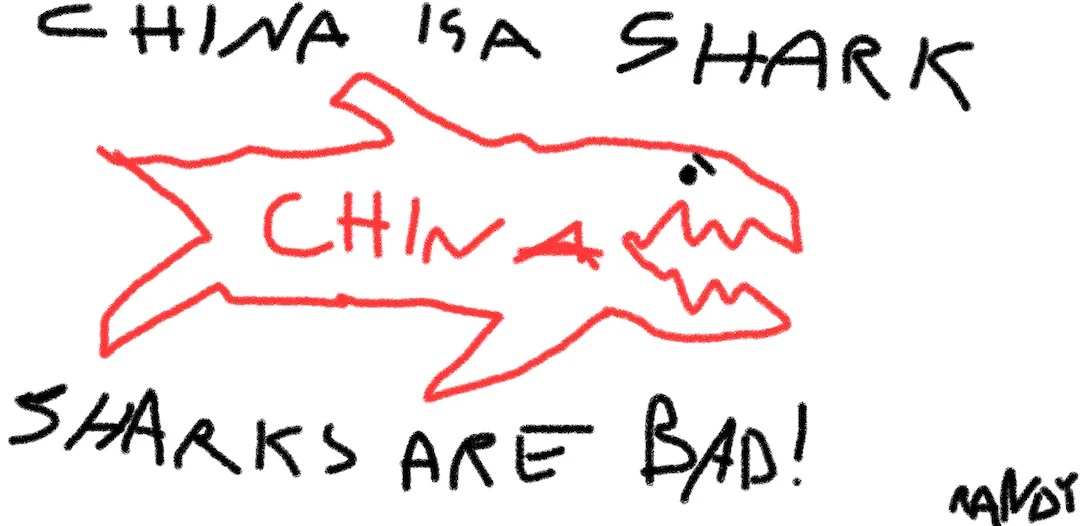
If you need it simplified even further, another way to put it might be, CHINA BAD. SHARK BAD. CHINA LIKE SHARK. CHINA VERY, VERY BAD. BAD CHINA. BAD.
Again, don’t be hard on yourself if you can’t quite wrap your head around the high-level analysis of intellectual giants like Matt Pottinger and Elbridge Colby. If we could understand these things as well as they do, we’d be the ones earning big bucks from Washington think tanks, not them!
Well I think that’s enough work for your gray matter today. Have a rest and a nice sleep and come back fresh tomorrow, where we’ll be discussing some mind-blowing comparisons western analysts have been drawing between Vladimir Putin and Adolf Hitler.
Luck is not a safety plan
“We must act now,” said International Atomic Energy Agency director general, Rafael Grossi. But what is his plan? IAEA efforts at creating a “safe zone” around the Zaporizhzhia reactors, where no fighting could then occur, have collapsed. On the geopolitical stage, both Russia and Ukraine appear to harbor the conviction that their side can win the war. NATO and its allies show no signs of insisting on a diplomatic solution, given the benefit to those countries of a Russian defeat.
War devastation is bad enough without adding a nuclear disaster
Luck is not a safety plan — Beyond Nuclear International
How much more perilous can the situation at Zaporizhzhia nuclear power plant become?
By Linda Pentz Gunter, 14 May 23
Luck is not a sound basis on which to rely when we are dealing with nuclear risks. But luck is again what me must depend on as we watch and wait for the worst to happen — or not — at the six-reactor Zaporizhzhia nuclear power plant in Ukraine.
The plant, located in the southwestern region of the country — the area most directly embroiled in some of the most intense fighting, and with parts of it already “annexed” by Russia — has already experienced some frightening near-misses. These include shelling and missile attacks and frequent losses of offsite power that, if not restored promptly, could lead to a meltdown.
The plant has been occupied by Russian forces since March 4, 2022. Rumors abound that a severely depleted workforce is laboring under stressful and even violent conditions, while other staff have fled or have disappeared.
Now we learn that mass evacuations are underway from communities close to the nuclear plant. These include residents of Enerhodar, the city that houses most of the plant workers and their families……………………….
Fears of a Ukrainian offensive designed to recapture some or all of the Russian-held territory appear to have prompted the sudden evacuation. But are people evacuating away from the conflict or from the prospect of a catastrophic outcome at the nuclear power plant, should it become fully engulfed by the fighting? And if that does happen, what might the consequences be?
As a precaution, all six Zaporizhzhia reactors are currently shut down — officially their status is called “cold shutdown”, which is not as final as it sounds and does not mean they are out of danger.
The fuel in the reactor core still requires electricity to power cooling, as do the pumps that supply cooling water to the fuel pools. This means a meltdown is still possible. Cold shutdown just buys workers more time to restore power should it become lost, but a reliable supply of electricity to the site is still essential to avoid disaster…………
The consequences of such an outcome would be drastic not only for the people of Ukraine and neighboring Russia, but for all of Europe, should any or all of these reactors melt down or suffer a fuel pool fire. We only have to look at the fallout map from the 1986 Chornobyl disaster, a single unit with a far smaller radioactive inventory, to understand the potential scale of such a tragedy.
Chornobyl contaminated 40% of the European landmass with long-lived radioactive fallout and created an effectively permanent 1,000 square mile Exclusion Zone around the stricken nuclear site.
Beyond electrical power, water supply is also essential to keep nuclear power plants out of danger. The thermally and radioactively “hot” irradiated fuel rods sitting in cooling pools, must stay submerged. Electrically powered pumps can maintain a steady water supply. But access to water is critical.
In late March, alarms were raised about a dramatic drop in water levels at the reservoir that supplies cooling water to the plant. Ukrainian officials said the Russians had drained the reservoir, increasing the risk of a meltdown at Zaporizhzhia.
But this month, headlines warned that record high water levels could threaten a dam that, if breached, would send floodwaters pouring onto the nuclear site, inundating the plant’s pumping systems.
War, flooding, and human error are all potential disasters waiting in the wings that could trigger a nuclear catastrophe. But what can prevent it?
“We must act now,” said International Atomic Energy Agency director general, Rafael Grossi. But what is his plan? IAEA efforts at creating a “safe zone” around the Zaporizhzhia reactors, where no fighting could then occur, have collapsed. On the geopolitical stage, both Russia and Ukraine appear to harbor the conviction that their side can win the war. NATO and its allies show no signs of insisting on a diplomatic solution, given the benefit to those countries of a Russian defeat.
All of this brutality already comes at immense cost to the population of Ukraine, but also to Russia, where mothers, too, are losing sons to an unnecessary war. A major strike on Europe’s largest nuclear power plant would extend that tragedy across thousands of miles, affecting hundreds of millions of lives. All we’ve got between us and that disaster is luck, which, like the deadly uranium that fuels nuclear power plants, will eventually run out.
UK’s Nuclear Waste Services ignore overwhelming local council opposition to siting plan for waste dump.
Candidates opposed to the siting of a Nuclear Waste facility on the border
of Mablethorpe and Theddlethorpe not only took control of all the parish
councils in the search area but also took all of the allocated seats on the
dissstrict council, plus two seats in Sutton on Sea.
Turnout was high for a local election. In Theddlethorpe and Withern 39.6% of those eligible to
vote did so and more than seventy per cent of the voted for Travis Hesketh
(pictured) In Sutton on Sea, Where one Green and one independent anti dump
candidates overturned a Conservative majority, the turnout topped forty per
cent.
With such an overwhelming result we wrote to the leaders of both
Lincolnshire County Council and East Lyndsey District Council demanding
that they honour the people’s decision and withdraw from the so-called,
Community Partnership.
We await their decision. However, NWS has spoken to
the press and intend to ignore the result. That makes the second “Test Of
Public Support ” they have chosen to ignore. The first, a survey carried
out by Theddlethorpe Residents Association, showed 85% against with a
turnout of 56%.
Guardians of the East Coast 13th May 2023
https://preview.mailerlite.io/emails/webview/385711/88100923539195491
1 This Month



19 November – Webinar – The Reality of Reprocessing
Time: 11:00 AM Pacific Time (US & Canada) / 2:00 PM Eastern / 7:00 PM UK / 8:00 PM CET
Register for the Zoom Event Here



Shut down the radiation-damaged Heysham nuclear reactors now
To see nuclear-related stories in greater depth and intensity – go to https://nuclearinformation.wordpress.com

Say No to NASA’s Reckless Nuclear Reactor on the Moon
Say No to NASA’s Reckless Nuclear Reactor on the Moon
-
Archives
- November 2026 (84)
- October 2026 (302)
- September 2026 (339)
- August 2026 (330)
- July 2026 (355)
- June 2026 (287)
- May 2026 (306)
- April 2026 (356)
- March 2026 (251)
- February 2026 (267)
- January 2026 (308)
- December 2025 (358)
-
Categories
- 1
- 1 NUCLEAR ISSUES
- business and costs
- climate change
- culture and arts
- ENERGY
- environment
- health
- history
- indigenous issues
- Legal
- marketing of nuclear
- media
- opposition to nuclear
- PERSONAL STORIES
- politics
- politics international
- Religion and ethics
- safety
- secrets,lies and civil liberties
- spinbuster
- technology
- Uranium
- wastes
- weapons and war
- Women
- 2 WORLD
- ACTION
- AFRICA
- Atrocities
- AUSTRALIA
- Christina's notes
- Christina's themes
- culture and arts
- Events
- Fuk 2022
- Fuk 2023
- Fukushima 2017
- Fukushima 2018
- fukushima 2019
- Fukushima 2020
- Fukushima 2021
- general
- global warming
- Humour (God we need it)
- Nuclear
- RARE EARTHS
- Reference
- resources – print
- Resources -audiovicual
- Weekly Newsletter
- World
- World Nuclear
- YouTube
-
RSS
Entries RSS
Comments RSS

