Elders say – Nuclear states must now act following G7 statement – Mary Robinson
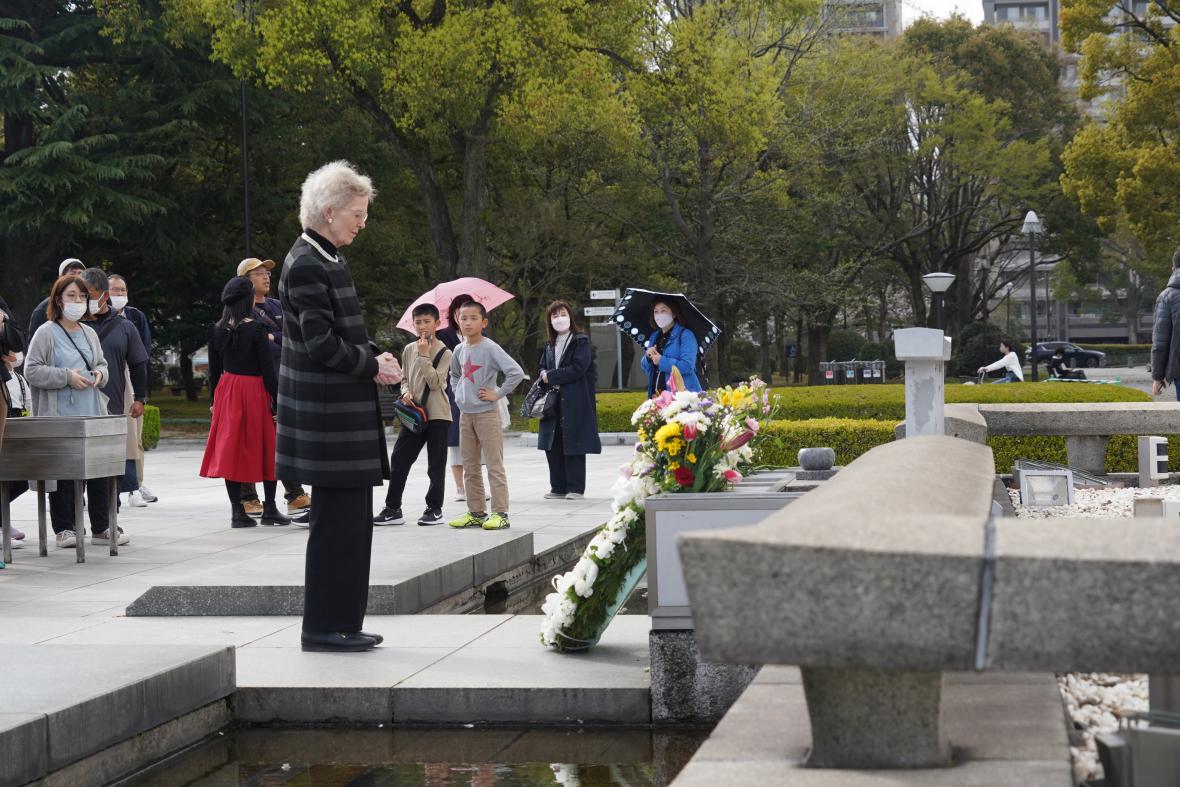
MARY ROBINSON https://theelders.org/news/nuclear-states-must-now-act-following-g7-statement 22 May 23
As the G7 leaders release their Hiroshima Vision on Nuclear Disarmament, The Chair of The Elders, Mary Robinson, stresses this must now lead to meaningful dialogue and action from nuclear states.
I welcome G7 leaders issuing their first separate statement reaffirming their commitment to a world without nuclear weapons. But these words must now be followed by meaningful action to realise that goal.
If G7 leaders are serious about their “Hiroshima Vision on Nuclear Disarmament”, they need a concrete plan to implement that vision. At the same time, leaders must prioritise serious dialogue between nuclear states to reduce nuclear risks. Despite the difficulties, it is vital that the USA engage Russia on returning to implementation of New START, and on a successor agreement.
When I visited Hiroshima in March, I was reminded again of the terrible human cost of nuclear weapons. Japan showed leadership by holding its G7 summit there. G7 nuclear states now need to show leadership by acting on what was agreed.
Russia Claims Group Crossed Border From Ukraine In Attack
Radio Free Europe 22 May 23
Violent clashes erupted on the Russian-Ukrainian border with Moscow accusing a Ukrainian “sabotage group” of trying to make an incursion into the country, an allegation Kyiv rejected.
Explosions and sporadic gunfire could be heard on May 22 in the Belgorod region, with the local governor, Vyacheslav Gladkov, saying that fighting had spilled into Russia in the Graivoron district which borders Ukraine. There were no immediate reports of casualties.
The governor said six people were injured in the clashes. The incursion into Russian territory may be the biggest since the Kremlin launched its war against Ukraine 15 months ago.
A group calling itself the Liberty of Russia Legion, which claims to be made up of Russians cooperating with Ukrainian forces, took responsibility for the attack. The Ukrainian government denied any role in the events………………………………………
Nuclear would be labeled ‘clean energy’ under new legislation

KEVIN GARCIA-GALINDO, MAY 22, 2023, The Carolina Journal
Senate Bill 678, “Promote Clean Energy,” currently in the N.C. House Rules Committee, could pave the way for more investment in nuclear energy in North Carolina.
The bill would relabel “renewable energy resources” as “clean energy resources” in the State’s Renewable Energy Portfolio Standard and add nuclear fission and fusion into the definition of clean energy. If approved by the state legislature, this bill would make nuclear energy a viable option toward replacing coal-fired power plants with new cleaner sources.
S.B. 678 would also help further the proliferation of nuclear energy by eliminating statutes that had previously restricted the construction of nuclear facilities in House Bill 951, which passed in 2021.
COOPER INDICATES RESISTANCE
The N.C. Senate passed S.B. 678 in late April, but it is now seeing opposition from Gov. Roy Cooper. At the State Energy Conference last month, Cooper told business leaders that he did not want politicians to be seen as influencing which energy sources are prioritized over others.
Environmental activist group CleanAIRE NC told the Wilmington Star-News in a statement that “nuclear energy may be zero-emission, but it is not renewable and it’s certainly not clean. … Uranium is a mined resource. And on the backend storing nuclear waste poses major, unanswered safety questions. With wind and solar capacity rapidly expanding, is it really worth gambling with our health and safety?”
A Cooper spokesperson stated that the governor would not look at the bill until it reached his desk………………………………………………….. https://www.carolinajournal.com/nuclear-would-be-labeled-clean-energy-under-new-legislation/
Rishi Sunak ‘turns his back’ on UK’s nuclear test veterans a year after pledging support
The Prime Minister has refused to look at their evidence of a criminal cover-up within the Ministry of Defence, less than a year after pledging his support for a police investigation
By Susie Boniface, 22 May 2023 https://www.mirror.co.uk/news/politics/rishi-sunak-turns-back-veterans-30046288
It comes after the G7 summit in Japan when the PM visited a memorial honouring the 200,000 who died at Hiroshima and Nagasaki in 1945, the event that triggered Britain’s own atomic experiments.
Campaigner Alan Owen, whose father died after witnessing 24 nuclear bombs in just 78 days, said: “He was happy to take the headlines for getting us a medal, but now he’s turned his back on 22,000 men who suffered and died for the nuclear deterrent that he’s relying on to keep us safe from Vladimir Putin.”
Nuke veterans have waited 70 years for official recognition, and since the weapons trials have suffered a legacy of cancers, miscarriages, and birth defects in their children.
Sunak delivered them a medal just a month after taking office.
During the Tory leadership campaign last summer, a spokesman for Sunak told the Mirror: “Rishi supports the campaign for nuclear veterans to be recognised for their service.
“We are incredibly grateful for our nuclear veterans’ sacrifice which kept Britain safe during the Cold War… He would also back an investigation into whether the tests represented a criminal offence towards these veterans.”
After making the medal announcement at the National Memorial Arboretum last November, he briefly met Laura Morris, of Salford, whose grandfather John witnessed several H-bombs in 1958, later lost his son Steven to cot death, and developed pernicious anaemia before being refused a war pension.
He had multiple blood tests during the trials, but the results are not in his medical file.
Parliament has been told all such records are at the Atomic Weapons Establishment in “scientific data”, but veterans, widows, and next-of-kin have been refused access. Withholding or falsifying medical records is a crime. Laura asked the PM to meet and discuss it, and he told her he would.
Her MP, Labour’s Rebecca Long-Bailey, said: “It’s frankly soul-destroying that the PM made a promise in person to my constituent but now fails to keep his word. It has taken six months to decide that he just can’t find the time.”
“In the Tory leadership contest he promised he’d support a criminal investigation, and now he won’t meet us so we can show him the evidence,” she said.
“It’s appalling that after what these veterans have suffered, and I truly hope he changes his mind, and meets them as promised.”
In a letter to Laura, Sunak said the “extraordinary sacrifice” of veterans had been overlooked “for too long” and he had been “delighted” to announce the medal.
He added: “The significance and poignancy of the announcement was not lost on me.
“I was greatly moved to meet and speak with the veterans during the event, including your grandfather… I want to thank him, not only for his years of service and campaigning, but also for bravely sharing his experiences with others.
“Unfortunately due to diary pressures, I am currently unable to meet you.
Portugal’s renewable energy success

Portugal reached a major milestone of producing more than half (51%) of
its electricity from wind and solar in April. The previous monthly record
high was 49%, set in December 2021.
According to Ember, Portugal’s record
of 50% from wind and solar comes despite relatively modest wind generation.
Strong deployment of solar capacity pushed solar generation to an all-time
high of 360 GWh in April, significantly higher than the previous record of
300 GWh in July and August of 2022. Last year, the country installed 0.9 GW
of solar photovoltaics, increasing its solar capacity by more than 50% to
2.5 GW.
Review Energy 18th May 2023
Damning critique of Rolls Royce
The new chief executive of Rolls-Royce has delivered another damning
critique of its performance, saying that one of its core divisions has been
“grossly mismanaged”. Tufan Erginbilgic, 63, took the top job at the
aerospace and engineering group at the start of this year and weeks later
infamously described the group as a “burning platform”. In his latest
broadside, the former BP executive took aim at the performance of its power
systems division, which makes diesel and gas engines for use in
superyachts, trains and mining lorries, and for back-up power generation.
Times 22nd May 2023
Ukraine’s Depleted Uranium Blast: Europe on Brink of ‘Environmental Disaster’
Sputnik lnternational 19.05.2023
Russian Security Council Secretary Nikolai Patrushev warned on Friday that a radioactive cloud was heading towards Western Europe following the destruction of a Ukrainian warehouse storing British-supplied depleted uranium ammunition.

Sputnik News spoke with Dr. Chris Busby, physical chemist and scientific secretary of the European Committee on Radiation Risk, about how the West’s decision to provide depleted uranium (DU) ammunition to Ukraine has potentially caused a continent-wide ecological disaster. Below is his answer in full.
Recently, several web media outlets provided videos of an enormous explosion in the town of Khmelnitski, located to the West of Kiev, and about 200 km from the border with Poland. There were two major explosions which produced a massive roiling swirling fireball which, like an atomic bomb, developed upwards and formed a mushroom cloud, which was black.
I have represented nuclear atmospheric test veterans in the Royal Courts of Justice in London and have seen many films of nuclear explosions: this was not one. A nuclear explosion is characterised by an immediate intense white light which wipes out the camera film or detector.
So, what was it? It was suggested by several commentators that an arms depot that had been hit contained the Depleted Uranium (DU) weapons sent by the UK to the Ukraine for use in the British Challenger tanks as anti-tank penetrators. That the explosion was one involving the burning of the DU in the fireball. Since I am a scientific authority on Uranium and its health effects, but have also examined its dispersion and behaviour in the environment, I will comment on what I believe happened, and why it is important. I was a member of the UK government Ministry of Defence Depleted Uranium Oversight Board (DUOB) in 2000-2005, and also the UK government Committee Examining Radiation Risk from Internal Emitters (CERRIE) 2000-2004. I am Scientific Secretary of the European Committee on Radiation Risk (ECRR) which is an independent NGO that provides advice on risk from ionising radiation.
My main research interest in this area is Uranium and health, particularly the DU particles, which are so small they act as a gas and move over very large distances once they are created by the burning of DU. I found them in England in 2003 after they had come from Iraq. I found them in 2023 in England after they came from the Ukraine war. So that is the first thing: the material is able to travel very large distances.
Therefore, if the Khmelnitsky explosion was a DU one, the material would move with the wind direction and should be detectable at monitor sites downwind.
First, we need to say that DU has a gamma signature, it releases gamma rays. The UK and USA governments lie about this. They point to the fact that the U-238, that remains after the fissile U-235 is removed in the centrifuges (and is sent off for nuclear weapons and reactors), is a weak alpha emitter.
They say that alpha radiation cannot penetrate skin and so the DU itself is harmless. That it cannot be detected by a Geiger Counter and the alpha particles don’t make it through the window. There is, of course, a health problem if the post-impact particles are inhaled and pass into the body through the lung into the lymphatic system or directly into the digestive system, but essentially DU is harmless.
What you need to know is that Uranium 238, when it decays with its alpha emission, turns into Thorium-234 and Protoactinium-234m which then turns into Uranium 234. Thorium 234 is a beta and gamma emitter delivering 6% of its decay energy as a gamma ray. Thus, large clouds of DU particulate aerosol will be detectable by gamma detectors.
When I visited Iraq with Al Jazeera in 2000 I went to the south and examined the corpses of the tanks that had been hit by DU in the first Gulf War. Some of the A-10 DU penetrators were still lying around. They gave off an intense gamma ray signal, and the holes in the tanks were highly gamma ray active. So much for only an alpha emitter.
I am a yachtsman: examination of the UK metereological weather pressure maps tell us that at the time, and for days after the explosion, there was an anticyclone to the North of the explosion site and winds were weak but from the South East blowing North Westerly around the high-pressure area. So, the plume would move towards Poland. If the winds were about 5km/h they would reach any Poland detectors 250 km away on the 15th.
After Chernobyl, the European Union set up a Europe-wide gamma radiation detector system that used to give gamma readings in real time. I went to look. But astonishingly, all the data was blocked. The web- based system, administered from Germany, (EURDEP) would not provide the detector maps that are normally available. Luckily, there were some location maps on the web and some that had been already downloaded by colleagues of mine before the system stopped working. I obtained maps from Poland. One of these I show below. [on original]
You will see that a very highly significant increase in gamma radiation occurred at this detector, north west of the explosion site almost exactly when it would be expected on the basis of a distance of 250km and a mean wind speed of 5km/h. The increase, from 60nSv/h to 90nSv/h was highly statistically significant about 50%. Other detectors all across Poland showed an increase*, as the plume passed over them, the increase being weaker the further away (due to dispersion of the plume).
Later, the Poles measured the increase at the Marie Curie Institute in Lublin, but their map was a more sophisticated one and needed some expert interpretation. The Polish map gave gamma increases split into two natural isotopes, Bismuth and Thallium, also total gamma and cosmic ray gamma………………………………………………………………..
The European radiation detector system web map came back online on May 18. The map type had been changed and everything we saw in the downloads had disappeared or had been smudged out by data analysis averaging. Why? This, and the early blocking of access to the site suggest panic and cover-up.
So taken all together, what we see is a massive explosion which is thought to be DU, and reports of a spike in gamma radiation near the site. Uranium oxide is black, and the black plume moves north west slowly, the weather pattern is stable and the wind blows to Poland. The Polish EU detectors all show gamma radiation increases at the expected time of arrival of the plume. The EU detector system is shut down rapidly, but not before we have obtained data from several sites. The Poles provide a detector result that identified Bismuth as the cause of the increase, but do not go so far as to formally state that it is (in case of later blowback).
One final piece of evidence. We see videos on the internet of the Ukrainians clearing up the explosion site using Robot vehicles, not ordinary firemen. Why do they need Robot vehicles? The last times we saw Robot vehicles clearing up was in the ruins of Chernobyl and Fukushima.
If I am right, there has been an environmental disaster, and the DU particles will travel across Poland, Germany and Hungary, and will end up in the Baltics, probably later the whole of Europe including the UK (after all, the Chernobyl Uranium particles came to the UK).
They will deliver genetic damage and death like that seen in the Balkans and Iraq. Cancer, birth defects, miscarriage, infertility, lung damage, mental problems (Gulf War Syndrome) and so forth. The scientific and epidemiological evidence on this has been clear since the Gulf War. It is all there in the scientific literature—but the governments in the West and the military ignore it, deny it and cover it up. In the case of the UK coroners court finding for Stuart Dyson, the jury found that DU caused his fatal colon cancer.

But when the coroner wrote to the health minister (as he had to by UK law, Rule 43) the reply was: we disagree. This stuff can be measured, but no one will measure it, or if they do, they will be attacked and their arguments dismissed.
Even if I am wrong, and there is some other explanation for the gamma peaks, DU must be banned. It is a weapon of indiscriminate effect and kills civilians, the enemy and your own troops (well, Ukrainian troops). It is much worse than a war gas, like Sarin, or phosgene, mustard gas or all the other chemical agents banned by civilisation. This stuff destroys the genetic basis of life itself. And no one does anything. Those who use it base their action on obsolete science supported by dishonest epidemiology carried out by dishonest scientists and obsolete and fantastical risk models.
Those who provide the weapons, the UK government in this case, are morally bankrupt. Unless it is their intention to destroy the Ukrainian people. Who knows anymore? The world has gone mad.
*Poland’s National Atomic Energy Agency claims there is no increase in radiation levels https://sputnikglobe.com/20230519/ukraines-depleted-uranium-blast-europe-on-brink-of-environmental-disaster-1110462939.html
AUKUS may turn out to be the largest financial swindle perpetrated by the United States and the United Kingdom against Australia and other Asia Pacific nations
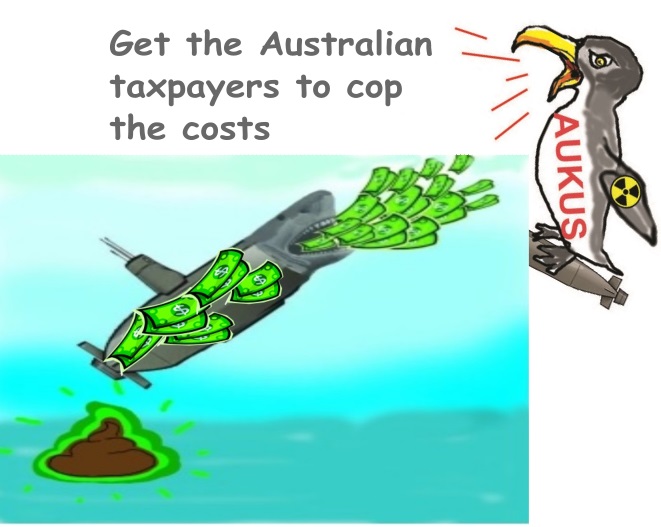
Now, it appears that Australia is becoming yet another naval base for the deployment of US and British fleets in the Asia-Pacific Region, including the basing of US nuclear submarines in 2026, without any hope of restoring economic ties with China and, consequently, the prior level of welfare in the near future. This is in addition to paying “compensation” under the guise of investing in unfeasible defense plans.
https://journal-neo.org/2023/05/20/aukus-may-turn-out-to-be-the-largest-financial-swindle-perpetrated-by-the-united-states-and-the-united-kingdom-against-australia-and-other-asia-pacific-nations/ 20.05.2023 Author: Bakhtiar Urusov
Equipment for the country’s ground forces “arrives with depressing regularity,” years behind time, and substantially over budget, according to a report issued on April 19 by the British Parliament’s Budgetary Control Committee. For instance, the programs, which provide new Ajax armored fighting vehicles and Morpheus tactical communication and information systems, have faced significant difficulties. According to the MPs’ assessment, the issue is made worse by underfunding of the defense budget expenditures and the pound’s declining purchasing value in relation to the dollar.
Ten days later, on April 28 this year, the Royal Navy informed the public about the decision to decommission the HMS Prince of Wales aircraft carrier, launched just four years ago (in 2019), to be used as a donor for spare parts for the HMS Queen Elizabeth aircraft carrier of the same class. According to the Royal Navy, the $3.72 billion aircraft carrier has docked more frequently than it has participated in naval operations, and the most recent maintenance cost $42 million.
This dispiriting news came just a month after the leaders of the US, the UK, and Australia had disclosed their ambitious long-term plans to build a nuclear-powered submarine fleet for Canberra on the basis of British technology, which will cost the Australian budget $245 billion.
When it comes to extremely sophisticated projects like nuclear submarines, it seems inconceivable that the parties involved would be so irresponsible as to neglect to evaluate the contractors’ capacity to meet their obligations. Still, if you trust the claims made by senior US, British, and Australian officials, the opposite is true in the case of AUKUS. Canberra would never have consented to work together on submarine design and construction with Great Britain’s waning technological strength otherwise. The example of the HMS Prince of Wales aircraft carrier shows that not only is Great Britain unable to complete a big naval project, but it is also facing significant technological difficulties in order to satisfy present ambitions for defense construction and equipment upgrades.
In the realm of economic crime, assigning work to a contractor who is known to be unable to perform is fraud, money laundering, or corruption.
In the context of Anglo-Saxon big politics, this appears to be retaliation against a certain sector of Australia’s elites for Canberra’s departure from a coordinated approach to restrain the PRC back in the day. This is primarily about the carefree era when Australia and China’s trading and economic relations remained unbroken, providing Canberra with significant revenue from exports to the PRC of a wide range of items, from wine and agricultural products to hard coal and other minerals.
Now, it appears that Australia is becoming yet another naval base for the deployment of US and British fleets in the Asia-Pacific Region, including the basing of US nuclear submarines in 2026, without any hope of restoring economic ties with China and, consequently, the prior level of welfare in the near future. This is in addition to paying “compensation” under the guise of investing in unfeasible defense plans.
All nations, including India, Japan, the Republic of Korea, New Zealand, and some ASEAN members that have been invited to participate in the AUKUS, should take a closer look at this alliance.
Bakhtiar Urusov, a political observer, exclusively for the online magazine “New Eastern Outlook.”
At a G7 summit high on ambition, nuclear disarmament takes a backseat to Zelensky’s diplomatic appeals

Picture above is from Zelensky’s previous visit to Washington, but it’s the same idea.
The Conversation, May 21, 2023 Donna Weeks, Professor of Political Science, Musashino University
Hiroshima, the site of this year’s G7 summit, is one of just a handful of places in the world that provides a stark reminder of the horrors of war.
The A-bomb Dome in the Hiroshima Peace Memorial Park, for example, is one of few structures left standing in the neighbourhoods that were flattened by the atomic blast in August 1945. Around the city, there are also “survivor trees” from the blast and burn marks on temple stoneware and statues – reminders of how far and wide it radiated.
It is no surprise that Japanese Prime Minister Fumio Kishida chose Hiroshima as the setting for the 2023 G7 meeting. Not only are his electoral constituency and family roots located here, he is also an advocate of a nuclear weapons-free world.
And there were hopes the meeting could spur further action towards this ultimate goal of global nuclear disarmament. Kishida said ahead of the meeting,
I believe the first step toward any nuclear disarmament effort is to provide a first-hand experience of the consequences of the atomic bombing and to firmly convey the reality.
Ukraine takes priority
It wasn’t to be. Though the final communique from the summit did make a vague commitment toward a “Hiroshima Vision” for nuclear disarmament, it took a backseat to the main headline from the weekend – the continued global support for Ukraine in its war against Russia.
An “unscheduled” visit by Ukrainian President Volodymyr Zelensky certainly raised the stakes for the summit at a critical time in the war.
On Friday evening, the leaders released a strongly worded, six-page statement on Ukraine, which reaffirmed their commitment “to stand together against Russia’s illegal, unjustifiable and unprovoked war of aggression against Ukraine” and condemned “Russia’s manifest violation of the Charter of the United Nations and the impact of Russia’s war on the rest of the world”.
But it was the potential impact of the in-person attendance that might amplify the otherwise rhetorical words of the summit leaders………………………
Zelensky’s opportunity to make a direct appeal to the leaders may end up being the key statement of the summit, distinguishing it from previous gatherings……………………………………………….
Inevitably, at each G7 Summit, there are calls for a review of its purpose. Originally an “informal” grouping of the world’s leading economies, it has become, like the UN Security Council, an institution of a different time. It is somewhat of an anachronism, no longer representative of today’s global economy.
…………………………………….. This summit will be most likely be remembered for Zelensky’s visit and the message it intended to send to Russia. But as leaders make their journeys home, wars will continue and all we are left with are the platitudes that will carry over to the next G7 Summit in 2024.
As for the ageing hibakusha, the survivors of the 1945 atomic bomb in Hiroshima, this may have been their last major opportunity to press for an end to nuclear weapons. https://theconversation.com/at-a-g7-summit-high-on-ambition-nuclear-disarmament-takes-a-backseat-to-zelenskys-diplomatic-appeals-205829
G7 Desecrates Hiroshima A-Bomb Memory With Warmongering Summit

Strategic Culture Editorial May 19, 2023
The Group of Seven held a de facto war summit in Hiroshima, a place that is synonymous with the horror and evil of war.
The United States-led “Group of Seven” cabal held one of their increasingly meaningless jamborees this weekend in the Japanese city of Hiroshima. The posturing of solemnity by these warmongering elites in a place that represents the ultimate barbarity of American imperialism is not only sickening in its hypocrisy and profanity. The evident lack of awareness and shame of these charlatans is a sure sign that their privileged historical charade is coming to an end……………..
The proceedings began with a cynical and disingenuous “dedication” at the Hiroshima Peace Park whose centerpiece is the Genbaku Dome, the iconic spectral ruin caused by the U.S. atomic bombing in 1945. The very gathering of leaders at this sacred place is the same people who are criminally pushing the world toward another conflagration.
Biden and his cronies soon dispensed with hollow talk about “peace” and “nuclear disarmament” to make the G7 summit a rallying call for more hostility toward Russia and China………. There were pledges of supplying more weapons to the powder keg that the U.S. and its NATO partners have created in Ukraine. There were high-handed dismissals of international diplomatic efforts to resolve the conflict, which have been proposed by China, and Latin American and African nations.
The U.S.-led G7 camarilla also made their hate fest a forum for drumming up more hostility toward China, accusing Beijing of building up nuclear arms and threatening the world.
In short, the Group of Seven held a de facto war summit in Hiroshima, a place that is synonymous with the horror and evil of war.
Seventy-eight years ago, on the morning of August 6, 1945, at 8.15 am, the US Air Force Enola Gay B-29 bomber dropped the atomic bomb on the city. The resulting death toll would be 140,000, mainly civilians, many of them instantly incinerated, others dying from horrendous burns and radiation poisoning. A second bomb was dropped on Nagasaki three days later.
History has shown that there was no military need to use such weapons of mass destruction. Official American reasoning ostensibly about hastening the end of the Pacific War can now be seen as a flagrant lie. The bombs were deliberately used by the United States in a demonstration of state terrorism especially directed at its wartime ally, the Soviet Union. Arguably, these grotesque genocidal crimes sealed the beginning of the Cold War. This horrific demarcation was how the U.S.-led Western imperialist system would try to control the postwar world.
…………. The ideological projection also casts a narcissistic image of America and its Western allies as benevolent, peace-loving, democratic, law-abiding, and so on. It’s an almost incredible feat of global gaslighting and inversion of reality; made possible largely by mass disinformation via the Western corporate media/propaganda system.
Thankfully, that charade is becoming threadbare too.
One indicator this week was a study by the respected Brown University’s Cost of War project which estimated the number killed just over the past two decades from U.S.-led wars at 4.5 million. All told, since the end of World War Two estimates of deaths from American wars of aggression around the world are in the order of 20-30 million. No other nation in history comes close to the destructiveness of U.S. power, which laughably declares itself the “leader of the free world”, the “democratic upholder of rules-based order”……………………………………………………
In any case, the G7 is becoming a global irrelevance. It is a relic of former American imperial might. The “rich club” used to command half of the world’s economy, it is now down to 30 per cent and falling. The emerging multipolar world led by China, Russia, the Global South and many others, the BRICS, ASEAN, ALBA, EEA, SCO, are all testimony to the waning American Empire and its rapidly declining dollar dominance. The G7 doesn’t even make any pretence about helping the global economy and development. It has become a bellicose vehicle emitting desperate warmongering by a crumbling hegemonic system.
Only in the fairytale realm of Western media/propaganda could such a vile charade at Hiroshima be projected. To the rest of the world, it is utterly sickening. https://strategic-culture.org/news/2023/05/19/g7-desecrates-hiroshima-a-bomb-memory-with-warmongering-summit/
Ukrainians forced by Russia to retreat from Artyomovsk (Bakhmut) , their supposed ‘fortress’ in Donbass
RT.com By Vladislav Ugolny, a Russian journalist born in Donetsk 21 May 23
The battle for Artyomovsk (called Bakhmut by the Ukrainians) began in August 2022, and gradually turned into the epicenter of fighting between Russia and Ukraine. While other parts of the front remained relatively stable, both sides actively brought forces to this small city. For Kiev, which in May 2022 suffered a defeat at Azovstal that helped undermine its image, Artyomovsk became the new Mariupol. Ukrainian propaganda labeled it ‘the Bakhmut Fortress’, and attempted to give an air of heroism to those fighting there.
………………………………………………………. The importance of the city grew tremendously after the start of Russia’s military operation in February 2022. Initially, when Russian troops broke the first line of fortifications in the area of Popasnaya, Zolotoye, and the Lisichansk-Severodonetsk agglomeration, Artyomovsk was an important transport hub. It kept the Ukrainian front line connected with the rest of the country.
After the Russians managed to break this line of defense and completely removed Kiev’s forces from the territory of the Lugansk People’s Republic (LPR), Artyomovsk went from being a transport hub to becoming Ukraine’s second line of defense around the Bakhmutka River. This strip ran from Ukrainian positions opposite Gorlovka – since 2014 controlled by the Donetsk People’s Republic (DPR) – in the south up to Seversk in the north, running straight into the Seversky Donets, the main river in Donbass.
Artyomovsk could not have been taken without this line of defense being broken. Since July 2022, PMC Wagner fighters have been focused on doing just that, preparing the ground for a successful encirclement of the city.
………………………………………………………………………………………………………………………………………………………………… the more than nine-month-long battle for Artyomovsk permanently changed the perception of the conflict, forcing both Ukraine and Russia to abandon any ideas of a fast-paced campaign or deep breakthroughs.
The battles discussed in this article took place barely 30 kilometers deep into the frontlines. In conditions of summer heat, fall mud, and winter frost, it largely resembled the First World War. According to Prigozhin’s estimates, the liberation of the entire territory of the Donetsk People’s Republic will take another one and a half to two years.
However, significant Ukrainian forces still remain to the west of Artyomovsk, having seized a number of positions during the May counteroffensive. They have established a foothold in Chasov Yar and hold the line between Krasnoye and Minkovka, thus preventing Russian forces from stabilizing the front along the Seversky Donets-Donbass canal. With the Russian flag flying over Artyomovsk and Russian soldiers in full control of the battlefield, the Russian priority now is to inflict maximum damage on the Ukrainian forces massed for the counteroffensive, and drive them out to the western bank of the canal. https://www.sott.net/article/480462-Victory-Ukrainians-forced-by-Russia-to-retreat-from-Artyomovsk-their-supposed-fortress-in-Donbass
US hopes to snatch victory from jaws of defeat in Ukraine
Indian Punchline BY M. K. BHADRAKUMAR
The G7 Leaders’ 2700-word statement on Ukraine, issued in Hiroshima after their summit meeting glossed over the burning question today — the so-called counter-offensive against the Russian forces.
It is a deafening silence, since rumours are swirling about the disappearance of the commander-in-chief of Ukraine’s armed forces. Significantly, President Vladimir Zelensky himself is making himself scarce from Kiev touring world capitals — Helsinki, Hague, Rome, Vatican, Berlin, Paris, London and Jeddah and Hiroshima. It does seem that something is rotten in the state of Denmark.
As the G7 summit ended, the head of the Wagner PMC, Yevgeny Prigozhin announced on Saturday that the Russian operation to capture the strategic communication hub of Bakhmut in Donbass region of eastern Ukraine lasting 224 days, has been brought to a successful completion, overcoming the resistance by more than 80,000 Ukrainian troops.
It is a painful moment for Zelensky, who had boasted before US lawmakers in Capitol Hill last December that “just like the Battle of Saratoga (in 1777 during the American Revolutionary War), the fight for Bakhmut will change the trajectory of our war for independence and for freedom.”
Meanwhile, to distract attention, there is talk now about a subtle shift in the US policy regarding supply of F-16 fighter jets to Ukraine in an indeterminate future. In reality, though, no one can tell what the Ukrainian rump state will look like when the jets arrive. Unsurprisingly, the Biden Administration still seems to be in two minds. F-16 is a hot item for export; what happens if the Russians were to blow it out of the sky with their hi-tech weapons and rubbish its fame ?
The Russians seem to have concluded that nothing short of a total victory will make the Americans and the British understand that Moscow means business on the three objectives behind the special military operations that are non-negotiable: security and safety of the ethnic Russian community and their right to live in peace and dignity in the new territories; demilitarisation and de-Nazification of Ukraine; and a neutral, sovereign, independent Ukraine freed from the US clutches and no longer a hostile neighbour.
……………………………. the big question is about the Ukrainian counteroffensive. The Russian forces enjoy overwhelming superiority in every sense militarily. Even if the hard core of the Ukrainian forces who were trained in the West, numbering some 30-35000 soldiers, manage to achieve some “breakthrough” in the 950-kilometre long frontline, what happens thereafter?
……………. If past American behaviour — be it Vietnam, Afghanistan or Iraq and Syria — is anything to go by, Washington will do nothing. The well-known American strategic thinker Col. (Retd.) David MacGreggor couldn’t have put things better when he said earlier this week:
“I can tell you that Washington is going to do nothing. And I’ve always warned… we (United States) are not a continental power, not a land power anywhere but in our own Hemisphere. We are primarily an aerospace and maritime power, much like Great Britain. And what does that mean? When things go badly for us, we sail away, we fly away, we go home… That’s what we always do. Eventually, we just leave. And I think, that’s on the agenda now.” …………………………………………………………………. https://www.indianpunchline.com/us-hopes-to-snatch-victory-from-jaws-of-defeat-in-ukraine/
Lying is the new black

by beyondnuclearinternational https://beyondnuclearinternational.org/2023/05/21/lying-is-the-new-black/
And the nuclear industry is going for the fiction prize
By Linda Pentz Gunter
Lying is the new black. It is everywhere. It is in, and cool and entirely acceptable in the circles where judgement and ethics are permanently suspended. Disgraced (and now criminally charged) U.S. congressman, George Santos, is the poster child of this new fashion statement. Make up something outlandish and Santos has probably claimed to have said it or done it. None of it is true. And he is still in Congress.
In this (hopefully permanently) post-Trump era, lying with impunity has become precisely that: unpunishable, even applauded, as Trump was on his CNN debacle, which consigned that network to the dustbin of what once used to be called journalism.
It’s all about entertainment now, and clicks, likes, readership and ratings. And fiction. And the nuclear industry boosters are going for the Pulitzer Prize on that one. We used to say, “you couldn’t make this stuff up,” but the pro-nukers do. All the time.
So nuclear power is “the cheapest, safest, greenest” form of energy ever invented. It is “carbon-free.” No one ever died because of a nuclear accident. Irrational fear-mongering by the anti-nuclear movement killed off nuclear power growth in the United States. Renewables are a pipe-dream of the crunchy granola set and about as boring and superfluous. And so on and so on.
There used to be fact-checkers at media organizations. Not any more. Because all this twaddle appears in print and on the air, unchecked and unchallenged. Not only that, media outlets are no longer impartial and are, in fact, deliberately fanning the flames of deceit. Thus, Bloomberg could trumpet an article about the Vogtle 3 and 4 reactors in Georgia with this headline: Nuclear Power Makes Comeback with Massive Carbon-Free Vogtle Plant in Georgia.
This is a comeback? From what, exactly? A comeback is usually a triumphant return to greatness by a previously successful but then faded star. Actor Robert Downey Jr made a comeback. Basketball legend, Michael Jordan, made a comeback.
But Vogtle 3 and 4 are a nuclear comeback? The two reactors are more expensive than any previous reactors — far more — and will exceed at least $35 billion when both are finally operational. That’s over $21 billion more than originally planned.

Massive? That would be the bill paid by Georgia ratepayers. As Stephanie Cooke reported recently in Energy Intelligencer, ratepayers haver already “been charged for the financing portion — but not the actual capital costs — of Georgia Power’s construction bills since 2011.” This has now gone on six years longer than expected, and counting.
And, as Patty Durand, a candidate for the Georgia Public Service Commission, pointed out in a recent column in Utility, Dive, “if all construction costs for Plant Vogtle get moved into the rate base, Georgia Power bills will increase 20% for 60 years.”
Another $2.1 billion of capital costs will be folded into the rate base once Vogtle 3 is fully operational. There will likely be a similar rate hike once Vogtle 4 starts up.
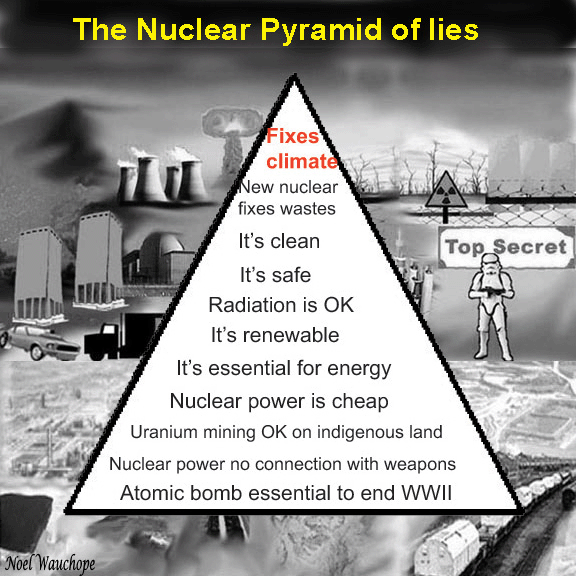
As for carbon-free, do the Bloomberg writers imagine that these plants just magically dropped into place like manna from heaven? Did they really not notice all the cement and steel and other manufactured parts and the trucks delivering it all, and the construction activities on the site? Do they know what fuel these reactors use (uranium) and where it comes from and what kind of carbon footprint uranium mining, milling and enrichment leave behind? Apparently not. Or, maybe calling it “carbon-free” is just, well, a lie.
The Vogtle 3 and 4 project has been beset by numerous delays and technical flaws along with its cost over-runs. It began more than 16 years ago and is still incomplete. If this is a “comeback” then during its previous go-around it must have fallen at the first fence, broken its leg and been shot on the spot. Because it really can’t get much worse than Vogtle.
Unless you are French. Then it can get positively scandaleuse. The French flagship new reactor is called the Evolutionary Power Reactor (EPR), but unless time is running backwards it’s not evolutionary. Like its American AP1000 counterpart, it has suffered years of delays at construction sites in France, Finland and the UK, and run up enormous cost over-runs.
Cost estimates for France’s twin reactor EPR project, Hinkley Point C in the UK, are now predicted to reach at least $40 billion, making it second only to the Great Mosque of Mecca as the most expensive building in the world.
Undeterred, voilà, along comes the French small modular reactor (SMR) known as the “Nuward”. (Notice how a version of “new” has to creep into the branding here — like the “NuScale” counterpart in the United States.)

When asked about the timeline for Nuward’s first concrete pour, the company’s president and CEO, Renaud Crassous, stated blandly: “The constant timeline has been to focus on 2030 as the best compromise between the expectation of the potential market and our ability to grow quickly to deliver this new product.”
2030? Quickly? Hello? So seven years from now, if we continue along our current path of doing too few renewables too late, by which time we will be in grave climate chaos (arguably in some parts of the world we are already there), the nuclear industry will proudly point to, drumroll, a concrete pad. But no actual reactor.
Reality check anyone? Why aren’t the editors at Bloomberg and the New York Times asking questions about time at the very least? And cost? The carbon-free part — that dominated the Bloomberg headline and which isn’t even true — is entirely irrelevant if nuclear power is too slow and too expensive. Which it is.
No matter. The nuclear industry will instead try to distract us with what they call “science”. (In their Thesaurus, ‘science’ is a synonym for ‘alchemy’.) One such example of their “science” is a claim that new reactors will consume their own waste as fresh fuel! No need for uranium mining, they crow!
Except that the claim that a nuclear reactor could “burn” or “consume” nuclear waste is misleading. Reactors can only use a fraction of irradiated fuel as new fuel, and separating that fraction — which requires carbon-intensive and radioactively polluting reprocessing — increases proliferation and terrorism risks.
Undeterred by, heaven forfend, actual facts, those who claim that reactors can eat their own waste won’t eat their own words. Because that would be uncool. And ethical. And these days, embracing integrity and the truth is just so last year.
Linda Pentz Gunter is the international specialist at Beyond Nuclear and writes for and curates Beyond Nuclear International.
New report finds millions of Britons planning to get rid of their cars
How the cost of living crisis and environmental concerns mean 6 million
Britons could ditch their cars.
A new report has found that 6.4 million
people are preparing to sell, or not replace, their motors due to the cost
of living crisis and a growing interest in healthier, more sustainable,
lifestyles.
There are currently around 33 million cars in the UK. But while
millions of people may intend to sell their cars in the coming years, how
feasible is it really for such large numbers to switch to alternatives,
such as walking, cycling and e-biking and buses, coaches and trains?
There are signs that a shift is already taking place. This was fueled, in part,
by the pandemic, which prompted people to walk and cycle more to avoid
crowded public transport and reduced car journeys as people worked from
home.
The new report reveals that 9.1 million Britons have already stopped
using their cars for at least some short journeys. In many cases they are
using public transport instead – although nearly 4 million are now
cycling or e-biking to work, according to the report, from Swytch
Techology, a maker of kit to convert regular bikes to e-bikes. This
involved a survey of 2,074 British adults conducted by the Yonder research
group.
iNews 21st May 2023
Germany’s green revolution puts nuclear power in the past

Renewed support for renewables and an end to nuclear power keep Germany on its carbon neutral path
By Linda Pentz Gunter 21 May 23
Germany is a country of sensible shoes. And, I might add, supremely comfortable ones. Germans do buttery leather as well as they do beer.
Germany’s energy policy is similarly sensible. Germans see no reason to choose the slowest, most expensive, most dangerous and decidedly non-renewable energy source with which to address the climate crisis.
Consequently, Germany rejected nuclear power, and on Saturday April 15, it closed the last of its reactors. Germany, like its even more sensible neighbor, Austria — where nothing nuclear may even traverse its terrain — is now a nuclear-free country. Almost. The next step for the German anti-nuclear movement will be to close the URENCO uranium enrichment facility there and the Lingen fuel fabrication plant. And of course there remain nuclear weapons in Germany, not theirs, but ours.
While France continues to wobble along on its high-fashion nuclear stilettos, turning ankles and snapping off heels whenever the going gets rough, Germany will trudge on inexorably, and comfortably, to its stated goal of carbon neutral by 2045.
Germany also plans to end it coal use possibly as soon as 2030, but certainly by 2038. Although, you’d never know it, with all the alarmist hype in circulation post nuclear shutdown. The nuclear lobby, already in propaganda over-drive, has now gone supersonic in its efforts to persuade the world that Germany’s choice to close those last three reactors — never mind that their energy has already been replaced by renewables —will mean burning more coal.
The decision to prolong the operating time of its last three reactors until April 2023 (they were originally due to close at the end of 2022) was largely political, designed to appease rightwing voices within the governing alliance led by the Social Democrats. “We could, in fact, have already shut down the nuclear power plants by January 1 of this year without the lights going out,” said German economist, Claudia Kemfert. “The extension was more like a psychological comfort blanket, as we had an oversupply of electricity,” she told the Washington Post.
Germany didn’t need those last three reactors to keep its green revolution on track. And it especially didn’t need them through this winter, after rejecting the supply of gas from Russia in response to that country’s invasion of Ukraine. German heating is not electric. So nuclear power had no role to play in easing that situation.
Meanwhile, power prices on the European Energy Exchange for the first quarter of 2024 were more than twice as high in France than in Germany. Much of this was due to loss of market confidence in French state energy company, EDF, to get sufficient numbers of their troubled nuclear reactors back on line to meet demand.
This did not change after Germany’s last three reactors closed. As Bruno Burger of Energy Charts noted as a caption to the graphic below [ on original] : “The shutdown of the last three German nuclear power plants has no visible effect on weekly Future Electricity Prices in Germany.”
The nuclear power contribution to Germany’s energy mix has been steadily declining since the renewable energy boom, known as the Energiewende, was launched in 2000 with the Renewable Energy Act. A precondition of the Act’s passage was that as nuclear power was phased out it would be replaced by renewable energy and energy efficiency (although demand should have been brought down much faster, much further) and not by fossil fuels.
In 2000, the renewables share in German electricity was just over 6%. The nuclear share was 30%. In just 23 years, those numbers have more than reversed, with today’s share of on- and off-shore wind plus solar at just over 46% and nuclear at 4.6% in the last week before the final reactor closures. Germany remains on track to achieve its carbon neutral goal by 2045.
The renewable energy boom was greatly helped by the implementation of a feed-in tariff that helped to create confidence and certainty for renewable energy investors who were guaranteed a fixed price for 20 years, above the standard market price. This spurred a big investment, not just by companies, farmers, and coops, but by individuals and many municipalities.
This led to local success stories such as Morbach, a small town about 92 miles west of Frankfurt that boasts 14 wind turbines, 4,000 square meters of solar panels and a biogas plant. Combined, these generate three times more electricity than the community of 11,000 people needs. They sell the surplus back to the grid.
Simply put, the nuclear phaseout opened the way for renewable energy growth in Germany and put the country on the path to a fossil fuel-free future as well. Without the former, the latter would not have happened.
Critics who falsely ascribe Germany’s continued use of coal, including brown coal or lignite, to the nuclear phaseout, fail to understand that these upticks are driven by the export market and are not related to domestic consumption or the nuclear shutdown.
Ironically it is nuclear France, dependent on electric heat, that is partially responsible for the demand for German coal. This was especially so this past winter when the French nuclear sector all but collapsed with more than 50% of its nuclear capacity down due to serious safety issues combined with scheduled maintenance.
In contrast, in 2022, Germany succeeded in weaning itself off Russian gas entirely and supplying France with 15 billion kWh of electricity net.
Furthermore, Germany’s lignite and coal production remains well below earlier levels and Germany is legally committed to end coal use by 2038. The current government is working to advance this date to 2030.
According to the 2022 World Nuclear Industry Status Report: “Lignite peaked in 2013 and then declined—especially in 2019–2020—before increasing again by 20.2 percent in 2021. However, lignite generation remained below the 2019-level and 25 percent below the 2010 level.
“Hard coal also peaked in 2013 then dropped to 64 percent below the 2010-level. While it has seen, at 27.7 percent, the strongest increase in 2021 of any power generation technology, it also remains below the 2019 numbers.
“Natural gas fluctuated since 2010 and peaked in 2020 at 2.6 percent above the 2010-level before dropping by 5.3 percent in 2021.”
In fact, Germany’s struggle to get off fossil fuels lies mainly in the transport rather than the electricity sector. The country’s love affair with the car and speed limit-free autobahns is a long engagement that now needs to be broken.
Germany’s path to a carbon neutral economy is all about the trajectory, which is on track, despite bumps in the road. As always, it is about a political commitment rather than any technological challenges. If the current government sticks to its word to greatly accelerate renewable energy implementation, the Energiewende, by no means a perfect roadmap, will get itself back on track.
Mistakes were undoubtedly made. Even after then Chancellor Angela Merkel had her epiphany in 2011 in light of the Japan nuclear disaster at Fukushima, making an overnight decision to restore Germany on the path to nuclear shutdown, she subsequently made drastic cuts in solar subsidies, something environmentalists described as “nothing less than a solar phase-out law”.
But despite this, Germany remains one of the few Western countries that has demonstrated a consistent commitment both to a nuclear phaseout and to climate chaos abatement.
The German anti-nuclear movement is greatly to be credited with much of this progress. It has long been one of the most powerful and politically effective. Like the sensible shoes they march in, green advocates in Germany understood exactly what their fight was about and the significance of that final nuclear shutdown. I hope they are having a jolly good party. They deserve it. Then it will be back to vigilance over the Energiewende — and hopefully to removing US nuclear weapons from German soil and closing those uranium fuel fabrication plants. Because that is the kind of thing that only people power can get done.
“The German nuclear phase-out is a victory of reason over the lust for profit; over powerful corporations and their client politicians,” read a statement from Greenpeace. “It is a people-powered success against all the odds.”
Linda Pentz Gunter is the international specialist at Beyond Nuclear and writes for and curates Beyond Nuclear International.
1 This Month



19 November – Webinar – The Reality of Reprocessing
Time: 11:00 AM Pacific Time (US & Canada) / 2:00 PM Eastern / 7:00 PM UK / 8:00 PM CET
Register for the Zoom Event Here



Shut down the radiation-damaged Heysham nuclear reactors now
To see nuclear-related stories in greater depth and intensity – go to https://nuclearinformation.wordpress.com

Say No to NASA’s Reckless Nuclear Reactor on the Moon
Say No to NASA’s Reckless Nuclear Reactor on the Moon
-
Archives
- November 2026 (84)
- October 2026 (302)
- September 2026 (339)
- August 2026 (330)
- July 2026 (355)
- June 2026 (287)
- May 2026 (306)
- April 2026 (356)
- March 2026 (251)
- February 2026 (267)
- January 2026 (308)
- December 2025 (358)
-
Categories
- 1
- 1 NUCLEAR ISSUES
- business and costs
- climate change
- culture and arts
- ENERGY
- environment
- health
- history
- indigenous issues
- Legal
- marketing of nuclear
- media
- opposition to nuclear
- PERSONAL STORIES
- politics
- politics international
- Religion and ethics
- safety
- secrets,lies and civil liberties
- spinbuster
- technology
- Uranium
- wastes
- weapons and war
- Women
- 2 WORLD
- ACTION
- AFRICA
- Atrocities
- AUSTRALIA
- Christina's notes
- Christina's themes
- culture and arts
- Events
- Fuk 2022
- Fuk 2023
- Fukushima 2017
- Fukushima 2018
- fukushima 2019
- Fukushima 2020
- Fukushima 2021
- general
- global warming
- Humour (God we need it)
- Nuclear
- RARE EARTHS
- Reference
- resources – print
- Resources -audiovicual
- Weekly Newsletter
- World
- World Nuclear
- YouTube
-
RSS
Entries RSS
Comments RSS

