‘Extreme risk’: AUKUS warnings as Garrett’s inquiry docks in Adelaide

“Extreme” economic risk and nuclear waste disposal concerns for the $368 billion AUKUS submarine project are being heard at an independent inquiry in Adelaide today.
The risk associated with the Federal Government’s $368 billion AUKUS nuclear submarine project are being criticised by former federal senator and self-described ‘transparency warrior’ Rex Patrick this morning at an independent inquiry held in Adelaide today.
And transparency warnings were raised over the government’s plans for nuclear waste from submarines built at Osborne in South Australia, Patrick saying he was fighting in the Federal Court for information to be made public.
Meanwhile, former South Australian Liberal MP Christopher Pyne, who was Minister for Defence from 2018 until his retirement in 2019, said he “thought twice about appearing” at the inquiry led by famed Australian musician and former federal Environment Minister Peter Garrett.
Pyne said he bit the bullet because he believed in the “battle of ideas”.
The independent inquiry into the defence agreement between Australia, the United Kingdom and the United States was established earlier this year to scrutinise the deal.
It is being led by former Labor MP and Midnight Oil front man Peter Garrett, with public hearings taking place across the country, including in Adelaide today and tomorrow.
Other commissioners included First Nations leader Karina Lester, former West Australian Premier Carmen Lawrence, former Chief of the Australian Defence Force Chris Barrie and co-CEO of the Australia Institute Leanne Minshull. A final report was expected on October 30.
“Adelaide is at the epicentre of the AUKUS project,” Garrett told reporters at a press conference before the inquiry started.
“Whether it’s questions on the safe, long-term storage of radioactive waste, whether it’s the impact on communities in Adelaide and around Osborne, whether it’s the question of opportunity cost for the Adelaide economy.
“It is a matter of some regret that the AUKUS decision – the biggest-ever decision by any Australian government to spend public money on submarines, some not even built – was made with minimal public debate.”
The inquiry has been supported by trade unions and non-profit organisations to address questions over whether risks – economic and political – were being managed appropriately, Patrick telling the inquiry the country was taking on a “hugely risky program”.
“From an absolute cost perspective, it is unaffordable and it is bankrupting,” he said.
“There’s also an opportunity cost. You know – $360 billion – if you think about what you can spend with that amount of money… we wouldn’t be worrying about fuel security, we wouldn’t be worrying about industrial resilience.”
He added that nuclear waste storage was “a problem that needs to be solved”, noting he was fighting in the Federal Court for the release of documents around where the government was planning to store waste from the nuclear submarines.
“I’m not asking for the release of documents that relate to how fast a submarine might go, how many weapons it might have… I’m asking for information that is incidental to this project but really important to it: Where are you going to put the waste associated with this?” Patrick said.
Pyne gave evidence ahead of Patrick, and emphasised the importance of the AUKUS project in terms of national defence against China, saying the uplift in defence capability would be imperative “if we find ourselves on our own in the worst case scenario”.
He described AUKUS as “unstoppable” and said it would deliver a permanent boost for defence spending, an upgrade to Australia’s bases and facilities, an investment in STEM and trade skills, and would be a permanent change to Australia’s national security.
The inquiry was set to continue until this evening, with other speakers including anti-nuclear campaigner David Noonan and SA Greens MLC Melanie Selwood.
The Greens today released new findings from a survey of 343 South Australians, showing 83.7 per cent of respondents were “mostly concerned” about AUKUS.
Seventy-one per cent said AUKUS would make Australia less secure, and 74.5 per cent said they did not see “clear benefits” from the defence pact.
AUKUS was set to be a boon for the South Australian economy and jobs creation, with the nuclear submarine shipbuilding yard set to be constructed at Osborne at a cost of at least $30 billion.
Both the state and federal governments said they hoped the project would create 10,000 jobs in design and construction as well as up to 1000 apprentices per year at an on-site training facility, with the first newly built submarines expected to be delivered to the Australian Navy in the 2040s.
Enough steel to make 17 Eiffel Towers as well as 710,000 cubic metres of structural concrete will be used in the construction of the 420-metre-long fabrication hall.
However it has already weathered several hiccups.
In June, Federal Defence Minister Richard Marles announced Australia would only buy three second-hand nuclear-powered submarines instead of the promised mix of new and used US vessels.
This plan was expected to happen before Australia eventually built its own submarines using US nuclear-propulsion technology and parts made in Britain.
The second-hand subs announcement comes after the US has struggled to make enough Virginia-class submarines for its own use, leading some American lawmakers to question how it could also build enough of the boats to meet Australia’s needs.
Australia faces a critical window to receive the submarines before its existing, 1980s-designed Collins-class vessels are retired from service.
No, Israel Does Not Have ‘A Right To Exist’
there is no such right in international law. None.
the International Court of Justice has repeatedly found that Israel has no right to claim self-defense in its attacks on occupied Palestinian territories. (In essence, you cannot break into someone’s house and then claim a right to self-defense when they resist you).
Unlike the Zionist claim that “Israel has a right to exist,” my assertion is rooted in international law. Of course, given Israel’s propensity for violating such laws, it’s no surprise they’re still claiming a right that has no basis in reality.
Mondoweiss, By Craig Mokhiber July 14, 2026
News that, in the midst of the genocide in Palestine, the German parliament was this week advancing legislation that would criminalize speech that denies that Israel has a “right to exist,” with penalties of up to five years in prison, came as a surprise to virtually no one.
This is, after all, the same Germany that perpetrated genocide first in Namibia and then in Europe, and is now actively and enthusiastically participating in the ongoing genocide in Palestine while brutally repressing all who dare speak out against it inside Germany.
Indeed, alongside Israel and the U.S., the German state today has the dubious distinction of being among those most captured by Zionist interests and most corrupted by Zionist ideology.
The German state even has an official policy (Staatsräson) dedicating the German state to the continued existence of the Israeli regime, and a formal declaration of Israel’s “right to exist” is required to acquire German citizenship. (No such declaration of Germany’s right to exist is required).
But the statement that the Israeli regime has no right to exist is not only a legally protected opinion. It is also demonstrably true, as a matter of both fact and law.
Of course, the statement that Israel “has a right to exist” has always been nonsense, unrooted as it is in either law or fact.
But this Zionist claim rings familiar to the ear of people in the West because it has been so often repeated as a pillar of Zionist propaganda, echoed by Western politicians benefiting from Israel lobby bribes, and by Israel-aligned media corporations dutifully buttressing the impunity of the regime.
Ask yourself if you have ever heard a similar refrain asserting Italy’s right to exist, or Canada’s — or Germany’s, for that matter? And yet the claim is constantly made that the Israeli regime (and only the Israeli regime) somehow has such a right.
The most obvious conclusion is that the regime and its proxies in the West are so deeply insecure about the legitimacy of the state, given the lawless and bloody history of its founding and expansion, that they have deemed it necessary to impose an enforced (and fictional) orthodoxy, rooted in an idea of Israeli exceptionalism and state-sponsored impunity.
But there is no such right in international law. None.
Inconvenient facts
Indeed, when I first entered the corridors of the United Nations in the 1980s, many states then existed that no longer existed when I left in 2023. Did the USSR, Czechoslovakia, Yugoslavia, East Germany, Tanganyika, Zanzibar, and the United Arab Republic have a “right to exist?” No. And neither does Israel.
States come and go, but none of them has a “right to exist.” As a factual matter, this is undeniable.
And yet, some still actively parrot the baseless Zionist fabrication that the Israeli regime somehow possesses it, others accept it without question, some (like Germany) even seek to compel others to declare it, and still others prohibit any attempts to challenge the lie.
There is no “right to exist” for states under international law. Thus, Israel cannot claim such a right.
Of course, states do have some rights. For example, states normally have a right to sovereign equality, to territorial integrity, and to self-defense under Article 51 of the UN Charter. But even these rights normally afforded to states are subject to conditions and qualifications, many of which would exclude Israel’s claim to them.
For example, the International Court of Justice has repeatedly found that Israel has no right to claim self-defense in its attacks on occupied Palestinian territories. (In essence, you cannot break into someone’s house and then claim a right to self-defense when they resist you).
Its 1949 “Green Line” with Lebanon, Syria, the West Bank, and Gaza, is not an international border, but rather an armistice line merely meant to separate forces. The regime cannot claim it as a lawful border.
Moreover, given that the prohibition of the acquisition of territory by force is a jus cogens norm (the highest, peremptory rules) of international law and a binding obligation under the UN Charter, it cannot claim any of that land as part of its lawful territory. ……………………………………………………………………………………………………………………………………………………………..
Even a cursory examination of international law reveals that, to the contrary, the Israeli regime should not exist.
The international community of states has obligations to cease recognition of the regime, to isolate it, and to work for its dismantlement and for the liberation of the Palestinian people from the regime.
Clearly, no one would today argue that Nazi Germany, or Apartheid South Africa, or Vichy France, or Khmer Rouge Kampuchea had a “right to exist.” Nor would we entertain claims for eternal colonial regimes in Algeria, India, Namibia, or Kenya. For the same reasons, no legal (or moral) argument could justify a right to exist for Zionist Israel.
To the contrary, international law requires that, where breaches of peremptory norms of international law are integral to the creation, expansion, and sustaining of a state (as was the case in apartheid Namibia and Rhodesia), such entities should not be recognized or accepted as legitimate states and should in no way be assisted.
Israel’s record is clear. It was founded on the breach of two peremptory (jus cogens) norms: the right to self-determination of the people of the land, and the rule on the non-acquisition of territory by force, as well as on the two highest crimes in international law: genocide and aggression.
Since then, it has refused the return of refugees and their compensation, and has continuously expanded its unlawful evictions, land theft, and colonization.
The United Nations and every major international human rights organization have concluded that the Israeli regime is guilty of apartheid and racial segregation, unlawful occupation, war crimes, crimes against humanity, and genocide.
The regime is now on trial for genocide at the ICJ, charges that the Court has found plausible enough to issue a series of preliminary orders (all of which the regime has ignored).
And the same Court has found the regime guilty of unlawful occupation, the forced denial of self-determination, the unlawful acquisition of territory by force, war crimes, apartheid, and racial segregation.
And the International Criminal Court has indicted the regime’s leaders for crimes against humanity.
For the full eighty years of its existence, the Israeli regime has held the distinction of being in breach of the highest number of UN resolutions and ICJ decisions of any country on the planet.
Today, the regime is unlawfully occupying Palestine, Lebanon, and Syria, attacking Lebanon, Syria, Iran, Yemen, and beyond, and perpetrating genocide in Palestine.
It has carried out assassinations across the region and has admitted to (indeed, bragged about) transnational terrorist attacks with booby-trapped pagers in Lebanon
Judged against the imperatives of international law, Israel is, in the strictest sense of the term, a rogue regime, illegitimate in its founding, and devoid of all legitimacy in its conduct ever since.
To declare that such a regime has a “right to exist” is an affront to generations of its victims, to international law, and to human decency itself. And the threat that it poses extends far beyond Palestine.
The Israeli regime is driven by a deeply racist and fundamentally violent ideology. It is armed with advanced technologies of surveillance and death, holds powerful conventional weaponry, and possesses stockpiles of nuclear, chemical, and biological weapons.
It has declared policies mandating the mass murder of civilians (the Dahiya Doctrine), the killing of its own citizens (the Hannibal Directive), and the potential nuclear destruction of the world (the Samson Option).
Its spies are active in countries around the globe, and its proxies are actively engaged in corrupting governments and institutions across the West.
Does such a regime have a “right to exist?” No.
In fact, dismantling such a regime and its replacement with a free Palestine with equal rights for all is not only a legal requirement, but also an existential imperative for all of humanity. https://mondoweiss.net/2026/07/no-israel-does-not-have-a-right-to-exist-quite-the-contrary-actually/
Iran Accuses Kushner, Witkoff of Pursuing Profits Over Peace in Diplomatic Talks
Drop Site reported that Iran warned Vice President JD Vance that “the pair were more interested in exploiting insider knowledge of the negotiations to profit in financial markets than they were in reaching a deal.”
Jake Johnson, Common Dreams, Jul 16, 2026
Iranian officials reportedly warned US Vice President JD Vance late last month that two officials leading the Trump administration’s diplomatic efforts in the Middle East—special envoys Steve Witkoff and Jared Kushner—were trying to profit from their proximity to critical negotiations rather than working to secure a lasting peace agreement.
According to Drop Site, which cited an unnamed Iranian official, “Iran conveyed to Vance that the pair were more interested in exploiting insider knowledge of the negotiations to profit in financial markets than they were in reaching a deal.” The Iranian side also “expressed concern about repeated leaks from Kushner to Israeli Prime Minister Benjamin Netanyahu.”
Iranian officials reportedly warned US Vice President JD Vance late last month that two officials leading the Trump administration’s diplomatic efforts in the Middle East—special envoys Steve Witkoff and Jared Kushner—were trying to profit from their proximity to critical negotiations rather than working to secure a lasting peace agreement.
According to Drop Site, which cited an unnamed Iranian official, “Iran conveyed to Vance that the pair were more interested in exploiting insider knowledge of the negotiations to profit in financial markets than they were in reaching a deal.” The Iranian side also “expressed concern about repeated leaks from Kushner to Israeli Prime Minister Benjamin Netanyahu.”
Iranians estimated that people with inside information have raked in $9 billion in profits stemming from financial market moves related to the US-Israeli war on Iran, which sparked significant volatility in energy and equity prices.
On several occasions during the war, massive trading volumes have closely preceded major conflict-related announcements by US President Donald Trump. (Kushner is Trump’s son-in-law, and Witkoff is a close personal friend of the president.)
Mohammad Bagher Ghalibaf, speaker of the Iranian Parliament and the country’s top negotiator, accused the Trump administration in March of peddling “fake news” to “manipulate the financial and oil markets and escape the quagmire in which the US and Israel are trapped.”……………………………………………..
“The public has no reason to trust Jared Kushner’s integrity as a government official to put their interests above his financial benefit,” Donald Sherman, president of Citizens for Responsibility and Ethics in Washington, said after Trump formally named Kushner a special peace envoy in February.
Less than a month later, The New York Times reported that Kushner was trying to raise at least $5 billion in funding for his private equity firm, Affinity Partners, from Middle East governments. Saudi Arabia’s Public Investment Fund is the largest investor in Affinity.
Witkoff, a real estate investor, has also faced scrutiny for potentially massive conflicts of interest.
Rep. Greg Stanton (D-Ariz.) noted during a House hearing last month that Witkoff “co-founded the cryptocurrency venture firm World Liberty Financial, alongside President Trump and President Trump’s children.”……………………………………. https://www.commondreams.org/news/kushner-witkoff-profit-iran-war
The West Won’t Punish The Settlements. Its Two-State Solution Was Always a Sham.
Western elites cannot imagine a world without Israel as their military thug in the oil-rich Middle East any more than you can imagine life without your arm.
If Israel wants the settlements to continue expelling Palestinians off their lands until there are no Palestinians left on those lands, then the West is not going to naysay it.
July 15, 2026, Jonathan Cook Substack, https://jonathancook.substack.com/p/the-west-wont-punish-the-settlements
For decades, the EU has devised ever more convoluted ways to avoid penalising Israel’s illegal settlements, even as they devour a two-state solution it claims is the only path to regional peace
If I asked you to cut off your arm, would you do it?
What if I pointed out that that your arm regularly punched a neighbour in the face so violently that it broke their nose and teeth, and left them unconscious? Would you cut your arm off then?
I’m guessing the answer to both questions is a firm, “No.”
Which is exactly why the European Union, Britain and the United States have precisely no intention of severing their support for Israel’s illegal Jewish settlements in the West Bank and East Jerusalem, however violent the Jewish colonisers who live on stolen Palestinian land prove to be.
For decades, settler militias – backed by Israeli soldiers – have beaten up Palestinians, shot them, poisoned their wells, chopped down their olive groves, torched their homes, all in an attempt to ethnically cleanse them from their historic homeland.
The relentless expansion of these illegal settlements has left any hope of a two-state solution in tatters. The West Bank is now an archipelago of Palestinian villages and towns isolated from one another by marauding violent settlers, apartheid roads only for Jews, steel and concrete barriers, and army checkpoints.
All of this has happened in full view of western states over many decades. The International Court of Justice, the world’s highest court, ruled back in 2004 – nearly a quarter of a century ago – that these Jewish settlements violated international law and needed to be dismantled.
It reiterated that demand in a decision two years ago in which it identified Israel as an apartheid state ruling over Palestinians. It warned states to “take steps to prevent trade or investment relations that assists in the maintenance of the illegal situation created by Israel in the occupied Palestinian territory”.
And yet the West has done nothing meaningful year after year as the settlements have stolen more land from Palestinians, made their lives there ever more miserable, and trashed any chance of the West’s supposed ambition of two states living alongside each other.
Remember this when Israel’s apologists tell you to wait for the same court’s definitive ruling – in a year or two, or maybe three – on what it deemed in early 2024 to be a “plausible” genocide in Gaza, just three months into Israel’s mass slaughter there.
Not only will any such ruling be far too late to make any difference to the victims of the genocide, but the US, Britain and Europe will do precisely no more to punish Israel for this crime of crimes – one we can see for ourselves without an ICJ ruling – than they have done in punishing Israel for the settlements.
Punching fist
Why? Because most western states no more wish to impose a penalty on Israel for its crimes than you would want to amputate a healthy arm.
If they refuse to lift a finger to stop a live-streamed genocide of Palestinians in Gaza, why on earth would anyone imagine they are ready to do anything to stop Israel’s violent settlers ethnically cleansing the West Bank?
The settlements are as deeply integrated into Israel as your arm is attached to your shoulder. And in turn, Israel is as much the punching fist of the imperial West’s war machine as the City of London – and its former tax-haven colonies – are the beating heart of the imperial West’s financial machine.
Western elites cannot imagine a world without Israel as their military thug in the oil-rich Middle East any more than you can imagine life without your arm.
That explains why no one really believed that EU foreign ministers, meeting once again this week to discuss banning settlement products – the bare minimum they have long been obligated to do under international law – would reach an agreement.
More than 100 legal scholars had earlier written to the European Commission’s top trade and foreign policy officials stressing the EU’s “international legal obligation”.
But as everyone predicted, EU ministers kicked the can down the road – until at least October, when they agreed to more talks about talks.
The EU has been delaying meaningful action on dealing with the settlements since at least 2004, when the ICJ ruled them illegal.
A year after that ruling, the EU issued a Technical Agreement that removed preferential trade tariffs of the kind Israeli goods enjoy from any items produced in the illegal settlements. Israel agreed only because there were so many loopholes and workarounds it had no practical effect whatsoever.
It was another seven years – in 2012 – before the EU started to express concern about these loopholes, including the fact that Israel was routinely mislabelling settlement products as “Made in Israel”.
Fast forward another three years and the EU finally got around to pretending to be closing the loopholes. In November 2015, 11 years after the ICJ ruling, the EU issued an “interpretative notice” requiring labels on settlement goods to state: “Product from the West Bank (Israeli settlement).”
Again, Israel simply ignored the notice and continued mislabelling products, or blended them with products made in Israel, making it hard to determine the provenance.
Pure pantomime
Remember, these lengthy, meaningless battles were not about banning settlement products or even imposing punitive tariffs. They were simply about labelling them correctly.
To this day, the overwhelming majority of consumers across the EU have no idea, even if items are correctly labelled, which they almost never are, that they are buying products supporting Israel’s violent campaign to ethnically cleanse Palestinians from their homeland.
It was because of this utter farce that civil society organisations started to noisily accuse the EU of complicity in Israel’s ethnic cleansing of Palestinians from the West Bank and East Jerusalem, and demand instead the outright banning of all settlement products.
These critics have now been banging their heads against a brick wall for over a decade. They have still achieved nothing, as this week’s EU meeting once again confirms.
Even were they to win a victory a year or two hence on banning settlement products, Israel would still be able to use the same workarounds it has been for the past 22 years to avoid any meaningful impact. European consumers would still be directly subsidising the violence of Jewish settler militias and the expulsion of Palestinians from their homes.
All of this has been pure theatre – or more accurately, pantomime – to suggest that some kind of administrative process is in hand, that legal avenues are being pursued, that Israel will one day pay a price for its decades-old programme of ethnically cleansing Palestinians.
And yet nothing ever actually happens. The most the EU is prepared to do is throw a sop to its critics by imposing symbolic sanctions on a couple of dozen of the most violent settlers – out of a total settler population of nearly 700,000.
Those settlers did not end up in the West Bank and East Jerusalem by accident. Most were encouraged there by the Israeli state with offers of cheap housing, lower mortgage rates and higher funding of educational and other municipal services.
Note too that this abject failure relates to Israel’s explicit goal in expanding its settlements: to eviscerate the two-state solution the West says it craves as the only way to bring peace to the region.
The fact is Europe, Britain and the US have no interest in the two-state solution. If they did, they would have used the ICJ ruling in 2004 as grounds to ban settlement products, give that ban real teeth, and threaten Israel with a loss of all preferential trade with the West until it abided by international law and removed all obstacles to Palestinian statehood, including the settlements.
They did none of this because that was never their intention.
Their only concern is keeping Israel – their pit bull in the Middle East – fed and watered.
If Israel wants the settlements to continue expelling Palestinians off their lands until there are no Palestinians left on those lands, then the West is not going to naysay it.
Just as if Israel wants to continue deliberately targeting Palestinian children in Gaza for death, as a United Nations inquiry recently determined, then the West will turn a blind eye to that too.
If Israel’s soldiers and Jewish settler militias want to take a US Congressperson hostage in the West Bank, as they briefly did to Democrat politician Ro Khanna last week, no western leader is going to make a fuss about it.
Israel may be a rogue state but it is a rogue state made entirely in the western elite’s image. The West’s only real concern is in ensuring its own publics don’t realise, as they watch a genocidal state disappear the Palestinians, that they are looking into the mirror.
Australian resistance to the war machine -500 march towards Pine Gap this morning demanding closure of the facility

Monday 20 July 2026, Mparntwe Alice Springs, Arrernte Country
Hundreds from across the country have joined a rally on the road to Pine Gap this morning demanding the closure of the controversial military facility. The action closes out the Close Pine Gap Sacred Land Back Convergence 2026 organised by Mparntwe for Falastin and Anti Militarism Action Network, the biggest convergence of its kind since 1987.
The Hayes family – Traditional Owners of Kuyunba, the sacred land that Pine Gap occupies – lead the rally, with a list of four demands:
- Return of Kuyunba
- The closure of Pine Gap
- Compensation for the years Kuyunba has been occupied
- Compensation to the families in Gaza for the lives lost there
These actions have been echoed by rallies across the country.
The action follows two days of learning and discussion about militarism and colonialism. Experts from around the country addressed the violent reality and risks of Pine Gap.
“If ever there was a message to end the world, it would come through Pine Gap. We would be the handmaidens of that,” said Senator David Shoebridge on the weekend, adding, “US bases have never made us safe, but right now they are especially making us a target.”
Felicity, Wyonna and Jacquita Hayes, Arrernte Apmereke-artweye Traditional Custodians, said earlier to supporters:
“We want people to support us to close down Pine Gap. We want them to know it’s a sacred site. We don’t want to be feeling guilty all the time when bad things are happening overseas to little ones. We’re not the ones controlling that facility, but we feel guilty that it’s coming from our land.”
Israel And The United States Are Merging Their Militaries. Here’s Why.
“From aid to partnership”, the US and Israel are set to become even more united in genocide
While the initial bill, the “United States-Israel FUTURES Act,” failed as a standalone bill, the core provisions have been included in the NDAA. This aims to “expand and accelerate bilateral defense technology research, development, testing, evaluation, integration, and industrial cooperation” between the US and Israel, led by an “executive agent” decided by the US Defense Secretary.
This merger would integrate the United States and Israeli occupation militarily, including “data fusion”, “network integration”, research and development, weapons and bio-manufacturing, and collaboration with AI, cyber, and quantum machine learning technologies. While the Israeli occupation forces and US military are already deeply connected and share many of their genocidal tactics, this represents a significant entanglement of the two most belligerent and murderous militaries in the world.
Nuvpreet Kalra, July 15, 2026, https://scheerpost.com/2026/07/15/israel-and-the-united-states-are-merging-their-militaries-heres-why/
In June 2026, Israeli Prime Minister Netanyahu wrote to Republican Representative Marlin Stutzman of California, saying that “the time has now arrived [for Israel] to move from aid recipient to partner” with the United States. Yesterday, on Fox News, Netanyahu again repeated the proposal to move “from aid to partnership“.
What Netanyahu proclaims is at the core of the proposed “United States-Israel Defense Technology Cooperation Initiative”, which has been included in a section of the National Defense Authorization Act (NDAA) that seeks to push the Pentagon budget to $1.5 trillion in 2027. This proposal to the annual military policy bill aims to essentially merge the Israeli and the US militaries.
In 2008, the US passed a law requiring it to protect Israel’s “military edge” against other countries in the region. The US is required to give Israel at least $3.8 billion a year in military funding until 2028. Israel has always been a major priority of the United States – this only makes that clearer.
This new integration differs from the way the US engages with its other allies. While NATO countries and partners share a degree of military integration with global weapons supply chains, intelligence sharing, military bases, and more, this removes the limitations in existence for military cooperation. Already, the US war drive through NATO has impacts across society beyond what might be recognised as purely military-related, given the military-industrial complex and integration of the US military in all aspects of life. In this case, the merger will deepen ruptures across the political, social, and economic system as the United States moves closer to its proxy. The main beneficiaries of this will be the weapons companies that profited immensely from and have made Israel’s genocide in Gaza possible, as they enter into new seamless contracts.
Israel is increasingly viewed across the world, and within the United States, as a pariah state. In the US, 60% of adults have an unfavourable view of Israel. This push to further integrate with Israel puts the US on the line in an attempt to ensure the continuation and longevity of the settler colonial project. By entrenching the US military with Israel’s own, it provides a layer of protection that goes even further than the impunity that has given Israel full rein to commit a holocaust in Gaza and further colonisation of the occupied West Bank. This integration will mean that Israel is given unfettered support to carry out its genocidal trajectory for the total colonisation of Palestine, inhibiting any future presidents from changing this relationship, if that were to ever occur.
This is the US empire defending itself, as the zionist state becomes isolated, by trying to make its proxy appear more robust and independent, while maintaining its unbreakable connection to the core. This is a clear response to the massive movements that have erupted across the world for nearly three years in opposing Israel’s genocide and the role of countries in facilitating it. The US is, in a way, absorbing Israel to provide the legitimacy being chipped away at internationally and domestically, ending the narrative opposition to unlimited foreign aid to Israel, which has garnered bipartisan support.
Israel is occupying at least 60% of Gaza. Palestinians are being pushed into a shrinking concentration camp, where they are bombed every single day and refused aid during what is described as a ceasefire. For US taxpayers, this merger would put even more of our money into funding this horrific genocide.
This NDAA is dangerous. Through the US-Israeli integration, it would facilitate more deadly technology, more weapons for genocide, and make it nearly impossible to sever support for Israel by the US. Through the $1.5 trillion Pentagon budget, it would funnel money out of welfare into more war and violence across the world. For the sake of humanity, we have to dismantle this apparatus of death that is the US empire, which is in a perpetual, ever-growing state of war to maintain its system of exploitation and plunder.
Nuvpreet Kalra is CODEPINK’s digital content producer. She completed a Bachelor’s in politics and sociology at the University of Cambridge, and an MA in Internet Equalities at the University of the Arts London. As a student, she was part of movements to divest and decolonize, as well as anti-racist and anti-imperialist groups. Nuvpreet joined CODEPINK as an intern in 2023 and now produces digital and social media content. In England, she organizes with groups for Palestinian liberation, abolition, and anti-imperialism.
While the initial bill, the “United States-Israel FUTURES Act,” failed as a standalone bill, the core provisions have been included in the NDAA. This aims to “expand and accelerate bilateral defense technology research, development, testing, evaluation, integration, and industrial cooperation” between the US and Israel, led by an “executive agent” decided by the US Defense Secretary.
This merger would integrate the United States and Israeli occupation militarily, including “data fusion”, “network integration”, research and development, weapons and bio-manufacturing, and collaboration with AI, cyber, and quantum machine learning technologies. While the Israeli occupation forces and US military are already deeply connected and share many of their genocidal tactics, this represents a significant entanglement of the two most belligerent and murderous militaries in the world.
While the initial bill, the “United States-Israel FUTURES Act,” failed as a standalone bill, the core provisions have been included in the NDAA. This aims to “expand and accelerate bilateral defense technology research, development, testing, evaluation, integration, and industrial cooperation” between the US and Israel, led by an “executive agent” decided by the US Defense Secretary.
This merger would integrate the United States and Israeli occupation militarily, including “data fusion”, “network integration”, research and development, weapons and bio-manufacturing, and collaboration with AI, cyber, and quantum machine learning technologies. While the Israeli occupation forces and US military are already deeply connected and share many of their genocidal tactics, this represents a significant entanglement of the two most belligerent and murderous militaries in the world.
Radiation Protection -analysis of NRC proposals
the US NRC is under pressure to weaken its current standards at a time when the scientific
evidence suggests these need to be tightened.
Tony Webb, July 2026.
Current standards under threat
Operating under a Directive from US President Donald Trump the US Nuclear Regulatory
Commission (NRC) proposes to weaken its current radiation protection standards – at a time when
the scientific evidence suggests these existing standards underestimate the risks faced by workers
and the public – and need to be significantly tightened. Unions, public health and environment
groups around the world are pressing governments, international and national protection agencies
to resist pressure from the USA to follow suit – and are calling for a comprehensive review the
evidence leading to increased worker and public protection.
In May 2025 US President Trump issued a Directive to the NRC to revise all its current regulations
and specifically those relating to radiation protection. It called for the NRC to abandon the
fundamental principle that underpins standards worldwide that there is no threshold or ‘safe’ level
of exposure to Ionising radiation. Any dose however small can be the one that triggers what are
known as ‘stochastic’ health effects that emerge over time from damage to individual cells in the
body – damage that is inadequately repaired and where the cells go on to reproduce in in
this damaged form, later manifesting as cancers, genetic, or other health damage. Some
other effects such as skin damage are called ‘deterministic’. A minimum or ‘threshold’ level
of exposure is required, and the severity of the damage increases with the level of exposure.
The severity of stochastic health effects is independent of the dose received – you either get
is or you don’t but the risk-probability that you do increases with the dose received over
your lifetime exposure.
Following from this principle that there is no safe level radiation standards required that all
exposures be kept ‘as low as reasonably achievable’ – known as the ALARA principle. . The
Presidential directive specifically instructed the NRC to reconsider this principle. It also required
review of the legal dose-limits for the amount of non-naturally occurring radiation that workers and
the public can be exposed to in any year. These annual dose limits have been set by national
standards agencies based mainly on international reviews of studies of Japanese survivors of the
bombing of the cities of Hiroshima and Nagasaki in 1945. These survivors who received relatively
large doses over a short time period. The level of damage to their health, notably their rates of
cancer has been tracked over time and used to estimate the probabilistic risk of stochastic damage
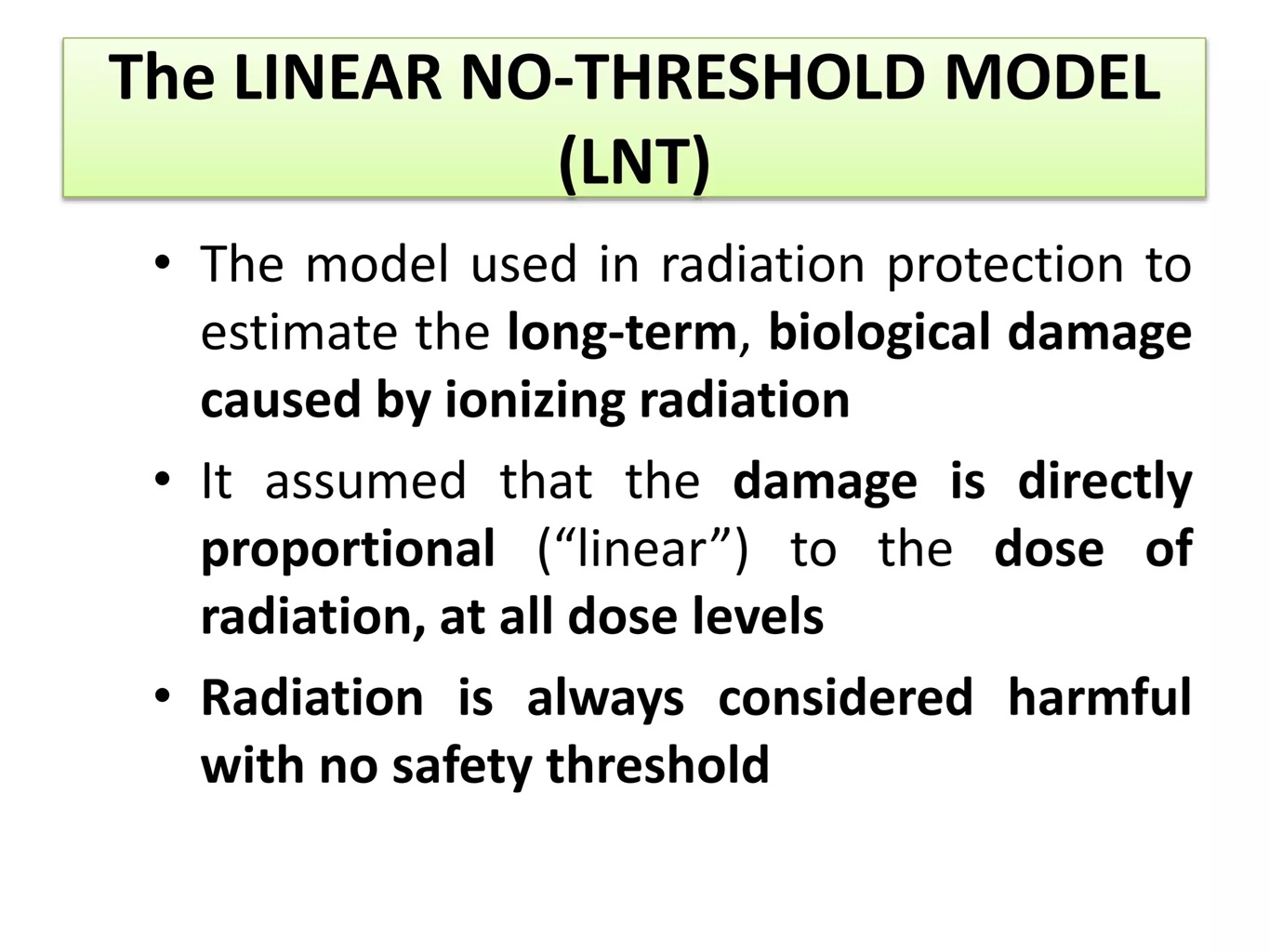
from lower doses spread over longer time periods using a ‘Linear No-Threshold’ (LNT) model –
essentially based on the no safe level principle. The risk estimates have been revised over time as
evidence emerged for higher cancer rates among the survivors and revision of the estimates of
doses they received that might have caused these cancers.
More recently large scale studies of nuclear plant workers in France the UK and USA – known as the
INWORKS studies (with more accurate measures of doses received and health effects compared to
non-exposed workers) have shown that the estimates used to set the current standards significantly
under-estimate the risk, and that the risk at low doses – over longer time periods may be
proportionately greater than the LNT model estimates suggest. These studies also show significantly
elevated levels or cardio-vascular diseases such as heart damage and strokes, and other worker
studies show elevated levels of dementia associated with radiation exposure. Together these
studies suggest there is an urgent need to comprehensively review the evidence of risks on which
the current national and international standards are based – particularly worker dose limits . In
addition recent meta analyses of cancer rates in large populations living close to nuclear power plants in Europe and the USA show that there is a significant general increase the closer people live
to these facilities particularly affecting the young and the elderly. These suggest the need to review
the standards that set dose-limits for public exposures alongside those reviewing expsore of
workers.
In short, the US NRC is under pressure to weaken its current standards at a time when the scientific
evidence suggests these need to be tightened.
The NRC proposals
Following the May 2025 Presidential Directive, the NRC has now, after several delays, released its
proposed revision of the standards. It clearly faced a dilemma as adopting the President’s suggested
changes would mean reversing its earlier 1991 decision that specifically rejected these same
proposals requested by industry lobbyists. In essence the 179-page proposal document (open for
45-days for comments) offers its reasoned judgements on the three key aspects of the review: the
LNT model, the ALARA principle and the occupational and public exposure limits.
To its credit the NRC retains the LNT as the basis for assessing risks at lower doses than those
received by Japanese bomb survivors. Hardly surprising as to have rejected this would have flown in
the face of international scientific pinion worldwide and its own 1991 decision. It does give some
credence the highly contested ‘Hormesis’ model based on limited studies suggesting that there may
be positive effects on health at low doses due to the capacity for cellular repair but ultimately
concludes that there is no scientific consensus that would support this or any other alternative to
the LNT model.
Unfortunately, proposes abandoning the ALARA principle arguing that it is subject to ‘excessive
subjectivity that leads to overly conservative assessments’ for managing exposures below the the
occupational and public dose limits. It is clearly identified as a burden on the nuclear industry – and
thus an impediment to the policy of reducing barriers to its development and operation. In its
place the NRC proposes ‘operating principles’ for managing doses below the legally enforceable
limits. Above (and perhaps only above) an expected dose of 100 mrem (1 MSv) per year – the limit
for public exposure – employees would need to be given ‘radiation worker training’. Above (and
again perhaps only above) an expected dose of 500 mrem (5 mSv) /year). i.e., at 10% of the
regulated exposure limit, employers would be required to monitor individual workers exposures. It
further suggests a cost-benefit approach for reducing exposures indicating that it would be
appropriate for employers to spend up to $5,200 (in 2014 US $) to avert each rem of occupational
exposure. If a radiation protection measure were more costly than that, the licensee would have an
acceptable cost-justified basis for not implementing the measure and instead accruing the dose as
long as that dose was within the regulatory dose limits.
The occupational dose limit is however further weakened by allowing exposures up to double the 5
rem (50 mSv) annual limit. Previously employers could apply for ‘planned special exposures’ for
situations needing higher worker-doses. These are no re-badged as ‘occupational dose limit
extensions’ (DLEs) permitting male workers (female workers are excluded) to receiving a dose of up
to 10 rem (100 mSV) in any year provided these do not result in the worker’s five-year average
exceeding the 5 rem (50mSv) annual limit – i.e. a total over any five year period of 25 rem (250 mSv).
These proposals will leave US workers facing permitted exposures greater than recommended by
international bodies and adopted by most national standards-setting agencies where the targeted
annual limit is 20mSv with exceptional exposures permitted up to 50 mSv provided these do not
exceed 20 mSv averaged over any five-year period. This 20 mSv annual averaging standard has been
in place since 1991 but was never adopted in the USA which retains the earlier 5 rem (50 mSv) annual limit. As indicated above the scientific evidence now calls for a revision of the stochastic
health damage risk estimates and a further tightening of the standards rather than their relaxation
as proposed by the NRC. Indeed it is notable that nowhere in the NRC proposals is here any mention
of, let alone critical review of the peer reviewed INWORKS studies.
The NRC does reject the Presidential Directive’s suggestion that the public exposure limit be raised
to 500 mrem (5 mSv). it leaves it at 100 mrem (1 mSv) in line with the international norm though it
does propose relaxing the emissions standards for radiation and radioactive material from nuclear
facilities from the existing 10 mrem to 25 mem. Again, these proposed relaxations come at a time
when the evidence suggests higher risks to the public living close to such plants and that a tightening
of existing standards is warranted. And again, nowhere does the NRC mention let alone critique this
evidence for increased health risks for populations living close to nuclear facilities.
International Opposition to the US NRC proposals
The NRC proposals are currently open for comments with a final decision on the revised regulations
due by the end of 2026. While any revised radiation protection standards will initially apply only to
the USA there are implications for radiation protection in other countries. Pressure on international
and national standards bodies can be expected. As well as the civil nuclear program it is expected
that the revised standards will apply to US based military facilities. Whether these US, or other
countries’ standards will apply to US military facilities and to any jointly owned civilian enterprises
based in other countries may be in doubt. In Australia for example a Naval Nuclear Powered
Submarine Safety Regulator (ANNPSR) has been created to oversee construction, operation,
maintenance, decommissioning and radioactive waste management from the UK, US (AUKUS)
nuclear submarine program. This new regulator reports to the Department of Defence and is
separate from the existing regulator, the Australian Radiation Protection and Nuclear Safety Agency
(ARPANSA) which reports to the Department of Health. How these regulators will collaborate, and
which standards will prevail is yet to be determined.
In Australia, as in other countries, notably the USA, Canada, coalitions bringing together the
concerns of trade unions, public health organisations and environment groups are campaigning for
rejection of the US NRC led proposals that would weaken current radiation protection standards
and for a comprehensive review of the scientific evidence that now strongly suggests the risks to
health of workers and the public are greater that when standards were last revised – now some 25
years ago – and need to be revised and significantly tightened.
Time for all US service personnel in Middle East to disobey illegal Trump orders to wage criminal war on Iran
The men and women carrying out these illegal orders from war criminal Trump and his unhinged defense Secretary Pete Hegseth dishonor their uniform. They are not serving their country. They are serving the war criminals that should be in the dock at The Hague,
Walt Zlotow West Suburban Peace Coalition Glen Ellyn IL, 19 July 26
Eight months ago, six US Congresspersons, all former military or intelligence community members, issued a video urging current service members to disobey illegal orders that might be issued by President Donald Trump’s administration.
They stated “threats to our Constitution are coming from right here at home,” and repeatedly urged the military to “refuse illegal orders.” “No one has to carry out orders that violate the law, or our Constitution. Know that we have your back… don’t give up the ship.” They did not specify the illegal orders referred to but it was assumed they were Trump’s illegal orders for service personnel to obliterate little unarmed boats in the Caribbean imagined to be bringing drugs into the Homeland.
But the six didn’t have current military personnel backs. The six shut up when none of the other 529 congresspersons joined them in doing the principled thing of demanding military not engage in Trump administration war crimes whether they be bombing little unarmed boats, bombing imagined bad guys in Somalia 75 times in 2026, killing over a hundred Venezuelans to snatch Venezuelan President Nicholas Maduro and his wife for a show trial in America.
Worst of all, the Silent Six remained mute when Trump ordered his war fighters to launch his criminal war on Iran that may plunge the world into recession if not depression. Every bomb, every missile they drop on Iran emanates from an illegal, indeed criminal order that kills mostly civilians in America’s lost cause to destroy Iran at the behest of Israel.
After 39 days of murderous bombing that killed thousands, Trump cried ‘uncle’ knowing he’d lost, forcing his negotiated a ceasefire. He thought he could salvage victory with a blockade of Iranian ports but that failed just as spectacularly. So he ordered his war fighters to attack again, except this time their targets were civilian infrastructure, obvious war crimes to any war fighter with a functioning moral compass.
The men and women carrying out these illegal orders from war criminal Trump and his unhinged defense Secretary Pete Hegseth dishonor their uniform. They are not serving their country. They are serving the war criminals that should be in the dock at The Hague, not in the White House and the Pentagon. And the phony Silent Six and their 529 fellow congresspersons doing nothing to end America’s criminal Iran war blowing up the Middle East, the world economy, possibly even unleashing nuclear weapons, are too busy scooping up Israel Lobby and US weapons makers’ money to advise military personnel to disobey illegal, criminal orders.
We need a massive military personnel sit down strike in the Middle East to end this madness and bring Trump and Hegseth to justice.
AI and the absurdity of nuclear deterrence
July 14, 2026, https://www.icanw.org/ai_and_nuclear_deterrence?utm_campaign=trinity_anniversary_2026&utm_medium=email&utm_source=ican
What if algorithms don’t feel fear? Nuclear deterrence isn’t a military capability. It’s a means of communication, intimidating the opponent’s mind, making them feel afraid. As AI edges into nuclear systems, it exposes the paradox at the heart of nuclear deterrence.
Artificial intelligence is changing how governments approach national security. It is reshaping intelligence analysis, early-warning systems, and military decision-making. Its growing role in the nuclear realm has sparked fears of a future in which machines decide to launch nuclear weapons.
That future is not here. No government or strategist is currently advocating that AI take charge of nuclear launch decisions. There is strong international agreement that these decisions must stay under human control.
But that misses the deeper issue. AI is already being woven into nuclear-related systems. AI is used in the military domain to identify missile launches, analyse sensor data, and model escalation. These integrations expose something that has always been true, nuclear deterrence has never been stable or responsible. The idea of responsible management of a genocidal capability, has always been an illusion. Nuclear deterrence relies on fear, perception, and moral contradiction. Increasing the speed of automation in these systems does not offer stability, it makes them more dangerous.
The Creeping Integration of AI
Currently AI applications are built to assist human decision-makers, not replace them. They filter data, flag threats, and support commanders under extreme time pressure. But even when humans keep final authority, automation reshapes how decisions get made. It determines what information appears, how it gets prioritised, and how fast a response is expected.
As reaction times shrink, the risk of catastrophic miscalculation grows. In a crisis, machine-generated assessments add urgency. Humans must respond to systems they cannot fully understand or verify in real time. As more nuclear-armed states fold AI into their command, control, and intelligence networks, the risk of unpredictable interactions between competing automated systems rises. These systems are also vulnerable to hacking and hallucinating and other interference.
AI magnifies the central weakness of deterrence, that it depends on fragile assumptions about rationality, perception, and control.
The Myth of Rational Control
For decades, nuclear deterrence has been sold as rational management, a balance of terror held steady by calculated threats. In reality, it is psychological theatre. It works by trying to shape an adversary’s behaviour through fear and the threat of annihilation. The whole logic of deterrence lives in the human mind.
Artificial intelligence breaks that logic. Algorithms cannot be coerced, bluffed, or frightened into restraint. They can be manipulated, fed false data, deceived, or trained to fail. That is a serious problem in its own right. But it is a different problem. It is not the manipulation deterrence relies on: intimidating a population, or impressing a leader’s mind, through shows of nuclear force. Code has no psyche. It cannot be impressed by posturing.
We are not yet in an era of fully automated nuclear decision-making. But the trajectory is clear. As AI increasingly mediates how information is processed and framed, the psychological foundation of deterrence starts to erode. The more automation shapes perception, the less room remains for the human uncertainty that deterrence theory depends on.
Automation also sharpens the dangers already built into deterrence: overconfidence, misperception, and compressed decision-making. A commander who trusts an algorithm may act faster, or more decisively, than one who trusts their own judgment. The apparent gain in control is an illusion. AI accelerates the instability already built into the system.
Deterrence has survived on luck, not logic.
What AI reveals is not a new danger. It is an old one, made visible. Nuclear deterrence has never been rational, predictable, or safe. History shows this. Deterrence doctrine did not prevent nuclear war. Luck did, along with individual decisions to defy protocol and err on the side of caution. AI now strips away the myth of “strategic stability” and shows the system for what it is: a gamble with humanity’s survival.
Policy Implications
Keeping nuclear launch authority under human control is important, and widely supported. But human control alone cannot make nuclear weapons safe. Nuclear history is full of near-catastrophic accidents, long before AI entered the picture. Transparency about how AI is used in nuclear systems is urgently needed. International dialogue should continue including at the UN General Assembly.
The goal should not be to make deterrence “AI-proof.” It should be to confront the fact that deterrence has always been technically unmanageable, strategically overestimated, and morally indefensible. Its risks cannot be automated away, because they are built into the system itself.
AI does not offer a new path to stability. Even committed defenders of deterrence would concede that much. What it offers instead is a stark reminder: the stability deterrence promised was illusory from the start. The only reliable way to prevent nuclear catastrophe, AI-driven or human-driven, is to eliminate these weapons, in line with international law and humanitarian principles.
This is why the humanitarian argument at the heart of the Treaty on the Prohibition of Nuclear Weapons (TPNW) matters more, not less, in the age of AI. The catastrophic humanitarian consequences of nuclear detonation do not change because a machine helped trigger it. No AI system can contain radiation, feed a starving population after a nuclear famine, or undo the collapse of a climate. The case for prohibition was never about how a weapon might be launched. It was, and remains, about what happens after. States should treat AI integration not as a reason to modernise deterrence, but as further evidence that security strategies must rely less on nuclear weapons, not more. That means investing in disarmament, not automation; in verification and transparency, not faster decision cycles; and in the TPNW’s normative and legal framework as the route out of a system that was never under control to begin with.
AI makes visible what has always been true
Artificial intelligence does more than raise the risk of nuclear use. It acts as a mirror, reflecting the instability and moral absurdity of a system built on the threat of annihilation.
Deterrence operates in the adversary’s mind. Even its most faithful advocates must admit that its logic collapses the moment that mind becomes a machine. AI makes visible what has always been true: there can be no psychological deterrence without psychology, and no responsible way to manage weapons designed for mass extinction.
The response to the AI-nuclear weapons debate should not be new layers of technical control. It should be to question whether these weapons can ever be controlled at all. The danger is not only a future where machines decide to launch nuclear weapons. It is a present where anyone still can.
Activists protest outside Pioneer Park nuclear event.

ACTIVISTS held a protest outside The Peddler in Whitehaven yesterday as nuclear sector figures shared their plans for ‘Pioneer Park’, an AI data centre powered by nuclear energy, with the public.
Land at Moorside, neighbouring Sellafield, has been central to new nuclear ambitions for a
number of years. There were once ambitions to develop a ‘clean energy hub’
on the land with a mix of energy-generation solutions, including a fleet of
small modular reactors (SMR).
Now named Pioneer Park, the proposal is to
develop an SMR site which will provide the energy for an ‘innovative’ AI
data centre. It is hoped the development will attract more than £12billion
in investment from business giants, provide a jobs boost and a space for
emerging industries to thrive.
But Radiation Free Lakeland, which protested
a consultation event about the proposals yesterday, argues that benefits of
the development would not outweigh the environmental impact, pointing out
the proximity of the land to the River Ehen as well as the village of
Beckermet.
Pioneer Park is set to be located on land at Moorside,
neighbouring Sellafield. The activist group said: “This area of green
fields and River Ehen Site of Special Scientific Interest (SSSI) should be
a buffer zone between the sprawling Sellafield site and the surrounding
villages.”
They said that the nuclear industry is “using public money like
there is no tomorrow to try and make this buffer zone a further nuclear
sacrifice zone and AI data centre.”
A spokesperson for Pioneer Park’s
developers said that the site at Moorside “has been identified through
Government policy for nuclear power generation since 2011″. Their ambition
is “to build on west Cumbria’s internationally recognised strengths in
energy and engineering by bringing forward new nuclear development,
alongside complementary clean energy and technology projects, helping to
diversify the economy, support the ongoing decommissioning mission at
Sellafield, generate secure, low-carbon energy and create long-term
opportunities for local people.”
Carlisle News & Star 15th July 2026, https://www.newsandstar.co.uk/news/26276371.activists-protest-outside-pioneer-park-nuclear-event/
Mysterious drones spotted flying over nuclear power plant

Sarah Hooper Metro. Live News Reporter, July 16, 2026
At least seven drones were spotted near Switzerland’s Gösgen nuclear power plant, sparking a large police response.
The mystery drones were spotted around 10.30pm yesterday and reported by a resident.
The safety of the power plant was not compromised during the incident, with the head of communications for the plant saying the threat posed by drones was ‘negligible’.
As is usually the case around power plants, a no-fly zone is in place around Gösgen.
It remains unclear who was behind the drones above the nuclear power plant this week.
Earlier this month, it was revealed that Russia launched hundreds of drones and covert UAVs across the UK and Europe from their shadow fleet, thought to be in preparation for a future conflict.
The International Institute of Strategic Studies issued a sobering report that found Vladimir Putin’s shadow fleet ships had sent drones to target airports, bases, and nuclear sites.
Among the sites affected by the spy drones were RAF Fairford, Feltwell, Lakenheath and Mildenhall, and dozens of sites across continental Europe………………………………. https://metro.co.uk/2026/07/16/seven-mystery-drones-swarm-european-nuclear-power-plant-29153061/
US industrial base is becoming stronger for wartime production, study finds
By Michael Peck, 13 July 26, https://www.militarytimes.com/industry/techwatch/2026/07/13/us-industrial-base-is-becoming-stronger-for-wartime-production-study-finds/?utm_source=sailthru&utm_medium=email&utm_campaign=c4-overmatch
As recent conflicts consume weapons at a ferocious rate, America’s defense industrial base is becoming more prepared to sustain a major war, according to a new report.
“The trends are moving in the right direction,” Jerry McGinn, who co-authored the study for the Center for Strategic and International Analysis think tank, told Defense News.
However, the study — described as a progress report on reforms to the defense manufacturing and acquisition system — still found numerous problems with ramping up and sustaining wartime production.
For example, “according to several measures — manufacturing lead times, critical munitions and materials stockpiles, and supply chain security — the U.S. industrial base has a long way to go to achieve resilience,” warned the analysis by CSIS’s Center for the Industrial Base.
CSIS did find measurable improvements since November 2025, when Secretary of Defense Pete Hegseth vowed to “transform the entire acquisition system to operate on a wartime footing.”
Hegseth also promised to “inspire American industry to become a wartime industrial base that focuses on speed and volume.”
Most striking is the number of new companies in the defense field.
“Roughly 10,000 new firms have entered the market in the past two years and nontraditional companies received over $120 billion in contract obligations in FY 2025, adding competition and innovation to the sector,” CSIS noted. “Munitions contract obligations have risen 330 percent since FY 2010. Spurred by this increased demand and depleted inventories, the Pentagon is signing multiyear agreements with munitions producers and suppliers on a historic scale.”
The military is also responding to depleted stockpiles of expensive guided weapons that have been rapidly consumed by the Iran and Ukraine wars.
The Pentagon’s 2027 budget request for munitions allocated 49% to low-cost munitions — defined as costing less than $600,000 apiece — rising to 70% by 2031.
The U.S. is also strengthening its defense supply chain, such as “multiyear procurement agreements, direct-to-supplier investments, and leaner acquisition pathways,” as well as investing in defense companies such as L3Harris Missile Solutions, according to CSIS.
However, while this signals government commitment to defense production, it “also complicates competitive dynamics within the industry as new entrants and established suppliers alike seek to meet rapidly growing demand for munitions at scale.”
Also notable is federal investment in rare earths, which has seen production soar from 95 tons in 2022, to 8,900 tons in 2025. Nonetheless, “the erosion of domestic rare earth manufacturing capacity and the rise of Chinese control took decades to unfold, however, and it will take several years of enduring effort for the United States and its allies to build, scale, and sustain the production capacity of these key defense inputs.”
Exports of U.S. arms, or cooperative multinational projects such as the F-35 fighter, have also become a pillar of America’s defense industry. Foreign Military Sales, or FMS, have more than tripled, from less than $20 billion in 2015 to more than $80 billion in 2025.
The Trump administration wants to take this further with the “America First Arms Transfer Strategy,” launched in February 2026.
“The United States will use foreign purchases and capital to support domestic reindustrialization, expand production capacity, and improve the resilience of the United States defense industrial base,” the White House executive order declared.
Ultimately, the federal government can control defense production through the products it demands, the prices it is willing to pay, and the incentives it offers.
“It’s a monopsony,” McGinn said. “Government sets the market. Government can regulate the market. So, if the government wants different outcomes, it changes how it buys.”
No radiation leak after ‘contamination’ events at Africa’s only nuclear plant, regulator says.
South Africa’s nuclear regulator said Thursday that no radioactive material
leaked into the environment during three recent “contamination” events
inside Africa´s only nuclear power station. The incidents involved
“elevated airborne radioactive contamination” inside the Koeberg Power
Station, on South Africa’s west coast, when there was a loss of power to
ventilation units during maintenance work, the National Nuclear Regulator
said, adding there was no danger to the public. It said the three separate
contamination events on June 30, July 2 and July 7 were contained inside
the station.
Mirror 16th July 2026
https://www.mirror.co.uk/news/world-news/koeberg-nuclear-power-station-africa-37442154
July 22 deadline to comment on downgrade of impact assessment for nuclear projects | Canada’s Federal government pushing for power with a “nuclear fist” | Dates and Deadlines.
| The Nuclear Fist: Five Federal Initiatives Pushing and Promoting Nuclear Power |
| There are currently five federal nuclear related initiatives / announcements: “Getting Major Projects Built in Canada – Discussion Paper on Proposed Legislative, Regulatory, and Policy Reforms” announced May 8th with the deadline now extended to July 22; the electricity strategy “Powering Canada Strong: A National Strategy for an Electrified Canadian Economy” which was announced May 14 with comment invited but no deadline; the Standing Committee on Natural Resources and the Environment electrification study with the deadline – and the study – now extended to mid-September; the Nuclear Energy Strategy for Canada announced June 22 with no comment invited and so no deadline for comment, and the June 24 announcement of the potential “listing” of the NWMO DGR under the Build Canada Act (aka Bill C-5), also no public comment period. |
July 22nd Deadline to Comment on “Big Projects” Discussion Paper
| The comment period will close on July 22nd on the federal government’s Discussion Paper Delivering on Big Projects in Canada. Released on May 8th, the discussion paper proposes that impact assessment of nuclear projects would be handed over to the Canadian Nuclear Safety Commission.Visit Assessing-Nuclear-Risk.ca for more information including submissions by public interest groups, media coverage and contacts and updates. Take one minute to send a message – the message tool is HERE. |
Fearing Justice: Rubio Gets Bolshie About the International Criminal Court (ICC)

15 July 2026 Dr Binoy Kampmark, https://theaimn.net/fearing-justice-rubio-gets-bolshie-about-the-icc/
Why are they so afraid? The Trump administration, pathologically obsessed about the exaggerated reach of the International Criminal Court, have decided to take to the barricades. In a July 13 media note released by a spokesperson for the US State Department, something akin to a declaration of war was made against the Hague-based tribunal.
Secretary of State Marco Rubio was getting bolshie about it, announcing “a sweeping campaign to dismantle the threat posed by [the court] to US sovereignty.” The effort promises to “feature a whole-of-government response to systematically disable the ICC’s ability to operate, target American servicemen or officials, or otherwise threaten American sovereignty.”
The late Henry Kissinger, who argued most stridently against the establishment of such a criminal court, would no doubt have approved. He, more than most, would have feared some eventual accounting for his own egregious crimes against international humanitarian law while serving the White House.
The alarmist tone of the announcement is palpable. The ICC was seeking “to become an unaccountable global arbiter – positioning itself above and beyond the nation state as a supranational enforcement arm of a globalist bureaucracy empowered to prosecute American servicemen and officials at will.” (This has a whiff of familiarity to it, given that the Department of Justice under Trump’s steering hand has been prosecuting, at will, individuals perceived to have wronged him in the past.)
The media release is filled with careless distortions and ugly inaccuracies, not least in the sovereignty it purports to understand and defend. The ICC, for instance, “claims authority to prosecute and even imprison American servicemen and officials operating on behalf of America’s national interest.” The body claims no explicit power to do so, given that jurisdiction is only exercisable over State Parties. The United States, in company with such states as Russia, China, India and Israel, have not appended their signatures to the Rome Statute.
It follows that no such threat is credible except in instances when the service personnel of such countries conduct war on the territory of a State Party. For that reason, arrest warrants have been issued against Israeli Prime Minister Benjamin Netanyanu, his former Defence Minister Yoav Gallant, and Russian President Vladimir Putin. Even then, enforcing such warrants, as the record shows, remains patchy and vulnerable to the political and legal interpretations offered by member states.
US military personnel have, similarly, caught the eye of the ICC in 2020 for its activities in Afghanistan, though the subsequent investigation also focused on alleged crimes committed by the Taliban and Afghan government it replaced. It took only a year for the ICC to essentially abandon the American aspect of the investigation and focus, instead, on the alleged transgressions of the Taliban and the former Afghan government.
Rubio’s opinion piece in the Wall Street Journal is also cratered with an embarrassing inability to understand the role of a tribunal that has the support, however imperfect, of 125 member states. He regards the judges as hailing from “random countries”; the court and its allies as determined to seek “near-unlimited reach, empowered to override the courts and constitutions of the US and other sovereign states – and to prosecute and arrest our citizens.”
Failing to mention the shift in focus of the 2020 investigation into alleged infractions against international law in Afghanistan, he took grave exception to the remarks of the chief prosecutor, Fatou Bensouda, that American authorities had been tardy in conducting their own prosecutions. “In effect,” snorts Rubio, “Ms Bensouda was anointing herself the final judge of US military policy and the entire US justice system.” Hardly.
A somewhat hysterical note is struck in Rubio’s assessment of the court’s supporters. Like a sinister fifth column of operatives, the tribunal “is backed and run by a powerful network of leftist nongovernment organizations, smug globalists, and hostile Third World governments united by their enmity towards the US.” For the most part, the Secretary tries to make good the image of the American republic as a bullying, thuggish nation state indifferent to the strictures of law.
He cannot understand the fuss made about the extrajudicial murders of alleged “narcoterrorists” in Latin America and the Caribbean, the shoddy practices of the administration in deporting “violent criminals to El Salvador,” or that organisations might wish that “apparent war crimes” committed against Iran by the US might be investigated. “Independence is our birthright,” he pompously asserts. “We don’t intend to trade it for rule by a self-appointed priesthood of ‘international law.’” It was therefore incumbent that Washington work along with allies to “dismantle the ICC – brick by brick, if necessary.”
This dismantling effort seems hyperbolic. The Trump administration has already sought to blunt the court’s functions and hound its officials. Even before Rubio’s announcement, the administration has been aggressively seeking to stem the reach of the court and the effectiveness of its officials. On February 6, 2025, for instance, President Donald Trump issued Executive Order 14203, allowing the sanctioning of any person or organisation engaged in any efforts of the ICC “to investigate, arrest, detain, or prosecute a protected person without consent of that person’s country of nationality.”
Protected persons include, among others, current and former members of the US Armed Forces; current or former elected or appointed officials of US government; and any other person currently or formerly employed or working on behalf of the US government. The personnel of US allies also fall within the definition.
The sanctions listed in the order included the blocking of property and assets within the United States “as well as the suspension of entry into the United States of ICC officials, employees, and agents, as well as their immediate family members, as their entry into our Nation would be detrimental to the interests of the United States.” ICC Prosecutor Karim Khan was the first to be designated as a sanctioned individual, though the list would swell to include members of the judiciary, including Second Vice-President Reine Alapini-Gansou from Benin, Uganda’s Solomy Balungi Bossa, Peru’s Luz del Carmen Ibáñez Carranza and Slovenia’s Beti Hohler.
The Open Society Justice Initiative accurately notes the effect of such sanctions, being “tantamount to a financial death penalty.” These entail the freezing of US assets in bank accounts, a denial of access to credit cards, relevant online platforms, banking services and health insurance, and the inability to attend speaking engagements in the US. Three of the sitting judges – Bossa, Alapini-Gansou and Canada’s Kimberly Prost are seeking declaratory and injunctive relieve against Executive Order 14203 in the US District Court for the Southern District of New York.
The State Department media note suggests more of the same, flavoured with a villainous menace. The entire US government diplomatic corps is to become a public relations arm “highlighting the abuses of the ICC and the risks posed to Americans” and urging member states to withdraw from the Rome Statute. Nations with partnering arrangements with American law enforcement and the military, and those enjoying “the benefits of the US security umbrella” will also be pressed “to reject the ICC’s purported authority to prosecute American officials and servicemen.”
States refusing to reject the authority of the ICC while still relying on American assistance would be subjected to greater scrutiny, while countries not a party to the Rome Statute would be encouraged to “leverage their diplomatic networks to take similar actions alongside us.” ICC personnel would be subjected to continued visa revocations and travel bans, while the tribunal and “affiliated organizations” will be subjected to further sanctions. It will be a time for war criminals and offenders of international law to rejoice.
All institutions, supposedly underpinned by protocols and principles, are at the mercy of Trump’s broad reading of executive power, one fickle and petulant. His office has also become a source of obscene self-enrichment, inuring this administration to giddying levels of corruption. “I’ve made money, I’ve made a tremendous amount of money, more than I would have ever thought I would have made,” he boasts. For a person who relishes breaching laws and flouting regulations, it is little wonder he, along with his insufferable cronies, have such an animus against a world court that, for all its faults and blemishes, remains a worthy project in international law and human rights.
1 This Month



26 September – International Day for the Total Elimination of Nuclear Weapons


PLEASE OPPOSE HR 8255 AND S.3639 – bills would accelerate satellite deployment, with no environmental review or safeguards – https://ncstd5li.quorum.us/campaign/169331/
To see nuclear-related stories in greater depth and intensity – go to https://nuclearinformation.wordpress.com
-
Archives
- September 2026 (219)
- August 2026 (330)
- July 2026 (355)
- June 2026 (287)
- May 2026 (306)
- April 2026 (356)
- March 2026 (251)
- February 2026 (267)
- January 2026 (308)
- December 2025 (358)
- November 2025 (359)
- October 2025 (375)
-
Categories
- 1
- 1 NUCLEAR ISSUES
- business and costs
- climate change
- culture and arts
- ENERGY
- environment
- health
- history
- indigenous issues
- Legal
- marketing of nuclear
- media
- opposition to nuclear
- PERSONAL STORIES
- politics
- politics international
- Religion and ethics
- safety
- secrets,lies and civil liberties
- spinbuster
- technology
- Uranium
- wastes
- weapons and war
- Women
- 2 WORLD
- ACTION
- AFRICA
- Atrocities
- AUSTRALIA
- Christina's notes
- Christina's themes
- culture and arts
- Events
- Fuk 2022
- Fuk 2023
- Fukushima 2017
- Fukushima 2018
- fukushima 2019
- Fukushima 2020
- Fukushima 2021
- general
- global warming
- Humour (God we need it)
- Nuclear
- RARE EARTHS
- Reference
- resources – print
- Resources -audiovicual
- Weekly Newsletter
- World
- World Nuclear
- YouTube
-
RSS
Entries RSS
Comments RSS
 nuclear-news