Radiation Protection -analysis of NRC proposals
the US NRC is under pressure to weaken its current standards at a time when the scientific
evidence suggests these need to be tightened.
Tony Webb, July 2026.
Current standards under threat
Operating under a Directive from US President Donald Trump the US Nuclear Regulatory
Commission (NRC) proposes to weaken its current radiation protection standards – at a time when
the scientific evidence suggests these existing standards underestimate the risks faced by workers
and the public – and need to be significantly tightened. Unions, public health and environment
groups around the world are pressing governments, international and national protection agencies
to resist pressure from the USA to follow suit – and are calling for a comprehensive review the
evidence leading to increased worker and public protection.
In May 2025 US President Trump issued a Directive to the NRC to revise all its current regulations
and specifically those relating to radiation protection. It called for the NRC to abandon the
fundamental principle that underpins standards worldwide that there is no threshold or ‘safe’ level
of exposure to Ionising radiation. Any dose however small can be the one that triggers what are
known as ‘stochastic’ health effects that emerge over time from damage to individual cells in the
body – damage that is inadequately repaired and where the cells go on to reproduce in in
this damaged form, later manifesting as cancers, genetic, or other health damage. Some
other effects such as skin damage are called ‘deterministic’. A minimum or ‘threshold’ level
of exposure is required, and the severity of the damage increases with the level of exposure.
The severity of stochastic health effects is independent of the dose received – you either get
is or you don’t but the risk-probability that you do increases with the dose received over
your lifetime exposure.
Following from this principle that there is no safe level radiation standards required that all
exposures be kept ‘as low as reasonably achievable’ – known as the ALARA principle. . The
Presidential directive specifically instructed the NRC to reconsider this principle. It also required
review of the legal dose-limits for the amount of non-naturally occurring radiation that workers and
the public can be exposed to in any year. These annual dose limits have been set by national
standards agencies based mainly on international reviews of studies of Japanese survivors of the
bombing of the cities of Hiroshima and Nagasaki in 1945. These survivors who received relatively
large doses over a short time period. The level of damage to their health, notably their rates of
cancer has been tracked over time and used to estimate the probabilistic risk of stochastic damage
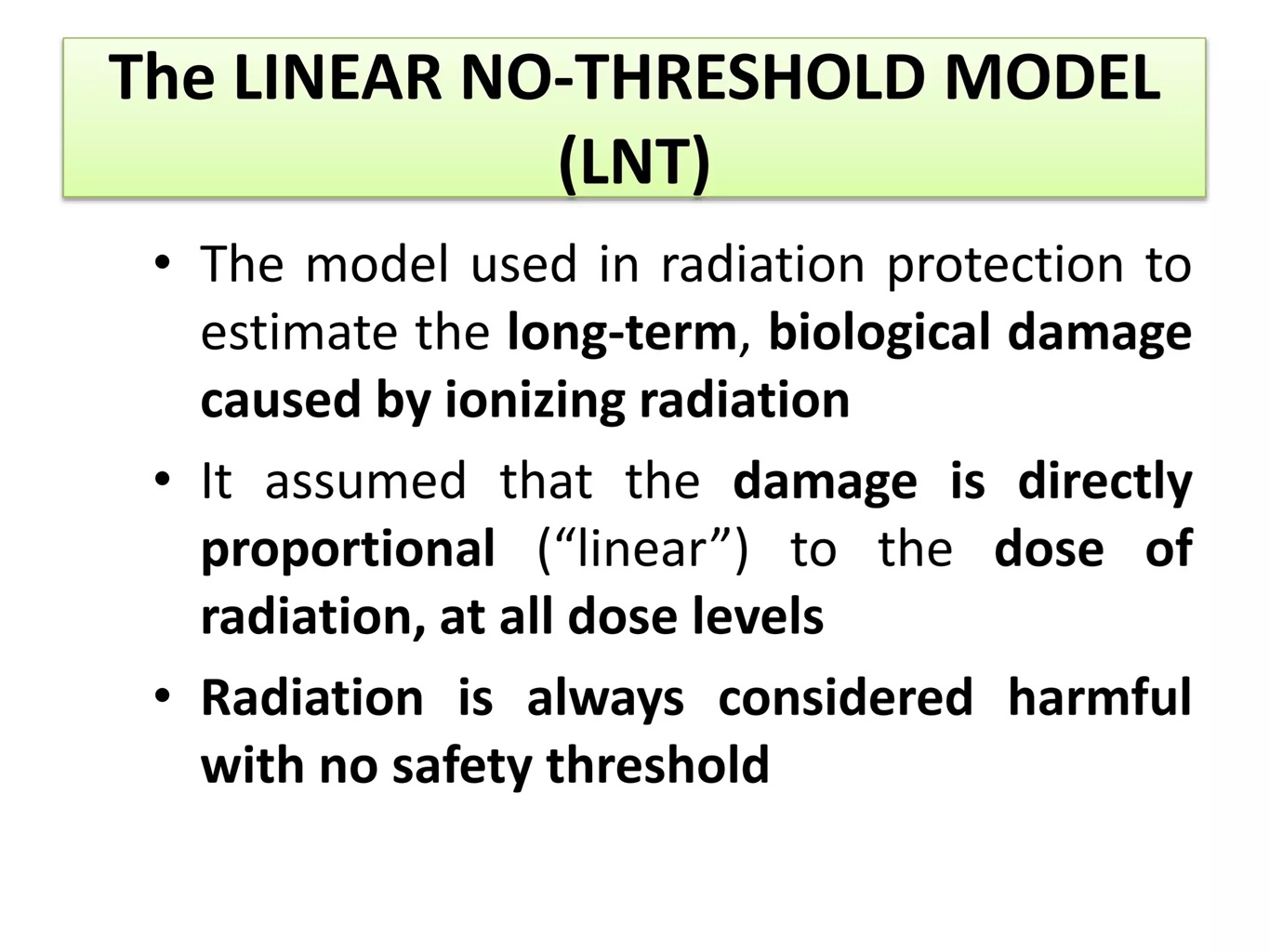
from lower doses spread over longer time periods using a ‘Linear No-Threshold’ (LNT) model –
essentially based on the no safe level principle. The risk estimates have been revised over time as
evidence emerged for higher cancer rates among the survivors and revision of the estimates of
doses they received that might have caused these cancers.
More recently large scale studies of nuclear plant workers in France the UK and USA – known as the
INWORKS studies (with more accurate measures of doses received and health effects compared to
non-exposed workers) have shown that the estimates used to set the current standards significantly
under-estimate the risk, and that the risk at low doses – over longer time periods may be
proportionately greater than the LNT model estimates suggest. These studies also show significantly
elevated levels or cardio-vascular diseases such as heart damage and strokes, and other worker
studies show elevated levels of dementia associated with radiation exposure. Together these
studies suggest there is an urgent need to comprehensively review the evidence of risks on which
the current national and international standards are based – particularly worker dose limits . In
addition recent meta analyses of cancer rates in large populations living close to nuclear power plants in Europe and the USA show that there is a significant general increase the closer people live
to these facilities particularly affecting the young and the elderly. These suggest the need to review
the standards that set dose-limits for public exposures alongside those reviewing expsore of
workers.
In short, the US NRC is under pressure to weaken its current standards at a time when the scientific
evidence suggests these need to be tightened.
The NRC proposals
Following the May 2025 Presidential Directive, the NRC has now, after several delays, released its
proposed revision of the standards. It clearly faced a dilemma as adopting the President’s suggested
changes would mean reversing its earlier 1991 decision that specifically rejected these same
proposals requested by industry lobbyists. In essence the 179-page proposal document (open for
45-days for comments) offers its reasoned judgements on the three key aspects of the review: the
LNT model, the ALARA principle and the occupational and public exposure limits.
To its credit the NRC retains the LNT as the basis for assessing risks at lower doses than those
received by Japanese bomb survivors. Hardly surprising as to have rejected this would have flown in
the face of international scientific pinion worldwide and its own 1991 decision. It does give some
credence the highly contested ‘Hormesis’ model based on limited studies suggesting that there may
be positive effects on health at low doses due to the capacity for cellular repair but ultimately
concludes that there is no scientific consensus that would support this or any other alternative to
the LNT model.
Unfortunately, proposes abandoning the ALARA principle arguing that it is subject to ‘excessive
subjectivity that leads to overly conservative assessments’ for managing exposures below the the
occupational and public dose limits. It is clearly identified as a burden on the nuclear industry – and
thus an impediment to the policy of reducing barriers to its development and operation. In its
place the NRC proposes ‘operating principles’ for managing doses below the legally enforceable
limits. Above (and perhaps only above) an expected dose of 100 mrem (1 MSv) per year – the limit
for public exposure – employees would need to be given ‘radiation worker training’. Above (and
again perhaps only above) an expected dose of 500 mrem (5 mSv) /year). i.e., at 10% of the
regulated exposure limit, employers would be required to monitor individual workers exposures. It
further suggests a cost-benefit approach for reducing exposures indicating that it would be
appropriate for employers to spend up to $5,200 (in 2014 US $) to avert each rem of occupational
exposure. If a radiation protection measure were more costly than that, the licensee would have an
acceptable cost-justified basis for not implementing the measure and instead accruing the dose as
long as that dose was within the regulatory dose limits.
The occupational dose limit is however further weakened by allowing exposures up to double the 5
rem (50 mSv) annual limit. Previously employers could apply for ‘planned special exposures’ for
situations needing higher worker-doses. These are no re-badged as ‘occupational dose limit
extensions’ (DLEs) permitting male workers (female workers are excluded) to receiving a dose of up
to 10 rem (100 mSV) in any year provided these do not result in the worker’s five-year average
exceeding the 5 rem (50mSv) annual limit – i.e. a total over any five year period of 25 rem (250 mSv).
These proposals will leave US workers facing permitted exposures greater than recommended by
international bodies and adopted by most national standards-setting agencies where the targeted
annual limit is 20mSv with exceptional exposures permitted up to 50 mSv provided these do not
exceed 20 mSv averaged over any five-year period. This 20 mSv annual averaging standard has been
in place since 1991 but was never adopted in the USA which retains the earlier 5 rem (50 mSv) annual limit. As indicated above the scientific evidence now calls for a revision of the stochastic
health damage risk estimates and a further tightening of the standards rather than their relaxation
as proposed by the NRC. Indeed it is notable that nowhere in the NRC proposals is here any mention
of, let alone critical review of the peer reviewed INWORKS studies.
The NRC does reject the Presidential Directive’s suggestion that the public exposure limit be raised
to 500 mrem (5 mSv). it leaves it at 100 mrem (1 mSv) in line with the international norm though it
does propose relaxing the emissions standards for radiation and radioactive material from nuclear
facilities from the existing 10 mrem to 25 mem. Again, these proposed relaxations come at a time
when the evidence suggests higher risks to the public living close to such plants and that a tightening
of existing standards is warranted. And again, nowhere does the NRC mention let alone critique this
evidence for increased health risks for populations living close to nuclear facilities.
International Opposition to the US NRC proposals
The NRC proposals are currently open for comments with a final decision on the revised regulations
due by the end of 2026. While any revised radiation protection standards will initially apply only to
the USA there are implications for radiation protection in other countries. Pressure on international
and national standards bodies can be expected. As well as the civil nuclear program it is expected
that the revised standards will apply to US based military facilities. Whether these US, or other
countries’ standards will apply to US military facilities and to any jointly owned civilian enterprises
based in other countries may be in doubt. In Australia for example a Naval Nuclear Powered
Submarine Safety Regulator (ANNPSR) has been created to oversee construction, operation,
maintenance, decommissioning and radioactive waste management from the UK, US (AUKUS)
nuclear submarine program. This new regulator reports to the Department of Defence and is
separate from the existing regulator, the Australian Radiation Protection and Nuclear Safety Agency
(ARPANSA) which reports to the Department of Health. How these regulators will collaborate, and
which standards will prevail is yet to be determined.
In Australia, as in other countries, notably the USA, Canada, coalitions bringing together the
concerns of trade unions, public health organisations and environment groups are campaigning for
rejection of the US NRC led proposals that would weaken current radiation protection standards
and for a comprehensive review of the scientific evidence that now strongly suggests the risks to
health of workers and the public are greater that when standards were last revised – now some 25
years ago – and need to be revised and significantly tightened.
No comments yet.
1 This Month





PLEASE OPPOSE HR 8255 AND S.3639 – bills would accelerate satellite deployment, with no environmental review or safeguards – https://ncstd5li.quorum.us/campaign/169331/
To see nuclear-related stories in greater depth and intensity – go to https://nuclearinformation.wordpress.com
-
Archives
- October 2026 (81)
- September 2026 (339)
- August 2026 (330)
- July 2026 (355)
- June 2026 (287)
- May 2026 (306)
- April 2026 (356)
- March 2026 (251)
- February 2026 (267)
- January 2026 (308)
- December 2025 (358)
- November 2025 (359)
-
Categories
- 1
- 1 NUCLEAR ISSUES
- business and costs
- climate change
- culture and arts
- ENERGY
- environment
- health
- history
- indigenous issues
- Legal
- marketing of nuclear
- media
- opposition to nuclear
- PERSONAL STORIES
- politics
- politics international
- Religion and ethics
- safety
- secrets,lies and civil liberties
- spinbuster
- technology
- Uranium
- wastes
- weapons and war
- Women
- 2 WORLD
- ACTION
- AFRICA
- Atrocities
- AUSTRALIA
- Christina's notes
- Christina's themes
- culture and arts
- Events
- Fuk 2022
- Fuk 2023
- Fukushima 2017
- Fukushima 2018
- fukushima 2019
- Fukushima 2020
- Fukushima 2021
- general
- global warming
- Humour (God we need it)
- Nuclear
- RARE EARTHS
- Reference
- resources – print
- Resources -audiovicual
- Weekly Newsletter
- World
- World Nuclear
- YouTube
-
RSS
Entries RSS
Comments RSS


Leave a comment