The Big Tech Campaign to Fast Track Nuke Energy. Senators Whitehouse and Booker Take the Lead in Congress

The ADVANCE Act passed 393-13 in the House and 88-2 in the Senate, where only Markey and Sanders voted no. Both senators have repeatedly opposed building new nuclear plants due to environmental concerns, such as the ongoing absence of a long-term solution to the nation’s roughly 100,000 tons of radioactive waste.
Last May, Trump signed a series of executive orders to radically overhaul nuclear safety oversight, citing the ADVANCE Act as justification for transforming the NRC’s culture, directing the agency to approve new reactors within 18 months, and consult with DOGE on a wholesale revision of its regulations. Since then, the administration has secretly overhauled nuclear safety rules, proposed to severely cut inspections and radiation standards, exempted new reactors from environmental reviews, and triggered an exodus of 400 NRC employees since Trump took office.
CAPITOL HILL CITIZEN, By Peter Castagno, May 2026
In September 2014, a Google engineer hosted a private meeting at the company’s Mountain View headquarters. The guests included a nuclear energy investor and staff from the influential think tank Third Way.
By the end of the meeting, the small group agreed to “fund a bit of work in DC” to influence policy in favor of nuclear energy. That meeting set in motion a decade-long campaign that would transform Democratic politics on nuclear energy – and leave the regulatory framework governing atomic safety vulnerable to the most aggressive deregulatory assault in its history.
The Trump administration leveraged the bipartisan legislative architecture that Democrats helped build to gut the Nuclear Regulatory Commission. Ross Koningstein – Google’s former director emeritus of nuclear energy R&D – hosted the Mountain View gathering.

As he explained in a 2024 article, the tech giant quietly supported Third Way, the Clean Air Task Force, ClearPath and other advocacy groups for over a decade, helping lawmakers craft pro-nuclear legislation.
Third Way and its partners have since taken credit for “creating an entirely new policy discussion around advanced nuclear energy,” helping draft overhauls to nuclear policy, and working “behind the scenes” to shift Democrats’ nuclear views.
In the early years of this effort, public support for nuclear energy was at a low point. In 2016, Gallup found a majority of Americans opposed nuclear energy for the first time since it began surveying the issue in 1994. Only 34% of Democrats favored it. By 2025, that figure climbed to 46% of Democrats – a 12-point change in less than a decade.
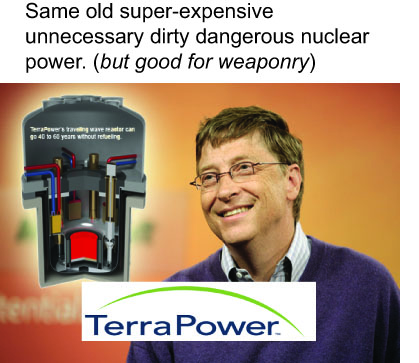
That shift coincided with a surge of Silicon Valley nuclear investment and advocacy. Jeff Navin, a lobbyist for Bill Gates’ small modular reactor (SMR) startup TerraPower, described 2015 as a pivotal year for nuclear support in Capitol Hill.
At that year’s Paris Climate Talks, Gates announced the Breakthrough Energy Coalition with co-investors including Jeff Bezos, Mark Zuckerberg and Richard Branson. Peter Thiel, another top Silicon Valley nuclear investor, published – The New Atomic Age We Need – a New York Times op-ed within the same 48-hour window.
Breakthrough Energy has since grown into a $4 billion juggernaut spanning venture capital, philanthropy, and policy advocacy, with $7.9 million in direct lobbying expenditures since 2020
Breakthrough Energy has since grown into a $4 billion juggernaut spanning venture capital, philanthropy, and policy advocacy, with $7.9 million in direct lobbying expenditures since 2020.
Taken together, Breakthrough entities and the Gates Foundation have given more than $60 million to the key pro-nuclear groups that reshaped policy, the majority since 2022.
This includes more than $20 million to Third Way, over $10 million to the Clean Air Task Force, more than $9 million to ClearPath, and nearly $4 million to the Breakthrough Institute. Laying the groundwork for Trump Third Way’s ties to Gates go beyond receiving more than $20 million from his philanthropies.
The think tank’s most recent 2024 tax filing lists lobby firm Boundary Stone Partners as its top contractor for ‘strategic consulting.’ Third Way has paid Boundary Stone Partners over $2 million since 2020, while the lobby group was simultaneously providing “comprehensive legislative and strategic support” to Gates’ nuclear firm TerraPower, which paid it $900,000 in lobby fees over the same period.
Former Office of Nuclear Energy chief of staff Andrew Richards, who led Boundary Stone Partners’ nuclear practice until March 2025, is now TerraPower’s vice president of government affairs. Jeff Navin, Boundary Stone Partner’s co-founder, has long helped coordinate Third Way’s nuclear strategy. He was Terra- Power’s director of external affairs until last April.
Navin and Josh Freed, Third Way’s energy and climate chief, approached the White House together to set up its first nuclear energy summit. Before joining Third Way, Freed was a senior advisor to the Gates Foundation. Gates has also exerted influence directly. He told Bloomberg in 2022 he had quietly lobbied elected officials including former Senator Joe Manchin, for years on federal climate policy, helping secure tax incentives for nuclear energy in the Inflation Reduction Act.
The billionaire told the former West Virginia senator that coal workers could potentially transition into building reactors for TerraPower – he donated $2,900 to Manchin in May 2022, months before the IRA’s passage. Manchin would later lead the ouster of Democrat NRC commissioner Jeff Baran, who frequently raised concerns about safety issues of experimental SMRs like TerraPower.
TerraPower’s client case study for Boundary Stone Partners notes it successfully lobbied for bills, including the 2024 ADVANCE Act. The law required the Nuclear Regulatory Commission to rewrite the language of its mission statement to promote the benefits of civilian nuclear expansion.
Victor Gilinsky, who served as a NRC commissioner in the Ford, Carter, and Reagan administrations, observed the bill showed “every sign of having been written by interested parties and with little vetting” in a 2024 Bulletin of the Atomic Scientists op-ed. He warned the subtle shift in language could open the door to severe consequences, eroding the agency’s independence to expedite licensing of experimental reactors.
“TerraPower foresees selling hundreds of such reactors for domestic use and export,” Gilinsky wrote in a 2024 analysis. “The new law is largely directed at clearing the way for the rapid licensing of such reactors by the Nuclear Regulatory Commission (NRC). It does so in part by providing additional resources but also—more ominously – by weakening the agency’s safety reviews and inspections in the name of efficiency.”
The ADVANCE Act passed 393-13 in the House and 88-2 in the Senate, where only Markey and Sanders voted no. Both senators have repeatedly opposed building new nuclear plants due to environmental concerns, such as the ongoing absence of a long-term solution to the nation’s roughly 100,000 tons of radioactive waste.
During his floor speech, Markey expressed skepticism that rapidly licensing experimental nuclear reactors was justified on climate grounds.
“It’s shortsighted to me to make such a herculean effort to promote new nuclear technologies when we’re yet to solve the longstanding problems resulting from our existing nuclear fleet,” Markey said in his floor speech. “To this day, the Navajo Nation is dealing with the legacy of uranium contamination, including more than 500 abandoned uranium mines and homes and water sources polluted with elevated levels of radiation.”
TerraPower-linked groups were heavily involved in pushing the ADVANCE Act through Congress and celebrated its passage, including the nation’s most prominent industry group, the Nuclear Energy Institute (NEI).
The NEI and Silicon Valley have deepened their relationship in recent years. Amazon is now a dues-paying member. The CEO of X-Energy, backed by $500 million in Amazon investment, sits on NEI’s board, alongside TerraPower CEO Chris Levesque and Oklo CEO Jacob DeWitte – whose firm was seeded by Sam Altman and Peter Thiel. NEI’s PAC has donated hundreds of thousands to the ADVANCE Act’s Democratic champions, including a total of $66,000 to Congressman Frank Pallone (D-New Jersey), Ranking Member of the House Energy and Commerce Committee.
Pallone and several other pro-nuclear Democrats have since expressed alarm at the Trump administration’s interpretation of the law they enacted.
Last May, Trump signed a series of executive orders to radically overhaul nuclear safety oversight, citing the ADVANCE Act as justification for transforming the NRC’s culture, directing the agency to approve new reactors within 18 months, and consult with DOGE on a wholesale revision of its regulations. Since then, the administration has secretly overhauled nuclear safety rules, proposed to severely cut inspections and radiation standards, exempted new reactors from environmental reviews, and triggered an exodus of 400 NRC employees since Trump took office.
Senators Sheldon Whitehouse (D-Rhode Island) and Cory Booker (D-New Jersey) each gave closing remarks at a nuclear energy summit in 2016. Third Way partnered with the Nuclear Energy Institute to host the Washington event.
In Third Way’s telling, the summit marked the beginning of a years-long partnership with lawmakers who “continued to champion” the nuclear legislation it helped write.
In 2020, the Democratic Party included support for nuclear energy in its national platform for the first time since 1972. That year, the Democratic National Committee paid digital consulting firm Bully Pulpit International more than $30 million.
From 2017 to 2023, the Nuclear Energy Institute paid the same firm $6.4 million to frame nuclear energy as “critical in the effort to lower carbon emissions” – achieving, according to Bully Pulpit, “consistent positive attitudinal shifts among DC elites and policy influencers.” Bully Pulpit was co-founded by former Obama campaign staffers.
The firm that helped elect Democrats was simultaneously taking millions from the nuclear industry to shift Democratic opinion. Booker became the face of Democrats’ nuclear shift during his 2020 presidential campaign.
He disparaged anti-nuclear Democrats, which a Gallup poll found made up 57% of the party at the time, during a 2019 interview: “As much as we say the Republicans when it comes to climate change must listen to science, our party has the same obligation to listen to scientists.” Booker’s framing is inaccurate.
On whether decarbonization requires nuclear energy, expert opinion is deeply divided – with leading experts including Daniel Kammen, Arjun Makhijani, and MV Ramana contending that 100% renewable pathways are viable. Yet this framing – disputed by leading experts – nonetheless became the political rationale for a sweeping legislative agenda Booker and Whitehouse would champion for the next half decade.
The senators were primary architects of the legislative architecture that the Trump administration has since used for maximal deregulation. This includes The ADVANCE Act and the 2019 Nuclear Energy Innovation and Modernization Act (NEIMA), which directed the NRC to create a new licensing pathway – called “Part 53” – for experimental reactors.
The Trump administration issued its Part 53 rule in March. It allows applicants to propose reactors in densely populated areas and use fast-tracked reviews from the Department of Defense and Department of Energy as evidence for their safety, and lacks specific guidance for carrying out systematic risk analyses.
As ranking member of the Senate Environment and Public Works committee, Whitehouse has repeatedly lambasted Trump administration officials for gutting nuclear safety standards.
“Despite so much commonsense, bipartisan work, the Trump Administration has upended progress in a flamingly partisan manner,” he said at a June 2025 hearing. “In this case, by DOGE-ing the NRC in flagrant disregard for nuclear safety, for the bipartisan direction of Congress, and for the law.”
The purpose of the hearing was to consider two Trump nominees, Energy Secretary Chris Wright and EPA assistant administrator Usha-Maria Turner. Whitehouse voted against the EPA nominee due to her history of working in the fossil fuel industry: “The corruption and conflicts of interest are happening in plain view. For that reason, I will not support this nomination.”
However, Whitehouse voted in favor of Wright, a former fossil fuel executive and board member of nuclear startup Oklo. He withdrew his support a month later in protest of the Department of Energy’s “hostile takeover” of the Nuclear Regulatory Commission.
Yet despite his vocal concerns about the dangers of ongoing nuclear safety rollbacks, Whitehouse introduced the Nuclear Refuel Act in June 2025 and voted to move it to the Senate floor in October 2025.
The bill would streamline new nuclear reprocessing facilities, which separate fissile material from spent fuel. The extracted materials are then repurposed for use as reactor fuel, but also can be used to create nuclear weapons.
As over a dozen experts explained in a July 2025 letter to elected officials, security and economic concerns have long prevented the U.S. from using plutonium for civilian nuclear fuel. Experts warned a U.S. reprocessing program could lead to the spread of nuclear weapons technology – President Carter banned the practice after India used it to make a bomb in 1974 – and weaken U.S. diplomats’ ability to discourage other countries from similarly extracting weapons-grade plutonium from their fuel.

The Senate EPW press release for the Nuclear Refuel Act featured a celebratory statement from Oklo CEO Jacob DeWitte, who plans to use plutonium-bearing fuel for his breeder reactor. This comes as the Trump administration aims to transfer 20 tons of plutonium to private industry while cutting security standards meant to safeguard against the theft of nuclear materials.
Unlike Whitehouse, Markey has opposed this effort: “Oklo Inc., a nuclear technology start-up, is the main company interested in receiving plutonium from [the Department of Energy],” Markey wrote in a September letter to Trump. “Oklo is also, with DOE’s support, building a $1.7 billion reprocessing plant in Tennessee. Your Secretary of Energy, Chris Wright, served on the Board of Directors of Oklo until his confirmation in February.
In 2024, Wright and his wife also made contributions to your presidential campaign totaling about $458,000 and made contributions to the Republican National Committee of about $330,400.” Whitehouse and, to a greater extent, Booker have also received generous support from nuclear interests, including at least $200,000 from Breakthrough Energy and Google leaders.

Holtec executives donated $68,100 to Booker’s committees in 2022, while the New Jersey firm was under a state criminal investigation for defrauding tax credit applications and under national scrutiny for safety violations.
That year, Booker helped pass IRA nuclear subsidies Holtec is now using to restart its Palisades plant. Whitehouse’s most recent financial disclosure reports holdings of at least $1.8 million in tech giants invested in nuclear expansion, including Google, Amazon, and Meta.
Whitehouse invests up to $5 million in Nvidia, which recently announced a partnership with Oklo for the AI-assisted fabrication of plutonium- bearing fuel.
Whitehouse and Booker also received donations from nuclear policy lobbyists, including $13,500 from KDCR Partners, a firm paid more than $4 million since 2020 by TerraPower, Breakthrough Energy, NEI, and Google to lobby on nuclear policy.

KDCR’s founder was President Clinton’s deputy assistant for legislative affairs, one of multiple veterans of Democratic administrations recruited by the nuclear industry to shepherd its agenda through the party. In the mid-2010s, the Nuclear Energy Institute retained consulting firm Kivvit – co-founded by David Axelrod, Obama’s chief campaign strategist and senior advisor – to help create the “Nuclear Matters” front group. As the Climate Investigations Center noted in 2016, Kivvit explained how its Nuclear Matters operation implemented a robust public affairs campaign, which includes advertising, sponsored event series, media relations, grasstops recruitment, third-party advocacy, and targeted social media engagement.”
Nuclear Matters is funded almost entirely by NEI, but it describes itself as “a national coalition of grassroots advocates, working to inform the public and policymakers about the clear benefits of nuclear energy.”
But the shell group transfers nearly its entire revenue to PR firm APCO Worldwide, which has received more than $20 million from Nuclear Matters and its parent nonprofit since 2016.
Nuclear Matters’ first president Neal Cohen was the former president of APCO, where he helped develop Phillip Morris’ PR playbook. Carol Browner – former Clinton EPA administrator and Obama climate advisor – is Nuclear Matters’ most prominent third-party recruit. The group has paid her at least $850,000 since 2018.
Browner recanted her formerly anti-nuclear views in a 2014 Forbes op-ed and announced she was joining a bipartisan “public education campaign” alongside former Senators Evan Bayh and Judd Gregg, to whom Nuclear Matters has paid $345,000.
Bayh received $1.95 million from a lobby group that represents nuclear clients during the same period. Nuclear Matters lists Third Way among its partners and the groups frequently collaborate.
Browner represented Nuclear Matters at the 2016 Third Way summit where Whitehouse and Booker gave closing remarks – in a room that also included Google’s Koningstein, Oklo’s future CEO, and TerraPower – a meeting Third Way later described as the milestone that launched a decade of successful bipartisan nuclear advocacy.
When Gates announced Breakthrough Energy at the 2015 Paris Climate Talks, he asserted the impending climate catastrophe brought an urgent need for “high risk” investments in clean energy technologies.
The billionaire struck a different tone a decade later in a public memo ahead of the 2025 UN Climate Change Conference.
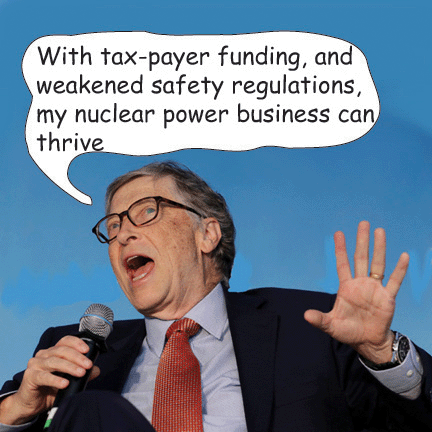
Gates explained he still views climate change as serious, but not a “doomsday” level threat, and advocated a different approach to address it – one that benefits his nuclear company.
The first priority in Gates’ memo is to lower the “Green Premium” – “the cost difference between the clean and dirty way of doing things.”
Gates wrote he was hopeful he could bring down TerraPower’s 50% Green Premium, before advocating government leaders promote policies to fund and support Green Premium technologies.
Amazon-backed SMR startup X-Energy similarly noted its reliance on government support in its recent IPO filing. Yet while its technology is supported by more than a billion in public funding, X-Energy has an “Intellectual Property-driven business model” to generate “attractive free cash flow” from the use of its complex proprietary technology.
Gates built his fortune on Microsoft’s copyright and patent protections. He co-founded TerraPower with former Microsoft CTO Nathan Myhrvold in 2008, as the first spinout company of Myhrvold’s patent portfolio firm Intellectual Ventures. TerraPower – which has so far received more than $2.5 billion in government funding – already has more than 500 patents.
The Trump administration greenlit TerraPower to begin construction of its first plant in March, nine months ahead of schedule. The company credited Trump’s May executive orders and bipartisan reforms that Third Way and its partners helped create for the rapid timeline.
Experts, such as Union of Concerned Scientists director of nuclear power safety Edwin Lyman, excoriated TerraPower’s rapid approval, noting the NRC itself conceded the reactor had unresolved safety issues in its reviews.
Balancing Act at the New York Times: Nicholas Kristof Wrote About Israel’s Sexual Torture of Prisoners, the Next Day Isabel Kershner Penned More Unverified Rape Allegations Against Hamas

Robin Andersen, SCHEERPOST, May 30, 2026
The New York Times attempted to ‘balance’ Nicholas Kristof’s documentation of the systematic rape of Palestinians by Israeli forces with yet another unverified rape ‘investigation’ claiming that Hamas had weaponized sexual violence on October 7. It was written by the paper’s pro-Israel Jerusalem-based reporter, Isabel Kershner.
Nicholas Kristof’s New York Times Op-ed piece titled The Silence That Meets the Rape of Palestinians, published on May 11, was based on documentation and grueling victim testimonies of rapes that Palestinians have experienced at the hands of Israeli security forces. Brutal and sadistic acts of sexual torture are described in a piece that triggered enormous attention even though human rights organizations have been documenting these same crimes for years now.
The Israeli human rights group B’Tselem has documented Israel’s sexual torture of Palestinian men, women and children calling the “Israeli prison system a network of torture camps.” Save the Children reported in July 2024 that Palestinian children in Israeli detention were facing “disease, increasing starvation, [and] abuse including sexual violence.” A Palestinian women’s rights organization warned that their documented 75 cases of rape and sexual violence against Palestinian women amounted to about 1% of what was actually happening in Israeli detention. Euro-Med Human Rights Monitor’s extensive report published on April 13, 2026, emphasized that the sexual torture was so bad it amounted to “another genocide behind walls.” They identified its purpose as a “systematic destruction of the body and identity.” The report emphasized the scope of “criminal responsibility,” by the collusion of state institutions that were creating impunity.
In a discussion about Kristof’s piece, Francesca Albanese, who has also documented brutal Israeli torture sites, told Al Jazeera’s UpFront that she had given a long interview about sexual torture to the New York Times as early as February 2024, but nothing came of it. Albanese went on to say she didn’t understand why the Times piece should have been “more important” than the extensive documentation of human rights monitors. But when Kristof finally acknowledged that Palestinians were being tortured and raped by trained dogs, (corroborated by a soldier) in Israeli prisons, it made headlines in the US and sent shock waves through Israel’s hasbara apparatus.
The agenda setting New York Times is a “paper of record,” with a journalism staff of 3000, about 7 percent of all journalists working in the US. The paper has also been a reliable source of pro-Israel messaging for years, especially after October 7, so when a well-respected human rights journalist wrote such an op-ed in its pages it was a public relations disaster for Israel and its propaganda machine went into high gear to counter the bad press. Zionists and genocide supporters protested in front of the Times building. Netanyahu was so outraged that he threatened to bring a defamation lawsuit against the paper. The Israel Foreign Ministry called the piece “blood liable” and accused Nicholas Kristof of writing “an endless stream of baseless lies and propaganda” that turned the “victims into the accused.”
It should come then, as no surprise that the paper attempted to “balance” Kristof’s essay by publishing a piece the very next day, on May 12, about another “two-year investigation” by Israel, that “concluded” that sexual violence by Hamas was widespread on October 7. Isabel Kirshner’s piece attempted to breathe new life into the thoroughly discredited and debunked original Times’ front-page ‘investigation’ titled Screams Without Words. Screams was first published on December 28, 2023, just as the South African legal case against Israel’s genocide was being presented to the International Court of Justice, and it served as a significant denial and justification for Israel’s genocidal violence at the time. Screams without Words can be described accurately (and has been) with the same words used by Israel’s Foreign Ministry to falsely describe Kristof’s piece; “an endless stream of baseless lies and propaganda.”
The timing of the now infamous rape story of 2023, along with its extravagant claims to evidence not found in the front-page article, had much to do with why, almost immediately, the piece drew critical attention from media analysts, independent investigative reporters, and human rights organizations. Withering criticisms of the story included an essay in Medium, calling it “crappy journalism,” saying it offered a “lesson on selection, slanting, and charged language, and why using words in these ways constitutes a poor substitute for solid evidence and reasoning.” An Egyptian feminist non-governmental organization (NGO) Speak Up, called the article a “disgraceful investigation,” and shamed the Times for claiming to provide readers with definitive evidence, while actually offering no evidence at all. Independent US investigators such as Electronic Intifada, The Grayzone, The Intercept, Mondoweiss and others, roundly debunked the fictionesque inventions continued within it. Sixty journalism professors wrote to the New York Times calling on the paper to commission an independent review of the article. It was “troubling to professors of journalism to see such a shoddy article be published without a retraction or an investigation,” Professor Deepa Kumar told Democracy Now! ………………………………………………………………
The paper’s 2026 version of the Hamas rape story was penned by one of the Times’ most reliably pro-Israeli reporters, Isabel Kershner, and this new ‘investigation’ once again takes seriously, discredited Israeli sources that Kershner claims to be independent and reliable…………………………………………………………………..
Isabell Kershner at the New York Times
Kershner has been providing positive reporting for Israeli Security Force for years now. With Kirshner, polishing the image of the IDF is a family affair. ………………………………………………………………………………………………………………………………………..
Balancing legitimate reporting that includes reliable witness testimony confirmed by multiple human rights investigations over a period of years cannot be not done by publishing unverified allegations from discredited sources. Alan MacLeod noted a recuring media pattern here that applies to the New York Times’ reporting on Israel; “whenever scrutiny intensifies around Israeli abuses against Palestinians, major Western outlets redirect attention toward unverified claims against Hamas to justify Israel’s genocide in Gaza.”
Balancing Kristof’s rare acknowledgment of Israeli war crimes with reporting by a pro-Israel, biased journalist citing discredited sources repeating unverifiable allegations was a shameful, and failed, attempt to appease the state of Israeli as it expands its crimes of war and occupation into Lebanon for a Greater Isreal. The Times would do better to simply report the truth and stop catering to hasbara and the false narratives that facilitate Israel’s on-going genocidal violence.
Material from this piece was drawn from Chapter 4, “A Compromised Media Landscape,” and from Chapter 8, “The New York Times Rape Story: War Propaganda and Trauma Porn,” in The Complect Lens: US Media Coverage of Israel’s Genocide in Gaza, by Robin Andersen
Robin Andersen is professor emerita of media studies at Fordham University and an award-winning author of a dozen single- and co-authored books. Her work examines film, television, and media coverage of war, the environment, politics, and elections. She edits the Routledge Focus Book Series on Media and Humanitarian Action, serves as a Project Censored Judge, and contributes to the annual State of the Free Press. Andersen is on the Board of Directors of Fairness and Accuracy in Reporting (FAIR), where she also writes regularly, and is an Izzy Award Judge for the Park Center for Independent Media. Her writing has appeared in CounterPunch, LA Progressive, The Progressive, Salon, Common Dreams, and ScheerPost, among others. https://scheerpost.com/2026/05/30/balancing-act-at-the-new-york-times-nicholas-kristofs-wrote-about-israels-sexual-torture-of-prisoners-the-next-day-isabel-kershner-penned-more-unverified-rape-allegations-against-h/
Why Congress and senior officials must deny Trump a ‘nuclear escape’ in Iran
Bulletin, By Paul Slovic, Rose McDermott | Analysis | May 26, 2026
The most frightening possibility in the ongoing Iran war is not simply that the United States could deepen its involvement. It is that a US president whose own decisions helped create the crisis could come to see nuclear escalation as the clearest path out of humiliation, stalemate, and existential loss.
That risk should not be dismissed as fanciful.
Early in the war, Axios reported that the Pentagon was developing options for a “final blow” against Iran that could include a massive bombing campaign, the use of ground forces, and even deep operations to open the Strait of Hormuz and possibly secure highly enriched uranium buried deeply underground. The same report said some officials believed a crushing show of force might create leverage in talks or simply give President Donald Trump something with which to declare victory. The scenario under discussion is not a narrow raid but a wider escalatory pathway in which troop exposure, political embarrassment, and the desire for a dramatic concluding act could converge. That is precisely the type of setting in which nuclear danger can grow.
Recent events underscore the urgency of this concern. In late March and early April 2026, President Trump threatened strikes against Iranian energy and nuclear infrastructure if Tehran did not accept US terms, at one point warning that “a whole civilization will die tonight, never to be brought back again.” Later that month, he posted an AI-generated image of himself holding an assault rifle under the words “NO MORE MR. NICE GUY!” while again pressing Iran to “get smart soon” in negotiations.
These threats illustrate how readily catastrophic violence can be recast as justified leverage, necessary for demonstrating resolve, or framed as a moral necessity rather than as an unthinkable humanitarian disaster.
Putin in Ukraine, Trump in Iran. The parallel to an earlier analysis of Vladimir Putin, threatening to use his nuclear weapons in Ukraine, is uncomfortable but real. As we have argued in Foreign Affairs, the central question is not whether a struggling Putin is rational in some abstract sense, but how known psychological forces could shape his perception of losses, humiliation, and escape routes.
Nuclear escalation becomes more likely when a leader feels backed into a corner, when military efforts are failing, and when the line between preserving personal power and preserving the state begins to blur.
The same pattern could arise for Trump in Iran: Nuclear escalation becomes more likely when a leader’s personal standing becomes fused with a nuclear objective—when retreat begins to look like humiliation. Trump has recently framed the Iran conflict in such absolute terms. Asked about Americans’ financial hardship amid rising prices, he said, “The only thing that matters, when I’m talking about Iran: They can’t have a nuclear weapon. I don’t think about Americans’ financial situation.”
Yet the military picture appears far less decisive than that rhetoric suggests. IAEA Director General Rafael Mariano Grossi reportedly said that much of Iran’s near-bomb-grade uranium may remain buried in surviving tunnels at Isfahan, despite Trump’s earlier claims that US strikes had “obliterated” Iran’s nuclear program. The Strait of Hormuz has become a continuing strategic and economic crisis; Iran’s missile and nuclear assets, as well as its geographic control of oil transport, remain central to its bargaining position; and US forces have already suffered casualties. In such conditions, Trump may see further escalation not as reckless, but as necessary to rescue a failing policy, protect his image of dominance, and reclaim the appearance of control and alleged victory.
This, of course, does not mean Trump will use nuclear weapons. But it shows that the pathway of nuclear escape deserves sober attention now, before events narrow choices.
Psychology of bad choices. The danger is not only deliberate evil but the ordinary psychology of bad trade-offs under stress. Research with an Iran war scenario eerily similar to the one Trump may create shows[1] that support for nuclear strikes can rise when projected US troop casualties rise. This research also shows that psychic numbing weakens sensitivity to mass suffering, that comparative framing can make one horrific option look relatively better than others and therefore more acceptable, and that punitive dispositions are associated with greater support for nuclear use. These findings identify the psychological levers that can distort our leaders’ judgments in a crisis……………………………………………………………………………………………………………………………………………………………………………………..https://thebulletin.org/2026/05/why-congress-and-senior-officials-must-deny-trump-a-nuclear-escape-in-iran/?utm_source=ActiveCampaign&utm_medium=email&utm_content=The%20Trump%20admin%20s%20attack%20on%20radiation%20protection&utm_campaign=20260528%20Thursday%20Newsletter
“Our Hands Are Dirty”: Jeffrey Wernick on America’s Founding Principles, Foreign Entanglements and the Moral Cost of Empire
Invoking George Washington, John Quincy Adams and the American abolitionist tradition, Jeffrey Wernick argues that permanent foreign attachments and endless war have pushed the United States far from the values it claims to defend.
XCNEERPOST, May 28, 2026, Joshua Scheer
Jeffrey Wernick delivers a sweeping and deeply provocative meditation on American foreign policy, arguing that the United States has abandoned the very principles its founders warned were essential to preserving the republic. Drawing on George Washington’s farewell address and John Quincy Adams’ warning that America “goes not abroad in search of monsters to destroy,” Wernick contends that modern U.S. policy has become defined by permanent alliances, military entanglements and moral contradictions that the founders would have viewed as dangerous to both liberty and republican government.
At the center of the speech is a sharp critique of America’s relationship with Israel and the broader logic of interventionist foreign policy. Wernick argues that U.S. support for occupation, military domination and endless regional conflict cannot be reconciled with the founding ideals of consent of the governed and universal human equality. At the same time, he rejects the cynical argument that America’s own historical crimes somehow excuse present injustices. Instead, he insists that the nation’s history of slavery, colonialism and war should deepen the obligation to resist repeating those patterns — not normalize them.
Moving between constitutional argument, moral philosophy and historical reflection, Wernick frames the current moment as a crisis of American identity itself: whether the country will continue down a path of empire and permanent war, or recover what he describes as the original American tradition of diplomacy without domination, commerce without conquest and principles applied universally rather than selectively.
Transcript
Our Hands Are Dirty: A Question of American Values
Jeffrey Wernick
In 1796, George Washington gave a farewell address to the American people. In it, he gave one specific warning: avoid permanent alliances with any portion of the foreign world.
He didn’t say avoid trade.
He didn’t say avoid diplomacy.
He said avoid the permanent attachments — the standing commitments that would entangle America in disputes that weren’t its own, generate domestic factions whose loyalties divided, and corrupt republican judgment with what he called:
“Sympathy for the favorite nation, facilitating the illusion of an imaginary common interest in cases where no real common interest exists.”
That sentence was written 230 years ago. Read it again. It describes our present moment with uncomfortable precision.
Twenty-five years after Washington’s address, John Quincy Adams stood as Secretary of State and faced calls for America to intervene on behalf of the Greek War of Independence against the Ottoman Empire. The Greeks were a sympathetic cause. They were fighting for freedom. They wanted American support.
Adams refused.
And the words he used to refuse have come down through American history:
“She goes not abroad in search of monsters to destroy. She is the well-wisher to the freedom and independence of all. She is the champion and vindicator only of her own.”
He went further. If America went abroad in search of monsters, he warned:
“She might become the dictatress of the world. She would be no longer the ruler of her own spirit.”
This was the American foreign policy tradition at its founding.
Not isolationism.
Commerce with all nations.
Diplomacy with all nations.
Temporary cooperation when American interests required it.But no permanent attachments.
No going abroad to fight other people’s wars.
No identification of American interests with the interests of any particular foreign country.That tradition has been almost entirely abandoned in modern American foreign policy.
And it wasn’t abandoned through democratic deliberation. It was set aside quietly through executive arrangements and political pressure until departing from it required explanation, while maintaining it became invisible.
When we accept the modern framework as the natural baseline, certain questions become almost impossible to ask — the very questions Washington and Adams considered foundational.
Should the United States maintain treaty-equivalent commitments to foreign countries without ratified treaties?
Under the founders’ framework, the answer is obviously no. The Treaty Clause exists precisely to prevent permanent attachments from forming without Senate deliberation.
When such attachments form anyway through executive agreements, lobbying pressure and political momentum, they bypass the constitutional architecture designed to prevent them.
Should American military resources be expended defending another nation’s territory when that nation has chosen not to enter a treaty that would create reciprocal obligations?
Again, under the founders’ framework, no……………………………………………………………………………………………………………………………………………………………………………………………………………………………………
American forces have expended more strategic missile defense ordnance defending Israel than Israel itself has expended defending itself.
This is in service of a war Israeli leadership reportedly pushed the United States to join.
Iran is not invading the United States.
Iran has no capability to invade the United States.Iran signed the Nuclear Non-Proliferation Treaty in 1968 and accepted the most intrusive nuclear inspections regime ever applied to any country under the JCPOA.
Israel has not signed the NPT, has no IAEA inspections, and maintains an undeclared nuclear arsenal.
The state that accepted inspections is treated as the proliferation threat.
The state that refused inspections is treated as the legitimate party demanding constraints on the inspected one……………………………………………………………………………………..Permanent military rule over millions of people who have no voting rights in the government controlling their lives, no freedom of movement, no citizenship and no realistic political path to acquiring any of these — that is government without consent of the governed.
Exactly the kind of illegitimate rule the founders identified when they applied the analysis to themselves………………………………………………………………………………………………………………………….
So let me ask the question plainly:
Is it an American value to conquer, occupy and permanently subjugate another people?
Is it an American value to treat some human beings as less than fully human?
No…………………………………………………………………………………………………………………………………………………………………….
Europe could source half its critical materials from waste by 2050, study finds

Europe could source half its critical materials from waste by 2050, study
finds. Recovery systems could help the region reclaim up to 5.7 million
tonnes of critical raw materials (CRMs) that are currently thrown away,
reducing European reliance on imported materials and strengthen supply
chain resilience.
The findings were published as part of the Future
Availability of Secondary Raw Materials (FutuRaM) project, which seeks to
map Europe’s ‘urban mine’ of unused or wasted metals and minerals lost in
discarded products, industrial residues and demolished infrastructure
across the EU27+4 (EU, UK, Switzerland, Iceland and Norway).
CRMs –
including rare earth metals, lithium and cobalt – underpin a host of modern
technologies, from smartphones and electric vehicles (EVs) to solar panels
and wind turbines. But currently, when these technologies reach the end of
their usable lives, many of these important materials are discarded, too.
Edie 27th May 2026,
https://www.edie.net/europe-could-source-half-its-critical-materials-from-waste-by-2050-study-finds/
Former Ambassador Joe Hockey says he is nervous about AUKUS – and wants Australia’s Prime Minister Albanese to cold-call Trump

Matthew Knott, May 26, 2026, https://www.smh.com.au/politics/federal/joe-hockey-says-he-is-nervous-about-aukus-and-wants-albanese-to-cold-call-trump-20260526-p600oa.html
Former ambassador to Washington Joe Hockey says he is worried about the possibility the United States will not supply nuclear-powered submarines to Australia as promised under the AUKUS pact because of faltering American production rates.
The former treasurer also urged Prime Minister Anthony Albanese to make a habit of cold-calling US President Donald Trump to improve their relationship and influence his thinking on world affairs.
Under the AUKUS plan, the US is supposed to sell three Virginia-class attack submarines to Australia, starting from 2032.
But senior US navy officials have warned that US shipyards must start pumping out significantly more submarines to have any spare for Australia, raising the possibility of the defence force being left with a capability gap.
Hockey, who served as Australia’s top diplomat in Washington from 2016 to 2020, told the National Press Club that “for the first time, I’m a little nervous about the Virginias, and that’s after a few conversations on the Hill”.
The US, he said, “just has not got the production of the Virginia up to speed”.
Hockey’s remarks are notable because he runs a Washington-based lobbying firm that represents major defence companies and he has been a passionate champion of AUKUS.
His remarks differ from Richard Marles, Defence Minister, who told this masthead last week that there was “zero possibility” of AUKUS coming unstuck.

Asked whether there was a growing danger the sale of Virginia-class submarines could be delayed or pared back, Hockey said: “I think the risk has increased, and we need again to have a full court press on the ground in Washington.”
He said that “we’ve got to prove that we’re ready for the Virginias here and display the physical capability to house them and to support their presence here, not to give the Americans any hook not to deliver”.
Hockey did not join calls for Australia to develop a “plan B” for AUKUS, saying it was not like Albanese could “go down to Bunnings” and buy a fleet of alternative submarines.
Hockey singled out US Deputy Secretary of War Steve Feinberg as a powerful official that Australia needed to court to ensure Trump’s vow that AUKUS is going “full steam ahead” is followed through.
“We’ve got to get political buy-in, more political buy-in, so that the people who are actually making the decisions on US procurement are keeping us at the top of the list,” he said.
Urging Australia to seek closer integration into US supply chains, Hockey said there was “no problem at a military-to-military or bureaucracy-to-bureaucracy level, it’s just a question of whether they can actually build the Virginias fast enough”.
Trump’s former acting chief of staff, Mick Mulvaney, agreed with Hockey that it would be “really, really, really difficult” for the US to build enough submarines to provide any to Australia, despite strong bipartisan support for AUKUS in Washington.
“There’s going to be technical difficulties building that many submarines,” he said.
The US Navy’s chief of naval operations, Daryl Caudle, said last year: “The only way we’ll ever make good on the AUKUS agreement is that we get to the 2.3 [build rate], and it is my goal to make good on that.”
The US is currently producing around 1.2 boats a year, meaning production will need to increase significantly to hit the 2.3 build rate figure.
Hockey said US allies were “really missing” a figure like the former Japanese prime minister Shinzo Abe, who developed a close relationship with Trump in his first term and spoke to him regularly on the phone.
Hockey lamented that among world leaders, “there’s no one that picks up the phone, they’re afraid almost to pick up the phone to the president [and] have a conversation.
“I mean, he answers phone calls from random journalists around the world, and it’s not hard to get his cell number, and he answers it,” he said.
“I’d encourage the prime minister to ring him occasionally. I mean, what have you got to lose? Australian prime ministers have been confidants of US presidents more than people realise, and I think the president of the United States is missing that back channel of advice.”
It has become something of a running joke among American journalists about how easy it is to obtain Trump’s phone number and call him for stories.
Albanese last year said he had Trump’s phone number after he remarked during an election debate that he’s “not sure that he has a mobile phone” and that texting a fellow world leader is “not the way it works”.
Blood Libels and Sexual Violence: Israel, Palestinian Prisoners and The New York Times
28 May 2026 Dr Binoy Kampmark, https://theaimn.net/blood-libels-and-sexual-violence-israel-palestinian-prisoners-and-the-new-york-times/
When the establishment journalism of Nicholas Kristof of that most establishment of papers, The New York Times, draws the ire of a foreign regime, and an unnaturally allied foreign regime at that, a pulse might be detected in the moribund state that is the Fourth Estate. In his piece alleging a campaign of sexual violence against Palestinians by Israel’s security apparatus, he shines some blistering light on practices long suspected and discussed. It begins a proposition that, “Whatever our views of the Middle East conflict, we should be able to unite in condemn rape.”
With that solemn theme declared, Kristof begins by remarking on the “brutal sexual assaults against Israeli women during the Hamas-led attack on Israel on Oct.7, 2023.” Members of the US administration and the Israeli Prime Minister, Benjamin Netanyahu, had rightly condemned them. “And yet in wrenching interviews, Palestinians have recounted to me a pattern of widespread Israeli sexual violence against men, women and even children – by soldiers, settlers, interrogators in the Shin Bet internal security agency, and, above all, prison guards.”
Brandishing his credentials as veteran war reporter, he makes it clear that, when writing about sexual violence, he knows what he’s talking about. Interest in the fate of Palestinian prisoners – especially in that way – was piqued during a visit to the activist and professor of non-violence Issa Amro. Amro had himself been sexually assaulted and suspected this to be a common practice “but underreported because of shame.” Interest then shifts to the conditions of incarceration, with something in the order of 9,000 Palestinians being held as of May. “Many have not been charged but were detained on ill-defined security grounds, and since 2023, most have been denied visits from the Red Cross and lawyers.”
Kristof then makes use of material gathered in 14 conversations with men and women who claim to have been sexually assaulted by Israeli settlers and the security forces, supplemented by the accounts of family members, investigators, officials and other sources. Reports are cited – Euro-Med, Save the Children, the Committee to Protect Journalists, the United Nations. The views of Sari Bashi, an Israeli American human rights lawyer who heads the Public Committee Against Torture in Israel are documented: “Rampant sexual abuse of Palestinian prisoners is a thing; it’s been normalized.” While he had seen no evidence such acts had been executed in accordance with a plan or program, “the authorities know it’s happening and are not stopping it.”
Kristof restates that point, finding “no evidence that Israeli leaders order rapes.” But what had germinated in recent years was “a security apparatus where sexual violence has become, as a United Nations report put it last year, one of Israel’s ‘standard operating procedures’ and ‘a major element in the ill-treatment of Palestinians’.”
And, as if we ever needed evidence to demonstrate that Israel’s prison system has become a foul stew of corruption, brutality and malice towards its Palestinian inmates, we only need witness the gloating joy of Israel’s Minister for National Security Itamar Ben-Gvir, who makes a ghoulish habit of posting videos glorying over their misfortune and suffering. (Sexual violence doesn’t tend to make the cut, but threats of execution do.) The fact that he thought such treatment appropriate for the activists of the Global Sumud Flotilla (his posted video sufficiently demonstrates this point) showed a consistent ecumenicism on cruelty: All who dare go against Israel’s interests or dare provide sympathy to the enemy (all Palestinians are, in Ben-Gvir-lese, the enemy) deserve what they get. For such a figure to boisterously thrive, the soil had to have been appropriately manured.
Reaction to the article in Israel was biliously swift and full of rage. The Israeli Prime Minister, Benjamin Netanyahu, worked himself up sufficiently to claim that Israel’s soldiers had been “defamed” by Kristof; a “blood libel about rape” had been perpetrated by an attempt to “create a false symmetry between the genocidal terrorists of Hamas and Israel’s valiant soldiers.”
In a media post, Israel’s ministry of foreign affairs announced what steps would be taken. “Following the publication by Nicholas Kristof in The New York Times of one of the most hideous and distorted lies ever published against the State of Israel in the modern press, which also received the backing of the newspaper, Prime Minister Benjamin Netanyahu and Foreign Minister Gideon Sa’ar have instructed the initiation of a defamation lawsuit against The New York Times.”
Kristof’s critics have decided to layer the blood libel allegation with sinister suggestions that writing about Israeli sexual abuses against Palestinian prisoners and detainees should not take place because it seasons pre-existing antisemitic sentiments. Avoid the talk about plans, programs and systems gone to the bad: patterns suggest conspiracy, and conspiracy suggests hidden forces in clandestine boardrooms plotting predation and cruelty. Thus, we have David Frum rumbling in The Atlantic about the increasingly violent attacks on Jews in the broader Western world as attributable to “anti-Jewish sentiment that draws on the deepest foundations of anti-Jewish myth.” Presumably, Palestinian victims of rape have added their share to that myth.
To its credit, the paper has held the line. Spokesperson Charlie Stadtlander confirmed that the accounts of the 14 men and women interviewed for the article had been “corroborated with other witnesses, whenever possible, and with people the victims confided in – that includes family members and lawyers. Details were extensively fact-checked, with accounts further cross-referenced with news reporting, independent research from human-rights groups, surveys in one case, with UN testimony.” Independent experts were also called upon through the reporting and verification phase. In a separate statement, the paper noted that the legal threat was “part of a well-worn political playbook that aims to undermine independent reporting and stifle journalism that does not fit a specific narrative. Any such legal claim would be without merit.”
Lawyers in Israel specialising in defamation law speculate about the chances of such an action credibly taking place let alone credibly succeeding. Liat Bergman Ravid of the firm Klein & Co is of the view that such a civil claim had “a low likelihood of success” seeing as the country’s Defamation Law barred collectives from bringing civil actions to court. The Attorney General might, however “file an indictment against the person who made the statement, but this is a rare event, bordering on non-existent.” Rare or non-existent, Idan Seger of Simchony, Klein, Sananes & Co was open to the suggestion. Were the case to groan into court, the paper “would face a far more stringent burden of proof in Israel than under the US standard, as a mere lack of malice is insufficient to avoid liability.” Absolute truth would have to be proved. That would be most telling on the Israeli authorities, were that allowed to happen.
Donald Trump Is Going Nuclear
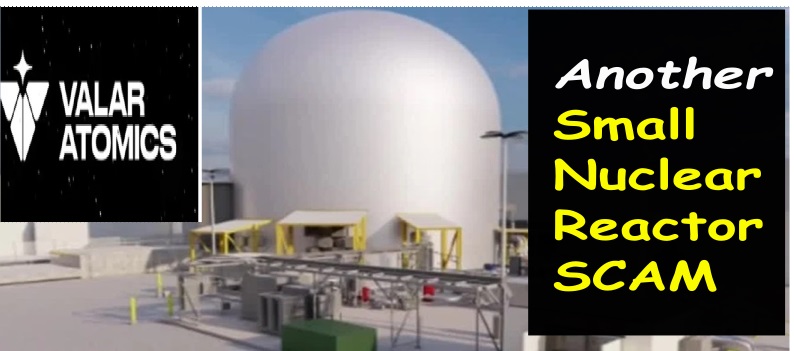
He envisions hundreds of reactors rolling off Valar’s assembly line every year, populating huge groupings of reactors that Valar calls “gigasites,” and possibly, at some point in the future, being installed on Martian soil. The primary obstacle standing in the way of such a future, he explained to me, was the “regulatory matrix.”
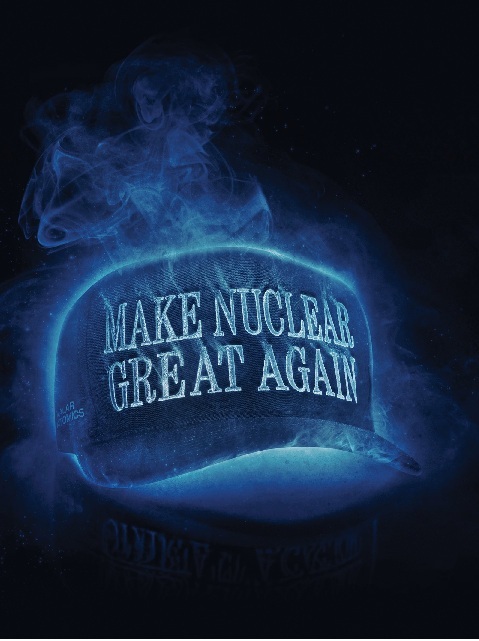
Valar has company hats that read “Make Nuclear Great Again,”
“It’s one thing to challenge the status quo and try to innovate,” said Scott Morris, the former number two at the Nuclear Regulatory Commission. “It’s another to try to go behind closed doors and blow the whole thing up.”
Valar has company hats that read “Make Nuclear Great Again,”
significant piece of Valar’s safety case is its choice of fuel. Called TRISO (for “tristructural isotopic”), the fuel is fabricated so that every uranium particle is encased in a ceramic coating that can withstand extremely high heat and will contain within it nearly all the radioactive fission products that are created as the uranium starts splitting. ………….. The big downsides are that TRISO is expensive to make, and there is very little available. Valar was planning to manufacture its own on-site, but that facility was nothing more than a patch of concrete when I saw it.
As the president explodes the nuclear energy regulatory landscape, hungry startups like Valar Atomics are racing to build new reactors as quickly as possible. But speed comes at what cost?
Colin Jones, The New Republic, May 26, 2026
At 27 years old, with a baby face and a receding hairline, Isaiah Taylor looks like nothing so much as a very large cherub. After dropping out of high school, he launched into entrepreneurship; he has described himself in his professional bio as a “self-taught engineer and 3x founder.” The first two companies were an auto repair shop in northern Idaho and a software system to allow auto repair shops to track the condition of their customers’ vehicles. The third was a nuclear energy startup, Valar Atomics, with hundreds of millions in capital, a factory in El Segundo, California, and a very active social media presence. (Taylor tweets regularly: pictures of him smiling next to the red Tesla that Trump bought from Elon Musk before their falling-out; paeans to God, “the empire,” and “Western civilization”; and more scattered thoughts, like gratitude for a national nuclear laboratory: “Fizz fizz. Fizz fizz. Uranium so good! Thank you Oak Ridge!”)
Taylor founded Valar in 2023. He has said he pitched his company to some 80 different venture capital firms before Stephen Marcus of Riot Ventures gave him his first investment. That was, frankly, a crazy bet: Taylor was only 24 years old and had no real connection to the nuclear industry, apart from a paper brief on his vision. Last year, the bet paid off. In February, Valar announced it had raised $19 million in seed funding and unveiled its first reactor prototype. Then, on May 23, Donald Trump issued four executive orders that have transformed the U.S. nuclear industry. These called for new public subsidies across the entire sector—from enrichment to plant construction to the disposal of radioactive waste. Crucially for startups like Valar, the executive orders also outlined regulatory transformations that would allow companies to build small reactors, load them with fuel, and turn them on without having to go through the painstaking licensing process of the Nuclear Regulatory Commission.
As news of Trump’s orders broke, Taylor published a manifesto heaping praise on them. (“There’s a new arm to national nuclear security: Dominance. Dominance in civilian nuclear technology development, dominance in nuclear energy infrastructure deployment, dominance in shaping global development.”) The same day, Taylor went live on Bloomberg TV. Alongside Utah Governor Spencer Cox, the young CEO announced that Valar had signed a deal with the state to build an advanced reactor there that would be operational by July 4, 2026. “That’s what the president has asked for,” said Cox. “It’s absolutely possible that we can do that.”
The timeline is immensely ambitious. In a 2021 study (from Oak Ridge National Laboratory, actually), researchers looked at how long it took to build over 500 advanced research reactors “from first concrete pour to criticality” with appropriate safeguards. They found that a majority had taken at least a year to build, with the average time being 32 months. Valar, as well as a handful of other companies selected for the Department of Energy’s Reactor Pilot Program, are attempting to do the same thing in a fraction of the time. The DOE maintains that three companies are on track to turn something on by the president’s deadline, although it is cagey about which companies exactly. Valar is gunning to be one of them.
Some critics have questioned the wisdom and purpose of this breakneck sprint. Paul Dickman, a retired senior policy fellow at Argonne National Laboratory and an adviser to the Japanese government on the decommissioning of the Fukushima Daiichi reactor complex, called it “bullshit” when I spoke with him. “I always tell people I don’t need to wait until July Fourth. I can do it tomorrow. I’m gonna go down to PetSmart and get myself a fish tank. I get myself a California source and a piece of fuel and I’ll have criticality tomorrow,” he said. “Of course I have a lot of dead fish floating around my fish tank, but that’s OK, you know.”
Others have pointed out that the United States has no long-term solution for waste disposal. Or that major questions hang over the economic viability of the small modular reactors most of these companies are building. Or that the reforms Trump has enacted at the Nuclear Regulatory Commission look like regulatory capture. Even further afield, there are those who view the current bipartisan enthusiasm for nuclear energy as a pernicious distraction, given that almost none of these reactors will come online soon enough to service the data-center boom or affect global carbon output in time to evade catastrophic climate change. “The first thing to understand is there isn’t much of a there there,” Allison Macfarlane, director of the University of British Columbia’s School of Public Policy and Global Affairs and former chair of the NRC, told me. “None of these things exist, OK. You can’t go and buy one and have it built tomorrow or even probably 10 years from now. So that’s the reality.”
Thus far these voices have been little more than a distant chorus to the forward march of industry. Asked recently what success looks like for the NRC, Ho Nieh, whom Trump appointed as NRC chair in January, replied, “Shovels in the ground.”
I first spoke with Taylor in summer 2025, a few weeks after Trump’s executive orders were announced. He popped up on my computer screen seated in a rattan chair and ready to give me his pitch. “Most of the time when we’re talking about building reactors, these are like five- to 10-year research projects, which maybe happen, maybe don’t,” he said. “And my whole philosophy in starting the company was like, we have to start moving faster as a country.” China, which had started building out a major domestic nuclear industry only this century, was on pace to overtake the United States in nuclear energy generation within a matter of years. It would require “a massive leap” to catch up. He thought Valar could do it.
Part of the reason I had been interested in Taylor and Valar was that they were such outliers in the field. Taylor has a great-grandfather who worked on the Manhattan Project, but his childhood was spent following his own dad from state to state as he chased white-collar sales work and the like. He says he grew up on food stamps. Their car was once stolen by a family friend, whom they confronted and forgave. I found these details immensely sympathetic when I heard Taylor relate them in an unusually personal interview he gave to the podcaster Shawn Ryan. I felt the same way hearing Taylor speak about his mother’s intelligence and how she used to discuss physics with him when he was a child.
All this cut against some other salient facts of Taylor’s life, which reporters in Salt Lake had been writing about of late, after his company announced it would build a nuclear reactor in their state. Like our secretary of war, Pete Hegseth, Taylor is a member of Christ Church, an institution that was founded and is still run by a pastor named Doug Wilson. Wilson wants an America in which non-Christians would be barred from public office. In a tweet about Wilson, Taylor said he appreciates the pastor’s teaching on “Christian wealth.” For Taylor, that not only means money, but also friends and family and other forms of wealth, although money is a big piece of it. (“Certain exceptions aside, participating in the system of wealth creation is simply blessing your neighbor at scale.”)
More directly related to what Valar was attempting, Taylor had erroneously claimed in a press release posted to X that you could hold spent fuel from his reactor after it had been removed. (“Nuclear engineer here. This statement cannot possibly be true,” Nick Touran, a prominent nuclear commentator and indeed a nuclear engineer, replied to the tweet. Fuel from the kind of reactor Taylor was talking about “would give a person a fatal dose within a few seconds if they were to hold a handful.”) And there was the unfortunate fact that in 2023, months after Taylor founded Valar, his friend and director of business operations, Elijah Froh, had sued Taylor’s other friend and head of operations, Kip Mock, for pouring diesel in a wood-burning stove and inadvertently setting Elijah on fire.
When Taylor and I talked, we focused on his criticisms of the Nuclear Regulatory Commission. Like most leading nuclear startups today, Valar is pursuing a small modular reactor, or SMR. Its chosen design is cooled with helium gas, and Taylor has called it “the Toyota Camry” of nuclear reactors. (That has to be understood as a proleptic description, as there is currently only one commercial version of such a reactor in operation in the world, and it is in Shandong, China). Also like most of its competitors, Valar has a business model that leans heavily on the notion that it will build its reactors in a factory. For years now, analysts have suggested that bringing construction inside a factory could help avoid the cost and schedule overruns for which the nuclear industry has become notorious. There is the tantalizing likelihood, too, that repeated construction will yield major efficiency gains, as mass production has tended to do for most products. Taylor is particularly captivated by these prospects. He envisions hundreds of reactors rolling off Valar’s assembly line every year, populating huge groupings of reactors that Valar calls “gigasites,” and possibly, at some point in the future, being installed on Martian soil. The primary obstacle standing in the way of such a future, he explained to me, was the “regulatory matrix.”
In April 2025, Valar had joined two other nuclear startups and the states of Texas, Utah, Louisiana, Arizona, and Florida as a plaintiff in a complaint against the NRC. Their case hinged on the claim that the small modular reactors that Valar and other companies planned to build posed “no meaningful risk to ‘the health and safety of the public.’” Because of that, the plaintiff’s lawyer argued, these reactors did not fall under NRC oversight. There was some exegesis of the Atomic Energy Act of 1954 involved, but in the main, the suit was asking a judge to adjudicate the basic safety of a broad category of nuclear reactors. To me, the whole thing seemed insane on its face. A report from New York University’s Institute for Policy Integrity also points out the risk of a “fifty-state patchwork of separate licensing regimes” if regulatory authority were taken from the federal government. But working on the rough heuristic that the Supreme Court had systematically undercut the authority of federal regulators over the past half decade, and that the suit against the NRC was being heard by a member of the Federalist Society, I reckoned Valar and its co-plaintiffs had a reasonable chance of success.
Early in our call, Taylor wanted to show me a chart. “So this is the cumulative U.S. nuclear construction permits over time with Three Mile Island drawn in,” he said. What that looked like on the page was a yellow line ramping upward at a healthy rate from 1955 until 1979, where it was bisected by a vertical red line marking what for Taylor was a diluvian event. That year, in March, a broken valve in the Unit 2 reactor at the Three Mile Island nuclear power plant precipitated a partial meltdown of the core and the release of a plume of radioactive fission products into the surrounding area. No deaths were directly linked to the disaster, but the U.S. nuclear industry never recovered. On Taylor’s chart, the yellow line effectively flatlined after this point.
There are a host of competing interpretations of exactly what went wrong with the nuclear industry over the 1970s. ……………………………………………………………………………………………………………………………………………….
In the past decade or so, though, it has become more common to see arguments that lay the blame at the foot of the NRC. Take, for example, “It’s the Regulation, Stupid,” a 2024 essay from Ted Nordhaus of the Breakthrough Institute……………………………………………………………………
Taylor shares the deregulatory impulse that lately goes under the slogan of abundance. His lawsuit against the NRC originated with the Abundance Institute and a former Chicago University law professor who, with financial support from the Koch brothers, had created an investment firm dedicated to “regulatory entrepreneurship.”…………………………………………………………………..
The bedrock of all this is his conviction that he should be able to build a reactor and test it without significant interference from the government……………………………………………………………………………………..
“I’ve said to people, an awful lot of what’s currently happening at the NRC feels like an Oklo revenge tour,” one former government official with knowledge of these events said to me. In 2020, Oklo Inc. was the first company to apply to the NRC for a construction permit to build an advanced reactor, or one that is not cooled with water. After two years of acrimonious back and forth, during which Oklo’s application never moved beyond the preliminary review, the NRC sent the company a letter informing it that its application had been rejected. The agency cited Oklo’s failure to provide “detailed technical information responsive to the staff’s requests for details about the safety of [Oklo’s] design.” Oklo’s CEO, Jacob DeWitte, has accused the NRC of screwing up. The executive orders that Trump signed on May 23 last year took Oklo’s side. “Instead of efficiently promoting safe, abundant nuclear energy, the NRC has instead tried to insulate Americans from the most remote risks without appropriate regard for the severe domestic and geopolitical costs of such risk aversion,” reads the second of the four. The same order goes on to call for a “wholesale revision” of the NRC……………………………………………………………….
Beginning in June, DOGE staff and the president also began implementing more direct forms of control. On the 16th, Trump fired Christopher Hanson, a Democratic appointee and the former chair of the NRC’s five-person commission. A steering committee was then stood up and staffed with DOGE affiliates to implement Trump’s executive orders, including the rewriting of the agency’s rules.
So far, their recommendations have suggested changing environmental-impact reviews, cutting the number of inspections for operating plants, allowing nuclear workers to sustain higher doses of radiation, and sunsetting the NRC’s aircraft impact assessment, which requires nuclear power plants to demonstrate that a large plane crashing into the reactor would not produce to a major release of radioactivity. ………………………………………………… . In a recent ProPublica article, a young DOE lawyer who had entered government through DOGE, Seth Cohen, is reported to have commented during an internal meeting: “Assume the NRC is going to do whatever we tell the NRC to do.”…………………………………………………….
“It’s one thing to challenge the status quo and try to innovate,” said Scott Morris, the former number two at the Nuclear Regulatory Commission. “It’s another to try to go behind closed doors and blow the whole thing up.”
…………………………………………………………………………………………………………………………………………………………………. Securing a plot at San Rafael let Taylor announce plans to build a test reactor on the same day that the executive orders were announced. From there, things just kept falling into place for him and his company. In August, Valar was selected as one of 10 companies to take part in the DOE’s Reactor Pilot Program. That gave it preference for fuel allotment and a fast track to regulatory approval for its test reactor through the DOE.
All companies in the pilot program benefited from the same structure, but Valar appears to have enjoyed a particularly close relationship with the former DOGE staffers who were spearheading reforms at the NRC. Valar has company hats that read “Make Nuclear Great Again,”
…………………………………………………………………………………….. The real lift for Valar came in November, however, with a Series A funding round led by Snowpoint Ventures, Dream Ventures, and Day One Ventures. (Snowpoint is a major firm founded by a former head of global defense at Palantir. Dream Ventures is a bit of a cypher; it has a website with a logo in one corner and the words “Investing in Extraordinary Dreamers” displayed prominently, with no other information.
Day One Ventures was founded by Masha Drokova, an émigré who was a high-ranking member of Russia’s nationalist youth movement, Nashi, before becoming disenchanted with Vladimir Putin. In the States, she got her start in venture capital while working as Jeffrey Epstein’s publicist from 2017 to 2019. When I asked Valar’s director of communication about Drokova, I was told that she’s not on the board.) The funding round brought in $130 million, much of it from Shyam Sankar, Palantir’s chief technology officer and executive vice president, as well as from Palmer Luckey, the founder and head of the defense company Anduril Industries. (I wrote to both of them asking to speak about their choice to invest in Valar and received a polite no from each.) With that money, Valar had more than enough to build its experimental reactor in Utah. As a first step, it brought its reactor core critical at Los Alamos. Taylor claimed that Valar was the first startup to “split the atom,” rowing that back after it was pointed out that other venture-backed companies had done it years earlier.
Work at the San Rafael Energy Lab moved quickly. ………………………………………………………………………………………………………………………………………………………………………………………………………..
significant piece of Valar’s safety case is its choice of fuel. Called TRISO (for “tristructural isotopic”), the fuel is fabricated so that every uranium particle is encased in a ceramic coating that can withstand extremely high heat and will contain within it nearly all the radioactive fission products that are created as the uranium starts splitting. ………….. The big downsides are that TRISO is expensive to make, and there is very little available. Valar was planning to manufacture its own on-site, but that facility was nothing more than a patch of concrete when I saw it.
Finally, we entered the reactor building. A large U.S. flag had been stuck to the wall, and the ground was a vast pad of exposed concrete that ran several feet deep. Near the center of this pad, looking somewhat small within the hangar’s voluminous interior, the reactor vessel stood upright, a rounded steel cylinder maybe 15 feet high and painted black. In Valar’s design, helium will draw the heat off the reactor core through a U-shaped pipe that runs through a trench and up again into an Escheresque complex of what looked like off-the-shelf steel ducts. These contained a heat exchanger, a purification system for the helium, and a squat red vessel, studded with steel bolts, that will pump the helium through the system……………………………………………………………………………………………………………………………………………………………………………………………………………………………………………… https://newrepublic.com/article/210095/donald-trump-nuclear-energy-regulations-valar-atomics?utm_source=newsletter&utm_medium=email&utm_campaign=tnr_daily
Norway becomes ninth country to come under French nuclear deterrence scheme
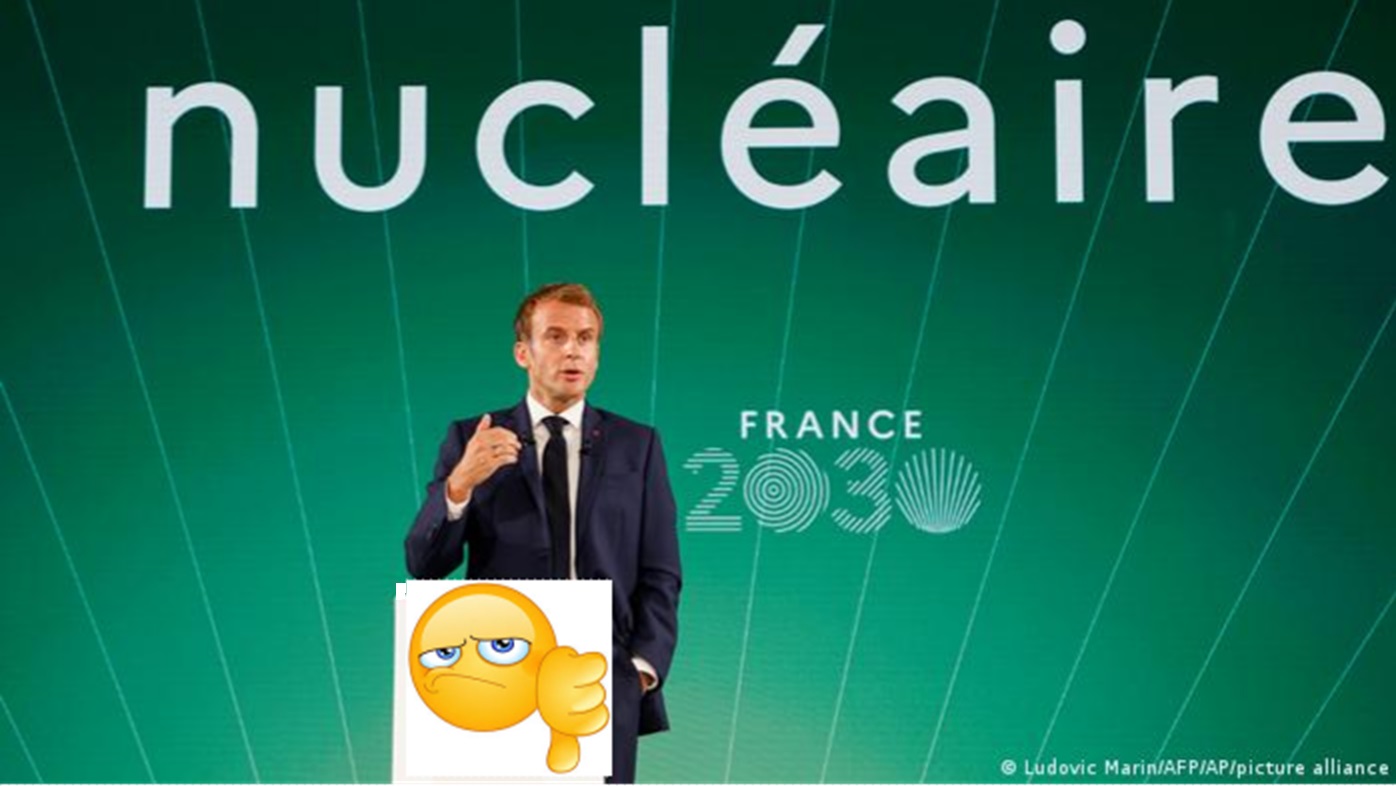
Norway on Wednesday became the ninth country to join the France-led nuclear deterrence scheme, the leaders of both countries said. President Emmanuel Macron announced in March that France – the only nuclear-armed country in the EU – would extend its nuclear deterrence scheme to willing European partners.
By: FRANCE 24, 27/05/2026
The leaders of France and Norway said on Wednesday that Oslo will join a Paris-led nuclear deterrence scheme to bolster security on the continent……………..
“In the past six months, we have entered into defence agreements with both Germany and the UK, and I am pleased that we have signed a comprehensive defence agreement with France today,” Macron said.
In March, Macron unveiled a programme under which France, the European Union‘s only nuclear-armed country, would use its atomic stockpile to boost security on the continent.
Under the so-called “forward” nuclear deterrence scheme, those who join will be able to temporarily host French “strategic air forces”, which will be able to “spread out across the European continent” to “complicate the calculations of our adversaries”, Macron said at the time…..
Prior to Norway, eight countries had joined the programme – Belgium, Denmark, Germany, Greece, the Netherlands, Poland, Sweden and fellow nuclear power the United Kingdom.
“The agreement also provides a framework for closer cooperation on hybrid warfare, maritime security, space cooperation, cybersecurity, support to Ukraine and defence industrial cooperation.”
France has an estimated 290 nuclear warheads, according to the latest figures released by the Stockholm International Peace Research Institute (SIPRI) and the Federation of American Scientists (FAS). More than 80 percent of France’s warheads are submarine-launched, according to the Bulletin of the Atomic Scientists.
That makes France the world’s fourth-largest nuclear power after Russia in the top spot (with more than 4,300 warheads) followed by the United States (with 3,700) and China (600). The United Kingdom – which is no longer an EU member but still a NATO ally – is estimated to have about 225 warheads, according to SIPRI and FAS. https://www.france24.com/en/europe/20260527-norway-becomes-ninth-country-to-come-under-french-nuclear-umbrella
Anti-nuclear group take on Sellafield for the second time in legal row

The group is concerned over the safety of toads thought to frequent local lakes.
Floyd March, Energy Voice 27th May 2026
An anti-nuclear group has successfully raised £20,000 for legal fees to take on Sellafield and the Environment Agency (EA) for a second time.
The Lakes Against Nuclear Dump (LAND) group previously failed a High Court attempt for a judicial review into the EA decision to award Sellafield a licence to extract water from the decommissioning site in Lancashire.
After the failed attempt in 2025, the new funds will look to overturn the development of a new radioactive waste storage facility.
Its leader, Marriane Birkby, fears the construction of a tunnel underground as part of the work will lead to the discharge of contaminated water into the River Ehen and River Calder, respectively.
Sellafield plans to pump water taken from the construction site to on-site storage tanks for testing prior to being discharged directly into the sea.
It has no plans to discharge into either River Ehen or Calder.
Toads, Salmon and water leaks
Birkby had previously taken issue with the length of time taken for a judge to dismiss the group’s previous attempt for a review.
If an appeal is approved, the group will argue the EA failed to conduct due diligence in assessing wildlife concerns, mainly Atlantic salmon and natterjack toads.
Natterjack toads are a protected species and reportedly inhabit a location less than a km south west of the site. Atlantic salmon, also protected, have a migration route along the River Ehen.
The group will use law firm Leigh Day to set out the grounds of appeal to overturn the original quashing of the judicial review.
High Court Judge Karen Ridge previously ruled that an assessment of the River Ehen special area of conservation wasn’t necessary “because it was considered unnecessary” as the extraction of water “was not likely to have a significant effect.”…………………..
Sellafield labelled ‘most hazardous’ UK building
Sellafield has previously been under fire from the Nuclear Decommissioning Authority (NDA). The agency had told the public accounts committee (PAC) in the House of Commons that Sellafield’s Magnox swarf storage silo (MSSS) was “the most hazardous building in the UK”.
The committee had noted there were “signs of improvement”. However, PAC chairman Sir Geoffrey Clifton-Brown said Sellafield continued to present “intolerable risks”………………………………. https://www.energyvoice.com/renewables-energy-transition/nuclear/598287/anti-nuclear-group-take-on-sellafield-for-the-second-time-in-legal-row/
Nuclear needs to build up to 8,000 SMRs just to catch up with wind and solar. By 2035, they might have 5

Giles Parkinson, May 27, 2026, https://reneweconomy.com.au/nuclear-needs-to-build-up-to-8000-smrs-just-to-catch-up-with-wind-and-solar-now-by-2035-they-might-have-5/
Australia’s almost indistinguishable far right political parties – the Liberals, Nationals and One Nation – are pushing the nuclear barrow once again, not for climate reasons but because of the “anything but wind and solar” ideology demanded by their fossil-fuelled benefactors.
So it came as a timely reminder on Wednesday, when one of the world’s leading green energy analysts, Michael Liebreich, underlined just how useless nuclear energy is for dealing with climate change, and how far the small nuclear reactors championed by many are from competing with surging wind and solar.
Liebreich is the founder of Bloomberg New Energy Finance and his address to the Energy Efficiency Council’s National Conference also touched on the perils of net zero targets (because it puts the focus on what’s really hard rather than what’s readily achievable), and the overwhelming push for electrification for “just about everything.”
But it was the nuclear hype that he was also keen to puncture, if only to underline the sheer scale and dominance of wind and solar, and its rapidly growing share of “useable” energy, as opposed to “primary energy” that ignores the massive inefficiencies of fossil fuels.
SMR are still not being built but they are championed by some of the world’s richest people, the AI and social media “tech bros” who are looking for ample energy sources to power their massive data centre needs (while contracting tens of gigawatts of wind and solar in the meantime).
“They (the tech bros) love nuclear, and they’re going to be very angry when they discover what everybody discovers, which is nuclear is kind of expensive and long and complicated,” Liebreich said.
“But even if they succeed, it’s not going to be a climate solution,” he said. And the reason is that simply to match the output of wind and solar in the 2024 calendar year, the industry would need 1,250 of the 470 MW SMRs that are being developed by Rolls Royce, or up to 8,000 of the much smaller SMRs pushed by the likes of Oklo.
“If they build five by 2035 that will be a big win,” Liebreich said. “And so, as a climate solution, by the time you did build 2000 Westinghouse SMRs, where do you think wind and solar is going to be?
“It’s obviously going to have grown. That green curve is not stopping, it is taking off, and you can see it’s taking off even in the countries that are really trying to build nuclear.”
The nuclear push is usually associated in Australia by calls to abandon net zero targets, with the main argument being – without evidence – that it is trashing the economy.
Net zero has been criticised by others supportive of strong action. Andrew Forrest, aiming for real zero at Fortescue’s giant iron ore mines by 2030, says net zero is an excuse to do not much and use offsets instead of cutting emissions, others say a 2050 target is used by an excuse to do not much anytime soon.
Liebreich’s criticism is that it makes everything sound too hard. “By focusing on zero, immediately your eye is drawn to doing the difficult bits, and the difficult bits are expensive, and we just don’t have to have those discussions right now.
“If we can’t do aviation, there’s … a smorgasbord of opportunities right in front of us that we should be doing first and quickly, because time matters. Carbon has a time value, once it’s up there, it stays up there.”
As an example of that smorgasbord, Liebreich pointed to EVs, and specifically the Nissan Leaf, which from its 2011 version to its 2026 version had trebled the size of its battery, quadrupled its range, doubled the power, and cut the cost by one third.
Simply looking at efficient technologies can also achieve so much.
“If you go from coal-fired incandescent light bulb to an LED, same energy service, you cut primary energy by 95 per cent.
“Electric cars are the same, you go from a fossil car to electric car, (you get a) 75 per cent cut in primary energy. Same for heating, you go from a boiler to a heat pump, (you get) a 75 per cent reduction in primary energy.”
Liebreich says the greater efficiency of wind ands solar – useable energy as opposed to the primary energy championed by the fossil fuel industry trying to pretend that non-hydro renewables have no impact – will accelerate that change.
“What it does is it pushes fossil off the system, it’s a transition, and if you think about it, when we went from analog to mobile and digital telephony, we didn’t measure it by how many landlines were disconnected in 1995.
“We just asked how many people have got mobile phones. Peak landline happened over 30 years after the invention of the mobile phone, in 2006. So if you had said in 2000 there’s no transition, it’s failed, it’s troubled, it’ll never happen, you look pretty stupid now.
“Peak horse in the US was 1920. The car was invented in 1886. So you measure a transition by the growth of the new, not the crushing of the old.
“And I also think … the politics of talking about how we’ve got to stop this and block this and destroy that, and so it’s very, very difficult.
“We’re telling people you’re going to stop them from using things, whether it’s coal or petrol or diesel or their boiler, or whatever, it is politically difficult. Well, it’s unacceptable. So I think we’ve got to talk about growing anew. That brings me to electrification, and electrification, I think, is the solution to all of the above.”
And for more on that, please see our recent story on Liebreich’s recently released Elecrification Staircase – From cars to coastal shipping, we can electrify almost everything, according to Electrification Staircase.
Energy Department takes steps toward allowing plutonium, historically used in weapons, in nuclear fuel

by Rachel Frazin – 05/26/26, https://thehill.com/policy/energy-environment/5896154-energy-department-plutonium-nuclear-power/
The Energy Department may allow up to five companies to use its surplus plutonium — which it has historically been used in nuclear warheads — as fuel.
The department has selected the firms for “advanced negotiations regarding the potential allocation of surplus plutonium materials,” a spokesperson for its nuclear energy office said Tuesday.
The five companies entering advanced negotiations are: Oklo, Exodys Energy, Shine Technologies, Standard Nuclear and Flibe Energy, Inc.
The Energy Department has historically used plutonium in nuclear warheads. It produced a significant amount of it during the Cold War.
In March, the White House issued an executive order directing the department to halt a prior program that sought to dilute and dispose of the plutonium. The order also directed the department to instead set up a program making surplus plutonium available to the nuclear energy industry.
In October, the Energy Department said that the available surplus for the program includes weapons-grade, fuel-grade, reactor-grade or mixed plutonium.
According to the department, the plan to give plutonium to energy companies “is anticipated to help companies unlock the next level of private funding to broaden domestic nuclear fuel supplies, spur innovation on American recycling technologies, and unlock private sector funding to fuel the nation’s nuclear renaissance.”
However, critics argue that repurposing plutonium for civilian energy could have security and other risks.
“Plutonium-based fuels and reprocessing have a poor track record when introduced in civilian nuclear energy programs,” Ernest Moniz, who was energy secretary under former President Obama, wrote last year, adding that it could lead to “the creation of additional stocks of weapons-usable materials.”
Meanwhile, Oklo cofounder and CEO Jacob DeWitte said in a written statement on Tuesday that the Energy Department program could help speed up the development of nuclear energy.
“Fuel supply constraints are a key throttle to advanced reactor development,” DeWitte said. “This program creates a pathway to use existing surplus material as bridge fuel for advanced reactors to bring more reactors online sooner.”
Bully Trump pivots from strong Iran to weak Oman – Walt Zlotow

Walt Zlotow West Suburban Peace Coalition Glen Ellyn IL, 29 May 26
Donald Trump is the classic schoolyard bully. Alas, instead of hurting, indeed terrorizing weaker school mates, he’s terrorizing the weaker on a global scale, both at home and abroad.
On the domestic front he’s demonizing the ‘other’ by abusing, sometimes killing decent, hardworking undocumented. He uses the Bully Pulpit, not in the rhetorical sense to uplift society promoting wise polices, but to dismantle most sensible domestic policies and institutions, and demonize anyone who crosses him. Nearly every critic of Trump within the Republican Party has been bullied from public office. Every Democrat is slimed as a terrible, horrible person. Classic bullying.
But it’s on the world stage where his bullying is relentlessly murderous. Over 60 bombings of imagined bad guys in Somalia without a hint of justification, much less even a mention. Swooping down into pitifully powerless Venezuela to snatch its president on trumped up charges, slaughtering hundreds in the process. Blowing up small, unarmed boats in the Caribbean then bragging his sick, murderous rampage saved a million US lives.
But on February 28th bully Trump met match. He attacked large, powerful Iran believing the lies of Israeli Prime Minister Benjamin Netanyahu and own war cabinet that Iran would collapse within days once Netanyahu assassinated Iran’s ruler. A few days turned into 39 days of bombing before Trump realized that Iran was not only surviving but winning. How? By unleashing a massive missile barrage on every US Gulf States base, Gulf States oil infrastructure, Israel, and closing the Strait of Hormuz to a fifth of the world’s oil supply.
What to do? After 91 days of humiliating defeat, bully Trump turned his bullying on tiny Oman which shares the Strait of Hormuz with Iran. Oman will be Iran’s partner in controlling traffic thru the Strait which consists of Iran and Oman territorial waters.
When asked if he’d accept a short-term deal that involved Iran and Oman jointly controlling the Strait of Hormuz, bully Trump unloaded on Oman. “No, the Strait’s got to be opened to everybody. It’s international waters. Nobody’s going to control it. We’ll watch over it, but nobody’s going to control it. Oman will behave just like everybody else, or we’ll have to blow them up. They understand that they’ll be fine,
Sorry bully Trump. Knowing Trump can no longer ‘blow up’ anybody in the region after squandering much US firepower on his lost Iran war, Oman will stand up to bully Trump just like Strait partner Iran.
Now that bully Trump has been exposed as the powerless bully he is, it’s all over for him to strut the world stage like he owns it. He’s alienated friend and foe alike with his murderous bullying, duplicitous negotiating and utter lack of credibility.
Trump’s bullying served him well in both his business career and his takeover of the r Republican Party for two presidential terms. But Karma eventually comes to bullies who believe they can bully their way thru life. It’s going to take months, years, possibly a decade to undo the damage of Trump’s bullying at home and abroad. But as Bob Dylan sang long ago…”Even the President of the United States must sometimes have to stand naked.”
U.S. Turns Cold War Plutonium Into Nuclear Fuel
Oil Price, By Charles Kennedy – May 28, 2026,
- The U.S. is exploring the use of Cold War-era plutonium from dismantled nuclear warheads as alternative fuel for advanced nuclear reactors due to uranium supply shortages and reliance on foreign enriched uranium.
- The Department of Energy has shortlisted five nuclear companies, including SMR developers.
- Critics warn the plan raises nuclear proliferation risks and could prove technically and economically difficult, as converting weapons-grade plutonium into reactor fuel remains highly expensive.
……………………………………………………………. The plutonium considered for distribution to nuclear companies is from dismantled warheads from the Cold War. The radioactive material—50 tons of surplus supply, according to the New York Times—was originally to be diluted and buried, but President Trump last year suspended that plan, per Reuters, which also recalled reports about Washington planning to make 20 tons of plutonium available to private companies.
……………………………There are, of course, opponents to the idea of using weapons-grade nuclear material for nuclear power generation by private companies. Indeed, some Democratic members of Congress have publicly protested the plan.
“The transfer of weapons-usable plutonium to private industry would increase the risk of nuclear weapons proliferation, including to rogue states or terrorists,” Massachusetts senator Ed Markey and representatives Don Beyer and John Garamendi said in a letter from last September. “The United States cannot effectively discourage other countries from using plutonium for civil purposes if we use it ourselves.”
The idea behind the move is to encourage the development of small modular nuclear reactors that could be built much more quickly than conventional ones—at least theoretically. The practical application of SMR technology, however, has stumbled after pioneer NuScale had to scrap its plans to build the first small modular reactor in the U.S. amid much higher than hoped-for costs, leading to insufficient numbers of future buyers willing to sign up for the facility’s output.
Despite these challenges in the MR segment, nuclear is back in a big way, not least thanks to Big Tech’s AI rush, which requires these companies to secure massive amounts of electricity for their facilities—and make it reliable. This is boosting the popularity of nuclear electricity outside the Big Tech community as well—higher electricity bills are making the construction costs of new nuclear power plants more palatable than they would have been a couple of years ago.
Whether plutonium would make an equivalent substitute for uranium in this nuclear renaissance remains questionable, it seems. The fact that the element could be used for the production of nuclear weapons is one problem with the idea. Another problem appears to be of a more technical nature, per the New York Times, which also cited critics as saying the cost of turning plutonium into nuclear fuel was prohibitively high. https://oilprice.com/Alternative-Energy/Nuclear-Power/US-Turns-Cold-War-Plutonium-Into-Nuclear-Fuel.html
The Israeli Knesset just voted to dissolve itself, but this won’t end the Gaza genocide
Even if Netanyahu and his right-wing allies are ousted from government, Israel’s genocide in Gaza, ethnic cleansing in the West Bank, and the wars against Lebanon and Iran enjoy broad support across the Israeli political spectrum.
By Qassam Muaddi May 27, 2026 , https://mondoweiss.net/2026/05/the-israeli-knesset-just-voted-to-dissolve-itself-but-any-new-government-will-still-pursue-genocide/
Israel might change its government sooner than expected after the Israeli Knesset voted to dissolve itself last week. The bill presented to the parliamentary body on May 20, which passed with a majority of 110 votes in favor and no opposing votes, could lead to early elections in September rather than November of this year. The vote was held in the absence of Israeli Prime Minister Benjamin Netanyahu and is set to be reconsidered at three more readings before moving toward implementation.
If passed, the current Knesset will expire, along with the government coalition based on its composition and the current cabinet led by Netanyahu. According to Israeli polls, Netanyahu’s main coalition allies, namely hardline ministers Bezalel Smotrich and Itamar Ben-Gvir, have low chances of winning. Although the two main opposition leaders, Naftali Bennet and Yair Lapid, joined forces in a new party, polls indicate that Netanyahu’s Likud Party would still win 56 out of 120 seats in the Knesset. This leaves the Likud as the main political force in Israel, but without enough of a majority to form a government on its own, forcing it to form a coalition with other opposition parties.
The vote came amid renewed controversy surrounding the military drafting of Orthodox Haredi Israelis to military service. Haredi leaders presented the bill after Netanyahu’s government failed to advance another bill to exempt the Haredis from military service.
The vote to dissolve the Knesset also comes amid mounting criticism of Netanyahu over his performance during the war on Iran and the security failure on October 7, 2023.
But what would the dissolution of the Israeli Knesset mean for Palestinians? And what does it say about the current state of Israeli politics that Netanyahu didn’t oppose the vote to move to early elections?
The short answer is: not much, or at least not for the better. Israel’s opposition parties have backed the war on Gaza, the expansion of settlements, and the war on Lebanon just as fervently as Netanyahu’s coalition, and in some cases have criticized him for not going far enough. Any new government will most likely pursue the same fundamental policies toward Palestinians. In the near term, the more pressing concern is what the current government will do to shore up its electoral standing before it leaves office. Precedent suggests that means further escalation.
Right-wing politics
Israeli politics has been dominated by its most extreme right-wing forces for almost two decades, but a common feature shared by past Israeli governments has been the lack of a simple majority by any single political party. In order to make up a majority government, any political party with the most seats in Knesset would have to form a coalition with other, smaller parties, such as Ben-Gvir’s Jewish Power and Smotrich’s Religious Zionism. When such government coalitions have formed, the junior partners have gained outsized leverage by the very fact that their presence keeps the government together.
Yet in all these varying combinations of successive government coalitions, Israeli policy toward Palestinians has remained largely the same.
Settlement expansion and the push toward the annexation of the West Bank have been constants of every right-wing Israeli government, as has the policy of siege and periodic military offensives in Gaza. So, too, has the escalating crackdown on Palestinian prisoners and the deterioration of their conditions, and the repeated attempts to alter the status quo in East Jerusalem and at Al-Aqsa Mosque — arenas where Israeli politicians have long competed to score political points, especially in the run-up to elections.
Netanyahu’s standing was already in decline before October 7, battered by his corruption trials, his attempts to overhaul the Israeli judiciary, and the Haredi draft crisis. After October 7, he faced additional backlash over his handling of the hostage negotiations and, later, over what many Israelis saw as unsatisfactory results from the war on Iran, particularly the way the U.S.-Iran ceasefire was reached without Israeli consultation. But none of this criticism has targeted the substance of Netanyahu’s policies, as reflected in the polls’ projections for the next election.
Both Lapid and Bennett, and most other opposition figures, have supported the war on Gaza, including actions that human rights organizations have characterized as genocidal. The Israeli opposition has also backed the war on Lebanon and the expansion of settlements in the West Bank — and has, in fact, harshly criticized Netanyahu for allowing the U.S. to constraint Israeli action in Lebanon and Iran. Whatever government emerges from the next election will almost certainly be composed of parties that support those same policies, with or without Netanyahu and his closest allies.
That said, the next Israeli government could bring a certain “cooling down” of some of the more aggressive policies, according to Esmat Mansour, a Palestinian journalist and specialist in Israeli politics.
Mansour believes that current regional conditions, including the reorganiztion of the region’s geopolitics in the wake of Iran’s newfound strategic advantage in its war with the U.S., might have an impact on the policy of the coming Israeli government. “The current situation pushes towards reorganizing the region geopolitically, and the ongoing wars that Israel is engaged in have taken a toll on Israel’s political credibility and on its social and military capacity, too,” Mansour told Mondoweiss. “This makes it necessary for any new government to focus on rebuilding and repairing damage.”
“This could lead the next government to ease its stranglehold on the Palestinian Authority financially, or to stop blocking its return to Gaza, and to allow aid and reconstruction materials into the Strip,” Mansour said. “It might also mean a reduction in settler violence against Palestinians in the West Bank, and some improvements to daily life, like allowing West Bank workers back into the Israeli labor market.”
More of the same
But Mansour clarified that “this doesn’t mean that the next Israeli government could be one of peace, but the internal conditions and Israel’s loss of international credibility impose new priorities.” He also stressed that “such a shift depends on Palestinians’ ability to restore their unity, and on the position Arab countries take once the war on Iran is over.”
The trajectory of any incoming Israeli government will also be shaped by the international community’s position and the pressure from global solidarity movements. In the meantime, the current Netanyahu government will do everything it can to improve its electoral prospects before the elections. At the earliest, that could be next September. Most alarmingly, this effort could include resuming the genocide in Gaza, as Israeli officials have repeatedly threatened to do in recent weeks.
As for Lebanon, the Netanyahu government already discussed expanding its war on Lebanon in a security cabinet meeting on Tuesday. Meanwhile, Smotrich has made moves to accelerate the annexation of the West Bank through a rash of legislation and unilateral orders, including the passing of the so-called “Antiquities Bill” that would transfer authority over West Bank antiquities from the Palestinian Authority to Israel, the unprecedented approval of settlement construction, and orders to erase numerous Bedouin communities around Jerusalem. All these drastic measures would stand to shore up popularity for Netanyahu’s right-wing coalition, especially among the younger right-wing voting bloc of Israeli settlers.
In other words, the way in which the Netanyahu government seeks to strengthen its electoral prospects will invariably come at the expense of Palestinians — and the other peoples of the region.
1 This Month




Shut down the radiation-damaged Heysham nuclear reactors now
To see nuclear-related stories in greater depth and intensity – go to https://nuclearinformation.wordpress.com

Say No to NASA’s Reckless Nuclear Reactor on the Moon
Say No to NASA’s Reckless Nuclear Reactor on the Moon
-
Archives
- November 2026 (12)
- October 2026 (302)
- September 2026 (339)
- August 2026 (330)
- July 2026 (355)
- June 2026 (287)
- May 2026 (306)
- April 2026 (356)
- March 2026 (251)
- February 2026 (267)
- January 2026 (308)
- December 2025 (358)
-
Categories
- 1
- 1 NUCLEAR ISSUES
- business and costs
- climate change
- culture and arts
- ENERGY
- environment
- health
- history
- indigenous issues
- Legal
- marketing of nuclear
- media
- opposition to nuclear
- PERSONAL STORIES
- politics
- politics international
- Religion and ethics
- safety
- secrets,lies and civil liberties
- spinbuster
- technology
- Uranium
- wastes
- weapons and war
- Women
- 2 WORLD
- ACTION
- AFRICA
- Atrocities
- AUSTRALIA
- Christina's notes
- Christina's themes
- culture and arts
- Events
- Fuk 2022
- Fuk 2023
- Fukushima 2017
- Fukushima 2018
- fukushima 2019
- Fukushima 2020
- Fukushima 2021
- general
- global warming
- Humour (God we need it)
- Nuclear
- RARE EARTHS
- Reference
- resources – print
- Resources -audiovicual
- Weekly Newsletter
- World
- World Nuclear
- YouTube
-
RSS
Entries RSS
Comments RSS

