Donald Trump Is Going Nuclear
He envisions hundreds of reactors rolling off Valar’s assembly line every year, populating huge groupings of reactors that Valar calls “gigasites,” and possibly, at some point in the future, being installed on Martian soil. The primary obstacle standing in the way of such a future, he explained to me, was the “regulatory matrix.”
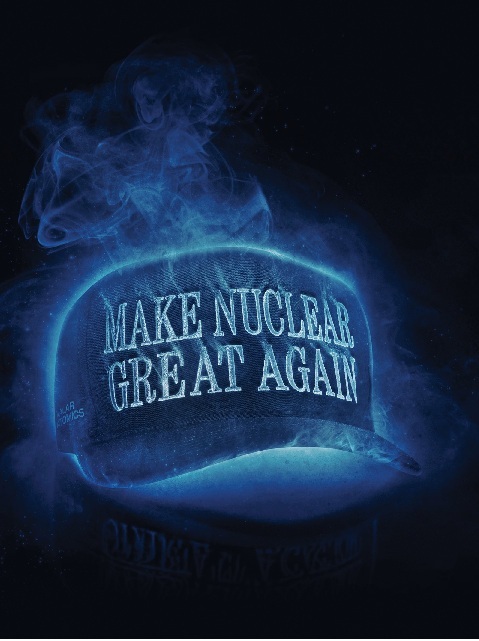
Valar has company hats that read “Make Nuclear Great Again,”
“It’s one thing to challenge the status quo and try to innovate,” said Scott Morris, the former number two at the Nuclear Regulatory Commission. “It’s another to try to go behind closed doors and blow the whole thing up.”
Valar has company hats that read “Make Nuclear Great Again,”
significant piece of Valar’s safety case is its choice of fuel. Called TRISO (for “tristructural isotopic”), the fuel is fabricated so that every uranium particle is encased in a ceramic coating that can withstand extremely high heat and will contain within it nearly all the radioactive fission products that are created as the uranium starts splitting. ………….. The big downsides are that TRISO is expensive to make, and there is very little available. Valar was planning to manufacture its own on-site, but that facility was nothing more than a patch of concrete when I saw it.
As the president explodes the nuclear energy regulatory landscape, hungry startups like Valar Atomics are racing to build new reactors as quickly as possible. But speed comes at what cost?
Colin Jones, The New Republic, May 26, 2026
At 27 years old, with a baby face and a receding hairline, Isaiah Taylor looks like nothing so much as a very large cherub. After dropping out of high school, he launched into entrepreneurship; he has described himself in his professional bio as a “self-taught engineer and 3x founder.” The first two companies were an auto repair shop in northern Idaho and a software system to allow auto repair shops to track the condition of their customers’ vehicles. The third was a nuclear energy startup, Valar Atomics, with hundreds of millions in capital, a factory in El Segundo, California, and a very active social media presence. (Taylor tweets regularly: pictures of him smiling next to the red Tesla that Trump bought from Elon Musk before their falling-out; paeans to God, “the empire,” and “Western civilization”; and more scattered thoughts, like gratitude for a national nuclear laboratory: “Fizz fizz. Fizz fizz. Uranium so good! Thank you Oak Ridge!”)
Taylor founded Valar in 2023. He has said he pitched his company to some 80 different venture capital firms before Stephen Marcus of Riot Ventures gave him his first investment. That was, frankly, a crazy bet: Taylor was only 24 years old and had no real connection to the nuclear industry, apart from a paper brief on his vision. Last year, the bet paid off. In February, Valar announced it had raised $19 million in seed funding and unveiled its first reactor prototype. Then, on May 23, Donald Trump issued four executive orders that have transformed the U.S. nuclear industry. These called for new public subsidies across the entire sector—from enrichment to plant construction to the disposal of radioactive waste. Crucially for startups like Valar, the executive orders also outlined regulatory transformations that would allow companies to build small reactors, load them with fuel, and turn them on without having to go through the painstaking licensing process of the Nuclear Regulatory Commission.
As news of Trump’s orders broke, Taylor published a manifesto heaping praise on them. (“There’s a new arm to national nuclear security: Dominance. Dominance in civilian nuclear technology development, dominance in nuclear energy infrastructure deployment, dominance in shaping global development.”) The same day, Taylor went live on Bloomberg TV. Alongside Utah Governor Spencer Cox, the young CEO announced that Valar had signed a deal with the state to build an advanced reactor there that would be operational by July 4, 2026. “That’s what the president has asked for,” said Cox. “It’s absolutely possible that we can do that.”
The timeline is immensely ambitious. In a 2021 study (from Oak Ridge National Laboratory, actually), researchers looked at how long it took to build over 500 advanced research reactors “from first concrete pour to criticality” with appropriate safeguards. They found that a majority had taken at least a year to build, with the average time being 32 months. Valar, as well as a handful of other companies selected for the Department of Energy’s Reactor Pilot Program, are attempting to do the same thing in a fraction of the time. The DOE maintains that three companies are on track to turn something on by the president’s deadline, although it is cagey about which companies exactly. Valar is gunning to be one of them.
Some critics have questioned the wisdom and purpose of this breakneck sprint. Paul Dickman, a retired senior policy fellow at Argonne National Laboratory and an adviser to the Japanese government on the decommissioning of the Fukushima Daiichi reactor complex, called it “bullshit” when I spoke with him. “I always tell people I don’t need to wait until July Fourth. I can do it tomorrow. I’m gonna go down to PetSmart and get myself a fish tank. I get myself a California source and a piece of fuel and I’ll have criticality tomorrow,” he said. “Of course I have a lot of dead fish floating around my fish tank, but that’s OK, you know.”
Others have pointed out that the United States has no long-term solution for waste disposal. Or that major questions hang over the economic viability of the small modular reactors most of these companies are building. Or that the reforms Trump has enacted at the Nuclear Regulatory Commission look like regulatory capture. Even further afield, there are those who view the current bipartisan enthusiasm for nuclear energy as a pernicious distraction, given that almost none of these reactors will come online soon enough to service the data-center boom or affect global carbon output in time to evade catastrophic climate change. “The first thing to understand is there isn’t much of a there there,” Allison Macfarlane, director of the University of British Columbia’s School of Public Policy and Global Affairs and former chair of the NRC, told me. “None of these things exist, OK. You can’t go and buy one and have it built tomorrow or even probably 10 years from now. So that’s the reality.”
Thus far these voices have been little more than a distant chorus to the forward march of industry. Asked recently what success looks like for the NRC, Ho Nieh, whom Trump appointed as NRC chair in January, replied, “Shovels in the ground.”
I first spoke with Taylor in summer 2025, a few weeks after Trump’s executive orders were announced. He popped up on my computer screen seated in a rattan chair and ready to give me his pitch. “Most of the time when we’re talking about building reactors, these are like five- to 10-year research projects, which maybe happen, maybe don’t,” he said. “And my whole philosophy in starting the company was like, we have to start moving faster as a country.” China, which had started building out a major domestic nuclear industry only this century, was on pace to overtake the United States in nuclear energy generation within a matter of years. It would require “a massive leap” to catch up. He thought Valar could do it.
Part of the reason I had been interested in Taylor and Valar was that they were such outliers in the field. Taylor has a great-grandfather who worked on the Manhattan Project, but his childhood was spent following his own dad from state to state as he chased white-collar sales work and the like. He says he grew up on food stamps. Their car was once stolen by a family friend, whom they confronted and forgave. I found these details immensely sympathetic when I heard Taylor relate them in an unusually personal interview he gave to the podcaster Shawn Ryan. I felt the same way hearing Taylor speak about his mother’s intelligence and how she used to discuss physics with him when he was a child.
All this cut against some other salient facts of Taylor’s life, which reporters in Salt Lake had been writing about of late, after his company announced it would build a nuclear reactor in their state. Like our secretary of war, Pete Hegseth, Taylor is a member of Christ Church, an institution that was founded and is still run by a pastor named Doug Wilson. Wilson wants an America in which non-Christians would be barred from public office. In a tweet about Wilson, Taylor said he appreciates the pastor’s teaching on “Christian wealth.” For Taylor, that not only means money, but also friends and family and other forms of wealth, although money is a big piece of it. (“Certain exceptions aside, participating in the system of wealth creation is simply blessing your neighbor at scale.”)
More directly related to what Valar was attempting, Taylor had erroneously claimed in a press release posted to X that you could hold spent fuel from his reactor after it had been removed. (“Nuclear engineer here. This statement cannot possibly be true,” Nick Touran, a prominent nuclear commentator and indeed a nuclear engineer, replied to the tweet. Fuel from the kind of reactor Taylor was talking about “would give a person a fatal dose within a few seconds if they were to hold a handful.”) And there was the unfortunate fact that in 2023, months after Taylor founded Valar, his friend and director of business operations, Elijah Froh, had sued Taylor’s other friend and head of operations, Kip Mock, for pouring diesel in a wood-burning stove and inadvertently setting Elijah on fire.
When Taylor and I talked, we focused on his criticisms of the Nuclear Regulatory Commission. Like most leading nuclear startups today, Valar is pursuing a small modular reactor, or SMR. Its chosen design is cooled with helium gas, and Taylor has called it “the Toyota Camry” of nuclear reactors. (That has to be understood as a proleptic description, as there is currently only one commercial version of such a reactor in operation in the world, and it is in Shandong, China). Also like most of its competitors, Valar has a business model that leans heavily on the notion that it will build its reactors in a factory. For years now, analysts have suggested that bringing construction inside a factory could help avoid the cost and schedule overruns for which the nuclear industry has become notorious. There is the tantalizing likelihood, too, that repeated construction will yield major efficiency gains, as mass production has tended to do for most products. Taylor is particularly captivated by these prospects. He envisions hundreds of reactors rolling off Valar’s assembly line every year, populating huge groupings of reactors that Valar calls “gigasites,” and possibly, at some point in the future, being installed on Martian soil. The primary obstacle standing in the way of such a future, he explained to me, was the “regulatory matrix.”
In April 2025, Valar had joined two other nuclear startups and the states of Texas, Utah, Louisiana, Arizona, and Florida as a plaintiff in a complaint against the NRC. Their case hinged on the claim that the small modular reactors that Valar and other companies planned to build posed “no meaningful risk to ‘the health and safety of the public.’” Because of that, the plaintiff’s lawyer argued, these reactors did not fall under NRC oversight. There was some exegesis of the Atomic Energy Act of 1954 involved, but in the main, the suit was asking a judge to adjudicate the basic safety of a broad category of nuclear reactors. To me, the whole thing seemed insane on its face. A report from New York University’s Institute for Policy Integrity also points out the risk of a “fifty-state patchwork of separate licensing regimes” if regulatory authority were taken from the federal government. But working on the rough heuristic that the Supreme Court had systematically undercut the authority of federal regulators over the past half decade, and that the suit against the NRC was being heard by a member of the Federalist Society, I reckoned Valar and its co-plaintiffs had a reasonable chance of success.
Early in our call, Taylor wanted to show me a chart. “So this is the cumulative U.S. nuclear construction permits over time with Three Mile Island drawn in,” he said. What that looked like on the page was a yellow line ramping upward at a healthy rate from 1955 until 1979, where it was bisected by a vertical red line marking what for Taylor was a diluvian event. That year, in March, a broken valve in the Unit 2 reactor at the Three Mile Island nuclear power plant precipitated a partial meltdown of the core and the release of a plume of radioactive fission products into the surrounding area. No deaths were directly linked to the disaster, but the U.S. nuclear industry never recovered. On Taylor’s chart, the yellow line effectively flatlined after this point.
There are a host of competing interpretations of exactly what went wrong with the nuclear industry over the 1970s. ……………………………………………………………………………………………………………………………………………….
In the past decade or so, though, it has become more common to see arguments that lay the blame at the foot of the NRC. Take, for example, “It’s the Regulation, Stupid,” a 2024 essay from Ted Nordhaus of the Breakthrough Institute……………………………………………………………………
Taylor shares the deregulatory impulse that lately goes under the slogan of abundance. His lawsuit against the NRC originated with the Abundance Institute and a former Chicago University law professor who, with financial support from the Koch brothers, had created an investment firm dedicated to “regulatory entrepreneurship.”…………………………………………………………………..
The bedrock of all this is his conviction that he should be able to build a reactor and test it without significant interference from the government……………………………………………………………………………………..
“I’ve said to people, an awful lot of what’s currently happening at the NRC feels like an Oklo revenge tour,” one former government official with knowledge of these events said to me. In 2020, Oklo Inc. was the first company to apply to the NRC for a construction permit to build an advanced reactor, or one that is not cooled with water. After two years of acrimonious back and forth, during which Oklo’s application never moved beyond the preliminary review, the NRC sent the company a letter informing it that its application had been rejected. The agency cited Oklo’s failure to provide “detailed technical information responsive to the staff’s requests for details about the safety of [Oklo’s] design.” Oklo’s CEO, Jacob DeWitte, has accused the NRC of screwing up. The executive orders that Trump signed on May 23 last year took Oklo’s side. “Instead of efficiently promoting safe, abundant nuclear energy, the NRC has instead tried to insulate Americans from the most remote risks without appropriate regard for the severe domestic and geopolitical costs of such risk aversion,” reads the second of the four. The same order goes on to call for a “wholesale revision” of the NRC……………………………………………………………….
Beginning in June, DOGE staff and the president also began implementing more direct forms of control. On the 16th, Trump fired Christopher Hanson, a Democratic appointee and the former chair of the NRC’s five-person commission. A steering committee was then stood up and staffed with DOGE affiliates to implement Trump’s executive orders, including the rewriting of the agency’s rules.
So far, their recommendations have suggested changing environmental-impact reviews, cutting the number of inspections for operating plants, allowing nuclear workers to sustain higher doses of radiation, and sunsetting the NRC’s aircraft impact assessment, which requires nuclear power plants to demonstrate that a large plane crashing into the reactor would not produce to a major release of radioactivity. ………………………………………………… . In a recent ProPublica article, a young DOE lawyer who had entered government through DOGE, Seth Cohen, is reported to have commented during an internal meeting: “Assume the NRC is going to do whatever we tell the NRC to do.”…………………………………………………….
“It’s one thing to challenge the status quo and try to innovate,” said Scott Morris, the former number two at the Nuclear Regulatory Commission. “It’s another to try to go behind closed doors and blow the whole thing up.”
…………………………………………………………………………………………………………………………………………………………………. Securing a plot at San Rafael let Taylor announce plans to build a test reactor on the same day that the executive orders were announced. From there, things just kept falling into place for him and his company. In August, Valar was selected as one of 10 companies to take part in the DOE’s Reactor Pilot Program. That gave it preference for fuel allotment and a fast track to regulatory approval for its test reactor through the DOE.
All companies in the pilot program benefited from the same structure, but Valar appears to have enjoyed a particularly close relationship with the former DOGE staffers who were spearheading reforms at the NRC. Valar has company hats that read “Make Nuclear Great Again,”
…………………………………………………………………………………….. The real lift for Valar came in November, however, with a Series A funding round led by Snowpoint Ventures, Dream Ventures, and Day One Ventures. (Snowpoint is a major firm founded by a former head of global defense at Palantir. Dream Ventures is a bit of a cypher; it has a website with a logo in one corner and the words “Investing in Extraordinary Dreamers” displayed prominently, with no other information.
Day One Ventures was founded by Masha Drokova, an émigré who was a high-ranking member of Russia’s nationalist youth movement, Nashi, before becoming disenchanted with Vladimir Putin. In the States, she got her start in venture capital while working as Jeffrey Epstein’s publicist from 2017 to 2019. When I asked Valar’s director of communication about Drokova, I was told that she’s not on the board.) The funding round brought in $130 million, much of it from Shyam Sankar, Palantir’s chief technology officer and executive vice president, as well as from Palmer Luckey, the founder and head of the defense company Anduril Industries. (I wrote to both of them asking to speak about their choice to invest in Valar and received a polite no from each.) With that money, Valar had more than enough to build its experimental reactor in Utah. As a first step, it brought its reactor core critical at Los Alamos. Taylor claimed that Valar was the first startup to “split the atom,” rowing that back after it was pointed out that other venture-backed companies had done it years earlier.
Work at the San Rafael Energy Lab moved quickly. ………………………………………………………………………………………………………………………………………………………………………………………………………..
significant piece of Valar’s safety case is its choice of fuel. Called TRISO (for “tristructural isotopic”), the fuel is fabricated so that every uranium particle is encased in a ceramic coating that can withstand extremely high heat and will contain within it nearly all the radioactive fission products that are created as the uranium starts splitting. ………….. The big downsides are that TRISO is expensive to make, and there is very little available. Valar was planning to manufacture its own on-site, but that facility was nothing more than a patch of concrete when I saw it.
Finally, we entered the reactor building. A large U.S. flag had been stuck to the wall, and the ground was a vast pad of exposed concrete that ran several feet deep. Near the center of this pad, looking somewhat small within the hangar’s voluminous interior, the reactor vessel stood upright, a rounded steel cylinder maybe 15 feet high and painted black. In Valar’s design, helium will draw the heat off the reactor core through a U-shaped pipe that runs through a trench and up again into an Escheresque complex of what looked like off-the-shelf steel ducts. These contained a heat exchanger, a purification system for the helium, and a squat red vessel, studded with steel bolts, that will pump the helium through the system……………………………………………………………………………………………………………………………………………………………………………………………………………………………………………… https://newrepublic.com/article/210095/donald-trump-nuclear-energy-regulations-valar-atomics?utm_source=newsletter&utm_medium=email&utm_campaign=tnr_daily
No comments yet.
-
Archives
- October 2026 (120)
- September 2026 (339)
- August 2026 (330)
- July 2026 (355)
- June 2026 (287)
- May 2026 (306)
- April 2026 (356)
- March 2026 (251)
- February 2026 (267)
- January 2026 (308)
- December 2025 (358)
- November 2025 (359)
-
Categories
- 1
- 1 NUCLEAR ISSUES
- business and costs
- climate change
- culture and arts
- ENERGY
- environment
- health
- history
- indigenous issues
- Legal
- marketing of nuclear
- media
- opposition to nuclear
- PERSONAL STORIES
- politics
- politics international
- Religion and ethics
- safety
- secrets,lies and civil liberties
- spinbuster
- technology
- Uranium
- wastes
- weapons and war
- Women
- 2 WORLD
- ACTION
- AFRICA
- Atrocities
- AUSTRALIA
- Christina's notes
- Christina's themes
- culture and arts
- Events
- Fuk 2022
- Fuk 2023
- Fukushima 2017
- Fukushima 2018
- fukushima 2019
- Fukushima 2020
- Fukushima 2021
- general
- global warming
- Humour (God we need it)
- Nuclear
- RARE EARTHS
- Reference
- resources – print
- Resources -audiovicual
- Weekly Newsletter
- World
- World Nuclear
- YouTube
-
RSS
Entries RSS
Comments RSS


Leave a Reply