Sizewell C campaigners slammed “clueless” Government
By Dominic Bareham, East Anglian Daily Times 9th Feb 2025
Campaigners opposed to the new Sizewell C nuclear power station have slammed prime minister Sir Keir Starmer’s backing for nuclear energy as “appalling”.
On Thursday, the Labour leader pledged to “build, baby, build” as part of an effort to create thousands of highly skilled jobs and boost economic growth in the UK.
This included plans to “fast forward on nuclear” by tackling “blockers” and changing planning rules so more reactors could be built in more parts of the country.
But Jenny Kirtley, chair of action group Together Against Sizewell C (TASC), said: “Starmer’s statement is appalling, full of soundbites fuelled by the pro-nuclear lobbyists – many of whom already have their ‘snouts in the trough’ – spouted by a clueless government blaming ‘blockers’ to divert attention away from the evidence that nuclear is not cheap, quick to deploy, homegrown, nor clean.”
In response to the prime minister’s suggestion that legal actions brought by campaign groups had delayed construction projects, she said Sizewell C had not been blocked by campaigners, but by “incompetent planning”.
In particular, she highlighted locating the reactor on a “fast eroding coastline” and in the UK’s driest, most drought-prone region with “no guaranteed sustainable supply of mains water”.
Instead, she said the UK government should be looking to develop renewable energy.
She added: “With renewables, we already have technologies that are cheaper, quicker to deploy and cleaner than nuclear, yet Labour favours slow nuclear, meaning that fossil fuels will burn for longer.”……………………….. https://www.eadt.co.uk/news/24919434.sizewell-c-campaigners-slammed-clueless-government/
TASC urge Chief Secretary to the Treasury to cancel Sizewell C.
Essex TV 5th Feb 2025, https://essex-tv.co.uk/tasc-urge-chief-secretary-to-the-treasury-to-cancel-sizewell-c/
Together Against Sizewell C (TASC) have written the attached letter to Chief Secretary to the Treasury, Darren Jones, urging government to cancel Sizewell C, saying TASC are “pleased to acknowledge your recent statement to Parliament affirming that you will ”undertake a zero-based review of every pound of public expenditure” as this will enable HM Treasury to carry out a full appraisal of the billions of public funds that the government are sleepwalking into committing to the Sizewell C project”
TASC claim “Sizewell C is a project progressing by stealth, spending money aggressively and at pace, with long lead items being ordered, acting, with taxpayer money, as if a final investment decision has already happened, even though without full financial backing Sizewell C will not be built. There has been no regard to the environmental cost if Sizewell C is not completed.”
TASC took the opportunity to remind Darren Jones of his statement reported in 2022[1] regarding the Sizewell C project “The review will probably conclude that the state can’t take on the capital risk of paying for the majority of the costs of Sizewell C, because private finance was not forthcoming. Nuclear is costly and risky…”
TASC concluded their letter saying, “Sizewell C, is a Boris Johnson vanity project[2] that was recklessly approved by the then Secretary of State, Kwasi Kwarteng, against the recommendation of the five expert planning inspectors”. TASC urge “HM Treasury not to throw more taxpayers’ money at this expensive, risky project that will raise energy bills during its lengthy and problematic construction and announce the cancellation of Sizewell C.”
Opponents of mini nuclear power station question lacklustre consultation
Greens oppose Llynfi power station plans; say Last Energy aren’t doing enough to seek local views.
Oggy Bloggy 5th Feb 2025, by Owen Donovan, https://oggybloggyogwr.com/2025/02/opponents-of-mini-nuclear-power-station-question-lacklustre-consultation/
Although we’re still a long way away from anything official – planning-wise – groups are beginning to organise against a proposed 80MW modular “mini” nuclear power station in the Llynfi Valley.
The proposal by American start-up, Last Energy, arrived out of the blue in October 2024 and has certainly generated lots of interest, both in favour and against.
In the last few days, the Bridgend branch of the Green Party issued a statement opposing the power station.
The Greens have questioned the need for a nuclear power plant, the potential safety and waste risks and the untested technology proposed at the site.
Last Energy has been hosting public meetings in the area about the project. The Greens say that two local meetings – one held in Bettws, one in Pencoed – were poorly advertised and poorly attended. Two meetings for potential suppliers were held in Cardiff and Swansea.
Last Energy has a proposed programme of further public meetings and outreach sessions, many of which are yet to be scheduled.
The next public meeting is set to be held at Coytrahen Community Centre on Monday 17th February 2025, starting at 6:15 pm.
Fury over switch of possible nuclear waste dump site to village land near Louth
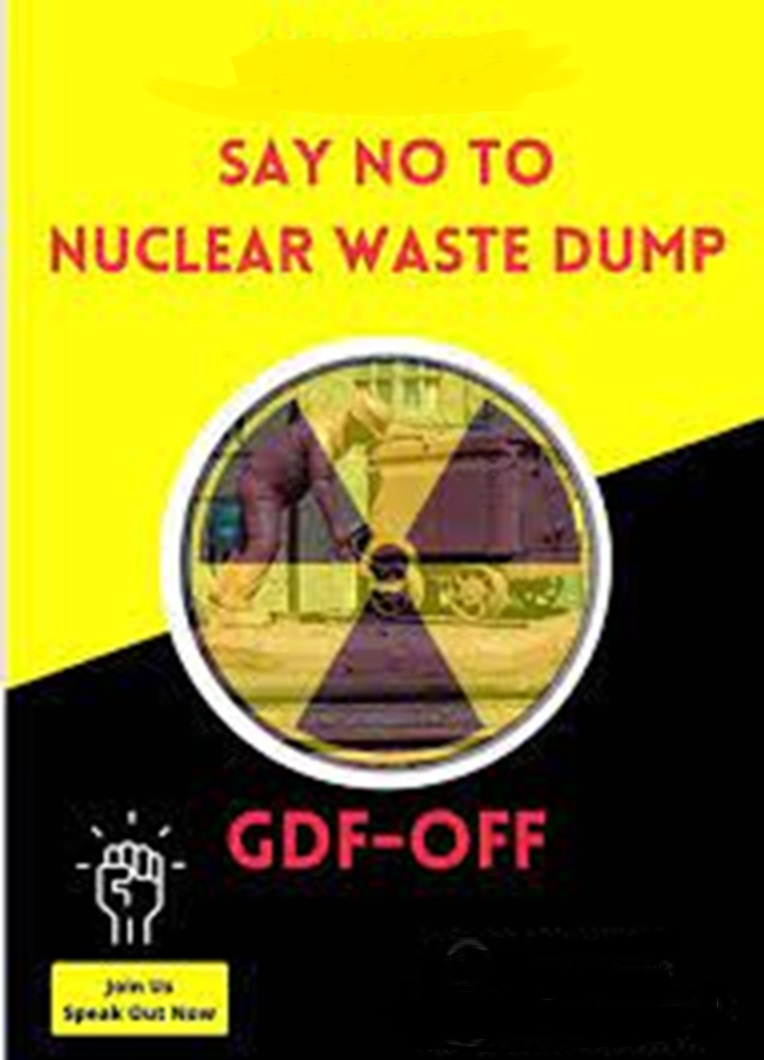
A previous survey revealed that 85 per cent of local residents were against the dump, which would store nuclear waste beneath up to 1,000 metres of solid rock until its radioactivity naturally decayed.
By Richard Silverwood, 3rd Feb 2025,
The bombshell news that a nuclear waste dump could now be built on greenfield land close to Louth has been greeted with dismay by campaigners and the town’s MP.
East Lincolnshire has long been identified as one of three potential locations for the dump, known as a GDF (geological disposal site).
And the government agency, Nuclear Waste Services (NWS), charged with finding a suitable area, has focused its attention on the former gas terminal site, operated by Conoco, within the coastal village of Theddlethorpe.
But now NWS has announced that it is looking inland and “beyond Theddlethorpe”. Instead, it is “prioritising” largely agricultural land to the north of the A157 road, between the villages of Gayton le Marsh and Great Carlton and south-west of Gayton Wind Farm.
A network of underground vaults and tunnels would transfer shipments of waste to a sealed storage area under the seabed which would extend 22 kilometres from the coast.
NWS insists nothing has been decided and has promised to keep all residents informed. A series of webinars and public drop-in events is already under way and will continue throughout February.
However, opponents of the dump, led by Conservative MP Victoria Atkins, are furious and are calling for a public vote on the entire scheme.
Ms Atkins said: “I have opposed the threat of a nuclear waste dump on the Lincolnshire coast since the proposal came to light several years ago.
“In that time, residents have had to live with the uncertainty, worry and financial costs of having this monstrous carbuncle threatened in their area.
“People have been left in limbo and have had their house prices severely impacted by these proposals.
“This latest news will be very distressing for the residents in and around the area. Rest assured, I will be meeting NWS in the coming week to continue to put pressure on them to move their focus away from Lincolnshire entirely………………………
The campaign group, Guardians Of The East Coast, has also lambasted the latest proposal, claiming the switch has been made because the Theddlethorpe site would not be large enough.
Chairman Mike Crookes said the fresh site would span 900 acres of agricultural land, including at least one farm. He called on Lincolnshire County Council to withdraw their apparent engagement with the dump scheme process.
“The council has expressed its outrage at agricultural land being taken for solar farms and pylons by National Grid,” Mr Crookes said.
“But it seems perfectly happy with a square mile of agricultural land being used to bury high-level nuclear waste, including weapons-grade plutonium.
“When the project was first announced, the council said it was policy to make use of ‘brownfield’ sites such as the gas terminal.
“But if it has a policy of opposing the industrial use of agricultural land, why is it apparently facilitating this project?”
Another group firmly against the nuclear waste dump is the Nuclear Free Local Authorities (NFLA), whose secretary Richard Outram described the fresh site as “worse than the original”.
“The news will have come as a tremendous shock to the residents of Gayton le Marsh and Great Carlton, where the threat of a dump suddenly appears writ large.
“Those residents are already up in arms and, doubtless in the coming days, new protest groups will be formed to represent the people affected.
“It is important to emphasise that the decision on the final site for a GDF is still a long way off. There is still time to organise and fight back.”
Coun Travis Hesketh, who represents the ward of Withern and Theddlethorpe on East Lindsey District Council, said residents were demanding a public vote – and this year, not in 2027 as previously promised.
A previous survey revealed that 85 per cent of local residents were against the dump, which would store nuclear waste beneath up to 1,000 metres of solid rock until its radioactivity naturally decayed.
However, NWS is hoping to win people over and has set up a community partnership group to fully explain the scheme.
Make your State a Nuclear Free Zone

Nuclear Energy Is a Recipe for Disaster
A rebirth of nuclear power is threatened in the United States. It stems from a combination of factors, including the U.S. government’s refusal to seriously address actually clean energy, the political and propaganda power of the nuclear weapons and nuclear energy industries, the poor quality of U.S. education, the sad state of corporate media, and the rise of a tech-firm oligarchy.
Click here to tell your state legislators and governor to make NY a nuclear free zone.
In the absence of actual intelligence, Amazon, Microsoft, and Google are making grand plans to use nuclear energy to power their Artificial Intelligence installations. Even the site of the most famous (even if never properly understood) U.S. nuclear disaster, Three Mile Island, is making plans for courting new disasters, despite strong local opposition.
Why is nuclear power a bad idea?
The top six reasons might be these:
1. There is no solution whatsoever to the indisputable problem of nuclear waste disposal.
2. There is no solution to the risk of more Three Mile Island- , Chernobyl- , Fukushima-like disasters — or, if there is, it has not persuaded any private insurance companies to take the risk of insuring nuclear power plants. The people of the United States will foot the bill (not to mention the cancer deaths) from the next catastrophe — whether accidental or caused by an attack (nuclear plants being prime targets for terrorism/war).
3. Nuclear energy is not “green,” but slow, dangerous, expensive, and inefficient.
4. Solar, wind, and tide energy solutions have been progressing even faster in reality than has nuclear energy in propaganda. While the solution of lower energy use has always been staring us in the face, the solution of energy that is cleaner, safer, faster, and cheaper is now well established.
5. Drone warfare has predictably spread far and wide, turning every nuclear power plant into a self-imposed nuclear weapon.
6. The nuclear energy and weapons industries rise or fall together. The energy technology is used as a stepping stone to the weapons. The energy waste is used as material for Depleted Uranium weapons. Nuclear energy powers the submarines that carry the weapons. And military contractors are working to give the world the marvelous gift of portable nuclear reactors that can be brought into war zones — in an apparent effort to win a prize for the worst idea ever.
But dozens of U.S. cities and counties are nuclear-free zones.
No nuclear weapons or energy allowed. There is no reason that U.S. states cannot take the same step.Click here to tell your state legislators and governors, that now is a time for independence and wisdom: Tell them to make NY a nuclear-free zone.
Anti-Nuclear War Activists Roll Out Counter Version of Doomsday Clock: The Peace Clock

CounterPunch News Service, January 29, 2025, https://www.counterpunch.org/2025/01/29/anti-nuclear-war-activists-roll-out-counter-version-of-doomsday-clock-the-peace-clock/
Multiple Cities – On January 27, antiwar and anti-nuclear weapons organizations will launch The Peace Clock, a new alternative to the Doomsday Clock. The launch of this new tracking system is set to coincide with the 2025 Doomsday Clock time announcement — a metaphorical warning from the Bulletin of the Atomic Scientists about how close we are to destroying our world with dangerous technologies of our own making.
The Peace Clock campaign was developed after witnessing years of the Doomsday Clock’s dire warnings fall on deaf ears. Recognizing that people are not motivated to make changes when they feel hopelessness and despair, the Peace Clock aims to make clear that by implementing antiwar proposals and climate justice initiatives, we can significantly reverse course.
By providing an outline of evolving steps toward real, long-lasting peace, the Peace Clock hopes to change the conversation from doom to hope. It will track proposals that are guaranteed to bring us a respite from the growing terror, proposals, and policies that can slow down or even reverse the race towards midnight and the end of the world.
“We are at a turning point in history. It is time to change the conversation with bold new proposals. Proposals that are guaranteed to bring us a respite from the growing terror. Proposals that will bring a shift in planetary consciousness allowing us to respond cooperatively to the impending cataclysmic climate disaster down the road” explained Peace Clock organizer Alice Slater. Slater serves on the Board of World BEYOND War and is a UN NGO Representative of the Nuclear Age Peace Foundation.
While the goal of the Doomsday Clock is to show how each year, the proliferation of nuclear weapons, disruptive technologies like artificial intelligence, war, bio-threats, and the continued climate crisis advance us closer to the world’s end, the Peace Clock is designed to keep track of actions and opportunities that can turn back time from the complete destruction of people and planet.
For more information about the campaign, please visit https://www.codepink.org/peaceclock
Campaigners accuse government of ‘lack of transparency’ over Sizewell C value.
A campaign group has urged the NAO to review the UK government’s
spending assessment for the nuclear power project in Suffolk. A campaign
group has written to the National Audit Office (NAO) calling for a review
of the government’s value assessment for the controversial Sizewell C
nuclear power station.
Campaign group Together Against Sizewell C (TASC)
has written to the audit office calling for a review of the government’s
value-for-money assessment, which underpinned £8bn of public spending on
the nuclear power station. It claims there has been a lack of transparency
over the government’s audit of spending on the nuclear project, which
unlocked billions of pounds of subsidies before a final investment decision
(FID) has been made.
“It is worth recalling that when EDF first proposed
Sizewell C, they budgeted the costs to get to FID to be £458 million,”
the campaign group said in its latest letter to the NAO. “With a £2.5
billion spend by the previous Tory government, £5.5 billion authorised by
this government under the Devex Scheme and an estimated £700 million
invested by EDF, the cost of getting to FID is approximately 1,900% of the
original budget.”
TASC called the underbudgeting by French energy
supplier EDF “staggering”. According to its registration document in
2020, EDF had “planned to pre-finance the development up to its share of
an initial budget of £458 million”. “There has been no explanation as
to why these costs are so astronomically higher than the original estimate,
how such increases have been justified and how much more public funding is
likely to be assigned to what many observers are calling ‘Labour’s
HS2’,” it said in the letter.
Energy Voice 8th Jan 2025 https://www.energyvoice.com/renewables-energy-transition/565210/campaigners-accuse-government-of-lack-of-transparency-over-sizewell-c-value/
Japan’s fishing town of Suttsu faces nuclear waste dilemma amid population decline

Residents of Suttsu worry that, despite potential economic benefits, a nuclear waste facility will harm the community and leave a legacy of radioactive waste
Jonathan Vit 29 Dec 24, https://www.scmp.com/week-asia/politics/article/3292482/japans-fishing-town-suttsu-faces-nuclear-waste-dilemma-amid-population-decline
It was a place Kyoko Tsuchiya could finally call home. As a child, her father was frequently transferred across Japan for his job at the national phone company. Later, as an adult, Kyoko fell in love with a man who worked for the post office. After they married, she continued to move around, rarely staying long enough in one place to truly feel at home.
Suttsu, with its unique charm, was different. This small town, nestled among scenic landscapes, is where Kyoko’s husband, Kazuyuki, grew up. Now in retirement, the couple decided to return to provide care and support for his elderly father.
Located on Hokkaido, Japan’s ruggedly beautiful northern island, the seaside fishing town hugs the windswept western coast. There, they opened a small inn called “Pension Mellow” which sits perched on a quiet hilltop overlooking the sea.
Kazuyuki could watch the fishing boats through binoculars from the kitchen window. When he spotted a friend’s boat, he would buy fresh seafood for his guests. One evening, he proudly served octopus sashimi made from a large octopus pulled from the frigid sea earlier that day.
“I was finally able to put down roots here,” Kyoko said. “I wanted a place where I could settle down and live a relaxed life. That’s how it was until 2020. Now, I don’t know …”
On Thursday, August 13, 2020, residents of this small town found themselves at the centre of a national controversy that attracted news helicopters and television crews to their usually sleepy streets.
Japan’s Nuclear Waste Management Organisation (Numo) was searching for a town willing to host a large underground facility to store the country’s nuclear waste.
However, there were stipulations: it could not be near a seismically active fault line or a volcano, could not contain valuable natural resources like coal or aquifers, and had to be within 20km (12.5 miles) of the coast for safe waste transport.
Any town meeting these requirements could volunteer to undergo studies to evaluate its suitability for the nuclear waste facility.
“In Japan, we have been using nuclear power for over half a century,” said Kenji Yamashita, a press officer with Numo. “As long as we have nuclear power plants, waste will always be produced. So, in every country, it is necessary to find a place to dispose of it.”
Japan currently sends its nuclear waste to a facility in Aomori, the prefecture just south of Hokkaido. The construction of that reprocessing and temporary storage centre has faced delays due to protests from local residents and anti-nuclear activists.
Finding a long-term storage site has been equally challenging. Some towns withdrew their interest due to local opposition before studies could start.
The study is non-binding, meaning a town can start the process without completing it. Additionally, the study is accompanied by substantial subsidies – up to 9 billion yen (US$57.6 million) paid out over the course of the investigation.
This offer was too attractive for Suttsu’s mayor, Haruo Kataoka, to ignore. Like many other towns across Japan, Suttsu has seen a dramatic population decline over the past half-century, having lost more than half of its residents since the 1970s. Nearly half of Suttsu’s population is 65 or older. The local junior school is so small that entire grades fit into a single classroom. A mere seven students make up the school’s first-grade class.
“There’s no doubt this is an ageing town,” Kazuyuki said.
Mayor Kataoka declined to speak with This Week in Asia for this story, but local residents said the six-term mayor has repeatedly tried to find new ways to revitalise the town’s shrinking economy.
Suttsu is home to a large wind energy farm – white windmills dot the landscape and are now featured on signs greeting visitors as they drive into town. It also built a modern town centre, a museum showcasing local history and an elderly care home on a bluff overlooking the town. Few projects delivered the promised financial returns for Suttsu, explained Takashi Saito, a former town council member and relative of the mayor.
“There are a lot of public buildings around town,” Saito said. “It costs a lot of money to maintain and manage them. When you pull back the lid on it, the town has a lot of debt.”
Saito explained that, although he opposes the construction of a nuclear waste facility in town, he understood the mayor’s reasons for pursuing the studies. Suttsu had changed greatly since his childhood, with empty streets and many businesses in the shopping district permanently closed.
“There’s no one walking around the town today,” Saito said. “The town feels lonely now.”
What didn’t happen in 2024 – Success on the ground and in court for the nuclear-free movement.
from Beyond Nuclear 30 Dec 24
For the anti-nuclear movement, success is often measured by what didn’t happen; what got delayed or stopped. These wins don’t necessarily make for an exciting story, but they are no less important.
When we delay, derail or prevent yet another dangerous, expensive and unnecessary nuclear project, it’s a result not only of our own persistence but also your steadfast support. A few of those “wins” in 2024 include:
Still no sign of SMRs! The much hyped and subsidized small modular reactors remain idle boasts on paper, with none built and no hope of any answering the climate crisis effectively or in time. We continue to promote the safer, faster, cheaper renewable energy alternatives.
Still no dumps in W. Texas and New Mexico! Our court battles continue as we support besieged communities in the Southwest who don’t want the country’s high-level radioactive reactor waste dumped where they live, supposedly as an “interim” measure but more likely permanently.
NRC busted on climate! License extension proceedings for currently operating reactors — out to 60 and even 80 years — have stalled as even a US Nuclear Regulatory Commission judge sided with our view that the agency is failing to consider the impact of the worsening climate crisis on a technology unsafe at any age.
There is much more to do in 2025 when we will continue to support community resistance and to face battles in court
Villagers oppose proposed nuclear plant in Arasinkeri
Hindustan Times,By Coovercolly Indresh, Bengaluru, Dec 21, 2024,
https://www.hindustantimes.com/india-news/villagers-oppose-proposed-nuclear-plant-in-arasinkeri-101734721956152.html
The residents of Arasinkeri village in Karnataka’s Koppal district have vowed not to surrender their land for the proposed establishment of a nuclear power plant near their village.
The central government’s initiative to set up a nuclear power plant in the region has caused significant apprehension among the villagers. The Department of Atomic Energy has reportedly directed local authorities to identify at least 1,200 acres of land surrounding Arasinkeri for the project. Revenue department officials have started surveying the area to locate suitable sites.
On December 13, the villagers made an official plea to Koppal deputy commissioner Nalini Atul, urging the government to abandon the project. They warned that failure to address their concerns could result in intensified protests.
“Arasinkeri is already burdened by pollution from over a hundred factories, including steel plants. Living conditions are already difficult. The majority of residents here depend on agriculture and forestry. Adding a nuclear power plant will destroy our livelihoods and pose irreversible risks to our health and the environment,” said M Veerabhadrappa, a local farmer. He is one of the 2,500 villagers who have refused to surrender their land.
The proposed site reportedly includes over 400 acres of forest land in Survey No 80 and another 100 acres in Survey No 9, areas critical to both the local community and biodiversity. Villagers fear the project will disrupt the fragile balance of their environment while threatening their safety and well-being.
On December 13, officials from NTPC (National Thermal Power Corporation) visited Koppal district and conducted an inspection in Arasinkeri village. “The project is still in its preliminary stages. If the site is approved, farmers will be provided with suitable compensation for their land. A technical team from Delhi is expected to visit soon to finalise the location,” Koppal sub-divisional magistrate Mahesh Malagati told Hindustan Times.
Despite these assurances, anxiety among villagers continues to grow. Their primary concern lies in the health risks associated with having a nuclear power plant in close proximity. They worry about potential contamination and other hazards that could affect both people and the environment.
“The government needs to understand that a nuclear power plant near a densely populated area is unacceptable,” said another villager. “We will continue to oppose this project with all our might.”
New generation must take up fight against nuclear weapons, Nobel laureate group says
Young people must take up the fight for a nuclear-free world, with such
weapons many times more powerful than in the past, a representative for
this year’s Nobel Peace Prize laureate, an atomic bomb survivors’ group,
said Tuesday. Nihon Hidankyo, a grassroots movement of survivors of the
1945 nuclear bombings of Japanese cities Hiroshima and Nagasaki, is
campaigning for a world free of nuclear weapons using witness testimony.
The average age of Japan’s atomic bomb survivors is now 85, Terumi Tanaka,
a co-chair of the group, said when accepting the prize at a ceremony held
at Oslo City Hall attended by Norway’s King Harald, Queen Sonja and other
dignitaries.
VOA News 10th Dec 2024 https://www.voanews.com/a/new-generation-must-take-up-fight-against-nuclear-weapons-nobel-laureate-group-says/7896005.html
Consultation, full disclosure, and an environmental audit: Nuclear Free Local Authorities’ triple demand of Australian government over nuke sub waste dump down under

the NFLAs have raised our fundamental objections to any siting of nuclear powered, and possibly nuclear armed, submarines at Garden Island as a violation of Australia’s legal commitments as a signatory to the Treaty of Rarotonga, which established a South Pacific nuclear free zone. The proposal will increase military tensions with China and make Rockingham a target for a counterstrike should war break out.
a White House paper states that Australia ‘has committed to managing all radioactive waste generated through its nuclear-powered submarine program, including spent nuclear fuel, in Australia’.
NFLA 22nd Nov 2024
With an international outlook and solidarity in mind, in response to a consultation by the Australian Federal Government, the UK / Ireland Nuclear Free Local Authorities have posted their objections to plans to station nuclear-powered subs and establish a waste dump in Western Australia.
As part of the AUKUS military pact established between Australia, the United Kingdom and United States, Australia intends to acquire a fleet of nuclear powered submarines, powered by reactors built by Rolls-Royce in Derby, as well as permitting Royal Navy and United States Navy nuclear submarines to operate from Australian naval bases.
In March 2023,the AUKUS Nuclear-Powered Submarine Pathway was announced by the three partners centred on the HMAS Stirling Naval Base on Garden Island in Western Australia’s Cockburn Sound. The Australian Government has allocated AUS $8 billion for base improvements.
Under the AUKUS ‘Force Posture Agreement’, from 2027, US Virginia Class submarines are to be stationed here, with British Astute submarines joining them on rotation in the 2030’s. Around this time, the base will also become the home port of Australia’s first nuclear powered submarines, with three and up to five Virginia Class submarines being purchased from the US (subject to Congressional approval).
The Federal Government has passed new legislation to allow for the domestic storage of nuclear waste from all these submarines, and in July after a limited consultation the Australian Radiation Protection and Nuclear Safety Agency (ARPANSA) issued a licence to the Australian Submarine Agency to prepare a nuclear waste storage site at the base. Without it, visiting United States and British nuclear-powered submarines could not undertake maintenance in Australia, so the nuclear dump is seen as essential to the pact.
The extent and nature of the waste to be stored, and for how long it would be stored, remains unclear. The Conservation Council of Western Australia (CCWA) complained to the regulatory authorities that: ‘The consultation documents provided no details about the volume of waste or how long it would be stored at the island. They also made confused and misleading claims about the types of low-level waste that would be accepted’.
Whilst regulators insist that it would be low-level waste, this claim has been refuted by critic Australian Green Senator David Shoebridge who said the Federal legislators were told in a Senate Estimates Hearing by the Australian Submarine Agency that it would include intermediate waste. It is also contradicted by a White House paper which states that Australia ‘has committed to managing all radioactive waste generated through its nuclear-powered submarine program, including spent nuclear fuel, in Australia’.
This waste would include US Virginia-class submarine reactors, which each weigh over 100 tonnes and contain over 200 kilograms of highly enriched uranium. Ian Lowe, an expert on radiation health and safety, told The Conversation in March 2023 that when the first three AUKUS submarines are at the end of their lives — 30 years from when they are commissioned — Australia will have 600 kilograms of ‘spent fuel’ and ‘potentially tonnes of irradiated material from the reactors and their protective walls’. The fuel being weapons-grade will require ‘military-scale security’.
Australian campaigners have also complained bitterly that the submarine base and the storage site are located in the wrong place.
Mia Pepper, Campaign Director at the CCWA, said that ‘Garden Island in one of the most pristine and diverse environments in the Perth region’ and that ‘This plan for both nuclear submarines and nuclear waste storage will inevitably impact access to parts of Cockburn Sound and Garden Island’.
And when responding to ARPANSA, the CCWA stated that the facility is ‘within an area of dense population’ and in the vicinity of ‘important and diverse heavy industrial facilities, including a major shipping port’. The CCWA also raised the ‘unaddressed community concerns regarding an accident’ on the site and complained about the ‘lack of transparency and rigour’ throughout the regulatory process.
Nor is there any long-term solution to storage. Garden Island would be seen as a temporary store, but it is unclear for how long. A Federal Government proposal to establish a nuclear waste dump at Kimba was resisted by local Indigenous people who launched a successful legal challenge to defeat the plan.
In its response to the consultation being conducted by the Australian Department of Climate Change, Energy, the Environment and Water, the NFLAs have raised our fundamental objections to any siting of nuclear powered, and possibly nuclear armed, submarines at Garden Island as a violation of Australia’s legal commitments as a signatory to the Treaty of Rarotonga, which established a South Pacific nuclear free zone. The proposal will increase military tensions with China and make Rockingham a target for a counterstrike should war break out.
We also called on the Federal Government to conduct a proper consultation and make a full disclosure of the facts, and requested that officials conduct a full environmental audit of the likely impact of the waste storage site…………………………………………. https://www.nuclearpolicy.info/news/consultation-full-disclosure-and-an-environmental-audit-nflas-triple-demand-of-australian-government-over-nuke-sub-waste-dump-down-under/
Seeds of Resistance – Reviving the Peace Movement in the Age of Trump
William Hartung, 17 Nov 24, https://tomdispatch.com/seeds-of-resistance/
—
When the election results came in on November 5th, I felt a pain in the pit of my stomach, similar to what I experienced when Ronald Reagan rode to power in 1980, or with George W. Bush’s tainted victory over Al Gore in 2000. After some grieving, the first question that came to my mind was: What will a Trump presidency mean for the movements for peace and social justice? I offer what follows as just one person’s view, knowing that a genuine strategy for coping in this new era will have to be a distinctly collective process.
As a start, history offers some inspiration. On issues of war and peace, the trajectory of the Reagan administration suggests how surprising hope can prove to be. The man who joked that “we begin bombing [Russia] in five minutes,” and hired a Pentagon official who told journalist Robert Scheer that America would survive a nuclear war if it had “enough shovels” to build makeshift shelters, ended up claiming that “a nuclear war cannot be won and must never be fought.” He even came tantalizingly close to an agreement with Soviet leader Mikhail Gorbachev to abolish nuclear weapons altogether.
To his credit, Reagan developed a visceral opposition to such weaponry, while his wife, Nancy, urged him to reduce nuclear weapons as a way to burnish his legacy. A Washington Post account of her role noted that “[s]he made no secret of her dream that a man once branded as a cowboy and a jingoist might even win the Nobel Peace Prize.” Such personal factors did come into play, but the primary driver of Reagan’s change of heart was the same thing that undergirds so many significant changes in public policy — dedicated organizing and public pressure.
Reagan’s presidency coincided with the rise of the largest, most mainstream anti-nuclear movement in American history, the nuclear freeze campaign.
Along the way, in June 1982, one million people rallied for disarmament in New York’s Central Park. And that movement had an impact. As Reagan National Security Advisor Robert MacFarlane pointed out at the time, “We took it [the freeze campaign] as a serious movement that could undermine congressional support for the [nuclear] modernization program, and potentially… a serious partisan political threat that could affect the election in `84.”
Reagan’s response was twofold. He proposed a technical solution, pledging to build an impenetrable shield against incoming missiles called the Strategic Defense Initiative (more popularly known as the Star Wars program). That impenetrable shield never came to be, but the quest to develop it deposited tens of billions of dollars in the coffers of major weapons contractors like Lockheed and Raytheon.
The second prong of Reagan’s response was a series of nuclear arms control proposals, welcomed by reformist Soviet leader Mikhail Gorbachev, including a discussion of the possibility of eliminating the two sides’ nuclear arsenals altogether. The idea of abolishing nuclear weapons didn’t come to fruition, but the Reagan administration and its successor, that of George H.W. Bush, did at least end up implementing substantial cuts to the American nuclear arsenal.
So, in a few short years, Reagan, the nuclear hawk, was transformed into Reagan, the arms-control-supporter, largely due to concerted public pressure. All of which goes to show that organizing does matter and that, given enough political will and public engagement, dark times can be turned around.
Trump at Peace (and War)
Donald Trump is nothing if not a top-flight marketeer — a walking, talking brand. And his brand is as a tough guy and a deal maker, even if the only time he’s truly lived up to that image was as an imaginary businessman on television.
But because Trump, lacking a fixed ideology — unless you count narcissism — is largely transactional, his positions on war and peace remain remarkably unpredictable. His first run for office was marked by his relentless criticism of the 2003 invasion of Iraq, a rhetorical weapon he deployed with great skill against both Jeb Bush and Hillary Clinton. That he failed to oppose the war when it mattered — during the conflict — didn’t change the fact that many of his supporters thought of him as the anti-interventionist candidate.
To his credit, Trump didn’t add any major boots-on-the-ground conflicts to the conflicts he inherited. But he did serious damage as an arms dealer, staunchly supporting Saudi Arabia’s brutal war in Yemen, even after that regime murdered U.S.-resident and Saudi journalist Jamal Khashoggi. In a statement after the murder, Trump bluntly said that he didn’t want to cut off arms to the Saudi regime because it would take business away from “Boeing, Lockheed Martin, Raytheon, and many other great U.S. defense contractors.”
Trump also did great damage to the architecture of international arms control by withdrawing from a treaty with Russia on intermediate-range nuclear forces and the Iran nuclear deal, known formally as the Joint Comprehensive Plan of Action. If those agreements were still in place, the risks posed by the current conflicts in Ukraine and the Middle East would be lower, and they might have served as building blocks in efforts to step back from such conflicts and return to a world of greater cooperation.
But there is another side to Trump, too. There’s the figure who periodically trashes the big weapons makers and their allies as greedy predators trying to line their own pockets at taxpayer expense. For example, in a September speech in Wisconsin, after a long rant about how he was being unfairly treated by the legal system, Trump announced that “I will expel warmongers. We have these people, they want to go to war all the time. You know why? Missiles are $2 million apiece. That’s why. They love to drop missiles all over the place.” And then he added, referring to his previous presidency, “I had no wars.” If past practice is any indication, Trump will not follow through on such a pledge. But the fact that he felt compelled to say it is at least instructive. There is clearly a portion of Trump’s base that’s tired of endless wars and skeptical of the machinations of the nation’s major defense contractors.
Trump has also said that he will end the war in Ukraine on day one. If so, it may be the peace of the graveyard, in the sense that he’ll cut off all U.S. support for Ukraine and let Russia roll over them. But his support for peace in Ukraine, if one can call it that, is not replicated in his other strategic views, which include a confrontational stance towards China, a pledge to further militarize the U.S.-Mexican border, and a call for Benjamin Netanyahu to “finish the job” in Gaza.
The last thing to consider in assessing what Trump’s military policies might look like is his administration’s close association with the most unhinged representatives of Silicon Valley’s military tech surge. For instance, Peter Thiel, founder of the emerging military tech firm Palantir, gave J.D. Vance, Trump’s vice president, a job at one of his companies and later donated large sums to his successful run for the Senate from Ohio. The new-age militarists of Silicon Valley loudly applauded the choice of Vance, whom they see as their man in the White House.
All of this adds up to what might be thought of as the Trump conundrum when it comes to war and peace and, to deal with it, a peace movement is truly needed.
Peace Resistance
For any peace movement, figuring out how to approach Trump will be like shadow boxing — trying to imagine what position he’s likely to take next.
The biggest problem in working for peace under a Trump presidency may involve whether groups are even allowed to organize without facing systematic government repression. After all, in the past, Trump has labeled his opponents with the Hitlerian-style insult “vermin” and threatened to jail any number of those he’s designated as his enemies.
Of course, the first job of any future peace movement (which would have applied as well had the Democrats taken the White House) will simply be to grow into a viable political force in such a difficult political climate.
The best way forward would undoubtedly be to knit together a coalition of organizations already opposing some aspect of American militarism — from the Gaza ceasefire movement and antinuclear groups to unions seeking to reduce the roles their members play in arms production, progressive veterans, big-tent organizations like the Poor People’s Campaign, groups opposed to the militarization of the Mexican border, organizations against the further militarization of the police, and climate activists concerned with the Pentagon’s striking role in pouring greenhouse gasses into our atmosphere. A coordinated effort by such movements could generate real political clout, even if it didn’t involve forming a new mega-organization. Rather, it could be a flexible, resilient network capable of focusing its power on issues of mutual concern at key moments. Such a network would, however, require a deeper kind of relationship-building among individuals and organizations than currently exists, based on truly listening to one another’s perspectives and respecting differences on what end state we’re ultimately aiming for.
Even as peace and justice organizations paint a picture of what a better world might look like, they may be able to win some short-term reforms, including some that could even garner bipartisan mainstream support. One thing that the American roles in the ongoing wars in Ukraine and Gaza and plans to arm up for a potential conflict with China have demonstrated is that the American system for developing and purchasing weapons is, at the very least, broken. The weapons are far too costly, take too long to produce, are too complex to maintain, and are often so loaded with unnecessary bells and whistles that they never work as advertised.
A revival of something along the lines of the bipartisan military reform caucus of the 1980s, a group that included powerful Republicans like former Georgia representative Newt Gingrich, is in order. The goal would be to produce cheaper, simpler weapons that can be turned out quickly and maintained effectively. Add to that the kinds of measures for curbing price gouging, holding contractors responsible for cost overruns, and preventing arms makers from bidding up their own stock prices (as advocated relentlessly by Senator Elizabeth Warren), and a left-right coalition might be conceivable even in today’s bitterly divided Congress and the Trump era.
After all, the most hawkish of hawks shouldn’t be in favor of wasting increasingly scarce tax dollars on weapons of little value to troops in the field. And even the Pentagon has tired of the practice of letting the military services submit “wish lists” to Congress for items that didn’t make it into the department’s official budget submission. Such measures, of course, would hardly end war in our time, but they could start a necessary process of reducing the increasingly unchecked power of the Lockheed Martins and Raytheons of our world.
There are also issues that impact all progressive movements like voter suppression, money in politics, political corruption, crackdowns on free speech and the right of political assembly, and so much more that will have to be addressed for groups to work on virtually any issue of importance. So, an all-hands-on-deck approach to the coming world of Donald Trump and crew is distinctly in order.
An invigorated network for peace, justice, and human rights writ large will also need a new approach to leadership. Old-guard, largely white leaders (like me) need to make room for and elevate voices that have either been vilified or ignored in mainstream discourse all these years. Groups fighting on the front lines against oppression have already faced and survived the kinds of crackdowns that some of us fear but have yet to experience ourselves. Their knowledge will be crucial going forward. In addition, in keeping with the old adage that one should work locally but think globally, it will be important to honor and support local organizing. Groups like the Poor People’s Campaign and the progressive feminist outfit Madre have been working along such lines and can offer crucial lessons in how to link strategies of basic survival with demands for fundamental change.
Last, but not least, while such organizing activities will undoubtedly involve real risks, there must be joy in the struggle, too. I’m reminded of civil rights activists singing freedom songs in jail. My favorite of that era isn’t “We Shall Overcome” — although overcome we must — but “Ain’t Gonna Let Nobody Turn Me Round,” which includes the lyric “gonna keep on walkin’, keep on talkin’, gonna build a brand-new world.” That may seem like a distant dream in the wake of the recent elections, but it’s all the more necessary because of that.
Victory is by no means assured, but what alternative do we have other than to continue to fight for a better, more just world? To do so will call for a broad-based, courageous, creative, and committed movement of the kind that has achieved other great transformations in American history, from securing the end of slavery to a woman’s right to vote to beginning the process of giving LGBTQ people full citizenship rights.
Time is short, when it comes to the state of this planet and war, but success is still possible if we act with what Martin Luther King, Jr., once called “the fierce urgency of now.”
Seven Canadian environmental groups challenge the nuclear industry’s false claims

Seven Canadians from environmental organizations submitted a complaint to the Competition Bureau on Oct. 16, 2024, asking the Bureau to take action against the Canadian Nuclear Association (CNA) and its members for falsely promoting nuclear energy as “clean” and “non-emitting.” These industry claims constitute misleading and deceptive marketing practices prohibited under Section 9 of the Competition Act.
The complaint demonstrates that the nuclear industry emits radioactive toxic pollutants during uranium mining and milling, and during the routine operation of nuclear reactors. Producing toxic pollutants which must be stored for hundreds of thousands of years is not “clean.” Annual releases from routine operations of all Canadian nuclear facilities are listed on a federal government website, HERE.
The same group of Canadians filed an earlier complaint in February, which the Competition Bureau dismissed, stating that the CNA’s claims of “clean” and “non-emitting” nuclear energy were “political statements” and not a priority for the Bureau. This new complaint makes it clear that the CNA’s false and misleading claims are promotional and aimed at portraying a “green” image to the public. The industry directly targets children with its teachnuclear.ca learning modules designed for schools, teachers and students.
The false “clean” image is intended to generate support for nuclear energy now when there is public concern about climate change. Nuclear energy’s high costs and toxic emissions, and the cost and time over-runs of new reactor builds have led to a declining share of global energy production over the past three decades. However the “clean” rhetoric has gained traction. Branding nuclear as “green” is a crucial step to unfairly gaining access to public funds, tax breaks and subsidies earmarked for real clean energy options.
The October complaint to the Competition Bureau can be downloaded HERE.
After two months, Nuclear Free Local Authorities receive vague response on Advanced’ Gas-Cooled Reactors (AGRs)
After a two month wait, the UK/Ireland Nuclear Free Local Authorities has just received a cryptic reply from Labour’s Nuclear Minister in response to our concerns about the future of Britain’s aging ‘Advanced’ Gas-Cooled Reactor (AGR) plants.
Four AGR plants – Hartlepool, Heysham-1, Heysham-2, and Torness – remain operational, each equipped with two gas cooled reactors. They first began generating in either 1983 or 1988, with an estimated operational life of 30 years. The plants are currently expected to cease operations by 2028, but in the Labour Party energy manifesto ‘Mission Climate’, the party pledged to ‘extend the lifetime of the existing plants until 2030’.
The AGR fleet has been operating for many years longer than intended. The NFLAs are concerned that the graphite moderators within each reactor are degenerating, compromising safety. We have previously raised our concerns with senior officials in the Office for Nuclear Regulation (ONR). It is our view that it is this independent regulator which has the expertise and the legal responsibility to determine whether to further extend the operating dates that should do so, and that it is ‘frankly not the business of Ministers’.
Consequently in his letter to Nuclear Minister Lord Hunt, NFLA Chair Councillor Lawrence O’Neill posed the central question:
‘Can the Minister therefore please reassure me that Labour Ministers will not seek to apply pressure on EDF to make an application to operate these plants beyond 2028, unless they genuinely wish to do so, and more importantly will not apply pressure on the independent regulator ONR to automatically sign off on any application without rigorous scrutiny?’
In his reply, Lord Hunt says cryptically that:
‘Decisions regarding the future operation of the Advanced Gas-cooled Reactor fleet or any nuclear power station in Great Britain would be for the operator, EDF Energy, (and) the ONR. The ONR would not allow a reactor to operate, return to service or extend its operating life if it judged that it was not safe to do so’.
We are hoping that the Minister means that it will fall to the operator EDF Energy to determine if it wishes to apply to the ONR for permission to extend the operating life of any, or all, of the AGR plants, but that it will be the responsibility of the ONR to decide if it can grant that permission based upon the safety case submitted.
This is a situation that the NFLAs shall continue to watch.
1 This Month
23-25 October – on Zoom – World BEYOND War’s annual global conferenc


Shut down the radiation-damaged Heysham nuclear reactors now
To see nuclear-related stories in greater depth and intensity – go to https://nuclearinformation.wordpress.com

Say No to NASA’s Reckless Nuclear Reactor on the Moon
Say No to NASA’s Reckless Nuclear Reactor on the Moon

-
Archives
- October 2026 (247)
- September 2026 (339)
- August 2026 (330)
- July 2026 (355)
- June 2026 (287)
- May 2026 (306)
- April 2026 (356)
- March 2026 (251)
- February 2026 (267)
- January 2026 (308)
- December 2025 (358)
- November 2025 (359)
-
Categories
- 1
- 1 NUCLEAR ISSUES
- business and costs
- climate change
- culture and arts
- ENERGY
- environment
- health
- history
- indigenous issues
- Legal
- marketing of nuclear
- media
- opposition to nuclear
- PERSONAL STORIES
- politics
- politics international
- Religion and ethics
- safety
- secrets,lies and civil liberties
- spinbuster
- technology
- Uranium
- wastes
- weapons and war
- Women
- 2 WORLD
- ACTION
- AFRICA
- Atrocities
- AUSTRALIA
- Christina's notes
- Christina's themes
- culture and arts
- Events
- Fuk 2022
- Fuk 2023
- Fukushima 2017
- Fukushima 2018
- fukushima 2019
- Fukushima 2020
- Fukushima 2021
- general
- global warming
- Humour (God we need it)
- Nuclear
- RARE EARTHS
- Reference
- resources – print
- Resources -audiovicual
- Weekly Newsletter
- World
- World Nuclear
- YouTube
-
RSS
Entries RSS
Comments RSS

