Jaitapur activists write to Japan’s PM to cease promoting the nuclear industry
 Jaitapur nuclear power project: Protesters write to Japan PM, warn of stepping up pressure . http://indianexpress.com/article/cities/mumbai/jaitapur-nuclear-power-project-protesters-write-to-japan-pm-warn-of-stepping-up-pressure 10 Dec 15
Recently, a top officer of the Fukushima plant Akira Ono as well as Naohiro Masuda, president of Tepco’s Fukushima Daiichi Decommissioning Company, have both admitted that there is no existing technology to remove the melted cores; that such technology may not be available for hundreds of years, and it may be impossible to decommission the stricken reactors. Thus the radioactive contamination may continue indefinitely for hundreds of years. Further, there is increasing evidence that rates of incidence of thyroid cancers among children near Fukushima have increased sharply,” the letter claimed.
The letter added that councils of all the 27 villages surrounding the proposed Jaitapur project have passed unanimous resolutions to oppose it.
“We, therefore, once again reiterate strongly our request that in the light of its own experience with radioactive contamination, Japan should shun any agreement for the promotion of the use of nuclear power. If our request goes unheeded, then be cautioned that we will be forced to step up national and international pressure against this policy of your government and build public opinion in both our countries, as well as all over the world against the double
standards it represents,” the letter warned.
Say in light of its own experience, Japan should not put profits of its nuclear industry before the environment. Written by Mihika Basu | Mumbai | Published:December 11, 2015 CLAIMING that in the wake of opposition to nuclear power in Japan, the nuclear industry there was protecting its profits by getting into a civil nuclear agreement with India, the Maharashtra-based outfit ‘Jaitapur Anuveej Prakalpvirodhi Abhiyan’ (JAPVA) or ‘campaign against Jaitapur nuclear power project’ has written letters to the Prime Minister of Japan and the National Diet of Japan and stated that “it is highly unethical and immoral on your part to put profits of nuclear industry before lives of millions of Indian citizens and environment”. Continue reading
The dangers of transporting nuclear waste by sea
 Nuclear waste transport risks ,Tor Justad, http://www.shetlandtimes.co.uk/2015/12/08/nuclear-waste-transport-risks-tor-justad “…..I would wish to draw attention to the proposal from the Nuclear Decommissioning Authority to transport nuclear waste by sea from Scrabster to Barrow – a distance of over 400 miles.
This high level nuclear waste/spent fuel emanates from the Dounreay nuclear site and is intended for Sellafield – described as “the most toxic nuclear site in Europe”.
The campaigning group Highlands Against Nuclear Transport (Hant) has been campaigning since 2013 to stop this plan on the grounds that the risk to the environment, fishing, aquaculture and tourism is unacceptable.
Transporting nuclear waste by sea is opposed by environmental groups throughout the world and Hant is of the view that all nuclear waste should remain on the sites where it is produced which is in line with Scottish government policy. Hant provided an input at a Nuclear Free Local Authorities (NFLA) seminar in Lerwick in August 2015 on “Transportation of Dounreay’s nuclear materials by rail or by sea to Sellafield – is it a safe solution for reducing the nuclear legacy in Scotland?” and was pleased to hear from SIC and Kimo representatives at that seminar that they supported Hant’s position.
The need for emergency response vessels stationed around the Northern Isles and Western Isles is important to safeguard these coasts against marine accidents and emergencies of any kind but the need is increased by the proposal to transport nuclear waste.
As is well known, nuclear radiation knows no land or sea boundaries so this issue is of concern to all coastal communities in the Highlands and Islands.
Hant will continue to campaign on this issue and would urge individuals and interested organisations to support this campaign.
Paris COP21 anti-nuclear activists arrested after daring climb on Arche de la Defense
 Anti-nuclear climbers defy Paris protest ban, four arrested http://www.nukeresister.org/2015/12/04/anti-nuclear-climbers-defy-paris-protest-ban-four-arrested/ Four anti-nuclear activists defied the state of emergency ban on public protest in Paris on Wednesday, December 2, climbing up the steel cables beneath the modern Arche de la Defense to hang banners. French environmentalists joined German climbers from the action group in the ascent as the COP 21 climate talks were underway. They first deployed small banners reading “Don’t Nuke the Climate – Stop EPR” (referring to the latest French reactor design). Police were quickly on the scene, including 20 from a specially equipped mountain brigade in town for the event. They pursued the climbers up the cables and prevented a larger banner from unrolling which would have proclaimed “System Change, Not Climate Change!”
The four were taken into custody and charged with disrupting public order and violating the state of emergency before their release some hours later. The action was part of international “Climate Games”, a call to direct action against institutions responsible for climate change.
Their statement said:
“States gathered at the COP 21 are powerless to prevent climate catastrophe. Their interests are too intertwined with those of multinationals. For the political change needed to happen, it is for the people to put pressure on governments and companies responsible for climate change.
“Given the climate problem, a capitalist economic system based on growth can only give us false solutions: geo-engineering, carbon markets and of course nuclear. It does not get us out of the impasse. It feeds unbridled energy consumption… ‘System change’ is to refuse the colonial wars of appropriation of resources and ecosystem changes that cause desperate migration, exacerbate ethnic and religious tensions, and contribute to the nihilistic radicalization of a minority. Faced with the threat of terrorism and the draconian response of the State, it is all the more urgent to carry this message to the heart of French economic power.”
Climber Cécile Lecomte wrote:
“In the international climate debate, uncontrolled economic growth is not discussed as a key driver of climate change. Nuclear power is totally unsuitable as a remedy to destructive economic growth. Instead of focusing on risky technologies, in particular the industrialized countries are invited to take a change of system – towards a democratic, social and ecological economy that is aligned to the needs of all people. Less is more!”
For more information, visit http://blog.eichhoernchen.fr/post/Action-escalade-pour-le-climat-Arche-de-la-Defense-malgré-etat-d-urgence
India’s Bhopal gas victims call on PM Modi to shun nuclear power industry
RECONSIDER SELLING NUCLEAR TECH TO INDIA’ HTTP://WWW.DAILYPIONEER.COM/STATE-EDITIONS/RECONSIDER-SELLING-NUCLEAR-TECH-TO-INDIA.HTML , 06 DECEMBER 2015 | STAFF REPORTER | BHOPAL | IN BHOPAL SURVIVORS OF THE BHOPAL GAS DISASTER HAVE URGED THE JAPAN PRIME MINISTER SHINZO ABE TO RECONSIDER THE IDEA OF SELLING NUCLEAR TECHNOLOGY TO INDIA AFTER FUKISHIMA DISASTER.

Five organisations working for the gas victims in a letter to Japanese PM Abe scheduled to visit New Delhi on December 11 to hold annual summit talks with his Indian counterpart Narendra Modi urged him to shun the idea of selling nuclear technology after Fukishima disaster more so because the Indian Government has totally failed in the responding to the aftermath of Bhopal disaster and poisons of Union Carbide and Dow Chemical continue to find new victims every day, even after 31 years of the disaster. The letter to the Japanese PM further says that the victims of Bhopal continue to struggle for justice, adequate compensation and proper medical, economic, social and environmental rehabilitation even after 31 years of the tragedy.
The organisations also warned him that to make their pleas heard citizens in Japan and people in India living near existing and proposed nuclear power plants would stage protests during his upcoming visit to India.
They said that one of the main reasons they were opposed to the India-Japan nuclear agreement is that in India, the implementation of environment and labour laws are pathetic. The letter said that they also realise that this nuclear agreement has nothing to do with the energy situation in this country, rather the sole aim is to restore some confidence in the global nuclear lobby, which is facing its terminal crisis after Fukushima.
They said , “We urge you to desist from this impending agreement during your visit to India. We want strong relationship between India and Japan. We want both countries to come closer and work on technologies that make human lives better—renewable energy sources, effective decontamination and more accessible medicines. For a better future for India and Japan, and for safety, security and prosperity of our people, let us shun the nuclear path and opt for a peaceful future”.
Green party of Ontario (GPO) strongly opposes nightmare prospect of Liberals rebuilding 6 nuclear reactors
Liberal nuclear dreams are a nightmare for Ontario, http://www.wireservice.ca/index.php?module=News&func=display&sid=17792 Amy Watson, 3 Dec1 5 Efforts to reduce electricity bills and build the renewable energy sector were dealt a killer blow today.
WireService.ca Media Release (12/03/2015) Queen’s Park – “It’s a nightmare for Ontario to make a deal to rebuild six reactors at Bruce,” says GPO leader Mike Schreiner. “Spending billions on nuclear will drive up electricity prices with toxic energy.”

“Why are the Liberals wasting your money on nuclear power that we don’t need without any public oversight or input? This is especially odd after the Auditor General criticized the government for excess supply,” Schreiner adds.
Ontario currently has a surplus of power. The province’s base load generation from 2015 to 2020 will exceed demand according to Ontario’s Auditor General. Excess supply cancels out any financial savings from conservation and energy efficiency programs.
No nuclear project in Ontario’s history has delivered on time or budget. The GPO has collected over 1000 signatures on a petition calling on the government to conduct an independent public review of the costs of and alternatives to rebuilding the Bruce B Nuclear Station and the Darlington Nuclear Station.
“It’s irresponsible for Ontario to spend billions on nuclear when they have access to more affordable, emission free electricity,” says GPC leader Elizabeth May. “The risks are too high to spend money on rebuilding nuclear reactors that threaten the Great Lakes.” Ontario does not have a plan for storing radioactive nuclear waste, nor does it have a public emergency plan to deal with a Fukushima-scale nuclear accident. Canadian taxpayers are on the hook for any nuclear accident that exceeds $1 billion.
Greens continue to oppose nuclear waste dumps that threaten the Great Lakes. The federal Green Party also seeks an amendment to the Nuclear Liability Act to increase maximum insured liabilities from $1 billion to $13 billion, which is the amount for which U.S. reactors are insured.
“We simply can’t leave a legacy of toxic waste and financial debt for our children and future generations,” says Schreiner. “Greens demand an independent public review of the costs of and alternatives to nuclear power.”
The GPO is on a mission to bring honesty, integrity and good public policy to Queen’s Park.
New York City and State Department oppose relicensing of Indian Point nuclear plant
 New York expresses opposition to relicensing Indian Point as NRC hears issues 18 Nov 2015. New York Governor Andrew Cuomo is strongly opposed to the renewal of the operating licenses for the two reactors at the 2,069-MW Indian Point nuclear plant and has asked the US Nuclear Regulatory Commission to deny Entergy’s application to extend its operations.
In a letter dated Monday, Jim Malatras, director of New York state operations, reiterated the state’s opposition to relicensing the units as the Atomic Safety and Licensing Board began hearings to address issues raised during the application process.
The hearings began Monday and will continue through the week.
The plant’s proximity to a major population center, with more than 20 million people within 20 miles of the two-unit plant makes it impossible to have an effective safety and evacuation plan, Malatras said. The reactors generate about 25% of the power for New York City and Westchester County. http://www.platts.com/latest-news/electric-power/birmingham-alabama/new-york-expresses-opposition-to-relicensing-21495027
NY agency objects to relicensing Indian Point nuclear plant November 12, 2015. A New York agency has objected to relicensing the Indian Point nuclear plant on the Hudson River, saying it kills millions of fish larvae and sits near seismic faults with an earthquake threat to millions of people.
The Department of State said the plant is incompatible with the estuary’s ecology and safety of New York City 24 miles downstream. The Nuclear Regulatory Commission is prohibited from relicensing the Indian Point reactors unless the U.S. commerce secretary overrides the objection on appeal, Secretary of State Cesar Perales wrote.http://finance.yahoo.com/news/ny-agency-objects-relicensing-indian-173916667.html
China’s authoritarian nuclear push meets community opposition
China’s authoritarian government, adept at corralling public opinion to get its way, can ram through its plans over the objections of people like Ms. Liu. But opponents say its closed, secretive political system is ill equipped to manage a rapid expansion of nuclear power, pointing to its struggle to prevent industrial disasters such as the chemical explosions in Tianjin in August that killed 173 people.

“The Chinese are beginning to wrestle with the same issues that Western countries were dealing with, concerning fear of the technology, transparency in decision making and trust of the authorities,”
Opponents of nuclear power in China maintain that the country can achieve its clean energy goals without a nuclear building spree, by investing heavily in improving solar and wind power and by upgrading the power grid so it can send electricity more efficiently across vast distances.
They point to the deadly explosions in Tianjin, where hazardous chemicals appear to have been stored improperly at a facility close to residential areas, as an example of how of lax regulation, graft and official obfuscation can undo the Chinese government’s promises to put safety first.
China’s Nuclear Vision Collides With Villagers’ Fears, NYT By CHRIS BUCKLEYNOV. 21, 2015“………..Hubin is one of dozens of sites across the country where officials have plans ready, awaiting further approval, to build atomic reactors over the next decade — an ambitious program to expand the use of nuclear energy that Beijing considers essential to weaning the Chinese economy from its reliance on coal-fired plants, which churn out air pollution and carbon dioxide.
Ask villagers here what they think of the proposed plant, though, and talk quickly turns to the Communist government’s dismal record of industrial accidents, as well as the 2011 nuclear disaster in Fukushima, Japan. Residents in Hubin will be resettled to new homes a few miles away, but many said that they would still feel threatened living so close to a nuclear station.
“It’s just not safe,” said Liu Shimin, a farmer in her 20s, nursing a baby outside her home near the banks of the Yahe River. “We’ll always be wondering, ‘What if there’s a big accident, like that one in Japan?’ ”
Such fears are on the rise in China as the nation embarks on a new phase of nuclear power construction that could make it the world’s biggest producer of nuclear energy by 2030. Continue reading
Call for Hong Gong to end nuclear energy imports when contract ends
Hong Kong should end nuclear energy imports after Daya Bay contract ends in 2034, Greenpeace says, South China Morning Post Group says ‘business as usual’ approach not enough and urges greater use of renewables, 04 November, 2015, Ernest Kao ernest.kao@scmp.com
By halting nuclear energy imports after the 20-year supply contract with the Daya Bay plant ends in 2034, along with reducing electricity use by one per cent each year and boosting renewable energy use to 10 per cent, Greenpeace calculated an emissions cut of 34 per cent could be achievable…..http://www.scmp.com/news/hong-kong/health-environment/article/1875380/hong-kong-should-end-nuclear-energy-imports-after
Japanese Prefecture Kyoto moves to replace nuclear with gas and renewables, in pact with Alaska

 Kyoto advances nuclear-free agenda with Alaska LNG pact, Japan Times, BY ERIC JOHNSTON KYOTO, 25 OCT 15, – The Kyoto Prefectural Government signed an agreement with Alaska last month to explore the possibility of importing liquid natural gas from the state to Maizuru, a port city on the Sea of Japan.
While daunting financial and bureaucratic challenges mean it will still be a while before Alaskan LNG flows to Kyoto, the agreement represents a step forward for Kyoto to achieve a larger goal: ending prefectural dependence on nuclear power by 2040.
The strategy, as outlined by Kyoto Gov. Keiji Yamada, calls for building up LNG facilities at Maizuru and installing new LNG pipelines in the Kansai region. The prefecture envisions Maizuru supplying not only Kyoto, but other prefectures in the region with gas to replace Fukui Prefecture’s nuclear power plants as a major source of electricity.
Kyoto is not alone in seeking to replace atomic power with a combination of LNG imports and renewable energy. As of the end of 2014, more than 600 local governments nationwide had declared their intent to be nuclear-free, although not all of have set specific dates like Kyoto, and many lack a strategic plan for achieving that goal.
Yamada listed several reasons why the prefecture needs to end its usage of nuclear power, which comes mostly from 11 Kansai Electric Power Co. reactors in neighboring Fukui……..
Kyoto and Hyogo, along with Osaka Gas, Kepco, and the Ministry of Economy, Trade and Industry, agreed in early September to formally research the cost of building an LNG pipeline from Maizuru to Sanda, Hyogo Prefecture, that could then supply other parts of Kansai and likely lead to other localities needing less nuclear power. http://www.japantimes.co.jp/news/2015/10/25/national/kyoto-advances-nuclear-free-agenda-alaska-lng-pact/#.Vi0_ztIrLGh
Uranium industry in Niger from AREVA to Chinese companies
 One uranium mine in Niger says a lot about China’s huge nuclear-power ambitions, Business Insider, 25 Oct 15, ARMIN ROSEN “………the ambitions of the nuclear powers in Niger are still playing out today as Niger’s remote and inhospitable northern desert environment contains the world’s fifth-largest recoverable uranium reserves, some 7% of the global total.
A fourth mine, in a place called Azelik, near the mostly ethnic Tuareg city of In’gall, is currently much smaller than the other three sites.
Like Imouraren, it’s currently shuttered as a partial result of the uranium price dip. But because of its ownership and a checkered recent history, it’s an instructive guide to the future of Niger’s uranium and the global nuclear energy industry at large.
Niger’s Azelik uranium mine, owned and operated by Chinese companies, is at the geographic and economic fringes of a continent-wide wave of Chinese investment, goods, and people. Continue reading
Australian Aboriginal women renew their long hard fight against nuclear waste dumping
Aboriginal women reaffirm fight against nuclear waste dump in South Australia ABC Radio National, The World Today By Natalie Whiting 16 Oct 15 The first shipment of Australia’s nuclear waste to be returned from re-processing in France has now left a French port, and will arrive on our shores by the end of the year. The return of the 25 tonnes of nuclear waste is putting renewed pressure on the Federal Government to find a location for a permanent waste dump.
The shipment began its journey just a day after senior Aboriginal women gathered in Adelaide to mark their fight against a proposed dump in South Australia in the 1990s.
The women say they will fight against any new move to put the waste on their land…..
SA Aboriginal women remember waste dump victory A Federal Government plan to build a
 nuclear waste dump in the South Australian outback in 1998 attracted fierce opposition, especially among local Aboriginal people.
An event in Adelaide last night celebrated the work of a group of women called kupa piti kungka tjuta, who campaigned against the dump. Emily Austin from Coober Pedy was one of them. (centre in picture)
The women campaigned for six years until a Federal Court challenge from the South Australian government put an end to the dump. Ms Austin said she could remember the day the court found in South Australia’s favour.
“I was out in the bush hunting and I heard it on the radio in the Toyota. We were all screaming, ‘We won’.
“All the kungkas (women) were happy.”
While the Federal Government is in the midst of a voluntary process for finding a site for a dump, South Australia’s outback is still seen as an ideal location.
The South Australian Government’s attitude to the industry has been shifting.
It has launched a royal commission to investigate possible further involvement in the nuclear fuel cycle.The royal commission is looking at everything from mining uranium, processing, waste storage and nuclear power.
The organiser of last night’s event, Karina Lester, is the granddaughter of one of the women who campaigned and her father was blinded by the British nuclear tests at Maralinga half a century ago.
She said the Aboriginal people in South Australia’s north have a long and tortured history with the nuclear industry. “Maralinga’s had a huge impact because people speak from first-hand experience,” she said.
“People like the amazing kupa piti kungka tjuta, many of those old women who are no longer with us today, they were there the day the ground shook and the black mist rolled.
“It’s an industry that doesn’t sit comfortably with Anungu community.”
Ms Lester said it was good to see the royal commission consulting with people before a decision is made.”Credit to the royal commission that they’ve made an effort to engage with a broader community of Aboriginal communities,” she said.
“But how many of those Anangu are really understanding he technicality of this royal commission and what industry really means?” Ms Austin said she was ready to fight any future attempts to set up a waste dump in the region.
“Oh yeah, I’ve still got fight yet. They might stop yet, they might listen, I dunno,” she said. http://www.abc.net.au/news/2015-10-16/aboriginal-women-fight-against-nuclear-waste-dump-in-sa/6861012
Expansion of South Korea’s massive Kori Nuclear Power Plant near 3.4 million people – an insane plan

 The insane plan to expand the world’s biggest nuclear plant http://www.greenpeace.org/international/en/news/Blogs/nuclear-reaction/nuclear-kori-korea-protest-busan/blog/54400/ [excellent photos] by Daul Jang – 13 October, 2015 Over 3 million people live within 30 km of what is set to become the largest nuclear power plant in South Korea and the world. So why is the government expanding nuclear and locking out safe, clean renewables?

Two inflatables with ten courageous and committed activists from around the world departed this morning to protest the expansion of the Kori Nuclear Power Plant, near Busan. They are taking action to highlight the risk of nuclear power and the urgent need to transition to clean, safe renewables.
The situation at Kori is insane, and it’s only getting worse. Here’s why the need for action is so urgent.
1. When the next unit is expected to go online next month, it will become the world’s largest nuclear power plant in terms of installed capacity (6860MW) with 7 reactors in operation.
2. What is most disturbing is that there are around 3.4 million people living within the 30km zone around the plant. This compares to 160,000 in the case of Fukushima.
3. When the two planned reactors start operation by 2020, it will become the only nuclear power plant with 10 reactors and more than 10,000 MW in the world.
4. More reactors = more risk. One of the critical lessons from the disastrous Fukushima disaster is that multiple reactors means increased risk.
5. Since beginning operation in 1978, the plant has continuously encountered problems including malfunctions, lack of safety regulations and poor maintenance. In February 2012 a complete station blackout was deliberately concealed by the high level decision makers at the Kori plant, only to be reported to the Nuclear Safety and Security Commission (NSCC), South Korea’s regulatory body, a month later.
We aim to expose the intolerable risk of adding two more reactors to the world’s largest nuclear power plant and the threat it poses to the general public and the citizens of Busan. The future is renewables. We’ve already helped convince one big company in South Korea to switch to 100% renewable energy – so what is the South Korean government waiting for? Out with the old, and in with the new!
It’s time to switch on renewables and abandon costly, dangerous nuclear.
Daul Jang is the Project Leader for the Climate and Energy Campaign at Greenpeace East Asia in Seoul.
The fight to preserve pure water in Nebraska from uranium mining contamination

 Water first! Lakota women and ranchers lead charge to close toxic uranium mine , Ecologist, Suree Towfighnia / Waging NonViolence 13th October 2015 The impending renewal of the license for a uranium mine in Nebraska has ignited a years long resistance among those – most of them women – for whom good health and safe, clean water in the Ogallala aquifer is as important as life itself, writes Suree Towfighnia. But for others, jobs and money come first. Now the Nuclear Regulatory Commission must reach its decision.
With a population of around 1,000 people, the rural town of Crawford, Nebraska was an unlikely setting for a federal hearing.
But it became the site of one in late August thanks to the dogged determination of a group of Lakota and environmental activists, as well as geologists, hydrologists and lawyers – all of whom have been fighting the permit renewal of a uranium mine located in town.
The region is ripe with stories from the brutal Indian wars, when Lakota and neighboring tribes fought over western expansion.
Today, this intersection of frontier America and Native resistance is a battleground in the war between environmental advocates and energy corporations, only this time allies from all sides are joining forces in the effort to protect their water.
The Crow Butte Resources, or CBR, uranium mine is comprised of thousands of wells at the base of Crow Butte, a sacred site located within Lakota treaty territories.
For the past couple of decades CBR has mined uranium using the in situ leach process, which injects water under high pressure into aquifers, extracts uranium ore, and then processes it into yellow cake.
Each year 700,000 pounds of uranium is produced here and shipped to Canada, where it is sold on the open market. CBR has applied for a permit renewal and expansions to three neighboring sites.
Pure water must be protected at all costs Continue reading
Move for Grand Canyon Monument that would ban uranium mining
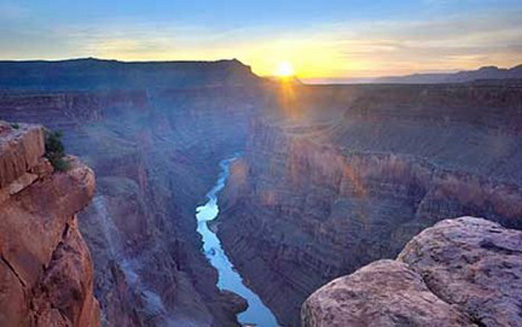 Grand Canyon Monument Would Make Uranium Ban Permanent http://www.fronterasdesk.org/content/10147/grand-canyon-monument-would-make-uranium-ban-permanent By Laurel Morales October 13, 2015 Arizona Congressman Raul Grijalva introduced legislation Monday that would preserve and restore sacred lands, the watershed and the environment north and south of Grand Canyon National Park. The Greater Grand Canyon Heritage National Monument Act would set aside 1.7 million acres of public land.
The area surrounding the Grand Canyon is rich in uranium. In 2012, the Obama administration put a 20-year moratorium on new uranium mining claims. If passed, the law would make that ban permanent.
Eleven tribes connected to the Grand Canyon support the bill. And if passed, they would help manage the monument.
Havasupai council member Carletta Tilousi told a group of reporters her tribe, that lives at the bottom of the Grand Canyon, is at the front lines of groundwater contamination.
“We the Havasupai would like to keep our canyon home clean of no uranium mining,” Tilousi said. “We’d like to see our water remain clean of no uranium mining. We’d like to see our children live in a clean environment, go to our sacred mountains in peace and pray and do our offerings.” This announcement comes at a time when the National Park Service says Energy Fuels has plans to reopen an old mine and extract uranium on Red Butte, what is considered a sacred site by the Havasupai Tribe.
Supporters of the legislation say it will be difficult to get the act through Congress.
Increasing public opposition to South Korean govt’s nuclear power policy
 The Repercussions of South Korea’s Pro-Nuclear Energy Policy A long-term policy is running into increasing domestic opposition, The Diplomat, By Se Young Jang, 8 Oct 15 Se Young Jang is an associate at the Belfer Center for Science and International Studies, Harvard Kennedy School, and a non-resident Kelly fellow at Pacific Forum CSIS.
In a local referendum held in October 2014, an overwhelming majority of the residents in Samcheok, a small coastal city in Gangwon province, rejected the South Korean government’s plan to build a nuclear power plant in the city. Since Japan’s 2011 nuclear disaster in Fukushima and South Korea’s 2013 scandals over fake safety certificates for nuclear equipment, South Koreans have begun to take nuclear safety issues more seriously, which in turn has prompted a growing anti-nuclear power sentiment. A series of scandals and accidents in South Korea’s nuclear power plants have focused public attention on the effects of radioactive materials on the health of the residents who live near the country’s four nuclear power plants. Last year, a South Korean courtruled that the Korea Hydro & Nuclear Power Co., a state-run nuclear power plant operator, was responsible for the thyroid cancer suffered by a plaintiff, who has lived 7.7 km away from the Kori nuclear power plant over the past 20 years. Since then, more than 500 thyroid cancer patients living close to the nuclear power plants in South Korea have been preparing a joint legal action against the company.
Notwithstanding the anti-nuclear sentiment, nuclear energy as a share of total electricity generated increased to about 30 percent in 2014, and the South Korean government is currently constructing four new nuclear reactors with eight more being planned. Standing firm on its nuclear power plant projects, the South Korean government regarded the Samcheok referendum as not legally binding, and this position remains unchanged. Under the Second Basic National Energy Plan for 2015-2035, South Korea appear to have few options but to stick to its original plan of building more nuclear power plants, as the 2015-2035 energy plan was based on the assumption that it could not avoid raising its dependence on nuclear power.
Critics say that the government overestimated future electricity demand and underpriced electricity. According to the Sixth Basic Supply-Demand Plan for Electricity (2013-2027), South Korea will use more electricity per capita than the United States in 2024. The high population density in South Korea could translate into lower demand for electricity per capita. Moreover, estimates of electricity demand are based on cheap prices for electricity; the government calculated that the rate of increase in electricity prices in the coming years would be one third of the inflation rate. Some newspapers in South Korea report concerns about rising electricity bills as a result of a decreasing reliance on nuclear power. Still, it is interesting to note that 65.6 percent of respondents in a 2013 poll were willing to pay a higher electricity bill if it meant fewer nuclear power plants……….
Today, South Korea no longer seeks its own nuclear weapons, but Park Geun-hye still sees boosting nuclear energy industry as a great opportunity for the South Korean economy. Now a nuclear exporter, South Korea has concluded agreements with Jordan and the United Arab Emirates to construct one research reactor and four commercial reactors. …….
Korea’s success in the nuclear export market and geopolitical necessities notwithstanding, the current domestic situation is hardly favorable to the South Korean government. The 2013 scandal over hundreds of faulty components used in reactors is still unfolding. A parliamentary audit last year revealed that the temporary suspension of the operations of nuclear power plants after the scandal caused the loss of 10 trillion won (about $9.5 billion), and that some officials fired from the KEPCO E&C (Korea Electric Power Corporation Engineering and Construction) over the scandals were rehired. Worse, the result of the referendum in Samcheok is probably only the beginning of a series of hurdles which the South Korean government will have to overcome. More than half of the respondents in a recent poll conducted in Yeongdeok, in North Gyeongsang Province, which was also designated as a nuclear power plant site by the government in 2012 along with Samcheok, opposed the central government’s construction plan.
The consent of local residents will be even more important in the near future as South Korea faces a crisis over the storage of nuclear spent fuel. South Korea has nearly 9,000 tons of spent fuel stacked in temporary storage pools with about 750 tons added to the pools every year. They could reach maximum capacity by 2021. The government has been deliberating over several ways of storing spent fuel, including pyroprocessing and a medium-term solution using dry casks; but no matter what method South Korea chooses, the government will need to be able to persuade people living next to the facility, no easy task as Samcheok has demonstrated……….http://thediplomat.com/2015/10/the-repercussions-of-south-koreas-pro-nuclear-energy-policy/
1 This Month
19 November – Webinar – The Reality of Reprocessing
Time: 11:00 AM Pacific Time (US & Canada) / 2:00 PM Eastern / 7:00 PM UK / 8:00 PM CET
Register for the Zoom Event Here

Tell Congress: Prevent Nuclear Catastrophe in Iran

Tell Congress: Prevent Nuclear Catastrophe in Iran

Read the Public Inquiry Report, the Commissioners’ report, Surrendering Australia: The AUKUS Deception is available to download for free at aukuspublicinquiry.com. Or just watch the replay of the National Press Club Luncheon.


Shut down the radiation-damaged Heysham nuclear reactors now
To see nuclear-related stories in greater depth and intensity – go to https://nuclearinformation.wordpress.com

Say No to NASA’s Reckless Nuclear Reactor on the Moon
Say No to NASA’s Reckless Nuclear Reactor on the Moon
-
Archives
- November 2026 (166)
- October 2026 (302)
- September 2026 (339)
- August 2026 (330)
- July 2026 (355)
- June 2026 (287)
- May 2026 (306)
- April 2026 (356)
- March 2026 (251)
- February 2026 (267)
- January 2026 (308)
- December 2025 (358)
-
Categories
- 1
- 1 NUCLEAR ISSUES
- business and costs
- climate change
- culture and arts
- ENERGY
- environment
- health
- history
- indigenous issues
- Legal
- marketing of nuclear
- media
- opposition to nuclear
- PERSONAL STORIES
- politics
- politics international
- Religion and ethics
- safety
- secrets,lies and civil liberties
- spinbuster
- technology
- Uranium
- wastes
- weapons and war
- Women
- 2 WORLD
- ACTION
- AFRICA
- Atrocities
- AUSTRALIA
- Christina's notes
- Christina's themes
- culture and arts
- Events
- Fuk 2022
- Fuk 2023
- Fukushima 2017
- Fukushima 2018
- fukushima 2019
- Fukushima 2020
- Fukushima 2021
- general
- global warming
- Humour (God we need it)
- Nuclear
- RARE EARTHS
- Reference
- resources – print
- Resources -audiovicual
- Weekly Newsletter
- World
- World Nuclear
- YouTube
-
RSS
Entries RSS
Comments RSS

