In protecting the biosphere from plutonium and other wastes, the first step is to stop producing them

paulrodenlearning 27 Dec 22, We have all of the wastes from the nuclear weapons and nuclear power program. We don’t know what to do with it and it and they must be kept out of the biosphere forever. So, the first step is to stop making more wastes. Shut down the nuclear weapons and nuclear power industry.
The second step is to store the waste in a secure, stable facility that can withstand earthquakes, accidents, terrorist, and or nuclear/conventional attack for billions of years. As the former Congressman John Hall and former rock star wrote in his 1980 solo album, “Power” in his song, “Plutonium is Forever.”
Has everybody forgotten about Fukushima, Chernobyl and Three Mile Island? Nuclear power is too dangerous, too expensive and totally unnecessary for our energy needs. Just go to the Websites of The Solutions Project and the Rocky Mountain Institute.
We have the resources and the technology to transition to renewable energy now. All we lack is the political will to do so, because the elected leaders in Washington, DC and in our State Houses have all been bought off by the nuclear and fossil fuel industries by their unlimited and unregulated campaign PAC donations, which remain anonymous. They have the best Congress and State Legislatures that money can buy. “Money talks, B.S. walks and we are all running a “very distant” third.”
Mothering a Movement: Notes from India’s Longest Anti-Nuclear Struggle

It was striking how these women activists situated their politics in motherhood and in their responsibility as the guardians for future generations. Prayers to Lourde Matha at the main church, floral tributes to Kadalamma, and protests against the nuclear plant all lie on a continuum as acts of reverence for life. While this politics around maternity might not sit well with a certain progressive outlook, these women are clear about their feminist goals.
A time will come. We will take over the village and remove the nuclear power plant.
Radiowaves Collective, Half-Life, December 2022
‘……………………………………………………………………… Both Idinthikarai and Kudankulam, the other settlement that abuts the northern boundary of the nuclear plant, lie off the beaten path for the tourists that come to Kanyakumari—a narrow strip of “Land’s End” with an old temple, newer memorials to regional and national personages, and the Indian Ocean—located a little over twenty-five kilometers away. Yet in 2011 and 2012, Kudankulam and its nearby villages had commanded significant media attention. Putting aside their caste and religious differences, the locals around Kudankulam had put up a remarkable non-violent resistance against the nuclear establishment. We want to find out what has happened to that movement a decade later.
Next morning, en route to Kudankulam, our bus lurches past the bustling town of Anjugramam and other smaller settlements, surrounded by farmlands and coconut and palmyra trees. But it is the giant windmills, mushrooming all over, that dominate the landscape and serve as a reminder that India is a country hungry for energy. All of this area, Anjugramam onwards, falls under what is called the emergency planning zone: a sixteen-kilometer radius around the nuclear plant that would need evacuation in case of a disaster. Our fellow passengers include some non-locals, who form the bulk of the workforce at the plant. When we do not get off at either the Anuvijay— “Victory of the Atom”— town, a gated community for staff and their families, or the plant some seven kilometers away, the few remaining people on the bus start eyeing us.
Once at the busy main market in Kudankulam, our local guide and a few other men quickly whisk us away to a house where we are scheduled to interview women activists who were involved in the 2012 protests. However, before we can start a conversation with them, a man in a striped blue shirt asks us to write down our names and contact details. “CID [Criminal Investigation Department],” he replies softly when we ask why. “He is a policeman. He is just doing his job,” another man chimes in, matter of factly. The sprawling nuclear plant across the road reaches far into the lives of the people here. Police surveillance is part and parcel of the architecture of the nuclear establishment.
The KKNPP is India’s largest nuclear power plant, housing two Russian VVER-1000 reactors—similar to the ones under siege now in Zaporizhzhya, Ukraine—and has four others in the pipeline. As far as one can tell, it has little to do with nuclear weapons, but the Department of Atomic Energy (DAE)—the agency which oversees all things nuclear in India—makes it easy to indulge in wild speculations. Right from its inception in 1954, the DAE has been notoriously opaque, with little independent or public scrutiny, and prone to misinformation and grandiose statements.
While the US launched its “Atoms for Peace” program in 1953, the motto of the DAE has always been “Atoms in the service of the nation.” But the nebulous nature of these slogans is often put on display. For instance, in 1974, the DAE tested nuclear weapons in the guise of a peaceful nuclear program, calling them “peaceful nuclear explosives” for the development of the nation.1 Things have been equally farcical in the case of the civilian nuclear energy program, where, in the name of national security, the DAE has refused to share details about basic public matters such as energy costs and nuclear safety. And even though the DAE is currently (and consistently) decades behind in meeting its own projections for power generation, it still proclaims a fifty-fold increase in nuclear power by 2050.2 The message is loud and clear: the future is nuclear, and only fools worry about the past—or the present.
“If we say anything against [the plant], they will file a case against us,” says a young woman who teaches science at a nearby school. “We don’t have permission to talk about this issue with the students. We can only teach things that are mentioned in the books,” she continued. While adding that the KKNPP supports some schools in its vicinity, like many others in Kudankulam, she is more concerned about the dismal state of affairs. “We do not have any facilities, we have long power cuts, we receive drinking water only once every ten days, and there are all sorts of diseases. Now, it is not possible to remove the plant, but at least our people should get better jobs. Outsiders have all the permanent positions there.” She is sympathetic to the DAE’s rhetoric of nation-building, but dismayed with the lopsidedness of it all. Why should people who live in metropolitan India receive the benefits of nuclear energy while people from Kudankulam take on the risks?
“People protested a lot, and nothing happened. Many who protested can’t get jobs there. It was a waste,” the teacher concluded. “People have accepted that they must live with the diseases. They have made up their mind to live happily until they die. They have started building bigger houses. And since people have come from other places, the land rates have increased, like in the big cities.” Indeed, right outside the nuclear plant, locals have opened new shops selling food, cellphones, and other sundry items. The area has become a real estate hotspot………………..
The region has seen sporadic protests ever since India and the erstwhile Soviet Union had signed an agreement to build these reactors in 1988, as part of post-Chernobyl nuclear diplomacy.3 With the fall of Soviet Union, the project went nowhere for a decade. In the wake of its Pokhran-II nuclear weapons tests in May 1998 and the sanctions that followed, however, India sought Russia’s help. Construction work at the Kudankulam plant finally began in 2000. However, it was the 2011 Fukushima accident in the aftermath of a tsunami that hit close to home…….
A few days after the Fukushima accident, a senior DAE official announced that “there [was] no nuclear accident or incident [in Fukushima],” instead claiming that “it was purely a chemical reaction and not a nuclear emergency.”4 Such technocratic stonewalling, typical of the DAE, did little to allay the anxieties of people living around the plant. Following a test run at the nuclear plant in July 2011, which involved generating high pressure steam to check safety mechanisms, residents started protesting non-violently. The DAE sought to further counter the heightened fear of locals with high-handedness and by flexing its scientific, economic, and legal authority.
Former Indian president A. P. J. Abdul Kalam—uniquely positioned as both a leading defense scientist and a member of the coastal fishing community in Tamil Nadu—visited KKNPP in November 2011. He declared the nuclear plant to be safe and recommended introducing four-lane highways, hospitals, jobs, and bank subsidies to the area. However, the former President refused to meet those in the village with anti-nuclear sentiments, declaring instead that “history is not made by cowards. Sheer crowd cannot bring about changes. Only those who think everything is possible can create history and bring about changes.”
Months later, tired of intransigent protestors, the state enlisted the help of India’s leading mental health hospital to counsel them. Meanwhile, the police and additional security agencies dealt with dissenting locals in their own style. By the first anniversary of the non-violent protests in August 2012, nearly 7,000 people had been accused of sedition and waging war against the state. Many in Idinthakarai still refuse to forgive the state for how they responded to the protests.
Mildred, a fifty-year-old leader of the Idinthikarai protests with dozens of legal cases against her recounted the day they had marched on the nuclear plant in September 2012. “We were frightened by the gun fire. I was in the front with other women and the hot gas fell between our legs. We couldn’t breathe. We couldn’t see for many days. They captured six other women, but I escaped by swimming into the sea,” For Mildred and other villagers from Idinthikarai, marching on the plant was a last-ditch effort to stop the loading of the nuclear fuel rods and the commissioning of the first reactor at KKNPP.
“That changed everything. We decided to protect the village by destroying the roads. We rang the church bell to warn people about the arrival of the police. We were hurt in our hearts,” Mildred continued. Throughout, the state could only see the irrationality and naïveté of this resistance, with the Prime Minister and Home Minister alleging that “foreign NGOs” were instigating the locals against the KKNPP. However, most apprehensions of the women activists we met in Kudankulam and Idinthakarai were grounded in their personal experience and knowledge…………
In Idinthakarai, this fierce sense of belonging to the soil and sea is a common refrain, even among different generations of women. A senior government official once put this down to their “primitive” mindset—calling them a “sea-tribe”—and to their inability to understand modern society. This framing is, of course, an attempt to dismiss these people as relics of a bygone era. “Mobile phones came around [the protest] time. We started googling the effects [of radiation]. Only then did we realize how dangerous this could be. We saw the fate of Chernobyl, of Fukushima,” a twenty-seven-year-old nurse, Preeka, who was shortly leaving to work at a hospital in Qatar, told us.
…………………there is little substantive dialogue around nuclear safety with the local communities. To date, let alone independent monitoring, plant authorities do not make their environment survey lab reports publicly available.
Albeit without recourse to scientific data, these women read the nuclear plant and its effects on their lives in anecdotal terms and in stories that make sense to them. The fish catch, the illnesses, the changing climate, and the sea all have become signs of things to come. Preeka observed, “the sea is my favorite. But now it is not good and it angers me. Many babies are affected with diseases, such as cancer and thyroid, these diseases are coming to our people… And since people get affected by diseases without doing anything wrong, they can’t control it. It makes me very sad.”
…………………….. these women are not far off from the scholars who see human-made radioactive nuclides as a marker of the Anthropocene.
Even though the authoritarian techniques of the nuclear establishment have prevailed, the activists in Idinthakarai have faith in their own powers………………………………………….. It was striking how these women activists situated their politics in motherhood and in their responsibility as the guardians for future generations. Prayers to Lourde Matha at the main church, floral tributes to Kadalamma, and protests against the nuclear plant all lie on a continuum as acts of reverence for life. While this politics around maternity might not sit well with a certain progressive outlook, these women are clear about their feminist goals.
A time will come. We will take over the village and remove the nuclear power plant…………………………….
A few days before we came, Idinthakarai witnessed a showdown between those who wanted to accept money from the nuclear plant to renovate the village playground and others who remain opposed to any such enticements. Even though the voices of the women activists carried the day, it isn’t clear how long this resistance will last. On our way out, we meet a young engineer, and ask him about his future plans. “I don’t blame others who might work at the plant, but I refused to work there. I have seen the people of my village struggle against it… Our people have no say. I am preparing for a government job. We need to take charge.” Perhaps the hopes of the women aren’t too far-fetched, for people’s movements too have long half-lives. https://www.e-flux.com/architecture/half-life/508409/mothering-a-movement-notes-from-india-s-longest-anti-nuclear-struggle/
Ineos Grangemouth refinery: Anti-nuclear campaigners will put up a huge fight against any attempt to build small nuclear reactors – Dr Richard Dixon
The talks between Ineos and Rolls Royce about siting a nuclear reactor at the Grangemouth refinery are a huge gift to campaigners opposed to a new generation of nuclear.
https://www.scotsman.com/news/opinion/columnists/ineos-grangemouth-refinery-anti-nuclear-campaigners-will-put-up-a-huge-fight-against-any-attempt-to-build-reactor-dr-richard-dixon-3944799 By Richard Dixon, 8 Dec 22,
The idea contains the perfect combination of elements needed to ensure its own defeat. This is a plan to build an untested type of nuclear reactor on a site with significant explosion risks all around, in the middle of the most densely populated part of Scotland, with a government that is opposed to nuclear, and, best of all, for a man trade unionists and the public love to hate.
Up to now, nuclear reactors have been placed in out-of-the way places in case the worst happens – from leaks and explosions to terrorist attacks. Or even direct military attacks as in Ukraine. This reactor would be in the middle of the Central Belt, with maximum consequences guaranteed if something goes wrong.

The nuclear industry’s latest wheeze is the small modular reactor (SMR). They make it in a factory, bring it in on trucks and bolt it together on site. There are a number of problems. Firstly they aren’t small, needing an area the size of two football pitches and with the latest proposal having a capacity half as big as the full-scale reactors used by the French nuclear fleet.
They will cost an eye-watering sum: the current estimate is £2 billion but the one certainty about the nuclear industry is that the final cost is always several times what they originally told you. And they would produce proportionally more radioactive waste than the bigger versions. And, of course, there is still no permanent solution for nuclear waste, 70 years on from the start of the civil nuclear programme. Oh yes, and it will be well into the 2030s before an SMR could be built.
The UK Government is keen on the idea, having allocated more than £200 million to their development. But the Scottish Government has been implacably opposed to new nuclear, concentrating instead on energy efficiency and renewable energy. Renewable energy is much cheaper, much faster to install and much, much safer. The scenarios drawn up ahead of the imminent Energy Strategy did not contain any new nuclear power, small, large or otherwise, and the Scottish Government has already been quoted in the press as saying it would block any attempt to build a reactor at Grangemouth.
The Grangemouth site is home to a range of hazardous industries, so much so that Falkirk’s football stadium only has stands on three sides because the fourth would have been inside the Grangemouth ‘blast zone’. Aside from an active war zone, there can’t be a more dangerous place to put a pile of super-hot radioactive material.
Then there is Sir Jim Ratcliffe, twice thwarted in his ambition to become the UK’s Fracker in Chief and a hate figure among the unions for the way he treated workers at Grangemouth. The ideal site-based environmental campaign would be based on this being a dangerous proposal in the wrong place, with hostile politics and a really clear bad guy. This proposal has it all and, if it starts to become real, you can expect an almighty fight.
No place for nuclear in New York’s clean energy future
syracuse.com, by Joseph J. Heath & Betty Lyons 2 Dec 22
As New York energy demand and prices spike heading into winter, the state’s Climate Action Council (CAC) works on its final Scoping Plan for implementing New York’s landmark climate legislation, the Climate Leadership and Community Protection Act (CLCPA). The Scoping Plan will lay out the details of how the state will accomplish the transition to clean energy, and how the transition will serve environmental justice.
Justice is a cornerstone of New York’s climate law, which stipulates that actions must not disproportionately burden disadvantaged communities. In a recent meeting, CAC members proposed strengthening Scoping Plan language to explain exactly why such burdens are unacceptable, and why climate and environmental justice must include every community in the state, including serious consultation with Indigenous Nations.
Continued reliance on nuclear plants — both existing and untested “advanced” nuclear or “small modular reactors” — violates these priorities. The Onondaga Nation, Haudenosaunee Environmental Task Force and the American Indian Law Alliance concluded that nuclear power is not viable in combating climate change. The CAC should reach the same conclusion.
The CAC’s Climate Justice Working Group has called on the CAC to draft a serious plan to phase out Oswego County’s three aging nuclear plants (on the traditional territory of the Onondaga Nation): Nine Mile Point (NMP) Unit 1, NMP 2 and FitzPatrick. So far, CAC has not responded to that call.
All three plants are old and obsolete. NMP Unit 1 is the oldest operating U.S. reactor, commissioned in 1969; FitzPatrick in 1975. These two are already past the 40-year lifespan they were designed for. However, their operating licenses are dangerously extended — through 2029 for NMP Unit 1, 2034 for FitzPatrick and 2046 for NMP Unit 2 (commissioned in 1988). These plants require increasing repair and replacement as components age, and, since they cannot compete in an unrigged market, rely on massive state and federal subsidies taken from ratepayers.
The three Oswego plants have GE Boiling Water Reactors, the same flawed design as Fukushima: weak containment vessels and highly radioactive spent fuel stored on an upper floor. The vulnerable pools are packed with more fuel rods than they were designed to hold. If the pools leak or water circulation fails, risk of fire and major radiation rises significantly. Water levels at Lake Ontario in recent years came within one foot of flooding these cement pools, a major problem at Fukushima. With rain events increasing due to climate change, flooding-related catastrophes increase in likelihood…………
The longer the Oswego plants run, the worse their impacts will be. The plants’ day-to-day operation kills millions of fish, causes thermal pollution, withdraws 13 million gallons of water from Lake Ontario a year, and releases tritium (a non-filterable radioactive hydrogen isotope) into air and water, to be absorbed by plants and our skin, lungs and GI tracts.
A leading point in CAC’s consideration of how to serve justice through the Scoping Plan should be that the whole nuclear lifecycle disproportionately harms Indigenous Nations and Peoples.
Seneca Nation citizens living on the Cattaraugus “Reservation” have already been impacted by the West Valley nuclear fuel reprocessing facility south of Buffalo. Tritium and lethal isotopes Cesium 137 and Strontium 90 contaminate the soil, groundwater and surface waters including Cattaraugus Creek, which flows into Lake Erie…………………..
Impacts from existing and proposed nuclear plants are not trivial or dismissible. New York should not waste resources in so-called advanced nuclear plants or even riskier small modular reactors. This is no better than existing technology: They have the same life-cycle impacts, accident risks, high costs and toxic waste. The growing dangers of continuing spent fuel rod accumulation, with no safe storage mechanism and no plan, is enough of a reason for reasonable CAC members to refuse money for new nuclear plants.
Not only is new nuclear not a just option, the state should cease subsidizing Nine Mile Point Units 1 and 2 and FitzPatrick. Nuclear energy harms the environment and public health and violates Indigenous rights and sovereignty. Investing in any nuclear energy goes against New York’s commitment to environmental justice and climate justice.
Joe Heath has served as General Legal Counsel for the Onondaga Nation since 1982. He was a leader in the effort to ban fracking in New York state. Prior to law school, Heath served as an officer on nuclear submarines.
Betty Lyons is the president and executive director of The American Indian Law Alliance (AILA) and an Onondaga Nation citizen. AILA was founded in 1989; it is an Indigenous, nonprofit, nonpartisan organization that works with Indigenous nations, communities and organizations for sovereignty, human rights and social justice for Indigenous Peoples.
Nuclear colonialism: indigenous people say no to uranium mining at Mulga Rock, Western Australia

https://www.greenleft.org.au/content/upurli-upurli-people-say-no-uranium-mining-mulga-rock—
Sam Wainwright, Perth, November 28, 2022
Nuclear Free WA protested outside Deep Yellow’s annual general meeting on November 25 against the company’s plans to mine uranium at Mulga Rock, north west of Kalgoorlie. The Upurli Upurli traditional owners absolutely oppose it.
Deep Yellow holds the only uranium deposit in Western Australia. This was the company’s first AGM following its merger in August with Vimy Resources.
Mia Pepper, Nuclear Free Campaigner at the Conservation Council of WA (CCWA), who has been tracking the mine plans for more than 10 years, said it faces more opposition than ever.
Deep Yellow does not have “any agreement with the Native Title claim groups” and “it doesn’t have the finance”, she said.
It has just started a third Definitive Feasibility Study into the beleaguered project, expected to be completed mid-2024. The latest project delay casts further doubt on the future of the site, campaigners said.
“Deep Yellow is the only company beating the uranium drum in Western Australia and even their own executive team has been clear they have no intention to mine at the current uranium price,” Pepper said.
“For a company with a highly speculative business model, no operating mines, many regulatory hurdles still to clear, and a sizeable pricing disincentive, it’s astounding that shareholders would endorse the proposed remuneration package for the Deep Yellow executive team, with the CEO alone receiving over $1 million,” she continued
First Nations communities have been continuing their protests.
WA Greens Legislative Council member Brad Pettitt read a statement in parliament on November 17 on behalf of Upurli Upurli and Spinifex women.
“We are Upurli Upurli and Spinifex women and we are writing because we face the unprecedented threat of uranium mining at Mulga Rock, east of Kalgoorlie … We have been saying no to uranium mining at Mulga Rock for a long time”
Their statement also detailed concerns about Deep Yellow’s executive who held senior roles in companies responsible for the destruction of Juukan Gorge, as well as several incidents of environmental pollution, industrial relations controversies and workplace fatalities at uranium mines in Malawi and Namibia.
The CCWA is delivering a WA Uranium Free Charter to WA MPs. It demands they “review and remove any approval for uranium mining at Mulga Rock” as well as withdraw the approvals of the stalled proposed uranium mines at Kintyre, Yeelirrie and Wiluna.
.
Uniting to oppose Japanese plan to dump nuclear waste in Pacific

Lydia Lewis, RNZ Pacific Journalist, lydia.lewis@rnz.co.nz, 28 Nov 22,
Activists and academics are joining forces to fight plans by Japan to start dumping nuclear waste from the damaged Fukushima Daiichi nuclear power plant into the Pacific Ocean.
It is scheduled to start next year and continue for 30 years.
A statement of solidarity opposing the move was being drafted following the Nuclear Connections Across Oceania conference in Dunedin at the weekend.
At least 800,000 tons of radioactive wastewater was scheduled to be dumped into the Pacific Ocean over 30 years from early next year.
“We understand this is within Japan’s jurisdiction but the ocean is not stagnant and Pacific Islands will be at the forefront of disposal,” Pacific Network on Globalisation Deputy Coordinator Joey Tau said.
Pacific anti-nuclear activists, a Hiroshima bomb survivor and academics voiced their opposition at the event and set up a working group to tackle the issue.
International law expert Duncan Currie told the conference Japan had not considered the impacts or conducted baseline studies, which he said was “completely unacceptable”.
He said modelling suggested the waste would travel to Korea, China, and then the Federated States of Micronesia and Palau.
“Japan has other options like storing the waste on land which is costly, but countries need to take a stand now. It is an open and shut case,” Curry said.
“Very simply, any country, any Pacific country, Korea, China could take a case against Japan in the international tribunal of Law of the Sea demanding an injunction or what are called provisional measures in international law be exercised.”
Toshiko Tanaka, an 84-year-old survivor of the atomic bomb attack on Hiroshima in 1945, urged the world to remember the suffering nuclear weapons cause.
Marshallese ‘still suffering’ from nuclear testing
The newly-elected Vanuatu Climate Minister Ralph Regenvanu said Vanuatu was against the move as the country was a member of the Pacific Islands Forum which had expressed its opposition to the dumping.
Fiji-based Bedi Racule said hearing about Japan’s plans and the potential impacts had been re-traumatising as Marshall Islands residents were still facing the impacts of nuclear testing by the United States………………. more https://www.rnz.co.nz/international/pacific-news/479626/uniting-to-oppose-japanese-plan-to-dump-nuclear-waste-in-pacific
The Blackwater Against New Nuclear Group (BANNG) strongly opposes new Bradwell nuclear proposal.

Rolls Royce interest in Bradwell for nuclear reactors, https://www.maldonandburnhamstandard.co.uk/news/23138663.rolls-royce-interest-bradwell-nuclear-reactors/ By Millie Emmett @millieemmett Reporter, 26th November
FRESH proposals to develop nuclear reactors in the Maldon district have been branded “outrageous”.
Rolls Royce announced that it is looking at the Bradwell site, owned by EDF, as a potential base for four to six small modular reactors (SMRs).
The Blackwater Against New Nuclear Group (BANNG) has strongly opposed any plans as it believes it would be larger than the proposed Bradwell B, which is under consideration by Chinese company CGN.
Professor Andy Blowers,chair of the Blackwater Against New Nuclear Group, said: “This proposal, if it ever came about, would place up to six nuclear reactors on the Bradwell site.
“And they are hardly ‘small’ since each reactor would be close to the size of the old Bradwell A station.
“Together these reactors would comprise a nuclear complex larger than the massive proposed Bradwell B currently under consideration for development by the Chinese company, CGN.
“It is hard to state how utterly inappropriate such a development, which would include long-term storage of highly radioactive nuclear wastes, would be on the low-lying Bradwell site, threatened by the impacts of climate change and sea level rise.
“It is an outrageous proposal which must be nipped in the bud before it gets anywhere near off the ground”
The group attended a meeting for the Department of Business, Energy and Industrial Strategy (BEIS) NGO nuclear forum and asked if CGN had withdrawn from the Bradwell B project.
The group was told “there was no change to the proposals for Bradwell B but that further discussion was not possible because of commercial confidentiality”.
BANNG has written to the Government to urge it to declare that the Bradwell site is unsuitable and to remove it from any further consideration by Rolls Royce or any other nuclear developer.
The anti-nuclear group has been campaigning to protect the people and the environment of the River Blackwater estuary for years.
Its aim is to raise awareness of the consequences of new nuclear development and to challenge any proposals for future nuclear power at the Bradwell site.
Campaign for Nuclear Disarmament, International Campaign to Abolish Nuclear Weapons, Global Zero, and Black Lives Matter- the reinvigorated anti-nuclear movement
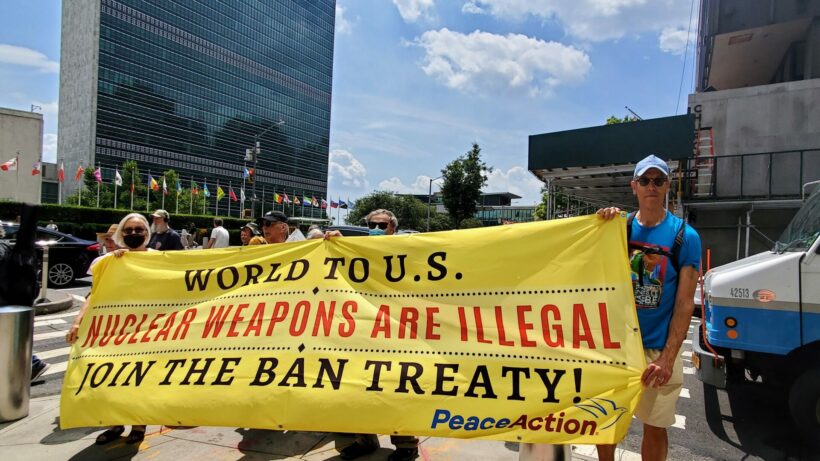
Fresh effort to ban the bomb as new generation bids for nuclear-free world,
Today’s disarmament activists are applying a new set of tactics to respond to threats including those from Putin in Ukraine
Guardian Julian Borger in Washington, Thu 10 Nov 2022
As nuclear dangers gather momentum three decades after the cold war, a disarmament movement is rising to meet them, with a new generation of activists.
In the late 50s and early 60s, and then again in the early 80s, when the US and the Soviet Union were pointing their missiles at each other in Europe, there were mass street protests against governments making plans for global annihilation.
The Campaign for Nuclear Disarmament (CND) was born in the UK and staged large-scale marches to the heart of the British nuclear weapons establishment at Aldermaston. More than four decades ago, a million Americans converged on New York’s Central Park to call a halt to the arms race and a nuclear freeze. At the end of 1982, more than 30,000 women formed a human chain around the Greenham Common air force base as an act of resistance to the deployment of US cruise missiles there. In October 1983, CND staged the biggest march through London the city had ever seen.
With Vladimir Putin’s invasion of Ukraine, and his repeated threats that he would use nuclear weapons if his regime felt in peril, the danger is every bit as real as it was during the Cuban missile crisis or the missile standoff in Europe. This time, there have not been any mass protests but there has been a popular response that has found other channels to express itself.
At the vanguard of the new movement is the International Campaign to Abolish Nuclear Weapons (Ican), which successfully canvassed support for a Treaty on the Prohibition of Nuclear Weapons (TPNW) at the UN general assembly, leading to its adoption in 2017.
Since then, more than 90 countries have signed the treaty and 68 have ratified it. It has not stopped the US and Russia from upgrading their arsenals and China from pursuing plans to become a third leading nuclear weapons power, but Beatrice Fihn, Ican’s executive director, said the ultimate aim was something more enduring: the delegitimization of nuclear weapons around the world.
“It makes it harder to see what is happening as you’re maybe not seeing so many people out on the streets,” said Fihn, who accepted the 2017 Nobel peace prize on Ican’s behalf. But she added: “The movement is very much here, and we’re definitely growing and building.”
While continuing the work of CND and the nuclear freeze movement, Ican and its 652 partner organisations around the world are seeking inspiration from other forms of civil society action, including the campaigns to ban landmines and cluster munitions, which sought to lay down new norms, and redraw the red lines of what is acceptable on the international stage.
“We’re trying to undo the brainwashing of accepting nuclear weapons as normal,” Fihn said. The movement’s greatest source of leverage, she argued, was the need of nuclear weapons for legitimacy.
“We see that with Russia right now. They’re fighting hard to re-establish legitimacy around the nuclear weapons and their security council seat and around the narrative of this war. And to me, it’s a sign that they are vulnerable.”
Kate Hudson, CND’s general secretary, says new membership has surged since Russia’s all-out invasion of Ukraine was unleashed.
“Activism is there in a big way, but it’s taking new forms, and it’s more fluid than previously: the way people understand and act on the links between issues, politically and in campaigning terms,” Hudson said.
The nuclear disarmament movement is no longer in a silo of its own, she argued, as it shares common concerns for those fighting to stop climate crisis, or to uphold social justice in a world where governments are spending huge amounts on nuclear stockpiles while the poorest people in their society are cold and hungry.
The Black Lives Matter (BLM) movement is now framing nuclear disarmament as a social justice issue for many newly recruited activists, making it a far more diverse field……………………………………
Mari Faines, partner for mobilisation in the Global Zero disarmament advocacy group, said BLM prompted her to see more clearly the “correlation between the systems of policing and militarism”, and the overlap between the nuclear weapons complex, social justice struggles and other existential threats.
Hurley is experimenting with new ways to talk about geopolitical threats. While working on her art degree, she writes a column on the Inkstick website, and her latest was about what the US and China might learn from the enemies-to-lovers trope in romantic fiction.
“You cannot fear-monger your way to a mass movement,” Molly Hurley said, arguing that what has been perceived as apathy within her generation was really a “coping mechanism for hopelessness”. The solution, she argued, was to offer some grounds for hope.
“There are things that we can do and we need to make clear all these feasible, very concrete steps that can be taken.” https://www.theguardian.com/world/2022/nov/10/nuclear-disarmament-activists-putin-ukraine
Austria holds the anti-nuclear line
https://www.euractiv.com/section/energy/news/austria-to-continue-anti-nuclear-stance-against-its-neighbours/ 9 Nov 22, Austria, described as “Europe’s most fervent anti-nuclear country,” is now planning protests and blockades in opposition to major nuclear build-out plans in neighboring Czech Republic that would threaten the health and safety of Austrian citizens.
Austria is a nuclear-free country and is currently suing the European Commission for including nuclear power under its so-called “green” taxonomy, allowing nuclear power to benefit from funding that should be going exclusively to truly green energy such as renewables. The law suit is being led by Austrian environment minister Leonore Gewessler, (pictured) who is a member of the Green Party.
The Czech Republic has six reactors in current operation but is chasing after the small modular reactor phantom. It is also planning to build two new full size reactors at Temelin, just 100 kilometers from Linz, Austria’s third largest city. “We will have to take to the streets again to raise awareness and make a difference,” said the mayor of one Austrian village close to the Czech border.
Campaigners seek early end to Chinese involvement at Bradwell nuclear project

https://www.nuclearpolicy.info/news/campaigners-seek-early-end-to-chinese-involvement-at-bradwell/ 7 Nov 22 Three campaign groups have written to influential parliamentarians asking them to seek an early end to plans by Chinese-state owned CGN to develop a new nuclear power plant at Bradwell in Essex.
In their letter to Conservative MPs, Alicia Kearns and Sir Iain Duncan Smith, the Nuclear Free Local Authorities, the Blackwater Against New Nuclear Group (BANNG), and the Bradwell B Action Network (BAN) have urged them ‘to make urgent representations to government to terminate CGN’s involvement at the Bradwell B site as soon as possible’.
Ms Kearns and Sir Iain are both prominent members of the China Research Group, whose stated position is that ‘Chinese involvement in our nuclear industry is now seen as an unacceptable national security risk’. The three campaign groups are opposed to any new nuclear projects at Bradwell as they believe the site does not meet any of the required national criteria to be suitable for the location of a power plant, however they have especial concerns about a Chinese-led project.
T
n their letter, they state that ‘the construction of a nuclear power plant by a Chinese-state owned entity, using Chinese-designed reactors that are not yet operational anywhere in the world, at a location relatively close to large urban populations, military installations, and other strategic assets and infrastructure, must represent a potentially substantial safety and security risk to the UK’.
Recent pronouncements by the Bradwell project team have contained mixed messages. In a circular to residents, they stated that boreholes dug on site to take soil samples would be filled in; that the site compound would soon be dismantled; and that a second phase of testing would be delayed beyond 2023. However, in a response to the media after the NFLA described this as ‘beating a retreat’, CGN insisted they are going to proceed with further feasibility studies.
This optimism seems ill-judged given the many statements by government ministers that they are hostile to Chinese investment in major British infrastructure projects, including at Sizewell C and Bradwell B. The government has enacted the National Security and Investment Act to allows ministers to restrict or prevent foreign investment in infrastructure projects that could compromise national security. Given the political backdrop, the three campaign groups cannot see how the British government could give the CGN-led Bradwell B development its endorsement
Professor Andrew Blowers OBE, Chair of BANNG, said: ‘For the past fourteen years, we have opposed any nuclear development on the grounds that the site is not in any way ‘potentially suitable’ for a new nuclear power station. We believe the Chinese project will be withdrawn owing to sustained local opposition and security concerns. We are asking politicians to confirm that this is the case.’
Councillor David Blackburn, Chair of the NFLA, added: ‘The Bradwell situation appears to be one in which life imitates art. The Bradwell B team are insisting, like the shopkeeper in the famous Monty Python parrot sketch, that their nuclear power project is ‘not dead, it’s merely resting’, whereas it is highly unlikely that it will ever go forward at a time when parliament believes the Chinese Government is not to be trusted. The NFLA believes it would be best if the government made plain that this is going nowhere to end the uncertainty for staff and the people in the communities surrounding the Bradwell B site.’
Together Against Sizewell and other groups to fight on, despite legal setback

Campaigners have pledged to fight on after the High Court rejected their
appeal against the Government’s decision to approve the new Sizewell C
nuclear power station. Together Against Sizewell C (TASC) and other
campaign groups are seeking an oral hearing through the judicial review
process after an initial assessment by the legal authority deemed the
appeal should be rejected.
The review of the approval had been sought on
the grounds that the decision was unlawful amid concerns about the
maintenance of a water supply to the new £20bn station and the resilience
of the coastline. The provision of fresh water to the site was one of the
key issues raised by the Planning Inspectorate when considering the plans.
TASC chair Pete Wilkinson described the rejection verdict as ‘predictable
and wholly unreasonable,’ adding there appeared to be a ‘presumption’
that judicial reviews should be dismissed rather than used as a forum for
democracy.
East Anglian Daily Times 28th Oct 2022
https://www.eadt.co.uk/news/23082932.high-court-rejects-sizewell-legal-challenge/
Nuclear Free Local Authorities urge the UK’s new Chancellor to scrap plan to invest in the Sizewell nuclear white elephant

Hot on the heels of the new Chancellor’s U-turn of everything his
predecessor held dear, the Chair of the Nuclear Free Local Authorities has
written to Jeremy Hunt to urge him to reverse the promised investment of
£700 million made by the previous prime minister on a flying-visit to
Sizewell C and to withdraw from making a commitment to taking an equity
stake in the nuclear ‘white elephant’.
In his letter to the Chancellor, NFLA Chair, Councillor David Blackburn asks for common sense and caution to prevail: “Once the government has Sizewell C on the hook, rather than
land the fish, it is more likely the fish will swallow you whole! Nuclear
projects are always inevitably delivered way over cost and way over time,
and, as an equity holder, His Majesty’s Government will be saddled with
ever greater demands for cash with an ever-decreasing likelihood of
offloading this turkey to a private investor.”
NFLA 20th Oct 2022
‘We want to thank them’: Local Marshallese community welcomes anti-nuclear testing ship.

BY ERIK HOGSTROM erik.hogstrom@thmedia.com
The voices of Noreen Akeang and the other singing women rose in intensity as the ship passed through the gates of Dubuque’s Ice Harbor.
The visit of the Golden Rule to Dubuque carried great significance to Akeang and other members of the city’s Marshallese community.
“We want to tell them how much we appreciate them,” Akeang said. “We want to thank them for what they tried to do so long ago.”
A national project of the Veterans For Peace organization, the Golden Rule arrived in Dubuque late Sunday afternoon and will depart Tuesday morning. Dubuque is among 100 ports of call during a tour of the Midwest, Southeast and eastern United States. The ship’s arrival Sunday drew more than 50 people to the Ice Harbor – with about half of the attendees drawn from the city’s Marshallese community.
“The significance (of the Dubuque visit) is especially important for the 800-plus members of the Marshallese community who live in Dubuque,” said Art Roche, a local organizer of the ship’s Dubuque visit. “Of all of the places where the ship is going to be stopping in the 15-month tour this is the largest Marshallese population on that tour.”
The 34-foot vessel attempted to sail in 1958 from Hawaii to the Marshall Islands to prevent atmospheric nuclear weapons testing. The ship never made it.
“They tried to come to the Marshall Islands, but the U.S. Coast Guard came (and intercepted the ship) and put (the crew) in jail,” said Maitha Jolet, a member of Dubuque’s Marshallese community. “We never knew about it (in the Marshall Islands). Many people didn’t know that a crew of people were supposed to come to the Marshall Islands and do something to protest and try to stop the nuclear testing.”
The United States began using the Marshall Islands as a nuclear testing site shortly after the end of World War II.
“The testing was really bad,” Jolet said.
Jolet said the nuclear testing and associated radiation has resulted in higher rates of cancer and other illnesses among Marshallese. Roche said nuclear contamination of the islands’ areas resulted in dietary changes with adverse effects, too.
“The nuclear testing resulted in their inability to grow their own food and take fish from local waters,” Roche said. “They can’t rely on their own natural resources so everything has to be brought into the Marshall Islands. Consequently, they experienced big dietary changes, including a dependence on rice.”
Roche said the high consumption of rice and other introduced foods puts Marshallese at greater risk of diabetes and other health concerns.
Golden Rule crew members and support staff said they were touched by the Marshallese community’s song-filled welcome to Dubuque.
“I wasn’t expecting it to be so emotional,” said Cindy Boyum, of St. Paul, Minn. “It was just so powerful to meet the people.”
Boyum has been sailing on the ship for part of its southerly journey down the Mississippi River.
“It’s so amazing that the Golden Rule finally gets to be among the Marshallese,” said Helen Jaccard, the Golden Rule project manager. “It just warms my heart that after all of these years we are able to see them and interact.”
64 years later, the Golden Rule takes to the water again to challenge nuclear arms

A crew will sail down the Mississippi, up the East Coast and through the Great Lakes to back the prohibition of nuclear weapons.
By Randy Furst Star Tribune, SEPTEMBER 23, 2022 ,
In the spring of 1958, four pacifists including David Gale,who grew up in Carver, Minn., set sail from California to the Marshall Islands to protest nuclear tests conducted there by the United States. Their 34-foot boat was named the Golden Rule.
Gale, then 25, became gravely ill and the boat developed mechanical problems, and a huge storm on the Pacific Ocean forced the crew to turn back. A second trip was launched, this time with another pacifist replacing Gale. But the crew was arrested by the U.S. Coast Guard near Honolulu and went to jail.
On Sunday, the newly refurbished Golden Rule will set sail again to protest nuclear weapons, this time setting out from St. Paul down the Mississippi River to New Orleans. It’s the start of a 15-month, 11,000-mile journey sponsored by Veterans for Peace that will eventually take the crew up the Eastern Seaboard, through the Great Lakes and back to the Gulf of Mexico, with stops in 100 towns and cities.
“We want to put pressure on the United States to sign the United Nations treaty on the prohibition of nuclear weapons,” said Helen Jaccard, the trip’s project manager.
Kiko Johnston-Kitazawa of Hawaii will captain the boat for the first five months, taking it as far as Jacksonville, Fla. He was working last week on some rigging lines at the St. Croix Marina in Hudson, Wis. “I’ve been interested in peace work and nuclear disarmament since I was 15,” he said.
Mike McDonald, past president of the Twin Cities chapter of Veterans for Peace, which is sponsoring Golden Rule events in the metro area, will be on the boat for the first leg of the trip. “If somebody starts a nuclear war, it isn’t going to be good for anybody,” he said.
The 1958 voyage of the Golden Rule to the Marshall Islands was a national news story. During the previous 12 years, the U.S. had dropped 67 nuclear bombs at Bikini and Enewetak atolls, equaling the energy yield of 7,000 Hiroshima bombs, according to Scientific American.
Gale died in 2016 at 83, but his family remains enthusiastic that the Golden Rule is still making a splash — and carrying the anti-nuclear message.
“I’m thrilled it is being renewed,” said his widow, Margaret Gale of Princeton, Ill., also a committed pacifist. “I still believe in what that boat stands for.”
“This is who he was,” said Andy Gale of San Diego, one of David’s sons. “He was a pacifist and felt strongly against war his whole life………………………………………………………………………………….
There will be a Golden Rule Project program at 11:30 a.m. Sunday at Crosby Farm Regional Park in St. Paul, with a potluck and an opportunity to meet the crew before the boat departs. https://www.startribune.com/sixty-four-years-later-the-golden-rule-takes-to-the-water-again-to-challenge-nuclear-arms/600209583/
1 This Month

of the week – Shut Down Drone Warfare!


Tell the Ukrainian Government to Drop Prosecution of Peace Activist Yurii Sheliazhenko

Petition to revoke the licensing of the Near Surface Nuclear Disposal Facility (NSDF) at Chalk River. https://www.ourcommons.ca/petitions/en/Petition/Details?Petition=e-7247
To see nuclear-related stories in greater depth and intensity – go to https://nuclearinformation.wordpress.com
-
Archives
- April 2026 (114)
- March 2026 (251)
- February 2026 (268)
- January 2026 (308)
- December 2025 (358)
- November 2025 (359)
- October 2025 (376)
- September 2025 (257)
- August 2025 (319)
- July 2025 (230)
- June 2025 (348)
- May 2025 (261)
-
Categories
- 1
- 1 NUCLEAR ISSUES
- business and costs
- climate change
- culture and arts
- ENERGY
- environment
- health
- history
- indigenous issues
- Legal
- marketing of nuclear
- media
- opposition to nuclear
- PERSONAL STORIES
- politics
- politics international
- Religion and ethics
- safety
- secrets,lies and civil liberties
- spinbuster
- technology
- Uranium
- wastes
- weapons and war
- Women
- 2 WORLD
- ACTION
- AFRICA
- Atrocities
- AUSTRALIA
- Christina's notes
- Christina's themes
- culture and arts
- Events
- Fuk 2022
- Fuk 2023
- Fukushima 2017
- Fukushima 2018
- fukushima 2019
- Fukushima 2020
- Fukushima 2021
- general
- global warming
- Humour (God we need it)
- Nuclear
- RARE EARTHS
- Reference
- resources – print
- Resources -audiovicual
- Weekly Newsletter
- World
- World Nuclear
- YouTube
-
RSS
Entries RSS
Comments RSS
 nuclear-news