Next year, May 2020, we’re celebrating the 10th birthday of the International Uranium Film Festival in Rio de Janeiro.
These filmmakers and producers have already agreed to come to Rio 2020: Peter Kaufmann (Australia), Kim Mavromatis (Australia), Laura Pires (Brazil), Angelo Lima (Brazil), Miguel Silveira (USA/Brazil), Cris Uberman (France), Marcus Schwenzel (Germany), Rainer Ludwigs (Germany), Michael von Hohenberg (Germany), Peter Anthony (Denmark), Michael Madson (Denmark), Lise Autogena (Denmark), Masako Sakata (Japan), Maurizio Torrealta (Italy), Alessandro Tesei (Italy), Amudhan R.P. (India), Tamotsu Matsubara (Japan), Tamiyoshi Tachibana (Japan), Tineke Van Veen (Netherlands), Mafalda Gameiro (Portugal), James Ramsay Cameron (Scotland), José Herrera Plaza (Spain), Marko Kattilakoski (Sweden), Edgar Hagen (Switzerland),Tetyana Chernyavska (Ukraine), Brittany Prater (USA), Ian Thomas Ash (Japan/USA).
Rio’s 10th International Uranium Film Festival is scheduled for May 21st to 31st. Do not miss it!
In 2010, nuclear engineer Donna Busche warned of the risks of a disastrous radioactive explosion at a Hanford site waste-treatment plant, then under construction. She insisted on the need for a “hazard review” that would cause costly delays for her employer, a federal Energy Department contractor. And she refused to back down even under intense workplace harassment that ended with her firing for “unprofessional conduct.”
Busche testified before a federal nuclear-safety board, met with U.S. senators and helped to launch a lawsuit against two major Hanford contractors alleging the multibillion-dollar project failed to meet rigorous nuclear quality standards.
“The impact on your personal life is hell,” Busche said. “People who I thought were my friends, I found out they are not my friends.”
In taking these steps, Busche became a Hanford whistleblower, one of hundreds of people who through the decades have raised alarms about waste, fraud and safety problems at the massive cleanup operations of the south central Washington federal site that once produced the plutonium for U.S. nuclear weapons.
“Hanford is ground zero for whistleblowing in America,” said Tom Mueller, author of “Crisis of Conscience,” a sweeping new chronicle of the nation’s whistleblowers, the difficulties they have faced and the wrongdoing they have exposed. “It has all the key factors … You have corporate power. You have government. You have huge amounts of money, and secrecy. Time and time again, taxpayer dollars are misspent.” Continue reading →
“Media outlets have faced attacks in the form of centralisation of private ownership, funding cuts to public broadcasters, and potential prosecution of journalists, including News Corp journalist Annika Smethurst.”
One of the report’s authors, Geoffrey Watson, SC, former counsel assisting the Independent Commission Against Corruption, said he had been shocked by how quickly the brutal type of politics that evolved in the United States and the United Kingdom, and partly led to the ascendancy of Donald Trump and Boris Johnson, had taken root in Australia.
“One day you see the judiciary attacked and the next someone in the media,” said Mr Watson, who is a director of the Centre for Public Integrity. “On the third day it might be the CSIRO, they even attack our scientists. Some people don’t recognise it as the same problem, but it is all part of the same disease.”
He said the effectiveness of the media in Australia as a watchdog was not only threatened by personal and legal attacks by the government, but by regulations that had allowed ownership of newspapers to be reduced to an effective duopoly.
The report, entitled “Protecting the Integrity of Accountability Institutions”, said that a range of institutions – including the judiciary and the Administrative Appeals Tribunal, the public service, integrity commissions such as the ICAC, statutory authorities such as the Human Rights Commission and the Fair Work Commission, and the CSIRO – had all been targeted in recent years by interested parties seeking to undermine their independence and public trust.
“These institutions are important not only because they ensure actual accountability, transparency and good governance but because they build confidence and trust within the Australian community,” it said. “When this confidence and trust is diminished, divisiveness and conflict increase. This impacts social cohesiveness and the economy, and the welfare of all Australians suffers. Ultimately, as international experience has shown, it is a threat to democracy itself.”
It cited as examples of interference attempts by federal ministers to influence the Victorian Court of Appeal in 2017 terrorism cases, sustained funding cuts and personal attacks on the ABC, and the de-skilling of the public service through the outsourcing of up to 50 per cent of government departments to contractors.
The report listed a series of principles that needed to be respected in order to protect the independence of the threatened institutions. They include protection from political retribution, secure and sufficient funding, secure tenure of senior officials and public access to advice to the government from accountability institutions, as well as the creation of an effective federal integrity watchdog.
The Centre for Public Integrity, a independently funded think tank, was formed earlier this year in part to champion the case for a such a body. The report comes in the midst of a campaign by Australian media, including the Herald and The Age, to defend the public right to information in the face of increasing attempts by government and government agencies to suppress information, prosecute whistleblowers and criminalise legitimate public interest journalism.
More Inclusive Science Journalism Is Better Science Journalism, Undark, 25 Oct 19 By expanding our pool of storytellers, we produce work that more fully reflects how science is done and why it matters. THIS YEAR, as in the past, the Nobel Prize’s science awards overwhelmingly went to white men. Nine of the 12 laureates in chemistry, physics, physiology or medicine, and economics were white men from North America or Europe, and only one was female. Many commenters noted the gender imbalance. Fewer pointed out the racial and ethnic imbalance. Although the skewed distribution of this year’s laureates doesn’t reflect the reality of today’s scientific workforce, it does drive public perception of what a scientist looks like………
I’m also learning from my students. And here’s what they’ve shown me: More inclusive science journalism is better journalism. When we expand our pool of storytellers and broaden our horizons beyond the kinds of stories we’ve long told, we will produce work that more fully reflects the spectrum of how science is done and why it matters to society.
Indeed, I’ve already seen this in the time that I’ve directed the UC Santa Cruz program, which trains 10 young science writers each year. As a first step toward diversifying the field of science journalism, our program has worked to recruit a more diverse corps of science writing students. Our recent classes have included students of color; students from underrepresented communities; lesbian, gay, and bisexual students; nonbinary students; and students from all over the U.S. and the rest of the world.
All of our incoming students are required to have science degrees and research experience. So my students have often experienced the inequities that frequently hamper the careers of female scientists and scientists of color. And they’ve seen that science journalism too often takes its cues from science: We tend to cover the topics and people that powerful and influential scientists themselves say are noteworthy. This perpetuates the very forces that distort science to begin with. https://undark.org/2019/10/24/more-inclusive-science-journalism-is-better-science-journalism/
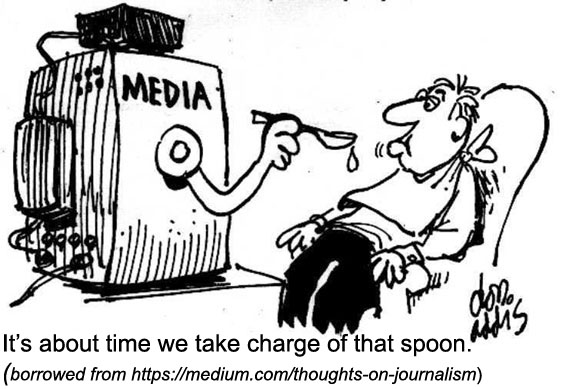
governments have a long history of trying to manipulate the media,” and are steadily moving into the realm of social media.
Facebook’s gigantic user base and its design make it an enormously influential media organization, one that can make or break politicians’ chances.
there is one rule for the powerful and quite another for the rest of us, and how the big social media platforms are increasingly acting like arms of Western governments, adopting their perspectives on what are and are not acceptable political viewpoints.
Government penetration and control over media of little interest to those who are subject to it, ALAN MACLEOD, 24 Oct 19, A recent investigation from independent news outlet Middle East Eye (9/30/19) uncovered that a senior Twitter executive is, in fact, an officer in the British Army’s 77th Brigade, a unit dedicated to psychological operations (psyops), propaganda and online warfare.
Gordon MacMillan, who joined the social media company in 2013, is its head of editorial for the Middle East and North Africa. While both Twitter and the British Army attempted to distance themselves from the implications of the report, it is unclear why MacMillan would have this role if not to manipulate and propagandize the public. (The British Ministry of Defense describes psyops as a way of getting “the enemy, or other target audience, to think and act in a way which will be to our advantage”—BBC, 6/20/08.)
For media so committed to covering news of foreign interference with US public opinion online (see FAIR.org, 8/24/16, 12/13/17, 7/27/18), the response was distinctly muted.The story did not appear at all in the New York Times, Washington Post, CNN, CNBC, MSNBC, Fox News or virtually any other mainstream national outlet. In fact, the only corporate US outlet of any note covering the news that a person deciding what you see in your Twitter feed is a foreign psyops officer was Newsweek, which published a detailed analysis from Tareq Haddad (10/1/19). When asked by FAIR why he believed this was, Haddad agreed it was major news, but downplayed the idea of media malevolence, suggesting that because it was a small British outlet breaking news involving a British officer, US media may have overlooked it.
Yet the bombshell was also largely downplayed in the UK press as well, with only the Independent, (9/30/19), the London Times (10/2/19) and the Financial Times (9/30/19) producing reports on the news, bland and even-toned as they were. There was no other reporting of it in the national press, including in the BBC or the Guardian, the latter having already “gotten rid of everyone who seemed to cover the security services and military in an adversarial way,” according to one current employee.
Furthermore, the news was the focus of alarmed reports in alternative media (Moon of Alabama, 9/30/19; Consortium News, 10/2/19), as well as from foreign government-owned outlets that have been labeled propaganda mills, and have been demoted or deleted from social media platforms like Twitter, YouTube and Facebook. Turkey’s TRT World (10/1/19), Venezuela’s TeleSur English (10/1/19), Iran’s Press TV (9/30/19), and Russia’s Sputnik (9/30/19) and RT (9/30/19) all immediately covered the scandal, suggesting the lack of Western coverage was a political rather than a journalistic choice.
Deep State and Fourth Estate
Haddad also noted that “governments have a long history of trying to manipulate the media,” and are steadily moving into the realm of social media. Regular FAIR readers will already know this. Last year Facebook announced that, in its fight against “fake news,” it had started working with the National Democratic Institute and the International Republican Institute, two organizations involved in covertly assisting the overthrow of foreign governments through propaganda campaigns, among other methods (FAIR.org, 9/25/18). It also began partnering with the Atlantic Council (FAIR.org, 5/21/18), a NATO-funded think tank, whose board of directors is a who’s who of ex-CIA chiefs, army generals and Bush-era neocon politicians. That the likes of Henry Kissinger, Condoleezza Rice and David Petraeus are deciding what Facebook’s 2.4 billion worldwide users see in their news feed is tantamount to state censorship on a global scale (FAIR.org, 8/22/18).
Facebook’s gigantic user base and its design make it an enormously influential media organization, one that can make or break politicians’ chances. Media (e.g., New York Times, 11/1/17; Buzzfeed News, 4/18/19; USA Today, 4/22/19) have consistently implied that a relatively small Russian ad campaign on the platform swung the 2016 election in favor of Donald Trump. Less well known is that an American advertising team met with far-right party Alternative für Deutschland at Facebook headquarters in Berlin to devise a campaign of micro-targeting ads on the platform that led to a massive increase in their vote, the strongest fascist showing in Germany since the 1940s (FAIR.org, 6/19/19).
A Fact-Free Zone
Facebook has rules against accepting advertisements containing “deceptive, false or misleading content.” Yet earlier this month, it announced it was rescinding these rules for political ads, allowing politicians who pay them to lie to its users. Referencing the long run-up to the 2020 election, where it is sure to cash in on both sides, a spokesperson justified the decision on the grounds of free speech: “We don’t believe that it’s an appropriate role for us to referee political debates.” It did note, however, that it would continue to ban ads by non-politicians that “include claims debunked by third-party factcheckers, or, in certain circumstances, claims debunked by organizations with particular expertise.”
Yet factchecking organizations are not neutral arbiters of truth, but part of an increasingly elite class of people with their own biases and preconceptions. In practice, they have tended to espouse a “centrist” ideology—a word with its own problems (FAIR.org, 3/23/19)—and are hostile to anyone challenging the status quo from either right or left. Factcheckers have been carrying out something of a war against Bernie Sanders’ campaign, constantly rating the Vermont Senator’s statements as misleading or untrue without due reason.
Furthermore, the choice of who gets to decide what is true and what is false is an important one. Facebook has already partnered with conservative magazine the Weekly Standard, a publication that was crucial in pushing arguably the greatest fake news stories of the 21st century: those of Iraqi weapons of mass destruction and Saddam Hussein’s links to 9/11 (Extra!, 9/09). “There is no debate about the facts” that “the Iraqi threat” to the US is “enormous” and that Saddam’s henchmen helped Osama Bin Laden, it wrote in 2002 (1/21/02). Yet Facebook picked this organization to help it gauge the veracity of viral stories across its platform.
Silencing Dissent Online
In September, Twittersuspended multiple accounts belonging to Cuban state media. And along with Facebook and YouTube, it also suspended hundreds of Chinese accounts it claimed were attempting to “sow political discord in Hong Kong” by “undermining the legitimacy” of the protest movement. These social media giants have already deleted thousands of Venezuelan, Russian and Iranian accounts and pages that were, in their own words, “in line with” those governments’ positions. The message is clear: Sharing opinions that do not fall in line with official US doctrine will not be tolerated online.
In contrast, Western politicians can continually flout Twitter’s terms of service with no consequences. Sen. Marco Rubio threatened Venezuelan President Nicolas Maduro with torture and execution, sharing a video of Moammar Gadhafi being tortured and killed in a not-so-subtle message that broke multiple Twitter rules. Meanwhile, Donald Trump announced that we would “totally destroy” North Korea with “fire and fury,” and promised he would bring about the “official end” of Iran if it angered him again. Twitter has continually refused to delete tweets like that on the grounds that this would “hamper necessary discussion,” although it later saw fit to delete those from Iran’s Ayatollah Ali Khamenei.
Decisions like these highlight how there is one rule for the powerful and quite another for the rest of us, and how the big social media platforms are increasingly acting like arms of Western governments, adopting their perspectives on what are and are not acceptable political viewpoints.
By Ed HoltIPS Correspondent Ed Holt speaks to Pauline Ades-Mevel, Head of European Union and Balkan desk at Reporters Without Borders, warns that press freedom in Europe is declining. Courtesy: Reporters Without BordersRising populism, anti-media rhetoric from politicians, cyber-harassment of journalists and physical attacks are among the reasons why press freedom in Europe is on the decline, according to the global media watchdog Reporters Without Borders (RSF).
As it released its annual Press Freedom Index earlier this year, the group warned that Europe was “no longer a sanctuary for journalists”, pointing to the murders of three journalists in Malta, Slovakia and Bulgaria in the space of a few months and warning that “hatred of journalists has degenerated into violence, contributing to an increase in fear… the decline in press freedom in Europe… has gone hand in hand with an erosion of the region’s institutions by increasingly authoritarian governments”.
IPS spoke to Pauline Ades-Mevel, Head of European Union & Balkan desk at RSF about why press freedom was deteriorating across the continent and how, while threats to press freedom in Central and Eastern Europe often make headlines, the situation is far from trouble free in Western Europe. Excerpts of the interview follow.
Inter Press Service (IPS): RSF’s most recent surveys and reports suggest that media freedom is on the decline generally in Europe. Is this decline specific for Europe or part of a global trend?
Pauline Ades-Meve (PAM): When working on our most recent Global Press Freedom Index, we looked to see if there was a trend of deterioration of press freedom just in Europe or elsewhere. We found that it was actually a global trend, that we could see that trend in many regions. We looked at why this was the case and, while there are some different reasons in different countries, what we saw in general was that there was a climate of fear in which many journalists were working in. This is why there is this general deteriorating trend. Fear has been causing the most problems for journalists.
In Europe specifically a number of countries have fallen down the Index. This is for a number of reasons and comes with rising populism, anti-media rhetoric from politicians, cyber-harassment of journalists, physical attacks.
IPS: Threats to media freedom in central and eastern Europe and the Balkans have made a lot of headlines in recent years, perhaps understandably due to the nature of those threats, but RSF has made clear that media freedom in western Europe is also declining. What kind of threats are media facing in western Europe today?
PAM: We have seen threats to journalists emerge in recent years in Western Europe. For instance, in Spain, during the Catalan independence protests, leaders of the movement delivered rhetoric which undermined trust in journalists. They did not think journalists were covering the situation properly, or at least not in the way they wanted, and they viewed journalists who were not supporting their cause as people who were working against it and trying to prevent independence.
We recently published a report on the pressures faced by journalists in Spain and people don’t realise that, at the moment, Spain is no longer a heaven to be a journalist when you cover politics.
And then another example is Italy where there are 20 journalists who have around the clock police protection because they are facing threats from criminal networks.
Journalists in Europe are facing cyber-harassment – journalists covering protests in Spain and in France have been attacked online.
There is also a trend we are seeing in Western Europe of journalists being attacked when covering protests themselves. This is because part of the population no longer trusts the media anymore – protest leaders have portrayed them negatively, as untrustworthy, because they are not happy with the coverage. Journalists sometimes face violence and terrible threats from protestors. We have had cases of female journalists being threatened with rape. And sometimes, when they cover demonstrations, journalists are sometimes targeted by both the protestors and the police, which makes their mission even harder.
IPS: Are these threats growing or changing in nature?
PAM: They are growing and new threats are emerging. One of these is growing legal harassment of journalists. Governments and businessmen are chasing journalists legally, through lawyers and courts, trying to stop them reporting and doing their jobs. This is extremely worrying.
IPS: How do they differ, if at all, from the threats faced by media in central and eastern Europe and the Balkans?
PAM: In some ways the threats are the same. There is a lot of legal harassment of journalists in central and eastern Europe and the Balkans. There is also physical intimidation of journalists and cyber-harassment too, while in some countries the independence of public media is under threat as well with governments trying to interfere in editorial independence, to influence them. We tend not to see this in Western Europe.
IPS: Physical intimidation of journalists is not a new phenomenon, especially in some countries in Europe, e.g. Russia or Ukraine. Is it becoming more common in western Europe, though, and if so, who is doing the intimidation?
PAM: Western Europe is certainly not free of this. Journalists in Western European states do face physical intimidation. Places like France, Spain, Italy, fascist groups in Greece. And it is only a few months ago that a journalist, Lyra McKee, was killed in Northern Ireland. Western Europe is not without this problem, even today.
IPS: There have been cases of journalists being attacked by protestors, and sometimes police, at demonstrations in parts of Western Europe in recent years e.g. in France. While this is not a problem specific to just western Europe, or Europe as a whole, in the past press were generally seen as neutral observers at such events and as such, left alone. Is that changing, are journalists now being seen as ‘fair game’ by certain groups?
PAM: One thing we have noticed in recent years is that due to social media and some ‘media’ which frankly should not be labelled as media, people are losing trust in media in general and this has galvanised certain people in certain movements and groups to attack journalists. As an example, when asked many of the Gilets Jaunes protestors in France said that their favourite TV station for news was the Russian state-sponsored channel RT, or people’s Facebook pages where they could read stories. We could then see at protests that protestors were attacking journalists with rocks because they were not happy with them, they did not trust them, did not think they were portraying the protests the way they wanted them to. So they just attacked them and destroyed their things, like cameras.
IPS: Online hatred towards journalists, including incitement to violence against them, appears to have become more of a problem in recent years. Is this the case in Europe and if so, what do you think is driving this rise?
PAM: This is a problem across Europe, but not just Europe. It is worldwide. Being online means that the attacked can remain anonymous and that anonymity emboldens them, makes them feel stronger. Their hatred also makes them feel powerful. Cyber-harassment is one of the major problems facing journalists in a lot of countries in Europe, both in Western Europe and the rest of the continent.
Much has been reported about authoritarian governments in parts of central and Eastern Europe and the Balkans trying to crack down on critical media so they can cement their power e.g. Hungary, Poland, Serbia. Do you think public perception of western Europe with its historical traditions of democracy and freedoms, particularly freedom of speech, means that people can sometimes mistakenly assume that this could never happen in western Europe?
I am often reminded of conversations between journalists in France who remind themselves of how they work in an environment where they are protected by legislation, by institutions, and have the freedom to do their jobs. But while the West is seen as having traditionally good, strong democracies to protect journalists, the situation with press freedom is not as good as it has been. Populist movements have spread across Europe, including Western Europe. We have seen problems with, for example, independence of public media in Spain
IPS: Would you say there are greater legal or constitutional safeguards against an erosion of media freedom in western European states than in other parts of Europe?
PAM: I think that Western European states may have a greater sense of European values and respecting those values. This includes respecting the freedom of the media and some governments in Western Europe have moved to specifically protect journalists, even giving them a special status – in Portugal, there is a legal statute protecting journalists so that if someone attacks a journalists it is actually more serious a charge than attacking a normal member of the public.
Overall the situation in Western Europe with regard for respect of the institution of press freedom is better than in other parts of the Europe. This is why we have seen an erosion of press freedom in places such as Hungary, or Bulgaria, because in those countries there is not the same tradition, or sense of, European values.
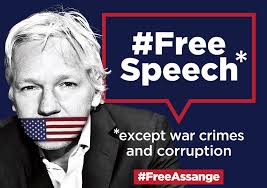
Julian Assange was denied a request to delay his extradition proceedings by three months, with the full hearing still set to take place over five days in late February 2020
Assange’s lawyer Mark Summers accused the US of illegally spying on Assange while he was inside the Ecuadorian Embassy seeking refuge
Scores of the WikiLeaks founder’s supporters filled the courtroom and protested outside it
The 48-year-old appeared in a packed court on Monday to fight extradition to the United States, where he faces 18 counts, including conspiring to hack into Pentagon computers and violating an espionage law.
Britain’s former Home Secretary Sajid Javid signed an order in June allowing Assange to be extradited to the US, where authorities accuse him of scheming with former Army intelligence analyst Chelsea Manning to break a password for a classified government computer.
He could spend decades in prison if convicted.
Assange and his legal team said he needed more time to prepare his case, but failed to convince District Judge Vanessa Baraitser that a slowdown was justified.
The full extradition is still set for a five-day hearing in late February, with brief interim hearings in November and December.
Assange — clean shaven, with his silvery-grey hair slicked back — defiantly raised a fist to supporters who jammed the public gallery in Westminster Magistrates Court.
After the judge turned down his bid for a three-month delay, Assange, speaking very softly and at times appearing to be near tears, said he did not understand the proceedings.
He said the case was not “equitable” because the US government had “unlimited resources” while he did not have easy access to his lawyers or to documents needed to prepare his battle against extradition while confined to Belmarsh Prison on the outskirts of London.
Lawyer Mark Summers, representing Assange, told the judge that more time was needed to prepare Assange’s defence against “unprecedented” use of espionage charges against a journalist.
Mr Summers said the case has many facets and would require a “mammoth” amount of planning and preparation.
He also accused the US of illegally spying on Assange while he was inside the Ecuadorian Embassy seeking refuge, and of taking other illegal actions against the WikiLeaks founder.
“We need more time,” Mr Summers said, adding that Assange would mount a political defence.
Mr Summers said the initial case against Assange was prepared during the administration of former president Barack Obama in 2010 but wasn’t acted on until Donald Trump assumed the presidency.
He said it represented the US administration’s aggressive attitude toward whistleblowers.
Representing the US, lawyer James Lewis opposed any delay to the proceeding.
The case is expected to take months to resolve, with each side able to make several appeals of rulings.
The judge said the full hearing would be heard over five days at Belmarsh Court, which would make it easier for Assange to attend and contains more room for the media.
Assange’s lawyers said the five days would not be enough for the entire case to be heard.
Health concerns for Assange
Outside the courthouse, scores of his defenders — including former London mayor Ken Livingstone — carried placards calling for Assange to be released.
Wikileaks editor-in-chief Kristinn Hrafnsson said it was a “big test case for journalism worldwide”.
“This should be thrown out immediately because this is a total violation of a bilateral treaty between the US and the United Kingdom which basically states that you cannot extradite someone for political offences, and this is a political case,” he said.
Regarding Assange’s health, Mr Hrafnsson said he was in a “stable condition” but was living in “de facto solitary confinement”.
“After three or four weeks it starts to bite in and you can feel that he is suffering,” he said.
Assange supporter Malcolm, who did not give his surname, told the ABC there was “not nearly enough” people actively campaigning for Assange’s freedom, and he wanted to see the whole street blocked at the next hearing.
Another supporter accused the Australian government of failing to “defend their own citizen”.
The crowd outside court was largely well-behaved but briefly blocked traffic when a prison van believed to be carrying Assange left court.
David Attenborough says humans have made ‘tragic, desperate mess’ of planet, Broadcaster urges people to look after natural world as he launches new series with conservation ‘at its heart’ , Independent UK, Chris Baynes 21 Oct 19, Humanity has made a “tragic, desperate mess” of the planet, Sir David Attenborough has said.
The veteran broadcaster urged people to “look after the natural world” and waste nothing, as he prepared for his latest series to air this week.
Seven Worlds, One Planet, breaks with the tradition of previous BBC Natural History Unit programmes by putting a conservation message “at its heart”, instead of being tagged on at the end of each episode.
The series, which has been four years in the making, features wildlife firsts and has already been bought by broadcasters around the world.
Producers took drones over “volcanoes, waterfalls, icebergs and underground into caves” to shoot heart-wrenching “animal dramas” in all seven continents, the BBC said.
Dramatic scenes include a lone, grey-headed albatross chick in Antarctica being blown off its nest as a result of increasingly intense storms in the region.
Speaking at the launch, Sir David, who presents the programme, said: “We are now universal, our influence is everywhere. We have it in our hands, and we made a tragic, desperate mess of it so far. But, at last, nations are coming together and recognising that we all live on the same planet … and we are dependent on it for every mouthful of food we eat and every breath of air we take.”
Asked what we can do to save the planet, Sir David, 93, said: “The best motto … is not to waste things.
“Don’t waste electricity, don’t waste paper, don’t waste food – live the way you want to live, but just don’t waste.”
The broadcaster added: “Look after the natural world, the animals in it and the plants in it too. This is their planet as well as ours. Don’t waste.”
The seven-part series will reveal “new species and behaviours,” producers said……..
Antarctica, North America, South America, Europe, Africa, Asia and Australia will feature over different episodes in the seven-part series.
Radiation Free Lakeland 12th Oct 2019,New Nuclear** On the anniversary of the Windscale disaster and in the midst of the building of a new gas plant especially for Sellafield, the North West Evening Mail publishes a press release from the nuclear industry touting the ‘Rediscover Nuclear’ campaign.
Some of the laughable descriptions include “homegrown” “safe” “low carbon”. Each of these claims is a big fat lie. As Phil Johnstone tweets: UK “homegrown” nuclear. “UK only ever sold 2 reactors back in 60s, British Energy no longer exists. The UK doesn’t really have much of a civil nuclear industry. What is “homegrown” about it? Electricite de France? China General Nuclear Power Corporation?
‘The Public Is Clearly on the Side of Net Neutrality’ FAIR,
JANINE JACKSONJANINE JACKSON INTERVIEWED FREE PRESS’S CRAIG AARON ABOUT THE NET NEUTRALITY SETBACK FOR THE OCTOBER 4, 2019, EPISODE OF COUNTERSPIN. THIS IS A LIGHTLY EDITED TRANSCRIPT. 11 Oct 19
Janine Jackson: A federal appeals court has ruled that it was OK for the FCC, over the overwhelming, openly stated will of millions of people, to classify internet service providers as “information services”—rather than what we understand them to be, “telecommunications services”—and thus allow them to avert rules about open and nondiscriminatory access. It’s a big loss, but it doesn’t sound like the fight is over, so much as maybe changing locale. Joining us now to catch us up is Craig Aaron, president of the group Free Press; he joins us by phone from Washington, DC. Welcome back to CounterSpin, Craig Aaron.
Craig Aaron: Thanks so much for having me back.
JJ: It would have been great for the court to push back against this Republican-led FCC ruling, which listeners will know went against the desires and demands of the vast majority of the public who commented. The agency went through all manner of shenanigans trying to distort that public comment, and then just ignored it; but it also went against common sense, and our knowledge about the role that the internet plays in our lives today.
SO THE RULING STINKS, I GUESS, IS THE FIRST THING TO SAY.
CA: I’m certainly very disappointed in the outcome. But you can look at all 186 pages of this ruling. What it all essentially boils down to is, the court said, “This is up to the FCC. They’re the expert agency, and we defer. And in this case, we defer, no matter how misguided, ideologically motivated or devoid of facts the FCC’s approach was; it’s ultimately up to them. The Supreme Court precedent backs them up.”
This was the high bar for challengers to clear, and the judges, while questioning how much the internet has changed, while going out of their way to talk about a number of areas where the FCC really lacked evidence or strong arguments, ultimately said, “You’re the expert agency. This Court are not the experts and we defer to you,” which, somewhat ironically, and not very satisfying, was the same reason that the previous FCC prevailed in making strong net neutrality rules. And when the industry challenged, they said, “Nope, it’s up to the agency.”
What we know about nuclear weapons and the nuclear industry thanks to WikiLeaks
“The Nobel Peace Prize will be awarded on 11 October. Why I support the nomination of Julian Assange and WikiLeaks.” Open Democracy, Felicity Ruby, 7 October 2019 The Nobel Peace Prize will be awarded on 11 October. Julian Assange and WikiLeaks have been nominated for the prize again this year, as they have since 2010. As the first staffer of the campaign that won the Peace Prize in 2017, the International Campaign to Abolish Nuclear Weapons (ICAN), I support this nomination for a number of reasons.
The vast majority of governments on this planet want nuclear disarmament negotiations to occur and produce results. ICAN has been mobilising this willingness to push for a new treaty to ban nuclear weapons. From the outset, the campaign deployed accurate information to mobilise public opinion and reeducate a new generation. In facing the truth about nuclear dangers, answers became available and courageous action was taken. Facing the truth about climate change similarly involves the public having accurate information and courageously acting on it.
WikiLeaks and Assange have made a great deal of information available about nuclear weapons and the nuclear industry. A search on the WikiLeaks site for the word ‘nuclear’ brings up 284, 493 results. These documents traverse the nuclear fuel cycle – from uranium mining to nuclear waste – with many thousands exposing nuclear energy industry giants, and nuclear weapon threat assessments, numbers, doctrines and negotiations.
Ten examples
Below are just ten examples of where WikiLeaks exposed wrongdoing on the part of governments and corporations that meant citizens could take action to protect themselves from harm, or governments were held to account:
After the Chalk River nuclear reactor was shut down for routine maintenance on 18 November 2007, inspectors verified the reactor’s cooling systems had not been modified as required by an August 2006 licensing review. Atomic Energy of Canada Limited (AECL) did not start the reactor but said upgrades could be done as part of maintenance while still operating safely. This impasse lasted a month, with the government intervening to grant an exemption to the reactor to allow its restart. The responsible Minister for Natural Resources, Gary Lunn MP, fired Linda Keen, the President of the Nuclear Safety Commission. Their exchange of letters revealed much about the safety standards and routine practices of the Canadian nuclear regulatory system, and particular problems with the ageing Chalk River reactor previously unknown to the public.
– Footage of the 1995 disaster at the Japanese Monju nuclear reactor – released 25 January 2008
Following the 2008 announcement that the Japanese Monju fast breeder nuclear reactor would be reopened, activists leaked the suppressed video footage of the sodium spill disaster that led to its closure in 1995. Named after the Buddhist divinity of wisdom, Monju, located in Japan’s Fukui prefecture, is Japan’s only fast-breeder reactor. Unlike conventional reactors, fast-breeder reactors, which “breed” plutonium, use sodium rather than water as a coolant. This type of coolant creates a potentially hazardous situation as sodium is highly corrosive and reacts violently with both water and air. On December 8, 1995, 700 kg of molten sodium leaked from the secondary cooling circuit of the Monju reactor, resulting in a fire that did not result in a radiation leak, but the potential for catastrophe was played down the extent of damage at the reactor and denied the existence of a videotape showing the sodium spill. Further complicating the story, the deputy general manager of the general affairs department at the PNC, Shigeo Nishimura, 49, jumped to his death the day after a news conference where he and other officials revealed the extent of the cover-up.
– Serious nuclear accident lay behind Iranian nuke chief’s mystery resignation – released 16 July 2009 WikiLeaks revealed that a source associated with Iran’s nuclear program confidentially told the organisation of a serious, recent, nuclear accident at Natanz. Natanz is the primary location of Iran’s nuclear enrichment program and the site targeted with the Stuxnet worm that contained 4 zero days and was designed to slow down and speed up centrifuges enriching uranium. WikiLeaks had reason to believe the source was credible, however contact with this source was lost. …………..
WikiLeaks and Assange have brought forward many truths that are hard to face, publishing well over 10 million documents since 2006. Often forgotten is that each one was provided by a whistleblower who trusted this platform to publish, and who sought reform of how political, corporate and media power elites operate. Each release has shared genuine official information about how governments, companies, banks, the UN, political parties, jailers, cults, private security firms, war planners and the media actually operate when they think no one is looking.
Assange is nominated for the Nobel Peace Prize because of these many releases of information, used as evidence in court cases, freeing prisoners and exposing scandals, torture, murder and surveillance for which redress is only possible when the wrongdoing is dragged into the light. For publishing this true information, Assange, an Australian based in the UK at the time of publication, is on the health ward of Belmarsh Prison, facing extradition and charges attracting 175 years in a US jail, an effective death sentence….. https://www.opendemocracy.net/en/can-europe-make-it/what-we-know-about-nuclear-weapons-and-nuclear-industry-thanks-wikileaks/
Those who couldn’t make it to the recent International Uranium Film Festival in Portugal have missed an amazing event at a special place where uranium mining started more than a hundred years ago. From September 13th to September 15th the festival was organised in partnership with ATMU (Former Uranium Mine Workers Association) and former uranium miners and their families in the towns Urgeiriça (Nelas), Viseu and Mangualde in the Dão region of central Portugal.
„We thank especially the former surviving uranium miners and their incredible wives for the warm welcome and their enthusiastic commitment for the festival“, said Uranium Film Festival’s executive director Márcia Gomes de Oliveira from Rio de Janeiro. And the President of ATMU added. „The Uranium Film Festival was, in fact, one of the most interesting cultural and scientific initiatives in which we had the privilege to participate. We extend our most sincere congratulations to the festival directors Márcia Gomes de Oliveira and Norbert G. Suchanek for three days of films, debates and remarkable of all, raising awareness.“
“We confess that we did not know some of the cases we were made aware of: the uncertain future of the Utah Ute people in the Grand Canyon; the scandalous case of Palomares, who lived under the shadow of lies for decades; and the living despair of Jadugoda whose inhabitants, the Adivasi, are sacrificed by uranium mining and under the hollow argument of so called development”, write the two observers Catarina Gameiro Minhoto & João Paiva in their final festival report to ATMU.
“Each case is unique, but the reality is the same. Let us quote a phrase from the Wismut movie (Yellow Cake) which said that uranium mining happened under a web of lies, propaganda and lack of information. Same in Palomares, where in 1966 two US planes crashed and four atomic bombs felt from the sky and where even today the United States and the now democratic government of Spain seem to hide the truth behind that accident and its ongoing consequences. We also mention Jadugoda where the situation is dramatic and where the authorities – like the nuclear industry in Brazil (INB) – insist on ignorance. Worse than natural ignorance, is conscious ignorance, based on the lie about the truth. The consequences of this attitude on the part of the authorities are clear: thousands of people suffering from cancer and other diseases; with terrible social conditions; the surroundings of these mines became ecological time bombs.
To our great shock, we have learned by the film that the main reason why the environmental situation is often untreated and the legacies of uranium mining are not rehabilitated is that the end point of nuclear fuel production is extremely costly. And no profit waiting. The big companies or uranium mills do not want to spend money on this last stage. The final price of this insensitivity is paid by the people of the surrounding areas, is paid by the environment, is paid by all of us.”
The audience found it noteworthy that no seats had been assigned to tribal representation.
the public has known very little about the decommissioning process. No seats on the CAB were given to the media, no one on the CAB thought it was their job to speak with the press, PG&E did not speak with the press, and the NRC has a very hands off approach to the decommissioning process and the utility’s relationship with the CAB.
Input from the public included a strong sentiment that this was a very poor storage location for the spent fuel.
Laird went on to say that while there’s already been half a meter of sea level rise, a meter more, which is predicted to occur within 40 years, will fully inundate the generation station, 101 in that area and cause the dry cask storage area to become an island, until it is eroded away.
Notably, PG&E’s Decommissioning Fund will run out in 2025, a mere 5 years from now, the casks the waste are in only have a shelf life of 40 to 50 years, and the half life of the waste in storage in those casks in PG&E’s custody, is 24,000 years.
NUCLEAR WASTE BEING STORED 115 FT FROM HUMBOLDT BAY AS SEA LEVEL RISES
Bruce Watson the Branch Chief in charge of Reactor Decommissioning at the NRC led the meeting. He instructed everyone that the sole purpose of the meeting was for him to collect their input on the best practices of the Citizen Advisory Boards. He said, “We are not here to talk about other issues related to decommissioning.” The speakers allowed some of their remarks to drift over to address what should be done about the spent fuel rod still being stored at the King Salmon site.
On January 14th, the Nuclear Energy Innovation and Modernization Act (NEIMA) was signed into law. According to Jurist Legal News and Research website, NEIMA makes several changes to the licensing process for nuclear reactors. The NEIMA gave the NRC less than a year to “develop and implement a staged licensing process for commercial advanced nuclear reactors.” Continue reading →
Unfortunately the Fissionline journal has ceased its publishing and has deleted its content. I have saved some important journals and have added links below to the 3 surviving files left in my possession for you to download for free (as evidence of a well funded nuclear cover up).
Within that vast repository of knowledge was information about the British Nuclear Test Veterans campaign for justice because of the health effects on the veterans and their children by the nuclear weapons testing carried out by the UK Government. As well as fighting for justice for these victims, Fissionline also challenged the Ministry of Defense (MoD) and UK nuclear industry for their complicity in covering up the health effects from nuclear reactor disasters such as Fukushima, Chernobyl and Semipalantisk (Soviet Kazakhstan) etc.
Specific to Fukushima Fissionline covered the the most egregious case of the BBC and their Science Media Centre colleagues (Now called Sense About Science after a rebrand because of Journalists, Nuclear Health Physicists, bloggers and others who pushed back against the “charity”/Corporate Lobbyists version of “The right science”) supporting bad science advise and pro military and industry bias.
Fissionline gave Prof. Geraldine (Gerry) Thomas an interview where she made many of her spurious health and safety claims on public broadcasting platforms around the world whilst promoting nuclear energy. This made her one of the prime lobbyists for the nuclear energy and nuclear weapons industries, in fact she was surprisingly appointed as Officer of the Order of the British Empire (OBE) in the 2019 Birthday Honours for services to science and public health.[9].
Many nuclear professionals etc, reacted against her incorrect and dangerous advice to the families of Fukushima and the wider world, in a series of official complaints and the BBC had to retract its Fukushima video series (3 videos) of her in Japan discussing Fukushima contamination in set of surreal nuclear marketing propaganda pieces (The BBC did this quietly without even informing the complainants), only one of these videos now exists and is a debunk of one of the videos Goddards Journal on You Tube and I recommend you read the comments on YouTube under the video for a detailed breakdown of the types of reaction from both anti nuclear and pro nuclear experts and activists that all agree she was dreadfully wrong in her calculations and so called expert advice.
In an astounding interview with Dr Keith Baverstock (who worked in the World Health Organisation as a radiological health expert) on Fissionline, we saw that he debunked her claims in a blow by blow during his interview. There were two specific articles in Fissionline issues 44 and 45 (you can download the issues for a limited time on the links) that were evidence to this interaction between the UK MOD “Expert” and ex-WHO expert and his testimony also supported the Complainants to the BBC videos.
The way in which the nuclear and military industries (supported by the various departments secretly working behind the auspices of the UK Home Office) have managed the devastating impact to the nuclear industry from the Fukushima Daichi nuclear disaster in 2011 which has been been impressive in its scope and its costs! At the forefront of this is Prof Geraldine Thomas OBE for the UK and people like Michael Shellenberger for the USA nuclear and military complex.
At the same time as Prof Thomas OBE was receiving her Honours from the Queen of England was she thinking about the fate of her opponent (Prof Chris Busby) at the court case for the British Nuclear Veterans (whose children and grandchildren for another 20 generations would be effected) where she used the same and similar arguments, to argue for the Mod against the victims of the UK`s nuclear testing. These same arguments she used to win the case were challenged by Prof Keith Baverstock in a concise and precise way.
Chris Busby had his house raided in a ridiculous over the top display of the operations of Project Servitor (Home Office Stasi like program) being used to embarrass and frighten Prof Busby with his neighbors and friends as well as the wider public.
He returned home that night to find officers had searched his home laboratory and sealed off his home in Bridge Street.
“They destroyed my experiment. It was most irritating,” he said.
Dr Busby said he felt he was being targeted because of his criticism of the government’s current assessment of radiation risks.
Even though huge funding from the UK Home Office and nuclear industry and massive man power costs by the security and police services etc have failed to save the nuclear industry because of costs, lack of transparency, connection to nuclear weapons, depleted uranium weapons etc, not compatible with climate change energy policies nor compatible with future renewable energy transmission infrastructure. Also, multiple nuclear disasters and costs over runs in building nuclear reactors and dealing with nuclear cleanup and nuclear waste disposal etc.
The only winners are the MoD in saving the cost of having to fully compensate their nuclear victims and TEPCO the Japanese energy company responsible for the Fukushima Nuclear disaster not having to fully compensate the victims of the nuclear meltdown.
In fact TEPCOs CEOs were recently found not guilty (in a surprise decision given the evidence) for their part in the bad governance of their company before , during and after the nuclear disaster. Of course, Prof Thomas OBE got an OBE for helping the UK Mod as well as helping TEPCO and the Japanese Government to reassure everyone (the courts and the media) that everything in Fukushima is just wonderful and dandy. Maybe even the UK Government supported Japans anti disaster marketing #TOKYO2020 Olympics bid? It certainly was a WIn WIn situation in that respect!
Of course many would say that any industry or government would not be able to pull off such a coup right in front of our faces? Its a conspiracy theory and fake news but as we see in the field of climate science, good science can be corrupted by bad science if you have enough money and power and control the narrative. Some excellent evidence for this also exists because of brave whistleblowers, publishers and activists and can be found here
Through Cablegate, @WikiLeaks exposed how the Copenhagen climate talks didn't fail to reach consensus; they were sabotaged by polluters who didn't want to pay and those who will lose profit in a low carbon economy. https://t.co/3qUG3tF5uo#Strike4Climate#climatestrike
Feel free to download the 2 evidential articles that were removed from the internet as proof of the power of PR marketing and ownership of perception while it is available.
“If you tell a lie big enough and keep repeating it, people will eventually come to believe it. The lie can be maintained only for such time as the State can shield the people from the political, economic and/or military consequences of the lie. It thus becomes vitally important for the State to use all of its powers to repress dissent, for the truth is the mortal enemy of the lie, and thus by extension, the truth is the greatest enemy of the State.”
[in 1992] Baverstock and his colleagues published a letter on their findings in the scientific journal Nature, in which they concluded, “the consequences to the human thyroid, especially in fetuses and young children, of the carcinogenic effects of radioactive fallout is much greater than previously thought.”
Now, after more than 30 years, U.N.-sponsored researchers have backed away from the 1992 UNSCEAR study by concluding that “studies of clean-up workers/liquidators suggest dose-related increases of thyroid cancer and hematological malignancies in adults,” as well as “increases in cardiovascular and cerebrovascular disease. If confirmed, these would have significant public health and radiation protection implications.”
The United States’ involvement with the Chernobyl aftermath was shaped largely, and shamefully, by the desire to avoid potential legal liabilities associated with the 166 U.S. open-air nuclear weapons tests in Nevada and the Marshall Islands. At the time of the Chernobyl accident, compensation radiation claims for injuries and deaths from bomb testing were looked upon by the nuclear weapons program as a dagger aimed at the heart of U.S. national security.
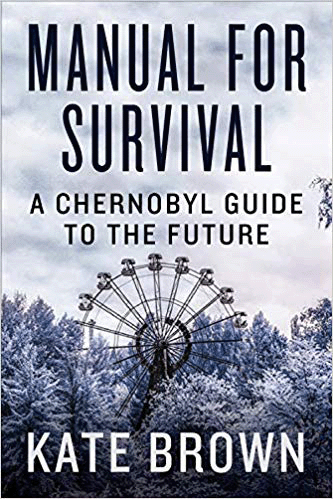
Much has been written about the strengths and flaws of Chernobyl—the HBO miniseries nominated for 19 Emmys that chronicles the catastrophe at the eponymous Russian nuclear power plant in 1986. In the mind of this reviewer, it’s a riveting if sobering television gem, and highly recommended. And to this newly enlivened debate over nuclear power we can now add Kate Brown’s book, Manual for Survival: A Chernobyl Guide to the Future, a tour de force about the radiological aftermath of the Chernobyl disaster. A science historian at the Massachusetts Institute of Technology, Brown peels away the layers of long-held mythologies—that in the end, the accident only killed 54 people, and that “radiation phobia” among the people who sustained heavy radioactive fallout was a bigger problem than any of the other health outcomes.
Brown, who is conversant in Russian, devoted years to extensive archival research (much of which was scattered and hidden from official attempts at confiscation). She conducted interviews with villagers, military officials, factory workers, medical doctors, Soviet nuclear experts, emergency responders, KGB operatives (who assumed control over much of the data from the accident), and international nuclear safety and radiation health experts. The result is a rich and deeply disturbing picture of the environmental perils of extensive and lasting nuclear contamination.
She digs prodigiously, much to the disfavor of defenders of nuclear power, into the widespread practice of secrecy and deception regarding the radiological harm from elevated, long-term, chronic exposures. Continue reading →










 nuclear-news