Environmentalists, political groups, companies demand that Facebook crack down on climate denialism
Everybody’s entitled to their opinion – but not their own facts’: The spread of climate denial on Facebook
‘The arguments are that people can’t trust scientists, models, climate data. It’s all about building doubt and undermining public trust in climate science’ Independent, Louise Boyle, New York @LouiseB_NY, 24 July, 20.
“………The pushbackOn 1 July, a coalition of environmental and political groups sent a letter to Facebook’s oversight board demanding a crackdown on climate denial and to close the “giant” opinion loophole that allows climate misinformation to be posted as an opinion. “Facebook is allowing the spread of climate misinformation to flourish, unchecked, across the globe. Instead of heeding the advice of independent scientists and approved fact-checkers from Climate Feedback, Facebook sided with fossil fuel lobbyists by allowing the CO2 Coalition to take advantage of a giant loophole for “opinion” content. The loophole has allowed climate denial to fester by labelling it “opinion,” and thus, avoiding the platform’s fact-checking processes,” they wrote. More than 500 companies including Coca-Cola, Dunkin’ Donuts, Verizon, and this week Disney, according to WSJ, have slashed or suspended ad spends on Facebook as part of the “Stop Hate for Profit” boycott, a move by civil rights groups to try to force the social media giant to address hate speech and misinformation. An independent audit of Facebook earlier this month reached harsh conclusions on the social media giant, reporting that it was allowing hate speech and disinformation to proliferate. Separately, Generation Progress, the youth-centered research and advocacy group, on Thursday launched a “Get The Facts Out Campaign” website aimed at debunking myths on the climate crisis and calling out climate deniers across Congress and the Trump administration, with a focus on the interwoven issues of climate and racial justice. “Black Americans have been fighting for clean air and water in their communities for years. Our legislators must understand the importance of addressing these inequities, not deny their existence,” the group said. And earlier this month, two senators introduced legislation to reform Section 230 of the 1996 Communications Decency Act, Reuters reported. The legislation, titled the Platform Accountability and Consumer Transparency Act, or PACT, from Democratic Senator Brian Schatz and Senate Republican John Thune, aims to provide more accountability and transparency for large tech platforms with respect to content moderation decisions……… Climate experts were sceptical of tech platforms’ ability, or desire, to enact meaningful change, and said that public action was key. For Dr Mann that means political overhaul. “Americans must vote in a Democratic president and Congress in the next US election. Unlike Trump and Congressional Republicans, who appear beholden to both Russia and fossil fuel interests, will be willing to crack down on Zuckerberg/Facebook’s nefarious activities,” he said. Dr Cook is working with machine-learning researchers on a system to detect and categorise climate misinformation in real-time. He acknowledged that social media platforms would have to be incentivised to use such a model, as it “would basically be taking money out of their pockets” in terms of ad revenue. Just as important, he says, is “building public resilience against misinformation” – teaching people how to spot misleading or rhetorical techniques and logical fallacies in climate denial arguments. “We found that when you explain techniques, that not only neutralises and inoculates people against that myth, but also against other topics like the tobacco industry and anti-vaxxer misinformation,” he said. Dr Cook and his team have created a smart-phone app for public use and for schools. He added: ”We need to look at technological solutions but ultimately we need to make ourselves un-hackable.” Additional reporting from Reuters https://www.independent.co.uk/environment/climate-crisis-denial-facebook-global-warming-denier-social-media-a9595546.html |
|
Virtual tours planned at Hiroshima Peace Memorial Museum and the Nagasaki Atomic Bomb Museum
Virtual tours planned at atomic bomb museums, https://www3.nhk.or.jp/nhkworld/en/news/20200721_43/?fbclid=IwAR2KZ-D8gWm-K1Yl8WVBDpUyobELxvI6Hm-DiWxtZYPBmyS8mo9BOneLd2E 21 Jul 20, Two Japanese museums dedicated to documenting the 1945 atomic bombings of Hiroshima and Nagasaki plan to offer virtual tours online in cooperation with an international NGO devoted to the elimination of nuclear weapons.They are planning the events as the number of international visitors to these museums has dropped sharply due to the coronavirus pandemic.
Kawasaki Akira, a member from the International Campaign to Abolish Nuclear Weapons, or ICAN, unveiled the plan online on Monday.
The exhibits at the Hiroshima Peace Memorial Museum and the Nagasaki Atomic Bomb Museum will be shown live on Instagram. Volunteers and researchers from universities will explain the displays in English.
The Hiroshima museum will hold the virtual tour on Wednesday for about 30 minutes after closing time, between 6:30 p.m. and 7p.m. Japan time.
The Nagasaki museum will hold it on Friday for about 30 minutes before opening time, between 8:00 a.m. and 8:30 a.m. Japan time.
Kawasaki said his group and the museums want to do everything possible online as various activities have been canceled due to the coronavirus pandemic.
He said he wants to offer young people abroad an opportunity to find out about the damage and aftereffects of the atomic bombings of the two cities.
Nuclear-news.net is proud to work, along with Democracy Now and others, towards exposing and closing the nuclear industry
 From the team at nuclear-news, 14 July 20, Some effective campaigns that we supported that gave positive results
1/ Got Halden Test Reactor and its nearby medical/test reactor (also in Norway) closed.
2/ Helped inform Mainland Chinese anti nuclears of dodgy nuclear industry tricks and scams (while it lasted) and promote the closure of at least 2 planned reactors
3/ Highlight the “Normal” releases from reactors (especially in Europe) which has no doubt been supportive of EU anti nuclear sentiment in the EU Commission and Parliament
4/ Helped highlight the issues in Fukushima prefecture including Typhoon damage to the nuclear waste badly stored there.
5/ Backed up many articles that have been removed from MSM websites. So useful to researchers (The wayback machine is being targeted for closure due to DMCA issues) so it makes sense that they want to close all blogs that also back up the articles for researchers.
6/ Supported many independent orgs/NGO`s and helped get their message out (ie CRIIRAD, Bellona etc) and that really damaged the nuclear industry and their messaging strategies.
Basically we have all kicked Corprate butt and the blog should be getting much more reach but since 2017 we got filtered (with Democracy Now as well as many other left wing outlets). We shall have to see if this is the first move in a take down bid by the nuclear industry and their PR buddies.
Fermi 2 nuclear station struggles with large COVID-19 outbreak among workers.

 Beyond Nuclear 14th May 2020, Fermi 2 struggles with large COVID-19 outbreak among workers. The large numbers of coronavirus test positives at Fermi nuclear power plant (the article reports more than 200 cases, but May 13 Facebook postings by Fermi employees have put the number as already grown worse, now at more than 300) is likely among the worst known (yet unreported, in the Michigan or U.S. national news media) at any single institution or workplace in Michigan.
A potential US extradition of Assange poses existential threats to democracy.
In his fight against extradition to the US, where he faces 175 years in prison and being subjected to harsh conditions under “Special Administrative Measures”, Assange is rendered defenseless. He is in effective solitary confinement, being psychologically tortured inside London’s maximum-security prison. With the British government’s refusal to release him temporarily into home detention, despite his deteriorating health and weak lung condition developed as consequences of long detention, Assange is now put at risk of contracting coronavirus. This threatens his life.
Now, as the world stands still and becomes silent in our collective self-quarantine, Assange’s words spoken years ago in defense of a free internet call for our attention from behind the walls of Belmarsh prison:
“Nuclear war, climate change or global pandemics are existential threats that we can work through with discussion and thought. Discourse is humanity’s immune system for existential threats. Diseases that infect the immune system are usually fatal. In this case, at a planetary scale.”
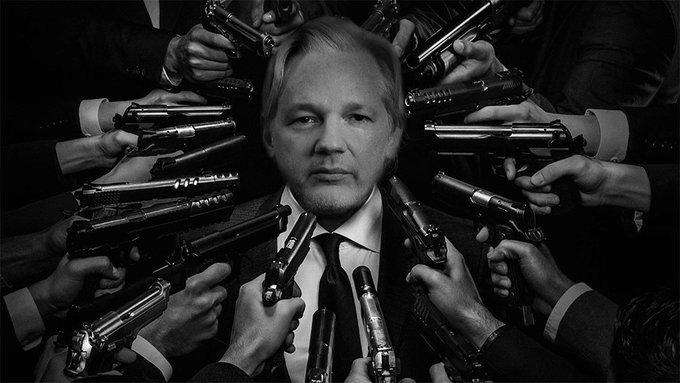
Assange’s US extradition, Threat to Future of Internet and Democracy, CounterPunch by NOZOMI HAYASE 8 May 20 On Monday May 4, the British Court decided that the extradition hearing for WikiLeaks publisher Julian Assange, scheduled for May 18, would be moved to September. This four month delay was made after Assange’s defense lawyer argued the difficulty of his receiving a fair hearing due to restrictions posed by the Covid-19 lockdown. Monday’s hearing at Westminster Magistrates’ Court proceeded without enabling the phone link for press and observers waiting on the line, and without Assange who was not well enough to appear via videolink.
Sunday May 3rd marked World Press Freedom Day. As people around the globe celebrated with online debates and workshops, Assange was being held on remand in London’s Belmarsh prison for publishing classified documents which exposed US war crimes in Iraq and Afghanistan. On this day, annually observed by the United Nations to remind the governments of the importance of free press, Amnesty International renewed its call for the US to drop the charges against this imprisoned journalist.
The US case to extradite Assange is one of the most important press freedom cases of this century. The indictment against him under the Espionage Act is an unprecedented attack on journalism. This is a war on free speech that has escalated in recent years turning the Internet into a battleground.
Privatized censorship Continue reading
“Mrs America”- Phyllis Schlafly determined fan of nuclear weapons, like today’s pro nuclear women in public life
|
The truth about the dangerous nuclear policy pushed by Mrs. America’s Phyllis Schlafly In the show, the evening’s program features a beautiful Phyllis Schlafly (Cate Blanchett) as the fierce, iron-jawed opponent to communism and nuclear disarmament. Schlafly is no iron-jawed angel though, and the miniseries focuses on her efforts to halt the progress of women’s rights in 1960s America. I wondered: How does a woman with the convictions of Henry Kissinger and the features of Elizabeth Taylor figure into the history of the atomic era? Who is the real Mrs. America? Within the first few minutes of the series, Schlafly is already talking about national defense. On the topic of the Strategic Arms Limitation Treaty (SALT), the treaty that paved the way for its successors SALT II, the Strategic Arms Reduction Treaty (START) and the now endangered New START, Schlafly is blunt, “The only country who will comply with the pact is the United States!” This rhetoric is one we’ve heard repeated again, and again and again, through the decades. “Peace is wonderful. Try it. You’ll like it.” she mocks. Despite FX’s glamorization of Schlafly’s obvious wit and intelligence, the Ayn Rand-esque obliviousness to her own privilege is a clear parallel to the bootstrap mentality Republicans cling to fifty years later. The eerie correlations between episode one of “Mrs. America” and the talking points of today’s Phyllis Schlaflys — KellyAnne Conway, Candace Owens and Susan Collins, to name a few — make this romanticizing even more unsettling. In the same scene that she argued in favor of new nuclear weapons — once calling them “a marvelous gift given to our country by a wise God” — she argues against equal rights amendments. ……. Ending women’s liberation, and everything that comes with it, from abortions to homosexuality, was the second great passion of Schlafly’s life. The first was preaching a hawkish view of national defense that would put John Bolton to shame. Feminism, LGBTQ rights and abortion access might have triumphed over Mrs. America — Phyllis Schlafly — but what about nuclear weapons? “Mrs. America” touches on Schlafly’s involvement with the nuclear weapons industry and her ultimate slight by President Ronald Reagan, who refused to appoint her to a position in government. She was too “controversial,” he claimed and that decision may well have saved the United States — and the planet — from an entirely different scenario than we live in now……. While “Mrs. America” might put a syrup sweet lens on Phyllis Schlafly, viewers can’t help but question all of her views on feminism and they should be questioning her thoughts on national security as well. We don’t live in the arms race Schalfly longed for, but as the Trump administration jettisons treaties left and right, we’re getting dangerously close The legacy of denuclearization started by Reagan is already being undone by Trump, who is rebuilding the nuclear sponge and has green-lit another ‘low-yield’ nuclear weapon that could fit in even his hands. New START, the latest iteration of arms control between the U.S. and Russia, expires in February 2021. Despite offers from Russia to extend the treaty for five years, no strings attached, Trump can’t withstand the allure of potential new toys. Surely we can all agree, if Phyllis Schlafly thought something was a bad idea it’s probably actually in all of our best interest, and the extension of New START is in the best interest of the planet. Tristan Guyette is the national field manager of Beyond the Bomb, where they lead volunteers across the country to mobilize and advocate for sane nuclear policy through No First Use. https://thehill.com/opinion/national-security/495218-the-nuclear-threat-behind-mrs-america-because-ms-stands-for-misery |
|
“Balance” a dangerous practice – journalists presenting as equal -Trump’s and scientists’ opinion on coronavirus science
 Presenting Trump and Science as Equals Isn’t Balanced, It’s Dangerous, FAIR, NEIL DEMAUSE, 23 Mar 20, With more than 32,000 COVID-19 infections and 400 deaths in the US to date, and Surgeon General Jerome Adams predicting that “this week, it’s going to get bad,” as hospitals prepare for the eventuality of rationing treatment for patients least likely to survive, the president of the United States hit his caps lock key and typed out a tweet:
The vital importance of media accuracy at this critical time
It’s Vitally Important for Media to Get Facts Right in a Life-or-Death Crisis https://fair.org/home/its-vitally-important-for-media-to-get-facts-right-in-a-life-or-death-crisis/
This won’t be popular to read in some quarters, but federal and state officials need to start adjusting their anti-virus strategy now to avoid an economic recession that will dwarf the harm from 2008–2009…. Barring [a quick vaccine], our leaders and our society will very soon need to shift their virus-fighting strategy to something that is sustainable…. America urgently needs a pandemic strategy that is more economically and socially sustainable than the current national lockdown.
Donald Trump threatens to get rid of National Public Radio
|
The cycle of Fox News coverage and President Donald Trump’s id repeated itself this weekend, this time involving the network’s coverage of the now-infamous blowup between Secretary of State Mike Pompeo and NPR reporter Mary Louise Kelly. In response to negative media coverage, Trump is now seconding a suggestion from Fox News personality Mark Levin — to end NPR’s funding, and even get rid of the organization itself…….. Right-wing talk radio host Mark Levin, who has a weekly TV show on Fox News itself and is a regular on Sean Hannity’s Fox show, tweeted a link to the Fox News article, and asked, “Why does NPR still exist?” Shortly thereafter, Trump quote-tweeted Levin and agreed.
|
|


Pentagon to get more control over the news? Is this a GOOD idea?
 The Pentagon Wants More Control Over the News. What Could Go Wrong?The Pentagon is using a moral panic over “fake news” to gain influence over the domestic news landscape, Rolling Stone The Pentagon Wants More Control Over the News. What Could Go Wrong?The Pentagon is using a moral panic over “fake news” to gain influence over the domestic news landscape, Rolling Stone
By MATT TAIBBI 9 Dec 19, If there’s a worse idea than the Pentagon becoming Editor-in-Chief of America, I can’t remember it. But we’re getting there:
From Bloomberg over Labor Day weekend: Fake news and social media posts are such a threat to U.S. security that the Defense Department is launching a project to repel “large-scale, automated disinformation attacks,” as the top Republican in Congress blocks efforts to protect the integrity of elections. One of the Pentagon’s most secretive agencies, the Defense Advanced Research Projects Agency (DARPA), is developing “custom software that can unearth fakes hidden among more than 500,000 stories, photos, video and audio clips.” Once upon a time, when progressives still reflexively distrusted the military, DARPA was a liberal punchline, known for helping invent the Internet but also for developing lunatic privacy-invading projects like LifeLog, a program to “gather in a single place just about everything an individual says, sees, or does.” DARPA now is developing a semantic analysis program called “SemaFor” and an image analysis program called “MediFor,” ostensibly designed to prevent the use of fake images or text. The idea would be to develop these technologies to help private Internet providers sift through content. ….. Stories about the need for such technologies are always couched as responses to the “fake news” problem. Unfortunately, “fake news” is a poorly-defined, amorphous concept that the public has been trained to fear without really understanding. ……. Fake news has a long history in America. Its most pernicious incarnation is never the work of small-time scam artists. The worst “fake news” almost always involves broad-scale deceptions foisted on the public by official (and often unnamed) sources, in conjunction with oligopolistic media companies, usually in service of rallying the public behind a dubious policy objective like a war or authoritarian crackdown. From the sinking of the Maine in 1898, to rumors of a union-led socialist insurrection before the Palmer raids in 1919, to the Missile Gap in the late fifties and early sixties (here is the CIA’s own website admitting that one was “erroneous”), to the Gulf of Tonkin lie that launched the Vietnam War, to the more recent WMD fiasco, true “fake news” is a concerted, organized, institutional phenomenon that involves deceptions cooked up at the highest levels. …… the final, omnipresent ingredient in most major propaganda campaigns is the authoritarian solution. Here, it’s unelected, unsupervised algorithmic control over media. We’ve never had a true news regulator in this country, yet the public is being conditioned now to accept one, without thinking of the consequences. The most enormous issue posed by the modern media landscape is the industry’s incredible concentration, which allows a handful of private platforms – Facebook, Twitter, Google – to dominate media distribution. This makes it possible to envisage direct levers of control over the public’s media habits that never existed back when people got much of their news from local paper chains with individual distribution networks. We’ve already seen scary examples of misidentified foreign subversion, from the Washington Post’s repeat editorials denouncing Bernie Sanders as a useful idiot for the Kremlin to the zapping of hundreds of domestic political sites as “coordinated inauthentic behavior.” What if the same people who can’t tell the difference between Truthdig and Pravda get to help design the new fake news algorithms? That’s a much bigger worry than the next Paul Horner or even, frankly, the next Russian Facebook campaign. While Donald Trump is in the White House, progressives won’t grasp how scary all of this is, but bet on it: In a few years, we’ll all wish we paid more attention when the Pentagon announced it wanted in on the news regulation business. https://www.rollingstone.com/politics/political-commentary/darpa-fake-news-internet-censorship-879671/ |
|
Paducah, Kentucky – its nuclear waste tragedy is compounded by climate change
“I never said a bad thing about the plant the whole time I was growing up,” Lamb said. “It made the economy good. But then we got sick.”
“People who were not highly educated could make really good money working in these industries
“Not only that but the government was saying, this is your patriotic duty. We need this. So everybody just went along because the compensation was pretty good.”
a GAO report released in November showed that 60 percent of U.S. Superfund sites are at risk from the impacts of climate change.
Instead of focusing on cleanup plans, some state lawmakers and federal agencies are loosening regulations on hazardous sites…… Last year, the DOE also moved to relax restrictions on the disposal and abandonment of radioactive waste
|
For over half a century, the plant was Paducah’s main employer, providing up to 7,000 jobs in a place where nearly a quarter of people now live in poverty. But poor working conditions and unregulated waste disposal also harmed Paducah residents. The legacy of these problems have cost the town and taxpayers. Despite multiple recommendations from a watchdog government agency, the Department of Energy is decades behind schedule on cleanup efforts.
Some experts say the federal government doesn’t know the full cost or scope of what cleaning them up will entail, and that becomes more complicated with more frequent extreme weather. It’s a problem Superfund sites — and especially nuclear waste sites — around the country face.Lynn said there’s a lot of secrecy surrounding the cleanup, as well as the health risks that may be associated with it. He’s just one Paducah resident, along with a slew of former workers, who say they’ve been left in the dark about problems with a complex cleanup. ….
There are 16 nuclear sites still managed by the U.S. Department of Energy (DOE) across the country — from Vermont to Washington, Nevada to South Carolina — most of them built between the 1940s and 1950s. Some created nuclear defense materials like plutonium — a core ingredient in atomic bombs that is 100,000 times as radioactive as uranium and can cause liver, lung, and bone cancer.
The Paducah Gaseous Diffusion Plant was one of the smallest projects in the U.S. When the plant was built in 1952, the town proudly adopted a new moniker: “Atomic City.” While gaseous diffusion was the public face of the plant, there were other operations, including programs with NASA, storing defunct materials from Oak Ridge, and work for Sandia, a nuclear security laboratory. By the early 1990s, many of the plants, including Paducah, had started transitioning to produce uranium for the nuclear power reactors that now provide a fifth of U.S. electricity generation.
“People who were not highly educated could make really good money working in these industries so you could have a good house, a boat, a couple of cars, raise your kids and send them to college,” said Mark Donham, who used to manage the DOE’s Citizens Advisory Board, which helps the agency monitor the plant’s environmental remediation. “Not only that but the government was saying, this is your patriotic duty. We need this. So everybody just went along because the compensation was pretty good.” However, a 1999 investigation by The Washington Post revealed the federal government used the plant to illegally recycle over 103,000 tons of used nuclear reactor fuel containing plutonium and other transuranics — man-made heavy metals derived from splitting atoms. The same year, workers filed a $10 billion class action lawsuit against three federal government contractors that led to the passage of a federal law intended to compensate current and former employees (or their survivors) for exposure to cancer-causing radiation.
Greg Landhorff, a utilities worker at the plant for 30 years, wasn’t involved in the lawsuit, but said he was exposed to “all kinds of different chemicals.” He said the exposure was an open secret, and workers weren’t given proper equipment or training. He claims operators told him about the exposure when he was hired, but didn’t report it because they didn’t want to lose their jobs. Landhorff now rattles off his health issues like a grocery list: beryllium disease, COPD, chronic bronchitis, and skin cancer.
Although the plant closed in 2013, hundreds of people still work on site. Nuclear sites often function like small towns, with wastewater treatment and steam plants, sewers, landfills and lagoons, administrative offices, enormous water towers, and medical centers. David Trimble, director of the Government Accountability Office, or GAO, said 30 to 60 percent of the DOE’s cleanup budget goes toward these “recurring activities.” The same is true for Paducah: Dawn Harris-Young, a spokesperson for the southeast regional EPA, said that only a “small fraction” goes toward environmental cleanup post-closure. This means that until the site is torn down, day-to-day operation often takes up more of the DOE’s cleanup budget than the necessary environmental remediation.
The DOE has demolished 84 facilities, removed over 66 million pounds of contaminated scrap material, and dug up over a million cubic feet of contaminated soil. While there is no official estimation of how much contaminated material remains, at least 400 buildings — and everything inside them — still need to be decontaminated and demolished at the Paducah site. The DOE requested $277 million specifically for Paducah in 2020, despite its budget for nuclear cleanup shrinking by $50 million in the last five years. But it’s still a small fraction of the budget DOE will need: cleanup isn’t expected to be completed until 2065, and the EPA has said it could take even longer because of the lack of knowledge about sources of contamination and the vast size of the facility. The waste at Paducah includes the gaseous diffusion plant, buried radioactive disposal sites, and waste leftover from neighboring nuclear sites in Ohio and Tennessee. It also includes over 52,000 cylinders of uranium hexafluoride, or spent uranium fuel, much of it from Oak Ridge. But there is still no solution for how to dispose of spent nuclear fuel, except to bury it. In recent decades, federal and state regulators have strategized for the remediation of these sites. But some have faced major problems like fires, radioactive leaks, and spills. According to Rodney Ewing, nuclear security expert at Stanford University, “there’s no path forward” to dispose of uranium hexafluoride, either. “That’s why they’re still stored in tanks out back,” he said. When the leaves fall on Ronald Lamb’s property, he can see the water tower and the grey siding of facility buildings at the Paducah plant just two miles away. On the road near Big Bayou Creek, which runs through both the plant and his 120-acre property, signs warn against getting in the water. His well is padlocked because of groundwater contamination from trichloroethylene, or TCE — a degreaser used to clean uranium equipment — which can impact childhood development, damage the central nervous system, and is linked to cancer. Lamb said the well water left his family with severe gastrointestinal problems. “I never said a bad thing about the plant the whole time I was growing up,” Lamb said. “It made the economy good. But then we got sick.” DOE officials report that the agency has cleaned over four billion gallons of contaminated groundwater through a pump and treat system, but two toxic plumes of TCE still flow through four miles of groundwater that lead to the Ohio River. The DOE lacks a national strategy for nuclear cleanup, instead relying on site managers to contract with companies that manage, operate, and cleanup nuclear facilities. The Paducah cleanup is now being managed by Four Rivers Nuclear Partnership, a conglomeration of companies hired by the DOE for soil and groundwater remediation. One of them is Jacobs Engineering, a contractor that was sued for exposing hundreds of workers to toxic substances during cleanup of the nation’s largest coal ash spill in Tennessee; more than 40 have died. At least three other nuclear sites — Oak Ridge, Hanford in Washington, and Savannah River in South Carolina — have also contracted with Jacobs. (Jacobs Engineering declined an interview for this story.) The DOE also declined to answer questions but said the agency was committed to the safe remediation of the plant and that they “look forward to continuing successful cleanup efforts in the future.” The agency works with the Citizens Advisory Board — a group of community members who apply and are appointed as well as liaisons from Kentucky and the regional EPA office — on environmental management at the Paducah site, including the monitoring of groundwater and planning for the site’s future use. Lamb advocated for the board many years ago, and the bi-monthly meetings are supposed to serve as a public comment period. The board doesn’t have any power beyond giving recommendations to the agency, and current and former members are divided about its effectiveness. Lesley Davis joined for about a year in 2016; her grandfather had worked at the plant and died of cancer. “It was informational at times, but it didn’t feel like it was making much of a difference,” she said. “In hindsight, it felt like they were trying to keep a good public face.”…….. In February, Paducah put up its floodgates, families stacked sandbags, and the bridge over the Ohio River to Illinois closed as floodwaters as rains drowned the region. According to local news stations, highway crews reported so much water they had trouble setting up warning signs. Former Kentucky Gov. Matt Bevin declared a statewide emergency due to heavy rainfall and flooding. The Ohio River, three miles north of the Paducah plant, had record flooding in 2018 and 2019. Record flooding this year across the Midwest hit eight Superfund sites, and a GAO report released in November showed that 60 percent of U.S. Superfund sites are at risk from the impacts of climate change. By mid-century, there will be heavier rainfall, increased flooding, and more intense hurricanes in the Southeast, which has nearly a quarter of the 1,335 active Superfund sites on the EPA’s National Priority List. ……… The Green New Deal resolution, which has not yet passed through the U.S. House of Representatives, identified cleaning up brownfields — contaminated sites previously used for development — and hazardous waste sites like Paducah as a key priority in restoring the American landscape — but there’s not yet a road map for that plan. While underground waste repositories may provide a solution, Ewing said that over the long term, the changing climate could make it more challenging: in a wetter environment, the amount of water leaking through the rock over the repository could be expected to increase. Instead of focusing on cleanup plans, some state lawmakers and federal agencies are loosening regulations on hazardous sites. In 2017, Kentucky passed a bill lifting a nuclear moratorium, a move that some hope will turn the site into a research facility or nuclear reactor; the law loosens the requirements for toxic waste management. Last year, the DOE also moved to relax restrictions on the disposal and abandonment of radioactive waste………..https://www.scalawagmagazine.org/2019/12/nuclear-waste-paducah-kentucky/ . |

Studies on Chernobyl nuclear disaster show that it’s relevant today, and for the future
 DOES CHERNOBYL STILL MATTER? https://www.publicbooks.org/does-chernobyl-still-matter/ 11.22.2019 BY GABRIELLE HECHT Since it first announced electricity “too cheap to meter,” in the 1950s, the nuclear industry has promised bountiful futures powered by a peaceful—and safe—atom. Design principles, the industry claims, limit the chances of core damage to one incident every 50,000 reactor-years of operation. History, however, has delivered a different verdict: together, Three Mile Island, Chernobyl, and the three Fukushima reactors represent five meltdowns in only 100 reactor-years. What lessons do these accidents hold for the future of nuclear power?
Each meltdown has impelled design, operational, and regulatory changes, increasing the cost of nuclear power. Today, says the industry, the technology is safer and more vital than ever. No other source of electricity can offer so much baseload power with so few carbon emissions. But who can make money when a single US Nuclear Regulatory Commission (NRC) inspection costs $360,000?
For the current US administration, the remedy for waning profits lies in cutting inspection hours. In a July 2019 proposal, which drew heavily on nuclear industry recommendations, the NRC also suggested crediting utility self-assessments as “inspections” and discontinuing press releases about problems of “low to moderate safety or security significance.” Translation: fewer inspections, less transparency, and weaker environmental and health oversight at the nation’s nuclear power plants.
The cause, costs, and consequences of the 1986 Chernobyl accident loom large in these battles. Was Chernobyl a fluke, the result of faulty technology and a corrupt political system? Or did it signal a fundamentally flawed technological system, one that would never live up to expectations?
Even simple questions are subject to debate. How long did the disaster last? Who were the victims, and how many were there? What did they experience? Which branches of science help us understand the damage? Whom should we trust? Such questions are tackled, with markedly different results, in Serhii Plokhy’s Chernobyl, Adam Higginbotham’s Midnight in Chernobyl, Kate Brown’s Manual for Survival, and HBO’s Chernobyl (created by Craig Mazin).
Serhii Plokhy’s book and Craig Mazin’s miniseries, both entitled Chernobyl, focus primarily on the accident and its immediate aftermath. Both build on the standard plotline embraced by nuclear advocates.
In this narrative, Soviet love of monumental grandeur—or “gigantomania”—led to the selection and construction of Chernobyl’s RBMK1 design: an enormous 1000-megawatt reactor, powered by low-enriched uranium fuel, moderated by graphite, and cooled by water. The utterly unique RBMK had fundamental design flaws, hidden by corrupt state apparatchiks obsessed with secrecy, prestige, and productivism. Operators made inexcusable errors. The accident was inevitable. But the inevitability, Plokhy and Mazin affirm, was purely Soviet.
Plokhy gives more backstory. The enormous scale of Soviet industrialization put huge strains on supply chains, resulting in shoddy construction. Some of the men in charge had no nuclear background. The pressure to meet production quotas—and the dire consequences of failure—led bureaucrats and engineers to cut corners.
For both Plokhy and Mazin, these conditions at Chernobyl came to a head during a long-delayed safety test. When the moment to launch the test finally arrived, shortly before midnight on April 25, 1986, there was confusion about how to proceed. The plant’s deputy chief engineer, Anatolii Diatlov, who did have extensive nuclear experience, believed he knew better than the woefully incomplete manuals. He pushed operators to violate the poorly written test protocol. (Disappointingly, Mazin’s miniseries portrays Diatlov more as a deranged bully than as someone with meaningful operational knowledge.)
The reactor did not cooperate: its power plummeted, then shot back up. Operators tried to reinsert the control rods. The manual didn’t mention that the RBMK could behave counterintuitively: in other reactor models, inserting control rods would slow down the fission reaction, but in the RBMK—especially under that night’s operating conditions—inserting the rods actually increased the reactivity. Steam pressure and temperature skyrocketed. The reactor exploded, shearing off its 2000-ton lid. Uranium, graphite, and a suite of radionuclides flew out of the core and splattered around the site. The remaining graphite in the core caught fire.
At first, plant managers didn’t believe that the core had actually exploded. In the USSR—as elsewhere—the impossibility of a reactor explosion underwrote visions of atomic bounty. Nor did managers believe the initial radiation readings, which exceeded their dosimeters’ detection limits. Their disbelief exacerbated and prolonged the harm, exposing many more people to much more radiation than they might have otherwise received. Firefighters lacked protection against radiation; the evacuation of the neighboring town of Pripyat was dangerously delayed; May Day parades proceeded as planned. Anxious to blame human operators—instead of faulty technology or (Lenin forbid!) a broken political system—the state put the plant’s three top managers on trial, in June 1987, their guilt predetermined.
Mazin’s miniseries follows a few central characters. Most really existed, though the script takes considerable liberties. The actions of the one made-up character, a Belarusian nuclear physicist, completely defy credibility. But hey, it’s TV. Dramatic convention dictates that viewers must care about the characters to care about the story. Familiar Cold War tropes are on full display: defective design, craven bureaucrats, and a corrupt, secrecy-obsessed political system. A few anonymous heroes also appear: firefighters, divers, miners, and others who risked their lives to limit the damage.
Nuclear advocates—many of whom believe that Chernobyl was a fluke, one whose lessons actually improved the industry’s long-term viability—object to the unrealistically gory hospital scenes portraying acute radiation sickness. But these advocates should feel appeased by the closing frames, which ignore the long-term damage caused by the accident.
Instead, the miniseries skates over post-1987 events in a few quick captions. The managers went to prison, a scientist committed suicide, people were evacuated. Yes, controversy persists over the number of casualties (31? That was the official Soviet number. How about 4,000? That’s the number issued by the Chernobyl Forum, an entity that includes representatives from the World Health Organization, the International Atomic Energy Agency, and other international organizations. As for the 41,000 cancers suggested by a study published in the International Journal of Cancer—that number isn’t even mentioned). But all is under control now, thanks to the new confinement structure that will keep the area “safe” for a hundred years. Mazin himself insists that the show isn’t antinuclear.
Instead, the miniseries skates over post-1987 events in a few quick captions. The managers went to prison, a scientist committed suicide, people were evacuated. Yes, controversy persists over the number of casualties (31? That was the official Soviet number. How about 4,000? That’s the number issued by the Chernobyl Forum, an entity that includes representatives from the World Health Organization, the International Atomic Energy Agency, and other international organizations. As for the 41,000 cancers suggested by a study published in the International Journal of Cancer—that number isn’t even mentioned). But all is under control now, thanks to the new confinement structure that will keep the area “safe” for a hundred years. Mazin himself insists that the show isn’t antinuclear.
Plokhy also addresses the accident’s role in the breakup of the USSR. In 2006, Mikhail Gorbachev famously speculated that “the nuclear meltdown at Chernobyl, even more than my launch of perestroika, was perhaps the real cause of the collapse of the Soviet Union.” Plokhy delivers details. Ukrainian dissidents trained their writerly gaze on Chernobyl, vividly describing the damage. Street demonstrations depicted the accident and its coverup as “embodiments of Moscow’s eco-imperialism.” This vision spread and morphed, animating protests in Belarus—also severely contaminated by the accident—and elsewhere. Chernobyl served as Exhibit A for why the republics should shed the Soviet yoke.
If you’re hoping for clear technical explanations, however, you’ll be disappointed. A stunning error mars the first few pages: Plokhy declares that each RBMK produced 1 million megawatts of electricity. This is off by a factor of 1,000. Typo? No, because he doubles down in the next sentence, affirming that the station produced 29 billion megawatts of electricity in 1985. He gets the orders of magnitude right later on, but these early missteps undermine reader confidence. Muddled technical descriptions and uninformative diagrams add to the confusion.
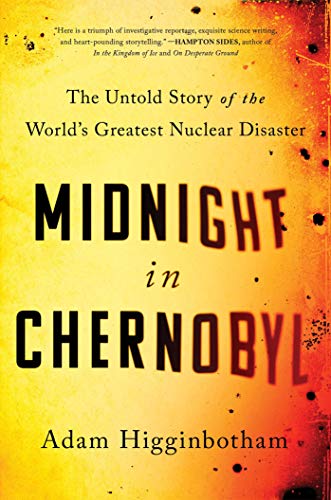 Readers seeking to understand the technology should turn instead to journalist Adam Higginbotham’s Midnight in Chernobyl. He uses global nuclear history to illuminate Soviet efforts to manage the Chernobyl crisis. By comparing the crisis to reactor accidents elsewhere, Higginbotham shows that deep vulnerabilities are widespread. Plokhy’s engineers and managers seem bumbling, verging on incompetent. Higginbotham’s more nuanced portrayal reflects how complex engineering projects of all types necessitate informed improvisation. The three-dimensional world doesn’t faithfully obey manuals. Adjustments are always required.
Higginbotham and Plokhy differ most starkly in their treatment of Soviet reactor choice. In the1960s, technocrats weighed the RBMK design against the VVER,2 the Soviet version of a pressurized light water reactor similar to those sold by Westinghouse and used in the United States. For Plokhy, it’s simple. The VVER was “safe.” The RBMK was not, but its size and cost appealed to Soviet productivism.
Higginbotham, however, wisely relies on Sonja Schmid’s pathbreaking Producing Power: The Pre-Chernobyl History of the Soviet Nuclear Industry (2015) to show that reactor safety isn’t a yes-no proposition. Plutonium-producing reactors similar to the Soviet RBMK (albeit half its size) existed in North America and Western Europe. Like nine of its French cousins, the RBMK could be refueled while continuing to operate. This presented significant advantages: light water reactors had to shut down for refueling, which entailed several weeks of outage. Even the risks presented by RBMK design vulnerabilities seemed manageable. “Nuclear experts elsewhere considered the RBMK design neither technologically novel nor particularly worrisome,” Schmid writes, noting that “what we consider good and safe always depends on context.” In the Soviet context, “selecting the RBMK made very good sense.”
Neither Schmid nor Higginbotham absolves the Soviet technopolitical system. The specific circumstances that led to Chernobyl’s explosions might not recur. But, as sociologist Charles Perrow has been arguing since his 1983 book Normal Accidents, highly complex technological systems create unpredictable situations, which inevitably lead to system failures. The question is not whether an accident of Chernobyl’s gravity can happen elsewhere, but how to prepare for the consequences when it does.
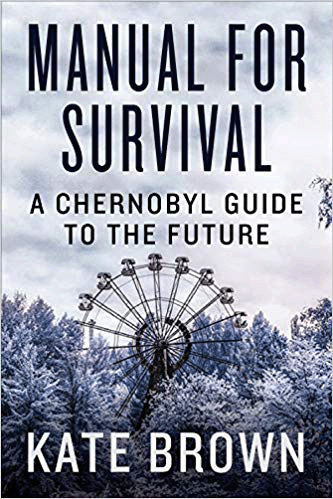 That’s one of the questions Kate Brown considers in Manual for Survival. Offering a wealth of new information and analysis, Brown speeds past the reactor explosion. Instead, she focuses on dozens of previously untold stories about how people coped with their newly radioactive lives.
Brown’s protagonists include women who worked at a wool factory fed by contaminated sheep and butchers ordered to grade meat according to radioactivity. Ukraine, we learn, kept serving as the Soviet breadbasket, despite food radiation levels that exceeded norms. The concentrations of radionuclides were biomagnified by receptive organisms and ecologies, such as mushrooms, wild boar, and the Pripyat Marshes. Defying expectations, some foods, over time, have even become more contaminated.
Brown’s descriptions add historical flesh to arguments first developed by Olga Kuchinskaya, in her 2014 book on Belarus’s Chernobyl experience, The Politics of Invisibility: Public Knowledge about Radiation Health Effects after Chernobyl.
Since the first studies of bomb survivors in Hiroshima and Nagasaki, science on the biological effects of radiation exposure has been subject to controversy. Like all scientific work, these early survivor studies had limitations. Exposure estimates were unreliable.
The largest study began data collection five years after the Hiroshima and Nagasaki blasts, so it didn’t include people who died or moved between 1945 and 1950. Another problem lies in the applicability of these studies. Bomb exposures, such as those in Japan, mostly consist of high, external doses from one big blast. Yet postwar exposures have mainly consisted of low doses, delivered steadily over a long period. They often involve internal exposures—such as inhalation of radioactive particles or consumption of irradiated food—which can be deadlier.
Irrespective of their limitations, however, the findings of these survivor studies have served as the basis for establishing regulatory limits for all types of radiation exposures. Critics argue that extrapolating from the Japan data underestimates low-dose effects: If you’ve already decided that the only possible health effects are the ones you’ve already found, surely you’re missing something? Among other limitations, studies of external gamma radiation exposures cannot illuminate the long-term health effects of inhaling radioactive alpha particles.
Brown injects the work of Dr. Angelina Gus’kova into this story. Gus’kova started treating radiation-induced illnesses in the 1950s, while working at the top-secret Mayak plutonium plant (where the radioactive spills from a 1957 accident continue to contaminate people, land, and water). A neurologist, Gus’kova made observations that extended beyond the narrow cancer focus of most Western practitioners who studied the health effects of radiation exposure. Her patients displayed a wide range of symptoms, which Gus’kova and her colleagues dubbed “chronic radiation syndrome.” Not that they neglected cancer: a 40-year study of 1.5 million people who lived near Mayak found significantly higher cancer and death rates than those reported in Hiroshima and Nagasaki.
The Soviet rubric of “chronic radiation syndrome” did not exist in the West. Yet Gus’kova’s findings did align with those of dissident scientists in the US and the UK. Thomas Mancuso, for example, was pushed out of the US Atomic Energy Commission because he refused to give the Hanford plutonium plant a clean bill of health after finding that workers there sustained high rates of cardiovascular disease, immune system damage, and other illnesses.
Alice Stewart, meanwhile, was shunned by the British establishment after her 1956 research showed that x-raying pregnant women increased the risk of cancer and leukemia in their children by 50 percent. Over the years, these and other scientists whose data challenged the findings of American and European nuclear establishments found themselves sidelined and defunded.
In tandem with perestroika, Chernobyl opened communication between Soviet and Western nuclear experts, engendering what Brown calls an “unholy alliance.” In 1990, the International Atomic Energy Agency (IAEA) sent a mission to Belarus and Ukraine to assess radiation damage. Belarusian scientists reported rising rates of many diseases in contaminated areas. Nevertheless, the IAEA team rejected radiation as a possible cause. Such correlations didn’t appear in Western data.
Instead, the IAEA teams used dose estimates provided by distant Moscow colleagues and ignored local Belarusian and Ukrainian descriptions of people’s actual consumption habits, which included significant amounts of contaminated food and milk. The IAEA assessments neglected the internal exposures resulting from this consumption. Yet these assessments now serve as international reference points. “Underestimating Chernobyl damage,” Brown warns, “has left humans unprepared for the next disaster.”
For some, hope springs eternal. In 2017, Chernobyl’s “New Safe Confinement” finally became operational, after two decades of design and construction. This $1.7 billion structure aims to contain the spread of radioactive rubble while workers inside dismantle the reactor and its crumbling sarcophagus. Ownership was transferred from the builders of the structure to the Ukrainian government in July 2019.
At the transfer ceremony, newly elected Ukrainian President Volodymyr Zelensky announced a tourism development plan for the radioactive exclusion zone, including a “green corridor” through which tourists could travel to gawk at the remains of Soviet hubris. “Until now, Chernobyl was a negative part of Ukraine’s brand,” declared Zelensky, who was nine years old when the reactor exploded. “It’s time to change.” (Zelensky further demonstrated his dedication to “branding” two weeks after this ceremony, when he emphasized his recent stay in a Trump hotel during his now-infamous phone conversation with the US president.)
Change also seems possible to Plokhy, who optimistically predicts that new reactor designs will be “cheaper, safer, and ecologically cleaner.” But Allison Macfarlane, who chaired the US Nuclear Regulatory Commission under Obama, recently noted that these “new” options are actually “repackaged designs from 70 years ago.” They still produce significant quantities of highly radioactive, long-lived waste.
Meanwhile, regulators in France—the world’s most nuclear nation—are taking the opposite approach from the United States’ NRC. Rather than rolling back oversight, France is intensifying inspections of their aging reactor fleet. After four decades of operation, many French reactors have begun to leak and crack. Keeping them operational will cost at least $61 billion. Despite the phenomenal cost, there are many who believe such an investment in the nuclear future is worthwhile.
Brown is far less sanguine about our nuclear future. Predictably, she has been denounced for believing marginal scientists and relying too heavily on anecdotal evidence. She does occasionally go overboard in suggesting conspiracy. Cover-ups clearly occurred on many occasions, but sometimes people were just sticking to their beliefs, trapped by their institutional and disciplinary lenses. Brown’s absence of nuance on this point matters, because the banality of ignorance—its complicity in all forms of knowledge production—can be more dangerous than deliberate lies: more systemic, harder to detect and combat.
Overall, though, Brown is on the right track. Many modes of scientific inquiry aren’t equipped to address our most urgent questions. Clear causal chains are a laboratory ideal. The real world brims with confounding variables. Some scientists studying Chernobyl’s “exclusion zone”—the region officially declared uninhabitable due to contamination—are trying new techniques to grapple with this reality. Tim Mousseau and Anders Møller, for example, collect data on the zone in its ecological entirety, rather than focusing on single organisms. Their findings belie romantic tales of wildlife resurgence (such as the one offered up by a 2011 PBS special on the radioactive wolves of Chernobyl). They too have met resistance.
How, then, can we harness the immense power of scientific analysis while also acknowledging its limitations? The nuclear establishment is quick to lump its opponents together with climate change deniers and anti-vaxxers. Some may deserve that. But much dissident science is well executed. So how do we, the lay public, tell the difference? How can dissent and uncertainty serve, not as a block to action, but as a call?
One way: we can refuse to see Chernobyl and its kin as discrete events of limited duration. Brown, for example, treats Chernobyl as an acceleration of planetary-scale contamination that began with the atomic arms race.
Let’s be clear: the contamination continues. After the triple meltdown at Fukushima, scientists found highly radioactive, cesium-rich microparticles in Tokyo, 150 miles south of the accident site. When inhaled, such particles remain in human lungs, where their decay continues to release radioactivity for decades. Contaminants from future accidents will, in turn, accrete on the radioactive residues of their predecessors.
And, we might add, on the ocean floor. The Russian state-run firm Rosatom recently announced the inauguration of its first floating reactor, towed across the melting Arctic to serve a community in Siberia: yet another manifestation of how climate change favors nuclear development. Rosatom is currently negotiating contracts for reactors (floating and otherwise) in some 30 countries, from Belarus to Bangladesh, Egypt to South Africa.
Threatened, the US nuclear industry sees Russian expansion as “another reason that the United States should maintain global leadership in nuclear technology exports.” And so we hurtle forward: rolling back oversight, acceleration unchecked.
This article was commissioned by Caitlin Zaloom.
If Julian Assange is extradited to the United States, journalism will be incarcerated, too
JOHN PILGER: Assange’s case will define the future of free journalism, https://independentaustralia.net/life/life-display/john-pilger-assanges-case-will-define-the-future-of-free-journalism,13324 By John Pilger | 18 November 2019 John Pilger describes the disturbing scene inside a London courtroom last week when the WikiLeaks publisher, Julian Assange, appeared at the start of a landmark extradition case that will define the future of free journalism.
THE WORST MOMENT was one of a number of “worst” moments. I have sat in many courtrooms and seen judges abuse their positions. This judge, Vanessa Baraitser – actually she isn’t a judge at all; she’s a magistrate – shocked all of us who were there.
Her face was a progression of sneers and imperious indifference; she addressed Julian Assange with an arrogance that reminded me of a magistrate presiding over apartheid South Africa’s Race Classification Board. When Julian struggled to speak, he couldn’t get words out, even stumbling over his name and date of birth.
When he spoke truth and when his barrister spoke, Baraister contrived boredom; when the prosecuting barrister spoke, she was attentive. She had nothing to do; it was demonstrably preordained. In the table in front of us were a handful of American officials, whose directions to the prosecutor were carried by his — back and forth this young woman went, delivering instructions.
Having ignored Julian’s barrister’s factual description of how the CIA had run a Spanish security firm that spied on him in the Ecuadorean embassy, she didn’t yawn, but her disinterest was as expressive. She then denied Julian’s lawyers any more time to prepare their case — even though their client was prevented in prison from receiving legal documents and other tools with which to defend himself.
Her knee in the groin was to announce that the next court hearing would be at remote Woolwich, which adjoins Belmarsh Prison and has few seats for the public. This will ensure isolation and be as close to a secret trial as it’s possible to get. Did this happen in the home of the Magna Carta? Yes, but who knew?
Who will then dare to expose anything of importance, let alone the high crimes of the West? Who will dare publish ‘Collateral Murder’? Who will dare tell the public that democracy, such as it is, has been subverted by a corporate authoritarianism from which fascism draws its strength?
Once there were spaces, gaps, boltholes, in mainstream journalism in which mavericks, who are the best journalists, could work. These are long closed now. The hope is the samizdat on the internet, where fine disobedient journalism is still practised.
The greater hope is that a judge or even judges in Britain’s court of appeal, the High Court, will rediscover justice and set him free. In the meantime, it’s our responsibility to fight in ways we know but which now require more than a modicum of Julian Assange’s courage.
The plight of Fukushima nuclear workers getting leukaemia
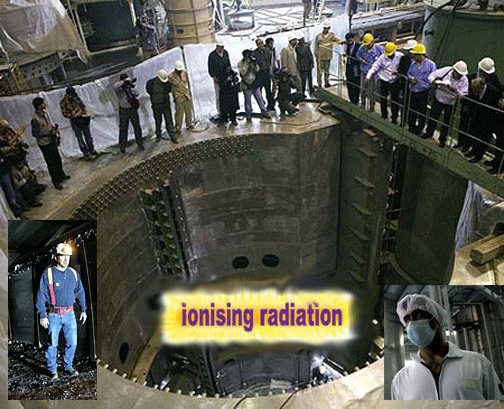 Fukushima Workers Battle Leukemia – and Bureaucracy Unseen Japan Fukushima Workers Battle Leukemia – and Bureaucracy Unseen Japan
by Hiro Ugaya, November 13, 2019 The March 2011 tsunami, and the subsequent meltdown of three reactors at the Fukushima nuclear power plant, has had a devastating impact on Japan. Eight years later, and most journalists – in Japan and abroad – have forgotten about the story. But for many, the struggle continues.
This is especially true of workers who helped assist in the cleanup effort at Fukushima. Some Fukushima workers have contracted severe diseases – including cancer and leukemia – since their work concluded. The government of Japan has even certified that some cases are a result of recovery work. But workers who are fighting for their lives also find themselves fighting the system. Tokyo Electric (TEPCO), which led the recovery effort, refuses to admit any connection between the cleanup work and subsequent diseases in workers. And many insurance companies are pointing to the fine print in private insurance contracts stating they don’t cover accidents at nuclear facilities. Unseen Japan has been pleased to partner with photojournalist Hiro Ugaya (烏賀陽弘道) to translate his interviews with evacuees and former evacuees, and to document the ongoing struggle of the victims of this tragedy. We previously published Hiro’s interview with a mother in the city of Minamisoma. In this installment, we share the first part of Hiro’s interview with Mr. Ikeda (pseudonym), a Fukushima nuclear reactor cleanup volunteer who now finds himself fighting two uphill battles. Translation from an article originally published on Note.mu. Translation by Jay, Editor/Publisher, Unseen Japan. All photos used with permission of Hiro Ugaya.) Ikeda’s StoryFor this installment of the Fukushima Report, I visited Northern Kyushu City in Fukuoka prefecture. I departed from Tokyo and flew west, in the direction opposite Fukushima. I went to Fukuoka, which is quite far from Fukushima. That’s where the leukemia-stricken Ikeda Kazuya (age 44; pseudonym) has lived since participating in the Daichi Nuclear Reactor reconstruction efforts. I had visited Ikeda once in 2017 to hear his story. Among all my interviews here in the Fukushima Report, it’s the one that’s reverberated the loudest. Mr. Ikeda volunteered to participate in the restoration work at the Fukushima Daiichi nuclear power plant. By trade, he’s an independent welder. In March 2011, when so many people died due to the tsunami, he looked at the report of the death of a small child and thought, “I need to do something useful for Tohoku” [Editor: the region of Japan hit by the tsunami]. He asked permission from his boss and threw himself into the reconstruction effort. The interior of the heavy machinery room of Reactor 4 butts up against the nuclear fuel rod pool. But in 2013, Mr. Ikeda came down with leukemia. Mr. Ikeda is one of the first cancer patients that the country recognizes as a work-related accident connected to the Fukushima Daiichi nuclear power plant. Two Fukushima workers contracted leukemia (bone marrow cancer), and one contracted thyroid cancer. The first case of leukemia was recognized in October 2015. The second was recognized in August 2016. The third person, who had thyroid cancer, was certified in December 2016. As of May 2019, there are six patients in the country whose cases have been recognized as occupational accidents caused by work at the Fukushima Daiichi nuclear power plant. To tell the truth, I was quite surprised that the country recognized them as occupational accidents. Judging from the history of pollution diseases, such as Minamata disease and Itai-itai disease, I predicted the government would probably prevaricate and not admit a causal relationship. But the government admitted it readily (employing a lot of rhetoric, of course, such as “This is not an admission of a scientific, causal relationship”). From a global and historical perspective, the admission is rare. In the Three Mile Island nuclear accident (1979) in the US, more than 2000 lawsuits have been filed, but no relationship between health damage and exposure has been admitted in even a single case. The state government naturally won’t admit it, and the courts don’t either. Due to this admission, the assertion that “the radiation leakage from the Fukushima Daiichi nuclear accident is mild enough not to damage health” fell apart. In the Chernobyl nuclear accident in the former Soviet Union, the first to suffer serious harm were the so-called “Liquidators,” the firefighters and soldiers who were the first responders. Nearly 5,000 people died. Naturally, people who are close to radiation-intensive sites will become seriously ill. The same phenomenon occurred in the Fukushima Daiichi nuclear power plant accident. While the case was recognized as a workplace injury, Mr. Ikeda filed a lawsuit against Tokyo Electric (TEPCO), which ran the restoration project. That’s because TEPCO doesn’t “recognize a causal relationship between Mr. Ikeda’s leukemia and exposure to radiation at the Fukushima Daiichi nuclear power plant.” I’ve long found it mysterious that not a single TV station, weekly newspaper, web media or other news outlet has done an article on those like Mr. Ikeda who contracted deadly diseases from the nuclear reactor recovery work. Since the government’s announcement certifying them as workplace injuries, there’s been dead silence. Those affected can’t be heard in their own voices. ……. Mr. Ikeda pointed out something important. People who work in nuclear facilities such as nuclear power plants are not covered by private insurance, even if they have an accident or get sick. It’s in the so-called “disclaimer.” If People who engaged in the dangerous work of recovering the nuclear power plant post-meltdown have been left naked and defenseless. And few people notice it. Even insurance companies don’t care. I want to fix this abnormality…… (Interview: -) There are six people, including yourself, who have been certified as workplace accidents due to cancer or death from overwork in the recovery work of the Fukushima Daiichi nuclear power plant accident. Any contact from them? No, none. I’ve caught sight of the wife of one of the Fukushima workers who died from overwork (karoshi) at rallies in Tokyo. It seems that TEPCO employees and primary subcontractors who got sick will receive 30 million yen [around USD $274,000]. But in return, they can’t sue. That’s what my lawyer emphasized at trial. But that offer doesn’t extend to us (second-tier subcontractors). The owner who hired me also had business owner insurance. Just in case we have an industrial accident. However, we found out later that it wasn’t valid in nuclear facilities, such as nuclear power plants. The insurance companies say it’s too dangerous a place to cover via employer insurance. And yet TEPCO denies responsibility for my leukemia. That’s what you’re contesting in court. That’s right. They’re denying everything. They say it was too low of a dose to bear any relationship. In the previous trial, TEPCO says I developed leukemia due to smoking, drinking, and a vegetable deficiency. That took me aback (laughs). They talk to us like we’re alcoholics…… What evidence is TEPCO presenting to refute you? Search for the stories of scholars who kowtow to the government, you’ll find it (laughs). Who’s providing testimony, besides you? There are various people I think. TEPCO won’t recognize the causal relationship between your leukemia and radiation exposure, correct? If they did, it’ll become a serious obstacle to future nuclear power policy. I was the first person certified, and there’ve been a number since. So there has to be a causal relationship, right? What total dose did you receive? A total of 19.8 millisieverts. Others received more. TEPCO is terrible. It’d be better if they just copped to it. “Others Will End Up Like Me”Why do you think TEPCO should admit responsibility? When this happens to someone else, this won’t be any guarantee, but it’ll give them peace of mind, you know? I mean, it’s not like you can tell people, “Don’t help with recovery efforts.” Other industries offer insurance – who’s going to guarantee workers who enter a nuclear facility if the employer’s primary insurance won’t? That’s what I want to tell people. Fukushima workers who entered the facility had no idea their employer’s primary insurance wouldn’t cover it……. https://unseenjapan.com/fukushima-workers-leukemia-bureaucracy/ |
|
Australia’s media on a campaign for freedom of press, but not when it comes to Julian Assange
 Mainstream Media Fights for Own Freedom, But Not for Assange’s, Sydney Criminal Lawyers, 02/11/2019 BY PAUL GREGOIRE Major Australian mainstream media outlets joined forces a fortnight ago to launched the Right to Know campaign. It aims to see public interest journalism decriminalised, and safeguards for whistleblowers enhanced.This unprecedented display of unity has seen The Guardian, the ABC, Nine, News Corp, SBS and the MEAA join forces in calling on the government to enact reforms. And this is rather significant, considering some of these organisations have been much criticised for towing the party line.
The Right to Know has six demands: exceptions so journalists can’t be prosecuted under national security laws, freedom of information reform, defamation law reform, a narrowing of the information classified as secret, protections for whistleblowers and the right to contest warrants.
Of course, the campaign was sparked by the June AFP press raids, which saw agents rifle through the house of a News Corp journalist, as well as the offices of the national broadcaster, in what was understood by many to be a warning to the media and whistleblowers to keep quiet.
However, a glaring campaign omission is the case of an Australian publisher who’s currently being remanded in the UK over charges that apply in the US, which relate precisely to public interest journalism. Yet, the Australian media has all but forgotten their colleague, Julian Assange.
Silenced by association
“The Right to Know campaign drives to the heart of the matter more than many journalists realise,” remarked Ian Rose, a member of the Support Assange and Wikileaks Coalition.
“While on the one hand, they’re right to finally be calling out the creeping incursions and restrictions into media freedoms,” he told Sydney Criminal Lawyers. “On the other, they don’t have the inner fortitude to stand up for Assange.”
According to Rose, there are two reasons that the Australian media has abandoned the Walkley award-winning journalist. One is that he’s “an egalitarian”, which “frightens the hell out of the ruling class”, as most of the work of WikiLeaks has been all about exposing their lies.
The second reason behind the silence is that the “oligarchs” are the “journalists’ paymasters”. And for this reason – which is underscored by the justifiable fear of losing their lives – journalists have refrained from “calling these people out”.
An excuse for silencing
Attorney general Christian Porter spoke out against the Right to Know campaign, claiming that by providing the media with the right to contest warrants could hinder criminal investigations. And he also asserted that the campaign demands could lead to national security threats.
As an example of how the media could become such a threat, Porter pointed to Assange having published leaked classified documents on WikiLeaks. The top lawmaker further set out that while this act of publication was widely condemned, the local industry still awarded Assange a Walkley……..
Neglecting an ally
And as for what the Australian media should be doing about one of its own locked away in isolation in circumstances that undermine the rule of law, Mr Rose says that it “ought to get over its jealousy and unite to support Assange”.
Indeed, the Right to Know campaign should embrace Assange’s cause, as it’s the quintessential example of the concerted crackdown on journalists that’s currently taking place across the western world. And there’s a clear correlation between his silencing and the local AFP raids.
“The way Assange is being treated is the way journalists are starting to be treated, and the way all of society will be treated if we don’t collectively call for a stop to the new dictatorial world order,” Rose warned.
And as an example of how this silencing of dissent is spreading beyond the media, Rose pointed to the recent assault on nonviolent climate activists, which has seen the application of ongoing arrests, draconian bail conditions, intimidatory procedures and the passing of restrictive laws……..https://www.sydneycriminallawyers.com.au/blog/mainstream-media-fights-for-own-freedom-but-not-for-assanges/
1 This Month



26 September – International Day for the Total Elimination of Nuclear Weapons


PLEASE OPPOSE HR 8255 AND S.3639 – bills would accelerate satellite deployment, with no environmental review or safeguards – https://ncstd5li.quorum.us/campaign/169331/
To see nuclear-related stories in greater depth and intensity – go to https://nuclearinformation.wordpress.com
-
Archives
- September 2026 (233)
- August 2026 (330)
- July 2026 (355)
- June 2026 (287)
- May 2026 (306)
- April 2026 (356)
- March 2026 (251)
- February 2026 (267)
- January 2026 (308)
- December 2025 (358)
- November 2025 (359)
- October 2025 (375)
-
Categories
- 1
- 1 NUCLEAR ISSUES
- business and costs
- climate change
- culture and arts
- ENERGY
- environment
- health
- history
- indigenous issues
- Legal
- marketing of nuclear
- media
- opposition to nuclear
- PERSONAL STORIES
- politics
- politics international
- Religion and ethics
- safety
- secrets,lies and civil liberties
- spinbuster
- technology
- Uranium
- wastes
- weapons and war
- Women
- 2 WORLD
- ACTION
- AFRICA
- Atrocities
- AUSTRALIA
- Christina's notes
- Christina's themes
- culture and arts
- Events
- Fuk 2022
- Fuk 2023
- Fukushima 2017
- Fukushima 2018
- fukushima 2019
- Fukushima 2020
- Fukushima 2021
- general
- global warming
- Humour (God we need it)
- Nuclear
- RARE EARTHS
- Reference
- resources – print
- Resources -audiovicual
- Weekly Newsletter
- World
- World Nuclear
- YouTube
-
RSS
Entries RSS
Comments RSS
 nuclear-news