The real photos of the Hiroshima bombing tell the story – no need for fictionalised ones.
Bad Idea: The New Yorker’s Nuclear Option, Peta Pixel AUG 12, 2021 ALLEN MURABAYASHI, On August 6, 1945, the U.S. detonated the world’s first wartime nuclear bomb over Hiroshima. An estimated 70,000 people died that day with another 70,000 perishing within four months from injury and radiation poisoning. On the ground, photojournalist Yoshito Matsushige miraculously survived unharmed despite living 1.7 miles from ground zero. Over the course of 10 hours, he could only bring himself to take 7 photos.
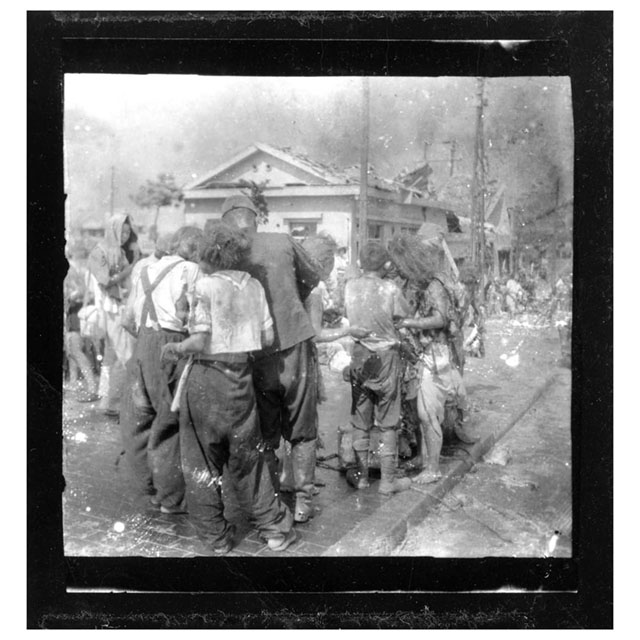
photo description: West end of Miyuki Bridge. This photograph was taken moving in closer to the people after taking the photograph on the left.From in front of the police box, both sides on Miyuki Bridge were full of dead and injured people. From that evening, the injured were taken by truck to Ujina and Ninoshima Island.Just after 11 a.m. Photo by Yoshito Mastushige
In an account of the bombing, Matsushige recalled passing by a girls junior high school, “Having been directly exposed to the heat rays, they were covered with blisters, the size of balls, on their backs, their faces, their shoulders, and their arms. The blisters were starting to burst open and their skin hung down like rugs.”
Three days later, the U.S. detonated a second nuclear bomb over Nagasaki. The following day, Yosuke Yamahata, a military photographer, spent 12 hours photographing the devastation. His 100 photos are a graphic and disturbing reminder about the horrors of nuclear war.
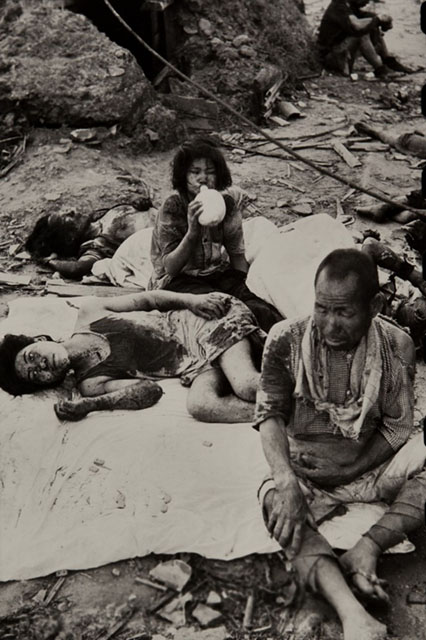
Photo by Yosuke Yamahata.
Yamahata died on his forty-eighth birthday in 1965 from terminal cancer of the duodenum. After retiring from his newspaper job, Matsushige spent the rest of his life as a dedicated peace activist…………….
A few days ago, journalist Max McCoy recounted his 1986 interview with Matushige. They hoped to meet again but never did. Matsuhige died in 2005 at the age of 92. In 2015, during a return trip to Japan, McCoy was approached by a close friend of Matsushige who relayed an untold part of his Hiroshima bombing story. McCoy wrote:
After developing the film, he was overcome by regret. In one of the photos from the bridge, at the edge of the frame, was a mother clutching a dead baby. He remembered the woman calling the child’s name. Using the point of a pair of scissors, he scratched the woman’s face from the negative, to save her — and himself — from the shame.
The horrors of nuclear war are unfathomable. The indiscriminate and instantaneous killing of tens of thousands of civilians needs no fictionalized reimagining. …….. https://petapixel.com/2021/08/12/bad-idea-the-new-yorkers-nuclear-option/
Jailing of a British Blogger Should Worry Journalists on Both Sides of the Atlantic
AUGUST 10, 2021Jailing of a British Blogger Should Worry Journalists on Both Sides of the Atlantic, FAIR. ARI PAUL IN A Conversation with C-SPAN‘s Brian Lamb (11/7/83) in 1983, then-Nation columnist Christopher Hitchens explained the United Kingdom’s Official Secrets Act, which, he said, says that “anything the government defines as a secret is a secret…. You can define something that is well-known by everybody as a secret under that law.” It gives the government a legal mallet to employ against investigative journalists probing national security.Lamb asked Hitchens, a British expatriate living in Washington, DC, if American journalists were freer than the ones in his home country. “Infinitely,” Hitchens replied, noting that Americans “have a constitution” that protects the freedom of the press.
Americans are accustomed to thinking that Britain is the European nation most like the United States, and with its robust market of salacious tabloid newspapers and saucy pop culture, Americans think of it as a free society. But Hitchens, like many British journalists, constantly challenged this myth. And the current imprisonment of blogger Craig Murray is a reminder of that gap.
‘Chilling effect on reporting’
Murray is a Scottish former diplomat who is vocal about his support for Scottish independence. He is also an outspoken advocate for WikiLeaks founder Julian Assange (New York Times, 1/4/21). According to the Scotsman (8/1/21), however, Murray “was judged to have been in contempt of court over blogs he wrote during the trial of former First Minister Alex Salmond”
Murray’s] posts contained details which, if pieced together, could lead readers to identify women who made allegations against Mr. Salmond, who was acquitted of all 13 charges, including sexual assault and attempted rape in March last year.An official at Reporters Without Borders said that a “prison sentence on charges related to his blogging is disproportionate and highly concerning,” adding that “journalistic activity should not lead to prison sentences anywhere,” because “imprisonment in connection with any journalistic activity should only ever be a measure of absolute last resort—if at all.”
Scottish PEN (Twitter, 7/30/21) said that Murray “is the first person to be imprisoned in Scotland for media contempt for over 70 years,” and the organization feared the “ruling will have a chilling effect on reporting and free expression.”But the New York Times hasn’t reported on Murray’s jailing, nor has AP. A search for his case at NPR and the Wall Street Journal yielded no results.
Why is this not big news? Belarus arresting a journalist who was flying outside the country (NPR, 5/25/21) was major news in the US press. The New York Times (12/28/20) made a big deal about the Chinese government clamping down on citizen journalists who challenged the government’s narrative about Covid-19. And NPR (2/4/21) reported on a Russian journalist who was briefly imprisoned for publicizing an anti-government protest on Twitter. It should be at least as alarming to American media that a key US ally would use jail as a weapon against any journalist…………..
History gives anyone concerned about the free press a right to be worried, as there are other examples of how the British press is censored to protect the powerful. The voice of Sinn Fein leader Gerry Adams was once banned from BBC broadcasts (BBC, 4/5/05). The BBC cited “legal reasons” for not naming one of the soldiers on trial for the Bloody Sunday massacre in Northern Ireland (BBC, 7/14/21). The Guardian (8/20/13) was forced to destroy leaked documents from Edward Snowden because of “a threat of legal action by the [British] government that could have stopped reporting on the extent of American and British government surveillance revealed by the documents.”………….
An attack on all journalists
Laura Poitras, co-founder of the Intercept and one of the principal journalists involved in the Snowden leaks, said in the New York Times (12/21/20) that the prosecution of Assange is an attack on all journalists, and that use of the Espionage Act, which forbids the leaking of classified materials, could be used against the journalists who receive that information. She said:
I have experienced the chilling effect of the Espionage Act. When I was in contact with Mr. Snowden, then an anonymous whistleblower, I spoke to one of the best First Amendment lawyers in the country. His response was unnerving. He read the Espionage Act out loud, and said it had never been used against a journalist, but there is always a first time. He added that I would be a good candidate, because I am a documentary filmmaker without the backing of a news organization.
As a British blogger, Murray is simply not protected by the First Amendment, and at first glance it would seem improbable that he would face this predicament if he was working in the United States. But given the aforementioned instances of the state going after leakers, the censorious trends in the Anglophone media are reasons for concern. US media should pay more attention. https://fair.org/home/jailing-of-a-british-blogger-should-worry-journalists-on-both-sides-of-the-atlantic/
How the USA fabricated a movie, full of falsehoods about the nuclear bombing in 1945.

Over and over we’re told that bigger bombs will bring peace and end war.
We’re told and shown completely fabricated nonsense
At the time The Beginning or the End was being scripted and filmed, the U.S. government was seizing and hiding away every scrap it could find of actual photographic or filmed documentation of the bomb sites.
Hiroshima Is A Lie Endangerment By David Swanson, World BEYOND War, August 5, 2021 ”……………………… In Greg Mitchell’s 2020 book, The Beginning or the End: How Hollywood — and America — Learned to Stop Worrying and Love the Bomb, we have an account of the making of the 1947 MGM film, The Beginning or the End, which was carefully shaped by the U.S. government to promote falsehoods.[xxiii] The film bombed. It lost money. The ideal for a member of the U.S. public was clearly not to watch a really bad and boring pseudo-documentary with actors playing the scientists and warmongers who had produced a new form of mass-murder. The ideal action was to avoid any thought of the matter. But those who couldn’t avoid it were handed a glossy big-screen myth. You can watch it online for free, and as Mark Twain would have said, it’s worth every penny.[xxiv]
The film opens with what Mitchell describes as giving credit to the UK and Canada for their roles in producing the death machine — supposedly a cynical if falsified means of appealing to a larger market for the movie. But it really appears to be more blaming than crediting. This is an effort to spread the guilt. The film jumps quickly to blaming Germany for an imminent threat of nuking the world if the United States didn’t nuke it first. (You can actually have difficulty today getting young people to believe that Germany had surrendered prior to Hiroshima, or that the U.S. government knew in 1944 that Germany had abandoned atomic bomb research in 1942.[xxv]) Then an actor doing a bad Einstein impression blames a long list of scientists from all over the world. Then some other personage suggests that the good guys are losing the war and had better hurry up and invent new bombs if they want to win it.
Over and over we’re told that bigger bombs will bring peace and end war. A Franklin Roosevelt impersonator even puts on a Woodrow Wilson act, claiming the atom bomb might end all war (something a surprising number of people actually believe it did, even in the face of the past 75 years of wars, which some U.S. professors describe as the Great Peace). We’re told and shown completely fabricated nonsense, such as that the U.S. dropped leaflets on Hiroshima to warn people (and for 10 days — “That’s 10 days more warning than they gave us at Pearl Harbor,” a character pronounces) and that the Japanese fired at the plane as it approached its target. In reality, the U.S. never dropped a single leaflet on Hiroshima but did — in good SNAFU fashion — drop tons of leaflets on Nagasaki the day after Nagasaki was bombed. Also, the hero of the movie dies from an accident while fiddling with the bomb to get it ready for use — a brave sacrifice for humanity on behalf of the war’s real victims — the members of the U.S. military. The film also claims that the people bombed “will never know what hit them,” despite the film makers knowing of the agonizing suffering of those who died slowly.
One communication from the movie makers to their consultant and editor, General Leslie Groves, included these words: “Any implication tending to make the Army look foolish will be eliminated.”[xxvi]
The main reason the movie is deadly boring, I think, is not that movies have sped up their action sequences every year for 75 years, added color, and devised all kinds of shock devices, but simply that the reason anybody should think the bomb that the characters all talk about for the entire length of the film is a big deal is left out. We don’t see what it does, not from the ground, only from the sky.
Mitchell’s book is a bit like watching sausage made, but also a bit like reading the transcripts from a committee that cobbled together some section of the Bible. This is an origin myth of the Global Policeman in the making. And it’s ugly. It’s even tragic. The very idea for the film came from a scientist who wanted people to understand the danger, not glorify the destruction. This scientist wrote to Donna Reed, that nice lady who gets married to Jimmy Stewart in It’s a Wonderful Life, and she got the ball rolling. Then it rolled around an oozing wound for 15 months and voilà, a cinematic turd emerged.
There was never any question of telling the truth. It’s a movie. You make stuff up. And you make it all up in one direction. The script for this movie contained at times all sorts of nonsense that didn’t last, such as the Nazis giving the Japanese the atomic bomb — and the Japanese setting up a laboratory for Nazi scientists, exactly as back in the real world at this very time the U.S. military was setting up laboratories for Nazi scientists (not to mention making use of Japanese scientists). None of this is more ludicrous than The Man in the High Castle, to take a recent example of 75 years of this stuff, but this was early, this was seminal. Nonsense that didn’t make it into this film, everybody didn’t end up believing and teaching to students for decades, but easily could have. The movie makers gave final editing control to the U.S. military and the White House, and not to the scientists who had qualms. Many good bits as well as crazy bits were temporarily in the script, but excised for the sake of proper propaganda.
If it’s any consolation, it could have been worse. Paramount was in a nuclear arms film race with MGM and employed Ayn Rand to draft the hyper-patriotic-capitalist script. Her closing line was “Man can harness the universe — but nobody can harness man.” Fortunately for all of us, it didn’t work out. Unfortunately, despite John Hersey’s A Bell for Adano being a better movie than The Beginning or the End, his best-selling book on Hiroshima didn’t appeal to any studios as a good story for movie production. Unfortunately, Dr. Strangelove would not appear until 1964, by which point many were ready to question future use of “the bomb” but not past use, making all questioning of future use rather weak. This relationship to nuclear weapons parallels that to wars in general. The U.S. public can question all future wars, and even those wars it’s heard of from the past 75 years, but not WWII, rendering all questioning of future wars weak. In fact, recent polling finds horrific willingness to support future nuclear war by the U.S. public.
At the time The Beginning or the End was being scripted and filmed, the U.S. government was seizing and hiding away every scrap it could find of actual photographic or filmed documentation of the bomb sites. Henry Stimson was having his Colin Powell moment, being pushed forward to publicly make the case in writing for having dropped the bombs. More bombs were rapidly being built and developed, and whole populations evicted from their island homes, lied to, and used as props for newsreels in which they are depicted as happy participants in their destruction.
Mitchell writes that one reason Hollywood deferred to the military was in order to use its airplanes, etc., in the production, as well as in order to use the real names of characters in the story. I find it very hard to believe these factors were terribly important. With the unlimited budget it was dumping into this thing — including paying the people it was giving veto power to — MGM could have created its own quite unimpressive props and its own mushroom cloud. It’s fun to fantasize that someday those who oppose mass murder could take over something like the unique building of the U.S. Institute of “Peace” and require that Hollywood meet peace movement standards in order to film there. But of course the peace movement has no money, Hollywood has no interest, and any building can be simulated elsewhere. Hiroshima could have been simulated elsewhere, and in the movie wasn’t shown at all. The main problem here was ideology and habits of subservience.
There were reasons to fear the government. The FBI was spying on people involved, including wishy-washy scientists like J. Robert Oppenheimer who kept consulting on the film, lamenting its awfulness, but never daring to oppose it. A new Red Scare was just kicking in. The powerful were exercising their power through the usual variety of means.
As the production of The Beginning or the End winds toward completion, it builds the same momentum the bomb did. After so many scripts and bills and revisions, and so much work and ass-kissing, there was no way the studio wouldn’t release it. When it finally came out, the audiences were small and the reviews mixed. The New York daily PM found the film “reassuring,” which I think was the basic point. Mission accomplished.https://worldbeyondwar.org/hiroshima-is-a-lie/
Mainstream media ignores how Israel continues sabotaging the Iran nuclear deal
Mainstream media ignores how Israel continues sabotaging the Iran nuclear deal https://mondoweiss.net/2021/08/mainstream-media-ignores-how-israel-continues-sabotaging-the-iran-nuclear-deal/Once again, the danger of conflict between Israel and Iran is rising. Once again, the mainstream U.S. media is either ignoring or distorting the news.BY JAMES NORTHAUGUST 4, 2021 Once again, the danger of conflict between Israel and Iran is rising. Once again, the mainstream U.S. media is either ignoring or distorting the news.
A drone attacked an Israeli-linked oil tanker in the Arabian Sea last week, and after a few days the U.S., Britain and Israel all accused Iran. The Washington Post report briefly noted that the drone strike is the latest in “tit-for-tat attacks” by both Israel and Iran, but stopped there. The Post nowhere mentioned that Israel is credibly charged with sponsoring attacks inside Iran, including assassinating Iranian scientists. At least the Post carried a report: the New York Times so far has ignored the latest escalation.
U.S. Secretary of State Antony Blinken promised a “collective response” to the allegedly Iranian drone attack, but the new Israeli prime minister Naftali Bennett warned that Israel could act against Iran on its own.
You have to turn to Fred Kaplan in Slate to find out what’s really going on here. Kaplan, who is not known as a foreign policy dove, accurately points out that the escalation must be considered against the backdrop of the negotiations to restore the Iran nuclear deal, which have reportedly stalled. He starts by noting that in the past two years “Israel has launched at least 10 attacks on Iranian vessels,” a statistic missing in the Post and Times. Even more vitally, Kaplan explains that Israel stokes the tension to try and sabotage the deal. He says that once Biden took office, then-prime minister Benjamin Netanyahu “stepped up attacks on Iran — knowing that Iran would strike back, which would make a new nuclear deal still more unpalatable politically.”
Kaplan connects the dots:
On April 6, hours before U.S., Iranian and European diplomats assembled in Vienna to reopen talks on the nuclear deal, an elite commando unit of the Israeli Navy attacked an Iranian military vessel.
Netanyahu is gone, for now, but Kaplan argues that Bennett must maintain the same hardline, anti-nuclear deal policy: “Israel’s fragile new government is in no position to take daring moves toward engaging with Iran.”
Contrast Kaplan’s insights about the Iran deal with a July 31 New York Times report on the same subject. The Times article does warn that the negotiations have stalled. But somehow the paper does not mention Israel one single solitary time.
Facebook apologises for blocking access to the website of the Scottish Campaign for Nuclear Disarmament (CND), – but does not explain why it happened
The Ferret 27th July 2021, Facebook has issued an apology to the Scottish Campaign for Nuclear
Disarmament (CND) after blocking people from accessing the peace
organisation’s website from its platform. The Ferret reported last week
that Scottish CND was considering a complaint to Ofcom because people
trying to access its website from its Facebook page were advised the URL
breached “community standards”. Facebook has now resolved the issue but
Scottish CND criticised the social media giant for failing to explain why
its site was blocked in the first place. The peace group thinks it may have
been a “malicious complaint” or the word “bomb” in its URL which
proved problematic.
The Ferret 27th July 2021
The military-industrial-media complex renders the American populus ill-informed in matters regarding war .

[and – it’s the same i Australia C.M.]
“How real is all this influence? Does the military-industrial-media complex (MIMC) actually affect the information we receive and our perception of war?”
The military-industrial-media complex renders the American populus ill-informed in matters regarding war — Rise Up Times
“The media has been a major player in ‘hyping up’ the sense of danger and need for military action in many situations.” https://wordpress.com/read/feeds/34005311/posts/3390423975
By HELEN JOHNSON The Miscellany News, Vassar College May 20, 2021
This is the fifth article in a five-part series about the military-industrial-media complex. The fourth article,“The (im)proper meshing of the corporate media and the military-industrial complex,” can be found here.
I have now examined the military-industrial complex (MIC) and the corporate media each individually; explained how the MIC has expanded to include not only the arms makers, Congress and the military, but also oil companies, service and equipment providers, surveillance and technology companies and think tanks; examined how the consolidation of corporate power within the media industry has resulted in a handful of companies controlling 90 percent of our media, and how these huge corporations hold incredible political power, not just to influence politicians and legislation directly, but to subtly shape entire ideologies. In this installment, I illustrated how the corporate media is linked in many ways to the MIC, including through outright ownership, interlocking directorates, revolving doors and overreliance on the government and the military for information and access to the battlefield during war.
But how real is all this influence? Does the military-industrial-media complex (MIMC) actually affect the information we receive and our perception of war? In this article I’ll explain that yes, because of its enormous reach, the extreme consolidation of its power and its entanglement with the gigantic machine that is the MIC, the media today has failed to properly inform the American citizenry on matters concerning war. The MIMC manufactures pro-military opinion among the public; suppresses information relevant to military activities; provides a sanitized coverage of war; fails to investigate, criticize, or thoroughly debate issues of military involvement; too easily bends to pressure from government and military officials and sometimes even spreads outright lies and false information.
This has resulted in an American populus that, in general terms, is ill-informed, uneducated and misled in matters regarding military involvement, as well as overly militaristic and pro-war. Americans are thus unable to hold their government accountable for unnecessary or inappropriate use of military force, and are complicit in the perpetuation of American imperialism, colossal defense budgets that strip the country of severely lacking social programs and never-ending wars that kill and destroy while a handful of corporations reap immense profits.
The media has been a major player in ‘hyping up’ the sense of danger and need for military action in many situations. Douglas Kellner—American academic and sociologist—explains in his book, Media Spectacle and the Crisis of Democracy: Terrorism, War and Election Battles, how Sept. 11 was a prime example of the media spreading hysteria and fear among an already panicked and traumatized nation. He notes how the media obsessively focused on terrorism, possible threats and retaliation in the weeks and months after Sept. 11. It also handed a megaphone to extremism and did little to weed out the potentially dangerous or incorrect information being spread on its platforms.
Spreading hysteria and panic throughout the population had two effects: First, it made Americans feel heavily reliant on the government for protection and, according to Kellner, made any disagreement with or questioning of the Bush administration seem “unpatriotic and even treasonous.” Second, it was extremely profitable for the media companies themselves; with millions of eyes glued to TVs, newspapers and other media platforms, media consumption spiked and profits went up. Thus, the corporate media and the military-industrial complex both benefited from this collaboration……………
An important note here is that this type of behavior is by no means limited to right-wing or conservative news outlets. In its analysis, FAIR cited The New York Times, The Hill, the Associated Press, and The Washington Post—in addition to Fox News—as all contributing to this culture of hysteria. A separate FAIR article’s headline directs a pointed accusation at CNN: “CNN’s Iran Fearmongering Would Make More Sense Coming Directly From Pentagon.” No mainstream media outlet is innocent of pro-war fear mongering.
The media has also suppressed or downplayed information relevant to military activity on multiple occasions. For example, although the media did everything in their power to vilify Iraq and Saddam Hussein in the lead-up to and during the Iraq war, they completely ignored how the United States backed Hussein in the past. The United States played an integral role in Hussein’s rise to power and actively supported Iraq during the Iran-Iraq War—including going along with Hussein’s use of chemical weapons. However, this seemed to be irrelevant once Bush Jr. had made up his mind to invade Iraq.
Another instance of the U.S. media suppressing or failing to report information came during the middle of the Iraq War in 2004. On Jun. 28, 2004, the United States transferred sovereignty of Iraq in a secret ceremony, immediately after which Paul Bremer—who had been seen by Iraqis as a dictator—left the country. Bremer had heavily controlled Iraqi politics and privatized a huge portion of the economy, including handing out contracts to American firms like Halliburton. However, Bremer’s replacement wasn’t much better. The U.S. chose Ayad Allawi, who had ties to the CIA, to serve as interim prime minister until elections could be held, and the U.S. handpicked the rest of the Iraqi council as well. The two months following the transfer of power saw escalated violence and a continuation of the chaos that had been produced by Bremer.
But watching the news in the United States, you would think “we had turned a corner,” as President Bush repeated over and over again. If the media had thoroughly reported on the situation in Iraq, it could have led to a nationwide understanding that the war was doing more harm than good and serving the interests of huge corporations at the expense of American and Iraqi lives. A truly informed citizenry could have put public pressure on the Bush administration to end the war, or an electorate dissatisfied with the situation could have voted him out of office. Instead, it would be seven more years before the withdrawal of American troops from Iraq.
Suppressing or downplaying information isn’t the only way the mainstream media—in complicity with the MIC—has warped our understanding of war. The media also produces an extremely sanitized coverage of war: it avoids printing and broadcasting images of death and destruction; sidesteps discussions of American casualties and almost entirely refuses to mention casualties on the other side (which are usually much higher); and uses euphemisms like “collateral damage” and “air campaign” that hold very different connotations from what these phrases actually mean—i.e., innocent civilian death and continuous bombing.
Kellner notes that during the Iraq war, “Entire networks like Fox and the NBC cable networks provided little but propaganda and jingoism, as did for the most part CNN. All of the cable networks, as well as the big three U.S. broadcasting networks, tended to provide highly sanitized views of the war, rarely showing Iraqi casualties, thus producing a view of the war significantly different than that shown in other parts of the world.”……………….
Not only do reporters and news anchors oftentimes receive direct instructions from higher-ups on what to and what not to say, but there is also careful screening of experts and guests brought onto the TV networks during wartime. And, as noted in my previous article, many of these “experts” are former generals and Pentagon officials, whose talking points have been carefully scripted and who have been trained on how to speak about matters of war in order to paint the U.S. military and government in the best possible light.
The U.S. corporate media has also chronically failed to properly investigate, criticize and debate issues of war and military involvement. It tends to take the current administration’s account of the situation as fact, and during times of war or military tension, it is branded unpatriotic to criticize the government. Although there are many examples of the media’s failure to investigate and report the truth when it comes to war, the most egregious case was in the lead-up to the invasion of Iraq.
George W. Bush and Dick Cheney had planned from day one of their administration to invade Iraq. As explained in this article, Bush and Cheney—as well as Paul Wolfowitz, Donald Rumsfeld and others in and around the Bush administration—were either directly a part of or tangentially related to the neoconservative think tank PNAC, which was advocating for a regime change in Iraq as early as 1998. The fact that Bush planned to invade Iraq from the get-go has been confirmed by multiple officials close to the administration.
From the immediate aftermath of Sept. 11 up until the 2003 invasion of Iraq, the Bush administration waged a propaganda war to convince the nation that Saddam Hussein was linked to Al Qaeda and that he possessed weapons of mass destruction (WMD). These claims turned out to be false. Not only did Saddam Hussein have nothing to do with the Sept. 11 attacks, but Iraq was not in possession of WMD nor were they in the process of making any.
Even so, these allegations were widely circulated in the mainstream media. The nonpartisan Center for Public Integrity documented a total of 935 false statements made by top administration officials regarding the threat from Iraq before the war, and the majority of these assertions “were broadcast widely by U.S. media with little or no investigation of their credibility, and few rebuttals from war skeptics or dissenters.”
Not only did the media outlets completely fail to properly investigate these claims before broadcasting them to the nation—even The Washington Post and The New York Times admitted that they had uncritically published information fed to them by the Bush administration—but they continued to circulate the misinformation long after it had been disproven. Even after ABC, NBC and The Washington Post reported that the claims were false, Fox Television and other U.S. cable networks continued to play the stories about Iraq’s alleged connection with Al Qaeda and supposedly threatening weapons program.
The Bush administration had accomplished its goal: to convince enough of the American population, still reeling and traumatized from Sept. 11, that Saddam Hussein was dangerous—so that they could have their war. The failure on the part of the corporate media to investigate and criticize the Bush administration’s claims, and the continued circulation of these claims even after they were proven false, would lead to a disastrous eight-year long conflict resulting in hundreds of thousands of deaths.
There are many, many more instances of skewed reporting when it comes to war and military involvement. Not all of these instances involve outright lying to the American public or regurgitating government pro-war propaganda; many of the ways in which the corporate media influences our perception of war are small and relatively unnoticeable……….. more https://riseuptimes.org/2021/06/12/the-military-industrial-media-complex-renders-the-american-populus-ill-informed-in-matters-regarding-war/
The Rio de Janeiro International Uranium Film Festival 2021 has awarded two film-makers on nuclear disarmament issues.
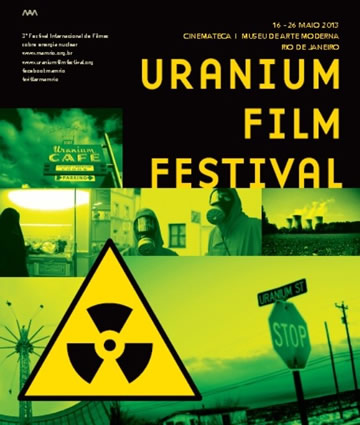
HONORARY LIFETIME ACHIEVEMENT AWARD WINNERS INTERNATIONAL URANIUM FILM FESTIVAL The Rio de Janeiro International Uranium Film Festival 2021 has awarded two in the world of nuclear disarmament well known personalities with the festival’s Honorary Lifetime Achievement Award: Sérgio Duarte, former Brazilian diplomat who served as Ambassador in several countries and has dedicated his life to end the nuclear threat. And Emmy Award-Winning Producer and Director Robert Frye from New York City who created “The Nuclear World Project“ and directed two important documentaries on Nuclear Disarmament: „The Nuclear Requiem“ and „In My Lifetime“.
Sérgio de Queiroz Duarte
Sérgio de Queiroz Duarte(link is external) is a former Brazilian diplomat who served as Ambassador to Nicaragua, Canada, China and Austria. Duarte was the President of the 2005 Review Conference of the Parties to the Treaty on the Non-Proliferation of Nuclear Weapons and was United Nations High Representative for Disarmament Affairs. He was his country’s Permanent Representative to the UN at Vienna and Chairman of the International Atomic Energy Agency Board of Governors. Duarte is President of „Pugwash Conferences on Science and World Affairs“, an organization founded in 1957 by philosopher Bertrand Russell and Sir Joseph Rotblat to contain the proliferation of atomic weapons. Pugwash won the Nobel Peace Prize in 1995.
Robert E. Frye
Robert E. Frye(link is external) is an Emmy award-winning producer of network news programs and independent documentaries for over five decades. He was born in Syracuse, NY USA, and studied political science and history at Hobart College. In 1958 he joined the U.S. Army. Frye worked on nuclear weapon planning while serving in Germany. The experience fostered a lifelong interest, which led him to create “The Nuclear World Project“.
Starting in the ’60s the Emmy and Peabody Award winner worked in New York City; Toronto; Washington, D.C.and London. His credits at ABC News include Executive Producer of “Good Morning America” and “ABC World News Tonight” with Peter Jennings; senior Producer at CBC’s Weekend, and as an independent director & producer of several films for public television which include “In My Lifetime” and “The Nuclear Requiem”. At the age of 81, Frye said, the obligation of his generation is to tell the story of nuclear weapons, to make clear the indescribable damage they have caused and their potential to end life on the planet entirely. http://www.thenuclearworld.org(link is external)
Robert E. Frye says: “The recognition from the Uranium Film Festival comes as a completely unexpected surprise and may I say honor. The Festival trophy will be a reminder to me of the work ahead. Of course, may I say that the continuing work of Sergio Duarte is so important to the world, especially his words of wisdom and leadership over the years, now as the President of Pugwash International. The Uranium Film Festival is such a unique institution, with all the films chosen that honor the dedicated filmmakers, whose work appears in the Festival, calling the world’s attention to the challenges dealing with the continuing presence of nuclear weapons, as well as, the conundrum of nuclear power. On the wall in my office I have the following quote from musician Leonard Cohen: Ring the bells that still can ring. Forget your perfect offering. There is a crack in everything. That’s how the light gets in. Thank you for providing the opportunity for all these stories to be told. Keep the bells ringing!”
Nuclear Hotseat Radio Show Interview with Robert E. Frey(link is external)
Watch also the festival’s live with Sergio Duarte, Robert E. Frye, Cristian Wittmann & filmmaker Miguel Silveira (Portuguese/English)(link is external)The 10th Rio de Janeiro International Uranium Film Festival has streamed in May 2021 during 10 days 34 films on nuclear weapons and nuclear energy online and free of charge…………….https://uraniumfilmfestival.org/en/honorary-lifetime-achievement-award-winners
Critique No 3 [a boys-with-toys view] -BBC documentary Building Britain’s Biggest Nuclear Power Station

Building Britain’s Biggest Nuclear Power Station, BBC2, review: A boys-and-their-toys view of a divisive build. Much of the programme is devoted to emphasising just how big the plant will be: we are shown a tunnelling machine so enormous it requires a police cavalcade; we are treated to front-row seats for the “largest continuous cement pour in the UK”; we learn that Hinkley’s canteens consume 316 tons of baked beans a year.
iNews 2nd June 2021
Critique No 2 of BBC documentary Building Britain’s Biggest Nuclear Power Station
Building Britain’s Biggest Nuclear Power Station, review: why didn’t this film ask the real questions? It seemed a little odd for one local’s (admittedly very valid) complaints about traffic to be given more airtime than, say, worries over industrial espionage in a project part-funded by the Chinese state, or of ballooning budgets (from £18 billion to
£22 billion).
Two of its three intended predecessors in Finland and France remain on ice owing to “concerns over cost and quality”, a phrase both vague and serious enough to warrant further enquiry, yet any doubts were confined to the voiceover and not put to the people involved.
Telegraph 2nd June 2021
Critique No 1 of BBC documentary Building Britain’s Biggest Nuclear Power Station
One cynical but reliable rule of thumb when reporting official statements is that the more often a fact is emphasised, the less likely it is to be true. The first time we were told on Building Britain’s Biggest Nuclear
Power Station (BBC2) that the new Hinkley Point C reactor will be able to withstand the impact of a plane crash, I was mildly reassured.
After the third or fourth repetition, I was quite uneasy. And when the last 15 minutes of the opening episode in this two-parter were devoted to explaining exactly how marvellously plane-proof the design is, panic was setting in. For all the talk of double-skinned, nuclear-grade concrete and X-rayed metal seals, it was pretty obvious that one misplaced Airbus is all it takes, and Goodbye Somerset.
Daily Mail 3rd June 2021
“Fallout: The Hiroshima Cover-up and the Reporter Who Revealed It to the World”

A secondary theme in the book is the role of a free press. Blume observes that “Hersey and his New Yorker editors created `Hiroshima’ in the belief that journalists must hold accountable those in power. They saw a free press as essential to the survival of democracy.” She does, too.
Review: Lesley Blume’s “Fallout: The Hiroshima Cover-up and the Reporter Who Revealed It to the World”, Portside, June 1, 2021 Lawrence Wittner In this crisply written, well-researched book, Lesley Blume, a journalist and biographer, tells the fascinating story of the background to John Hersey’s pathbreaking article “Hiroshima,” and of its extraordinary impact upon the world.
In 1945, although only 30 years of age, Hersey was a very prominent war correspondent for Time magazine—a key part of publisher Henry Luce’s magazine empire………..
Blume reveals that, at the time of the U.S. atomic bombing of Hiroshima, Hersey felt a sense of despair—not for the bombing’s victims, but for the future of the world. He was even more disturbed by the atomic bombing of Nagasaki only three days later, which he considered a “totally criminal” action that led to tens of thousands of unnecessary deaths.
…………. Blume shows very well how this approval of the atomic bombing was enhanced by U.S. government officials and the very compliant mass communications media. Working together, they celebrated the power of the new American weapon that, supposedly, had brought the war to an end, producing articles lauding the bombing mission and pictures of destroyed buildings. What was omitted was the human devastation, the horror of what the atomic bombing had done physically and psychologically to an almost entirely civilian population—the flesh roasted off bodies, the eyeballs melting, the terrible desperation of mothers digging with their hands through the charred rubble for their dying children.
The strange new radiation sickness produced by the bombing was either denied or explained away as of no consequence. “Japanese reports of death from radioactive effects of atomic bombing are pure propaganda,” General Leslie Groves, the head of the Manhattan Project, told the New York Times. Later, when, it was no longer possible to deny the existence of radiation sickness, Groves told a Congressional committee that it was actually “a very pleasant way to die.”
When it came to handling the communications media, U.S. government officials had some powerful tools at their disposal. In Japan, General Douglas MacArthur, the supreme commander of the U.S. occupation regime, saw to it that strict U.S. military censorship was imposed on the Japanese press and other forms of publication, which were banned from discussing the atomic bombing. As for foreign newspaper correspondents (including Americans), they needed permission from the occupation authorities to enter Japan, to travel within Japan, to remain in Japan, and even to obtain food in Japan. American journalists were taken on carefully controlled junkets to Hiroshima, after which they were told to downplay any unpleasant details of what they had seen there.
In September 1945, U.S. newspaper and magazine editors received a letter from the U.S. War Department, on behalf of President Harry Truman, asking them to restrict information in their publications about the atomic bomb. If they planned to do any publishing in this area of concern, they were to submit the articles to the War Department for review…………
Hersey had concluded that the mass media had missed the real story of the Hiroshima bombing. And the result was that the American people were becoming accustomed to the idea of a nuclear future, with the atomic bomb as an acceptable weapon of war. Appalled by what he had seen in the Second World War—from the firebombing of cities to the Nazi concentration camps—Hersey was horrified by what he called “the depravity of man,” which, he felt, rested upon the dehumanization of others. Against this backdrop, Hersey and Shawn concluded that he should try to enter Japan and report on what had really happened there……….
Hersey arrived in Tokyo on May 24, 1946, and two days later, received permission to travel to Hiroshima, with his time in that city limited to 14 days.
Entering Hiroshima, Hersey was stunned by the damage he saw. In Blume’s words, there were “miles of jagged misery and three-dimensional evidence that humans—after centuries of contriving increasingly efficient ways to exterminate masses of other humans—had finally invented the means with which to decimate their entire civilization.” Now there existed what one reporter called “teeming jungles of dwelling places . . . in a welter of ashes and rubble.” As residents attempted to clear the ground to build new homes, they uncovered masses of bodies and severed limbs. A cleanup campaign in one district of the city alone at about that time unearthed a thousand corpses. Meanwhile, the city’s surviving population was starving, with constant new deaths from burns, other dreadful wounds, and radiation poisoning.
Given the time limitations of his permit, Hersey had to work fast. And he did, interviewing dozens of survivors, although he eventually narrowed down his cast of characters to six of them.
……… Ross and Shawn decided to keep the explosive forthcoming issue a top secret from the magazine’s staff.
Given the time limitations of his permit, Hersey had to work fast. And he did, interviewing dozens of survivors, although he eventually narrowed down his cast of characters to six of them.
……… Ross and Shawn decided to keep the explosive forthcoming issue a top secret from the magazine’s staff.
Groves believed that the Japanese deserved what had happened to them, and could not imagine that other Americans might disagree. ………. and he believed that an article that led Americans to fear nuclear attacks by other nations would foster support for a U.S. nuclear buildup.
The gamble paid off. Although Groves did demand changes, these were minor and did not affect the accounts by the survivors…….
On August 29, 1946, copies of the “Hiroshima” edition of the New Yorker arrived on newsstands and in mailboxes across the United States, and it quickly created an enormous sensation, particularly in the mass media. Editors from more than thirty states applied to excerpt portions of the article, and newspapers from across the nation ran front-page banner stories and urgent editorials about its revelations. Correspondence from every region of the United States poured into the New Yorker’s office. A large number of readers expressed pity for the victims of the bombing. But an even greater number expressed deep fear about what the advent of nuclear war meant for the survival of the human race.
Of course, not all readers approved of Hersey’s report on the atomic bombing. Some reacted by canceling their subscriptions to the New Yorker. Others assailed the article as antipatriotic, Communist propaganda, designed to undermine the United States. Still others dismissed it as pro-Japanese propaganda or, as one reader remarked, written “in very bad taste.”
………………………… The conclusion drawn by Blume in this book is much like Hersey’s. As she writes, “Graphically showing what nuclear warfare does to humans, `Hiroshima’ has played a major role in preventing nuclear war since the end of World War II.”
A secondary theme in the book is the role of a free press. Blume observes that “Hersey and his New Yorker editors created `Hiroshima’ in the belief that journalists must hold accountable those in power. They saw a free press as essential to the survival of democracy.” She does, too.
………… Blume has written a very illuminating, interesting, and important work—one that reminds us that daring, committed individuals can help to create a better world.https://portside.org/2021-06-01/review-lesley-blumes-fallout-hiroshima-cover-and-reporter-who-revealed-it-world
How Bill Gates bankrolls the news agenda.

Nowhere does this concern loom larger than with the Gates Foundation, a leading donor to newsrooms and a frequent subject of favorable news coverage.
During the pandemic, news outlets have widely looked to Bill Gates as a public health expert on covid—even though Gates has no medical training and is not a public official.
PolitiFact and USA Today (run by the Poynter Institute and Gannett, respectively—both of which have received funds from the Gates Foundation) have even used their fact-checking platforms to defend Gates from “false conspiracy theories” and “misinformation,” like the idea that the foundation has financial investments in companies developing covid vaccines and therapies. In fact, the foundation’s website and most recent tax forms clearly show investments in such companies, including Gilead and CureVac.
critical questions about journalists’ tendency to cover the Gates Foundation as a dispassionate charity instead of a structure of power.
Journalism’s Gates keepers, Columbia Journalism Review, By Tim Schwab AUGUST 21, 2020 ,
LAST AUGUST, NPR PROFILED A HARVARD-LED EXPERIMENT to help low-income families find housing in wealthier neighborhoods, giving their children access to better schools and an opportunity to “break the cycle of poverty.” According to researchers cited in the article, these children could see $183,000 greater earnings over their lifetimes—a striking forecast for a housing program still in its experimental stage.
If you squint as you read the story, you’ll notice that every quoted expert is connected to the Bill & Melinda Gates Foundation, which helps fund the project. And if you’re really paying attention, you’ll also see the editor’s note at the end of the story, which reveals that NPR itself receives funding from Gates..
NPR’s funding from Gates “was not a factor in why or how we did the story,” reporter Pam Fessler says, adding that her reporting went beyond the voices quoted in her article. The story, nevertheless, is one of hundreds NPR has reported about the Gates Foundation or the work it funds, including myriad favorable pieces written from the perspective of Gates or its grantees.
And that speaks to a larger trend—and ethical issue—with billionaire philanthropists’ bankrolling the news. The Broad Foundation, whose philanthropic agenda includes promoting charter schools, at one point funded part of the LA Times’ reporting on education. Charles Koch has made charitable donations to journalistic institutions such as the Poynter Institute, as well as to news organizations such as the Daily Caller News Foundation, that support his conservative politics. And the Rockefeller Foundation funds Vox’s Future Perfect, a reporting project that examines the world “through the lens of effective altruism”—often looking at philanthropy.
As philanthropists increasingly fill in the funding gaps at news organizations—a role that is almost certain to expand in the media downturn following the coronavirus pandemic—an underexamined worry is how this will affect the ways newsrooms report on their benefactors. Nowhere does this concern loom larger than with the Gates Foundation, a leading donor to newsrooms and a frequent subject of favorable news coverage.
I recently examined nearly twenty thousand charitable grants the Gates Foundation had made through the end of June and found more than $250 million going toward journalism. Recipients included news operations like the BBC, NBC, Al Jazeera, ProPublica, National Journal, The Guardian, Univision, Medium, the Financial Times, The Atlantic, the Texas Tribune, Gannett, Washington Monthly, Le Monde, and the Center for Investigative Reporting; charitable organizations affiliated with news outlets, like BBC Media Action and the New York Times’ Neediest Cases Fund; media companies such as Participant, whose documentary Waiting for “Superman” supports Gates’s agenda on charter schools; journalistic organizations such as the Pulitzer Center on Crisis Reporting, the National Press Foundation, and the International Center for Journalists; and a variety of other groups creating news content or working on journalism, such as the Leo Burnett Company, an ad agency that Gates commissioned to create a “news site” to promote the success of aid groups. In some cases, recipients say they distributed part of the funding as subgrants to other journalistic organizations—which makes it difficult to see the full picture of Gates’s funding into the fourth estate.
The foundation even helped fund a 2016 report from the American Press Institute that was used to develop guidelines on how newsrooms can maintain editorial independence from philanthropic funders. A top-level finding: “There is little evidence that funders insist on or have any editorial review.” Notably, the study’s underlying survey data showed that nearly a third of funders reported having seen at least some content they funded before publication.
Gates’s generosity appears to have helped foster an increasingly friendly media environment for the world’s most visible charity. Twenty years ago, journalists scrutinized Bill Gates’s initial foray into philanthropy as a vehicle to enrich his software company, or a PR exercise to salvage his battered reputation following Microsoft’s bruising antitrust battle with the Department of Justice. Today, the foundation is most often the subject of soft profiles and glowing editorials describing its good works.
During the pandemic, news outlets have widely looked to Bill Gates as a public health expert on covid—even though Gates has no medical training and is not a public official. PolitiFact and USA Today (run by the Poynter Institute and Gannett, respectively—both of which have received funds from the Gates Foundation) have even used their fact-checking platforms to defend Gates from “false conspiracy theories” and “misinformation,” like the idea that the foundation has financial investments in companies developing covid vaccines and therapies. In fact, the foundation’s website and most recent tax forms clearly show investments in such companies, including Gilead and CureVac.
In the same way that the news media has given Gates an outsize voice in the pandemic, the foundation has long used its charitable giving to shape the public discourse on everything from global health to education to agriculture—a level of influence that has landed Bill Gates on Forbes’s list of the most powerful people in the world. The Gates Foundation can point to important charitable accomplishments over the past two decades—like helping drive down polio and putting new funds into fighting malaria—but even these efforts have drawn expert detractors who say that Gates may actually be introducing harm, or distracting us from more important, lifesaving public health projects.
From virtually any of Gates’s good deeds, reporters can also find problems with the foundation’s outsize power, if they choose to look. But readers don’t hear these critical voices in the news as often or as loudly as Bill and Melinda’s. News about Gates these days is often filtered through the perspectives of the many academics, nonprofits, and think tanks that Gates funds. Sometimes it is delivered to readers by newsrooms with financial ties to the foundation.
In the same way that the news media has given Gates an outsize voice in the pandemic, the foundation has long used its charitable giving to shape the public discourse on everything from global health to education to agriculture—a level of influence that has landed Bill Gates on Forbes’s list of the most powerful people in the world. The Gates Foundation can point to important charitable accomplishments over the past two decades—like helping drive down polio and putting new funds into fighting malaria—but even these efforts have drawn expert detractors who say that Gates may actually be introducing harm, or distracting us from more important, lifesaving public health projects.
From virtually any of Gates’s good deeds, reporters can also find problems with the foundation’s outsize power, if they choose to look. But readers don’t hear these critical voices in the news as often or as loudly as Bill and Melinda’s. News about Gates these days is often filtered through the perspectives of the many academics, nonprofits, and think tanks that Gates funds. Sometimes it is delivered to readers by newsrooms with financial ties to the foundation.
……. In 2015, Vox ran an article examining the widespread uncritical journalistic coverage surrounding the foundation—coverage that comes even as many experts and scholars raise red flags. Vox didn’t cite Gates’s charitable giving to newsrooms as a contributing factor, nor did it address Bill Gates’s month-long stint as guest editor for The Verge, a Vox subsidiary, earlier that year. Still, the news outlet did raise critical questions about journalists’ tendency to cover the Gates Foundation as a dispassionate charity instead of a structure of power.
Five years earlier, in 2010, CJR published a two-part series that examined, in part, the millions of dollars going toward PBS NewsHour, which it found to reliably avoid critical reporting on Gates.
In 2011, the Seattle Times detailed concerns over the ways in which Gates Foundation funding might hamper independent reporting:
To garner attention for the issues it cares about, the foundation has invested millions in training programs for journalists. It funds research on the most effective ways to craft media messages. Gates-backed think tanks turn out media fact sheets and newspaper opinion pieces. Magazines and scientific journals get Gates money to publish research and articles. Experts coached in Gates-funded programs write columns that appear in media outlets from The New York Times to The Huffington Post, while digital portals blur the line between journalism and spin………
These stories offered compelling evidence of Gates’s editorial influence, but they didn’t attempt to investigate the full scope of the foundation’s financial reach into the fourth estate…………
NPR does occasionally hold a critical lens to the Gates Foundation. Last September, it covered a decision by the foundation to give a humanitarian award to Indian prime minister Narendra Modi, despite Modi’s dismal record on human rights and freedom of expression. (That story was widely covered by news outlets—a rare bad news cycle for Gates.)
On the same day, the foundation appeared in another NPR headline: “Gates Foundation Says World Not on Track to Meet Goal of Ending Poverty by 2030.” That story cites only two sources: the Gates Foundation and a representative from the Center for Global Development, a Gates-funded NGO. The lack of independent perspectives is hard to miss. Bill Gates is the second-richest man in the world and might reasonably be viewed as a totem of economic inequality, but NPR has transformed him into a moral authority on poverty.
Given Gates’s large funding role at NPR, one could imagine editors insisting that reporters seek out financially independent voices or include sources who can offer critical perspectives. (Many NPR stories on Gates don’t: here, here, here, here, here, here.) Likewise, NPR could seek a measure of independence from Gates by rejecting donations that are earmarked for reporting on Gates’s favored topics.
Even when NPR publishes critical reporting on Gates, it can feel scripted. In February 2018, NPR ran a story headlined “Bill Gates Addresses ‘Tough Questions’ on Poverty and Power.” The “tough questions” NPR posed in this Q&A were mostly based on a list curated by Gates himself, which he previously answered in a letter posted to his foundation’s website. With no irony at all, reporter Ari Shapiro asked, “How do you…encourage people to be frank with you, even at risk of perhaps alienating their funder?”
……………… If critical reporting about the Gates Foundation is rare, it is largely beside the point in “solutions journalism,” a new-ish brand of reporting that focuses on solutions to problems, not just the problems themselves. That more upbeat orientation has drawn the patronage of the Gates Foundation, which directed $6.3 million to the Solutions Journalism Network (SJN) to train journalists and fund reporting projects. Gates is the largest donor to SJN—supplying around one-fifth of the organization’s lifetime funding. SJN says more than half of this money has been distributed as subgrants, including to Education Lab, its partnership with the Seattle Times.
………… Even perfect disclosure of Gates funding doesn’t mean the money can’t still introduce bias. At the same time, Gates funding, alone, doesn’t fully explain why so much of the news about the foundation is positive. Even news outlets with no obvious financial ties to Gates—the foundation isn’t required to publicly report all of the money it gives to journalism, making the full extent of its giving unknown—tend to report favorably on the foundation. That may be because Gates’s expansive giving over the decades has helped influence a larger media narrative about its work. And it may also be because the news media is always, and especially right now, looking for heroes.
A larger worry is the precedent the prevailing coverage of Gates sets for how we report on the next generation of tech billionaires–turned-philanthropists, including Jeff Bezos and Mark Zuckerberg. Bill Gates has shown how seamlessly the most controversial industry captain can transform his public image from tech villain to benevolent philanthropist. Insofar as journalists are supposed to scrutinize wealth and power, Gates should probably be one of the most investigated people on earth—not the most admired. A larger worry is the precedent the prevailing coverage of Gates sets for how we report on the next generation of tech billionaires–turned-philanthropists, including Jeff Bezos and Mark Zuckerberg. Bill Gates has shown how seamlessly the most controversial industry captain can transform his public image from tech villain to benevolent philanthropist. Insofar as journalists are supposed to scrutinize wealth and power, Gates should probably be one of the most investigated people on earth—not the most admired. https://www.cjr.org/criticism/gates-foundation-journalism-funding.php
Rising threat of nuclear war is barely noticed. Corporate media likes it that way.
Rising Threat of Nuclear War Is Barely Noticed, Consortium news, By Caitlin Johnstone
CaitlinJohnstone.com 23 Apr 21, U.S. Strategic Command, the branch of the U.S. military responsible for America’s nuclear arsenal, tweeted the following on Tuesday:
“The spectrum of conflict today is neither linear nor predictable. We must account for the possibility of conflict leading to conditions which could very rapidly drive an adversary to consider nuclear use as their least bad option.”
STRATCOM called it a preview of the “posture statement” it submits to U.S. Congress every year. It was a bit intense for Twitter and sparked a lot of alarmed responses. This alarm was due not to any inaccuracy in STRATCOM’s frank statement, but due to the bizarre fact that our world’s increasing risk of nuclear war barely features in mainstream discourse.
STRATCOM has been preparing not just to use its nuclear arsenal for deterrence but also to “win” a nuclear war should one arise from the (entirely U.S. -created) “conditions” which are “neither linear nor predictable.”
And it’s looking increasingly likely that one will as the prevailing orthodoxy among Western imperialists that U.S. unipolar hegemony must be preserved at all cost rushes headlong toward America’s plunge into post-primacy.
The U.S. has been ramping up aggressions with Russia in a way that has terrified experts, and it looks likely to continue doing so. These aggressions are further complicated on increasingly tense fronts like Ukraine, which is threatening to obtain nuclear weapons if it isn’t granted membership to NATO, either of which would increase the risk of conflict.
Aggressions against nuclear-armed China are escalating on what seems like a daily basis at this point, with potential flashpoints in the China Seas, Taiwan, Xinjiang, Hong Kong, India and any number of other possible fronts………
The fact that those in charge of U.S. nuclear weapons now see both Russia and China as a major nuclear threat, and the fact that U.S. cold warriors are escalating against both of them, is horrifying.
The fact that they’re again playing with “low-yield” nukes designed to actually be used on the battlefield makes it even more so. This is to say nothing of tensions between nuclear-armed Pakistan and nuclear-armed India, between nuclear-armed Israel and its neighbors, and between nuclear-armed North Korea and the Western empire.
The Bulletin of the Atomic Scientists has the 2021 Doomsday Clock at 100 seconds to midnight, citing the rising threat of nuclear war:……………
As I all too frequently find myself having to remind people, the primary risk here is not that anyone will choose to have a nuclear war, it’s that a nuke will be deployed amid heightening tensions as a result of miscommunication, miscalculation, misfire, or malfunction, as nearly happened many times during the last Cold War, thereby setting off everyone’s nukes as per Mutually Assured Destruction.
The more tense things get, the likelier such an event becomes. This New Cold War is happening along two fronts, with a bunch of proxy conflicts complicating things even further. There are so very many small moving parts, and it’s impossible to remain in control of all of them.
Thousands of Starter Buttons
People like to think every nuclear-armed country has one “The Button” with which they can consciously choose to start a nuclear war after careful deliberation, but it doesn’t work that way.
There are thousands of people in the world controlling different parts of different nuclear arsenals who could independently initiate a nuclear war. Thousands of “The Buttons.” It only takes one. The arrogance of believing anyone can control such a conflict safely, for years, is astounding.
A 2014 report published in the journal Earth’s Future found that it would only take the detonation of 100 nuclear warheads to throw 5 teragrams of black soot into the Earth’s stratosphere for decades, blocking out the sun and making the photosynthesis of plants impossible. This could easily starve every terrestrial organism to death that didn’t die of radiation or climate chaos first. China has hundreds of nuclear weapons; Russia and the United States have thousands.
This should be the main thing everyone talks about. There is literally no more urgent matter on earth than the looming possibility that everyone might die in a nuclear war.
But people don’t see it.
On a recent “Tucker Carlson Tonight” appearance, former Congresswoman Tulsi Gabbard did a solid job describing the horrors of nuclear war and the very real possibility that it could be inflicted upon the U.S. due to America’s insane brinkmanship with Russia. She spoke earnestly about how “such a war would come at a cost beyond anything we can really imagine,” painting an entirely accurate picture of “hundreds of millions of people dying and suffering, seeing their flesh being burned from their bones.”
Gabbard is correct, and was right to give such a confrontational account of what we are looking at right now. But if you read the replies to Gabbard’s tweet in which she shared a clip from the interview, you’ll see a deluge of commenters accusing her of “hyperbole,” saying she’s being soft on Russian President Vladimir Putin and admonishing her for appearing on Tucker Carlson. It’s like they can’t even hear what she’s saying, how real it is, how significant it is.
Normalcy Bias & Media Malpractice
People’s failure to wrap their minds around this issue is a testament to the power of normalcy bias, a cognitive glitch which causes the U.S. to assume that because something bad hasn’t happened in the past, it won’t happen in the future. We survived the last Cold War by the skin of our teeth, entirely by sheer, dumb luck; the only reason people are around to bleat “hyperbole” is because we got lucky. There’s no reason to believe we’ll get lucky in this New Cold War environment; only normalcy bias says we will. Believing we’ll survive this Cold War just because we survived the last one is as sane as believing Russian roulette is safe because the guy passing you the gun didn’t die.
It’s also a testament to the power of plain old psychological compartmentalization. People can’t handle the idea of everything ending, of everyone they know and love dying, of watching their loved ones die in flames or from radiation poisoning right in front of them, all because someone made a mistake at the wrong time after a bunch of imperialists decided that U.S. planetary domination was worth putting every terrestrial organism at risk.
But mostly it’s testament to the ubiquitous malpractice of the Western media. It’s inconvenient to the agendas of the imperial war machine to have people protesting these insane Cold War games of nuclear brinkmanship, so their media stenographers barely touch on this issue. If mainstream journalism actually existed, this flirtation with nuclear war would be front and center in everyone’s awareness and people would be flooding the streets in protest against their lives being toyed with as casino chips in an insane all-or-nothing gamble.
This is so much bigger than any of the petty little things we spend our mental energy on from day to day……….The rising threat of nuclear war is the most urgent matter in the world and it’s absolute madness that we’re not talking about it all the time. https://consortiumnews.com/2021/04/23/rising-threat-of-nuclear-war-is-barely-noticed/
Attachments areaPreview YouTube video Tulsi Gabbard issues warning about potential war with RussiaTulsi Gabbard issues warning about potential war with RussiaPreview YouTube video Vasili Arkhipov: HeroVasili Arkhipov: Hero
Two years since Julian Assange was seized from the Ecuadorian Embassy
the Biden administration has continued Trump’s pursuit of the WikiLeaks founder—in 2010, Biden had labelled him a “high-tech terrorist”.

Two years since Assange was seized from the Ecuadorian Embassy, World Socialist Website, Thomas Scripps, 9 April 2021 Two years ago on Sunday, WikiLeaks founder Julian Assange was seized from the Ecuadorian embassy in London. He has been incarcerated ever since, fighting extradition to the United States where he faces life imprisonment in barbaric conditions for exposing war crimes, coup plots, mass state surveillance, torture and corruption.
On April 11, 2019, Assange’s political asylum status was revoked by the Ecuadorian government and British police entered the embassy building, dragging him away. The recently published diaries of former Foreign Office minister Sir Alan Duncan confirm the involvement of the highest levels of the state in this lawless operation.
Duncan explains how he watched the police raid on a live feed from the “Operations Room at the top of the Foreign Office.” Codenamed “Pelican”, Duncan recalled how one of its officials looked on, “wearing a pelican-motif tie.” Duncan’s diary entry concludes, “So, job done at last—and we take a commemorative photo of Team Pelican. It had taken many months of patient diplomatic negotiation, and in the end it went off without a hitch. I do millions of interviews, trying to keep the smirk off my face.”
The sadism of the British state’s snatch-and-grab operation was matched only by the degraded efforts of the pseudo-left to vilify Assange and blacken his reputation in support of a manufactured sexual assault investigation launched by Sweden in 2010. Rightly fearing that his extradition to Sweden would be a stepping-stone to US extradition, Assange sought asylum in the Ecuadorian embassy. While he was there, his former “media partners”, most prominently the Guardian, and an international roll call of pseudo-left groups, launched a despicable years’ long slander campaign to smear him as a sexual predator………………
The Trump administration, it was later revealed, was working with the CIA to spy on Assange, including his privileged communications with lawyers and doctors, and to steal his personal documents. CIA operatives discussed plans for Assange’s kidnap or assassination, until Ecuadorian President Lenin Moreno agreed to turn him over to the UK police.
Once in the hands of the British state, Assange was subjected to two years of pseudo-legal persecution, culminating in a degrading show trial. Hauled in front of Westminster Magistrates Court just hours after he was seized from the embassy, Assange was found guilty of violating bail. District judge Michael Snow declared, “His assertion that he has not had a fair hearing is laughable. And his behaviour is that of a narcissist who cannot get beyond his own selfish interests.”………..
Assange’s time in Belmarsh was characterised by the repeated and flagrant denial of his legal rights, aimed at crushing him and which left him suicidal. He was repeatedly denied proper access to his lawyers and to materials necessary to prepare his defence. When Assange reached the end of his sentence, District Judge Vanessa Baraitser ordered that he continue to be held in Belmarsh on remand. During the initial week of Assange’s extradition hearing, held in February 2020 at Woolwich Crown Court, he was held in a glass box, with Baraitser preventing him from speaking or communicating effectively with his lawyers. He was stripped twice and handcuffed 11 times on the first day.
In the run-up to the main hearing at Westminster Magistrates Court in September 2020, Assange was repeatedly denied bail, even as COVID-19, to which he is especially vulnerable on account of a respiratory condition, ripped through Belmarsh prison.
The US government used this time to develop its monstrous assault on democratic rights. The initial indictment of the WikiLeaks founder, unsealed on the day of his seizure from the embassy, charged him with conspiracy to commit computer intrusion, with a maximum sentence of five years. On May 23, 2019, the US unveiled 17 new charges under the 1918 Espionage Act with a combined potential sentence of 170 years. These charges have chilling implications for freedom of the press, criminalising basic journalistic practices and holding them tantamount to treason or espionage.
Another superseding indictment was issued on June 24, 2020, after one phase of Assange’s hearing had been completed and a matter of weeks before the defence was due to submit its skeleton argument for the second. Besides being a gross abuse of due process, the new indictment, based largely on testimony from FBI informants with histories of fraud and entrapment, expanded the framework of the charges to an even wider range of journalistic activity.
The immense significance of WikiLeaks’ and Assange’s journalism, and the criminality of their persecution, was underscored at his hearing in September. Dozens of witnesses spoke to WikiLeaks’ pioneering source protection and the global impact of releases like the Collateral Murder video, revealing the massacre of Iraqi civilians, journalists and first responders by a US Apache helicopter gunship. The US case was exposed as a groundless, vindictive witch-hunt designed to destroy Assange and set a dictatorial precedent for what will happen to any journalists who dare expose imperialist crimes.
With a ruling in favour of extradition considered all but assured, Baraitser delivered a surprise decision against on January 4 of this year. But her politically calculated ruling blocked the extradition request solely on the grounds that it would be oppressive by reason of Assange’s compromised mental health and his risk of suicide if he were imprisoned in the US. She accepted every other element of the prosecution’s case, including its denial of free speech and freedom of the press, and its justification of the abuse of Assange’s democratic rights.
This left the gate wide open to a US appeal. The US Department of Justice quickly responded, “While we are extremely disappointed in the court’s ultimate decision, we are gratified that the United States prevailed on every point of law raised. In particular, the court rejected all of Mr. Assange’s arguments regarding political motivation, political offense, fair trial, and freedom of speech. We will continue to seek Mr. Assange’s extradition to the United States.”………
the Biden administration has continued Trump’s pursuit of the WikiLeaks founder—in 2010, Biden had labelled him a “high-tech terrorist”. As the World Socialist Web Site and the International Committee of the Fourth International (ICFI) have warned, Assange’s persecution is integral to the war drive of US imperialism, escalated by Trump and now intensified by his successor.
Biden has engaged in an aggressive anti-China campaign and is whipping up anti-Chinese xenophobia at home, promoting conspiracy theories on the origin of COVID-19. The US and its allies stand on a cliff edge with Russia over Crimea and eastern Ukraine, with NATO’s endless anti-Russia provocations and proxy incursions threatening to spill into war.
Military conflicts of such catastrophic scope can only be pursued abroad by destroying democratic rights at home. WikiLeaks’ releases of the Afghanistan and Iraq war logs were a spark to mass anti-war sentiment all over the world. The ruling class in the imperialist countries around the world are determined to prevent their war plans and crimes being reported and have sought to crack down on left-wing, socialist and anti-war opposition. The Assange case is emblematic of this turn to dictatorship.
In the two years since Assange’s arrest, two sharply opposed political perspectives have defined themselves in the fight for his freedom. The official campaign, run by Don’t Extradite Assange (DEA), has based itself on rotten appeals to the state and its representatives. The DEA’s first champion was former Labour leader Jeremy Corbyn. Throughout the 2019 general election, as leader of the Labour Party, Corbyn maintained a politically criminal silence on Assange, blocking the development of a mass movement against British and US imperialism to secure his freedom. When Corbyn did finally speak, it was to appeal to Boris Johnson and the British justice system that had trampled Assange’s democratic rights………..
The pandemic has proved beyond all doubt that there is no constituency in the ruling class for even the most basic democratic rights, including the right to protest and assembly and the right to life. It has responded to the virus with a policy of social murder and by advancing its preparations for state repression and war on a vast scale……….
On the second anniversary of the WikiLeaks founder’s seizure, we reaffirm our demand for Assange’s immediate, unconditional freedom and our commitment to a programme of class struggle to achieve it. https://www.wsws.org/en/articles/2021/04/10/assa-j01.html?pk_campaign=assange-newsletter&pk_kwd=wsws
The Asahi Shimbun continues to warn against nuclear power -Japan’s rik of another “Fukushima -type” disaster
Asahi Shimbun 12th March 2021, Four months after the Fukushima nuclear disaster, The Asahi Shimbun called on Japan to pursue a future without atomic energy. An opinion piece published in July 2011 said, “Japan should build a society that does not depend on nuclear power generation as soon as possible.”
Since then, The Asahi Shimbun has repeatedly asserted the importance of phasing out nuclear
power generation in editorials and other stories. Our argument for weaning our nation from the use of atomic energy is driven by the fear that another nuclear accident would threaten the survival of Japanese society.
1 This Month



26 September – International Day for the Total Elimination of Nuclear Weapons


PLEASE OPPOSE HR 8255 AND S.3639 – bills would accelerate satellite deployment, with no environmental review or safeguards – https://ncstd5li.quorum.us/campaign/169331/
To see nuclear-related stories in greater depth and intensity – go to https://nuclearinformation.wordpress.com
-
Archives
- September 2026 (233)
- August 2026 (330)
- July 2026 (355)
- June 2026 (287)
- May 2026 (306)
- April 2026 (356)
- March 2026 (251)
- February 2026 (267)
- January 2026 (308)
- December 2025 (358)
- November 2025 (359)
- October 2025 (375)
-
Categories
- 1
- 1 NUCLEAR ISSUES
- business and costs
- climate change
- culture and arts
- ENERGY
- environment
- health
- history
- indigenous issues
- Legal
- marketing of nuclear
- media
- opposition to nuclear
- PERSONAL STORIES
- politics
- politics international
- Religion and ethics
- safety
- secrets,lies and civil liberties
- spinbuster
- technology
- Uranium
- wastes
- weapons and war
- Women
- 2 WORLD
- ACTION
- AFRICA
- Atrocities
- AUSTRALIA
- Christina's notes
- Christina's themes
- culture and arts
- Events
- Fuk 2022
- Fuk 2023
- Fukushima 2017
- Fukushima 2018
- fukushima 2019
- Fukushima 2020
- Fukushima 2021
- general
- global warming
- Humour (God we need it)
- Nuclear
- RARE EARTHS
- Reference
- resources – print
- Resources -audiovicual
- Weekly Newsletter
- World
- World Nuclear
- YouTube
-
RSS
Entries RSS
Comments RSS
 nuclear-news