Review of film ”Fukushima 50”
Fukushima 50 review – simmering tribute to power-plant heroes https://www.theguardian.com/film/2021/mar/08/fukushima-50-review-ken-watanabe-in-simmering-tribute-to-power-plant-heroes
There’s a touch of Hollywood in this dramatised account of the 50 workers who stayed at Fukushima Daiichi in an attempt to avert catastrophe Phil Hoad, @phlode, Tue 9 Mar 2021
It is possible director Setsurō Wakamatsu has taken the Hollywood route in portraying the staff as so infallibly courageous – though Fukushima 50 is adapted from journalist Ryusho Kadota’s book, which investigated the response to the earthquake and tsunami in more than 90 interviews. Possibly to avoid lawsuits from Tokyo Electric Power Company executives portrayed here as selfish and shamefully caught on a back foot, everyone in the film is fictionalised – except for prime minister Naoto Kan, though he is never referred to by name, and plant manager Masao Yoshida. Yoshida crucially defies orders and allows the reactors to be cooled with seawater – which prevented meltdown and the possible devastation of Japan’s entire eastern seaboard. The reactors also must be “vented” for pressure manually by workers agonisingly selected for the task. Played by Ken Watanabe as a man having the ultimate bad day at work, the simmering Yoshida looks in need of a similar intervention.
Wakamatsu treats his account of these critical hours – the first direct depiction of the disaster, though Sion Sono’s Himizu (2011) was a poetic first responder – like a machine to be kept running at all costs. Often it consists of little more than technicians pelting into crisis rooms, adhering to the Akira school of screaming, with shocking gas-pressure read-outs. The civilian backstories are token, and though the film is critical of the brass, it doesn’t let this anger break into climactic outrage. Yoshida died in 2013 of unrelated oesophageal cancer: Watanabe’s big-shouldered presence makes this an ample tribute to the man, but the film could have been more than an easy clap for his workers.
Fukushima 50 is available from 8 March on digital formats.
Isolated and alone — Beyond Nuclear International
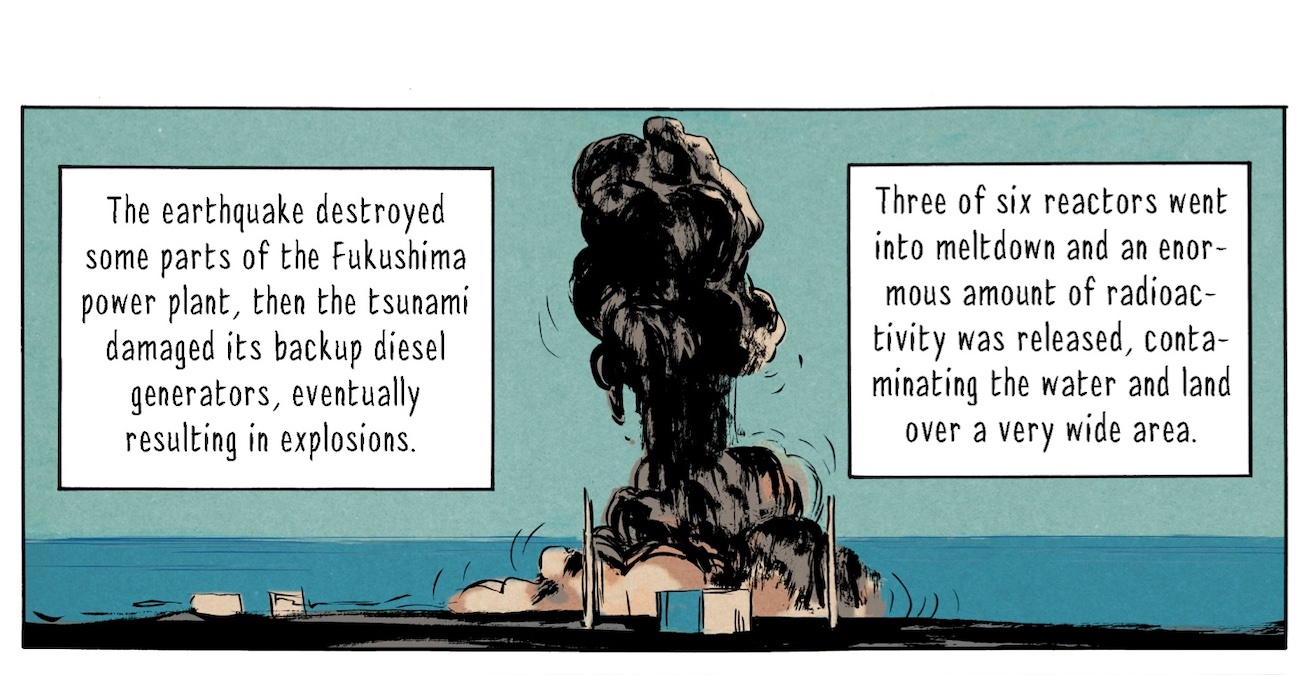
Suguru’s story reveals bullying, ostracization and government whitewash
Isolated and alone — Beyond Nuclear International

A teenager’s account of the Fukushima ordeal https://wordpress.com/read/feeds/72759838/posts/3219596582 By Linda Pentz Gunter, 7 Mar 21,Ten years after the March 2011 Fukushima nuclear disaster, how has the Japanese government responded and what is it like for the people affected, still struggling to return their lives to some semblance of normality? Here is how things look:
- Manuals are being distributed in schools explaining that radioactivity exists in nature and is therefore not something to be afraid of.
- The government is considering getting rid of radiation monitoring posts as these send the wrong message at a time of “reconstruction”.
- The Oversight Committee for Fukushima Prefecture Health Management Survey is discussing the possibility of stopping thyroid inspections at schools because they stress children out and overburden teachers and staff.
Depression and suicide rates among young people from Fukushima are likely to be triggered by being called “germs” and by being seen as “contaminated”.
- Those who speak out about radiation are more stigmatized today than they were 10 years ago.
- Those who “voluntarily” evacuated, recognizing that the so-called protection standards were not adequate for their region, are often ostracized from their new communities. They are seen as selfish for abandoning their homeland, friends and families “just to save themselves” and are bullied as parasites living on compensation funds, even though the “auto-evacuees” as they are known, received none.
- Those forced to evacuate are also bullied if they do not now return, accused of not trusting the government and its assertions that it is safe to do so.
- The taboo against speaking out for proper radiation protection and for compensation has grown worse as the rescheduled Olympics loom for this summer and Japan is determined to prove to the world it has fixed the radiation problem and beaten Covid-19.
- On March 1, 2021, it took three judges all of 30 seconds to dismiss a case brought by 160 parents and children who lived in Fukushima prefecture at the time of the nuclear accident, and known as the Children’s Trial Against Radiation Exposure. The class action suit sought 100,000 yen per person in damages from the government and the prefecture, due to the psychological stress brought on by the lack of measures to avoid radiation exposure after the accident.
These are some of the realities uncovered by France-based Japanese activist, Kurumi Sugita, as she interviewed those affected and began to compile a graphic short story about her findings, entitled Fukushima 3.11 and illustrated by French artist, Damien Vidal. The booklet is produced by the French NGO, Nos Voisins Lontains 3.11 (Our Distant Neighbors 3.11).
Fukushima 3.11, a long-form cartoon strip, is told in the first person by the youngest of Sugita’s interview subjects, Fukushima evacuee, Suguru Yokota, who was 13 at the time of the nuclear disaster.
Suguru was also one of the plaintiffs in the Children’s Trial, and noted after the devastating dismissal, just days before the Fukushima disaster’s 10th anniversary, that “we cannot give up” and that “the court hasn’t issued a legitimate verdict.”
In 2012, Sugita had traveled to Japan with a research project she helped create, financed by the French National Centre for Scientific Research where she worked, to set up an investigation into Japan’s nuclear victims. A list of 70 interview candidates was put together.
“I met Suguru in 2013 in Sapporo where he was living alone after he moved there from Fukushima,” said Sugita. “I also interviewed his mother and they were interviewed once a year over six years.”
A schoolboy at the time of the accident, the book follows Suguru’s account of his experiences. He encounters the refusal by his uncle to believe the dangers in the early days of the accident, “a typical denial case,” says Sugita, and he is ostracized at school where he is the only pupil to wear a mask.
Suguru’s only respite comes when his mother, who is equally alert to the radiation risks, sends him on a “radiation vacation” to Hokkaido, the first time he encounters peers who share his concerns.
Back at school and feeling isolated and alone, Suguru studies at home instead, eventually leaving the region for a different high school and then college.
The book weaves in essential information about radiation risks, and the clampdowns by the Japanese government, which withdrew support for auto-evacuees claiming, as Suguru relates it, that “these families are not victims. They are responsible for their fate.”
The book was first published in the magazine, TOPO, whose audience is predominantly teenagers and which reports on topics of current interest.
“It appealed to us to address an audience interested in world events, but not exclusively the nuclear issue,” said illustrator Vidal. “We thought our comic strip could be read by all those — and not necessarily just teenagers — who want to understand what the consequences of the nuclear accident were, and how it affected the inhabitants of Fukushima Prefecture.”
The book vividly brings home the psychological and emotional pain suffered by those who chose to recognize the true dangers posed by the Fukushima disaster, as well as the financial hardships and fracturing of families. And it exposes the depths of deliberate denial by authorities, more interested in heightened normalization of radiation exposure in the name of commerce and reputation.
Even as early as October 2011, an announcement is made that “rice produced in Fukushima Prefecture will supply school canteens again.” We see Suguru and his mother watching this news on their television, then the name-calling Suguru faces in school for bringing his own lunch. He is shown in the strip being called a “hikokumin”, which, explains Suguru, “is a really insulting word, used during the Second World War. It refers to people who are not worthy of being Japanese citizens.”
But that stigma has only become worse with time, Sugita says.
These days people are name-called “hoshano”. “Hoshano”(放射能) means radioactivity, but with a different Chinese character(放射脳) it means “radioactive brain – or brain contaminated by the fear of radioactivity”, she explains. And that is the slur in common circulation now.
Nevertheless, the book ends on a hopeful note. “Today,” concludes Suguru on the closing page, “I know I’m not alone. I hope other voices will be heard in Japan and around the world.”
It’s easy to say “never again.” But in order to ensure it, we must all continue to raise our voices, joining Suguru’s and others yearning to be heard.Read the English language version of Fukushima 3.11 on line for free. A version is also available in French. Hard copies (in French only), may be ordered from Nos Voisins Lontains 3.11 for 8€ plus shipping costs.
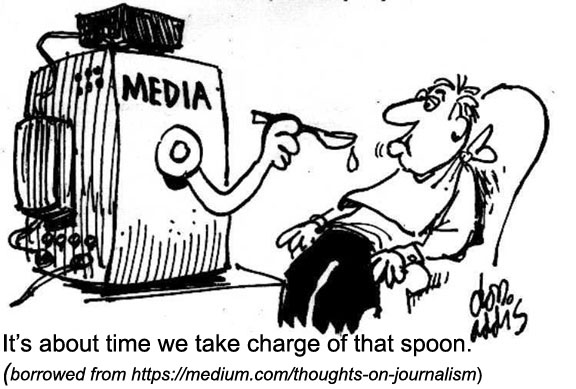
The American media sanitises the Biden administration’s killings in Syria
 Purging Inconvenient Facts in Coverage of Biden’s ‘First’ Air Attacks https://fair.org/home/purging-inconvenient-facts-in-coverage-of-bidens-first-air-attacks/ Purging Inconvenient Facts in Coverage of Biden’s ‘First’ Air Attacks https://fair.org/home/purging-inconvenient-facts-in-coverage-of-bidens-first-air-attacks/
GREGORY SHUPAK 5 Mar 21, When the Biden administration bombed Syria on February 25, the attack killed “at least 22,” most of them members of Iraqi militias, according to the Syrian Observatory for Human Rights, a London-based monitoring organization opposed to the Syrian government. The US said the bombing was retaliation for three rocket
 attacks on US bases in Iraq that it claims were carried out by groups allied with Iran (NBC, 2/25/21). In one of the attacks, rockets fired at Erbil airport killed a military contractor and an Iraqi civilian. attacks on US bases in Iraq that it claims were carried out by groups allied with Iran (NBC, 2/25/21). In one of the attacks, rockets fired at Erbil airport killed a military contractor and an Iraqi civilian.
The US does not say that its airstrike on Syria was aimed at the group that carried out the Erbil attack, which, as the New York Times (2/26/21) reported, was claimed by a previously unknown armed group calling itself the Guardians of the Blood. United States officials said it appeared to be affiliated with one or more of Iraq’s better-known militias, and Thursday’s strikes in Syria targeted facilities belonging to them. Furthermore, the site that the US bombed in Syria “was not specifically tied to the rocket attacks” (CNN, 2/25/21). A New York Times (2/25/21) report from Helene Cooper and Eric Schmitt ran with the headline, “US Airstrikes in Syria Target Iran-Backed Militias That Rocketed American Troops in Iraq.” However, the 11th paragraph of the article said that “little is known about” Guardians of the Blood, “including whether it is backed by Iran or related to the organizations that used the facilities the American airstrikes targeted on Thursday.” Manufactured amnesia CNN’s Barbara Starr, The less clear the US population is about the frequency and scale of murderous violence its government carries out, the easier it is for the US ruling class to go about its wars. Fortunately for the US state, corporate media help manufacture collective amnesia by expunging US aggression from the record. Liebermann and Nicole Gaouette (2/25/21) said the February 25 airstrikes “mark the US military’s first known action under President Joe Biden,” while their colleague Fareed Zakaria (GPS, 2/28/21) had a segment about them called “Biden’s First Military Action.” Christian Science Monitor (3/2/21) ran an editorial called “Biden’s First Use of Force Overseas.” Yet not even a month before Biden bombed Syria, the US carried out an airstrike in Iraq that it said killed ISIS commander Jabbar Salman Ali Farhan al-Issawi and nine other ISIS fighters (New York Times, 1/29/21). Furthermore, Airwars, a nonprofit monitoring group affiliated with the University of London, suspects the US of carrying out or helping to carry out four bombings in Somalia in the period between Biden’s inauguration and the attack on Syria, killing 2–4 people in one case and 6–12 on two other occasions. The US military stopped disclosing its airstrikes in Afghanistan last year, but it is unlikely that military operations in the US’s longest overseas war came to a halt when Biden took office. Purging inconvenient facts is another way of producing mass forgetfulness and confusion. Flying colors To praise Biden’s killings, corporate media pretended the US was fighting back against a bully. Max Boot of the Washington Post (2/26/21), writing that Biden “is passing his early tests with flying colors” and “is off to an excellent start,” claimed that “if Biden did nothing in response to the latest Iranian provocations, he would have risked sending a message of weakness that would have further emboldened Tehran.” In Boot’s opinion, “Biden ordered the right response: an airstrike on a Syrian base used by Iranian-backed militias.” He praised Biden for negotiating with Iran while simultaneously “engaging in a policy of active containment and deterrence to curb Iran’s destabilizing activities in the region,” which he characterized as “regional aggression.” (The Times‘ February 26 piece used similar language, writing that the prospect of a new nuclear deal with Iran is overshadowed by “the issue of Iran’s destabilizing activities across the Middle East.”)
Forget for a moment that no evidence has been provided that Iran was actually behind the relevant rocket attacks: Boot apparently doesn’t think he even has to say what “Iran’s destabilizing activities in the region” are, nor where its “regional aggression” takes place, let alone offer any proof for these claims. The US murdered an Iranian general who was revered in his country (FAIR.org, 1/21/20), invaded Iraq and causing the death of upward of 1 million people (Jacobin, 6/19/14), resupplied Israel with weaponry (Al Jazeera, 7/31/14) as it slaughtered more than 2,000 Palestinians in Gaza, played a central role in a war that has made Yemen home to the world’s worst humanitarian crisis (Middle East Eye, 11/17/17): For Boot, evidently, nothing on this nonexhaustive list of recent US crimes in the Middle East constitutes “regional aggression” or “destabilizing activities in the region” that need “active containment and deterrence.” Boot was hardly the only journalist who rationalized the American bombing by portraying the US as acting defensively. The Post‘s Jennifer Rubin (2/28/21) said Biden had “responded forcefully” to “Iranian proxy attacks,” and thereby sent an “important…signal to Iran that the new administration will not look the other way on Tehran’s regional conduct simply to encourage discussion about” Iran’s nuclear power program. Cooper and Schmitt (New York Times, 2/25/21) noted that the US dropped “seven 500-pound bombs” on Syria, and described this as Biden taking “a more measured response to the rocket fusillade in Erbil than Mr. Trump’s pitched campaign against Iran and past actions of its proxies in Iraq.” Set aside the absurdity of calling dropping nearly two tons of bombs “measured”; set aside the lack of evidence of Iranian responsibility for the deaths at Erbil; set aside that the US doesn’t claim that it bombed the parties that fired the rockets that killed the contractor and the Iraqi civilian in Erbil, and assume for the sake of argument that Iran is behind those acts. The pretense that the US defended itself by carrying out last week’s airstrikes also necessitates glossing over the fact that the country Washington actually bombed, Syria, is accused of neither sponsoring nor carrying out the rocket attacks on American bases in Iraq that should not be there in the first place. The articles I’ve examined all acknowledge that the US airstrikes hit Syria, but it’s remarkable how little attention they pay to the country, especially considering that the bombing was aimed at groups allied with the Syrian government in that country’s war, so the attack amounts to an intervention on behalf of anti-government forces there. Had the coverage paid more notice to how Biden’s bombing was carried out against a country that the US has helped to decimate (FAIR.org, 3/7/18; Electronic Intifada, 3/16/17), despite Syria not attacking or threatening to attack the US, the narrative that Biden was merely conducting a “response” to bad actors would have been that much more obviously threadbare. Securing consent for running a lethal, worldwide empire requires unremitting propaganda: Redacting the historical record and playing the victim are two useful strategies. |
|
French report on the unfairness of France’s nuclear history in Algeria

French report grapples with nuclear fallout from Algerian War https://thebulletin.org/2021/03/french-report-grapples-with-nuclear-fallout-from-algerian-war/?utm_source=Newsletter&utm_medium=Email&utm_campaign=ThursdayNewsletter03042021&utm_content=NuclearRisk_AlgerianWar_03042021&__cf_chl_captcha_tk__=32bfe924bf6171eab26d9deb08cd73459b5e69dc-1614896664-0-AWxxiguytXLkG_ERcOpFeDyCqmv7X1FYZmZBNGAnlwY6ZlI8PgWd2By Austin R. Cooper | March 4, 2021 n January, the French historian Benjamin Stora filed a report commissioned by the French President Emmanuel Macron aimed at “reconciliation of memories between France and Algeria,” which France ruled as the jewel of its colonial empire for more than 130 years.
The Stora Report addressed several scars from the Algerian War for Independence (1954–62), a bloody struggle for decolonization that met savage repression by French troops. One of these controversies stems from French use of the Algerian Sahara for nuclear weapons development.
France proved its bomb in the atmosphere above this desert, naming the inaugural blast , or Blue Jerboa, after the local rodent. Between 1960 and 1966, France detonated 17 nuclear devices in the Algerian Sahara: four atmospheric explosions during the Algerian War, and another 13 underground, most of these after Algerian Independence.
French nuclear ambitions became inextricable from the process of Algerian decolonization. The Saharan blasts drew international outrage, stalled ceasefire negotiations, and later threatened an uneasy peace across the Mediterranean.
The Stora Report signaled that radioactive fallout from the Algerian War has remained a thorn between the two nations. But the document comes up short of a clear path toward nuclear reconciliation.
A United Nations dispute. The French bomb collided with the Algerian War before the first mushroom cloud rose above the Sahara. In November 1959, Algerian allies representing independent states in Africa and Asia contested French plans for the desert in the First Committee on Disarmament at the United Nations.
Part of the French strategy at the United Nations was to drive a wedge between the nuclear issue and what French diplomats euphemistically termed the “Question of Algeria.” French obfuscation continued for decades.
France would not, until 1999, call the bloodshed a war, preferring the line that what happened in Algeria, as part of France, amounted to a domestic dispute, rather than UN business. Macron became, in 2018, the first French president to acknowledge “systemic torture” by French troops in Algeria.
The Afro-Asian challenge to Saharan explosions hurdled France’s diplomatic barricades at the United Nations. The French delegation tried to strike references to the Algerian War as irrelevant. But their African and Asian counterparts painted the desert blasts as a violation of African sovereignty.
The concern was not only for contested territory in Algeria, but also for independent states bordering the desert, whose leaders warned that nuclear fallout could cross their national borders. Radiation measurements taken in the wake of Gerboise bleue proved many of them right.
Nuclear weapons represented another piece of French imperialism on the continent.
Secret negotiations resumed in September 1961, with US Ambassador to Tunisia Walter N. Walmsley serving as France’s backchannel. The US State Department worried that French attachment to the test sites might thwart the decolonization process.
Lead Algerian negotiator Krim Belkacem asked Walmsley if prospects for a ceasefire still hinged on France retaining control of the test sites. Krim got his answer when Franco-Algerian talks resumed the following month, at the end of October 1961.
France did not abandon its goal to continue nuclear explosions in the Sahara. But the Algerian position appeared to have softened. So long as further blasts did not impinge on Algeria’s “eventual sovereignty” over the desert, as one archival document put it, a deal looked possible.
The Evian Accords marked a nuclear compromise. Finally signed in March 1962, the landmark treaty granted France a five-year lease to the Saharan test sites but did not specify terms of use.
Going underground. Advice from the French Foreign Ministry played a key role in pushing France’s weapons program beneath Saharan mountains. French diplomats suggested that underground explosions would present, according to one archival document, “significantly less serious” challenges than atmospheric ones for future relations with Algeria and its African neighbors.
This did not stop Algeria’s first president, Ahmed Ben Bella, from winning political capital with the nuclear issue. In public, Ben Bella cast Saharan blasts as an intolerable violation of Algerian sovereignty, as had his allies at the United Nations. In private, however, Ben Bella acquiesced to the Evian terms and reportedly tried to squeeze French financial aid out of the deal.
The Hoggar Massif shook 13 times before France handed over its two Saharan test sites to Algeria in 1967. An accident occurred during one of these underground blasts, dubbed Béryl, when containment measures failed. Several French soldiers and two high-ranking French officials suffered the highest radiation exposures, but roughly 240 members of “nomadic populations” in the region received lower doses.
Meanwhile, France began construction on its Pacific test range in French Polynesia, the site of nearly 200 nuclear explosions between 1966 and 1996. Most took place underground, but France also conducted atmospheric detonations in Polynesia, and these continued into the 1970s. Even though the Limited Test Ban Treaty had gone into effect in 1963—prohibiting nuclear blasts in the atmosphere, underwater, and in outer space—France refused to sign it.
Contamination and compensation. As part of its reconciliation proposal, the Stora Report encouraged Franco-Algerian cooperation on environmental remediation of the Saharan test sites. An expert report from the International Atomic Energy Agency, however, concluded in 2005 that environmental interventions were “not required” unless human traffic near the sites should increase.
The Stora Report briefly mentioned compensation linked to radiation exposure from French nuclear weapons development, but this deserves a closer look. In 2010, the French Parliament passed a law recognizing these victims and establishing funds and procedures to provide compensation for illness and injury. So far, France has earmarked 26 million euros for this purpose, but almost none of that has gone to Algerians.
Decades earlier, France’s nuclear allies turned to compensation programs in an attempt to reconcile with marginalized groups affected by weapons development without disclosure or consent. In 1993, for example, the United Kingdom settled with Australia as redress for indigenous people and personnel involved in UK explosions conducted in the former colony.
Facing similar lawsuits, the United States provided monetary compensation and health benefits to the indigenous people of the Marshall Islands, where US nuclear planners “offshored” their most powerful blasts during the Cold War arms race. Other US programs have made compensation available to communities “downwind” of the Nevada Test Site and surrounded by the uranium mines fueling the US nuclear arsenal, including Tribal Nations in the Four Corners region.
Compensation programs map a global history of colonial empire, racial discrimination, and dispossession of indigenous land, but postcolonial inequalities look particularly stark from the Sahara. Including appeals, France has granted 545 of 1,739 total requests filed by French soldiers and civilian participants in the nuclear detonations, as well as exposed populations in Algeria and Polynesia. Only 1 of 52 Algerian dossiers has proven successful.
French officials responsible for evaluating these files report that the ones from Algeria often arrive incomplete or in a shoddy state, and pin the blame on the Algerian government’s inability or unwillingness to provide the geographical, historical, and biomedical evidence that French assessment procedures demand. Claims must demonstrate that an individual worked or lived in a fixed area surrounding one of the two Saharan test sites, between February 1960 and December 1967, and suffered at least one of 21 types of cancer recognized as radiation-linked by French statute.
A step toward reconciliation. If Macron really wants to tackle France’s nuclear history in Algeria—and its aftermath—his government should start here. The French Parliament opened the door to Algerian compensation in 2010, and important revisions to the evaluation procedures took place in 2017, but there has never been a level playing field. Macron could, for example, require that French diplomats posted in Algeria help Algerians build their cases and locate supporting documents.
Another option: Macron could declassify archival materials documenting the intensity and scope of radioactive fallout generated by French nuclear blasts. Draconian interpretations of French statutes on the reach of military secrecy continue to block access to the vast majority of military, civil, and diplomatic collections on France’s nuclear weapons program—including radiation effects. Foreign archives have provided useful information, but official documentation from the French government would help exposed populations—like those in the Sahara—understand what happened, evaluate the risks, bolster their claims, and likely find these more successful.
The Stora Report did well to acknowledge nuclear fallout from the Algerian War. Giving Algerians a fair shot at compensation should mark France’s first step toward reconciliation.
In India, Google and Facebook help a vicious government campaign against environmental activists
Naomi Klein: how big tech helps India target climate activists, Guardian, by Naomi Klein 5 Mar 21, Companies such as Google and Facebook appear to be aiding and abetting a vicious government campaign against Indian environmental campaigners
The bank of cameras camped outside Delhi’s sprawling Tihar jail was the sort of media frenzy you would expect to await a prime minister caught in an embezzlement scandal, or a Bollywood star caught in the wrong bed. Instead, the cameras were waiting for Disha Ravi, a nature-loving 22-year-old vegan climate activist who against all odds has found herself ensnared in an Orwellian legal saga that includes accusations of sedition, incitement and involvement in an international conspiracy whose elements include (but are not limited to): Indian farmers in revolt, the global pop star Rihanna, supposed plots against yoga and chai, Sikh separatism and Greta Thunberg.
If you think that sounds far-fetched, well, so did the judge who released Ravi after nine days in jail under police interrogation. Judge Dharmender Rana was supposed to rule on whether Ravi, one of the founders of the Indian chapter of Fridays for Future, the youth climate group started by Thunberg, should continue to be denied bail. He ruled that there was no reason for bail to be denied, which cleared the way for Ravi’s return to her home in Bengaluru that night.
But the judge also felt the need to go much further, to issue a scathing 18-page ruling on the underlying case that has gripped Indian media for weeks, issuing his own personal verdict on the various explanations provided by the Delhi police for why Ravi had been apprehended in the first place. The police’s evidence against the young climate activist is, he wrote, “scanty and sketchy”, and there is not “even an iota” of proof to support the claims of sedition, incitement or conspiracy that have been levelled against her and at least two other young activists.
Though the international conspiracy case appears to be falling apart, Ravi’s arrest has spotlighted a different kind of collusion, this one between the increasingly oppressive and anti-democratic Hindu nationalist government of the prime minister, Narendra Modi, and the Silicon Valley companies whose tools and platforms have become the primary means for government forces to incite hatred against vulnerable minorities and critics – and for police to ensnare peaceful activists like Ravi in a hi-tech digital web.
The case against Ravi and her “co-conspirators” hinges entirely on routine uses of well-known digital tools: WhatsApp groups, a collectively edited Google Doc, a private Zoom meeting and several high-profile tweets, all of which have been weaponised into key pieces of alleged evidence in a state-sponsored and media-amplified activist hunt. At the same time, these very tools have been used in a coordinated pro-government messaging campaign to turn public sentiment against the young activists and the movement of farmers they came together to support, often in clear violation of the guardrails social media companies claim to have erected to prevent violent incitement on their platforms.
In a country where online hatred has tipped with chilling frequency into real-world pogroms targeting women and minorities, human rights advocates are warning that India is on the knife-edge of terrible violence, perhaps even the kind of genocidal bloodshed that social media aided and abetted against the Rohingya in Myanmar.
Through it all, the giants of Silicon Valley have stayed conspicuously silent. Their famed devotion to free expression, as well as their newfound commitment to battling hate speech and conspiracy theories, is, in India, nowhere to be found. In its place is a growing and chilling complicity with Modi’s information war, a collaboration that is poised to be locked in under a draconian new digital media law that will make it illegal for tech companies to refuse to cooperate with government requests to take down offending material or to breach the privacy of tech users. Complicity in human rights abuses, it seems, is the price of retaining access to the largest market of digital media users outside China.
After some early resistance from the company, Twitter accounts critical of the Modi government have disappeared in the hundreds without explanation; government officials engaging in bald incitement and overt hate speech on Twitter and Facebook have been permitted to continue in clear violation of the companies’ policies; and Delhi police boast that they are getting plenty of helpful cooperation from Google as they dig through the private communications of peaceful climate activists like Ravi.
“The silence of these companies speaks volumes,” a digital rights activist told me, requesting anonymity out of fear of retribution. “They have to take a stand, and they have to do it now.”
…………………. It is this quest for a political diversion, in other words, that helps explain how a simple solidarity campaign has been recast as a secret plot to break India apart and incite violence from abroad. The Modi government is attempting to drag the public debate away from terrain where it is glaringly weak – meeting people’s basic needs during an economic crisis and pandemic – and move it to the ground on which every ethnonationalist project thrives: us versus them, insiders versus outsiders, patriots versus seditious traitors.
In this familiar manoeuvre, Ravi and the broader youth climate movement were simply collateral damage. Yet the damage done is considerable, and not only because the interrogations are ongoing and Ravi’s return to jail remains distinctly possible. As the joint letter from Indian environmental advocates states, her arrest and imprisonment have already served a purpose: “The Government’s heavy handedness are clearly focused on terrorising and traumatising these brave young people for speaking truth to power, and amounts to teaching them a lesson.”
The still wider damage is in the chill the entire toolkit controversy has placed over political dissent in India – with the silent complicity of the tech companies that once touted their powers to open up closed societies and spread democracy around the world. As one headline put it, “Disha Ravi arrest puts privacy of all Google India users in doubt”.
Indeed, public debate has been so deeply compromised that many activists in India are going underground, deleting their own social media accounts to protect themselves. Even digital rights advocates are wary of being quoted on the record. Asking not to be named, a legal researcher described a dangerous convergence between a government adept at information war and social media companies built on maximising engagement to mine their users’ data: “All of this stems from a stronger weaponisation of social media platforms by the status quo, something that was not present earlier. This is further aggravated by the tendency of these companies to prioritise more viral, extremist content, which allows them to monetise user attention, ultimately benefiting their profit motives.”…………..
The new code is being introduced in the name of protecting India’s diverse society and blocking vulgar content. “A publisher shall take into consideration India’s multi-racial and multi-religious context and exercise due caution and discretion when featuring the activities, beliefs, practices, or views of any racial or religious group,” the draft rules state.
In practice, however, the BJP has one of the most sophisticated troll armies on the planet, and its own politicians have been the most vociferous and aggressive promotors of hate speech directed at vulnerable minorities and critics of all kinds. To cite just one example of many, several BJP politicians actively participated in a misinformation campaign claiming that Muslims were deliberately spreading Covid-19 as part of a “Corona Jihad”.
What a code like this would do is enshrine in law the double digital vulnerability experienced by Ravi and other activists: they would be unprotected from online mobs revved up by a Hindu nationalist state, and they would be unprotected from that same state when it sought to invade their digital privacy for any reason it chose……….
The new code, which will impact all digital media, including streaming and news sites, is set to take effect within the next three months. A few digital media producers in India are pushing back. Siddharth Varadarajan, the founding editor of the Wire, tweeted last Thursday that the “lethal” new code is “aimed at killing the independence of India’s digital news media. This attempt to arm bureaucrats with the power to tell the media what can and can’t be published has no basis in law.” ………….
Do not expect portraits of courage from Silicon Valley, however. Many US tech executives regret early decisions, made under public and worker pressure, to refuse to cooperate with China’s apparatus of mass surveillance and censorship – an ethical choice, but one that cost companies like Google access to a staggeringly large, lucrative market. These companies appear unwilling to make the same kind of choice again. As the Wall Street Journal reported last August, “India has more Facebook and WhatsApp users than any other country, and Facebook has chosen it as the market in which to introduce payments, encryption and initiatives to tie its products together in new ways that [CEO Mark] Zuckerberg has said will occupy Facebook for the next decade.”
For tech companies like Facebook, Google, Twitter and Zoom, India under Modi has heralded a harsh moment of truth. In North America and Europe, these companies are going to great lengths to show that they can be trusted to regulate hate speech and harmful conspiracies on their platforms while protecting the freedom to speak, debate, and disagree that is integral to any healthy society. But in India, where helping governments hunt and imprison peaceful activists and amplify hate appears to be the price of access to a huge and growing market, “all of those arguments have gone out the window,” one activist told me. And for a simple reason: “They are profiting from this harm.” https://www.theguardian.com/news/2021/mar/04/how-big-tech-helps-india-target-climate-activists-naomi-klein
Why is the media fawning over nuclear businessman Bill Gates?
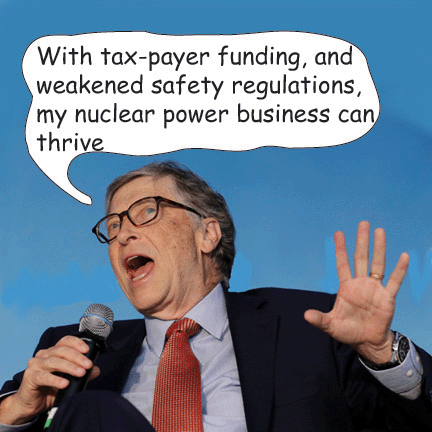
In a much-publicised interview he did on 60 Minutes Gates hyped up “advanced nuclear” fusion, SMRs and all the other tech marvels he is promoting. His interviewer, Anderson Cooper, completely ignorant of the subject, lapped it up, and failed to point out that none of these are proven technologies.
|
Why Bill Gates can’t save the world, The Fifth Estate, BY DAVID THORPE / 23 FEBRUARY 2021 Why don’t these billionaire philanthropists like Gates just stop their foundations and pay their fair share of taxes?
The media everywhere has been fawning over Bill Gates and his new book, How To Avoid A Climate Disaster. But should we really be listening to the world’s third wealthiest man for advice? If his suggestions and plans of action were wise and useful then maybe… Microsoft founder Bill Gates has an estimated net worth of $129 billion. His incalculable possessions, hugely destructive habits, and the massive investments of his opaque charitable trust, do everything to contradict his message that he’s the man with the plan to solve climate change. The fundamental point is that the richer you are, the bigger your ecological footprint. There’s no escaping it. The Gates’ fossil footprint……..Among the many $22.34 billion investments of Bill & Melinda Gates Foundation Trust, most of them are decidedly not in low carbon enterprises:
This is just scratching the surface. Journalist Tim Schwab, who has made it a mission to investigate Gate’s wealth and influence, has discovered his investments in fossil fuel companies: Gates claims to have divested from fossil fuel companies in 2019, but his foundation’s tax filing from that year shows millions of dollars in direct investments in companies like Exxon, Chevron, and Japan Petroleum Exploration. Billions more are invested in fossil-fuel-dependent industries like airlines, heavy machinery and automobiles. There’s a $1.6 billion stake in Caterpillar, for example, which makes diesel-guzzling plant used in mining. He is chairman of TerraPower, a nuclear reactor design company which has put no energy into the power grid. In October 2020, the United States Department of Energy gave TerraPower a grant of $400 million rising to $4 billion over the next seven years towards building a demonstration reactor. For reasons like this, Schwab calls Gates’ book “a long-winded advertisement for his investments”. Gates uses it to appeal to the US government to become a co-investor in TerraPower. The blind spotWhat is astonishing is the uncritical attitude of the media to Gates’ outpourings. The Financial Times last Saturday devoted the front page and a half of its Life & Arts supplement, to his “Green Manifesto”, without comment or criticism: it was free advertorial. Who else would get this treatment? Not long into the piece Gates pontificates, “The problem is simple. We can’t afford to release more greenhouse gasses.” Naturally, he doesn’t include himself in this “we” because if he did he would have to completely change his behaviour and lifestyle, something that he seems incapable of doing. This massive blind spot to his vision is also a blind spot to the media. The vast majority is in denial about his wealth. We want someone to come and lead us to salvation from the dire future we appear to be heading for. Of course, it should be a rich white man! Who else? But just as an alcoholic can’t rely on a whiskey distillery for a cure, we shouldn’t put our faith in the super-rich – because they are a huge part of this problem. Like most of the industrial-business sector, Gates imagines that the solution to climate change is technological. It can never be just that, it’s system change, it’s behavioural. In a much-publicised interview he did on 60 Minutes Gates hyped up “advanced nuclear” fusion, SMRs and all the other tech marvels he is promoting. His interviewer, Anderson Cooper, completely ignorant of the subject, lapped it up, and failed to point out that none of these are proven technologies. Gates the philanthropistBeing one of the top philanthropists in the USA, having donated billions to charity, gives Gates a powerful platform for his views. He sits on world stages amongst experts in the field who have been either democratically elected or appointed because they are experts. What is Gates’ experience or qualifications to talk about climate change? Charles Dickens used his writings to attack injustice in Victorian times. He was especially scathing of rich individuals who styled themselves as philanthropists but whose charitable acts did more to serve their own vanity than deserving causes. Nowhere is this better exemplified than in his novel Bleak House, where he puts in the mouth of one character the following aphorism: “There were two classes of charitable people; one, the people who did a little and made a great deal of noise; the other, the people who did a great deal and made no noise at all.” He satirises the former with Mrs Jellyby and Mrs Pardiggle, both of whom practice philanthropy – but at the expense of others. For both, philanthropy is more of a profession than born of genuine motivations to help. Philanthropy has become Gates’ profession, and his motivation is to assuage his guilt at the size of his wealth and ecological footprint, and to wield power. Dickens would have a field day. Can it be a coincidence that his charitable donations and investments in finding vaccines for the coronavirus, have seen his personal fortune rise $20 billion dollars as a result. That’s not philanthropy, it’s profiteering. Tim Schwab again, in the above article, quotes Anthony Rogers-Wright, director of environmental justice for the New York Lawyers for the Public Interest, as saying “These billionaires, the best they could do, some would say, would be to be stop their foundations and pay their fair share of taxes”. He observes how new tax revenues could help fund democratically devised solutions. “If Gates really wants to be effective and in a way that lifts up equity, he should be really listening to people who are being impacted the most and scaling up their solutions, rather than coming in with a parachute and with an air of white saviour-ism that actually in some cases causes more harm than good.” Christine Nobiss, founder of the indigenous people’s Great Plains Action Society, claims that Bill Gates has become the largest farmland owner in the United States. He owns nearly 100,000 hectares and is not farming it regeneratively or even sustainably. “He’s basically participating in the never-ending cycle of colonisation,” Nobiss says. The world’s most frequent flyer?Flying is one of the worst things you can do for the climate change, right? In a 2019 study of 10 celebrities and their flying habits, Celebrities, air travel, and social norms, Gates came top with the most emissions, beating Jennifer Lopez, Paris Hilton, and Oprah Winfrey. No wonder he would like the sustainable aviation fuel he dreams of in his book, and a neat way of offsetting all his carbon guilt. Let’s face it, would you rely on McDonald’s to make the world go vegan, or Putin to bring world peace? So why listen to Bill Gates, a man with a carbon footprint the size of a small country? Then there is the question of climate justice. In his book he never questions the political systems and economic models that result in climate change’s greatest impacts being on the poor and people of colour. There would be only one way for him to escape these financial conflicts of interest: let him lead by example. Let him give away all his money to the world’s poor with no strings attached. Let him live in a small apartment on $100 a week. Let him see the world from the point of view of a climate refugee – and say nothing about it. When he’s done all that, I’ll follow him. https://www.thefifthestate.com.au/urbanism/climate-change-news/why-bill-gates-cant-save-the-world-and-why-these-billionaire-philanthropists-might-do-best-to-simply-pay-fair-share-of-taxes/ |
|
‘Medical Scientific’ committee, stacked with nuclear executives, promotes nuclear power in space
 “The nuclear industry views space as a new—and wide-open—market for their toxic product that has run its dirty course on Mother Earth.”
“Now it appears that the nuclear industry has also infiltrated the National Academies of Sciences, Engineering, and Medicine that has been studying missions to Mars. ”
It’s going to take enormous grassroots action—and efforts by those in public office who understand the error of the space direction being taken—to stop it.
Nuclear Rockets to Mars?, BY KARL GROSSMAN– CounterPunch, 16 Feb 21,
A report advocating rocket propulsion by nuclear power for U.S. missions to Mars, written by a committee packed with individuals deeply involved in nuclear power, was issued last week by the National Academies of Sciences, Engineering and Medicine.
The 104-page report also lays out “synergies” in space nuclear activities between the National Aeronautics and Space Administration and the U.S. military, something not advanced explicitly since the founding of NASA as a civilian agency supposedly in 1958.
The report states: “Space nuclear propulsion and power systems have the potential to provide the United States with military advantages…NASA could benefit programmatically by working with a DoD [Department of Defense] program having national security objectives.”’
The report was produced “by contract” with NASA, it states.
The National Academy of Sciences, Engineering and Medicine (NAS) describes itself as having been “created to advise the nation” with “independent, objective advice to inform policy.”
The 11 members of the committee that put together the report for the National Academy includes: Jonathan W. Cirtain, president of Advanced Technologies, “a subsidiary of BWX Technologies which is the sole manufacturer of nuclear reactors for the U.S. Navy,” the report states; Roger M. Myers, owner of R. Myers Consulting and who previously at Aerojet Rocketdyne “oversaw programs and strategic planning for next-generation in-space missions [that] included nuclear thermal propulsion and nuclear electric power systems; Shannon M. Bragg-Sitton, the “lead for integrated energy systems in the Nuclear Science and Technology Directorate at the Idaho National Laboratory:” Tabitha Dodson, who at the U.S. government’s Defense Advanced Research Project Agency is chief engineer of a program “that is developing a nuclear thermal propulsion system;” Joseph A. Sholtis, Jr., “owner and principal of Sholtis Engineering & Safety Consulting, providing expert nuclear, aerospace, and systems engineering services to government, national laboratories, industry, and academia since 1993.” And so on.
The NAS report is titled: “Space Nuclear Propulsion for Human Mars Exploration.” It is not classified and is available here.
Bruce Gagnon, coordinator of the Global Network Against Weapons and Nuclear Power in Space, from its offices in Maine in the U.S., declared: “The nuclear industry views space as a new—and wide-open—market for their toxic product that has run its dirty course on Mother Earth.”
“During our campaigns in 1989, 1990, and 1997 to stop NASA’s Galileo, Ulysses and Cassini plutonium-fueled space probe launches, we learned that the nuclear industry positioned its agents inside NASA committees that made the decisions on what kinds of power sources would be placed on those deep space missions,” said Gagnon. “Now it appears that the nuclear industry has also infiltrated the National Academies of Sciences, Engineering, and Medicine that has been studying missions to Mars. The recommendation, not any surprise, is that nuclear reactors are the best way to power a Mars mission.”
“It’s not the best for us Earthlings because the Department of Energy has a bad track record of human and environmental contamination as they fabricate nuclear devices. An accident at launch could have catastrophic consequences.”
Stated Gagnon: “We fought the DoE and NASA on those previous nuclear launches and are entering the battle again. The nuclear industry has its sights set on nuclear-powered mining colonies on an assortment of planetary bodies—all necessitating legions of nuclear devices being produced at DoE and then launched on rockets that blow up from time to time.”
“We urge the public to help us pressure NASA and DoE to say no to nukes in space. We’ve got to protect life here on this planet. We are in the middle of a pandemic and people have lost jobs, homes, health care and even food on their table.”
“Trips to Mars can wait,” said Gagnon.
There have been accidents in the history of the U.S.—and also the former Soviet Union and now Russia—using nuclear power in space……
(Article goes on to explain how solar power can be, and is being used for space travel and research)
The NAS committee, however, was mainly interested in a choice between a “nuclear thermal propulsion” (NTP) or “nuclear electric propulsion” (NEP) for rocket propulsion…….
“Advanced nuclear propulsion systems (along or in combination with chemical propulsion systems) have the potential to substantially reduce trip time” to Mars “compared to fully non-nuclear approaches,” says the report.
An issue: radioactivity from either of the systems affecting human beings on the rockets with nuclear reactors propelling them. Back after World War II with the Cold War beginning, the U.S. began working on bombers propelled by onboard nuclear reactors—even built one. The idea was that such bombers could stay aloft for days ready to drop nuclear weapons on the Soviet Union. No crews would need to be scrambled and bombers then sent aloft.
But, as The Atlantic magazine noted in a 2019 article titled, “Why There Are No Nuclear Airplanes”:
“The problem of shielding pilots from the reactor’s radiation proved even more difficult. What good would a plane be that killed its own pilots? To protect the crew from radioactivity, the reactor needed thick and heavy layers of shielding. But to take off, the plane needed to be as light as possible. Adequate shielding seemed incompatible with flight. Still, engineers theorized that the weight saved from needing no fuel might be enough to offset the reactor and its shielding. The United States spent 16 years tinkering with the idea, to no avail”
The Eisenhower administration concluded that the program was unnecessary, dangerous, and too expensive. On March 28, 1961, the newly inaugurated President John F. Kennedy canceled the program. Proposals for nuclear-powered airplanes have popped up since then, but the fear of radiation and the lack of funding have kept all such ideas down.”……
The “synergies” in space nuclear activities between NASA and the U.S. military advanced in the NAS report mark a change in public acknowledgement. The agency was supposed to have a distinctly civilian orientation, encouraging peaceful applications in space science.
However, throughout the decades there have been numerous reports on its close relationship with the U.S. military—notably during the period of NASA Space Shuttle flights. As a 2018 piece in Smithsonian Magazine noted, “During the heyday of the space shuttle, NASA would routinely ferry classified payloads into orbit for the Department of Deense among other projects the agencies have collaborated on.”
With the formation of a U.S. Space Force by the Trump administration in 2019, the NASA-Pentagon link would appear to be coming out of the shadows, as indicated by the NAS report. The Biden administration is not intending to eliminate the Space Force, despite the landmark Outer Space Treaty of 1967 put together by the U.S., the then Soviet Union and the U.K, setting aside space for peaceful purposes. It is giving the new sixth branch of U.S. armed forces “full support,” according to his spokesperson Jen Psaki.
The NAS report says, “Areas of common interest include (1) fundamental questions about the development and testing of materials (such as reactor fuels and moderators) that can survive NTP conditions and (2) advancing modeling and simulation capabilities that are relevant to NTP.” And, “Additionally, a NASA NTP system could potentially use a scaled-up version of a DoD reactor, depending on the design.”
It declares: “Threats to U.S. space assets are increasing. They include anti-satellite weapons and counter-space activities. Crossing vast distances of space rapidly with a reasonably sized vehicle in response to these threats requires a propulsion system with high Isp [Specific Impulse] and thrust. This could be especially important in a high-tempo military conflict.”
Moreover, on December 19, just before he was to leave office, Trump signed Space Policy Directive-6, titled “National Strategy for Space Nuclear Propulsion.” Its provisions include: “DoD [Department of Defense] and NASA, in cooperation with DOE [Department of Energy}, and with other agencies and private-sector partners, as appropriate, should evaluate technology options and associated key technical challenges for an NTP [Nuclear Thermal Propulsion] system, including reactor designs, power conversion, and thermal management. DoD and NASA should work with their partners to evaluate and use opportunities for commonality with other SNPP [Space Nuclear Power and Propulsion] needs, terrestrial power needs, and reactor demonstration projects planned by agencies and the private sector.”
It continues: “DoD, in coordination with DOE and other agencies, and with private sector partners, as appropriate, should develop reactor and propulsion system technologies that will resolve the key technical challenges in areas such as reactor design and production, propulsion system and spacecraft design, and SNPP system integration.”
It’s going to take enormous grassroots action—and efforts by those in public office who understand the error of the space direction being taken—to stop it.
Karl Grossman, professor of journalism at State University of New York/College at Old Westbury, and is the author of the book, The Wrong Stuff: The Space’s Program’s Nuclear Threat to Our Planet, and the Beyond Nuclear handbook, The U.S. Space Force and the dangers of nuclear power and nuclear war in space. Grossman is an associate of the media watch group Fairness and Accuracy in Reporting (FAIR). He is a contributor to Hopeless: Barack Obama and the Politics of Illusion. more https://www.counterpunch.org/2021/02/16/nuclear-rockets-to-mars/

Australian government’s brazen duplicity concerning Julian Assange

What Assange and WikiLeaks said about Australia, https://www.smh.com.au/culture/books/what-assange-and-wikileaks-said-about-australia-20210129-p56xyo.html, By Jessie Tu, February 4, 2021 He has been called “truth-telling hero”, “evil and perverted traitor”, “heroic, trickster, mythical – reviled”. Robert Manne called him the “most consequential Australian of the present time”. The new US President has called him a “high-tech terrorist”.
The protean narratives of Julian Assange, who will be 50 in July, have been brewing since 2010, when his website published “The Afghan War Diaries”, “Iraq War Logs” and “Collateral Murder”, a video showing the US military killing two Reuters employees in Iraq.
December marked 10 years since Assange has been “arbitrarily detained” in Britain, according to Felicity Ruby and Peter Cronau in their introduction to A Secret Australia – a collection of 18 essays that survey the impact WikiLeaks has had on Australia’s media landscape and the consequences of our government’s attraction towards America’s intelligence and military empire.
The potpourri of authors and thinkers includes Julian Burnside, Antony Loewenstein, Scott Ludlam and Helen Razer, who critique “the powers opposed to openness and transparency” and examine the evidence, “not the likelihoods, the probabilities, the suspicions, and assumptions” around the “subversive, technology-based publishing house”.
WikiLeaks invented a “pioneering model of journalism” – one that embodied the “contemporary spirit of resistance to imperial power”, says Richard Tanter, from the school of political and social sciences at the University of Melbourne. It brought renewed debates on free speech, digital encryption and questions around the management and protection of whistleblowers who risk their lives to expose covert, deceitful actions by governments.
The documents exposed the “brazen duplicity” of the Australian government towards its citizens and presented “off-stage alliance management conversations”, Tanter writes. They invited the layperson into the green room of the performance that is politics and international diplomacy.
WikiLeaks unmasked reports that showed governments recommending media strategies to deceive the public, demonstrating their unethically utilitarian approach to international diplomacy and governance and “enlightened the public on the dark corners of wars”, writes journalist and author Antony Loewenstein.
Assange is still in a cell at London’s Belmarsh Prison, facing an appeal by the United States in its bid to extradite him to face charges for the 2010 publications. He is continuing to be “denied adequate medical care” and “denied emergency bail in light of the COVID-19″, says Lissa Johnson, a clinical psychologist and writer for New Matilda – one of the few Australian publications that have paid genuine attention to the WikiLeaks saga.
In Australia, there’s been a “striking absence of a solid debate on WikiLeaks in the mainstream public discourse”, according to Benedetta Brevini, a journalist and media activist who insists that our concerning “lack of a thorough and sustained debate” is incomprehensible. Loewenstein calls Australia’s lack of journalistic solidarity with Assange “deeply shameful”. He says we have an “anodyne media environment” – perhaps not unsurprising, considering our highly concentrated media market, one of the most severe in the world.
The most useful essay is Rundle’s take on the historical basis for WikiLeaks. He surveys the swirling currents of Australian history that led to its founding, identifying WikiLeaks as a continuation of political activist Albert Langer’s resistance to capital.
“We need a whole new organisation of how recent Australian history is told,” Rundle concludes, seconding Lissa Johnson’s opinion that we demand citizens who “cut across the acquiescence and consent, remove the deadbolt on the torture chamber door, turn down the music and expose what is going on inside”. This collection of polemics, though at times repetitive, takes us closer to a future where these demands no longer seem beyond reality.
Eds., Felicity Ruby & Peter Cronau, Monash University Publishing, $29.95
Isle of Man Wakes Up to What is Planned – SUB SEA NUCLEAR DUMP — Keep Cumbrian Coal in the Hole

At last there is some Grrrrr over the plan to dump heat generating nuclear waste under the Irish Sea – so far the plan appears to be to looking in all seriousness at having above surface nuclear sprawl at Ghyll Scuar quarry ( on the edge of Millom Deer Park ) with the drift tunnels shunting planetary destroying nuclear wastes under the Marine Conservation Zone outwards towards the Isle of Man. Whats not to like? EVERYTHING!
Good on the Isle of Man Examiner for this headline and write up. To read the article in full (for £1) go to the Isle of Man Examiner
Isle of Man Wakes Up to What is Planned – SUB SEA NUCLEAR DUMP — Keep Cumbrian Coal in the Hole
The media’s false concept of “balance”
|
Even After January 6, Some Media Can’t Kick Their Addiction to False Balance, Fair,
JULIE HOLLAR 18 Jan, 21, In the wake of the unprecedented events of January 6, many in corporate media—on both the editorial and reporting sides—have displayed a new and refreshing ability to apply accurate labels to people and their behaviors (“sedition,” “incitement,” “white nationalists,” etc.) and to apportion blame based on reality, not a wished-for fantasy of balance.
That false concept of balance, which FAIR has criticized for years (e.g., 9/30/04, 9/17/20), is finally coming under greater scrutiny. As Washington Post media critic Margaret Sullivan (1/17/21) recently wrote: “When one side consistently engages in bad-faith falsehoods, it’s downright destructive to give them equal time.” Considering that Trump has few allies left within the establishment—even many big businesses have publicly turned against him—perhaps it’s easier for journalists to cast off their commitment to false balance. But it’s far from inevitable. ……..https://fair.org/home/even-after-january-6-some-media-cant-kick-their-addiction-to-false-balance/ |
|
|
”Small Modular Reactors”’- governments are being sucked in by the ”billionaires’ nuclear club”

SNC-Lavalin Scandal-ridden SNC-Lavalin is playing a major role in the push for SMRs.
Terrestrial Energy….. Terrestrial Energy’s advisory board includes Dr. Ernest Moniz, the former US Secretary of the Dept. of Energy (2013-2017) who provided more than $12 billion in loan guarantees to the nuclear industry. Moniz has been a key advisor to the Biden-Harris transition team, which has come out in favour of SMRs.
The “billionaires’ nuclear club” …“As long as Bill Gates is wasting his own money or that of other billionaires, it is not so much of an issue. The problem is that he is lobbying hard for government investment.”
Going after the public purse
Bill Gates was apparently very busy during the 2015 Paris climate talks. He also went on stage during the talks to announce a collaboration among 24 countries and the EU on something called Mission Innovation – an attempt to “accelerate global clean energy innovation” and “increase government support” for the technologies.
Gates’ PR tactic is effective: provide a bit of capital to create an SMR “bandwagon,” with governments fearing their economies would be left behind unless they massively fund such innovations.
governments “are being suckers. Because if Wall Street and the banks will not finance this, why should it be the role of the government to engage in venture capitalism of this kind?”
It will take a Herculean effort from the public to defeat this NICE Future, but along with the Assembly of First Nations, three political parties – the NDP, the Bloc Quebecois, and the Green Party – have now come out against SMRs.
|
Mini-Nukes, Big Bucks: The Interests Behind the SMR Push https://watershedsentinel.ca/articles/mini-nukes-big-bucks-the-money-behind-small-modular-reactors/
It’s remarkable that only five years ago, the National Energy Board predicted: “No new nuclear units are anticipated to be built in any province” by 2040.So what happened? The answer involves looking at some of the key influencers at work behind the scenes, lobbying for government funding for SMRs. |
Donald Trump the Worst President in the History of the United States

Anna Thurlow, 9 Jan 21, Donald Trump Has Been the Worst President in the History of the United StatesBy Eve ottenburg and Karl Grossman
“For those who concluded from the Covid-19 debacle that Trump simply wasn’t up to the job, it looks unlikely, to say the least, that his China legacy will be anything other than catastrophic. U.S. and Chinese economies are intertwined and, as we’ve already seen, decoupling hurts lots of Americans, starting with farmers. Trump’s executive order on December 28, prohibiting investments in firms reportedly controlled by the Chinese military does little besides ratchet up tensions. Hostilities between the two navies in the South China Sea could explode into regional war at any time. And how that war would be prevented from becoming nuclear is a very well-kept secret. But the geniuses in the Pentagon aren’t concerned. They believe in their new generation of small, “smart” nuclear weapons and “winnable” nuclear wars, as does Trump, the president who arguably has done more to promote nuclear war than perhaps any predecessor since mankind first split the atom.
Donald Trump has been the worst president in the history of the United States.”
Eve ottenburg
The attack by his supporters on the Capitol was a capstone of his presidency — lawless, an attack on democracy, a U.S. counterpart of the rise of Nazism in Germany in the 1930s.
It was a horror representative of his tenure.
Thank heavens and thanks to successful and hard political work, he will in days be out of office. And there must be criminal prosecutions on the state and local levels as well the federal level, which he’ll likely try to wrangle out of with a pardon.
There must be consequences to his horrendous term in office.
“An American Tragedy” was the title of a piece by David Remnick, editor of The New Yorker magazine, right after Election Day 2016. “The election of Donald Trump,” Remnick wrote, “is nothing less than a tragedy for the American republic, a tragedy for the Constitution, and a triumph for the forces, at home and abroad, of nativism, authoritarianism, misogyny, and racism.” There would be “miseries to come”– and there have been.
Remnick warned against an “attempt to normalize” the election of Trump. “Trump is vulgarity unbounded, a knowledge-free national leader”, “a twisted caricature of every rotten reflex of the radical right…a flim-flam man” with “disdain for democratic norms.”
The attack on the Capitol by the Trumpsters was an attempt at a coup to undo a presidential election in which a record number of voters came out to dump Trump and elect Joe Biden.
It was an act of insurrection incited by Trump.
As he tweeted to followers on December 20th — “Big protest in DC on January 6th. Be there, will be wild!”
Yes, and indeed it was wild.
And then, in a speech in front of The White House on Wednesday, addressing his backers who had arrived, said: “We’re going to walk down Pennsylvania Avenue…and we’re going to the Capitol.” He added: “You have to be strong.”
His call was preceded by his lawyer, Rudy Giuliani, proclaiming “let’s have trial by combat.”
Giuliani, who took an oath to be an attorney and adhere to rule of law, represented Trump in many courts in challenges to his election defeat with claims that judges found totally untrue–but Giuliani opted instead, in violation of that oath, for “trial by combat.”
Remnick warned about an “attempt to normalize” Trump, but so much of media have engaged in “both sides-ing” the situation, as Julie Hollar of Fairness and Accuracy in Reporting has written.
When a person tells an out-and-out lie, there is no journalistic obligation to “balance” a story with a falsehood
And Trump, The Washington Post report has recorded, has uttered more than 20,000 falsehoods in his term in office.
And then there have been the Trump disinformation machines led by Fox -about which Nazi propagandist Joseph Goebbels would smile.
But this is far more than a media problem.
Trump tapped into a vein of racism and other poisons in the United States.
He soon will be out of The White House but Trumpism, so horribly, will still be here.
“You have to summon an act of will, a certain energy and imagination, to replace truth with the authority of a con man like Trump,” George Packer wrote in the current issue of The Atlantic.
Trump’s “barrage of falsehoods — as many as 50 daily in the last fevered months of the 2020 campaign — complemented his unconcealed brutality,” writes Packer.
“Two events in Trump’s last year in office broke the spell of his sinister perversion of the truth,” he says: COVID-19 and a free election.
“The beginning of the end of Trump’s presidency arrived on March 11, 2020, when he addressed the nation for the first time on the subject of the pandemic and showed himself to be completely out of his depth. The virus was a fact that Trump couldn’t lie into oblivion or forge into a political weapon — it was too personal and frightening, too real. As hundreds of Americans died and the administration flailed between fantasy, partisan incitement, and criminal negligence, a crucial number of Americans realized that Trump’s lies could get someone they love killed,” says Packer.
He continues: “The second event came on November 3”– the election.
And that is what Trump and his followers who attacked the Capitol sought to undo. And, on the same day, Trump enablers in Congress were trying to undo it by having the votes of the Electoral College denied.
“The election didn’t end his lies — nothing will…But we learned that we still want democracy. This, too, is the legacy of Donald Trump,” Packer concluded.
Yes, most Americans still want democracy, but the history of authoritarian takeovers shows that a relatively small group of fanatics can beat the majority.
And we still are left with those toxic issues that Trump capitalized on.
Another component here is the enabling of Trump by all those Republicans.
Margaret Sullivan wrote a piece earlier this week in The Washington Post, headed “We must stop calling Trump’s enablers ‘conservative.’ They are the radical right.”
She wrote: “These days the true radicals are the enablers of President Trump’s ongoing attempted coup: the media bloviators on Fox News, One America and Newsmax who parrot his lies about election fraud; and the members of Congress who plan to object on Wednesday to what should be a pro forma step of approving the electoral college results, so that President-elect Joe Biden can take office peacefully on Jan. 20.
“But instead of being called what they are, these media and political figures get a mild label: conservative. Instead of calling out the truth, it normalizes; it softens the dangerous edges,” she continued. “It makes it seem, well, not so bad. Conservative, after all, describes politics devoted to free enterprise and traditional ideas. But that’s simply false. Sean Hannity is not conservative. Sen. Josh Hawley of Missouri and Sen. Tommy Tuberville of Alabama are not conservative. Nor are the other 10 (at last count) Senators who plan to object” to the Electoral College vote.
She notes Tim Alberta wrote on Politico that “‘There is nothing conservative about subverting democracy.’ He suggests ‘far right’ as an alternative descriptor. Not bad. But I’d take it a step further, because it’s important to be precise. I’d call them members of the radical right.
“Members of the radical right won’t like this, of course. They soak in the word ‘conservative” like a warm bath.”
“On Jan. 20, we can still presume Trump will be gone from the White House,” she writes. “But his enablers and the movement that fostered him, and that he built up, will remain. That’s troubling. We should take one small but symbolic step toward repairing the damage by using the right words to describe it. It would be a start.”
Journalist Carl Bernstein, of Watergate fame, says Trump “will be in our history books as a dark, dark stain unlike any president of the United States.” And he investigated Nixon.
How the marketing of American weapons determines U.S. foreign policy on China

Key Pentagon Official Turned China Policy Over to Arms Industry & Taiwan Supporters October 28, 2020, The triumph of  corporate and foreign interests over one of the most consequential decisions regarding China is likely to bedevil U.S. foreign policy for
  years to come, writes Gareth Porter. https://consortiumnews.com/2020/10/28/key-pentagon-official-turned-china-policy-over-to-arms-industry-taiwan-supporters/ By Gareth Porter
The Grayzone
When the United States finalized a set of seven arms sales packages to Taiwan in August, including 66 upgraded F-16 fighter planes and longer-range air-to-ground missiles that could hit sensitive targets on mainland China, it shifted U.S. policy sharply toward a much more aggressive stance on the geo-strategic island at the heart of military tensions between the United States and China.
Branded “Fortress Taiwan” by the Pentagon, the ambitious arms deal was engineered by Randall Schriver, a veteran pro-Taiwan activist and anti-China hardliner whose think tank had been financed by America’s biggest arms contractors and by the Taiwan government itself.
Since assuming the post of assistant secretary of defense for Asian and Pacific security affairs in early 2018, Schriver has focused primarily on granting his major arms company patrons the vaunted arms deals they had sought for years.
The arms sales Schriver has overseen represent the most dangerous U.S. escalation against China in years. The weapons systems will give Taiwan the capability to strike Chinese military and civilian targets far inland, thus emboldening those determined to push for independence from China.
Although no U.S. administration has committed to defending Taiwan since Washington normalized relations with China, the Pentagon is developing the weapons systems and military strategy it would need for a full-scale war. If a conflict breaks out, Taiwan is likely to be at its center.
Returning Favors
Schriver is a longtime advocate of massive, highly provocative arms sales to Taiwan who has advanced the demand that the territory be treated more like a sovereign, independent state. His lobbying has been propelled by financial support from major arms contractors and Taiwan through two institutional bases: a consulting business and a “think tank” that also led the charge for arms sales to U.S. allies in East Asia.
The first of these outfits was a consulting firm called Armitage International, which Schriver founded in 2005 with Richard Armitage, a senior Pentagon and State Department official in the Reagan and George W. Bush administrations.
Schriver had served as Armitage’s chief of staff in the State Department and then as deputy sssistant secretary of state for East Asian and Pacific affairs. (Armitage, a lifelong Republican, recently released a video endorsement of Joseph Biden for president).
As a partner in Armitage International, Schriver was paid consulting fees by two major arms contractors — Boeing and Raytheon — both of which hoped to obtain arms sales to Taiwan and other East Asian allies to compensate for declining profits from Pentagon contracts.
Schriver started a second national-security venture in 2008 as president and CEO of a new lobbying front called The Project 2049 Institute, where Armitage served as chairman of the board. The name of the new institution referred to the date by which some anti-China hawks believed China intended to achieve global domination.
From its inception, The Project 2049 Institute focused primarily on U.S. military cooperation with Northeast Asian allies — and Taiwan in particular — with an emphasis on selling them more and better U.S. arms.
Schriver, known as the Taiwan government’s main ally in Washington, became the key interlocutor for major U.S. arms makers looking to cash in potential markets in Taiwan. He was able to solicit financial support for the institute from Lockheed Martin, General Atomics, BAE and Raytheon, according to Project 2049’s internet site, which provides no figures on the amounts given by each prior to 2017.
Equally important, however, is The Project 2049 Institute’s heavy dependence on grants from the government of Taiwan. The most recent annual report of the institute shows that more than a third of its funding in 2017 came either directly from the Taiwan government or a quasi-official organization representing its national security institutions.
Project 2049 received a total of $280,000 from the Taiwan Ministry of Defense and Taiwan’s unofficial diplomatic office in Washington (TECRO) as well as $60,000 from the “Prospect Foundation,” whose officers are all former top national-security officials of Taiwan. In 2017, another $252,000 in support for Schriver’s institute came from the State Department, at a time when it was taking an especially aggressive public anti-China line.
By creating a non-profit “think tank,” Schriver and Armitage had found a way to skirt rules aimed at minimizing conflicts of interest in the executive branch.
The Executive Order 13770 issued by President Donald Trump in early 2017 that was supposed to tighten restrictions on conflicts of interest barred Schriver from participation for a period of two years “in any particular matter that is directly and substantially related to my former employer or former clients….”
However, the financial support for Project 2049 from Boeing, Lockheed-Martin, General Atomics, Northrop Grumman and Raytheon, and from Taiwanese official and quasi-official bodies were considered as outside that prohibition, because they were not technically “clients.”
Big Wins for Supporters
Brought into the Pentagon at the beginning 2018 to push China policy toward a more confrontational stance, Schriver spent 2018 and the first half of 2019 moving proposals for several major arms sales to Taiwan — including the new F-16s and the air-to-ground missiles capable of hitting sensitive targets in China — through inter-agency consultations.
He secured White House approval for the arms packages and Congress was informally notified in August 2019, however, Congress was not notified of the decision until August 2020. That was because Trump was engaged in serious trade negotiations with China and wanted to avoid unnecessary provocation to Beijing.
Lockheed Martin was the biggest corporate winner in the huge and expensive suite of arms sales to Taiwan. It reaped the largest single package of the series: a 10-year, $8 billion deal for which it was the “principal contractor” to provide 66 of its own F-16 fighters to Taiwan, along with the accompanying engines, radars and other electronic warfare equipment.
The seven major arms sales packages included big wins for other corporate supporters as well: Boeing’s AGM-84E Standoff Land Attack Missile (SLAM), which could be fired by the F-16s and hit sensitive military and even economic targets in China’s Nanjing region, and sea-surveillance drones from General Atomics.
In February 2020, shortly after Schriver left the Pentagon, the Taiwanese President Tsai Ing-wen received the lobbyist in her office in Taipei and publicly thanked him for having “facilitated the sale of F-16V fighter jets to Taiwan and attached great importance to the role and status of Taiwan in the Indo-Pacific region.” It was an extraordinary expression of a foreign government’s gratitude for a U.S. official’s service to its interests.
Having delivered the goods for the big military contractors and the Taiwan government, Schriver returned to The Project 2049 Institute, replacing Armitage as chairman of the board.
Neocon Vision
The arms sales to Taiwan represented a signal victory for those who still hoping to reverse the official U.S. acceptance the People’s Republic of China as the legitimate government of all of China.
Ever since the 1982 U.S.-China Joint Communique, in which the United States vowed that it had “no intention of interfering in China’s internal affairs or pursuing a policy of “two China’s” or “one China, one Taiwan,” anti-China hardliners who opposed that concession have insisted on making the 1979 Taiwan Relations Act, which called for the United States to sell Taiwan such arms “as may be necessary to enable Taiwan to maintain a sufficient self-defense capability” as keystone of U.S. Taiwan policy.
The neoconservative Project for a New American Century (PNAC) led by William Kristol and Robert Kagan wanted to go even further; it pushed for the United States to restore its early Cold War commitment to defend Taiwan from any Chinese military assault.
Thus a 1999 PNAC statement called on the United States to “declare unambiguously that it will come to Taiwan’s defense in the event of an attack or a blockade against Taiwan, including against the offshore islands of Matsu and Kinmen.”
After leaving the World Bank in 2008 amidst a scandal involving his girlfriend, Paul Wolfowitz – the author of that 1999 statement on East Asia – turned his attention to protecting Taiwan.
Despite the absence of any business interest he was known to have in Taiwan, Wolfowitz was chairman of the board of the U.S.-Taiwan Business Council from 2008 to 2018. The Project 2049 Institute was a key member of the council, along with all the major arms companies hoping to make sales to Taiwan.
During the first days of Wolfowitz’s chairmanship, the U.S.-China Business Council published a lengthy study warning of a deteriorating air power balance between China and Taiwan. The study was obviously written under the auspices of one or more of the major arms companies who were members, but it was attributed only to “the Council’s membership” and to “several outside experts” whom it did not name.
The study criticized both the George W. Bush and Obama administrations for refusing to provide the latest F-16 models to Taiwan, warning that U.S. forces would be forced to defend the island directly if the jets were not immediately supplied. It also called for providing Taiwan with land-attack cruise missiles capable of hitting some of the most sensitive military and civilian targets in the Nanjing province that lay opposite Taiwan.
The delicacy of the political-diplomatic situation regarding Taiwan’s status, and the reality of China’s ability to reunify the country if it chooses to do so has deterred every administration since George H.W. Bush sold 150 F-16 fighter jets to Taiwan. That was, until Shriver’s provocative “Fortress Taiwan” sale went through.
The triumph of corporate and foreign interests in determining one of the most consequential U.S. decisions regarding China is likely to bedevil U.S. policy for years to come. At a moment when the Pentagon is pushing a rearmament program based mainly on preparation for war with China, an influential former official backed by arms industry and Taiwanese money has helped set the stage for a potentially catastrophic confrontation.
Gareth Porter is an independent investigative journalist who has covered national security policy since 2005 and was the recipient of Gellhorn Prize for Journalism in 2012. His most recent book is The CIA Insider’s Guide to the Iran Crisis, co-authored with John Kiriakou, just published in February.
This article is from The Grayzone
In USA’s economic and health crisis – nuclear weapons spending is booming
Roughly 50,000 Americans are now involved in making nuclear warheads at eight principal sites stretching from California to South Carolina. And the three principal U.S. nuclear weapons laboratories — located in Los Alamos and Albuquerque, N.M., and Livermore, Calif. — have said they are adding thousands of new workers at a time when the overall federal workforce is shrinking.
“the insane idea that after a pandemic and dealing with climate change and in an economic crisis in which people are struggling with massive inequality that we are going to spend this much money modernizing every last piece of our nuclear infrastructure — that would be a failure, a failure of policy and a failure of imagination.”
But major defense contractors and their employees — including many of those making nuclear weapons or running the national laboratories where they are designed — have long influenced budget choices by helping to finance elections of the members of Congress who approve spending for that work. The industry’s donations in the current election cycle to members of the House and Senate Armed Services committees alone had reached $9.4 million as of mid-October; of that amount, the two chairmen took in a total of at least $802,000, according to the Center for Responsive Politics, a nonpartisan research group. These tallies don’t include separate donations by lawyers or lobbyists.
|
While the country has been preoccupied with the COVID-19 pandemic, economic decline and the election, President Trump’s administration quietly and steadily steered America’s nuclear weapons industry to its largest expansion since the end of the Cold War, increasing spending on such arms by billions of dollars with bipartisan congressional support.
President-elect Joe Biden may embrace other priorities as he confronts the pandemic, tries to steer the country out of a recession, and is pressured to address social programs neglected under the Trump administration, as well as a ballooning deficit created by the 2017 Trump tax cuts and COVID-19 stimulus spending. But the creation of a larger and more modern nuclear warhead complex of factories, laboratories and related businesses is already playing out around the country, despite slowdowns in other federal projects due to the pandemic Four factories in Texas, South Carolina, Tennessee and New Mexico dedicated to producing warheads are being modernized. Four existing warheads are being substantially rebuilt with modern parts, on top of another such upgrade — costing $3.5 billion — that was completed last year. This pace compares with an average modernization of one type of warhead at a time during the Obama administration. “Over the next five years, the [nuclear weapons-related] costs start going up dramatically,” Continue reading |

USA government resists paying compensation to nuclear workers made ill by ionising radiation
the labor department ignored overwhelming evidence that her husband became sick from working at SRS
the system has become hard to navigate, with the government often fighting tooth-and-nail against the workers they were supposed to help
More than 2,200 workers had spent five years or more going through the exhaustive claims process, according to McClatchy’s 2015 “Irradiated’’ series. Some workers who filed for benefits died while awaiting decisions from the government, McClatchy found.
 Death and despair. How the feds refused to help a nuclear worker’s family in SC, The State,
 BY SAMMY FRETWELL, December18, 2020 Every time Jerry Bolen came home from a construction job at the local nuclear weapons complex, he took off his dusty coveralls before stepping into the house he shared with his wife and children.
It was a precaution against tracking hazardous, radioactive materials into the family’s home in rural Barnwell County, says his widow, recalling how she would gingerly place the contaminated garment into the washing machine.
But while the effort protected the couple’s three kids, Jerry Bolen suffered. The long days he spent working at the Savannah River Site, exposed to chemicals and radiation, eventually killed him, his widow says.
Now, an exasperated Carolyn Bolen has sued the U.S. Department of Labor following a 13-year battle with the government over whether the family should receive compensation for the cancer that took Jerry Bolen’s life in 2006.
Her story is a familiar one. Many people who worked at SRS have complained for years that a federal compensation program for sick workers and their families is a bureaucratic morass that takes too long to maneuver and often doesn’t provide the benefits they were promised.
In Carolyn Bolen’s case, however, she was turned down so many times for benefits through the federal program that she exhausted all her appeals, prompting the federal lawsuit, she and her lawyers say.
The Nov. 20 suit against the labor department is among a handful of cases in South Carolina by ex-SRS workers and their families who were denied benefits in recent years through the federal compensation program, said Bolen’s lawyers, who specialize in helping sick workers.
Bolen’s attorneys said the labor department ignored overwhelming evidence that her husband became sick from working at SRS. They are seeking $275,000, the maximum she can get under the program. Other suits are expected as more workers or their loved ones are turned down by the government, said attorneys Warren Johnson and Josh Fester.
The federal government launched the compensation program two decades ago after conceding that employment at nuclear weapons sites likely made some of the workers ill. It was designed to help former employees who got sick working in U.S. nuclear sites during the Cold War.
To receive compensation, workers or their families must show that radiation on the site was as likely as not to have caused cancer or a handful of other ailments. Or, in some cases, they must show that people worked on the site during times when records of exposure are difficult to find.
The nuclear compensation program provides benefits to sick workers, but in some cases, covers their families after the person has passed away, such as with Bolen.
Unfortunately, the system has become hard to navigate, with the government often fighting tooth-and-nail against the workers they were supposed to help, Johnson said. Taking legal action to force federal compensation shouldn’t be necessary, said Johnson and Fester, whose law practice has represented sick SRS workers for years.
“This was supposed to be a way to make up for, or show our gratitude to these patriotic workers,’’ Johnson said of the compensation program. “They gave their health for our sake for the Cold War. We can at least offset the burden, by giving financial security, knowing they aren’t leaving a burden on their wives and children.’’………..
In 2015, the labor department told The State and the McClatchy Co. the program had approved more than 40 percent of the claims made by nuclear workers and their families, far more than the 25 percent the government anticipated when the program launched in 2001. The labor department said Friday the approval rate nationally is now more than 50 percent.
Even so, many claims don’t get approved and the wait for answers can be time-consuming. More than 2,200 workers had spent five years or more going through the exhaustive claims process, according to McClatchy’s 2015 “Irradiated’’ series. Some workers who filed for benefits died while awaiting decisions from the government, McClatchy found.
Earlier this month, a federal panel considered a proposal, advocated by Johnson, that could make it easier for thousands of workers and their families to receive benefits. But the board put off a decision until next year…………
he never complained about the long hours or said much about hazardous conditions at the site. That was important to the federal government because, during the Cold War, much of the work on the Savannah River Site needed to be kept confidential, family members say.
Tim Bolen, his son, said he never knew his father worked at SRS until just a few weeks before his death. But Carolyn Bolen did.
She remembers the days her husband came home with his coveralls coated in “white stuff’’ that she says came from the Savannah River Site. Bolen never knew what the material was, but she was always wary of the potential danger. And her husband occasionally offered clues that the white material came from SRS, she said……….
The site, a 310-square-mile complex, contains an array of nuclear production areas with some of the most toxic substances in the world.
Among them is a tank farm, which houses nuclear waste deadly enough to rapidly kill a person directly exposed to it. Carolyn Bolen’s lawsuit says her husband worked for a while in the tank farm area and another section where radioactive material is used.
The Savannah River Site, located near the Georgia border outside Aiken, was part of the national effort to produce atomic weapons between World War II and the early 1990s. Nationally, the effort employed some 600,000 people, according to the U.S. Government Accountability Office……
After working periodically at SRS through the years, Jerry Bolen began to feel an uncomfortable sensation in the late 1990s that he couldn’t shake.
Something was wrong with his bladder. During trips to the bathroom, bloody urine flowed into the toilet and a sharp sting caused him to gasp. The pain was so bad, at times, that Carolyn Bolen could hear her husband’s cries throughout the house.
“He just screamed for mercy,’’ she said.
The discomfort sent him to a doctor, where the family learned the man who had faithfully kept a roof over their heads and food on the table was gravely ill. He had bladder and prostate cancer…….
In August 2006, Jerry “Little Mac’’ Bolen died at the age of 60, leaving his wife and family wondering how the once robust man could slip from their world. It didn’t seem right that a man so young and energetic had become so sick, family members say. …….
MISSING RECORDS
Jerry Bolen’s time at SRS, and his devotion to his family, haven’t impressed federal officials who have considered whether his family is eligible for benefits through the labor department’s sick worker compensation program. They’re skeptical an award to his widow is warranted, saying they need more evidence.
An obstacle some workers face is gaining access to records that could show there is at least a 50 percent chance radiation caused cancer they developed after working at the Savannah River Site, a complex developed in the early 1950s.
Many records either can’t be located, are inaccurate or don’t exist, meaning workers can’t prove how many days they worked on site, or the amount of radioactive material they might have been exposed to.
That’s a particular concern for subcontractors like Bolen, who did not work directly for the government or for the major contractors hired by the U.S. Department of Energy to run the site. Subcontractors often were local construction companies brought in to do specific jobs.
Johnson and Fester said records of subcontractors often are harder to find than those for energy department workers.
In Bolen’s case, the labor department turned down the family’s claim for benefits because “the submitted documentation does not establish covered SRS employment for the employee,’’ according to the federal lawsuit Carolyn Bolen filed. In declining comment on the Bolen case, a Department of Labor spokeswoman said Friday that claims can be turned down for a variety of reasons…..
Bolen’s lawsuit, however, said the labor department simply dismissed credible evidence that would prove the case. Jerry Bolen, for instance, worked with acquaintances or for his brothers’ construction businesses in the late 1960s, 1970s and 1980s, according to five affidavits filed in Carolyn Bolen’s federal lawsuit last month.
Those affidavits, provided by family and friends who worked with Jerry Bolen, were combined with SRS identification badges issued in his name, and records of radiation doses the family ran across in his belongings. Some material was unearthed and provided to the government after the labor department had initially denied requests for compensation.
Despite the evidence, the Department of Labor ruled against the Bolen family’s request for reconsideration this past summer. Her case had been turned down at least three times before 2020.
“The department simply ignored additional evidence that Mr. Bolen was present at the site before 1968 and after Jan. 24, 1969,’’ the lawsuit said. “Mrs. Bolen’s request for reconsideration further asserts the department misapplied the law in determining covered employment by holding Mrs. Bolen to an impossible burden of proof.’’
While the Bolens have been turned down repeatedly in seeking compensation, Johnson and Fester are hoping the lawsuit will succeed. Fester said one of the five other cases the firm has filed resulted in a verdict that would have required payment to a sick worker. But the worker died before benefits were dispersed.
In the meantime, Fester and Johnson are pushing the federal government to approve a proposal that could open up benefits to thousands of people who worked at the Savannah River Site.
Under federal law, the government can acknowledge that it is too difficult to find records during certain years that would prove a person’s case for compensation for radiation-related cancer. As a result, the government can declare periods of years free of the need to provide records showing that a person likely got cancer from working at SRS.
The government already has done that for the time from 1953 to fall 1972. Some ex-workers at SRS, who were employed there for at least 250 days between these times, are eligible for benefits without producing extensive documentation about exposure to radioactive materials.
Now, a federal advisory board is considering whether to extend that to cover up to 1990 for some types of workers at SRS. It’s clear that Jerry Bolen worked well above 250 days between 1972 and 1990 at the site, so it’s possible his family could gain compensation if the time period is expanded to 1990, Johnson and Fester said.
A decision, under consideration for years, could be rendered as early as February if the federal advisory board recommends expanding the period. Such a decision ultimately would be made by the U.S. Department of Health and Human Services, the labor department said Friday.
Carolyn Bolen said a favorable decision — and her lawsuit — would mean a lot to many people who need help after they or their loved ones got sick at SRS.
“There are a lot of poor people in this world, and they don’t have the money like the president or the people in the White House,’’ she said. “I ain’t just talking about myself. There are people with needs.’’
This story has been updated with information provided Friday Dec. 18, 2020 by the U.S. Department of Labor. https://www.thestate.com/news/local/environment/article247828620.html
1 This Month



26 September – International Day for the Total Elimination of Nuclear Weapons


PLEASE OPPOSE HR 8255 AND S.3639 – bills would accelerate satellite deployment, with no environmental review or safeguards – https://ncstd5li.quorum.us/campaign/169331/
To see nuclear-related stories in greater depth and intensity – go to https://nuclearinformation.wordpress.com
-
Archives
- September 2026 (233)
- August 2026 (330)
- July 2026 (355)
- June 2026 (287)
- May 2026 (306)
- April 2026 (356)
- March 2026 (251)
- February 2026 (267)
- January 2026 (308)
- December 2025 (358)
- November 2025 (359)
- October 2025 (375)
-
Categories
- 1
- 1 NUCLEAR ISSUES
- business and costs
- climate change
- culture and arts
- ENERGY
- environment
- health
- history
- indigenous issues
- Legal
- marketing of nuclear
- media
- opposition to nuclear
- PERSONAL STORIES
- politics
- politics international
- Religion and ethics
- safety
- secrets,lies and civil liberties
- spinbuster
- technology
- Uranium
- wastes
- weapons and war
- Women
- 2 WORLD
- ACTION
- AFRICA
- Atrocities
- AUSTRALIA
- Christina's notes
- Christina's themes
- culture and arts
- Events
- Fuk 2022
- Fuk 2023
- Fukushima 2017
- Fukushima 2018
- fukushima 2019
- Fukushima 2020
- Fukushima 2021
- general
- global warming
- Humour (God we need it)
- Nuclear
- RARE EARTHS
- Reference
- resources – print
- Resources -audiovicual
- Weekly Newsletter
- World
- World Nuclear
- YouTube
-
RSS
Entries RSS
Comments RSS
 nuclear-news