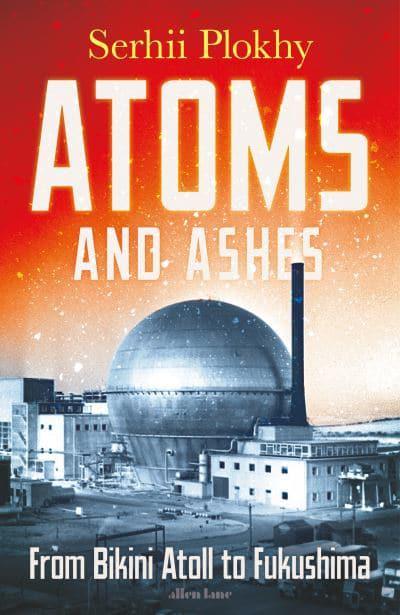
Atoms and Ashes—lessons from six of the world’s worst nuclear disasters
This is a powerful and timely book. At a time when arguments for nuclear power are returning as a way to solve both climate change and the energy crisis, we need to arm ourselves with the arguments. Not only is nuclear power not a solution to the problems we face, the lesson from this book is that it’s inherently dangerous and could have devastating consequences for life on earth.
https://socialistworker.co.uk/long-reads/atoms-to-ashes-lessons-from-six-of-the-wo2 27 June 22, Atoms and Ashes—from Bikini Atoll to Fukushima, the new book by Serhii Plokhy, is a compulsive but terrifying read, writes Amy Leather
Standing in front of Hinkley Point C nuclear power plant, Boris Johnson launched the Tories’ Energy Security Strategy in April. Nuclear energy was central to the plan. Johnson claimed the strategy would deliver “clean, affordable, secure power to the people for generations to come”. He called for 25 percent of our electricity to come from nuclear power by 2050—up from the current 16 percent. That means greatly increasing capacity, with Johnson bragging the first phase of the plan will involve building eight new nuclear reactors.
Reading Atoms and Ashes by Serhii Plokhy in this context is chilling. As Plokhy says at the start, his main purpose is to take a fresh look at the history of nuclear accidents. He looks at why they happened, how bad they were, what we can learn, and assesses if they could ever happen again.
To do this, he examines six of the world’s worst nuclear disasters—although he is very clear these are by no means the only accidents that have occurred. In fact, there have been hundreds of known incidents and probably even more that have been kept secret or covered up.
Plokhy starts with the Castle Bravo nuclear test that took place in March 1954 at Bikini Atoll, Marshall Islands, in the Pacific. A miscalculation of the hydrogen bomb’s radiation yield and wind direction significantly damaged human health and the environment. The book ends with the Fukushima disaster of 2011, when a 43-foot-high tsunami crashed over the Japanese nuclear plant causing three reactors to go into meltdown.
In between these terrible events Plokhy explores the 1957 Kyshtym disaster in Russia’s Ural Mountains. The explosion of a nuclear waste tank released a massive amount of radiation into the atmosphere. He examines the reactor fire at the Windscale works in Cumbria in the same year. And then he looks at the reactor meltdowns at Three Mile Island in the US in 1979 and the 1986 nuclear disaster at Chernobyl in what is now Ukraine.
It confirms in revealing detail what many of us who’ve campaigned against nuclear power already know—that it is neither clean nor safe. And, rather than a legacy of “secure power”, it will leave future generations nuclear waste, contaminated water and land, and the cost of clean ups, decontamination and decommissioning.
The catastrophic explosion at the Chernobyl plant made the entire region uninhabitable, with up to half a million people permanently displaced. A report in September 2005 put the predicted final death toll from radiation induced cancers at 4,000 people. The Union of Concerned Scientists suggests it could be more than six times that. Recent estimates put the number of deaths from the Fukushima disaster at 2,202 with some predicting thousands more extra cancer deaths. Around 150,000 people had to evacuate the region.
Lots of dangerous material is generated from nuclear power. One of the solutions is to bury high level nuclear waste underground. The US government buries its waste from weapons in New Mexico. The land will still be contaminated in 300,000 years’ time. Meanwhile in Japan, the future of over one million tons of contaminated water stored in a thousand tanks on the site of the Fukushima nuclear plant is unresolved. Last year the Japanese government decided to start releasing the water into the ocean—a process that could last decades and cause environmental damage.
Plokhy charts how the race to make atomic and hydrogen bombs drove the development of nuclear power during and just after the Second World War. Nuclear plants were first built to produce the plutonium needed for bombs, not to generate electricity. The first nuclear bombs were dropped by the US on Hiroshima and Nagasaki in Japan in August 1945, with devastating consequences.
It wasn’t until the end of 1953 that the US launched the concept of “atoms for peace”. President Dwight Eisenhower claimed that the nuclear industry could produce “good atoms” for energy. It was an attempt to reassure people after concerns were raised about nuclear energy. He wanted to change public perception in the US in order to win support for more investment in nuclear arms and weapons.
In Britain the first nuclear plant was Windscale, built in the village of Seascale on the Cumbrian coast. Construction began in 1947 and it went operational in 1950. The purpose of the nuclear reactors was to produce the material for a British bomb. Successive prime ministers—Labour and Tory—wanted to boost British nuclear capabilities. In the context of the Cold War’s imperialist competition between the US and Russia and British imperial decline, they sought to prove
Britain’s worth to the US. That meant developing a nuclear bomb as quickly as possible.
From the very beginning this competition between states to develop nuclear weapons meant great secrecy, cutting corners, taking risks and an often-cavalier attitude to safety. It becomes clear as each disaster plays out that—whether it was in the US, Russia or Britain—there was little care about that or the people affected by accidents and tests.
For example, when it came to the nuclear bomb tests in the Marshall Islands, those in charge proceeded despite knowing the risks. The people living on some nearby islands were not even told the tests were happening. The colonial mindset of the US meant the indigenous people of the Marshall Islands were either ignored or moved at will. And once suffering from radiation, they were subject to studies—not to help them recover but to help the industry assess the effects of radiation.
For example, when it came to the nuclear bomb tests in the Marshall Islands, those in charge proceeded despite knowing the risks. The people living on some nearby islands were not even told the tests were happening. The colonial mindset of the US meant the indigenous people of the Marshall Islands were either ignored or moved at will. And once suffering from radiation, they were subject to studies—not to help them recover but to help the industry assess the effects of radiation.
.Competition and secrecy meant that scientists developing and building the new nuclear reactors could not properly learn from each other. For example, those building the Windscale Works in the 1950s only learnt of new developments piecemeal from the US. Often it was too late to incorporate them into the reactor design. Plokhy describes how the scientists and engineers at Windscale didn’t find out about the need for radiation filters to be fitted on the chimneys until after construction had begun. Rather than start again, they were put at the top of the chimneys where they were less effective. Tellingly even this addition was nicknamed “Cockcroft’s Folly” after the man who insisted they had them at all. In fact, these filters helped trap much of the radiation when the reactor fire broke out.
From the start, Russia chose to use outdated and unsafe reactor designs. Safer ones would have taken longer to build and they had no time to spare when racing against the US. The operators and nuclear engineers at Chernobyl had not even been told about the previous accidents with this type of reactor. Similarly, no manager or operator at Three Mile Island had been told of problems with the type of reactor they were using. It had previously caused an accident at another plant.
The pressure to produce plutonium as quickly as possible meant cutting corners with safety. For example, something called “Wigner energy” builds up in the main body of the reactor while the fission reaction is taking place. This needs to be regularly released otherwise it ignites the graphite used to moderate the reaction. This special operation to release the excess energy is called “annealing”. But the procedure at Windscale required stopping the reactor, so reducing operational hours and productivity. Under pressure from the government to produce more bomb fuel the Windscale Technical Committee had decided to reduce the number of anneals. By the time the anneal finally took place the day before the reactor fire in October 1957, it was long overdue.
At the Chernobyl nuclear plant, in order to meet the deadline of December 1983, the fourth reactor had gone operational before a key safety test. It was not until April 1986 that plans were made to carry out this test. It meant shutting down the reactor. This is a very challenging operation and can lead to the reactor becoming unstable. What followed led to two massive blasts that flung off the shield that covered the top of the reactor. Masses of radioactive particles escaped into the atmosphere.
Prior to the disaster at Fukushima a scandal had broken out over the falsification of safety reports by the company—Tokyo Electric Power Company (TEPCO). According to Plokhy, from as early as 1977 “there were at least two hundred cases in which the company had supplied false information about inspections not carried out and issued reports that papered over existing problems”.
Nuclear power stations are often portrayed as calm laboratories where the experts are in charge. Bill Gates, a founder of nuclear innovation company TerraPower, has said that any problems will be solved by “innovation” and the “laws of physics”.
However, the descriptions in the book show the complete opposite of a calm, controlled environment. As Plokhy says, “Hazard is inherent in all nuclear power.” Atomic fission itself is dangerous, and nuclear reactors can be unreliable and unpredictable. The book makes clear how competition, secrecy, lack of communication as well as miscommunication make it extremely unsafe.
Plokhy describes almost minute by minute the trajectory of each disaster. In all of them, there comes a point when the scientists, the operators, the experts simply don’t know what to do to prevent the accident from worsening. In the end, due to the conditions they are operating under, they sometimes make decisions that actually make the situation worse. Or, by solving one problem, another one is created. At Windscale, they simply did not know how to stop the fire. At Chernobyl one issue among many was that they did not know if the radiation would get into the groundwater. And at Three Mile Island, two scientists were having a raging argument about what next steps to take in the midst of the emergency. Meanwhile, in every case, the authorities delayed evacuation plans.
.This is in no way to blame the individuals working at the time or those who had to deal with the accidents. They acted with immense bravery and sacrificed their own health, and even lives, to prevent greater disaster. Plokhy highlights how often the subsequent reports into accidents wrongly blame personnel and not the reactor designs. He illustrates how the conditions they were operating in and the nature of nuclear power led to such problems.
After each major accident, the authorities say they’ve learned the lessons and developed new technology that will prevent anything similar from happening. However, Plokhy highlights that there was – and still is—an inherent safety problem with nuclear reactors being used to generate power. They were never designed for that purpose. The reactors were developed from military prototypes to produce plutonium or to power nuclear submarines.
Many of the new, smaller reactors that have been designed from scratch to produce energy, are still at the computer-simulation stage and years away from construction. Plokhy predicts that the expansion in the number of plants now being proposed will increase the probability of accidents.
Although it is not discussed in the book, it is worth remembering that nuclear power is not carbon neutral. While nuclear fission itself does not release carbon emissions, every other stage of the production process means greenhouse gases are pumped into the atmosphere. More than almost any other form of energy generation nuclear power requires a complex cycle of mining, generation, storage and disposal. And in 2022 there are new risk factors. As Plokhy has written elsewhere, “Warfare, economic collapse, climate change itself—all of these increasingly real risks make nuclear sites potentially perilous places.”
This is a powerful and timely book. At a time when arguments for nuclear power are returning as a way to solve both climate change and the energy crisis, we need to arm ourselves with the arguments. Not only is nuclear power not a solution to the problems we face, the lesson from this book is that it’s inherently dangerous and could have devastating consequences for life on earth.
- Atoms and Ashes—from Bikini Atoll to Fukushima by Serhii Plokhy. £25.00 Available from Bookmarks—the socialist bookshop
After lying for months, the media are preparing the public for Ukraine’s military collapse.
THE AMERICAN CONSERVATIVE DOUGLAS MACGREGOR JUNE 17, 2022
Diogenes, one of the ancient world’s illustrious philosophers, believed that lies were the currency of politics, and those lies were the ones he sought to expose and debase. To make his point, Diogenes occasionally carried a lit lantern through the streets of Athens in the daylight. If asked why, Diogenes would say he was searching for an honest man.
Finding an honest man today in Washington, D.C., is equally challenging. Diogenes would need a Xenon Searchlight in each hand.
Russian errors were exaggerated out of all proportion to their significance. Russian losses and the true extent of Ukraine’s own losses were distorted, fabricated, or simply ignored. But conditions on the battlefield changed little over time. Once Ukrainian forces immobilized themselves in static defensive positions inside urban areas and the central Donbas, the Ukrainian position was hopeless. But this development was portrayed as failure by the Russians to gain “their objectives.
Ground-combat forces that immobilize soldiers in prepared defenses will be identified, targeted, and destroyed from a distance. When persistent overhead intelligence, surveillance, and reconnaissance assets, whether manned or unmanned, are linked to precision guided-strike weapons or modern artillery systems informed by accurate targeting data, “holding ground” is fatal to any ground force. This is all the more true in Ukraine, because it was apparent from the first action that Moscow focused on the destruction of Ukrainian forces, not on the occupation of cities or the capture of Ukrainian territory west of the Dnieper River.
The result has been the piecemeal annihilation of Ukrainian forces. Only the episodic infusion of U.S. and allied weapons kept Kiev’s battered legions in the field; legions that are now dying in great numbers thanks to Washington’s proxy war.
Kiev’s war with Moscow is lost. Ukrainian forces are being bled white. Trained replacements do not exist in sufficient numbers to influence the battle, and the situation grows more desperate by the hour. No amount of U.S. and allied military aid or assistance short of direct military intervention by U.S. and NATO ground forces can change this harsh reality.
The problem today is not ceding territory and population to Moscow in Eastern Ukraine that Moscow already controls. The future of the Kherson and Zaporozhye regions along with the Donbas is decided. Moscow is also likely to secure Kharkov and Odessa, two cities that are historically Russian and Russian-speaking, as well as the territory that adjoins them. These operations will extend the conflict through the summer. The problem now is how to stop the fighting…………….
The Guardian’s direct collusion with media censorship by secret services exposed

WSWS, Thomas Scripps, 22 June 2019, Minutes of Ministry of Defence (MoD) meetings have confirmed the role of Britain’s Guardian newspaper as a mouthpiece for the intelligence agencies.
Last week, independent journalist Matt Kennard revealed that the paper’s deputy editor, Paul Johnson, was personally thanked by the Defence and Security Media Advisory Notice (or D-Notice) committee for integrating the Guardian into the operations of the security services.
Minutes of a meeting in 2018 read: “The Chairman thanked Paul Johnson for his service to the Committee. Paul had joined the Committee in the wake of the Snowden affair and had been instrumental in re-establishing links with the Guardian.”
D-Notices are used by the British state to veto the publication of news damaging to its interests. The slavish collusion of the mainstream media ensures that such notices function as gag orders.
Johnson joined the committee in 2014 and evidently excelled in his performance. A separate set of minutes from the first meeting attended by Johnson records the Guardian’s close collaboration with military officials.
Under a section detailing “advice” given by the intelligence agencies to the media, the document reads “most of the occurrences and requests for advice were related to further publications by The Guardian of extracts from the Snowden documents. The Secretary reported that the engagement of DPBAC [Defence Press and Broadcasting Advisory Committee] Secretariat with The Guardian had continued to strengthen during the last six months, with regular dialogues between the Secretary and Deputy Secretaries and Guardian journalists.”
In September 2014, the Guardian allowed the former head of GCHQ (Government Communications Headquarters) Sir David Omand to publish an article titled, “Edward Snowden’s leaks are misguided—they risk exposing us to cyber-attacks.”
He declared, “Journalists are not best placed to identify security risks; we have to trust those who oversee the intelligence-gathering.”
In 2016, Paul Johnson used an unprecedented interview with a serving head of MI5, Andrew Parker, to propagandize for the antidemocratic, British warmongering interests .
These facts are damning proof of the Guardian’s total integration into the propaganda wing of the MoD following its involvement in the WikiLeaks and Snowden files releases. Indeed, the work of WikiLeaks and its founder Julian Assange has served to expose and confirm the deep ties of the entire mainstream media to the military-intelligence complex.
The Guardian has been viewed historically as the voice of British liberal dissent, critical of the worst excesses of British capitalism at home and abroad. But it has always acted as a political policeman—filtering the news “responsibly” and channelling the resulting anger into impotent moral appeals to the state and other authorities. Its dealings with Assange and Snowden transformed political allegiance into direct subservience. Its liberal, critical pretensions unravelled in a matter of a few months.
When Assange looked to the Guardian and other papers internationally such as the New York Times to publish the Afghan and Iraq war logs and secret US diplomatic cables in 2010, the editors’ main concern was damage control. Within a month of an initial publication of documents, the Guardian had broken off relations with Assange—publishing an infamous December 17 editorial “WikiLeaks: the man and the idea.” It stated that the Guardian had only agreed to publish “a small number of cables” to control the political fall-out from the details of murder, torture, espionage and corruption they revealed and give it the opportunity of “editing, contextualising, explanation and redaction.”
The main purpose of the editorial was to support Assange’s extradition to Sweden on trumped-up allegations of sexual misconduct relating to a trip to that country a few months earlier………………………………..
One of Assange’s persecutors-in-chief, Luke Harding, enjoys the most intimate relations with the security services. His notorious November 2018 fabrication, claiming Assange held meetings with US President Donald Trump’s former campaign manager Paul Manafort, was published in the Guardian just two weeks after Johnson was thanked for “re-establishing links” with the MoD. The story was widely cited and formed a keystone of the efforts, spearheaded by the Democrats in the US, to present WikiLeaks and “Russian interference” as the causes of Trump’s 2016 election victory……. https://www.wsws.org/en/articles/2019/06/22/guar-j22.html
Australian government lobbying behind the scenes for Assange’s freedom
“in the end the Americans can’t say no [to his release], given that President Obama commuted the sentence of Chelsea Manning for exposing the very war crime that Assange went on to publicise worldwide”.
“It was in Priti Patel’s power to do the right thing,” she said in a statement. “Instead, she will forever be remembered as an accomplice of the United States in its agenda to turn investigative journalism into a criminal enterprise.”
further appeals in British courts could rely on media reports last year that the CIA had planned to assassinate the Wikileaks founder. “There’s absolute validity to these matters .
https://www.theage.com.au/politics/federal/federal-government-lobbying-behind-the-scenes-for-assange-s-freedom-20220618-p5auq3.html By James Massola and Latika Bourke, June 19, 2022 —
The federal government is lobbying US counterparts behind the scenes to secure the freedom of Wikileaks founder Julian Assange, after the United Kingdom’s decision to approve his extradition to the United States.
The Trump administration brought charges against Assange under the Espionage Act relating to the leaking and publication of the WikiLeaks cables a decade ago.
The UK Home Office announced late on Friday (AEST) that “after consideration by both the Magistrates Court and High Court, the extradition of Julian Assange to the US was ordered”.
“In this case, the UK courts have not found that it would be oppressive, unjust or an abuse of process to extradite Mr Assange.
“Nor have they found that extradition would be incompatible with his human rights, including his right to a fair trial and to freedom of expression, and that whilst in the US he will be treated appropriately, including in relation to his health.”
Assange’s legal team has 14 days to appeal the decision to the High Court and will do so while he remains in Belmarsh prison.
Prime Minister Anthony Albanese, while still opposition leader in December, said “enough is enough” and that it was time for Assange to be returned to Australia.
Asked about Assange’s extradition on Saturday, he told The Sun-Herald and The Sunday Age that he stood by the comments he made in December.
At the time, Albanese said “he [Assange] has paid a big price for the publication of that information already. And I do not see what purpose is served by the ongoing pursuit of Mr Assange”.
Albanese met US President Joe Biden at the Quad meeting in Tokyo in late May, days after the federal election, but there has been no indication that he raised the Assange matter with him during their meeting.
A source in the federal government, who asked not to be named so they could discuss the matter, has confirmed to The Sun-Herald and The Sunday Age that Assange’s case has been raised with senior US officials.
Former foreign minister Bob Carr said the discussions over Assange’s release would be “governed by sensitive, nuanced alliance diplomacy appropriate between partners”.
“I trust the judgment of Prime Minister Albanese on this, given his recent statement cautioning against megaphone diplomacy and his comments last December,” he said.
But Carr predicted that “in the end the Americans can’t say no [to his release], given that President Obama commuted the sentence of Chelsea Manning for exposing the very war crime that Assange went on to publicise worldwide”.
“The Yank has had her sentence commuted; the Aussie faces an extradition and a cruel sentencing.”
Foreign Minister Penny Wong said on Friday that “Assange’s case has dragged on for too long and that it should be brought to a close. We will continue to express this view to the governments of the United Kingdom and United States”.
Albanese is due to attend the NATO summit in Madrid at the end of the month, which US President Joe Biden will also attend, though it is not clear if he will raise the matter there.
Assange’s wife, Stella Moris, hit out at UK Home Secretary Priti Patel for approving the extradition.
“It was in Priti Patel’s power to do the right thing,” she said in a statement. “Instead, she will forever be remembered as an accomplice of the United States in its agenda to turn investigative journalism into a criminal enterprise.”
Former prime minister Kevin Rudd tweeted that he disagreed with the decision to approve the extradition, even though he did not support Assange’s actions and “his reckless disregard for classified security information”.
“But if Assange is guilty, then so too are the dozens of newspaper editors who happily published his material.”
Labor MP Julian Hill said there could never be a legal solution to the case as it was inherently political and that “we should speak up for our fellow Australian and request that these charges be dropped and he not be extradited”.
Greens senator Jordon Steele-John said the extradition to the United States would set a dangerous precedent for press freedom and called on the prime minister to pick up the phone to his British and American counterparts.
Independent MP Andrew Wilkie, the chair of the Bring Julian Assange Home Parliamentary Group, has called Britain’s decision an outrageous betrayal of the rule of law, media freedom and human rights.
“This matter is so deeply wrong on so many levels … time’s up for the new federal government hinting at caring and then doing nothing,” he said.
“The new Australian government is now to be condemned for abandoning an Australian hero journalist facing the very real prospect of spending the rest of his life rotting in a US prison.”
Amnesty International is urging the UK to refrain from extradition and the US to drop all charges.
The secretary-general of the human rights organisation, Agnes Callamard, says allowing the Australian to be sent to the US for trial would put him at great risk.
“Assange faces a high risk of prolonged solitary confinement, which would violate the prohibition on torture or other ill treatment,” Callamard said.
“Diplomatic assurances provided by the US that Assange will not be kept in solitary confinement cannot be taken on face value given previous history.”
Adviser to the Australian campaign to free Mr Assange, Greg Barns SC, says Britain’s decision is unsurprising given past approaches.
“The UK does not regard the extradition as being political when it clearly is,” he told ABC News on Saturday.
He says further appeals in British courts could rely on media reports last year that the CIA had planned to assassinate the Wikileaks founder.
“There’s absolute validity to these matters … the real issue is do we let this matter go back into the court system for another couple of years or do we say there are important principles here.”
There had been a change in rhetoric on the matter from the new government and statements from Prime Minister Anthony Albanese and Ms Wong had heartened the campaign, Mr Barns said.
“We’re certainly urging and hoping that now is the time for Australia to get involved with its key allies in London and Washington and bring this matter to an end.”
Assange Is Doing His Most Important Work Yet

https://caityjohnstone.medium.com/assange-is-doing-his-most-important-work-yet-7b3ba4f3bea3 Caitlin Johnstone, 18 June 22, British Home Secretary Priti Patel has authorized the extradition of WikiLeaks founder Julian Assange to the United States to be tried under the Espionage Act in a case which seeks to set a legal precedent for the prosecution of any publisher or journalist, anywhere in the world, who reports inconvenient truths about the US empire.
Assange’s legal team will appeal the decision, reportedly with arguments that will include the fact that the CIA spied on him and plotted his assassination.
“It will likely be a few days before the (14-day appeal) deadline and the appeal will include new information that we weren’t able to bring before the courts previously. Information on how Julian lawyers were spied on, and how there were plots to kidnap and kill Julian from within the CIA,” Assange’s brother Gabriel Shipton told Reuters on Friday.
And thank goodness. Assange’s willingness to resist Washington’s extradition attempts benefit us all, from his taking political asylum in the Ecuadorian embassy in 2012 until British police forcibly dragged him out in 2019, to his fighting US prosecutors in the courtroom tooth and claw during his incarceration in Belmarsh Prison.
Assange’s fight against US extradition benefits us not just because the empire’s war against truth harms our entire species and not just because he cannot receive a fair trial under the Espionage Act, but because his refusal to bow down and submit forces the empire to overextend itself into the light and show us all what it’s really made of.
Washington, London and Canberra are colluding to imprison a journalist for telling the truth: the first with its active extradition attempts, the second with its loyal facilitation of those attempts, and the third with its silent complicity in allowing an Australian journalist to be locked up and persecuted for engaging in the practice of journalism. By refusing to lie down and forcing them to come after him, Assange has exposed some harsh realities of which the public has largely been kept unaware.
The fact that London and Canberra are complying so obsequiously with Washington’s agendas, even while their own mainstream media outlets decry the extradition and even while all major human rights and press freedom watchdog groups in the western world say Assange must go free, shows that these are not separate sovereign nations but member states of a single globe-spanning empire centralized around the US government. Because Assange stood his ground and fought them, more attention is being brought to this reality.
By standing his ground and fighting them, Assange has also exposed the lie that the so-called free democracies of the western world support the free press and defend human rights. The US, UK and Australia are colluding to extradite a journalist for exposing the truth even as they claim to oppose tyranny and autocracy, even as they claim to support world press freedoms, and even as they loudly decry the dangers of government-sponsored disinformation.
Because Assange stood his ground and fought them, it will always reek of hypocrisy when US presidents like Joe Biden say things like, “The free press is not the enemy of the people — far from it. At your best, you’re guardians of the truth.”
Because Assange stood his ground and fought them, people will always know British prime ministers like Boris Johnson are lying when they say things like, “Media organisations should feel free to bring important facts into the public domain.”
Because Assange stood his ground and fought them, more of us will understand that they are being deceived and manipulated when Australian prime ministers like Anthony Albanese say things like “We need to protect press freedom in law and ensure every Australian can have their voice heard,” and “Don’t prosecute journalists for just doing their jobs.”
Because Assange stood his ground and fought them, US secretaries of state like Antony Blinken will have a much harder time selling their schtick when they say things like “On World Press Freedom Day, the United States continues to advocate for press freedom, the safety of journalists worldwide, and access to information on and offline. A free and independent press ensures the public has access to information. Knowledge is power.”
Because Assange stood his ground and fought them, UK home secretaries like Priti Patel will be seen for the frauds they are when they say things like “The safety of journalists is fundamental to our democracy.”
Extraditing a foreign journalist for exposing your war crimes is as tyrannical an agenda as you could possibly come up with. The US, UK and Australia colluding toward this end shows us that these are member states of a single empire whose only values are domination and control, and that all its posturing about human rights is pure facade. Assange keeps exposing the true face of power.
There is in fact a strong argument to be made that even all these years after the 2010 leaks for which he is currently being prosecuted, Assange is doing his most important work yet. As important as his WikiLeaks publications were and are, none of them exposed the depravity of the empire as much as forcing them to look us in the eye and tell us they’ll extradite a journalist for telling the truth.
Assange accomplished this by planting his feet and saying “No,” even when every other possible option would have been easier and more pleasant. Even when it was hard. Even when it was terrifying. Even when it meant being locked away, silenced, smeared, hated, unable to fight back against his detractors, unable to live a normal life, unable to hold his children, unable even to feel sunlight on his face.
His very life casts light on all the areas where it is most sorely needed. We all owe this man a tremendous debt. The least we can do is try our best to get him free.
Can Australian Prime Minister Anthony Albanese save Julian Assange?
New Prime Minister Anthony Albanese, has said he couldn’t see any purpose in keeping Assange in gaol, stating “enough is enough”. In the first week of the Albanese Government, the ABC reported: ‘Mr Albanese is also a signatory to the Bring Julian Assange Home Campaign petition.’
Questioned by The Guardian – Albanese replied that it was his position that “not all foreign affairs is best done with the loudhailer”.
So – we are now getting used to an Australian Prime Minister who values thinking and diplomacy rather than bull-dozing and bullying tactics . So there’s hope.
On the other hand, there’s the determination of the U.S.military-industrial-complex, which rules U.S. politics – to punish Julian Assange for exposing U.S. military’s war crimes. And the subservience of the U.K. to USA, now vested in just oned person, Home Secretary Priti Patel, who shows no sign of having the integrity to stand up for justice.
It is ironic that everyone is now (rightly) jumping up and down about Russian military atrocities, and praising reporters who reveal these – but it seems it’s OK to persecute Assange for revealing U.S. military atrocities?
Julian Assange and family suffer as unjust detention continues
Independent Australia By Binoy Kampmark | 16 June 2022,
The documentary Ithaka powerfully depicts the fight Julian Assange’s family is putting up for him, writes Dr Binoy Kampmark.
JOHN Shipton, despite his size, glides with insect-like grace across surfaces. He moves with a hovering sense, a holy man with message and meaning. As Julian Assange’s father, he has found himself a bearer of messages and meaning, attempting to convince those in power that good sense and justice should prevail over brute stupidity and callousness.
His one object: release Julian………………………..
The documentary Ithaka powerfully depicts the fight Julian Assange’s family is putting up for him, writes Dr Binoy Kampmark.
JOHN Shipton, despite his size, glides with insect-like grace across surfaces. He moves with a hovering sense, a holy man with message and meaning. As Julian Assange’s father, he has found himself a bearer of messages and meaning, attempting to convince those in power that good sense and justice should prevail over brute stupidity and callousness.
His one object: release Julian…………………..
The documentary Ithaka powerfully depicts the fight Julian Assange’s family is putting up for him, writes Dr Binoy Kampmark.
JOHN Shipton, despite his size, glides with insect-like grace across surfaces. He moves with a hovering sense, a holy man with message and meaning. As Julian Assange’s father, he has found himself a bearer of messages and meaning, attempting to convince those in power that good sense and justice should prevail over brute stupidity and callousness.
His one object: release Julian……………………………….
Soft, a voice of reed and bird song, Shipton urged activists and citizens to join the fray, to save his son, to battle for a cause imperishably golden and pure. From this summit, power would be held accountable, institutions would function with sublime transparency, and citizens could be assured that their privacy would be protected.
In the documentary Ithaka, directed by Ben Lawrence, we see Shipton, Assange’s partner, Stella Moris, the two children, the cat and glimpses of brother Gabriel, all pointing to the common cause that rises to the summit of purpose. The central figure, who only ever manifests in spectral form – on-screen via phone or fleeting footage – is one of moral reminder, the purpose that supplies blood for all these figures.
Assange is being held at Belmarsh, Britain’s most secure and infamous of prisons, denied bail and being crushed by judicial procedure. But in these supporters, he has some vestigial reminders of a life outside.
The film’s promotion site describes the subject as ‘the world’s most famous political prisoner, WikiLeaks founder Julian Assange’ a figure who has ‘become an emblem of an international arm wrestle over freedom of journalism, government corruption and unpunished war crimes’. ………..
suffer he shall, if the UK Home Secretary Priti Patel decides to agree to the wishes of the U.S. Department of Justice (DOJ).
The DOJ insists that their man face 17 charges framed, disgracefully and archaically, from a U.S. law passed during World War I and inimical to free press protections. The Espionage Act of 1917 has become the crutch and support for prosecutors who see, in Assange, less a journalist than an opportunistic hacker who outed informants and betrayed confidences. ……………………..
Through the film, the exhausting sense of media, that estate ever-present but not always listening, comes through. This point is significant enough; the media – at least in terms of the traditional fourth estate – put huge stock in the release of material from WikiLeaks in 2010, hailing the effort and praising the man behind it.
But relations soured, and tabloid nastiness set in. The Left found tell-all information and tales of Hillary Clinton too much to handle while the Right, having initially revelled in the revelations of WikiLeaks in 2016, took to demonising the herald. Perversely, in the United States, accord was reached across a good number of political denizens: Assange had to go, and to go, he had to be prosecuted in the United Kingdom and extradited to the United States.
The documentary covers the usual highlights without overly pressing the viewer. A decent run-up is given to the Ecuadorian stint lasting seven years, with Assange’s bundling out, and the Old Bailey proceedings covering extradition. But Shipton and Moris are the ones who provide the balancing acts in this mission to aid the man they both love……….
The film has faced, as with its subject, the usual problems of distribution and discussion. When Assange is mentioned, the dull-minded exit for fear of reputation, and the hysterical pronounce and pounce.
In Gabriel Shipton’s words:
“All of the negative propaganda and character assassination is so pervasive that many people in the sector and the traditional distribution outlets don’t want to be seen as engaging in advocacy for Julian.”
Where Assange goes, the power monopolies recoil. Distribution and the review of a documentary such as Ithaka is bound to face problems in the face of such a compromised, potted media terrain. Assange is a reminder of the plague in the patient of democracy, a pox on the body politic. ……….. https://independentaustralia.net/life/life-display/julian-assange-and-family-suffer-as-unjust-detention-continues,16470#.YqqqxM6TP0M.twitter
Ukraine staging battle scenes for propaganda – Russia
Russia, https://www.rt.com/russia/556544-staged-footage-action-ukraine/ 7 June 22, The propaganda footage was allegedly sponsored by the British government, The Russian Defense Ministry released on Friday what it claimed to be staged combat scenes filmed on behalf of the Ukrainian government and paid for by the British government. The two short clips appear to be raw footage of what looks like a war movie.
The filming of the videos took place on May 28 in the town of Meshkovka in Ukraine’s Nikolaev Region, the ministry said. A train station of the same name is located on the outskirts of the provincial capital in the south of the country.
One of the videos shows two armored vehicles facing the camera. At the command of a woman, who appears to be the film director, the backdoor of the closest vehicle opens, and a group of armed men in uniform wearing red armbands starts pouring out. Several others rise from the grass around the second vehicle in the distance and start moving forward, their weapons raised.
The second clip is a shootout scene, with a group of armed uniformed men retreating through rubble while firing back at an unseen enemy. Pyrotechnics appear to simulate enemy fire. At one point, a professional-looking film crew comes into view.
New film shows the anguish and destruction of the Chernobyl nuclear disaster
| A new documentary contains “lost tapes” of the Chornobyl disaster that have never been seen before, showing the horrific destruction and anguish that occurred during and after the worst nuclear incident in history. In a new trailer for the Sky Original documentary, Chernobyl: The Lost Tapes, HBO released small snippets of footage of the heroic workers that fought to contain the fallout and of the thousands of residents evacuating the area, including the voices of locals that the documentary claims were “silenced” following the disaster. IFL 6th June 2022https://www.iflscience.com/editors-blog/lost-tapes-of-chernobyl-reveal-the-devastating-impact-of-the-worst-nuclear-disaster/ |
Caitlin Johnson, rogue journalist, on corporate control of the media

The report says that toward this end the US government has deliberately circulated false or poorly evidenced claims about impending chemical weapons attacks, about Russian plans to orchestrate a false flag attack in the Donbass…………………. So they lied. They may hold that they lied for a noble reason, but they lied. They knowingly circulated information they had no reason to believe was true, and that lie was amplified by all the most influential media outlets in the western world.
Nowadays the CIA collaboration happens right out in the open, and people are too propagandized to even recognize this as scandalous. Immensely influential outlets like The New York Times uncritically pass on CIA disinfo which is then spun as fact by cable news pundits. The Washington Post has consistently refused to disclose the fact that its sole owner has been a CIA contractor when reporting on US intelligence agencies as per standard journalistic protocol.
Ten Times Empire Managers Showed Us That They Want To Control Our Thoughts
https://caitlinjohnstone.com/2022/05/29/ten-times-empire-managers-showed-us-that-they-want-to-control-our-thoughts/ Caitlin Johnstone, 30 May 22,
The single most overlooked and under-appreciated aspect of our society is the fact that immensely powerful people are continuously working to manipulate the thoughts we think about the world. Whether you call it propaganda, psyops, perception management or public relations, it’s a real thing that happens constantly, and it happens to all of us.
And its consequences shape our entire world.
This should be at the forefront of our attention when examining news, trends and ideas, but it hardly ever gets mentioned. This is because the mass-scale psychological manipulation is succeeding. Propaganda only works if you don’t know it’s happening.
To be clear, I am not talking about some kind of wacky unsubstantiated conspiracy theory here. I am talking about a conspiracy fact. That we are propagandized by people with authority over us is not seriously in dispute by any well-informed good faith actor and has been extensively described and documented for many years.
More than this, the managers of the US-centralized empire which dominates the west and so much of the rest of the world have straightforwardly shown us that they propagandize us and want to propagandize us more. They have shown us with their actions, and they have at times come right out and told us with their words.
Here are just a few of those times.
1. Operation Mockingbird
Let’s start with maybe the best-known example. In 1977 Carl Bernstein published an article titled “The CIA and the Media” reporting that the CIA had covertly infiltrated America’s most influential news outlets and had over 400 reporters who it considered assets in a program known as Operation Mockingbird.
It was a major scandal, and rightly so. The news media are meant to report truthfully about what happens in the world, not manipulate public perception to suit the agendas of spooks and warmongers.
But it only got worse from there.
2. Intelligence operatives now just openly working in the media
Continue readingNo credibility in the way that the Ukraine war is being reported – says Colonel Richard Black (ret)

Video: Col. Richard Black — U.S. Leading World to Nuclear War, The International Schiller Institute, 27 May 22, Mike Billington with Executive Intelligence Review interviews Col. Richard Black (ret.).
”…………………………..BILLINGTON: Many flag grade officers certainly understand the consequences that you just described in a rather hair-raising way. Why is it that, while there are some generals speaking out in Italy, in France, in Germany, warning that we are pursuing a course that could lead to nuclear war, why are there not such voices from flag grade officers—retired, perhaps—saying what you’re saying here today?
BLACK: You know, there’s been a tremendous deterioration in the quality of flag officers………. we now have “yes men.” These are not people whose principal devotion is to the United States and its people. Their principal devotion is to their careers and their ability to network with other military officers upon retirement. There’s a very strong network that can place military generals into think tanks, where they promote war, into organizations like Raytheon and Northrop Grumman, and all of these defense operations, where they can get on boards and things like that. So there’s quite a personal price that you pay for saying, “Hey, stop. War is not in the interests of the American people.” If we had a better quality of individual, we would have people with the courage who would say, “I don’t care what it costs me personally.” But it is very difficult to get into the senior ranks, if you are an individual guided by principle, and patriotism, and devotion to the people of this nation. That’s just not how it works. And at some point, we need a President who will go in and shake the tree, and bring a lot of these people falling down from it, because they’re dangerous. They’re very dangerous to America.
………………. Just like I asked what’s keeping the generals from speaking out, why, and what will it take, to get Americans to recognize that we can and must sit down with Russians, and with Chinese, and with all other nations and establish a true, just world based on the dignity of man and the right to development and security?
………. at this point, the media have been so totally censored and so biased that the American people really don’t have a perception of the need for anything of that sort. It’s going to be difficult.
………… The idea that somehow we have this enormously just cause, it doesn’t strike a great deal of the world that it is just, and much of the world does not accept the latest propaganda about war crimes: this thing about Bucha. That’s probably the most prominent of all the war crimes discussions.
And what was Bucha? There was a film taken of a vehicle driving down the road in Bucha, which had been recaptured from the Russians. And every hundred feet or so there was some person with his hands, zip tied behind his back, and he’d been killed. It was not announced until four days after the Ukrainians had retaken Bucha.
Now, we knew almost nothing about it. We actually didn’t even have proof that people had been killed. But assuming they had, we didn’t know where they had been killed. We did not know who they were. We did not know who killed them. We did not know why they were killed. No one could provide an adequate motive for the Russians to have killed them. The Russians held Bucha for a month. If they were going to kill them, why didn’t they kill them during that month? And if you’re going to slaughter a bunch of people, wouldn’t they all be in one place and wouldn’t you gun them all down there? Why would they be distributed along a roadside, a mile along the way? It makes no sense!
What we do know is that four days after the mayor of Bucha joyously announced that the city was liberated, four days after the Ukrainian army had moved in, and their special propaganda arm of the Ukrainian military were there, all of a sudden there were these dead people on the road. How come they weren’t there when the Russians were there? How come they only appeared after the Russians were gone?
If I were looking at it as simply a standard criminal case, and I was talking to Criminal Investigation Division or the FBI, or military police or something, I’d say, “OK, the first thing, let’s take a look at the Ukrainians.” My guess would be, and you start with a hunch when you’re investigating a crime—my hunch is that the Ukrainians killed off these people after they moved in, and after they looked around, and said, “OK, who was friendly towards the Russian troops while the Russians were here? We’re going to execute them.” That would be my guess. Because I don’t see any motive for the Russians to have just killed a few people on their way out of town.
And nobody questions this, because the corporate media are so monolithic. We know for a fact, from the mouth of the head of a Ukrainian hospital, the guy who ran the hospital, he boasted that he had given strict orders to all of his doctors, that when wounded Russian POWs, when casualties were brought in, they were to be castrated. Now, this is a horrific war crime, admitted from the mouth of the hospital administrator, and the Ukrainian government said, “we’ll kind of look into that,” Like it’s no big thing. I can’t think of a more horrific, horrific war crime, ever. Where did you hear about it, on ABC and MSNBC and CNN and FOX News? Not a whisper. And yet the proof is undeniable. We had another clip where there was a POW gathering point, where the Ukrainians would bring POWs to a central point for processing—and this is about a seven-minute video—and the Ukrainian soldiers simply gunned them all down.
And they had probably 30 of these wounded Russian soldiers lying on the ground, some of them clearly dying from their wounds. Some of them, they put plastic bags over their heads. Now, these are these are guys who are laying there, sometimes fatally wounded with their hands zip-tied behind their backs, and they’ve got plastic bags over their heads, making it difficult to breathe. And because they can’t raise their hands, they can’t take the bags off, so that they can breathe. At the end of the video, the Ukrainians bring in a van, and there are three unwounded Russian POWs. Without the slightest thought or hesitation, as the three come off, and their hands are bound behind their backs, they gunned down two of them, right on camera and they fall over. And the third one gets on his knees, and begs that they won’t hurt him. And then they gun him down! These are crimes. And these were not refuted by the Ukrainian government. But you’d never even know that they occurred! So far, I will tell you that the only proven—I’m not saying that there aren’t war crimes happening on both sides. I’m just telling you, that the only ones where I have seen, fairly irrefutable proof of war crimes, have been on the Ukrainian side.
Now, often you hear it said, well, the Russians have destroyed this or destroyed that. Well, I’ve got to tell you, you go back to the wars that we fought when we invaded Iraq, the “Shock and Awe,” we destroyed virtually everything in Iraq, everything of significance. We bombed military and civilian targets without much discrimination. The coalition flew 100,000 sorties in 42 days. You compare that to the Russians, who have only flown 8,000 sorties in about the same period of time. 100,000 American sorties versus 8,000, in about the same time. I think the Russians have tended to be more selective. Whereas we went out — the philosophy of Shock and Awe is that you destroy everything that is needed to sustain human life and for a city to function. You knock out the water supply, the electrical supply, the heat, the oil, the gasoline; so that you knock out all of the major bridges. And then you just continue to destroy everything.
So it’s really ironic. And keep in mind, Iraq is a relatively small country. Ukraine is a huge country. 100,000 sorties in 42 days, 8,000 sorties in about the same time. A tremendous difference in violence between what we did in Iraq, and what they have done in Ukraine. So there’s simply no credibility when you actually get down to the facts and you look at the way that the war has been conducted…………… https://schillerinstitute.com/blog/2022/04/26/video-col-richard-black-u-s-leading-world-to-nuclear-war/
Hiroshima man’s anime sheds light on Fukushima nuclear project
THE ASAHI SHIMBUN 27 May 22, Hiroshima resident Hidenobu Fukumoto was astonished when he learned there was once a plan to build a nuclear power plant in his hometown, the first city devastated by a nuclear bomb.
He discovered the shocking news by chance while visiting Fukushima Prefecture, which suffered its own nuclear disaster in 2011, as a “kamishibai” picture card show artist.
“I was stunned,” said Fukumoto, who has produced about 170 kamishibai titles based on the accounts of residents affected by the disaster. “I decided to face up to the new fact about Hiroshima I discovered during my visits to Fukushima.”Hiroshima resident Hidenobu Fukumoto was astonished when he learned there was once a plan to build a nuclear power plant in his hometown, the first city devastated by a nuclear bomb.
He discovered the shocking news by chance while visiting Fukushima Prefecture, which suffered its own nuclear disaster in 2011, as a “kamishibai” picture card show artist.
“I was stunned,” said Fukumoto, who has produced about 170 kamishibai titles based on the accounts of residents affected by the disaster. “I decided to face up to the new fact about Hiroshima I discovered during my visits to Fukushima.”
The anime, titled “Fukushima Genpatsu Hajimari Monogatari: Toge” (The prologue to the Fukushima nuclear power plant: Mountain pass), portrays a man in his 60s who was born in 1949 in Okuma, a town in Fukushima Prefecture that co-hosts the now-stricken plant.
When Japan’s economy begins booming following the period of postwar poverty, the protagonist enters a university in Tokyo and enjoys his college life.
The story illustrates the major events leading up to the construction of the nuclear plant in Fukushima Prefecture at a time when people in Japan were suddenly blessed with material wealth.
The anime, titled “Fukushima Genpatsu Hajimari Monogatari: Toge” (The prologue to the Fukushima nuclear power plant: Mountain pass), portrays a man in his 60s who was born in 1949 in Okuma, a town in Fukushima Prefecture that co-hosts the now-stricken plant.
When Japan’s economy begins booming following the period of postwar poverty, the protagonist enters a university in Tokyo and enjoys his college life.
The story illustrates the major events leading up to the construction of the nuclear plant in Fukushima Prefecture at a time when people in Japan were suddenly blessed with material wealth.
Another scene shows young people in Fukushima leaving their hometown to seek jobs, while long-term residents are split over whether the prefecture should host a nuclear plant.
When the protagonist eventually returns home in Okuma and sees a massive nuclear plant standing in the town, he is left speechless.
The anime then fast-forwards to 2011, when the Great East Japan Earthquake and tsunami triggered the triple meltdown at the plant.
“The move to promote atomic power prevailed globally under the pretext of the peaceful use of nuclear energy, overshadowing even the destruction of Hiroshima brought on by the atomic bomb,” the protagonist said while living as an evacuee at the end of the story. “Ordinary people like us could do nothing about it.”………………………………………….
STORY HITS HOME
Fukumoto’s kamishibai project has struck a chord with many Fukushima residents who experienced the nuclear disaster…………………………………
Kinue Ishii, 70, who also performs kamishibai with Oka as a member of a storytelling group, said people can think deeply about the nuclear accident by learning why the nuclear plant was built in Fukushima.
“I want people to imagine themselves becoming victims of a nuclear accident by watching this anime,” Ishii said.
Hisai Yashima, 56, another member of the storytelling group, said she hopes the anime will help raise awareness of what led to the construction of the nuclear plant because people from outside Fukushima often ask her why the prefecture approved the plan.
The package of an anime DVD and a 16-page, A4-size picture book costs 2,000 yen ($16). For more details, visit the production committee’s website: https://matimonogatari.iinaa.net) (Japanese only).
(This article was compiled from reports by Miki Morimoto and Yusuke Noda.) https://www.asahi.com/ajw/articles/14604129
Extraditing Julian Assange would be a gift to secretive, oppressive regimes
Handing over the WikiLeaks founder to the US will benefit those around the world who want to evade scrutiny

Peter Oborne 22 May 22, https://www.theguardian.com/commentisfree/2022/may/20/extradite-julian-assange-investigative-journalism-wikileaks
In the course of the next few days, Priti Patel will make the most important ruling on free speech made by any home secretary in recent memory. She must resolve whether to comply with a US request to extradite Julian Assange on espionage charges.
The consequences for Assange will be profound. Once in the US he will almost certainly be sent to a maximum-security prison for the rest of his life. He will die in jail.
The impact on British journalism will also be profound. It will become lethally dangerous to handle, let alone publish, documents from US government sources. Reporters who do so, and their editors, will risk the same fate as Assange and become subject to extradition followed by lifelong incarceration.
For this reason Daniel Ellsberg, the 91-year-old US whistleblower who was prosecuted for his role in the Pentagon Papers revelations, which exposed the covert bombing of Laos and Cambodia and thus helped end the Vietnam war, has given eloquent testimony in Assange’s defence.
He told an extradition hearing two years ago that he felt a “great identification” with Assange, adding that his revelations were among the most important in the history of the US.
The US government does not agree. It maintains that Assange was effectively a spy and not a reporter, and should be punished accordingly.
Up to a point this position is understandable. Assange was anything but an ordinary journalist. His deep understanding of computers and how they could be hacked singled him out from the professionally shambolic arts graduates who normally rise to eminence in newspapers.
The ultimate creature of the internet age, in 2006 he helped found WikiLeaks, an organisation that specialises in obtaining and releasing classified or secret documents, infuriating governments and corporations around the world.
The clash with the US came in 2010, when (in collaboration with the Guardian, Der Spiegel, Le Monde, the New York Times and other international news organisations) WikiLeaks entered into one of the great partnerships of the modern era in any field. It started publishing documents supplied by the US army intelligence analyst Chelsea Manning.
Between them, WikiLeaks and Manning were responsible for a series of first-class scoops that any self-respecting reporter would die for. And these scoops were not the tittle-tattle that comprises the daily fodder of most journalism. They were of overwhelming global importance, reshaping our understanding of the Iraq war and the “war on terror”.
To give one example among thousands, WikiLeaks published a video of soldiers in a US helicopter laughing as they shot and killed unarmed civilians in Iraq – including a Reuters photographer and his assistant. (The US military refused to discipline the perpetrators.)
To the intense embarrassment of the US, WikiLeaks revealed that the total number of civilian casualties in Iraq was 66,000 – far more than the US had acknowledged.
It shone an appalling new light on the abuse meted out to the Muslim inmates at Guantánamo Bay, including the revelation that 150 innocent people were held for years without charge.
Clive Stafford Smith, the then chairman of the human rights charity Reprieve who represented 84 Guantánamo prisoners, praised the way WikiLeaks helped him to establish that charges against his clients were fabricated.
It’s easy to see why the US launched a criminal investigation. Then events took an unexpected turn in November 2010 when Sweden issued an arrest warrant against Assange following allegations of sexual misconduct. Assange refused to go to Sweden, apparently on the grounds that this was a pretext for his extradition to the United States and took refuge in the Ecuadorian embassy in London. Sweden never charged Assange with an offence, and dropped its investigation in 2019.
This was an eventful year in the Assange story. Ecuador kicked him out of the embassy and he was promptly arrested for breaching bail: he’s languished for the past three years in Belmarsh prison. Meanwhile the US pursues him using the same 1917 Espionage Act under which Ellsberg was unsuccessfully prosecuted. Assange’s defence, led by the solicitor Gareth Peirce and Edward Fitzgerald QC, has argued that his only crime was the crime of investigative journalism.
They point out that the indictment charges Assange with actions, such as protecting sources, that are basic journalistic practice: the US alleges that “Assange and Manning took measures to conceal Manning as the source of the disclosure of classified records”. Any journalist who failed to take this elementary precaution when supplied with information by a source would be sacked.
The US stated that Assange “actively encouraged Manning” to provide the information. How disgraceful! No wonder Kenneth Roth, the executive director of Human Rights Watch, has warned that: “It is dangerous to suggest that these actions are somehow criminal rather than steps routinely taken by investigative journalists who communicate with confidential sources to receive classified information of public importance.”
Despite all this, there’s no reason to suppose that Patel will come to Assange’s rescue – though there may yet be further legal ways to fight extradition.
Even if Patel wasn’t already on the way to winning the all-corners record as the most repressive home secretary in modern history, the Johnson government, already in Joe Biden’s bad books, has no incentive to further alienate the US president.
If and when Assange is put on a plane to the US, investigative journalism will suffer a permanent and deadening blow.
And the message will be sent to war criminals not just in the US but in every country round the globe that they can commit their crimes with impunity.
New book – does nuclear power have a future?
| Dave Elliott: Nuclear power’s development has been both exciting and difficult, as well as controversial. In this new book, an updated and much expanded second edition of the 2017 text that I wrote for the Institute of Physics (IoP), I look first at the early history of nuclear innovation in the 1950s, when, growing out of the weapons programme, a wide range of ideas for uranium fission reactors were tested, mainly in the USA and UK. As it attempts to show, many of the pilot projects were unsuccessful, indeed some proved dangerous, but some viable lines of power plant development were identified, mostly water-cooled reactors. The book then moves on to the present, when, with economic problems facing the current generation of water-cooled nuclear plants, some of the other older ideas are being revisited. The book looks critically at progress on these ideas so far and asks will any of them be successful, or will nuclear fission prove to be a dead end as an energy option? It also looks at the state of play with nuclear fusion, a parallel development often seen as providing the ultimate energy source for the long term, and it asks whether that is likely to be viable in time to respond to climate change. Overall, it adopts a critical approach. With renewable expanding rapidly around the world as their costs fall, the case for nuclear is, arguably, much weakened. It is still possible that it will revive, with new cheaper technology, but that case has to be made, not just assumed. Nuclear power is often promoted as a viable energy option for major expansion in the future, perhaps alongside renewables, but it clearly has significant problems. By looking back to the past, and also at current progress with new nuclear technology based on earlier ideas, this book aims to identify whether nuclear has a future. Renew Extra 21st May 2022 https://renewextraweekly.blogspot.com/2022/05/nuclear-power-past-present-and-future.html |
Disinformation’ Label Serves to Marginalize Crucial Ukraine Facts
To ignore the fact that prolonged military aid could reshape Ukraine’s politics in favor of neo-Nazi groups prevents an understanding of the threats posed to Ukrainian democracy and civil society.
These “disinformation” claims also ignore the more contemporary evidence that Western officials have an explicit agenda of weakening Russia and even ending the Putin regime. According to Ukrainska Pravda (5/5/22; Intercept, 5/10/22), in his recent trip to Kyiv, UK prime minister Boris Johnson told Volodymyr Zelensky that regardless of a peace agreement being reached between Ukraine and Russia, the United States would remain intent on confronting Russia.
https://fair.org/home/disinformation-label-serves-to-marginalize-crucial-ukraine-facts/– 18 May 22,
Disinformation has become a central tool in the United States and Russia’s expanding information war. US officials have openly admitted to “using information as a weapon even when the confidence and accuracy of the information wasn’t high,” with corporate media eager to assist Washington in its strategy to “pre-empt and disrupt the Kremlin’s tactics, complicate its military campaign” (NBC, 4/6/22).
In defense of the US narrative, corporate media have increasingly taken to branding realities inconvenient to US information goals as “disinformation” spread by Russia or its proxies.
The New York Times (1/25/22) reported that Russian disinformation doesn’t only take the form of patently false assertions, but also those which are “true but tangential to current events”—a convenient definition, in that it allows accurate facts to be dismissed as “disinformation.” But who determines what is “tangential” and what is relevant, and what are the guiding principles to make such a determination? In this assessment, Western audiences are too fickle to be trusted with making up their own mind.
There’s no denying that Russia’s disinformation campaign is key to justifying its war on Ukraine. But instead of uncritically outsourcing these decisions to Western intelligence officials and weapons manufacturers, and as a result erasing realities key to a political settlement, the media’s ultimate guiding principle for what information is “tangential” should be whether it is relevant to preventing the further suffering of Ukrainian civilians—and reducing tensions between the world’s two largest nuclear powers.
For Western audiences, and US citizens in particular, labeling or otherwise marginalizing inconvenient realities as “disinformation” prevents a clear understanding of how their government helped escalate tensions in the region, continues to obstruct the possibility of peace talks, and is prepared to, as retired senior US diplomat Chas Freeman describes it, “fight to the last Ukrainian” in a bid to weaken Russia.
Coup ‘conspiracy theory’
For example, the New York Times (4/11/22) claimed that US support for the 2014 “Maidan Revolution” that ousted Ukraine’s democratically elected President Viktor Yanukovych was a “conspiracy theory” being peddled by the Chinese government in support of Russia. The article featured an image with a red line crossing out the face of journalist Benjamin Norton, who was appearing on a Chinese news channel to discuss how the US helped orchestrate the coup. (Norton wrote for FAIR.org frequently from 2015–18.) The evidence he presented—a leaked call initially reported by the BBC in which then–State Department official Victoria Nuland appears to select opposition leader Arseniy Yatsenyuk to be Ukraine’s new prime minister—is something, he noted, that the Times itself has reported on multiple times (2/6/14, 2/7/14).
Not having been asked for comment by the Times, Norton responded in a piece of his own (Multipolarista, 4/14/22), claiming that the newspaper was “acting as a tool of US government information warfare.”
Beyond Nuland’s apparent coup-plotting, the US campaign to destabilize Ukraine stretched back over a decade. Seeking to isolate Russia and open up Ukraine to Western capital, the US had long been “fueling anti-government sentiment through mechanisms like USAID and National Endowment for Democracy (NED)” (FAIR.org, 1/28/22). High-profile US officials like Sen. John McCain even went so far as to rally protesters in the midst of the Maidan uprising.
In the wake of the far right–led and constitutionally dubious overthrow, Russia illegally annexed the Crimean Peninsula and supported a secession movement in the eastern Donbass region, prompting a repressive response from Ukraine’s new US-backed government. Eight years later, the civil war has killed more than 14,000. Of those deaths, 3,400 were civilian casualties, which were disproportionately in separatist-controlled territories, UN data shows. Opinions on remaining in Ukraine vary within the Donbass.
When the Times covered the Russian annexation of Crimea, it acknowledged that the predominantly ethnic Russian population there viewed “the Ukrainian government installed after the ouster last weekend of Mr. Yanukovych as the illegitimate result of a fascist coup.” But now the newspaper of record is using allegations of disinformation to change the record.
To discredit evidence of US involvement in Ukraine’s 2014 regime change hides crucial facts that could potentially support a political solution to this crisis. When the crisis is reduced merely to the context of Russian aggression, a peace deal that includes, for example, a referendum on increased autonomy for the Donbass seems like an outrageous thing for Ukraine to have to agree to. But in the context of a civil war brought on by a US-backed coup—a context the Times is eager to erase—it may appear a more palatable solution.
More broadly, Western audiences that are aware of their own government’s role in sparking tensions may have more skepticism of Washington’s aims and an increased appetite for peace negotiations.
Normalizing neo-Nazis
The outsized influence of neo-Nazi groups in Ukrainian society (Human Rights Watch, 6/14/18)—including the the Azov Regiment, the explicitly neo-Nazi branch of Ukraine’s National Guard—is another fact that has been dismissed as disinformation.
Western outlets once understood far-right extremism as a festering issue (Haaretz, 12/27/18) that Ukraine’s government “underplayed” (BBC, 12/13/14). In a piece called “Ukraine’s Got a Real Problem with Far-Right Violence (and No, RT Didn’t Write This Headline),” the Atlantic Council (UkraineAlert, 6/20/18) wrote:
Amnesty International, Human Rights Watch, Freedom House and Front Line Defenders warned in a letter that radical groups acting under “a veneer of patriotism” and “traditional values” were allowed to operate under an “atmosphere of near total impunity that cannot but embolden these groups to commit more attacks.”
To be clear, far-right parties like Svoboda perform poorly in Ukraine’s polls and elections, and Ukrainians evince no desire to be ruled by them. But this argument is a bit of “red herring.” It’s not extremists’ electoral prospects that should concern Ukraine’s friends, but rather the state’s unwillingness or inability to confront violent groups and end their impunity.
But now Western media attempt to diminish those groups’ significance, arguing that singling out a vocal but insignificant far right only benefits Russia’s disinformation campaign (New Statesman, 4/12/22). Almost exactly three years after warning about Ukraine’s “real problem” with the far right, the Atlantic Council (UkraineAlert, 6/19/21) ran a piece entitled “The Dangers of Echoing Russian Disinformation on Ukraine,” in which it seemingly forgot that arguments about the electoral marginalization of Ukraine’s right wing are a “red herring”
In reality, Ukraine’s nationalist parties enjoy less support than similar political parties in a host of EU member states. Notably, in the two Ukrainian parliamentary elections held since the outbreak of hostilities with Russia in 2014, nationalist parties have failed miserably and fallen short of the 5% threshold to enter Ukrainian parliament
‘Lead[ing] the white races’
Russian propaganda does overstate the power of Nazi elements in Ukraine’s government—which it refers to as “fascist”—to justify its illegal aggression, but seizing on this propaganda to in turn downplay the influence and radicalism of these elements (e.g., USA Today, 3/30/22; Welt, 4/22/22) only prevents an important debate on how prolonged US and NATO military aid may empower these groups.
The Financial Times (3/29/22) and London Times (3/30/22) attempted to rehabilitate the Azov regiment’s reputation, using the disinformation label to downplay the influence of extremism in the national guard unit. Quoting Azov’s founder Andriy Biletsky as well as an unnamed Azov commander, the Financial Times cast Azov’s members as “patriots” who “shrug off the neo-Nazi label as ‘Russian propaganda.’” Alex Kovzhun, a “consultant” who helped draft the political program of the National Corps, Azov’s political wing, added a lighthearted human interest perspective, saying Azov was “made up of historians, football hooligans and men with military experience.”
That the Financial Times would take Biletsky at his word on the issue of Azov’s Nazi-free character, a man who once declared that the National Corps would “lead the white races of the world in a final crusade…against Semite-led Untermenschen [subhumans]” (Guardian, 3/13/18), is a prime example of how Western media have engaged in information war at the expense of their most basic journalistic duties and ethics.
Azov has opened its ranks to a flood of volunteers, the Financial Times continued, diluting its connection to Ukraine’s far-right movement, a movement that has “never proved popular at the ballot box” anyways. BBC (3/26/22) also cited electoral marginalization in its dismissal of claims about Ukraine’s far right as “a mix of falsehoods and distortions.” Putin’s distortions require debunking, but neither outlet acknowledged that these groups’ outsized influence comes more from their capacity for political violence than from their electoral participation (Hromadske, 10/13/16; Responsible Statecraft, 3/25/22).
In the London Times piece, Azov commander Yevgenii Vradnik dismissed the neo-Nazi characterization as Russian disinformation: “Perhaps [Putin] really believes it,” as he “lives in a strange, warped world. We are patriots but we are not Nazis.” Sure, the article reports, “Azov has its fair share of football hooligans and ultranationalists,” but it also includes “scholars like Zaikovsky, who worked as a translator and book editor.”
To support such “patriots,” the West should fulfill their “urgent plea” for more weapons. “To retake our regions, we need vehicle-mounted anti-aircraft weapons from NATO,” Vradnik said. Thus Western media use the “Russian disinformation” label to not only downplay the threat of Ukraine’s far right, but even to encourage the West to arm them.
Responsible Statecraft (3/25/22) pushed back on the media’s dismissiveness, warning that “Russian propaganda has colossally exaggerated the contemporary strength of Ukrainian extreme nationalist groups,” but
because these groups have been integrated into the Ukrainian National Guard yet retain their autonomous identities and command structures, over the course of an extended war they could amass a formidable fifth column that would radicalize Ukraine’s postwar political dynamic.
To ignore the fact that prolonged military aid could reshape Ukraine’s politics in favor of neo-Nazi groups prevents an understanding of the threats posed to Ukrainian democracy and civil society.
Shielding NATO from blame
Much like with the Maidan coup, the corporate media’s insistence on viewing Russian aggression as unconnected to US imperial expansion has led it to cast any blame placed on NATO policy as Russian disinformation.
In “The Five Conspiracy Theories That Putin Has Weaponized,” New York Times (4/25/22), historian and author Ilya Yaboklov listed the Kremlin’s most prominent “disinformation” narratives. High on his list was the idea that “NATO has turned Ukraine into a military camp.”
Without mentioning that NATO, a remnant of the Cold War, is explicitly hostile to Russia, the Times piece portrayed Putin’s disdain for NATO as a paranoia that is convenient for Russian propaganda:
”NATO is Mr. Putin’s worst nightmare: Its military operations in Serbia, Iraq and Libya have planted the fear that Russia will be the military alliance’s next target. It’s also a convenient boogeyman that animates the anti-Western element of Mr. Putin’s electorate. In his rhetoric, NATO is synonymous with the United States, the military hand of “the collective West” that will suffocate Russia whenever it becomes weak.”
The New York Times is not the only outlet to dismiss claims that NATO’s militarization of Ukraine has contributed to regional tensions. Jessica Brandt of the Brookings Institute claimed on CNN Newsroom (4/8/22): “There’s two places where I have seen China carry Russia’s water. The first is, starting long before the invasion, casting blame at the foot of the United States and NATO.” The Washington Post editorial board (4/11/22) argued much to the same effect that Chinese “disinformation” included arguing “NATO is to blame for the fighting.” Newsweek (4/13/22) stated that Chinese disinformation “blames the US military/industrial complex for the chaos in Ukraine and other parts of the world,” and falsely claims that “Washington ‘squeezed Russia’s security space.’”
Characterizing claims that NATO’s militarization of Russia’s neighbors was a hostile act as “paranoia” or “disinformation” ignores the decades of warnings from top US diplomats and anti-war dissidents alike that NATO expansionism into former Warsaw Pact countries would lead to conflict with Russia.
Jack F. Matlock Jr, the former ambassador to the USSR warned the US Senate as early as 1997 that NATO expansion would threaten a renewal of Cold War hostilities (Responsible Statecraft, 2/15/22):
I consider the administration’s recommendation to take new members into NATO at this time misguided. If it should be approved by the United States Senate, it may well go down in history as the most profound strategic blunder made since the end of the Cold War. Far from improving the security of the United States, its Allies, and the nations that wish to enter the Alliance, it could well encourage a chain of events that could produce the most serious security threat to this nation since the Soviet Union collapsed.
Weakening Russia
These “disinformation” claims also ignore the more contemporary evidence that Western officials have an explicit agenda of weakening Russia and even ending the Putin regime. According to Ukrainska Pravda (5/5/22; Intercept, 5/10/22), in his recent trip to Kyiv, UK prime minister Boris Johnson told Volodymyr Zelensky that regardless of a peace agreement being reached between Ukraine and Russia, the United States would remain intent on confronting Russia.
The evidence doesn’t stop there. In the past months, Joe Biden let slip his desire that Putin “cannot remain in power,” and US officials’ have become more open about their objectives to weaken Russia (Democracy Now!, 5/9/22; Wall Street Journal, 4/25/22). Corporate media have cheered on these developments, running op-eds in support of policies that go beyond a defense of Ukraine to an attack on Russia (Foreign Policy, 5/4/22; Washington Post, 4/28/22), even expressing hope for a “palace coup” there (The Lead, 4/19/22; CNN Newsroom, 3/4/22).
As famed dissident Noam Chomsky said in a discussion with the Intercept’s Jeremy Scahill (4/14/22):
We can see that our explicit policy—explicit—is rejection of any form of negotiations. The explicit policy goes way back, but it was given a definitive form in September 2021 in the September 1 joint policy statement that was then reiterated and expanded in the November 10 charter of agreement….
What it says is it calls for Ukraine to move towards what they called an enhanced program for entering NATO, which kills negotiations.
When the media denies NATO’s culpability in stoking the flames of war in Ukraine, Americans are left unaware of their most effective tool in preventing further catastrophe: pressuring their own government to stop undermining negotiations and to join the negotiating table. Dismissing these realities threatens to prolong the war in Ukraine indefinitely.
Squelching dissent
As the Biden administration launches a new Disinformation Governance Board aimed at policing online discourse, it is clear that the trend of silencing those who speak out against official US narratives is going to get worse.
Outlets like Russia Today, MintPress News and Consortium News have been banned or demonetized by platforms like Google and its subsidiary YouTube, or services like PayPal. MintPress News (4/25/22) reported YouTube had “permanently banned more than a thousand channels and 15,000 videos,” on the grounds that they were “denying, minimizing or trivializing well-documented violent events.” At the same time, platforms are loosening the restrictions on praising Ukraine’s far right or calling for the death of Russians (Reuters, 3/11/22). These policies of asymmetric censorship aid US propaganda and squelch dissent.
After receiving a barrage of complaints from the outlet’s supporters, PayPal seemingly reversed its ban of Consortium News’ account, only to state later on that this reversal was “mistaken,” and that Consortium was in fact permanently banned. The outlet’s editor-in-chief Joe Lauria (5/4/22) responded to PayPal’s ban:
Given the political climate it is reasonable to conclude that PayPal was reacting to Consortium News’ coverage of the war in Ukraine, which is not in line with the dominant narrative that is being increasingly enforced.
As Western outlets embrace the framing of a new Cold War, so too have they embraced the Cold War’s McCarthyite tactics that rooted out dissent in the United States. With great-power conflict on the rise, it is all the more important that US audiences understand the media’s increasing repression of debate in defense of the “dominant narrative.” In the words of Chomsky:
There’s a long record in the United States of censorship, not official censorship, just devices, to make sure that, what intellectuals call the “bewildered herd,” the “rabble,” the population, don’t get misled. You have to control them. And that’s happening right now.
1 This Month



26 September – International Day for the Total Elimination of Nuclear Weapons


PLEASE OPPOSE HR 8255 AND S.3639 – bills would accelerate satellite deployment, with no environmental review or safeguards – https://ncstd5li.quorum.us/campaign/169331/
To see nuclear-related stories in greater depth and intensity – go to https://nuclearinformation.wordpress.com
-
Archives
- September 2026 (233)
- August 2026 (330)
- July 2026 (355)
- June 2026 (287)
- May 2026 (306)
- April 2026 (356)
- March 2026 (251)
- February 2026 (267)
- January 2026 (308)
- December 2025 (358)
- November 2025 (359)
- October 2025 (375)
-
Categories
- 1
- 1 NUCLEAR ISSUES
- business and costs
- climate change
- culture and arts
- ENERGY
- environment
- health
- history
- indigenous issues
- Legal
- marketing of nuclear
- media
- opposition to nuclear
- PERSONAL STORIES
- politics
- politics international
- Religion and ethics
- safety
- secrets,lies and civil liberties
- spinbuster
- technology
- Uranium
- wastes
- weapons and war
- Women
- 2 WORLD
- ACTION
- AFRICA
- Atrocities
- AUSTRALIA
- Christina's notes
- Christina's themes
- culture and arts
- Events
- Fuk 2022
- Fuk 2023
- Fukushima 2017
- Fukushima 2018
- fukushima 2019
- Fukushima 2020
- Fukushima 2021
- general
- global warming
- Humour (God we need it)
- Nuclear
- RARE EARTHS
- Reference
- resources – print
- Resources -audiovicual
- Weekly Newsletter
- World
- World Nuclear
- YouTube
-
RSS
Entries RSS
Comments RSS
 nuclear-news