Lawsuit against USA’s The Federal Energy Regulatory Commission (FERC)’s rules disincentivising renewable energy

 Did An Entire Region Of The U.S. Just Disincentivize Renewables? This Lawsuit Says Yes. Climate Progress BY SAMANTHA PAGE
 JUL 15, 2016 DURING THE POLAR VORTEX OF 2014, POWER COMPANIES STRUGGLED. THERE WASN’T ENOUGH NATURAL GAS POWER IN THE PIPELINE (PUN INTENDED), AND PRICES SKYROCKETED.
The shortage was expensive for homeowners — some saw their monthly bill go up five-fold from January to February — but for utilities, it was expensive, dangerous, and scary. No one wants to be on the hook for a bunch of families losing power in the middle of a -7°F night.
Following the prolonged cold snap, PJM, the entity that oversees utilities in the Mid-Atlantic and parts of Appalachia and the Midwest, put a plan into action: It would help the local utilities ensure that power was more reliable. To do this, PJM fast-tracked new rules for capacity resources — an industry phrase for guaranteed electricity supply. The Federal Energy Regulatory Commission (FERC) approved the new rules last May.
But now four environmental groups, including the Natural Resources Defense Council and the Sierra Club, have announced a lawsuit against FERC, saying the rules are going to cost consumers and are unduly burdensome to renewable energy.
Under the new rules, renewable energy providers, such as solar and wind companies, will have a hard time participating in PJM’s capacity market, where utilities pay to make sure that they have a certain amount of electricity guaranteed in future years. The new rules require the providers in the market to be able to provide consistent production year-round, whereas wind and solar perform better during different parts of the year.
“The new rules will funnel billions of dollars from electricity consumers to fossil and nuclear power plants while severely limiting clean energy participation in PJM’s capacity market,” writes Jennifer Chen, an attorney with NRDC’s Sustainable FERC project……..
Chen and her colleagues argue that making it difficult for renewables (and demand response) to participate in the capacity market will push the auction prices higher — prices that, again, will be passed on to consumers, while disincentivizing developers and investors from pursuing renewable energy projects in PJM.
“The way that PJM’s rules operate basically doesn’t acknowledge the contribution of anything but fossil fuel resources that operate year-round,” Casey Roberts, an attorney for the Sierra Club, told ThinkProgress. “What regulators need to bring about a smarter energy future is rules that are more flexible and recognize the different capabilities that different resources offer.”
The irony of the new PJM rules is that during the polar vortex, wind performed incredibly well, saving consumers $1 billion in electricity costs, according to research by the American Wind Energy Association……..
environmental groups will put the pressure on FERC to reconsider the rule. The lawsuit will be filed in the D.C. Circuit Court of Appeals. http://thinkprogress.org/climate/2016/07/15/3798275/renewables-deserve-capacity-markets-too/
Illegal to use Trident nuclear missile, so it should be phased out
 Using Trident would be illegal, so let’s phase it out https://www.theguardian.com/commentisfree/2016/jul/15/trident-illegal-nuclear-britain-arsenal Geoffrey Robertson, 15 July 16
Nuclear doom is nearer than most of us believe, experts warn. Britain must set a moral lead by becoming the first of the ‘big five’ powers to reduce its arsenal The most portentous decision for every new prime minister is what to write in the secret “letter of last resort” to Trident submarine commanders telling them what to do with their nuclear missiles if the British government is wiped out. In Monday’s debate on the renewal of Trident, Theresa May should tell parliament what life-or-death decision she has made in her letters of last resort.
It is said that Margaret Thatcher ordered our nukes, trained on Moscow, to be fired so as to cause maximum destruction to the enemy – ie to its civilians. That order, even for a nuclear “second strike”, would today be illegal.
It is ironic that although Chilcot produced so much condemnation of Blair for joining an unlawful war, MPs are now being asked to vote for a weapons system that cannot be used without committing a crime against humanity. This was defined in 1998 by the Rome Statute, which set up the international criminal court, as “a systematic attack directed against a civilian population, resulting in extermination or torture, or an inhumane act intentionally causing great suffering”.
The same statute additionally makes it a war crime to intentionally launch an attack in the knowledge that it would cause incidental loss of civilian life or severe damage to the natural environment, out of proportion to military advantage.
Trident’s 200 thermonuclear bombs, each 10 times more powerful than those that struck Hiroshima and Nagasaki, are illegal because they cannot discriminate between military targets and hospitals, churches and schools; because of their capacity to cause untold human suffering for generations to come; and because their consequences (eg ionising radiation, which tortures victims and lingers for half a century) are beyond the control or knowledge of the attacker, who cannot judge the proportionality of their use.
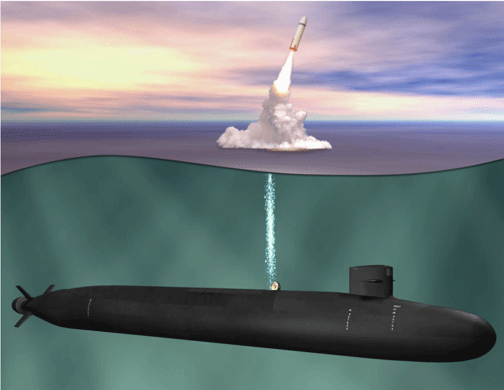
As the international court of justice put it, back in 1996: “The destructive power of nuclear weapons cannot be contained in space or time. They have the potential to destroy all civilisation and the entire ecosystem of the planet.”
So why is our law-abiding government spending tens of billions on a weapons system that cannot lawfully be used?
First, because its advisers wrongly think that nuclear weapons are legal in certain circumstances. Back in that 1996 case, the UK argued that it could lawfully drop “a low-yield nuclear weapon against warships on the high seas or troops in sparsely populated areas”.
This scenario has now been shown up as fantastical: “first use” in these circumstances by the UK would trigger a nuclear reprisal with inevitable damage to the atmosphere, the oceans and the “sparsely populated” area (which would henceforth be entirely unpopulated). In any event, Trident’s weapon-bays will not carry “low-yield” bombs, and if they did the result would be better achieved by conventional weapons, making nuclear deployment unnecessary and disproportionate.
The world court ruled that the threat or use of nuclear weapons would “generally” be contrary to war law but might be lawful “in extreme circumstances of self-defence, in which the very survival of a state would be at stake”. This was a time-warped view of war law in 1996 that is not tenable today. The court, to be fair, predicted as much, saying that it expected international law to “develop” towards a total ban on the use of the bomb. It soon did, with the Rome Statute and subsequent development of the principle that a state has no right to preserve itself at the expense of damage to other states and to the rights to life of millions of citizens.
It is absurd to suggest that it would have been lawful for Hitler, his back to the bunker wall, to start a nuclear Götterdämmerung to save the Nazi state (Nuremberg decided it was not lawful for him even to fire doodlebugs). Given what we now know about the uncontrollable and devastating propensities of modern nuclear weapons, it is unlawful to fire them at all.
There is a further legal reason for allowing Trident to wear out. It is Article VI of the nuclear proliferation treaty (NPT), by which parties undertake to proceed in good faith to “general and complete” nuclear disarmament.
The world court’s 1996 ruling decided that this imposed not a “mere” obligation but a binding legal obligation on existing nuclear states to reduce the number of their bombs gradually, to zero. It is contrary to the spirit of article VI to upgrade rather than downgrade the fleet.
A decision to phase out Trident would help Britain recover some of the clout it has lost through Brexit. It would show moral leadership, and shame other nuclear powers that have failed to live up to their NPT obligations (especially the US; President Obama’s Nobel prize was prematurely awarded in part for envisaging “a world without nuclear weapons”).
Moral leadership from a nuclear-weapons state is urgently needed. The latest US defence budget allocates $1tn for future modernisation of its nukes and it has acquired new sites for them, in Poland and Romania. President Putin has promised in return a new generation of nuclear-tipped intercontinental ballistic missiles. The American most knowledgeable on the subject – Bill Clinton’s defence secretary William J Perry – has just published a book warning that “nuclear doom” is closer today than it ever was during the cold war.
Although possession of nuclear weapons is not per se unlawful, the UK is under a duty to reduce its arsenal: the vice of refurbishing Trident is that it encourages other states to do the same, and remains a constant stimulus for countries – particularly in the Middle East and Asia – to acquire arsenals of their own.
When negotiating to buy Polaris (Trident’s predecessor), back in 1962, Harold Macmillan confided in his diary that “the whole thing is ridiculous”, but consoled himself with the thought that “countries which have played a great role in history must retain their dignity”.
A half-century later, the best way for Britain to regain its dignity post-Brexit is not to throw vast sums of money away on a weapon that cannot lawfully be used, but rather to appear as the first of the “big five” powers to shoulder its legal obligation to disarm under article VI of the NPT. It will be many years before the mushroom cloud becomes a hallucination, but at least Britain would be able to boast that it had led the way.
Again, a Japanese court blocks restart of 2 nuclear reactors

 Japan court again blocks restart of 2 nuclear reactors, Nikkei Asian Review, 13 July 16 OSAKA — Handed another defeat by a Japanese court on Tuesday, Kansai Electric Power likely will not be able to run any of its nuclear power plants for at least six months, a major setback for a utility facing intense competition from industry newcomers.
The Otsu District Court in Shiga Prefecture rejected the company’s objection to an injunction issued in March that suspended operation of the Nos. 3 and 4 reactors at the Takahama nuclear plant in neighboring Fukui Prefecture. The presiding judge was the same as when the injunction was issued.
The Osaka-based company had been banking on the restart of nuclear power stations for an earnings recovery. Its medium-term business plan released in April set a pretax profit target of 300 billion yen ($2.87 billion) on the assumption that most of its nuclear reactors will be back online by fiscal 2025.
Assuming that its earnings would improve by about 10 billion yen a month if the two Takahama reactors went back onstream, Kansai Electric had intended to lower its power rates to compete on a better footing with newcomers expected to enter the market following deregulation in April. But it was forced to scrap its plan to cut rates after the court ordered the two reactors — reactivated in January and February — shut down in March.
Since April, Kansai Electric has lost more than 200,000 customers to Osaka Gasand other power providers. ……..http://asia.nikkei.com/Business/Companies/Japan-court-again-blocks-restart-of-2-nuclear-reactors
America’s major taxpayer liability – the Department of Energy
How the Department of Energy became a major taxpayer liability http://www.cnbc.com/2016/07/05/how-the-department-of-energy-became-a-major-taxpayer-liability.html Mark Fahey | @marktfahey Wednesday, 6 Jul 2016 If you were to guess which government agency has had to pay out the most in court in recent years, the Department of Energy probably wouldn’t come to mind.
And according to the department itself, the bloodletting as far from over. The DOE has failed to make good on some of its most important contractual obligations for years, and its private partners have been collecting billions in damages.
The Nuclear Waste Policy Act of 1982 requires that the DOE dispose of nuclear waste being produced at civilian energy plants around the country, which in turn pay fees for a long-term storage facility. The department’s contracts with dozens of energy companies said it would start disposing of the waste in 1998.
The companies held up their end, feeding about $750 million into the Nuclear Waste Fund each year. But the department did not manage to set up any facility to receive the waste, forcing energy companies to store it themselves on-site.
All those partial breaches of contract haven’t come cheap. As of the end of 2015, the DOE has paid $5.3 billion for failing to fulfill its obligations, and even if it manages to start disposing of waste in the next 10 years, it could still be on the hook for nearly $24 billion in additional liability.
“Because the United States has no facility available to receive spent nuclear fuel (SNF) and high-level radioactive waste (HLW) under the Nuclear Waste Policy Act, it has been unable to begin disposal of SNF from utilities as required by the standard contract with utilities,” said a DOE spokesperson in an email. “Significant litigation claiming damages for partial breach of contract has ensued as a result of this delay.”
At the end of 2015, the DOE had settled 35 lawsuits and resolved 33 with judgments, with 19 cases pending, according to the Congressional Budget Office. A court ruling halted the collection of storage fees in 2014, but energy companies are still seeking to recoup the money they’re spending every year on waste storage. Even after settlements for back pay are reached, the department is usually required to reimburse those costs going forward.
The hang-up has been in finding a location for the centralized storage facility. For decades, Yucca Mountain in Nevada was the only location that could legally be considered, despite fierce opposition from state and local groups. The Obama administration eventually abandoned the site as “unworkable” in 2011.
At the recommendation of the administration’s Blue Ribbon Commission (BRC), the department is now pursuing a “consent-based” approach, meaning that the DOE will seek the approval of relevant communities before construction, rather than trying to force all of the country’s spent nuclear waste on a pre-decided site in Nevada.
“The administration concurs with the conclusion of the BRC that a fundamental flaw of the 1987 amendments to the NWPA was the imposition of a site for characterization,” wrote then-Energy Secretary Steven Chu in the department’s most recent guiding strategy document from January 2013. “In practical terms, this means encouraging communities to volunteer to be considered to host a nuclear waste management facility.”
The DOE plans to have a pilot interim storage facility by 2021, initially to accept waste from reactor sites that were shut down years ago. Limiting the government’s massive liabilities is a major focus of the department’s strategy, according to the document.
The question isn’t whether the DOE will continue to have to pay out an exorbitant amount of money, but just how exorbitant that sum will end up being. The department itself projects that its total liabilities based on previous payouts will ultimately come to $29 billion in 2015 dollars, but that’s assuming it manages to start accepting waste in the next decade.
Neither the Department of Energy nor the Department of Justice could provide a list of related judgments and settlements so far, and the DOE said an updated liability estimate will not be available until its fiscal 2016 financial report comes out later this year.
“The department is currently developing a consent-based siting process for storage and disposal of SNF [spent nuclear fuel] and HLW [high-level radioactive waste],” said the department spokesperson. “Since January, DOE has held a series of public meetings and received feedback on how best to develop this process.”
The energy industry does not seem optimistic about a quick solution. According to the Nuclear Energy Institute, the department’s total liabilities could stretch to more than $50 billion. But that’s a more pessimistic figure that assumes a “total default” by the DOE.
The DOE’s own documentation for the Yucca Mountain project forecasts that if it failed completely and waste had to stay at the current sites indefinitely, it would cost between $75 billion and $82 billion in 2015 dollars over the first 100 years (including the cost of decommissioning Yucca).
Jay Silberg, a prominent energy industry attorney, said his estimate for total liability is closer to the $50 billion figure.
“I think that number is going to bear out, because I unfortunately don’t have much faith that the government will do what they promised to do in 1982,” said Silberg. “We all hope they can get their act together, but whether that will actually happen and whether it will be at large enough scale to remove the fuel piled up on these sites, I don’t have a lot of confidence in that.”
Court reject nuclear company EOn’s claim for compensation
 Court rejects EOn’s compensation claim, World Nuclear News, 5 July 16 A regional court in Hannover has ruled that EOn is not entitled to €382 million ($426 million) in compensation it sought for the forced shut down of its Isar 1 and Unterweser nuclear power units in 2011……The court’s ruling echoes that of a decision in April by a regional court in Bonn to throw out a similar compensation claim by EnBW for the shutdown of its Neckarwestheim 1 and Phillipsburg 1 units in the state of Baden-Würtemberg. That court ruled the utility, which also filed its lawsuit in 2014, had not used immediately “all legal means available” to avert the consequences of the forced shut down of its nuclear power units.
EnBW had sought compensation of €261 million, citing German court decisions in 2013 and 2014 in favour of rival utility RWE, which had sued for damages of €235 million against the forced closure of its Biblis reactor immediately after the moratorium.http://www.world-nuclear-news.org/C-Court-rejects-EOns-compensation-claim-0507164.html
Frivolous lawsuits aimed to attack climate scientists
 Climate scientists are under attack from frivolous lawsuits, Skeptical Science Lauren Kurtz 7 July 2016 Today’s climate scientists have a lot more to worry about than peer review. Organizations with perverse financial incentives harass scientists with lawsuit after lawsuit, obstructing research and seeking to embarrass them with disclosures of private information.
On June 14th, an Arizona court ruled that thousands of emails from two prominent climatescientists must be turned over to the Energy & Environment Legal Institute (E&E), a group that disputes the 97% expert consensus on human-caused climate change and argues against action to confront it. E&E and its attorneys are funded by Peabody Coal, Arch Coal, and Alpha Natural Resources, coal corporations with billions of dollars in revenue.
Formerly named the American Tradition Institute, E&E has been described as “filing nuisance suits to disrupt important academic research.”
E&E originally attacked Dr. Michael Mann, whose research shows a dramatic increase in recent temperatures in a graph popularly known as the “hockey stick.” In 2011, the group sued under Virginia open records laws to obtain six years of Dr. Mann’s emails from the University of Virginia—over 10,000 messages in total. The Virginia Supreme Court denied E&E’s claims and ruled that academic research correspondence should be protected because release would cause “harm to university-wide research efforts, damage to faculty recruitment and retention, undermining of faculty expectations of privacy and confidentiality, and impairment of free thought and expression.”
E&E did not relent. Despite losing in Virginia, the group brought another open records case in Arizona to demand the same six years of emails—this time from Dr. Mann’s coauthor, University of Arizona professor Dr. Malcolm Hughes. Additionally, E&E sued for thirteen years of emails from UN Intergovernmental Panel on Climate Change (IPCC) leadauthor Dr. Jonathan Overpeck, also at the University of Arizona.
In court filings, E&E acknowledges it seeks emails that, in its words, “embarrass both Professors Hughes and Overpeck and the University.” These smear tactics serve no role in scientific discourse, but are an attempt to distract, disrupt, and intimidate legitimate researchers.
n an ongoing federal case, the conservative group Judicial Watch—which claims climatescience is a “fraud science”—has sued the National Oceanic and Atmospheric Administration (NOAA) for thousands of climate scientists’ emails related to a 2015 climate change study published in Science. Congressman Lamar Smith (R-TX), who accusedNOAA of having an “extreme climate change agenda,” unsuccessfully sought the same emails last year.
In addition to the Arizona case, E&E attorney Christopher Horner paired with another fossil fuel industry funded-group, the Competitive Enterprise Institute, to sue for the emails of climate communications professor Dr. Edward Maibach. While Dr. Maibach sought to intervene in the litigation, the judge ruled that he lacked jurisdiction. Thousands of pages of Dr. Maibach’s emails were released, and plaintiffs posted them to the internet with quotes pulled out of context and commentary calling him and other climateresearchers “frauds,” “snake oil salesman,” and worse.
Click here to read the rest http://www.skepticalscience.com/climate-scientists-under-attack-frivolous-lawsuits.html
Delaware Riverkeeper Network’s legal challenge against New Jersey nuclear permits
Permit needed for 2 N.J. nuclear plants to operate challenged By Bill Gallo Jr. | For NJ.com , 8 July 16 One of the state’s leading environmental groups is calling for a new hearing on the state’s decision to grant a water-use permit which allows the continued operation of two nuclear reactors.
The Delaware Riverkeeper Network filed a legal challenge with the Department of Environmental Protection Friday.
A five-year permit granted by the DEP June 30 lets PSEG Nuclear to continue to draw billions of gallons of water from the Delaware River to cool its Salem 1 and Salem 2 reactors in Salem County.
The Delaware Riverkeeper Network and other environmental groups had opposed the permit sought by PSEG Nuclear for the reactors at its Artificial Island generating site in Lower Alloways Creek Township.
Officially known as the New Jersey Pollutant Discharge Elimination System Permit, without it Salem 1 and 2 might have been forced to shut down.
“We are disappointed by the New Jersey Department of Environmental Protection’s failure to recognize the ongoing hazards of permitting the continued use of outdated technology at Salem when there are other proven eco-friendly technologies available,” said Maya van Rossum, the Delaware Riverkeeper.
When operating at full power, Salem 1 and 2 draw in about 3 billion gallons of water a day from the Delaware River, circulate it through the plants’ open-cycle cooling systems and return it to the river.
The amount of marine life killed through this process is unacceptable, environmental groups say……..
Friday’s filing was submitted to the DEP’s Office of Legal Affairs in Trenton.
Van Rossum said the goal is to get the DEP to require a closed-cycle cooling system or require PSEG Nuclear to use updated technology that would rival a closed-cycle system to protect fish and water quality.
Environmentalists claim that billions of fish are killed each year either through being caught on screens at plant water intakes or by being sucked through the plants’ cooling system…….. http://www.nj.com/salem/index.ssf/2016/07/environmental_group_challenges_dep_water-use_permi.html
Federal court considers South Carolina’s suit over Mixed Oxide Fuel nuclear fiasco
Judge considers nuclear fuel dispute between S.C., Energy Dept. Savannah Now, By MEG KINNARD 1 July 16 COLUMBIA, S.C. — It’s now up to a federal judge to decide if South Carolina’s lawsuit against the federal government over an unfinished plutonium processing project should be dismissed, or if the state’s pursuit of millions of dollars in fees should move forward.
During a hearing in federal court in Columbia, attorney Randy Lowell said that the law is clear that the government owes South Carolina millions of dollars in fees and also must remove plutonium from the state because the processing plant wasn’t operational on time.
“All of this is a problem of their own creation,” Lowell, representing the state, said during a 90-minute hearing.
South Carolina in February sued the U.S. Department of Energy over the mixed oxide fuel project at the Savannah River Site, a sprawling former nuclear weapons plant along the South Carolina-Georgia border. The multi-billion-dollar project was intended to help the United States fulfill an agreement with Russia to dispose of at least 34 metric tons apiece of weapons-grade plutonium, an amount that’s enough for about 17,000 nuclear warheads.
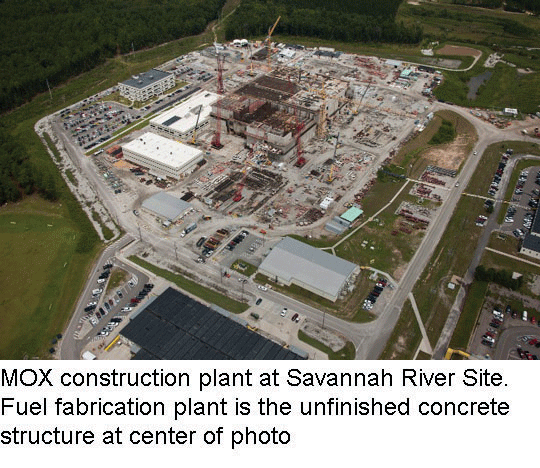
The plant is years behind schedule and billions over budget. Because the facility wasn’t operational by a Jan. 1, 2016, deadline, the federal government was supposed to remove 1 metric ton of plutonium from South Carolina or pay fines of $1 million a day — up to $100 million yearly — until either the facility meets production goals or the plutonium is taken elsewhere for storage or disposal.
Lowell argued that the government has given South Carolina repeated assurances that no plutonium would enter the state without a pathway out – like the production of mixed-oxide fuel, which would be sold to commercial power producers – thus keeping the state from being a permanent home for the materials.
But that hasn’t happened, Lowell said. He asserted that the government is in breach of the law governing the project.
“The whole purpose of the statute is to ensure that we are not the dumping ground,” he said.
Attorneys for the federal government argue that, while the mixed-oxide facility isn’t up and running, the Energy Department is already pursuing an alternate way to process the plutonium and send it out of state for permanent storage……..http://savannahnow.com/news/2016-06-30/judge-considers-nuclear-fuel-dispute-between-sc-energy-dept
South Carolina versus US Dept of Energy in court about mixed oxide fuel project
SC, Dept. of Energy in court about nuclear fuel lawsuit http://abcnews4.com/news/local/sc-dept-of-energy-in-court-about-nuclear-fuel-lawsuit  BY MEG KINNARD, THE ASSOCIATED PRESS , JUNE 30TH 2016 COLUMBIA, S.C. — Attorneys for the federal government and the state of South Carolina are in court arguing about a lawsuit concerning an unfinished plant to turn old plutonium into commercial nuclear reactor fuel.
A federal judge in Columbia is hearing arguments Thursday in South Carolina’s lawsuit against the U.S. Department of Energy over the mixed oxide fuel project at the Savannah River Site near Aiken.
South Carolina is suing the federal government because the project is well past its start date. The state is seeking daily fines of up to $1 million, as well as the removal of plutonium from the state.
The federal government is asking that the lawsuit be dismissed, saying that such issues are best handled in a different type of court.
French Polynesia at UN presses case for compensation for nuclear tests
French Polynesia goes to UN over nuclear compensation http://www.radionz.co.nz/international/pacific-news/307569/french-polynesia-goes-to-un-over-nuclear-compensation, 29 June 16, A legislator from French Polynesia has appeared at the United Nations pressing the territory’s case for compensation over nuclear testing.
Richard Tuheiava appeared before the UN Committee on Decolonisation, in an effort to bring the issue to international attention.
The French Government has compensated just a handful of French Polynesians who suffered from exposure to radiation after thirty years of tests in the territory’s vicinity.
Mr Tuheiava said France should compensate the territory as well as individuals.
“The fact is since the nuclear testing most of the diseases were cancer, leukaemia. Most of the diseases were as a result of the nuclear testing, so we collectively also put a request for the state of France, the colonial power to not only compensate directly the veterans, but also compensate this fund, this public health care fund.”
Richard Tuheiava said he has serious doubts about whether anything will come from the negotiations, but at least the truth is being exposed on a global stage.
Earlier this year during a visit to the territory, the French president Francois Hollande acknowledged that the weapons tests had an environmental impact with consequences for people’s health.
He promised to revisit the way compensation claims are being treated.
Japan’s nuclear industry reels as court upholds injunction to halt reactors
Japan court upholds injunction to halt reactors in blow to nuclear power industry, Reuters, TOKYO | BY OSAMU TSUKIMORI 17 June 16, A Japanese court on Friday upheld an order to keep two reactors at the Takahama nuclear plant closed, operator Kansai Electric Power said, leaving efforts to get a struggling nuclear industry up and running in limbo.
 , upholding a petition from residents living near the plant concerned about safety, keeps the legal battle center stage in a struggle by Prime Minister Shinzo Abe’s government to restore atomic power five years after the Fukushima disaster.
The Otsu District Court on March 9 ordered Kansai Electric, Japan’s second-biggest utility, to shut down the reactors in Fukui prefecture west of Tokyo, in the country’s first injunction to halt an operating nuclear plant.
The nuclear industry has only recently started to get reactors in a nuclear sector, which used to supply about a third of the country’s power, back online amid widespread public opposition after the melt downs at Fukushima in 2011.
Friday’s decision denied the utility’s attempt to temporarily halt the shutdown order……….
Amid mounting public scepticism over nuclear safety, local residents have lodged injunctions against nuclear plants across Japan…….http://www.reuters.com/article/us-japan-nuclear-court-idUSKCN0Z306R
Bulgaria must pay Russia over cancelled nuclear project, says court.
Court orders Bulgaria to pay Russia over cancelled nuclear project: minister http://uk.reuters.com/article/uk-bulgaria-russia-arbitration-idUKKCN0Z213A , Jun 16, 2016
An arbitration court has ruled that Bulgarian state energy firm NEK should pay nearly 550 million euros (437.70 million pound) in compensation to Russia‘s Atomstroyexport for a cancelled nuclear power project, Bulgaria’s energy minister said on Thursday.
“NEK received the court’s decision late last night. It is still not handed down officially. In the next days, NEK will approach Atomstroyexport over the decision,” Energy Minister Temenuzhka Petkova told reporters.
Atomstroyexport had sought more than 1 billion euros at the Paris-based International Court of Arbitration against NEK over the cancellation of the Belene nuclear power plant it had been contracted to build.
NEK teamed up with Atomstroyexport to build two 1,000 megawatt reactors at Belene, on the Danube River at the border with Romania, in 2006.
Sofia abandoned the project in 2012, after it failed to attract investors for the 10 billion euros ($11 billion) scheme and also came under pressure from its Western allies about its energy dependence on Moscow.
Petkova said the court has ruled that NEK should cover the funds the Russian state company had spent to produce equipment for the project, but has rejected claims for additional works and damages from lost profits.
Bulgaria is currently extending the lifespan of its two 1,000 Soviet-made reactors at its Kozloduy nuclear power plant and is looking for an investor to build one more reactor at the same site.
Taiwan: environmentalists take legal action against nuclear restart
Activists are planning to sue premier for offense contrary to public safety, China Post,
 CNA June 6, 2016, TAIPEI –– Environmentalists blasted the first reactor of First Nuclear Power Plant Sunday as a very dangerous facility, and said they will sue the premier for an offense against public safety after he revealed that he might allow the reactivation of the reactor. CNA June 6, 2016, TAIPEI –– Environmentalists blasted the first reactor of First Nuclear Power Plant Sunday as a very dangerous facility, and said they will sue the premier for an offense against public safety after he revealed that he might allow the reactivation of the reactor.Anti-nuclear campaigner Lin Jui-chu (林瑞珠) said there are more than 40 used fuel rods still left in the reactor facility since it was shut down for repair in late 2014.
“One small glitch and Taiwan will be gripped by a disaster beyond redemption,” Lin warned. Also, although the electricity supply has been tight over the past few days due to the hot weather, all the hydroelectric power plants and solar power generators operated by the state-run Taiwan Power Co. (Taipower) remained idle during the period, according to Lin. She accused Taipower of creating a fake issue to get people to believe Taiwan is being threatened by a risk of power insufficiency. Officials of Taipower were unavailable for comment. Expressing strong opposition to the government’s plan to reactivate the reactor at the First Nuclear Power Plant, situated in New Taipei’s Shimen District, Lin said she will file a lawsuit against Premier Lin Chuan (林全) in the near future for causing danger to public safety. Lin Jui-chu was among a group of environmentalists, who filed a lawsuit last week against Economics Minister Lee Chih-kung (李世光) and Atomic Energy Council (AEC) Minister Hsieh Shou-shing (謝曉星) over the proposal. Prime Minister Lin Chuan said Sunday that he is considering having the reactor reactivated after it was shut down for repair 17 months ago, on the premise that it is safe enough to be used…… Echoing Lin Jui-chu, Green Consumers’ Foundation chairman Jay Fang (方儉) argued that Taiwan has no shortage of electricity, but has the “fake phenomenon of power insufficiency.” Taiwan’s overall power generation capacity is 48,000 megawatts (MW), but the actual output has only reached 35,000 MW so far this year, Fang said, implying that the government is failing to run the country’s power generating facilities properly. “If Lin Chuan does not see (the problem), he is not qualified to take the helm of the government,” Fang said. http://www.chinapost.com.tw/taiwan/national/national-news/2016/06/06/468441/Activists-are.htm |
South Africa’s Energy Minister again misses legal deadline to file nuclear procurement papers for the High Court
Joemat-Pettersson misses third deadline to file papers in nuclear case http://www.bdlive.co.za/business/energy/2016/06/03/joemat-pettersson-misses-third-deadline-to-file-papers-in-nuclear-case
BY CAROL PATON, ENERGY Minister Tina Joemat-Pettersson has missed a third deadline to file papers to oppose an application by the SA Faith Communities Environmental Initiative (Safcei) and Earthlife Africa to have the proposed procurement of nuclear energy declared unconstitutional.
The two groups filed papers in October asking the High Court in Cape Town to rule that government had failed to meaningfully consult the public on the nuclear procurement.
They will also argue that the inter-governmental agreements on nuclear procurement signed with Russia, France, China and the US are illegal as they were not preceded by a determination in the government gazette by the minister.
Safcei and Earthlife Africa said on Friday that this was the third deadline that Joemat-Pettersson had missed in as many weeks.
Government failed to respond by the May 13, and asked for an extension until May 30. Earthlife and Safcei then instructed their lawyers to issue a rule 30A notice, which gave the government until the May 31 to respond.
“On Tuesday June 1, our attorneys were advised that the answering affidavit has been drafted, is currently being reviewed by the Office of the Presidency, and that the State Attorney hopes to be in a position to file it on or about June 7,” they said in a statement.
If this latest deadline is missed, the Safcei/ ELA legal team will approach the courts to force government to comply with the legal time frames. Failing this they will ask the courts to strike out the government defence and for their application to be unopposed.
“We believe that this consistent failure to comply with the legal time frames points to an unaccountable government,” says Liz McDaid, Safcei spokeswoman.
U.S. Court of Appeals upholds Nuclear Fuel Storage Rule
Appeals Court Upholds Nuclear Fuel Storage Rule https://morningconsult.com/alert/appeals-court-upholds-nuclear-fuel-storage-rule/ ASHA GLOVER | JUNE 3, 2016 The U.S. Court of Appeals for the District of Columbia Circuit on Friday upheld a rule that allows the Nuclear Regulatory Commission to store spent nuclear fuel at power plants.
The three-judge panel denied a request from four states, including New York, to review the rule, arguing the NRC failed to comply with obligations under the National Environmental Policy Act. The case is not the first time the court has had to address nuclear waste storage, according to the Friday decision.
“The petitioners contend that the NRC did not consider alternatives to and mitigation measures for the continued storage of spent nuclear fuel, miscalculated the impacts of continued storage, and relied on unreasonable assumptions in its environmental impact statement,” Senior Circuit Judge David B. Sentelle wrote in the court’s opinion. “Because we hold that the NRC did not engage in arbitrary or capricious decision-making, we deny the petitions for review.”
1 This Month



26 September – International Day for the Total Elimination of Nuclear Weapons


PLEASE OPPOSE HR 8255 AND S.3639 – bills would accelerate satellite deployment, with no environmental review or safeguards – https://ncstd5li.quorum.us/campaign/169331/
To see nuclear-related stories in greater depth and intensity – go to https://nuclearinformation.wordpress.com
-
Archives
- September 2026 (219)
- August 2026 (330)
- July 2026 (355)
- June 2026 (287)
- May 2026 (306)
- April 2026 (356)
- March 2026 (251)
- February 2026 (267)
- January 2026 (308)
- December 2025 (358)
- November 2025 (359)
- October 2025 (375)
-
Categories
- 1
- 1 NUCLEAR ISSUES
- business and costs
- climate change
- culture and arts
- ENERGY
- environment
- health
- history
- indigenous issues
- Legal
- marketing of nuclear
- media
- opposition to nuclear
- PERSONAL STORIES
- politics
- politics international
- Religion and ethics
- safety
- secrets,lies and civil liberties
- spinbuster
- technology
- Uranium
- wastes
- weapons and war
- Women
- 2 WORLD
- ACTION
- AFRICA
- Atrocities
- AUSTRALIA
- Christina's notes
- Christina's themes
- culture and arts
- Events
- Fuk 2022
- Fuk 2023
- Fukushima 2017
- Fukushima 2018
- fukushima 2019
- Fukushima 2020
- Fukushima 2021
- general
- global warming
- Humour (God we need it)
- Nuclear
- RARE EARTHS
- Reference
- resources – print
- Resources -audiovicual
- Weekly Newsletter
- World
- World Nuclear
- YouTube
-
RSS
Entries RSS
Comments RSS
 nuclear-news