USA Department of Energy wants to delay Southy Carolina MOX hearings

Judge J. Michelle Childs scheduled a hearing for June 30 in Columbia, but the Energy Department’s lawyers say there’s too much to do before then. Besides, they want her to rule first on their motion to dismiss the case altogether.
South Carolina filed suit in February asking for the $100 million in penalties that a federal law assesses the agency for not removing 2 metric tons of plutonium from Savannah River Site. The law was to ensure construction remained on schedule for the mixed-oxide fuel plant on the site, but the builders are still late……..
Construction on the MOX facility is behind schedule and about $8 billion over budget, by some critics’ estimates. The Obama administration says that’s why it wants to shut the program down and use a different method of disposing of 34 metric tons of plutonium…….http://chronicle.augusta.com/news/metro/2016-05-26/federal-government-wants-delay-mox-court-hearing?v=1464299788
South Africa’s govt coy about its secret nuclear deal with Russia


 Govt misses deadline to open up alleged Russian nuclear deal http://businesstech.co.za/news/energy/124645/govt-misses-deadline-to-open-up-alleged-russian-nuclear-deal/ By News24Wire May 24, 2016 The government must respect the rules and commit to following the timeframes, leading environmentalists said after the state once again failed to submit answering affidavits in the court case regarding its nuclear energy agreement with Russia.
Earthlife SA and the Southern African Faith Communities’ Environment Institute (Safcei) claim that Energy Minister Tina Joemat-Pettersson acted unconstitutionally in not submitting the government’s nuclear deal with Russia to Parliament.
Following the Department of Energy (DoE) and Joemat-Pettersson’s failure to meet the original May 13 deadline to submit answering affidavits, the State Attorney on Monday said they could also not meet the 20 May Rule 30A notice deadline, a rule that prohibits further delays.
“Unfortunately the first and the second respondents are still not in a position to file answering affidavits and are still in the process of drafting same,” the State Attorney’s office said in a letter to the environmentalists on Monday.
“As already pointed out the respondents have difficulty in finalising their answering affidavits due inter alia to the bulk of the founding affidavit, as supplemented, the complexity of the application as well as the importance thereof for all parties concerned. The incomplete draft already runs to more than 200 pages.
“The first and the second respondents will endeavour to have their answering affidavits finalised in terms of the provisions of the notice … by Tuesday, 31 May 2016.”
Safcei spokesperson Liz McDaid said on Monday that “it is not unexpected that government once again fails to meet their own deadlines”.
“But what is of concern is that government lawyers are even not committing to the legal rule 30a notice deadline, but only going to ‘endeavour’ to meet it.
“If the country is to function as a democratic state under the rule of law, then the state must respect the rules and commit to following the timeframes, which are set out under the law,” she said.
In October last year, Earthlife Africa JHB and Safcei filed court papers challenging the constitutionality of the intergovernmental framework agreements the DoE signed with Russia, China, South Korea and the USA on the country’s planned nuclear development.
Safcei said it waited for Joemat-Pettersson to provide the records of the decisions that are being challenged. “In that period, Safcei and Earthlife Africa generously allowed the government extensions, which eventually meant that government only provided the requisite documents on February 16 2016.”
Legal documents indicate that South Africa did sign a nuclear deal with Russia, claim the environmentalists in their affidavit.
Here, they said “the Russian agreement was entered into unlawfully, but makes (an) internationally binding commitment to buy a fleet of nuclear reactors from Russia”.
From the state law adviser’s explanatory memorandum that was prepared in November 2013 but only revealed recently to Safcei/ELA, “it is evident that the Russian agreement is to build reactors and an enrichment plant”, the group said.
They said other subsequent agreements would “cover the details of how it is to be financed, not if it would go ahead”. The court case appears to be stalling the country’s bid to launch its request for proposals for the 9.6GW nuclear procurement programme. This was supposed to occur on April 1.
Chelsea Manning appeals conviction in WikiLeaks case
http://www.armytimes.com/story/military/crime/2016/05/19/chelsea-manning-appeal-wikileaks/84585376/
Manning’s attorney, Vincent Ward, said the documents were filed Wednesday with the U.S. Army Court of Criminal Appeals at Fort Belvoir, Virginia.
Chief Deputy Clerk John Taitt said the document must undergo a review for classified information before it can be publicly released. Ward said he’ll wait until the review is complete before commenting.
Manning is serving a 35-year sentence at Fort Leavenworth, Kansas. The transgender soldier, formerly known as Bradley Manning, was convicted of espionage and other offenses for sending WikiLeaks more than 700,000 digital files including battlefield logs, diplomatic cables and video clips.
After 26 year battle for justice, Rocky Flats residents get some kind of deal from nuclear weapons plant operators
Deal reached between homeowners, weapons plant operators, Albuquerque Journal By Dan Elliott / Associated Press May 19th, 2016 DENVER — Thousands of homeowners have reached a $375 million settlement over their claims that plutonium releases from a nuclear weapons plant in Colorado damaged their health and devalued their property, officials said Thursday.
A federal judge must approve the agreement before it officially ends the 26-year legal battle between the residents and two corporations that ran the Rocky Flats plant for the federal government.
Perched on a wind-swept mesa west of Denver, Rocky Flats manufactured plutonium triggers for nuclear warheads until it closed in 1989 because of safety and environmental concerns. It’s the most prominent of Colorado’s Cold War relics, which also included a nerve gas manufacturing site east of Denver.
Few details of the settlement were available. The lead attorney for the plaintiffs, Merrill Davidoff, said the agreement has been submitted to the judge overseeing the case but no documents have been made public…….
The lawsuit took years to go to trial. In 2006, a jury found the companies had damaged nearby land and hurt residents’ health. In 2008, a judge ordered the companies to pay a combined $925 million.
An appeals court overturned the verdict and the award on Sept. 3, 2010, saying the homeowners hadn’t proved that plutonium releases from the plant had hurt their health or their property. The court said a decline in property value can’t be considered damage.
The case had been appealed to the Supreme Court, but the appeal has been dropped.
After a $7 billion cleanup that took 10 years, most of the 8-square-mile property became a wildlife refuge managed by the U.S. Fish and Wildlife Service. The most heavily contaminated area remains off-limits to the public. http://www.abqjournal.com/777588/deal-reached-between-homeowners-weapons-plant-operators-3.html
Boston Edison Company, now known as NSTAR Electric Company sues US Dept of Energy
DOE Sued for $40M Over Nuclear Waste Storage, Courthouse News Service By LORRAINE BAILEY CN), 19 May 16 — Blaming the government for not settling on a nuclear-waste storage scheme, a nuclear energy company has filed a federal complaint to recover $40 million.
The Nuclear Waste Policy Act of 1982 required the U.S. Department of Energy to accept and dispose of spent nuclear fuel and high-level radioactive waste by Jan. 31, 1998, in return for fees paid by owners of such waste.
It also effectively made it mandatory for nuclear utilities to enter into contracts for such disposal.
When the Department of Energy failed to meet the 1998 deadline, however, utilities began to incur substantial costs for storage and management of the waste accumulating at reactor sites.
By 2006, the U.S. Court of Federal Claims had found that the Department of Energy partially breached its contractual obligations to Yankee Atomic Electric Co., Connecticut Yankee Atomic Power Co., and Maine Yankee Atomic Power Co., all of which are now decommissioned, to the tune of $235 million
It sued the U.S. in the Court of Federal Claims Wednesday over its continued obligation to pay for highly reactive waste storage.
Boston Edison says it paid Entergy $40.3 million to cover the cost to store spent nuclear fuel through 2012, the expected decommissioning date for the plant.
That fuel would have been disposed of by the government had it kept its pledge.
But now, Entergy has stated that operations at Pilgrim will continue through 2019, and there is still no government plan for a permanent repository for high level nuclear waste.
Most nuclear power plants continue to keep their reactor waste on-site in steel and concrete casks……. The Department of Energy has expressed the urgency need to find a permanent repository, but the Congress has taken no action since abandoning the Yucca Mountain project.
Boston Energy seeks damages for breach of contract, and breach of the covenant of good faith. http://www.courthousenews.com/2016/05/19/doe-sued-for-40m-over-nuclear-waste-storage.htm
Emotional plea from Former Prime Minister Junichiro Koizumi in support of U.S. sailors, victims of radiation
Tearful Koizumi backs U.S. vets suing over 2011 nuclear disaster THE ASAHI SHIMBUN CARLSBAD, California, 19 May 16, –Former Prime Minister Junichiro Koizumi broke down in tears as he made an emotional plea of support for U.S. Navy sailors beset by health problems they claim resulted from radioactive fallout after the 2011 nuclear disaster.
More than 400 veterans who were part of a mission called Operation Tomodachi to provide humanitarian relief after the Great East Japan Earthquake and tsunami filed a mass lawsuit in California against Tokyo Electric Power Co., operator of the crippled Fukushima No. 1 nuclear plant. They are seeking compensation and an explanation for their health problems.
Koizumi, 74, responded to a request from a group supporting the plaintiffs and flew to the United States to meet with 10 veterans.
At a news conference here on May 17, Koizumi said: “U.S. military personnel who did their utmost in providing relief are now suffering from serious illnesses. We cannot ignore the situation.”……
Some of the plaintiffs in the lawsuit were crew members of the nuclear-powered aircraft carrier USS Ronald Reagan, which anchored off the Tohoku coast to provide relief along the battered coastline.
Theodore Holcomb, an aviation mechanic on the flattop, was tasked with washing down U.S. helicopters that had operated in areas with high radiation. He was later diagnosed with synovial sarcoma, a rare form of cancer. He died in 2014 at age 35.
The Department of Veterans Affairs later cut off a study into the causal relationship between his exposure to radiation and his illness.
His best friend in the Navy, Manuel Leslie, 41, now is one of the plaintiffs in the lawsuit on behalf of Holcomb.
Leslie said he just wants the truth to come out for his friend.
Another crew member, Ron Wright, 26, worked on the deck. After finishing his shift one day, he was forced to remove his clothes after a high radiation reading. Subsequently, he developed a swelling of the testicles and underwent surgery four times after he returned to the United States. However, the pain was so intense that he had to rely on painkillers and sleeping pills.
A military doctor told him there was no relationship between his illness and exposure to radiation.
Wright said he was never given protective clothing or iodine during the mission. He also said he had no knowledge of radiation at the time.
According to the ship’s logs and the testimony of former crew members, sailors aboard the Ronald Reagan may well have been exposed to radiation as the carrier passed under a radiation plume that was generated by the Fukushima accident. In addition, the carrier used desalinated seawater for drinking and showers by crew members……… This article was written by Masato Tainaka and Ari Hirayama. http://www.asahi.com/ajw/articles/AJ201605190065.html
Lawsuit on Bikini Atoll nuclear tests
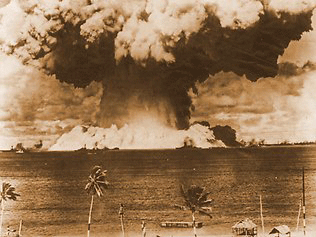 Revisiting Bikini Atoll nuclear tests Japan Times, 15 May 16 A recent lawsuit filed by former crew members and relatives of deceased crew members of fishing boats operating near the area where the United States conducted a series of nuclear weapons tests in the Pacific in 1954 — seeking compensation from the Japanese government over its questionable behavior at the time and in subsequent years — carries historical significance. More than six decades after the hydrogen bomb tests at Bikini Atoll in the Marshall Islands, beginning with a test explosion code-named Castle Bravo on March 1, 1954, the lawsuit will help shed fresh light not only on the scope of radiation exposure for Japanese fishermen but also on whether the Japanese and U.S. governments acted properly to deal with the consequences of the fallout from the tests.
Even before the court proceedings begin, the omission on the part of the Japanese government seems clear — its failure to properly examine and keep track of the potential damage to the fishermen’s health and nondisclosure for decades of the records of their radiation exposure.
In connection with the 15-megaton Castle Bravo test, which was over 1,000 times more powerful than the atomic bomb dropped on Hiroshima on Aug. 6, 1945, the tragedy of the tuna trawler Fukuryu Maru No. 5, also known as the Lucky Dragon, is widely known. The fallout from the test fell onto the vessel for a few hours, causing its 23 crew members to suffer nausea. By the time they returned to their home port of Yaizu, Shizuoka Prefecture, two weeks later, they had developed serious symptoms of radiation sickness, and the radio operator, Aikichi Kuboyama, died six months later. The Fukuryu Maru incident sowed the seed for civic anti-nuclear movements in Japan.
The islanders suffered a great deal. The H-bomb tests contaminated many areas of the Marshall Islands so badly that they became unlivable. The tests destroyed the culture of the islands and irradiated thousands of people. In the years after the tests, the U.S. told evacuated islanders that it was safe to return. But many returning residents were exposed to contaminated water, air and food due to the false assurance.
The plaintiffs in the lawsuit, the first legal action seeking state compensation over the 1954 H-bomb tests, are former crew members of fishing boats other than the Fukuryu Maru that were operating in the area around the time of the tests and family members of fishermen who have since died. Most of the fishing boats were from Kochi Prefecture……
With the lawsuit, the plaintiffs will try to bring to light the government’s omission, including its failure to conduct follow-up health surveys on the crew members and to pay compensation to those who fell ill due to causes linked to the radiation exposure. Several of the former fishermen died of cancer — although it will be difficult to establish the causal relationship because so much time has passed. At least the court proceedings should shed light on how the government acted when it negotiated the settlement with the U.S. over the Fukuryu Maru incident — as well as on why the records of the radiation exposure suffered by other Japanese fishermen were kept undisclosed for so long and why no follow-up checks on the fishermen’s health were made. http://www.japantimes.co.jp/opinion/2016/05/15/editorials/revisiting-bikini-atoll-nuclear-tests/#.VzjsOTV97Gg
European law mean sit is illegal for France’s govt to fund EDF’s Hinkley nuclear project

 France funding Hinkley C ‘would be illegal’ under EU competition rules say Greenpeace and Ecotricity http://www.cheddarvalleygazette.co.uk/France-funding-Hinkley-C-illegal-EU-competition/story-29158662-detail/story.html By Cheddar Valley Gazette April 24, 2016 The European Commission is ‘almost certain’ to block the French Government spending billions of pounds of taxpayers’ money to make sure the Hinkley C nuclear power station project is completed.
That was the view of a coalition of West environmentalists today, who said if the French president Francois Hollande was to plunge £3 billion into Hinkley C, it would breach European state aid rules.
The European Union forbids states using taxpayers’ money to invest in projects which favour one company over another – and a new report revealed this morning by a leading London law firm says that would clearly be illegal under EU competition rules.
EDF, the firm planning to build a third nuclear power station in west Somerset, is majority-owned by the French Government anyway, but Greenpeace, Stroud-based renewable energy firm Ecotricity and the Green Party’s South West MEP, Molly Scott Cato, have all said they would challenge that decision, and ask the European Commission to block any state investment by France.
EDF is putting in half the £18 billion Hinkley C project cost, two Chinese nuclear energy firms are investing a third, but attempts by EDF to find that shortfall – one-sixth, or around £3 billion – have failed amid fears the project would be uneconomic.
The firm has gone to French Government ministers to ask for state backing, and that is ‘expected’ to be ratified and the project get the go-ahead in the next couple of weeks.
But the environmentalists who have long campaigned against Hinkley C said this morning that would breach EU competition rules, arguing the French Government should not be allowed to use taxpayers’ money to compete against energy providers in this country who receive no such help.
Dale Vince, Ecotricity founder, said his firm would consider legal action to stop Hinkley C. “It’s time for everyone to realise that we’ve reached the end of the road for Hinkley Point – it’s not going to happen,” he said.
“Illegal state aid is one thing, and we’ll work with Greenpeace to challenge that if it happens, but it’s not just financial issues, there are technical problems with Hinkley Point too – EDF are yet to build one of these reactors and their first two attempts are, between them, 16 years late and billions over budget.
“Our government needs to change its stance on green energy, which powered a quarter of the country last year and could do so much more if the sector received even a fraction of the economic and political support given the nuclear industry,” he added.
Greenpeace have yesterday wrote to energy minister Amber Rudd and chancellor George Osborne warning the ministers not to proceed with the project unless and until the French state support has been notified to and approved by the EU Commission.
“The only way Hinkley can be kept alive is on the life support machine of state aid,” said Greenpeace boss John Sauven. “EDF, if it is to stay in business, needs a new vision which is not looking backwards. And the UK Government needs to stop penalising the UK renewable energy industry in favour of propping up an ailing state owned nuclear industry in France.
“Globally, the nuclear market is shrinking year by year overtaken by the huge surge in renewable energy. The UK should be a haven for renewable energy investment given the massive potential for wind, solar and tidal to cost effectively meet our energy needs,” he added.
The legal opinion is given by Jon Turner QC, Ben Rayment and Julian Gregory, three eminent competition and EU law barristers from Monckton Chambers.
It sets out how the French government’s reported refinancing plans for EDF are likely to be illegal under EU law unless and until they are approved by the European Commission.
The European Commission’s investigation of state aid takes around a year, and it is doubtful that approval would be given.
“The numbers for the Hinkley deal have never stacked up and it is clear that the commercial case for this white elephant is dead,” said Green MEP for the south west, Molly Scott Cato.
“We have now a political battle where the stakes for both the UK and France are just too high to admit failure. But we cannot let this override EU rules on state aid or fair competition.”
“With EDF close to bankruptcy and serious questions over the legality of state aid for the project the French government and the French President are showing themselves to be totally irresponsible. The Board of EDF must put the interests of its shareholders and employees first and avoid committing economic suicide by rejecting a final investment decision,” she added.
EDF has consistently denied claims it was benefiting from illegal state aid, and robustly defended the legal action from Austria that the British Government’s agreement to pay EDF double the current electricity price for the energy Hinkley C will produce.
Employee’s legal threat hangs over EDF’s U.K. Nuclear Project
 EDF Unions Threaten to Go to Court Over U.K. Nuclear Project, Bloomberg, Francois De Beaupuy April 22, 2016
-
Employee representatives ask to be consulted before decision
-
Trade unions say they’ll sue if not consulted in advance
-
Electricite de France SA’s unions are threatening to take the company to court if employees are not consulted in advance on a decision concerning a proposed 18 billion-pound ($25.8 billion) U.K. atomic plant project.
EDF’s workers committee, which includes representatives from the biggest unions, met near Paris and voted to take legal action should the company fail to consult employees on Hinkley Point, according to a statement Thursday. The project is key to EDF earnings and has prompted disagreements between management and unions, it said.
“We ask that the workers’ committee is consulted before any decision by management or the board,” the committee said. If that didn’t happen then “the committee would be forced to take legal action to have any decision linked to the Hinkley Point project suspended or annulled.”
The threat marks the latest attempt by workers to delay a decision, given concerns about EDF’s finances amid falling power prices across Europe. Union FO has already threatened to call for a strike. EAS, an association of EDF employees holding the company’s shares, is asking the stock market regulator to require that the French government, which owns 85 percent of EDF, repurchases shares at the initial public offering price…..http://www.bloomberg.com/news/articles/2016-04-21/edf-unions-threaten-to-go-to-court-over-u-k-nuclear-project
Global nuclear salesmen still not happy with India’s Nuclear Liability Law
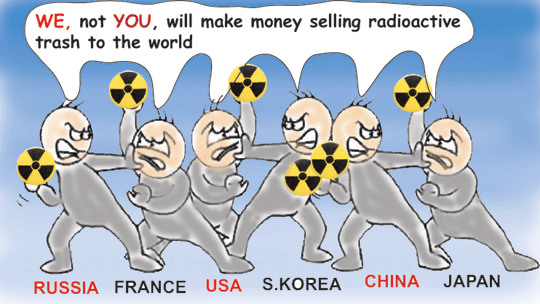 Concern Over India’s Nuclear Liability Law Still Remains: French Firm EDF http://www.ndtv.com/india-news/concern-over-indias-nuclear-liability-law-still-remains-french-firm-edf-1398896
The fresh techno-commercial proposal will also take into account India’s concern over high per unit tariff, French government officials said.
“The French feel that there is a lot of ambiguity in Clause 46 and there is fear in the minds of suppliers. We have raised this issue both with NPCIL and the Department of Atomic Energy,” said a French official.
Last month, Nuclear Power Corporation of India Limited (NPCIL) had signed an agreement for building six European Pressurised Reactors (EPR) as against the earlier proposal of two such reactors.
The delay in the project, which was first signed in 2008, and concern over India’s liability law came in the wake of nuclear firms Areva and EDF merging their reactor businesses into a joint venture controlled by EDF, as part of a broad restructuring last year.
In 2014, the US too had raised similar concerns about Clause 46 in particular.
In April last year, Areva had also signed an agreement with NPCIL to expedite the programme.
“Things are unclear over how much insurance cover does supplier have to take. There is still a lot of ambiguity in this,” the French official said.
The French government officials said the liability issue is still “manageable” but pricing still remains a major hurdle.
While the cost of the electricity generated by Kudankulam Nuclear Power Project (KKNPP) Units I and II hovers between Rs. 3 to 3.50 per unit, for JNPP, it is expected to be Rs. 9.14 per unit. India is not ready to go beyond Rs. 6.50 per unit.
EDF plan to help finance Hinkley nuclear project could be illegal
Legal challenge fuels doubt over Westcountry nuclear power station By WMNK Rossiter http://www.plymouthherald.co.uk/Legal-challenge-fuels-doubt-Westcountry-nuclear/story-29157974-detail/story.html April 22, 2016 By Keith Rossiter A French government plan to help energy company EDF to build a nuclear power station in Somerset could be illegal, barristers have warned.
Greenpeace and green energy company Ecotricity released a legal opinion on a proposed package of financial support.
French economy minister Emmanuel Macron insisted this week that the £18 billion Hinkley Point C power station will go ahead, in spite of doubts over the viability of the project.
EDF won the contract to build Hinkley Point, but has delayed giving the final go-ahead for months. The company has still not signed off a contract with its Chinese partner China General Nuclear Power Corporation.
Mr Macron said he was “actively working” with EDF and the UK Government to draw up the “final points” of a deal for Hinkley and that it was “very important for France” that the project went ahead.
EDF declined to comment on the Greenpeace claims.
The latest speculation, fuelled by Mr Macron, is that the French government would accept dividends from EDF in the form of shares rather than cash.
The legal experts say that the capital injection this would give to EDF would constitute state aid.
“This would destroy a level playing field for European energy companies,” Greenpeace said.
John Sauven, Greenpeace UK executive director, said: “The only way Hinkley can be kept alive is on the life support machine of state aid.
“The UK Government needs to stop penalising the UK renewable energy industry in favour of propping up an ailing state-owned nuclear industry in France.
“The UK should be a haven for renewable energy investment given the massive potential for wind, solar and tidal to cost effectively meet our energy needs.”
The legal opinion from competition and EU law barristers Jon Turner QC, Ben Rayment and Julian Gregory says that the reported refinancing plans for EDF are likely to be illegal under EU law unless and until they are approved by the European Commission.
Greenpeace has written to Amber Rudd, the Energy Secretary, and George Osborne, the Chancellor, warning them not to proceed with the project unless the French state support has been notified to and approved by the Commission.
Ecotricity says State aid for Hinkley would be harmful to EDF’s competitors.
Dale Vince, Ecotricity founder, said: “It’s time for everyone to realise that we’ve reached the end of the road for Hinkley Point – it’s not going to happen.
“Illegal state aid is one thing, but there are technical problems too. EDF is yet to build one of these reactors and their first two attempts are, between them, 16 years late and billions over budget.
“Our government needs to change its stance on green energy, which powered a quarter of the country last year and could do so much more if the sector received even a fraction of the economic and political support given the nuclear industry.”
Molly Scott Cato, Green MEP for the South West, has already asked the European Commission to investigate whether a proposed rescue plan for Hinkley C was in breach of European state aid rules.
She said: “The numbers for the Hinkley deal have never stacked up and it is clear that the commercial case for this white elephant is dead.
“We now have a political battle where the stakes for both the UK and France are just too high to admit failure.”
This week Amber Rudd said that further delays or even a cancellation of Hinkley would not compromise national energy supply.
Dr Scott Cato said: “We know the lights won’t go out if there is a concerted effort to implement Plan B based on renewable energy, energy efficiency and innovative smart grid and energy storage solutions.
“This could be delivered in time to prevent blackouts and create 122,000 quality jobs – many more than nuclear could ever hope to deliver.”
Judge rules against proposed Turkey Point nuclear plans

 Court overturns state’s approval of proposed Turkey Point plans, Palm Beach Post April 21, 2016 Florida Power & Light’s quest to add two new reactors and miles of new transmission lines at its Turkey Point plant south of Miami experienced a major setback Wednesday when an appellate court overturned a state decision that would have permitted the reactors.
While the 2014 approval of Units 6 & 7 by Gov. Rick Scott and his Cabinet found the project would not harm the Everglades or wetlands and would not impact endangered birds such as the snail kite and the wood stork, the court disagreed.
To read the 28-page ruling, click here.
The Third District Court of Appeal reversed the state’s approval of nuclear Units 6 and 7 in an appeal brought by the City of Miami, the Village of Pinecrest and Miami-Dade County.
The court remanded the case and found the board failed to apply Miami’s applicable land development regulations, failed to properly apply environmental regulations and erroneously thought it did not have the power to require FPL to install miles of power lines underground at FPL’s expense.
“FPL presented no competent substantial evidence that the project could satisfy the environmental performance standards” of Miami-Dade County rules, Judge Ivan Fernandez wrote in the ruling…….
By the end of this year, FPL customers will have paid $247 million towards units 6 and 7. The U.S. Nuclear Regulatory Commission has not yet issued the operating license for the project slated to be completed by 2028.
Juno Beach based FPL’s Turkey Point plant is home to two nuclear reactors, known as units 3 and 4. The plant’s two-by-five mile unlined earthen cooling canal system has caused an underwater saltwater plume that has spread roughly 5 miles west of the plant, an administrative law judge found in February.
The cooling canals have been linked to pollutants in Biscayne Bay and into ground water, according to data released by Miami-Dade County. http://protectingyourpocket.blog.palmbeachpost.com/2016/04/20/court-overturns-states-approval-of-two-proposed-turkey-point-reactors/
US citizen indicted for nuclear power conspiracy
Several indicted for nuclear power conspiracy against U.S.U.S. nuclear engineer, China General Nuclear Power Company, Energy Technology International named Claiborne Progress April 21st, 2016 WASHINGTON – A two-count indictment was unsealed April 14 in the Eastern District of Tennessee charging Szuhsiung Ho, aka Allen Ho, a citizen of the United States; China General Nuclear Power Company (CGNPC), formerly known as the China Guangdong Nuclear Power Company and Energy Technology International (ETI) for conspiracy to unlawfully engage and participate in the production and development of special nuclear material outside the United States, without the required authorization from the U.S. Department of Energy. This authorization is required by U.S. law and is robustly observed through frequent legal U.S.-China civil nuclear cooperation. Ho was also charged with conspiracy to act in the United States as an agent of a foreign government.
The announcement was made by Assistant Attorney General for National Security John P. Carlin, Acting U.S. Attorney Nancy Stallard Harr of the Eastern District of Tennessee and Executive Assistant Director Michael Steinbach of the FBI’s National Security Branch.
“Allen Ho, at the direction of a Chinese state-owned nuclear power company allegedly approached and enlisted U.S. based nuclear experts to provide integral assistance in developing and producing special nuclear material in China,” said Carlin. “Ho did so without registering with the Department of Justice as an agent of a foreign nation or authorization from the U.S. Department of Energy. Prosecuting those who seek to evade U.S. law by attaining sensitive nuclear technology for foreign nations is a top priority for the National Security Division.”
“The prosecution of individuals who potentially endanger our U.S. citizens by violating laws enacted to ensure our national security, has been and will remain a priority for the U.S. Attorney’s Office in eastern Tennessee,” said Acting U.S. Attorney Harr.
“The arrest and indictment in this case send an important message to the U.S. nuclear community that foreign entities want the information you possess,” said Steinbach. “The federal government has regulations in place to oversee civil nuclear cooperation, and if those authorities are circumvented, this can result in significant damage to our national security. The U.S. will use all of its law enforcement tools to stop those who try to steal U.S. nuclear technology and expertise.”…….. http://claiborneprogress.net/news/6303/several-indicted-for-nuclear-power-conspiracy-against-u-s
France’s nuclear corporation EDF warned on legal action over the Hinkley nuclear project debacle

 Pressure rises on EDF board over Hinkley Point nuclear plant, FT.com, 19 Apr 16, Michael Stothard in Paris A group of managers at French utility EDF have sent a letter to its board of directors warning they could all face legal action if the company pushes ahead with its contentious Hinkley Point C nuclear project in the UK.
The letter, dated April 19 and seen by the Financial Times, said that if a board decision in favour of Hinkley Point led to the “destruction of the value” at EDF its directors could be held personally responsible……….
French president François Hollande is also meeting ministers at the Élysée Palace on Wednesday to discuss financing options for Hinkley Point. The French state has an 85 per cent stake in EDF.
The letter by the group of EDF managers highlights the internal battle that has raged within the company over Hinkley Point, with chief financial officer Thomas Piquemal resigning last month because of concerns that the UK project could threaten the company’s future…….
Two other nuclear projects in France and Finland using the same reactor technology proposed for Hinkley Point are both severely delayed and billions over budget…….. http://www.ft.com/intl/cms/s/0/d6d16bd0-0628-11e6-9b51-0fb5e65703ce.html#axzz46IzsG72i
A future of litigation doesn’t augur well for Japan’s nuclear industry
 Japan’s nuclear restart stymied by courts Reactors switched on and off in campaign of litigation launched by activists Ft.com APRIL 6, 2016 by: Robin Harding in Tokyo
A welter of conflicting legal decisions has left Japan’s nuclear reactors in a state of limbo as national energy strategy clashes with the courts.
The reactors are being turned on and off like light switches as activists file lawsuits, highlighting the tension between safety fears and energy supply, and raising questions about the role of courts in nuclear regulation………The Takahama shutdown was a particular blow to the industry because a court in the district that hosts the reactor had lifted its injunction against the plant. That showed how plaintiffs can try different judges, given the wide areas potentially affected by an accident.
The stop-start court decisions are a huge frustration to government policymakers, who last year set a goal of restoring nuclear power to 20-22 per cent of Japan’s energy mix……..
“We tried leaving everything to the experts and what we got is Fukushima,” he says, arguing that one way or another, Japan’s nuclear experts are tied to the industry.
“The courts don’t consider energy strategy, they just consider whether a reactor should start or stop,” Mr Kawai says. “Thinking too much about energy strategy and government policy is what leads courts to error.”
Kenichi Ido, a former judge who issued an injunction against a nuclear power station in 2006 — well before the Fukushima disaster — said it was not surprising Japan’s courts kept coming to different opinions given the widely different views in society………That leaves Japan’s reactors facing a future of constant litigation — and Mr Kawai is revelling in it. “We’ll aim to get injunctions against any reactor that tries to restart,” he says.
With the Sendai plant operating, he recognises his alliance of lawyers may not stop them all. But, he promises: “There’s no chance of all Japan’s reactors starting up again.” https://next.ft.com/content/1c92b5ac-fbbb-11e5-b3f6-11d5706b613b
1 This Month



26 September – International Day for the Total Elimination of Nuclear Weapons


PLEASE OPPOSE HR 8255 AND S.3639 – bills would accelerate satellite deployment, with no environmental review or safeguards – https://ncstd5li.quorum.us/campaign/169331/
To see nuclear-related stories in greater depth and intensity – go to https://nuclearinformation.wordpress.com
-
Archives
- September 2026 (219)
- August 2026 (330)
- July 2026 (355)
- June 2026 (287)
- May 2026 (306)
- April 2026 (356)
- March 2026 (251)
- February 2026 (267)
- January 2026 (308)
- December 2025 (358)
- November 2025 (359)
- October 2025 (375)
-
Categories
- 1
- 1 NUCLEAR ISSUES
- business and costs
- climate change
- culture and arts
- ENERGY
- environment
- health
- history
- indigenous issues
- Legal
- marketing of nuclear
- media
- opposition to nuclear
- PERSONAL STORIES
- politics
- politics international
- Religion and ethics
- safety
- secrets,lies and civil liberties
- spinbuster
- technology
- Uranium
- wastes
- weapons and war
- Women
- 2 WORLD
- ACTION
- AFRICA
- Atrocities
- AUSTRALIA
- Christina's notes
- Christina's themes
- culture and arts
- Events
- Fuk 2022
- Fuk 2023
- Fukushima 2017
- Fukushima 2018
- fukushima 2019
- Fukushima 2020
- Fukushima 2021
- general
- global warming
- Humour (God we need it)
- Nuclear
- RARE EARTHS
- Reference
- resources – print
- Resources -audiovicual
- Weekly Newsletter
- World
- World Nuclear
- YouTube
-
RSS
Entries RSS
Comments RSS
 nuclear-news