Citizen groups organise for legal action to stop Japan’s nuclear restarts

 Shikoku MOX plant restarts amid outcry over fresh quake fears, Japan Times, BY ERIC JOHNSTONSTAFF WRITER, 12 Aug 16, MATSUYAMA, EHIME PREF. – Shikoku Electric Power Co. restarted the Ikata No. 3 reactor Friday at its plant on the narrow Sadamisaki Peninsula in Ehime Prefecture as citizens groups sought injunctions in three different prefectures to turn it back off amid various safety concerns, including the viability of evacuations.
The reactor is the fifth to be switched back on since all of the nation’s atomic reactors were closed due to the March 2011 triple core meltdown at the Fukushima No. 1 power plant following a mega-quake and tsunami.
However, a March decision by the Otsu District Court to place a temporary injunction on two Kansai Electric Power Co. reactors in Takahama, Fukui Prefecture, left only two reactors at Kyushu Electric Power Co.’s Sendai plant in Kagoshima Prefecture in operation. They were restarted a year ago.
The Ikata No. 3 unit is also the only reactor burning the mixed uranium-plutonium oxide (MOX) fuel…….
the reactor’s restart has not gone unchallenged. The Otsu District Court decision, which shut down Kepco’s Takahama No. 3 and 4 reactors less than two months after they were restarted, has energized residents who opposed the Ikata restart. In light of the quakes in Kyushu earlier this year, many now fear a natural disaster could also damage the reactor, and that official evacuation plans for the slender peninsula could prove unrealistic.
Petitions seeking a temporary injunction on the Ikata reactor have been filed in the district courts of Matsuyama in Ehime, as well as Hiroshima and Oita, by people living relatively close to the plant. Matsuyama is about 60 km from Ikata and Hiroshima is within 100 km. Oita’s Saganoseki Peninsula is about 45 km away.
A temporary injunction from any one of the three courts would almost certainly mean Ikata No. 3 would have to shut down immediately. For this reason, anti-nuclear lawyers involved with the petitions remain hopeful the courts will do what politicians have not.
“The Otsu court decision to shut down the Takahama reactors sent a shock wave through the government and the utilities. Political measures including demonstrations are needed. But I’ve come to believe the best way to stop the restart of nuclear power plants is through legal means, such as filing lawsuits and requests for temporary injunctions,” Hiroyuki Kawai, a lawyer involved with the Matsuyama, Hiroshima and Oita petitions, said at a news conference in Matsuyama late last month.
The Otsu decision angered Kepco and senior corporate leaders in the Kansai region who fear it will spark a nationwide movement against nuclear power plants. Some are now pushing the government to establish a separate court presided over by judges with specialized knowledge, or to establish separate legal measures to review petitions by citizens’ groups targeting restarts in the hope of obtaining more favorable rulings.
“From the viewpoint of a stable energy supply, it’s necessary to reduce the legal risks as much as possible,” Kansai Economic Federation chairman and former Kepco Chairman Shosuke Mori said at his regular news conference last month.
Other pro-nuclear Kansai economic leaders support Mori’s call for legal changes.
“Why should the nation’s energy policy be impaired by a judge at a district court? I hope the law is quickly changed so this doesn’t happen,” said Kansai Economic Federation Vice Chairman and Hankyu Railways Chairman Kazuo Sumi after the initial Oita ruling in March.
In their request for a temporary injunction on the Ikata unit, citizens’ groups cite the fact that it lies about 5 km from the Median Tectonic Line, which runs from Kyushu to Honshu. They also say that evacuation plans in the event of a natural disaster that damages the plant could prove impossible if the roads along the narrow, landslide-prone peninsula hosting it collapse or are washed away by a tsunami…….http://www.japantimes.co.jp/news/2016/08/12/national/shikoku-electric-poised-fire-ehime-plant-mox-reactor-amid-protests/#.V642mlt97Gg
Lawsuit claims that US aid to Israel is illegal under the Foreign Aid Act

 Lawsuit claims US aid to Israel violates nuclear pact Institute for Research:
  Middle Eastern Policy says atomic powers who don’t sign NPT aren’t legally eligible for American money, Times of Israel, BY JTA August 12, 2016 A lawsuit filed in a US district court claims that American aid to Israel is illegal under a law passed in the 1970s that prohibits aid to nuclear powers who don’t sign the Nuclear Non-Proliferation Treaty.
Discussing his August 8 lawsuit in an interview to Court House News, Smith said the litigation has been 10 years in the making.
Though Israel is not a signatory to the Nuclear Non-Proliferation Treaty, Smith noted that it is a known nuclear power and recipient of US aid. Israel has neither confirmed nor denied possession of nuclear weapons but is widely believed to possess dozens if not hundreds of nuclear warheads.
The US has had a long-standing policy of keeping mum on the existence of Israel’s nuclear weapons program, an open secret that successive US administrations since Gerald Ford have refused to publicly acknowledge.
Smith’s lawsuit comes on the eve of an aid deal that would boost US assistance to the country by between $1 billion and $2 billion per year over a decade. Israel already gets $3 billion a year in US aid.
In addition to the United States and President Barack Obama, the complaint names as defendants Secretary of State John Kerry, CIA Director John Brennan, Defense Secretary Ash Carter, and the secretaries of the Treasury, Energy and Commerce Departments.
“Defendants have collectively engaged in a violation of administrative procedure and the Take Care Clause by unlawful failure to act upon facts long in their possession while prohibiting the release of official government information about Israel’s nuclear weapons program, particularly ongoing illicit transfers of nuclear weapons material and technology from the US to Israel,” the 33-page lawsuit states.
To sustain a policy of “nuclear ambiguity” on Israel’s weapons program, Smith says the government uses improper classification and threatens federal employees and researchers with prosecution, fines and imprisonment.
The gag is driven, according to the complaint, by a Department of Energy directive known as WNP-136, Foreign Nuclear Capabilities. Smith says his digging under the Freedom of Information Act brought a version of the document to light that was “nearly 90 percent redacted.”
“This is an Energy Department directive that demands imprisonment for any federal official or contractor who even mentions that Israel might have a nuclear weapons program,” Smith said in an interview.
In the lawsuit, Smith says foreign aid to Israel violates two amendments of the 1961 Foreign Aid Act, known as the Symington and Glenn amendments, which ban aid to clandestine nuclear powers……..http://www.timesofisrael.com/lawsuit-claims-us-aid-to-israel-violates-atomic-pact/
Chinese executives charged with spying on USA nuclear technology, particularly Small Nuclear Reactor plans
 US government accuses Hinkley point partner of nuclear espionage, SC Magazine, Max Metzger, Reporter, 12 Aug 16 Major partners in the controversial nuclear power plant at Hinkley Point have been accused in American courts of attempting to steal US nuclear technology. Fears over Chinese involvement in a new nuclear power plant at Hinkley Point have been reinforced as a major partner in the plant’s development has been accused by the US government of nuclear espionage.
Szuhsiung Ho, an advisor to the state-owned China General Nuclear Power (CGN) company, which would have a 33 percent stake in the new plant at Hinkley, has been charged with “conspiracy to unlawfully engage and participate in the production and development of special nuclear material outside the United States”.
Essentially, the US Department of Justice has accused Szuhsiung Ho, otherwise known as Allen Ho, of trying to steal US nuclear technology.
Ho, under orders from CGN, is supposed to have tried to get US nuclear experts to help develop nuclear material in China. According to a statement released by the DoJ, for nearly 20 years, between 1997 and 2016, Ho “identified, recruited and executed contracts with US-based experts from the civil nuclear industry who provided technical assistance related to the development and production of special nuclear material”.
Of particular interest to Ho and his co-conspirators was assistance with CGN’s programmes on small modular reactors, advanced fuel assembly and fixed in-core detectors.
If one is to act as an agent of a foreign power within the United States, their status must be declared to the US attorney general. Not only did Ho not do this but explicitly told those he was trying to recruit that he was acting on behalf of the Chinese state. The DoJ records him as telling his potential recruits that he was working surreptitiously to help China “to design their Nuclear Instrumentation System independently and manufacture them independently”.
None of the accusations have yet been proven but the charges could carry a sentence of life and a US$250,000 (£192,000) fine.
The case is being pursued by a number of US law enforcement agencies including the Department of Energy – National Nuclear Security Administration and the US Federal Bureau of Investigation (FBI). Executive assistant director of the FBI’s national security branch Michael Steinbach said in a statement, “The arrest and indictment in this case send an important message to the US nuclear community that foreign entities want the information you possess”.
“The federal government has regulations in place to oversee civil nuclear cooperation, and if those authorities are circumvented, this can result in significant damage to our national security. The US will use all of its law enforcement tools to stop those who try to steal US nuclear technology and expertise.”…….http://www.scmagazineuk.com/us-government-accuses-hinkley-point-partner-of-nuclear-espionage/article/515702/
Previously classified documents help legal case for thorium affected nuclear workers
Once secret documents helping lawyers argue for sick nuclear workers at South Carolina complex Unlike many lawyers, Bob Warren agreed to represent sick workers at the Savannah River Site in South Carolina. The pay has been low, but Warren has for 13 years handled their cases in hopes of gaining compensation from the federal government. He’s done so, despite battling Parkinson’s disease and financial difficulties.Today, he continues to press their cases from a tiny law office in Black Mountain, N.C. BY SAMMY FRETWELL sfretwell@thestate.com COLUMBIA, SC , 11 Aug 16,

Lawyers are using once-classified government documents to argue that potentially thousands of sick nuclear weapons workers and their families should be eligible for federal benefits.
The documents, released late last year, provide evidence that some workers at the Savannah River Site were exposed to thorium after 1972 even though the government said the South Carolina plant no longer had significant quantities of the radioactive material, said Bob Warren, an attorney representing ex-SRS employees.
Warren said the federal records show that SRS had ample amounts of thorium, a metal used in nuclear reactions that can cause cancer. Warren obtained the documents under the Freedom of Information Act from the U.S. Department of Energy after a three-year wait.
“Without this information, we would not be able to go forward,’’ Warren said in an interview with The State. “These documents are pivotal in making the case.’’
In a letter to a government radiation advisory board, Warren asks that more people employed at SRS be compensated for illnesses they contracted while working there.
Warren’s request, to be discussed by the advisory board Wednesday, seeks to expand a federal compensation program by making it easier for people who worked at SRS from 1973-2007 to gain benefits for cancer the site caused.
The federal government has already made it easier for many sick workers employed before 1973 at SRS to receive compensation because of likely exposure to thorium at the site.
Those eligible for benefits could get up to $400,000 each under the federal compensation program. The program, available to sick workers at federal weapons complexes across the country, has been criticized as a bureaucratic maze of rules so tough that many deserving people have been denied benefits. Some ex-workers have died before receiving compensation, according to a McClatchy newspapers investigation last year.
“There is no reason not to expand,’’ Warren’s written comments said, noting that approving his request would make “many more workers and their survivors eligible for benefits from the … program before they die.’’
Warren said if he is successful, several thousand people who worked at SRS from 1973 to 2007 could receive benefits.
SRS is a 310-square mile federal atomic weapons site near Aiken along the Georgia border. It was a cornerstone of the nation’s Cold War nuclear weapons production effort, at times employing more than 10,000 people. Many who worked there were exposed to radiation, and some now say the exposure made them sick.
Federal officials charged with recommending whether to expand the program are expected to challenge Warren’s arguments at Wednesday’s meeting of the Advisory Board on Radiation and Worker Health. But Warren said it’s hard to dispute what he has found in more than 1,300 pages of records that the government released.
The documents, many of which were previously classified, contradict past federal justification for not expanding the compensation program, he said. The records indicate that thorium existed in notable quantities for years at SRS after 1972 – despite government arguments that it did not.
Among the documents are:
▪ Handwritten records from SRS officials showing that more than 8 tons of thorium were stored at the site in 1998.
▪ A 1982 memo from a ranking SRS official showing that thorium was among the radioactive materials the government wanted to discard.
▪ A 1976 inventory report showing about 7 tons of thorium on the site.
In addition, Warren’s comment letter to the advisory board uses the deposition of a top site official to show that the government had no bioassay medical screening program for thorium exposure before 2000.
Thorium is used in the aerospace industry and in nuclear reactions. Breathing thorium dust may cause an increased chance of lung disease as well as lung and pancreatic cancer years after being exposed, according to the federal Agency for Toxic Substances and Disease Registry. Thorium, which is odorless and tasteless, also has been linked to bone cancer, the agency reports.
The 1,300 pages released by the government now “definitely show thorium shipments to, and in some cases from, SRS after 1972,’’ Warren’s letter says. In the past, federal health officials charged with giving the advisory board information have not provided documentation that would have helped the board recommend expanding the program to cover more recent years, he said.
The Department of Energy had no immediate comment on the thorium issue. It could be months before Warren’s request is resolved……….
Under the federal compensation program, employees sickened by numerous types of cancer at SRS and other federal weapons sites must show that the radiation they received was a significant cause of their illnesses. But the government also can declare entire classes of workers as eligible without requiring each worker to document his or her doses. The class designation can occur when individual dosage records are unavailable to workers.
Bioassy records are unavailable for individual workers to show exposure to thorium, Warren said. So Warren argues that all workers from 1973-2007 should be eligible for compensation. In 2011, he was successful in persuading the government to make workers prior to 1973 eligible for compensation because of thorium exposure.
Warren’s petition is part of a 14-year-effort to obtain compensation for people who say they were sickened by radiation at SRS. An attorney in Black Mountain, N.C., Warren is one of the few lawyers who took on SRS compensation cases, which do not pay attorneys well. He plans to retire soon because of health problems but he works with South Carolina lawyers Warren Johnson and Joshua Fester, who will continue the work.
Nationally, the government has paid more than $12 billion to sick ex-nuclear workers and their families, including those from SRS, McClatchy newspapers reported last year. The energy employees compensation program began in 2001. http://www.thestate.com/news/local/article94448307.html
European Commission investigating French government’s financing of AREVA nuclear comnpany
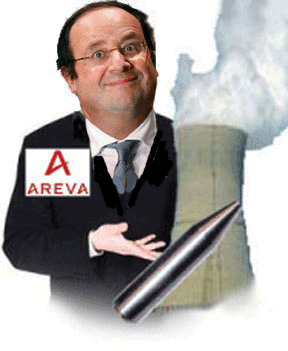 Europe checks French state aid for Areva restructuring, WNN 20 July 2016 The European Commission has launched an investigation to determine whether the French government’s contribution of €4.0 billion ($4.4 billion) towards the financing of the restructuring of Areva meets EU rules on state aid.
In late July 2015, EDF and Areva announced they had signed a memorandum of understanding setting out the principal terms and conditions for EDF to take a majority share in Areva’s reactor business, Areva NP. Areva – which has been experiencing financial difficulties for over five years – plans to create a new group later this year that will bring together all its fuel cycle operations: mining, chemistry, enrichment, recycling, dismantling, logistics and related engineering. And in April 2016 France notified the European Commission of a restructuring plan to return the Areva Group’s competitiveness and improve its financial position. The plan includes state aid in the form of a public capital injection of €4.0 billion. It also involves a renewed focus on the nuclear fuel cycle through various divestments and withdrawal from certain activities.
Areva – in which the French state owns, either directly or indirectly, an 86.5% stake – plans to launch a capital increase by the first quarter of 2017. The company earlier said, “The French state has indicated its intention of subscribing to it and ensuring its complete success, in compliance with European regulations.”
According to European guidelines on state aid for rescuing and restructuring companies in difficulty, aid to rescue such firms can only be granted for up to six months. Beyond this period, aid must either be reimbursed or a restructuring plan must be approved by the European Commission to allow aid for the company’s restructuring. The plan must ensure that the long-term viability of a company is restored without further state support, that the distortions of competition induced by the state aid are addressed by specific measures and that the company contributes to the cost of restructuring. Restructuring aid may only be granted once over a period of ten years.
The European Commission announced yesterday it has opened an in-depth investigation into the French government’s financial contribution to Areva’s restructuring…..http://www.world-nuclear-news.org/C-Europe-checks-French-state-aid-for-Areva-restructuring-2007164.html
US Dept Energy ordered by court to hand over Idaho nuclear waste documents
 Court orders feds to turn over Idaho nuclear waste documents http://www.seattletimes.com/nation-world/court-orders-feds-to-turn-over-idaho-nuclear-waste-documents/ August 9, 2016 By KEITH RIDLER The Associated Press
BOISE, Idaho (AP) — A federal judge has ordered the U.S. Department of Energy to make available to the court documents sought by former Idaho Gov. Cecil Andrus involving nuclear waste shipments to eastern Idaho.
U.S. District Court Judge B. Lynn Winmill on Monday ordered the agency to produce the documents within a week so Winmill can determine whether to make them public.
Andrus filed a lawsuit in September after Energy Department officials responded to Andrus’ Freedom of Information Act request with heavily redacted documents. Andrus wants information on research shipments of spent nuclear fuel to the Idaho National Laboratory that require a waiver to a 1995 agreement.Andrus says the waiver would make the state a nuclear waste repository.
Energy Department officials didn’t immediately respond to inquiries from The Associated Press on Tuesday.
New York “s Clean Energy standard drafted with an effort to avoid legal challenges about nuclear subsidy
NY Attempts to Thread Legal Needle with Clean Energy Standard, Nuke Incentives, RTO Insider,
The U.S. Supreme Court cast a long shadow as New York regulators drafted the Clean Energy Standard and its incentives to preserve upstate nuclear power plants.
Audrey Zibelman, chair of the state Public Service Commission, said that the order adopted last week was drafted to avoid legal challenges that could jeopardize the standard’s goal of generating 50% of the state’s power from renewable resources by 2030. PSC lawyers feared challenges to the zero-emission credit (ZEC) program for nuclear plants and the way in which renewable energy development is encouraged. (See New York Adopts Clean Energy Standard, Nuclear Subsidy.)……
ZEC Pricing
New York has priced ZECs based on EPA’s social cost of carbon, minus prices for carbon allowances sold under the nine-state Regional Greenhouse Gas Initiative, in which New York participates. Load-serving entities must purchase ZECs, which recognize the carbon-free attribute of nuclear power, proportionate to their annual energy sales.
Although it was designed to be similar to the REC procurement, the ZEC program may face a legal challenge that the mandate would suppress energy and capacity prices.
A group of power generators advanced that argument during the public comment period last month.
The comments were “a dry run driving right at the heart of ZEC,” said David Appelbaum, an attorney for the New York Power Authority. “They’re going to try to derail this. I don’t know if they’re going to be successful.”
The suppliers, 11 power generators and marketers, say the ZEC proposal violates the Federal Power Act and impinges on FERC jurisdiction over wholesale markets. “It conflicts with FERC’s policy that the NYISO’s capacity market provide the necessary price signals to encourage maintenance of existing, and development of new, facilities to meet reliability needs,” the suppliers contend. “But for the artificial price suppression, prospective new generators that may have been economic may forego entry, and existing generators that may have been economic may prematurely retire.”
The PSC order sought to head off this line of attack. The proposal “does not establish wholesale energy or capacity prices; it only establishes pricing for attributes completely outside of the wholesale commodity markets administered by NYISO,” the order states. “To the contrary, it addresses a well recognized externality that otherwise would lead to economic inefficiencies with respect to the costs incurred due to environmental damage, in particular, climate change.”
John Reese, the senior vice president of Eastern Generation, one of the suppliers, told RTO Insider on Monday that no decisions on any appeal have been made.
“We continue to look at all of the options, so we are in the process of deciding what is the best action to take,” he said. http://www.rtoinsider.com/new-york-clean-energy-standard-30101/
Japanese Government Wins in Supreme Court: Tents of Anti-Nuclear Groups Next to METI Ministry Building to Be Forcibly Removed
On July 28, Japan’s Supreme Court handed down its ruling in a case filed originally by the national government over tents pitched by anti-nuclear groups outside buildings of the Ministry of Economy, Trade and Industry (METI) in Kasumigaseki, Tokyo. It upheld an earlier order that the groups evacuate and pay for their use of the land.
The court’s petty bench, led by Judge Naoto Ohtani, rejected an appeal made by members of the groups against a lower court ruling. The Tokyo District Court is expected to carry out the forcible removal of the tents upon the request of the government, though members of the groups are expected to resist……..
The ruling includes an order that two defendants of the groups pay about JPY21,000 (USD206 at USD1 = JPY102) per day for use of the land, for a total of nearly JPY40 million (USD392,000) for the five-year period, plus interest.
http://www.jaif.or.jp/en/japanese-government-wins-in-supreme-court-tents-of-anti-nuclear-groups-next-to-meti-ministry-building-to-be-forcibly-removed/
Non-profit World Business Academy sues Lands Commission over Diablo Canyon Nuclear Station
Santa Barbara nonprofit sues Lands Commission over Diablo Canyon, Cal Coast News, August 3, 2016
By JOSH FRIEDMAN
A Santa Barbara-based nonprofit has filed a lawsuit against the California State Lands Commission, alleging the agency wrongfully approved a new lease for the cooling system at Diablo Canyon power plant. The lawsuit claims state law mandates than Diablo Canyon undergo an environmental review.
On June 28, the three-member State Lands Commission voted unanimously to approve a new tidelands lease for the Diablo Canyon cooling system. The decision will allow PG&E to continue operating the nuclear plant until 2025, when the utility plans to shut it down. If PG&E did not obtain the new lease, it faced the possibility of closing Diablo Canyon as early as 2018.
The World Business Academy, a think tank that opposes nuclear power and promotes renewable energy, filed its lawsuit in Los Angeles County Superior Court. The suit demands that state officials review potential environmental and public health dangers that could occur due to continued operation of Diablo Canyon.
California law mandates a project undergo an environmental review when any unusual circumstances exist, the lawsuit states. The World Business Academy claims there are numerous unusual circumstances surrounding Diablo Canyon. They include: high seismic risk; adverse health impacts from continuing emissions of radioactive isotopes; devastating impacts on marine life; potential adverse impacts from a terror attack; leakage and buildup of radioactive waste; and Diablo Canyon’s status as the sole remaining nuclear plant in California.
Rinaldo Brutoco, the president of the nonprofit, said any of the unusual circumstances should have triggered an environmental review…….http://calcoastnews.com/2016/08/santa-barbara-nonprofit-sues-lands-commission-diablo-canyon/
Potential for legal challenges to New York’s new Clean Energy Standard
With Clean Energy Standard, New York looks to save nukes, skirt legal challenges Regulators say three nuclear plants are essential to meeting state climate goals, but is their plan to save them legal? Utility Dive, By Robert Walton | August 4, 2016 New York regulators approved an aggressive Clean Energy Standard this week that calls for 50% renewable energy and includes income supports to keep three upstate nuclear plants online. ……the order has been carefully crafted to pass federal or legal scrutiny, though a challenge is all but inevitable……
In the days after its announcement, much of the legal speculation has centered on Hughes v. Talen Energy Marketing.
In a unanimous decision in April, the U.S. Supreme Court rejected a controversial Maryland program to incentivize new in-state generation, finding that it intruded on federal authorities’ jurisdiction over wholesale energy markets.
That case is also being talked about in the context of Ohio’s struggles with uneconomic generation. A previous subsidy passed by that state was blocked by FERC, forcing the utilities to revise and reduce their subsidy proposals……http://www.utilitydive.com/news/with-clean-energy-standard-new-york-looks-to-save-nukes-skirt-legal-chall/423673/
French trade unions consider further legal action against EDF’s Hi8nkley nuclear project
 Now French want to block Hinkley nuclear plant with unions set to launch second legal challenge http://www.thisismoney.co.uk/money/markets/article-3720786/Now-French-want-block-Hinkley-nuclear-plant-unions-set-launch-second-legal-challenge.html By CITY & FINANCE REPORTER FOR THE DAILY MAIL, 2 Aug 16 Fresh fears have emerged over the future of Hinkley Point nuclear power station as French trade unions look poised to launch a second legal challenge against the project.
EDF gave its long-awaited approval for funding of the £18billion nuclear plant last week.
But yesterday it was claimed board members were only given 48 hours to read the 2,500-page proposal document before voting on the investment. Complaints about the brevity of the two-day window have prompted French trade unions, who voted against the project, to consider further legal action against the energy company.
It follows an earlier legal bid from the unions over claims EDF did not provide enough information during the consultation on Hinkley.
EDF declined to comment.
Britain’s High Court rules that UK nuclear agency ‘manipulated’ £7bn clean-up contract

 UK nuclear agency ‘manipulated’ £7bn clean-up contract High Court ruling exposes government to potential £200m damages claim Ft.com by: Catherine Belton, 30 July 16 Britain’s Nuclear Decommissioning Authority “manipulated” and “fudged” a tender process for a £7bn contract to clean up the country’s nuclear power plants, the High Court has ruled.
The judgment, handed down on Friday, raises fresh questions over the way government entities hand out multibillion-pound contracts and casts further doubt on the UK’s nuclear industry a day after the government’s decision to launch a review of the £18bn Hinkley Point project. It could eventually cost the government hundreds of millions of pounds in damages.
The NDA said it was considering its legal options after the ruling, which found that it had wrongly awarded one of the government’s largest contracts to Babcock, the UK engineering company, and Texas-based Fluor……..
The court found that the NDA had “manipulated” the valuation process in order to avoid disqualifying the Babcock-Fluor bid. “In my judgment the NDA sought to avoid the consequence of disqualification by fudging the evaluation,” Justice Fraser wrote in his ruling.
He found that the NDA “fell short” in meeting its obligations of “transparency and equal judgment”……..
he contract involves the clean-up of 12 of the UK’s 25 nuclear sites, including the Sizewell, Hinkley and Dungeness “Magnox” nuclear power stations built in the 1960s which have reached the end of their lives.
The government is facing increasing scrutiny over its procurement process following the referral of G4S and Serco to the Serious Fraud Office for overcharging on electronic tagging contracts for offenders, and the West Coast main line rail franchising debacle two years ago. https://next.ft.com/content/7f11f174-55ad-11e6-9664-e0bdc13c3bef
Legal dispute in Britain over £7bn nuclear waste clean-up contract
High court to rule on £7bn nuclear clean-up contract https://next.ft.com/content/5c2dbe24-4f39-11e6-8172-e39ecd3b86fc A win for Energy Solutions would raise questions about procurement process y: Gill Plimmer, 24 July 16
Britain’s Nuclear Decommissioning Authority is in the High Court this week for the final ruling in a long-running damages claim on a £7bn deal to clean up Britain’s oldest nuclear power plants.
Energy Solutions, a US-based company, filed a high court writ in 2014 after losing the contract to engineering company Babcock and Texas-based Fluor. It had been managing the nuclear sites for 14 years and in documents filed to the court alleged that the NDA did not follow its own procedures when the new contract was awarded and that its point scoring system was flawed.
At the heart of the dispute is one of the largest contracts ever put out to tender by the government, which involves about 3,000 workers cleaning 12 of Britain’s 25 nuclear sites. These include Sizewell, Hinkley and Dungeness — built in the 1960s to produce plutonium to make nuclear weapons but now at the end of their lives.
If the NDA loses the case it could cost the government hundreds of millions of pounds and will again raise questions over the way large and sensitive public-sector contractsare awarded.
The judgment is expected on July 29 and will rule whether the NDA made serious errors in awarding the contract. If so, there will be further hearings, which could stretch into 2017, to decide any payment for damages.
Although Energy Solutions competed for the contract in partnership with the US company Bechtel, Energy Solutions is taking legal action alone.
Energy Solutions, which has since been taken over by the construction and support services company Atkins, declined to comment. Atkins said it had “no economic interest in or any control over the resolution of the … claim, which has been retained by the remaining part of the Energy Solutions business”.
A series of botched contracts has raised concerns over the government’s procurement processes. The referral of G4S and Serco to the Serious Fraud Office for overcharging on electronic tagging contracts for offenders and the West Coast main line rail franchising debacle two years ago are among examples.
In 2012, FirstGroup won a 13-year deal to manage the rail network linking London to Scotland, only for Virgin Trains to challenge the decision in court and eventually force a government U-turn.
An NDA spokesperson said: “We continue to await the judgment being handed down and cannot comment before this time.”
Washington State asks judge for immediate worker protection at Hanford
State asks judge for immediate protection at Hanford
State attorney general, others request injunction
Detail worker illnesses
Ask court to mandate supplied air respirators
TRI CITY HERALD, BY ANNETTE CARY acary@tricityherald.com 22 July 16 Washington state’s attorney general wants a federal judge to immediately protect Hanford workers from chemical vapors at the nuclear reservation’s tank farms.
The state alleges that safety measures at the tank farms have been reduced since it and others sued in September to better protect workers.
A request for a preliminary injunction was filed by the state on Thursday. It’s part of the federal court lawsuit that Attorney General Bob Ferguson filed against the Department of Energy and its tank farm contractor, Washington River Protection Solutions.
Seattle-based Hanford Challenge and Union Local 598 followed with a similar request for preliminary injunction.
The matter is not scheduled to go to trial until May 2017, and Ferguson and other plaintiffs in the consolidated lawsuits want a judge to step in sooner to ensure worker protection until the case is heard.
“We are acting today to protect the Hanford work force and end exposure to toxic chemical vapors at Hanford,” Tom Carpenter, executive director of Hanford Challenge, said in a statement. “Too many workers have already gotten sick and even disabled by brain and lung diseases.”
The state is asking that a judge order the mandatory use of supplied air respirators at all time for workers within the fence of Hanford tank farms, where waste is stored in underground tanks from the past production of weapons plutonium. The chemical vapors are associated with the waste in the tanks.
The Hanford Atomic Metal Trades Council, a coalition of 15 Hanford unions, made the same demand in June and then called a halt to work this month unless the demand was met. Washington River Protection Solutions has said it is now mandating supplied air respirators for any work done inside the tank farms.
The federal court filing also asks the judge to order mandatory use of the supplied air respirators in the area at least 200 feet outside the fence of tank farms if work that disturbs waste is being done within a farm.
It also would require barricading of roads and access points in the expanded area, called the vapor control zone.
The state also wants the judge to require immediate installation of improved monitoring and alarm equipment when waste is disturbed, which can cause the release of chemical vapors. The improved equipment would warn workers when vapors are emitted.
“I’ve been asking for months: How many sick Washington workers will it take before the federal government fixes this problem?” Ferguson said in a statement.
From April through June more than 50 Hanford employees were given medical evaluations for possible exposure to chemical vapors. Those with symptoms had nosebleeds, chest and lung pain, headaches, coughing, sore throats, irritated eyes and difficulty breathing, according to the lawsuit.
Worker descriptions of exposures over more than a decade are remarkably similar, according to court documents. Workers typically report a musty or metallic odor, followed by symptoms.
Documents filed by Hanford Challenge and Local 598 detailed some of the illnesses workers have experienced over the last 20 years after working in or near the tank farms……..
The state’s court documents say many of the exposures happened after work began this spring to empty a double-shell tank with an interior leak and transfer its contents to another tank, creating a high potential for vapor exposures in and around the transfer site.
As work progressed, Hanford officials repeatedly reduced the area in which workers were required to wear supplied air respirators based on sampling data, according to the state.
Two weeks later more than 40 workers received medical checks for possible chemical vapor exposure over a five-day period, the state said. Many of the exposures were outside tank farm fences, with some up to 200 feet away from the farms. http://www.tri-cityherald.com/news/local/hanford/article91011762.html
As with tobacco, the climate wars are going to court

Déjà vu: as with tobacco, the climate wars are going to court Skeptical Science
18 July 2016 by dana1981, JohnMashey Investigative journalism has uncovered a “web of denial” in which polluting industries pay “independent” groups to disseminate misinformation to the public and policymakers. The same groups and tactics were employed first by the tobacco industry, then fossil fuel companies. Big Tobacco has been to court and lost; now it’s Big Oil’s turn. Political leaders are choosing sides in this war.
Elizabeth Warren Rips Think Tanks & Policy Groups For Fake Climate Change Research
Research by Inside Climate News revealed that Exxon did top notch climate science research in the late 1970s and early 1980s, which revealed the dangers its products posed via climate change. Soon thereafter, Exxon launched misinformation campaigns by funding “think tanks” and front groups to manufacture doubt about climate science and the expert consensus on human-caused global warming.Exxon wasn’t alone. Koch Industries, Peabody Energy, and other fossil companies have similarly funneled vast sums of money to these groups. Last week, Senate Democrats, including presidential candidate Bernie Sanders and vice presidential contenders Elizabeth Warren and Al Franken signed a Resolution expressing congressional disapproval of the fossil fuel industry’s misinformation campaign.19 Senate Democrats also took to the floor of the Senate to speak out against the web of denial, with repeated references to the tobacco/fossil connections.
Senator Elizabeth Warren speaking about the web of denial on the Senate floor.
The climate battle goes to court
The fossil fuel industry has already put forth its best scientific argument in court,and lost. Now 17 state attorneys general, led by New York Attorney General Eric Schneiderman, have formed a coalition to investigate ExxonMobil’s activities. As Schneiderman put it:
The First Amendment, ladies and gentlemen, does not give you the right to commit fraud
However, Lamar Smith (R-TX), chairman of the House Science Committee, along with his Republican colleagues last week issued subpoenas to Schneiderman and Massachusetts Attorney General Maura Healey, accusing them of violating Exxon’s First Amendment rights. As Smith claimed:
The Committee has a responsibility to protect First Amendment rights of companies, academic institutions, scientists, and nonprofit organizations. That is why the Committee is obligated to ask for information from the attorneys general and others.
In this battle of First Amendment claims, Big Oil & Coal use the same argument as Big Tobacco, who lost.
The fossil fuel industry copied the tobacco playbook
Last century, we saw a similar battle with tobacco. By the 1950s, the tobacco industry knew that its products caused cancer and other diseases. They still marketed their harmful products to children, and soon created pseudo-academic institutes like the Council for Tobacco Research to cast doubt on smoking’s damage. However, the institutes’ connections to the tobacco industry were too obvious; they wanted “independent” voices.In the 1980s the Koch brothers started creating a vast web of “think tanks” that could simulate credible independence, funded via dark money, often tax-exempt. Big Tobacco eagerly joined, to “quarterback behind the scenes.” They contributed great marketing talent, some later hired by Kochs.As extensively documented at DeSmogBlog, Big Tobacco has long funded science-denying think tanks, such as the Heartland Institute, Heritage Foundation, Cato Institute, George Marshall Institute, American Legislative Exchange Council (ALEC), and Manhattan Institute, to name a few. ExxonMobil later funded these same groups.The fossil fuel industry has adopted the tobacco industry’s playbook, and shared the same web of denial. The Senate Resolution made this point, calling out both the tobacco and fossil fuel industries for having:
(A) developed a sophisticated and deceitful campaign that funded think tanks and front groups, and paid public relations firms to deny, counter, andobfuscate peer-reviewed science; and(B) used that misinformation campaign to mislead the public and cast doubt in order to protect their financial interest
Their tactics have grown more sophisticated, for example using money anonymizers like Donors Trust to ensure their “dark money” becomes even harder to trace.
The tobacco industry lost in court
In 1999, the US Justice Department filed a civil Racketeer Influenced and Corrupt Organizations Act (RICO) lawsuit against the major tobacco companies and their associated industry groups. In 2006, US District Court Judge Gladys Kessler ruledthat the tobacco industry’s campaign to “maximize industry profits by preserving and expanding the market for cigarettes through a scheme to deceive the public” about the health hazards of smoking amounted to a racketeering enterprise. She wrote a clear statement, appealed fruitlessly by tobacco companies:
The First Amendment Does Not Protect Defendants’ False and Misleading Public Statements
The attorneys general investigating Exxon have a strong case that the fossil fuel industry is similarly guilty of racketeering by deceiving the public in order to maximize profits. Exxon and other fossil fuel companies knew of the dangers of carbon pollution more than three decades ago, and yet funneled tens of millions of dollars to think tanks that disseminate misinformation to try to convince the public and policymakers otherwise.Sharon Eubanks led the Justice Department trial team, as documented in the book Bad Acts: The Racketeering Case Against the Tobacco Industry and was a key contributor to the report Establishing Accountability for Climate Change Damages. Of the Exxon case, she said:
I think a RICO action is plausible and should be consideredThe First Amendment defense of the fossil fuel industry by House Republicans simply doesn’t hold water. Defending the fossil fuel industry today is no different than defending the tobacco industry in the 1990s, as did Lamar Smith’s colleague“Smokey Joe” Barton (R-TX).Unsurprisingly, oil & gas is the top industry donor to Lamar Smith. History books will reflect poorly on those who sold out millions of peoples’ health for personal gain or industry profits, and on those who worked to destabilize the climate on which future generations will rely for the sake of their own political power orExxonMobil’s record profits. http://www.skepticalscience.com/deja-vu-climate-wars-going-to-court-like-tobacco.html
1 This Month



26 September – International Day for the Total Elimination of Nuclear Weapons


PLEASE OPPOSE HR 8255 AND S.3639 – bills would accelerate satellite deployment, with no environmental review or safeguards – https://ncstd5li.quorum.us/campaign/169331/
To see nuclear-related stories in greater depth and intensity – go to https://nuclearinformation.wordpress.com
-
Archives
- September 2026 (219)
- August 2026 (330)
- July 2026 (355)
- June 2026 (287)
- May 2026 (306)
- April 2026 (356)
- March 2026 (251)
- February 2026 (267)
- January 2026 (308)
- December 2025 (358)
- November 2025 (359)
- October 2025 (375)
-
Categories
- 1
- 1 NUCLEAR ISSUES
- business and costs
- climate change
- culture and arts
- ENERGY
- environment
- health
- history
- indigenous issues
- Legal
- marketing of nuclear
- media
- opposition to nuclear
- PERSONAL STORIES
- politics
- politics international
- Religion and ethics
- safety
- secrets,lies and civil liberties
- spinbuster
- technology
- Uranium
- wastes
- weapons and war
- Women
- 2 WORLD
- ACTION
- AFRICA
- Atrocities
- AUSTRALIA
- Christina's notes
- Christina's themes
- culture and arts
- Events
- Fuk 2022
- Fuk 2023
- Fukushima 2017
- Fukushima 2018
- fukushima 2019
- Fukushima 2020
- Fukushima 2021
- general
- global warming
- Humour (God we need it)
- Nuclear
- RARE EARTHS
- Reference
- resources – print
- Resources -audiovicual
- Weekly Newsletter
- World
- World Nuclear
- YouTube
-
RSS
Entries RSS
Comments RSS
 nuclear-news