USA Department of Veterans Affairs conveniently lost hundreds of claims for children, grandchildren of contaminated veterans
 VA lost or misplaced hundreds of claims for children, grandchildren of contaminated veterans http://www.wfla.com/8-on-your-side/investigations/va-lost-or-misplaced-hundreds-of-claims-for-children-grandchildren-of-contaminated-veterans/1194448265, Steve Andrews May 23, 2018
Missouri legal case – claim that cancer caused by Manhattan Project

 Woman claims Manhattan Project caused her cancer https://stlrecord.com/stories/511423482-woman-claims-manhattan-project-caused-her-cancer, by Amanda Thomas | May 20, 2018, ST. LOUIS – A Florissant woman has filed a lawsuit against a biopharmaceutical company and chemical-producing corporation for alleged negligence related to the disposal of “hazardous, toxic, and radioactive materials” near residential neighborhoods in St. Louis County.
Trial of French activists who entered Cruas nuclear plant to demonstrate vulnerability of spent fuel storage pools
Liberation 17th May 2018 [Machine Translation] At Greenpeace activists’ trial, nuclear safety is no exception. At the trial of 22 activists of Greenpeace, the court tried Thursday to limit the debates to the facts – their intrusion in November in the nuclear site of Cruas-Meysse (Ardèche) – without being able to avoid the question of the safety of the power plants, that the NGO is  questioning.
This action, preceded by a first in Cattenom (Moselle), had the same objective for its authors: to show flaws in the safety of spent fuel storage pools. The hearing was held under high police protection while a rally to support these “whistleblowers” was held all day in front of the courthouse. http://www.liberation.fr/societe/2018/05/17/au-proces-de-militants-greenpeace-la-securite-nucleaire-n-echappe-pas-aux-debats_1650850
Mediapart 18th May 2018 Against Greenpeace, state prosecutes civil disobedience. Sentences of reprieve and imprisonment were required against the twenty-three activists of Greenpeace who illegally entered the Cruas nuclear power plant in November 2017. For the public prosecutor, as for EDF, “it is time it stops. It is no longer possible to tolerate these repeated intrusions . ”
https://www.mediapart.fr/journal/france/180518/contre-greenpeace-l-etat-fait-le-proces-de-la-desobeissance-civile
Nuclear war, nuclear pollution nuclear waste, and climate inaction – crimes against future generations
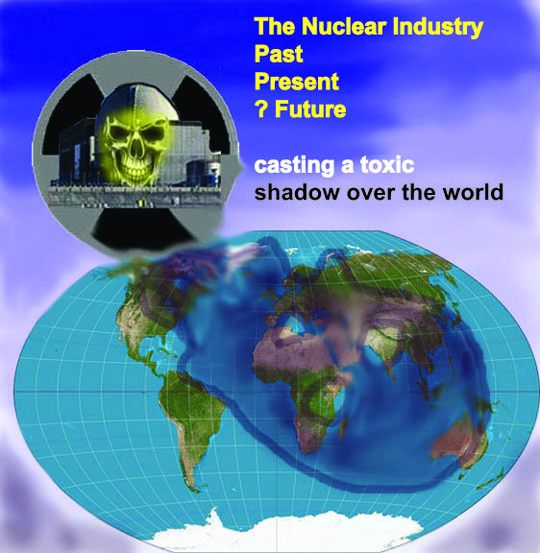
Crimes against future generations https://beyondnuclearinternational.org/2018/05/13/crimes-against-future-generations/ By Andreas Nidecker, Emilie Gaillard, and Alyn Ware
As nuclear tensions increase, dangerous times have raised legally-loaded questions about nuclear weapons. What happens now the U.S. is withdrawing from Iran nuclear deal? Does the president have unfettered power to launch a preemptive nuclear strike on North Korea? What’s the legal status of the Trump administration’s intention, telegraphed in the Nuclear Posture Review, to expand U.S. nuclear capabilities and arsenals when the Nuclear Non-Proliferation Treaty supposedly commits us to cutting and eventually eliminating them?
But there’s an even broader legal dilemma looming over production, testing and threatened use of nuclear weapons: how they affect the human rights of future generations. Those threats to the future are also compounded by nuclear energy, which generates radioactive waste we’re manifestly unable to control, and by destabilizing the climate that has enabled and sustained human civilization.
Can such crimes against the future be legal? How can we respect the human rights of future generations in view of them? International symposia at the University of Basel (Switzerland), University of Caen (France) and Charles University in Prague (Czech Republic) recently grappled with those questions. The Basel conference produced a declaration on human rights and trans-generational crimes resulting from nuclear weapons and nuclear energy.
Protecting future generations from the threat of nuclear weapons was an important consideration in the International Court of Justice’s 1996 affirmation that threat or use of nuclear weapons is generally illegal, given their long-term and indiscriminate impact. But despite the Court’s decision, most nuclear-armed states retain (illegal) policies to use nuclear weapons, including in a first, pre-emptive strike.
In general, current law fails to safeguard the rights of future generations. But that doesn’t make failure defensible, sustainable or in accord with legal principles. Evolution of this area of law is necessary and inevitable.
Some 2000 nuclear weapons were detonated for “testing” since 1945, releasing millions of curies of radiation. This impacted human health globally, and will continue to do so for generations. Most nuclear testing victims live in remote areas like the Pacific islands, the Kazakhstan steppe, or the North African Sahara. They have largely been forgotten; today’s younger generations are unaware of their sacrifice. Yet forgetting is perilous, because today’s youth will be tomorrow’s victims unless the cycle is broken.
There are some legal efforts to break it. For example, the 2017 Treaty on the Prohibition of Nuclear Weapons obligates signatories to provide environmental remediation and assistance for nuclear testing victims. But the provision is unenforceable, because none of the nine nuclear weapons states signed the treaty.
Like nuclear weapons, nuclear energy also poses enduring threats to human health. The Chernobyl explosion caused widespread contamination across the region and the whole European continent. High volumes of radiologically contaminated water from Fukushima continue to leak into the Pacific.
These, too, are crimes against the future. Some lethal isotopes in nuclear waste have half-lives of thousands of years. Waste repositories will need to be guarded for unimaginable time periods, with associated financial, logistical and security implications for future societies, an enormous burden we leave to our descendants.
Like the Treaty on the Prohibition of Nuclear Weapons, the International Covenant on Economic, Social and Cultural Rights (ICESCR) asserts a human right to health, applicable to nuclear contamination. But in practice that right isn’t respected.
For example, Japan ratified the covenant, and the Japanese constitution even defends the trans-generational principle of human rights in articles 11 and 97. But despite those legal principles being articulated, the Japanese media is still prevented from reporting on current events in Fukushima, and medical research on the effects of the meltdown is still restricted. The Japanese government maintains that small amounts of radiation are harmless, so limits for public radiation exposure could be increased from 1 to 20 millisieverts per year, the same as for radiation workers.
That’s unconscionable and untenable, not to mention discriminatory against young women and children who are much more susceptible to radiation exposure than men, with higher risks of cancer and non-cancerous diseases. Radiation exposure may present mutations and diseases in their offspring decades later. That’s why Japan’s handling of the Fukushima nuclear disaster fails to accord with its own constitution as well as the ICESCR.
Failing to combat climate change effectively is also a crime against the future. The chances of meeting the Paris goal of limiting global warming to 2°C are receding since the U.S. withdrew and financial contributions of many signatories remain out of scale with the problem. Greenhouse gas emissions have risen in the two years since the Paris accord. If we stay on this too-little, too-late trajectory, we’ll not only fail to protect human rights, but much of life on Earth.
Can all this be considered legal? Not for long. The dawn of the nuclear age marked the acquisition of unprecedented human power over the Earth and all forms of life, as the Caen symposium pointed out. Many legal experts believe that in this new anthropocene era, a new code of medical and legal ethics is necessary. Trans-generational impacts of nuclear war, nuclear catastrophes and climate change must now be seriously considered, and require a paradigm shift in our legal thinking about the future.
The District Court of the Hague took a step in that direction in 2015 when it affirmed in Urgenda Foundation v. the Dutch State that the government had a responsibility to protect future generations by limiting greenhouse gas emissions. A similar case in the United States brought by young people — Juliana et al v. United States — was granted jurisdiction and is proceeding to consideration of its merits.
There remains a long way to go to adapt the current legal framework to the realities of nuclear threats and climate change. Current laws need better implementation, and new laws need to be established. But those changes are vital to protecting the human rights of future generations.
Emilie Gaillard is an Associate Professor of law and a researcher at the University of Caen Normandy (France). She is a member of the Pôle Risques, Qualité et Environnement Durable at Maison de la recherché et des Sciences de l’Homme (Caen).
Andreas Nidecker MD is a Professor Emeritus of Radiology at the University of Basel, Switzerland. Board member and past president of PSR / IPPNW Switzerland and member of the organizing Committees of the symposium “Human Rights, Future Generations & Crimes in the Nuclear Age.”
Alyn Ware is a member of the World Future Council and consultant for the International Association of Lawyers Against Nuclear Arms.
UK nuclear regulator prosecutes waste firm over worker exposed to radiation
Sellafield faces huge fine over worker’s exposure to radiation Nuclear regulator prosecutes waste firm after injury leaves employee open to exposure https://www.theguardian.com/environment/2018/may/11/sellafield-faces-huge-fine-over-employees-exposure-to-radiation Adam Vaughan, 11 May 18
Britain’s biggest nuclear waste storage and reprocessing site is facing a potential multimillion-pound fine after an employee was exposed to dangerously high levels of radiation.
The nuclear regulator said its investigation had led it to prosecute Cumbria-based Sellafield Ltd, which handles the waste from the UK’s nuclear power stations as well as spent fuel from Japan and the US.
It is the first time in five years that the Office for Nuclear Regulation has prosecuted the company.
Last time, Sellafield was fined £700,000 for sending bags of radioactive waste to a landfill dump instead of a specialist facility.
Now, if the prosecution is successful, the firm is understood to be facing the prospect of a substantial fine, likely to be much larger because an individual was affected.
The case relates to an accident in February 2017, when a site employee was wounded while handling equipment, leaving him open to internal radiation exposure.
He was decontaminated afterwards, but an investigation found the individual may have been exposed to radiation up to three times the annual limit. The regulator is taking the firm to court over offences under the Health and Safety at Work act.
Both Sellafield and the ONR said they were unable to comment further for legal reasons.
The prosecution is due to begin at Workington magistrates court in Cumbria on 20 July.
Sellafield has been state-run since 2016, after MPs raised concerns over how much it was costing taxpayers under private ownership.
The facility is in the process of a major transformation from a reprocessor of nuclear waste, where it turns spent fuel from power stations into uranium that can be used again, to solely focusing on storage.
The site’s Thermal Oxide Reprocessing Plant (Thorp) ceases operations in November this year, and will then be dismantled. Sellafield’s Magnox reprocessing plant, which handles waste from Britain’s early nuclear power stations, is scheduled to close in 2020.
Widening fraud scandal over radioactive contamination clean-up
Former Hunters Point shipyard cleanup workers plead guilty to fraud
First criminal convictions in widening toxic cleanup scandal, Curbed San Francisco , By
Legal discussions over failed nuclear plants – will result in tougher regulations
 Tougher utility regulations advance, as attorneys argue over failed S.C. nuclear project https://www.postandcourier.com/business/tougher-utility-regulations-advance-as-attorneys-argue-over-failed-s/article_872a5b7c-4d5d-11e8-8743-b78c8b42b82a.html, By Andrew Brown abrown@postandcourier.com
2018 Goldman Environmental Prize goes to South African anti nuclear activists
Makoma Lekalakala and Liz McDaid, 2018 Goldman Environmental Prize, South Africa
South African activists awarded Goldman Environmental Prize for fight against nuclear power deal http://www.abc.net.au/news/2018-04-24/two-south-african-women-stopped-international-nuclear-deal/9691528, The World Today By Sally Sara
Two women tooki on the South Afric an government – and won their anti nuclear fight
Makoma Lekalakala and Liz McDaid, 2018 Goldman Environmental Prize, South Africa
South African activists awarded Goldman Environmental Prize for fight against nuclear power deal http://www.abc.net.au/news/2018-04-24/two-south-african-women-stopped-international-nuclear-deal/9691528, The World Today ,By Sally Sara
U.S. Federal judge allows lawsuit about radiation to go ahead
Federal judge allows Lakeland radiation lawsuit against Drummond Co. to go forward, The Ledger, By Suzie Schottelkotte , 20 Apr 18,
TAMPA — In a ruling released late Thursday, a federal judge again has determined that a lawsuit against the developer of the Grasslands and Oakbridge communities in Lakeland alleging radiation contamination in the soil will go forward.
U.S. District Judge Elizabeth Kovachevich rejected all of Alabama-based Drummond Co.’s arguments cited in a motion to dismiss, and ruled that lawyers for two residents have alleged enough facts to support their claims of residual gamma radiation from Drummond’s phosphate mining and subsequent reclamation in the late 1970s and early 1980s.
The lawsuit alleges that gamma radiation levels in the two developments have been measured at 11 to 21 times that of federal acceptable risk levels. It seeks compensation for cleaning up the contamination and a medical-monitoring program for residents in the 1,400-acre development.
Lawyers for the residents intend to seek class-action status in the lawsuit, which would allow anyone impacted by the alleged contamination to share in a monetary verdict if the residents prevail in court. The residents are represented by a consortium of six law firms led by the Houston-based Lanier Law Firm. ……http://www.theledger.com/news/20180420/federal-judge-allows-lakeland-radiation-lawsuit-against-drummond-co-to-go-forward
U.S. Supreme Court considers forcing changes to reduce Savannah nuclear sites leaking into the river.
The State 18th April 2018 ,Four decades after radiation leaked from a landfill for nuclear waste near
Barnwell, unsafe levels of radioactive pollution continue to contaminate
groundwater near the site, as well as a creek that flows toward the
Savannah River. Now, after 13 years of legal battles between the landfill’s
operator and environmentalists, the S.C. Supreme Court is considering
whether to force changes that would make the site less likely to leak
radioactive contaminants, landfill critics say. http://www.thestate.com/latest-news/article209093444.html
Proposed new European energy laws could hamper community and renewable energy
Energy Post 23rd March 2018,The European Commission has proposed new European legislation that could
put Europe’s distribution system operators in a powerful position to bend
market rules to their own advantage, writes Julie Finkler of NGO
ClientEarth. According to Finkler, this could seriously hamper other market
players, like community energy initiatives, renewable energy producers and
aggregators. She calls on the European Parliament and the Member States to
ensure this will not happen. http://energypost.eu/eu-electricity-distributors-should-not-be-allowed-to-police-themselves/
Nine Iranians Charged With Conducting Massive Cyber Theft Campaign on Behalf of the Islamic Revolutionary Guard Corps
Mabna Institute Hackers Penetrated Systems Belonging to Hundreds of Universities, Companies, and Other Victims to Steal Research, Academic and Proprietary Data, and Intellectual Property, USA Department of Justice, 23 Mar 18
An Indictment charging Gholamreza Rafatnejad, 38; Ehsan Mohammadi, 37; Abdollah Karima, aka Vahid Karima, 39; Mostafa Sadeghi, 28; Seyed Ali Mirkarimi, 34; Mohammed Reza Sabahi, 26; Roozbeh Sabahi, 24; Abuzar Gohari Moqadam, 37; and Sajjad Tahmasebi, 30, all citizens and residents of Iran, was unsealed today. The defendants were each leaders, contractors, associates, hackers-for-hire or affiliates of the Mabna Institute, an Iran-based company that, since at least 2013, conducted a coordinated campaign of cyber intrusions into computer systems belonging to 144 U.S. universities, 176 universities across 21 foreign countries, 47 domestic and foreign private sector companies, the U.S. Department of Labor, the Federal Energy Regulatory Commission, the State of Hawaii, the State of Indiana, the United Nations, and the United Nations Children’s Fund……..https://www.justice.gov/opa/pr/nine-iranians-charged-conducting-massive-cyber-theft-campaign-behalf-islamic-revolutionary
1960 Paris Convention part of undemocratic government support for nuclear industry
 La Libre 19th March 2018, More than 40 scientists, intellectuals, engineers and artists: “It is time
for the political world to assume Fukushima” (OPINION).It is time for the
political world to take its mistakes and put an end to the nuclear
industry.
This is not only illegitimate, but it is also an extreme threat
to our future. On June 25 last year, 50,000 people joined hands to demand
the closure of the Tihange plant. The number of protesters surprised many.
Also notable was the lack of reaction from the political world as a result
of this extraordinary event.
There are reasons for this apparent lethargy of the leaders of this country, in the face of this popular demonstration,
perhaps starting with a feeling of guilt, which would be quite appropriate.
Indeed, what has prevailed in the implementation of the nuclear industry is
the lack of democratic debate and false state propaganda, that of an energy
that would be unlimited, cheap and safe; as we recalled the commemoration
of the seventh anniversary of Fukushima, the second accident of a nuclear
power station which has no end, after that of Chernobyl in 1986.
More serious still, in 1960, the leaders of 16 European countries, including
Belgium, agreed to sign the Paris Convention which was intended to limit
the financial liability of the operator in the event of a nuclear accident,
no insurance company willing to cover the nuclear risk considered too high.
Without this unique Convention, the nuclear industry could never have developed in Europe.
It is worth mentioning here that a major accident in Tihange would mean the end of life as we know it and, in fact, the end of Wallonia as a region. That the cost of such an accident would amount to
several trillions of euros, without it being possible to quantify the
sanitary and psychological misery into which the Walloons, sentenced,
either to leave their country abandoning all their property – but to go
where, or to live in a contaminated territory for the poorest of them. That
on this amount, the operator, Engie-Electrabel, would have to pay only 1.2
billion, less than its profit of certain years and less than one thousandth
of the cost of the disaster.
http://www.lalibre.be/debats/opinions/plus-de-40-scientifiques-intellectuels-ingenieurs-et-artistes-il-est-temps-que-le-monde-politique-assume-fukushima-opinion-5aae9319cd702f0c1a63ffda
$1 billion case against Tokyo Electric Power Company Holdings Inc by Americans affected by Fukushima nuclar dizaster
https://mainichi.jp/english/articles/20180320/p2g/00m/0dm/023000c (Mainichi Japan) TOKYO (Kyodo) — Some 200 U.S. residents filed a suit against Tokyo Electric Power Company Holdings Inc. and a U.S. firm seeking at least $1 billion to cover medical expenses related to radiation exposure suffered during the 2011 Fukushima nuclear disaster, the utility said Monday.
Many of the plaintiffs are suing TEPCO and the U.S. company, whose name was withheld by TEPCO, for the second time after a similar suit was rejected by the federal court in California in January.
They are seeking the establishment of a compensation fund of at least $1 billion to cover medical and other costs, the utility said.
The plaintiffs claim that the nuclear accident occurred due to improper design and management of the plant by TEPCO. They are also seeking compensation for physical and psychological damage suffered as a result of the disaster, said the utility.
In Operation Tomodachi, which began two days after the natural disasters, the aircraft carrier Ronald Reagan and other U.S. military resources and personnel were deployed to deliver supplies and undertake relief efforts at the same time as three reactors at the Fukushima Daiichi complex suffered fuel meltdowns.
1 This Month

26 September – International Day for the Total Elimination of Nuclear Weapons


PLEASE OPPOSE HR 8255 AND S.3639 – bills would accelerate satellite deployment, with no environmental review or safeguards – https://ncstd5li.quorum.us/campaign/169331/
To see nuclear-related stories in greater depth and intensity – go to https://nuclearinformation.wordpress.com
-
Archives
- September 2026 (194)
- August 2026 (330)
- July 2026 (355)
- June 2026 (287)
- May 2026 (306)
- April 2026 (356)
- March 2026 (251)
- February 2026 (267)
- January 2026 (308)
- December 2025 (358)
- November 2025 (359)
- October 2025 (375)
-
Categories
- 1
- 1 NUCLEAR ISSUES
- business and costs
- climate change
- culture and arts
- ENERGY
- environment
- health
- history
- indigenous issues
- Legal
- marketing of nuclear
- media
- opposition to nuclear
- PERSONAL STORIES
- politics
- politics international
- Religion and ethics
- safety
- secrets,lies and civil liberties
- spinbuster
- technology
- Uranium
- wastes
- weapons and war
- Women
- 2 WORLD
- ACTION
- AFRICA
- Atrocities
- AUSTRALIA
- Christina's notes
- Christina's themes
- culture and arts
- Events
- Fuk 2022
- Fuk 2023
- Fukushima 2017
- Fukushima 2018
- fukushima 2019
- Fukushima 2020
- Fukushima 2021
- general
- global warming
- Humour (God we need it)
- Nuclear
- RARE EARTHS
- Reference
- resources – print
- Resources -audiovicual
- Weekly Newsletter
- World
- World Nuclear
- YouTube
-
RSS
Entries RSS
Comments RSS
 nuclear-news