Nuclear power is racist, sexist and ageist — Beyond Nuclear International

Progressive Democrats should reject, not embrace it.
Nuclear power is racist, sexist and ageist — Beyond Nuclear International https://wordpress.com/read/feeds/72759838/posts/4139419698
So why do some progressives support it?
By Linda Pentz Gunter
I am sure that certain Democratic senators such as Cory Booker and Sheldon Whitehouse, who are reasonably progressive on a host of social issues, would not considers themselves racist, sexist or ageist.
Nuclear power is all three of these things, yet Booker, Whitehouse and a number of others on the Democratic left, support nuclear power with almost fervent evangelism.
Let’s start with racism. The fuel for nuclear power plants comes from uranium, which must be mined. The majority of those who have mined it in this country — and would again under new bills such as the ‘International Nuclear Energy Act of 2022’ forwarded by not-so-progressive “Democrat”, Senator Joe Manchin (D-WV) — are Native Americans.
As such, they have taken the brunt of the negative health impacts as well as the environmental degradation both created and then left behind by uranium mines when they cease to operate, as most in the U.S. now have.
Studies conducted among members of the Navajo Nation have shown increases in a number of diseases and lingering internal contamination from uranium mine waste among newborns and children. Chronic ailments including kidney disease and hypertension found in these populations are medically linked with living near –and contact with — uranium mine waste.
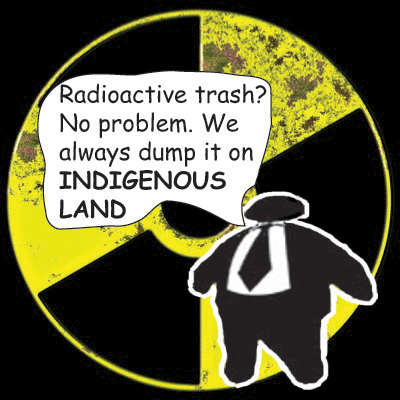
At the other end of the nuclear power chain comes the lethal, long-lived and highly radioactive waste as well as the so-called low-level radioactive waste stream of detritus, including from decommissioned nuclear power plants. Again, Indigenous peoples and poor communities of color are routinely the target.
The first and only high-level radioactive waste repository identified for the U.S. was to have been at Yucca Mountain, Nevada, against the strong wishes of the Western Shoshone Nation of Indians, on whose land the now canceled site is located. The Western Shoshone had already suffered the worst of the atomic testing program, with the Nevada atomic test site also on their land, making them “the most bombed nation on Earth,” as Western Shoshone Principal Man, Ian Zabarte, describes it.
An attempt to site a “low-level” radioactive waste dump in the largely Hispanic community of Sierra Blanca, TX was defeated, as was an allegedly temporary high-level radioactive waste site targeted for the Skull Valley Goshute Indian reservation in Utah.
Currently, efforts are underway to secure what are euphemistically known as “Consolidated Interim Storage Sites” in two communities in New Mexico and Texas, again with large Hispanic populations and considerable opposition.
Needless to say, these waste projects come with notable incentives — sometimes more accurately characterized as bribes — for the host community, in an effort to describe the deal as “voluntary.” But this preys upon the desperate economic needs of the most vulnerable communities, which are usually those of color.
The only two new U.S. nuclear reactors still under construction sit close to the African American community of Shell Bluff, Georgia, a population riddled with cancers and other diseases and who bitterly opposed the addition of more reactors to an already radioactively contaminated region.
Nuclear power is sexist because exposure to the ionizing radiation released at every stage of the nuclear fuel chain harms women more easily than men. Women are more radiosensitive than men — the science is not fully in on this but it is likely connected to greater hormone production — but women are not protected for.
Instead, the standard guidelines on which allowable radiation exposure levels are based (and “allowable” does not mean “safe”), consider a healthy, White male, in his mid-twenties to thirties and typically weighing around 154 pounds. He is known as “Reference Man”.
Women’s more vulnerable health concerns, and especially those of pregnant women, the fetus, babies and small children — and in particular female children — are thus overlooked in favor of the higher doses a healthy young male could potentially withstand.
As my colleagues Cindy Folkers and Ian Fairlie wrote:” “Women, especially pregnant women and children are especially susceptible to damage from radiation exposure. This means that they suffer effects at lower doses. Resulting diseases include childhood cancers, impaired neural development, lower IQ rates, respiratory difficulties, cardiovascular diseases, perinatal mortality and birth defects — some appearing for the first time within a family in the population studied.”
Even around nuclear power plants, the very young are at greater risk. Numerous studies in Europe have demonstrated that children age five or younger living close to nuclear power plants show higher rates of leukemia than those living further away. The closer they lived to the nuclear plant, the higher the incidences.
Similarly, the elderly are more vulnerable to the harmful effects of radiation exposure than adults in the prime of life. They, too, are overlooked in favor of protecting a robust man. Elders exposed to radiation are mainly to be found in the uranium mining and milling communities, or where waste dumps are located, and are therefore more likely to be low-income with poorer access to health care and fewer finances to pay for it.
The urgency of the climate crisis is a valid reason to revisit all electricity sources and make some important choices about lowering — and ideally eliminating — carbon emissions. Ruling out fossil fuel use is a must. But turning to nuclear power — rather than the faster, cheaper and safer options of renewable energy and efficiency — is not a humane choice.
If health is the concern, along with climate change, as it most certainly is for someone like Cory Booker, then choosing nuclear power as a substitute for fossil fuels is simply trading asthma for leukemia and asking frontline and Indigenous communities to, once again, suffer the greatest harm for the least return.
A truly progressive energy policy looks forward, not back. Nuclear power is an energy of the past — borne of a public relations exercise to create something positive out of splitting the atom. It was a mistake then. And it is a mistake now. If we are to address our climate crisis in time, and to do so with justice and equality, then we must ensure a Just Transition that considers the most vulnerable and discriminated among us, not what is best for that healthy, White Reference Man.
Linda Pentz Gunter is the international specialist at Beyond Nuclear and writes for and curates Beyond Nuclear International.
Uranium, conflict and Indigenous lives

Where will non-Russian uranium come from and who does it hurt?
Uranium, conflict and Indigenous lives — Beyond Nuclear International https://wordpress.com/read/feeds/72759838/posts/4139419366.
Nuclear power, uranium and the war in Ukraine
By Günter Wippel, for the uranium network
Although little known to the public, the European Union obtains about 20% of the uranium it needs for nuclear power plants from Russia, and another 20% from Kazakhstan, which is considered a close ally to Russia.
While for Germany the issue of nuclear power will be settled by the end of this year in regard to demand for uranium, the EU will have to continue importing almost 100% of the required nuclear fuel.
If sanctions against Russia are to be taken seriously, uranium supplies will have to be sourced from countries not belonging to, or not close to, the Russian Federation.
The number of (potential) suppliers is manageably small: eight countries worldwide produce more than 90% of the uranium supply, led by Kazakhstan, followed by Australia, Namibia and Canada, Uzbekistan and Niger. Eight companies provide about 85% of the supply, with Kazakhstan’s KAZATOMPROM alone delivering 25%.
Thus, Australia or Canada, for example, might be considered as alternative sources of supply.
However, in both countries, there are regular conflicts between uranium mining companies, the state and Indigenous People. Currently operating Canadian uranium mines – all of them in the north of the province of Saskatchewan – are located on the land of the Dene and Cree, who have been opposing the mines and further exploration for decades.
In Canada’s province of Quebec, uranium companies have been trying to gain a foothold since 2008 – without success. The Cree in Quebec were able to stop uranium mining plans, also through cooperation with environmental protection organizations. Since 2016, there has been a de facto moratorium.
In Nunavut, Canada’s far North (formerly Northwest Territories), a large-scale uranium mining project was rejected by the Inuit people in 2016 after years of conflict with French uranium miner AREVA (now renamed ORANO).
In Namibia, uranium mining is now firmly in the hands of Chinese companies, which primarily extract uranium for Chinese nuclear power plants.
In Australia, uranium mining is also highly controversial: Indigenous / Aboriginal people are generally critical or opposed to it. Ranger Uranium mine was to be closed in 2021. An expansion to mine neighboring deposits was rejected by the Mirrar Aboriginal people and by environmental organizations.
The nearby Jabiluka Uranium Mine was rejected after more than 20 years of disagreement between Aboriginal people, environmental organizations and the company. Another Australian uranium deposit, Koongarra , was saved from exploitation by the refusal of the traditional Indigenous landowner, Jeffrey Lee, to release his land for uranium mining. Today, it is a national park and inscribed as a World Heritage Site.
The US and uranium
In the US, the situation is not much different. Domestic uranium production has dropped to nearly zero for various reasons. The fuel for nuclear power plants is 100% imported. Similar to the EU, just under 40% comes from Russia’s sphere of influence (16% from Russia, 22% from Kazakhstan). Another 22% comes from neighboring Canada, while Australia supplies 11% of the uranium needed in the US.
Attempts by the domestic mining industry to revive uranium mining in the United States were unsuccessful under Trump’s presidency, despite great efforts on the part of some companies. Under President Biden, the creation of a “national uranium reserve” was considered, but no money was allocated for it in the budget.
In May 2022, US Energy Secretary, Jennifer Granholm, stated that the US is working on a strategy to ensure a stable uranium supply. What it might look like was not clarified.
Nevertheless, some media outlets are speculating about a ‘revival ‘ of the domestic uranium industry.
In June 2022, there was discussion about allocating over $4 billion for the construction of uranium enrichment capacities, since lack of such plants makes the US also heavily dependent on Russian plants and companies. However, it is not clear yet how uranium enrichment plants might help to break the dependency on uranium imports from CIS-states.
In any case, the risk for uraniferous regions to become a sacrifice area is growing: this applies also to the Grand Canyon region. The danger has not escaped the attention of Indigenous Peoples who view this development with great concern after their very bad experiences with uranium mining in the past, the New York Times reported. Carletta Tilousi , Havasupai , who with her people has been resisting the Canyon Mine Uranium Mining (now renamed Pinyon Mine) for decades, found clear words: “We’ll lie down in front of the mine’s entrance to keep it from fully functioning if we have to,” she said. “We’ll make them understand this is about much more than money.”
Günter Wippel manages the uranium network, which works to inform the world of the hazards of uranium mining.
A big win for Yeelirrie — Beyond Nuclear International

Indigenous community keeps door closed to uranium mining in Australia
A big win for Yeelirrie — Beyond Nuclear International Cameco delays mean uranium mining permit not extended
By Maggie Wood, Acting Executive Director, Conservation Council of Western Australia
On April 6, we celebrated a huge step forward in our sustained campaign to keep the door closed to uranium mining in Yeelirrie.
The Minister for Environment has rejected an application by the Canadian mining company Cameco to extend their environmental approval for the Yeelirrie uranium mine.
The approval was controversially granted in 2017 in the dying days of the Barnett government and required Cameco to commence mining within five years. They have failed to do this and now they have failed in their bid to have this time extended.
This is a huge win for the local area, the communities nearby and for life itself. The special and unique lives of the smallest of creatures, endemic subterranean fauna found nowhere else on earth, would have most likely been made extinct had this project gone ahead, according to the WA EPA.
For over five decades Traditional Custodians from the Yeelirrie area have fought to protect their Country and community from uranium mining. Over this time they have stood up and overcome three major multinational mining companies – WMC, BHP and now Cameco.
We have stood united with communities to say no to uranium mining and this consistent rejection of the nuclear industry in WA has helped secure the sensible decision to not extend the approval.
“It is possible to stand up to multinational companies and stop major mining projects from destroying sacred lands and environments – we do that from a base of strength in unity and purpose, from persistent and consistent actions and most of all perseverance against all odds to stand up for what is right …” – Kado Muir, Tjiwarl Traditional Custodian.
And this couldn’t have happened without you. Hundreds of supporters like you have spent time on country with Traditional Custodians – listening, walking, connecting with country and standing up for a nuclear free future. Traditional Custodians, unions, faith groups, health groups, environmental groups, the WA and Australian Greens and WA Labor – we’ve all had a big part to play.
Thank you to everyone who has stood up, spoken out, donated, walked, written letters, signed petitions and online actions, bought artwork and t-shirts, volunteered, and organised to say no to uranium mining.
The campaign to protect Yeelirrie is not entirely over. While the approvals can’t be acted on currently, they do still exist, and an amendment could be made by a future government giving Cameco the greenlight to mine.
This is why we are now calling on the State Government to withdraw approvals for Yeelirrie along with expired approvals for Cameco’s Pilbara proposal at Kintyre and Toro Energy’s Wiluna uranium proposal. Doing this would be consistent with WA Labor’s policy and community expectations and – as Vicki Abdullah says – is the next step to a lasting solution.
“We’re really glad to hear the news that Yeelirrie’s approval has not been extended. It was a bad decision in the first place and after years in court and fighting to defend our country this news is a great relief. We will really celebrate properly when this government withdraws approvals altogether and then we can have more confidence the threat is over…” – . – Vicki Abdullah, Tjiwarl Traditional Custodian. https://wordpress.com/read/feeds/72759838/posts/4098309284
Indigenous groups challenge New Brunswick’s costly radioactive waste legacy
Difficulty, cost of managing radioactive waste underlined by hearings, https://nbmediacoop.org/2022/06/08/indigenous-groups-challenge-new-brunswicks-costly-radioactive-waste-legacy/ by Kim Reeder and Susan O’DonnellJune 8, 2022
The recent re-licencing hearing for New Brunswick’s Point Lepreau nuclear reactor highlighted the difficulty and cost of managing the province’s long-lived legacy of radioactive waste.
Most of the radioactive materials generated by the Lepreau nuclear facility were never found in nature before the discovery of nuclear fission 83 years ago.
The Point Lepreau facility, however, has produced – and will continue to produce – thousands of tons of these toxic radioactive materials in the form of high, intermediate and low-level radioactive waste which must be kept isolated from all living things for a period of time that dwarfs the span of recorded human history.
When the Point Lepreau reactor was first built, the materials used in the core area – the metal, the concrete, even the heavy water that fills the vessel – were ordinary, non-radioactive materials. However, these items have all been transformed into extremely radioactive material during the normal operation of the reactor.
In fact, because these materials are so toxic, once the plant is shut down, NB Power has a plan to let the facility sit for approximately three decades before dismantling it, a strategy referred to as ‘deferred decommissioning’. During this time, referred to as the ‘dormancy’ period, the radioactivity will decrease significantly. However, the radioactivity will still be sufficiently high as to require handling by robotic equipment and careful packaging so as not to deliver a lethal dose of radiation to an unshielded worker or the environment.
The second consideration is that currently, no waste disposal site exists for the Point Lepreau facility itself, which will become thousands of tons of radioactive rubble, classified as intermediate and low-level waste. By deferring decommissioning, NB Power avoids the need to store and monitor the wastes until a disposal facility becomes available. As well, they avoid potential double-handling of wastes to meet unknown future disposal facility requirements.
NB Media Co-op’s Harrison Dressler described in a previous article that during the re-licencing hearing for Point Lepreau, a main focus of the Peskotomuhkati Nation’s intervention reflected their concerns about the lack of adequate planning for the toxic decommissioning waste. The Nation is and always has been opposed to producing and storing radioactive waste on its territory, which includes Point Lepreau.
The Nation does not want the regulator, the Canadian Nuclear Safety Commission (CNSC), to ‘approve’ NB Power’s inadequate plan and financial guarantee for decommissioning Point Lepreau.
The Nation’s expert on the topic, Canadian Coalition for Nuclear Responsibility president Gordon Edwards, compared NB Power’s financial guarantee with an OECD study of dozens of reactors that have already been dismantled. In his report, Edwards notes that NB Power’s financial guarantee is less than 40 percent of what is needed according to the OECD study. Indeed, the total amount NB Power plans to set aside is more than a billion dollars less than what the OECD estimates is likely required.
NB Power’s current decommissioning plan assumes much of the decommissioning waste will be sent off-site to a licensed facility for permanent disposal. Currently no such facilities exist, which is recognized as an industry challenge.
Edwards also found that NB Power has so far made no effort to locate a repository to receive the decommissioning waste, which is solely the responsibility of NB Power and the provincial government. Without a storage site, and without adequate funding, where will it all go?
During the re-licencing hearings in May, both the CNSC and NB Power were questioned by the regulator about the unrealistic nature of their plan, considering the plan assumes there will be a permanent home for this waste – and that no plans are being made for such a facility.
CNSC staff explained that the current plan is all that is required under Canadian law, and NB Power said that because of the deferred decommissioning strategy, they have a long time to figure out a solution to the problem. Experience shows, however, that NB Power and the New Brunswick government are already late in starting the effort, if they indeed do intend to have a site approved in the 2050s. Lepreau is scheduled to be shut down around 2040.
At the CNSC hearing, the Mi’gmawe’l Tplu’taqnn Inc., and Kopit Lodge – representing Elsipogtog First Nation – also raised similar concerns about radioactive waste. The Wolastoq Nations did not participate in the hearing. However, in March 2021, the traditional Wolastoq Grand Council issued a declaration against producing more radioactive waste at Point Lepreau. No Indigenous community in Canada – or elsewhere – has so far declared itself in favour of storing radioactive waste on its traditional territory.
Without a dramatic increase in the financial guarantee that NB Power must accumulate while the reactor is still earning money by selling electricity, and without a concerted effort to develop a concrete long-term strategy for New Brunswick’s radioactive waste legacy, both the Peskotomuhkati Nation and the New Brunswick population will be left with a permanent dump for radioactive waste right on the shore of North America’s Natural Wonder: the Bay of Fundy.
Kim Reeder, a senior policy analyst with the RAVEN project at the University of New Brunswick, coordinated the CNSC intervention for the Passamaquoddy Recognition Group. Susan O’Donnell, the lead researcher for RAVEN, also participated at the CNSC hearing.
Opposition mounts against 25-year licence extension request from New Brunswick nuclear plant with no long-term waste disposal plan
By Cloe Logan National Observer May 20th 2022 Sitting on the Bay of Fundy, one of the seven wonders of North America, is the Point Lepreau Nuclear Generating Station. New Brunswick Power hopes it will remain there a good long time: the company has asked for an unprecedented 25-year licence extension, prompting pushback during a recent round of public hearings.
Coming into operation in the 1980s, the station is one of four in Canada and the only nuclear power station outside of Ontario. Consisting of a singular CANDU reactor, a heavy-water reactor that generates power, Point Lepreau’s current licence renewal is reaching a close, so the Canadian Nuclear Safety Commission (CNSC) is required to grant a new one. The current term is five years, as was the one before that.
The request to operate until 2047 has raised concerns from numerous people, who say a shorter licence should be granted instead, and during that time, NB Power should focus on a decommissioning plan. So far, the CNSC has suggested a 20-year extension but will release its final decision before June 30, when the current licence expires. If the commission deems more information is needed, it could grant a short extension while deliberating, a spokesperson told Canada’s National Observer.
Many environmentalists oppose nuclear plants of any sort, insisting they stand in the way of cleaner and more sustainable renewable energy, such as wind. Although the CANDU reactor doesn’t directly produce carbon dioxide like oil or gas, the process produces harmful nuclear waste, and opponents say the cost and risk make it a poor solution to the climate crisis.
The concern around waste is top of mind for one Indigenous community — the Passamaquoddy, whose traditional territory includes Point Lepreau where the nuclear reactor is sited. Chief Hugh Akagi said at a public hearing in Saint John last week that a three-year extension would be more reasonable. As an intervenor through the Passamaquoddy Recognition Group (PRG), Akagi is deeply concerned about the nuclear waste resulting from the reactors. Nuclear waste is currently stored at Point Lepreau but will need to be moved elsewhere in the future. He notes there is no plan for long-term storage; the Nuclear Waste Management Organization is currently responsible for finding somewhere to bury the spent fuel but needs to convince a community to take on the responsibility.
| The Passamaquoddy Tribe spans across New Brunswick and Maine’s borders and are a federally recognized group in the States but not in Canada. Although they don’t have First Nations status, the Passamoquoddy in New Brunswick have a government and have been seeking recognition for decades.The nation wasn’t consulted about storing nuclear waste on its land, which goes against the United Nations Declaration on the Rights of Indigenous Peoples Act (UNDRIP), the PRG stated. It pointed to Article 29.2, which says: “States shall take effective measures to ensure that no storage or disposal of hazardous materials shall take place in the lands or territories of Indigenous peoples without their free, prior and informed consent.”………………………… https://www.nationalobserver.com/2022/05/20/news/opposition-against-25-year-licence-extension-request-nb-nuclear-plant |
This black smoke rolling through the mulga’: almost 70 years on, it’s time to remember the British atomic tests at Emu Field, Australia

The Convesation, Liz Tynan, Associate professor and co-ordinator of professional development GRS, James Cook University: May 4, 2022
The name Emu Field does not have the same resonance as Maralinga in Australian history. It is usually a footnote to the much larger atomic test site in South Australia. However, the weapons testing that took place in October 1953 at Emu Field, part of SA’s Woomera Prohibited Area, was at least as damaging as what came three years later at Maralinga.
The Emu Field tests, known as Operation Totem, were an uncontrolled experiment on human populations unleashing a particularly mysterious and dangerous phenomenon – known as “black mist” – which is still being debated.
Operation Totem involved two “mushroom cloud” tests, held 12 days apart, which sought to compare the differences in performance between varying proportions of isotopes of plutonium. The tests were not safe, despite assurances given at the time.
Between 1952 and 1957, Britain used three Australian sites to test 12 “mushroom cloud” bombs: the uninhabited Monte Bello Islands off the Western Australian coast and the two South Australian sites. (An associated program of tests of various weapons components and safety measures continued at Maralinga until 1963.)
The British government, with loyal but uncomprehending support from Australia under Liberal prime minister Robert Menzies, proceeded despite incomplete knowledge of atomic weapons effects or the sites’ meteorological and geographical conditions.
The British government, with loyal but uncomprehending support from Australia under Liberal prime minister Robert Menzies, proceeded despite incomplete knowledge of atomic weapons effects or the sites’ meteorological and geographical conditions.
The first British atomic test, Operation Hurricane, held in 1952, was a maritime test of a 25 kiloton atomic device detonated below the waterline in a ship anchored off part of the Monte Bello Islands.
Operation Totem was designed to test two much smaller devices – 9.1 and 7.1 kilotons respectively – by detonating them on steel towers in the desert.
At the time, Britain was in the process of commissioning a new reactor at Calder Hall in Cumbria (designed to make plutonium for both military and civilian uses) that would produce nuclear fuel containing more plutonium-240 than a previous reactor.
Totem was intended to test “austerity” weapons made from nuclear fuel eked out of this reactor. (Plutonium-240 can potentially make nuclear weapons unstable, in contrast to the fuel of choice for fission weapons, plutonium-239, which is more controllable.)
Totem was a “comparative” test. Its innermost technicalities are still kept secret by the British government.
A greasy black mist
The two tests at Emu Field were fired at 7am, on 15 October and 27 October.
The first test, Totem I, produced a mysterious, greasy “black mist” that rolled over Aboriginal communities around Wallatinna and Mintabie, 170 kilometres to the northeast of Emu Field. The black mist directly harmed Aṉangu people. Because no data was collected at the time, it is impossible to quantify precisely, however, the anecdotal evidence suggests death and sickness occured.
The British meteorologist, Ray Acaster, gave an account of the phenomenon, and its possible causes, in 2002:
The Black Mist was a process of mist or fog formation at or near the ground at various distances from the explosion point … Radioactive particles from the unusually high concentration in the explosion cloud falling into the mist or fog contributed to the condensation process … The radioactive particles in the mist or fog became moist and deposited as a black, sticky, and radioactive dust, particularly dangerous if taken into the body by ingestion or breathing.
The black mist was an horrific experience for all in its path. Survivors gathered at Wallatinna and Marla Bore in 1985 testified to the Royal Commission into the British Atomic Tests in Australia on its effect on individuals and communities.
Among those who testified was Lallie Lennon, who lived at Mintabie with her husband and children in 1953. After breakfast on 15 October they heard a deep rumble, followed by weird smoke that smelt of gunpowder and stuck to the trees. Lallie, her children and the others with her all got sick with diarrhoea, flu-like symptoms, rashes and sore eyes. Lallie’s skin problems were so severe, it looked like she had rolled in fire.
Another witness, the later tireless advocate for the survivors of the British atomic tests, Yami Lester, was a child at the time of Totem and lost his vision after the tests.
He recalled his experiences in testimony to the royal commission, and elsewhere. Interviewed by two London Observer journalists in a story republished in the Bulletin under the title “Forgotten victims of the ‘rolling black mist’”, he said:
I looked up south and saw this black smoke rolling through the mulga. It just came at us through the trees like a big, black mist. The old people started shouting ‘It’s a mamu’ (an evil spirit) … they dug holes in the sand dune and said ‘Get in here, you kids’. We got in and it rolled over and around us and went away.
Contaminated planes
The second test, Totem II, took place on October 27 in completely different meteorological conditions and did not produce a black mist. Its cloud rose quickly into the atmosphere and broke up soon after. However, radioactivity from both Totem I and Totem II travelled east across the continent, crossing the coast near Townsville.
Air force crews from both Britain and Australia flew into the atomic clouds. A British Canberra aircraft with three crew aboard entered the Totem I cloud just six minutes after detonation, far earlier than any of the other cloud sampling aircraft.
For a brief period the radioactivity to which they were exposed was off the scale. The aircraft was flown back to the UK, where it was found to carry extensive residual radioactive dust despite having been cleaned in Australia.
While air crew were exposed to contamination in flight, RAAF ground crew were worse affected, since they were largely unprotected and worked for hours on the contaminated planes. The risk to both air and ground crew was extensively examined by the Royal Commission.
One account by Group Captain David Colquhoun, head of RAAF operations at Emu Field, mentioned a gathering of crew in a hangar at Woomera, where a doctor ran a Geiger counter over those present.
As it reached the hip of one man, “the Geiger gave a very strong number of counts”. The young man then said he had a rag in his hip pocket he had used to wipe grease “off the union between the wing and the fuselage”. This rag was heavily contaminated.
Abrogating responsibility
After America’s McMahon Act of 1946 made it illegal for the US to work with other countries on atomic weaponry, a secret British Cabinet committee made the decision to conduct tests of a British bomb – but not on its own territory.
Britain explicitly abrogated all responsibility for those who lived near the Emu Fields site. Britain maintained through to the royal commission – and in years beyond – that it was not responsible for Aboriginal welfare in the face of atomic weapons tests.
The extent of the huge British atomic weapons testing program here is still largely unknown by Australians. The Australian government forced the British government to contribute to the cost of remediation of Maralinga in the mid-1990s, although Monte Bello and Emu Field were largely left untouched.
The story of Emu Field has been forgotten for nearly 70 years. Bringing it back into our national consciousness reminds us the costs of harmful political decisions are often not borne by the decision-makers but by the most powerless.

The author would like to thank Maralinga Tjarutja Council for allowing access to the Maralinga lands, including Emu Field.
The Secret of Emu Field: Britain’s forgotten atomic tests in Australia, by Elizabeth Tynan, has just been published by NewSouth
Take uranium contamination off our land, Navajos urge federal nuclear officials
By Marjorie Childress, New Mexico In Depth | April 23, 202
The gale-force winds that swept across New Mexico on Friday, driving fires and evacuations, gave Diné residents in a small western New Mexico community an opportunity to demonstrate first hand the danger they live with every day.
Nuclear Regulatory Commission (NRC) members were in the Red Water Pond Road community, about 20 minutes northeast of Gallup, to hear local input on a controversial plan to clean up a nearby abandoned uranium mine. It was the first visit anyone could recall by NRC commissioners to the Navajo Nation, where the agency regulates four uranium mills. Chairman Christopher Hanson called the visit historic, and the significance was visible with Navajo Nation President Jonathan Nez and other Navajo officials in attendance.
As commissioners listened to 20 or so people give testimony over several hours Friday afternoon, high winds battered the plastic sheeting hung on the sides of the Cha’a’oh, or shade house, making it hard for some in the audience of many dozens to hear all that was said. “This is like this everyday,” community member Annie Benally told commissioners, mentioning the dust being whipped around outside by the wind. “They say it’s clean, it’s ok. But we have more piles back there and you see it blowing this way.”
Benally was referring to piles of contaminated radioactive soil and debris at two adjacent abandoned uranium mines. One mine is near enough to the shade house that its gate is visible. The U.S. Environmental Protection Agency wants to move some of that waste to a mill site regulated by the NRC, where contaminated groundwater is still being cleaned up. To drive north of Church Rock to the Red Water Pond Road community is to appreciate how close that mill site is to the surrounding community. It sits one mile south of the shade house, on private land but right next to a highway driven every day by local residents.
After Friday afternoon’s listening session, the federal commissioners conducted a public meeting in Gallup in the evening where they heard from EPA officials. The NRC is expected to decide in June whether or not to permit the EPA to move the mine debris to the mill.
The swirling dust outside was a consistent theme during the Friday afternoon session as residents described a generational struggle with significant health risks from uranium contamination.
…………………………….. The multiple hours of testimony concluded with remarks by Nez, who put a point on the message residents were sending: the mining waste should be moved completely outside of their community.
“This is what the Navajo people live with, just imagine 500 open uranium mines on a windy day,” Nez said. “…the Navajo people in this area have lived with this for a very long time, so we plead with you, I plead with you, let’s get this waste, and get it way far away from the Navajo Nation.”
The EPA cleanup plan wouldn’t move the contamination far, though, just to the nearby mill site. At the public meeting Friday evening, NRC commissioner Jeff Baran asked San Francisco-based EPA Region 9 Superfund and Emergency Management Director Michael Montgomery whether there are other disposal locations outside Indian country but still reasonably close.
Montgomery said current law only allows the EPA to go so far. It can’t site or create facilities for disposal, or ask a private party to do it either, he said. The agency is working to identify locations on federal land for other mine cleanups, Montgomery said, but for the Church Rock area there are no easy solutions for taking the waste out of Indian country. Should the NRC not approve the current plan, the agency would be at an “impasse” that would take years to move beyond, he said.
Montgomery suggested that Navajo aspirations to remove all uranium mine waste from their land would be difficult to achieve by the EPA alone. “If the solution for all the mines is to take all the waste off of tribal land, it’s going to require a dialogue that’s possibly outside our authority,” he said.
Montgomery’s answers seemed to confound Baran. “Would EPA proceed with the mill site option if the community it is meant to benefit opposes it?” he asked.
“There are a lot of perspectives within the community,” Montgomery said. “You can’t always get everyone to agree.”
Nez challenged those remarks later in the meeting after Baran asked him if he wanted to respond to any of Montgomery’s comments.
“I’ve heard a hundred percent of my Navajo relatives there say they didn’t want the waste. So I’m just wondering who are these individuals who can’t agree?” he asked.https://nmpoliticalreport.com/2022/04/25/take-uranium-contamination-off-our-land-navajos-urge-federal-nuclear-officials/
U.S. foreign policy, corporate news on Ukraine and elsewhere is steeped in racism
Nonstop Corporate News on Ukraine Is Fueling Support for Unchecked US Militarism,
Henry A. Giroux, Truthout, 13 Apr 22 ”…………………………………….
U.S. foreign policy is soaked in blood; torture; the violations of civil rights; abductions; kidnappings; targeted assassinations; illegal black holes; the scorched bodies of members of a wedding party in Yemen killed by a drone attack; and hundreds of women, children and old men brutally murdered by U.S. soldiers in the Vietnam village of My Lai.
In a war culture, memory fades, violence is elevated to its most visible and mediating force, and logic is refigured to feed a totalitarian sensibility. Under such circumstances, as London School of Economics Professor Mary Kaldor has argued, we live at a time in which the relationship between politics and violence is changing. She states: “Rather than politics being pursued through violent means, violence becomes politics. It is not conflict that leads to war but war itself that creates conflict.”
Behind this disproportionate response by the international community and its media platforms lies the ghosts of colonialism and the merging of culture and the undercurrents of white supremacy. For example, the general indifference to comparable acts of war and unspeakable violence can be in part explained by the fact that the Ukrainian victims appearing on the mass media are white Europeans. What is not shown are “Black people being refused at border crossings in favor of white Ukrainians, leaving them stuck at borders for days in brutal conditions [or] Black people being pushed off trains.” The mainstream media celebrate Poland’s welcoming of Ukrainian refugees but are silent about the Polish government boasting about building walls and “creating a ‘fortress’ to keep out refugees from Syria and Afghanistan.”
The war in Ukraine makes clear that racism is not deterred by global boundaries. Empathy in this war only runs skin deep. It is easy for white people in the media to sympathize with people who look just like them. This was made clear when CBS News Senior Correspondent Charlie D’Agata, reporting on the war, stated that it was hard to watch the violence waged against Ukrainians because Ukraine “isn’t a place, with all due respect, like Iraq or Afghanistan, that has seen conflict raging for decades. This is a relatively civilized, relatively European [country] … one where you wouldn’t expect that, or hope that it’s going to happen.” In this case, “civilized,” is code for white. D’Agata simply echoed the obvious normalization of racism as is clear in a number of comments that appeared in the mainstream press. The Guardian offered a summary of just a few, which include the following:
The BBC interviewed a former deputy prosecutor general of Ukraine, who told the network: ‘It’s very emotional for me because I see European people with blue eyes and blond hair … being killed every day.’ Rather than question or challenge the comment, the BBC host flatly replied, ‘I understand and respect the emotion.’ On France’s BFM TV, journalist Phillipe Corbé stated this about Ukraine: ‘We’re not talking here about Syrians fleeing the bombing of the Syrian regime backed by Putin. We’re talking about Europeans leaving in cars that look like ours to save their lives…. And writing in the Telegraph, Daniel Hannan explained: ‘They seem so like us. That is what makes it so shocking. Ukraine is a European country. Its people watch Netflix and have Instagram accounts, vote in free elections and read uncensored newspapers. War is no longer something visited upon impoverished and remote populations.’
There is more here than a slip of the tongue; there is also the repressed history of white supremacy. As City University of New York Professor Moustafa Bayoumi writing in The Guardian observes, all of these comments point to a deeply ingrained and “pernicious racism that permeates today’s war coverage and seeps into its fabric like a stain that won’t go away. The implication is clear: war is a natural state for people of color, while white people naturally gravitate toward peace.”
Clearly, in the age of Western colonialism, a larger public is taught to take for granted that justice should weigh largely in favor of people whose skin color is the same as those who have the power to define whose lives count and whose do not. These comments are also emblematic of the propaganda machines that have resurfaced with the scourge of racism on their hands, indifferent to the legacy of racism with which they are complicit……………… https://truthout.org/articles/nonstop-corporate-news-on-ukraine-is-fueling-support-for-unchecked-us-militarism/?eType=EmailBlastContent&eId=77fff940-46b2-4233-a46f-c6b8512452b6
A $50 billion (bottomless?) pit? Four public interest groups demand review of production of nuclear weapons ”pits”

DOE’s and NNSA’s pit production plan would involve extensive processing, handling, and transportation of extremely hazardous and radioactive materials, and presents a real and imminent harm to the plaintiffs and to the frontline communities around the production sites.
The government estimates that the cleanup will take until about 2060, Kelley said. “And at Site 300, some contamination will remain there in perpetuity—parts of Site 300 are essentially a sacrifice.” Such contamination is present at all U.S. nuclear weapons sites, “and at some of the big production sites, the contamination is even worse.”
Nuclear weapons monitors demand environmental review of new bomb production plans https://wordpress.com/read/feeds/72759838/posts/3943195911 By Marilyn Bechtel. 10 Apr 22,
Four public interest groups monitoring the nation’s nuclear weapons development sites are demanding the Department of Energy and the National Nuclear Security Agency conduct a thorough environmental review of their plans to produce large quantities of a new type of nuclear bomb core, or plutonium pit, at sites in New Mexico and South Carolina.
The organizations, Tri-Valley Communities Against a Radioactive Environment, Savannah River Site Watch, Nuclear Watch New Mexico, and Gullah/Geechee Sea Island Coalition, filed suit in late June 2021 to compel the agencies to conduct the review as required under the National Environmental Policy Act. They are now fighting an effort by DOE and NNSA to dismiss the suit over the plaintiffs’ alleged lack of standing. The groups are represented by the nonprofit South Carolina Environmental Law Project.
In 2018, during the Trump administration, the federal government called for producing at least 80 of the newly designed pits per year by 2030.
The public interest groups launched their suit after repeated efforts starting in 2019 to assure that DOE and NNSA would carry out their obligations to issue a thorough nationwide programmatic environmental impact statement, or PEIS, to produce the new plutonium pits at the Los Alamos National Laboratory in New Mexico and the Savannah River Site in South Carolina.
The organizations said that in correspondence with NNSA in March, the agency stated that it did not plan to review pit production, relying instead on a decade-old PEIS and a separate review limited to the Savannah River Site.
Although more will be known when the Biden administration completes the Nuclear Posture Review now underway, the administration’s request for $43.2 billion in fiscal 2022 to maintain and modernize the U.S. nuclear arsenal, and individual items to expand U.S. capabilities including pit production, very much follows the Trump administration’s spending patterns. The proposed nuclear weapons spending comes to nearly 6 percent of the $753 billion the current administration is asking for national defense, itself a total marginally higher than under Trump.
Continue readingIndigenous support for Tularosa Basin Downwinders Consortium
“Fix your damn mistakes before you ask us to risk anymore,” Pino said
recently during an interview from his home in Albuquerque. “The money
that we get from the nuclear industry is a pittance to what we pay out in
medical bills and suffering.”
As he learned more about the blast and the
impacts of the nuclear industry on his native community, about five years
ago Pino joined with the Tularosa Basin Downwinders Consortium, an activist
group in New Mexico that promotes awareness for those affected by nuclear
activities and exposure to radiation.
Pino and the Downwinders join a
diverse group of interests across New Mexico who’ve put aside their
differences to oppose Holtec International’s plan to send nuclear waste
stranded at nuclear power plants across the country to a 1,000-acre site in
the New Mexico desert halfway between Carlsbad and Hobbs.
Carlsbad Current Argus 5th Feb 2022
Chief Hugh Akagi will present the case against having a CANDU-6 nuclear reactor on Peskotomuhkati land
Canada’s nuclear regulator starts hearings on Lepreau, h
Chief Hugh Akagi says he’ll listen today and speak his mind this spring
Rachel Cave · CBC News · Jan 26, 2022 Chief Hugh Akagi says his 15 minutes is coming in May.
That will be his time to tell Canada’s Nuclear Safety Commission that he objects to having a CANDU-6 reactor on traditional Peskotomuhkati land.
“If anything goes wrong,” said Akagi, his voice trailing away as he contemplated the possibility of a nuclear accident. “Nuclear is being touted as green energy and I just do not feel that there is any compatibility there at all.”
Akagi will be speaking for the Passamaquoddy Recognition Group.
The organization has been granted $45,000 in federal funding to research and prepare a presentation that will take place this spring.
That’s part two of the licensing hearings that start today, as NB Power seeks approval to operate Lepreau for another 25 years.
N.B. Power will try to make the case that Lepreau has an outstanding record for safety and reliability.
There’s never been an industrial accident on site since it started operating in 1983.
However, the off-site emergency plan does raise the spectre of some devastating possibilities.
They include an active attacker on site, a hostile takeover of the control room, a potential aircraft impact, a credible bomb threat and the accidental release of radioactive material.
Akagi says he’s disturbed by the idea of having radioactive waste stored on site, and so close to the Bay of Fundy.
“This is one of the most productive ecosystems in the world,” said Akagi. .
“The damage… if anybody could imagine the damage. You’re sacrificing all the fish, the clams… everything would be gone.”
At 75, Akagi says he’s been before the CNSA at least three times before.
Most recently, he presented to the Commissioners in 2017, when the regulator agreed to a five-year renewal of Lepreau. ……………. https://www.cbc.ca/news/canada/new-brunswick/nuclear-regulator-hearings-lepreau-1.6327509
Aboriginal ttraditional owners lodge legal challenge to planned South Australian nuclear waste dump.

Traditional owners lodge legal challenge to planned Kimba nuclear waste dump, https://www.abc.net.au/news/2021-12-21/barngarla-challenge-kimba-radioactive-waste-facility-napandee/100717404?fbclid=IwAR3QiztQ5454cuTfmjLaBaCb_nK4usDM43TObZV5R
ABC North and West SA / By Declan Gooch, Patrick Martin, and Gillian Aeria Tue 21 Dec 2021 raditional owners on South Australia’s Eyre Peninsula have formally lodged a legal challenge to the federal government’s plan to build a nuclear waste dump in the region.
Key points:
- The Barngarla people have begun legal action against a planned radioactive waste dump
- The federal government wants to build the facility near Kimba
- Traditional owners have complained they were not consulted properly
The government wants to store low and intermediate-level waste at a property called Napandee, near the town of Kimba.
The Barngarla people say they were not included in the consultation process, which included a ballot of ratepayers.
“We don’t want it to be at Kimba because we were excluded from the vote under white man’s law,” Barngarla Determination Aboriginal Corporation chairman Jason Bilney said.
The group filed for a judicial review of the site selection process in the Federal Court on Tuesday.
The ballot of Kimba ratepayers, which the government has repeatedly cited as evidence of community support, showed about 60 per cent of voters were in favour of the plan.
“The government says broad community support — well what broad community support did you have, let alone with the native title holders of Kimba or on the Eyre Peninsula?” Mr Bilney said.
The ballot of Kimba ratepayers, which the government has repeatedly cited as evidence of community support, showed about 60 per cent of voters were in favour of the plan.
“The government says broad community support — well what broad community support did you have, let alone with the native title holders of Kimba or on the Eyre Peninsula?” Mr Bilney said.
He said South Australian law required a parliamentary inquiry if nuclear waste was to be brought in and stored.
“We are going to see continual opposition emerge over the next five to 10 years, and this has got a long way to run.”
He expected the court to decide in the Barngarla group’s favour.
“They have a clear and strong case. They were excluded from the community ballot, and they do have native title rights, and it’s essential the Federal Court stands up and protects those rights.”
The government had initially tried to legislate the location of the facility in a way that would have eliminated the possibility of a judicial review.
It later amended the legislation in response to pressure from Labor so it received the support needed to pass both houses of parliament.
In a statement, resources minister Keith Pitt said the declaration of Kimba as the site for the facility was a “significant step”.
He said his facility was a crucial piece of national infrastructure for Australia’s nuclear medicine industry and nuclear research capabilities.
Flooding and nuclear wastes eat away at a tribe’s ancestral home
For decades, chronic flooding and nuclear waste have encroached on the
ancestral lands in southeastern Minnesota that the Prairie Island Indian
Community calls home, whittling them to about a third of their original
size.
Two years after the tribe received federal recognition in 1936, the
Army Corps of Engineers installed a lock-and-dam system just to the south
along the Mississippi River. It repeatedly flooded the tribe’s land,
including burial mounds, leaving members with only 300 livable acres.
Decades later, a stockpile of nuclear waste from a power plant next to the
reservation, which the federal government reneged on a promise to remove in
the 1990s, has tripled in size. It comes within 600 yards of some
residents’ homes. With no room to develop more housing on the
reservation, more than 150 tribal members who are eager to live in their
ancestral home are on a waiting list.
New York Times 13th Nov 2021
Precious waters — Tribes file to stop pollution from uranium and other hard rock mines

“The Havasupai Tribe has fought for decades to protect our beautiful water and traditional cultural lands from the harmful effects of uranium mining,”
Tribes file to stop pollution from uranium and other hard rock mines
Precious waters — Beyond Nuclear International Tribes, Indigenous groups, conservation organizations file petition to strengthen federal mining rules, By Earthworks, 7 Nov 21, Tribes, Indigenous groups and conservation organizations filed a rulemaking petition on September 16 with the U.S. Department of the Interior to improve and modernize hardrock mining oversight on public lands. The proposed revisions aim to safeguard critically important lands across the West and Alaska, including sacred lands and their cultural resources, vital wildlife habitat, and invaluable water resources.
“It’s long past time to reform the nation’s hardrock mining rules, end generations of mining-inflicted injustice to Indigenous communities, and chart a new course for public lands stewardship toward a sustainable, clean energy economy,” the petition states. “For far too long, mining companies have had free rein to decimate lands of cultural importance to tribes and public lands at enormous cost to people, wildlife, and these beautiful wild places of historic and cultural significance. The harm is undeniable, severe, and irreparable. Reforming these rules will prevent more damage, help us transition to green infrastructure, and leave a livable planet to future generations.”
The petition seeks to significantly update hardrock mining regulations, a need the Biden administration has also identified, to avoid perpetuating the mining industry’s toxic legacy. Current regulations disproportionately burden Indigenous and other disenfranchised communities with pollution and threaten land, water, wildlife and climate. New mining rules would help protect these resources and minimize the damage from the mineral demands of transitioning to a cleaner energy economy……………
“It is unacceptable for mining companies to evade scrutiny and tribal consultation requirements using outdated regulatory loopholes,” said Tohono O’odham Nation Chairman Ned Norris, Jr. “At this very moment, mining projects in Arizona are threatening the permanent destruction of dozens of sacred sites for the Tohono O’odham Nation and other tribes. That is why the Tohono O’odham Legislative Council has unanimously taken a position in support of righting this historic wrong. The time has come for the federal government to uphold its responsibility in ensuring that sacred lands and waters are properly protected.”
“The Havasupai Tribe has fought for decades to protect our beautiful water and traditional cultural lands from the harmful effects of uranium mining,” said Vice Chairman Matthew Putesoy, Sr. of the Havasupai Tribe. “Each day uranium mining threatens contamination of Havasu Creek, which is the sole water source that provides life to Supai Village, our tribal homeland located at the bottom of the Grand Canyon. Without this precious resource, our Tribe and our homeland will be destroyed. We know that uranium poses a serious and irreversible threat to our survival as a people. This petition is necessary to hold the Department of Interior accountable for meeting its federal trust responsibility and helping to protect our sacred traditional cultural homelands and waters from the harmful and often irreversible effects of mining.”……………….
“We face an existential climate crisis, and must move quickly to convert our infrastructure to support low-carbon energy — but we must do so without replacing dirty oil with dirty mining,” said Lauren Pagel of Earthworks. “The Biden administration has an historic opportunity to confront the legacy of injustice to Indigenous communities and damage to the public lands and waters held in trust for all Americans. Seizing that opportunity requires policies that prioritize metals recycling and reuse over new mining. Where new mining is acceptable, the mining industry must undertake the most responsible methods.”
According to the U.S. Environmental Protection Agency, the metals mining industry is the single largest source of toxic waste in the United States, and hardrock mines have contaminated an estimated 40% of Western watersheds. Unlike the oil, gas, and coal industries, metal mining companies pay nothing to extract publicly owned minerals from public lands across the West and Alaska.
The Interior Department oversees the regulations governing compliance with federal mining law and other public lands laws. The petition proposes revisions to several mining regulations and includes legal and policy analysis for each proposed improvement.
Overhauling the rules is a critical step toward bringing mining regulations and policy into the 21st century to protect public health and Indigenous and public lands and resources in the West.
Proposed revisions include:
– Clarifying that the BLM must use its authority to protect tribal and cultural resources and values, wildlife, and water quality and quantity;
– Requiring the BLM to verify mining rights;
– Closing loopholes that allow the mining industry to escape public review and consultation with local tribes and governments
The Interior Department is required to respond to the petition within a reasonable amount of time and indicate whether it will revise the rules. https://beyondnuclearinternational.org/2021/11/07/precious-waters/
White Mesa uranium mill – its owners want to accept radioactive trash from Estonia – 1000s of miles away !

Over the past 40 years, the construction of the mill demolished
archaeological and burial sites important to the Ute Mountain Ute Tribe and
depleted the tribe’s traditional hunting grounds, destroying places where
people once gathered plants for basketry and medicine.
Radioactive waste
has been spilled along the main highway from trucks hauling material from
Wyoming to White Mesa for processing. The children can no longer play
outside because of the stench and the fear of what might be causing it. The
mill sits in the heart of San Juan County, a few miles east of the original
boundaries of Bears Ears National Monument, with Canyonlands National Park
to the north and Monument Valley to the southeast.
It opened in 1980 to
process uranium ore from the Colorado Plateau into yellowcake, a
concentrated powder used in energy production and nuclear weapons. Most
uranium mines closed in the last half-century. But White Mesa not only
remains open, it has become a destination for radioactive material from
around the world. Now, its owners want to accept waste from the Northern
European country of Estonia, nearly 5,000 miles away.
High Country News 1st Nov 2021
The nation’s last uranium mill plans to import Estonia’s radioactive waste
1 This Month

of the week – Shut Down Drone Warfare!


Tell the Ukrainian Government to Drop Prosecution of Peace Activist Yurii Sheliazhenko

Petition to revoke the licensing of the Near Surface Nuclear Disposal Facility (NSDF) at Chalk River. https://www.ourcommons.ca/petitions/en/Petition/Details?Petition=e-7247
To see nuclear-related stories in greater depth and intensity – go to https://nuclearinformation.wordpress.com
-
Archives
- March 2026 (237)
- February 2026 (268)
- January 2026 (308)
- December 2025 (358)
- November 2025 (359)
- October 2025 (376)
- September 2025 (257)
- August 2025 (319)
- July 2025 (230)
- June 2025 (348)
- May 2025 (261)
- April 2025 (305)
-
Categories
- 1
- 1 NUCLEAR ISSUES
- business and costs
- climate change
- culture and arts
- ENERGY
- environment
- health
- history
- indigenous issues
- Legal
- marketing of nuclear
- media
- opposition to nuclear
- PERSONAL STORIES
- politics
- politics international
- Religion and ethics
- safety
- secrets,lies and civil liberties
- spinbuster
- technology
- Uranium
- wastes
- weapons and war
- Women
- 2 WORLD
- ACTION
- AFRICA
- Atrocities
- AUSTRALIA
- Christina's notes
- Christina's themes
- culture and arts
- Events
- Fuk 2022
- Fuk 2023
- Fukushima 2017
- Fukushima 2018
- fukushima 2019
- Fukushima 2020
- Fukushima 2021
- general
- global warming
- Humour (God we need it)
- Nuclear
- RARE EARTHS
- Reference
- resources – print
- Resources -audiovicual
- Weekly Newsletter
- World
- World Nuclear
- YouTube
-
RSS
Entries RSS
Comments RSS
 nuclear-news