Savannah River Nuclear Bomb Plant – home of Radioactive Racism

 Race and Radiation: The Equal Opportunity Killer at the Savannah River Site DC Bureau By Joseph Trento, September 6th, 2012 The old Atomic Energy Commission did not give much thought to where they were going to put their new nuclear weapons processing plant in the 1950s other than it needed to be on the other side of the country from their World War II era facility in Hanford, Washington…..
At SRS, five reactors, two separation plants, thousands of miles of pipes and high level nuclear waste storage facilities were built on what amounts to a swamp with the worst earthquake fault in the South running under it. Towns were relocated and the orchards, hunting and fishing grounds that sustained the lives of poor residents were taken over by a country fighting a new kind of war – a cold war. The reactors were built five miles apart so if the Soviets attacked one, the others could survive and keep producing plutonium. Production wastes – deadly to humans – were buried in cardboard boxes in open trenches.
The ugliest of America’s nuclear weapons history is the cavalier way in which the old Atomic Energy Commission and later Department of Energy management allowed African American workers to be deliberately exposed to radiation at the sprawling Savannah River Site while sparing white workers from the same dangers. Continue reading
Film reveals the secret story of nuclear research on the Marshall Islands people

The long term study of the human health effects of exposure to fallout and remaining nuclear waste in the Marshallese environment extended over four decades with a total of 72 research excursions to the Marshall Islands involving Marshallese citizens from Rongelap, Utrik, Likiep, Enewetak and Majuro Atolls. Some 539 men, women, and children were subject to studies documenting and monitoring the varied late effects of radiation. In addition to the purposeful exposure of humans to the toxic and radioactive waste from nuclear weapons, some Marshallese received radioisotope injections, underwent experimental surgery, and were subject to other procedures in experiments addressing scientific questions which, at times, had little or no relevance to medical treatment needs and in some instances involved procedures that were detrimental to their health.
Human Rights, Environment and Nuclear Disaster Nuclear Savages http://www.counterpunch.org/2012/06/01/nuclear-savages/ Counter Punch by BARBARA ROSE JOHNSTON, June 2012 also at http://snippits-and-slappits.blogspot.com.au/2012/06/nuclear-savages.html (with video) Are you wondering about the disconcerting contradictions in the nuclear news in recent weeks?…. We have been here before, in a world blanketed with nuclear fallout, where massive amounts of iodine, cesium, strontium and other radioactive isotopes moved through the marine and terrestrial food chain and the human body, in well-documented ways, with degenerative and at times deadly outcomes. Yet, for many reasons, while the environmental and biomedical trajectory of such exposures are well documented, the human experience and associated public health risks are largely suppressed, classified, or simply and persistently denied.
Sometimes clarity is best achieved by stepping back, taking pause, and considering the historical antecedents and experiences that have brought us to these chaotic times. A new documentary film by Adam Horowitz offers an opportunity to do just that.
 Premiering June 2, at 6:30 pm at the Lincoln Center in New York City, Nuclear Savage: The Islands of Secret Project 4.1 is a poignant, provocative, and deeply troubling look at lingering and lasting effects of nuclear disaster and the human consequences of US government efforts to define, contain, and control public awareness and concern.
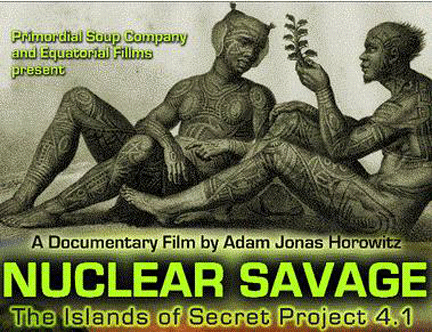
Nuclear Savage recounts the experiences of the Marshallese nation in the years following World War II, as they played host to the US’s Pacific Proving Grounds and served as human subjects in the classified, abusive pseudoscience that characterized the US government medical response to civilian exposures from the 1954 Bravo Test, the largest and dirtiest hydrogen bomb detonated by the United States. Detonated in the populated nation of the Marshall Islands.
Here is the story: Continue reading
Permanent ban on uranium determined by James Bay Cree Nation
 James Bay Cree Nation enacts permanent uranium moratorium in James Bay territory, The First Perspective (Canada) Crees “determined to protect our way of life against the unique and grave threat posed by uranium mining and waste, today and for thousands of years to come”. Waskaganish, QC, Aug. 9, 2012 – The James Bay Cree Nation has declared a Permanent Moratorium on uranium exploration, uranium mining and uranium waste emplacement in Eeyou Istchee, the James Bay Cree territory. The permanent moratorium was enacted unanimously by the Annual Cree Nation General Assembly in Waskaganish.
“The risks inherent in uranium exploration, mining, milling, refining and transport, and in radioactive and toxic uranium mining waste, are incompatible with our stewardship responsibilities in Eeyou Istchee,” the Resolution declares.
“The Cree Nation is determined to protect our economies and way of life against the unique and grave threat posed by uranium mining and uranium waste, today and for thousands of years to come,” said Grand Chief Dr. Matthew Coon Come. “We are not opposed to sustainable and equitable mining and other industrial and resource development activities in Eeyou Istchee – but the toxic and radiation risks created by uranium mining and uranium waste are unique in scale and duration.” Continue reading
Navajo Nation determined to get uranium cleanup
The Navajo Nation Diné Natural Resources Protection Act of 2005 prohibits uranium mining within Navajo Indian Country.
Uranium Cleanup is Priority for Navajos NEW MINING IS SECONDARY OFFICIALS SIGN AGREEMENT , Cibola Beacon, July 31, 2012 By Donald Jaramillo Beacon Managing Editor CIBOLA COUNTY – The Navajo Nation and many of its members have stated it loud and clear, no new uranium mining until cleanup is complete on Navajo lands.
An agreement was signed on July 19 between the Navajo Nation and Hydro Resources, Inc. (HRI), a subsidiary of Uranium Resources, Inc. (URI). Continue reading
BHP’s contempt for Aboriginal rights in Australia
BHP has shown similar contempt for taking responsibility for the impacts of its actions in Australia. The recently amended Indenture Act which will apply to the new mine continues to exempt BHP from the Aboriginal Heritage Act 1988, which applies elsewhere in the state.
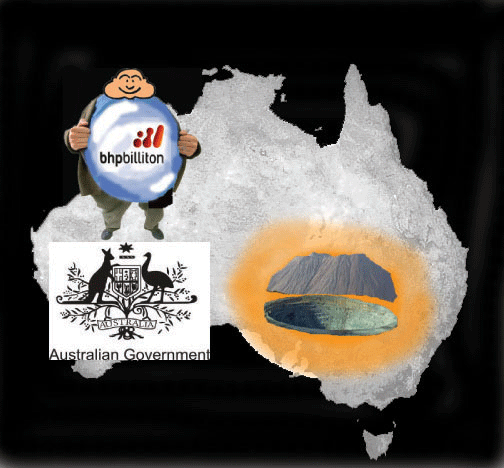
It is clearly a conflict of interest to have a corporation with a commercial interest in a piece of land also making decisions as to whether this same piece of land has competing non-commercial values.
Uncle Kevin Buzzacott is an Arabunna elder. Arabunna land lies North of the mine site. The borefields which extract water for the mine from the Great Artesian Basin are located on Arabunna land. The recent recognition of the Arabunna peoples long standing Native Title claim does not give the Arabunna people any rights to contest the location of the borefields. The GAB feeds the mound springs scattered throughout the Lake Eyre region. The springs are integral to the desert ecosystem and sacred to the Arabunna people. They have already been impacted by the water usage of the current mine.
by Nectaria Calan, 9 July 12, The Lizards Revenge was first announced on the 10th October 2011, coinciding with the State and Federal approvals of the Olympic Dam expansion. Since then, Rio + 20 in June this year has highlighted the failure of the concept of sustainable development and the failure of individual governments and the international community to genuinely address the ongoing environmental destruction that has become a feature of our age. Continue reading
Indian Country communities to strengthen economies by hosting solar energy project
“Tribal lands hold great renewable energy potential, and smart development of these resources has the power to strengthen tribal economies, create jobs and generate clean electricity for communities across Indian Country,”
 Solar energy project approved on tribal land near Las Vegas, Las Vegas Sun, By Conor Shine , June 21, 2012 The federal government on Thursday approved a massive 350-megawatt solar energy project to be built on land in Clark County belonging to the Moapa Band of Paiute Indians Tribe.
It would be the first utility-scale solar project on tribal lands. The project, covering about 2,000 acres, would be located 30 miles north of Las Vegas and occupy about 3 percent of the tribe’s land, which is held in trust by the U.S. government.
The operation would generate enough electricity to power 100,000 homes, the Department of the Interior said in a statement. Continue reading
Cree people say No to uranium mining and nuclear power
Chief Shecapio explained that the Crees “have always been the guardians and protectors of the land and will continue to be. For the Crees of Mistissini, the land is a school of its own and the resources of the land are the material and supplies they need. Cree traplines are the classrooms. What is taught on these traplines to the youth is the Cree way of life, which means living in harmony with nature.
“We do not believe that nuclear energy, which is the primary use for uranium in Canada, is a sustainable form of energy. We do not want to see a resource extracted from our land be responsible for causing pollution and waste. We do not want this to be our impact on the world..
Uranium Exploration: Mistissi Says “No” and Calls for a Moratorium MISTISSINI, Market Watch, EEYOU ISTCHEE, Jun 05, 2012 (MARKETWIRE via COMTEX) 5 June 12, — The Chief of Cree Nation of Mistissini, Richard Shecapio, made it clear at the Canadian Nuclear Safety Commission’s (CNSC) public hearing, held today (June 5) in Mistissini, that his
community is firmly against uranium development in Eeyou Istchee. “We want to put an end to the question of uranium development once and for all, right now. We know where this is going and we don’t want any uranium mining at all”, said Chief Shecapio. Continue reading
Denouncing the Doctrine of Discovery as the basis for exploitation of indigenous peoples
Papal bull that granted those European monarchs the right to claim sovereignty over these newly “discovered” lands occupied by non-Christian “barbarous nations.”
the Doctrine of Discovery is the basis for all Indian land law in this country, and it has imposed similar burdens on indigenous peoples all over the world — in Canada, Australia and New Zealand, in Africa, in Latin America and in the island nations of the Caribbean and Oceania.
Stand for Human Rights for Indigenous Peoples and Renounce the ’Doctrine of Discovery’ HUFFINGTON POST, Tadodaho Sid HillSpiritual Leader, Haudenosaunee (Six Nations/Iroquois Confederacy), 15 May 12,
When the United Nations Permanent Forum on Indigenous Issues convened on May 7th in New York, native peoples around the world turned their eyes to the most important effort to renounce the Doctrine of Discovery, a 15th century Papal bull that has been exploited for five centuries to deny the human rights of hundreds of millions of people who continue to be subject to its power. Continue reading
Australia’s Aborigines fight laws that will take more of their land for mining
 NT elders fight Stronger Futures law plans, THE AUSTRALIAN AAP , May 02, 2012 ABORIGINAL leaders from Arnhem Land communities have threatened a revolt against the Federal Government’s Stronger Futures laws by refusing to participate in land lease negotiations or give the nod to mining exploration licences. Continue reading
Solar energy- a new economy for Navajo tribes
 There’s a strong desire in Indian Country to step out of the role of just a landlord that is collecting rents to being involved in the equity ownership,” MacCourt said.Erny Zah, spokesman for Navajo
The 30-megawatt solar photovoltaic plant planned for the outlying Navajo community of To’Hajiilee would cover more than 200 acres.
Navajo community banks on proposed solar array, Bloomberg, By SUSAN MONTOYA BRYAN, 26 April 12, TO’HAJIILEE, N.M. This flat, dusty stretch of prairie in central New Mexico is where the leaders of a remote, sparsely populated American Indian community envision a sea of solar panels capable of producing enough electricity for more than 10,000 homes miles away from the reservation.
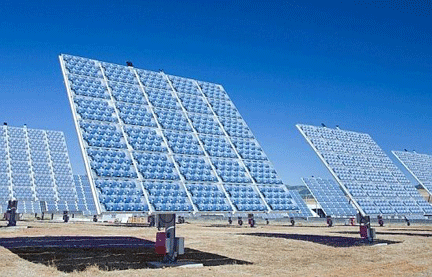
The To’Hajiilee solar project is one of 19 energy projects that will share in $6.5 million recently awarded by the U.S. Department of Energy to spur renewable energy development on tribal lands. About two-thirds of the money is earmarked for tribes in the West, and most of that will be going toward getting projects in New Mexico andArizona off the ground…… At stake is a wealth of untapped potential. Continue reading
Navajo’s continuing cancer danger from uranium mines
Navajos will continue to be exposed to uranium and its decay products, radon and radium. This means that they are at great risk for bone, liver, breast, and lung cancer, among other health problems….
Uranium Mines Still Pose Serious Health Threat on Navajo Land, Web Wire 12 April 12, In 2010, a Navajo cattle rancher named Larry Gordy discovered an abandoned uranium mine in the middle of his grazing land in Cameron, AZ, according to the New York Times. The Environmental Protection Agency (EPA) visited the site and found dangerously high levels of uranium, but the agency has yet to begin the clean-up.
The EPA found that the radioactivity there measured one million counts per minute, meaning that two days there would expose a person to more external radiation than the Nuclear Regulatory Commission considers safe for an entire year. A dose would lead directly to malignant tumors and other health problems. Continue reading
Addressing Climate Change: lessons from Indigenous Peoples
“Modern education and knowledge is mainly about how to better dominate nature. It is never about how to live harmoniously with nature.”
“Living well is all about keeping good relations with Mother Earth and not living by domination or extraction.”
Indigenous Peoples Can Show the Path to Low-Carbon Living If Their Land Rights Are Recognized http://newswatch.nationalgeographic.com/2012/04/04/indigenous-peoples-can-show-the-path-to-low-carbon-living-if-their-land-rights-are-recognized/ National Geographic, by Stephen Leahy in Climate Change and Indigenous Peoples April 4, 2012 Indigenous peoples are living examples of societies living, sustainable low-carbon lifestyles. Successfully meeting the global climate change challenge requires that much of the world shift from high carbon-living to low.
This shift is daunting. Current emissions for Australia and United States average about 20 tonnes of carbon dioxide per person. In the coming decades that needs to fall to two tonnes per person as it is currently in Brazil or Dominican Republic.
Emissions from most Indigenous peoples are even lower and are amongst the lowest in the world. Continue reading
Hypocrisy and racism – Australia’s sorry nuclear history
 Dumping on Traditional Owners: the ugly face of Australian racism The Drum, 29 March 12 The nuclear industry has been responsible for some of the crudest racism in Australia’s history.
This racism dates from the British nuclear bomb tests in the 1950s but it can still be seen today.
The British government conducted 12 nuclear bomb tests in Australia in the 1950s, most of them at Maralinga in South Australia. Permission was not sought from affected Aboriginal groups such as the Pitjantjatjara, Yankunytjatjara, Tjarutja and Kokatha. Thousands of people were adversely affected and the impact on Aboriginal people was particularly profound.
Many Aboriginal people suffered from radiological poisoning. There are tragic accounts of families sleeping in the bomb craters. So-called ‘Native Patrol Officers’ patrolled thousands of square kilometres to try to ensure that Aboriginal people were removed before nuclear tests took place. Signs were erected in some places – written in English, which few in the affected Indigenous communities could understand. The 1985 Royal Commission found that regard for Aboriginal safety was characterised by “ignorance, incompetence and cynicism”. Many Aboriginal people were forcibly removed from their homelands and taken to places such as the Yalata mission in South Australia, which was effectively a prison camp.
In the late-1990s, the Australian government carried out a clean-up of the Maralinga nuclear test site. It was done on the cheap and many tonnes of debris contaminated with kilograms of plutonium remain buried in shallow, unlined pits in totally unsuitable geology. As nuclear engineer and whistleblower Alan Parkinson said of the ‘clean-up’ on ABC radio in August 2002:
“What was done at Maralinga was a cheap and nasty solution that wouldn’t be adopted on white-fellas land.”
Despite the residual contamination, the Federal Government has off-loaded responsibility for the land onto the Maralinga Tjarutja Traditional Owners. The Government portrays this land transfer as an act of reconciliation, but the real agenda was spelt out in a 1996 government document which states that the clean-up was “aimed at reducing Commonwealth liability arising from residual contamination.”….. http://www.abc.net.au/unleashed/3919296.html
Indigenous peoples have knowledge to help deal with climate change
Indigenous peoples have not been involved in discussions about climate change in most countries said Henrietta Marrie, a Aboriginal leader of the Gimuy-Walubarra Yidinji Nation of Cairns. Indigenous and local peoples collectively represent more than a billion people
The IPCC and United Nations University (UNU) have organized this week’s main workshop to incorporate and “credibly validate” indigenous people’s traditional knowledge
Indigenous Peoples Needed to Meet the Challenge of Climate Change (includes VIDEO)National Geographic, by Stephen Leahy, March 25, 2012 “Planning is not part of our culture. You just get up in the morning and do what you need to do for the day,” said Marilyn Wallace of the Kuku Nyungka ‘mob’ (aboriginal nation) in northern Queensland, Australia.
“Bama” or caring for their local territory is an important part of aboriginal culture and identity Wallace told participants at a mini-workshop in Cairns, Australia today Sunday March 25th prior to the start of the main workshop Climate Change Mitigation with Local Communities and Indigenous peoples on Monday.
Caring for the land includes monitoring the impacts of climate change and using traditional knowledge to keep or sequester carbon she said.
Indigenous peoples and local communities are the least responsible for climate-altering emissions of carbon but they can play an important role helping to reduce emissions through the way they manage their lands. Continue reading
Indigenous peoples’ new network to oppose nuclear waste dumping on Aboriginal land
It mentioned the Tao, who live on the outlying island of Lanyu (蘭嶼, also known as Orchid Island), as well as Aboriginal tribes in the US and Australia, as examples of indigenous people becoming victims of nuclear waste disposal on their traditional lands.
Groups to propose Aborigine network, Taipei Times, 23 March 12 SENEGAL CONGRESS:The network would give voice to the global Aboriginal community and focus on issues like nuclear waste disposal, environmental groups said. Environmental and Aboriginal groups yesterday said they would propose the establishment of an Aboriginal network at an upcoming congress in Senegal, with the aim of uniting global support for Aboriginal people on environmental issues. Continue reading
1 This Month

To see nuclear-related stories in greater depth and intensity – go to https://nuclearinformation.wordpress.com
-
Archives
- September 2026 (194)
- August 2026 (330)
- July 2026 (355)
- June 2026 (287)
- May 2026 (306)
- April 2026 (356)
- March 2026 (251)
- February 2026 (267)
- January 2026 (308)
- December 2025 (358)
- November 2025 (359)
- October 2025 (375)
-
Categories
- 1
- 1 NUCLEAR ISSUES
- business and costs
- climate change
- culture and arts
- ENERGY
- environment
- health
- history
- indigenous issues
- Legal
- marketing of nuclear
- media
- opposition to nuclear
- PERSONAL STORIES
- politics
- politics international
- Religion and ethics
- safety
- secrets,lies and civil liberties
- spinbuster
- technology
- Uranium
- wastes
- weapons and war
- Women
- 2 WORLD
- ACTION
- AFRICA
- Atrocities
- AUSTRALIA
- Christina's notes
- Christina's themes
- culture and arts
- Events
- Fuk 2022
- Fuk 2023
- Fukushima 2017
- Fukushima 2018
- fukushima 2019
- Fukushima 2020
- Fukushima 2021
- general
- global warming
- Humour (God we need it)
- Nuclear
- RARE EARTHS
- Reference
- resources – print
- Resources -audiovicual
- Weekly Newsletter
- World
- World Nuclear
- YouTube
-
RSS
Entries RSS
Comments RSS
 nuclear-news