Forgetting World War II, Germany joins in the frenzy of hostility to Russia
SCOTT RITTER: The Nightmare of NATO Equipment Being Sent to Ukraine

In a turn of events which must have Vasily Chuikov and the Soviet heroes to whom the Tiergarten war memorial was dedicated turning in their graves, the forces of fascism have once again reared their odious heads, this time manifested in a Ukrainian government motivated by the neo-Nazi ultra-nationalistic ideology of Stepan Bandera and his ilk.
The West’s recent approval of more military assistance for Kiev risks nuclear nightmare, fails Ukrainian expectations and rebukes the World War II history enshrined in a prominent Soviet war memorial in Berlin.
On Tuesday the White House decided that it would send about 30 M1 Abrams tanks to Ukraine, which was seen as political cover for Germany, which decided to ship 14 Leopard 2 tanks to Kiev.
By Scott Ritter, Consortium News 24 Jan 23
Early on the morning of May 2, 1945, General Vasily Chuikov, the commander of the Soviet 8thGuards Army, accepted the surrender of the German garrison of Berlin.
Two days prior, soldiers from the 150th Rifle Division, part of the Soviet 5th Shock Army, had raised the victory banner of the Red Army over the Reichstag. An hour after the banner went up, Adolf Hitler and his mistress, Eva Braun, committed suicide in his study inside the Furhrerbunker.
Chuikov, the hero of Stalingrad whose battered 62nd Army was renamed the 8th Guards Army in honor of their victory in holding that city in the face of a massive German onslaught, had led his troops into the heart of the Nazi capital, battling stubborn Nazi resistance in the Tiergarten district of Berlin, where the den of the Nazi beast was located. The Soviet general was rewarded for the courage and sacrifice of his soldiers by being in position to accept the German surrender.
In honor of this accomplishment, and the sacrifice it entailed, the Soviet Army inaugurated, in November 1945, a commemorative monument along the Tiergarten. Constructed from red marble and granite stripped away from the ruins of Adolf Hitler’s Neue Reichskanzlei (New Imperial Chancellery), the monument, consisting of a concave colonnade of six joined axes flanked by Red Army artillery and a pair of T-34 tanks, with a giant bronze statue of a victorious Red Army soldier standing watch from the center pylon.
From 1945 until 1993, when the Russian Army withdrew from Berlin, Soviet guards stood guard over the monument. Since that time, the monument has been maintained according to the terms of the German Reunification Treaty of 1990, which brought West and East Germany together in the aftermath of the fall of the Berlin Wall.
Carved into the granite of the monument, in Cyrillic letters, is an inscription that reads “Eternal glory to the heroes who fell in battle with the German fascist occupiers for the freedom and independence of the Soviet Union.”
In a turn of events which must have Vasily Chuikov and the Soviet heroes to whom the Tiergarten war memorial was dedicated turning in their graves, the forces of fascism have once again reared their odious heads, this time manifested in a Ukrainian government motivated by the neo-Nazi ultra-nationalistic ideology of Stepan Bandera and his ilk.
Bandera and his murderous movement had been physically defeated by Soviet forces in the decade following the end of the Second World War. However, its ideology survived in a western Ukrainian diaspora formed from the survivors of that movement who found safe haven in West Germany (where Bandera himself settled until assassinated by the Soviet KGB in 1959); Canada (where Chrystia Freeland, the granddaughter of a former publisher of pro-Bandera propaganda, currently serves as deputy prime minister), and the United States (where the followers of Stepan Bandera have constructed a “heroes park” outside Ellenville, New York, including a bust of Bandera and other neo-Nazi Ukrainian ultra-nationalists.)
The ideology also survived in the shadows of the western Ukrainian districts that had been absorbed by the Soviet Union following the dismemberment of Poland in 1939, and later, after the reoccupation of these territories by Soviet forces in 1945.
CIA-Funded Political Underground
Here, beginning in 1956, (following the de-Stalinization policies instituted by Soviet Premier Nikita Khrushchev in the aftermath of his “secret speech” to members of the Communist Party), thousands of members of the Ukrainian Insurgent Army (UPA)/Organization of Ukrainian Nationalists-Bandera (OUN-B), who had been arrested and convicted by Soviet authorities, were released from the Gulag and returned to their homes, ostensibly to be reintegrated into Soviet society. This reintegration never materialized, however.
Instead, Ukrainian fascists, funded by the C.I.A., operated as a political underground, running sabotage operations and fomenting anti-Soviet/anti-Russian ideology amongst a population where the precepts of Ukrainian nationalist ideology ran strong.
[Related: JOE LAURIA: On the Influence of Neo-Nazism in Ukraine]
Following the collapse of the Soviet Union, at the end of 1991, these Ukrainian nationalists emerged from the shadows and began organizing into political parties backed by gangs of violence-prone extremists who promulgated, through physical intimidation, a cult of personality built around the person of Stepan Bandera………………………………………………………………………… more https://consortiumnews.com/2023/01/24/scott-ritter-the-nightmare-of-nato-equipment-being-sent-to-ukraine/
It’s all about the bomb: why civilian nuclear power is merely a cover for producing more nuclear weapons

Nuclear weapons are a special kind of horror opposed by most rational people around the world.
the IAEA’s bluntly stated mission is to promote nuclear technology.
Like Atoms for Peace, this repackaging of a military activity as a civilian one succeeded in making the endeavor socially acceptable and somewhat self-funding
The nuclear power-nuclear weapons link can only be broken by a ban on both
It’s all about the bomb — Beyond Nuclear International
Why civilian nuclear power is merely a cover for producing more nuclear weapons
By Alfred Meyer, 8 Jan 23,
The Zaporizhzhia Nuclear Power Station in southeastern Ukraine, Europe’s largest nuclear power plant, has the world’s attention right now, and rightly so. For the first time in history, six nuclear reactors and thirty-seven years’ worth of high-level nuclear waste are in the middle of a battlefield in an active war zone—one artillery shell, on site or off, could interrupt the control and cooling of the operational reactor, or the cooling of the waste in storage, leading to a catastrophic release of radiation that could spread throughout the Northern Hemisphere. How in the world can nuclear power reactors be considered clean and safe sources of electricity?
Russia, a nuclear-armed nation that invaded Ukraine on February 24, 2022, has said that it would use nuclear weapons if needed. And strong allies of Ukraine—the United States, the United Kingdom, and France, all NATO members—are also armed with nuclear weapons.
You likely are aware of what has happened in the weeks since this magazine went to press, and whether or not the world is in the midst of another major radioactive disaster, as happened at Fukushima in Japan in 2011, Chernobyl in northern Ukraine in 1986, and Three Mile Island in the United States in 1979. I assume that if you are reading this, nuclear weapons have not been used in the war in Ukraine. So how has the world ended up in such an existentially threatening situation? Why does the nuclear enterprise have the world’s future so tightly in its grip?
The short answer: nuclear weapons. It is all about the bomb.
In 1939, Albert Einstein wrote to President Franklin D. Roosevelt urging him to pursue nuclear research in the United States. It was crucial, Einstein wrote, to counter Germany’s efforts to harness the magic of radioactivity and develop a super weapon. A few years later, the Manhattan Project was born in secrecy in 1942. A sprawling and tightly controlled academic, military, industrial, and governmental infrastructure was built to accommodate an entirely new industry equal in size to the American automobile industry at the time. Secrecy was so thorough that when Vice President Harry Truman ascended to the presidency on April 12, 1945, upon Roosevelt’s sudden death, he was unaware that the atomic bomb program even existed, much less that it was on the verge of testing a plutonium weapon in July.
During World War II, the United States succeeded in developing atomic weapons, while Germany was defeated before it could do so. Even though Japan was essentially defeated by then, Truman, some three months after he learned that the United States did possess the super weapons, chose to use them. Although the firebombing of Tokyo in March 1945 had burned to death more than 100,000 people and left more than a million people homeless, it did not occasion the global outcry that followed the use of the uranium bomb on Hiroshima, on August 6, 1945, and the plutonium bomb on Nagasaki, three days later. Nuclear weapons are a special kind of horror opposed by most rational people around the world.
However, following the use of nuclear weapons in Japan in 1945, there has been significant ongoing public opposition to them. In the earliest days of the United Nations, there were various efforts to abolish or control nuclear weapons. It was clear that they constitute an entirely different type of military threat that includes the likelihood of ending life on earth as we know it. Abolishing nuclear weapons is the way to end this existential threat.
When World War II hero General Dwight D. Eisenhower became President in 1953, the dilemma for the military, and for Eisenhower, was how to grow the atomic bomb programs, in light of negative public opinion toward the nuclear enterprise. At the same time, the United States wanted to be recognized as the leader of the “free world” in the postwar years. In the early 1950s, the military needed to recast nuclear enterprise activities to appear to be peaceful, beneficial parts of our modern life, very distant from the wartime horrors.
In August 1953, Eisenhower was worried about the Soviet Union’s successful test of a sophisticated hydrogen bomb—which signaled to the United States that the nuclear arms race was officially on. Eisenhower considered delivering a type of “fireside chat” to the American public—or perhaps a “mushroom cloud chat”—to level with citizens about the truly horrific existential threat that nuclear weapons posed to the world.
But by December of that year, a different strategy appeared to take effect. In a now famous speech on December 8, 1953, titled “Atoms for Peace,” Eisenhower proposed to the U.N. General Assembly an international program of sharing “peaceful” nuclear materials and know-how for untold bounty, to encourage development of nuclear programs around the world.
The United States also proposed an international agency under the United Nations to promote and oversee nuclear activities, which today is the International Atomic Energy Agency, or IAEA. While acknowledging the IAEA’s important oversight role, such as inspecting the Zaporizhzhia reactors and fuel pools at this perilous time in history, one should also recognize that the IAEA’s bluntly stated mission is to promote nuclear technology. The first leaders of the IAEA were from the United States, to ensure that U.S. interests were protected.
Nuclear enterprise infrastructure is an outgrowth of World War II. These new endeavors drew international interest in creating the huge nuclear marketplace now in existence. Atoms for Peace—a plan to share nonmilitary nuclear technology with other countries to “win hearts and minds”—placed nuclear materials and reactors in more than forty countries, including Iran. This generated ongoing business for many American nuclear enterprise companies while supporting and expanding the U.S. military’s nuclear infrastructure and capacity in the United States.
Having nuclear activities under the auspices of the United Nations conferred upon them the legitimacy and respect of that international body. While Eisenhower was making his “Atoms for Peace” speech at the United Nations, he was in the middle of planning the largest hydrogen bomb test ever in the United States, the fifteen-megaton “Bravo” test, on March 1, 1954, which was more than 1,000 times bigger than the bomb dropped on Hiroshima.
The generally favorable response to Atoms for Peace was a trifecta for the nuclear enterprise. U.S. nuclear activities were repackaged as the “peaceful” atom and given the patina of social acceptance through United Nations oversight. Eisenhower was lauded as a good leader for sharing the atom with the world, and the U.S. nuclear infrastructure got new business and growth, which supported more U.S. nuclear weapons and nuclear Navy programs.
Atoms for Peace also served geopolitical ends. For instance, one reason the United States provided Iran with a research reactor in 1967 was to saddle that country with significant financial obligations, including paying for ongoing parts, services, and technical support from American companies. These financial obligations would then, theoretically, force Iran to sell more oil on the world market, regardless of OPEC actions, a kind of atoms-for-oil program—but only peaceful atoms, mind you!
As Atoms for Peace was taking shape, a major policy change was made via the Atomic Energy Act of 1954. The top-secret, tightly controlled Manhattan Project to build the atomic bomb was a governmental endeavor. Nuclear reactors produce the plutonium needed for atomic bombs. With the passage of this new bill by Congress, the operation of nuclear power reactors by privately owned corporations was allowed.
The Atomic Energy Commission was created in 1946 to promote and regulate the development of this new industry. With the commission led by Wall Street banker Lewis Strauss for five critical years, it is not surprising that the scales heavily favored promotion over regulation. Encouraging private investment in these risky reactor projects was assisted by minimizing regulatory safety and operational demands upon the private operators.
Being the biggest nuclear enterprise on earth encourages the circular, self-sustaining dynamic of the nuclear arms race.
But why was it so important for the U.S. government to develop and subsidize civilian nuclear power? Because it allowed the military, in essence, to spin off its nuclear reactor activities to private financing and corporate operations. Like Atoms for Peace, this repackaging of a military activity as a civilian one succeeded in making the endeavor socially acceptable and somewhat self-funding—although government subsidies are still perennially needed to carry on, and taxpayers are still covering the liability insurance costs of the private corporations. Most importantly, as detailed in a 2017 report by former U.S. Energy Secretary Ernest Moniz, civilian nuclear power is an “essential enabler” of our national security. The Atlantic Council calculates the value of this contribution to national security to be $42.4 billion a year. Businesses contributing to the nuclear Navy’s supply chain are in forty-four U.S. states.
The essential nature of civilian nuclear power for national security would suggest that if the United States has the largest national inventory of civilian nuclear reactors in the world, then it also has the largest nuclear enterprise infrastructure to support nuclear weapons production and a nuclear Navy.
Being the biggest nuclear enterprise on earth encourages the circular, self-sustaining dynamic of the nuclear arms race. The United States is busy modernizing its nuclear weapons infrastructure to be “strong enough” to negotiate the elimination of nuclear weapons. This is presented as official doctrine in the nonproliferation world. In reality, the United States is actually driving the growing international nuclear arms race.
Atoms for Peace and the nuclear enterprise employ particularly successful advertising campaigns, greatly influencing public opinion and shaping our cultural consciousness of the nuclear world.
Presenting civilian nuclear power as the answer to climate change, as clean and safe electrical generation, or as energy “too cheap to meter” is simply a sales pitch. What is actually delivered by a robust nuclear energy fleet is the capacity for nuclear weapons and a nuclear Navy.
Over the decades, there have been numerous expert critiques of nuclear power, authoritatively debunking these misleading and false promises, yet these critiques seem to have no effect on the trajectory of the nuclear enterprise. I suggest that these sales pitches are diversionary techniques aimed at sapping our energy. It does not matter if nuclear power can really solve climate change, it just has to be seen as an essential part of the solution to attract bright, young talent into what is made to appear as the cutting edge of technology and climate solutions, even though the civilian nuclear power industry worldwide has been in decline since 2002.
To protect ourselves from the dangers of the nuclear enterprise, we need to stop the nuclear weapons and nuclear power reactor programs—a tall order, for sure. But if we seek success in our efforts, we are well advised to understand the forces we are engaging with. It is all about nuclear weapons.
Alfred Meyer is a member of Physicians for Social Responsibility and has worked with communities affected by the Chernobyl and Fukushima nuclear catastrophes.
Why Did Portland General Electric Want to Build Trojan Nuclear Plant in the First Place?
The mighty atom had just won WWII and was enjoying George W. Bush-right-after-9/11 levels of popularity, while the invention of hippies was still decades away. https://wordpress.com/post/nuclear-news.net/216592 By Marty SmithJanuary 02, 2023
I recall protesting against the now-defunct Trojan nuclear plant in the 1980s. One question I don’t recall anyone asking back then, however: Why did they want to build Trojan in the first place, given that our region already had (and still has) more hydropower than we can use? —Duke Nukem
I share your historical curiosity, Duke—there’s just something about this time of year that makes one want to muse about topics from Portland’s colorful past that can be researched without having to get anybody to return a call during the week between Christmas and New Year’s.
I doubt that anyone under 50 reads this column (which not only doesn’t come as video, but presumes your mastery of this tedious system of archaic glyphs in which it’s encoded), but just in case someone missed it: Portland General Electric—PGE to its friends—began construction of Trojan Nuclear Power Plant near Rainier, Oregon, in 1970 (which, perhaps fittingly, is the same year the Ford Pinto was introduced). The plant came online in 1975 and was slated to operate until 2011. However, it was plagued from the start with equipment failures and bad press, and was finally shuttered for good in 1992.
Why would PGE take on such a fraught endeavor? Well, for starters, they’d first begun exploring the possibility of building a nuclear plant way back in the late 1940s. The mighty atom had just won WWII and was enjoying George W. Bush-right-after-9/11 levels of popularity, while the invention of hippies was still decades away. Nuclear power’s downsides would become more apparent in the years to follow, but they don’t appear to have penetrated PGE’s C-suite in any significant way prior to the 1967 decision to build the plant.
But back to your question: Given that Northwest hydropower is abundant enough to make Oregon’s electricity market the nation’s third cheapest, why build a plant at all? Here’s the thing: All that juicy hydropower is controlled by the Bonneville Power Administration, a public entity. PGE, the private utility, has to buy it from them wholesale and then retail it to us. If, as seemed possible at the time, BPA had decided to cut PGE off in favor of public utilities—perhaps when PGE’s 20-year contract with BPA came up for renewal in 1973—PGE could have been in a world of hurt.
Trojan represented a hedge against such a possibility, as well as an opportunity to grow PGE as a company. Toss in a few million bucks’ worth of federal “Atoms for Peace” emoluments to the industry and, congratulations, you’ve got yourself a nuclear plant. Have fun! (Just be careful not to run into it from behind, especially with a lit cigarette.)
Dishonesty: British authorities knew it was wrong to proceed with the thermal oxide reprocessing plant (Thorp) at Sellafield.
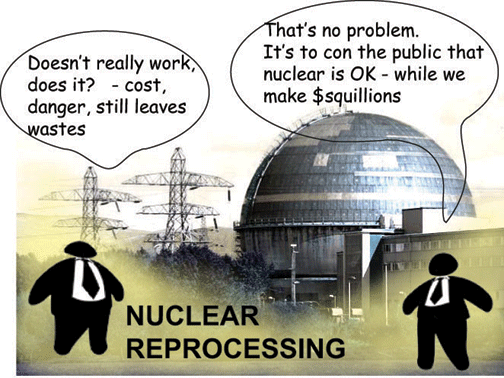
Letter William Walker: In 1993, a government official told me that “it
was sometimes right to do the wrong thing”. For reasons of political
expediency, it was right to give political consent for the operation of the
thermal oxide reprocessing plant (Thorp) at Sellafield.
This huge facility, not mentioned in Samanth Subramanian’s fine long read, had been built over
the previous decade to reprocess British and foreign, especially Japanese,
spent nuclear fuels. Abandoning it would be too embarrassing for the many
politicians and their parties that had backed it, expensive in terms of
compensation for broken contracts, and damaging to Britain’s and the
nuclear industry’s international reputation.
It was wrong to proceed, as
the government well knew, because the primary justification for its
construction – supply of plutonium for fast breeder reactors (FBRs) – had
been swept away by the abandonment of FBRs in the 1980s (none were built
anywhere).
Because returning Thorp’s separated plutonium and radwaste to
Japan would be difficult and risky.
Because decommissioning Thorp would
become much more costly after its radioactive contamination.
Because there was a known win-win solution, favoured by most utilities – store the spent
fuel safely at Sellafield prior to its return to senders, avoiding the many
troubles that lay ahead.
Guardian 22nd Dec 2022
Despite the hype, we shouldn’t bank on nuclear fusion to save the world from climate catastrophe

Robin McKie, https://www.theguardian.com/commentisfree/2022/dec/17/dont-bank-on-nuclear-fusion-to-save-the-world-from-a-climate-catastrophe-i-have-seen-it-all-before
Last week’s experiment in the US is promising, but it’s not a magic bullet for our energy needs
“…….. For almost half a century, I have reported on scientific issues and no decade has been complete without two or three announcements by scientists claiming their work would soon allow science to recreate the processes that drive the sun. The end result would be the generation of clean, cheap nuclear fusion that would transform our lives.
Such announcements have been rare recently, so it gave me a warm glow to realise that standards may be returning to normal. By deploying a set of 192 lasers to bombard pellets of the hydrogen isotopes deuterium and tritium, researchers at the US National Ignition Facility (NIF) in Livermore, California, were able to generate temperatures only found in stars and thermonuclear bombs. The isotopes then fused into helium, releasing excess energy, they reported.
It was a milestone event but not a major one, although this did not stop the US government and swaths of the world’s media indulging in a widespread hyping jamboree over the laboratory’s accomplishment. Researchers had “overcome a major barrier” to reaching fusion, the BBC gushed, while the Wall Street Journal described the achievement as a breakthrough that could herald an era of clean, cheap energy.
It is certainly true that nuclear fusion would have a beneficial impact on our planet by liberating vast amounts of energy without generating high levels of carbon emissions and would be an undoubted boost in the battle against climate change.
The trouble is that we have been presented with such visions many times before. In 1958, Sir John Cockcroft claimed his Zeta fusion project would supply the world with “an inexhaustible supply of fuel”. It didn’t. In 1989, Martin Fleischmann and Stanley Pons announced they had achieved fusion using simple laboratory equipment, work that made global headlines but which has never been replicated.
To this list you can also add the International Thermonuclear Experimental Reactor (Iter), a huge facility being built in Saint-Paul-lès-Durance in Provence, France, that was supposed to achieve fusion by 2023 but which is over 10 years behind schedule and tens of billions of dollars over budget.
In each case, it was predicted that the construction of the first commercially viable nuclear fusion plants was only a decade or two away and would transform our lives. Those hopes never materialised and have led to a weary cynicism spreading among hacks and scientists. As they now joke: “Fusion is 30 years away – and always will be.”
It was odd for Jennifer Granholm, the US energy secretary, to argue that the NIF’s achievement was “one of the most impressive scientific feats of the 21st century”. This is a hard claim to justify for a century that has already witnessed the discovery of the Higgs boson, the creation of Covid-19 vaccines, the launch of the James Webb telescope and the unravelling of the human genome. By comparison, the ignition event at the NIF is second-division stuff.
Most scientists have been careful in their responses to the over-hyping of the NIF “breakthrough”. They accept that a key step has been taking towards commercial fusion power but insist such plants remain distant goals. They should not be seen as likely saviours that will extract us from the desperate energy crisis we now face – despite all the claims that were made last week.
Humanity has brought itself to a point where its terrible dependence on fossil fuels threatens to trigger a 2C jump in global temperatures compared with our pre-industrial past. The consequences will include flooding, fires, worsening storms, rising sea levels, spreading diseases and melting ice caps.
Here, scientists are clear. Fusion power will not arrive in time to save the world. “We are still a way off commercial fusion and it cannot help us with the climate crisis now,” said Aneeqa Khan, a research fellow in nuclear fusion at Manchester University. This view was backed by Tony Roulstone, a nuclear energy researcher at Cambridge University. “This result from NIF is a success for science, but it is still a long way from providing useful, abundant clean energy.”
At present, there are two main routes to nuclear fusion. One involves confining searing hot plasma in a powerful magnetic field. The Iter reactor follows such an approach. The other – adopted at the NIF facility – uses lasers to blast deuterium-tritium pellets causing them to collapse and fuse into helium. In both cases, reactions occur at more than 100 million C and involve major technological headaches in controlling them.
Fusion therefore remains a long-term technology, although many new investors and entrepreneurs – including Bill Gates and Jeff Bezos – have recently turned their attention to the field, raising hopes that a fresh commercial impetus could reinvigorate the development of commercial plants.
This input is to be welcomed but we should be emphatic: fusion will not arrive in time to save the planet from climate change. Electricity plants powered by renewable sources or nuclear fission offer the only short-term alternatives to those that burn fossil fuels. We need to pin our hopes on these power sources. Fusion may earn its place later in the century but it would be highly irresponsible to rely on an energy source that will take at least a further two decades to materialise – at best.
Plutonium’s Fatal Attraction

In February 2022, on the first day of Russia’s invasion of Ukraine, Russian forces took over the Chornobyl Zone of Alienation, an exclusion zone surrounding the plant created in the weeks after the Chornobyl accident. A month later, the Russian Army occupied the Zaporizhzhia Nuclear Power Plant in southern Ukraine, and since then, the plant has been repeatedly under fire. At the start of the invasion, the world seemingly received an education in nuclear power. News reporting illuminated that containment vessels protecting nuclear reactors had been stress-tested for tornadoes, tsunamis, and planes landing on them, but not for something so banal and human as a conventional war.
The public also came to understand that nuclear reactor complexes require a steady supply of electricity to keep running and to prevent overheating, and also that nuclear power plants hold years of highly-radioactive spent nuclear fuel—chock full of plutonium, among other harmful isotopes—which are not protected by containment buildings.
e-flux Architecture, Kate Brown, Half-Life, December 2022
Think of the earth. At its core is fire, an inferno around which biological life emerged. With fire in our planetary loins, no wonder humans have trouble staying away from it; that they delight in reproducing it in fiction, movies, fireworks, war games, and in technologies.
Perhaps that is why, decades after radioactive toxins saturated the Earth’s surface and at a time when threatened reactors in war-torn Ukraine are at risk of blowing again, many people are still enchanted by nuclear reactors. They are burning cores, sources of other-worldly heat and energy. If you can harness plutonium, the element at the heart of the nuclear inferno, then you can magnify human power to a super-hero level. In tandem, plutonium has the power to re-map territories, produce new borders—not just between people, but between humans and the environment. By extension, plutonium spatializes power.
In 1940, Glenn Seaborg first synthesized plutonium in a cyclotron in Berkeley, California. With these initial micrograms, plutonium became the first human-produced element on the periodic table. Plutonium has a half-life of 24,000 years, which means that Seaborg’s plutonium will linger on earth for over 240,000 years. Like all good offspring, plutonium promises to outlast humans on Earth.

Plutonium is also beautiful, sensual, and kaleidoscopic. It is a heavy metal that self-heats, warming a person’s hands like a small animal. In metallic form, plutonium is yellow or olive green. Shine a UV light on it, and it glows red. When it comes in contact with other radioactive isotopes plutonium sends out a dazzling blue light, a light show designed and powered by what appears to be an inert, inanimate metal. But it is not.
In 1943, the DuPont Corporation built a massive factory for the Manhattan Project to produce the world’s first industrial supplies of plutonium in the eastern reaches of Washington State. As engineers drew up plans for nuclear reactors and radio-chemical processing plants necessary for production, Dupont officials learned something alarming: “the most extreme health hazard is the product itself.”1 “It is now estimated,” DuPont executive Roger Williams wrote to the US Army Corps of Engineers overseeing the project, “that five micrograms (0.000005 grams) of the product [plutonium] entering the body through the mouth or nose will constitute a lethal dose.” A Manhattan Project medical officer wrote on the margins of this sentence: “Wrong!” With the first birthing pains of plutonium, a debate was born over the lethality and consequent liabilities inherent in nuclear industries.
Plutonium is a monumental invention, akin to harnessing fire. Upscaling the Pu chemical extraction process meant separating plutonium from about a hundred thousand curies of fission fragment radiation every single day. This was an incredibly dangerous undertaking. Plant operators worked with robotic arms and protective gear behind massive concrete walls and thick lead-glass windows in ship-sized “canyons.” They worked toward a final product that had extraordinary properties. Seaborg described element 94:

Plutonium is so unusual as to approach the unbelievable. Under some conditions it can be nearly as hard and brittle as glass; under others, as soft and plastic as lead. It will burn and crumble quickly to powder when heated in air, or slowly disintegrate when kept at room temperature. It undergoes no less than five phase transitions between room temperature and its melting point… It is unique among all of the chemical elements. And it is fiendishly toxic, even in small amounts.
Plutonium made not only a novel weapon of war, but its special existence inspired people to use it to create new technologies, and it gave birth to an elaborate security apparatus to safeguard the “super-poisonous” product, and later, new border zones to protect regions spoiled by the spillage of plutonium and other radioactive byproducts after accidents. As workers over subsequent decades produced more and more plutonium, the new mineral transformed landscapes, science, energy production, and human society around the world. Plutonium militarized, segregated, and compartmentalized large parts of the Earth, leaving a profound shadow that reaches into the twenty-first century.
Plutonium Landscapes
At the Hanford Plutonium Plant in Richland, Washington, DuPont engineers initially dedicated minimal resources to the management of growing volumes of radioactive waste. They had chosen a sparsely populated site and removed several towns and a settlement of the Wanapum nation from the newly designated “federal reservation” in case of accidents and the leakage of radioactive waste. They often repeated the platitude: “diffusion is the solution.” With a good bit of distance and privacy won with an elaborate security apparatus, DuPont and Army Corps engineers set up waste facilities for non-radioactive debris according to existing, standard practices. They drilled holes, called “reverse wells,” for dumping liquid radioactive waste. They bulldozed trenches and ponds, pouring in radioactive liquid and debris. Cooling ponds attached to reactors held hot, radioactive water for short periods before flushing it into the Columbia River. Smokestacks above processing plants issued radioactive particles in gaseous form. High-level waste—terrifically radioactive—went into large, single-walled steel coffins buried underground. Engineers designed these chambers for temporary, ten-year storage with the knowledge that the waste would corrode even thick steel walls.

DuPont leaders were nervous about these waste management procedures. The corporation had experience polluting rivers and landscapes with chemical toxins near their factories, and insisted that the Army Corp pay for environmental assays to learn what happened to the dumped radioactive waste. At Hanford in the 1940s, Dupont set up a soil study, a meteorological station, and a fish lab to monitor the health of valuable salmon migrations in the Columbia River. The studies showed that while it took large hits of external gamma rays to kill fish, much smaller ingested doses weakened and killed fish and other experimental animals. Weather studies showed that radioactive gases either traveled considerable distances in strong winds or hovered for long periods over the Columbia Basin when caught in an inversion. Researchers found, in short, that radioactive waste did not spread in a diffuse pattern, but collected in random hot spots of radioactivity. Soil scientists discovered that plants drank up radioactive isotopes readily from the soil and that aquifers became contaminated with radioactive liquids. Ichthyologists learned that fish concentrated radioactivity in their bodies at levels at least sixty times greater than the water in which they swam. Generally, researchers found that radioactive isotopes attached to living organisms readily made their way up the food chain.
Despite this troubling news, even after September 1946 when General Electric took over the running of the plant, no major changes were made to waste management methods for thirty years. In the course of forty-four years, Hanford rolled out the plutonium content for 60,000 nuclear weapons.4 The environmental footprint of that military production, however, is immeasurable. Indeed, it is intrinsically shape-shifting.
Rushing to develop their own bomb and encouraged by the example of the United States, Soviet leaders followed American practices in the years following World War II. Soviet generals commanded Mayak, a site in the southern Russian Urals that became known as “Post Box 40.” Engineers at Mayak dumped radioactive waste into the atmosphere, ground, and local water sources. High-level waste was contained temporarily in underground tanks similar to those built at Hanford. Unlike the high-volume, rocky Columbia River, the nearby Techa River flowed slowly, flooding frequently and bogging down in swamps and marshes. After just two years of operation of the Mayak Plutonium Plant, its director deemed the Techa River “exceedingly polluted.”5 By 1949, when the first Soviet nuclear bomb was tested, the plant’s underground containers for high-level waste were overflowing. Rather than shutting down production while new containers were built, plant directors decided to dump the high-level waste in the turgid Techa River.6 Each day, four thousand three hundred curies of waste? flowed down the river. From 1949 to 1951, when dumping ended, plant effluent comprised a full twenty percent of the river. A total of 3.2 million curies of waste clouded the river along which 124,000 people lived.7 Radioactivity became a new contour that outlined human activity and new communities of people who shared in dangerous exposures.
Rushing to develop their own bomb and encouraged by the example of the United States, Soviet leaders followed American practices in the years following World War II. Soviet generals commanded Mayak, a site in the southern Russian Urals that became known as “Post Box 40.” Engineers at Mayak dumped radioactive waste into the atmosphere, ground, and local water sources. High-level waste was contained temporarily in underground tanks similar to those built at Hanford. Unlike the high-volume, rocky Columbia River, the nearby Techa River flowed slowly, flooding frequently and bogging down in swamps and marshes. After just two years of operation of the Mayak Plutonium Plant, its director deemed the Techa River “exceedingly polluted.”5 By 1949, when the first Soviet nuclear bomb was tested, the plant’s underground containers for high-level waste were overflowing. Rather than shutting down production while new containers were built, plant directors decided to dump the high-level waste in the turgid Techa River.6 Each day, four thousand three hundred curies of waste? flowed down the river. From 1949 to 1951, when dumping ended, plant effluent comprised a full twenty percent of the river. A total of 3.2 million curies of waste clouded the river along which 124,000 people lived.7 Radioactivity became a new contour that outlined human activity and new communities of people who shared in dangerous exposures.

Villagers used the river for drinking, bathing, cooking, and watering crops and livestock. Soviet medical personnel investigated the riverside settlements in 1951 and found most every object and body contaminated with Mayak waste. Blood samples showed internal doses of uranium fission products, including cesium-137, ruthenium-106, strontium-90, and iodine-131. Villagers complained of pains in joints and bones, digestive tract illnesses, strange allergies, weight loss, heart murmurs, and increased hypertension.8 Further tests showed that blood counts were low and immune systems weak. Soviet army soldiers carried out an incomplete evacuation of riverside villages over the next ten years. Twenty-eight thousand people, however, remained in the largest village, Muslumovo. They became subjects of a large, four-generation medical study. In subsequent years, prison laborers created a network of canals and dams to corral radioactive waste streams into Lake Karachai, now capped with crumbling cement and considered the most radioactive body of water on earth.
Radioactive waste redraws the spatial relationships between humans and environment on the ground and by air. On September 29, 1957, an underground waste storage tank exploded at the Mayak plutonium plant in the southern Urals. The explosion sent a column of radioactive dust and gas rocketing skyward a half mile. Twenty million curies of radioactive fallout spread over a territory four miles wide and thirty miles long. An estimated 7,500 to 25,000 soldiers, students, and workers cleaned up radioactive waste ejected from the tank. Witnesses described hospital beds fully occupied and the death of young recruits, but the fate of 92% of the accident clean-up crew is unknown. Following the radioactive trace, soldiers evacuated seven of the eighty-seven contaminated villages downwind from the explosion. Residents of the villages that remained were told not to eat their agricultural products or drink well water, an impossible request as there were few alternatives. In 1960, soldiers resettled twenty-three more villages. In 1958, the depopulated trace became a research station for radio-ecology.
Plutopia
In the postwar era, the social consequences of the production and dispersal of large volumes of invisible, insensible radioactive toxins were profound, manifesting in sophisticated spatial planning and infrastructure that appropriated and exploited existing inequities. Plant managers in the US and USSR created special residential communities—“nuclear villages” in the US and “closed cities” in the USSR—to both manage and control the movement of workers and radioactive isotopes. In exchange for the risks, workers in plutonium plants were paid well and lived like their professional class bosses. As part of the bargain, they signed security oaths and agreed to surveillance of their personal and medical lives. They remained silent about accidents, spills, and intentional daily dumping of radioactive waste into the environment. Free health care and a show of monitoring employees and the nuclear towns led workers to believe they were safe.

To protect full-time employees, much of the dirty work of dealing with radioactive waste and accidents fell to temporary, precarious labor in the form of prisoners, soldiers, and migrant workers, often of ethnic minorities (Muslims in the USSR, Latinos and Blacks in the USA). Segregating space by race to disaggregate “safe” places—or what I call plutopias—and sacrifice zones became a larger pattern in Soviet and American Cold War landscapes.
Soviet and American plutonium communities surfed on a wave of federal subsidies in company towns in isolated regions where there were no other industries and few alternative sources of employment for plant workers. Leaders found it politically difficult to shut off the good life they had created for their plutopias. In Richland, Washington, when the supply of plutonium had been satiated, city leaders campaigned to keep their plants going nonetheless, resulting in an overwhelming excess.11 By the 1980s, the US had produced fifty percent more plutonium than that which was deployed in nuclear warheads.
American officials explored other uses for plutonium. In 1953, President Dwight Eisenhower announced a new international program, Atoms for Peace. At the time, this was largely a propaganda slogan to counter Soviet officials who frequently pointed out that the US was the only nation to use nuclear weapons to kill.
In the next decade, engineers and physicists devised new, non-military uses for plutonium and its radioactive by-products. Turbines attached to reactors began to produce plutonium for (very expensive) generation of electricity. Scientific experiments tested plutonium in cancer research, as a power source for pacemakers, and even for instruments for espionage.12 It seemed there was no end to the uses of plutonium and its radioactive by-products. In the 1950s and 1960s, American radioactive isotopes were shipped abroad under the Atoms for Peace logo in great quantities, dispersing and propagating nuclear technologies across the globe. This trade was both open and clandestine.13 In the name of “peace,” US not only gave other nations the possibility to build nuclear weapons, but also to expose civilian populations as well.
One of the most critical technologies that US agencies exported were “civilian” nuclear power plants. Advocates for nuclear power have long carefully drawn boundaries between nuclear weapons and nuclear power generation. But the existence of nuclear power reactors opened the door for the production of plutonium at the core of nuclear missiles and nuclear accidents. In the late 1960s, both the US and USSR created so-called “dual-purpose reactors” that erased the already-questionable boundaries between peaceful and martial nuclear technologies. These reactors were designed to produce either electricity to power a grid or plutonium for the core of a nuclear missile.
American engineers created the N-reactor at the Hanford Nuclear Reservation in Richland, Washington, while Soviet engineers designed the RBMK-1000 reactor, a standardized model that was built over a dozen times in the USSR. In contrast to the US, Soviet leaders were worried that the RBMK-1000’s plutonium-generating capabilities could be abused if their technology was shipped abroad.
………………………………………………………… Geopolitics could not reconcile the way that nuclear contaminants did not respect borders. For most officials in the USSR and abroad, the solution was silence and suppression. To admit in the 1990s to the ongoing public health disaster in Ukraine and Belarus would mean acknowledging the damage done to populations around the globe exposed to Cold War nuclear experimentation, weapons production, nuclear testing, and future nuclear accidents. But underestimating and obscuring the effects of Chornobyl has left humans unprepared for the next disaster.
In the years after 1986, commentators repeated that a tragedy like Chornobyl could never occur in a developed, industrial country. This claim was dispelled, however, in 2011, when a tsunami crashed into the Fukushima Daiichi Nuclear Power Plant. Japanese business and political leaders responded in ways eerily similar to Soviet leaders twenty-five years earlier. They grossly understated the magnitude of the disaster (a meltdown of three reactors), sent in firefighters unprotected from the high fields of radioactivity, raised the acceptable level of radiation exposure for the public twenty-fold, and dismissed a recorded increase in pediatric thyroid cancers.
In February 2022, on the first day of Russia’s invasion of Ukraine, Russian forces took over the Chornobyl Zone of Alienation, an exclusion zone surrounding the plant created in the weeks after the Chornobyl accident. A month later, the Russian Army occupied the Zaporizhzhia Nuclear Power Plant in southern Ukraine, and since then, the plant has been repeatedly under fire.
At the start of the invasion, the world seemingly received an education in nuclear power. News reporting illuminated that containment vessels protecting nuclear reactors had been stress-tested for tornadoes, tsunamis, and planes landing on them, but not for something so banal and human as a conventional war. The public also came to understand that nuclear reactor complexes require a steady supply of electricity to keep running and to prevent overheating, and also that nuclear power plants hold years of highly-radioactive spent nuclear fuel—chock full of plutonium, among other harmful isotopes—which are not protected by containment buildings.
The ongoing war in Ukraine has shown how vulnerable electric power grids are in times of war and, one can presume, in scenarios of extreme weather, triggered by climate change. The grounded sites of nuclear events, whether on the high plains of Eastern Washington, the birch-pine forests of the Russian Urals, the swampy stretches of Northern Ukraine, or in coastal Japan, have a global reach. The impact of the invention of plutonium, a new element on the periodic chart, reshaped landscapes, reconfigured spatial and security regimes, and remade what we understand to be human bodies, which have all incorporated radioactive isotopes. Watching the crisis in Ukraine unfold in real-time, a global audience has learned that humanity’s attraction to fire continues to be a fatal one.
Notes………………. https://www.e-flux.com/architecture/half-life/507133/plutonium-s-fatal-attraction/
Fallout from a nuclear past: New book explores human toll of ‘nuclear colonization’ in New Mexico.

From Los Alamos to the Trinity Test site, the human toll of “nuclear colonization” looms large
Las Cruces Sun News, Alicia Inez Guzmán, Searchlight New Mexico, 20 Nov 22,
Of the three waves of colonization New Mexico has undergone — Spanish, American and nuclear — the latter is the least explored. And for author Myrriah Gómez, there were personal reasons to reveal the truth about how “nuclear colonization” has altered the state’s past and continues to shape its future.
Gómez, an assistant professor at the University of New Mexico, is the author of “Nuclear Nuevo México,” a book that explores the history of the Los Alamos National Laboratory and the fundamental tension of living in its shadow. Its publication this month by the University of Arizona Press couldn’t be timelier: Los Alamos is currently preparing to build plutonium “pits” that act as triggers in nuclear weapons, putting the lab front and center in an ongoing national debate about nuclear impacts.
“If Spanish colonialism brought Spanish colonizers and U.S. colonialism brought American colonizers,” as Gómez writes in her book, “then nuclear colonialism brought nuclear colonizers, scientists, military personnel, atomic bomb testing, and nuclear waste among them.”
For Gómez, the story is deeply felt. She grew up in El Rancho, just 20 miles from Los Alamos. And like so many in the Pojoaque Valley and its nearby villages, she was surrounded by relatives and others who worked at “the labs.” The profound, but not uncommon, loss of family members to radiation exposure shaped her writing.
The book describes in great detail how the Manhattan Project’s site was chosen; how the deaths of Nuevo Mexicanos in the 1950s were designated as “classified” and kept secret; and how atomic testing affected the health of people living in the Tularosa Basin, downwind of the world’s first nuclear detonation. She also touches on the plutonium pit production that is gearing up today.
I recently sat down with her to talk about her book, which started as a PhD dissertation and grew from there. We also shared some of our common experiences. As a Truchas native, I myself lost a relative to illness that was linked to his work at Los Alamos.
……………………………………………………………………………….So it’s not just the health, the illness, the disease and the deaths. It’s also the rifts created in the community. The big reduction in the labor forces that happened in the 1990s, the majority of whom were from the valley — that period of time was the biggest reflection of how dependent we are on the labs and why it’s problematic.
It’s not just the illness. It’s not just kicking people off their land. It’s not just the Radiation Exposure Compensation Act, or the ‘Let us give you this lump sum of money for how you’ve been sick.’ This is all treating the symptoms instead of getting to the root of the illness.
Which is to say that it’s systemic, which is why it’s colonialism.
Who are the Ukrainian integral nationalists ?


Do Western enthusiasts for the Ukrainian government have any idea of the history behind this war?
Regretfully, I have mutilated this historical article below, because it’s long and complex.
So – I have just selected extracts – in my effort to outline this history of the Ukrainian nationalists
Voltaire Network Thierry Meyssa Translation Roger Lagassé 16 Nov 22
Who knows the history of the Ukrainian “integral nationalists”, “Nazis” according to the terminology of the Kremlin? It begins during the First World War, continues during the Second, the Cold War and continues today in modern Ukraine.
Many documents have been destroyed and modern Ukraine forbids under penalty of imprisonment to mention their crimes. The fact remains that these people massacred at least four million of their compatriots and conceived the architecture of the Final Solution, that is, the murder of millions of people because of their real or supposed membership in the Jewish or Gypsy communities of Europe.
Like most Western political analysts and commentators, I was unaware of the existence of Ukrainian neo-Nazis until 2014. When the president-elect was overthrown, I was living in Syria at the time and thought they were violent groupings that had burst onto the public scene to assist pro-European elements. However, since the Russian military intervention, I have gradually discovered a lot of documents and information on this political movement which, in 2021, represented one third of the Ukrainian armed forces. This article presents a synthesis of it.
At the very beginning of this story, that is to say before the First World War, Ukraine was a large plain which had always been tossed between German and Russian influences. At the time, it was not an independent state, but a province of the tsarist empire. It was populated by Germans, Bulgarians, Greeks, Poles, Rumanians, Russians, Czechs, Tatars and a very large Jewish minority supposedly descended from the ancient Khazar people.

A young poet, Dmytro Dontsov, was fascinated by the avant-garde artistic movements, believing that they would help his country to escape from its social backwardness. ……….. When the Great War broke out, he became an agent of the German secret service.

……….. In 1917, the Bolshevik revolution turned the tables. Dontsov’s friends supported the Russian revolution, but he remained pro-German. In the anarchy that followed, Ukraine was divided de facto by three different regimes: the nationalists of Symon Petliura (who imposed themselves in the area held today by the Zelensky administration), the anarchists of Nestor Makhno (who organized themselves in Novorosssia, the land that had been developed by Prince Potemkin and that had never known serfdom), and the Bolsheviks (especially in the Donbass). The war cry of Petliura’s followers was “Death to the Jews and Bolsheviks”. They perpetrated numerous murderous pogroms.
……………Dmytro Dontsov helped Petliura to ally with Poland to crush the anarchists and Bolsheviks. ……………………………………………..
Dmytro Dontsov published literary magazines that fascinated the youth. He continued to promote a Central Europe dominated by Germany and became closer to Nazism as it rose…………………………………………
The expression “integral nationalism” is still claimed today by Dontov’s followers, who, after the fall of the Third Reich, are careful to refute the term “Nazism” with which the Russians describe it, not without reason………………………………….
Dontsov became an unconditional admirer of the Führer, Adolf Hitler. . His followers had founded, in 1929, the Organization of Ukrainian Nationalists (OUN) around Colonel Yevhen Konovalets. Konovalets called Dontsov “the spiritual dictator of the youth of Galicia”. However, a quarrel arose between Dontsov and another intellectual about his extremism that led to war against all, when Konovalets was suddenly murdered. The OUN (financed by the German secret service) then split in two. The “integral nationalists” reserved for themselves the OUN-B, named after Dontsov’s favorite disciple, Stepan Bandera…………………………………………
In 1934, Bandera organized, as a member of the Nazi secret service and head of the OUN-B, the assassination of the Polish Minister of the Interior, Bronisław Pieracki………………………………………………..
From the beginning of the Second World War, under the guidance of Dmytro Dontsov, the OUN-B fought alongside the Nazi armies against the Jews and the Soviets.
The collaboration between the Ukrainian “integral nationalists” and the Nazis continued with constant massacres of the majority of the Ukrainian population, accused of being Jews or Communists, until the “liberation” of Ukraine by the Third Reich in the summer of 1941 to the cry of “Slava Ukraїni!” (Glory to Ukraine), the war cry used today by the Zelensky administration and the US Democrats. At that time, the “integral nationalists” proclaimed “independence” from the Soviet Union in the presence of Nazi representatives and Greek Orthodox clergy, not in Kiev, but in Lviv, on the model of the Hlinka Guard in Slovakia and the Ustasha in Croatia.
They formed a government under the leadership of Providnyk (guide) Stepan Bandera, whose friend Yaroslav Stetsko was Prime Minister. Their support in Ukraine is estimated at 1.5 million people. That is, the “integral nationalists” have always been in the minority.
…………………………………….in September 1941 The OUN-B was reorganized under German command.. all Ukrainian nationalists took the following oath:”……………….. I believe in Adolf Hitler as the leader and supreme commander …………”
The Nazis announced that many bodies had been discovered in the prisons, victims of “Bolshevik Jews. So the “integral nationalists” celebrated their “independence” by murdering more than 30,000 Jews and actively participating in the roundup of Jews from Kiev to Babi Yar, where 33,771 of them were shot in two days, on September 29 and 30, 1941, by the Einsatzgruppen of SS Reinhard Heydrich.
In this tumult, Dmytro Dontsov disappeared. In reality, he had gone to Prague and placed himself at the service of the architect of the Final Solution, Reinhard Heydrich, who had just been appointed vice-governor of Bohemia-Moravia. Heydrich organized the Wannsee Conference, which planned the “Final Solution of the Jewish and Gypsy Questions” [4]. He then created the Reinard Heydrich Institute in Prague to coordinate the systematic extermination of all these populations in Europe. The Ukrainian Dontsov, who now lived in Prague in great luxury, immediately became its administrator. He was one of the main architects of the largest massacre in history. Heydrich was assassinated in June 1942, but Dontsov retained his functions and privileges.
…………………… 1944, as the Reich army retreated ……… Bandera and Stetsko resumed the armed struggle, among the Nazis, against the Jews and the Bolsheviks.
But it was already too late. The Reich collapsed. The Anglo-Saxons got Dontsov, Bandera and Stetsko. The theorist of integral nationalism was transferred to Canada, while the two practitioners of mass murder were transferred to Germany. MI6 and the OSS (predecessor of the CIA) rewrote their biographies, making their Nazi involvement and responsibility for the “Final Solution” disappear.
[Ed not: from here, the story becomes very complex. with ,in the 1950s, the involvement of the CIA, the Muslim Brotherhood, Radio Free Europe, and prominent political and media leaders…….Chiang Kai-shek and the World Anti-Communist League , going on to Slava Stetsko in 1986]
………………………………………..Slava Stetsko, took over the leadership of these organizations. She too travelled the world to support any fight against the “communists”, or rather, if we refer to Dontsov’s writings, against the Russians and the Chinese. When the USSR was dissolved, Mrs. Stetsko simply changed the title of the League to the World League for Freedom and Democracy, a name it still has today. She then devoted herself to regaining a foothold in Ukraine.
………in 1994 she brought the Ukrainian president, Leonid Kuchma, to the CIA offices in Munich and dictated parts of the new constitution to him. Even today, Article 16 of the new constitution states: “Preserving the genetic heritage of the Ukrainian people is the responsibility of the state. Thus, Nazi racial discrimination is still proclaimed by modern Ukraine as in the worst moments of World War II.
………………………………….. On May 8, 2007, in Ternopol, on the initiative of the CIA, the “integral nationalists” of the Ukrainian People’s Self-Defense and Islamists created an anti-Russian “Anti-Imperialist Front”………………………………
The pro-US president, Viktor Yushchenko, created a Dmytro Dontsov Institute, following the “Orange Revolution”. Yushchenko is an example of Anglo-Saxon whitewashing. He has always claimed to have no connection with the mainstream nationalists, but his father, Andrei, was a guard in a Nazi extermination camp [8]. The Dmytro Dontsov Institute would be closed in 2010, and then reopened after the 2014 coup.
President Viktor Yushchenko, shortly before the end of his term of office, elevated the criminal against humanity Stepan Bandera to the title of “Hero of the Nation”.
In 2011, the mainstream nationalists succeeded in passing a law banning the commemoration of the end of World War II because it was won by the Soviets and lost by the Banderists……………………………
In 2014, Ukrainians in Crimea and Donbass refused to recognize the coup government. Crimea, which had declared itself independent before the rest of Ukraine, reaffirmed its independence a second time and joined the Russian Federation. The Donbass sought a compromise. The “Ukrainian nationalists,” led by President Petro Poroshenko, stopped providing public services there and bombed its population. In eight years, they murdered at least 16,000 of their fellow citizens in general indifference.
It was also from the 2014 coup that the full nationalist militias were incorporated into the Ukrainian Armed Forces. In their internal regulations, they enjoin each fighter to read the works of Dmytro Dontsov, including his master book, Націоналізм (Nationalism).
In April 2015, the Verkhovna Rada declared members of the Organization of Ukrainian Nationalists (OUN) “independence fighters.” The law was enacted, in December 2018, by President Poroshenko. Former Waffen SS were retrospectively entitled to a pension and all sorts of benefits. The same law criminalized any claim that OUN militants and UPA fighters collaborated with the Nazis and practiced ethnic cleansing of Jews and Poles. Published in Ukraine, this article would send me to jail for writing it and you for reading it.
On July 1, 2021, President Volodymyr Zelenski enacted the Law “On Indigenous Peoples of Ukraine” which places them under the protection of Human Rights. By default, citizens of Russian origin can no longer invoke them in court.
In February 2022, the “full nationalist” militias, which made up one-third of the country’s armed forces, planned a coordinated invasion of Crimea and the Donbass. They were stopped by the Russian military operation to implement UN Security Council Resolution 2202 to end the suffering of the people of Donbass.
In March 2022, Israeli Prime Minister Nafatali Bennett, breaking with the “revisionist Zionism” of Benjamin Netanyahu (the son of Jabotinsky’s secretary), suggested to President Volodymyr Zelensky that he should agree with Russian demands and denazify his country …………………………………
Main sources:
Ukrainian Nationalism in the age of extremes. An intllectual biography of Dmytro Dontsov, Trevor Erlacher, Harvard University Press (2021).
Stepan Bandera, The Life and Afterlife of a Ukrainian Nationalist. Fascism, Genocide, and Cult, Grzegorz Rossoliński-Liebe, Ibidem (2014). https://www.voltairenet.org/article218395.html
The entire article is below
Read more: Who are the Ukrainian integral nationalists ?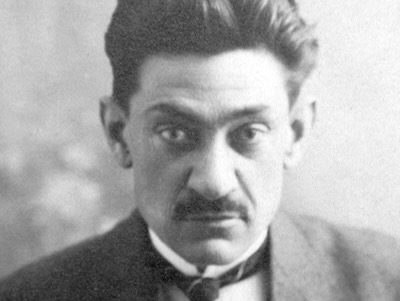
Like most Western political analysts and commentators, I was unaware of the existence of Ukrainian neo-Nazis until 2014. When the president-elect was overthrown, I was living in Syria at the time and thought they were violent groupings that had burst onto the public scene to assist pro-European elements. However, since the Russian military intervention, I have gradually discovered a lot of documents and information on this political movement which, in 2021, represented one third of the Ukrainian armed forces. This article presents a synthesis of it.
At the very beginning of this story, that is to say before the First World War, Ukraine was a large plain which had always been tossed between German and Russian influences. At the time, it was not an independent state, but a province of the tsarist empire. It was populated by Germans, Bulgarians, Greeks, Poles, Rumanians, Russians, Czechs, Tatars and a very large Jewish minority supposedly descended from the ancient Khazar people.
A young poet, Dmytro Dontsov, was fascinated by the avant-garde artistic movements, believing that they would help his country to escape from its social backwardness. Since the Tsarist Empire had been immobile since the death of Catherine the Great, while the German Empire was the scientific center of the West, Dontsov chose Berlin over Moscow.
When the Great War broke out, he became an agent of the German secret service. He emigrated to Switzerland, where he published, on behalf of his masters, the Bulletin of the Nationalities of Russia in several languages, calling for the uprising of the ethnic minorities of the Tsarist Empire in order to bring about its defeat. This model was chosen by the Western secret services to organize the “Forum of Free Peoples of Russia” this summer in Prague [1].
In 1917, the Bolshevik revolution turned the tables. Dontsov’s friends supported the Russian revolution, but he remained pro-German. In the anarchy that followed, Ukraine was divided de facto by three different regimes: the nationalists of Symon Petliura (who imposed themselves in the area held today by the Zelensky administration), the anarchists of Nestor Makhno (who organized themselves in Novorosssia, the land that had been developed by Prince Potemkin and that had never known serfdom), and the Bolsheviks (especially in the Donbass). The war cry of Petliura’s followers was “Death to the Jews and Bolsheviks”. They perpetrated numerous murderous pogroms.
Dmytro Dontsov returned to Ukraine before the German defeat and became the protégé of Symon Petliura. He participated briefly in the Paris peace conference but, for some unknown reason, did not remain in his delegation. In Ukraine, he helped Petliura to ally with Poland to crush the anarchists and Bolsheviks. After the capture of Kiev by the Bolsheviks, Petliura and Dontsov negotiated the Treaty of Warsaw (April 22, 1920): the Polish army undertook to push back the Bolsheviks and to liberate Ukraine in exchange for Galicia and Volhynia (exactly as the Zelensky administration is negotiating today the entry of Poland into the war against the same lands [2]). This new war was a fiasco.
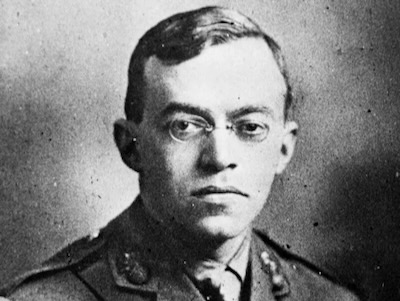
To strengthen his side, Petliura secretly negotiated with the founder of the Jewish battalions in the British army (the “Jewish Legion”) and now administrator of the World Zionist Organization (WZO), Vladimir Jabotinsky. In September 1921, the two men agreed to unite against the Bolsheviks in exchange for Petliura’s commitment to forbid his troops to continue their pogroms. The Jewish Legion was to become the “Jewish Gendarmerie. However, despite his efforts, Petliura did not succeed in pacifying his troops, especially as his close collaborator Dontsov was still encouraging the massacre of Jews. Finally, when the agreement was revealed, the World Zionist Organization rebelled against the Petliura regime. On January 17, 1923, the WZO set up a commission to investigate Jabotinsky’s activities. Jabotinsky refused to come and explain himself and resigned from his position.
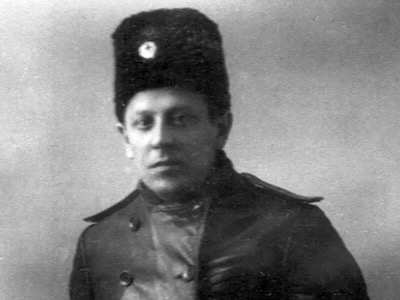
Petliura fled to Poland and then to France, where he was murdered by a Jewish anarchist from Bessarabia (now Transnistria). During the trial, the latter assumed his crime and pleaded to have avenged the hundreds of thousands of Jews murdered by the troops of Petliura and Dontsov. The trial had a great impact. The court acquitted the murderer. The League against Pogroms, later Licra (International League against Racism and Anti-Semitism), was founded on this occasion.
Not only were the nationalists defeated, but the anarchists as well. Everywhere the Bolsheviks triumphed and chose, not without debate, to join the Soviet Union.
Dmytro Dontsov published literary magazines that fascinated the youth. He continued to promote a Central Europe dominated by Germany and became closer to Nazism as it rose. He soon referred to his doctrine as Ukrainian “integral nationalism “. In doing so, he referred to the French poet, Charles Maurras. Indeed, the logic of both men was initially identical: they sought in their own culture the means to affirm a modern nationalism. However, Maurras was a Germanophobe, while Dontsov was a Germanophile. The expression “integral nationalism” is still claimed today by Dontov’s followers, who, after the fall of the Third Reich, are careful to refute the term “Nazism” with which the Russians describe it, not without reason.
According to him, “Ukrainian nationalism” is characterized by:
“the affirmation of the will to live, power, expansion” (it promotes “The right of strong races to organize peoples and nations to strengthen the existing culture and civilization”)
“the desire to fight and the awareness of its extremity” (he praises the “creative violence of the initiative minority”).
Its qualities are:
“fanaticism” ;
” immorality”.
Finally, turning his back on his past, Dontsov became an unconditional admirer of the Führer, Adolf Hitler. His followers had founded, in 1929, the Organization of Ukrainian Nationalists (OUN) around Colonel Yevhen Konovalets. Konovalets called Dontsov “the spiritual dictator of the youth of Galicia”. However, a quarrel arose between Dontsov and another intellectual about his extremism that led to war against all, when Konovalets was suddenly murdered. The OUN (financed by the German secret service) then split in two. The “integral nationalists” reserved for themselves the OUN-B, named after Dontsov’s favorite disciple, Stepan Bandera.
In 1932-33, the Bolshevik political commissars, who were mostly Jewish, levied a tax on crops, as in other regions of the Soviet Union. Combined with significant and unpredictable climatic hazards, this policy caused a huge famine in several regions of the USSR, including the Ukraine. It is known as “Holodomor”. Contrary to what the nationalist historian Lev Dobrianski says, it was not a plan for the extermination of Ukrainians by the Russians, since other Soviet regions suffered, but an inadequate management of public resources in times of climate change. Lev Dobrianski’s daughter, Paula Dobrianski, became one of President George W. Bush’s aides. She led a merciless struggle to have historians who did not adhere to her father’s propaganda excluded from Western universities [3].
In 1934, Bandera organized, as a member of the Nazi secret service and head of the OUN-B, the assassination of the Polish Minister of the Interior, Bronisław Pieracki.
From 1939, members of the OUN-B, forming a military organization, the UPA, were trained in Germany by the German army, and then still in Germany, but by their Japanese allies. Stepan Bandera offered Dmytro Dontsov to become the leader of their organization, but the intellectual refused, preferring to play the role of a leader rather than an operational commander.
The “integral nationalists” admired the invasion of Poland, in application of the German-Soviet pact. As Henry Kissinger, who could not be suspected of pro-Sovietism, demonstrated, it was not a question of the USSR annexing Poland, but of neutralizing part of it in order to prepare for the confrontation with the Reich. On the contrary, for Chancellor Hitler, it was a question of beginning the conquest of a “vital space” in Central Europe.
From the beginning of the Second World War, under the guidance of Dmytro Dontsov, the OUN-B fought alongside the Nazi armies against the Jews and the Soviets.
The collaboration between the Ukrainian “integral nationalists” and the Nazis continued with constant massacres of the majority of the Ukrainian population, accused of being Jews or Communists, until the “liberation” of Ukraine by the Third Reich in the summer of 1941 to the cry of “Slava Ukraїni!” (Glory to Ukraine), the war cry used today by the Zelensky administration and the US Democrats. At that time, the “integral nationalists” proclaimed “independence” from the Soviet Union in the presence of Nazi representatives and Greek Orthodox clergy, not in Kiev, but in Lviv, on the model of the Hlinka Guard in Slovakia and the Ustasha in Croatia. They formed a government under the leadership of Providnyk (guide) Stepan Bandera, whose friend Yaroslav Stetsko was Prime Minister. Their support in Ukraine is estimated at 1.5 million people. That is, the “integral nationalists” have always been in the minority.
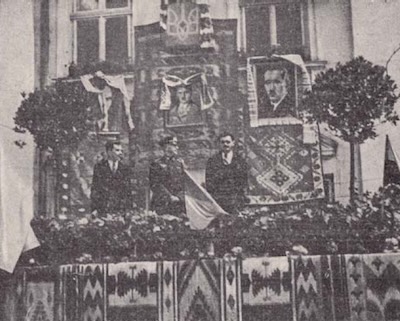
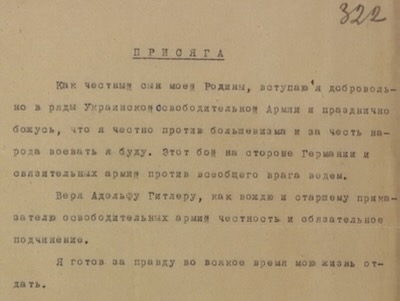
The Nazis were divided between the Reich Commissioner for the Ukraine, Erich Koch, for whom the Ukrainians were subhuman, and the Minister for the Occupied Eastern Territories, Alfred Rosenberg, for whom the “integral nationalists” were true allies. Finally, on July 5, 1941, Bandera was deported to Berlin and placed under Ehrenhaft (honorable captivity), i.e., under house arrest as a high-ranking official. However, after the members of OUN-B murdered the leaders of the rival faction, OUN-M, the Nazis sanctioned Stepan Bandera and his organization on September 13, 1941. 48 of their leaders were deported to a prison camp in Auschwitz (which was not yet an extermination camp, but only a prison). The OUN-B was reorganized under German command. At that time all Ukrainian nationalists took the following oath: “Faithful son of my Fatherland, I voluntarily join the ranks of the Ukrainian Liberation Army, and with joy I swear that I will faithfully fight Bolshevism for the honor of the people. This fight we are waging together with Germany and its allies against a common enemy. With loyalty and unconditional submission I believe in Adolf Hitler as the leader and supreme commander of the Liberation Army. At any time I am prepared to give my life for the truth.
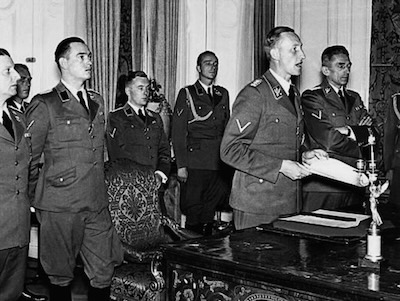
The Nazis announced that many bodies had been discovered in the prisons, victims of “Bolshevik Jews. So the “integral nationalists” celebrated their “independence” by murdering more than 30,000 Jews and actively participating in the roundup of Jews from Kiev to Babi Yar, where 33,771 of them were shot in two days, on September 29 and 30, 1941, by the Einsatzgruppen of SS Reinhard Heydrich.
In this tumult, Dmytro Dontsov disappeared. In reality, he had gone to Prague and placed himself at the service of the architect of the Final Solution, Reinhard Heydrich, who had just been appointed vice-governor of Bohemia-Moravia. Heydrich organized the Wannsee Conference, which planned the “Final Solution of the Jewish and Gypsy Questions” [4]. He then created the Reinard Heydrich Institute in Prague to coordinate the systematic extermination of all these populations in Europe. The Ukrainian Dontsov, who now lived in Prague in great luxury, immediately became its administrator. He was one of the main architects of the largest massacre in history. Heydrich was assassinated in June 1942, but Dontsov retained his functions and privileges.
Stepan Bandera and his deputy Yaroslav Stetsko were placed under house arrest at the headquarters of the General Inspectorate of Concentration Camps in Oranienburg-Sachsenhausen (30 km from Berlin). They wrote letters to their supporters and to the Reich leadership in complete freedom and were not deprived of anything. In September 1944, as the Reich army retreated and Bandera’s followers began to rebel against it, the two leaders were released by the Nazis and reinstated in their previous positions. Bandera and Stetsko resumed the armed struggle, among the Nazis, against the Jews and the Bolsheviks.
Centuria Integral Nationalist Order Ceremony. According to George Washington University, by 2021 it had already penetrated the main NATO armies.
But it was already too late. The Reich collapsed. The Anglo-Saxons got Dontsov, Bandera and Stetsko. The theorist of integral nationalism was transferred to Canada, while the two practitioners of mass murder were transferred to Germany. MI6 and the OSS (predecessor of the CIA) rewrote their biographies, making their Nazi involvement and responsibility for the “Final Solution” disappear.
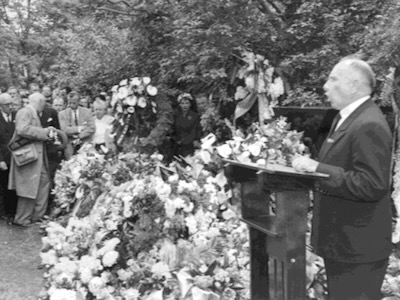
Bandera and Stetsko were installed in Munich to organize the Anglo-Saxon stay-behind networks in the Soviet Union. From 1950 onwards, they had an important radio station, Radio Free Europe, which they shared with the Muslim Brotherhood of Said Ramadan (the father of Tariq Ramadan). The radio station was sponsored by the National Committee for a Free Europe, a CIA offshoot of which its director Alan Dulles was a member, as well as future president Dwight Eisenhower, newspaper magnate Henry Luce and film director Cecil B. DeMilles. Psychological warfare specialist and future patron of the Straussians, Charles D. Jackson, was chairman.
Vladimir Jabotinsky, for his part, after living in Palestine, took refuge in New York. He was joined by Benzion Netanyahu (the father of the current Israeli Prime Minister). The two men wrote the doctrinal texts of “revisionist Zionism” and the Jewish Encyclopedia.
Bandera and Stetsko moved around a lot. They organized sabotage operations throughout the Soviet Union, particularly in the Ukraine, and parachuted leaflets. For this purpose, they created the Anti-Bolshevik Bloc of Nations (ABN), which brought together their Central European counterparts [5]. The British double agent, Kim Philby, informed the Soviets in advance about the actions of the Bandera. Bandera met with Dontsov in Canada and asked him to take the lead in the struggle. Once again, the intellectual refused, preferring to devote himself to his writing. He then drifted into a mystical delirium inspired by Viking myths. He announced the final battle of the Ukrainian knights against the Russian dragon. As for Bandera, he allied himself with the Chinese leader Chiang Kai-shek whom he met in 1958. But he was assassinated the following year by the KGB in Munich.
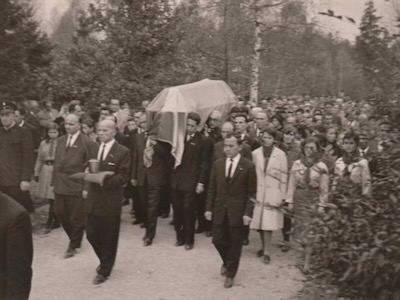
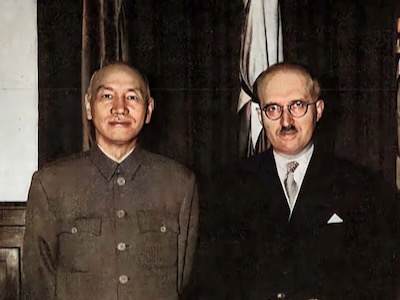
Yaroslav Stetsko continued the struggle through Radio Free Europe and the ABN. He went to the United States to testify before Senator Joseph MacCarthy’s Commission on Un-American Activities. In 1967, he and Chiang Kai-shek founded the World Anti-Communist League [6]. The League included many pro-US dictators from around the world and two schools of torture, in Panama and Taiwan. Klaus Barbie, who assassinated Jean Moulin in France and Che Guevara in Bolivia, was a member. In 1983, Stetsko was received at the White House by President Ronald Reagan and participated, along with Vice President George Bush Sr., in Lev Dobrianski’s “Captive Nations” (i.e., peoples occupied by the Soviets) ceremonies. He finally died in 1986.
But the story does not end there. His wife, Slava Stetsko, took over the leadership of these organizations. She too travelled the world to support any fight against the “communists”, or rather, if we refer to Dontsov’s writings, against the Russians and the Chinese. When the USSR was dissolved, Mrs. Stetsko simply changed the title of the League to the World League for Freedom and Democracy, a name it still has today. She then devoted herself to regaining a foothold in Ukraine.
Slava Stetsko ran in the first elections of the independent Ukraine in 1994. She was elected to the Verkhovna Rada, but having been stripped of her nationality by the Soviets, she could not sit. However, she brought the Ukrainian president, Leonid Kuchma, to the CIA offices in Munich and dictated parts of the new constitution to him. Even today, Article 16 of the new constitution states: “Preserving the genetic heritage of the Ukrainian people is the responsibility of the state. Thus, Nazi racial discrimination is still proclaimed by modern Ukraine as in the worst moments of World War II.
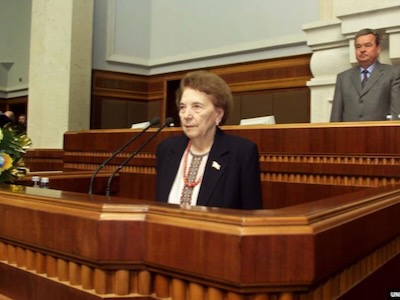
Slava Stetsko was re-elected at the next two sessions. She solemnly presided over the opening sessions on March 19, 1998 and on May 14, 2002.
In 2000, Lev Dobriansky organized a large symposium in Washington with many Ukrainian officials. He invited Straussian Paul Wolfowitz (a former collaborator of Charles D. Jackson). During this meeting, the “integral nationalists” put themselves at the service of the Straussians to destroy Russia [7].
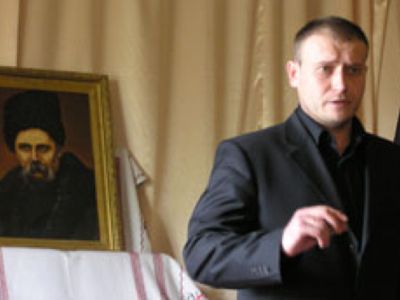
On May 8, 2007, in Ternopol, on the initiative of the CIA, the “integral nationalists” of the Ukrainian People’s Self-Defense and Islamists created an anti-Russian “Anti-Imperialist Front” under the joint chairmanship of the Emir of Itchkeria, Dokka Umarov, and Dmytro Yarosh (the current special adviser to the head of the Ukrainian army). The meeting was attended by organizations from Lithuania, Poland, Ukraine and Russia, including Islamist separatists from Crimea, Adygea, Dagestan, Ingushetia, Kabardino-Balkaria, Karachaevo-Cherkessia, Ossetia and Chechnya. Dokka Umarov, who was unable to go there due to international sanctions, had his contribution read out. In retrospect, the Crimean Tatars are unable to explain their presence at this meeting, if not their past service to the CIA against the Soviets.
The pro-US president, Viktor Yushchenko, created a Dmytro Dontsov Institute, following the “Orange Revolution”. Yushchenko is an example of Anglo-Saxon whitewashing. He has always claimed to have no connection with the mainstream nationalists, but his father, Andrei, was a guard in a Nazi extermination camp [8]. The Dmytro Dontsov Institute would be closed in 2010, and then reopened after the 2014 coup.
President Viktor Yushchenko, shortly before the end of his term of office, elevated the criminal against humanity Stepan Bandera to the title of “Hero of the Nation”.
In 2011, the mainstream nationalists succeeded in passing a law banning the commemoration of the end of World War II because it was won by the Soviets and lost by the Banderists. But President Viktor Yanukovych refused to enact it. Enraged, the “integral nationalists” attacked the procession of Red Army veterans, beating up old men. Two years later, the cities of Lviv and Ivano-Frankivsk abolished the Victory Day ceremonies and banned all manifestations of joy.
In 2014, Ukrainians in Crimea and Donbass refused to recognize the coup government. Crimea, which had declared itself independent before the rest of Ukraine, reaffirmed its independence a second time and joined the Russian Federation. The Donbass sought a compromise. The “Ukrainian nationalists,” led by President Petro Poroshenko, stopped providing public services there and bombed its population. In eight years, they murdered at least 16,000 of their fellow citizens in general indifference.
It was also from the 2014 coup that the full nationalist militias were incorporated into the Ukrainian Armed Forces. In their internal regulations, they enjoin each fighter to read the works of Dmytro Dontsov, including his master book, Націоналізм (Nationalism).
In April 2015, the Verkhovna Rada declared members of the Organization of Ukrainian Nationalists (OUN) “independence fighters.” The law was enacted, in December 2018, by President Poroshenko. Former Waffen SS were retrospectively entitled to a pension and all sorts of benefits. The same law criminalized any claim that OUN militants and UPA fighters collaborated with the Nazis and practiced ethnic cleansing of Jews and Poles. Published in Ukraine, this article would send me to jail for writing it and you for reading it.
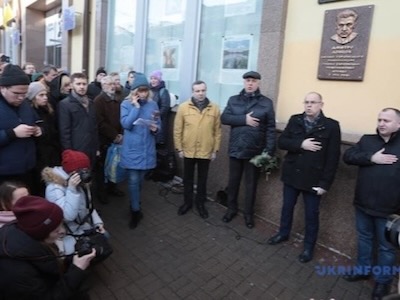
On July 1, 2021, President Volodymyr Zelenski enacted the Law “On Indigenous Peoples of Ukraine” which places them under the protection of Human Rights. By default, citizens of Russian origin can no longer invoke them in court.
In February 2022, the “full nationalist” militias, which made up one-third of the country’s armed forces, planned a coordinated invasion of Crimea and the Donbass. They were stopped by the Russian military operation to implement UN Security Council Resolution 2202 to end the suffering of the people of Donbass.
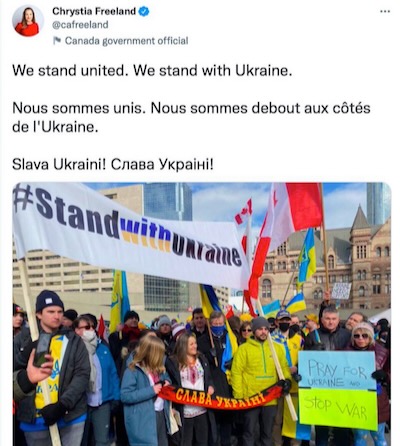
In March 2022, Israeli Prime Minister Nafatali Bennett, breaking with the “revisionist Zionism” of Benjamin Netanyahu (the son of Jabotinsky’s secretary), suggested to President Volodymyr Zelensky that he should agree with Russian demands and denazify his country [8]. Emboldened by this unexpected support, Russian Foreign Minister Sergei Lavrov dared to mention the case of the Jewish Ukrainian president, saying: “The Jewish people in their wisdom have said that the most ardent anti-Semites are usually Jews. Every family has its black sheep, as they say.” This was too much for the Israelis, who always worry when someone tries to divide them. His counterpart at the time, Yair Lapid, recalled that the Jews themselves never organized the Holocaust of which they were victims. Caught between its conscience and its alliances, the Hebrew state repeated its support for Ukraine, but refused to send it any weapons. In the end, the General Staff decided and the Minister of Defense, Benny Gantz, closed any possibility of support to the successors of the mass murderers of Jews.
Ukrainians are the only nationalists who are not fighting for their people or their land, but for one idea: to annihilate the Jews and the Russians.
Main sources:
Ukrainian Nationalism in the age of extremes. An intllectual biography of Dmytro Dontsov, Trevor Erlacher, Harvard University Press (2021).
Stepan Bandera, The Life and Afterlife of a Ukrainian Nationalist. Fascism, Genocide, and Cult, Grzegorz Rossoliński-Liebe, Ibidem (2014).
[1] “The Western strategy to dismantle the Russian Federation”, by Thierry Meyssan, Translation Roger Lagassé, Voltaire Network, 17 August 2022.
[2] “Poland and Ukraine”, by Thierry Meyssan, Translation Roger Lagassé, Voltaire Network, 14 June 2022.
[3] “The Holodomor, new avatar of “European” anti-communism” (excerpt from Le Choix of defeat), Annie Lacroix-Riz (2010).
[4] «The Wannsee Conference in 1942 and the National Socialist living space dystopia», Gerhard Wolf, Journal of Genocide Research, Vol 17 N°2 (2015). https://doi.org/10.1080/14623528.2015.1027074
[5] [Bulletins of the Anti-Bolshevik Nations Block are available in the Voltaire Network Library. ABN Korrespondenz (auf Deutsch), ABN Correspondence (in english).
[6] “The World Anti-Communist League: the Internationale of Crime”, by Thierry Meyssan, Translation Anoosha Boralessa, Voltaire Network, 12 May 2004.
[7] “Ukraine : the Second World War continues”, by Thierry Meyssan, Translation Roger Lagassé, Voltaire Network, 26 April 2022.
America’s Abandoned Nuclear Power Projects (includes Interactive Map)
THE BIG PICTURE: Abandoned Nuclear Power Projects (Interactive Map), Power, by Sonal Patel Increasing uncertainties concerning low forecasted load; construction financing constraints and reversals; state certification hurdles; and challenges to nuclear profitability posed by the growing share of coal plants beset the nuclear industry in the early 1970s. The nuclear suffered a renewed economic meltdown and fierce public pushback in the aftermath of the Three Mile Island accident in 1979. By 1983, these factors prompted the delay or cancellation of 100 nuclear units—nearly 45% of total commercial capacity previously ordered. An estimated $10 billion (in mid-1982 dollars) had been spent on the scrapped projects. Mounting public opposition from Chernobyl and new safety rules required after Fukushima also affected a number of later projects.
POWER in April 2020 published an infographic showing construction timeframes of completed nuclear reactors: THE BIG PICTURE (Infographic): U.S. Nuclear Lifetimes
A supplement to POWER‘s February 2018 THE BIG PICTURE print infographic, this interactive map offers a sampling of nuclear plant projects that have been abandoned. Double click on the map to activate the zoom function. Click on “Map Overview” to zoom out. Scroll down for an overview. Note: All dollar figures are from the corresponding year. Source: NRC
—Copy, artwork, and interactive feature by Sonal Patel, a POWER senior associate editor (@sonalcpatel, @POWERmagazine)
………………………… A Brief History of Abandoned U.S. Nuclear Projects
1974: Tyrone 2 (1.2 GW)—Wisconsin regulators denied certification of the project being built by Northern States Power (now Xcel Energy) owing to insufficient demand growth and public opposition. Abandonment cost the company $103 million. The Wisconsin Public Utility Commission ordered the company to study a substitute coal-fired plant.
1974: Vogtle 3 and 4 (each 1,113 MW)— While Georgia Power gave this project new life 2013 as AP1000s—and they remain the only two reactors under construction in the U.S.—the company canceled two reactors under construction at the Vogtle site in 1974, citing citizen opposition and regulatory changes, which contributed to rising costs and construction delays. Critics, however, pointed to management issues for the project’s failure.
1977: Surry 3 and 4 (each 882 MW)—Power demand fell dramatically from 1972, when Surry 3 and 4 were planned by Virginia Electric & Power Co. (VEPCO) northwest of Newport News, Virginia, through March 1977, when the units were canceled. VEPCO, which also cited construction delays caused by labor problems, intervention of environmentalists, and tighter NRC controls, said the company had invested $53 million in the projects and had contracts for another $93 million (1977 dollars).
1980: North Anna 4 (907 MW)—In the wake of Three Mile Island, VEPCO abandoned the project when it was only 4% complete. Abandonment of Unit 4 cost it $155 million (1980 dollars). The company had reportedly spent $485 million to build Unit 3 (abandoned two years later) and 4 at North Anna at the time. In 1982, when it scrapped Unit 3 because of a sharp increase in construction costs, VEPCO sought rate increases to cover an estimated $540 million write-off.
1980: Sterling (1.2 GW)—The New York Public Service Commission unequivocally allowed Rochester Gas & Electric Corp. full recovery of costs of the Sterling plant, which had just kicked off construction, estimated at about $129 million.
1980: Jamesport 1 and 2 (1.2 GW)—Long Island Lighting, which had also just entered construction, also recovered abandonment costs of about $120 million.
1980: Forked River 1 (1.1 GW)—Jersey Central Power & Light halted construction at this project in 1974 owing to financial cutbacks and protests, but it resumed construction only to abandon the project which was 5.6% complete owing to “financial difficulties” stemming from the Three Mile Island accidents, and also, uncertainty about whether the NRC would grant a license or put in place costly regulations.
1981: Callaway 2 (1.2 GW)—Construction had barely begun when Union Electric Co. halted the project, citing financial risks to investors posed by uncertainties afflicting the sector.
1981: Hope Creek 2 (1.1 GW)— Public Service Electric & Gas scrapped the unit when it was about 19% complete, but pressed on with Hope Creek 1. The $3.79 billion Hope Creek 1 was already plagued with soaring cost overruns, up from $600 million initially estimated for both units.
1981: Bailly 1 (645 MW)—The U.S. Supreme Court halted Northern Indiana Public Service’s $1.8 billion boiling water reactor (BWR) project owing to questions regarding pilings for the plant. Faced with longer delays for the project already seven years into construction, the company abandoned it.
1981: Shearon Harris 3 and 4 (900 MW each)—Costly safety upgrades and weakening power demand prompted Carolina Power & Light to abandon two of four planned Westinghouse 3 loop reactors under construction. The third 900-MW reactor, Shearon Harris 2, was abandoned in 1983.
1982: Washington Nuclear 4 and 5 (1.2 GW each)—Unit 4 was 25% complete and Unit 5 17% complete when Energy Northwest’s predecessor Washington Public Power Supply System halted construction at the two units after it failed to sell enough bonds to complete five reactors needed to meet projected power in the Pacific Northwest. Abandonment of the two units alone led to the company’s
defaulting on $2.2 billion in municipal bonds. Total costs for all five units planned at the site was estimated to exceed $24 billion.
1982: Phipps Bend 1 and 2 (1.2 GW each)—The Tennessee Valley Authority’s (TVA’s) board voted to stall construction of Unit 1, which was 29% complete, and Unit 2, 5% complete owing to slacker power demand as aluminum plants in the South closed down. Abandoning the project cost the TVA about $1.2 billion. The site in 2017 became home to a 1-MW solar farm.
1982: Hartsville B1 and B2 (1.2 GW each)—TVA also slowed work at Hartsville, B1 and B2, which were 17% and 7% complete, finally moving to scrap them. The decision cost $718 million.
1982: Cherokee 2 and 3 (1.3 GW)—Economic troubles also prompted Duke Power to abandon two of three reactors it was building in South Carolina. In 1983, Duke Power also scrapped the 1.3-GW Unit 1.
1984: Yellow Creek 1 and 2 (1.3 GW each)—About 30% of the two System 80 pressurized water reactors (PWRs) near Iuka, Mississippi, were complete when TVA moved to abandon them, citing lower power demand and dramatically higher construction costs. TVA estimated Yellow Creek would have cost $10 billion to build.
1984: Hartsville A1 and A2 (1.2 GW each)—On the same day it abandoned Yellow Creek, TVA also scrapped the two remaining Hartsville reactors near Nashville, Tennessee. Completing the Hartsville reactors would have cost $6.5 billion, it said.
1984: Zimmer 1 (810 MW)—When Cincinnati Gas & Electric Co. announced cancellation of the project to convert it to a coal plant, it was 97% complete and had so far cost $1.6 billion—up from a the $240 million originally estimated. The decision to scrap the project was rooted in estimates that completing the project would cost an additional $1.5 billion and two more years of construction to satisfy new requirements from the NRC. Just months before, the federal regulatory body repudiated its own probe into a pipe-weld problem at Zimmer, alleging “incompetence” after a whistleblower—29-year-old Thomas Applegate, a private investigator hired by the utility to check possible time-card padding at the plant—brought to light that the NRC’s regional office of inspection and enforcement had never inspected the defective welds in safety-related systems. While Applegate alleged a cover up by the NRC, the NRC rejected its own overall finding, deeming the investigation “unsatisfactory.” Ultimately, it halted construction on several parts of the plant after finding fault with project management and for safety violations. Fallout from the Zimmer project struck the nuclear industry widely—specifically for utilities looking to sell bonds to finance new nuclear—as no company had walked away from a costly nuclear project so close to completion.
1986: Midland 1 (818 MW) and 2 (492 MW)—After 17 years of sporadic construction, hearing and protests, and after project partner Dow Chemical pulled out of the project, Consumers Powers Co.’s board of directors voted to abandon the two reactors in Michigan—even though the project was 85% complete. At the time, the board cited changing safety rules, which it blamed for costly delays, and a refusal by some of Michigan’s major industrial consumers to agree to rate increases. Some critics also alleged project mismanagement. Consumers had spent $4 billion on the two reactors when it abandoned the project. In 1987, it began converting the plant to a natural gas–fired cogeneration facility, and in 2009, after years of high natural gas prices, the company sold its stake in the Midland Cogeneration Venture to New York–based Fortistar.
1988: Bellefonte 1 and 2 (1.2 GW each)—TVA’s board suspended the project when Unit 1 was 88% complete and Unit 2, 58% complete, after a combined $6 billion investment. TVA considered completing the project in 2010, but it ultimately sold the site in November 2016 to Nuclear Development LLC, a firm that has sought federal loan guarantees to complete the project.
1988: Seabrook 2 (1.2 GW)— Public Service Co. of New Hampshire canceled plans for the second of two reactors planned at Seabrook. Unit 2 was 25% complete and the utility had spent $800 million on the project. Unit 1 was completed in 1986.
1989: Shoreham (820 MW)—The Shoreham Long Island Lighting Co. (LILCO) fully completed this GE BWR in 1984, but considerable public opposition after Three Mile Island prompted Suffolk County officials in New York to determine that the county could not be safely evacuated in the event of a serious nuclear accident at the plant. Even though the company received federal permission for low power tests in 1985, the states declined a company-sponsored evacuation plan, effectively barring it from ever opening. In 1992, the Long Island Power Authority bough the plant from LILCO (for $1), and it was fully decommissioned in 1994. In 1965 when LILCO first announced plans for the plant, it said it could be completed by 1973 at a cost of $75 million; by the late 1970s, after LILCO decided to increase the size of Shoreham from 540 MW to 820 MW, costs soared to $2 billion; and by the 1990s, ratepayers were saddled with an enormous price tag of $6 billion for the project, which never produced commercial power.
1990: Grand Gulf 2 (1.3 GW)—Though planned in the 1970s when regional demand for power was rising sharply every year, in 1986, Middle South Utilities—Entergy’s predecessor— suspended construction of the project where work had begun in 1975 after state regulators denied the company’s request for rate increases to pay for the project. Citing a massive debt load and political imbroglio, and though the project was 66% complete and one unit at the plant had been placed in commercial operation in 1985, the company scrapped the project in 1990.
1995: Washington Nuclear 1 (1.3 GW) and Washington Nuclear 3 (1.2 GW)—Only one of five reactors planned by the Washington Public Power Supply System was completed (Columbia Generating Station, in 1984) but the remaining unfinished plants were mothballed against the possibility that construction would be resumed. In 1995, the projects were formally terminated. The company, renamed as Energy Northwest, asked the NRC to extend the construction permit for Unit 1 to 2001, but in 2005, it determined again that the construction permit was no longer needed.
2017: V.C. Summer 3 and 4 (each 1.1 GW)—SCANA Corp. and its partner Santee Cooper scrapped two AP1000 reactors that were 64% complete, claiming completion would cost $9.8 billion. The project, whose construction began in 2013, was dogged by costly delays stemming in part due to new safety rules implemented in the wake of the 2011 Fukushima disaster. In early 2017, delays at the project and two other AP1000s under construction in Georgia forced contractor Westinghouse to declare bankruptcy. The partners spent $9 billion on the project they estimated could cost up to $24 billion to complete. https://www.powermag.com/interactive-map-abandoned-nuclear-power-projects/#.Y2Sprx1KxHA.twitter
Cuban missile crisis, 60 years on: new papers reveal how close the world came to nuclear disaster
In 1962, a Soviet submarine commander nearly ordered a nuclear launch, newly translated accounts show, with modern parallels over Ukraine all too clear
Guardian, Julian Borger in Washington 27 Oct 2022
The commander of a nuclear-armed Soviet submarine panicked and came close to launching a nuclear torpedo during the Cuban missile crisis 60 years ago, after being blinded and disoriented by aggressive US tactics, according to newly translated documents.
Many nuclear historians agree that 27 October 1962, known as “Black Saturday”, was the closest the world came to nuclear catastrophe, as US forces enforced a blockade of Cuba to stop deliveries of Soviet missiles. On the same day a U-2 spy plane was shot down over the island, and another went missing over Siberia when the pilot lost his way.
Six decades on from the “world’s most dangerous day”, last week’s revelation that a Russian warplane fired a missile near a British Rivet Joint surveillance plane over the Black Sea has once more heightened concerns that miscalculation or accident could trigger uncontrolled escalation.
In October 1962, the US sent its anti-submarine forces to hunt down Soviet submarines trying to slip through the “quarantine” imposed on Cuba. The most perilous moment came when one of those submarines, B-59, was forced to surface late at night in the Sargasso Sea to recharge its batteries and found itself surrounded by US destroyers and anti-submarine planes circling overhead.
In a newly translated account, one of the senior officers on board, Captain Second Class Vasily Arkhipov, described the scene……………………………………………………………
In his account, Arkhipov played down his role and how close the B-59 submarine commander, Savitsky, came to launching the submarine’s one nuclear-tipped torpedo. However, Svetlana Savranskaya, the director of the National Security Archive’s Russian programmes, interviewed another submarine commander from the same brigade, Ryurik Ketov, who said Savitsky was convinced they were under attack and that the war with the US had started.
The commander panicked, calling for an “urgent dive” and for the number one torpedo with the nuclear warhead to be prepared. However, because the signalling officer was in the way, Savitsky could not immediately get down the narrow stairway through the conning tower, and during those few moments of hesitation, Arkhipov realised that the US forces were signalling rather than attacking, and deliberately firing off to the side of the submarine.
“He called to Savitsky and said: ‘calm down, look they are signalling, not attacking, let’s signal back.’ Savitsky turned back, saw the situation, ordered the signalling officer to signal back,” Savranskaya said. She added that two other officers would have had to confirm any order from Savitsky before the nuclear torpedo could have been launched.
Tom Blanton, the director of the National Security Archive, said the aggressive tactics used by the American submarine hunters contributed to the close shave…………………………………………….
Saved ‘primarily because of luck’
The B-59 incident was just one of a cascade of crises that day. A U-2 went missing over Siberia when the pilot lost his bearings, blinded by the aurora borealis and misled by compass malfunction close to the north pole.
Some F-102 interceptor jets were scrambled to protect the U-2, but the joint chiefs of staff who gave the order for their launch were not aware they had been armed with nuclear missiles as a matter of course once the alert level was raised to Defcon 2.
Minutes later, the joint chiefs heard that another U-2 had been shot down over Cuba and assumed it was a deliberate escalation by Moscow. In fact, the order had been given independently by two Soviet generals in Cuba. The joint chiefs were also unaware that there were 80 nuclear warheads on the missiles already in Cuba when they gave their recommendation for the US to carry out airstrikes and then an invasion of Cuba.
The recommendation was overruled by president John Kennedy, as negotiations with Soviet representatives, some of them in a Washington Chinese restaurant, were making progress, leading ultimately to the withdrawal of Soviet missiles from Cuba while US missiles were pulled back from Turkey.
Tom Collina, the director of policy at the Ploughshares Fund, a disarmament advocacy group, said Black Saturday “reminds us that the reason we’ve gotten out of things like that in the past is primarily because of luck”.
“We had some good management, we had some good thinkers,” Collina, co-author of The Button, a book on the nuclear arms race, said. “But basically, we got lucky in the closest situations where we could have gotten involved in nuclear war.”……………………………..
“The lesson we should have learned in 1962 is that humans are fallible, and we should not combine crises with fallible humans with nuclear weapons,” Collina said. “Yet here we are again.” https://www.theguardian.com/world/2022/oct/27/cuban-missile-crisis-60-years-on-new-papers-reveal-how-close-the-world-came-to-nuclear-disaster
The world doesn’t want another Cuban missile crisis.
By DOUGLAS ROCHE OCTOBER 12, 2022
We are not bereft of key ideas and high-level persons to find creative ways to end the present carnage in Ukraine. The Cuban Missile Crisis ended because John F. Kennedy and Nikita Khrushchev took a risk with crisis diplomacy. Can Joe Biden and Vladimir Putin take a similar risk for peace? Canada should push diplomacy, not arms, to end the Ukraine war.
EDMONTON—The possibility of Russia’s use of nuclear weapons in the Ukraine war has led to comparisons with the Cuban Missile Crisis 60 years ago this month, in which, for 13 days, humanity stood on the brink of World War III.
The crisis passed because U.S. president John F. Kennedy and Soviet Union president Nikita Khrushchev engaged in crisis diplomacy and negotiated a solution to the problem of the Soviets installing nuclear missiles in Cuba. But negotiations today to end the Ukraine war seem farthest from the minds of the Western leaders and Russian President Vladimir Putin, let alone Ukraine’s President Volodymyr Zelenskyy. For Canada’s part, the word “negotiations” does not escape the lips of Prime Minister Justin Trudeau or Foreign Minister Mélanie Joly. The G7, which includes Canada, has just signed on for more weapons to be sent to Ukraine.
I am undoubtedly speaking against a headwind when I call for Canada to support the creation of an international commission, composed of eminent figures, to reach beyond the clamour and hubris engaged in by both the West and Russia to deal with the practical realities of the Ukraine war. The essential reality is to stop the war before it escalates into World War III.
The history of the Cuban Missile Crisis should be a guide. Here is what happened in the momentous days, Oct. 16-29, 1962……………………..more https://www.hilltimes.com/2022/10/12/the-world-doesnt-want-another-cuban-missile-crisis/387625—
60 years of luck -why did the nuclear arms race escalate?

Why didn’t the Cuban Missile Crisis save us?
60 years of luck — Beyond Nuclear International By Linda Pentz Gunter https://beyondnuclearinternational.org/2022/10/16/60-years-of-luck/
When you are a medical professional, relying on luck is not the preferred option. But for 87-year old retired radiologist, Dr. Murray Watnick, there are some circumstances when, if luck comes your way, you readily embrace it.
One such moment was the Cuban Missile Crisis, 13 tense days in October 1962, now being remembered 60 years on. Watnick was serving as a medical officer at the time, assigned to the US Strategic Air Command base at High Wycombe in the UK, headquarters base for the 7th Air Division and also home to a “nuclear bunker”.
The Cuban Missile Crisis is still believed, today, to be the closest the world ever came to nuclear war between two superpowers.
It lasted from October 16-28, 1962, although officially it was finally resolved on November 20. The phrase, ‘thirteen days in October’, remains synonymous with our narrowest of escapes from a nuclear apocalypse.
“We were on edge for 13 days,” recounted Watnick in a conversation last month as he recalled the rising tension among troops when the base was placed on DEFCON 2, the highest alert level before all-out war.
“Fortunately cooler heads prevailed and war was averted,” he said. “We were very lucky to have Nikita Khrushchev and John Kennedy in charge. Theirs were measured responses and a careful analysis of the situation.”
That measured response included a letter written by Khrushchev to President Kennedy on October 26, 1962 that is hard to imagine being replicated today. In part, it said:
“Mr. President, we and you ought not now to pull on the ends of the rope in which you have tied the knot of war, because the more the two of us pull, the tighter that knot will be tied. And a moment may come when that knot will be tied so tight that even he who tied it will not have the strength to untie it, and then it will be necessary to cut that knot, and what that would mean is not for me to explain to you, because you yourself understand perfectly of what terrible forces our countries dispose.
“Consequently, if there is no intention to tighten that knot and thereby to doom the world to the catastrophe of thermonuclear war, then let us not only relax the forces pulling on the ends of the rope, let us take measures to untie that knot. We are ready for this.”
And yet, despite that realization as the bullet of Armageddon was dodged, the Cold War continued and the nuclear arms race between the two super powers escalated to obscene heights. There was a failure to recognize then, and still now, that nuclear weapons are a madness and we need to get rid of them completely. Instead, the world’s collective atomic arsenal ballooned to a high of more than 64,000 by the late 1980s.
Part of the problem, contends Watnick, was once again one of leadership. He recalled a conversation with Dr. Helen Caldicott as she recounted her December 1982 meeting with then US president, Ronald Reagan. Watnick remembered Caldicott telling him how Reagan “was very uneducated about nuclear weapons,” and that “he believed that if you sent a missile towards Russia it could be called back.”
Caldicott, a pediatrician, activist, author and leading light in the nuclear weapons abolition movement, had been invited to the meeting by the president’s activist daughter, Patti Davis. And Caldicott was indeed shocked by Reagan’s profound level of ignorance:
“I wanted to talk to him about the medical effects of nuclear war. He was not interested. He just wanted to talk about numbers of missiles,” Caldicott recounted in a later talk. “I was really shocked to find that everything he said to me was factually inaccurate. To give you an indication of his lack of knowledge, he said he thought submarine-launched ballistic missiles were recallable after they were launched. That’s analogous to recalling a bullet once you’ve shot it from a gun.”
As Caldicott concluded, Reagan “had no background knowledge to debate any point with me at all.”
Perhaps not uncoincidentally, however, what eventually followed was the famous meeting between the US president and then Soviet premier, Mikhail Gorbachev at Reykjavik in Iceland. That summit, on October 11 and 12, 1986, occurred almost exactly 24 years after the Cuban Missile Crisis.
Once again, an opportunity for full nuclear disarmament was lost. While Gorbachev wanted to ban all ballistic missiles, Reagan clung on to his misguided obsession with the Strategic Defense Initiative, also known as “Star Wars.”
Nevertheless, points out Watnick, the Iceland summit still led to the signing, one year later by the US and the Soviet Union, of the Intermediate-Range Nuclear Forces Treaty and eventually, under subsequent US and Russian administrations, to START.
“You have to give a lot of credit to Dr. Caldicott,” Watnick said. “I think she started the educational process for Ronald Reagan.”
Today there are estimated to be around 13,000 nuclear warheads in the world, with Russia and the United States still in possession of the vast majority (approximately 6,257 and 5,550 respectively).
That’s still 13,000 too many, of course. And once again, averting disaster relies on luck.
“With so many nuclear devices in the world, the law of statistics dictates that these types of events will occur,” said Watnick, reflecting on the narrow escape in Cuba 60 years ago. “Lady Luck intervened,” he said. “Who can predict that this will be the situation for future events?”
Who, indeed.
Linda Pentz Gunter is the international specialist at Beyond Nuclear and writes for and curates Beyond Nuclear International.
Cuban Missile Crisis 60th anniversary: How world teetered on nuclear abyss
9News, By Richard Wood • Senior Journalist Oct 15, 2022
“……………………………………… Sixty years ago, the flashpoint was Cuba and the deployment of Russian nuclear missiles to the island – just 180km from the US mainland.
Here is a look at how the dramatic events unfolded over a tense 13 days.
………………………………………………………. On Friday, October 26, 1962, fears of a US invasion were so great that Cuban leader Fidel Castro ordered American reconnaissance planes to be shot down.
The end game came in the form of a public US promise the next day not to invade Cuba and a private – long denied – promise to remove US missiles from Turkey in return for a Soviet pledge to pull out their nuclear missiles from Cuba.
How the 1962 Cuban Missile Crisis unfolded
October 16: Photos taken by a US spy plane that show nuclear-armed missiles on Cuba are shown to President John F. Kennedy.
October 18: Kennedy receives an assurance from the Soviet government that his country is providing only defensive aid to Fidel Castro’s Cuba.
October 22: In a TV address, Kennedy says the weapons are a “clear and present danger” to the US and its allies.
October 23: US naval forces deploy around Cuba to enforce their blockade
October 25: Russian freighters bound for Cuba turn back.
October 26: Nikita Khrushchev writes to Kennedy offering to remove the missiles if the US lifts the blockade and pledges not to invade Cuba.
October 27: Kennedy receives a second letter from the Soviet government demanding much tougher terms. A US spy plane is shot down over Cuba and its pilot dies.
October 28: Russian state radio announces Khrushchev will withdraw the missiles in exchange for a non-invasion pledge by the US. https://www.9news.com.au/world/cuban-missile-crisis-sixty-years-on/e8c362a8-3971-4067-80b6-5b421ab94a9f
Both sides need to acknowledge their mistakes, especially regarding Crimea and the Donbass
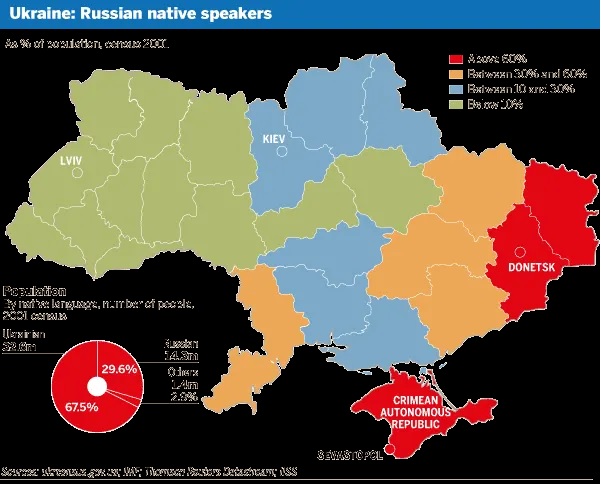
At the end of this presentation, we see that the blame is shared, but not equally. The West recognized the 2014 coup; it tried to stop the ensuing massacre, but ultimately let the full nationalists continue it; it armed Ukraine instead of forcing it to comply with the Minsk 1 and 2 agreements. Russia, for its part, built a bridge that locks the Sea of Azov without consultation. Peace will only be preserved if both sides recognize their mistakes.
Are we able to do this?
Crimea, which had already voted in a referendum to become part of the future independent Russia when the USSR was dissolved, six months before the rest of the Ukrainian Soviet Republic declared its independence, voted again in a referendum. For four years, Crimea was claimed by both Russia and Ukraine. Moscow argues that between 1991 and 1995, it and not Kiev was paying pensions and salaries of officials in Crimea. In fact, Crimea was always Russian, even if it was considered part of Ukraine. In the end, it was Russian President Boris Yeltsin who, in the midst of a severe economic crisis, decided to abandon Crimea to Kiev. However, Crimea then voted for a constitution recognizing its autonomy within Ukraine, which Kiev never accepted. The second referendum, in 2014, overwhelmingly proclaimed independence. The Crimean Parliament then called for the attachment of its state to the Russian Federation, which the latter accepted. To strengthen the continuity of its territory, Russia built, without consulting Ukraine, a gigantic bridge linking its metropolis to the Crimean peninsula across the Sea of Azov, effectively privatizing this small sea.
How to Stop the Escalation to War,
Voltaire.net, by Thierry Meyssan, Translation, Roger Lagassé, 27 Sept 22,
The Ukrainian conflict is turning into a war between the West on one side and Russia and China on the other. Each side is convinced that the other one wants its loss. And fear is a bad advisor. Peace can only be preserved if each side recognizes its mistakes. This must be a radical change, because today neither Western discourse nor Russian actions correspond to reality.
o political leader wants a war on his territory. When they do, it is usually out of fear. Each side fears the other, rightly or wrongly. Of course, there are always a few elements that push for a cataclysm, but they are fanatical and in the minority.
This is exactly the situation in which we find ourselves. Russia is convinced, rightly or wrongly, that the West wants to destroy it, while the West is identically convinced that Russia is conducting an imperialist campaign and will eventually destroy its freedoms. In the shadows, a very small group, the Straussians, want confrontation.
This is not to say that World War III is just around the corner. But if no political leader radically changes his or her foreign policy, we are walking directly into the unknown and must prepare for absolute chaos.
To clear up misunderstandings, we must listen to the narratives of both sides.
Moscow believes that the overthrow of democratically elected President Viktor Yanukovych was a coup d’état orchestrated by the United States. This is the first point of divergence as Washington interprets the events as a “revolution”, the “EuroMaidan” or “Dignity” revolution. Eight years later, numerous Western testimonies attest to the involvement of the US State Department, the CIA and the NED, Poland, Canada and finally NATO.
The people of Crimea and Donbass refused to endorse the new power, which included many “integral nationalists”, successors of the defeated of the Second World War.
Crimea, which had already voted in a referendum to become part of the future independent Russia when the USSR was dissolved, six months before the rest of the Ukrainian Soviet Republic declared its independence, voted again in a referendum. For four years, Crimea was claimed by both Russia and Ukraine. Moscow argues that between 1991 and 1995, it and not Kiev was paying pensions and salaries of officials in Crimea. In fact, Crimea was always Russian, even if it was considered part of Ukraine. In the end, it was Russian President Boris Yeltsin who, in the midst of a severe economic crisis, decided to abandon Crimea to Kiev. However, Crimea then voted for a constitution recognizing its autonomy within Ukraine, which Kiev never accepted. The second referendum, in 2014, overwhelmingly proclaimed independence. The Crimean Parliament then called for the attachment of its state to the Russian Federation, which the latter accepted. To strengthen the continuity of its territory, Russia built, without consulting Ukraine, a gigantic bridge linking its metropolis to the Crimean peninsula across the Sea of Azov, effectively privatizing this small sea.
Crimea is home to the port of Sevastopol, which is indispensable to the Russian navy. The latter represented nothing in 1990, but became a power again in 2014.
The West recognized the Soviet referendum in Ukraine in 1990, but not the one in 2014. Yet the right of peoples to self-determination does apply to the Crimeans. The West argues that many Russian soldiers were present without wearing their uniforms. True, but the results of the two referendums in 1990 and 2014 were similar. There is no room for suspicion of fraud.
To show that they did not accept this “annexation”, the West collectively imposed sanctions on Russia, without authorization from the Security Council. These sanctions violate the UN Charter, which gives exclusive authority to the Security Council.
The Donetsk and Luganks oblasts have also rejected the 2014 coup government. They proclaimed their autonomy and posed as resisters to the “Nazis” in Kiev. Equating “integral nationalists” with “Nazis” is historically justified, but does not allow non-Ukrainians to understand what is going on.
The “integral nationalist” was created in Ukraine by Dmytro Dontsov at the very beginning of the 20th century. Initially, Dontsov was a left-wing philosopher, only gradually moving to the extreme right. He was a paid agent of the Second Reich during the First World War, before participating in the Ukrainian government of Symon Petliura, which arose during the Russian Revolution of 1917. He participated in the Paris Peace Conference and accepted the Treaty of Versailles. During the inter-war period, he exercised a mastery over Ukrainian youth and became a propagandist of fascism, then of Nazism.
He became violently anti-Semitic, preaching for the massacre of the Jews long before this theme was supported by the Nazi authorities, who spoke only of expulsion until 1942. During the Second World War, he refused to take over the leadership of the Organization of Ukrainian Nationalists (OUN), which he entrusted to his disciple Stepan Bandera, assisted by Yaroslav Stetsko.
Almost all the documents about his activity within Nazism have been destroyed. It is not known what he did during the war, except for his active participation in the Reinhard Heydrich Institute after the latter’s assassination. The newspapers of this anti-Semitic organ gave him a lot of space
At the Liberation, he fled to Canada, under the protection of the Anglo-Saxon secret services, and then to the United States. At the end of his life, he was still as virulent as ever and had evolved into a form of Viking mysticism, preaching the final confrontation against the “Muscovites. Today, his books, especially his Nationalism, are required reading for militiamen, especially those in the Azov Regiment. Ukrainian “integral nationalists” massacred at least 3 million of their fellow citizens during World War II.
Washington reads this history differently. For it, the “integral nationalists” certainly made mistakes, but they were fighting for their independence against both the German Nazis and the Russian Bolsheviks. The CIA was therefore right to host Dmytro Donsov in the USA and to employ Stepan Bandera on Radio Free Europe. And even more, to create the World Anti-Communist League around the Ukrainian Nazi Prime Minister, Yaroslav Stetsko, and the leader of the Chinese anti-communist opposition, Chiang Kai-shek. Today, again according to Washington, these facts belong to the past.
In 2014, with President Petro Poroshenko, the Kiev government cut off all aid to the “Muscovites” of Donbass. It stopped paying pensions to its citizens and salaries to their civil servants. It banned the Russian language, spoken by half of Ukrainians, and launched punitive military operations against these “sub-humans”, killing 5,600 and displacing 1.5 million in 10 months. In the face of these horrors, Germany, France and Russia imposed the Minsk agreements. The aim was to bring the Kiev government to its senses and to protect the people of the Donbass.
Noting that the first agreements had not been followed by effect. Russia had the Minsk 2 agreement endorsed by the Security Council. This was resolution 2202, adopted unanimously. During the explanations of vote, the United States developed its interpretation of this period. For them, the “resistance” in Donbass were only “separatists” supported militarily by Moscow. They therefore specified that the Minsk 2 agreement (February 12, 2015) did not replace the Minsk 1 agreements (September 5 and 19, 2014), but added to them. They thus demanded that Russia withdraw the troops it had deployed without uniform in the Donbass. Germany and France had a joint statement added, co-signed by Russia, guaranteeing the “binding” implementation of this set of “commitments.”
However, shortly afterwards, President Poroshenko declared that he had no intention of implementing anything and resumed hostilities, a position that the government of President Zelensky has reiterated. In the seven years following resolution 2202, 12,000 new victims were killed, according to Kiev, or 20,000, according to Moscow.
During this period, Moscow did not intervene. President Vladimir Putin not only withdrew his troops, but also forbade an oligarch to send mercenaries to support the people of Donbass. The latter have been abandoned by the guarantors of the Minsk agreements and by the other members of the Security Council.
In the Russian way of politics, one waits until one is in a position to do something before announcing it. So Moscow did not say anything, but prepared for what was to come. Suffering from the sanctions it had endured since the annexation of Crimea, it expected the West to tighten them when it intervened to implement resolution 2202. So Putin approached other sanctioned states, including Iran, to circumvent the sanctions on him and prepare to circumvent others. Anyone who regularly visits Russia will have noticed that the Putin administration is developing food autarky, including for meat and cheese, which his country had previously lacked. Russia has moved closer to China in banking, which we have wrongly interpreted as a move against the dollar. In reality, it was a preparation for the exclusion of the SWIFT system.
When President Putin launched his army into Ukraine, he made it clear that he was not declaring a “war” to annex Ukraine, but was implementing a “special military operation” under Resolution 2202 and his “responsibility to protect” the civilian population of Donbass.
As expected, the West responded with economic sanctions that severely disrupted the Russian economy for two months. Then things turned around and these sanctions turned out to be profitable for Russia, which had prepared for them for a long time.
On the ground, the West sent a lot of weapons, then deployed military advisors and some special forces. The Russian army, three times smaller in number than the Ukrainian army, began to suffer. It has therefore just decreed a partial mobilization to send new troops without having to dismantle its national defence system.
Nato, for its part, has developed a plan to mobilize a core group of states and an expanded group of its more distant allies. The idea is to spread the financial effort over as many partners as possible until Russia is exhausted.
Moscow responded by announcing that if the West took a further step, it would use its new weapons.
The Russian and Chinese armies have mastered hypersonic launchers, which the West lacks. Moscow and Beijing can destroy any target, anywhere in the world, in a matter of minutes. It is impossible to stop them, and this imbalance will last at least until 2030, according to US generals. Russia has already said that it will strike first at the British Foreign Office, which it considers to be the head of its enemies, and the Pentagon, which it considers to be its armed wing. In the event of an attack, the Russian and Chinese armies would first destroy the United States’ strategic communication satellites (CS3). The latter would lose in a few hours the possibility of guiding nuclear missiles and therefore of retaliating. There is little doubt about the outcome of such a war.
……………Engaging in this confrontation is not impossible. In the United States, the Straussians, a very small group of unelected politicians, are determined to bring about the apocalypse. In their view, the United States will no longer be able to exercise dominance over the entire world, but it can still achieve it over its allies. To do this, they must not hesitate to sacrifice some of their own, if their allies suffer even more than they do and if, in this way, they remain the first (not the best).
As in all conflicts, people are afraid and some individuals push them to war.
Russia has just held four referendums on self-determination and annexation, both in the two republics of Donbass and in two oblasts of Novorossia. The view of the G7, whose foreign ministers were attending the UN General Assembly in New York, was immediately to denounce the referendums as invalid because they were held in a war situation, which is a debatable opinion. So they went on to denounce a violation of the sovereignty and territorial integrity of Ukraine and the principles of the UN Charter. These last points are false. By definition, the right of peoples to self-determination does not violate the sovereignty and territorial integrity of the state from which they can, if they wish, separate. Moreover, all the members of the G7 (except Japan) have signed the Helsinki Final Act, in which they undertake to defend all these principles simultaneously.
It is particularly odious to note the way in which the G7 interprets the right to self-determination to its advantage. For example, the United Nations General Assembly has condemned the illegal occupation by the United Kingdom of the Chagos Archipelago. It ordered that it be returned to Mauritius by October 22, 2019. Not only has this not been done, but one of the Chagos Islands, Diego Garcia, is still illegally leased to the United States to house the largest military base in the Indian Ocean. Moreover, France illegally transformed its colony of Mayotte into a department in 2009. It held a referendum in violation of General Assembly resolutions 3291, 3385 and 31/4, which affirm the unity of the Comoros and prohibit referendums in only one of its parts, the state of the Comoros and the French colony of Mayotte. It is precisely to avoid decolonization that France has organized this referendum, given that it has installed a maritime military base there and above all a military interception and intelligence base.
From a Russian point of view, these referendums, if internationally recognized, would put an end to military operations. By refusing them, the West is prolonging the conflict. Their intention is to see the rest of Novorossia fall into the hands of Russia. If Odessa becomes Russian again, Moscow will have to accept the accession of the adjacent Transnistria to the Russian Federation. Transnistria is not Ukrainian, but Moldovan, hence its current name of Dniester Moldavian Republic.
Russia refuses to accept a Moldavian territory that has historical reasons to proclaim itself independent. But it did not accept it either with South Ossetia and Abkhazia, which also have historical reasons to proclaim themselves independent, but are Georgian. Neither Moldova nor Georgia have committed crimes comparable to those of modern Ukraine.
At the end of this presentation, we see that the blame is shared, but not equally. The West recognized the 2014 coup; it tried to stop the ensuing massacre, but ultimately let the full nationalists continue it; it armed Ukraine instead of forcing it to comply with the Minsk 1 and 2 agreements. Russia, for its part, built a bridge that locks the Sea of Azov without consultation. Peace will only be preserved if both sides recognize their mistakes.
Are we able to do this? https://www.voltairenet.org/article218093.html
HISTORIC CONTEXT OF THE REFERENDA IN UKRAINE.
Popular Resistance, By Moon of Alabama., September 24, 2022, Educate!
Voting for membership in the Russian Federation has started in four oblast of Ukraine:
………………….. The Ukrainian regime has resorted to pure terrorism to prevent the votes from happening:
” Ukrainian partisans, sometimes working with special operations forces, have blown up warehouses holding ballots and buildings where Russian proxy officials preparing for the vote held meetings. Ukrainian officials have acknowledged that they are engaged in a campaign to assassinate key Russian administration officials; more than a dozen have been blown up, shot and poisoned, according to Ukrainian and Russian officials.“
Such behavior by the Zelenski regime against its still Ukrainian compatriots will only encourage the people in the four oblast to vote for an alignment with Russia.
The propaganda in the ‘west’ will declare that the vote is irregular and that the results, likely to be pro-Russian, will be fake.
But a view on historic election outcomes since Ukrainian independence in 1991 show clear geographic preferences in east and south Ukraine for pro-Russian policies:
[ The original here shows a graphic chart illustrating voting patterns over the years]
The graphic above is from research published by the Eurasian Research Institute of the International Hoca Ahmet Yesevi Turkish-Kazakh University. Its author writes:
“As we can see, the have always been a clear-cut geographical split in the way the regions of Ukraine vote for particular candidates. The East and West division or also referred as Southeast and Northwest division was always present throughout the electoral history of the independent Ukraine. It is conventionally believed that the eastern part of Ukraine is more influenced by Russia politically, economically and culturally. Therefore, the presidential candidates proposing more pro-Russian agenda usually gain much more political support in eastern regions than in other parts of Ukraine.
On the other hand, the western part of the country has traditionally been more pro-European with strong reference to traditional core Ukrainian ethnic traditions and values. Consequently, presidential candidates with pro-European political agenda and traditional Ukrainian appeal usually had strong support in western regions of the country. It is interesting to note that preferences of the electorate were not related to the geographical origin or background of the presidential candidates and any candidate could easily become popular in the east as well as in the west. Moreover, the same candidate could be both pro-eastern and pro-western in different periods of time as did Leonid Kuchma in 1994 and 1999, who is the only Ukrainian president to serve two consecutive terms from 1994 to 2005.“
The division is consistent with ethnic and linguistic differences between those parts of Ukraine.
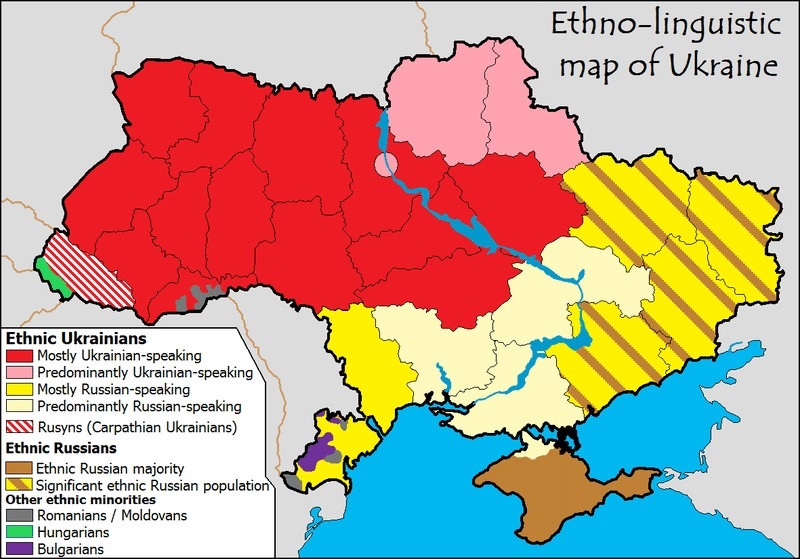
In 2014, after the violent fascist coup in Kiev, one of the first laws implemented by the new government removed the Russian language from official use. Instead of overcoming the differences between its people it only sealed the predominant split in Ukraine.
The election promise of the current Ukrainian president Vladimir Zelenski to make peace with the Russia aligned rebellious Donbas region by adhering to the Minsk 2 agreements was rewarded with a large share of southeastern votes for his presidency. However, after having been threatened with death by fascists, Zelenski has made a 180 degree turn and has since posed as Ukrainian nationalist. In consequence he has lost all support in southeastern Ukraine.
The southeastern parts of today’s Ukraine have for centuries been part of the central Russian empire. They were only attached to the Soviet Republic of Ukraine under Lenin’s rule in 1922 and, in the case of Crimea, in 1954 under Nikita Khrushchev who himself had grown up in the Donbas region.
A likely high turnout and majority vote for membership in the Russian Federation will only correct the historic misalignment created by those illogical transfers.
https://popularresistance.org/historic-context-of-the-referenda-in-ukraine/
1 This Month

of the week – Shut Down Drone Warfare!


Tell the Ukrainian Government to Drop Prosecution of Peace Activist Yurii Sheliazhenko

Petition to revoke the licensing of the Near Surface Nuclear Disposal Facility (NSDF) at Chalk River. https://www.ourcommons.ca/petitions/en/Petition/Details?Petition=e-7247
To see nuclear-related stories in greater depth and intensity – go to https://nuclearinformation.wordpress.com
-
Archives
- April 2026 (68)
- March 2026 (251)
- February 2026 (268)
- January 2026 (308)
- December 2025 (358)
- November 2025 (359)
- October 2025 (376)
- September 2025 (257)
- August 2025 (319)
- July 2025 (230)
- June 2025 (348)
- May 2025 (261)
-
Categories
- 1
- 1 NUCLEAR ISSUES
- business and costs
- climate change
- culture and arts
- ENERGY
- environment
- health
- history
- indigenous issues
- Legal
- marketing of nuclear
- media
- opposition to nuclear
- PERSONAL STORIES
- politics
- politics international
- Religion and ethics
- safety
- secrets,lies and civil liberties
- spinbuster
- technology
- Uranium
- wastes
- weapons and war
- Women
- 2 WORLD
- ACTION
- AFRICA
- Atrocities
- AUSTRALIA
- Christina's notes
- Christina's themes
- culture and arts
- Events
- Fuk 2022
- Fuk 2023
- Fukushima 2017
- Fukushima 2018
- fukushima 2019
- Fukushima 2020
- Fukushima 2021
- general
- global warming
- Humour (God we need it)
- Nuclear
- RARE EARTHS
- Reference
- resources – print
- Resources -audiovicual
- Weekly Newsletter
- World
- World Nuclear
- YouTube
-
RSS
Entries RSS
Comments RSS
 nuclear-news