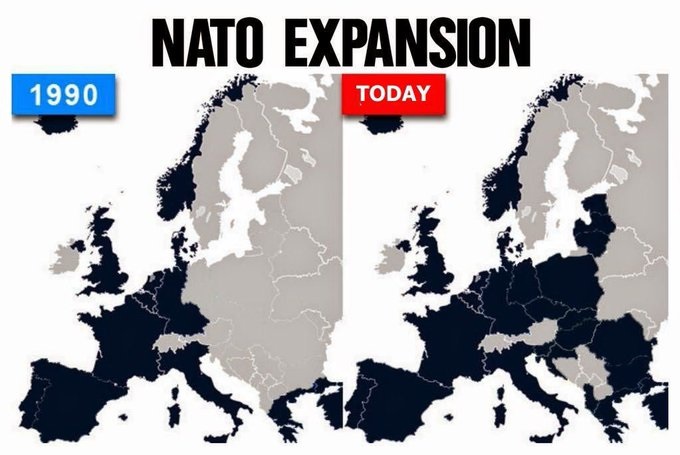
By recognizing that the question of NATO enlargement is at the center of this war, we understand why U.S. weaponry will not end this war. Only diplomatic efforts can do that.
George Orwell wrote in 1984 that “Who controls the past controls the future: who controls the present controls the past.” Governments work relentlessly to distort public perceptions of the past. Regarding the Ukraine War, the Biden administration has repeatedly and falsely claimed that the Ukraine War started with an unprovoked attack by Russia on Ukraine on February 24, 2022. In fact, the war was provoked by the U.S. in ways that leading U.S. diplomats anticipated for decades in the lead-up to the war, meaning that the war could have been avoided and should now be stopped through negotiations.
Recognizing that the war was provoked helps us to understand how to stop it. It doesn’t justify Russia’s invasion. A far better approach for Russia might have been to step up diplomacy with Europe and with the non-Western world to explain and oppose U.S. militarism and unilateralism. In fact, the relentless U.S. push to expand NATO is widely opposed throughout the world, so Russian diplomacy rather than war would likely have been effective.
The Biden team uses the word “unprovoked” incessantly, most recently in Biden’s major speech on the first-year anniversary of the war, in a recent NATO statement, and in the most recent G7 statement. Mainstream media friendly to Biden simply parrot the White House. The New York Times is the lead culprit, describing the invasion as “unprovoked” no fewer than 26 times, in five editorials, 14 opinion columns by NYT writers, and seven guest op-eds!
There were in fact two main U.S. provocations. The first was the U.S. intention to expand NATO to Ukraine and Georgia in order to surround Russia in the Black Sea region by NATO countries (Ukraine, Romania, Bulgaria, Turkey, and Georgia, in counterclockwise order). The second was the U.S. role in installing a Russophobic regime in Ukraine by the violent overthrow of Ukraine’s pro-Russian President, Viktor Yanukovych, in February 2014. The shooting war in Ukraine began with Yanukovych’s overthrow nine years ago, not in February 2022 as the U.S. government, NATO, and the G7 leaders would have us believe.
Biden and his foreign policy team refuse to discuss these roots of the war. To recognize them would undermine the administration in three ways. First, it would expose the fact that the war could have been avoided, or stopped early, sparing Ukraine its current devastation and the U.S. more than $100 billion in outlays to date. Second, it would expose President Biden’s personal role in the war as a participant in the overthrow of Yanukovych, and before that as a staunch backer of the military-industrial complex and very early advocate of NATO enlargement. Third, it would push Biden to the negotiating table, undermining the administration’s continued push for NATO expansion.
The archives show irrefutably that the U.S. and German governments repeatedly promised to Soviet President Mikhail Gorbachev that NATO would not move “one inch eastward” when the Soviet Union disbanded the Warsaw Pact military alliance. Nonetheless, U.S. planning for NATO expansion began early in the 1990s, well before Vladimir Putin was Russia’s president. In 1997, national security expert Zbigniew Brzezinski spelled out the NATO expansion timeline with remarkable precision.
U.S. diplomats and Ukraine’s own leaders knew well that NATO enlargement could lead to war…………………………………………………………………..
Ukraine’s leaders knew clearly that pressing for NATO enlargement to Ukraine would mean war. Former Zelensky advisor Oleksiy Arestovych declared in a 2019 interview “that our price for joining NATO is a big war with Russia.”
During 2010-2013, Yanukovych pushed neutrality, in line with Ukrainian public opinion. The U.S. worked covertly to overthrow Yanukovych, as captured vividly in the tape of then U.S. Assistant Secretary of State Victoria Nuland and U.S. Ambassador Geoffrey Pyatt planning the post-Yanukovych government weeks before the violent overthrow of Yanukovych. Nuland makes clear on the call that she was coordinating closely with then Vice President Biden and his national security advisor Jake Sullivan, the same Biden-Nuland-Sullivan team now at the center of U.S. policy vis-à-vis Ukraine.
…………………………………. Historian Geoffrey Roberts recently wrote: “Could war have been prevented by a Russian-Western deal that halted NATO expansion and neutralised Ukraine in return for solid guarantees of Ukrainian independence and sovereignty? Quite possibly.” In March 2022, Russia and Ukraine reported progress towards a quick negotiated end to the war based on Ukraine’s neutrality. According to Naftali Bennett, former Prime Minister of Israel, who was a mediator, an agreement was close to being reached before the U.S., U.K., and France blocked it.
While the Biden administration declares Russia’s invasion to be unprovoked, Russia pursued diplomatic options in 2021 to avoid war, while Biden rejected diplomacy, insisting that Russia had no say whatsoever on the question of NATO enlargement. And Russia pushed diplomacy in March 2022, while the Biden team again blocked a diplomatic end to the war.
By recognizing that the question of NATO enlargement is at the center of this war, we understand why U.S. weaponry will not end this war. Russia will escalate as necessary to prevent NATO enlargement to Ukraine. The key to peace in Ukraine is through negotiations based on Ukraine’s neutrality and NATO non-enlargement. The Biden administration’s insistence on NATO enlargement to Ukraine has made Ukraine a victim of misconceived and unachievable U.S. military aspirations. It’s time for the provocations to stop, and for negotiations to restore peace to Ukraine. https://www.commondreams.org/opinion/the-war-in-ukraine-was-provoked-and-why-that-matters-if-we-want-peace—
Received 08 Nov 2022, Accepted 17 Apr 2023, Published online: 04 May 2023
ABSTRACT
This commentary looks at how nuclear power has evolved in the last five decades since the Treaty on the Non-Proliferation of Nuclear Weapons entered into force in 1970. Using data on numbers of reactors constructed around the world, we show that the early expectations of a rapid growth of nuclear power plants around the world has not materialized. We also outline the trends in safeguards at nuclear facilities, namely the measures undertaken to prevent the diversion of fissile materials for use in nuclear weapons, and highlight the potential risks due to the rapid growth in the amount of material that could potentially be diverted.
A top-secret atomic bunker has opened to the public in Denmark. Built to withstand a nuclear attack, it’s now an astonishing subterranean museum that sheds light on Cold War paranoia.
Hidden in northern Jutland’s Rold Forest, some 400km north-west of Copenhagen, is the sprawling bunker complex of Koldrigsmuseet REGAN Vest (The Cold War Museum REGAN West). Secretly built in the 1960s at the height of Cold War tensions, this is where the Danish government and even the queen would have been evacuated if nuclear war broke out.
The plan was to run the country from inside this shelter, 60m below ground, and its very existence was kept hushed for decades until it was finally revealed in 2012. After years of preparations, it opened to the public for the first time in February 2023 as a museum. Only 50,000 visitors are permitted annually, and access has been limited to small groups of 10 on 90-minute guided tours that explore 2km of the labyrinthine bunker system. It’s an eye-opening journey into the heart of a Cold War-era time capsule…………………………………………………………………………………………………………………..
The resulting nuclear-proof bunker was a staggering 5,500sq m behemoth, shaped like two large, connected rings, each with an upper and lower floor, and more than 230 rooms that would house around 350 personnel. Mostly these would be ministers and civil servants, part of a slimmed down administration tasked with running the nation’s affairs during the darkest of times, plus a few medical staff, several journalists and a priest……………………………………………. more https://www.bbc.com/travel/article/20230501-regan-vest-inside-denmarks-secret-nuclear-bunker
Survivors of Britain’s Cold War radiation experiments are to have their life stories recorded and stored in the British Library. The £250,000 scheme will lead to a documentary and resources to teach A-level students about the Cold War and the impact the weapons testing programme had on the men who took part in it, and their families.
Dr Chris Hill, one of the academics leading the project, said: “It’s about furthering their story, embedding it deeper in the public consciousness and confronting what is a very problematic part of Britain’s history.”
More than 3,000 radioactive particles have been found at Dalgety Bay.
ALBA Party MP Neale Hanvey has called on the Ministry of Defence to clean-up radiation contamination on the Dalgety Bay shoreline.
In a statement, Hanvey added that “there can be no excuse for inaction”.
Leading a Westminster debate on the issue on Tuesday, the MP for Kirkcaldy and Cowdenbeath – the constituency which includes the West Fife town – listed and condemned what he described as a “historical backlog in remediation”.
Radioactive material was first detected at Dalgety Bay in 1990 and came from WW2 planes, which had aircraft dials coated in radium to help pilots see in the dark.
More than 3,000 radioactive particles, with a half-life of 1,600 years, have been found on the beach and next to Dalgety Bay Sailing Club.
Restrictions were put in place in 2011, with parts of the beach fenced off.
The MoD admitted responsibility for the radioactive pollution in 2014. But plans to tackle the issue have frequently been delayed.
Balfour Beatty took on a £10.5 million contract in 2020 but decontamination work didn’t get under way until May 2021 and hasn’t yet been completed.
Hanvey has repeatedly condemned the Ministry of Defense for continued silence and delays in tackling the issue.
At the debate, Hanvey asked the Minister for Defence Procurement, Alex Chalk, for further clarification as to when the work would be completed, the costs incurred and whether they will be fully covered by the MoD.
Chalk said the cost would be around £15 million. He said that the costs would be be met by the MoD, but added: “I stress that there was absolutely no legal requirement on the Ministry of Defence to do so. However, we decided to take that step.”
Chalk also stressed that many of the delays were unforeseen, including having to “search through many tonnes of sand and soil for minute radioactive particles”.
The AUKUS agreement attempts developments that will shift Australia into a zone that will threaten the existence of Australia itself.
I am not merely thinking of the militarisation of Australia, although that is definitely one likely outcome. I also have in mind our way of life that, while still set in settler-colonial assumptions that give First Nations people no substantial value in Australian society, is relatively relaxed when compared with the way of life of people in the United States. Australia has not experienced the focus upon security that high-powered militarisation associated with nuclear weapons brings. This is the world our leaders are leading us towards.
I want to take up two lines of inquiry into Aukus in this brief article. Firstly AUKUS brings together three Anglo-settled countries – two examples of settler-colonial domination that date back two centuries and more. plus of course the original Anglo-source nation, the United Kingdom. This may seem like an insignificant reference to an aspect of European colonialism that has shaped the whole world for centuries. However, Anglo colonialism has a particular complexion. Here I am drawing in part on the book by James Belich, Replenishing the Earth, about the history of Anglo colonialism. It is well-known these days in anti-colonialism circles that the Anglo slavery pursued in the Caribbean by England was the worst form of slavery, with cruelty on a scale that makes slavery in the United States seem enlightened. Anglo colonialism is typified by relations of difference that deal with colonised peoples with a vengeance. It is noteworthy that Anglo-settled countries like Australia have not at all come to terms with the cultures that pre-existed them. All invading cultures find this difficult, but Anglo-based cultures, as Belich shows, are a special case. It is no coincidence that Adolf Hitler looked with admiration to the United States for its ‘handling’ of its First Nations ‘problem’—a form of extermination of the Native American population—in how to think about the treatment of Jews and Slavs in Europe. Anglo cultures’ commitment to freedom and democracy has a repellent underbelly of racism and cultural suppression, not to mention genocidal elimination.
Significant cultural reform is always difficult but clearly the Anglo-powers have made the decision, at a time when in many respects their backs are up against the wall, to stand and fight—not for their own territory, but against the emergence of China, which was itself on the humiliating receiving end of Anglo colonialism in the nineteenth century. AUKUS in a strong sense is a thumbing of the West’s nose at all the emerging powers in Asia—on racial grounds. They must toe the line.
This is surely a crisis for an Australia seeking in the first half of the twenty-first century to survive in our region. To survive here Australia has to change its spots profoundly. It needs a form of cultural regeneration, in significant combination with Australian First Peoples, to justify its presence outside of the strategies of colonial power. While cultural change is always slow and complex, it is Australia’s only hope of both flourishing and being accepted in this region. It is also crucial because our allies are, in any case falling apart.
While I think the Voice could be the first step towards a significant and substantial change, only a weak version of the Voice, suitable for photo opportunities and feel-good policy, will survive the reassertions of this new Anglo alliance. Australia combines an especially empty form of recognition of First Nations with the arrogance of a superior colonial presence, coloured only a little by multiculturalism, and all this in a region where it has no basic right to exist.
The AUKUS alliance represents an incapacity to flexibly adjust to an emerging situation in which a new world power has emerged, one that will not go away. It is deeply ironic that the United States has fostered this emergence by its global development strategies, just as it fostered its opponents in Afghanistan at an earlier time.
That China is a new superpower is a reality—not that being a superpower is good for China or for us. Like large bureaucracies, superpowers develop self-oriented agendas related to their size, and are not to be trusted. But linking up with the remnants of the old powers to resist emergence means that Australia has resorted to a last gasp Anglo-cultural alliance rather than enter a serious process of rethinking its social composition and its place in the world.
The second line of comment is about nuclear submarines, drawing on a piece that appears in Arena Quarterly, just publishe
I want to take up two lines of inquiry into Aukus in this brief article. Firstly AUKUS brings together three Anglo-settled countries – two examples of settler-colonial domination that date back two centuries and more. plus of course the original Anglo-source nation, the United Kingdom. This may seem like an insignificant reference to an aspect of European colonialism that has shaped the whole world for centuries. However, Anglo colonialism has a particular complexion. Here I am drawing in part on the book by James Belich, Replenishing the Earth, about the history of Anglo colonialism. It is well-known these days in anti-colonialism circles that the Anglo slavery pursued in the Caribbean by England was the worst form of slavery, with cruelty on a scale that makes slavery in the United States seem enlightened. Anglo colonialism is typified by relations of difference that deal with colonised peoples with a vengeance. It is noteworthy that Anglo-settled countries like Australia have not at all come to terms with the cultures that pre-existed them. All invading cultures find this difficult, but Anglo-based cultures, as Belich shows, are a special case. It is no coincidence that Adolf Hitler looked with admiration to the United States for its ‘handling’ of its First Nations ‘problem’—a form of extermination of the Native American population—in how to think about the treatment of Jews and Slavs in Europe. Anglo cultures’ commitment to freedom and democracy has a repellent underbelly of racism and cultural suppression, not to mention genocidal elimination.
Significant cultural reform is always difficult but clearly the Anglo-powers have made the decision, at a time when in many respects their backs are up against the wall, to stand and fight—not for their own territory, but against the emergence of China, which was itself on the humiliating receiving end of Anglo colonialism in the nineteenth century. AUKUS in a strong sense is a thumbing of the West’s nose at all the emerging powers in Asia—on racial grounds. They must toe the line.
This is surely a crisis for an Australia seeking in the first half of the twenty-first century to survive in our region. To survive here Australia has to change its spots profoundly. It needs a form of cultural regeneration, in significant combination with Australian First Peoples, to justify its presence outside of the strategies of colonial power. While cultural change is always slow and complex, it is Australia’s only hope of both flourishing and being accepted in this region. It is also crucial because our allies are, in any case falling apart.
While I think the Voice could be the first step towards a significant and substantial change, only a weak version of the Voice, suitable for photo opportunities and feel-good policy, will survive the reassertions of this new Anglo alliance. Australia combines an especially empty form of recognition of First Nations with the arrogance of a superior colonial presence, coloured only a little by multiculturalism, and all this in a region where it has no basic right to exist.
The AUKUS alliance represents an incapacity to flexibly adjust to an emerging situation in which a new world power has emerged, one that will not go away. It is deeply ironic that the United States has fostered this emergence by its global development strategies, just as it fostered its opponents in Afghanistan at an earlier time.
That China is a new superpower is a reality—not that being a superpower is good for China or for us. Like large bureaucracies, superpowers develop self-oriented agendas related to their size, and are not to be trusted. But linking up with the remnants of the old powers to resist emergence means that Australia has resorted to a last gasp Anglo-cultural alliance rather than enter a serious process of rethinking its social composition and its place in the world.
The second line of comment is about nuclear submarines, drawing on a piece that appears in Arena Quarterly, just published.
The AUKUS strategy seeks to assert massive power, especially surveillance in the Pacific, surrounding China. Nuclear submarines combined with surveillance are the main focus of this attempt to cripple what actually, as I see it, cannot be stopped, in a way similar to Paul Keating’s argument. AUKUS shifts the whole emphasis away from how we protect our independence to what is needed to contain China. For Australia this seems to mean we have to achieve interoperability with US weaponary and systems, with nuclear submarines a key aspect of this. It means Australia must take a first step into adopting nuclear technology, and its consequences. We should not be assured by those who claim that it will be the last step.
Much has been written about the dangers of nuclear power and weapons over the years, to the point where it seems many in the community are now blasé about it—unless radiation waste is to be placed next door to you. Part of what the nuclear industry and its supporters have done is to launch smaller scale tactical nuclear weapons and also small-scale nuclear power plants because both large-scale nuclear weapons and large-scale power plants have unmanageable consequences and poor public acceptance, either because of non-human-scale destruction or ridiculous costs, which only keep escalating.
No one, with the exception of some military strategists, favours nuclear war. The reasons are obvious. The level of destruction of atomic bombs steps beyond our capacity to comprehend: it steps into another realm, a post-human one. Even the seemingly more mundane questions associated with nuclear waste are on another scale because they cannot be effectively disposed. All around the world nuclear waste is piling up around nuclear power stations as well as ‘storage’ of used nuclear submarines components because the waste is not of this world. There is no solution to the waste question. Nuclear waste is killing us on an increasing scale, as exposed by Kate Brown in her book A Manual for Survival. Contrary to the findings of mainstream Western science, she argues that low-level radiation is a mass killer and a general source of ill health As one Russian scientist she quotes puts it: ‘Chronic radiation is a crime’, and chronic radiation is a process that Australia has just signed up for with its nuclear submarines, adding its contribution to the systemic decline of the Earth’s environment, at least one that is suitable for human habitation.
We need to give some focus to this because it is an embarrassment to the nuclear lobby, which they handle and largely get away with by resorting to silence. But nuclear waste is a contradiction that will not go away. All attempts at solutions have failed in every part of the world. This cannot be emphasised enough.
What sort of contradiction is this?
Like nuclear technology, nuclear waste is usually simply regarded as a special category of danger. But its special effects arise out of a social process that is usually ignored. And this is a disaster because that social process is transforming our world in unprecedented ways.
This new world first burst upon us in 1945, with the practical scientific triumph of the atomic bomb. It was not merely novel. It was a consequence of the practical/conceptual reconstructions in the early twentieth century we associate with Albert Einstein and his associates. It was not merely a new theory. It was a combination of abstract academic theory with practical technology in the real world that gave birth to technoscientific society and culture, most importantly through its systematic approach to the transformation of nature. As such, academic theory entered the world of production, as an alternative or supplement to the transformations performed by the working classes, in a way that has expanded exponentially ever since. For better or worse, our world has become increasingly composed socially of the intellectually-trained.
The novelty of nuclear technology is contained within this social approach. Scientific intellectuals now uncover deep levels of the natural world, levels never before encountered by human societies that turn out to be mysterious and unmanageable. Nuclear is not the only example but it is a key one that destroys whatever it touches.
This is the world we are now entering, and doing so with great enthusiasm. It is not only a question of nuclear war. It is just as much one of the levels of security needed when dealing with what we do not know how to control. Nuclear weapons have been ‘controlled’ by such monstrosities as the Cold War and MAD (Mutually Assured Destruction) strategies that give reason a bad name. And low-level radiation has been controlled by denial of any major effects, while the environment of Planet Earth deteriorates. As Brown remarks, ‘Western researchers are discovering, like Soviet scientists before them, that radioactive decay at low doses changes the way cells behave in subtle and life-changing ways’, laying the basis for ‘chronic radiation syndrome’.
AUKUS is a strategy that pursues these outcomes systematically, our leaders planning to leave submarine waste in the desert, once again to be dealt with by First Nations people, now to be permitted by the WA Labor government. Among other things, the crime of chronic radiation poisoning needs to be sheeted home to the powers that be, and in particular now, the Albanese government.
KTXL) — The Sacramento region has a rich history of United States Air Force aviation, but on a Tuesday in 1961 that history turned dark as an aircraft armed with nuclear bombs crashed in Sutter County.
Following World War II the United States Air Force was looking to add a modern bomber to its fleet and in 1955 the B-52 Stratofortress began its military service.
Between 1960 and 1968, the USAF would run Operation Chrome Dome, which would have B-52’s armed with nuclear weapons remain continuously airborne on the border of the Soviet Union.
On March 14, 1961, a B-52F-70-BW armed with two nuclear weapons departed Mather Air Force Base, now Mather Airport, when the cabin pressure in the crew compartment began to fail, according to Department of Defense records.
The crew dropped the plane to 10,000 feet but the increased fuel consumption caused “fuel exhaustion” before an air tanker could refuel the B-52.
The crew bailed out at 10,000 feet, but the commander stayed until 4,000 feet in order for the massive bomber to be steered away from a populated area.
The bomber crashed into Sutter County farmland near the intersection of Moroni Road and Drexler Road, about 17.5 miles southwest of Yuba City.
When the bomber crashed, the two nuclear weapons it was carrying were stripped away from the body of the plane, but their explosives did not detonate. No nuclear contamination was detected either.
This recounting of events by the Department of Defense was challenged years later in a 2013 book written by Retired USAF Lt Col Earl McGill, a B-47 and B-52 pilot during the Cold War.
His book “Jet Age Man: SAC B-47 and B-52 Operations in the Early Cold War” recounts the Strategic Air Commands (SAC) Operation Chrome Dome and the events of March 14, 1961.
“Whatever the cause, SAC crews were briefed on every B-52 accident….we were summoned to the alert shack briefing room where we were told that a B-52 returning from a 24-hour CHROME DOME mission ran out of fuel and dumped four Mk-28’s on Northern California,” McGill writes.
McGill’s recounting of the crash also puts into question how safe the nuclear weapons actually were when the plane went down.
“The safety devices barely worked as designed,” McGill writes. “Apparently three weapons chutes did not fully deploy, which prevented detonation. The one that hung up (in a tree), we were briefed, had ‘rung in’, a term we used to indicate ‘armed’….”
McGill’s book was Nominated as Best Military History Book 2013 by Air Power History, published by the US Air Force Historical Foundation.
Northern California was not the only area of the United States or the world that saw crash landings by B-52’s armed with nuclear bombs.
Operation Chrome Dome would come to an end in 1968 after five B-52 crashes in the United States and abroad.
On February 16, 2022, a full week before Putin sent combat troops into Ukraine, the Ukrainian Army began the heavy bombardment of the area (in east Ukraine) occupied by mainly ethnic Russians. Officials from the Observer Mission of the Organization for Security and Co-operation in Europe (OSCE) were located in the vicinity at the time and kept a record of the shelling as it took place. What the OSCE discovered was that the bombardment dramatically intensified as the week went on until it reached a peak on February 19, when a total of 2,026 artillery strikes were recorded. Keep in mind, the Ukrainian Army was, in fact, shelling civilian areas along the Line of Contact that were occupied by other Ukrainians.
We want to emphasize that the officials from the OSCE were operating in their professional capacity gathering first-hand evidence of shelling in the area. What their data shows is that Ukrainian Forces were bombing and killing their own people.This has all been documented and has not been challenged.
So, the question we must all ask ourselves is this: Is the bombardment and slaughter of one’s own people an ‘act of war’?
We think it is.And if we are right, then we must logically assume that the war began before the Russian invasion (which was launched a full week later) We must also assume that Russia’s alleged “unprovoked aggression” was not unprovoked at all but was the appropriate humanitarian response to the deliberate killing of civilians. In order to argue that the Russian invasion was ‘not provoked’, we would have to say that firing over 4,000 artillery shells into towns and neighborhoods where women and children live, is not a provocation? Who will defend that point of view?
No one, because it’s absurd. The killing of civilians in the Donbas was a clear provocation, a provocation that was aimed at goading Russia into a war. And –as we said earlier– the OSCE had monitors on the ground who provided full documentation of the shelling as it took place, which is as close to ironclad, eyewitness testimony as you’re going to get.
This, of course, is a major break with the “official narrative” which identifies Russia as the perpetrator of hostilities. But, as we’ve shown, that simply isn’t the case. The official narrative is wrong. Even so, it might not surprise you to know that most of the mainstream media completely omitted any coverage of the OSCE’s fact-finding activities in east Ukraine. The one exception to was Reuters that published a deliberately opaque account published on February 18 titled “Russia voices alarm over sharp increase of Donbass shelling”. Here’s an excerpt:
Russian Foreign Minister Sergei Lavrov voiced alarm on Friday over a sharp increase in shelling in eastern Ukraine and accused the OSCE special monitoring mission of glossing over what he said were Ukrainian violations of the peace process….
Washington and its allies have raised fears that the upsurge in violence in the Donbass could form part of a Russian pretext to invade Ukraine. Tensions are already high over a Russian military buildup to the north, east and south of Ukraine.
“We are very concerned by the reports of recent days – yesterday and the day before there was a sharp increase in shelling using weapons that are prohibited under the Minsk agreements,” Lavrov said, referring to peace accords aimed at ending the conflict. “So far we are seeing the special monitoring mission is doing its best to smooth over all questions that point to the blame of Ukraine’s armed forces,” he told a news conference.
Ukraine’s military on Friday denied violating the Minsk peace process and accused Moscow of waging an information war to say that Kyiv was shelling civilians, allegations it said were lies and designed to provoke it.” (Russia voices alarm over sharp increase of Donbass shelling, Reuters)
Notice the clever way that Reuters frames its coverage so that the claims of the Ukrainian military are given as much credibility as the claims of the Russian Foreign Minister. What Reuters fails to point out is that the OSCE’s report verifies Lavrov’s version of events while disproving the claims of the Ukrainians. It is the job of a journalist to make the distinction between fact and fiction but, once again, we see how agenda-driven news is not meant to inform but to mislead.
The point we are trying to make is simple: The war in Ukraine was not launched by a tyrannical Russian leader (Putin) bent on rebuilding the Soviet Empire. That narrative is a fraud that was cobbled together by neocon spin-meisters trying to build public support for a war with Russia. The facts I am presenting here can be identified on a map where the actual explosions took place and were then recorded by officials whose job was to fulfill that very task. Can you see the difference between the two? In one case, the storyline rests on speculation, conjecture and psychobabble; while in the other, the storyline is linked to actual events that took place on the ground and were catalogued by trained professionals in the field. In which version of events do you have more confidence?
Bottom line: Russia did not start the war in Ukraine. That is a fake narrative. The responsibility lies with the Ukrainian Army and their leaders in Kiev.
And here’s something else that is typically excluded in the media’s selective coverage. Before Putin sent his tanks across the border into Ukraine, he invoked United Nations Article 51 which provides a legal justification for military intervention. Of course, the United States has done this numerous times to provide a fig leaf of legitimacy to its numerous military interventions. But, in this case, you can see where the so-called Responsibility To Protect (R2P) could actually be justified, after all, by most estimates, the Ukrainian army has killed over 14,000 ethnic Russians since the US-backed coup 8 years ago. If ever there was a situation in which a defensive military operation could be justified, this was it. But that still doesn’t fully explain why Putin invoked UN Article 51. For that, we turn to former weapons inspector Scott Ritter, who explained it like this:
“Russian President Vladimir Putin, citing Article 51 as his authority, ordered what he called a “special military operation”…. under Article 51, there can be no doubt as to the legitimacy of Russia’s contention that the Russian-speaking population of the Donbass had been subjected to a brutal eight-year-long bombardment that had killed thousands of people.… Moreover, Russia claims to have documentary proof that the Ukrainian Army was preparing for a massive military incursion into the Donbass which was pre-empted by the Russian-led “special military operation.” [OSCE figures show an increase of government shelling of the area in the days before Russia moved in.]
..The bottom line is that Russia has set forth a cognizable claim under the doctrine of anticipatory collective self-defense, devised originally by the U.S. and NATO, as it applies to Article 51 which is predicated on fact, not fiction.
While it might be in vogue for people, organizations, and governments in the West to embrace the knee-jerk conclusion that Russia’s military intervention constitutes a wanton violation of the United Nations Charter and, as such, constitutes an illegal war of aggression, the uncomfortable truth is that, of all the claims made regarding the legality of pre-emption under Article 51 of the United Nations Charter, Russia’s justification for invading Ukraine is on solid legal ground.” (“Russia, Ukraine & the Law of War: Crime of Aggression”, Consortium News)
Here’s a bit more background from an article by foreign policy analyst Danial Kovalik:
“One must begin this discussion by accepting the fact that there was already a war happening in Ukraine for the eight years preceding the Russian military incursion in February 2022. And, this war by the government in Kiev… claimed the lives of around 14,000 people, many of them children, and displaced around 1.5 million more … The government in Kiev, and especially its neo-Nazi battalions, carried out attacks against these peoples … precisely because of their ethnicity. ..
While the UN Charter prohibits unilateral acts of war, it also provides, in Article 51, that “nothing in the present Charter shall impair the inherent right of individual or collective self-defense… ” And this right of self-defense has been interpreted to permit countries to respond, not only to actual armed attacks, but also to the threat of imminent attack.
In light of the above, it is my assessment.. that Russia had a right to act in its own self-defense by intervening in Ukraine, which had become a proxy of the US and NATO for an assault – not only on Russian ethnics within Ukraine – but also upon Russia itself.” (“Why Russia’s intervention in Ukraine is legal under international law”, RT)
So, has anyone in the western media reported on the fact that Putin invoked UN Article 51 before he launched the Special Military Operation?
No, they haven’t, because to do so, would be an admission that Putin’s military operation complies with international law. Instead, the media continues to spread the fiction that ‘Hitler-Putin is trying to rebuild the Soviet empire’, a claim for which there is not a scintilla of evidence. Keep in mind, Putin’s operation does not involve the toppling of a foreign government to install a Moscow-backed stooge, or the arming and training a foreign military that will be used as proxies to fight a geopolitical rival, or the stuffing a country with state-of-the-art weaponry to achieve his own narrow strategic objectives, or perpetrating terrorist acts of industrial sabotage (Nord-Stream 2) to prevent the economic integration of Asia and Europe. No, Putin hasn’t engaged in any of these things. But Washington certainly has, because Washington isn’t constrained by international law. In Washington’s eyes, international law is merely an inconvenience that is dismissively shrugged off whenever unilateral action is required. But Putin is not nearly as cavalier about such matters, in fact, he has a long history of playing by the rules because he believes the rules help to strengthen everyone’s security. And, he’s right; they do.
And that’s why he invoked Article 51 before he sent the troops to help the people in the Donbas. He felt he had a moral obligation to lend them his assistance but wanted his actions to comply with international law. We think he achieved both.
Here’s something else you will never see in the western media. You’ll never see the actual text of Putin’s security demands that were made a full 2 months before the war broke out. And, the reason you won’t see them, is because his demands were legitimate, reasonable and necessary. All Putin wanted was basic assurances that NATO was not planning to put its bases, armies and missile sites on Russia’s border. In other words, he was doing the same thing that all responsible leaders do to defend the safety and security of their own people.
Here are a few critical excerpts from the text of Putin’s proposal to the US and NATO: [on original]………………………….
It doesn’t take a genius to figure out what Putin was worried about. He was worried about NATO expansion and, in particular, the emergence of a hostile military alliance backed by Washington-groomed Nazis occupying territory on his western flank. Was that unreasonable of him? Should he have embraced these US-backed Russophobes and allowed them to place their missiles on his border? Would that have been the prudent thing to do?
So, what can we deduce from Putin’s list of demands?
First, we can deduce that he is not trying to reconstruct the Soviet empire as the MSM relentlessly insists. The list focuses exclusively on security-related demands, nothing else.
Second, it proves that the war could have easily been avoided had Zelensky simply maintained the status quo and formally announced that Ukraine would remain neutral. In fact, Zelensky actually agreed to neutrality in negotiations with Moscow in March, but Washington prevented the Ukrainian president from going through with the deal which means that the Biden administration is largely responsible for the ongoing conflict. (RT published an article today stating clearly that an agreement had been reached between Russia and Ukraine in March but the deal was intentionally scuttled by the US and UK. Washington wanted a war.)
Third, it shows that Putin is a reasonable leader whose demands should have been eagerly accepted. Was it unreasonable of Putin to ask that “The Parties shall refrain from deploying their armed forces and… military alliances.. in the areas where such deployment could be perceived by the other Party as a threat to its national security”? Was it unreasonable for him the ask that “The Parties shall eliminate all existing infrastructure for deployment of nuclear weapons outside their national territories”?
Where exactly are the “unreasonable demands” that Putin supposedly made?
There aren’t any. Putin made no demands that the US wouldn’t have made if ‘the shoe was on the other foot.’
Forth, it proves that the war is not a struggle for Ukrainian liberation or democracy. That’s hogwash. It is a war that is aimed at “weakening” Russia and eventually removing Putin from power. Those are the overriding goals. What that means is that Ukrainian soldiers are not dying for their country, they are dying for an elitist dream to expand NATO, crush Russia, encircle China, and extend US hegemony for another century. Ukraine is merely the battlefield on which the Great Power struggle is being fought.
There are number points we are trying to make in this article:
Who started the war? Answer– Ukraine started the war
Was the Russian invasion a violation of international law? Answer– No, the Russian invasion should be approved under United Nations Article 51
Could the war have been avoided if Ukraine declared neutrality and met Putin’s reasonable demands? Answer– Yes, the war could have been avoided
The last point deals with the Minsk Treaty and how the dishonesty of western leaders is going to effect the final settlement in Ukraine. I am convinced that neither Washington nor the NATO allies have any idea of how severely international relations have been decimated by the Minsk betrayal. In a world where legally binding agreements can be breezily discarded in the name of political expediency, the only way to settle disputes is through brute force. Did anyone in Germany, France or Washington think about this before they acted? (But, first, some background on Minsk.)
The aim of the Minsk agreement was to end the fighting between the Ukrainian army and ethnic Russians in the Donbas region of Ukraine. It was the responsibility of the four participants in the treaty– Germany, France, Russia and Ukraine– to ensure that both sides followed the terms of the deal. But in December, former German Chancellor Angela Merkel said in an interview with a German magazine, that there was never any intention of implementing the deal, instead, the plan was to use the time to make Ukraine stronger in order to prepare for a war with Russia. So, clearly, from the very beginning, the United States intended to provoke a war with Russia.
On September 5, 2014, Germany, France, Ukraine and Russia all signed Minsk, but the treaty failed and the fighting resumed. On February 12, 2015, Minsk 2 was signed, but that failed, as well. Please, watch this short segment on You Tube by Amit Sengupta who gives a brief rundown of Minsk and its implications: (I transcribed the piece myself and any mistakes are mine.) …………………. [Transcription on original]
There’s no way to overstate the importance of the Minsk betrayal or the impact it’s going to have on the final settlement in Ukraine. When trust is lost, nations can only ensure their security through brute force. What that means is that Russia must expand its perimeter as far as is necessary to ensure that it will remain beyond the enemy’s range of fire. (Putin, Lavrov and Medvedev have already indicated that they plan to do just that.) Second, the new perimeter must be permanently fortified with combat troops and lethal weaponry that are kept on hairtrigger alert. When treaties become vehicles for political opportunism, then nations must accept a permanent state of war. This is the world that Merkel, Hollande, Poroshenko and the US created by opting to use ‘the cornerstone of international relations’ (Treaties) to advance their own narrow warmongering objectives.
We just wonder if anyone in Washington realizes whet the fu** they’ve done?
SCOTT RITTER: The Nightmare of NATO Equipment Being Sent to Ukraine
In a turn of events which must have Vasily Chuikov and the Soviet heroes to whom the Tiergarten war memorial was dedicated turning in their graves, the forces of fascism have once again reared their odious heads, this time manifested in a Ukrainian government motivated by the neo-Nazi ultra-nationalistic ideology of Stepan Bandera and his ilk.
The West’s recent approval of more military assistance for Kiev risks nuclear nightmare, fails Ukrainian expectations and rebukes the World War II history enshrined in a prominent Soviet war memorial in Berlin.
On Tuesday the White House decided that it would send about 30 M1 Abrams tanks to Ukraine, which was seen as political cover for Germany, which decided to ship 14 Leopard 2 tanks to Kiev.
Early on the morning of May 2, 1945, General Vasily Chuikov, the commander of the Soviet 8thGuards Army, accepted the surrender of the German garrison of Berlin.
Two days prior, soldiers from the 150th Rifle Division, part of the Soviet 5th Shock Army, had raised the victory banner of the Red Army over the Reichstag. An hour after the banner went up, Adolf Hitler and his mistress, Eva Braun, committed suicide in his study inside the Furhrerbunker.
Chuikov, the hero of Stalingrad whose battered 62nd Army was renamed the 8th Guards Army in honor of their victory in holding that city in the face of a massive German onslaught, had led his troops into the heart of the Nazi capital, battling stubborn Nazi resistance in the Tiergarten district of Berlin, where the den of the Nazi beast was located. The Soviet general was rewarded for the courage and sacrifice of his soldiers by being in position to accept the German surrender.
In honor of this accomplishment, and the sacrifice it entailed, the Soviet Army inaugurated, in November 1945, a commemorative monument along the Tiergarten. Constructed from red marble and granite stripped away from the ruins of Adolf Hitler’s Neue Reichskanzlei (New Imperial Chancellery), the monument, consisting of a concave colonnade of six joined axes flanked by Red Army artillery and a pair of T-34 tanks, with a giant bronze statue of a victorious Red Army soldier standing watch from the center pylon.
From 1945 until 1993, when the Russian Army withdrew from Berlin, Soviet guards stood guard over the monument. Since that time, the monument has been maintained according to the terms of the German Reunification Treaty of 1990, which brought West and East Germany together in the aftermath of the fall of the Berlin Wall.
Carved into the granite of the monument, in Cyrillic letters, is an inscription that reads “Eternal glory to the heroes who fell in battle with the German fascist occupiers for the freedom and independence of the Soviet Union.”
In a turn of events which must have Vasily Chuikov and the Soviet heroes to whom the Tiergarten war memorial was dedicated turning in their graves, the forces of fascism have once again reared their odious heads, this time manifested in a Ukrainian government motivated by the neo-Nazi ultra-nationalistic ideology of Stepan Bandera and his ilk.
Bandera and his murderous movement had been physically defeated by Soviet forces in the decade following the end of the Second World War. However, its ideology survived in a western Ukrainian diaspora formed from the survivors of that movement who found safe haven in West Germany (where Bandera himself settled until assassinated by the Soviet KGB in 1959); Canada (where Chrystia Freeland, the granddaughter of a former publisher of pro-Bandera propaganda, currently serves as deputy prime minister), and the United States (where the followers of Stepan Bandera have constructed a “heroes park” outside Ellenville, New York, including a bust of Bandera and other neo-Nazi Ukrainian ultra-nationalists.)
The ideology also survived in the shadows of the western Ukrainian districts that had been absorbed by the Soviet Union following the dismemberment of Poland in 1939, and later, after the reoccupation of these territories by Soviet forces in 1945.
CIA-Funded Political Underground
Here, beginning in 1956, (following the de-Stalinization policies instituted by Soviet Premier Nikita Khrushchev in the aftermath of his “secret speech” to members of the Communist Party), thousands of members of the Ukrainian Insurgent Army (UPA)/Organization of Ukrainian Nationalists-Bandera (OUN-B), who had been arrested and convicted by Soviet authorities, were released from the Gulag and returned to their homes, ostensibly to be reintegrated into Soviet society. This reintegration never materialized, however.
Instead, Ukrainian fascists, funded by the C.I.A., operated as a political underground, running sabotage operations and fomenting anti-Soviet/anti-Russian ideology amongst a population where the precepts of Ukrainian nationalist ideology ran strong.
Following the collapse of the Soviet Union, at the end of 1991, these Ukrainian nationalists emerged from the shadows and began organizing into political parties backed by gangs of violence-prone extremists who promulgated, through physical intimidation, a cult of personality built around the person of Stepan Bandera………………………………………………………………………… more https://consortiumnews.com/2023/01/24/scott-ritter-the-nightmare-of-nato-equipment-being-sent-to-ukraine/
Nuclear weapons are a special kind of horror opposed by most rational people around the world.
the IAEA’s bluntly stated mission is to promote nuclear technology.
Like Atoms for Peace, this repackaging of a military activity as a civilian one succeeded in making the endeavor socially acceptable and somewhat self-funding
The nuclear power-nuclear weapons link can only be broken by a ban on both
Why civilian nuclear power is merely a cover for producing more nuclear weapons
By Alfred Meyer, 8 Jan 23,
The Zaporizhzhia Nuclear Power Station in southeastern Ukraine, Europe’s largest nuclear power plant, has the world’s attention right now, and rightly so. For the first time in history, six nuclear reactors and thirty-seven years’ worth of high-level nuclear waste are in the middle of a battlefield in an active war zone—one artillery shell, on site or off, could interrupt the control and cooling of the operational reactor, or the cooling of the waste in storage, leading to a catastrophic release of radiation that could spread throughout the Northern Hemisphere. How in the world can nuclear power reactors be considered clean and safe sources of electricity?
Russia, a nuclear-armed nation that invaded Ukraine on February 24, 2022, has said that it would use nuclear weapons if needed. And strong allies of Ukraine—the United States, the United Kingdom, and France, all NATO members—are also armed with nuclear weapons.
You likely are aware of what has happened in the weeks since this magazine went to press, and whether or not the world is in the midst of another major radioactive disaster, as happened at Fukushima in Japan in 2011, Chernobyl in northern Ukraine in 1986, and Three Mile Island in the United States in 1979. I assume that if you are reading this, nuclear weapons have not been used in the war in Ukraine. So how has the world ended up in such an existentially threatening situation? Why does the nuclear enterprise have the world’s future so tightly in its grip?
The short answer: nuclear weapons. It is all about the bomb.
In 1939, Albert Einstein wrote to President Franklin D. Roosevelt urging him to pursue nuclear research in the United States. It was crucial, Einstein wrote, to counter Germany’s efforts to harness the magic of radioactivity and develop a super weapon. A few years later, the Manhattan Project was born in secrecy in 1942. A sprawling and tightly controlled academic, military, industrial, and governmental infrastructure was built to accommodate an entirely new industry equal in size to the American automobile industry at the time. Secrecy was so thorough that when Vice President Harry Truman ascended to the presidency on April 12, 1945, upon Roosevelt’s sudden death, he was unaware that the atomic bomb program even existed, much less that it was on the verge of testing a plutonium weapon in July.
During World War II, the United States succeeded in developing atomic weapons, while Germany was defeated before it could do so. Even though Japan was essentially defeated by then, Truman, some three months after he learned that the United States did possess the super weapons, chose to use them. Although the firebombing of Tokyo in March 1945 had burned to death more than 100,000 people and left more than a million people homeless, it did not occasion the global outcry that followed the use of the uranium bomb on Hiroshima, on August 6, 1945, and the plutonium bomb on Nagasaki, three days later. Nuclear weapons are a special kind of horror opposed by most rational people around the world.
However, following the use of nuclear weapons in Japan in 1945, there has been significant ongoing public opposition to them. In the earliest days of the United Nations, there were various efforts to abolish or control nuclear weapons. It was clear that they constitute an entirely different type of military threat that includes the likelihood of ending life on earth as we know it. Abolishing nuclear weapons is the way to end this existential threat.
When World War II hero General Dwight D. Eisenhower became President in 1953, the dilemma for the military, and for Eisenhower, was how to grow the atomic bomb programs, in light of negative public opinion toward the nuclear enterprise. At the same time, the United States wanted to be recognized as the leader of the “free world” in the postwar years. In the early 1950s, the military needed to recast nuclear enterprise activities to appear to be peaceful, beneficial parts of our modern life, very distant from the wartime horrors.
In August 1953, Eisenhower was worried about the Soviet Union’s successful test of a sophisticated hydrogen bomb—which signaled to the United States that the nuclear arms race was officially on. Eisenhower considered delivering a type of “fireside chat” to the American public—or perhaps a “mushroom cloud chat”—to level with citizens about the truly horrific existential threat that nuclear weapons posed to the world.
But by December of that year, a different strategy appeared to take effect. In a now famous speech on December 8, 1953, titled “Atoms for Peace,” Eisenhower proposed to the U.N. General Assembly an international program of sharing “peaceful” nuclear materials and know-how for untold bounty, to encourage development of nuclear programs around the world.
The United States also proposed an international agency under the United Nations to promote and oversee nuclear activities, which today is the International Atomic Energy Agency, or IAEA. While acknowledging the IAEA’s important oversight role, such as inspecting the Zaporizhzhia reactors and fuel pools at this perilous time in history, one should also recognize that the IAEA’s bluntly stated mission is to promote nuclear technology. The first leaders of the IAEA were from the United States, to ensure that U.S. interests were protected.
Nuclear enterprise infrastructure is an outgrowth of World War II. These new endeavors drew international interest in creating the huge nuclear marketplace now in existence. Atoms for Peace—a plan to share nonmilitary nuclear technology with other countries to “win hearts and minds”—placed nuclear materials and reactors in more than forty countries, including Iran. This generated ongoing business for many American nuclear enterprise companies while supporting and expanding the U.S. military’s nuclear infrastructure and capacity in the United States.
Having nuclear activities under the auspices of the United Nations conferred upon them the legitimacy and respect of that international body. While Eisenhower was making his “Atoms for Peace” speech at the United Nations, he was in the middle of planning the largest hydrogen bomb test ever in the United States, the fifteen-megaton “Bravo” test, on March 1, 1954, which was more than 1,000 times bigger than the bomb dropped on Hiroshima.
The generally favorable response to Atoms for Peace was a trifecta for the nuclear enterprise. U.S. nuclear activities were repackaged as the “peaceful” atom and given the patina of social acceptance through United Nations oversight. Eisenhower was lauded as a good leader for sharing the atom with the world, and the U.S. nuclear infrastructure got new business and growth, which supported more U.S. nuclear weapons and nuclear Navy programs.
Atoms for Peace also served geopolitical ends. For instance, one reason the United States provided Iran with a research reactor in 1967 was to saddle that country with significant financial obligations, including paying for ongoing parts, services, and technical support from American companies. These financial obligations would then, theoretically, force Iran to sell more oil on the world market, regardless of OPEC actions, a kind of atoms-for-oil program—but only peaceful atoms, mind you!
As Atoms for Peace was taking shape, a major policy change was made via the Atomic Energy Act of 1954. The top-secret, tightly controlled Manhattan Project to build the atomic bomb was a governmental endeavor. Nuclear reactors produce the plutonium needed for atomic bombs. With the passage of this new bill by Congress, the operation of nuclear power reactors by privately owned corporations was allowed.
The Atomic Energy Commission was created in 1946 to promote and regulate the development of this new industry. With the commission led by Wall Street banker Lewis Strauss for five critical years, it is not surprising that the scales heavily favored promotion over regulation. Encouraging private investment in these risky reactor projects was assisted by minimizing regulatory safety and operational demands upon the private operators.
Being the biggest nuclear enterprise on earth encourages the circular, self-sustaining dynamic of the nuclear arms race.
But why was it so important for the U.S. government to develop and subsidize civilian nuclear power? Because it allowed the military, in essence, to spin off its nuclear reactor activities to private financing and corporate operations. Like Atoms for Peace, this repackaging of a military activity as a civilian one succeeded in making the endeavor socially acceptable and somewhat self-funding—although government subsidies are still perennially needed to carry on, and taxpayers are still covering the liability insurance costs of the private corporations. Most importantly, as detailed in a 2017 report by former U.S. Energy Secretary Ernest Moniz, civilian nuclear power is an “essential enabler” of our national security. The Atlantic Council calculates the value of this contribution to national security to be $42.4 billion a year. Businesses contributing to the nuclear Navy’s supply chain are in forty-four U.S. states.
The essential nature of civilian nuclear power for national security would suggest that if the United States has the largest national inventory of civilian nuclear reactors in the world, then it also has the largest nuclear enterprise infrastructure to support nuclear weapons production and a nuclear Navy.
Being the biggest nuclear enterprise on earth encourages the circular, self-sustaining dynamic of the nuclear arms race. The United States is busy modernizing its nuclear weapons infrastructure to be “strong enough” to negotiate the elimination of nuclear weapons. This is presented as official doctrine in the nonproliferation world. In reality, the United States is actually driving the growing international nuclear arms race.
Atoms for Peace and the nuclear enterprise employ particularly successful advertising campaigns, greatly influencing public opinion and shaping our cultural consciousness of the nuclear world.
Presenting civilian nuclear power as the answer to climate change, as clean and safe electrical generation, or as energy “too cheap to meter” is simply a sales pitch. What is actually delivered by a robust nuclear energy fleet is the capacity for nuclear weapons and a nuclear Navy.
Over the decades, there have been numerous expert critiques of nuclear power, authoritatively debunking these misleading and false promises, yet these critiques seem to have no effect on the trajectory of the nuclear enterprise. I suggest that these sales pitches are diversionary techniques aimed at sapping our energy. It does not matter if nuclear power can really solve climate change, it just has to be seen as an essential part of the solution to attract bright, young talent into what is made to appear as the cutting edge of technology and climate solutions, even though the civilian nuclear power industry worldwide has been in decline since 2002.
To protect ourselves from the dangers of the nuclear enterprise, we need to stop the nuclear weapons and nuclear power reactor programs—a tall order, for sure. But if we seek success in our efforts, we are well advised to understand the forces we are engaging with. It is all about nuclear weapons.
Alfred Meyer is a member of Physicians for Social Responsibility and has worked with communities affected by the Chernobyl and Fukushima nuclear catastrophes.
I recall protesting against the now-defunct Trojan nuclear plant in the 1980s. One question I don’t recall anyone asking back then, however: Why did they want to build Trojan in the first place, given that our region already had (and still has) more hydropower than we can use? —Duke Nukem
I share your historical curiosity, Duke—there’s just something about this time of year that makes one want to muse about topics from Portland’s colorful past that can be researched without having to get anybody to return a call during the week between Christmas and New Year’s.
I doubt that anyone under 50 reads this column (which not only doesn’t come as video, but presumes your mastery of this tedious system of archaic glyphs in which it’s encoded), but just in case someone missed it: Portland General Electric—PGE to its friends—began construction of Trojan Nuclear Power Plant near Rainier, Oregon, in 1970 (which, perhaps fittingly, is the same year the Ford Pinto was introduced). The plant came online in 1975 and was slated to operate until 2011. However, it was plagued from the start with equipment failures and bad press, and was finally shuttered for good in 1992.
Why would PGE take on such a fraught endeavor? Well, for starters, they’d first begun exploring the possibility of building a nuclear plant way back in the late 1940s. The mighty atom had just won WWII and was enjoying George W. Bush-right-after-9/11 levels of popularity, while the invention of hippies was still decades away. Nuclear power’s downsides would become more apparent in the years to follow, but they don’t appear to have penetrated PGE’s C-suite in any significant way prior to the 1967 decision to build the plant.
But back to your question: Given that Northwest hydropower is abundant enough to make Oregon’s electricity market the nation’s third cheapest, why build a plant at all? Here’s the thing: All that juicy hydropower is controlled by the Bonneville Power Administration, a public entity. PGE, the private utility, has to buy it from them wholesale and then retail it to us. If, as seemed possible at the time, BPA had decided to cut PGE off in favor of public utilities—perhaps when PGE’s 20-year contract with BPA came up for renewal in 1973—PGE could have been in a world of hurt.
Trojan represented a hedge against such a possibility, as well as an opportunity to grow PGE as a company. Toss in a few million bucks’ worth of federal “Atoms for Peace” emoluments to the industry and, congratulations, you’ve got yourself a nuclear plant. Have fun! (Just be careful not to run into it from behind, especially with a lit cigarette.)
Letter William Walker: In 1993, a government official told me that “it was sometimes right to do the wrong thing”. For reasons of political expediency, it was right to give political consent for the operation of the thermal oxide reprocessing plant (Thorp) at Sellafield.
This huge facility, not mentioned in Samanth Subramanian’s fine long read, had been built over the previous decade to reprocess British and foreign, especially Japanese, spent nuclear fuels. Abandoning it would be too embarrassing for the many politicians and their parties that had backed it, expensive in terms of compensation for broken contracts, and damaging to Britain’s and the nuclear industry’s international reputation.
It was wrong to proceed, as the government well knew, because the primary justification for its construction – supply of plutonium for fast breeder reactors (FBRs) – had been swept away by the abandonment of FBRs in the 1980s (none were built anywhere).
Because returning Thorp’s separated plutonium and radwaste to Japan would be difficult and risky.
Because decommissioning Thorp would become much more costly after its radioactive contamination.
Because there was a known win-win solution, favoured by most utilities – store the spent fuel safely at Sellafield prior to its return to senders, avoiding the many troubles that lay ahead.
“…….. For almost half a century, I have reported on scientific issues and no decade has been complete without two or three announcements by scientists claiming their work would soon allow science to recreate the processes that drive the sun. The end result would be the generation of clean, cheap nuclear fusion that would transform our lives.
Such announcements have been rare recently, so it gave me a warm glow to realise that standards may be returning to normal. By deploying a set of 192 lasers to bombard pellets of the hydrogen isotopes deuterium and tritium, researchers at the US National Ignition Facility (NIF) in Livermore, California, were able to generate temperatures only found in stars and thermonuclear bombs. The isotopes then fused into helium, releasing excess energy, they reported.
It was a milestone event but not a major one, although this did not stop the US government and swaths of the world’s media indulging in a widespread hyping jamboree over the laboratory’s accomplishment. Researchers had “overcome a major barrier” to reaching fusion, the BBC gushed, while the Wall Street Journaldescribed the achievement as a breakthrough that could herald an era of clean, cheap energy.
It is certainly true that nuclear fusion would have a beneficial impact on our planet by liberating vast amounts of energy without generating high levels of carbon emissions and would be an undoubted boost in the battle against climate change.
The trouble is that we have been presented with such visions many times before. In 1958, Sir John Cockcroft claimed his Zeta fusion project would supply the world with “an inexhaustible supply of fuel”. It didn’t. In 1989, Martin Fleischmann and Stanley Pons announced they had achieved fusion using simple laboratory equipment, work that made global headlines but which has never been replicated.
To this list you can also add the International Thermonuclear Experimental Reactor (Iter), a huge facility being built in Saint-Paul-lès-Durance in Provence, France, that was supposed to achieve fusion by 2023 but which is over 10 years behind schedule and tens of billions of dollars over budget.
In each case, it was predicted that the construction of the first commercially viable nuclear fusion plants was only a decade or two away and would transform our lives. Those hopes never materialised and have led to a weary cynicism spreading among hacks and scientists. As they now joke: “Fusion is 30 years away – and always will be.”
It was odd for Jennifer Granholm, the US energy secretary, to argue that the NIF’s achievement was “one of the most impressive scientific feats of the 21st century”. This is a hard claim to justify for a century that has already witnessed the discovery of the Higgs boson, the creation of Covid-19 vaccines, the launch of the James Webb telescope and the unravelling of the human genome. By comparison, the ignition event at the NIF is second-division stuff.
Most scientists have been careful in their responses to the over-hyping of the NIF “breakthrough”. They accept that a key step has been taking towards commercial fusion power but insist such plants remain distant goals. They should not be seen as likely saviours that will extract us from the desperate energy crisis we now face – despite all the claims that were made last week.
Humanity has brought itself to a point where its terrible dependence on fossil fuels threatens to trigger a 2C jump in global temperatures compared with our pre-industrial past. The consequences will include flooding, fires, worsening storms, rising sea levels, spreading diseases and melting ice caps.
Here, scientists are clear. Fusion power will not arrive in time to save the world. “We are still a way off commercial fusion and it cannot help us with the climate crisis now,” said Aneeqa Khan, a research fellow in nuclear fusion at Manchester University. This view was backed by Tony Roulstone, a nuclear energy researcher at Cambridge University. “This result from NIF is a success for science, but it is still a long way from providing useful, abundant clean energy.”
At present, there are two main routes to nuclear fusion. One involves confining searing hot plasma in a powerful magnetic field. The Iter reactor follows such an approach. The other – adopted at the NIF facility – uses lasers to blast deuterium-tritium pellets causing them to collapse and fuse into helium. In both cases, reactions occur at more than 100 million C and involve major technological headaches in controlling them.
Fusion therefore remains a long-term technology, although many new investors and entrepreneurs – including Bill Gates and Jeff Bezos – have recently turned their attention to the field, raising hopes that a fresh commercial impetus could reinvigorate the development of commercial plants.
This input is to be welcomed but we should be emphatic: fusion will not arrive in time to save the planet from climate change. Electricity plants powered by renewable sources or nuclear fission offer the only short-term alternatives to those that burn fossil fuels. We need to pin our hopes on these power sources. Fusion may earn its place later in the century but it would be highly irresponsible to rely on an energy source that will take at least a further two decades to materialise – at best.
In February 2022, on the first day of Russia’s invasion of Ukraine, Russian forces took over the Chornobyl Zone of Alienation, an exclusion zone surrounding the plant created in the weeks after the Chornobyl accident. A month later, the Russian Army occupied the Zaporizhzhia Nuclear Power Plant in southern Ukraine, and since then, the plant has been repeatedly under fire. At the start of the invasion, the world seemingly received an education in nuclear power. News reporting illuminated that containment vessels protecting nuclear reactors had been stress-tested for tornadoes, tsunamis, and planes landing on them, but not for something so banal and human as a conventional war.
The public also came to understand that nuclear reactor complexes require a steady supply of electricity to keep running and to prevent overheating, and also that nuclear power plants hold years of highly-radioactive spent nuclear fuel—chock full of plutonium, among other harmful isotopes—which are not protected by containment buildings.
e-flux Architecture, Kate Brown, Half-Life, December 2022
Think of the earth. At its core is fire, an inferno around which biological life emerged. With fire in our planetary loins, no wonder humans have trouble staying away from it; that they delight in reproducing it in fiction, movies, fireworks, war games, and in technologies.
Perhaps that is why, decades after radioactive toxins saturated the Earth’s surface and at a time when threatened reactors in war-torn Ukraine are at risk of blowing again, many people are still enchanted by nuclear reactors. They are burning cores, sources of other-worldly heat and energy. If you can harness plutonium, the element at the heart of the nuclear inferno, then you can magnify human power to a super-hero level. In tandem, plutonium has the power to re-map territories, produce new borders—not just between people, but between humans and the environment. By extension, plutonium spatializes power.
In 1940, Glenn Seaborg first synthesized plutonium in a cyclotron in Berkeley, California. With these initial micrograms, plutonium became the first human-produced element on the periodic table. Plutonium has a half-life of 24,000 years, which means that Seaborg’s plutonium will linger on earth for over 240,000 years. Like all good offspring, plutonium promises to outlast humans on Earth.
Plutonium is also beautiful, sensual, and kaleidoscopic. It is a heavy metal that self-heats, warming a person’s hands like a small animal. In metallic form, plutonium is yellow or olive green. Shine a UV light on it, and it glows red. When it comes in contact with other radioactive isotopes plutonium sends out a dazzling blue light, a light show designed and powered by what appears to be an inert, inanimate metal. But it is not.
In 1943, the DuPont Corporation built a massive factory for the Manhattan Project to produce the world’s first industrial supplies of plutonium in the eastern reaches of Washington State. As engineers drew up plans for nuclear reactors and radio-chemical processing plants necessary for production, Dupont officials learned something alarming: “the most extreme health hazard is the product itself.”1 “It is now estimated,” DuPont executive Roger Williams wrote to the US Army Corps of Engineers overseeing the project, “that five micrograms (0.000005 grams) of the product [plutonium] entering the body through the mouth or nose will constitute a lethal dose.” A Manhattan Project medical officer wrote on the margins of this sentence: “Wrong!” With the first birthing pains of plutonium, a debate was born over the lethality and consequent liabilities inherent in nuclear industries.
Plutonium is a monumental invention, akin to harnessing fire. Upscaling the Pu chemical extraction process meant separating plutonium from about a hundred thousand curies of fission fragment radiation every single day. This was an incredibly dangerous undertaking. Plant operators worked with robotic arms and protective gear behind massive concrete walls and thick lead-glass windows in ship-sized “canyons.” They worked toward a final product that had extraordinary properties. Seaborg described element 94:
Plutonium is so unusual as to approach the unbelievable. Under some conditions it can be nearly as hard and brittle as glass; under others, as soft and plastic as lead. It will burn and crumble quickly to powder when heated in air, or slowly disintegrate when kept at room temperature. It undergoes no less than five phase transitions between room temperature and its melting point… It is unique among all of the chemical elements. And it is fiendishly toxic, even in small amounts.
Plutonium made not only a novel weapon of war, but its special existence inspired people to use it to create new technologies, and it gave birth to an elaborate security apparatus to safeguard the “super-poisonous” product, and later, new border zones to protect regions spoiled by the spillage of plutonium and other radioactive byproducts after accidents. As workers over subsequent decades produced more and more plutonium, the new mineral transformed landscapes, science, energy production, and human society around the world. Plutonium militarized, segregated, and compartmentalized large parts of the Earth, leaving a profound shadow that reaches into the twenty-first century.
Plutonium Landscapes
At the Hanford Plutonium Plant in Richland, Washington, DuPont engineers initially dedicated minimal resources to the management of growing volumes of radioactive waste. They had chosen a sparsely populated site and removed several towns and a settlement of the Wanapum nation from the newly designated “federal reservation” in case of accidents and the leakage of radioactive waste. They often repeated the platitude: “diffusion is the solution.” With a good bit of distance and privacy won with an elaborate security apparatus, DuPont and Army Corps engineers set up waste facilities for non-radioactive debris according to existing, standard practices. They drilled holes, called “reverse wells,” for dumping liquid radioactive waste. They bulldozed trenches and ponds, pouring in radioactive liquid and debris. Cooling ponds attached to reactors held hot, radioactive water for short periods before flushing it into the Columbia River. Smokestacks above processing plants issued radioactive particles in gaseous form. High-level waste—terrifically radioactive—went into large, single-walled steel coffins buried underground. Engineers designed these chambers for temporary, ten-year storage with the knowledge that the waste would corrode even thick steel walls.
DuPont leaders were nervous about these waste management procedures. The corporation had experience polluting rivers and landscapes with chemical toxins near their factories, and insisted that the Army Corp pay for environmental assays to learn what happened to the dumped radioactive waste. At Hanford in the 1940s, Dupont set up a soil study, a meteorological station, and a fish lab to monitor the health of valuable salmon migrations in the Columbia River. The studies showed that while it took large hits of external gamma rays to kill fish, much smaller ingested doses weakened and killed fish and other experimental animals. Weather studies showed that radioactive gases either traveled considerable distances in strong winds or hovered for long periods over the Columbia Basin when caught in an inversion. Researchers found, in short, that radioactive waste did not spread in a diffuse pattern, but collected in random hot spots of radioactivity. Soil scientists discovered that plants drank up radioactive isotopes readily from the soil and that aquifers became contaminated with radioactive liquids. Ichthyologists learned that fish concentrated radioactivity in their bodies at levels at least sixty times greater than the water in which they swam. Generally, researchers found that radioactive isotopes attached to living organisms readily made their way up the food chain.
Despite this troubling news, even after September 1946 when General Electric took over the running of the plant, no major changes were made to waste management methods for thirty years. In the course of forty-four years, Hanford rolled out the plutonium content for 60,000 nuclear weapons.4 The environmental footprint of that military production, however, is immeasurable. Indeed, it is intrinsically shape-shifting.
Rushing to develop their own bomb and encouraged by the example of the United States, Soviet leaders followed American practices in the years following World War II. Soviet generals commanded Mayak, a site in the southern Russian Urals that became known as “Post Box 40.” Engineers at Mayak dumped radioactive waste into the atmosphere, ground, and local water sources. High-level waste was contained temporarily in underground tanks similar to those built at Hanford. Unlike the high-volume, rocky Columbia River, the nearby Techa River flowed slowly, flooding frequently and bogging down in swamps and marshes. After just two years of operation of the Mayak Plutonium Plant, its director deemed the Techa River “exceedingly polluted.”5 By 1949, when the first Soviet nuclear bomb was tested, the plant’s underground containers for high-level waste were overflowing. Rather than shutting down production while new containers were built, plant directors decided to dump the high-level waste in the turgid Techa River.6 Each day, four thousand three hundred curies of waste? flowed down the river. From 1949 to 1951, when dumping ended, plant effluent comprised a full twenty percent of the river. A total of 3.2 million curies of waste clouded the river along which 124,000 people lived.7 Radioactivity became a new contour that outlined human activity and new communities of people who shared in dangerous exposures.
Rushing to develop their own bomb and encouraged by the example of the United States, Soviet leaders followed American practices in the years following World War II. Soviet generals commanded Mayak, a site in the southern Russian Urals that became known as “Post Box 40.” Engineers at Mayak dumped radioactive waste into the atmosphere, ground, and local water sources. High-level waste was contained temporarily in underground tanks similar to those built at Hanford. Unlike the high-volume, rocky Columbia River, the nearby Techa River flowed slowly, flooding frequently and bogging down in swamps and marshes. After just two years of operation of the Mayak Plutonium Plant, its director deemed the Techa River “exceedingly polluted.”5 By 1949, when the first Soviet nuclear bomb was tested, the plant’s underground containers for high-level waste were overflowing. Rather than shutting down production while new containers were built, plant directors decided to dump the high-level waste in the turgid Techa River.6 Each day, four thousand three hundred curies of waste? flowed down the river. From 1949 to 1951, when dumping ended, plant effluent comprised a full twenty percent of the river. A total of 3.2 million curies of waste clouded the river along which 124,000 people lived.7 Radioactivity became a new contour that outlined human activity and new communities of people who shared in dangerous exposures.
Villagers used the river for drinking, bathing, cooking, and watering crops and livestock. Soviet medical personnel investigated the riverside settlements in 1951 and found most every object and body contaminated with Mayak waste. Blood samples showed internal doses of uranium fission products, including cesium-137, ruthenium-106, strontium-90, and iodine-131. Villagers complained of pains in joints and bones, digestive tract illnesses, strange allergies, weight loss, heart murmurs, and increased hypertension.8 Further tests showed that blood counts were low and immune systems weak. Soviet army soldiers carried out an incomplete evacuation of riverside villages over the next ten years. Twenty-eight thousand people, however, remained in the largest village, Muslumovo. They became subjects of a large, four-generation medical study. In subsequent years, prison laborers created a network of canals and dams to corral radioactive waste streams into Lake Karachai, now capped with crumbling cement and considered the most radioactive body of water on earth.
Radioactive waste redraws the spatial relationships between humans and environment on the ground and by air. On September 29, 1957, an underground waste storage tank exploded at the Mayak plutonium plant in the southern Urals. The explosion sent a column of radioactive dust and gas rocketing skyward a half mile. Twenty million curies of radioactive fallout spread over a territory four miles wide and thirty miles long. An estimated 7,500 to 25,000 soldiers, students, and workers cleaned up radioactive waste ejected from the tank. Witnesses described hospital beds fully occupied and the death of young recruits, but the fate of 92% of the accident clean-up crew is unknown. Following the radioactive trace, soldiers evacuated seven of the eighty-seven contaminated villages downwind from the explosion. Residents of the villages that remained were told not to eat their agricultural products or drink well water, an impossible request as there were few alternatives. In 1960, soldiers resettled twenty-three more villages. In 1958, the depopulated trace became a research station for radio-ecology.
Plutopia
In the postwar era, the social consequences of the production and dispersal of large volumes of invisible, insensible radioactive toxins were profound, manifesting in sophisticated spatial planning and infrastructure that appropriated and exploited existing inequities. Plant managers in the US and USSR created special residential communities—“nuclear villages” in the US and “closed cities” in the USSR—to both manage and control the movement of workers and radioactive isotopes. In exchange for the risks, workers in plutonium plants were paid well and lived like their professional class bosses. As part of the bargain, they signed security oaths and agreed to surveillance of their personal and medical lives. They remained silent about accidents, spills, and intentional daily dumping of radioactive waste into the environment. Free health care and a show of monitoring employees and the nuclear towns led workers to believe they were safe.
To protect full-time employees, much of the dirty work of dealing with radioactive waste and accidents fell to temporary, precarious labor in the form of prisoners, soldiers, and migrant workers, often of ethnic minorities (Muslims in the USSR, Latinos and Blacks in the USA). Segregating space by race to disaggregate “safe” places—or what I call plutopias—and sacrifice zones became a larger pattern in Soviet and American Cold War landscapes.
Soviet and American plutonium communities surfed on a wave of federal subsidies in company towns in isolated regions where there were no other industries and few alternative sources of employment for plant workers. Leaders found it politically difficult to shut off the good life they had created for their plutopias. In Richland, Washington, when the supply of plutonium had been satiated, city leaders campaigned to keep their plants going nonetheless, resulting in an overwhelming excess.11 By the 1980s, the US had produced fifty percent more plutonium than that which was deployed in nuclear warheads.
American officials explored other uses for plutonium. In 1953, President Dwight Eisenhower announced a new international program, Atoms for Peace. At the time, this was largely a propaganda slogan to counter Soviet officials who frequently pointed out that the US was the only nation to use nuclear weapons to kill.
In the next decade, engineers and physicists devised new, non-military uses for plutonium and its radioactive by-products. Turbines attached to reactors began to produce plutonium for (very expensive) generation of electricity. Scientific experiments tested plutonium in cancer research, as a power source for pacemakers, and even for instruments for espionage.12 It seemed there was no end to the uses of plutonium and its radioactive by-products. In the 1950s and 1960s, American radioactive isotopes were shipped abroad under the Atoms for Peace logo in great quantities, dispersing and propagating nuclear technologies across the globe. This trade was both open and clandestine.13 In the name of “peace,” US not only gave other nations the possibility to build nuclear weapons, but also to expose civilian populations as well.
One of the most critical technologies that US agencies exported were “civilian” nuclear power plants. Advocates for nuclear power have long carefully drawn boundaries between nuclear weapons and nuclear power generation. But the existence of nuclear power reactors opened the door for the production of plutonium at the core of nuclear missiles and nuclear accidents. In the late 1960s, both the US and USSR created so-called “dual-purpose reactors” that erased the already-questionable boundaries between peaceful and martial nuclear technologies. These reactors were designed to produce either electricity to power a grid or plutonium for the core of a nuclear missile.
American engineers created the N-reactor at the Hanford Nuclear Reservation in Richland, Washington, while Soviet engineers designed the RBMK-1000 reactor, a standardized model that was built over a dozen times in the USSR. In contrast to the US, Soviet leaders were worried that the RBMK-1000’s plutonium-generating capabilities could be abused if their technology was shipped abroad.
………………………………………………………… Geopolitics could not reconcile the way that nuclear contaminants did not respect borders. For most officials in the USSR and abroad, the solution was silence and suppression. To admit in the 1990s to the ongoing public health disaster in Ukraine and Belarus would mean acknowledging the damage done to populations around the globe exposed to Cold War nuclear experimentation, weapons production, nuclear testing, and future nuclear accidents. But underestimating and obscuring the effects of Chornobyl has left humans unprepared for the next disaster.
In the years after 1986, commentators repeated that a tragedy like Chornobyl could never occur in a developed, industrial country. This claim was dispelled, however, in 2011, when a tsunami crashed into the Fukushima Daiichi Nuclear Power Plant. Japanese business and political leaders responded in ways eerily similar to Soviet leaders twenty-five years earlier. They grossly understated the magnitude of the disaster (a meltdown of three reactors), sent in firefighters unprotected from the high fields of radioactivity, raised the acceptable level of radiation exposure for the public twenty-fold, and dismissed a recorded increase in pediatric thyroid cancers.
In February 2022, on the first day of Russia’s invasion of Ukraine, Russian forces took over the Chornobyl Zone of Alienation, an exclusion zone surrounding the plant created in the weeks after the Chornobyl accident. A month later, the Russian Army occupied the Zaporizhzhia Nuclear Power Plant in southern Ukraine, and since then, the plant has been repeatedly under fire.
At the start of the invasion, the world seemingly received an education in nuclear power. News reporting illuminated that containment vessels protecting nuclear reactors had been stress-tested for tornadoes, tsunamis, and planes landing on them, but not for something so banal and human as a conventional war. The public also came to understand that nuclear reactor complexes require a steady supply of electricity to keep running and to prevent overheating, and also that nuclear power plants hold years of highly-radioactive spent nuclear fuel—chock full of plutonium, among other harmful isotopes—which are not protected by containment buildings.
The ongoing war in Ukraine has shown how vulnerable electric power grids are in times of war and, one can presume, in scenarios of extreme weather, triggered by climate change. The grounded sites of nuclear events, whether on the high plains of Eastern Washington, the birch-pine forests of the Russian Urals, the swampy stretches of Northern Ukraine, or in coastal Japan, have a global reach. The impact of the invention of plutonium, a new element on the periodic chart, reshaped landscapes, reconfigured spatial and security regimes, and remade what we understand to be human bodies, which have all incorporated radioactive isotopes. Watching the crisis in Ukraine unfold in real-time, a global audience has learned that humanity’s attraction to fire continues to be a fatal one.
From Los Alamos to the Trinity Test site, the human toll of “nuclear colonization” looms large
Las Cruces Sun News, Alicia Inez Guzmán, Searchlight New Mexico, 20 Nov 22,
Of the three waves of colonization New Mexico has undergone — Spanish, American and nuclear — the latter is the least explored. And for author Myrriah Gómez, there were personal reasons to reveal the truth about how “nuclear colonization” has altered the state’s past and continues to shape its future.
Gómez, an assistant professor at the University of New Mexico, is the author of “Nuclear Nuevo México,” a book that explores the history of the Los Alamos National Laboratory and the fundamental tension of living in its shadow. Its publication this month by the University of Arizona Press couldn’t be timelier: Los Alamos is currently preparing to build plutonium “pits” that act as triggers in nuclear weapons, putting the lab front and center in an ongoing national debate about nuclear impacts.
“If Spanish colonialism brought Spanish colonizers and U.S. colonialism brought American colonizers,” as Gómez writes in her book, “then nuclear colonialism brought nuclear colonizers, scientists, military personnel, atomic bomb testing, and nuclear waste among them.”
For Gómez, the story is deeply felt. She grew up in El Rancho, just 20 miles from Los Alamos. And like so many in the Pojoaque Valley and its nearby villages, she was surrounded by relatives and others who worked at “the labs.” The profound, but not uncommon, loss of family members to radiation exposure shaped her writing.
The book describes in great detail how the Manhattan Project’s site was chosen; how the deaths of Nuevo Mexicanos in the 1950s were designated as “classified” and kept secret; and how atomic testing affected the health of people living in the Tularosa Basin, downwind of the world’s first nuclear detonation. She also touches on the plutonium pit production that is gearing up today.
I recently sat down with her to talk about her book, which started as a PhD dissertation and grew from there. We also shared some of our common experiences. As a Truchas native, I myself lost a relative to illness that was linked to his work at Los Alamos.
……………………………………………………………………………….So it’s not just the health, the illness, the disease and the deaths. It’s also the rifts created in the community. The big reduction in the labor forces that happened in the 1990s, the majority of whom were from the valley — that period of time was the biggest reflection of how dependent we are on the labs and why it’s problematic.
It’s not just the illness. It’s not just kicking people off their land. It’s not just the Radiation Exposure Compensation Act, or the ‘Let us give you this lump sum of money for how you’ve been sick.’ This is all treating the symptoms instead of getting to the root of the illness.
Which is to say that it’s systemic, which is why it’s colonialism.