Governments’ history of covering up radiation danger
 Radiation Danger Covered Up Ever Since Nuclear Weapons Invented http://www.globalresearch.ca/index.php?context=va&aid=32390 Global Research, August 17, 2012 Government Has Been Covering up Radiation Danger for 67 Years The U.S. and other governments have been covering up nuclear meltdowns for fifty years to protect the nuclear power industry.
It turns out that the U.S. tried to cover up the destructive nature of radiation produced by nuclear weapons 67 years ago. As Democracy Nowreports:
The army was well aware in 1943 of the enormous potential for radiation dangers to civilians and military personnel as a result of the use of radioactive weapons ….
[The New York Times] was essentially putting out the official government narrative [regarding the bombing of Hiroshima and Nagasaki], which is that atomic radiation is not harmful, is not a major byproduct of the nuclear weapons program. You know, it’s only the blast that has essentially a very short impact. The reason that this has importance is that for really a half century, this narrative became the government’s response to all protests against nuclear power, the nuclear weapons programs of the 1950s and 1960s and the Cold War. So, [The New York Times] essentially set the table that the government was to occupy for the next half century as they disputed any attempt to rein in, you know, the rapid acceleration of nuclear weapons and power programs.
Nothing has changed. Governments worldwide continue to this day to cover up the amount – and health effects – of radiation released by military and energy facilities.
And the same considerations which drove the cover up in 1945 are still driving it. The archaic uranium reactor designs developed more than 40 years ago are good for making bombs.
Film reveals the secret story of nuclear research on the Marshall Islands people
The long term study of the human health effects of exposure to fallout and remaining nuclear waste in the Marshallese environment extended over four decades with a total of 72 research excursions to the Marshall Islands involving Marshallese citizens from Rongelap, Utrik, Likiep, Enewetak and Majuro Atolls. Some 539 men, women, and children were subject to studies documenting and monitoring the varied late effects of radiation. In addition to the purposeful exposure of humans to the toxic and radioactive waste from nuclear weapons, some Marshallese received radioisotope injections, underwent experimental surgery, and were subject to other procedures in experiments addressing scientific questions which, at times, had little or no relevance to medical treatment needs and in some instances involved procedures that were detrimental to their health.
Human Rights, Environment and Nuclear Disaster Nuclear Savages http://www.counterpunch.org/2012/06/01/nuclear-savages/ Counter Punch by BARBARA ROSE JOHNSTON, June 2012 also at http://snippits-and-slappits.blogspot.com.au/2012/06/nuclear-savages.html (with video) Are you wondering about the disconcerting contradictions in the nuclear news in recent weeks?…. We have been here before, in a world blanketed with nuclear fallout, where massive amounts of iodine, cesium, strontium and other radioactive isotopes moved through the marine and terrestrial food chain and the human body, in well-documented ways, with degenerative and at times deadly outcomes. Yet, for many reasons, while the environmental and biomedical trajectory of such exposures are well documented, the human experience and associated public health risks are largely suppressed, classified, or simply and persistently denied.
Sometimes clarity is best achieved by stepping back, taking pause, and considering the historical antecedents and experiences that have brought us to these chaotic times. A new documentary film by Adam Horowitz offers an opportunity to do just that.
 Premiering June 2, at 6:30 pm at the Lincoln Center in New York City, Nuclear Savage: The Islands of Secret Project 4.1 is a poignant, provocative, and deeply troubling look at lingering and lasting effects of nuclear disaster and the human consequences of US government efforts to define, contain, and control public awareness and concern.
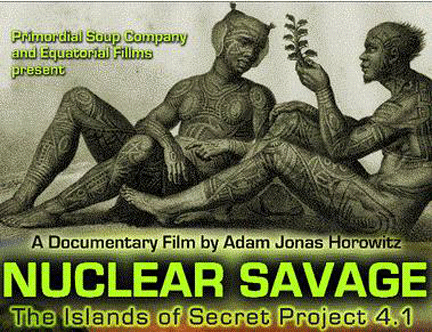
Nuclear Savage recounts the experiences of the Marshallese nation in the years following World War II, as they played host to the US’s Pacific Proving Grounds and served as human subjects in the classified, abusive pseudoscience that characterized the US government medical response to civilian exposures from the 1954 Bravo Test, the largest and dirtiest hydrogen bomb detonated by the United States. Detonated in the populated nation of the Marshall Islands.
Here is the story: Continue reading
Lest we forget – thermonuclear bombs exploded over the Pacific Ocean
 Going Nuclear Over the Pacific , Past Imperfect, Smithsonian.com August 15, 2012“…Fifty years ago this summer there were strange doings in the skies above earth as well….. But of all the things happening in the skies that summer, nothing would be quite as spectacular, surreal and frightening as the military project code-named Starfish Prime . Just five days after Americans across the country witnessed traditional Fourth of July fireworks displays, the Atomic Energy Commission created the greatest man-made light show in history when it launched a thermonuclear warhead on the nose of a Thor rocket, creating a suborbital nuclear detonation 250 miles above the Pacific Ocean. Continue reading
How President Jimmy Carter slowed down the spread of nuclear weapons
Carter entered office and promptly pushed through Congress the 1978 Non-Proliferation Act
Carter’s U.S. nuclear doctrine was enormously unpopular among America’s nuclear science elite
To the chagrin of the powerful nuclear weapons and nuclear power lobbies, Carter abandoned the idea of a new nuclear renaissance.
Jimmy Carter’s re-election defeat brought the nuclear establishment another opportunity.
United States Circumvented Laws To Help Japan Accumulate Tons of Plutonium, DC Bureau By Joseph Trento, April 9th, 2012 “….Stopping the Spread of Fissile Material After Jimmy Carter won the presidency in 1976, he instituted an aggressive policy to control the spread of fissile materials. As a former nuclear reactor engineer on a Navy submarine, Carter knew better than any other world leader the immense power locked up in plutonium and highly enriched uranium. He was determined to keep it out of the hands of even our closest non-nuclear allies – including Japan.
Carter had good reason for this policy. Despite Japan’s ratification of the NPT in 1976, a study conducted for the CIA the following year named Japan as one of the three countries most able to go nuclear before 1980. Only the Japanese people’s historic opposition to nuclear weapons argued against Japanese deployment. Every other factor argued for a Japanese nuclear capability.
By now the CIA – and its more secretive sister agency, the NSA — had learned the position of Japan’s inner circle.
Carter knew the incredibly volatile effect plutonium would have on world stability. Continue reading
Hibakusha bear witness to nuclear power’s exploitation of indigenous peoples
the world is still full of hibakusha who can testify to the rippling consequences of radiation exposure on health, family and community.
Nuclear testing hibakusha who have been removed from their home communities have suffered the social breakdowns
They often define themselves in relation to the colonial power that irradiated them, i.e., they are victims of French nuclear testing, of Soviet nuclear testing, of American nuclear testing
 Hibakusha: Hiroshima, Nagasaki and Beyond . Dr Bo Jacobs 11 Aug 12, http://www.dianuke.org/hibakusha-hiroshima-nagasaki-robert-jacobs/ Hundreds of hibakusha gather in Hiroshima today, and in Nagasaki on 9 August. Many more will stay away from such commemorations, preferring to spend these anniversaries in private. Almost all of these hibakusha were children when their families were attacked with nuclear weapons: and it is these grown children who remain to bear witness.
While over 70,000 people were killed in Hiroshima on the day that the US dropped an atomic bomb on the city center in August 1945, even more people became survivors of that attack. Many tens of thousands would die in the coming weeks, months and years, but some would live long and full lives. Their lives would forever be marked by this experience. Many have never shaken the trauma of expecting that they would die, having watched their family and their friends die, having seen an endless horizon full of the dead and dying and the corpses of people and animals burned beyond recognition, and of seeing their homes and city disappear into fire and rubble.
Beyond the epidemiological and psychological affects on the hibakusha, the social impacts were often as devastating. Experiencing discrimination in marriage and employment, many were also plagued by their own worries about whether to have children, and by anxieties that every subsequent cold or flu that they or their children experienced might be the first signs of an impending fatal illness. In a sense the nuclear attacks on Hiroshima and Nagasaki never ended. Continue reading
Japan’s secret nuclear weapons program
United States Circumvented Laws To Help Japan Accumulate Tons of Plutonium, DC Bureau By Joseph Trento, April 9th, 2012 “…..The Fukushima I Nuclear Power Plant after the 2011 Tōhoku earthquake and tsunami How Japan ended up in this nuclear nightmare is a subject the National Security News Service has been investigating since 1991.
We learned that Japan had a dual use nuclear program. The public program was to develop and provide unlimited energy for the country. But there was also a secret component, an undeclared nuclear weapons program that would allow Japan to amass enough nuclear material and technology to become a major nuclear [weapons] power on short notice.
That secret effort was hidden in a nuclear power program that by March 11, 2011– the day the earthquake and tsunami overwhelmed the Fukushima Daiichi Nuclear Plant – had amassed 70 metric tons of plutonium. Like its use of civilian nuclear power to hide a secret bomb program, Japan used peaceful space exploration as a cover for developing
sophisticated nuclear weapons delivery systems.
Political leaders in Japan understood that the only way the Japanese people could be convinced to allow nuclear power into their lives was if a long line of governments and industry hid any military application. For that reason, a succession of Japanese governments
colluded on a bomb program disguised as innocent energy and civil space programs. The irony, of course, is that Japan had gone to war in 1941 to secure its energy future only to become the sole nation attacked with nuclear weapons……
http://www.dcbureau.org/201204097128/national-security-news-service/united-states-circumvented-laws-to-help-japan-accumulate-tons-of-plutonium.html
History of deception in Japan’s development of nuclear reprocessing
Japan would have to do what the Americans and Europeans had failed to do – make an experimental breeder program a commercial success.
during the Reagan administration – legislation that dramatically changed U.S. policy. The United States ceded virtually all control of U.S.-origin nuclear materials shipped to Japan.
International corporations and officials sacrificed the safety and security of the public to carry out the deception. Under the guise of a peaceful nuclear power program, they made huge profits.
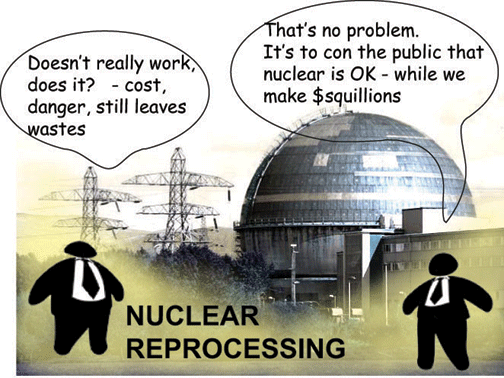
United States Circumvented Laws To Help Japan Accumulate Tons of Plutonium, DC Bureau By Joseph Trento, April 9th, 2012“……Energy has always been Japan’s Achilles’ heel. Her need for oil in the face of an American embargo triggered Japan’s attack on Pearl Harbor, and the continued shortage was a recurring theme in her defeat in that war. Only one act could take more credit for Japan’s humiliation – the splitting of the atom that gave birth to the nuclear bomb. Now Japan would turn that same atom to its own purposes — to ensure a stable source of energy well into the next century and, equally important, to ensure that the homeland never again suffered the indignity of defeat.
Japan approached the nuclear problem the same way it tackled the electronics and automobile industries. A core group of companies were each given key tasks with long-term profit potential. Then the government nurtured these companies with whatever financial, technological and regulatory support needed to assure their success. The strategy worked brilliantly to bring Japan from post-war oblivion to economic dominance in a single generation. Continue reading
How fast breeder nuclear reactors were tried in USA, and failed
Despite the efforts of the country’s best minds and nearly limitless budgets, the breeder program did not work. And it was not only the Clinch River team who failed. Breeder programs in Germany, France and the United Kingdom also could not make the leap from lab experiment to commercially viable practice.
United States Circumvented Laws To Help Japan Accumulate Tons of Plutonium, DC Bureau By Joseph Trento, April 9th, 2012.….Reversing Course – Reagan Undermines Carter’s Policies Richard Kennedy One of the most passionate nuclear believers was a career bureaucrat named Richard Kennedy. A former Army officer, he labored in obscurity at the Nuclear Regulatory Commission, his career held hostage by his vehement opposition to President Carter’s nuclear policies. All of that changed after Ronald Reagan’s election in 1980. One of Reagan’s first acts as president was to effectively reverse Carter’s nuclear doctrine, which had barred the United States from using plutonium in civilian power projects with America’s friends or adversaries.
Reagan made Kennedy his right-hand man for nuclear affairs. From his new post as Ambassador at Large for Nuclear Energy, Kennedy oversaw the dismantling of the Carter policies he despised. The new administration rejuvenated American and international reliance on plutonium. Continue reading
How USA secretly transferred nuclear weapons research to Japan
United States Circumvented Laws To Help Japan Accumulate Tons of Plutonium, DC Bureau By Joseph Trento, April 9th, 2012 National Security News Service The United States deliberately allowed Japan access to the United States’ most secret nuclear weapons facilities while it transferred tens of billions of dollars worth of American tax paid research that has allowed Japan to amass 70 tons of weapons grade plutonium since the 1980s, a National Security News Service investigation reveals. These activities repeatedly violated U.S. laws regarding controls of sensitive nuclear materials that could be diverted to weapons programs in Japan. The NSNS investigation found that the United States has known about a secret nuclear weapons program in Japan since the 1960s, according to CIA reports.
The diversion of U.S. classified technology began during the Reagan administration after it allowed a $10 billion reactor sale to China. Japan protested that sensitive technology was being sold to a potential nuclear adversary. The Reagan and George H.W. Bush administrations permitted sensitive technology and nuclear materials to be transferred to Japan despite laws and treaties preventing such transfers. Highly sensitive technology on plutonium separation from the U.S. Department of Energy’s Savannah River Site and Hanford nuclear weapons complex, as well as tens of billions of dollars worth of breeder reactor research was turned over to Japan with almost no safeguards against proliferation. Japanese scientist and technicians were given access to both Hanford and Savannah River as part of the transfer process.
While Japan has refrained from deploying nuclear weapons and remains under an umbrella of U.S. nuclear protection, NSNS has learned that the country has used its electrical utility companies as a cover to allow the country to amass enough nuclear weapons materials to build a nuclear arsenal larger than China, India and Pakistan combined.
This deliberate proliferation by the United States fuels arguments by countries like Iran that the original nuclear powers engage in proliferation despite treaty and internal legal obligations. Russia, France, Great Britain as well as the United States created civilian nuclear power industries around the world from their weapons complexes that amount to government-owned or subsidized industries. Israel, like Japan, has been a major beneficiary and, like Japan, has had nuclear weapons capabilities since the 1960s.
A year ago a natural disaster combined with a man-made tragedy decimated Northern Japan and came close to making Tokyo, a city of 30 million people, uninhabitable. Nuclear tragedies plague Japan’s modern history. It is the only nation in the world attacked with nuclear weapons. In March 2011, after a tsunami swept on shore, hydrogen explosions and the subsequent meltdowns of three reactors at the Fukushima Nuclear Power Plant spewed radiation across the region. Like the bombs dropped on Hiroshima and Nagasaki, Japan will face the aftermath for generations. A twelve-mile area around the site is considered uninhabitable. It is a national sacrifice zone. ……..http://www.dcbureau.org/201204097128/national-security-news-service/united-states-circumvented-laws-to-help-japan-accumulate-tons-of-plutonium.html
How bureaucrats worked secretly to subvert laws on nuclear weapons proliferation
U.S. and international law strictly limited the technology developed in the Clinch River program, particularly reprocessing technology used to separate plutonium from spent nuclear fuel. And the plan would require hundreds of international shipments of weapons-grade plutonium and high level nuclear waste on ships.
United States Circumvented Laws To Help Japan Accumulate Tons of Plutonium, DC Bureau By Joseph Trento, April 9th, 2012“…..Giving to Both Sides – Nuclear deals with China and Japan Westinghouse AP 1000 in China In 1984 the Westinghouse Corporation had struck a deal to supply nuclear reactors to China worth as much as $10 billion. The deal was an incredible windfall for the American nuclear industry and would be a cornerstone in [bureaucrat] Richard Kennedy’s efforts to make the United States dominate in the world’s nuclear commerce. The only problem was China’s abysmal record of sharing nuclear secrets with all bidders.
In a bitter session on the Senate floor, then Democratic Assistant Majority Leader Alan Cranston charged that the Reagan administration on [bureaucrat Richard] Kennedy’s watch had “systematically withheld, suppressed and covered up information – known virtually throughout the executive branch – which Congress might find worrisome.” China was already known to have sold nuclear technology to five international nuclear outlaws: Pakistan, Iran, South Africa, Brazil and Argentina. By 1984, Cranston and most of the American government knew that China had given sophisticated nuclear weapons designs to Pakistan. Beijing had also sold the enriched uranium that would find its way into South Africa’s nuclear bombs. China sold heavy water for use in Argentina’s bomb program, while also selling nuclear materials to arch rival Brazil and negotiating nuclear agreements with Iran.
China’s nuclear proliferation track record could hardly have been worse, but instead of negotiating ironclad safeguards, Kennedy returned from Beijing with an agreement so ambiguous that both sides could interpret it however they liked. Continue reading
Radio and Television Address to the American People on the Nuclear Test Ban Treaty John Kennedy, Washington, D.C., July 26, 1963 “…….This treaty can be a step towards freeing the world from the fears and dangers of radioactive fallout. Our own atmospheric tests last year were conducted under conditions which restricted such fallout to an absolute minimum. But over the years the number and the yield of weapons tested have rapidly increased and so have the radioactive hazards from such testing. Continued unrestricted testing by the nuclear powers, joined in time by other nations which may be less adept in limiting pollution, will increasingly contaminate the air that all of us must breathe Even then, the number of children and grandchildren with cancer in their bones, with leukemia in their blood, or with poison in their lungs might seem statistically small to some, in comparison with natural health hazards. But this is not a natural health hazard-and it is not a statistical issue. The loss of even one human life, or the malformation of even one baby-who may be born long after all of us have gone-should be of concern to us all. Our children and grandchildren are not merely statistics towards which we can be indifferent.
Nor does this affect the nuclear powers alone. These tests befoul the air of all men and all nations, Continue reading
The unnecessary atrocity of Hiroshima nuclear bombing
Ham’s conclusion to his very well documented and stringently argued book is that for 70 years the world has accepted an American myth – that the atomic bombs ended the war by shocking Japan into surrender. In fact it was ‘a planned massacre of innocent civilians – an unwarranted, American atrocity’.
 Hiroshima: A stain on human history , HIROSHIMA NAGASAKI BY PAUL HAM(Bantam Press £25) By PETER LEWIS, PUBLISHED, 26 July 2012 This controversial book delivers a double-whammy in the way of shocks. First, it argues that the Atomic Bombing of two Japanese cities in August, 1945, was militarily unnecessary and politically unjustified.
Second, by interviewing many survivors while he was living in the two cities, Paul Ham, an Australian journalist and expert on the Pacific war, gives an eye-witness picture that leaves Dante’s Inferno looking pale.
Let me start with the inferno, so that we realise just what we are considering. Tomiko Nakamura was a schoolgirl of 13 at Shintaku High School in Hiroshima when the Bomb exploded, killing almost all her 300 schoolmates in the playground. Although over a mile from the blast, the flash, she remembers, ‘felt like the sun had fallen out of the sky and landed right in front of us’.
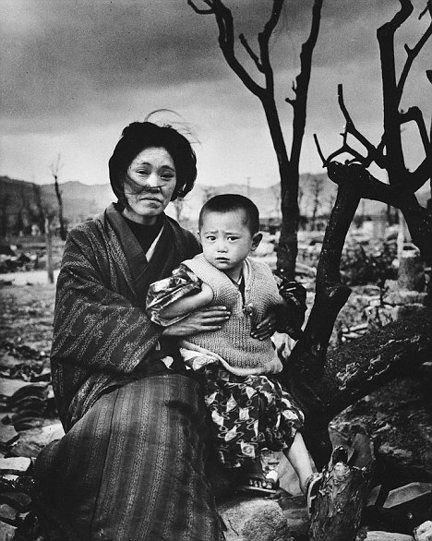
She regained consciousness in darkness. The mushroom cloud had turned dirty brown and cut off the sun. Flashes like ‘sunrises’ were coming from it in all directions. She examined her scalp covered in glass splinters. ‘My skin rolled off my legs like stockings’. Her shirt and trousers had been burnt onto her flesh. ‘I felt very sick and sat down but the flames were coming closer’. She started to walk over the rubble. ‘Voices beneath the timbers cried “Help! Help! It’s so hot!” I just kept walking’.
She reached a bridge where people with black or red faces were jumping into the river. ‘I couldn’t tell men from women. Some were holding their insides in their hands, staring at them. Everywhere dehydrated people were crying for water but when they drank some they died. A girl screamed: ‘The faster I die the better!’ as she jumped into the river. Continue reading
The major security concern about Russia’s secret nuclear cities

 Closed Cities & Nuclear Entrepreneurship In Russia JULY 30, 2012 by EDWARD PERELLO Faced with a dearth of opportunity, the aged nuclear scientist would not need much imagination, nor would he have to look far, to find a buyer interested in an exchange that would provide him with a hefty retirement package with which to live out his remaining
years….
.Russia’s ten nuclear cities contain the former Soviet Union’s principal nuclear weapons research, design and production facilities, and to the ordinary citizen, they weren’t really there. Nuclear cities were not officially recognised as existing until 1992 as they were amongst the Soviet unions many “closed cities” that were involved in certain sensitive activities. Located in remote regions around the country, closed cities were not labelled on any
publicly-available map and were isolated from the world. Continue reading
What has happened with UK’s nuclear Polaris missiles?

 Faslane and Coulport nuclear weapons maintenance to be privatised – Polaris? For Argyll.com July 28, 2012 The Ministry of Defence (MoD) has made a contractual commitment to hand over to a private sector consortium the maintenance of the UK’s nuclear weapons – described by the BBC as ‘Trident and Polaris weapons systems’ – held in Argyll at Faslane and Coulport on the Clyde.
This raises an immediate public information issue.
What is our position on the Polaris system? It was quite a shock to see it mentioned, like a rising from almost forgotten history. Polaris – and are we storing redundant warheads? Continue reading
VIDEO: USA’s soldier guinea pigs watched atomic explosion
“It was a publicity stunt to show the American public how safe it was during an atomic bomb,” Yoshitake says, “and if there was a war or something, with atomic bombs going off, that it was going to be safe for the general public.”..
all six people who were there that day have had cancer
 VIDEO How not to watch an overhead nuclear test http://www.cbsnews.com/8301-505263_162-57475611/how-not-to-watch-an-overhead-nuclear-test/ CBS News COLLEGE POINT, Md. 19 July 12 – On this date in 1957, the U.S. conducted one of the most important tests of the atomic age.
A nuclear-tipped missile was fired and detonated in the skies over the Nevada desert.
But what was happening on the ground at that moment seems beyond comprehension today. Continue reading
1 This Month
Chernobyl: The Lost Tapes – A good documentary on Chernobyl on SBS available On Demand for the next 3 weeks– https://www.sbs.com.au/ondemand/tv-program/chernobyl-the-lost-tapes/2352741955560

of the week–London Campaign for Nuclear Disarmament

Tell the Ukrainian Government to Drop Prosecution of Peace Activist Yurii Sheliazhenko
To see nuclear-related stories in greater depth and intensity – go to https://nuclearinformation.wordpress.com
-
Archives
- April 2026 (126)
- March 2026 (251)
- February 2026 (268)
- January 2026 (308)
- December 2025 (358)
- November 2025 (359)
- October 2025 (376)
- September 2025 (257)
- August 2025 (319)
- July 2025 (230)
- June 2025 (348)
- May 2025 (261)
-
Categories
- 1
- 1 NUCLEAR ISSUES
- business and costs
- climate change
- culture and arts
- ENERGY
- environment
- health
- history
- indigenous issues
- Legal
- marketing of nuclear
- media
- opposition to nuclear
- PERSONAL STORIES
- politics
- politics international
- Religion and ethics
- safety
- secrets,lies and civil liberties
- spinbuster
- technology
- Uranium
- wastes
- weapons and war
- Women
- 2 WORLD
- ACTION
- AFRICA
- Atrocities
- AUSTRALIA
- Christina's notes
- Christina's themes
- culture and arts
- Events
- Fuk 2022
- Fuk 2023
- Fukushima 2017
- Fukushima 2018
- fukushima 2019
- Fukushima 2020
- Fukushima 2021
- general
- global warming
- Humour (God we need it)
- Nuclear
- RARE EARTHS
- Reference
- resources – print
- Resources -audiovicual
- Weekly Newsletter
- World
- World Nuclear
- YouTube
-
RSS
Entries RSS
Comments RSS
 nuclear-news