HOW 5 PEOPLE SURVIVED NAGASAKI’S NUCLEAR HELL
 http://www.nationalgeographic.com.au/people/how-5-people-survived-nagasakis-nuclear-hell.aspx Three days after Hiroshima, an American B-29 dropped an atomic bomb on Nagasaki. A new book tells stories of those who lived through horror. on August 9, 1945, an American B-29 dropped an atomic bomb on the Japanese city of Nagasaki, obliterating much of it and killing 74,000 people, mostly civilians. It was only the second time in history an atomic bomb had been used as a weapon. BY SIMON WORRALL 14 SEPTEMBER 2017 In Nagasaki: Life After Nuclear War, Susan Southard follows the lives of five hibakusha (survivors) who escaped the firestorm and through extraordinary courage and resilience went on to live happy, fulfilled lives.
Speaking from her home in Arizona, she talks about the battle for the truth over what happened in Nagasaki; how square dancing helped heal the wounds of war; and why the survivors no longer harbour feelings of animosity towards Americans.
Yours is the first book to tell this story. Why has it taken so long?
One of the reasons is that the bombs were kept top secret. Very few military leaders knew they existed, except for the people who were creating the bombs and those directly overseeing them. After the bombs were dropped, several factors, both in the U.S. and Japan, contributed to people not knowing the effects.
One was direct denial of any radiation effects by key U.S. military leaders like General Leslie Groves, General Thomas Farrell and the U.S. War Department. During the U.S. occupation of Japan, which lasted from 1945 to 1952, General Douglas MacArthur also instituted a strict press code banning “false or destructive criticism” of the Allied powers out of concern that too much anger could put the thousands of U.S. troops in Japan at risk.
General Groves and others promoted the idea that the Japanese were using the effects of the bomb as anti-American propaganda. So, the people of Japan, other than the people in the cities directly affected, didn’t know for years what was happening in their own country. There was medical censorship as well. Physicians working with the survivors weren’t allowed to publish studies or findings of what was happening.
They also didn’t want the decision to use the bombs to be challenged in the U.S., by books like John Hersey’s Hiroshima. So President Truman and the Secretary of War, Henry Stimson, made a concerted effort to publish articles justifying the use of the bombs, excluding any information about what happened to the people beneath the atomic clouds.
The justifications were so airtight that they became the dominant way of perceiving the decision to use the bombs on Japan: that the two bombs ended the war and saved a million American lives.”
What made you want to write this book?
“It has deep roots in my life. In high school, I spent a year as an exchange student in Japan and happened to go on a field trip to the southern island of Kyushu, where I visited the Nagasaki Atomic Bomb Museum. I stood next to my Japanese classmates as the only American and observed the destruction.
But the key event came in 1986, when one of the Nagasaki survivors, Taniguchi Sumiteru, who was 57 years old by then, came to Washington on a speaking tour. I went to hear him speak, then, through a series of unexpected events, his interpreter became unable to complete the last few days of his time in Washington, and I became his interpreter.
In between his presentations we spent hours together. I got to ask him questions and tried to grasp what his experience had been like; it was truly a horrific experience. His entire back had been burned off. From that time on I couldn’t get out of my mind what it would be like to have survived nuclear war.”
Explain the term “hypocenter” and describe the destructive power of the blast in relation to it.
“Contrary to what some of us might imagine, the bomb did not explode on the ground but about one-third of a mile above ground. The purpose was to maximize the blast force and the effect of the heat on the city because the blast and the heat would travel further.
The area directly beneath the blast is called the “hypocenter.” The heat on the ground directly below it was about 5,000 to 7,000 degrees Fahrenheit. For quite a long distance, buildings were pulverized and trees, plants, and animals were blown away or carbonized. It’s an unimaginable level of instantaneous destruction.”
You recount the stories of five survivors. I want to focus on two of them: Do-oh Mineko and Taniguchi. Where were they at the moment of impact and what happened to them?
“Taniguchi was 16 years old at the time. He was delivering mail in the northwestern part of the valley on his bicycle. He was facing away from the blast a little over a mile away. He was thrown off his bicycle and although he didn’t know it at the time, because he was in a daze, his entire back was burned off. He also had severe burns on his arms and legs.
The earth was shaking but he was able to stand up. He gathered the mail he could still see. All the children that had been playing around him were dead. He wandered to a factory and some men carried him to a hillside where they laid him on his stomach. He lay there for two nights, dipping in and out of consciousness, while his grandfather searched for him.
Do-oh was about three-fourths of a mile from the hypocenter, inside a Mitsubishi torpedo factory. The massive steel and concrete Mitsubishi factory collapsed on top of her and thousands of others. Remarkably, she was able to get up. She had a big gash in the back of her neck and was desperate to escape because fires were beginning to flare around her. She had to step over dead bodies to get to an embankment, where her father found her.”
Tanaguchi’s ordeal is of almost biblical proportions. Tell us about his first few years after the bombing.
“There were no hospitals or medical supplies in Nagasaki, so he was taken to a village outside Nagasaki with his grandfather and cared for in a very basic way for three months. He was finally taken to a naval hospital in Omura, 22 miles north of Nagasaki, where he finally began to get proper medical care.
He lay on his stomach in extraordinary agony for three years. As he wasn’t able to lie on his sides or his back, he got incredibly deep bedsores—so deep, that the doctors could see his internal organs, including his heart beating. He was finally released from the hospital on March 20, 1949, when he was 20 years old.”
One of the more bizarre actions taken by the Americans after the bombing was to introduce square dancing. What was that all about?
“It’s so crazy! And quite lovely in the end. It began in Nagasaki. The people assigned to lead the occupation efforts in Nagasaki were very sympathetic toward the suffering of the survivors and tried to find ways to help them. One night, the civilian education officer for the U.S. occupation in Nagasaki, Winfield Niblo, was at a dinner party with Japanese educators.
Afterwards, there was a presentation of Japanese folk dancing. Niblo decided to present some American square dancing to add to the festivities. It caught on nationally to become a post-war American contribution to Japanese life.”
One of the things that shocked me was the extent to which the hibakusha werediscriminated against and mocked by their fellow Japanese. They were even called “tempura face.”
“It was surprising to me as well. The children were made fun of and laughed at. Those who were disfigured, even after the economy recovered a decade later, had trouble getting jobs. Even those who had no physical disfigurement often kept their status as a hibakusha quiet. It made it difficult to get a job and their marriage prospects were almost completely eliminated. Anyone who found out they were hibakusha was afraid of the genetic effects that radiation would have on their children. Many of them married other hibakusha.”
It took many years for the survivors to tell their stories. Why was it so difficult for them to go public and what changed their minds?
“Recovering from nuclear war is a very long process—healthwise, psychologically and economically. Some lost every member of their family and all their friends. The survivors I write about were all in their teen years at the time of the bombing. It was something so extremely painful that they didn’t want to revisit it.
The people who did decide to speak out, including the five survivors I feature in my book, had very personal reasons. One told me that as he held his first granddaughter in his arms, he had a flashback of a baby’s charred body that he had to step over as he was helping in the relief effort. He suddenly realized I have to do something about this, I don’t want my beautiful granddaughter to ever experience what I experienced.
Together, he and other hibakusha are fighting to ensure that Nagasaki will be the last city to be destroyed by an atomic bomb.”
How did the survivors feel towards the United States?
“Each survivor is different. Two I know well had a lot of anger towards the U.S. for dropping the bomb and causing this suffering. Others were so preoccupied with survival and grief and trying to deal with the medical implications that they didn’t think about the Americans too much. They just had to survive. The five I know well no longer feel negatively toward Americans. They accept that it was the governments and militaries of each nation that waged war, not individuals.”
Do-oh’s story has a remarkable happy ending. Tell us about her afterlife in Tokyo.
“Do-oh lost all her hair after the bomb. It didn’t grow back for 10 years, so she remained in her house until she was 25 years old. Her father said she had to learn how to support herself as an adult.
Before the war, she had dreamed of being in fashion so she got a part time job in Nagasaki in a cosmetics shop and was eventually offered a job in Tokyo with that same company. Against her parents’ wishes and cultural norms, she went on her own to Tokyo and began a new life. She worked fiercely and over time rose in the ranks to become a Senior VP of Utena, one of Japan’s leading cosmetics companies. It was unheard of at that time for a woman to have such a high executive position with a corporation.
She then returned to Nagasaki for retirement. She was an artist and poet as well, and she created this beautiful work of art, with green stems and a purple flowering iris. In Japanese writing from the top right, down, she says, “Thank you for a good life.”
How did the time you spent with these survivors change your life, Susan?
“It expanded my appreciation of human courage, resilience and strength. I also learned to appreciate the complexity of political and military actions and decisions, the consequences of those decisions, and how we respond and react to them.
I’ve been changed very profoundly by getting to know these people and being allowed to know the many difficult, intimate moments of their lives, which were split in half by nuclear war.”
Anniversary of radiation-caused death (at 24 years) of Manhattan Project physicist
Paul Waldon, Fight to stop nuclear waste dump in flinders ranges sa, Today the 15th of September is another red letter day in the nuclear arena, with the 72nd anniversary of the death of Haroutune Krikor “Harry” Daglian, physicist with the Manhattan Project.
Harry was NOT the only person working on the project to die from “Acute Radiation Syndrome” but he was the youngest at only 24 years of age. Three members of the big four were to follow Harry to a early grave with cancer deemed to be from the radiation they were subjected to during their time on the Manhattan and other projects.
The contaminated materials left over from the development of the bombs are still having a impact on life and the environment, and will continue to do so for generations. However the deaths and contamination on American soil from the development of the bombs, outnumber Japan’s. RIP Harry. https://www.facebook.com/groups/344452605899556/
Background to the North Korea nuclear crisis – the Cold War that never ended
 The Cold War Never Ended: Historical Roots of the Current North Korea Crisis, Portside, 12 Sept 17 The current conflict is one of the many unintended consequences of the continuing Cold War and the arbitrary division of the Korean peninsula that has lasted to this day. In a military confrontation with the United States, North Korea faces a terrible choice between using its weapons first or losing them in a conventional war against a far superior power.Suzy Kim, American Historical Association
Thompson concluded that the Cold War was an “addiction,” “a habit supported by very powerful material interests in each bloc,” from the military-industrial complex to intelligence and national security agencies, and the politicians they serve. This is no less true here in the United States as it is in North Korea today, where the American threat has been used to justify draconian measures since the Korean War.
North Korea’s threat of turning the United States into a “sea of fire,” while rhetorically inflammatory and unproductive, is based on its historical experience of the Korean War, during which the United States engaged in a literal scorched earth campaign of incendiary bombing that exhausted all targets. Despite American introduction of nuclear weapons into South Korea in 1958 in violation of the 1953 Armistice Agreement, North Korea began developing its own nuclear weapons in earnest only in the 1990s when it could no longer rely on the Soviet nuclear umbrella.
North Korea’s threat of turning the United States into a “sea of fire,” while rhetorically inflammatory and unproductive, is based on its historical experience of the Korean War, during which the United States engaged in a literal scorched earth campaign of incendiary bombing that exhausted all targets. Despite American introduction of nuclear weapons into South Korea in 1958 in violation of the 1953 Armistice Agreement, North Korea began developing its own nuclear weapons in earnest only in the 1990s when it could no longer rely on the Soviet nuclear umbrella…….http://portside.org/2017-09-11/cold-war-never-ended-historical-roots-current-north-korea-crisis
One woman’s story of the horrific Hiroshima nuclear bombing

A Hiroshima survivor’s apocalyptic tale underscores Japanese abhorrence for the Bomb, Straits Times, Ravi Velloor, Associate Editor, 9 Sept 17 “……Mrs Yoshiko Kajimoto, now a sprightly 86, experienced the blast first-hand. She knows something of wars: She had just entered secondary school when the Second Sino-Japanese War broke out and in the sixth grade when the Pacific War, as Japanese call World War II, broke out. And she was in the 9th grade when the bomb arrived.
Middle school kids were mobilised for the war effort. For this reason, she was in a factory making propeller parts, 2.5km from the blast centre when the moment came.
“It was a clear day without the trace of a cloud,” she said, hands and voice steady as she recounted the trauma. “It had been warm since early morning and there were no warnings of an air raid.”
Then, a flash of light.
“The faces of my parents and my grandfather passed before my eyes and I thought I was dead. It was as though Earth had exploded.”
As she had been trained to do, Mrs Kajimoto pressed her fingers to her eyes to prevent them from falling out of their sockets, as the shock wave arrived moments later, meanwhile trying to scramble to safety under the machines.
“My body was lifted up and I passed out of consciousness. When I came to, my friend, stuck under a machine was whimpering: ‘Help me, Mother. Help me, Teacher!’ My shoulders and legs were trapped. I shook my head and the ash fell from my mouth. The flesh had been ripped off my bones. The factory roof had collapsed. I knew I was alive only because of the pain. People had gone insane. In the distance, I heard someone wail: ‘Hiroshima is gone’.”
Mrs Kajimoto tore off her blouse to put a tourniquet on her bleeding friend, and used her school headband to fasten it further. Around her was a scene so ghoulish that it was worse than the worst nightmares.
People had their nails ripped out, faces had puffed up like balloons, lips had turned inside out. A fellow student approached her, one hand holding a nearly torn-off arm. Suddenly, she knelt before her, and slumped to the ground, dead.
Fires raged everywhere. A mother holding a dead baby was spinning around, insanely.
Then, incredibly, the 14-year-old felt fear leave her as she stepped over bodies and on shiny skin as she helped carry friends to nearby Oshiba Park.
Then, the cremations started and a foul smell spread through the city. There were maggots everywhere, including on her own body.
On the third day, she heard her own neighbourhood was safe, and she staggered towards her home, meeting her father along the way. He had gone to the factory and turned over each body as he looked for her. Seeing her, he broke down and extracted a ball of rice he had been carrying in his pocket as a good luck charm.
For the next few weeks, she was bed-ridden, her grandmother removing maggots from her body with chopsticks.
Two months later, a doctor arrived to remove glass shards from her body. A year and a half later, the father died vomiting blood.
“He had probably been affected by the radiation from walking three days in the city,” she said. “Those days there was no concept of radiation, because it is colourless and odourless.”
Mrs Kajimoto herself suffered gastric cancer in later years and had two-thirds of her stomach removed.
Then peace arrived, and so did poverty. She had to provide for three brothers and food was frequently short.
“For the dead it was hell. For the survivors it was hell too.”
Mrs Kajimoto’s husband died 17 years ago, and she has two daughters, eight grandkids and two great grandchildren. Her fortunes have improved but for five decades, she said, she didn’t want to talk about her experience, until a grandson convinced her she must tell her story. That’s how I got to hear of it.
“I do not ask for disarmament, but I demand abolition of nuclear weapons,” she told me. “Nuclear weapons are an absolute evil and cannot exist with human beings. I do not want Hiroshima, or Nagasaki, to be repeated anywhere.”
“Am I concerned over the North Korean situation? Of course, I am. And I believe, that is the sentiment with the young as well. I say that Prime Minister Shinzo Abe should visit North Korea (for talks) even at the risk of his life.”
Is this point of view limited to the few thousands still around who saw the curse of Hiroshima? Not hardly. After a week in Japan, I’d say that there are millions who share the same view.
Japan has all the technology in place to build a nuclear arsenal. From the moment a decision is taken to having ready bombs will probably take a few weeks, no more. But it will be a brave Japanese prime minister who orders those final turns of the screws for Japan’s first atomic bomb. http://www.straitstimes.com/opinion/a-hiroshima-survivors-apocalyptic-tale-underscores-japanese-abhorrence-for-the-bomb
Plutonium scattered over New Mexico – the shameful history of the July 16, 1945, atomic bomb test
 The God-awful mess made in New Mexico, nm politics, 10 Sept 17, “What the diary does not reveal… is the appalling fact that from late 1945 until 1952 Japanese medical researchers were prohibited by U. S. Occupation Authorities from publishing scientific articles on the effects of the atomic bombs.” – John W. Dower
COMMENTARY: It wasn’t the effects of the atomic bombs on Japan that prohibited Japanese medical researchers from publishing on the effects of the atomic bombs. Rather, it was how that information would be seen in New Mexico, which never suspected a lurking killer.
Three weeks before the atomic bombs were dropped on Japan, a concept test was made at New Mexico’s Trinity Site. This was an atomic device equal to what was used on Japan.
There’s no doubt that in Japan people were sickened by the resultant radiation. But there wasn’t that realization in New Mexico, even to this day. In fact, there’s resistance to that notion.
Robert Oppenheimer was the head of the Los Alamos Laboratory that developed the first nuclear weapons. The “Manhattan Project” initially produced three nuclear devices.
The first, a plutonium implosion device, was detonated July 16, 1945 at New Mexico’s Trinity Site. Oppenheimer remarked the explosion brought to mind the words of the Bhagavad Gita: “Now I am become Death, the destroyer of worlds.” I certainly understand that thought.
That plutonium scattered over New Mexico……..One positive for Japan: The scientists saw how the New Mexico ground blast spread so much contamination, and they exploded the next two nuclear bombs at 2,000 feet to get the blunt force trauma on the site but not contaminate it as had happened in New Mexico.
The military sent lots of scientists to Hiroshima and Nagasaki to monitor the radiation but seem to have not done so in New Mexico. Or, perhaps they did and the government authorities realized what a mess they made in New Mexico. Worse, they didn’t want the role of cleaning up this God-awful mess. Curious, eh?
As the decades have passed and the New Mexicans who were sickened by the plutonium passed, the interest in this story has gone from very little to none at all, except among those people effected.
I don’t believe there’s a risk now, but government is supposed to protect the citizens. Our government hasn’t even said they are sorry for the God-awful mess they made and all of the people they sickened. http://nmpolitics.net/index/2017/09/the-god-awful-mess-made-in-new-mexico/
TSAR BOMBA – Most Horrific Man-made Explosion in History
 The monster atomic bomb that was too big to use, In 1961, the Soviet Union tested a nuclear bomb so powerful that it would have been too big to use in war. And it had far-reaching effects of a very different kind. By Stephen Dowling, BBC, 16 August 2017, On the morning of 30 October 1961, a Soviet Tu-95 bomber took off from Olenya airfield in the Kola Peninsula in the far north of Russia……
nothing the Soviet Union had tested would compare to this.
TSAR BOMBA – Most Horrific Man-made Explosion in History – USSR Hydrogen Bomb
The Tu-95 carried an enormous bomb underneath it, a device too large to fit inside the aircraft’s internal bomb-bay, where such munitions would usually be carried. The bomb was 8m long (26ft), had a diameter of nearly 2.6m (7ft) and weighed more than 27 tonnes. It was, physically, very similar in shape to the ‘Little Boy’ and ‘Fat Man’ bombs which had devastated the Japanese cities of Hiroshima and Nagasaki a decade-and-a-half earlier. The bomb had become known by a myriad of neutral technical designations – Project 27000, Product Code 202, RDS-220, and Kuzinka Mat (Kuzka’s Mother). Now it is better known as Tsar Bomba – the ‘Tsar’s bomb’……
It was more than a metal monstrosity too big to fit inside even the largest aircraft – it was a city destroyer, a weapon of last resort…… In order to give the two planes a chance to survive – and this was calculated as no more than a 50% chance – Tsar Bomba was deployed by a giant parachute weighing nearly a tonne. The bomb would slowly drift down to a predetermined height – 13,000ft (3,940m) – and then detonate. By then, the two bombers would be nearly 50km (30 miles) away. It should be far enough away for them to survive.
The bomb’s mushroom cloud soared to 64km (40 miles) high, with its cap spreading outwards until it stretched nearly 100km (63 miles) from end to end. It must have been, from a very far distance perhaps, an awe-inspiring sight.
On Novaya Zemlya, the effects were catastrophic. In the village of Severny, some 55km (34 miles) from Ground Zero, all houses were completely destroyed (this is the equivalent to Gatwick airport being destroyed by a bomb that had fallen on Central London). In Soviet districts hundreds of miles from the blast zone, damage of all kinds – houses collapsing, roofs falling in, damage to doors, windows shattering – were reported. Radio communications were disrupted for more than an hour.……
Tsar Bomba unleashed almost unbelievable energy – now widely agreed to be in the order of 57 megatons, or 57 million tons of TNT. That is more than 1,500 times that of the Hiroshima and Nagasaki bombs combined, and 10 times more powerful than all the munitions expended during World War Two. Sensors registered the bomb’s blast wave orbiting the Earth not once, not twice, but three times……
One of the architects of this formidable device was a Soviet physicist called Andrei Sakharov – a man who would later become world famous for his attempts to rid the world of the very weapons he had helped create. He was a veteran of the Soviet atomic bomb programme from the very beginning, and had been part of the team that had built some of the USSR’s earliest atom bombs…….
With such immense power, there would be no guarantee that the giant bomb wouldn’t swamp the north of the USSR with a vast cloud of radioactive fallout.
That was of particular concern to Sakharov, says Frank von Hippel, a physicist and head of Public and International Affairs at Princeton University.
“He was really apprehensive about the amount of radioactivity it would create,” he says, “and the genetic effects that could have on future generations
“It was the beginning of his journey from being a bomb designer to becoming a dissident.”…….
The Soviets had built a weapon so powerful that they were unwilling to even test it at its full capacity. And that was only one of the problems with this devastating device.
The Tu-95 bombers built to carry the Soviet Union’s nuclear weapons were designed to carry much lighter weapons. The Tsar Bomba was so big that it couldn’t be placed on a missile, and so heavy that the planes designed to carry it wouldn’t have been able to take them all the way to their targets with enough fuel. And, if the bomb was as powerful as intended, the aircraft would have been on a one-way mission anyway…..
Tsar Bomba had other effects. Such was the concern over the test – which was 20% of the size of every atmospheric test combined before it, von Hippel says – that it hastened the end of atmospheric testing in 1963. Von Hippel says that Sakharov was particularly worried by the amount of radioactive carbon 14 that was being emitted into the atmosphere – an isotope with a particularly long half-life. “This has been partly mitigated by all the fossil fuel carbon in the atmosphere which has diluted it,” he says.
Sakharov worried that a bomb bigger than the one tested would not be repelled by its own blastwave – like Tsar Bomba had been – and would cause global fallout, spreading toxic dirt across the planet.
Sakharov become an ardent supporter of the 1963 Partial Test Ban, and an outspoken critic of nuclear proliferation and, in the late 1960s, anti-missile defences that he feared would spur another nuclear arms race. He became increasingly ostracised by the state, a dissident against oppression who would in 1975 be awarded the Nobel Peace Prize, and referred to as “the conscience of mankind”, says von Hippel.
Tsar Bomba, it seems, may have had fallout of a very different kind. http://www.bbc.com/future/story/20170816-the-monster-atomic-bomb-that-was-too-big-to-use
USA’s nuclear power industry is not sustainable, and critics have known this for a long time
What Is the Future of US Nuclear Power Industry? VOA 15, Aug 17 As America’s nuclear power industry continues to suffer major economic difficulties, some are questioning whether it can – or should – survive.
The latest setback came July 31, when state power companies in South Carolina halted construction of two reactors. After spending about $9 billion, the companies decided that increasing costs and repeated building delays did not make the project worth finishing…..
Industry groups had hoped the South Carolina reactors would mark a new beginning for U.S. nuclear power and show the benefits of the latest technology….o…nly two new nuclear reactors are currently being built in the United States – both of them in Georgia. The reactors were the first large nuclear plants to be started in the United States in more than 30 years. And the future of those reactors is uncertain.
The project – currently about half-finished – has also suffered major cost overruns and delays. For now, the company’s parent, Japan-based Toshiba, has promised to provide at least $3.7 billion to finish the project……
opponents say they’ve been hearing the same arguments in support of nuclear power for decades.
Paul Gunter is a longtime anti-nuclear activist. He co-founded the Clamshell Alliancein 1976. The group was formed to oppose the Seabrook Station nuclear plant in New Hampshire. He and hundreds of other protesters were arrested during non-violent demonstrations against the project. Gunter says his main opposition was that the licensing approval process was corrupt.
“For example, you couldn’t raise the issue of, what are you going to do with all the nuclear waste from Seabrook? And that question was not allowed in the licensing proceeding.”
Seabrook Station was eventually completed at a cost of about $7 billion and began operations in 1990. The Clamshell Alliance helped shape America’s anti-nuclear movement for many years to come.
Another defining moment came after the Three Mile Island plant accident in Pennsylvania in 1979 – the worst nuclear disaster in U.S. history. A series of mechanical and human mistakes sent one of the reactors into a partial meltdown, sending large amounts of radiation into the surrounding area.
Gunter says even before that accident, there were clear signs the nuclear industry would not be economically sustainable. Today, he says neither state utility providers nor large energy companies are willing to put up money for risky nuclear projects.
“So the only way that you can revive nuclear power is going to be through socializing its financing through the rate payer and the taxpayer. But at this point, we’re seeing the rate payer become the irate payer – when you waste billions and billions of dollars and decades on a predictable outcome.”…
Haunting photographs of 1945 Hiroshima and Nagasaki
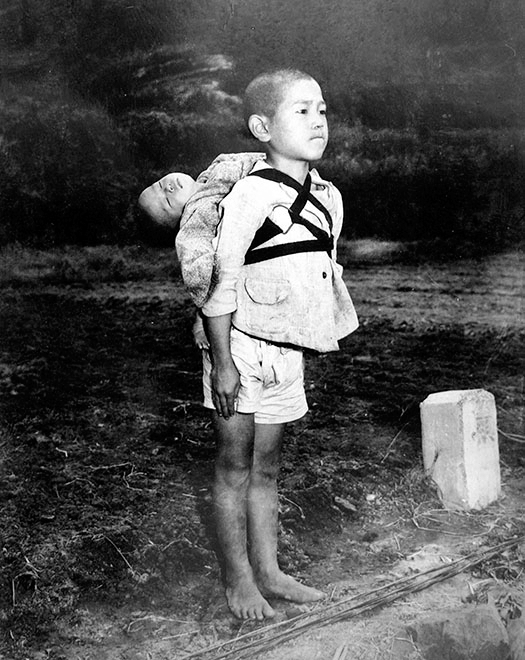 If you’re against war, get this book: The photos will haunt you http://www.asahi.com/ajw/articles/AJ201708100035.html By SONOKO MIYAZAKI/ Staff Writer August 10, 2017 A boy standing at rigid attention with the dead body of his infant brother strapped to his back at a crematorium in Nagasaki is one of searing images of the city’s destruction after the U.S. atomic bombing in 1945.
In a book published Aug. 9, Kimiko Sakai, the widow of Joe O’Donnell, the photographer who snapped the image, tells the story of her husband’s life work through photographs he shot in Japan in the immediate aftermath of the war.
Aug. 9 marked the 72nd anniversary of the bombing as well as the 10th anniversary of O’Donnell’s death at the age of 85.
The 192-page book, titled “Kamisama no Finder: Moto-Beijugun Cameraman no Isan” (God’s finder: the legacy of a former war photographer), was published by the Tokyo-based Word of Life Press Ministries.
After Japan’s surrender, O’Donnell, who was attached to the U.S. Marine Corps, traveled to Hiroshima, Nagasaki and other Japanese cities to document the wartime devastation. He stayed in Japan from September 1945 to March 1946.
He took 300 or so photographs for his private use.
He believed it was wrong to drop the atomic bombs after witnessing the sufferings of the victims.
But O’Donnell didn’t exhibit these pictures for decades because of prevailing U.S. sentiment that the atomic bombings of Hiroshima and Nagasaki hastened the end of World War and saved many American lives.
O’Donnell later decided to exhibit the photographs in the hope they would help advance the anti-war movement.
The catalyst for this was when he gazed on a sculpture evoking Jesus on the cross and engulfed by flames at a church in Kentucky in 1989. The life-size work, titled “Once,” was created for the repose of the tens of thousands of people killed in that atomic bombings, with photos of victims pasted all over the body. O’Donnell was stunned.
After that, O’Donnell until his death held exhibitions of his photos in the United States and Japan to convey the horrors of nuclear war.
The image of the boy at the crematorium stayed with him. O’Donnell recalled that the boy stared motionless as bodies were being burned and he awaited his turn. He also noticed that the boy’s lips were caked with blood because he was biting them so hard, although no blood spilled.
Sakai agreed to a proposal to publish the book after she was contacted by the publisher two years or so ago. Sakai, who lives in Tennessee, said she accepted out of respect for her husband’s commitment to the anti-war cause.
“My husband photographed his subjects as fellow human beings, not as an occupier,” she said in a recent interview with The Asahi Shimbun.
Asked if she had a message for those working to rid the world of nuclear arsenals, she said, “Just ‘not to forget,’ which is important.”
Dispelling the myths about U.S. President Harry Truman’s decision to nuclear bomb Japanese cities
The destruction of Hiroshima and Nagasaki was a war crime worse than any that Japanese generals were executed for in Tokyo and Manila. If Harry Truman was not a war criminal, then no one ever was.
 Mises Institute 10 Aug 17 [Excerpted from “Harry S. Truman: Advancing the Revolution,” in Reassessing the Presidency: The Rise of the Executive State and the Decline of Freedom, John Denson, ed.]
The most spectacular episode of Harry Truman’s presidency will never be forgotten but will be forever linked to his name: the atomic bombings of Hiroshima on August 6, 1945, and of Nagasaki three days later. Probably around two hundred thousand persons were killed in the attacks and through radiation poisoning; the vast majority were civilians, including several thousand Korean workers. Twelve US Navy fliers incarcerated in a Hiroshima jail were also among the dead.1
Great controversy has always surrounded the bombings. …….
the rationale for the atomic bombings has come to rest on a single colossal fabrication, which has gained surprising currency — that they were necessary in order to save a half-million or more American lives. These, supposedly, are the lives that would have been lost in the planned invasion of Kyushu in December, then in the all-out invasion of Honshu the next year, if that had been needed. But the worst-case scenario for a full-scale invasion of the Japanese home islands was forty-six thousand American lives lost.7 The ridiculously inflated figure of a half-million for the potential death toll — nearly twice the total of US dead in all theaters in the Second World War — is now routinely repeated in high-school and college textbooks and bandied about by ignorant commentators. Unsurprisingly the prize for sheer fatuousness on this score goes to President George H.W. Bush, who claimed in 1991 that dropping the bomb “spared millions of American lives.”8
Still, Truman’s multiple deceptions and self-deceptions are understandable, considering the horror he unleashed. It is equally understandable that the US occupation authorities censored reports from the shattered cities and did not permit films and photographs of the thousands of corpses and the frightfully mutilated survivors to reach the public.9 Otherwise, Americans — and the rest of the world — might have drawn disturbing comparisons to scenes then coming to light from the Nazi concentration camps.
The bombings were condemned as barbaric and unnecessary by high American military officers, including Eisenhower and MacArthur.10 The view of Admiral William D. Leahy, Truman’s own chief of staff, was typical:
the use of this barbarous weapon at Hiroshima and Nagasaki was of no material assistance in our war against Japan. … My own feeling was that in being the first to use it, we had adopted an ethical standard common to the barbarians of the Dark Ages. I was not taught to make wars in that fashion, and wars cannot be won by destroying women and children.11
The political elite implicated in the atomic bombings feared a backlash that would aid and abet the rebirth of horrid prewar “isolationism.” Apologias were rushed into print, lest public disgust at the sickening war crime result in erosion of enthusiasm for the globalist project.12 No need to worry. A sea change had taken place in the attitudes of the American people. Then and ever after, all surveys have shown that the great majority supported Truman, believing that the bombs were required to end the war and save hundreds of thousands of American lives, or, more likely, not really caring one way or the other.
Those who may still be troubled by such a grisly exercise in cost-benefit analysis — innocent Japanese lives balanced against the lives of Allied servicemen — might reflect on the judgment of the Catholic philosopher G.E.M. Anscombe, who insisted on the supremacy of moral rules.13 When, in June 1956, Truman was awarded an honorary degree by her university, Oxford, Anscombe protested.14 Truman was a war criminal, she contended, for what is the difference between the US government massacring civilians from the air, as at Hiroshima and Nagasaki, and the Nazis wiping out the inhabitants of some Czech or Polish village?……
While the mass media parroted the government line in praising the atomic incinerations, prominent conservatives denounced them as unspeakable war crimes. Felix Morley, constitutional scholar and one of the founders of Human Events, drew attention to the horror of Hiroshima, including the “thousands of children trapped in the thirty-three schools that were destroyed.” He called on his compatriots to atone for what had been done in their name, and proposed that groups of Americans be sent to Hiroshima, as Germans were sent to witness what had been done in the Nazi camps.
The Paulist priest, Father James Gillis, editor of The Catholic World and another stalwart of the Old Right, castigated the bombings as “the most powerful blow ever delivered against Christian civilization and the moral law.” David Lawrence, conservative owner of US News and World Report, continued to denounce them for years.21 The distinguished conservative philosopher Richard Weaver was revolted by
the spectacle of young boys fresh out of Kansas and Texas turning nonmilitary Dresden into a holocaust … pulverizing ancient shrines like Monte Cassino and Nuremberg, and bringing atomic annihilation to Hiroshima and Nagasaki.
Weaver considered such atrocities as deeply “inimical to the foundations on which civilization is built.”22
Today, self-styled conservatives slander as “anti-American” anyone who is in the least troubled by Truman’s massacre of so many tens of thousands of Japanese innocents from the air. This shows as well as anything the difference between today’s “conservatives” and those who once deserved the name.
Leo Szilard was the world-renowned physicist who drafted the original letter to Roosevelt that Einstein signed, instigating the Manhattan Project. In 1960, shortly before his death, Szilard stated another obvious truth:
If the Germans had dropped atomic bombs on cities instead of us, we would have defined the dropping of atomic bombs on cities as a war crime, and we would have sentenced the Germans who were guilty of this crime to death at Nuremberg and hanged them.23
The destruction of Hiroshima and Nagasaki was a war crime worse than any that Japanese generals were executed for in Tokyo and Manila. If Harry Truman was not a war criminal, then no one ever was. https://mises.org/blog/harry-truman-and-atomic-bomb
Pictures from a Hiroshima Schoolyard
 Pictures from a Hiroshima Schoolyard presents the aftermath of the first atomic bomb through the remarkable drawings and stories of surviving Japanese school children who were part of an extraordinary, compassionate exchange with their American counterparts after the war.
In 1995, a parishioner of the All Souls Church in Washington, D.C., discovered a long-forgotten box containing dozens of colorful drawings made by Japanese children from the Honkawa Elementary School in Hiroshima just two years after their city was destroyed. The surprisingly hopeful drawings were created and sent to the church nearly 50 years earlier in appreciation for much-needed school supplies received as part of the church’s post-war humanitarian efforts.
The Honkawa school was just 1100 feet from ground zero on August 6, 1945. Nearly 400 children died in the schoolyard that fateful morning. Surviving students and teachers describe the horror of that day and reflect on their difficult lives amidst the rubble of their decimated city, as well as the hope they shared through their art.
Classes resumed soon after in the window-less concrete shell of the remaining Honkawa school building to provide some sense of normalcy. The film features recently found archival footage that shows what life was like in the weeks and months after the bomb fell and how Hiroshima gradually recovered.
The rediscovered drawings were restored by members of the All Souls Church, who several years later embarked on an emotional journey to Japan to exhibit the artwork at the Honkawa school and reunite the surviving artists for the first time with the drawings they created as children.
The artists and church members reflect on the lessons that resulted from a compassionate exchange nearly 70 years ago between American and Japanese children following a bitter and devastating World War.
The film is produced by Shizumi Shigeto Manale and written and directed by Bryan Reichhardt. More information here.
Memoirs of 1945 photographer of the devastated city of Hiroshima
FULL VERSION OF HIROSHIMA AND NAGASAKI FILM THEY DIDN’T WANT US TO SEE 34962,
(this is not the same as the film discussed below)
Memos found from man who shot Hiroshima ‘phantom film’, Asahi Shimbun , By GEN OKAMOTO/ Staff Writer, July 23, 2017 SAGAMIHARA, Kanagawa Prefecture--Memos written by a photographer who documented the damage inflicted on Hiroshima after the atomic bombing and his personal feelings have been discovered by his grandson and will be displayed in Tokyo next month.
Kiyoji Suzuki took the notes with sketches when a documentary team, in which he was a member, roamed the flattened city between September and October 1945.
The documentary, “Effects of the Atomic Bomb on Hiroshima and Nagasaki,” was undertaken by a Japanese film company to scientifically record the extent of the damage done to both cities, including footage of destroyed cityscapes, injured people and the existence of vegetation.
The shooting of Nagasaki ran into difficulties as the U.S. military meddled in the project. But the crew managed to continue with their work after being commissioned by the U.S. military.
Although the documentary was completed in 1946, the U.S. military confiscated the film and didn’t return it to Japan until 1967. The footage became known as the “phantom film” on the atomic bombings.
Hiroshi Nose, also a photographer who lives in Sagamihara, found his grandfather’s memos at his home in 2013.
Suzuki’s entries began on Sept. 18, 1945, when he was living in Tokyo and assigned to the film project in Hiroshima.
His memos show sketches of a “shadow” of a person or object etched on a nearby building by the bomb’s thermal flash and of a deformed leaf of a plant.
Suzuki also mentioned which lenses he used for filming and the weather that day.
Although many of the memos concern objective data, others appeared to reveal his personal feelings in the midst of the devastation…….
Nose completed a 28-minute documentary film last fall, titled “Hiroshima Bomb, Illusive Photography Memos,” after visiting places in Hiroshima that were associated with Suzuki’s memos.
The documentary compared footage of Hiroshima today and that of the city 72 years ago shot by his grandfather.
The memos will be displayed for the first time to the public at Art Gallery 884 in Tokyo’s Bunkyo Ward on Aug. 5-9. http://www.asahi.com/ajw/articles/AJ201707230019.html
Russia and China came close to nuclear war in 1969
Forgotten Fact: Russia and China Almost Started a Nuclear War in 1969, National Interest, Kyle Mizokami, 2 Jul 17, In 1969 the two pillars of the communist bloc, the Soviet Union and the People’s Republic of China, nearly went to full-scale war. Years of deteriorating ties between the two countries, once the staunchest of allies, finally led to skirmishing on the long mutual border between the two countries. While tensions were eventually de-escalated, what if the two countries had gone to war?
On March 2, 1969 Soviet troops patrolling Damansky Island (Zhenbao) on the Ussuri River came under fire from Chinese troops. The attack, just 120 miles from the major Soviet city of Khabarovsk, killed fifty Soviet troops and wounded many more. The Moscow believed that the attack was premeditated, with Beijing bringing in a special combat unit to ambush Soviet forces. Alleged atrocities against wounded Soviet troops made the Soviet leadership furious.
The de-escalation of the Sino-Soviet crisis in 1969 avoided what could have been yet another large, destructive war of the twentieth century. The current friendship between Moscow and Beijing is a reflection of that crisis and the realization that it’s much better for both countries to be allies than enemies. This is particularly in Moscow’s interests: given Beijing’s rapid military and economic progress over the past thirty years, next time, the Kremlin may find the tables turned. http://nationalinterest.org/blog/the-buzz/forgotten-fact-russia-china-almost-started-nuclear-war-1969-21398
Secret nuclear fallout bunker set up for President Kennedy in 1960
JFK Had a Super Secret Nuclear War Bunker in Florida,National Interest, Darien Cavanaugh, 2 Jul 17, This place wouldn’t have survived a direct hit,” Anthony Miller of the Palm Beach Maritime Museum told VisitFlorida.com, Florida’s official Website for promoting tourism.
In December 1960, the SeaBees – the U.S. Navy’s construction force — supposedly began the mundane task of building a munitions depot behind the Coast Guard station on Peanut Island, Florida.
It took the SeaBees less than two weeks to complete the underground bunker, which consisted of a corrugated steel shelter covered with 25 feet of concrete, earth and lead. Official documents referred to the site as “Detachment Hotel,” and the government didn’t formerly acknowledge its existence until 1974……. http://nationalinterest.org/blog/the-buzz/jfk-had-super-secret-nuclear-war-bunker-florida-21406
The scandalously unethical 1946 testing of atomic bombs on Bikini Atoll
 The Crazy Story of the 1946 Bikini Atoll Nuclear Tests http://www.smithsonianmag.com/smart-news/crazy-story-1946-bikini-atoll-nuclear-tests-180963833/ They were the first time that a nuclear weapon had been deployed since the 1945 attacks on Japan By Kat Eschner, smithsonian.com
June 30, 2017 Operation Crossroads, which had its first big event–the dropping of a nuclear bomb–on July 1, 1946, was just the beginning of the nuclear testing that Bikini Atoll would be subjected to. When the first bomb of the tests dropped, it was the first time since the 1945 attacks on Japan that a nuclear weapon had been deployed. Here are three things you might not know about the infamous test.
The goal of the tests was to see what happened to naval warships when a nuclear weapon went off, writes the Atomic Heritage Foundation. More than 42,000 people–including a crew of Smithsonian Institution scientists, as well as reporters and United Nations representatives, according to Alex Wellerstein for The New Yorker–were involved in observing the nuclear tests, but the humans were, of course, not the test subjects.
Instead, “some of the ships were loaded with live animals, such as pigs and rats, to study the effects of the nuclear blast and radioactive fallout on animals,” writes the foundation. In total, more than 90 vessels, not all carrying live cargo, were placed in the target area of the bomb, which was named Gilda–after Rita Hayworth’s character in the eponymous film.
The gathered scientists included fish scientist Leonard P. Schultz, who was then the curator of ichthyology for the National Museum of Natural History. Although he was given safety goggles, writes the museum, “he was doubtful whether the goggles would protect him.” So, in true scientific fashion, “he covered one eye and observed the explosion with the other.” His eyes were fine, and the effects that he felt included “a slight warmth” on his face and hearing a boom about two minutes after the flash.
Schultz and his colleagues were there to collect species and document the Atoll before and after the tests. They collected numerous specimens including sea and land creatures, writes the museum, which remain in the museum’s collections today. “The Smithsonian’s collections document the extent to which the diversity of marine life was affected by the atomic blasts,” writes the museum, “providing researchers who continue to study the health of the ecosystem with a means to compare species extant today with those collected before the tests.”
The first bomb missed its target
That reduced the damage done to the ghost ships. “The weapon exploded almost directly above the Navy’s data-gathering equipment, sinking one of its instrument ships, and a signal that was meant to trigger dozens of cameras was sent ten seconds too late,” Wellerstein writes.
“The nuclear arms race between the US and Soviet Union displaced 167 Marshallese as refugees in their own country,” writes Sarah Emerson for Motherboard. After the first 1946 tests, the U.S. government continued to use the area around Bikini Atoll and the Marshall Islands for nuclear testing, writes Erin Blakemore for Smithsonian.com, conducting 67 nuclear tests in total. 23 of those tests were conducted at Bikini Atoll specifically, including one 1954 test of the largest nuclear device the U.S. ever exploded.
The Marshallese displaced by the testing have not been able to go back to their poisoned homes. Today, it’s hard to know when the Atoll will ever be safe to return to, writes Blakemore, although the Marshall Islands overall are becoming less radioactive.
And it all started in 1946.
1 This Month

Shut down the radiation-damaged Heysham nuclear reactors now
To see nuclear-related stories in greater depth and intensity – go to https://nuclearinformation.wordpress.com

Say No to NASA’s Reckless Nuclear Reactor on the Moon
Say No to NASA’s Reckless Nuclear Reactor on the Moon
-
Archives
- October 2026 (256)
- September 2026 (339)
- August 2026 (330)
- July 2026 (355)
- June 2026 (287)
- May 2026 (306)
- April 2026 (356)
- March 2026 (251)
- February 2026 (267)
- January 2026 (308)
- December 2025 (358)
- November 2025 (359)
-
Categories
- 1
- 1 NUCLEAR ISSUES
- business and costs
- climate change
- culture and arts
- ENERGY
- environment
- health
- history
- indigenous issues
- Legal
- marketing of nuclear
- media
- opposition to nuclear
- PERSONAL STORIES
- politics
- politics international
- Religion and ethics
- safety
- secrets,lies and civil liberties
- spinbuster
- technology
- Uranium
- wastes
- weapons and war
- Women
- 2 WORLD
- ACTION
- AFRICA
- Atrocities
- AUSTRALIA
- Christina's notes
- Christina's themes
- culture and arts
- Events
- Fuk 2022
- Fuk 2023
- Fukushima 2017
- Fukushima 2018
- fukushima 2019
- Fukushima 2020
- Fukushima 2021
- general
- global warming
- Humour (God we need it)
- Nuclear
- RARE EARTHS
- Reference
- resources – print
- Resources -audiovicual
- Weekly Newsletter
- World
- World Nuclear
- YouTube
-
RSS
Entries RSS
Comments RSS

