By JON GAMBRELL, DUBAI, United Arab Emirates (AP) — Once expunged from its official history, documents outlining the U.S.-backed 1953 coup in Iran have been quietly published by the State Department, offering a new glimpse at an operation that ultimately pushed the country toward its Islamic Revolution and hostility with the West.
The CIA’s role in the coup, which toppled Prime Minister Mohammed Mosaddegh and cemented the control of the shah, was already well-known by the time the State Department offered its first compendium on the era in 1989. But any trace of American involvement in the putsch had been wiped from the report, causing historians to call it a fraud.
The papers released this month show U.S. fears over the spread of communism, as well as the British desire to regain access to Iran’s oil industry, which had been nationalized by Mosaddegh. It also offers a cautionary tale about the limits of American power as a new U.S. president long suspicious of Iran weighs the landmark nuclear deal with Tehran reached under his predecessor……..
The 1,007-page report , comprised of letters and diplomatic cables, shows U.S. officials discussing a coup up to a year before it took place. ……..
The report fills in the large gaps of the initial 1989 historical document outlining the years surrounding the 1953 coup in Iran. The release of that report led to the resignation of the historian in charge of a State Department review board and to Congress passing a law requiring a more reliable historical account be made.
Byrne and others have suggested the release of the latest documents may have been delayed by the nuclear negotiations, as the Obama administration sought to ease tensions with Tehran, and then accelerated under President Donald Trump, who has adopted a much more confrontational stance toward Iran……
Die-hard opponents of Iran’s current government might look to 1953 as a source of inspiration. But the Americans involved in the coup acknowledged at the time they were playing with fire.
Widespread Iranian anger over the heavy-handed Western intervention lingered for decades, and fed into the 1979 revolution, when Iranians seized control of the U.S. Embassy and held those inside captive for 444 days. To this day Iran’s clerical leaders portray the U.S. as a hostile foreign power bent on subverting and overthrowing its government.
As President Dwight Eisenhower wrote in his diary in 1953, if knowledge of the coup became public, “We would not only be embarrassed in that region, but our chances to do anything of like nature in the future would almost totally disappear.” Online:
State Department report: https://history.state.gov/historicaldocuments/frus1951-54Iran https://apnews.com/5111167bcaf84892b01eea93eea4bc01
July 1, 2017
Posted by Christina Macpherson |
history, Iran, politics international, USA |
Leave a comment
In 1983, A NATO Military Exercise Almost Started a Nuclear World War III, The National Interest, Warfare History Network, 11 June 17, On the night of November 20, 1983, Armageddon went prime time. Over 100 million Americans tuned in to the ABC television network to watch the two-hour drama The Day After. This depiction of a hypothetical nuclear attack on the United States attracted a great deal of publicity and controversy. Schools made watching the film a homework assignment, discussion groups were organized in communities across the country, and even the secretary of state at the time, George Schulz, took part in a question-and-answer session hosted by ABC after the film’s broadcast. That a mere made-for-TV movie could garner such attention from a leading figure in the Reagan administration indicates how real the fear of a nuclear apocalypse was at the time. But almost no one watching that Sunday night realized just how close fiction came to reality in the fall of 1983.
The possibility of the world’s two greatest military powers destroying each other and the earth in a full-scale thermonuclear war was a fear shared by many throughout the world. At the time, both the United States and the USSR maintained huge nuclear arsenals of over 20,000 nuclear warheads each. In North America and Western Europe, nuclear freeze movements were gaining new members daily, with mass demonstrations that routinely numbered in the tens of thousands.
World events seemed to only reaffirm people’s fears. It was the third year of the presidency of Ronald Reagan, a man who had built his political career on a virulent hatred for all things communist. His 1980 victory over incumbent President Jimmy Carter had largely been the result of his hard-line stance against the Russians. A former film actor with a natural flair for the dramatic, Reagan both inspired and shocked people with his hardcore rhetoric, such as his statement before the British House of Commons in 1982 that the Marxist ideology would be relegated to the “ash heap of history.” Perhaps his most memorable and antagonistic remarks came on March 8, 1983, when Reagan referred to the Soviet Union as the “focus of evil in the modern world” and an “evil empire.”……
“Star Wars” and Fleetex 83: On the Brink of Nuclear War
On March 23, 1983, Reagan took the superpower rivalry to a new level when he unveiled the Strategic Defense Initiative Program during a live television address. The SDI program, more popularly referred to as “Star Wars,” was to provide an orbital shield that would protect the United States—at least partly—from a nuclear strike…..
To Yuri Andropov, then general secretary of the USSR, Reagan’s intentions spelled trouble…….http://nationalinterest.org/blog/the-buzz/1983-nato-military-exercise-almost-started-nuclear-world-war-21111
June 12, 2017
Posted by Christina Macpherson |
history, politics international, weapons and war |
Leave a comment
 Generating controversy: The Shoreham nuclear power plant, http://www.newsday.com/long-island/history/generating-controversy-the-shoreham-nuclear-power-plant-1.13702920 [large set of excellent photos] June 2, 2017 The nuclear power plant built in Shoreham was initially sold as a solution for a power-hungry Island, a safe and economical source of electricity that would light 500,000 homes and last for several decades. The LILCO project instead generated intense controversy.
An estimated 15,000 people rallied in a driving rainstorm outside Shoreham’s gates on June 3, 1979, in what was then believed to be the biggest demonstration of any kind in Long Island history. Before the protest was over, 571 people were peacefully arrested. In the years after the protest, questions about the plant’s safety and its ballooning costs led to a state takeover of the Long Island Lighting Co. and the decommissioning of the plant. LIPA, which owns the property and operates a substation and other power facilities there, continues to express interest in redeveloping the site. But despite occasional calls to convert it for other uses, the property’s future remains uncertain.
The plant’s legacy included $6 billion in debt related to its closure and LIPA taking over LILCO, with $1 billion left to be paid, and vivid memories of a demonstration that captivated the Island on June 3, 1979.
After years of controversy, the Shoreham nuclear power plant was ordered closed on May 25, 1988. It was fully decommissioned in 1994.
June 5, 2017
Posted by Christina Macpherson |
history, USA |
Leave a comment
A thermonuclear bomb slammed into a US farm in 1961 — and part of it is still missing https://www.businessinsider.com.au/nuclear-bomb-accident-goldsboro-nc-swamp-2017-5?r=US&IR=T, DAVE MOSHER MAY 8, 2017,
- In 1961, a US nuclear bomber broke up over North Carolina farmland, killing three of eight crew members.
- The accident dropped two powerful hydrogen bombs over the area, but they did not detonate.
- The military fully recovered one of the bombs.
- While the second bomb was mostly recovered, one of its nuclear cores is likely still buried in up to 200 feet of mud and dirt.
Disaster struck early in the morning of January 24, 1961, as eight servicemen in a nuclear bomber were patrolling the skies near Goldsboro, North Carolina.
They were an insurance policy against a surprise nuclear attack by Russia on the United States — a sobering threat at the time. The on-alert crew might survive the initial attack, the thinking went, to respond with two large nuclear weapons tucked into the belly of their B-52G Stratofortress jet.
Each Mark 39 thermonuclear bomb was about 12 feet long, weighed more than 6,200 pounds, and could detonate with the energy of 3.8 million tons of TNT. Such a blast could kill everyone and everything within a diameter of about 17 miles — roughly the area inside the Washington, DC, beltway.
But the jet aeroplane and three of its crew members never returned to base, and neither nor did a nuclear core from one of the bombs.
The plane broke up about 2,000 above the ground, nearly detonating one of the bombs in the process.
Had the weapon exploded, the blast would have packed about 250 times the explosive power of the bomb dropped on Hiroshima.
A major accident involving a nuclear weapon is called a “broken arrow,” and the US military has officially recognised 32 of them since 1950.
A mysterious fuel leak, which the crew found out as a refuelling plane approached, led to the broken arrow incident over North Carolina in 1961.
The leak quickly worsened, and the jet bomber “lost its tail, spun out of control, and, perhaps most important, lost control of its bomb bay doors before it lost two megaton nuclear bombs,” according to a two–part series about the accident by The Orange County Register newspaper. “The plane crashed nose-first into a tobacco field a few paces away from Big Daddy Road just outside Goldsboro, N.C., about 60 miles east of Raleigh.”
One bomb safely parachuted toward the ground and snagged on a tree. Crews quickly found it, inspected it, and moved it onto a truck.
However, the parachute of the other bomb failed, causing it to slam into a swampy, muddy field and break into pieces. It took crews about a week of digging to find the crumpled bomb and most of its parts.
The military studied the bombs and learned that six out of seven steps to blow up one of them had engaged, according to the Register. Only one trigger stopped a blast — and that switch was set to “ARM,” yet somehow failed to detonate the bomb.
It was only “by the slightest margin of chance, literally the failure of two wires to cross, a nuclear explosion was averted,” said Robert McNamara, the US secretary of defence at the time, according to a declassified 1963 memo.
“Had the device detonated, lethal fallout could have been deposited over Washington, Baltimore, Philadelphia and as far north as New York City — putting millions of lives at risk,” according to a 2013 story by Ed Pilkington in the Guardian. Here’s a Nukemap simulation of what might have been the blast radius and fallout zone of the Goldsboro incident: [on original]
The thermonuclear core no one recovered
Both bombs were a thermonuclear design. So instead of just one nuclear core, these weapons — the most powerful type on Earth — had two nuclear cores.
In the fleeting moments after the first core (called a primary) explodes, it releases a torrent of X-ray and other radiation. This radiation reflects off the inside of the bomb casing, which acts like a mirror to focus it on and set off the secondary core. The one-two punch compounds the efficiency and explosive power of a nuclear blast.
While the US military recovered the entire Goldsboro bomb that hung from a tree, the second bomb wasn’t fully recovered: Its secondary core was lost in the muck and the mire.
Reports suggest the secondary core burrowed more than 100 feet into the ground at the crash site — possibly up to 200 feet down.
The missing secondary is thought to be made mostly of uranium-238, which is common and not weapons-grade material (but can still be deadly inside a thermonuclear weapon), plus some highly enriched uranium-235 (HEU), which is a weapons-grade material and a key ingredient in traditional atomic bombs.
Business Insider contacted the Department of Defence (DoD) to learn about the current status of the site and the missing secondary, and a representative said neither the DoD, Department of Energy, or USAF has “any ongoing projects or activities with this site.”
The DoD representative would not say whether or not the secondary was still there. However, the representative forwarded some responses by Joel Dobson, a local author who penned the book “The Goldsboro Broken Arrow“.
“Nothing has changed [since 1961],” Dobson said, according to the DoD email. (Dobson did not return calls or emails from Business Insider.) “The area is not marked or fenced. It is being farmed. The DOD has been granted a 400 foot in diameter easement which, doesn’t allow building of any kind but farming is OK.”
When asked about the still-missing secondary, Michael O’Hanlon, a US defence strategy specialist with the Brookings Institution, said there should be little to worry about.
“Clearly, having a large part of a nuclear weapon on private land … is a bit unsettling. That said, I’m not suggesting anyone lose sleep over this,” O’Hanlon told Business Insider in an email.
“It would take a serious operation to get at it, requiring tunnelling equipment and a fairly obvious and visible approach to the site by some kind of road convoy, presumably,” O’Hanlon added. “Moreover, a secondary does NOT have a lot of HEU or plutonium … which makes it less dangerous because you can’t make a nuclear weapon out of it from scratch.”
But O’Hanlon at least hopes the DoD and others have thought through “the possibility of someone trying to steal it.”
“After all, digging and tunnelling equipment has continued to improve over the years — and there is apparently no secret about where this weapon is located,” O’Hanlon said. “On balance, I’d rather it not be there — but don’t consider it a major national security risk, either.”
May 8, 2017
Posted by Christina Macpherson |
history, incidents, USA |
Leave a comment
 The deadly industry – this is a brief section from Nuclear Power and the Collapse of Society
The story of how nuclear generated power came to be starts in the 1950s. After WWII, the US, UK, France, Russia, and China set out to build arsenals, but required more plutonium than could be furnished by their respective military programs. A US Atomic Energy Commission study concluded that commercial nuclear reactors for power were not economically feasible because of costs and risks. Dr. Charles Thomas, an executive at Monsanto, suggested a solution: A “dual purpose” reactor that would produce plutonium for the military and electric power for commercial use.
Companies profited from these dual markets, while leaving the public to assume responsibility for research, infrastructure, and risk: Privatise the profits, socialise the costs. The real purpose of a “nuclear power” industry was to provide plutonium for weapons and profit for a few corporations.
This deadly industry has now left dead zones and ghost towns around the world. The Hanford nuclear storage site in the US, Acerinox Processing Plant in Spain, The Polygon weapons test site in Kazakhstan, the Zapadnyi uranium mine in Kyrgyzstan, and countless other uranium mines, decommissioned plants, nuclear waste dumps, and catastrophes like Fukushima and Chernobyl. http://www.greenpeace.org/international/en/news/Blogs/makingwaves/nuclear-weapons-power-Chernobyl-Fukushima-danger/blog/59326/ by Rex Weyler, 5 May 17,
May 6, 2017
Posted by Christina Macpherson |
history, Reference, USA, weapons and war |
Leave a comment
Today, as the UK works on reintroducing our Cold War nuclear warning system, examining military plans like Plan Totality can shed an alarming light on the realities of a global nuclear conflict.
Just as chilling is the 1949 follow up to Plan Totality – known as Operation Dropshot – which reveals how the US was really ready to obliterate the USSR with terrifying force.
And we also recently revealed details of the chilling plans drawn up by Soviet generals to survive an all-out war with NATO and conquer the remains of the European continent.
 PLAN TOTALITY https://www.thesun.co.uk/living/2619209/the-american-cold-war-strategy-which-could-have-plunged-the-world-into-a-nuclear-conflict/ The American Cold War strategy which could have plunged the world into a nuclear conflict
Plan Totality was the name given to a last-ditch nuclear strategy cooked up by American generals in the wake of the Second World War REVEALED By GEORGE HARRISON 15th January 2017,
A DECLASSIFIED military plan reveals that America was prepared to plunge the world into a nuclear conflict just as World War 2 had been brought to an end.
Plan Totality was the name given to a last-ditch nuclear strategy cooked up by American generals in the wake of the Second World War.
Despite the successes of Soviet and American cooperation in toppling Nazi Germany, the conclusion of the war put relations between the two superpowers on ice.
The former Allies fell out when America began to suspect that the then-Soviet Union was plotting to sweep into the charred remains of the European continent to conquer it themselves.
Fearing global domination by the USSR, America prepared for the worst and hatched a number of military plans and simulations designed to beat back a Russian invasion of Western Europe. Plan Totality was established by US General Dwight D. Eisenhower in the summer of 1945, following the Potsdam Conference – where the Allies decided how to carve up defeated Germany.
The chilling strategy involved plans to obliterate 20 Soviet cities with America’s newly-tested atomic arsenal.
Moscow, Leningrad and Stalinsk were all in the American firing line, with military planners claiming that all of the biggest Soviet cities could be wiped out in one surprise strike.
Between 20 and 30 atomic bombs were set to be dropped if it came to it – a move which could have resulted in Russia and America wiping each other off the map.
However, all was not as it seemed, and the supposedly secret plan ended up leaked to the world soon after it was drawn up. In fact, America didn’t have anywhere near 20 atomic bombs at the time, and only had 27 bombers capable of delivering the few devices available.
The real genius of Plan Totality was that it was a complete bluff, which was deliberately leaked with the intention of tricking the USSR into thinking that America’s military was more powerful than it really was. Plan Totality was just one component of then-President Truman’s “Giant Atomic Bluff”, a military strategy aimed at scaring America’s enemies into submission.
Unfortunately, the USSR saw through it, prompting the arms race which could have resulted in the death of billions.
Today, as the UK works on reintroducing our Cold War nuclear warning system, examining military plans like Plan Totality can shed an alarming light on the realities of a global nuclear conflict.
Just as chilling is the 1949 follow up to Plan Totality – known as Operation Dropshot – which reveals how the US was really ready to obliterate the USSR with terrifying force.
And we also recently revealed details of the chilling plans drawn up by Soviet generals to survive an all-out war with NATO and conquer the remains of the European continent.
May 1, 2017
Posted by Christina Macpherson |
history, USA, weapons and war |
Leave a comment
The High Costs of US Warmongering Against North Korea TruthOut, Wednesday, April 26, 2017 By Christine Ahn, Truthout | News Analysis
“………..Contrary to Trump’s campaign rhetoric that he “would be very, very cautious” and not be a “happy trigger” compared to Hillary Clinton, the Trump administration has mercilessly and without coherence dropped massive US bombs throughout the Middle East. With regards to Korea, the Trump administration has said that all options are on the table, including military action. Trump announced that the US launched 59 Tomahawk cruise missiles on Syria over dinner with President Xi Jinping at Mar-a-Lago in a clear message to China that it must either rein in North Korea, or the United States will take unilateral action. It was soon after that Donald Trump told the world that the US was “sending an armada, very powerful” toward North Korea, even though it wasn’t.
A Long History of US Military Brutality Against Korea
But North Koreans don’t need to look at Syria or Afghanistan, or at Libya or Iraq, to understand the sheer brutality of US military power. They have their own history of surviving indiscriminate US bombing during the Korean War that destroyed 80 percent of North Korean cities and claimed one in four relatives.
More bombs were dropped on Korea than on all of Asia and the Pacific islands during World War II. According to the memoir Soldier by Anthony Herbert, the most decorated veteran of the Korean War, in May 1951, one year into the war, General MacArthur offered this testimony before Congress:
The war in Korea has already almost destroyed that nation of 20,000,000 people. I have never seen such devastation. I have seen, I guess, as much blood and disaster as any living man, and it just curdled my stomach…. After I looked at that wreckage and those thousands of women and children and everything, I vomited…. If you go on indefinitely, you are perpetuating a slaughter such as I have never heard of in the history of mankind.
Curtis LeMay, who took over for MacArthur, later wrote, “We burned down just about every city in North Korea and South Korea both … we killed off over a million civilian Koreans and drove several million more from their homes.”
While all parties to the Korean War, including the North Korean People’s Army, committed heinous acts, Americans must remember this tragic history because it very much underlies the North Korean mindset and their enormous will to survive, underscoring how counterproductive “strategic patience” is.
According to Korea expert John DeLury,
Thinking that it’s a matter of making North Korea hurt enough, shows a fundamental misunderstanding of a key attribute of the [Democratic People’s Republic of Korea] state and society which has an extraordinary capacity to absorb pain. They have maybe suffered more than anyone since 1945. They’re like a boxer, they’ll never beat you but you can never knock them down. No matter how hard you hit them, they get back up.
And the sober lesson that the Obama, Bush and Clinton administrations ultimately arrived at was that there was no military option.
In 1994, President Bill Clinton considered a preemptive strike on North Korea’s Yongbyon nuclear reactor, but the Pentagon concluded that even limited action would claim a million lives in the first 24 hours — and this was well before Pyongyang possessed nuclear weapons. President Obama, too, considered surgical strikes, but as David Sanger reported in the New York Times, obtaining such timely intelligence was nearly impossible and “the risks of missing were tremendous, including renewed war on the Korean peninsula.” Any military action by Washington will undoubtedly trigger a counter-reaction from Pyongyang that could instantly kill a third of the South Korean population.
To most Americans, Korea is a problem “over there.” It’s not. The situation on the Korean Peninsula has for 70 years been dictated by US foreign policy. In 1945, at the end of WWII, the United States, along with the Soviets — as victors over Japan in the Pacific Theater — divided the Korean peninsula. Two young officers in the State Department literally tore a page out of the National Geographic and drew a line across the 38th parallel, taking Seoul and giving Pyongyang to the Soviets.
The Korean people, who were preparing for their liberation from 35 years of Japanese colonial rule, had organized one of the most vibrant grassroots democratic people’s committees in history. Instead of liberation, they got two military occupations and became the front line of the Cold War. The division of Korea led in 1948 to the creation to two separate states: the Republic of Korea in the south, and the Democratic People’s Republic in the north, which ultimately led to the 1950-53 Korean War.
The atrocious war was temporarily halted on July 27, 1953, when US Army Lieutenant General William Harrison, representing the UN Command, and North Korean General Nam Il, representing the Korean People’s Army and the Chinese People’s Volunteers, signed the Armistice Agreement. Article IV, paragraph 60, called for the official end of the Korean War by replacing the Armistice with a peace treaty.
Hopes for Diplomacy and Peacebuilding
Today, the US still has wartime operational control over South Korea and jurisdiction over half the DMZ. There are 28,500 US troops across South Korea, and it’s the US missile defense system, THAAD, which has prompted massive protests across South Korea and is straining Seoul’s relations with Beijing. The rapid deployment of THAAD — ahead of schedule and pushed during the political vacuum in South Korea — is just the latest example of US intrusion into Korean affairs to further its own geopolitical interests.
But just as the security of Korean peoples is tied to US policy, Korea has very much influenced human security in the United States. Fifty years ago, Dr. Martin Luther King Jr. presciently noted, “A nation that continues year after year to spend more money on military defense than on programs of social uplift is approaching spiritual death.” In fact, Korea has been the justification for US military expansion in the Asia Pacific, and inaugurated the military-industrial complex and massive spending that has built the greatest war-making force in world history. According to University of Chicago historian Bruce Cumings, “It was the Korean War, not Greece or Turkey, or the Marshall Plan or Vietnam that inaugurated big defense budgets and the national security state that transformed a limited containment doctrine into a global crusade that ignited McCarthyism just as it seemed to fizzle, and thereby gave the Cold War its long run.”
Sadly, the conflict with North Korea is being used as further justification to increase the US military budget. In February, President Trump requested an additional $54 billion for the military — a 10 percent increase — while making drastic cuts to social welfare programs. This is on top of the already bloated $598 billion US military budget, which is the world’s largest and more than the next seven highest-spending countries combined. “The Pentagon spends an estimated $10 billion a year on overseas bases,” according to the Los Angeles Times. “More than 70% of the total is spent in Japan, Germany and South Korea, where most US troops abroad are permanently stationed.”
The good news is that on May 9, South Korea will be holding a snap presidential election after the impeachment and imprisonment of its corrupt politician Park Geun-hye, whose hardline policy against North Korea strained inter-Korean relations. The leading candidate, Moon Jae-in, has pledged to improve relations with Pyongyang, noting that diplomatic relations are the best bet to ensure South Koreans’ security. As South Koreans work to improve peace on the Korean Peninsula, our job here in the United States is to strengthen the connection between the struggles for democracy, justice and liberation throughout the Asia Pacific, including South Korea, Okinawa and the Philippines, which are very much tied to our struggle for a just world built on food, land, water, health care and education. http://www.truth-out.org/news/item/40367-the-high-costs-of-us-warmongering-against-north-korea
April 28, 2017
Posted by Christina Macpherson |
history, North Korea, politics international, USA, weapons and war |
Leave a comment
Dorking narrowly avoided ‘nuclear bomb drop’ fiasco, http://www.bbc.com/news/uk-england-surrey-39684216, 23 Apr 17, Scientists working on the UK’s first atom bomb narrowly avoided a fiasco when they nearly dropped a five tonne replica on Dorking, it has emerged.
The dummy device was being flown to Orford Ness, a top secret military test site in Suffolk, in the early 1950s.It came loose in the bomb bay while over the Surrey town, about 20 miles from London, but the bomb doors held.An engineer who worked on the device said it was then dropped in the Thames estuary, where it remains to this day.
Fortunately, the device contained no explosives or nuclear material.
The revelation is made in a BBC Four documentary, Britain’s Nuclear Bomb: The Inside Story. Reg Milne, of the Royal Aircraft Establishment, told the programme: “One flight to Orford Ness, a bomb came loose over Dorking. It fell off its hook. “Luckily the bomb doors were strong enough to hold it.” He revealed: “The pilot took the aircraft over the Thames estuary, opened the bomb doors, and the bomb fell out.” He said the huge splash that resulted nearly drowned a couple of sailors nearby.
“They never found it – it’s still in the Thames somewhere,” he added.
The programme features interviews with military veterans and scientists who took part in the atomic bomb programme, some speaking for the first time, plus newly released footage of the British atomic bomb tests.
At the time, with the UK excluded from the US nuclear programme, scientists were scrambling to make a British bomb and seemingly cutting a few corners in the process. According to the programme, highly radioactive plutonium was also frequently transported in a lead-lined box by car from the research reactor in Cumbria to a testing site in south London.
On one occasion, the vehicle broke down and the driver had to knock doors to get help. As a result, the dangerous material allegedly spent several hours in the boot of a Vauxhall stranded in a pub car park. Britain’s Nuclear Bomb: The Inside Story will be broadcast on BBC Four on 3 May.
April 24, 2017
Posted by Christina Macpherson |
history, UK |
Leave a comment
Generation IV reactors to the rescue?
Given these problems, some look to new ‘Generation IV’ designs. They are basically new versions of the old designs looked at in the 1950s, 60s and 70s in the USA and elsewhere – and abandoned as unviable, or after accidents.
They include fast neutron plutonium breeders, High Temperature Reactors (HTRs) and Molten Salt Reactors (MSR) possibly using thorium as a fuel and possibly also in scaled down Small Modular Reactor (SMR) format.
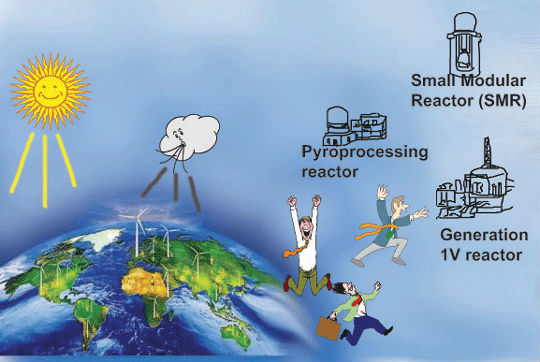
The message from the past is not promising……
False promise: nuclear power: past, present and (no) future http://www.theecologist.org/News/news_analysis/2988856/false_promise_nuclear_power_past_present_and_no_future.html David Elliott 12th April 2017
Nuclear power was originally sold on a lie, writes Dave Elliott. While we were being told it would make electricity ‘too cheap to meter’, insiders knew it cost at least 50% more than conventional generation. Since then nuclear costs have only risen, while renewable energy prices are on a steep decline. And now the nuclear behemoths are crumbling … not a moment too soon.
In a December 1953 speech to the United Nations, President Dwight D. Eisenhower launched the ‘Atoms for Peace’programme, saying:
“The miraculous inventiveness of man shall not be dedicated to his death but consecrated to his life.”
He claimed that “peaceful power from atomic energy is not a dream of the future. That capability, already proved, is here – now – today.” And the USA would help to ensure it could be used worldwide.
However, his advisors soon told him that it wasn’t viable. A classified internal State Department Intelligence Report, circulated in January 1954, ‘Economic Implications of Nuclear Power in Foreign Countries‘, warned that the introduction of nuclear power would
” … not usher in a new era of plenty and rapid economic development as is commonly believed. Nuclear power plants may cost twice as much to operate and as much as 50 percent more to build and equip than conventional thermal plants.” [Quoted by Mara Drogan in ‘The Nuclear Imperative: Atoms for Peace and the Development of U.S. Policy on Exporting Nuclear Power, 1953-1955 Diplomatic History 40 Issue 5 948-974.]
Nonetheless, the nuclear juggernaut rolled on, with, US Atomic Energy Commission Chairman Lewis Strauss, in a 1954 address to science writers, claiming: “It is not too much to expect that our children will enjoy in their homes electrical energy too cheap to meter.”
The USA, followed by the UK, France, Russia and Japan, poured vast resources into nuclear power – new plants and new research projects.
Murphy’s law of nuclear power?
But things didn’t always go to plan. For example, there took place a series of accidents at US experimental reactor test sites, including an explosion at the SL1 project in Idaho in 1961, which killed three operators – one of whom was impaled to the roof by a fuel rod.
Then in 1966, the Fermi fast reactor, near Detroit, suffered a fuel melt down, and in 1979, the Pressurised Water Reactor (PWR) at Three Mile island narrowly avoided a major hydrogen explosion by venting radioactive gas to the air. That signalled the end of nuclear growth in the the USA. The multi-billion dollar plant had to be written off. Opposition mounted. New plants, orders collapsed.
Then came the Chernobyl disaster in the Ukraine in 1986, with the cloud spreading across most of Europe. There was a global meltdown in orders for new plants.
However, it wasn’t just the accidents that were the problem. The poor economics of nuclear gradually became more apparent- as cheaper alternatives began to emerge. It turned out to be too expensive – e.g. it could not compete with cheap gas plants in the UK. As Lord (Walter) Marshall, one- time head of the UK Atomic Energy Authority, when chair of the CEGB in 1987, commented:
“The British Public have never had the cheap electricity that we have always promised from nuclear power. It has been, and continues to be, a case of ‘jam tomorrow, but never today’.”
But for our politicians, the nuclear dream never died
But that didn’t stop Marget Thatcher from pushing ahead with a new nuclear plant (a PWR) at Sizewell, work on it starting in 1987. Or Tony Blair later trying to relaunch a new programme “with a vengence”. That has still yet to happen. But it’s pending, with the £24 billion Hinkley Point C European Pressurised-water Reactor (EPR), if it goes ahead, being the first new UK plant in 30 years.
Fukushima, in 2011, had intervened, slowing the nuclear programme worldwide, and creating liabilities of hundreds of billions of dollars. But the UK has pressed ahead with plans for maybe 18GW of new plant – delivering around 30% of UK electricity in the 2030s.
This expansion is based on so-called ‘Generation III’ reactors, basically upgrades of the Generation II PWRs and similar designs that have been the mainstay of nuclear so far. The new versions are unlikely to be any more competitive against cheap gas and increasingly cheap renewables.
The nuclear industry still has hopes for the French EPR, the Toshiba / Westinghouse AP1000 and the Hitachi ABWR – an upgrade of the Fukushima boiling water reactor design.
But the EPRs being built in France and Finland, Flamanville and Olkiluoto, are both around eight years late and three times over budget. Flamanville’s gigantic stainless steel reactor vessel and dome is also suffering from serious metallurgical flaws which may yet prevent its completion.
The two AP1000s being built in the USA have also been delayed, creating losses of over $10 billion that have pushed Westinghouse into bankruptcy, and its Japanese parent company, Toshiba, into what may prove to be a terminal financial meltdown. The two ABWRs under construction in the US are also seriously behind schedule.
Generation IV reactors to the rescue?
Given these problems, some look to new ‘Generation IV’ designs. They are basically new versions of the old designs looked at in the 1950s, 60s and 70s in the USA and elsewhere – and abandoned as unviable, or after accidents.
They include fast neutron plutonium breeders, High Temperature Reactors (HTRs) and Molten Salt Reactors (MSR) possibly using thorium as a fuel and possibly also in scaled down Small Modular Reactor (SMR) format.
The message from the past is not promising. Most countries (US, UK, France) gave up on fast breeders in the 1980s and 1990s. Japan has now too. The UK tested an HTR in the 1960s with its Dragon project at Winfrith. Germany and the USA had a go too. The US also tested some MSR technology in the 1960s, and also the use of thorium as fuel. SMRs were also tested.
None of these ideas went forward owing to massively escalating costs and successive technical dificulties. But the industry claims that new variants on these old designs will be upgraded, cheaper and safer.
However, in a review of Generation IV options, the French nuclear agency IRSN said that, at the present stage of development, it did not see any evidence that “the systems under review are likely to offer a significantly improved level of safety compared with Generation III reactors, except perhaps for the High Temperature Reactor” – and even that would require “significantly limiting unit power”.
Allison MacFarlane, former chair of the US Nuclear Regulatory Commission, talking about the HTR, said “I do not see past experience pointing at a positive direction.”
She also noted that Fast Breeder Reactors “turn out to be very expensive technologies to build. Many countries have tried over and over. What is truly impressive is that … many governments continue to fund a demonstrably failed technology.”
As nuclear power grows more costly, renewables prices plunge
Cost reduction is clearly vital if any of these ideas is to prosper. That’s one of the arguments used for small modular reactors (SMRs): they would be faster to build and so possibly easier to finance. It might also be possible to use the waste heat from them to supply heat to urban areas – if residents would accept them in or near cities.
But is that likely? SMRs are very unlikely ever to be cheap. The reason why civil nuclear power stations ever got so big as the EPR (1.6GW), ABWR (1.6GW) and AP1000 (1.25GW) is to reap ‘economies of scale’ which would be lost by going small.
And of course there is nothing remotely ‘new’ about SMRs, indeed they are a distinctly mature technology: hundreds of them have been deployed in military submarines and ships, for decades. The reason why they were never used for civil power generation is simple – they cost too much! So what exactly is about to change?
In any case all these Generation IV ideas are a decade or two, or maybe more, away from anything approaching commercial reality. It’s like the situation renewables faced in the 1980s. Renewables did break through and are now viable – wind and PV solar especially. Will Generation IV nuclear be able to do the same? Or do we need to wait until Generation V – fusion? If that ever works. Or do we actually need any of these nuclear ideas?
Renewables have outperformed nuclear across the board – undercutting its cost and delivering over twice its total annual output globally: renewables now supply 24% of global electricity, and are growing rapidly, as against the fairly static 11.5% from nuclear.
Renewables are on the way to 50% of power production in many countries by 2030, and maybe close to 100% by 2050. The resource is huge, and, unlike uranium or thorium, it won’t ever run out, or leave long-term hazardous wastes. That looks like our best future.
April 14, 2017
Posted by Christina Macpherson |
2 WORLD, history, spinbuster |
Leave a comment
 Nuclear Power’s Original Mistake: Trying to Domesticate the Bomb, Bloomberg View, APRIL 8, 2017
Stephen Mihm “……….In July 1953, the construction of the nation’s first full-scale civilian nuclear power plant was funded. Much of this, as historian Paul Boyer has
observed, was driven by a desire to find a “silver lining” in the mushroom cloud. While Americans had generally supported the use of nuclear weapons on Japan, the growing specter of thermonuclear war in the 1950s sparked a growing desire to find peaceful applications for the new technology that would compensate for its destructive powers……….
Eisenhower wasted no time in trumpeting the news of the new plant. In December 1953, he appeared before the United Nations and delivered his “Atoms for Peace” speech. Eisenhower pledged that the United States would solve what he called the “fearful atomic dilemma” — to figure out how the new technology could improve life on Earth rather than destroy it.
Foremost among these was the promise of nuclear energy. “The United States knows that peaceful power from the atomic energy is no dream of the future,” he declared. “That capability, already proved, is here — now — today.”……..
The Shippingport plant soon began generating electricity, and the government pronounced the reactor a success. And on one level, it certainly was: it sparked the construction of dozens of nuclear power plants in the U.S. and abroad, a good number of them designed and built by Westinghouse. Everything miraculous about the nuclear power industry began at Shippingport.
But so did everything that is overwhelming it now. Aside from the cost overruns, the electricity produced by Shippingport was quite costly. Though Duquesne Light bought electricity from the government at the rate of 8 mills per kilowatt-hour, the actual cost ranged between 55 and 60 mills.
In succeeding decades, nuclear power costs declined, but the industry remained heavily dependent on subsidies. And in recent years, the investment cost of developing new nuclear plants ballooned from $2,065 per kilowatt in 1998 to $5,828 in 2015, according to a World Nuclear Association report…..
All of this bodes ill for the future of nuclear power. But the failure for nuclear to live up to its potential should hardly surprise us. It began as an idealistic attempt to domesticate the bomb in peacetime; the actual economic cost and benefits of doing was a secondary concern at best.
The world has spent nearly sixty years trying to make economic sense of nuclear power, with limited success. It may be time to pull the plug.
To contact the author of this story:
Stephen Mihm at smihm1@bloomberg.net
To contact the editor responsible for this story:
Mike Nizza at mnizza3@bloomberg.net https://www.bloomberg.com/view/articles/2017-04-08/nuclear-power-s-original-mistake-trying-to-domesticate-the-bomb
April 12, 2017
Posted by Christina Macpherson |
history, spinbuster, USA |
Leave a comment
Nuclear secrets you probably didn’t know about Colorado http://www.thedenverchannel.com/news/local-news/nuclear-secrets-you-probably-didnt-know-about-colorado, Robert Garrison Mar 31, 2017 DENVER – You might not know it, but Colorado played a major role in the nuclear arms race during the Cold War.
From the mining of uranium, nuclear testing, production and the disposal of Cold War weapons, Colorado had its hand in the nuclear defense of our country.
Here are some of Colorado’s nuclear secrets:
Uranium mining
The radioactive metal is used in the production of nuclear weapons, and Colorado had plenty to offer.
Uravan in western Montrose County was a mining town turned Superfund site. The Uravan mill was once part of the Manhattan project that produced uranium for the first atomic bomb.
The town once boasted a population of 800 (in the 1950s and 60s) and offered several amenities that any small towns of the era would have, including a swimming pool. But what many in the town didn’t know at the time, was that the uranium they were pulling out of the nearby hills was slowly killing them.
The town was abandoned in the 1980s and turned into a Superfund site. All of the former buildings were destroyed or moved out of the area.
Was there ever a nuclear detonation in Colorado?
Yes, there was.
Project Rullison was an underground 40-kiloton nuclear test near the Garfield County town of Parchute (then called Grand Velley).
The 1969 blast was part of a series of “peaceful” engineering tests to see how atomic weapons could be used to liberate natural gas from underground regions.
Rocky Flats
Perhaps one of the most well-known relics (and most contaminated sites) of the Cold War, Rocky Flats was a former nuclear weapons production facility near Denver.
The site operated from 1952 to 1992 and was the source of contamination issues throughout the decades. Cleanup began in the 90s and now nearly 4,000 acres of the site is set aside as a wildlife refuge. All of the former buildings from the time it was in operation have been destroyed.
April 1, 2017
Posted by Christina Macpherson |
history, USA |
Leave a comment
Native American uranium miners and the Trump budget, Bulletin of the Atomic Scientists Robert Alvarez, 30 Mar 17, Bulletin of the Atomic Scientists “…….The hazards of uranium mining have been known for centuries. As early as 1556, dust in the Ore Mountain (Erzgebirge) mines bordering Germany and what is now the Czech Republic was reported to have “corrosive qualities… it eats away the lungs and implants consumption in the body…” By 1879, researchers found that 75 percent of the miners in the Ore Mountains had died from lung cancer. By 1932, the Ore Mountain miners were receiving compensation for their cancers from the German government. Uranium mining was convincingly linked to lung cancer by dozens of epidemiological and animal studies by the late 1930s.
In 1942, Wilhelm C. Hueper, the founding director of the environmental cancer section of the National Cancer Institute, brought the European studies to light in the United States—concluding that radon gas was responsible for half of the deaths of European miners after 10 to 20 years of exposure. By this time, uranium had become a key element for the making of the first atomic weapons. Hueper’s superiors blocked him from further publication and discussion in this area; they told him that dissemination of such information was “not in the public interest.”
In fact, withholding information about workplace hazards was deeply embedded in the bureaucratic culture of the early nuclear weapons program. In 1994, the Energy Department made a previously secret document, written in the late 1940s, public. It crystallized the long-held rationale for keeping nuclear workers in the dark: “We can see the possibility of a shattering effect on the morale of the employees if they become aware that there was substantial reason to question the standards of safety under which they are working. In the hands of labor unions, the results of this study would add substance to demands for extra-hazardous pay.”
Kee Begay worked in the mines for 29 years and was dying of lung cancer when I first met him. “The mines were poor and not fit for human beings,” he told me. Begay also lost a son to cancer. “He was one of many children that used to play on the uranium piles during those years. We had a lot of uranium piles near our homes—just about 50 or 100 feet away or so. Can you imagine? Kids go out and play on those piles.”
In 1957, the US Public Health Service reported that the average radiation lung dose to Indian miners was 21 times higher than was allowed in the Atomic Energy Commission’s nuclear weapons plants. In 1962, the Public Health Service revealed that radon exposure in the mines was statistically linked to lung cancer among US miners—at a rate comparable to what Heuper had warned about 20 years earlier.
Lung disease associated with radon exposure was “totally avoidable,” former chief health scientist for the AEC Merrill Eisenbud said in 1979. “The Atomic Energy Commission … is uniquely responsible for the death of many men who developed lung cancer as a result of the failure of the mine operators, who must also bear the blame, because they too had the information, and the Government should not have had to club them into ventilating their mines………..”http://thebulletin.org/native-american-uranium-miners-and-trump-budget10657?platform=hootsuite
March 31, 2017
Posted by Christina Macpherson |
2 WORLD, history, Reference, Uranium |
Leave a comment
Nuclear core was unarmed, but 6,000 pounds of explosives detonated
WYFF News 4 Mar 13, 2017, Mars Bluff SC – This weekend was the 59th anniversary of an event many people don’t know happened in South Carolina. On March 11, 1958, a nuclear bomb was accidentally dropped on a small community near Florence.
A U.S. Air Force Boeing Stratojet that was flying out of Hunter Air Force Base took off at about 4:30 p.m. headed for the United Kingdom and then on to Africa. The aircraft was carrying nuclear weapons as a precaution in case war broke out with the Soviet Union.
The captain of the aircraft accidentally pulled an emergency release pin in response to a fault light in the cabin, and a Mark 4 nuclear bomb, weighing more than 7,000 pounds, dropped, forcing the bomb bay doors open. The bomb, which lacked an armed nuclear core, plunged 15,000 feet to the ground below…..http://www.wyff4.com/article/moose-on-the-loose-animal-races-to-catch-up-to-snowboarder/9131703
March 15, 2017
Posted by Christina Macpherson |
history, incidents, USA, weapons and war |
Leave a comment
DID HITLER HAVE A NUKE? Declassified US documents suggest Adolf Hitler successfully tested nuclear bomb during World War Two https://www.thesun.co.uk/news/2938529/declassified-us-documents-suggest-adolf-hitler-successfully-tested-nuclear-bomb-during-world-war-two/ Two pilots claim they witnesses a mushroom cloud while flying over Nazi Germany in 1944 BY ALLAN HALL 23rd February 2017
DOCUMENTS unearthed in an archive suggest that Adolf Hitler may have tested an operational nuclear bomb before the end of WW2. A recently declassified file from the National Archives in Washington is a detailed survey of how far Nazi scientists got in the development of an atomic bomb. In the file, obtained by the German newspaper Bild, the task of the academics who prepared the paper between 1944 and 1947 was the “investigations, research, developments and practical use of the German atomic bomb.”
The report was prepared by countless American and British intelligence officers and also includes the testimony of four German experts – two chemical physicists, a chemist and a missile expert. It concludes that Hitler’s boffins failed in the quest to achieve a breakthrough in nuclear technology – BUT that a documented test may have taken place of a rudimentary warhead in 1944.
The statement of the German test pilot Hans Zinsser in the file is considered evidence – the missile expert says he observed in 1944 a mushroom cloud in the sky during a test flight near Ludwigslust. His log submitted to the Allied investigators reads; “In early October 1944 I flew away 12-15 km from a nuclear test station near Ludwigslust. “A cloud shaped like a mushroom with turbulent, billowing sections (at about 7000 metres) stood, without any seeming connections over the spot where the explosion took place. “Strong electrical disturbances and the impossibility to continue radio communication as by lighting turned up.”
He estimated the cloud stretched for nine kilometres and described further “strange colourings” followed by a blast wave which translated into a “strong pull on the stick” – meaning his cockpit controls.
An hour later a pilot in a different machine took off from Ludwigslust and observed the same phenomenon.
According to other archival documents, the Italian correspondent Luigi Romersa observed on the ground the same explosion. He had been sent by dictator Benito Mussolini to watch the test of a “new weapon” of the Germans.He was ordered to report his impressions back to Mussolini.
It is known that Hitler pursued the goal of nuclear technology and wanted his V-2 rockets to be able to carry them to destroy the UK.
The testimony of the four German scientists in the declassified American report mentions a top secret meeting held in Berlin in 1943. Nazi weapons minister Albert Speer was present for the discussion called a “nuclear summit.”
In the end the report states that the Allies believe the Germans fell short of triggering the nuclear chain reaction necessary to trigger a nuclear blast.
But none could come up with an explanation for what occurred in the skies over Ludwigslust in 1944.
February 25, 2017
Posted by Christina Macpherson |
Germany, history, weapons and war |
Leave a comment

What I DO KNOW for a fact, is that, when war ended, Werner Von Braun and 260 other nuclear scientists were quickly taken to USA to work on America’s atomic bomb project

Adolf Hitler’s secret nuke plan REVEALED: Nazis plotted to drop A-bomb on London http://www.dailystar.co.uk/news/latest-news/585184/Nazi-Nuclear-Bomb-Adolf-Hitler-London-Nuke-Heavy-Water-Allies-Axis-Damien-Lewis-V2-Rocket
ADOLF Hitler was on the brink of unleashing a nuclear bomb and plotted to drop the devastating weapons on London. By Henry Holloway / Published 5th February 2017 Nazi scientists were “years” ahead of their Western counterparts as they steamed ahead with developing a nuclear device.As well as the tank divisions sweeping across the Europe and naval war in the Pacific, a secret war was waged between the Allies and the Axis.
World War Two became a race to the nuclear bomb, and the Nazis were on the verge of winning, says respected British author Damien Lewis.
Daily Star Online can now exclusively reveal just how close Britain came to nuclear armageddon.
Hitler enjoyed a horrifying perfect storm of brilliant scientists and slave labour in his race to the nuclear bomb, Mr Lewis – who has penned books such as
Hunting Hitler’s Nukes and
The Nazi Hunters – told Daily Star Online.
The former war reporter spent dozens of hours trawling through archives and documents as declassified files revealed the true threat from the Nazi nuke.
Hitler’s scientists were “two years” ahead of the allies, he said.
Nazi engineers planned to mount dirty bombs and nuclear warheads on the tips of Hitler’s devastating Vengeance V2 rockets – which could not be shot down by AA guns or chased by fighter planes because they were too fast.
Classified missions and projects to undercut the Nazis to either beat them to the bomb, or stop their nuclear programme saw a secret war waged beneath World War 2. Nazi nukes were a threat right up to the final days of the war when the Americans discovered the Third Reich’s nuclear reactor hidden in a cave beneath a church in the tiny village of Haigerloch, Germany.
“General Groves was the head of the Manhattan Project. In April 1945 he cabled the White House and told them ‘only now can I tell you the threat of a Nazi nuclear strike is over’,” said Mr Lewis.
Winston Churchill and Franklin D. Roosevelt took the threat so seriously the British Prime Minister flew across the Atlantic in a giant flying boat for a meeting about the threat in January, 1942, he adds. Hitler considered nuclear bombs the “ultimate terror weapons” and would have targeted cities such as London and New York.
Daily Star Online revealed Hitler’s obsession with terror weapons such as the monster tank the Panzer-1000 Ratte.
Mr Lewis told Daily Star Online the Germans had the resources and manpower to produce “scores of improvised nuclear devices and they could have engineered a full atom bomb”.
He said: “You are looking at a scenario where the world leaders were very concerned about the technology and its kill-rate.
“So behind the scenes you had special operations prioritising efforts to stop Hitler’s nuclear programme.
“Part of it was the Manhattan Project, part of it was sabotage efforts, and the third part was all about getting ready.” The author revealed reports to the Allies in late 1943 on the Nazi nukes said the Reich “had the technology and the wherewithal”.
“The concern was rooted in absolute science, the Nazis had working reactors, they had the raw materials, and they had the delivery system,” said Mr Lewis.
Both the US and Britain quaked in the face of the nuclear bomb, with discussions about evacuating Washington at Christmas, 1943, and rumours of a successful blast test in Nazi-occupied Russia.
Nazi efforts were hampered by daring Allied missions such as Operation Gunnerside which sabotaged Hitler’s heavy water plant in Norway – one of the key elements needed for atom bombs.
Operation Peppermint was a massive undertaking launched to prepare the troops during the D-Day landings from nuclear attack and analyse V2 detonation sites for radiation. But as the war on the sea, in the air and on land tipped in favour of the allies, Mr Lewis believes the Nazis hoped to use a nuclear weapon as a “bargaining chip” to sue for peace.
However, he says it is a mystery as to why the Third Reich did not use the technology that was tantalisingly within their reach.
“It is a brilliant question,” he said “I cannot give an answer from documents, but there will be an answer in a secret file somewhere which won’t be available for another 50 years.
“There is always back channels, always conversations during a war, so I am sure there must have been something like that.
“The allies must have said ‘if you use the nuclear material you have to hand, we will respond in this way’ – it does not make sense other wise.”
February 6, 2017
Posted by Christina Macpherson |
history, weapons and war |
Leave a comment