Injecting dogs with plutonium – to prove what?
Nuclear radiation, Kierkegaard, and the philosophy of denial, The Ecologist, Chris Busby 8th January 2016 “……….Injecting dogs with plutonium – to prove what?
 Some years ago I was up against one of these hormesis geezers, a certain Dr Otto Raabe, in a court case in America. He was the expert for the defence. Raabe was in charge of the Beagle dog studies in New Mexico.
They injected these poor creatures with Plutonium, Radium or Strontium-90 and watched them develop bone cancer and leukemia. The doses were enormous, the number of dogs was small (cost). The whole place was contaminated with Plutonium, the particles hanging in the air like fairy dust. The burial site for the dogs is so radioactive it is fenced off as a US superfund site for decontamination.
Raabe’s thing was that he had mathematically converted beagle dogs into humans: you should just see his amazing three dimensional graphs (these guys love all that stuff). Well you can probably find them somewhere on the internet.
The best thing was that in one of his papers he discussed how difficult it was to do these beagle studies. He wrote that 12 (yes 12) of his control dogs (no injections of Plutonium) had unfortunately died of lung cancer and had to be removed from the analysis. What!!?
I checked out the rates of lung cancer in dogs (you can find everything on the web) and that was the end of Raabe. Low dose, you see. Fairy dust………..http://www.theecologist.org/essays/2986384/nuclear_radiation_kierkegaard_and_the_philosophy_of_denial.html
America’s secret plutonium experiments on humans
Then there is the horrifying reality that these experiments were taking place in the shadow of Nazi Germany; some of the scientists involved in the radiation experiments were the very men whose earlier experimental designs had tormented prisoners of concentration camps. Welsome describes Operation Paperclip, conducted under the auspices of the U.S. government. Paperclip imported Nazi scientists and supported their work, helping to confer, in the words of scientist Joseph G. Hamilton, “a little of the Buchenwald touch” on American medicine.
This valuable work represents an elegy to lost ideals, lost health, and lost trust. One can only hope it will serve as a cautionary tale.
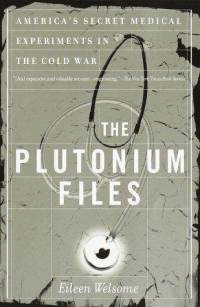 The Plutonium Files: America’s secret medical experiments in the Cold War N Engl J Med 1999; 341:1941-1942 December 16, 1999 Harriet A. Washington
The Plutonium Files: America’s secret medical experiments in the Cold WarBy Eileen Welsome. 580 pp. New York, Dial Press, 1999. $26.95. ISBN: 0-385-31402-7
Amid the embarrassments of Monicamania and of multiple public mea culpas, the past few years have not been exemplary ones for American journalism. This fact makes the triumph of The Plutonium Files all the sweeter, because this superlative book is a reminder of the purpose of investigative journalism.
This richly detailed, subtly nuanced history of government-engineered radiation experiments on unwitting Americans is based on the Pulitzer-prize–winning series Eileen Welsome wrote for the Albuquerque Tribune. Welsome’s tenacious and resourceful detective work has unveiled the saga of a sordid, tragic, yet fascinating chapter in the history of American medical science. The book succeeds on many levels. It is a gripping exposé of governmental exploitation and of medicine’s moral failures in an era in which blind trust defined the normal relationship between physicians and patients.
Between April 1945, scant months before the bombing of Hiroshima, and July 1947, the scientists of the Manhattan Project followed the construction of the atomic bomb with a chilling second act: medical experimentation on hundreds of unsuspecting Americans. Continue reading
Secret radiation experiments carried out on people
Some of the classified government experiments included:
 * Exposing more than 100 Alaskan villagers to radioactive iodine during the 1960s.
* Feeding 49 retarded and institutionalised teenagers radioactive iron and calcium in their cereal during the years 1946-1954.
* Exposing about 800 pregnant women in the late 1940s to radioactive iron to determine the effect on the fetus.
* Injecting 7 newborns (six were Black) with radioactive iodine.
* Exposing the testicles of more than 100 prisoners to cancer-causing doses of radiation. This experimentation continued into the early 1970s.
* Exposing almost 200 cancer patients to high levels of radiation from cesium and cobalt. The AEC finally stopped this experiment in 1974.
* Administering radioactive material to psychiatric patients in San Francisco and to prisoners in San Quentin.
* Administering massive doses of full body radiation to cancer patients hospitalised at the General Hospital in Cincinnati, Baylor College in Houston, Memorial Sloan-Kettering in New York City, and the US Naval Hospital in Bethesda, during the 1950s and 1960s. The experiment provided data to the military concerning how a nuclear attack might affect its troops.
* Exposing 29 patients, some with rheumatoid arthritis, to total body irradiation (100-300 rad dose) to obtain data for the military. This was conducted at the University of California Hospital in San Francisco.
—In preparing America for nuclear attack during the Cold War years following World War II, thousands of US citizens became the innocent victims of over 4,000 secret and classified radiation experiments conducted by the Atomic Energy Commission (AEC) and other government agencies, such as the Department of Defense, the Department of Health, Education and Welfare, the Public Health Service (now the CDC), the National Institutes of Health, the Veterans Administration (VA), the CIA, and NASA.
Millions of people were exposed to radioactive fallout from the continental testing of more than 200 atmospheric and underground nuclear weapons, and from the hundreds of secret releases of radiation into the environment. Over 200,000 “atomic vets” who worked closely with nuclear detonations at the Nevada test site during the 1950s and 1960s were especially vulnerable to radiation fallout.
Also affected were the thousands of so-called “downwinders”, who lived in nearby small towns in Nevada, Utah, Colorado and New Mexico. These downwinders (along with the animal populations) suffered the worst cumulative radioactive effects of fallout, along with a contaminated environment teeming with radioactive food and farm products. The plight of these poor country people exposed to government-induced radiation sickness has been recorded in Carole Gallagher’s remarkable photo-essay American Ground Zero: The Secret Nuclear War (The Free Press, 1993).
In reviewing declassified AEC records (now the Department of Energy) from the 1950s, Gallagher was shocked to discover one document that described the people downwind of the Nevada Test Site as “a low use segment of the population.” Her shock at such callous bigotry caused her to eventually move West to research, investigate and document those who lived closest to the Test Site, as well as workers at the site, and soldiers repeatedly exposed to nuclear bombs during the military tests.
Disinformation and Nuclear Fallout
In the nuclear arms race, government doctors and scientists brainwashed the public into believing low dose radiation was not harmful. Some officials even tried to convince people that “a little radiation is good for you.” Totally ignored was the knowledge that the radiation from nuclear fallout could lead to an increased risk of cancer, heart disease, neurological disorders, immune system disease, reproductive abnormalities, sterility, birth defects, and genetic mutations which could be passed on from generation to generation. The full extent of this radiation damage to the American public during the Cold War years will never be known. Continue reading
Radiation Risk : Linear No Threshold (LNT) Model Tested
Radiation Risk: Linear No Threshold (LNT) Model Tested
How plutonium infiltrates the body’s cells
 Plutonium Trojan Horse in the Body , Mining Awareness Plus, 26 Feb 15 Plutonium shares some important similarities with biologically important trivalent transition metals, especially iron. This could have importance from a material science point of view, as well.
“Plutonium tricks cells by ‘pretending’ to be iron
By Jared Sagoff July 8, 2011
Plutonium gets taken up by our cells much as iron does,…
Researchers at the U.S. Department of Energy’s Argonne National Laboratory and Northwestern University have identified a new biological pathway by which plutonium finds its way into mammalian cells. The researchers learned that, to get into cells, plutonium acts like a ‘Trojan horse,’ duping a special membrane protein that is typically responsible for taking up iron.
This discovery may help enhance the safety of workers who deal with plutonium, as well as show the way to new ‘bio-inspired’ approaches for separating radioactive elements from other metals in used nuclear fuel.
Because the bodies of mammals have evolved no natural ability to recognize plutonium—the element was first produced in 1941—scientists were curious to know the cellular mechanisms responsible for its retention in the body. The researchers exposed adrenal cells from rats to minute quantities of plutonium to see how the cells accumulated the radioactive material.
Using the high-energy X-rays provided by Argonne’s Advanced Photon Source, the researchers were able to characterize a particular protein known as “transferrin,” which is responsible for bringing iron into cells. Each transferrin is made up of two subunits, known as N and C, that normally bind iron. When another protein—the transferrin receptor—recognizes both the N and C subunits, it admits the molecule to the cell. However, when both the N and C subunits contain plutonium, the transferrin receptor doesn’t recognize the protein and keeps it out.
Contrary to their expectations, the researchers discovered that in one of the mixed states—when an iron-containing N-subunit is combined with a plutonium-containing C-subunit—the resulting hybrid so closely resembles the normal iron protein that the uptake pathway is ‘tricked’ into allowing plutonium to enter the cell.
‘Although the interaction between plutonium and bodily tissues has been studied for a long time, this is the first conclusive identification of a specific pathway that allows for the introduction of plutonium into cells,’ said Mark Jensen, an Argonne chemist who led the research.
… The research was funded by the U.S. Department of Energy’s Office of Science as well as by the National Institutes of Health.”http://www.anl.gov/articles/plutonium-tricks-cells-pretending-be-iron Author manuscript found here: “An iron-dependent and transferrin-mediated cellular uptake pathway for plutonium“, Mark P. Jensen et. al. (http://www.ncbi.nlm.nih.gov/pmc/articles/PMC3462652/)
From the Jensen et. al. author manuscript: “… Pu is radiotoxic and is strongly retained by organisms1, Pu uptake from an accident, environmental contamination, or a nuclear or radiological attack can pose significant health risks. Plutonium localizes principally in the liver and skeleton in humans where it remains for decades2. It associates in vivo with the iron-containing proteins serum transferrin and ferritin3,4, but despite the danger of plutonium poisoning, the specific molecular-level pathways Pu travels to enter and localize in cells have never been identified2,5…”………. https://miningawareness.wordpress.com/2015/02/26/plutonium-trojan-horse-in-the-body/
Scientists used X ray images to prove the ecosystem damage from ionising radiation

 The X-Ray Images That Showed Midcentury Scientists How Radiation Affects an Ecosystem http://www.slate.com/blogs/the_vault/2015/12/28/how_midcentury_ecologists_used_x_ray_radioautographs_to_see_how_radiation.html By Laura J. Martin In June 1947, biologists from the University of Washington collected a wrasse from the waters around Bikini Atoll, squished it against a photographic plate, and took an x-ray. The resulting image shocked them. Almost an entire year had passed since the United States had detonated “Able” and “Baker,” two fission bombs, at the atoll. The scientists involved in the Bikini Scientific Resurvey were certain that the expansive Pacific Ocean would have quickly diluted and dispersed any radioactive products from the 1946 detonations.
And yet here, in dazzling white, was radiation revealed. Bikini Atoll’s biota had absorbed the products of the explosions. More curious, still: the radioactivity was not distributed evenly across a fish’s body. It seemed to be concentrated in the digestive system.
The U.S. Atomic Energy Commission was the main funder of ecological research in the United States from World War II until the 1970s. Between 1946 and 1962, the United States exploded 105 atomic and nuclear weapons in these inhabited Pacific atolls, changing their ecology, as well as the science of ecology itself. During this time the Commission continued to contract ecologists from the University of Washington and other institutions to return to the proving grounds.
The first studies done by the University of Washington Radiation Ecology laboratory—assembled by the Manhattan Project under strict confidentiality in 1943—had reflected the Manhattan Project’s belief that the major hazard of atomic technology was prolonged exposure to external sources of highly penetrative gamma radiation. The biologists burned specimens to ash and then passed those ashes through a Geiger counter. But during the Bikini Scientific Resurvey, they decided to employ a relatively new and more efficient method, “radioautography,” based on the assumption that a radioactive sample placed against photographic film would produce a brighter or darker image, depending on how much radiation reacted with the film.
Over the next two decades, such radioautographs led to the emergence of the idea that radiation is “biomagnified” as it moves up the food chain. This concept wouldprove essential to convincing legislators to ban DDT and restrict other pollutants. Interconnections among species—the objects of abstract flow charts in the 1930s —became brilliantly visible.
A number of other photos from the Pacific Surveys can be viewed at the University of Washington’s Digital Collection at this link.
Laura J. Martin is an environmental historian. She is a Ziff Environmental Fellow at the Harvard University Center for the Environment and a postdoc in the Department of the History of Science. Visit her website or find her on Twitter.
USA: Your town’s radiation levels this week

 Fukushima Update: “Your Radiation This Week, BEFORE IT’S NEWS, Dec 19 to Dec 26, 2015″ By Bob Nichols
Normal Radiation is 5 to 20 CPM. 50 CPM is an alert level.
RADIATION CPM* • TIMES NORMAL BACKGROUND LEVEL • CITY, STATE • TYPE (
Baby Pulse Spikes Rad Monitors in US: ..……
“Radiation Sensors in Major U.S. Cities Turned Off By EPA
BEFORE IT’S NEWS, Dec 19 to Dec 26, 2015″ By Bob Nichols”………“Radiation Sensors in Major U.S. Cities Turned Off By EPA”: Billings, Montana on Oct 16, 2015 was reading a Combined Beta and Gamma Rad of 1,227 Beta and 703 Gamma for a Combined reading of 1,930CPM. The Beta Rad unit stopped publicly reporting, then four (4) days later on Oct 20, 2015 at 12:37:25 the unit came to life again. It’s… ahh, personality had changed, though. The new Beta and Gamma reading was 926 Beta and 401 Gamma. The new Combined radiation number on Oct 20 was 1,227 CPM Combined. The Combined reading was 603 CPM less than it was 4 days before. There was no Note or Comment on the missing four days. It was a 4 Day Rad Gap and an unexplained disappearance of 603CPM. The disappearing CPM was comprised of 302 CPM Gamma and 301 CPM Beta. In the next 4 Hours the Combined CPM eroded another 550 CPM for a total CPM Loss of 1,153 CPM. Billings, Montana today is barely in the List of cities above 1000 CPM. Billings is now 23rd on the list and reads 1,101 CPM. The missing Radiation remains “Unaccounted For.” Presumably it [the radiation] did not go to the Moon; therefore, it is on Earth somewhere now. (So, they apparently tried to “rig” the system and failed, so instead turned it all off. Just my hunch… – CP)Increased risk of cancer for American heart patients due to diagnostic radiation exposure
 American patients are ‘exposed to excessive radiation during heart tests – raising the risk of cancer’, Daily Mail, 29 Dec 15
- Scientists revealed US heart patients face higher risk of radiation exposure
- Myocardial perfusion imaging is used to diagnose coronary artery disease
- The imaging technology requires the use of radiation, the study said
- US patients receive a 20% higher radiation dose during these tests
- That’s because US facilities don’t closely follow radiation dosing guidelines
By LISA RYAN FOR DAILYMAIL.COM , 30 December 2015 |…………..Dr Einstein said the results from the studies show that doctors must do more to minimize radiation exposure.
That’s because radiation exposure will still cause cancer in a small – but real – number of patients, according to Dr Rebecca Smith-Bindman of the University of California, San Francisco.
Dr Smith-Bindman wrote, in an accompanying editorial: ‘The right imaging tests performed at the right time can lead to earlier and more accurate diagnoses, better treatment decisions and improved patient outcomes, and advanced imaging has had a very positive impact on patient care.’
Yet, she cautioned that ‘unnecessary and inappropriately performed tests cause patients discomfort and anxiety
They can lead to a large number of irrelevant incidental findings and expose them to ionizing radiation – which can have negative effects on their health – she concluded.
The studies were published in JAMA Internal Medicine. http://www.dailymail.co.uk/health/article-3377866/American-patients-exposed-excessive-radiation-heart-tests-raising-risk-cancer.html
Official data now reveals hugh extent of Fukushima radiation to USA West Coast
OFFICIAL DATA: FUKUSHIMA BOMBARDED WEST COAST WITH 790X NORMAL RADIATION http://www.thedailysheeple.com/official-data-fukushima-bombarded-west-coast-with-790x-normal-radiation_122015 DECEMBER 14, 2015 | JOSHUA KRAUSE | THE DAILY SHEEPLE |Ever since the meltdown of the Fukushima Daiichi power plant in 2011, our government has been pretty quiet about the environmental and health implications of that disaster. When the plant first melted down, much of our population was justifiably alarmed. After all, many of us remembered the Chernobyl incident and how the radiation it produced spread all across Europe, and in smaller amounts, the world.
But the government assured us that everything would be fine, and at most we would see a negligible amount of radioactive particles in the United States. Everyone who said otherwise was and still is, called a quack or a conspiracy theorist.
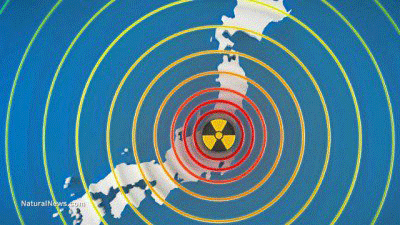
However, official government data that was collected in 2011 has just seen the light of day, and it suggests that our initial concerns were probably correct. The information was collected by officials with Los Angeles County when concerns were raised by residents. After state and federal agencies failed to test the area for radiation in a timely manner, the county hired their own people to run the test. Natural News reported on the results.
Samples were taken between April 29 and May 2, 2011, approximately seven weeks after the radioactive releases from Fukushima. The county found that gross alpha radiation levels at a location in Los Angeles were 300 femtocuries per cubic meter (fCi/m3), and levels at a Hacienda Heights location were 200 fCi/m3.
For context, the Lawrence Livermore National Laboratory reports the average (annual median) level of gross alpha activity for the state of California as just 0.38 fCi/m3 – that is, 790 times lower.
The levels detected in Los Angeles County were a full 100 times higher than the level that requires an investigation at a U.S. nuclear laboratory, according to the Environmental Monitoring Plan at Brookhaven National Laboratory: “If the gross alpha activity in the [air] filters is greater than 3 fCi/m3, then collect more samples in the vicinity, and project manager will review all detections above the limits … All values greater than the above-stated gross alpha/beta concentration shall trigger an investigation.”
Finally, the Los Angeles County levels were almost 15 times higher than the federal regulatory limit for alpha radiation, which is 21 fCi/m3, according to a 2010 document from Idaho National Laboratory.
Moreover, the alpha radiation emitting particles that were deposited on the West Coast are incredibly dangerous for humans. While Gamma and Beta Radiation have far more power and penetration, Alpha rays produce a tremendous amount of damage in the human body when ingested. Because they don’t penetrate materials like Gamma rays do, all of their energy is deposited into the cells that reside near the particle.
More importantly, it doesn’t take very many of these particles to ruin your long-term health. For instance, if you were exposed to a temporary large dose of radiation, your body could probably recover from it, perhaps without even developing cancer. But when the particle itself is embedded in your tissue for weeks, months, and in some cases for years, as it destroys and mutates surrounding cells over and over again, you can expect a significantly shorter lifespan. Even if the amount radiation is small, it’s also continuous, and its source is difficult to remove
So while the government was telling us that everything was hunky dory in the weeks after the Fukushima meltdown, major West Coast cities like Los Angeles were being drenched in alarming levels of this radioactive waste.
Who knows how much of that fell onto the countless farms in the Central Valley, which feed much of the United States? And since they failed to inform us about the danger we were in then, who knows how much danger we are in now? Our government hates to admit when its wrong (or they won’t admit that they lied to us), so if we are still in danger, somehow I doubt they will have anything to say to us now.
Delivered by The Daily Sheeple
We encourage you to share and republish our reports, analyses, breaking news and videos (Click for details).
Contributed by Joshua Krause of The Daily Sheeple.
Joshua Krause is a reporter, writer and researcher at The Daily Sheeple. He was born and raised in the Bay Area and is a freelance writer and author. You can follow Joshua’s reports at Facebook or on his personal Twitter. Joshua’s website is Strange Danger .
America’s nuclear workers: 33,480 died from radiation- caused illnesses
At least 33,480 US nuclear workers died of exposure: Report http://www.presstv.ir/Detail/2015/12/13/441510/US-nuclear-arsenal-dead-Cold-War A yearlong investigation reveals that America’s great push to win World War II and the Cold War has left “a legacy of death on American soil,” with at least 33,480 US nuclear workers dying of radiation exposure over the course of the last seven decades.
The death count, disclosed for the first time, is more than four times the number of American fatalities in the wars in Iraq and Afghanistan, according to a report from McClatchy called “irritated.”
The investigation has exposed the “enormous human cost” of the US nuclear weapons complex using more than 70 million records in a database obtained from the US Department of Labor under the Freedom of Information Act.
The count includes all workers who died after they or their survivors were compensated under a special fund established in 2001 to help those who were exposed to deadly materials while building the US nuclear stockpile, the report said.
A total of 107,394 workers, involved in the construction of America’s nuclear arsenal, have been diagnosed with cancers and other diseases over the last seven decades, records from an interactive database showed.
In addition to utilizing the federal data, McClatchy’s investigation is also based on over 100 interviews with nuclear workers, government officials, experts and activists.
The report noted that US government officials greatly underestimated how sick the nuclear workforce would become. At first, the government estimated that the compensation program would cost $120 million a year to cover 3,000 people. However, 14 years later, the government has spent $12 billion of taxpayer money to compensate more than 53,000 nuclear workers.
Despite the enormous costs, federal records show that only fewer than half of those who sought compensation have had their claims approved by the US Department of Labor.
Decades after the first victims of the radiation exposure have been identified; McClatchy’s investigation revealed that current safety standards have not reduced the exposure rates and day-to-day accidents in America’s nuclear facilities.
The government, meanwhile, seeks to save money by cutting current workers’ health plans, retirement benefits and sick leave. More than 186,000 nuclear employees have been exposed since the compensation program was created in 2001.
McClatchy conducted the project in partnership with the Investigative Fund of the Nation Institute, a nonprofit media center in New York City.
The report comes as the US prepares to upgrade its aging nuclear arsenal to the tune of $1 trillion over the next 30 years.
Astronauts teaching doctors on the hazards of ionising radiation?
Doctors, astronauts learn radiation dangers from each other Dr. Diethrich developed a brain tumor – one he believes came from years of exposure to radiation KHOU.com 8 Dec 15 HOUSTON — Each year in the Texas Medical Center, hundreds of experts in medicine, energy, aerospace and academia gather to share ideas and collaborate across disciplines, finding ways their industries can learn from each other.
This year at the ninth annual Pumps and Pipesgathering at Houston Methodist, a celebrated surgeon offered his misfortune as a warning to travelers in a seemingly unrelated field: Future astronauts bound for Mars.
Dr. Edward Diethrich is one of the world’s foremost experts on endovascular surgery. He studied under Michael E. DeBakey, M.D. at Houston Methodist Hospital and started the Arizona Heart Institute. But a few years ago he developed a brain tumor – one he believes came from years of exposure to radiation.
“We didn’t know anything about radiation. We were surgeons,” Diethrich said. “I was being radiated from dusk to dawn not even thinking about it. We had to do what we had to do. We wanted to make patients well. Didn’t even think about ourselves.”…..
Diethrich was a pioneer in fluoroscopy – X-ray guided surgical procedures. And, in his presentation Monday, offered his dilemma has a warning and a challenge to NASA scientists designing radiation protection for future Mars-bound astronauts…….
“There is no such thing as good radiation. So that’s really the message that needs to come out of this. Whatever we can do to mitigate it is important,” said Alan B. Lumsden, MD, Medical Director, Methodist DeBakey Heart & Vascular Center. “I think that particularly we as surgeons, and I’m sure probably astronauts probably worse than we are in that respect, often tend to think you’re indestructible.”……http://www.khou.com/story/news/health/2015/12/08/doctors-astronauts-learn-radiation-dangers-from-each-other/76965756/
Coal ash is NOT more radioactive than nuclear waste
 Coal ash is NOT more radioactive than nuclear waste http://www.cejournal.net/?p=410 The idea that coal ash is 100 times more radioactive than nuclear waste has been making the rounds among bloggers and Twitterers discussing the coal ash catastrophe in Tennessee, thanks to a headline which makes that assertion in Scientific American online. In fact, Google the words in the headline and you’ll come up with dozens of Web sites that have repeated this statement.
The problem is that it is a profoundly preposterous idea unsupported by a single shred of evidence. Continue reading
Why pilots and air hostesses are classified as radiation workers
 Here’s why airline crewmembers are classified as radiation workers http://www.techinsider.io/airplane-flight-cosmic-radiation-exposure-altitude-2015-11 Julia Calderone Nov. 19, 2015
Airline crewmembers have tough jobs. They have to maintain an aircraft’s safety while dealing with grumpy and inattentive passengers — all while keeping smiles on their faces.
But flight attendants and pilots also face an unseen menace on the job: Cosmic radiation.
You can’t see it or feel them, but at any given moment, tens of thousands of highly charged particles are soaring through space and slamming into Earth from all directions.
These particles, sometimes called cosmic rays or cosmic ionizing radiation, originate from the farthest reaches of the Milky Way. They’re bits and pieces of atomic cores shot to nearly light-speed by black holes and exploding stars, and they smash into (and through) anything and everything in their way.
With that incredible speed and energy, it’s no surprise cosmic rays can easily penetrate human flesh and, in the process, pose risks to our health. Their damage to tissues and DNA have been linked to cancer and reproductive problems, for example.
The good news is that these rays don’t pose much of a risk to humans on Earth. That’s because our planet’s atmosphere and magnetic field form a mighty shield against these rays. But the shield isn’t impenetrable, and some particles leak through.
Those who spend a lot of time high up in the atmosphere — flight crews, for instance — face much higher exposure to cosmic radiation. The closer to the ground you are, the less exposure you’ll get. For this reason, the Centers for Disease Control and Prevention (CDC) classifies airline crewmembers as radiation workers.
In fact, the National Council on Radiation Protection and Measurements reported in 2009 that aircrews have, on average, the highest yearly dose of radiation out of all radiation-exposed workers in the US.
The annual hit to aircrews is an estimated 3 millisieverts (mSv) — a complicated-sounding measure of the amount of background radiation a person receives in one year in the US — which beats out the annual doses received by other high-radiation jobs, such as X-ray technicians and nuclear power workers. (Only astronauts are more exposed; 10 days in spaces delivers about 4.3 mSv to the skin alone, which is about 4.3 years’ worth of cosmic radiation on the surface of Earth.)
Flying through the sky increases your exposure of two different types of cosmic radiation: galactic cosmic radiation, which is always soaring through an aircraft, and solar particle events, which only occur during solar flares. The latter, very intense bursts of energy from the sun can occur anywhere from one to 20 times per day.
We know that ionizing radiation — which not only comes from space, but from X-rays, nuclear power generation, and atomic bombs — causes cancer and reproductive issues in humans, including miscarriage and birth defects. But we don’t know the health effects of cosmic radiation alone.
Most studies have looked at people bombarded with high amounts of various kinds of radiation, such as atomic bomb survivors and those who received radiation therapy. For this reason we don’t know what level of cosmic radiation is safe for humans,according to the CDC. Which is why there are no official limits on the amount of radiation a crew member can receive in a given year.
There are some worldwide guidelines, however. The International Commission on Radiological Protection recommends that a crew member not be exposed to more than 20 mSv per year. The ICRP says that the general public, on the other hand, should receive less than 1 mSv per year. That same 1 mSv recommendation goes for those who are pregnant, both in the sky or on the ground.
But for crewmembers, these limits are difficult to abide, according to the CDC, and such exposures may put them at greater risk for health effects.
To minimize exposures, crew members should try to limit working on flights that are very long, at high altitudes, or that fly over the poles, which are all associated with heightened exposures. Pregnant crewmembers are also particularly at risk and should try not to fly during their first trimester, or at all when the sun is having a solar particle event, which can deliver a higher dose of radiation in one flight than is recommended for the entirety of the pregnancy, according to the CDC.
To calculate your exposure on a typical flight, check out this handy Federal Aviation Administration online tool.
Travel to Mars completely stalled by reality of radiation danger
 Space Radiation Is Quietly Stopping Us From Sending Humans to Mars
In order to create a colony, we need to be able to survive a long trip through space. Neel V. Patel, November 17, 2015 Innumberable dangers threaten human astronauts traveling into deep space. Some of these, like asteroids, are obvious and avoidable with some decent LIDAR. Others aren’t. At the top of the not-so-much list is space radiation, something NASA is in no way prepared to protect explorers from while ferrying them to Mars. The radiation environment beyond the magnetosphere is not conducive to life, meaning sending astronauts out there without protection is equivalent to sending them to their doom.
While we’ve sent astronauts into space for over half a century now, the vast majority of these missions have been limited to traveling into low Earth orbit — between 99 and 1,200 miles in altitude. The Earth’s magnetic field — which extends thousands of miles into space — protects the planet from being hit head-on by high-energy solar particles traveling over one million miles per hour.
There are three big sources of space radiation, and they all pose a certain amount of risk that can’t always be anticipated or protected against. The first is trapped radiation. Some particles don’t get deflected by the Earth’s magnetic field. Instead, they’re trapped in one of the big two magnetic rings surrounding the Earth, and accumulate together as part of the Van Allen radiation belts. NASA has only had to contend with the Van Allen belts during the Apollo missions.
The second source is galactic cosmic radiation, or GCR, which originates from outside the solar system. These ionized atoms travel at basically the speed of light, although Earth’s magnetic field is also able to protect the planet and objects in low Earth orbit from GCR.
The last source is from solar particle events, which are huge injections energetic particles produced by the sun. There’s a distinction between the solar winds normally emitted by the sun, which take about a day to get to the Earth, and these higher-intensity events that hit us within 10 minutes. Besides producing a potentially lethal amount of radiation for astronauts, SPE can sometimes be wildly unpredictable, making it difficult for NASA scientists and engineers to develop protective measures against them.
NASA examines space radiation the way employers determine acceptable risks for their employees — they will not subject astronauts to an occupational risk of developing cancer beyond a certain threshold……. Continue reading
1 This Month

of the week – Shut Down Drone Warfare!


Tell the Ukrainian Government to Drop Prosecution of Peace Activist Yurii Sheliazhenko

Petition to revoke the licensing of the Near Surface Nuclear Disposal Facility (NSDF) at Chalk River. https://www.ourcommons.ca/petitions/en/Petition/Details?Petition=e-7247
To see nuclear-related stories in greater depth and intensity – go to https://nuclearinformation.wordpress.com
-
Archives
- April 2026 (57)
- March 2026 (251)
- February 2026 (268)
- January 2026 (308)
- December 2025 (358)
- November 2025 (359)
- October 2025 (376)
- September 2025 (257)
- August 2025 (319)
- July 2025 (230)
- June 2025 (348)
- May 2025 (261)
-
Categories
- 1
- 1 NUCLEAR ISSUES
- business and costs
- climate change
- culture and arts
- ENERGY
- environment
- health
- history
- indigenous issues
- Legal
- marketing of nuclear
- media
- opposition to nuclear
- PERSONAL STORIES
- politics
- politics international
- Religion and ethics
- safety
- secrets,lies and civil liberties
- spinbuster
- technology
- Uranium
- wastes
- weapons and war
- Women
- 2 WORLD
- ACTION
- AFRICA
- Atrocities
- AUSTRALIA
- Christina's notes
- Christina's themes
- culture and arts
- Events
- Fuk 2022
- Fuk 2023
- Fukushima 2017
- Fukushima 2018
- fukushima 2019
- Fukushima 2020
- Fukushima 2021
- general
- global warming
- Humour (God we need it)
- Nuclear
- RARE EARTHS
- Reference
- resources – print
- Resources -audiovicual
- Weekly Newsletter
- World
- World Nuclear
- YouTube
-
RSS
Entries RSS
Comments RSS
 nuclear-news