
Typical mutations in children of radar soldiers https://www.sciencedaily.com/releases/2018/10/181005111447.htm, October 5, 2018
- Source:
- University of Bonn
- Summary:
- The offspring of radar soldiers exposed to high doses of radiation during their service experience more genetic alterations than families without radiation exposure.
-
The offspring of radar soldiers exposed to high doses of radiation during their service experience more genetic alterations than families without radiation exposure. This has been demonstrated in a pilot study by the research team involving Charité-Universitätsmedizin Berlin, the Berlin Institute of Health (BIH), the Max Delbrück Centre for Molecular Medicine, Radboud University Nijmegen (Netherlands) and the University Hospital Bonn, which has now been published in the journal Scientific Reports. The results of this pilot study will be reviewed in a larger scale study.
Until the 1980s, military radar systems were often inadequately shielded against spurious radiation emitted by radar amplifier tubes. Such rays can cause radiation damage to service and maintenance personnel. The persons involved have joined forces in the ‘Association for the support of persons harmed by radar beams’. In 2003, a commission of experts made recommendations on compensatory payments. Since some children of former radar soldiers suffer from physical disabilities attributed to the radiation exposure of their fathers, their offspring are now in the spotlight. Whether radiation led to genotype damage in these children is debated.
A research team from Charité-Universitätsmedizin Berlin, the Berlin Institute of Health (BIH), the Max Delbrück Center for Molecular Medicine, Radboud University Nijmegen (Netherlands) and the University Hospital Bonn have now investigated this question in a pilot study. ‘Through the latest methods of high-throughput sequencing, the complete genomes of parents and their children can now be studied within a short time. This allows us to determine the mutation rates after radiation exposure much more accurately than before’ says first author Dr. med. Manuel Holtgrewe of the Core Unit Bioinformatics (CUBI) of the Berlin Institute of Health (BIH) and Charité-Universitätsmedizin Berlin.
Researchers studied the genomes of twelve families
The scientists studied the genomes of twelve families of radar soldiers. The entire genomes of 18 offspring and their parents were sequenced. The exact radiation exposure of the soldiers cannot be determined retroactively. Researchers estimate, however, that a ‘high dose’ of radiation emanated from the radar systems, especially because radar soldiers very frequently became ill, many from cancer. Scientists compared the mutation rates in the genomes of radar soldier families with that of 28 offspring of parents who were not exposed to radiation.
The focus was on so-called ‘multisite de novo mutations’ (MSDN), which have already been demonstrated in mice because of radiation. An MSDN is present when two or more defects in DNA strands occur adjacently to each other in a line of 20 base pairs. While in the families without radiation exposure, only every fifth offspring had an MSDN, in the radar soldier families this was two out of three offspring. Twelve MSDNs were found in the 18 offspring of radar soldiers, in one family indeed six MSDNs in three offspring. In addition, in two offspring, chromosomal alterations were also detected that had serious clinical consequences. The origin of these mutations could also be traced back to the paternal germ line and only rarely occurs by chance.
‘The results of our pilot study suggest that an accumulation of certain genotype damage by radiation can basically be demonstrated in the next generation,’ says Prof. Dr. med. Peter Krawitz from the Institute for Genomic Statistics and Bioinformatics at the University Hospital Bonn. How pronounced the accumulation of genotype damage by radiation is must be demonstrated by even larger studies, the results of which rely on a much broader database. A team involving Krawitz is currently planning such a follow-up study together with the Institute of Human Genetics of the University Hospital Bonn, the Charité-Universitätsmedizin Berlin and the Berlin Institute of Health (BIH), who are funding it.
The researchers thank the Government Organisation in Support of Radar Victims (BzUR) and its members for supporting the current study. The investigation was facilitated by a private donation of 50,000 euros by Dr. Gisela Sperling.
Story Source:
Materials provided by University of Bonn. Note: Content may be edited for style and length.
Journal Reference:
- Manuel Holtgrewe, Alexej Knaus, Gabriele Hildebrand, Jean-Tori Pantel, Miguel Rodriguez de los Santos, Kornelia Neveling, Jakob Goldmann, Max Schubach, Marten Jäger, Marie Coutelier, Stefan Mundlos, Dieter Beule, Karl Sperling, Peter Michael Krawitz. Multisite de novo mutations in human offspring after paternal exposure to ionizing radiation. Scientific Reports, 2018; 8 (1) DOI: 10.1038/s41598-018-33066-x
|
|
|
October 8, 2018
Posted by Christina Macpherson |
Germany, radiation, Reference |
Leave a comment
|
 CAN SMALL DOSES OF RADIATION HARM YOU? THE EPA ISN’T CONVINCED. A new rule might open the door for regulation rollbacks on radiation and harmful chemicals. Pacific Standard OCT 3, 2018 CAN SMALL DOSES OF RADIATION HARM YOU? THE EPA ISN’T CONVINCED. A new rule might open the door for regulation rollbacks on radiation and harmful chemicals. Pacific Standard OCT 3, 2018
|
|
October 8, 2018
Posted by Christina Macpherson |
politics, radiation, USA |
Leave a comment
Deep-Space Radiation Could Damage Astronauts’ Guts By Samantha Mathewson, Space.com Contributor | October 4, 2018 Deep-space missions, to Mars and beyond, could spell trouble for astronauts, according to new research showing that cosmic radiation can damage the digestive tract, stomach and colon.
Spending weeks or months in space can lead to muscle loss, deterioration in cognitive ability and bone formation, and even vision problems for astronauts. As we prepare to send astronauts deeper into space, researchers are investigating how these even-longer journeys will affect the human body.
“While short trips, like the times astronauts traveled to the moon, may not expose them to this level of damage, the real concern is lasting injury from a long trip, such as a Mars [mission] or other deep-space missions, which would be much longer,” Kamal Datta, the study’s lead investigator and project leader of the NASA Specialized Center of Research (NSCOR) at Georgetown University Medical Center, said in a statement. [What Does Space Travel Do to Your Gut Microbes? (Video)]
To simulate how galactic cosmic radiation in deep space will affect future astronauts, researchers at Georgetown University Medical Center studied radiation’s impact on the small intestine of mice. Their findings suggest that exposure to a low dose of iron radiation could cause serious gastrointestinal (GI) damage, as well as tumor growth in the stomach and colon, according to the statement………
The radiation appeared to cause permanent damage, according to the study. Also, the researchers suggested that exposure to heavy ions may cause similar damage responses in other organs.
“With the current shielding technology, it is difficult to protect astronauts from the adverse effects of heavy-ion radiation,” Datta said. “Although there may be a way to use medicines to counter these effects, no such agent has been developed yet.”……
The findings were published Monday (Oct. 1) in the journal Proceedings of the National Academy of Sciences.
Follow Samantha Mathewson @Sam_Ashley13. Follow us @Spacedotcom, Facebook and Google+. Original article on Space.com. https://www.space.com/42018-deep-space-travel-damage-astronauts-gut.html
October 8, 2018
Posted by Christina Macpherson |
radiation |
Leave a comment
nations that rely on the use — and marketing — of nuclear technology, will do everything possible to suppress knowledge about its dangers. This has resulted in public relations campaigns endeavoring to persuade its citizens — as is happening in post-Fukushima Japan —that their “hysteria” and “radiophobia” are causing more illnesses than any radiation that might have gotten out.
This tactic is embedded in a strategy to “normalize” radiation exposures so that exposure limits can be raised. In Japan, the 1 millisievert a year “acceptable” level of exposure was raised to 20 mSv a year after the Fukushima disaster, simply because the Japanese government cannot ever hope to “clean up” areas contaminated with radioactivity back down to the 1 mSv level. Thus, an annual dose rate that is completely unacceptable, especially for children, becomes the new “normal.”
 Radioactivity harms us and no dose is “safe” https://wordpress.com/read/feeds/72759838/posts/2018491636 Radioactivity harms us and no dose is “safe” https://wordpress.com/read/feeds/72759838/posts/2018491636
A “small” dose can do immense damage; our new handbook explains how and why, By Cindy Folkers and Linda Pentz Gunter, 4 Oct 18
All nuclear power plants routinely release radioactive gases and water contaminated with radioactive isotopes. When a nuclear plant has a serious accident — as occurred at Three Mile Island, Chernobyl and Fukushima — orders of magnitude more radioactivity is released into the environment.
Uranium mining also releases harmful radioactive isotopes and leaves behind radioactive waste. The 1979 uranium tailings pond spill at Church Rock, NM — 90 million gallons of liquid radioactive waste and 1,100 tons of solid mill waste — was the largest accidental release of radioactive waste in US history and permanently contaminated the Puerco River.
Radioactive releases occur all along the uranium fuel chain, beginning with uranium mining and culminating in radioactive waste “management.”
All of these releases — whether large or small (because there is no “safe” dose) — impact human health with  varying degrees of severity. And yet most of the time, these impacts are poorly understood, hushed up, or even dismissed. When discoveries are made — such as increased rates of leukemia in populations living near nuclear power or reprocessing plants — there is an immediate effort by industry, often supported by governments, to undermine, challenge or negate such findings. varying degrees of severity. And yet most of the time, these impacts are poorly understood, hushed up, or even dismissed. When discoveries are made — such as increased rates of leukemia in populations living near nuclear power or reprocessing plants — there is an immediate effort by industry, often supported by governments, to undermine, challenge or negate such findings.
The fact remains, however, that both the immediate and long-term damage done to human health — which can last for generations — is the single, most compelling reason not to continue with the use of nuclear power and the extractive, polluting industries that must support it.
The Radiation and Harm to Human Health chapter of the Beyond Nuclear anti-nuclear handbook, is available now for download and printing as a standalone booklet. In it, we endeavor to both explain and synthesize the many ways that radioactivity released through the nuclear power sector damages human health, especially the most vulnerable members of our population — women, pregnancy, babies and young children.
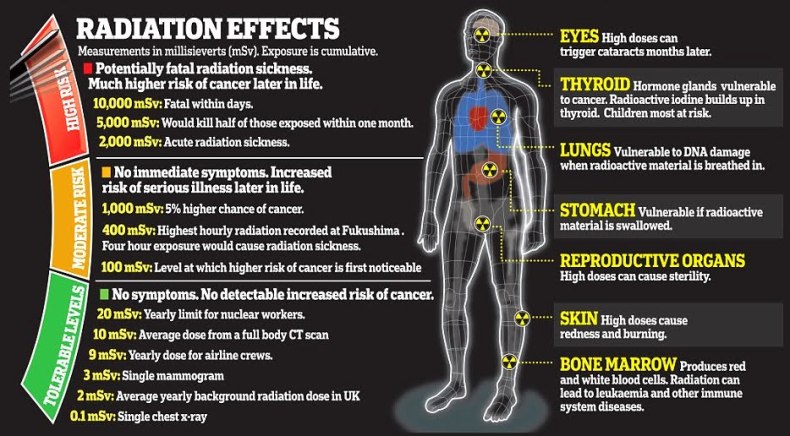
We begin with some simple explanations about radiation and radioactive releases. When we make the case that nuclear power harms us, it’s necessary to understand the differences between types of radiation and exactly what is released by the different phases of the nuclear industry fuel chain.
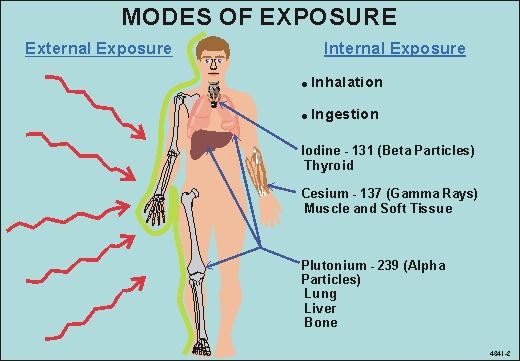
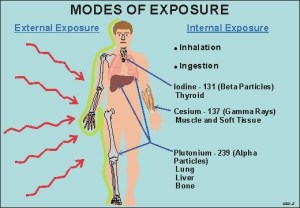 We also rebut the misleading arguments made by the pro-nuclear lobby about exposures. We explain the difference between internal and external exposures — a very important distinction. We also rebut the misleading arguments made by the pro-nuclear lobby about exposures. We explain the difference between internal and external exposures — a very important distinction.
We also break down the “natural” versus “man-made” argument. Too often, you may hear suggestions that exposures caused by nuclear plants are no worse than flying in an airplane. The sin of omission is a common tactic by the nuclear lobby. In this booklet, we describe why these arguments are deliberately misleading and unscientific.
It is important to remember that the negative health effects caused by the uranium fuel chain are not restricted to radiation exposures. Uranium mining, for example, also releases heavy metals such as lead and even arsenic, just as harmful and in some cases even worse than radiation, depending on the dose.
The whole issue of “dose,” of course, and what this means, is also used to cloud facts with mythology in order to suggest that some radioactive releases are not high enough to do real damage. But differentiating between high and low doses is very tricky, depending on whether the doses are delivered to a whole body, an individual organ, or a few cells. For example, even just a single alpha-emitting isotope — such as uranium, radon or thorium —when inhaled or ingested, can impart a huge dose to the cell or cells it travels through. The dose may sound small, but the damage is immense.
Medical science is in agreement that women are more susceptible to damage from radiation exposure than men.  And yet, so-called “allowable” radiation exposure limits are based on a model known as “Reference Man,” a healthy, white male in the prime of life. This means that current “allowable” exposure levels are putting women and children at higher risk of disease than men. Additionally, “allowable” exposure limits mostly ignore impacts on pregnancy, the life stage most susceptible to radiation damage. We make the case that pregnancy, rather than reference man, should form the basis for any exposure standards. And yet, so-called “allowable” radiation exposure limits are based on a model known as “Reference Man,” a healthy, white male in the prime of life. This means that current “allowable” exposure levels are putting women and children at higher risk of disease than men. Additionally, “allowable” exposure limits mostly ignore impacts on pregnancy, the life stage most susceptible to radiation damage. We make the case that pregnancy, rather than reference man, should form the basis for any exposure standards.
Accidents such as Chernobyl have led to lasting and widespread health problems. But these have been hard to record and quantify. Many affected people were never registered, others moved away or have died. The “burden of proof” that Chernobyl harmed them remains on the victim rather than the obvious perpetrator. This has allowed authorities such as the International Atomic Energy Agency (whose mandate is to promote the use of nuclear power) to capitalize on uncertainty by spreading statistics that grossly underestimate the health impacts of nuclear accidents such as Chernobyl.
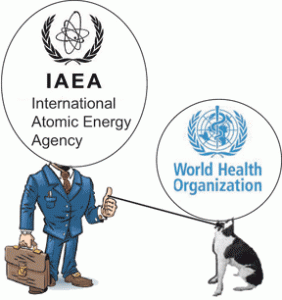 The IAEA gets away with this by using the mouthpiece of the World Health Organization — a seemingly august and reliable authority — to disseminate health statistics related to nuclear accidents. But the WHO submitted to a gag order imposed by the IAEA in 1959, allowing the IAEA to veto any actions by the WHO related to nuclear power. This makes any health figures released by the WHO in relation to Chernobyl or other nuclear incidents highly suspect and likely censored. The IAEA gets away with this by using the mouthpiece of the World Health Organization — a seemingly august and reliable authority — to disseminate health statistics related to nuclear accidents. But the WHO submitted to a gag order imposed by the IAEA in 1959, allowing the IAEA to veto any actions by the WHO related to nuclear power. This makes any health figures released by the WHO in relation to Chernobyl or other nuclear incidents highly suspect and likely censored.
Similarly, nations that rely on the use — and marketing — of nuclear technology, will do everything possible to suppress knowledge about its dangers. This has resulted in public relations campaigns endeavoring to persuade its citizens — as is happening in post-Fukushima Japan —that their “hysteria” and “radiophobia” are causing more illnesses than any radiation that might have gotten out.
This tactic is embedded in a strategy to “normalize” radiation exposures so that exposure limits can be raised. In Japan, the 1 millisievert a year “acceptable” level of exposure was raised to 20 mSv a year after the Fukushima disaster, simply because the Japanese government cannot ever hope to “clean up” areas contaminated with radioactivity back down to the 1 mSv level. Thus, an annual dose rate that is completely unacceptable, especially for children, becomes the new “normal.”
Our handbook chapter on Radiation and Harm to Human Health endeavors to keep things concise and simple. We hope you will use it to help educate residents, politicians and the press about the true risks of accepting uranium mining operations, nuclear power plants or radioactive waste management schemes into your communities.
We understand that a handbook should be something you can carry in your hand! To that end, we are raising funds to print copies of this booklet. If you would like to contribute, so that we can get this handbook out to the communities that most need it, please donate here. Choose “Handbook” from the pulldown menu to designate your gift. And thank you!
Cindy Folkers is the radiation and health specialist at Beyond Nuclear and the primary author of the Radiation and Harm to Human Health handbook. Linda Pentz Gunter is the international specialist at Beyond Nuclear.
If you’d like to be the first to read stories like these, sign up for our Monday email digest. We will send you a very brief synopsis of the new stories on our site, with links to read them and learn more. Sign up today!
|
|
|
October 5, 2018
Posted by Christina Macpherson |
2 WORLD, radiation |
2 Comments
Three New IAEA Safety Guides on Radiation Protection Available
Aabha Dixit, IAEA Office of Public Information and Communication, 4 Oct 18 “…….The recommendations provided in these three Safety Guides, together with the requirements of IAEA General Safety Requirements(
GSR Part 3), provide a basis for including environmental considerations in the assessment and management of radioactive releases.
- IAEA Safety Standards Series No. GSG-8, Radiation Protection of the Public and the Environment, provides high level/generic guidance in relation to the protection of members of the public and the environment in planned exposure situations, existing exposure situations and emergency exposure situations. Key stakeholders from governments, regulatory bodies and operating organizations are provided with a structured approach to controlling radiation exposures resulting from the operation of facilities and environmental contamination resulting from accidents.
- IAEA Safety Standards Series No. GSG-9, Regulatory Control of Discharges to the Environment provides specific guidance on the application of the principles of radiation protection and safety objectives associated with the control of radioactive discharges from facilities and activities and on the process for their authorization. Recommendations and guidance focus on the process for the authorization for discharges, including the setting of discharge limits, the means of verification of compliance, that will contribute to control radiological impact on the public and the environment.
- IAEA Safety Standards Series No. GSG-10, Prospective Radiological Environmental Impact Assessment for Facilities and Activities details the general framework and methodologies for prospective radiological environmental impact assessment. It defines various types of methodologies that can enhance prospective radiological environmental impact assessment, which are normally undertaken at the pre-operational and the operational stage of a facility or activity, as a requirement for their authorization. The methodologies are also applicable for governmental decision-making processes, such as for the environmental impact assessment process included in several national and international regulatory frameworks.
Member States are encouraged to apply these recommendations and use them to enhance and develop national regulations on protection of the environment from harmful effects of ionizing radiation, Telleria said. Effective national radiation protection infrastructures, including the existing and those under development, can benefit from these new safety guides that promote the establishment optimal levels of protection. https://www.iaea.org/newscenter/news/three-new-iaea-safety-guides-on-radiation-protection-available
October 5, 2018
Posted by Christina Macpherson |
2 WORLD, radiation |
Leave a comment
Hidden danger: Radioactive dust is found in communities around nuclear weapons sites, LA Times, By RALPH VARTABEDIAN SEP 28, 2018 “……….Studies by a Massachusetts scientist say that invisible radioactive particles of plutonium, thorium and uranium are showing up in household dust, automotive air cleaners and along hiking trails outside the factories and laboratories that for half a century contributed to the nation’s stockpile of nuclear weapons.
· The findings provide troubling new evidence that the federal government is losing control of at least some of the radioactive byproducts of the country’s weapons program.
· Marco Kaltofen, a nuclear forensics expert and a professor at Worcester Polytechnic Institute, said he collected samples from communities outside three lab sites across the nation and found a wide variation of particle sizes. He said they could deliver lifelong doses that exceed allowable federal standards if inhaled.
· “If you inhale two particles, you will exceed your lifetime dose under occupational standards, and there is a low probability of detecting it,” he said.
· A peer-reviewed study by Kaltofen was published in its final form in May in Environmental Engineering Science. Kaltofen, who also is the principal investigator at the nuclear and chemical forensics consulting firm Boston Chemical Data Corp., released a second study in recent weeks.
· The Energy Department has long insisted that small particles like those collected by Kaltofen deliver minute doses of radioactivity, well below typical public exposures. One of the nation’s leading experts on radioactivity doses, Bruce Napier, who works in the Energy Department’s lab system, said the doses cited by Kaltofen would not pose a threat to public health.
· Such assurances have been rejected by nuclear plant workers, their unions and activists who monitor environmental issues at nearly every lab and nuclear weapons site in the nation.
· Jay Coghlan, executive director of NuclearWatch New Mexico, cited a long history of denial about the claims of “down winders,” the residents of Western states who were exposed to radioactive fallout from atmospheric weapons testing. “We can not trust self-reporting by the Department of Energy,” he said. “I don’t accept that low levels of radioactivity have no risk.”
· Tom Carpenter, executive director of another watchdog group, the Hanford Challenge in central Washington, said as recently as last year that the Energy Department released an unknown quantity of radioactive particles during demolition of a shuttered weapons factory, the Plutonium Finishing Plant.
· After a series of three releases during 2017, the Energy Department shut down the demolition and has yet to resume it. Forty two workers were exposed in the incidents.
· “If you work in a coal mine, you go home with coal dust on you,” Carpenter said. “Same with a textile mill; you go home with cotton dust. These Hanford workers went home with plutonium dust.”
· The second study by Kaltofen, completed in August, reported that fairly high radioactivity levels were found in 30 samples from the communities around the Hanford nuclear site, near Richland, Wash. The samples found contamination on personal vehicles driven inside the Hanford site that would leave mechanics exposed if they worked around the vehicles, the report said.
· Kaltofen also reviewed an internal study in March by an Energy Department contractor, Washington River Protection Solutions, that found a calculated potential dose of 95 milliren for workers, roughly 10 times higher than the federal Environmental Protection Agency standard.
· Kaltofen said a broader independent study should look at residual contamination around Hanford. An Energy Department spokesman at the Hanford site said the office had no comment on the studies.
For his studies, Kaltofen collected samples outside the Los Alamos National Laboratory in New Mexico, the former Rocky Flats weapons plant near Denver and the Hanford site……..
Kaltofen’s sampling found some very high levels of contamination in Los Alamos’ Acid Canyon, a recreational area near a community pool and skate park………
A worker’s exposure to radioactivity, such as walking by a radioactive substance or having particles cling to clothing, is checked by monitors and badges worn by workers at plant sites. Such exposure is like a medical X-ray, which delivers a momentary dose. But inhaling a small particle of plutonium or thorium can go unnoticed by such monitors and deliver a lifetime of alpha radiation right next to lung tissue, Kaltofen said.
“You can walk through a portal monitor without setting it off but you can get a substantial amount of energy from particles in the body,” he said. http://www.latimes.com/local/california/la-na-radiation-hazards-2018-story.html#
September 29, 2018
Posted by Christina Macpherson |
radiation, USA, weapons and war |
Leave a comment
Dr Yamashita is only one among a host of politicians, bureaucrats, experts and advertising and media consultants who support the post-3.11 safety mantra of anshin (secure 安心), anzen (safe 安全), fukkō (recovery 復 興). Through public meetings, media channels, education manuals and workshops,54 local citizens in Fukushima Prefecture were inundated with optimistic and reassuring messages.
*********************************************
At the same time, to reduce ‘radiophobia’ and anxiety, while focusing on the psychological impact from stress, health risks from radiation exposures have been trivialised and/or normalised for the general public.
*********************************************
This approach is backed up by international nuclear-related agencies. As stipulated on 28 May 1959 in the ‘WHA12-40’ agreement, the WHO is mandated to report all data on health effects from radiation exposures to the IAEA, which controls publication.
*********************************************
Nevertheless, it is no longer possible to ignore a significant body of research, including 20 years of scientific studies compiled in Belarus and Ukraine that show serious depopulation, ongoing illnesses and state decline.
 Informal Labour, Local Citizens and the Tokyo Electric Fukushima
  Daiichi Nuclear Crisis: Responses to Neoliberal Disaster Management Adam Broinowski {extensive footnotes and references on original] September 2018, “……… (Official Medicine: The (Il)logic of Radiation Dosimetry On what basis have these policies on radiation from Fukushima Daiichi been made? Instead of containing contamination, the authorities have mounted a concerted campaign to convince the public that it is safe to live with radiation in areas that should be considered uninhabitable and unusable according to internationally accepted standards. To do so, they have concealed from public knowledge the material conditions of radiation contamination so as to facilitate the return of the evacuee population to ‘normalcy’, or life as it was before 3.11. This position has been further supported by the International Atomic Energy Agency (IAEA), which stated annual doses of up to 20 mSv/y are safe for the total population including women and children.43 The World Health Organisation (WHO) and United Nations Scientific Commission on the Effects of Atomic Radiation (UNSCEAR) also asserted that there were no ‘immediate’ radiation related illnesses or deaths (genpatsu kanren shi 原発 関連死) and declared the major health impact to be psychological.
While the central and prefectural governments have repeatedly reassured the public since the beginning of the disaster that there is no immediate health risk, in May 2011 access to official statistics for cancer-related illnesses (including leukaemia) in Fukushima and southern Miyagi prefectures was shut down. On 6 December 2013, the Special Secrets Protection Law (Tokutei Himitsu Hogo Hō 特定秘密保護法) aimed at restricting government employees and experts from giving journalists access to information deemed sensitive to national security was passed (effective December 2014). Passed at the same time was the Cancer Registration Law (Gan Tōroku Hō 癌登録法), which made it illegal to share medical data or information on radiation-related issues including evaluation of medical data obtained through screenings, and denied public access to certain medical records, with violations punishable with a 2 million yen fine or 5–10 years’ imprisonment. In January 2014, the IAEA, UNSCEAR and Fukushima Prefecture and Fukushima Medical University (FMU) signed a confidentiality agreement to control medical data on radiation. All medical personnel (hospitals) must submit data (mortality, morbidity, general illnesses from radiation exposures) to a central repository run by the FMU and IAEA.44 It is likely this data has been collected in the large Fukushima Centre for Environmental Creation, which opened in Minami-Sōma in late 2015 to communicate ‘accurate information on radiation to the public and dispel anxiety’. This official position contrasts with the results of the first round of the Fukushima Health Management Survey (October 2011 – April 2015) of 370,000 young people (under 18 at the time of the disaster) in Fukushima prefecture since 3.11, as mandated in the Children and Disaster Victims Support Act (June 2012).45 The survey report admitted that paediatric thyroid cancers were ‘several tens of times larger’ (suitei sareru yūbyōsū ni kurabete sūjūbai no ōdā de ōi 推定される有病数に比べて数十倍の オーダーで多い) than the amount estimated.46 By 30 September 2015, as part of the second-round screening (April 2014–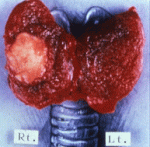 March 2016) to be conducted once every two years until the age of 20 and once every five years after 20, there were 15 additional confirmed thyroid cancers coming to a total of 152 malignant or suspected paediatric thyroid cancer cases with 115 surgically confirmed and 37 awaiting surgical confirmation. Almost all have been papillary thyroid cancer with only three as poorly differentiated thyroid cancer (these are no less dangerous). By June 2016, this had increased to 173 confirmed (131) or suspected (42) paediatric thyroid cancer cases.47
The National Cancer Research Center also estimated an increase of childhood thyroid cancer by 61 times, from the 2010 national average of 1–3 per million to 1 in 3,000 children. Continue reading →
September 22, 2018
Posted by Christina Macpherson |
Fukushima continuing, radiation, Reference, secrets,lies and civil liberties, spinbuster |
4 Comments
Astronauts Going to Mars Will Absorb Crazy Amounts of Radiation. Now We Know How Much. https://www.space.com/41887-mars-radiation-too-much-for-astronauts.html By Meghan Bartels, Space.com Senior Writer | September 20, 2018, There are plenty of challenges to putting people on Mars, whether you look at the rocket, the astronaut or the planet itself.
New data from one of the many spacecraft at work around Mars confirm just how dangerous a round-trip human journey would be by measuring the amount of radiation an astronaut would experience.
Cosmic radiation is made up of incredibly tiny particles moving incredibly fast, nearly at the speed of light — the sort of phenomenon a human body isn’t very well equipped to withstand. That radiation travels across all of space, but Earth’s atmosphere buffers us from the worst of its impacts. That means the farther away from Earth’s surface you go, the more cosmic radiation your body absorbs. [Space Radiation Threat to Astronauts Explained (Infographic)]
By the time you’re traveling to and from Mars, that gets to be a very big problem. “Radiation doses accumulated by astronauts in interplanetary space would be several hundred times larger than the doses accumulated by humans over the same time period on Earth, and several times larger than the doses of astronauts and cosmonauts working on the International Space Station,” Jordanka Semkova, a physicist at the Bulgarian Academy of Sciences and lead scientist on the new research, said in a statement. “Our results show that the journey itself would provide very significant exposure for the astronauts to radiation.”
Those results are based on data from the European Space Agency’s Trace Gas Orbiter, a spacecraft that has been circling the Red Planet since 2016. One of the instruments it carries is a dosimeter, which has been taking measurements throughout the orbiter’s journey.
According to the team behind the new research, those measurements show that just getting to and from Mars would expose astronauts to at least 60 percent of the current recommended maximum career exposure.
What precisely that recommended maximum is varies with sex and age, but it ranges from 1 sievert for a 25-year-old woman to 4 sieverts for a 55-year-old man. (The measurement of sieverts already accounts for differences in weight.)
But 60 percent just for the round-trip is particularly concerning, since presumably the point of going to Mars is to spend at least a little time on the planet’s surface — ideally, without overdosing on radiation.
Email Meghan Bartels at mbartels@space.com or follow her @meghanbartels. Follow us @Spacedotcom, Facebook and Google+. Original article on Space.com.
September 21, 2018
Posted by Christina Macpherson |
2 WORLD, radiation, technology |
Leave a comment
 Ken Raskin, Tritium is mostly what the Japanese want to dump from Fukushima. Millions of tons of water with tritium in it. Massive amounts of nuclear waste from Fukushima.
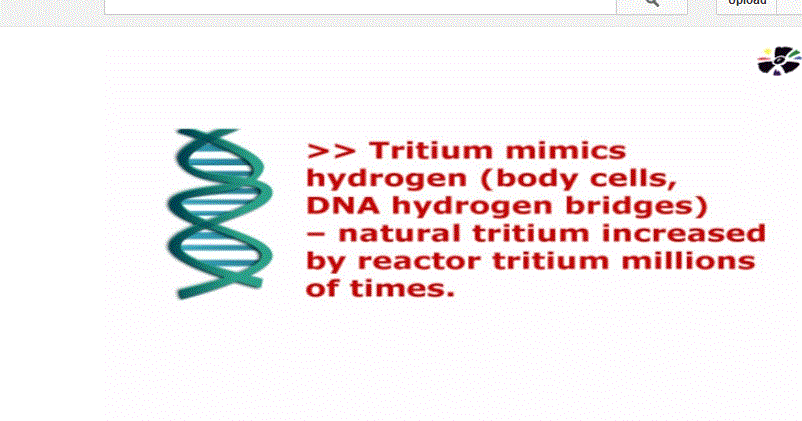
Tritium bombards, and even attaches to tissue covalently. There is usually a lot of UNACCOUNTED FOR RADIONUCLIDE-TRITIUM, around nuclear reactors. That is because the nucleoapes that run the reactors are psychopaths. They have little value for life, human or otherwise. Like radioactice Carbon 14 can, Tritium, binds to tissue. TRITIUM then permanently bombards the heck out of surrounding tissue, with beta rays!
 There was a large study, that showed tritium increases cancer 20 times. It is teratogenic. There are several case studies, of workers with increased rates of granulomas and lymphomas who were chronically exposed for years.
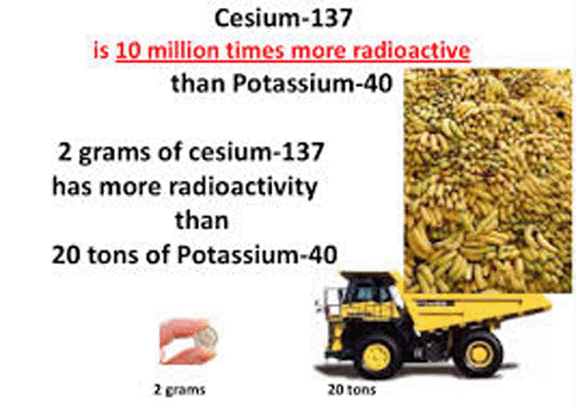
The pronukers go on and on, about k40 which is a nonstart. Even the gaslighters do it. It is Irrelevent, then they trurn around and lie their asses off about the extreme radiotoxicity and biological toxicity of tritium!
The nuclearists encourage the myth of how harmless tritium is. It does not just mostly pass through the body in water. Another blatant lie. It biocumulates in worse ways than radioactive, iodine, cesium, uranium because it becomes a part of the human body. It impairs and destroys reproductive capabilities. There is a comprehensive study done showing it increased cancer several times. It can covalently take the place of hydrogen in the body, in tissue.
https://www.scientificamerican.com/article/is-radioactive-hydrogen-in-drinking-water-a-cancer-threat/
September 18, 2018
Posted by Christina Macpherson |
2 WORLD, radiation, Reference |
1 Comment
 Ken Raskin, FOUR OF THE BIGGEST THINGS NUCLEOAPES AND THEIR APOLOGISTS CONSTANTLY LIE ABOUT ARE…
1. THE ACTUAL MORTALITY AND MORBIDITY OF RADIONUCLDES AND THEIR EFFECTS
2. THE HIGH TOXIICITY AND RADIOTOXICITY OF TRITIUM
3. THE BIG LIE OF HORMESIS
4. THAT RADIOACTIVE WASTE CAN BE SAFELY STORED – WE ARE ALL LIVING ON THE BEACH NOW! (see https://nuclear-news.net/2018/09/14/no-way-to-store-nuclear-waste-safely-we-are-living-on-the-beach-in-the-usa-in-japan-it-is-much-worse/)
In this post, Ken Raskin covers 1. THE ACTUAL MORTALITY AND MORBIDITY OF RADIONUCLDES AND THEIR EFFECTS
Radionuclides In Industry In Pharmaceuticals (the other items will be published in later posts.)
I have seen first hand, THE RESULTS OF RADIOPHARMACEUTICAL OVEREXPOSURES AND industrial ACCIDENTS with things like cesium 137.
I am constantly amazed, at how willingly, experts are so quick to lowball morbidity and mortality calculations and effects, in the face of Chernobyl and Fukushima. There is no such thing as low-level radioactive waste. Any ingested radionuclide, does its damage and then some. Even in microscopic amounts!
The dose of I131, used for thyroid ablation is about 30 billionths of a gram. It is not necessary to do any radiation modeling for that. I131 is used as a pharmaceutical drug, to destroy thyroid tissue in place of surgery. There is little need for complicated individual dose calculations. There is certainly, no need for any bs radiation modeling. If a bolus of radiopharmaceutical I131 is administered via oral solution, it will find its way to the thyroid to do its dirty deed.
I131 is also a fission product . An acute dose of I131 in the environment, rarely reaches the saturation level of a radiopharmaceutical administered, in a hospital for a thyroidectomy. Global thyroid damage will be observed, for those who are unlucky enough to absorb higher boluses of I131, in an exposure. Thyroid cancer may occur. I saw a case of Iridium Exposure, where a man died in an industrial accident. How many of us have seen bad results of gamma knife therapy or readiopharmaceutical therapy. A lot. Then the rotten frikin nucleoapes have the gall to stand around ans say there were minimal casualties from chernobyl or fukushima.
There is the fella I knew, who worked a brief time in an Uranium complex. Fifteen of his coworkers died before age 50, of cancer. The chickenshits will turn around and tell you, THAT only one worker has died, from radionuclide related causes at fukushima. They will say the Mclatchy study that showed 33,000 or so, nuclear workers died over 2 years, is wrong. They will say it because they are liars, propagandists, professional shills, or unrepentant-ignorant fools.

Similar to Iodine131 in it’s incredible toxicity, is Cesium 137 . It is a gamma and beta emmiter. CESIUM 137 Is acutely toxic to heart tissue, at 100 billionths of a gram. Remember chernobyl heart. No radiation modelling is necessary to establish this fact. The observation of heart effects from cesium 137/134 exposure to cesium 137, effects on the heart quite discernable. From the many studies from chernobyl and belarussian victims of chernobyl, observed by Bandhechevsky, Yablokov, and Miller.
September 17, 2018
Posted by Christina Macpherson |
2 WORLD, radiation |
1 Comment
 Fukushima water release into sea faces chorus of opposition https://mail.google.com/mail/u/0/#inbox?compose=DmwnWtDqNzxklZTsLVvsRFtgBQZHzxshPgMCgrVGpNqZnjrqDwNNWbPprDwxPlNFzCVZnfDvsQwVCitizens and environmental groups have expressed opposition to the idea of releasing into the ocean water tainted with tritium, a radioactive substance, from Tokyo Electric Power Company Holdings Inc.’s disaster-stricken Fukushima No. 1 nuclear power plant.“Long-term storage (of the tritium-containing water) is possible from technical and economic standpoints,” Komei Hosokawa, 63, an official of the Citizens’ Commission on Nuclear Energy, said at a public hearing held in Tokyo on Friday by a subcommittee of the Agency for Natural Resources and Energy. “The radiation levels in the water will decrease during the long-term storage,” he added.
At a similar hearing held the same day in Koriyama, Fukushima Prefecture, Aki Hashimoto, a housewife from the city, said, “I never want to see further worsening of ocean pollution from radiation.”
Opinions objecting to the release of the tritium-contaminated water into the ocean were also heard at a hearing held in the Fukushima town of Tomioka on Thursday.
After Friday’s hearings, Ichiro Yamamoto, who heads the subcommittee, told reporters that many participants in the hearings said the tainted water should continue to be held in storage tanks.
The subcommittee will study the option of keeping the water in the tanks, he added.
Tepco is lowering the radiation levels in contaminated water at the Fukushima No. 1 plant using special equipment, but the device cannot remove tritium.
The tritium-tainted water is stored in tanks within the premises of the power plant, which was heavily damaged in the March 2011 earthquake and tsunami.
In 2016, an expert panel of the Agency for Natural Resources and Energy discussed five methods to dispose of the tritium-tainted water —injection deep into the ground, release into the sea after dilution, release into the air through evaporation, conversion into hydrogen through electrolysis, and burying it after it is solidified.
The panel estimated that the ocean release is the cheapest option, costing up to about ¥3.4 billion.
September 3, 2018
Posted by Christina Macpherson |
Fukushima continuing, oceans, radiation |
Leave a comment
Pregnant Flight Crewmembers Face Unique Hazard: Cosmic Radiation https://ehsdailyadvisor.blr.com/2018/08/pregnant-flight-crewmembers-face-unique-hazard-cosmic-radiation/
Working as a flight crewmember can put a pregnancy at risk, particularly during the first trimester, notes the National Institute for Occupational Safety and Health (NIOSH). NIOSH points to three hazards that could imperil a pregnancy—circadian rhythm disruption (jet lag) or shiftwork, physical job demands, and cosmic ionizing radiation.
While pregnant workers in many occupations do shiftwork and heavy lifting, exposure to high levels of cosmic ionizing radiation is probably an occupational hazard that is unique to flight crews. The problem for pregnant flight attendants is that it cannot be avoided while flying.
What Is It?
Cosmic ionizing radiation comes from outer space with a very small amount reaching the earth. At flight altitudes, passengers and crewmembers are exposed to higher levels on every flight. The World Health Organization says that ionizing radiation causes cancer as well as reproductive problems, but NIOSH believes the issue warrants additional study.
“We don’t know what causes most health problems that could be linked to radiation, including some forms of cancer and reproductive health issues like miscarriage and birth defects,” states NIOSH. “If you are exposed to cosmic ionizing radiation and have these health problems, we can’t tell if it was caused by your work conditions or something else. We don’t know what levels of cosmic radiation are safe for every person.”
Unsafe Levels
Despite these reservations, NIOSH does not dismiss the risk. For example, one NIOSH study found that exposure to 0.36 millisievert (mSv) or more of cosmic radiation in the first trimester may be linked to an increased risk of miscarriage. If this estimated is accurate, the risk to flight crewmembers is high. The National Council on Radiation Protection and Measurements report that aircrew have the largest average annual effective dose (3.07 mSv) of all U.S. radiation-exposed workers. Other estimates of annual aircrew cosmic radiation exposure range from 0.2 to 5 mSv per year.
There are no official radiation dose limits for aircrew in the United States; however, there are national and international guidelines. For example, the International Commission on Radiological Protection (ICRP) recommends a dose limit of 20 mSv/year averaged over 5 years for radiation workers and 1 mSv/year for the public. For pregnant radiation workers, the ICRP recommends a dose limit of 1 mSv throughout pregnancy. The National Council on Radiation Protection and Measurements has a 0.5 mSv recommended monthly radiation limit during pregnancy.
Solar Particle Events
Flying through a solar particle event doesn’t happen often; pilots fly through about 6 solar particle events in an average 28-year career. Still, a pregnant crewmember who flies through a solar particle event can receive more radiation than is recommended during pregnancy by national and international agencies. Also, avoiding exposure to solar particle events is difficult because they often happen with little warning. One helpful resource is the National Aeronautics and Space Administration’s (NASA) Nowcast of Atmospheric Ionizing Radiation System ((NAIRAS), which was developed to report potentially harmful flight radiation levels to flight crews and passengers.
Recommendations
NIOSH says it recognizes that controlling one’s flight crew responsibilities to reduce exposure to high-altitude radiation is not a simple solution and one that can be constrained by job seniority, lifestyle, and personal issues. However, there are several actions pregnant crewmembers can consider:
- Try to reduce time working on very long flights, flights at high latitudes, or flights over the poles. Calculate usual cosmic radiation exposures. The Federal Aviation Administration has developed a tool to estimate the effective dose from galactic cosmic radiation (not solar particle events) for a flight (https://www.faa.gov/data_research/research/med_humanfacs/aeromedical/radiobiology/cari6).
- If pregnant or planning a pregnancy, consider work exposures, including cosmic radiation. If pregnant and aware of an ongoing solar particle event when scheduled to fly, consider trip-trading or other rescheduling actions if possible.
More information on the risks of cosmic ionizing radiation to pregnant flight crewmembers is at https://www.cdc.gov/niosh/topics/aircrew/reproductivehealth.html.
August 31, 2018
Posted by Christina Macpherson |
2 WORLD, radiation, women |
Leave a comment
Water at Fukushima nuclear plant still radioactive even after treatment, Government wants to dump the contaminated water into the sea, but locals and fishermen oppose the idea https://www.scmp.com/news/asia/east-asia/article/2160382/water-fukushima-nuclear-plant-still-radioactive-even-after 19 August, 2018
Radioactive substances have not been removed from treated but still tritium-containing water at the crippled Fukushima Daiichi nuclear power plant. The government and Tokyo Electric Power Company have faced the pressing need to dispose of such treated water now kept in tanks. One option is to dump it into the sea, as tritium is said to pose little risk to human health.
If the plan goes ahead, tritium-tainted water from the nuclear plant is expected to be diluted so it is likely to lower the levels of other radioactive materials as well before being discharged.
But locals and fishermen are worried about the water discharge and a government panel debating how to deal with it has mainly focused on tritium, not other radioactive substances.
According to Tepco, a maximum 62.2 becquerels per litre of lodine 129, far higher than the 9 becquerel legal limit, was found in the water filtered by the Advanced Liquid Processing System used to remove various types of radioactive materials
Iodine 129 has a half-life of 15.7 million years.
Tepco, which gathered data in fiscal 2017 through March, also detected a maximum 92.5 becquerels of Ruthenium 106 – more than the 100 becquerel legal limit – and 59 becquerels of technetium 99 against the limit of 1,000 becquerels.
The Fukushima Daiichi nuclear complex was damaged by the 2011 earthquake and tsunami. Reactors 1 and 3 suffered fuel meltdowns as their cooling systems were crippled.
Water was injected to keep the fuel cold but it is extremely toxic. The water is filtered but it is hard for tritium to be separated.
In August, there were around 920,000 tonnes of tritium-containing water stored in some 680 tanks at the plant. But Tepco said it has not checked the concentration of radioactive materials in each tank.
The government has examined several ways to dispose of tritium-containing water, including the release of it into the sea or atmosphere.
Toyoshi Fuketa, who heads the Nuclear Regulation Authority, said pumping the water into the sea is the only solution.
August 20, 2018
Posted by Christina Macpherson |
Fukushima continuing, radiation |
Leave a comment







 nuclear-news