Nuclear reactors routinely release radioactive gases into the environment
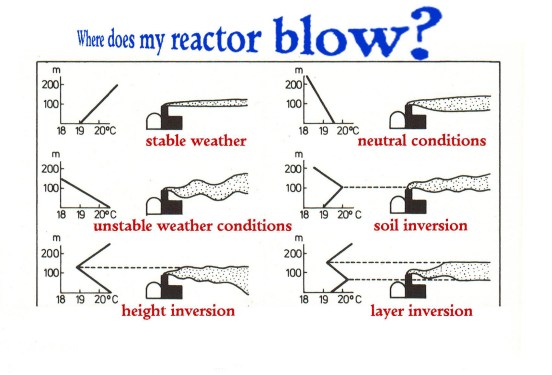
This graphic best explains issues with venting and filtering of nuclear reactor cores under normal operations. The venting is done approximately once every three months at the beginning of fuel cycle and once a month or more at the end of fuel cycle. Noble gases like Krypton 85 are chemically inert single atoms. They go right through the filters.

A single jawbone has revealed just how much radiation Hiroshima bomb victims absorbed
WP, By Kristine Phillips, 2 May 2018, At 8:15 a.m. on Aug. 6, 1945, the United States dropped the first combat atomic bomb, “Little Boy.” It exploded 43 seconds later, creating a massive fireball that incinerated much of Hiroshima. Nearly 350,000 people were in the Japanese city that day, and most were civilians.
Twenty-seven years later, a scientist from across the Pacific Ocean arrived in Hiroshima with what was considered then a novel idea. Brazilian physicist Sérgio Mascarenhas, at the time a visiting professor at Harvard University, said that exposure to radiation makes human bone magnetic, and that “magnetic memory” existed in the bones of atomic bombing victims years after the explosion. Scientists could measure radiation exposure by examining the bones of victims, Mascarenhas proposed.
With the help of two Japanese scientists in Hiroshima, Mascarenhas obtained several samples of victims’ bones, including a jawbone that belonged to a person who was less than a mile away from Ground Zero. They were able to estimate the amount of radiation present in the bones, according to a paper Mascarenhas presented to the American Physical Society meeting in April 1973 in Washington, but specific calculations could not be achieved with 1970s technology.
Mascarenhas brought the samples home to Brazil, where they sat in storage for the next four decades — until two other Brazilian scientists continued his research using more advanced technology. The result was astonishing.
Using a technique called electron spin resonance, the researchers measured that the jawbone had absorbed 9.46 grays of radiation from the Hiroshima attack. (A gray or Gy is a unit used to measure the amount of radiation absorbed by an object or a person.)
To place this in context: A cancer patient receiving radiotherapy treatment is exposed to about 2 to 3 grays on a very localized part of the body where a tumor is located. Whole-body radiation with about 5 grays — nearly half of the amount calculated from the jawbone — is enough to kill a person, Oswaldo Baffa, one of the researchers and a professor at the University of São Paulo, told The Washington Post Tuesday.
Teeth have been used to measure the amount of radiation a person had been exposed to. In 1997, scientists from Taiwan measured the radiation dose that patients with nasopharyngeal cancer (in which cancer cells form near the throat behind the nose) had absorbed from radiotherapy by examining their jawbones. But the researchers in Brazil said this is the first time that bones were used to precisely measure the amount of radiation absorbed by atomic bombing victims……..https://www.washingtonpost.com/news/retropolis/wp/2018/05/02/a-single-jawbone-has-revealed-just-how-much-radiation-hiroshima-bomb-vic
Dr Gordon Edwards explains the background to former NRC chairman’s opposition to nuclear power
 Nuclear Regulatory Commission ex-Chairman Gregory Jaczko is adamantly opposed to the idea of keeping existing nuclear reactors running as a way to offset climate change, because each reactor is like a time bomb ready to explode if the cooling is cut off by a total station blackout, by equipment failure, by major pipe breaks, or by acts of warfare, sabotage, or terrorism. The societal dislocation caused by the spread of radioactive material over wide areas, affecting drinking water, food and habitation for decades or centuries, is as bad as the ravages of climate change for the communities so affected.
Radioactive fallout killed up to 690,000 Americans from 1951 to 1973.
In the 1950s, the U.S. government downplayed the danger of radioactive fallout, asserting that all radioactivity was confined to the Nevada test site. Despite this, a national estimate attributed 49,000 cancer deaths to nuclear testing in the area.
But the results of new research suggest that this number is woefully inaccurate. Using a novel method, and today’s improved understanding of radioactive fallout, Keith Meyers from the University of Arizona discovered that U.S. nuclear testing was responsible for the deaths of at least as many — and likely more — as those killed by the nuclear bombs in Hiroshima and Nagasaki.
Specifically, between 340,000 and 690,000 Americans died from radioactive fallout from 1951 to 1973.
 At least 340,000 Americans died from radioactive fallout between 1951
  and 1973 https://bigthink.com/politics-current-affairs/new-estimate-deaths-from-us-nuclear-tests?rebelltitem=2#rebelltitem2 Domestic nuclear testing wreaked havoc on thousands of families. MATTHEW DAVIS 14 December, 2018
- Hiroshima and Nagasaki resulted in the deaths of hundreds of thousands. But new research shows that domestic U.S. nuclear tests likely killed more.
- The new research tracked an unlikely vector for radioactive transmission: dairy cows.
- The study serves as a reminder of the insidious and deadly nature of nuclear weapons.
When we think of nuclear disasters, a few names probably come to mind. There’s the Chernobyl disaster, which killed around 27,000 people, although estimates are fuzzy. After Fukushima, there were no deaths due to radiation poisoning, but this event occurred relatively recently, and radiation poisoning often kills slowly over decades. When the U.S. dropped atomic bombs on Hiroshima and Nagasaki, estimates put the death toll at around 200,000 people, but again, exact numbers are difficult to calculate.
One name that almost certainly didn’t come to mind is Nevada. When the Soviet Union detonated their first atomic bomb in 1949, the U.S. was shocked into action. America’s prior nuclear testing had been carried out in the Pacific, but it was logistically slow and costly to conduct tests there. In order to maintain dominance over the growing Soviet threat, the U.S. selected a 1,375 square-mile area in Nye County, Nevada.
This was an ideal spot for several reasons. It was closer than Bikini Atoll. The weather was predictable and very dry, reducing the risk that radioactive fallout would be dispersed by rainstorms. It was sparsely populated. There was an understanding that there would be some amount of risk posed to nearby civilians, but it was deemed acceptable at the time. The trouble is, our understanding of radioactive fallout was still in its infancy. It was a catch-22; the only way to learn more was to test nuclear weapons.
In the 1950s, the U.S. government downplayed the danger of radioactive fallout, asserting that all radioactivity was confined to the Nevada test site. Despite this, a national estimate attributed 49,000 cancer deaths to nuclear testing in the area.
But the results of new research suggest that this number is woefully inaccurate. Using a novel method, and today’s improved understanding of radioactive fallout, Keith Meyers from the University of Arizona discovered that U.S. nuclear testing was responsible for the deaths of at least as many — and likely more — as those killed by the nuclear bombs in Hiroshima and Nagasaki. Specifically, between 340,000 and 690,000 Americans died from radioactive fallout from 1951 to 1973.
Prior studies generally looked at the areas surrounded the Nevada test site and estimated the deaths caused by fallout from the area. This number was relatively low, owing to the dry, predictable weather mentioned earlier. However, the bulk of the deaths were actually dispersed throughout the country, primarily in the Midwest and Northeast regions. These deaths were caused by an unfortunate synergy between meteorology, radiation, and — perhaps oddly enough — cows.
Out of all the radioactive elements produced by a nuclear explosion, iodine-131 was the biggest killer. I-131 has an eight-day half-life, tends to accumulate in the thyroid gland, and emits beta and gamma radiation. While alpha radiation is generally weak and doesn’t penetrate material very well, beta and gamma radiation are highly energetic and shoot through clothing and flesh, ripping up DNA as it goes along.
Prior studies had examined the radioactive fallout dispersed by low-altitude winds, which would generally settle around the Nevada test site. However, a significant amount of I-131 was caught up in high-altitude winds. These winds carried the radioactive particles to other regions of the U.S., where it mixed with rain clouds.
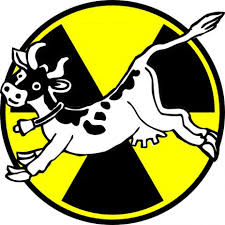 The now-radioactive rain fell onto the grasslands in the Midwest and Northeast. Then, cows ate the now-radioactive grass. The cows then produced radioactive milk. Dairy practices during the study period were different than they are today — most people drank milk that had recently been extracted from local cows.
Thanks to a National Cancer Institute database that contains broad data on radiation exposure, Meyers was able to track the amount of I-131 found in local milk and compare this with the number and nature of deaths on a county level. In this way, Meyers was able to determine that a significant number of these deaths were due to drinking poisoned milk. These civilians would have had no idea that the milk they were drinking had been irradiated by nuclear explosions hundreds of miles away.
Ironically, the area around the Nevada test site didn’t have this problem. Although they too drank fresh milk from local cows, they imported hay from other parts of the country. Since their cows weren’t eating irradiated hay, the local Nevadans took in significantly less radioactive material than their less-fortunate, distant countrymen.
Although our understanding of radiation and nuclear fallout is much improved since the dawn of the nuclear age, the study serves as a warning of the insidious nature of nuclear weapons. Containing nuclear fallout is challenging, even when you know where all of the vectors of radioactive transmission are. The complexity and intertwining nature of our ecological and social systems means that words like “clean,” “precise,” or “surgical” will likely never apply to nuclear weapons.
TRUMP WANTS TO RECLASSIFY RADIOACTIVE WASTE FROM NUCLEAR WEAPONS TO ‘LOW LEVEL’ SO DISPOSAL IS CHEAPER
|
The Department of Energy intends to relabel high-level radioactive waste left over from the production of nuclear weapons as low-level, the Associated Press reported. Currently, high-level radioactive waste is defined as that which is a byproduct of fuel reprocessing (where leftover fissionable material is separated from the waste) or from nuclear reactors. Low-level waste, on the other hand, represents around 90 percent of all such waste, according to the American Nuclear Society, and generally comes from facilities where radioisotopes are used, such as nuclear power stations, and local hospitals. Items often include wipes, clothes and plastic. In the U.S., 90,000 metric tons of nuclear waste is being temporarily stored as successive administrations have grappled to find a long-term solution. Storing nuclear waste safely presents a number of challenges: it needs to be protected from natural disasters, and stopped from seeping into the surrounding water and soil, while its radiation blocked. Thieves must be kept from accessing it, and so too future generations who may not understand how toxic such materials are. The Associated Press reported the agency said the reclassification would shave $40 billion off the cost of cleaning up after the production of nuclear weapons. A Department of Energy official told Newsweek it is requesting public comment on its interpretation of the meaning of the statutory term of high-level radioactive waste through the federal register. …….. Facilities which would be affected include the country’s most highly contaminated: the Hanford Nuclear Reservation in Washington state, which takes up an area half the size of Rhode Island. Opened in 1943, the site produced the plutonium for the atomic bomb dropped on Nagasaki, Japan in 1945, according to its website. The production of nuclear materials carried on until 1987, leaving behind waste that threatened the local environment, prompting the state and federal authorities — including the Department of Energy, the Environmental Protection Agency — to pledge in 1987 to clean up the site, without success. Other facilities mentioned in the plans are the Savannah River Plant, South Carolina and the Idaho National Laboratory, according to the Associated Press……. Alex Smith, Program Manager of the State of Washngton Department of Ecology Nuclear Waste Program, which is involved in the Hanford project, told the Associated Press: “They see it as a way to get cleanup done faster and less expensively.” The consultation originally ran from October 10 until December 10. Democratic Senator Ron Wyden for Oregon requested a public consultation on the proposal be extended to January 9……..https://www.newsweek.com/trump-reclassify-radioactive-waste-nuclear-weapons-low-level-disposal-cheaper-1253063?fbclid=IwAR1H-mvAOsdN24NT1pKy3MGAuVDn_q_siZc67iXsl-eLkKNFNMeZ4F8xKgA |
|
|
Assessing the effects of planetary electromagnetic pollution
Planetary electromagnetic pollution: it is time to assess its impact, https://www.thelancet.com/journals/lanplh/article/PIIS2542-5196%2818%2930221-3/fulltext?dgcid=raven_jbs_etoc_email
Priyanka Bandara
David O Carpenter
Open AccessPublished:December, 20 As the Planetary Health Alliance moves forward after a productive second annual meeting, a discussion on the rapid global proliferation of artificial electromagnetic fields would now be apt. The most notable is the blanket of radiofrequency electromagnetic radiation, largely microwave radiation generated for wireless communication and surveillance technologies, as mounting scientific evidence suggests that prolonged exposure to radiofrequency electromagnetic radiation has serious biological and health effects. However, public exposure regulations in most countries continue to be based on the guidelines of the International Commission on Non-Ionizing Radiation Protection and Institute of Electrical and Electronics Engineers, which were established in the 1990s on the belief that only acute thermal effects are hazardous. Prevention of tissue heating by radiofrequency electromagnetic radiation is now proven to be ineffective in preventing biochemical and physiological interference. For example, acute non-thermal exposure has been shown to alter human brain metabolism by NIH scientists, electrical activity in the brain, and systemic immune responses.
At the Oceania Radiofrequency Scientific Advisory Association, an independent scientific organisation, volunteering scientists have constructed the world’s largest categorised online database of peer-reviewed studies on radiofrequency electromagnetic radiation and other man-made electromagnetic fields of lower frequencies. A recent evaluation of 2266 studies (including in-vitro and in-vivo studies in human, animal, and plant experimental systems and population studies) found that most studies (n=1546, 68·2%) have demonstrated significant biological or health effects associated with exposure to anthropogenic electromagnetic fields. We have published our preliminary data on radiofrequency electromagnetic radiation, which shows that 89% (216 of 242) of experimental studies that investigated oxidative stress endpoints showed significant effects.
This weight of scientific evidence refutes the prominent claim that the deployment of wireless technologies poses no health risks at the currently permitted non-thermal radiofrequency exposure levels. Instead, the evidence supports the International EMF Scientist Appeal by 244 scientists from 41 countries who have published on the subject in peer-reviewed literature and collectively petitioned the WHO and the UN for immediate measures to reduce public exposure to artificial electromagnetic fields and radiation.
Evidence also exists of the effects of radiofrequency electromagnetic radiation on flora and fauna. For example, the reported global reduction in bees and other insects is plausibly linked to the increased radiofrequency electromagnetic radiation in the environment.
Honeybees are among the species that use magnetoreception, which is sensitive to anthropogenic electromagnetic fields, for navigation.
References……

Prisoners in New York will learn about their radiation exposure due to body scans
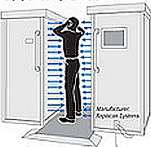 Body-scanned inmates will get radiation exposure stats, NY Post By Rich Calder and Tamar Lapin, November 8, 2018 “………The city Health Department has issued new regulations that would allow inmates to learn how much radiation they’ve absorbed from body scans in the clink.Upon request, the Correction Department would have to provide them with their “total accumulated radiation exposure,” according to a legal notice issued by the city Thursday. Body-scanned inmates will get radiation exposure stats, NY Post By Rich Calder and Tamar Lapin, November 8, 2018 “………The city Health Department has issued new regulations that would allow inmates to learn how much radiation they’ve absorbed from body scans in the clink.Upon request, the Correction Department would have to provide them with their “total accumulated radiation exposure,” according to a legal notice issued by the city Thursday.
The regulation was in response to a new state law authorizing correction officers to again use high-powered body scanners to spot nonmetal objects — such as ceramic knives — in the possession of inmates. As part of the law, the Health Department had to implement rules to make sure the scanners are safe — including “setting annual exposure limits and mandates for training and signage.”…… The Correction Department thought it had the problem solved in 2012 and 2013, after it purchased five “airport-style” body scanners with ionizing radiation that picked up every imaginable kind of weapon and contraband. But after a year’s use, the scanners were shelved when it was discovered they violated a little-noticed state law that said “ionizing radiation” may not be “applied to human beings” except by licensed medical personnel for a medical purpose…….. The new state law wipes out the scanner-use medical restriction…….https://nypost.com/2018/11/08/body-scanned-inmates-will-get-radiation-exposure-stats/ |
|
Trump administration heads for the dodgy science of the radiation sceptics
| Is a Little Radiation Good For You? Trump Admin Steps Into Shaky Science, Discover Magazine, By Nathaniel Scharping | October 5, 2018
For decades, studies have shown that even low doses of radiation are harmful to humans. This week, the Associated Press reported that the Trump administration may be reconsidering that. The Environmental Protection Agency seemed to be looking at raising the levels of radiation considered dangerous to humans based on a controversial theory rejected by mainstream scientists. The theory suggests that a little radiation might actually be good for our bodies. In April, an EPA press release announced the proposal and included supporting comments from a vocal proponent of the hypothesis, known as hormesis. It prompted critical opinion pieces and sparked worry among radiation safety advocates.
The debate cuts to the heart of the debate over the effects of low doses of radiation and reveals how difficult it is to craft clear guidelines in an area where scientific evidence is not clear cut. Radiation DebateWhen radiation damages our DNA, the body steps in to make repairs. Hormesis suggests that hitting the body with a little more radiation should kick our defensive mechanisms into overdrive. According to proponents of the theory, this results in the production of anti-oxidants and anti-inflammatory compounds that reduce our risk for cancer and heart disease, among other things. That’s why hormesis backers want the EPA to raise the level of acceptable radiation, pointing out that it would also save millions in safety costs. It sounds convincing, and proponents have dozens of studies to point to that they say back up their claims. But, “Large, epidemiological studies provide substantial scientific evidence that even low doses of radiation exposure increase cancer risk,” says Diana Miglioretti, a professor in biostatistics at the University of California, Davis in an email. “Risks associated with low-doses of radiation are small; however, if large populations are exposed, the evidence suggests it will lead to measurable numbers of radiation-induced cancers.” Long-term studies of Hiroshima and Nagasaki bombing survivors show higher cancer risks. Marshall Islanders exposed to radiation from atomic bomb tests suffered a higher risk of thyroid disease. And patients who get CT scans, which deliver a dose of radiation equal to thousands of X-rays, saw cancer risks go up afterward. Researchers also found that radiation from childhood CT scans can triple the risk of leukemia and, at higher doses, triple the risk of brain cancers as well. Another found that low-dose radiation increased the risk of breast cancer among some some women. And large-scale reviews of the evidence for hormesis find that it is decidedly lacking. Two studies, one in 2006 by the National Research Council, and another in 2018 by the National Council and Radiation Protection and Measurements looking at 29 studies of radiation exposure find no evidence for hormesis, and reiterate that the evidence points toward radiation being bad for us even at low doses. Scientific UncertaintyIt’s difficult to study low doses of radiation, though, and that’s where much of the controversy comes from. At doses below a few hundred millisieverts (mSv), a radiation unit that accounts for its effects on the body, it becomes extraordinarily hard to separate out the effects of radiation from other things like lifestyle or genetics. Research on the effects of these small radiation doses often use data sets involving thousands of people to compensate for the minimal effect sizes, but even then it’s often not enough to be certain what’s happening. “Data collected at low doses (defined by the scientific community [as] exposures less than 100 mSv) suffers from a ‘signal to noise’ problem which limits our ability to conclusively state effects one way or another,” says Kathryn Higley, head of the school of nuclear science and engineering at Oregon State University in an email. A single CT scan delivers anywhere from 1 to 15 mSv, but some patients need many scans during the course of their treatment, increasing the total dose. Workers cleaning up after the Fukushima meltdown received radiation doses above 100 mSv in some cases. And current U.S. standards limit radiation workers to no more than 50 mSv of exposure per year. Many studies indicate that there are dangers at that level, but it’s often an assumption. Those studies base their suppositions on what’s called the linear no-threshold model, which extrapolates more reliable data from studies of higher doses of radiation to lower doses. Though it may be an educated guess, for decades large-scale studies have indicated this is true. ……….. The EPA in recent days appeared to back away from the suggestion that it supported hormesis. The agency released a statement in response to the APstory affirming that it intends to continue using the linear no-threshold model when constructing radiation guidelines, something that contradicts Calabrese’s comments in the April press release. “The proposed regulation doesn’t talk about radiation or any particular chemicals. EPA’s policy is to continue to use the linear-no-threshold model for population-level radiation protection purposes which would not – under the proposed regulation that has not been finalized – trigger any change in that policy,” said an EPA spokesman in response to a request for comment. Radiologist Rebecca Smith-Bindman says the vast bulk of the evidence suggests even small amounts of radiation are harmful. We shouldn’t base our policies on an unproven theory, she adds. “There is extensive evidence that ionizing radiation will cause cancer,” says Smith-Bindman, a professor of radiology at the University of California, San Francisco in an email exchange. “These data come from a range of different sources, including epidemiological data (such as studies of patients who have received diagnostic and therapeutic radiation and from environmental exposures and accidents), from animal studies and from basic science studies. While it is more difficult to precisely quantify the exposures — which will vary by many factors, such as age at exposure, and source of radiation, etc. — there is no uncertainty among the scientific community that radiation will cause cancer.” She says that pointing to issues with the linear no-threshold model misses the point. Though it may not be totally accurate at very low doses, she says it’s unfair to use that uncertainty to cast doubt on data about radiation where there’s solid evidence. …….. Miglioretti says “Based on the large body of evidence to date, I believe that revising the regulations to increase allowable radiation exposure limits will lead to an increase in the number of radiation-induced cancers in this country.” That’s in line with what multiple experts Discover contacted believe — that radiation can harm even at low doses and raising limits would endanger the public, though the increase in risk would likely be small. It’s not clear at the moment whether the EPA proposal to raise limits will pass, though it does follow in the footsteps of other Trump administration proposals to weaken safety standards. At the moment, it’s unclear what the effects on the public if the EPA raises radiation limits. “Perhaps it might make nuclear power plants less expensive to build. It might lower the cost of cleanup of radioactively polluted sites,” says David Brenner, director of the Center for Radiological Research at Columbia University in an email. “But [it] begs the question of whether cleanup to a less rigorous standard is desirable.” http://blogs.discovermagazine.com/crux/2018/10/05/epa-trump-administation-radiation-guidelines/#.W99ZFtIzbGg
|

Reclassifying nuclear wastes as “Low Level”

DOE proposes reclassifying high-level nuclear waste, could send more to WIPP A proposal to re-characterize high-level nuclear waste could bring more waste to the Waste Isolation Pilot Plant.
The U.S. Department of Energy posted a notice in the federal register in October, requesting public comment on the potential change.
If approved, the DOE would change how it labels high level waste (HLW), allowing some of the waste resulting from processing nuclear fuel to be characterized as either low-level or transuranic (TRU) waste.
If the waste is deemed low-level, it can be disposed of at the generator site, or in a surface-level facility………
When the HLW is held at the site, the federal government pays for the facility’s utilities, costing tax payers billions of dollars a year, Heaton said.
Some of that money could be saved, he said, if the waste was moved.
“A lot of would pass the waste acceptance criteria at WIPP,” Heaton said. “It would extend the life of WIPP for sure. ………
Don Hancock, director of the Nuclear Waste Program at the Southwest Research and Information Center said the proposal is not only illegal, but hypocritical.
He said HLW is defined numerous times in laws passed by the U.S. Congress, and the DOE’s proposal would circumvent congressional powers.
“What it seems like they’re proposing is illegal,” he said. “They say they get to rewrite the law, not Congress. They’re a lot of opposition to this nationally.”
Hancock also said that if waste is truly less dangerous than previously thought, it could be safely kept where it is.
If it’s more dangerous to keep the waste at the generator sites, Hancock said the DOE should petition for more repositories.
All HLW must be sent to a geologic repository, per federal law, excluding WIPP which is licensed for TRU waste.
Aside from re-characterizing HLW as TRU waste, Hancock said the proposal was also intended to get around the law requiring HLW to go underground, by re-characterizing it as low-level waste.
“There was a consensus that there should be multiple geologic repositories,” Hancock said. “There should be multiple places in the U.S. where you can have safe repositories. That didn’t happen.”
Adrian Hedden can be reached at 575-628-5516, achedden@currentargus.com or @AdrianHedden on Twitter. https://www.currentargus.com/story/news/local/2018/11/02/doe-reclassifying-nuclear-waste/1831914002
Electromagnetic radiation from cell-phones is a cancer causer to rats
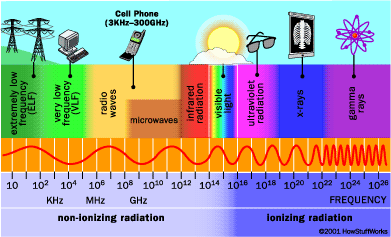
‘Clear evidence’ of mobile phone radiation link to cancers in rats, US health agency concludes
Uncertainty remains about risk to humans who experience much lower radio wave doses, Independent, Alex Matthews-King, Health Correspondent 2 Nov 18, A long-running US study on the effects of radio wave radiation, the sort emitted by mobile phones, has found “clear evidence” of high levels of exposure and heart cancers in male rats.
Some evidence of links to brain and adrenal gland tumours was also found in male rats, but in female rodents and male mice signs of cancer weren’t clear, the National Toxicology Programme (NTP) concluded in its final report on Thursday.
The programme is run by the US Department of Health and Human Services and was tasked with reviewing the toxicity of mobile phone radiation in response to the devices’ near ubiquity in modern life.
Radiation exposure in the trial was well above the levels most humans would experience, but researchers said the findings show the link between radio frequencies and tumours – at least for rats – “is real”.
“In our studies, rats and mice received radio frequency radiation across their whole bodies. By contrast, people are mostly exposed in specific local tissues close to where they hold the phone.
“In addition, the exposure levels and durations in our studies were greater than what people experience.”………..
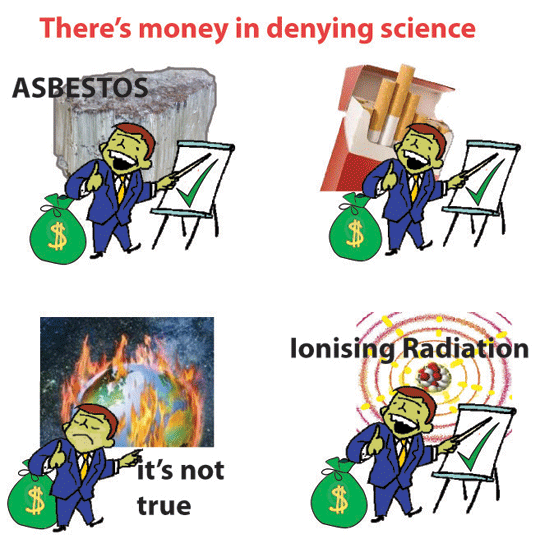
There’s money in denying the science about ionising radiation – it’s useful nuclear lobby spin
 radiation-protection-experts-are-concerned-over-epa-proposal-104895
 When the Associated Press reported that the Trump administration’s Environmental Protection Agency solicited the advice of a controversial toxicologist, Edward Calabrese, to consider changes to how it regulates radiation, it sent shock waves through the radiation protection community. Calabrese is well known for his unconventional and outlying view that low-dose radiation is not dangerous.It is important to note that the health effects of high doses of radiation are well established. We all know about the horrific effects based on studies of the populations of Hiroshima and Nagasaki after the atomic bombs were dropped. Then there was also the recent case of Russian defector Alexander Litvenenko who quickly sickened and died 23 days after being poisoned with the radioactive isotope polonium-210 in 2006.However, the effects of low doses of radiation are not well understood. Part of the reason is that these low doses are difficult to measure.
There have been questions as to whether the LNT model is appropriate for measuring cancer risk from low doses of radiation. That’s because when the radiation-induced cancer rate is low, and the sample size is small, there is more statistical uncertainty in the measurement. This allows more wiggle room in putting forward alternative dose- response models such as Calabrese’s, which have little scientific backing but that promise financial benefits for regulated industries.
Also, not being able to determine the effect of a low dose of radiation is a problem in measurement, not in the underlying linear threshold model. As doses of radiation decrease, fewer cases of radiation-induced cancers occur, making it more difficult to identify those specific cases.
This is especially true given that cancer is already a common occurrence, making it nearly impossible to disentangle radiation exposure from many other potential cancer risk factors. This is where the analogy with Takata air bags fails, because it is not possible to prove that a specific cancer death is due to ionizing radiation, but this does not make it any less real or significant.
Who profits if radiation guidelines change
The EPA issues guidance and sets regulations to “limit discharges of radioactive material affecting members of the public” associated with the nuclear energy industry. The EPA defines what radiation levels are acceptable for a protective cleanup of radioactive contamination at Superfund sites. It also provides guidance on the levels of radiation exposure that would trigger a mass evacuation. It is not surprising that certain stakeholders would welcome modifications in EPA assessment of low-dose radiation exposure given the high costs involved in preventing or cleaning up sites and in compensating victims of such exposure.
Recently, the National Council on Radiation Protection and Measurements (NCRP) – scientists who provide guidance and recommendations on radiation protection under a mandate from Congress – supported the LNT model. NCRP analyzed 29 epidemiological studies and found that the data was “broadly supportive” of the LNT model and that “no alternative dose-response relationship appears more pragmatic or prudent for radiation protection purposes.”
In fact, the National Academies’ Nuclear and Radiation Studies Board, the International Council on Radiation Protection, and other international bodies and regulators all use the LNT model for guidance and radiation protection.
From my perspective, as someone who has worked with radioactive sources, the EPA should be cognizant of the warning by the late Harvard sociologist Daniel Yankelovich that just because an effect can’t be easily quantified does not mean it is not important or does not exist.
Genetic effects on UK soldiers – ‘guinea pigs’ at nuclear bomb tests in Australia in 1950s
 UK to probe poisonous genetic legacy of nuclear test ‘guinea pigs’ SMH, By Nick Miller, 19 October 2018 London: The UK government is considering a new study into the health of the children of British veterans used as guinea pigs in its Australian and Pacific nuclear weapons tests, to test fears of a poisonous genetic legacy.
If a link can be found it may form the basis of a claim for compensation from the UK government, despite courts previously turning down such claims from the veterans themselves.
Defence Secretary Gavin Williamson has told officials in the Ministry of Defence to look at the feasibility of a study into the health and well-being of the children of nuclear test veterans, an MOD spokesman said.
Decades ago, around 22,000 British military personnel witnessed nuclear weapons tests in South Australia, on the Montebello Islands off Western Australia, and on Kiribati’s Christmas Island in the Pacific.
Some felt the heat of the explosion on their backs and were ordered to turn around and observe the mushroom cloud. One veteran told the BBC in February the tests “bowled people over” and left them on the ground screaming. He had watched “another sun hanging in the sky”, dressed only in a t-shirt, shorts and thongs.
“We were guinea pigs,” Bob Fleming, 83, said. He said 16 of his 21 children, grandchildren and great-grandchildren had birth defects or health problems: his youngest daughter has thyroid problems and severe breathing difficulties.
The family believe it is a result of the radiation Mr Fleming was exposed to during the test.
Another veteran, RAF sergeant Roy Kirkland, slept a half a mile from Ground Zero and was ordered to collect dead seabirds from the Christmas Island test site.
The new feasibility study follows a campaign by the Mirrorand Labour deputy leader Tom Watson, who have been pushing for recognition and compensation for the veterans who were exposed to radiation during the tests in the region between 1952 and 1967 – and their families.
In 2007 a study of New Zealand nuclear test veteransfound they had more than double the expected amount of genetic damage for men of the same age – even higher than that detected in workers close to the Chernobyl nuclear accident or involved in the clean-up.
The study by researchers from Massey University found the genetic damage was most likely attributable to the veterans having been on board NZ navy frigates observing nuclear tests at Christmas Island.
In 2014 a study by European researchers found a “significant excess” of infant mortality and congenital illnesses in nuclear test veterans’ children. The veterans’ wives had five times as many stillbirths, and 57 children of veterans had congenital conditions – ten times the rate in the control group and eight times the national average. There were also significantly higher congenital illnesses – and cancer – among the veterans’ grandchildren. The researchers said their results were “highly statistically significant”. …….. https://www.smh.com.au/world/europe/uk-to-probe-poisonous-genetic-legacy-of-nuclear-test-guinea-pigs-20181019-p50alz.html
Gender and radiation impact project
“For too long, girls and women have been invisible in the construction of radiation standards to protect heath. We are ready to expand the research base and collective will to change this – starting right now.”
— Mary Olson, Founder
THE BASICS
While this public health threat impacts us all, the risk is dramatically greater for women and girls.
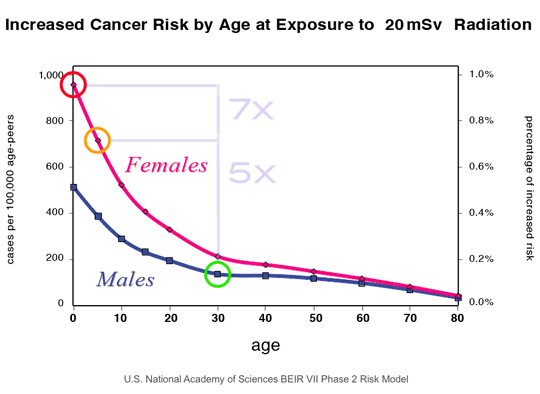
For every two men who develop cancer through exposure to ionizing radiation, three women will get the disease.Further, while children as a whole are more harmed by radiation than adults, infant and young girls, when exposed, run the highest risk of cancer across their lifetime, and teenage girls will suffer almost double rates of cancer compared to boys in the same juvenile group and the same level of exposure.
The information above, derived from data contained in the 2006 National Academy of Sciences Report Biological Effects of Ionizing Radiation VII, or BEIR VII, clearly shows that gender is a major factor in determining who suffers harm from exposure to ionizing radiation, yet this fact has not been widely reported and is not reflected in regulations or practice.
Yet, there is reason to hope. With the participation of 135 nations, the preamble of the 2017 UN Treaty on the Prohibition of Nuclear Weapons was written to include the following stanza:
Cognizant that the catastrophic consequences of nuclear weapons cannot be adequately addressed, transcend national borders, pose grave implications for human survival, the environment, socioeconomic development, the global economy, food security and the health of current and future generations, and have a disproportionate impact on women and girls, including as a result of ionizing radiation… (emphasis added)
The fact this treaty was crafted to include language referring to impact on girls and women demonstrates we have a window to examine why this is the case, which will lead to better and healthier solutions for everyone.
It is time to ask the right questions and educate the public about the policy and lifestyle choices related to ionizing radiation.
A false reference: “acceptable” radiation risks set as they affect adult men, not women, not children
 It’s Time to Retire Reference Man https://www.genderandradiation.org/blog/2018/9/4/its-time-to-retire-reference-man– Mary Olson, 17 Oct 18 Our species split atoms on purpose in 1942. Since then, few have looked back.
Weapons of Mass Destruction, energy that was supposed to be too cheap to meter which has produced more than 100,000 metric tons of waste with the potential to poison all the waters on the Blue Planet Earth, and may, in the end cost more than the electricity it made. We did all that before anyone noticed that radiation is more harmful to women, compared to men, and way more harmful to little girls than boys, and compared to men there is a whole order of magnitude greater harm to girls than to the men that regulators chose as the baseline for all regulations and risk-assessments.
Now analysts have noticed that gender, or more specifically, biological sex is a factor in harm from radiation. This discovery was made when examining the data-set used by the world to establish radiation standards—the Life Span Study data from people who survived the US nuclear attacks on Japan in 1945.
It is unconscionable that the first nuclear weapons were used, on cities full of people. And the fact that happened, and the aggressors decided to study the radiation impact, resulted in the creation of a data-set of more than 100,000 people, that includes people of both sexes and who were all ages (birth to 80) at the time of the bomb.
I sometimes say, in the atomic ashes of Hiroshima and of Nagasaki was hidden a very important message for us all…that a mistake was made: someone thought that only military males would be exposed to fission products. No one ever stopped to evaluate that assumption when hundreds of nuclear power reactors, nuclear fuel factories, nuclear weapons factories, uranium processing factories and hundreds of thousands of uranium mines were opened, and the standards made for the adult man were extended to the general population.
The mistake was not only that regulations based on men were used for the entire human lifecycle—it is that the very decisions to make nuclear weapons and generate nuclear electricity were made without the decision-makers understanding that the risk-assessments are off by a factor of ten, or more.So, we looked at the data from Hiroshima and Nagasaki and we found a pattern that has been ignored:
- Boys exposed in childhood cancers over lifetime
- Girls exposed in childhood 2x more cancers over lifetime than boys
- Men exposed in young adulthood à cancer / fatal cancer
- Women exposed in young adulthood à 1.5x more fatal cancer than men
- AND when women who were exposed as girls are compared to men: 10 times more cancers over their lifetime
Regulators say that girls are a “sub-population” – but that is a false construct that comes from not being trained in life-science. Girls are a part of the human lifecycle!
But all of the regulations governing nuclear operations, medical and dental exposures, assumptions about high-altitude air travel and levels of radon in homes are based on the “Reference Man.” How do we change that?
Today, there are three papers, and several presentations that tell this story about gender and radiation.
That is not enough. In order to change medical practices, policy recommendations and decisions, the first thing that is needed is a body of published literature telling the story. In order for top researchers working on radiation today to add questions on gender and radiation, they need additional capacity. Funding for post-docs and graduate and medical students will enable them to tackle these new questions.
Gender and Radiation Impact Project is dedicated to functioning as a catalyst, or a fairy god-mother, to fund initial study of why and how biological sex and life-cycle stage impact outcome of radiation exposure.
We believe that by providing a spark, the fire will build, and that mainstream funders will see the merit in this work, and that the work will grow to provide a solid basis for a policy review.
In addition, we will be raising a much-needed new generation of experts.
I hope you are as ready as I am.
“Transparency”- the Trump administration’s dirty trick to strangle access to reputable science on nuclear radiation
 Yes, radiation is bad for you. The EPA’s ‘transparency rule’ would be even worse. The Trump administration wants to strangle access to reputable science. https://www.washingtonpost.com/outlook/2018/10/08/yes-radiation-is-bad-you-epas-transparency-rule-would-be-even-worse/?noredirect=on&utm_term=.b7e530a79729 By Audra J. Wolfe, 8 Oct 18 Audra J. Wolfe is a Philadelphia-based writer, editor, and historian. She is the author of Freedom’s Laboratory: The Cold War Struggle for the Soul of Science.
Last Tuesday, a headline from the Associated Press sparked outrage in the ordinarily quiet world of science policy. The Environmental Protection Agency, the story suggested, was considering relaxing guidelines for low-dose ionizing radiation, on the theory that “a bit of radiation may be good for you.” Within hours, the AP had issued a correction. As it turned out, the EPA was not, after all, endorsing hormesis, the theory that small doses of toxic chemicals might help the body, much like sunlight triggers the production of vitamin D.
Instead, the EPA was doing something much scarier: It was holding hearings on the “Transparency Rule,” which would restrict the agency to using studies that make a complete set of their underlying data and models publicly available. The rule is similar to an “Open Science” order issued by the Interior Department last month, and incorporates language from the HONEST Act, a bill that passed in the House in 2017 but later stalled in the Senate. The HONEST Act originally required that scientific studies provide enough data that an independent party could replicate the experiment — which is simply not realistic for large-scale longitudinal studies.
Although these rules cite the need to base regulatory policy on the “best available science,” make no mistake: They aim to strangle access to reputable studies.
The Transparency Rule continues the Trump administration’s pattern of anti-science policies. The White House’s Office of Science and Technology Policy is a ghost town, with most of the major positions, including the director’s post, vacant since January 2017. Agencies and departments across the board, including the State Department and the Agriculture Department, are dropping their science advisers and bleeding scientific staff. It’s getting harder and harder for federal rulemakers to access expertise.
Understanding what’s wrong with “transparency,” at least as defined by these policies, requires a closer look at how scientists work. Let’s say you’re trying to understand the health effects of a one-time, accidental release of a toxic chemical. This incident might be epidemiologists’ only chance to investigate how this particular chemical interacts with both the air and the humans who breathe it, at varying doses, over a period of time. No matter how careful your approach, your study would fall short of the replicability standard.
You wouldn’t have baseline health information for the specific people who happened to be in the area. You might not have information on which residents had air filtration systems installed in their homes, or which residents were working outside when the incident took place. Your early results would, by definition, reflect only short-term health outcomes, rather than long-term effects. And you couldn’t replicate the study (with better controls) without endangering the health of thousands of people. In such cases, scientists have to extrapolate from existing, sometimes imperfect, data to protect the public.
Epidemiologists have community standards, including peer review, to evaluate these kinds of studies. A careful, peer-reviewed study of this hypothetical incident might well represent the “best available science” on this particular chemical. Regulators might rely on this study to establish the permissible levels of this chemical in the air we breathe. But now, let’s also say that this study took place 30 years ago. The leading scientists involved are dead, and no one kept their files. The raw data are, effectively, lost. Should scientists at the EPA be blocked from using the study?
Despite what made last week’s headlines, the EPA’s Oct. 3 hearing went beyond radiation. In fact, its lead witness, University of Massachusetts toxicologist Edward Calabrese, barely mentioned his theory of radiation hormesis. Instead, his testimony argued that the EPA should no longer rely on linear no-threshold (LNT) models for any number of hazards, including toxic chemicals and soil pollutants. In toxicology, LNT models assume that the biological effects of a given substance are directly connected to the amount of the exposure, with no minimum dose required. Radiation protections standards are based on LNT models; so are basic regulations involving ozone, particulate pollution, and chemical exposure.
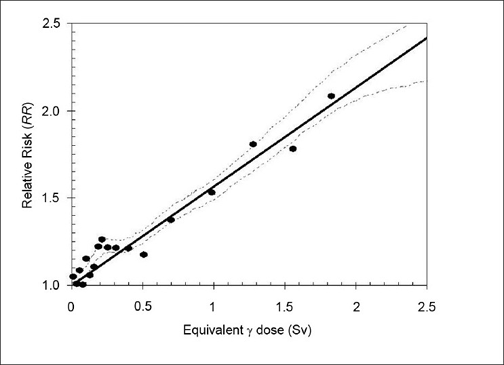
The original studies asserting a LNT model for low-dose ionizing radiation were conducted in the 1950s. Like our hypothetical epidemiologist investigating a toxic chemical release, the geneticists who tried to understand the biological effects of atomic radiation were working with imperfect data, much of which is no longer available. The concept of a “comprehensive data management policy” simply did not exist in 1955. These particular studies were primarily based on survivors of the atomic bombing of Hiroshima and Japan. The scientists also extrapolated from high-dose exposure data in fruit flies and mice and from unethical high-dose experiments conducted on humans.
These studies are imperfect, but focusing on their limitations misses the broader scandal. These studies took place during the heyday of atmospheric nuclear weapons testing, an era when both the United States and the Soviet Union were pumping the atmosphere full of radioactive nucleotides. Some of the areas near the testing zones received so much radiation that they are still uninhabitable today. The tests coated the entire planet with a scrim of radiation. The Atomic Energy Commission, the agency in charge of the United States’ nuclear weapons program, didn’t even attempt to investigate the potential health effects of this constant, low-dose exposure to ionizing radiation on the world’s population. Studies of low-dose radiation were expensive, inconvenient, and politically risky, potentially jeopardizing the weapons testing program and therefore the United States’ ability to fight the Soviet Union. From the government’s perspective, it was better not to know.
This week, a sensational headline distracted us from a broader crisis. Without government support for research of environmental hazards, the public’s health is left to either the whims of industry researchers, who have a strong incentive to play down their dangers, or to public advocacy groups, which are too easily smeared with charges of anti-industry bias. The “transparency” movement supposedly resolves this crisis of authority by giving the public access to the underlying data on which science is based, but it ignores the power dynamics that determine which research questions get asked, and why and how they’re answered.
In the past, Americans looked to their federal science agencies and science advisers to resolve these sorts of disputes. But a few weeks ago, the EPA announced that it, too, would be eliminating its Office of the Science Adviser. With the science offices empty, who will decide?
There is one bright spot in all of this: On Sept. 28, bipartisan legislation authorized the Energy Department to restart its low-dose radiation research program. But what about the other pollutants that the EPA supposedly regulates? Who will produce the kinds of science deemed acceptable under the “transparency” rule?
“Transparency” has become another way to cultivate institutional ignorance. Americans deserve better from the agencies that are supposed to protect them. In the case of environmental hazards, what you don’t know can hurt you.
1 This Month
19 February – VIRTUAL EVENT-Decision Time: AI and Our Nuclear Arsenal
12:45 p.m. Central / 1:45 p.m. Eastern
To see nuclear-related stories in greater depth and intensity – go to https://nuclearinformation.wordpress.com
-
Archives
- February 2026 (170)
- January 2026 (308)
- December 2025 (358)
- November 2025 (359)
- October 2025 (376)
- September 2025 (258)
- August 2025 (319)
- July 2025 (230)
- June 2025 (348)
- May 2025 (261)
- April 2025 (305)
- March 2025 (319)
-
Categories
- 1
- 1 NUCLEAR ISSUES
- business and costs
- climate change
- culture and arts
- ENERGY
- environment
- health
- history
- indigenous issues
- Legal
- marketing of nuclear
- media
- opposition to nuclear
- PERSONAL STORIES
- politics
- politics international
- Religion and ethics
- safety
- secrets,lies and civil liberties
- spinbuster
- technology
- Uranium
- wastes
- weapons and war
- Women
- 2 WORLD
- ACTION
- AFRICA
- Atrocities
- AUSTRALIA
- Christina's notes
- Christina's themes
- culture and arts
- Events
- Fuk 2022
- Fuk 2023
- Fukushima 2017
- Fukushima 2018
- fukushima 2019
- Fukushima 2020
- Fukushima 2021
- general
- global warming
- Humour (God we need it)
- Nuclear
- RARE EARTHS
- Reference
- resources – print
- Resources -audiovicual
- Weekly Newsletter
- World
- World Nuclear
- YouTube
-
RSS
Entries RSS
Comments RSS
 nuclear-news