Trump administration accepting the greedy “radiation is good for you” group

These assertions stand scientific consensus on its head. Most experts say to the contrary that even low doses of radiation cause cell damage that years later can promote uncontrolled cell growth and replication, and that children and fetuses are particularly susceptible to harm. That seven-decade-old view was reaffirmed as recently as last April in a study by a congressionally chartered nonprofit organization, the National Council on Radiation Protection and Measurement.
The study, overseen by a dozen experts from the government, academia, and industry, and funded by the NRC, considered 29 contemporary scientific studies of the effects of low-dose radiation in reaffirming that even low-level radiation should be avoided to the extent possible.
 RADIATION IS GOOD FOR YOU? THE FRINGE VIEWPOINT GAINS GROUND IN THE TRUMP ADMINISTRATION, https://publicintegrity.org/national-security/radiation-is-good-for-you-the-heretical-view-gains-ground-under-trump/The Nuclear Regulatory Commission is actively considering claims that low-dose radiation protections should be lifted because exposures make you healthier, a potential boon to radiation-related industries.
Since World War II, virtually every American business where radiation is present – hospital emergency rooms and cancer wards, uranium mines, nuclear power plants, and others – has operated under rules generally requiring that exposures be kept as low as possible. The rules are based on a widely-accepted scientific dicta that even small amounts of extra radiation can be harmful to human health.
Following those rules, though, is costly and often cumbersome, and so the requirement for low-dose radiation protections – known as the ALARA standard for “as low as reasonably achievable” – has long been annoying to a large swath of American industry. Estimates of the costs associated with these protections run into the billions of dollars.
Until the Trump era, opponents of the rules have gotten little traction in trying to upend low-dose radiation protections – such as isolation units, elaborate shielding, specialized air cleaners, and elaborate worker training — in federal regulations. But proposed relaxations have been percolating in recent months, courtesy of a little-known advocacy group called Scientists for Accurate Radiation Information, or SARI.
 Members of the group, which claims its ideas have been wrongly dismissed and belittled by mainstream scientists, subscribe to a minority theory known as “hormesis.” It defies conventional wisdom by holding that damaging things that are dangerous in high doses might actually be beneficial to human health in small doses.
Despite swimming against the tide in the past, one of the group’s members has just been appointed to head a Radiation Advisory Panel at the Environmental Protection Agency, which helps set federal standards for radiation doses received by the public and by workers. And several of its recommendations to ease radiation protections are presently under active consideration by the Nuclear Regulatory Commission.
SARI’s members typically have more day-to-day connections to radiation than others, and potentially more influence: They have held jobs connected to radiation protection at the EPA, the Department of Labor, the Energy Department and its sub-agency responsible for building nuclear weapons at nine factories across the country. Practitioners of nuclear medicine, people employed in the nuclear industry, and professors who teach nuclear medicine or industrial hygiene also populate SARI.
The NRC’s consideration of the SARI views got started when three members of the group petitioned it in 2015 to abandon its current approach and accept that radiation in low doses is not only benign, but improves health. That was two years after SARI’s founding by industry officials trying to tamp down public concerns about the radiation that spilled from the 2011 Fukushima nuclear disaster.
The NRC took the petitions seriously. Its staff created a working group to study the issue, and insiders now say that work is done. According to Scott Burnell, an NRC spokesman, the five members of the commission as a result will take up the issue this spring. Continue reading
Coastal populations dosed with radiation from nearby nuclear facilities
Radioactive sea spray is dosing communities, February 17, 2019Governments want to cover it up By Tim Deere-Jones.
It is clear from the available empirical data that coastal populations impacted by prevailing onshore winds and living next to sea areas contaminated with liquid radioactive effluents from nuclear sites, are annually exposed to dietary and inhalation doses of man-made marine radioactivity.
Effluents discharged to the sea by nuclear power stations, fuel fabrication sites and reprocessing facilities are transferred from sea to land in airborne sea spray and marine aerosols (micro-droplets). They come in also during episodes of coastal flooding. This problem has been particularly pronounced around the UK Sellafield reprocessing and plutonium production site in Cumbria. In 1988, independent empirical research commissioned by a west Wales local authority reported that
Sellafield-derived, sea-discharged cesium had been found in pasture grass up to 10 miles inland of the Ceredigion coast.
Clearly, this contributes to human dietary doses via the dairy and beef food chain. The research also implies the inevitability of further dietary doses via arable and horticultural crops. Given that airborne radioactivity is driven at least 10 miles inland, it should be assumed that coastal populations are exposed, on a repeated annual basis, to inhalation doses.
https://beyondnuclearinternational.org/2019/02/17/radioactive-sea-spray-is-dosing-communities/
Ireland’s Radiation scrutiny now transfers to HIQA
13 Feb 19, Last month’s transposition of European Council Directive 2013/59/EURATOM into Irish law means that HIQA is now responsible for regulating medical exposure to ionising radiation.
The new law covers dental x-rays, hospital CT scans, mammograms and radiotherapy received as part of cancer treatment.
Treatment
A medical exposure to ionising radiation is when a patient receives ionising radiation as part of their diagnosis or treatment.
The transposition into Irish law confers new statutory functions on HIQA under the EU’s (Basic Safety Standards for Protection against Dangers Arising from Medical Exposure to Ionising Radiation) Regulations 2018 SI No. 256.
HIQA’s John Tuffy said: “Generally the risks associated with receiving medical exposure to ionising radiation can be considered very low.
“However, as procedures that involve ionising radiation carry varying levels of risk dependent on the dose given, it is important that all radiation doses are kept as low as practically possible.
Vital
“It is vital that patients are only exposed when the benefits of receiving the exposure outweigh the risks.”
“The new legislation has given HIQA regulatory powers to ensure that appropriate processes are in place to protect patients in public and private healthcare facilities for the first time.”
Last month’s transposition of European Council Directive 2013/59/EURATOM into Irish law means that HIQA is now responsible for regulating medical exposure to ionising radiation.
The new law covers dental x-rays, hospital CT scans, mammograms and radiotherapy received as part of cancer treatment.
Treatment
A medical exposure to ionising radiation is when a patient receives ionising radiation as part of their diagnosis or treatment.
The transposition into Irish law confers new statutory functions on HIQA under the EU’s (Basic Safety Standards for Protection against Dangers Arising from Medical Exposure to Ionising Radiation) Regulations 2018 SI No. 256.
HIQA’s John Tuffy said: “Generally the risks associated with receiving medical exposure to ionising radiation can be considered very low.
“However, as procedures that involve ionising radiation carry varying levels of risk dependent on the dose given, it is important that all radiation doses are kept as low as practically possible.
Vital
“It is vital that patients are only exposed when the benefits of receiving the exposure outweigh the risks.”
Last month’s transposition of European Council Directive 2013/59/EURATOM into Irish law means that HIQA is now responsible for regulating medical exposure to ionising radiation.
The new law covers dental x-rays, hospital CT scans, mammograms and radiotherapy received as part of cancer treatment.
Treatment
A medical exposure to ionising radiation is when a patient receives ionising radiation as part of their diagnosis or treatment.
The transposition into Irish law confers new statutory functions on HIQA under the EU’s (Basic Safety Standards for Protection against Dangers Arising from Medical Exposure to Ionising Radiation) Regulations 2018 SI No. 256.
HIQA’s John Tuffy said: “Generally the risks associated with receiving medical exposure to ionising radiation can be considered very low.
“However, as procedures that involve ionising radiation carry varying levels of risk dependent on the dose given, it is important that all radiation doses are kept as low as practically possible.
Vital
“It is vital that patients are only exposed when the benefits of receiving the exposure outweigh the risks.”
“The new legislation has given HIQA regulatory powers to ensure that appropriate processes are in place to protect patients in public and private healthcare facilities for the first time.”
Last month’s transposition of European Council Directive 2013/59/EURATOM into Irish law means that HIQA is now responsible for regulating medical exposure to ionising radiation.
The new law covers dental x-rays, hospital CT scans, mammograms and radiotherapy received as part of cancer treatment.
Treatment
A medical exposure to ionising radiation is when a patient receives ionising radiation as part of their diagnosis or treatment.
The transposition into Irish law confers new statutory functions on HIQA under the EU’s (Basic Safety Standards for Protection against Dangers Arising from Medical Exposure to Ionising Radiation) Regulations 2018 SI No. 256.
HIQA’s John Tuffy said: “Generally the risks associated with receiving medical exposure to ionising radiation can be considered very low.
“However, as procedures that involve ionising radiation carry varying levels of risk dependent on the dose given, it is important that all radiation doses are kept as low as practically possible.
Vital
“It is vital that patients are only exposed when the benefits of receiving the exposure outweigh the risks.”
“The new legislation has given HIQA regulatory powers to ensure that appropriate processes are in place to protect patients in public and private healthcare facilities for the first time.”
 |
ReplyForward
|
Increasing danger of the radioactive by-products from the nuclear industry
From mining the uranium rich ore, to nuclear abandonment – a dozen by-products more radio toxic than the ore mined to fuel the reactor are discarded. These products are the raffinates culminating in 85% of the total radioactivity that goes directly into the tailings only to migrate throughout the environment.
Products like Radon gas, Polonium-210 with a 140 day half life, Radium-226, with a 1600 year half life, Thorium-230 with a 76,000 year half life are released , and yet only 1kg of Uranium oxide is recovered in every 4,000 kilos mined.
Uranium-238 subjected to neutron bombardment in the reactor becomes Uranium-239 with a 23 minute half life, then that becomes Neptunium-239 with a 2.3 day half life, and that goes on to become Plutonium-239 with a 244,000 year half life, then this spent fuel finally decays to become Uranium- 235 with a half life of 700 million years.
Moreover, x that by no less than 10 to get the life of the radioactive hazard, which equates to no less than 7 billion years, and here we have only just crossed the nuclear industries threshold within the last 76 years with many thousands of nuclear events, and accidents recorded, and yet this is not the only wastes these machines produce with one Canadian CANDU reactor that recorded 100 trillion becquerels of radiation from the Tritium released in just one year.
The nuclear embracing coterie tell us they can safely manage these radioactive wastes, yet there containment vessels are only guaranteed for 25 years not 7 billion years, and a director of Holtec has stated there is no way to remedy a breach of containment. Moreover these nuclear wastes are a gamble and risk that only grows exponentially with every generation.
A claim that 5G networks are a dangerous experiment
‘A global catastrophe’: Radiation activist warns that 5G networks are ‘massive health experiment’ https://www.rt.com/news/450775-massive-health-experiment-5g-cancer/ 6 Feb, 2019 A leading activist on the issue of electromagnetic radiation and its negative impacts on public health has described the rollout of 5G as a “massive health experiment” which could “become a global catastrophe.”
Arthur Robert Firstenberg is a well-known advocate for curtailing the development of 5G networks both in the US and internationally, claiming that super fast broadband could cause cancer in humans and wildlife, as well as exacerbating the symptoms of electromagnetic hypersensitivity.
In a bid to stall the rollout of the networks Firstenberg is petitioning the World Health Organization, the UN and the EU to “urgently halt the development of 5G.” The petition had garnered over 40,000 signatures at time of writing.
The deployment of 5G constitutes an experiment on humanity and the environment that is defined as a crime under international law,” the petition states. The US rollout of the new network has already begun in cities like Houston, Indianapolis, Los Angeles, and Sacramento.
“This could become a global catastrophe. When the first satellites were launched in the late 1990s for mobile phones, on the day they were launched people sensitive to these things got very sick. The mortality rate rose in the US by 5-10% too and there were reports that birds were not flying,” Firstenberg told the Daily Star.
Firstenberg also claims that, in areas of the world where rollout of 5G antennas has already begun, the local population, including insects and other wildlife, are already getting sick. He claims to have a condition known as electromagnetic hypersensitivity, which induces symptoms like dizziness, nausea, amnesia, insomnia, tremors, heart arrhythmia, acute and chronic pain, among others though it is not scientifically or medically recognized.
n addition, Firstenberg filed a lawsuit seeking $1.43 million in damages from his neighbor for damaging his health by using her iPhone and WiFi connection.
Much like cell phones before it in the 1980s and 90s, 5G has encountered strong pushback from the general public since it was first announced. In September 2018, Mill Valley city council, in California, voted to block development of 5G towers and small cells in residential areas citing “serious adverse health and environmental impacts caused by the microwave radiation emitted from these 4G and 5G Small Cell Towers,” Motherboard reports.
However, according to the Centers for Disease Control and Prevention (CDC), “There is no scientific evidence that provides a definite answer to that question… More research is needed before we know if using cell phones causes health effects.”
Despite a number of broad-ranging studies into the potential effects of cell phone radiation showing no solid evidence of any significant health risks to humans (let alone insects), many within the scientific community remain skeptical that the benefits of 5G technology outweigh the potential harm to humans.
Tworecent studies also showed elevated risk of cancerous tumors developing in male rats (though not female) who were exposed to electromagnetic fields (EMFs) for nine hours a day over two years. However, the claims didn’t stand up in follow-up double-blind tests.
215 scientists from 40 different countries have allegedly signed an appeal calling for international protection from non-ionizing electromagnetic field exposure, the effects of which include, but are not limited to, “increased cancer risk, cellular stress, increase in harmful free radicals, genetic damages, structural and functional changes of the reproductive system, learning and memory deficits, neurological disorders, and negative impacts on general well-being.”
In a letter, Dr Martin Pall, a biochemistry professor at the Washington State University, claimed there were severe biological and health effects, including increased risk of cancer via DNA mutations, due to exposure to 5G networks, while also claiming that the FCC is a “captured agency”that is subject to the will of the very industry it is supposed to regulate.
5G would provide broadband speeds over 100 times faster than current data speeds. But to facilitate its rollout 300,000 new antennas would be required in the US alone. That’s roughly equal to three decades-worth of cell phone tower development.
The networks require a more dense array of “small cell” sites because their high frequency waves provide faster speeds but don’t travel as far
Sending dummies into space, to test effects of radiation on women
Radiation for dummies, Space Daily, by Staff Writers, Paris (ESA) Jan 28, 2019 Meet Helga and Zohar, the dummies destined for a pioneering lunar flyby to help protect space travelers from cosmic rays and energetic solar storms.
These two female phantoms will occupy the passenger seats during Orion’s first mission around the Moon, going further than any human has flown before.
Fitted with more than 5600 sensors, the pair will measure the amount of radiation astronauts could be exposed to in future missions with unprecedented precision.
The flight test will take place during NASA’s Exploration Mission-1, an uncrewed trip to the vicinity of the Moon and back to Earth.
Radiation poses a major health risk to people in space. Astronauts on the International Space Station receive doses 250 higher than on Earth. Away from Earth’s magnetic field and into interplanetary space, the impact on the human body could be much higher – up to 700 times more.
Two sources of radiation are of concern: galactic cosmic radiation and virulent solar particle events. This radiation could increase the crew’s risk of cancer and become a limiting factor in missions to the Moon and Mars.
Helga and Zohar
The two phantoms simulate adult female torsos. Both Helga and Zohar are made up of 38 slices of tissue-equivalent plastics that mimic the varying density of bones, soft tissue and lungs. Similar dummies are used in hospitals to quantify the right dose of radiation for cancer therapies.
“We chose female phantoms because the number of women astronauts is increasing, and also because the female body is typically more vulnerable to radiation,” explains Thomas Berger, lead scientist of the Matroshka AstroRad Radiation Experiment (MARE) at the German Aerospace Center, DLR.
Sensors have been fitted in the most radiation-sensitive areas of the body – lungs, stomach, uterus and bone marrow. While thousands of passive dosimeters will record the radiation dose from launch until return to Earth, a set of 16 active detectors will map the radiation dose both on the phantoms’ skin and internal organs during flight.
An astronaut’s shield
The only difference between the twin dummies is that Zohar will be wearing a radiation protection vest, while Helga will travel unprotected from spaceborne radiation…….. http://www.spacedaily.com/reports/Radiation_for_dummies_999.html
America’s Environmental Protection Agency appoints a radiation sceptic to head radiation panel
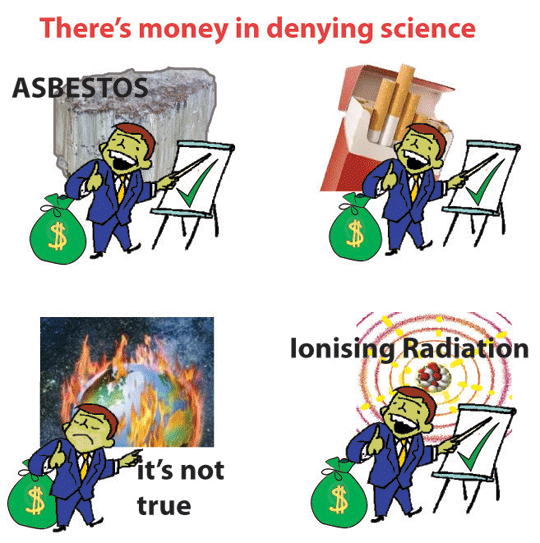
Brant Ulsh, skeptic on radiation limits, to head EPA radiation panel, Japan Times, 2 Feb 19, WASHINGTON  – The Environmental Protection Agency has appointed a scientist who argues for easing regulations on lower-level radiation exposures to lead the agency’s radiation advisory committee.
Acting EPA head Andrew Wheeler on Thursday announced the appointment of Brant Ulsh, a health physicist, as one of the EPA’s science advisers and the panel’s chairman. Ulsh has been a leading critic of the EPA’s decades-old position that exposure to any amount of ionizing radiation is a cancer risk.
In a paper he co-wrote last year, Ulsh and a colleague argued that the position was based on outdated scientific information and forced the “unnecessary burdens of costly clean-ups” on facilities working with radiation.
The EPA under President Donald Trump has targeted a range of environmental protections, in line with Trump’s arguments that overly strict environmental rules have hurt U.S. businesses. Environmental and public health advocates say the rollbacks threaten the health and safety of Americans.
Some environmental groups and scientists have criticized what they say is the administration’s openness to an outlier position on radiation risks.
“Once again the Trump administration is moving to the fringe for its scientific advice, choosing someone who could undercut foundational protections from radiation,” Bemnet Alemayehu, a staff scientist at the Natural Resources Defense Council environmental advocacy group, said in a statement Friday. “We need sound science to dictate health protections, not dangerous theories.”
EPA spokesman John Konkus declined comment Friday, referring a reporter to a news release announcing the appointment.
Ulsh did not immediately respond to an email Friday asking for comment, including whether he intended to use the advisory position to encourage reconsideration of the EPA’s no-tolerance policy on lower doses of radiation exposure……… https://www.japantimes.co.jp/news/2019/02/02/world/science-health-world/brant-ulsh-skeptic-radiation-limits-head-epa-radiation-panel/#.XFdRStIzbGg
Who will be there?
Nuclear reactors routinely release radioactive gases into the environment
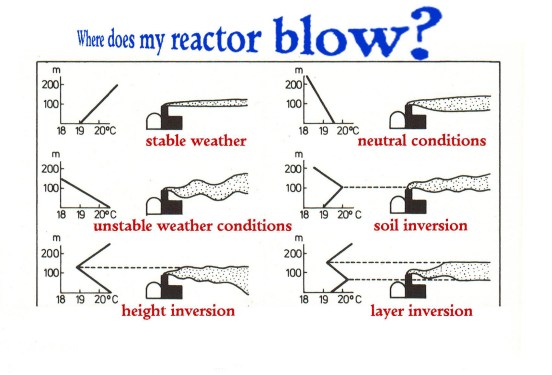
This graphic best explains issues with venting and filtering of nuclear reactor cores under normal operations. The venting is done approximately once every three months at the beginning of fuel cycle and once a month or more at the end of fuel cycle. Noble gases like Krypton 85 are chemically inert single atoms. They go right through the filters.

A single jawbone has revealed just how much radiation Hiroshima bomb victims absorbed
WP, By Kristine Phillips, 2 May 2018, At 8:15 a.m. on Aug. 6, 1945, the United States dropped the first combat atomic bomb, “Little Boy.” It exploded 43 seconds later, creating a massive fireball that incinerated much of Hiroshima. Nearly 350,000 people were in the Japanese city that day, and most were civilians.
Twenty-seven years later, a scientist from across the Pacific Ocean arrived in Hiroshima with what was considered then a novel idea. Brazilian physicist Sérgio Mascarenhas, at the time a visiting professor at Harvard University, said that exposure to radiation makes human bone magnetic, and that “magnetic memory” existed in the bones of atomic bombing victims years after the explosion. Scientists could measure radiation exposure by examining the bones of victims, Mascarenhas proposed.
With the help of two Japanese scientists in Hiroshima, Mascarenhas obtained several samples of victims’ bones, including a jawbone that belonged to a person who was less than a mile away from Ground Zero. They were able to estimate the amount of radiation present in the bones, according to a paper Mascarenhas presented to the American Physical Society meeting in April 1973 in Washington, but specific calculations could not be achieved with 1970s technology.
Mascarenhas brought the samples home to Brazil, where they sat in storage for the next four decades — until two other Brazilian scientists continued his research using more advanced technology. The result was astonishing.
Using a technique called electron spin resonance, the researchers measured that the jawbone had absorbed 9.46 grays of radiation from the Hiroshima attack. (A gray or Gy is a unit used to measure the amount of radiation absorbed by an object or a person.)
To place this in context: A cancer patient receiving radiotherapy treatment is exposed to about 2 to 3 grays on a very localized part of the body where a tumor is located. Whole-body radiation with about 5 grays — nearly half of the amount calculated from the jawbone — is enough to kill a person, Oswaldo Baffa, one of the researchers and a professor at the University of São Paulo, told The Washington Post Tuesday.
Teeth have been used to measure the amount of radiation a person had been exposed to. In 1997, scientists from Taiwan measured the radiation dose that patients with nasopharyngeal cancer (in which cancer cells form near the throat behind the nose) had absorbed from radiotherapy by examining their jawbones. But the researchers in Brazil said this is the first time that bones were used to precisely measure the amount of radiation absorbed by atomic bombing victims……..https://www.washingtonpost.com/news/retropolis/wp/2018/05/02/a-single-jawbone-has-revealed-just-how-much-radiation-hiroshima-bomb-vic
Dr Gordon Edwards explains the background to former NRC chairman’s opposition to nuclear power
 Nuclear Regulatory Commission ex-Chairman Gregory Jaczko is adamantly opposed to the idea of keeping existing nuclear reactors running as a way to offset climate change, because each reactor is like a time bomb ready to explode if the cooling is cut off by a total station blackout, by equipment failure, by major pipe breaks, or by acts of warfare, sabotage, or terrorism. The societal dislocation caused by the spread of radioactive material over wide areas, affecting drinking water, food and habitation for decades or centuries, is as bad as the ravages of climate change for the communities so affected.
Radioactive fallout killed up to 690,000 Americans from 1951 to 1973.
In the 1950s, the U.S. government downplayed the danger of radioactive fallout, asserting that all radioactivity was confined to the Nevada test site. Despite this, a national estimate attributed 49,000 cancer deaths to nuclear testing in the area.
But the results of new research suggest that this number is woefully inaccurate. Using a novel method, and today’s improved understanding of radioactive fallout, Keith Meyers from the University of Arizona discovered that U.S. nuclear testing was responsible for the deaths of at least as many — and likely more — as those killed by the nuclear bombs in Hiroshima and Nagasaki.
Specifically, between 340,000 and 690,000 Americans died from radioactive fallout from 1951 to 1973.
 At least 340,000 Americans died from radioactive fallout between 1951
  and 1973 https://bigthink.com/politics-current-affairs/new-estimate-deaths-from-us-nuclear-tests?rebelltitem=2#rebelltitem2 Domestic nuclear testing wreaked havoc on thousands of families. MATTHEW DAVIS 14 December, 2018
- Hiroshima and Nagasaki resulted in the deaths of hundreds of thousands. But new research shows that domestic U.S. nuclear tests likely killed more.
- The new research tracked an unlikely vector for radioactive transmission: dairy cows.
- The study serves as a reminder of the insidious and deadly nature of nuclear weapons.
When we think of nuclear disasters, a few names probably come to mind. There’s the Chernobyl disaster, which killed around 27,000 people, although estimates are fuzzy. After Fukushima, there were no deaths due to radiation poisoning, but this event occurred relatively recently, and radiation poisoning often kills slowly over decades. When the U.S. dropped atomic bombs on Hiroshima and Nagasaki, estimates put the death toll at around 200,000 people, but again, exact numbers are difficult to calculate.
One name that almost certainly didn’t come to mind is Nevada. When the Soviet Union detonated their first atomic bomb in 1949, the U.S. was shocked into action. America’s prior nuclear testing had been carried out in the Pacific, but it was logistically slow and costly to conduct tests there. In order to maintain dominance over the growing Soviet threat, the U.S. selected a 1,375 square-mile area in Nye County, Nevada.
This was an ideal spot for several reasons. It was closer than Bikini Atoll. The weather was predictable and very dry, reducing the risk that radioactive fallout would be dispersed by rainstorms. It was sparsely populated. There was an understanding that there would be some amount of risk posed to nearby civilians, but it was deemed acceptable at the time. The trouble is, our understanding of radioactive fallout was still in its infancy. It was a catch-22; the only way to learn more was to test nuclear weapons.
In the 1950s, the U.S. government downplayed the danger of radioactive fallout, asserting that all radioactivity was confined to the Nevada test site. Despite this, a national estimate attributed 49,000 cancer deaths to nuclear testing in the area.
But the results of new research suggest that this number is woefully inaccurate. Using a novel method, and today’s improved understanding of radioactive fallout, Keith Meyers from the University of Arizona discovered that U.S. nuclear testing was responsible for the deaths of at least as many — and likely more — as those killed by the nuclear bombs in Hiroshima and Nagasaki. Specifically, between 340,000 and 690,000 Americans died from radioactive fallout from 1951 to 1973.
Prior studies generally looked at the areas surrounded the Nevada test site and estimated the deaths caused by fallout from the area. This number was relatively low, owing to the dry, predictable weather mentioned earlier. However, the bulk of the deaths were actually dispersed throughout the country, primarily in the Midwest and Northeast regions. These deaths were caused by an unfortunate synergy between meteorology, radiation, and — perhaps oddly enough — cows.
Out of all the radioactive elements produced by a nuclear explosion, iodine-131 was the biggest killer. I-131 has an eight-day half-life, tends to accumulate in the thyroid gland, and emits beta and gamma radiation. While alpha radiation is generally weak and doesn’t penetrate material very well, beta and gamma radiation are highly energetic and shoot through clothing and flesh, ripping up DNA as it goes along.
Prior studies had examined the radioactive fallout dispersed by low-altitude winds, which would generally settle around the Nevada test site. However, a significant amount of I-131 was caught up in high-altitude winds. These winds carried the radioactive particles to other regions of the U.S., where it mixed with rain clouds.
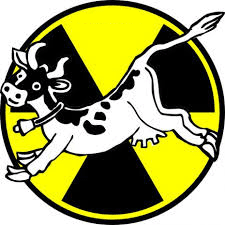 The now-radioactive rain fell onto the grasslands in the Midwest and Northeast. Then, cows ate the now-radioactive grass. The cows then produced radioactive milk. Dairy practices during the study period were different than they are today — most people drank milk that had recently been extracted from local cows.
Thanks to a National Cancer Institute database that contains broad data on radiation exposure, Meyers was able to track the amount of I-131 found in local milk and compare this with the number and nature of deaths on a county level. In this way, Meyers was able to determine that a significant number of these deaths were due to drinking poisoned milk. These civilians would have had no idea that the milk they were drinking had been irradiated by nuclear explosions hundreds of miles away.
Ironically, the area around the Nevada test site didn’t have this problem. Although they too drank fresh milk from local cows, they imported hay from other parts of the country. Since their cows weren’t eating irradiated hay, the local Nevadans took in significantly less radioactive material than their less-fortunate, distant countrymen.
Although our understanding of radiation and nuclear fallout is much improved since the dawn of the nuclear age, the study serves as a warning of the insidious nature of nuclear weapons. Containing nuclear fallout is challenging, even when you know where all of the vectors of radioactive transmission are. The complexity and intertwining nature of our ecological and social systems means that words like “clean,” “precise,” or “surgical” will likely never apply to nuclear weapons.
TRUMP WANTS TO RECLASSIFY RADIOACTIVE WASTE FROM NUCLEAR WEAPONS TO ‘LOW LEVEL’ SO DISPOSAL IS CHEAPER
|
The Department of Energy intends to relabel high-level radioactive waste left over from the production of nuclear weapons as low-level, the Associated Press reported. Currently, high-level radioactive waste is defined as that which is a byproduct of fuel reprocessing (where leftover fissionable material is separated from the waste) or from nuclear reactors. Low-level waste, on the other hand, represents around 90 percent of all such waste, according to the American Nuclear Society, and generally comes from facilities where radioisotopes are used, such as nuclear power stations, and local hospitals. Items often include wipes, clothes and plastic. In the U.S., 90,000 metric tons of nuclear waste is being temporarily stored as successive administrations have grappled to find a long-term solution. Storing nuclear waste safely presents a number of challenges: it needs to be protected from natural disasters, and stopped from seeping into the surrounding water and soil, while its radiation blocked. Thieves must be kept from accessing it, and so too future generations who may not understand how toxic such materials are. The Associated Press reported the agency said the reclassification would shave $40 billion off the cost of cleaning up after the production of nuclear weapons. A Department of Energy official told Newsweek it is requesting public comment on its interpretation of the meaning of the statutory term of high-level radioactive waste through the federal register. …….. Facilities which would be affected include the country’s most highly contaminated: the Hanford Nuclear Reservation in Washington state, which takes up an area half the size of Rhode Island. Opened in 1943, the site produced the plutonium for the atomic bomb dropped on Nagasaki, Japan in 1945, according to its website. The production of nuclear materials carried on until 1987, leaving behind waste that threatened the local environment, prompting the state and federal authorities — including the Department of Energy, the Environmental Protection Agency — to pledge in 1987 to clean up the site, without success. Other facilities mentioned in the plans are the Savannah River Plant, South Carolina and the Idaho National Laboratory, according to the Associated Press……. Alex Smith, Program Manager of the State of Washngton Department of Ecology Nuclear Waste Program, which is involved in the Hanford project, told the Associated Press: “They see it as a way to get cleanup done faster and less expensively.” The consultation originally ran from October 10 until December 10. Democratic Senator Ron Wyden for Oregon requested a public consultation on the proposal be extended to January 9……..https://www.newsweek.com/trump-reclassify-radioactive-waste-nuclear-weapons-low-level-disposal-cheaper-1253063?fbclid=IwAR1H-mvAOsdN24NT1pKy3MGAuVDn_q_siZc67iXsl-eLkKNFNMeZ4F8xKgA |
|
|
Assessing the effects of planetary electromagnetic pollution
Planetary electromagnetic pollution: it is time to assess its impact, https://www.thelancet.com/journals/lanplh/article/PIIS2542-5196%2818%2930221-3/fulltext?dgcid=raven_jbs_etoc_email
Priyanka Bandara
David O Carpenter
Open AccessPublished:December, 20 As the Planetary Health Alliance moves forward after a productive second annual meeting, a discussion on the rapid global proliferation of artificial electromagnetic fields would now be apt. The most notable is the blanket of radiofrequency electromagnetic radiation, largely microwave radiation generated for wireless communication and surveillance technologies, as mounting scientific evidence suggests that prolonged exposure to radiofrequency electromagnetic radiation has serious biological and health effects. However, public exposure regulations in most countries continue to be based on the guidelines of the International Commission on Non-Ionizing Radiation Protection and Institute of Electrical and Electronics Engineers, which were established in the 1990s on the belief that only acute thermal effects are hazardous. Prevention of tissue heating by radiofrequency electromagnetic radiation is now proven to be ineffective in preventing biochemical and physiological interference. For example, acute non-thermal exposure has been shown to alter human brain metabolism by NIH scientists, electrical activity in the brain, and systemic immune responses.
At the Oceania Radiofrequency Scientific Advisory Association, an independent scientific organisation, volunteering scientists have constructed the world’s largest categorised online database of peer-reviewed studies on radiofrequency electromagnetic radiation and other man-made electromagnetic fields of lower frequencies. A recent evaluation of 2266 studies (including in-vitro and in-vivo studies in human, animal, and plant experimental systems and population studies) found that most studies (n=1546, 68·2%) have demonstrated significant biological or health effects associated with exposure to anthropogenic electromagnetic fields. We have published our preliminary data on radiofrequency electromagnetic radiation, which shows that 89% (216 of 242) of experimental studies that investigated oxidative stress endpoints showed significant effects.
This weight of scientific evidence refutes the prominent claim that the deployment of wireless technologies poses no health risks at the currently permitted non-thermal radiofrequency exposure levels. Instead, the evidence supports the International EMF Scientist Appeal by 244 scientists from 41 countries who have published on the subject in peer-reviewed literature and collectively petitioned the WHO and the UN for immediate measures to reduce public exposure to artificial electromagnetic fields and radiation.
Evidence also exists of the effects of radiofrequency electromagnetic radiation on flora and fauna. For example, the reported global reduction in bees and other insects is plausibly linked to the increased radiofrequency electromagnetic radiation in the environment.
Honeybees are among the species that use magnetoreception, which is sensitive to anthropogenic electromagnetic fields, for navigation.
References……

Prisoners in New York will learn about their radiation exposure due to body scans
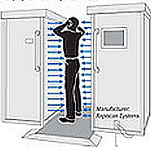 Body-scanned inmates will get radiation exposure stats, NY Post By Rich Calder and Tamar Lapin, November 8, 2018 “………The city Health Department has issued new regulations that would allow inmates to learn how much radiation they’ve absorbed from body scans in the clink.Upon request, the Correction Department would have to provide them with their “total accumulated radiation exposure,” according to a legal notice issued by the city Thursday. Body-scanned inmates will get radiation exposure stats, NY Post By Rich Calder and Tamar Lapin, November 8, 2018 “………The city Health Department has issued new regulations that would allow inmates to learn how much radiation they’ve absorbed from body scans in the clink.Upon request, the Correction Department would have to provide them with their “total accumulated radiation exposure,” according to a legal notice issued by the city Thursday.
The regulation was in response to a new state law authorizing correction officers to again use high-powered body scanners to spot nonmetal objects — such as ceramic knives — in the possession of inmates. As part of the law, the Health Department had to implement rules to make sure the scanners are safe — including “setting annual exposure limits and mandates for training and signage.”…… The Correction Department thought it had the problem solved in 2012 and 2013, after it purchased five “airport-style” body scanners with ionizing radiation that picked up every imaginable kind of weapon and contraband. But after a year’s use, the scanners were shelved when it was discovered they violated a little-noticed state law that said “ionizing radiation” may not be “applied to human beings” except by licensed medical personnel for a medical purpose…….. The new state law wipes out the scanner-use medical restriction…….https://nypost.com/2018/11/08/body-scanned-inmates-will-get-radiation-exposure-stats/ |
|
1 This Month

26 September – International Day for the Total Elimination of Nuclear Weapons


PLEASE OPPOSE HR 8255 AND S.3639 – bills would accelerate satellite deployment, with no environmental review or safeguards – https://ncstd5li.quorum.us/campaign/169331/
To see nuclear-related stories in greater depth and intensity – go to https://nuclearinformation.wordpress.com
-
Archives
- September 2026 (206)
- August 2026 (330)
- July 2026 (355)
- June 2026 (287)
- May 2026 (306)
- April 2026 (356)
- March 2026 (251)
- February 2026 (267)
- January 2026 (308)
- December 2025 (358)
- November 2025 (359)
- October 2025 (375)
-
Categories
- 1
- 1 NUCLEAR ISSUES
- business and costs
- climate change
- culture and arts
- ENERGY
- environment
- health
- history
- indigenous issues
- Legal
- marketing of nuclear
- media
- opposition to nuclear
- PERSONAL STORIES
- politics
- politics international
- Religion and ethics
- safety
- secrets,lies and civil liberties
- spinbuster
- technology
- Uranium
- wastes
- weapons and war
- Women
- 2 WORLD
- ACTION
- AFRICA
- Atrocities
- AUSTRALIA
- Christina's notes
- Christina's themes
- culture and arts
- Events
- Fuk 2022
- Fuk 2023
- Fukushima 2017
- Fukushima 2018
- fukushima 2019
- Fukushima 2020
- Fukushima 2021
- general
- global warming
- Humour (God we need it)
- Nuclear
- RARE EARTHS
- Reference
- resources – print
- Resources -audiovicual
- Weekly Newsletter
- World
- World Nuclear
- YouTube
-
RSS
Entries RSS
Comments RSS
 nuclear-news